This is a repository copy of
Generation of a two-photon state from a quantum dot in a
microcavity
.
White Rose Research Online URL for this paper:
http://eprints.whiterose.ac.uk/84435/
Version: Accepted Version
Article:
del Valle, E., Gonzalez-Tudela, A., Cancellieri, E. orcid.org/0000-0002-4099-2716 et al. (2
more authors) (2011) Generation of a two-photon state from a quantum dot in a
microcavity. New Journal of Physics, 13. ARTN 113014. ISSN 1367-2630
https://doi.org/10.1088/1367-2630/13/11/113014
[email protected] https://eprints.whiterose.ac.uk/
Reuse
Unless indicated otherwise, fulltext items are protected by copyright with all rights reserved. The copyright exception in section 29 of the Copyright, Designs and Patents Act 1988 allows the making of a single copy solely for the purpose of non-commercial research or private study within the limits of fair dealing. The publisher or other rights-holder may allow further reproduction and re-use of this version - refer to the White Rose Research Online record for this item. Where records identify the publisher as the copyright holder, users can verify any specific terms of use on the publisher’s website.
Takedown
If you consider content in White Rose Research Online to be in breach of UK law, please notify us by
E. del Valle,1 A. Gonzalez-Tudela,2 E. Cancellieri,2 F. P. Laussy,3 and C. Tejedor2
1
Physikdepartment, TU M¨unchen, James-Franck-Str. 1, 85748 Garching, Germany 2
F´ısica Te´orica de la Materia Condensada, Universidad Aut´onoma de Madrid, 28049, Madrid, Spain 3
Walter Schottky Institut, Technische Universit¨at M¨unchen, Am Coulombwall 3, 85748 Garching, Germany
(Dated: July 6, 2011)
We propose and characterize a two-photon emitter in a highly polarised, monochromatic and directional beam, realized by means of a quantum dot embedded in a linearly polarized cavity. In our scheme, the cavity frequency is tuned to half the frequency of the biexciton (two excitons with opposite spins) and largely detuned from the excitons thanks to the large biexciton binding energy. We show how the emission can be Purcell enhanced by several orders of magnitude into the two-photon channel for available experimental systems.
Sources of pairs of identical photons are fundamen-tal devices in quantum metrology [1], quantum com-munication and cryptography [2–4], linear-optics quan-tum computation [5, 6], and even for fundamental tests of quantum mechanics like hidden variables interpreta-tions [7, 8]. A number of devices have been proposed and experimentally demonstrated with atomic gases [9] or nonlinear crystals [1]. The realization of such devices, however, is a highly nontrivial task since, in order to be useful, the generated photons need to be almost iden-tical, extremely narrow-band and be generated with an extremely high repetition rate. Some of us and cowork-ers have recently proposed a scheme based on a single quantum dot embedded in a microcavity [10], which the-oretically fulfils all the above requirements and, more-over, is particularly promising for scalable technological implementations. The principle relies on the biexciton (the occupation of the quantum dot by two excitons of opposite spins) being brought in resonance with twice the cavity photon energy. Thanks to the large biexciton binding energy, single-photon processes are detuned and are thus effectively suppressed, while simultaneous two-photon emission is Purcell enhanced. This effect has been recently demonstrated experimentally [11]. In the exper-iment, as in the initial proposal [10], the signature for the two-photon emission is a strong emission enhancement of the cavity mode when hitting the biexciton two-photon resonance. Because of incoherent excitation used in both the theoretical proposal and its experimental realization, the quantum character of the two-photon emission is not directly demonstrated nor quantified [12]. Here, we up-grade to a configuration that is nowadays experimentally accessible, where the quantum dot is initially prepared in a pure biexciton state [13–15], and analyze in details the underlying microscopic mechanisms, demonstrating the perfect two-photon character of the emission beyond a mere enhancement at the expected energy. We show how the two-photon state is created by the system in a chain of virtual processes that cannot be broken apart in phys-ical one-photon states. Our understanding is analytphys-ical and allows for optimisation of a practical setup, enabling the realization of a practical source of two simultaneous
and indistinguishable photons in a monolithic semicon-ductor device.
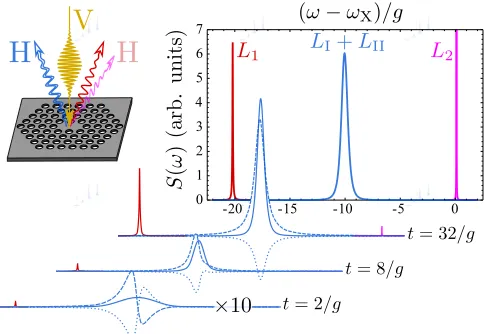
The characteristic spectral profile of the cavity-assisted two-photon emission is shown in Fig. 1, with a central peak that is strongly enhanced at the two-photon reso-nance, corroborating its two-photon character, and sur-rounded by standard (single-photon) de-excitation [10, 11]. The photon-pair peak is spectrally narrow and iso-lated from the other events, that can never be completely avoided, so the source is appealing on practical grounds. The Hamiltonian of the system reads [10]:
H(t) = (ωa−ωL)a†a+
X
i=↑,↓
(ωX−ωL)σi†σi−χσ↑†σ↑σ†↓σ↓
+ X
i=↑,↓
h
gi(a†σi+aσ
†
i) + Ωi(t)(σi+σ
†
i) i
, (1)
where we have included i =↑,↓ the up and spin-down degrees of freedom for the excitonic states σi
(fermions) with common frequency ωX and a the cav-ity field annihilation operator (boson) with frequencyωa.
The cavity mode can have a strong polarization, say lin-early polarized in the horizontal direction for a photonic crystal, a case we shall assume in the following. The biexciton binding energyχallows to bring the biexciton energyωBin resonance with the two-photon energy while detuning all other excitonic emissions from the cavity mode. It is red (blue) shifted if the biexciton is “bound” (“antibound”), giving rise to a positiveχ >0 (negative χ <0) binding energyχ= 2ωX−ωB. Our scheme works with both the bound and antibound biexciton. With-out loss of generality, we assumeχ >0, with the added advantage of being less affected by pure dephasing and coupling to phonons, that we neglect [16]. This bind-ing energy is typically large (χ≈400µeV) as compared
to splittings between excitonic states (≈ 10µeV) [11],
which is ideal for our purpose. We will assume an equal coupling of both excitons to the linearly polarized mode of the cavity,g↑=g↓=g/
√
2, and takegas the unit in the remaining of the text. The Hilbert space of the quan-tum dot is spanned, in its natural basis of circularly po-larised states, by the ground|Gi, spin-up |↑i, spin-down
2
-20 -15 -10 -5 0
0 1 2 3 4 5 6 7
FIG. 1. (color online) Cavity spectra of emission S(t, ω) at the two-photon resonance for different times (unframed) and integrated over all times (framed). They feature the 2P peak atωa≈ −χ/2 (central, blue) and the two 1P peaks atω1 ≈ −χ(left, red) andω2≈0 (right, pink). The 2P peak cannot
be decomposed into two physical processes. Parameters: χ= 20g,κ=g,γ= 5×10⁻⁴g.
|↓i and biexciton |Bi states. In the linearly polarised basis, the excitonic states are |Hi= (|↑i+|↓i)/√2 and |Vi= (|↑i − |↓i)/√2. The dot-cavity joint Hilbert space includes the photonic numbern: |j, ni, wherej= G, V, H and B, withn∈N.
The quantum dot is excited by a laser of amplitude Ωi(t) and frequency ωL, that brings it in the biexciton state through two-photon absorption. This can be re-alised via an appropriate pulse or sequence of pulses. The laser polarization should be taken orthogonal to that of the cavity, Ω↑(t) = −Ω↓(t) = Ω(t)/
√
2, so that the latter is not affected by the excitation process. Coher-ent control of the biexciton has been reported in sev-eral works [13–15] and we will assume the biexciton in an empty cavity,|B,0i, as the initial state following the pulse. The laser frequency should be set to match the two-photon resonance,ωL=ωB/2 =ωX−χ/2. With the previous considerations, the Hamiltonian in the basis of linearly polarized states reads:
H =ωaa†a+ωX(|Hi hH|+|Vi hV|) + (2ωX−χ)|Bi hB| +gha†(|Gi hH|+|Hi hB|) + h.c.i, (2) where it now appears explicitly that the cavity couples only to its corresponding linear polarization (H). Dissipa-tion affects the bare states, i.e., in the spin-up/spin-down basis, yielding a master equation:
∂tρ=i[ρ, H] +
κ
2La(ρ) + γ 2
X
i=↑,↓
h
L|Gihi|+L|iihB|
i
(ρ),
(3) where Lc(ρ) = 2cρc† −c†cρ−ρc†c, with κ the cavity
losses and γ the exciton relaxation rates. Fig. 2 shows
the configuration of levels involved in the biexciton de-excitation, that is truncated self-consistently. The coher-ent coupling (g) is represcoher-ented by bidirectional (green) arrows, spontaneous decay (γ) by straight (gray) arrows and cavity decay (κ) by curly (blue) arrows, each of them linking in a reversible (g) or irreversible (γ, κ) way the different levels.
A one-photon resonance (1PR) is realized when the cavity is set at resonance with one of the excitonic tran-sitions: |B,0i → |H,0i with frequencyω1 ≈ωB−ωX or |H,0i → |G,0i with frequencyω2 ≈ ωX. The resonant single-photon emission is then enhanced into the cavity mode according to the conventional scenario [17], with a Purcell decay rateγP= 4g2/κ. Atwo-photon resonance (2PR) is realized when the transition |B,0i → |G,0i matches energetically the emission of two cavity pho-tons [10]:
ωa≈ωX−χ/2 with χ≫g , κ , γ . (4)
This process also benefits from Purcell enhancement. In fact, if the decay ratesγ and κ are small enough, two-photon Rabi oscillations between states|B,0iand|G,2i are even realized, with a characteristic frequencyg2P ≈ 4g2/(√2χ) [10]. Note that in Eq. (4), we have neglected the small Stark shifts ∼ g2P, which should be taken into account to achieve maximum Rabi amplitude. In this text, to remain within experimentally achievable configurations, we consider systems in strong coupling, g ' κ, but not so much that the two-photon oscil-lations actually take place, that is, we remain within the 2P weakly coupled regime, 4g2P ≪ κ. The one-photon Rabi oscillations (e.g.,|B,0i ↔ |H,1i) still take place at the frequency g but, as they are largely de-tuned, the coupling strength effectively reduces tog1P≈ g/p
1 + [χ/(γ+κ)]2≈gκ/χ[18].
To characterize and analyze the main output of the sys-tem, shown in Fig. 1, we study the time-resolved power spectrum S(t, ω) ∝ ℜRt
0dT
Rt−T
0 dτ e
iωτha†(T)a(T +
τ)i[19] that we compute as:
S(t, ω) = 1 π
X
α∈{1,2,I,II,...}
Lα(γα/2)−Kα(ω−ωα)
(γα/2)2+ (ω−ωα)2
, (5)
where we emphasised in the sum four dominant processes labelled 1, 2, I and II (results below include all processes). Eachαcorresponds to a transition in the system, char-acterised by its frequency (ωα) and broadening (γα) on
the one hand, which allow us to identify its microscopic origin, as discussed below, and its intensity Lα and
in-terferences with other transitions Kα [18] on the other
hand. The time dependent spectra of emission can be measured experimentally with a streak camera [20].
[image:3.612.57.299.51.218.2]
-~~
~~
(a) (b)
real processes effective processes
Ene
rgy
FIG. 2. (color online) Level scheme of a quantum dot cou-pled to a cavity mode with linear polarization H at the 2PR. In (a), the microscopic configuration and in (b) the effective processes taking place in the de-excitation of the biexciton. Those involving the cavity are, on the one hand, through the emission of two real and distinguishable photons ω1 and ω2
(in dotted red and pink), and, on the other hand, through the simultaneous emission of one two-photon state atωa (in dashed blue), labelledωI,II.
four excitonic lowering operators). With the biexciton state in an empty cavity, |B,0i, as the initial condition, we identify three de-excitation mechanisms of the system. We now describe them in turns.
i) The first decay route is a cascade of two spontaneous emissions, from |Bi to |Hi(or |Vi) in a first time, and then from|Hi(or|Vi) to|Giin a second time, as shown in straight (gray) lines in Fig. 2(a). This decay into leaky modes is at the excitonic energies,ω1,ω2, and is a direct process with a straightforward microscopic origin as a transition between two states. Each process happens at the rateγ, so that, as far as the biexciton is concerned, its total rate of de-excitation through this channel is 2γ. The effect of this channel is to reduce the efficiency of de-excitation through the cavity mode, which is the one of interest. This can be kept small by choosing a system with a smallγ.
ii) The second decay route is another cascade of one-photon emissions, but now through the cavity mode, namely from |Bi to |Gi passing by |Hi. It is shown in dotted lines in Fig. 2(b). It effectively amounts to two consecutive photons into the cavity mode at the ex-citonic energies ω1 and ω2, also shown (with the same color code) in Fig. 2(b), but the microscopic origin is now more complex, as it involves virtual intermediate states. The first photon (1) is emitted through the
pro-cess |B,0i −−−→ ||H,1i H,0i, via the off-resonant (“virtual”) state|H,1iand the second (2), similarly through the
pro-cess |H,0i −−−→ ||G,1i G,0i. These transitions occur at the Purcell rate κ1P ≈ 4g1P2 /κ ≈ T1P2 κ, where T1P = 2g/χ is the effective mixing parameter between states|B,0i– |H,1i and |H,0i–|G,1i. The positions and broadenings are more precisely given byω1≈ −χ−2g2/χ,ω2≈2g2/χ andγ1≈3γ, γ2≈γ.
iii) Finally, the central event in our proposal is formed
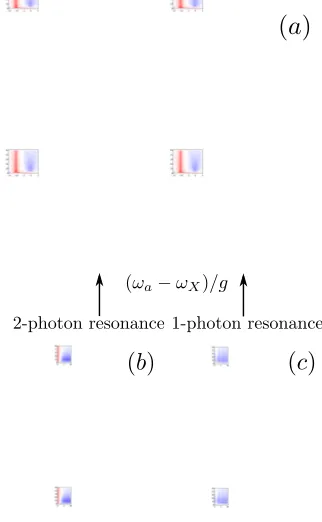
FIG. 3. (color online) (a) Mandel parameterQ(t, τ = 0) as a function of the cavity frequency ωa, for a set of typical parameters (χ= 20g,κ= 0.5gandγ= 5×10⁻³g). Q(t, τ) is shown below at the two relevant resonances, two-photon (a) and one-photon (b). There is a change in the statistics from antibunching < 0 (1PR), colored in blue, to bunching > 0 (2PR), colored in red.
by the third channel of de-excitation of the biexciton, namely, the emission into the cavity mode of two simul-taneous and indistinguishable photons with a frequency very close to that of the cavity ωI ≈ ωII ≈ ωa. This
[image:4.612.54.301.51.162.2] [image:4.612.362.523.69.330.2]4
0.1 0.5 1 5 10 50 100 0.05
0.10 0.50 1.00 5.00 10.00
5 10 50 100 500 1000 0.02
0.05 0.10 0.20 0.50 1.00 2.00
I
nt
ens
ity
Int
ens
ity
(a)
(b)
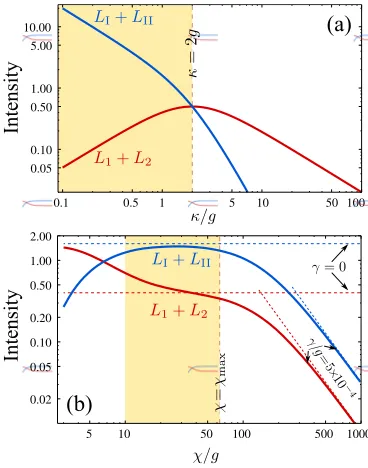
FIG. 4. (color online) (a) IntensityLI+LIIof emission in the
2P channel (blue) andL1+L2 in the two 1P channels (red)
as a function ofκin the ideal case of nonradiative emission, γ= 0 andχ→ ∞. The shaded (yellow) areaκ <2gshows the
region where the 2P emission dominates. (b) Same as above forκ =g as a function ofχ, that must be large enough so that 1P are suppressed and small enough to maintain a high cavity emission efficiency in the realistic case of nonzeroγ.
probability of (two-photon) detection. This decomposi-tion of the two-photon (central) peak is shown in Fig. 1 in the time-dependent spectra, with the process I shown in a dotted line and II in dashed line. They sum to the physical (observable) peak, in solid line. Both peaks grow together in time and develop an asymmetry, one (I) being completely positive, the other (II) completely negative. None, not even the fully positive peak, can be observed in isolation. In contrast, the single-photon peaks on both sides (red and pink), are formed by sin-gle, isolated transitions, showing their real (as opposed to virtual) nature. The two-photon emission is enhanced by the Purcell rate κ2P ≈ 4g2P2 /(2κ) ≈ T2P2 2κ, where T2P = g2P/κ is the effective mixing parameter between states|B,0i-|G,2i. We use 2κbecause this is the decay rate of the intermediate state |G,2i. One transition ap-pears, more precisely, atωI≈ −χ/2 + 2g2/χwith broad-eningγI≈κ+2γ(this is the sum of the decay that initial and final states suffer,|B,0iand|G,1i). The other tran-sition (II) stems from the direct process |G,1i → |G,0i. This transition appears at ωII ≈ −χ/2 −2g2/χ with broadeningγII≈κ.
Another proof of the two-photon character is given by the time-dependent spectrum, Fig. 1. Whereas the single-photon events grow in succession—first the L1 peak, that populates the state |Hi, which subsequently decays to|Gi, forming theL2peak—the two photon peak
arises from the joint and simultaneous contribution of the I and II processes. In fact, one can show that at the 2PR, LI +LII ≈ 2ha†2a2i, linking directly the in-tensity of the peak with the two-photon emission prob-ability. This can be brought to the experimental test by resolving the photon statistics in time, g(2)(t, τ) = ha†(t)a†(t +τ)a(t +τ)a(t)i/[n
a(t)na(t +τ)]. We use
the MandelQ-parameter,Q(t, τ) =na(t)(g(2)(t, τ)−1),
that changes sign (negative for anticorrelations). This is shown in Fig. 3. The main panel, (a), shows a strong and sharp bunching of the emission when the cavity hits the two-photon resonance (meaning that photons come to-gether, and in our case, in pairs), while it is antibunched in other cases (photons coming separately). What is re-markable of the two photon emission is that it is consis-tently bunched at all times: while the system can emit at any time, when it does, it emits the two photons together. In contrast, the 1PR emission which is antibunched as expected when the process is isolated, also has the pos-sibility to be bunched by fortuitous joint emission of two photons. This is the case when ωa = ω2, the cavity is then in resonance with the lower transition, that can start only as a successor of the upper transition resulting in high probability for two photons detection, but only at very early times, since one photon is a precursor of the other one in a cascade of two otherwise distinguishable events. The proof is complete with the autocorrelation timeτ, shown in panels (b) and (c), further demonstrat-ing that in the 2PR emission, the two photons arrive at zero time delay (the emission being less likely again at nonzero delay).
Now that we have demonstrated from various points of view the two-photon character of the central peak, we aim to maximise it as compared to all other de-excitation channels. There are three key parameters to enhance the 2P emission, κ, γ and χ. The case γ = 0 and χ → ∞ is the ideal configuration, where all the emission goes through the cavity:
Ia= Z ∞
0 h
a†ai(t)dt= 2/κ , (6)
which is redistributed between the two possible decay paths as:
L1+L2≈ κ1P
κ1P+κ2PIa≈ 2
γP+κ, (7a)
LI+LII≈ κ2P κ1P+κ2P
Ia ≈
2γP/κ γP+κ
. (7b)
[image:5.612.83.267.50.284.2]When γ is nonzero, the situation of experimental in-terest, but still is the smallest parameter (≪κ, g ≪χ), the channel of decay it opens leads to:
Ia = Z ∞
0
na(t)dt=
γP(γP+κ)
γχ2 , (8)
which is now redistributed between the two cavity decay paths as an increasing function ofχ−2:
L1+L2≈ κ1P
κ1P+κ2P+ 2γIa≈ γPκ
γχ2, (9a)
LI+LII≈
κ2P κ1P+κ2P+ 2γ
Ia ≈
γ2 P
γχ2. (9b)
This nonzeroγ case is shown in Fig. 4(b), where the ideal situation can be recovered in a region ofχbounded by above by:
χmax= min(2g
p
κ/(2γ),4g2/p2κγ), (10)
that follows from 2γ= min(κ1P, κ2P). Above χmax, the 2P emission still dominates over 1P emission but effi-ciency is spoiled, according to Eqs. (9), that are shown in dashed tilted lines.
In conclusion, we have presented a scheme where the biexciton is in two-photon resonance with a microcavity mode, as an efficient two-photon source, both in terms of the purity of the two-photon state and of its emission efficiency. The timescale for two-photon emission, that limits the repetition rate, is of the order of κ−2P1. The quantum character of the two-photon emission is demon-strated theoretically by a detailed analysis of all the pro-cesses involved in the biexciton de-excitation, which also allows us to find analytically the optimum conditions for its realization. We have shown that the two-photons are emitted simultaneously with no delay in the autocorre-lation time. Experimentally, the ultimate proof of indis-tinguishability can be obtained by directing the central peak to a beam-splitter, which half of the time will sepa-rate the photon pair into two ports that can then be fed in an Hong-Ou-Mandel interferometer.
We thank F. Troiani, D. Sanvitto, A. Laucht and J. J. Finley for discussions. We acknowledge support from the Emmy Noether project HA 5593/1-1 (DFG), the Marie Curie IEF ‘SQOD’, the Spanish MICINN (MAT2008-01555 and CSD2006-00019-QOIT) and CAM (S-2009/ESP-1503). A.G.-T. thanks the FPU program (AP2008-00101) from the Spanish Ministry of Education.
[1] T. Nagata, R. Okamoto, J. L. O’Brien, K. Sasaki, and S. Takeuchi, Science316, 726 (2007)
[2] C. Simon, H. de Riedmatten, M. Afzelius, N. Sangouard, H. Zbinden, and N. Gisin, Phys. Rev. Lett.98, 190503 (2007)
[3] J. I. Cirac, P. Zoller, H. J. Kimble, and H. Mabuchi, Phys. Rev. Lett.78, 3221 (1997)
[4] L.-M. Duan, M. D. Lukin, J. I. Cirac, and P. Zoller, Nature414, 413 (2001)
[5] P. Kok, W. J. Munro, K. Nemoto, T. C. Ralph, J. P. Dowling, and G. J. Milburn, Rev. Mod. Phys.79, 135 (2007)
[6] B. P. Lanyon, T. J. Weinhold, N. K. Langford, J. L. O’Brien, K. J. Resch, A. Gilchrist, and A. G. White, Phys. Rev. Lett.100, 060504 (2008)
[7] A. Aspect, P. Grangier, and G. Roger, Phys. Rev. Lett. 49, 91 (1982)
[8] D. Collins, N. Gisin, N. Linden, S. Massar, and S. Popescu, Phys. Rev. Lett.88, 040404 (2002)
[9] J. K. Thompson, J. Simon, H. Loh, and V. Vuletic, Science313, 74 (2006)
[10] E. del Valle, S. Zippilli, F. P. Laussy, A. Gonzalez-Tudela, G. Morigi, and C. Tejedor, Phys. Rev. B 81, 035302 (2010)
[11] Y. Ota, S. Iwamoto, N. Kumagai, and Y. Arakawa, arXiv:1107.0372 (2011)
[12] The Authors of Ref. [11] also realize this limitation and speculate on the scheme that we analyze here in de-tails.Stop
[13] A. Dousse, J. Suffczynski, A. Beveratos, O. Krebs, A. Lemaitre, I. Sagnes, J. Bloch, P. Voisin, and P. Senel-lart, Nature466, 217 (2010)
[14] S. Stufler, P. Machnikowski, P. Ester, M. Bichler, V. M. Axt, T. Kuhn, and A. Zrenner, Phys. Rev. B73, 125304 (2006)
[15] T. Flissikowski, A. Betke, I. A. Akimov, and F. Hen-neberger, Phys. Rev. Lett.92, 227401 (2004)
[16] P. Machnikowski, Phys. Rev. B78, 195320 (2008) [17] J.-M. G´erard, B. Sermage, B. Gayral, B. Legrand,
E. Costard, and V. Thierry-Mieg, Phys. Rev. Lett.81, 1110 (1998)
[18] F. P. Laussy, E. del Valle, and C. Tejedor, Phys. Rev. B 79, 235325 (2009)
[19] J. Eberly and K. W´odkiewicz, J. Opt. Soc. Am.67, 1252 (1977)