Five principles for the practice of knowledge exchange in
environmental management
M.S. Reed
a,*, L.C. Stringer
b, I. Fazey
c, A.C. Evely
d, J.H.J. Kruijsen
eaKnowledge Exchange Research Centre of Excellence, Birmingham School of the Built Environment, Birmingham City University, Millennium Point,
Curzon Street, Birmingham B4 7XG, United Kingdom
bSustainability Research Institute, School of Earth and Environment, University of Leeds, Leeds LS2 9JT, United Kingdom cSchool of the Environment, University of Dundee, Perth Road, Dundee DD1 4HN, United Kingdom
dProject MAYA CIC, 54 Tetherdown, London N101NG, United Kingdom
eCentre for Understanding Sustainable Practice, Robert Gordon University, Schoolhill, Aberdeen AB10 7GJ, United Kingdom
a r t i c l e i n f o
Article history:
Received 24 January 2014 Received in revised form 11 July 2014
Accepted 21 July 2014
Available online 6 September 2014
Keywords:
Knowledge exchange Knowledge management Knowledge translation Knowledge transfer Stakeholder participation Stakeholder engagement Research
Environmental management
a b s t r a c t
This paper outlinesfive principles for effective practice of knowledge exchange, which when applied, have the potential to significantly enhance the impact of environmental management research, policy and practice. The paper is based on an empirical analysis of interviews with 32 researchers and stake-holders across 13 environmental management research projects, each of which included elements of knowledge co-creation and sharing in their design. The projects focused on a range of upland and catchment management issues across the UK, and included Research Council, Government and NGO funded projects. Preliminaryfindings were discussed with knowledge exchange professionals and aca-demic experts to ensure the emerging principles were as broadly applicable as possible across multiple disciplines. The principles suggest that: knowledge exchange needs to be designed into research; the needs of likely research users and other stakeholders should be systematically represented in the research where possible; and long-term relationships must be built on trust and two-way dialogue between researchers and stakeholders in order to ensure effective co-generation of new knowledge. We found that the delivery of tangible benefits early on in the research process helps to ensure continued motivation and engagement of likely research users. Knowledge exchange is aflexible process that must be monitored, reflected on and continuously refined, and where possible, steps should be taken to ensure a legacy of ongoing knowledge exchange beyond initial research funding. The principles have been used to inform the design of knowledge exchange and stakeholder engagement guidelines for two interna-tional research programmes. They are able to assist researchers, decision-makers and other stakeholders working in contrasting environmental management settings to work together to co-produce new knowledge, and more effectively share and apply existing knowledge to manage environmental change. ©2014 The Authors. Published by Elsevier Ltd. This is an open access article under the CC BY-NC-ND license (http://creativecommons.org/licenses/by-nc-nd/3.0/).
1. Introduction
The last twenty two years since the Earth Summit in Rio in 1992 have seen a proliferation in environmental management research that can be used to guide policy and practice (Fazey et al., 2005; Felton et al., 2009; Lawler et al., 2006). However, simply creating and accumulating more knowledge does not necessarily translate into better practice (Fazey et al., 2014). The extent to which knowledge generated through research is likely to inform policy and practice depends on its relevance, legitimacy and accessibility
(Leviton and Hughes, 1981; Pullin and Knight, 2001; Pullin et al., 2004; Contandriopoulos et al., 2010; Stringer and Dougill, 2013). These aspects in turn depend on how knowledge is produced, shared with and between those who might use it, translated and/or transformed as it is shared, and the social context in which people learn about new knowledge (Reed et al., 2010, 2013). In this paper we refer collectively to such processes as ‘knowledge exchange’
(KE). KE typically takes place between three, usually highly het-erogeneous, groups (knowledge producers, intermediaries and those who use the knowledge;Contandriopoulos et al., 2010), and may lead to impacts on policy and practice that may be conceptual (raising awareness and changing beliefs or thinking), instrumental (direct changes to policy or practice) or symbolic (justifying exist-ing policy or practice) (Rudd, 2011). Enablexist-ing more effective KE *Corresponding author.
E-mail address:[email protected](M.S. Reed).
Contents lists available atScienceDirect
Journal of Environmental Management
j o u r n a l h o m e p a g e : w w w . e l s e v ie r . c o m / l o c a t e / j e n v m a n
http://dx.doi.org/10.1016/j.jenvman.2014.07.021
between research producers and users has the potential to signif-icantly enhance the impact of environmental management research, policy and practice.
This is of crucial importance to the generation of evidence-informed policy and practice relating to environmental manage-ment (Rudd, 2011). Evidence-based policy is often considered in simplistic ways given its positivist assumptions and reliance on a technical approach to policy-making (Stanhope and Dunn, 2011; Geyer, 2012), and lacks the sophistication necessary for complex policy areas like environmental management. However, the rapid rise in popularity of the evidence-based approach has put pressure on policy-makers to search for evidence far and wide, sometimes transferring policies and their associated evidence bases across continents (Legrand, 2012). The growing importance attached to research by policy-makers and practitioners in environmental management requires an increasingly close relationship between researchers and those who are likely to use theirfindings. However, those who wish to use research, often express frustration at the barriers they face, for example poor communication and dissemi-nation of research, lack of technical expertise to interpret and apply research findings to their decision-making context, and the mismatch in timescales between research and policy cycles (e.g. Hyder et al., 2011; Fazey et al., 2013).
Although there is a growing body of experience emerging in KE for environmental management, there has been very little consol-idation of what has already been learnt and what needs to be done to improve the practice of KE. Consequently, KE is often conducted on an ad-hoc basis, based on ‘what seems to work’ with little theoretical, methodological, or empirical grounding, and without any systematic evaluation. Although there is growing interest in tracing the pathways through which research influences decisions in policy and practice (Holmes and Clark, 2008), results are not reported in a way that can assist the wider community to learn how to build better KE processes in future (Fazey et al., 2014). Thus, despite considerable conceptual understanding of the kinds of KE processes that work well, in environmental management there is still a distinct lack of both understanding of KE pathways and limited empirically founded guidance available for researchers who wish to facilitate KE to achieve beneficial impacts from their work. This paper addresses this gap by eliciting and synthesising the expertise of practitioners to identify key principles for the practice of KE in diverse multi-stakeholder research projects related to environmental management.
This paper systematically analyses experiences of KE activities from the perspectives of 32 researchers and stakeholders involved in 13 environmental research projects working on catchment management and uplands in the UK. By focussing on projects working in similar contexts, it was possible to ensure that stake-holders and barriers to KE were likely to be broadly similar between projects. This enabled the research to distinguish the effects of different approaches to KE, rather than focusing on the effects of doing KE in different contexts. Catchment management and up-lands were chosen as a research context that typically requires interdisciplinary and transdisciplinary working, spanning a variety of different knowledges and stakeholders, where there was a range of projects currently or recently engaged in KE. Our research identifies the factors and conditions that enhance or inhibit KE and identifies how KE can be designed and implemented more effec-tively to support environmental management. The findings from the research provide guiding principles for KE in environmental management, which are of value to researchers, policy-makers, practitioners and other stakeholders working in environmental management. They have been used to develop KE guidelines for the UK's largest funder of environmental research, the Living with Environmental Change partnership (LWEC, 2012). They have also
directly informed the development of the EU Biodiversa pro-gramme's Stakeholder Engagement Toolkit (BiodivERsA, 2014). The paperfirst outlines the research design and methodology. The re-sults then explain the principles, while the discussion draws out the relevance of the principles for KE at two scales: in single projects and multi-projects (programmes).
2. Methods
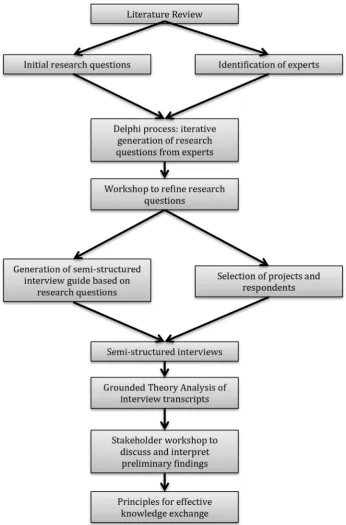
Fig. 1 provides a schematic overview of the methodology employed. First, peer-reviewed and grey literature was critically reviewed (Evely et al., 2012). From this, a set of initial questions was developed and key experts were identified for inclusion in an initial Delphi structured process (see Linstone and Turoff, 1975). The Delphi process culminated in an expert workshop with twenty KE specialists representing a range of disciplines, for example educa-tion, linguistics, communicaeduca-tion, ecology, human geography and international development (for detailed methods, seeFazey et al., 2013). This aimed to gain a deeper theoretical understanding of KE and to refine the research questions to ensure they targeted key knowledge gaps.
Thefinalised research questions were then turned into a semi-structured interview guide (see supplementary material), and one-hour long interviews were conducted with 32 respondents (including 8 principal investigators, 11 project managers, 4 re-searchers, 8 non-academic stakeholders and 1 facilitator) from across the 14 upland and catchment management research projects selected for the research (Table S1, supplementary material). Pro-jects were selected to: represent a range of geographical contexts from across the UK; investigate a range of issues linked to catchment management and/or uplands; include those that explicitly incor-porated processes to undertake KE; and represent research funded by a range of bodies (we contrasted projects funded by an inter-disciplinary programme designed to feed into policy and practice1 with projects funded by other research funders, Government and NGOs). These were supplemented with two key informant in-terviews with employees of UK research funding bodies with sig-nificant experience in facilitating and managing KE within the context of large-scale research programmes. Data were analysed using thematic analysis techniques based on a Grounded Theory Analysis approach (seeCharmaz, 2006; Braun and Clarke, 2006).
Findings were then presented for feedback in a workshop comprising self-selected members of the original group of KE ex-perts (a total offive out of the original twenty who attended the
first workshop described above), supplemented by members of the research funder, policy and practitioner community interested in KE (making a group of 25 people who attended this second work-shop). The workshop included discussion about how thefindings from the analysis could be generalised across different disciplines and sectors, and made more relevant for the design of KE at research programme level.
3. Results
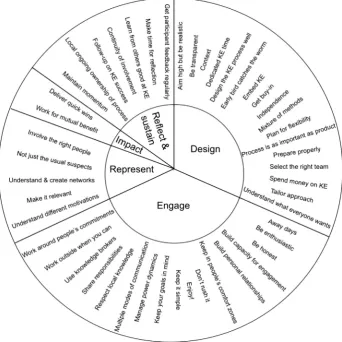
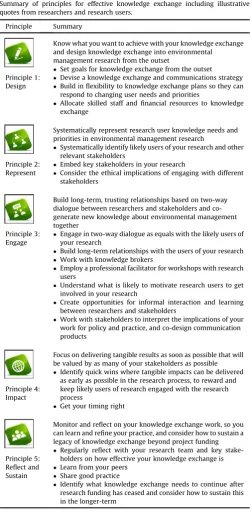
Approximately 50 themes were identified and sorted into broader themes as part of this analysis, to reach the smallest possible number of distinct themes, which formed the basis for each of the principles (see Fig. 2 and Table S2, supplementary material). Thefive principles are summarised inTable 1. There is some overlap between the principles and they are thus deliberately not presented in a step-wise manner, even though some principles underpin the application of others.
3.1. Principle 1: design
Interviewees argued that successful KE should be carefully designed as part of the research process, with inputs from likely research users and other stakeholders,2and there should be clarity
about the intended outcomes and any assumptions about why particular activities would deliver those outcomes. This was considered essential to foster a sense of trust between all those involved, and create a sense of shared ownership over research questions and subsequentfindings.
[image:3.595.129.476.64.590.2]More specifically, there were four key aspects to effective design. First, KE should be incorporated into research projects from the outset to ensure adequate tailoring of the design to project goals and the needs of likely research users. Second, as many opportu-nities as possible for stakeholder engagement throughout the research cycle needed to be built into the design, from proposal development and research planning, to data collection, analysis Fig. 1.Schematic diagram of the research methodology.
2 Stakeholders are defined as anyone who is affected by or can affect the
and/or interpretation of results (e.g. prioritising, ranking, evalu-atingfindings), and the evaluation and dissemination of project outcomes. Time was therefore needed to build a project team capable of managing KE or to work with a KE professional. Third, building flexibility into the design was considered essential, allowing project goals to adapt to changing stakeholder needs and priorities (for example, by leaving flexibility in project design where certain activities can be specified once the project has started). Fourth, interviewees indicated that it was important to be clear and realistic about the likely impacts of KE to ensure that expectations can be managed appropriately. This included a need for openness with stakeholders about what the project hoped to achieve, how, when stakeholders could engage with the research, and how they may benefit from the results.
Interviewees further suggested that when tailoring KE activities to the needs of different groups, it is useful to consider the different factors that motivate people to engage with the research process. Common factors cited included: accessing future funding and new business opportunities; developing new solutions to old problems; increasing personal impact/influence through collaboration with re-searchers; and intrinsic motivations, for example to“make the world a better place”or a desire to learn about the issues being researched. Several interviewees had explicitly developed KE strategies to help plan and effectively manage KE activities across their research projects. Typical elements of these strategies included: i) identi-fying KE mechanisms that could be used to achieve specific out-comes associated with each of the project's KE objectives
(discussed above); ii) identifying ways of determining when these outcomes are achieved (e.g. using indicators); iii) ensuring KE ac-tivities are appropriately resourced and integrated within project planning and management; iv) including some form of stakeholder mapping and/or analysis (see Principle 2); and v) identifying communication modes/channels and approaches that are appro-priate for different types of stakeholder.
3.2. Principle 2: represent
Research projects need to adequately represent the diversity of stakeholders involved in the research. These should be identified systematically, as early as possible in the research process, ideally prior to the submission of funding proposals, so that stakeholders can help design both the research and the implementation of KE activities.
[image:4.595.122.465.69.412.2]findings widely; and/or iii) are typically marginalised/excluded from decision-making processes.
In some projects it was necessary to actively ensure personal/ organisational agendas were made explicit when stakeholders engaged in the research process and to actively manage difficult individuals. Using structured stakeholder analysis techniques, some projects also identified potentially conflicting stakeholders and consequently designed engagement to encourage parties to work more constructively together. Those projects that did not do this indicated that greater effort to address any potential tensions would have been valuable.
Compensating stakeholders for their time facilitated engage-ment in some contexts, either through monetary or other means (e.g. providing food and drink, help with local projects or
demonstrating how their involvement would help meet their per-sonal or organisational goals). However, ethical concerns were raised in paying likely research users for their involvement. Engagement with stakeholders during the research process may lead to other ethical considerations too, linked e.g. to intellectual property rights, recording and attribution of comments, access to preliminaryfindings prior to publication in peer-reviewed journals and the creation of unrealistic expectations. These kinds of con-cerns need to be discussed openly.
3.3. Principle 3: engage
Respondents emphasised the need for KE processes to create a safe space in which those involved can effectively listen to each other, share knowledge and skills, explore new ideas, learn, adapt and apply the knowledge they gain. For KE to achieve sustained, long-term impacts, one respondent argued that“a culture of KE”
must be promoted, where stakeholders are valued, two-way KE is promoted and projects work to a shared purpose with stake-holders. This was re-iterated by others.
Understanding the context in which the project operates was considered vital e.g. understanding the local traditions and culture of an area. To achieve this, it was suggested thatfield or laboratory visits early on in the process may enable researchers to understand the contexts in which research users work, and vice versa, and develop trust. It was also suggested that where possible, projects build on existing structures and processes run by those involved in KE pro-cesses, especially where they are known to be working effectively.
Several projects had benefited from being embedded within research programmes that offered formal opportunities for re-searchers and stakeholders to work more closely together e.g. via work shadowing, placements and fellowships. However, re-spondents also argued that creating more informal opportunities for researchers and different stakeholders to connect with one another around project meetings may be equally important e.g. providing sufficiently long breaks, designing activities to get different people working together in small groups, or opportunities to talken routeto thefield.
Many researchers and users of research found professional facili-tation important in enabling dialogue, especially where there was conflict or controversy. Similarly, interviewees emphasised the need to identify and engage effective knowledge brokers and in-termediaries as early as possible in the research process. Effective knowledge brokers were typically well-known and trusted by many different groups with an interest in the project. Some projects created official roles for such individuals in the research process e.g. on advisory panels or involving them in hosting or co-designing events. Finally, it was suggested that working with stakeholders to identify and articulate the implications of research for policy and practice may help researchers target their communication effec-tively and enhance the probability that the target audience inter-preted the research findings appropriately. Co-designing communication materials with stakeholders increased the likeli-hood that others engaged with the material, and the process of co-developing materials often facilitated learning, among stakeholders (about the research) and researchers (about communicating more effectively with particular groups). Encouraging research users and stakeholders to disseminate these communication materials themselves may further increase their reach, often well beyond the lifespan of the project.
3.4. Principle 4: generate impact
[image:5.595.43.296.74.588.2]For KE to be perceived as effective by stakeholders, it needs to deliver tangible outputs that are of real value to as many Table 1
Summary of principles for effective knowledge exchange including illustrative quotes from researchers and research users.
Principle Summary
Principle 1: Design
Know what you want to achieve with your knowledge exchange and design knowledge exchange into environmental management research from the outset
Set goals for knowledge exchange from the outset Devise a knowledge exchange and communications strategy Build inflexibility to knowledge exchange plans so they can
respond to changing user needs and priorities
Allocate skilled staff andfinancial resources to knowledge exchange
Principle 2: Represent
Systematically represent research user knowledge needs and priorities in environmental management research
Systematically identify likely users of your research and other relevant stakeholders
Embed key stakeholders in your research
Consider the ethical implications of engaging with different stakeholders
Principle 3: Engage
Build long-term, trusting relationships based on two-way dialogue between researchers and stakeholders and co-generate new knowledge about environmental management together
Engage in two-way dialogue as equals with the likely users of your research
Build long-term relationships with the users of your research Work with knowledge brokers
Employ a professional facilitator for workshops with research users
Understand what is likely to motivate research users to get involved in your research
Create opportunities for informal interaction and learning between researchers and stakeholders
Work with stakeholders to interpret the implications of your work for policy and practice, and co-design communication products
Principle 4: Impact
Focus on delivering tangible results as soon as possible that will be valued by as many of your stakeholders as possible Identify quick wins where tangible impacts can be delivered
as early as possible in the research process, to reward and keep likely users of research engaged with the research process
Get your timing right
Principle 5: Reflect and Sustain
Monitor and reflect on your knowledge exchange work, so you can learn and refine your practice, and consider how to sustain a legacy of knowledge exchange beyond project funding Regularly reflect with your research team and key
stake-holders on how effective your knowledge exchange is Learn from your peers
Share good practice
stakeholders as possible. Some interviewees suggested that deliv-ering a number of useful outcomes as soon as possible (but without compromising the rigour and integrity of the research) may help gain the respect and ongoing support of stakeholders. Suggested outputs included: synthesis reports; briefings; and providing ac-cess to useful data, models and expertise that stakeholders did not have prior to the research. Despite the preliminary nature of many of these outputs and the lesser value they had for researchers at this point of the research cycle, for research users who did not have access to research behind journal pay-walls, simply seeing the collective knowledge of the research team could be valuable, and in some cases transformational.
Several respondents emphasised the need for iterative engage-ment throughout the research process, taking time to engage regularly with research users to ensure the planned research remained relevant. This also helped identify new opportunities that could later generate impact. However, interviewees warned that sufficient funding andflexibility needed to be incorporated into the research design to enable effective responses to these opportunities (Principle 1).
Some research users (especially policy-makers and regulators) may need to receive information and/or advice from ongoing research to coincide with key points in decision-making e.g. coin-ciding with policy/legislation review cycles. Interviewees suggested that it may be useful for researchers to plan in advance how a research project can make different contributions to this process on timescales of (i) days/weeks, (ii) months and (iii) years. Although it was difficult to plan for many short-term needs, they argued that it was sometimes possible to update, adapt and re-frame existing outputs, making them relevant to current needs. However, some interviewees emphasised the need to carefully consider how risk and uncertainty was communicated to decision-makers, especially when working with preliminaryfindings.
3.5. Principle 5: reflect and sustain
Many comments were made about the need for ongoing reflection and learning as part of KE, and planning so that KE ac-tivities could be sustained beyond the lifetime of the project.
Interviewees spoke about the need to build time into KE activ-ities for participants to reflect on the effectiveness of the KE process and its outcomes. Several challenges were identified, given the many different aspects of KE that could be evaluated, the significant time-lag that often occurs between a KE process and eventual outcomes (e.g. formulation of government policy), and the non-linear relationships between KE process, impacts and outcomes that may be affected by many other political, social, cultural and institutional factors. However, interviewees who regularly evalu-ated their KE activities found that this helped their projects identify and adapt to shortcomings in the design of KE or the research itself (usually in terms of its relevance for likely users), and enabled them to harness new opportunities for generating impacts as they arose (Principle 4). By building in opportunities for regular feedback about KE activities, it facilitates re-assessment of who holds a stake or is likely to use the research, and can ensure stakeholder repre-sentation remains relevant throughout the research cycle (Principle 2).
Some interviewees found it beneficial to involve stakeholders who had engaged with the research in the evaluation of their KE activities. The evaluation process provided opportunities for stakeholders to work together to share perspectives, increase ownership of and responsibility for KE, and enabled participants to work together to refine KE practice. However, others were more critical of what they perceived as the increasingly burdensome reporting requirements of funders, who want to evaluate KE
activities regularly throughout the research. It may therefore be necessary to balance the benefits of working with stakeholders to evaluate KE against the additional work this would create.
Finally, interviewees spoke about the value that many stake-holders derived from research, long after projects had been completed, and stressed the need for on-going communication and interpretation offindings. Such‘legacy arrangements’may support continued engagement between researchers and research users, to extract and augment value from the previous research through interpretation activities and supplementary analysis. In some cases, this was seen as the role of funding programmes, rather than shorter-term projects. However, some believed that the extent to which long-term KE might be required beyond the life of a project should be considered at the start. For example, if a project planned to develop a network that would have the potential to continue operating beyond the time-frame of the initial project, it would be necessary to forge collaborations with organisations who shared this goal, but who could also fund or administer such a network long after the project has ended.
4. Discussion
In this section, we situate the principles that emerged from our empirical analysis of KE in environmental management projects within evidence from a broad range of theories and practices. In doing this, we demonstrate the wider applicability of the principles, for and beyond environmental management.
Recent years have seen understanding of knowledge shift from
“knowledge as a thing” (which can be given and received) towards“knowledge as a process”(which evolves over time and is context-specific) (Evely et al., 2011;Phillipson et al., 2012). This evolution emphasises approaches to KE that explicitly recognise knowledge as a complex system in its own right, where knowledge is seen as context-dependent and strongly related to an individual's perceptions and worldview (Evely et al., 2011). These theoretical models view KE as an inherently social process. They highlight feedback learning loops and non-linearity, along with thresholds, where new knowledge may be particularly important in effecting change and informing decisions about the natural environment (Evely et al., 2011). This means that it becomes possible to plan and design for KE (Principle 1) identify stakeholders (Principle 2), and plan activities in relation to stakeholder needs to deliver tangible impacts (e.g. with reference to key points in the policy cycle; Principle 4).
makers and practitioners and their social context, than it is upon the quality of the research itself (Principle 3). These relationships and social context mediate the transformation of information into knowledge, and whether and how it is subsequently shared with others, and ultimately reaches decision-makers who can act upon it. This is borne out by empirical analyses of KE interventions in other contexts (e.g.Beyer and Trice, 1982; Huberman, 1987; Shulha and Cousins, 1997; Landry et al., 2001; Carpenter et al., 2003; Kramer and Wells, 2005), including lobbying (e.g.Hansen, 1991; Heinz et al., 1993; Heaney, 2006) and individual-level theories of human behaviour (e.g.Albaek, 1995; Bourdieu, 1980, 1994 cited in Contandriopoulos et al., 2010). This emphasises the importance of carefully identifying and selecting likely users and other stake-holders for engagement with research (Principle 2), and the importance of interpersonal trust in facilitating effective two-way communication between researchers and those likely to use their
findings (Principle 3).
A critical approach to KE must therefore acknowledge the social nature of knowledge. For example, evidence may become distorted as it is passed from person to person through social networks (Owen et al., 2009), and may even be misappropriated to achieve the goals of special interest groups (Ladle et al., 2005). Robust evidence may be overlooked whilst moreflimsyfindings may gain traction with decision-makers who do not always have the time or expertise to critically interrogate its theoretical, methodological or empirical basis (Pullin et al., 2004). This is because, when forced to make de-cisions over short deadlines, evidence is often judged as trustworthy on the basis of its source (Hurley, 2006), for example the quality of the journal it is published in, or the credentials of the person who communicates it. It is also important to note that the credibility of information is not judged purely on the basis of its scientific rigour and internal validity; instead, there is evidence that the implicit and sometimes tacit knowledge and experience of the decision-maker can be afforded significant weight in the decision-making process (Weiss and Bucuvalas, 1980; Whiteman, 1985; Cousins and Leithwood, 1986; Dobrow et al., 2004). As such,Contandriopoulos et al. (2010)argue that scientificfindings are rarely afforded any greater weight than other lines of evidence in policy decisions.
This implies that researchers need to take on new roles if they are to facilitate KE and channel their research into policy and practice. Conducting rigorous research upon which scientifically sound advice can be based is only thefirst step in a much longer journey towards the implementation of researchfindings. Viewing KE as an inherently social process challenges researchers to go beyond simply producing and communicating new knowledge and to begin acting as “knowledge brokers”,3 providing decision-makers with access to the most reliable and relevant knowledge, whether from their own research or the work of colleagues (Phillipson et al., 2012; Principle 3). The knowledge broker role is based on trust, which can only be built through time, patience, humility and empathy (Pomeroy et al., 2001; Berkes, 2009). Adopting a knowledge broker role can also create opportunities for researchers to work together with decision-makers in order to co-produce new knowledge that is correctly tailored to feed directly into policy or practice (B€ackstrand and L€ovbrand, 2006; Stringer and Dougill, 2013; Principle 3). In collaboration with the likely research users, researchers may then integrate theirfindings into options or actions that embed research results in normative argu-ments that assert a link between a particular course of action and its anticipated consequences (Knott and Wildavsky, 1980;
Brunsson, 1982; Bardach, 1984;Majone, 1989; Haas, 1992; Princi-ple 3).
Bardach (1984)suggests that knowledge has both a cost and a value, and that knowledge will reach those who value it enough to meet the costs of producing or obtaining it. As such, the producers, intermediaries and users of knowledge will invest in KE processes to the extent that they perceive it will profit their cause (Contandriopoulos et al., 2010). This suggests researchers mustfind ways of designing KE to reduce the costs and maximize the value of engagement for those who are most likely to use their research (Principle 1). Ourfindings suggest that one way of doing this is to ensure that there are tangible benefits from engagement as early on as possible (Principle 4). If researchers are to engage the likely users of their work throughout the research process and co-generate knowledge, then this requires an investment of time and re-sources by both researchers and research users. By sharing the costs of collaborative work (e.g. stakeholders spending time on the advisory panels of research projects and researchers spending time designing the questions, needs and priorities of likely users into their research), researchers and the likely users of the knowledge that is generated, can then each share in the benefits of more relevant research that achieves greater impact.
Despite this, no matter how effectively the principles in this paper are applied, there are a number of factors that will always be beyond our control. For example, although much can be done to adapt research outputs to feed into the events and issues of the day, timing (whether good or bad) will always influence the extent to which researchfindings are likely to be perceived as relevant by decision-makers. Timing may also affect the way that knowledge from research is used in the decision-making process e.g. pre-senting new opportunities for decision-makers based on research
findings, presenting opportunities to adapt research to help address specific challenges faced by decision-makers, or simply being used to justify existing opinions or policy positions (c.f. Weiss and Bucuvalas, 1980). Some KE processes operate between autono-mous individuals who have the power to act upon what they learn (e.g. land managers), but many operate in systems or organisations characterised by high levels of interdependency between in-dividuals, with no individual having the power to make decisions by themselves (e.g. members of the policy community) (Contandriopoulos et al., 2010).
5. Conclusions
The research has empirically identifiedfive principles for the practice of KE for environmental management through interviews with researchers, intermediaries and users of research, refined through workshops with KE academic experts and experienced practitioners. Despite the relatively small sample size, this is one of the few empirical studies to systematically consider good practice in knowledge exchange for environmental management. By care-fully designing KE into the research process (Principle 1), this paper has argued that projects may be better able to adapt their work to meet the needs and priorities of those who are most likely to apply their research in policy and practice. Crucial to this, is the system-atic representation of likely users of research and other relevant stakeholders (Principle 2). Ensuring time is spent reflecting on how knowledge is being generated and shared throughout and beyond the limited lifespan of the typical project (principle 5), enables adjustments to be made to how the project engages in dialogue with stakeholders (principle 3) to further ensure knowledge is generated that can feed into real-word decisions and achieve beneficial impact as soon as possible (principle 4). Effective KE is based on long-term relationships, and consideration should be given to the legacy of ongoing KE that may be necessary beyond 3 Trusted individuals or organisations who connect and facilitate two-way
initial research funding (Principle 5). Following these principles should help researchers, policy-makers and practitioners in envi-ronmental management move towards greater recognition of the different ways of understanding and working with knowledge and away from uni-directional, linear exchanges of knowledge and only technical approaches to KE. Importantly, while the context in which research knowledge is used will clearly have a strong influence on the impact of the research, our research clearly demonstrates that no matter how challenging the context, a genuine exchange of knowledge and a more effective approach to informing future de-cisions can be grounded in the five principles of knowledge exchange.
Acknowledgements
This research was funded by the Rural Economy and Land Use programme (ES/H037144/1). We are grateful to all those who participated in interviews for this research. Thanks to LWEC for commissioning the graphics used inFig. 1, and to Susan Ballard for her help and support with thefinal project workshop and feedback on earlier drafts used in the LWEC Knowledge Exchange Guidelines.
Appendix A. Supplementary data
Supplementary data associated with this article can be found, in the online version, athttp://dx.doi.org/10.1016/j.jenvman.2014.07. 021.
References
Albaek, E., 1995. Between knowledge and power: utilization of social science in public policy making. Policy Sci. 28, 79e100.
B€ackstrand, K., L€ovbrand, E., 2006. Planting trees to mitigate climate change: con-tested discourses of ecological modernization, green governmentality and civic environmentalism. Glob. Environ. Polit. 6, 50e75.
Bandura, A., 1977. Social Learning Theory. Englewood Cliffs, NJ, Prentice Hall. Bardach, E., 1984. The dissemination of policy research to policymakers. Knowl.
Creat. Diffus. Util. 6, 125e144.
Berkes, F., 2009. Evolution of co-management: role of knowledge generation, bridging organizations and social learning. J. Environ. Manag. 90, 1692e1702. Beyer, J.M., Trice, H.M., 1982. The utilization process: a conceptual framework and
synthesis of empiricalfindings. Adm. Sci. Q. 27, 591e622.
BiodivERsA, 2014. The BiodivERsA Stakeholder Engagement Handbook. BiodivERsA, Paris.
Braun, V., Clarke, V., 2006. Using thematic analysis in psychology. Qual. Res. Psychol. 3, 77e101.
Brunsson, N., 1982. The irrationality of action and action rationality: decisions, ideologies and organizational actions. J. Manag. Stud. 19, 29e44.
Carpenter, D.P., Esterling, K.M., Lazer, D.M.J., 2003. The strength of strong ties: a model of contact-making in policy networks with evidence from U.S. health politics. Ration. Soc. 15, 411.
Charmaz, K., 2006. Constructing Grounded Theory: a Practical Guide Through Qualitative Analysis. Sage Publications Limited.
Contandriopoulos, D., Lemire, M., Denis, J.-L., Tremblay,E, 2010. Knowledge ex-change processes in organizations and policy arenas: a narrative systematic review of the literature. Milbank Q. 88, 444e483.
Cousins, J.B., Leithwood, K.A., 1986. Current empirical research on evaluation uti-lization. Rev. Educ. Res. 56, 331e364.
Dobrow, M.J., Goel, V., Upshur, R.E.G., 2004. Evidence-based health policy: context and utilisation. Soc. Sci. Med. 58, 207e217.
Evely, A.C., Fazey, I., Stringer, L.C., Reed, M.S., 2012. Designing Knowledge Exchange for Resilience: How People View and Conduct Knowledge Matters. Sustainable Learning Working Paper Series No.2, [online] URL:http://sustainable-learning. org/workingpapers/newworking-papers.
Evely, A.C., Pinard, M., Reed, M.S., Fazey, I., 2011. High levels of participation in conservation projects enhance learning. Conservation Lett. 4, 116e126. Fazey, I., Fazey, J.A., Fazey, D.M.A., 2005. Learning more effectively from experience.
Ecol. Soc. 10 (2) art 4.
Fazey, I., Evely, A.C., Reed, M.S., Stringer, L.C., Kruijsen, J.H.J., White, P.C.L., Newsham, A., Jin, L., Cortazzi, M., Phillipson, J., Blackstock, K.L., Entwistle, N., Sheate, W.R., Armstrong, F., Blackmore, C., Fazey, J.A., Ingram, J., Gregson, J., Lowe, P., Morton, S., Trevitt, C., 2013. Knowledge Exchange: a review and research agenda for environmental management. Environ. Conserv. 40, 1. Fazey, I., Bunse, L., Msika, J., Pinke, M., Preedy, K., Evely, A.C., Lambert, E.,
Hastings, E., Morris, S., Reed, M.S., 2014. Evaluating knowledge exchange in
interdisciplinary and multi-stakeholder research. Glob. Environ. Change 25, 204e220.
Felton, A., Fischer, J., Lindenmayer, D.B., Montague-Drake, R., Lowe, A.R., Saunders, D., Felton, A.M., Steffen, W., Munro, N.T., Youngentob, K., Gillen, J., Gibbons, P., Bruzgul, J.E., Fazey, I., Bond, S.J., Elliott, C.P., Macdonald, B.C.T., Porfirio, L.L., Westgate, M., Worthy, M., 2009. Climate change, conservation and management: an assessment of the peer-reviewed scientific journal literature. Biodivers. Conserv. 18, 2243e2253.
Freeman, R.E., 1984. Strategic Management: A Stakeholder Approach. Pitman, Boston, MA.
Geyer, R., 2012. Can complexity move UK policy beyond‘evidence-based policy making’and the‘audit culture’? Applying a‘complexity cascade’to education and health policy. Polit. Stud. 60, 20e43.
Haas, P., 1992. Epistemic communities and international policy Coordination: introduction. Int. Organ. 46, 1e35.
Hansen, J.M., 1991. Gaining Access: Congress and the Farm Lobby, 1919e1981. University of Chicago Press, Chicago.
Heaney, M.T., 2006. Brokering health policy: coalitions, parties, and interest group influence. J. Health Polit. Policy Law 31, 887e944.
Heinz, J.P., Laumann, E.O., Nelson, R.L., Salisbury, R.H., 1993. The Hollow Core: Pri-vate Interests in National Policy Making. Harvard University Press, Cambridge. Holmes, J., Clark, R., 2008. Enhancing the use of science in environmental policye
making and regulation. Environ. Sci. Policy 11, 702e711.
Huberman, M., 1987. Steps toward an integrated model of research utilization. Knowl. Creat. Diffus. Util. 8, 586e611.
Hurley, R.F., 2006. The decision to trust. Harv. Bus. Rev. 84, 55e62.
Hyder, A.A., Corluka, A., Winch, P.J., El-Shinnawy, A., Ghassany, H., Malekafzali, H., Lim, M.K., Mfutso-Bengo, J., Segura, E., Ghaffar, A.A.F., 2011. National policy-makers speak out: are researchers giving them what they need? Health Pol-icy Plan. 26, 73e82.
Kramer, D.M., Wells, R.P., 2005. Achieving buy-in: building networks to facilitate knowledge transfer. Sci. Commun. 26, 428e444.
Knott, J., Wildavsky, A., 1980. If dissemination is the solution, what is the problem? Knowl. Creat. Diffus. Util. 1, 537e578.
Ladle, R., Jepson, P., Whittaker, R., 2005. Scientists and the media: the struggle for legitimacy in climate change and conservation science. Interdiscip. Sci. Rev. 30, 231e240.
Landry, R., Amara, N., Lamari, M., 2001. Climbing the ladder of research uti-lizationdevidence from social science research. Sci. Commun. 22, 396e422. Lawler, J.J., Aukema, J.E., Grant, J.B., Halpern, B.S., Kareiva, P., Nelson, C.R., Ohleth, K.,
Olden, J.D., Schlaepfer, M.A., Silliman, B.R., Zaradic, P., 2006. Conservation sci-ence: a 20-year report card. Front. Ecol. Environ. 4, 473e480.
Legrand, T., 2012. Overseas and over here: policy transfer and evidence-based policy-making. Policy Stud. 33, 329e348.
Leviton, L.C., Hughes, E.F.X., 1981. Research on the utilization of evaluations: a re-view and synthesis. Eval. Rev. 5, 525e548.
Linstone, H.A., Turoff, M. (Eds.), 1975. The Delphi Method: Techniques and Appli-cations. Addison-Wesley.
LWEC, 2012. Knowledge Exchange Guidelines. Available online at:www.lwec.org. uk/ke-guidelines.
Majone, G., 1989. Evidence, Argument and Persuasion in the Policy Process. Yale University Press, New Haven.
Owen, C., Hemmings, L., Brown, T., 2009. Lost in translation: maximizing handover effectiveness between paramedics and receiving staff in the emergency department. Emerg. Med. Australasia 21, 102e107.
Phillipson, J., Lowe, P., Proctor, A., Ruto, E., 2012. Stakeholder engagement and knowledge exchange in environmental research. J. Environ. Manag. 95, 56e65. Poortinga, W., Steg, L., Vlek, C., 2004. Values, environmental concern, and envi-ronmental behavior a study into household energy use. Environ. Behav. 36, 70e93.
Pomeroy, R.S., Katon, B.M., Harkes, I., 2001. Conditions affecting the success of fisheries co-management: lessons from Asia. Mar. Policy 25, 197e208. Pullin, A.S., Knight, T.M., 2001. Effectiveness in conservation practice: pointers from
medicine and public health. Conserv. Biol. 15, 50e54.
Pullin, A.S., Knight, T.M., Stone, D.A., Charman, K., 2004. Do conservation managers use scientific evidence to support their decision-making? Biol. Conserv. 119, 245e252.
Reed, M.S., Graves, A., Dandy, N., Posthumus, H., Hubacek, K., Morris, J., Prell, C., Quinn, C.H., Stringer, L.C., 2009. Who's in and why? Stakeholder analysis as a prerequisite for sustainable natural resource management. J. Environ. Manag. 90, 1933e1949.
Reed, M.S., Fazey, I., Stringer, L.C., Raymond, C.M., Akhtar-Schuster, M., Begni, G., Bigas, H., Brehm, S., Briggs, J., Bryce, R., Buckmaster, S., Chanda, R., Davies, J., Diez, E., Essahli, W., Evely, A., Geeson, N., Hartmann, I., Holden, J., Hubacek, K., Ioris, I., Kruger, B., Laureano, P., Phillipson, J., Prell, C., Quinn, C.H., Reeves, A.D., Seely, M., Thomas, R., van der Werff Ten Bosch, M.J., Vergunst, P., Wagner, L., 2013. Knowledge management for land degradation monitoring and assess-ment: an analysis of contemporary thinking. Land Degrad. Dev. 24, 307e322. Reed, M.S., Evely, A.C., Cundill, G., Fazey, I., Glass, J., Laing, A., Newig, J., Parrish, B.,
Prell, C., Raymond, C., Stringer, L.C., 2010. What is social learning? Ecol. Soc. 15 (4), r1 [online] URL:http://www.ecologyandsociety.org/vol15/iss4/resp1/. Rudd, M.A., 2011. How research-prioritization exercises affect conservation policy.
Conserv. Biol. 25, 860e866.
Stanhope, V., Dunn, K., 2011. The curious case of housingfirst: the limits of evidence based policy. Int. J. Law Psychiatry 34, 275e282.
Stern, P.C., 2002. New environmental theories: toward a coherent theory of envi-ronmentally significant behavior. J. Soc. Issues 56, 407e424.
Stringer, L.C., Dougill, A.J., 2013. Channelling scientific knowledge on land issues into policy: enabling best-practices from research on land degradation and sustainable land management in dryland Africa. J. Environ. Manag. 114, 328e335.
Sutherland, W.J., Pullin, A.S., Dolman, P.M., Knight, T.M., 2004. The need for evidence-based conservation. Trends Ecol. Evol. 19, 305e308.
Weiss, C.H., Bucuvalas, M.J., 1980. Social Science Research and Decision-making. Lexington Books, Lexington, MA.