City, University of London Institutional Repository
Citation
: Connor Desai, S. and Reimers, S. ORCID: 0000-0002-9497-0942 (2018).
Comparing the use of open and closed questions for web-based measures of the continued
influence effect. Behavior Research Methods, doi: 10.3758/s13428-018-1066-z
This is the published version of the paper.
This version of the publication may differ from the final published
version.
Permanent repository link:
http://openaccess.city.ac.uk/19831/
Link to published version
: http://dx.doi.org/10.3758/s13428-018-1066-z
Copyright and reuse:
City Research Online aims to make research
outputs of City, University of London available to a wider audience.
Copyright and Moral Rights remain with the author(s) and/or copyright
holders. URLs from City Research Online may be freely distributed and
linked to.
Comparing the use of open and closed questions for Web-based
measures of the continued-influence effect
Saoirse Connor Desai1 &Stian Reimers1
#The Author(s) 2018
Abstract
Open-ended questions, in which participants write or type their responses, are used in many areas of the behavioral sciences. Although effective in the lab, they are relatively untested in online experiments, and the quality of responses is largely unex-plored. Closed-ended questions are easier to use online because they generally require only single key- or mouse-press responses and are less cognitively demanding, but they can bias the responses. We compared the data quality obtained using open and closed response formats using thecontinued-influence effect(CIE), in which participants read a series of statements about an unfolding event, one of which is unambiguously corrected later. Participants typically continue to refer to the corrected misin-formation when making inferential statements about the event. We implemented this basic procedure online (Exp.1A,n= 78), comparing standard open-ended responses to an alternative procedure using closed-ended responses (Exp.1B,n= 75). Finally, we replicated these findings in a larger preregistered study (Exps. 2A and 2B,n= 323). We observed the CIE in all conditions: Participants continued to refer to the misinformation following a correction, and their references to the target misinformation were broadly similar in number across open- and closed-ended questions. We found that participants’open-ended responses were relatively detailed (including an average of 75 characters for inference questions), and almost all responses attempted to address the question. The responses were faster, however, for closed-ended questions. Overall, we suggest that with caution it may be possible to use either method for gathering CIE data.
Keywords Open-ended . Closed-ended . Response formats . Web-based . Misinformation . Continued influence effect
Over the past decade, many areas of research that have tradi-tionally been conducted in the lab have moved to using Web-based data collection (e.g., Peer, Brandimarte, Samat, & Acquisti,2017; Simcox & Fiez,2014; Stewart, Chandler, & Paolacci,2017; Wolfe,2017). Collecting data online has many advantages for researchers, including ease and speed of par-ticipant recruitment and a broader demographic of partici-pants, relative to lab-based students.
Part of the justification for this shift has been the finding that the data quality from Web-based studies is comparable to that obtained in the lab: The vast majority of Web-based
studies have replicated existing findings (e.g., Crump, McDonnell, & Gureckis,2013; Germine et al.,2012; Zwaan et al.,2017). However, the majority of these studies have been in areas in which participants make single key- or mouse-press responses to stimuli. Less well explored are studies using more open-ended responses, in which participants write their answers to questions. These types of question are useful for assessing recall rather than recognition and for examining spontaneous responses that are unbiased by experimenter ex-pectations, and as such may be unavoidable for certain types of research.
There are reasons to predict that typed responses might be of lower quality for open-ended than for closed-ended ques-tions. Among the few studies that have failed to replicate online have been those that have required high levels of atten-tion and engagement (Crump et al.,2013), and typing is both time-consuming and more physically effortful than pointing and clicking. Relatedly, participants who respond on mobile devices might struggle to make meaningful typed responses without undue effort.
Electronic supplementary materialThe online version of this article (https://doi.org/10.3758/s13428-018-1066-z) contains supplementary material, which is available to authorized users.
* Saoirse Connor Desai [email protected]
1 Department of Psychology, City, University of London,
Thus, researchers who typically run their studies with open-ended questions in the lab, and who wish to move to running them online, have two options. Either they can retain the open-ended question format and hope that the online par-ticipants are at least as diligent as those in the lab, or they can use closed-ended questions in place of open-ended questions, but with the risk that participants will respond differently or draw on different memory or reasoning processes to answer the questions. We examined the relative feasibility of these two options by using thecontinued-influence effect, a para-digm that (a) is a relatively well-used memory and reasoning task, (b) has traditionally used open-ended questions, and (c) is one that we have experience with running in the lab.
The continued-influence effect
Thecontinued-influence effectof misinformation refers to the consistent finding that misinformation continues to influence people’s beliefs and reasoning even after it has been corrected (Chan, Jones, Hall Jamieson, & Albarracín,2017; Ecker, Lewandowsky, & Apai, 2011b; Ecker, Lewandowsky, Swire, & Chang, 2011a; Ecker, Lewandowsky, & Tang,
2010; Gordon, Brooks, Quadflieg, Ecker, & Lewandowsky,
2017; Guillory & Geraci,2016; Johnson & Seifert,1994; Rich & Zaragoza, 2016; Wilkes & Leatherbarrow, 1988; for a review, see Lewandowsky, Ecker, Seifert, Schwarz, & Cook,
2012). Misinformation can have a lasting effect on people’s reasoning, even when they demonstrably remember that the information has been corrected (Johnson & Seifert,1994) and are given prior warnings about the persistence of misinforma-tion (Ecker et al.,2010).
In the experimental task used to study the continued-influence effect (CIE), participants are presented with a series of 10–15 sequentially presented statements describing an unfolding event. Target (mis)information that allows inferences to be drawn about the cause of the event is presented early in the sequence and is later corrected. Participants’inferential reason-ing and factual memory based on the event report are then assessed through a series of open-ended questions.
For example, in Johnson and Seifert (1994), participants read a story about a warehouse fire in which the target (mis)information implies that carelessly stored flammable ma-terials (oil paint and gas cylinders) are a likely cause of the fire. Later in the story, some participants learned that no such materials had actually been stored in the warehouse, and there-fore that they could not have caused the fire. The ensuing questionnaire included indirect inference questions (e.g.,Bwhat could have caused the explosions?^), as well as direct questions probing recall of the literal content of the story (e.g.,Bwhat was the cost of the damage done?^). The responses to inference questions were coded in order to measure whether the misin-formation had been appropriately updated (no oil paint and gas
cylinders were present in the warehouse). The responses were categorized according to whether they were consistent with the explanation implied by the target (mis)information1 (e.g., Bexploding gas cylinders^) or were not (e.g.,Belectrical short circuit^).
In a typical CIE experiment, performance on a misinforma-tion-followed-by-correction condition is usually compared to one or more baselines: a condition in which the misinforma-tion is presented but is not then retracted (no-correcmisinforma-tion condition) or a condition in which the misinformation is never presented (no-misinformation condition). The former control condition allows for assessment of the retraction’s effective-ness; the latter arguably shows whether the correction reduces reference to misinformation to a level comparable to never having been exposed to the misinformation (but see below).
The key finding from CIE studies is that people continue to use the misinformation to answer the inference questions, even though it has been corrected. The most consistent pattern of findings is that references to previously corrected misinfor-mation are elevated relative to a no-misinformisinfor-mation condition, and are either below, or in some cases indistinguishable from, references in the no-correction condition.
Using open- and closed-ended questions
online
With only a few exceptions (Guillory & Geraci,2013,2016; Rich & Zaragoza,2016), research concerning reliance on mis-information has used open-ended questions administered in the lab (see Capella, Ophir, & Sutton,2018, for an overview of approaches to measuring misinformation beliefs). There are several good reasons for using such questions, particularly on memory-based tasks that involve the comprehension or recall of previously studied text. First, the responses to open-ended questions are constructed rather than suggested by response options, and so avoid bias introduced by suggesting responses to participants. Second, open-ended questions also allow partic-ipants to give detailed responses about complex stimuli and permit a wide range of possible responses. Open-ended ques-tions also resemble cued-recall tasks, which mostly depend on controlled retrieval processes (Jacoby,1996) and provide limited retrieval cues (Graesser, Ozuru, & Sullins,2010). These factors are particularly important for memory-based tasks wherein an-swering the questions requires the active generation of previous-ly studied text (Ozuru, Briner, Kurby, & McNamara,2013).
For Web-based testing, these advantages are balanced against the potential reduction in data quality when
participants have to type extensive responses. The evidence concerning written responses is mixed. Grysman (2015) found that participants on the Amazon Mechanical Turk (AMT) wrote shorter self-report event narratives than did college par-ticipants completing online surveys, typing in the presence of a researcher, or giving verbal reports. Conversely, Behrend, Sharek, Meade, and Wiebe (2011) found no difference in the amounts written in free-text responses between university-based and AMT respondents.
A second potential effect concerns missing data: Participants have anecdotally reported to us that they did not enjoy typing open-ended responses. Open-ended questions could particularly discourage participants with lower levels of literacy or certain disabilities from expressing themselves in the written form, which could in turn increase selective dropout from some demographic groups (Berinsky, Margolis, & Sances,2014). As well as losing whole partici-pant datasets, open-ended questions in Web surveys could also result in more individual missing data points than closed-ended questions do (Reja, Manfreda, Hlebec, & Vehovar,2003).
The alternative to using open-ended questions online is using closed-ended questions. These have many advantages, particularly in a context where there is less social pressure to perform diligently. However, response options can also inform participants about the researcher’s knowledge and expecta-tions about the world and suggest a range of reasonable re-sponses (Schwarz, Hippler, Deutsch, & Strack, 1985; Schwarz, Knauper, Hippler, Neumann, & Clark, 1991; Schwarz, Strack, Müller, & Chassein,1988). There is also empirical evidence to suggest that open- and closed-end re-sponses are supported by different cognitive (Frew, Whynes, & Wolstenholme,2003; Frew, Wolstenholme, & Whynes,
2004) or memory (Khoe, Kroll, Yonelinas, Dobbins, & Knight,2000; see Yonelinas,2002, for a review) processes. A straightforward conversion of open- to closed-ended ques-tions might therefore be impractical for testing novel scientific questions in a given domain.
The latter caveat may be particularly relevant for the CIE. Repeated statements are easier to process and are subsequent-ly perceived as more truthful than new statements (Ecker, Lewandowsky, Swire, & Chang, 2011a; Fazio, Brashier, Payne, & Marsh,2015; Moons, Mackie, & Garcia-Marques,
2009). Therefore, repeating misinformation in the response options could activate automatic (familiarity-based) rather than strategic (recollection-based) retrieval of studied text, which may not reflect how people reason about misinforma-tion in the real world. Conversely, presenting correcmisinforma-tions that explicitly repeat misinformation is more effective at reducing misinformation effects than is presenting corrections that avoid repetition (Ecker, Hogan, & Lewandowsky,2017). As such, substituting closed-ended for open-ended questions might have unpredictable consequences.
Overview of experiments
The overarching aim of the experiments reported here was to examine open- and closed-ended questions in Web-based memory and inference research. The more specific goals were (1) to establish whether a well-known experimental task that elicits responses with open-ended questions would replicate online, and (2) to explore the feasibility of converting open-ended questions to the type of closed-open-ended questions more typically seen online. To achieve these goals, two experiments were designed to replicate the CIE. Experiments1A and1B used the same experimental stimuli and subset of questions as in Johnson and Seifert (1994, Exp. 3A), wherein participants read a report about a warehouse fire and answered questions that assessed inferential reasoning about the story, factual ac-curacy, and the ability to recall the correction or control infor-mation (critical inforinfor-mation). Experiments 1A and 2A employed standard open-ended measures, whereas a closed-ended analogue was used in Experiments 1B and 2B. Although they are reported as separate experiments, both Experiments1A and1B were run concurrently as one study, as were Experiments2A and2B, with participants being ran-domly allocated to each experiment, as well as to the experi-mental conditions within each experiment.
Experiment 1A
Method
ParticipantsA power analysis using the effect size observed in previous research using the same stimuli and experimental design (Johnson & Seifert,1994; effect size obtained from the means in Exp. 3A) indicated that a minimum of 69 partic-ipants were required (f= 0.39, 1–β= .80,α= .05). In total, 78 US-based participants (50 males, 28 females; between 19 and 62 years of age,M= 31.78,SD= 10.10) were recruited via AMT. Only participants with a Human Intelligence Task (HIT) approval rating greater than or equal to 99% were re-cruited for the experiment, to ensure high-quality data without having to include attentional check questions (Peer, Vosgerau, & Acquisti, 2014). The participants were paid $2, and the median completion time was 11 min.
between groups; participants were randomly assigned to one of three experimental groups: no correction (n= 32), correction (n
= 21), and alternative explanation (n= 25).
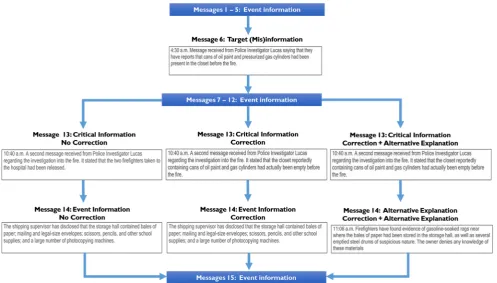
The target (mis)information, implying that carelessly stored oil paint and gas cylinders played a role in the fire, was presented at Message 6. This information was then corrected at Message 13 for the two conditions featuring a correction. Information implying that the fire was actually the result of arson (alternative explanation group) was present-ed at Message 14; the other two experimental groups merely learned that the storage hall contained stationery materials. The other messages provided further details about the incident and were identical in all three experimental conditions.
The questionnaire following the statements consisted of three question blocks: inference, factual, and critical informa-tion recall. The quesinforma-tion order was randomized within the inference and factual blocks, but not in the correction recall block, in which the questions were presented in a predefined order: Inference questions (e.g.,BWhat was a possible cause of the fumes^) were presented first, followed by factual ques-tions (e.g.,BWhat business was the firm in?^), and then critical information recall questions (e.g.,BWhat was the point of the second message from Police Investigator Lucas?^).
There were three dependent measures: (1) reference to the target (mis)information in the inference questions, (2) factual
recall, and (3) critical information recall. The first dependent measure assessed the extent to which the misinformation influ-enced interpretation of the news report, whereas the second assessed memory for the literal content of the report. The final measure specifically assessed understanding and accurate recall of the critical information that appeared at Message 13 (see Fig.
1). Although not all groups received a correction, the partici-pants in all experimental groups were asked these questions so that the questions would not differ between the conditions. The stimuli were piloted on a small group of participants to check their average completion time and obtain feedback about the questionnaire. Following the pilot, the number of questions in-cluded in the inference and factual blocks was reduced from ten to six, because participants felt some questions were repetitive.
ProcedureParticipants clicked on a link in AMT to enter the experimental site. After seeing details about the experiment, giving consent, and receiving detailed instructions, they were told that they would not be able to backtrack and that each message would appear for a minimum of 10 s before they could move on to the next message.
Immediately after reading the final statement, participants were informed that they would see a series of inference-based questions. They were told to type their responses in the text box provided, giving as much detail as necessary and writing
Fig. 1 Thecontinued-influence effecttask: Messages 1–5 provide general
information about the event, beginning with the fire being reported. The target (mis)information is presented at Message 6 and is then corrected, for correction and correction + alternative explanation groups, at Message
[image:5.595.50.548.51.334.2]in full sentences; that they should write at least 25 characters to be able to continue to the next question; and that they should answer questions on the basis of their understanding of the report and of industrial fires in general. After this they were informed that they would answer six factual questions, which then followed. Next, participants were instructed to answer the two critical information recall questions on the basis of what they remembered from the report. After com-pleting the questionnaire, participants were asked to provide their sex, age, and highest level of education.
Results
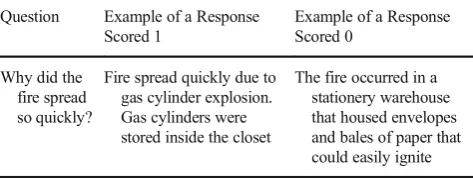
Coding of responsesThe main dependent variable extracted from responses to the inference questions wasBreference to target (mis)information.^References that explicitly stated, or strongly implied, that oil paint and gas cylinders caused or contributed to the fire were scored a 1; otherwise, responses were scored as 0. Table1shows an example of a response that was coded as a reference to target (mis)information and an example of a response that was not coded as such. There were several examples of references to flammable items that did not count as references to the corrected information. For example, stating that the fire spread quicklyBBecause there were a lot of flammable things in the shop^ would not be counted as a reference to the corrected information, since there was no specific reference to gas, paint, liquids, substances, or the fact that they were (allegedly) in the closet. The maximum indi-vidual score across the inference questions was 6. The re-sponses to factual questions were scored for accuracy; correct or partially correct responses were scored 1, and incorrect responses were scored 0. Again, the maximum factual score was 6. We also examined critical information recall, to check participants’awareness of either the correction to the misin-formation or the control message, computed using two ques-tions that assessed awareness and accuracy for the critical information that appeared at Message 13. This meant that the correct response depended on correction information con-dition. For the participants in the no-correction group, the correct response was that the injured firefighters had been released from hospital, and for the two conditions featuring a c o r r e c t i o n , t h i s w a s a c o r r e c t i o n o f t h e t a rg e t (mis)information.
Intercoder reliabilityAll participants’responses to the infer-ence, factual, and correction recall questions were indepen-dently coded by two trained coders. Interrater agreement was .88, and Cohen’sΚ= .76 ± .02, indicating a high level of agreement between coders; both measures are higher than the benchmark values of .7 and .6 (Krippendorff, 2012; Landis & Koch,1977), respectively, and there was no system-atic bias between raters,χ2= 0.29,p = .59.
Inference responsesThe overall effect of the correction infor-mation on references to the target (mis)inforinfor-mation was sig-nificant, F(2, 75) = 10.73, p < .001, ηp
2
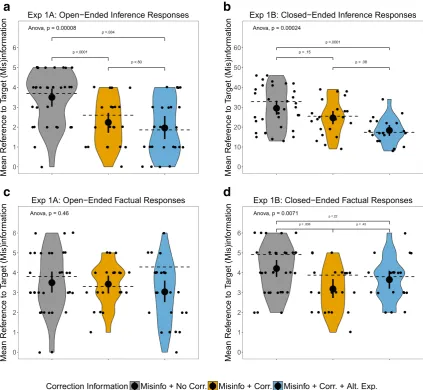
= .22 [.07, .36]. Dunnett multiple comparison tests (shown in panel A of Fig.
2) revealed that a correction or a correction with an alternative explanation significantly reduced reference to the target (mis)information in response to the inference questions.
A Bayesian analysis using the BayesFactor package in R and default priors (Morey & Rouder,2015) was performed to examine the relative predictive success of the comparisons between conditions. The BF10for the first comparison 28.93, indicating strong evidence (Lee & Wagenmakers, 2014) in favor of the alternative that there was a difference between the no correction and correction groups. The BF10for the comparison between the no-correction and alternative-explanation groups was 209.03, again indicating very strong evidence in favor of the alternative. The BF10was 0.36 for the final comparison between the correction and alternative-explanation groups, indicating anecdotal evidence in favor of the null.
The Bayes factor analysis was mostly consistent with the p values and effect sizes. Both conditions featuring a correction led to a decrease in references to the target (mis)information, but the data for the two conditions featuring a correction cannot distinguish between the null hypothesis and previous findings (i.e., that an alter-native explanation substantially reduces reference to misinformation, as compared to a correction alone).
Factual responses Factual responses were examined to establish whether the differences in references to the (mis)information could be explained by memory for the literal content of the report. Overall, participants accurately recalled similar numbers of correct details across the correction information conditions (Fig. 2C), and the omnibus test was not significant,F(2, 75) = 0.78,p= .46,ηp2= .02.
[image:6.595.51.288.623.712.2]Response qualityParticipants were required to write a mini-mum of 25 characters in response to the questions. The num-ber of characters written was examined as a measure of re-sponse quality. Participants wrote between 36% and 64% more, on average, than the minimum required 25 characters in response to the inference (M= 69.45,SD= 40.49), factual (M= 39.09,SD= 15.85), and critical information recall (M=
Table 1 Example of response codings in Experiment1
Question Example of a Response Scored 1
Example of a Response Scored 0
Why did the fire spread so quickly?
Fire spread quickly due to gas cylinder explosion. Gas cylinders were stored inside the closet
66.72,SD= 42.76) questions. There was—unsurprisingly—a positive correlation between time taken to complete the study and number of characters written,r(76) = .31,p= .007.
Experiment 1B
In Experiment 1B we examined the feasibility of converting open-ended questions to a comparable closed-ended form.
Method
ParticipantsSeventy-five US-based (46 male, 29 female; be-tween 18 and 61 years of age,M= 34.31,SD= 10.54) partic-ipants were recruited from AMT. The particpartic-ipants were paid $2; the median completion time was 9 min.
Design, stimuli, and procedureExperiment1B used the same story/newsfeed stimuli and high-level design as Experiment
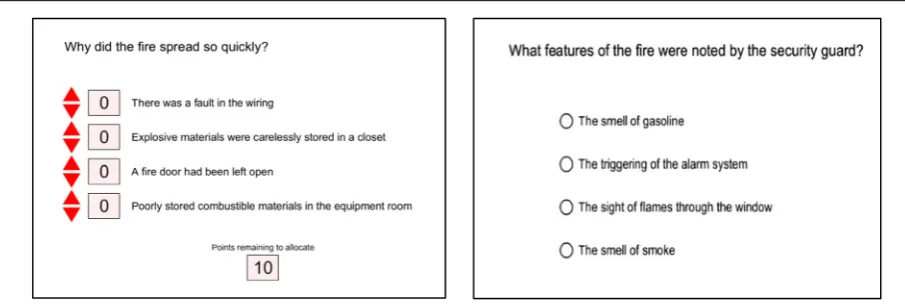
1A; participants were randomly assigned to one of three ex-perimental conditions: no correction (n= 33), correction (n= 22), or alternative explanation (n= 20). The only difference between the experiments was that closed-ended questions were used in the subsequent questionnaire. Figure 3 shows how participants had to respond to inference and factual ques-tions. For the inferential questions, points were allocated to response alternatives that corresponded to four possible expla-nations. For example, when answering the question BWhat could have caused the explosions?,^ participants could allo-cate points to a misinformation-consistent option (e.g.,BFire came in contact with compressed gas cylinders^), an alternative-explanation-consistent option (e.g., BSteel drums filled with liquid accelerants^), an option that was plausible
Anova, p = 0.00008
p =.80 p =.004
p =.0001
0 1 2 3 4 5 6
Mean Ref
erence to T
arget (Mis)inf
or
mation
Exp 1A: Open−Ended Inference Responses
a
Anova, p = 0.00024
p = .08 p =.0001
p = .15
0 10 20 30 40 50 60
Mean Ref
erence to T
arget (Mis)inf
or
mation
Exp 1B: Closed−Ended Inference Responses
b
Anova, p = 0.46
0 1 2 3 4 5 6
Mean Ref
erence to T
arget (Mis)inf
or
mation
Exp 1A: Open−Ended Factual Responses
c
Anova, p = 0.0071
p = .43 p =.22 p = .006
0 1 2 3 4 5 6
Mean Ref
erence to T
arget (Mis)inf
or
mation
Exp 1B: Closed−Ended Factual Responses
d
Correction Information Misinfo + No Corr. Misinfo + Corr. Misinfo + Corr. + Alt. Exp.
Fig. 2 Effects of correction information on the numbers of (A) references
to the target (mis)information in Experiment1A, (B) references to the target misinformation in Experiment1B, (C) accurately recalled facts in Experiment1A, and (D) accurately recalled facts in Experiment1B. Error bars represent 95% confidence intervals of the means. The brackets
[image:7.595.86.510.54.444.2]given the story details but that was not explicitly stated (e.g., BVolatile compounds in photocopiers caught on fire^), or an option that was inconsistent with the story details (e.g., BCooking equipment caught on fire^).
The response options were chosen in this way to give participants the opportunity to provide more nuanced responses than would be possible using multiple-choice or true/false alternatives. This approach allowed the participants who were presented with misinformation and then a correc-tion to choose an explanacorrec-tion that was consistent with the story but did not make use of the target (mis)information. If the CIE were observed in response to closed-ended questions, then the number of points allocated to misinformation-consistent options in the conditions featuring a correction should be non-zero. The accuracy on factual questions was measured using four-alternative forced choice multiple-choice questions, in which participants responded by choosing the correct answer from a set of four possible options. The order of presentation for the response alternatives for inference and factual questions was randomized across participants. The critical informatin recall questions were open-ended, and par-ticipants gave free-text responses in the same manner as Experiment1A.
Results
Individual inference, factual, and critical information recall scores (an analysis of the critical information recall responses is shown in the additional analyses in the
supplemental materials) were calculated for each participant.
Since the maximum number of points that could be allocated to a given option explanation theme for each question was 10, the maximum inference score for an individual participant was 60. The maximum factual score was 6, and the maximum critical information recall score was 2. Critical information recall questions were open-ended, and responses were coded using the same criteria as in Experiment1A.
Inference responses A one-way analysis of variance (ANOVA) on reference to the target (mis)information re-vealed a significant effect of correction information,F(2, 72) = 9.39,p< .001,ηp2= .21 [.05, .35]. Overall, the pattern of results for reference to the target (mis)information in response to closed-ended questions was very similar to that in Experiment1A (Fig.2B). Although a correction with an al-ternative explanation significantly reduced reference to the target (mis)information, a correction on its own did not. The difference between the two conditions featuring a correction was also not significant.
The BF10was 1.02 for the first comparison, between the no-correction and correction groups, indicating anecdotal ev-idence in favor of the alternative, or arbitrary evev-idence for either hypothesis. The BF10was 250.81 for the second com-parison, between the no-correction and alternative-explanation groups, indicating strong evidence for the alterna-tive. The BF10was 4.22 for the final comparison, indicating substantial evidence in favor of the alternative.
The Bayes factor analysis was mostly consistent with thep
values and effect sizes, except that the Bayes factor for the comparison between the correction and alternative-explanation conditions suggested an effect, whereas thep val-ue did not.
Factual responses Analysis of the factual scores indicated a significant difference between the correction information groups, F(2, 72) = 5.30, p = .007, ηp2 = .13 [.01, .26]. Figure2D shows that the average number of factually correct details recalled from the report was significantly lower in the correction condition than in the no-correction group but not than in the alternative-explanation group. The poorer overall performance on factual questions for the correction group was mainly attributable to incorrect responses to two questions. The first of these questions asked about the contents of the closet that had reportedly contained flammable materials, be-fore the fire; the second asked about the time the fire was put
Fig. 3 Screenshots of how the inference (left) and factual (right)
ques-tions and response opques-tions were presented to participants. Participants used the red arrow features to allocate points to the response alternatives
[image:8.595.69.522.45.197.2]out. Only a third (23% in the correction and 25% in the alternative-explanation group) answered the question about the contents of the closet correctly (i.e., that the storeroom was empty before the fire), whereas 86% of the no-correction group correctly responded that oil paint and gas cylinders were in the storeroom before the fire. This is perhaps unsurprising: The correct answer for the no-correction condi-tion (Bpaint and gas cylinders^) was more salient and unam-biguous than the correct answer for the other two conditions (BThe storage closet was empty before the fire^).
Discussion
The results for Experiments1A and1B suggest that both open- and closed-ended questions can successfully be used in online experiments with AMT to measure differ-ences in referdiffer-ences to misinformation in a standard continued-influence experiment. There was a clear CIE of misinformation in all conditions of both experi-ments—a correction reduced, but did not come near elim-inating, reference to misinformation in inference ques-t i o n s . I n b o ques-t h e x p e r i m e n ques-t s , r e f e r e n c e s ques-t o ques-t a rg e ques-t (mis)information were significantly lower in the correc-tion + alternative than in the no-correccorrec-tion condicorrec-tion, with the correction condition lying between those two extremes (see Fig.2A and B). Although the patterns of significant results were slightly different (correction condition was significantly below no correction in Exp. 1A but not in Exp. 1B), this is consistent the variability seen across experiments using the CIE, in that some researchers have found a reduction in references to (mis)information fol-lowing a correction (Connor Desai & Reimers, 2017; Ecker, Lewandowsky, & Apai, 2011b; Ecker et al.,
2010), but others have found no significant reduction (Johnson & Seifert,1994).
With regard to motivation, we found that the vast majority of participants wrote reasonable responses to the open-ended questions. The answers were of a con-siderable length for the question, with participants usu-ally typing substantiusu-ally more than the minimum num-ber of characters required. We found that the absolute numbers of references to the misinformation were com-parable to those found in existing studies. That said, the open-ended questions had to be coded by hand, and for participants the median completion time was 18% lon-ger in Experiment 1A (11 min) than in Experiment 1B (9 min). This disparity in completion times only serves to emphasize that using closed-ended questions stream-lines the data collection process relative to open-ended questions.
Taken as a whole, these findings show that reasonably complex experimental tasks that traditionally require partici-pants to construct written responses can be implemented
online using either the same type of open-ended questions or comparable closed-ended questions.
Rationale for Experiments
2
A and
2
B
The results of Experiments1A and1B are promising with regard to using open-ended questions in online research in general, and to examining phenomena such as the CIE specif-ically. However, they have some limitations. The most salient limitation was the sample size. Although the numbers of par-ticipants in the different conditions were comparable to those in many lab-based studies of the CIE, the sample size was nonetheless small. One of the advantages of using Web-based procedures is that it is relatively straightforward to re-cruit large numbers of participants, so in Experiments2A and
2B we replicated the key conditions of the previous studies with twice as many participants. We also preregistered the method, directional hypotheses, and analysis plan (including planned analyses, data stopping rule, and exclusion criteria) prior to data collection; this information can be found at
https://osf.io/cte3g/.
We also used this opportunity to include a second baseline condition. Several CIE experiments have included control conditions in some form that makes it possible to see whether references to the cause suggested by the misinformation fol-lowing its correction are not only greater than zero, but greater than the references to the same cause if the misinformation is never presented. In this study we did not believe that such a condition would be very informative, because the strictness of the coding criteria meant that it would be unlikely that partic-ipants would spontaneously suggest paint or gas cylinders as contributing to the fire.2
Instead, Experiments2A and2B included a more directly comparable control group for whom a correction was present-ed without the initial target (mis)information. According to the mental-model-updating account of the CIE, event information is integrated into a mental model that is updated when new information becomes available. Corrections may be poorly encoded or retrieved because they threaten the model’s inter-nal coherence (Ecker et al.,2010; Johnson & Seifert,1994; Johnson-Laird,1980). If the CIE arises because of a mental-model-updating failure, then presenting the misinformation only as part of a correction should not result in a CIE, because there would not be an opportunity to develop a mental model involving the misinformation. On the other hand, participants might continue to refer to the misinformation for more super-ficial reasons: If the cause presented in the misinformation
were available in memory and recalled without the context of its being corrected, then presenting the misinformation as part of the correction should lead to a CIE comparable to those in other conditions.
In these experiments, we repeated the no-correction and correction conditions from Experiments1A and1B. In place of the correction + alternative condition, however, we had the no-mention condition, which was the same as the correction condition except that we replaced the target (mis)information with a filler statement (BMessage 6—4:30 a.m. Message re-ceived from Police Investigator Lucas saying that they have urged local residents to keep their windows and doors shut^). The wording of the correction message for this condition stat-ed thatBa closet reportedly containing cans of oil paint and gas cylinders had actually been empty before the fire^rather than referring simply toBthe closet,^so that the participants would not think they had missed some earlier information.
Beyond this, the general setup for Experiments2A and2B was the same as that for Experiments1A and1B, except in the following respects: We included an instruction check (which appeared immediately after the initial instructions and immediately before the warehouse fire report was presented) that tested participants’comprehension of the instructions via three multiple-choice questions. Participants were not excluded because of this check, but they were not allowed to proceed to the main experiment until they had answered all three questions correctly, consistent with Crump et al.’s (2013) recommendations. Because Adobe Flash, which we had used for Experiments1A and 1B, is being deprecated and is increasingly hard to use for Web-based research, we implemented Experiments2A and2B using Qualtrics, which led to some superficial changes in the implementation. Most notable was that the point-allocation method for closed-ended inference questions required participants to type numbers of points to allocate, rather than adjusting the values using buttons.
The sample size was also doubled in this second set of experiments.
Experiment 2A
Method
ParticipantsIn all, 157 US- and UK-based participants (91 male, 66 female; between 18 and 64 years of age, M = 33.98,SD= 10.57) were recruited using AMT.3The median
completion time was 16 min and participants, and were paid $1.25.4
Design and procedureParticipants were randomly assigned to one of three experimental conditions: misinformation + no correction (n= 52), misinformation + correction (n= 52), or no misinformation + correction (n= 53).
Results
Intercoder reliabilityParticipants’responses to the inference, factual, and critical information recall5questions were coded by one trained coder, and 10% (n= 16) of the responses were independently coded by a second trained coder. The interrater agreement was 1 and Cohen’sK= 1 ± 0, indicating, surpris-ingly, perfect agreement between the coders.
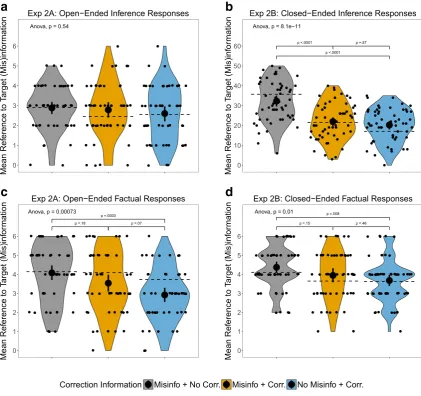
Inference responsesParticipants produced similar numbers of references to the target (mis)information across correction in-formation conditions (Fig.4A), and the omnibus test was not significant,F(2, 154) = 0.62,p = .54, ηp2= .01 [.00, .05]. Unlike in Experiment 1A, a correction did not significantly reduce the number of references to the target (mis)information relative to a control group who did not receive a correction. Moreover, participants who were not presented with the initial misinformation but did receive a correction message, made a number of misinformation references similar to those for par-ticipants who were first exposed to the misinformation.
Factual responsesParticipants’ability to accurately recall de-tails from the report differed across correction information conditions (Fig.4C), F(2, 154) = 8.12,p < .001, ηp2= .10 [.02, .18]. Tukey’s test for multiple comparisons revealed that the group who received a correction without the initial misin-formation recalled significantly fewer details from the report than did the group who saw the uncorrected misinformation, but the other differences were nonsignificant,ps > .05.
Response quality Participants wrote between 48% and 69% more, on average, than the minimum of 25 required characters in response to the inference (M= 80.76,SD= 56.38), factual (M= 48.15,SD= 24.86), and critical information recall (M= 75.56,SD= 47.05) questions. We found a positive correlation between the time taken to complete the study and the number of characters written,r(155) = .34,p< .0001, showing that the participants who took longer wrote more.
3Three of the participants were recruited from Prolific Academic. Data was collected from 159 participants but two of the participants were excluded because they gave nonsense answers to the questions (e.g.,Bbecause the wind is blow, love is fall, I think it is very interesting^).
4
The modal completion time in Experiments 1 and 2 was below 10 min, so the fee was reduced so that participants were paid the equivalent of the federal minimum wage in the US ($7.25).
Experiment 2B
Method
ParticipantsA total of 166 US- and UK-based participants (100 male, 66 female; between 18 and 62 years of age,M= 35.04,SD= 10.36) were recruited using AMT.6Participants were paid $1.25; their median completion time was 13 min.
Design and procedureExperiment 2B used the same high-level design and procedure as Experiment2A. The responses were closed-ended and made in the same way as in Experiment1B. Participants were randomly assigned to one of three experimental conditions: misinformation + no correc-tion (n = 54), misinformation + correction (n = 56), or no misinformation + correction (n= 56).
Results
Inference responsesWe found a significant effect of correction information on references to the target (mis)information for closed-ended measures (Fig. 4B),F(2, 163) = 26.90, p < .001,ηp2= .25 [.14, .35]. Tukey-adjusted multiple comparisons further revealed that the group exposed to misinformation and its correction, and the group who saw only the correction 6The recruited number of participants differed from stopping rule specified in
the preregistration. In total, 168 participants were recruited for the closed-ended condition, due to an error. Ultimately we decided to include the extra participants in the analysis rather than exclude their data. However, the re-sponses from two participants were excluded: one because the participant took the HIT twice, and another because the participant provided nonsense answers to the open-ended questions at the end of the study.
Anova, p = 0.54
0 1 2 3 4 5 6
Mean Ref
erence to T
arget (Mis)inf
or
mation
Exp 2A: Open−Ended Inference Responses
a
Anova, p = 8.1e−11
p <.0001 p <.0001
p =.57
0 10 20 30 40 50 60
Mean Ref
erence to T
arget (Mis)inf
or
mation
Exp 2B: Closed−Ended Inference Responses
b
Anova, p = 0.00073
p =.18 p =.0003
p =.07
0 1 2 3 4 5 6
Mean Ref
erence to T
arget (Mis)inf
or
mation
Exp 2A: Open−Ended Factual Responses
c
Anova, p = 0.01
p =.15 p =.008
p =.46
0 1 2 3 4 5 6
Mean Ref
erence to T
arget (Mis)inf
or
mation
Exp 2B: Closed−Ended Factual Responses
d
Correction Information Misinfo + No Corr. Misinfo + Corr. No Misinfo + Corr.
Fig. 4 Effects of correction information on the numbers of (A) references
to the target (mis)information in Experiment2A, (B) references to the target (mis)information in Experiment2B, (C) accurately recalled facts in Experiment2A, and (D) accurately recalled facts in Experiment2B. Error bars represent 95% confidence intervals of the means. The brackets
[image:11.595.86.508.54.450.2]without the initial misinformation, made significantly fewer references to the target (mis)information than did the uncor-rected misinformation condition. The two groups who received correction information did not differ significantly.
Factual responsesParticipants’responses to the factual ques-tions also showed a significant effect of correction informa-tion condiinforma-tion (Fig.4D),F(2, 163) = 4.70,p= .01,ηp2= .05 [.00, .13]. Tukey’s tests revealed that the factual responses from participants in the condition featuring a correction with-out the initial misinformation were significantly lower than those from the group who saw uncorrected misinformation. The other differences were not significant (ps > .1). A closer inspection of the individual answers revealed that incorrect responses for the no misinformation + correction group were mainly attributable to the question asking about the contents of the closet before the fire.
Dropout analysisOf the 375 people who started the study, only 323 fully completed it (dropout rate 13%). Of those who completed the study, four (1.23%) were excluded prior to the analysis because they gave nonsense open-ended re-sponses (e.g., B21st century fox, the biggest movie in theatre^). The majority of participants who dropped out did so immediately after entering their worker ID and before being assigned to a condition (41%). Of the remaining dropout par-ticipants who were assigned to a condition, 27% were assigned to one of the open-ended conditions and dropped out during the first question block. A further 16% were assigned to one of the closed-ended conditions and dropped out when asked to answer the open-ended critical information recall questions. The remaining 14% were assigned to a closed-ended condition and dropped out as soon as they reached the first question block. The dropout breakdown suggests that many people dropped out because they were unhappy about having to give open-ended responses. Some participants who were assigned to the closed-ended conditions dropped out when faced with open-ended questions, despite the fact that the progress bar showed that they had almost completed the study.
Discussion
Experiments2A and2B again showed clear evidence of a CIE. As in Experiments1A and 1B, participants continued to refer to the misinformation after it had been corrected. Also consistent with the previous two experiments, the effects of a correction differed slightly across conditions. This time the reduction in references to the (mis)information was signif-icant for the closed-ended questions, but not for the open-ended questions. As we noted earlier, this is consistent with findings that a correction sometimes reduces references to misinformation relative to no correction, and sometimes it does not (Connor Desai & Reimers,2017; Ecker et al.,2010).
Experiments2A and2B also included a novel control con-dition in which participants were not exposed to the initial misinformation but were exposed to its correction. Contrary to expectations, the new condition resulted in a number of references to the target (mis)information that was statistically equivalent to that in the group who were exposed to both the misinformation and its correction. This finding suggests that the CIE might not reflect a model-updating failure, but rather a decontextualized recall process.
General discussion
In four experiments we examined the feasibility of collecting data on the CIE online, comparing the efficacy of using tradi-tional open-ended questions versus adapting the task to use closed-ended questions. For both types of elicitation proce-dures, we observed clear CIEs: Following an unambiguous correction of earlier misinformation, participants continued to refer to the misinformation when answering inferential questions. As such, these studies provide clear evidence that both open-ended and closed-ended questions can be used in online experiments.
The continued-influence effect
Across all four studies we found that participants continued to use misinformation that had been subsequently corrected. This occurred even though a majority of participants recalled the correction. We found mixed results when examining whether a correction had any effect at all in reducing refer-ences to misinformation. Experiments using similar designs have both found (Ecker, Lewandowsky, & Apai,2011b; Ecker et al.,2010) and failed to find (Johnson & Seifert,1994) an effect of a correction. Overall, we found limited evidence for an effect of a correction for the open-ended questions, but substantial evidence for an effect of a correction using closed-ended questions. For open-ended questions, it appears that any effect of a correction on reference to misinforma-tion—at least using this scenario—is relatively small, and would be hard to detect consistently using the small sample sizes that have traditionally been used in this area. This may explain the variability in findings in the literature.
A correction with an alternative explanation appeared (at least numerically) to be more effective in reducing reliance on misinformation than a correction alone. Furthermore, given that Experiment1B’s results were actually more consistent with the original finding (Johnson & Seifert,1994), the differ-ences between past and present work are most likely unsys-tematic and therefore unrelated to the online testing environ-ment or question type.
that was only presented as part of a correction had as much of a continuing influence effect as misinformation presented ear-ly in a series of statements and onear-ly later corrected. This has both theoretical and practical implications. Theoretically, it suggests that—under some circumstances—the CIE may not be the result of participants’unwillingness to give up an existing mental model without an alternative explanation (Ecker, Lewandowsky, & Apai,2011b; Ecker, Lewandowsky, Swire, & Chang,2011a; Johnson & Seifert,1994). Instead, it might be that participants search their memory for possible causes when asked inferential questions, but fail to retrieve the information correcting the misinformation.
Open- and closed-ended questions and the CIE
The pattern of results in response to inference questions was qualitatively very similar across both open and closed ended questions. This finding is particularly interesting in light of the fact that responses to open and closed ques-tions might be supported by different underlying retrieval processes (Fisher, Brewer, & Mitchell,2009; Ozuru et al.,
2013; Shapiro,2006). Crucially, the response options used in Experiments1B and2B required participants to make a more considered judgment than multiple-choice or yes/no questions, which may have encouraged recall rather than a familiarity-based heuristic. It is also interesting that par-ticipants still referred to the incorrect misinformation de-spite the fact that another response option was consistent with the report, although this was not explicitly stated.
Another important observation was that we found an effect of correction information on responses to closed-ended factual questions, but not to open questions. The difference between conditions is significant, because it was partly attributable to a question that probed partici-pants’verbatim memory of the correction. Many partici-pants in both conditions featuring a correction answered this question incorrectly, despite the fact that the options clearly distinguished between the correct and incorrect answers, given what participants had read. This question asked what the contents of the closet were before the fire, so it not hard to see why participants who continued to rely on the misinformation might have answer this ques-tion incorrectly. The fact that there were differences be-tween the conditions highlights the importance of careful-ly wording questions and response options in order to avoid bias.
It is also worth noting that floor effects were not ob-served (i.e., the misinformation was still influential for both groups that received a correction), despite the fact that the present study did not include a distractor task and that participants answered the inference questions directly after reading the news report (and so, theoretically, should have had better memory for the report details).
A brief note on the use of closed-ended questions and response alternatives: There is the possibility that presenting a closed list of options reminded participants of the arson materials explanation and inhibited re-sponses consistent with the oil paint and gas cylinders explanation. Also, the closed list of options that repeat-ed the misinformation could have increasrepeat-ed its familiar-ity, making it more likely to be accepted as true (e.g., Ecker, Lewandowsky, Swire, & Chang, 2011a). For the group that received a simple correction, the other op-tions had not been explicitly stated in the story. These participants may not have fully read or understood the question block instructions, and therefore perceived the task as choosing the option that had appeared in the story, irrespective of the correction. In contrast, the par-ticipants in the alternative-explanation group were able to better detect the discrepancy between the misinforma-tion and its correcmisinforma-tion, because of the opmisinforma-tion alluding to arson materials. Although the response alternatives pro-vided a plausible response that was consistent with the details of the fire story, none of the options made it possible to rule out that participants just did not consid-er the correction when responding. The response altconsid-er- alter-natives provided forced the participants to choose one from among four explanations, which may not have reflected their understanding of the event, but nonethe-less was the option that was most consistent with what they had read. This explanation is also consistent with previous studies showing that the response options cho-sen by the researcher can be used by the participants to infer which information the participant considers rele-vant (Schwarz et al., 1985; Schwarz et al., 1991).
Open- and closed-ended questions in Web-based
research
As well as looking directly at the CIE, we also exam-ined the extent to which participants recruited via Amazon Mechanical Turk could provide high-quality data from open-ended questions. We found high levels of diligence—participants typed much more than was required in order to give full answers to the questions, they spent more time reading statements than was re-quired, and—with a small number of exceptions—they engaged well with the task and attempted to answer the questions set.
some participants, because of the device they were using, would struggle to provide open-ended responses, and so dropped out when faced with open-ended questions. Either way, it is striking that we had over 4% of the participants in Experiment2B who read all the statements and gave answers to all the closed-ended questions, but then dropped out when asked to type their responses to the final two critical informa-tion recall quesinforma-tions. There are ethical implicainforma-tions of having participants spend 10 min on a task before dropping out, so the requirement for typed answers should be presented promi-nently before participants begin the experiment.
We found that participants’recall of the correction for the misinformation was worse than in previous lab-based studies. We found that only a little over half of participants across the conditions in our study correctly reported the correction when prompted. This figure is poor when compared to the figures of 95% (correction) and 75% (alternative explanation) found in Johnson and Seifert’s (1994, Exp. 3A) laboratory-based ex-periment. It is possible that this was the result of poor attention and recall of the correction, but we believe it was more likely a response issue, in which participants retained the information but did not realize that they were being asked to report it when asked whether they were aware of any inconsistencies or cor-rections. (In other unpublished research, we have found that simply labeling the relevant statementBCorrection:^ greatly increased participants’reference to it when asked about any corrections.) Although this did not affect the CIE, in future research we would recommend making the instructions for the critical information recall questions particularly clear and ex-plicit. This advice would, we imagine, generalize to any ques-tions that might be ambiguous and would require a precise answer.
In choosing whether to use open-ended questions or to adapt them to closed-ended questions for use online, there are several pros and cons to weigh up. Open-ended questions allow for a consistency of methodology with traditional lab-based approaches—meaning there is no risk of participants switching to using different strat-egies or processes, as they might with closed-ended questions. We have shown that participants generally engage well and give good responses to open-ended questions. It is also much easier to spot and exclude participants who respond with minimal effort, since their written answers tend to be nonsense or copied and pasted from elsewhere. For closed-ended responses, attention or consistency checks or other measures of participant engagement are more likely to be necessary. That said, closed-ended questions are, we have found, substantially faster to complete, meaning that re-searchers on a budget could test more participants or ask more questions; such questions require no time to manually code; participants are less likely to drop out with them; and—at least in the area of research used
here—they provide results comparable to those from open-ended questions.
Conclusion
In conclusion, thecontinued-influence effectcan be added to the existing list of psychological findings that have been suc-cessfully replicated online. Data obtained online are of suffi-ciently high quality to allow examining original research ques-tions and are comparable to data collected in the laboratory. Furthermore, the influence of misinformation can be exam-ined using closed-ended questions with direct choices be-tween options. Nevertheless, as with any methodological tool, researchers should proceed with caution and ensure that suf-ficient piloting is conducted prior to extensive testing. More generally, the research reported here suggests that open-ended written responses can be collected via the Web and Amazon Mechanical Turk.
Author noteWe thank Cassandra Springate for help with coding the data.
Open Access This article is distributed under the terms of the Creative C o m m o n s A t t r i b u t i o n 4 . 0 I n t e r n a t i o n a l L i c e n s e ( h t t p : / / creativecommons.org/licenses/by/4.0/), which permits unrestricted use, distribution, and reproduction in any medium, provided you give appropriate credit to the original author(s) and the source, provide a link to the Creative Commons license, and indicate if changes were made.
References
Behrend, T. S., Sharek, D. J., Meade, A. W., & Wiebe, E. N. (2011). The viability of crowdsourcing for survey research.Behavior Research Methods,43, 800–813. doi: https://doi.org/10.3758/s13428-011-0081-0
Berinsky, A. J., Margolis, M. F., & Sances, M. W. (2014). Separating the shirkers from the workers? Making sure respondents pay attention on self-administered surveys.American Journal of Political Science,58, 739–753. doi:https://doi.org/10.1111/ajps.12081
Cappella, J. N., Ophir, Y., & Sutton, J. (2018). The importance of mea-suring knowledge in the age of misinformation and challenges in the tobacco domain. In B. G. Southwell, E. A. Thorson, & L. Sheble (Eds.), Misinformation and mass audiences (pp. 51–70). Austin, TX: University of Texas Press.
Chan, M. S., Jones, C. R., Hall Jamieson, K., & Albarracín, D. (2017). Debunking: A meta-analysis of the psychological efficacy of mes-sages countering misinformation.Psychological Science,28, 1531– 1546. doi:https://doi.org/10.1177/0956797617714579
Connor Desai, S., & Reimers, S. (2017). But where’s the evidence? The effect of explanatory corrections on inferences about false informa-tion. In G. Gunzelmann, A. Howes, T. Tenbrink, & E. Davelaar (Eds.), Proceedings of the 39th Annual Conference of the Cognitive Science Society (pp. 1824–1829). Austin, TX: Cognitive Science Society.
research.PLoS ONE,8, e57410. doi:https://doi.org/10.1371/journal. pone.0057410
Ecker, U. K. H., Hogan, J. L., & Lewandowsky, S. (2017). Reminders and repetition of misinformation: Helping or hindering its retrac-tion?Journal of Applied Research in Memory and Cognition,6, 185–192.
Ecker, U. K. H., Lewandowsky, S., & Apai, J. (2011b). Terrorists brought down the plane!—No, actually it was a technical fault: processing corrections of emotive information. Quarterly Journal of Experimental Psychology,64, 283–310. doi:https://doi.org/10. 1080/17470218.2010.497927
Ecker, U. K. H., Lewandowsky, S., Swire, B., & Chang, D. (2011a). Correcting false information in memory: Manipulating the strength of misinformation encoding and its retraction.Psychonomic Bulletin & Review,18, 570–578. doi: https://doi.org/10.3758/s13423-011-0065-1
Ecker, U. K. H., Lewandowsky, S., & Tang, D. T. W. (2010). Explicit warnings reduce but do not eliminate the continued influence of misinformation.Memory & Cognition,38, 1087–1100. doi:https:// doi.org/10.3758/MC.38.8.1087
Fazio, L. K., Brashier, N. M., Payne, B. K., & Marsh, E. J. (2015). Knowledge does not protect against illusory truth.Journal of Experimental Psychology: General,144, 993–1002. doi:https:// doi.org/10.1037/xge0000098
Fisher, R. P., Brewer, N., & Mitchell, G. (2009). The relation between consistency and accuracy of eyewitness testimony: Legal versus cognitive explanations. In R. Bull, T. Valentine, & T. Williamson (Eds.), Handbook of psychology of investigative interviewing: Current developments and future directions (pp. 121–136). Hoboken, NJ: Wiley. doi:https://doi.org/10.1002/9780470747599. ch8
Frew, E. J., Whynes, D. K., & Wolstenholme, J. L. (2003). Eliciting willingness to pay: Comparing closed-ended with open-ended and payment scale formats.Medical Decision Making,23, 150–159. doi:
https://doi.org/10.1177/0272989X03251245
Frew, E. J., Wolstenholme, J. L., & Whynes, D. K. (2004). Comparing willingness-to-pay: Bidding game format versus open-ended and payment scale formats.Health Policy,68, 289–298.
Germine, L., Nakayama, K., Duchaine, B. C., Chabris, C. F., Chatterjee, G., & Wilmer, J. B. (2012). Is the Web as good as the lab? Comparable performance from Web and lab in cognitive/ perceptual experiments.Psychonomic Bulletin & Review,19, 847– 857. doi:https://doi.org/10.3758/s13423-012-0296-9
Gordon, A., Brooks, J. C. W., Quadflieg, S., Ecker, U. K. H., & Lewandowsky, S. (2017). Exploring the neural substrates of misin-formation processing.Neuropsychologia,106, 216–224. doi:https:// doi.org/10.1016/j.neuropsychologia.2017.10.003
Graesser, A., Ozuru, Y., & Sullins, J. (2010). What is a good question? In M. McKeown & G. Kucan (Eds.), Bringing reading research to life (pp. 112–141). New York, NY: Guilford.
Grysman, A. (2015). Collecting narrative data on Amazon’s Mechanical Turk.Applied Cognitive Psychology,29, 573–583.
Guillory, J. J., & Geraci, L. (2013). Correcting erroneous inferences in memory: The role of source credibility.Journal of Applied Research in Memory and Cognition,2, 201–209. doi:https://doi.org/10.1016/ j.jarmac.2013.10.001
Guillory, J. J., & Geraci, L. (2016). The persistence of erroneous infor-mation in memory: The effect of valence on the acceptance of corrected information.Applied Cognitive Psychology,30, 282– 288. doi:https://doi.org/10.1002/acp.3183
Jacoby, L. L. (1996). Dissociating automatic and consciously controlled effects of study/test compatibility. Journal of Memory and Language,35, 32–52.
Johnson, H. M., & Seifert, C. M. (1994). Sources of the continued influ-ence effect: When misinformation in memory affects later infer-ences.Journal of Experimental Psychology: Learning, Memory,
and Cognition,20, 1420–1436. doi: https://doi.org/10.1037/0278-7393.20.6.1420
Johnson-Laird, P. N. (1980). Mental models in cognitive science. Cognitive Science, 4, 71–115. doi:https://doi.org/10.1207/ s15516709cog0401_4
Khoe, W., Kroll, N. E., Yonelinas, A. P., Dobbins, I. G., & Knight, R. T. (2000). The contribution of recollection and familiarity to yes–no and forced-choice recognition tests in healthy subjects and amne-sics.Neuropsychologia,38, 1333–1341.
Krippendorff, K. (2012). Content analysis: An introduction to its meth-odology. New York, NY: Sage.
Landis, J. R., & Koch, G. G. (1977). The measurement of observer agree-ment for categorical data.Biometrics,33, 159–174.
Lee, M. D., & Wagenmakers, E.-J. (2014). Bayesian cognitive modeling: A practical course. Cambridge, UK: Cambridge University Press. Lewandowsky, S., Ecker, U. K. H., Seifert, C. M., Schwarz, N., & Cook,
J. (2012). Misinformation and its correction: Continued influence and successful debiasing.Psychological Science in the Public I n t e re s t, 1 3, 1 0 6–1 3 1 . d o i :h t t p s : / / d o i . o r g / 1 0 . 11 7 7 / 1529100612451018
Moons, W. G., Mackie, D. M., & Garcia-Marques, T. (2009). The impact of repetition-induced familiarity on agreement with weak and strong arguments.Journal of Personality and Social Psychology,96, 32– 44. doi:https://doi.org/10.1037/a0013461
Morey, R. D., & Rouder, J. N. (2015). BayesFactor: Computation of Bayes factors for common designs. Retrieved from https://cran.r-project.org/package=BayesFactor
Ozuru, Y., Briner, S., Kurby, C. A., & McNamara, D. S. (2013). Comparing comprehension measured by multiple-choice and open-ended questions. Canadian Journal of Experimental Psychology,67, 215–227. doi:https://doi.org/10.1037/a0032918
Peer, E., Brandimarte, L., Samat, S., & Acquisti, A. (2017). Beyond the Turk: Alternative platforms for crowdsourcing behavioral research. Journal of Experimental Social Psychology,70, 153–163. Peer, E., Vosgerau, J., & Acquisti, A. (2014). Reputation as a sufficient
condition for data quality on Amazon Mechanical Turk.Behavior Research Methods,46, 1023–1031. doi:https://doi.org/10.3758/ s13428-013-0434-y
Reimers, S., & Stewart, N. (2007). Adobe Flash as a medium for online experimentation: A test of reaction time measurement capabilities. Behavior Research Methods,39, 365–370. doi:https://doi.org/10. 3758/BF03193004
Reimers, S., & Stewart, N. (2015). Presentation and response timing accuracy in Adobe Flash and HTML5/JavaScript Web experiments. Behavior Research Methods,47, 309–327. doi:https://doi.org/10. 3758/s13428-014-0471-1
Reja, U., Manfreda, K. L., Hlebec, V., & Vehovar, V. (2003). Open-ended vs. close-ended questions in Web questionnaires.Developments in Applied Statistics,19, 159–177. Retrieved fromwww.websm.org/ uploadi/editor/Reja_2003_open_vs._close-ended_questions.pdf
Rich, P. R., & Zaragoza, M. S. (2016). The continued influence of implied and explicitly stated misinformation in news reports.Journal of Experimental Psychology: Learning, Memory, and Cognition,42, 62–74. doi:https://doi.org/10.1037/xlm0000155
Schwarz, N., Hippler, H. J., Deutsch, B., & Strack, F. (1985). Response scales—Effects of category range on reported behavior and compar-ative judgments.Public Opinion Quarterly,49, 388–395. doi:
https://doi.org/10.1086/268936
Schwarz, N., Knauper, B., Hippler, H. J., Neumann, B., & Clark, L. (1991). Rating scales: Numeric values may change the meaning of scale labels.Public Opinion Quarterly,55, 570–582.
Shapiro, L. R. (2006). The effects of question type and eyewitness tem-perament on accuracy and quantity of recall for a simulated misde-meanor crime.Emporia State Research Studies, 43, 1–7.
Simcox, T., & Fiez, J. A. (2014). Collecting response times using amazon mechanical turk and adobe flash.Behavior Research Methods,46, 95–111. doi:https://doi.org/10.3758/s13428-013-0345-y
Stewart, N., Chandler, J., & Paolacci, G. (2017). Crowdsourcing samples in cognitive science.Trends in Cognitive Sciences,21, 736–748. doi:https://doi.org/10.1016/j.tics.2017.06.007
Wilkes, A. L., & Leatherbarrow, M. (1988). Editing episodic memory following the identification of error. Quarterly Journal of Experimental Psychology,40A, 361–387. doi:https://doi.org/10. 1080/02724988843000168
Wolfe, C. R. (2017). Twenty years of Internet-based research at SCiP: A discussion of surviving concepts and new methodologies.Behavior Research Methods,49, 1615–1620. doi:https://doi.org/10.3758/ s13428-017-0858-x
Yonelinas, A. P. (2002). The nature of recollection and familiarity: A review of 30 years of research.Journal of Memory and Language, 46, 441–517. doi:https://doi.org/10.1006/jmla.2002.2864