Copyright ©D1988,American Society for Microbiology
Evidence
that
the Matrix
Protein
of Influenza
C
Virus
Is
Coded for by a Spliced
mRNA
MAKOTOYAMASHITA,t MARKKRYSTAL, AND PETER PALESE*
Departmentof Microbiology, Mount SinaiSchool of Medicine, City University ofNew York, Fifth Avenue and 100th Street, New York, New York 10029
Received 6April1988/Accepted2 June1988
Incontrast toinfluenza A and Bviruses, which encode their matrix (M) proteins viaanunspliced mRNA, theinfluenzaC virus M protein appears to be coded for byaspliced mRNA from RNA segment 6. Although anopenreadingframe inRNAsegment6of influenzaC/JJ/50virus couldpotentially code foraprotein of 374 aminoacids,asplicingeventresultsin an mRNAcoding fora242-amino-acidMprotein. The message for this protein represents themajorMgene-specific mRNA speciesinC virus-infectedcells.Despitethedifference in coding strategies, therearesequencehomologies amongthe Mproteins of influenza A, B, and C viruses which confirm theevolutionary relationship ofthethreeinfluenzavirus types.
Influenza virusesareclassified into three types, A, B, and C, on the basis of antigenic differences among the internal proteins of the viruses. The genomes of influenza A and B viruses consist of eight segments of negative-sense RNA, whereas influenza C viruses possess only seven negative-sense RNA segments (1, 16, 17, 27). Although influenzaC viruses lack a proteinequivalent to the neuraminidase of A and B viruses, areceptor-destroyingenzymeis foundtobe associatedwith the HEsurface glycoprotein (35). The latter protein thus possesses both binding and receptor-destroying activities(14, 15, 26, 28, 35). Previously,wehave analyzed RNA segments 4, 5, and 7 of influenza C viruses, which code for the NP, HE, and NS proteins, respectively (22-24). The codingstrategies of these RNA segments were foundto besimilartothose of the related influenza A and B viruses (1, 17).
Inthe present study, RNA segment 6 of influenzaC/JJ/50 virus was cloned, sequenced, and shown to code for the matrix (membrane; M) protein of the virus. The M RNA segment possesses oneopenreadingframewhich couldcode foraprotein ofover40kilodaltons (kDa) (374 amino acids). However, the M protein of C viruses is smaller than 40 kDa when analyzed by sodium dodecyl sulfate (SDS)-poly-acrylamide gel electrophoresis (approximately27kDa).This apparent discrepancy is explained by evidence reported here, which suggests that the mRNA coding for the matrix protein undergoesasplicingevent that removes aportion of the open reading frame. This finding contrasts with the situation in the influenza A and B viruses, which possess matrix proteins that are translated from unspliced mRNA molecules (2, 7, 36). In the case of influenza A viruses, a spliced mRNA is used to code for a small integral membrane protein, M2(18-20).
MATERIALSANDMETHODS
Viruses and cells. InfluenzaC/JJ/50 virus was grown in the amniotic sacs of 11-day-old embryonated chicken eggs at 35°C. Virus purification and RNA extraction have been described previously (30). Influenza C virus proteins were
* Corresponding author.
tVisitingresearchscientist from BioscienceResearch Laborato-ries, Sankyo Co. Ltd., 1-2-58, Hiromachi, Shinagawa-ku, Tokyo, Japan.
labeled in MDCK cells underhypertonic medium conditions as reported previously (25, 35). Extraction of RNA from purified virus and from virus-infected MDCK cells (17 h postinfection) was accomplished according to the proce-duresdescribedpreviously(3). Selection ofpoly(A)+ RNA wasachieved through multiplepassages overoligo(dT) col-umns(3).
Cloning and sequencing of virus-specific RNA. Double-stranded cDNA was obtained from influenza C/JJ/50 virus RNAby usingmousemammary tumorvirus-clonedreverse transcriptaseaccordingtotherecommendations ofthe man-ufacturer(Bethesda ResearchLaboratories, Inc., Gaithers-burg, Md.). The DNA primer used for first-strand cDNA synthesis was a mixed oligonucleotide [AGCA(GA)AAG
CAGG] corresponding
topositions1through12 atthe3' end ofall influenza C virus RNAs (11). Virus-specific double-strandedcDNA wasligatedinto the BamHI site ofplasmid
pIBI30 (International Biotechnologies, Inc., New Haven, Conn.) after addition of synthetic BamHI linkers (CGCG GATCCGCG). EscherichiacoliDH5a cellswerethen trans-formed with the DNA, and plasmids containing RNA seg-ment 6-specific cDNA were identified by Northern blot (RNA blot) analysis. The plasmid containing the longest segment 6-specific cDNA clone was identified (pCM144), and the insert was recloned into M13 bacteriophage. Se-quencing ofthecDNAinsertwasdoneontheoriginal phage DNA and deletion subclones, which were created by non-randomcloningof Bal31-digested insertDNA(29). Deletion subclones were created by first digesting pCM144 with EcoRI, which only cuts in the multiplecloning
site. After digestion with Bal 31 for various times, insert DNA was excisedwithBamHI,purified,and inserted into the BamHI-SmaI windowofM13mpl9 phage. Sequencingwas accom-plished by using the modified T7 polymerase, sequenase (United States Biochemical Corp., Cleveland, Ohio), ac-cording to the specifications of the manufacturer. The 5' region ofthe viral RNA (positions 1103 through 1180) not present in pCM144 was directly sequenced bythe dideoxy chain termination methodbyusingthesynthetic oligonucle-otideprimer GATGGTGTGGAGATATAAAGACCAC (po-sitions 990through 1014) and reverse transcriptase (7, 32). All oligonucleotides were chemically synthesized by using an Applied Biosystems 380A DNA synthesizer(Applied
Biosystems, FosterCity, Calif.).3348
on November 10, 2019 by guest
http://jvi.asm.org/
M PROTEIN OF INFLUENZA C VIRUS 3349
Northern blot analysis of vRNA and mRNA. Total RNA was denatured by using glyoxal and dimethyl sulfoxide (3), separated on 3% polyacrylamide gels containing 7.6 M urea, and electrophoretically transferred to Zetabind paper (CUNO Inc., Meriden, Conn.). Filters were hybridized by standard procedures with either 32P-labeled nick-translated probes derived from pCM144 DNA or 32P-labeled cDNA transcripts derived from virion RNA (vRNA). The latter were obtained through reverse transcription of total vRNA with the mixed oligonucleotide primer described earlier.
Translation of hybrid-selected RNA. Hybrid selection of RNAfollowed established procedures (9). Briefly, alkaline-denatured DNA (pCM144) immobilized on a nitrocellulose filterwasused to select mRNA segment6-specificpoly(A)+ RNAobtained from Cvirus-infectedcells. RNA was hybrid-ized to the filter at 47°C for 2 h in PIPES [piperazine-N-N'-bis(2-ethanesulfonic acid)] buffer (pH 7.5) containing 30% formamide,0.5 MNaCl,0.4%SDS, and 2 mM EDTA. After extensive washing of the filter, bound poly(A)+ RNA was released by boiling and then translated in a rabbit reticulo-cyte lysate (Promega Biotec, Madison, Wis.) containing [35S]methionine (800Ci/mmol;NewEngland NuclearCorp., Boston, Mass.). 35S-labeledproteinswereanalyzed by SDS-polyacrylamide gel electrophoresis (14% SDS-polyacrylamide).
Si
nuclease assay. 32P-labeledRNAprobeswere madeby using T7 polymerase and either BalI-, PvuII-, or XbaI-digested pCM144 DNA (see Fig. 5). Following purification on3% polyacrylamide gels containing6 M urea,thedifferent probes were hybridized with poly(A)+ RNAfrom infected cells at45°C for16 h in PIPESbuffer(pH 6.4) containing 1 mMEDTA, 0.4 MNaCl, and80%formamide. Hybrids were digestedwith1 UofS1nuclease per mlat37°C for1 h and analyzed ona6.5% polyacrylamidegelcontaining6 Murea (21).Sequencing of splice site. A 2.88-,g quantity of total poly(A)+ RNA from C/JJ/50 virus-infected cells was first transcribed into cDNA by using reverse transcriptase and the oligonucleotide primer CCATCGAGTCAATTTCAGG CAT(corresponding topositions 1040 through 1019 in the vRNA sense). This cDNA template then was used for a polymerase chain reaction using Taq polymerase (New England BioLabs,Inc.,Beverly,Mass.) andoligonucleotide primersCCATCGAGTCAATTTCAGGCAT (positions1040 through 1019 in the vRNA sense) and GCCAGCACAG CAATTAACGA (positions 557 through 576 in the mRNA sense) (31). The amplifieddouble-stranded cDNAfragment of approximately 250 base pairs was purified on an 8% polyacrylamide gel and sequenced by the dideoxy termina-tion method by using the oligonucleotide CCATCGAGT CAATTTCAGGCAT (positions 1040 through 1019 in the vRNA sense) as aprimer.
RESULTS
Cloning and sequencing of influenza C/JJ/50 virus RNA segment 6. Reverse transcription of influenza C/JJ/50 virus RNA and cloning of double-stranded cDNA into pIBI30 yielded recombinant plasmids with virus-specific sequences. Segment 6-specific clones were identified by Northern blot analysis,and theplasmid containingthelongest cDNA insert (pCM144)wasisolated(Fig.1,lanes 1 and 2). Sequencingof the insert revealed that the clone contained sequences com-mon to the conserved 3' ends of influenza C virus RNAs (11). The insert was 1,101 nucleotides long but did not appear to be a full-length copy ofRNA 6, because it was lacking 5'-terminal sequences shown to be conserved in
1 2
Zf..:s..%
3
23
4~ (2071)
5- .
(1 809)
(i180) s
(934)
FIG. 1. Northern blot analysis of C/JJ/50 virus-specific vRNA andmRNA. Lane1, PurifiedvRNA was separated by electropho-resis, transferred to aZetabindfilter, and hybridized with radioac-tive cDNA prepared from total vRNA; lane 2, purified vRNA hybridized with nick-translated pCM144 DNA; lane 3, poly(A)-enriched RNA from C/JJ/50 virus-infected cells hybridized with nick-translatedpCM144DNA.Thenumbers of theinfluenzaC virus RNA segments areindicatedtotheleft of thegel, and the nucleotide lengths ofRNA segments4,5, 6,and 7areshown inparentheses.
influenza C viruses. This was not surprising, as second-strand cDNA synthesis was accomplished through partial RNase Hcleavage of the vRNA and subsequentuseofthe RNAas aprimerfor second-strand cDNAsynthesis (12).In order to complete the sequence of segment 6 vRNA, a
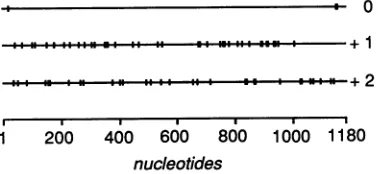
syntheticprimerclosetotheendoftheinsert(positions 990 through 1014) was used for direct RNA sequencing on purified influenza Cvirus vRNA. From theseexperiments,a total length of 1,180 nucleotides was deduced for RNA segment 6 ofinfluenzaC/JJ/50 virus (Fig. 2). This segment codes forone longopen reading frame, which could poten-tially produceaproteinof 374 amino acids with apredicted molecularweight of 41,700. In the two alternative reading frames,thelongestopenreading framecodesforapeptideof only41 amino acids
(Fig.
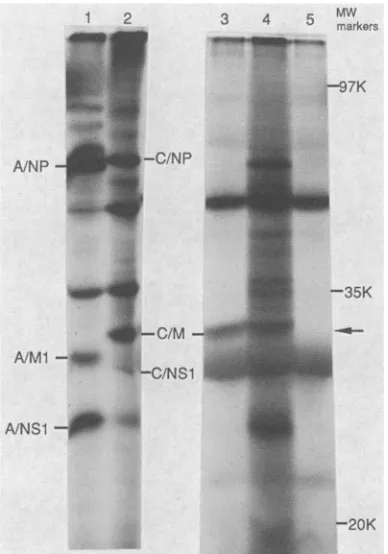
3).Coding assignmentfor RNAsegment6. Inorderto answer the question of which viral protein is encoded by RNA segment6,mRNAfrom influenza C virus-infected cellswas purified by hybridselectionby using pCM144DNAboundto nitrocellulose filters. The segment 6-specific mRNA was thentranslated inarabbitreticulocyte
lysate
(Fig.4), and the products were analyzed on polyacrylamide gels. The only RNA 6-specific protein detected under these experimental conditions migrated in the similar position to the matrix VOL.62, 1988on November 10, 2019 by guest
http://jvi.asm.org/
[image:2.612.376.502.70.377.2]AGCAGAAGCAGGGGATTTCTAAACA ATG GCA CAT GAA ATA CTG ATT GCT GAA ACA GAG GCA TTT CTA AAA AAT GTT GCT CCT GAG ACC AGG ACA GCA ATA 100 Met Ala His Glu Ile Leu Ile Ala Glu Thr Glu Ala Phe Leu Lys Asn Val Ala Pro Glu Thr Arg Thr AlaIle 25
ATT TCA GCA ATA ACA GGAGGAAAA TCA GCC TGC AAA TCA GCA GCT AAA CTGATTAAGAAT GAA CAT CTT CCC CTA ATG TCT GGA GAA GCC ACC ACA ATG 199 Ile Ser Ala Ile Thr Gly Gly Lys Ser Ala Cys Lys Ser AlaAla Lys LeuIle Lys Asn Glu His Leu Pro Leu Met Ser Gly Glu Ala Thr Thr Met 58
CAC ATC GTT ATG AGG TGC TTA TATCCT GAA ATA AAA CCA TGG AAA AAG GCAAGC GAC ATG CTGAAT AAA GCA ACT TCT AGT TTGAAA AAA TCA GAA GGA 298 HisIle Val Met Arg Cys Leu Tyr Pro Glu Ile Lys Pro Trp Lys Lys Ala Ser Asp Met Leu Asn Lys Ala Thr Ser Ser Leu Lys Lys Ser Glu Gly 91
u II
AGA GAC ATA AGAAAG CAA ATG AAA GCA GCT GGA GAC TTC TTG GGA GTG GAG TCA ATG ATG AAA ATG AGG GCC TTC AGA GAT GAC CAA ATA ATG GAA ATG 397 Arg Asp Ile Arg Lys Gln Met Lys Ala Ala Gly Asp Phe Leu Gly Val Glu Ser Met Met Lys Met Arg Ala Phe Arg Asp Asp GlnIle Met Glu Met 124
GTT GAA GAA GTA TAT GAT CAC CCA GAC GAC TAC ACA CCA GAC ATC CGA ATA GGA ACA ATC ACA GCT TGG TTG AGA TGC AAA AAC AAG AAA AGT GAA AGA 496 Val Glu Glu Val Tyr Asp His Pro Asp Asp Tyr Thr Pro Asp Ile ArgIle Gly ThrIle Thr Ala Trp Leu Arg Cys Lys Asn Lys Lys Ser Glu Arg 157
TAC AGG AGTAAT GTC TCA GAA AGT GGA AGA ACA GCT TTA AAA ATT CAT GAA GTA AGA AAA GCC AGC ACA GCA ATTAAC GAG ATT GCT GGT ATT ACT GGC 595 Tyr Arg Ser Asn Val Ser Glu Ser Gly Arg Thr Ala Leu Lys Ile His GluVal Arg Lys Ala Ser Thr AlaIle Asn Glu Ile Ala GlyIle Thr Gly 190
Bal I
CTT GGA GAA GAA GCA CTA TCT CTCCAA AGA CAA ACA GAA AGT TTG GCC ATA TTA TGTAAT CAC ACT TTT GGA AGTAAT ATA ATG AGA CCC CAC TTG GAA 694 Leu Gly Glu Glu Ala Leu Ser Leu Gln Arg Gln Thr Glu Ser Leu Ala Ile Leu Cys Asn His Thr Phe Gly Ser AsnIle Met Arg Pro His Leu Glu 223
AMA GCAATA AAA GGA GTT GAA GGC AGA GTT GGA GAG ATG GGA CGA ATG GCAATG AaA TTA GTT GTT ATA ATA TGT TTC TCT ATA ACA AGT CAA CCT 793 Lys AlaIle Lys Gly Val Glu Gly Arg Val Gly Glu Met Gly Arg Met Ala Met Lys(End)Trp Leu Val Val242 Ile Ile Cys Phe Ser Ile Thr Ser Gln Pro
GCT TCT GCT TGCAAT CTAAAG ACC TGT CTA AAA CTA TTT AAC AAT ACT GAT GCG GTA ACT GTT CAT TGT TTTAAT GAA ACC CAA GGA TAC ATG CTA ACA 892 Ala Ser Ala Cys Asn Leu Lys Thr Cys Leu Lys Leu Phe Asn Asn Thr Asp Ala Val Thr Val His Cys Phe Asn Glu Thr Gln Gly Tyr Met Leu Thr TTA GCC TCT TTG GGA TTA GGG ATA ATT ACT ATG TTG TAT TTA TTA GTAAAA ATC ATA ATT GAA CTT GTCAAT GGT TTT GTG CTC GGC A TGG GAGAGA 991 LeuAla Ser Leu Gly Leu Gly Ile Ile Thr Met Leu Tyr Leu Leu Val LysIleIle Ile Glu Leu Val Asn Gly Phe Val Leu GlyArg Trp Glu Arg TGG TGT GGA GAT ATAAAG ACC ACA ATT ATG CCT GAA ATT GAC TCG ATG GAAAAA GAT ATT GCC CTT TCT AGG GAG AGA CTT GAC CTG GGA GAG GAT GCT 1090 Trp Cys Gly Asp Ile Lys Thr Thr Ile Met Pro Glu Ile Asp Ser Met Glu Lys Asp Ile Ala Leu SerArg Glu Arg Leu Asp Leu Gly Glu Asp Ala CCT GAC GAA ACC GAC ATC TCA CCA ATT CCT TTT TCCAAT GAT GGT ATT TTT GAA ATT TAM TTACCTTGAAAAAATCCCCTTGCTACTGCT 1180
Pro Asp Glu ThrAspIle Ser Pro Ile Pro Phe Ser Asn Asp Gly Ile Phe Glu Ile End
FIG. 2. Completenucleotide sequenceofsegment6ofinfluenza C/JJ/50 virus. The sequence ispresentedin cDNA form(mRNAsense). The pCM144 clone encompasses bases 2 through 1102. The uncloned 3' specific nucleotide sequences were obtained by direct RNA sequencingofvRNA.Restriction enzyme sitesusedforthe preparation of specific RNAprobes (see Fig. 5)areindicated. Verticalarrows indicatethesplice site positionsfor the M protein-specific mRNA. Horizontal arrows indicatethe sequence ofthe mRNA-derived cDNA piecethat wasamplifiedbythepolymerase chainreaction (see Fig. 6). The nucLeotides TG andA(boxed)representthe newlygenerated termination codon in the spliced mRNA. The deducedaminoacid sequence of the M protein is shown in roman type. The amino acid sequences which couldbeencoded by the3'-terminal regionof the full-length RNA are showninitalic type.
proteinof Cvirus-infectedcells.These resultssuggestedthat RNA 6of influenza C virus codesfor the matrixprotein.
Evidence that the matrix protein is encoded by a spliced mRNA. As described above, RNAsegment6ofinfluenza C virus has the coding capacityfor aprotein ofmore than41 kDa. However, analysis of influenza C virus proteins in
i ,0
2
1 200 400 600 800 1000 1180
nucleotides
FIG. 3. Openreading frames ofRNA 6 of influenza C/JJ/50 virus
(mRNA sense). Terminationcodonsareshownby verticallines.
virions, as well as in infected cells, did not reveal the presence ofa major polypeptide species of 41 kDa (10, 13, 37). In order to rule out the possibility that the M protein migrates anomalously in
SDS-polyacrylamide
gels, an RNA transcript of the insert from pCM144 wastranscribedinvitro by using T3polymerase. In arabbit reticulocytetranslation system, this transcript directed the synthesis of a product thatmigrated as predicted from thesequence in the position of a40-kDa protein onpolyacrylamidegels(data notshown). Since the openreading frame in RNA 6potentially codes for aproteinapproximately 15 kDa larger than the viral M protein, attempts were made to analyze the Mgene-specific mRNA species in virus-infected cells. A Northern blot analysis of poly(A)-enriched infected-cell RNA using pCM144 DNA as a probe is shown in Fig. 1 (lane 3). An intense diffuse band is present which is 100 to 200 nucleo-tidesshorter thanfull-lengthsegment 6. Inaddition, a sharp bandmigratingidentically with full-length segment 6 (lane 1) ispresent. This latter band is probably the result ofon November 10, 2019 by guest
http://jvi.asm.org/
[image:3.612.91.280.615.702.2]M PROTEIN OF INFLUENZA C VIRUS 3351
3 4 5
ma
markersVA,__,'
-97K
A/NP
A/l
-W
A/NS
-*
-35K
-1>
-20K
FIG. 4. In vitro translation of pCM144 hybrid-selected mRNA. Poly(A)+ selected mRNA of influenza C virus-infected cells was
enriched for RNA segment 6-specific sequences by binding to
nitrocellulose filters containing pCM144 DNA, followed by elution
at 100°C. Translation of the eluted mRNA preparation in the rabbit reticulocytelysatewasexaminedby polyacrylamide gel electropho-resis of the [35S]methionine-labeled product. Lane 1, Influenza A/ PR/8/34 virus-infected MDCK cells labeled with [35S]methionine
underhypertonic conditions; lane 2, influenza C/JJ/50 virus-infected
MDCK cellslabeled with[35S]methionine underhypertonic condi-tions; lane 3, hybrid-selected mRNA preparation of C/JJ/50 virus-infected MDCK cells translated in the reticulocyte lysate; lane4,
total poly(A)+ RNA preparation ofC/JJ/50 virus-infected MDCK
cellstranslatedinthereticulocytelysate;lane5, reticulocytelysate
withnoexogenousRNAadded. The gel positions of the influenza A or C virus NP, M, and NS proteins are indicated. The arrow
highlights the gel position of the influenza C virus M protein. MW,
Molecularweight; K, molecular weight in thousands.
ination by vRNA or full-length template RNA in samples
selectedoveroligo(dT) columns.
Itwasspeculatedthat thesmaller RNAseeninFig.1may
be the result of a splicing event. In order to test this hypothesis, Si nuclease protectionassays were done using
probesderivedfrompCM144.PlasmidpCM144wasdigested
with either BalI, PvuII, or XbaI. Transcription with T7
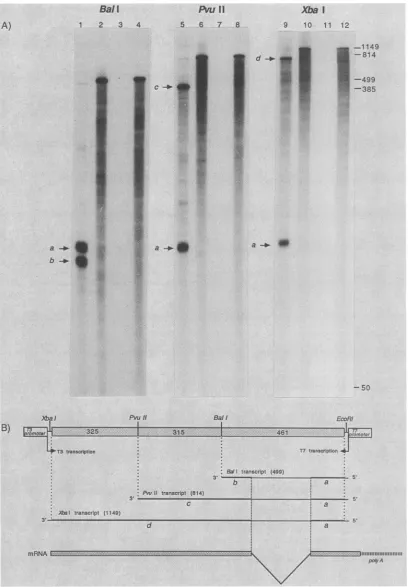
polymerase yielded minus-sense probes of 499, 814, and 1,149 nucleotides, respectively (Fig. SB). After gel purifica-tion, these probes were hybridized to total poly(A)+ RNA (theRNAsamplewhichwasused inFig. 1)and subjectedto Si digestion and polyacrylamide gel electrophoresis analy-sis. Si analysis of eachofthe threeprobes after hybridiza-tion with the poly(A)+ RNApreparationfrominfected cells resulted in an identical intense band ofapproximately 100
nucleotides(band labeleda; Fig. 5A, lanes 1, 5, and 9). The
BalI probe produced an additional intense band with an
approximate length of 90 nucleotides (band b), while the PvuII andXbaIprobes produced bands of approximately400 (band c) and 750 (band d) nucleotides, respectively. As a
control, probe RNA was hybridized with unlabeled RNA produced by T3 transcription of EcoRI-digested pCM144 (Fig. SA,lanes2, 6, 10). These resultsareconsistent with the model showninFig. SB. The band labeledacorrespondsto thefragment located3' to thesplice junctionand isprotected byall threeprobes.Bands labeled b, c,and dcorrespondto fragments located 5' tothesplice junction; they vary dueto the differentlengths of the RNA probes. In this model forthe mRNAof the matrix protein, approximately 250 bases are splicedout nearthe 3' end of the message.
Inadditionto the intense bands seen in lanes1, 5,and 9 of Fig. 5A, minor bands are alsoapparent. For eachprobe, a minor band isseen at aposition correspondingtothe sizeof an unspliced transcript. Although this may be due to con-tamination of the poly(A)+ RNA with trace amounts of full-length templateRNA(Fig. 1,lane3), wecannot rule out thepresence of smallquantities ofunspliced RNA segment 6-specificmRNA.
Identification of the splice site of RNA segment 6-specific mRNA. The data inFig. 5 suggest that the 5' and3' splicing sites for the mRNA of M protein are located around posi-tions 750 and1000, respectively. For precise identificationof the splicing site, direct sequencing of the poly(A)+ RNA preparationwithaprimer (positions 1040 through 1019 inthe vRNAsense) was attempted. In this way, the splicing sites weretentatively identifiedatnucleotide 753(5' splicing site) and nucleotide 981(3' splicing site) (data not shown). In a confirmatory experiment,cDNAwasproduced bythe poly-merasechain reaction anddirectly sequenced. First, cDNA was synthesizedfrom poly(A)+ RNAisolatedfrom infected cells using reverse transcriptase and an oligonucleotide primer (positions 1040 through 1019 in the vRNA sense). Polymerase chain reaction-amplified DNA was then ob-tainedby usingthecDNAasthetemplate andTaq polymer-aseandtwooligonucleotide primers (positions1040through 1019in the vRNAsenseandpositions557through576 inthe mRNAsense). Theamplified fragmentofexpectedsizewas purified on an 8% polyacrylamide gel, and the cDNA was sequenced directly by using an oligonucleotide (positions 1040 through 1019 in the vRNA sense) as a primer in a dideoxy sequencing reaction. The results shown in Fig. 6 confirm that splicing occurred between nucleotide 753 (5' splicing site) and nucleotide 981 (3' splicing site). Although the position ofthe splicing site would not shift the reading frameoftheprotein, it isinterestingthat thesplice junction creates atermination codon (Fig. 2). Therefore, the spliced mRNAofthematrixproteinencodesan openreadingframe ofonly242 amino acids.
DISCUSSION
Theentire sequenceofRNA segment 6of influenzaC/JJ/ 50 virus was determined.
Analysis
ofthe sequence (1,180 nucleotides) revealed only one long open reading frame which couldpotentiallycode foraproteinof 374 aminoacids with anestimated molecularweightof41,700. Although the matrix (M)proteinof influenzaC/JJ/50 viruswas shown by hybrid selection experiments to be coded for by RNA segment 6, the apparent size of the matrix protein (approx-imately 28kDa)was much smaller than that predictedfrom the deduced sequence. Initial evidence for a processed mRNA speciescamefrom Northern blots, which showeda diffuse RNAsubstantially
shorter thanfull-length
segment6 vRNA (Fig. 1). Si nuclease analysis then confirmed the splicing event, and sequencing of anamplified
cDNA de-rived fromanmRNApreparation
allowedlocalizationof the VOL.62,1988on November 10, 2019 by guest
http://jvi.asm.org/
[image:4.612.91.285.69.346.2]Ball
A) 1 2 3
PWvui
4 5 6 7
Xha
8 9 10 11 12
I* _~1149
d__ -814
- ~-49
W 31 -385
''
e.
-50
ECfRi
I~~~~~~~~~~~~~~~~~::6I
IB) roou 325 3e'135 481 rmt-;;-rvw
T3 transcription
: at transcript (1149)
: Balt transcript (499) 3'-* ,
b
PvuIt transcript (814)
,M..
C
FIG. 5. Si nucleaseanalysis ofRNAsegment6-specific splicedmRNA.(A) RadioautogramofSi nucleaseanalysis.Three different RNA segment6-specific probeswerepreparedfromBall-, PvuII-,orXbaI-digested pCM144DNAby usingT7polymerase (asshownatthetop of thegel). Probeswere hybridized withpoly(A)+ RNA from infected cells(lanes 1, 5, and9) orwithmessage-sense RNA, whichwas
transcribedby T3 polymerase from EcoRI-digested pCM144 (lanes 2, 6,and10). Sampleand control(lanes 3, 7,and11)werethendigested with Si nuclease.Lanes4, 8,and12showundigested probe. Sampleswereanalyzedon6.5%polyacrylamide gels.Numbers shownonthe
rightindicatenucleotide length of markers. (B)Diagrammatic representationofresultsfromS1 analysis. The sites usedtodigesttheDNA
areillustratedwithinthepCM144 cDNA insert. Numbersinstippledboxes indicate nucleotidelength.Direction ofpolymerase transcription isshown,andnumbers in parentheses identify the length oftheprobesused. Bold lines oftranscriptsindicate Si nuclease-resistantregions
as shownin theanalysis. Lettersunder the lines correspondtobandsidentified in panelA. Theproposed structureof the splicedRNA
6-specificmRNAisshownonthebottom ofthepanel.
3352
-1
I _
sC_-fi sr r _
i- _
L S5Ew _S
Fs :r.ir: _
F :o,,:, _
e _
t S. e_ w
.. _!
:_: _.
., j,
._.
.s
,...
:
*:'#.
:
.:':
*:
::
-a __
F
-_
-_
-_
-_
_ _: _F
-_.
:
._. ._ _.
_
_
-_
_
_5.
.g
}X.
*.t
*tn, +..Xme...-. ..
a _ w t
b _ t
.t.
*:
j*:
.: 5,j, :: *s:'
...w.
XbI I PvuIt Ball
T7 transcription
d
mRNA
a
a
a
5, 5.
5.
[image:5.612.101.509.40.627.2]pofA
... ... :.:..
.-:1.'.-,-..:.:.:-',-,'-..:-:.:".,..:... 2:2ii:;l
k o
;:-::':111111
l lilII
lifi lli ll 1 1lon November 10, 2019 by guest
http://jvi.asm.org/
M PROTEIN OF INFLUENZA C VIRUS 3353
TC
AT
c AT
FIG. 6. Sequencing of splice site of mRNA. Adouble-stranded cDNA copy of the region around the splice site of the RNA 6-specific mRNA was obtained by a polymerase chain reaction describedin Materials andMethods.Theamplifieddouble-stranded DNA was separated by polyacrylamide gel electrophoresis, iso-lated, and sequenced directly. Nucleotides around the splice junc-tion(arrow) are shown. Sequencing was in the vRNA-sense direc-tion.
5' splicing site and 3' splicing site (nucleotides 753 and 981, respectively). This spliced mRNA could code for aprotein of 26,970daltons, which is in agreement with the measured size of the M protein. Interestingly, the splicing event itself introduced a stop codon (TGA), with the TG coming from the 5' splicing site and the A coming from the 3' splicing site. In addition to the size argument mentioned above, several lines of evidence suggest that the spliced mRNA (rather than theunspliced form) gives rise to the M protein of influenzaC virus. (i) Northern blotting shows that the major RNA segment 6-specific mRNA species in infected cells is an
RNA which is shorter than full-length RNA segment 6 (Fig. 1). (ii) Si analysis reveals that themajor signal derives from the spliced mRNA species and not from full-length tran-scripts (Fig. 5A). (iii) Direct sequencing ofpoly(A)+ RNA and polymerase chain reaction-amplified cDNA show that the spliced mRNA is the major form (Fig. 6).
It is interestingthat the splicing pattern of the influenza C virus M gene is so different from that of influenza A and B viruses. With respect to the latter virus types, the matrix proteins are coded for by unspliced mRNAs; a spliced mRNA, which is not the major M gene-specific species, directs the synthesis of the M2 protein in influenza A virus-specific cells (4, 18, 20). This contrasts with the situa-tion in influenza C viruses, in which the major mRNA species is spliced and appears to code for the structural matrixprotein.
It should be noted that small quantities of an mRNA colinear with RNA 6may exist, since a faint signalfor such a species is observed following Si analysis (Fig. 5). The protein translated from an unspliced mRNA would contain the entire M proteinsequence, with an additional 132amino acids tacked on to the carboxy terminus. The additional amino acids, as deduced from the sequence, are mostly hydrophobic and could change the properties of the M protein in a dramatic way. However, at this point, no evidence for the expression of a second long M protein of influenza C viruses has been obtained.
Comparing the M proteins ofall influenzavirustypes,it is interesting that they have a similar length of approximately 250 amino acids (2, 4, 36). However, sequence homologies between the M proteins are low (Fig. 7). The greatest homology is between A and B type M proteinsand amounts
AIM [TLAEFG[~ GLLSVE V I SPS E G E TLD
C2MAHII A IIKLL`A Y LNVA GWED G R E K H C W FLG..aL]E FA D.JAL
A H E I I AIEIT
IEi
AlS
FKN
V ALE
TR TL.I
I S A I T I:GKIS
A CK1ASFWLji]T1RPI[ T KG I L GF V F T L T P R G
I.LIK...
BKW2L...KNKR.. ... . CILIT,~~~~~~IQK... .._..[:P.[:ASKCE
K L -E H p.S.MSG E ATm T M H I V M R C L Y .p EI K
A[N
DP N N MD AV Kj Y L K E ITFGAK
B G T AS...S....T KLG L IG R A E R MR RR C V SVD F F
C K A S S L S E G R1 D I -Q A A G Dn VSM
L Q R R tVQ N A - ;
R K-R F I T E
Pj-P W K K A S DMWII
LSYS G[:A.LA SE M
EG H E S L Y C L MI
M K M R F R D D Q I [M
A
G L I N R M G A JV
T E A Fi
L V|K
T[:T
]IrnDHQ[:
HS
RQ
M VB
rnMI|;0Y:I|L
N ENS MQL
KLIGT`L:LCAI|
AIS|H
S H SR A ALUL~~~~~~~~~~~~~~~~~~~~~~~~~~L-CE
MVEE
V
D
HPD
D PD IR I
|I TE
WuRW
KN
K K
TE
R
Y!-RN
VW
E S G
A
jGjT
N[MThI |RKiESiS|NML|y0A#0000XSS$000ST!W:000T0020:A000g
E
MEVRS
EJQ A A
A ME V
AJ
]A
[M
B
R E
S V EEV
E
MVSA
NSAA
MT
MN
GMS
G K
GED V
QKL AE E
N cRaWA
WK I[HjEV
K-
T
A I N E I A IT
LE
LdS
L`T
A VQ
A M T I TP
S
S
AL
K N[L N QA Y QKRMG
V QQ[
F
B I G V L S L A
QK
NICE
G A KVXjIEV
LQ
Sj[gEG1N
S AVR
K YL
C E
S L A I L
C
N TF
G NHP
M RHP
L
K A IGE
G VVLldEEGL]MAM
E
FIG. 7. Comparison of the deduced amino acid sequences of the matrix proteins of influenzaA/PR18134(2,36), B/Lee/40 (4), andC/JJ/50 viruses. Single amino acids conserved between matrix proteins of any two types are in open boxes. Amino acids conserved in the matrix proteins of all three virus types and two or more amino acids conserved in the matrix proteins of two virus types are presented in stippled boxes.The alignment was done using the MicroGenie (Beckman Instruments, Inc., Fullerton, Calif.) program.
VOL. 62, 1988
on November 10, 2019 by guest
http://jvi.asm.org/
[image:6.612.105.255.70.189.2] [image:6.612.63.566.413.684.2].1
-1y
-IV
-2
--3'1
100 200 25
3- ~~~~~~B/Lee/40
2
-A1-
A
u
--2
-.1_
100 200
proteins in influenza viruses. It is suggested, however, that matrix proteins may play a structural role in the assembly andpackaging of the virus and that they possess a regulatory function during RNA synthesis (5, 6, 8, 33). Therefore, attempts will be made to study possible interactions of the influenza C virus M protein with other viral proteins or RNAsduringreplication. Experimentswill also be designed to determine whether analogous to influenza A viruses, M2-like proteins are expressed by influenza C viruses. A possible candidatefor thisactivityis theproteinwhich could be produced bytheunsplicedMgene-specificmRNA. This protein would possess, in addition to the 242 amino acids of the M protein, an extra carboxy-terminal domain of 132 amino acids. From the deduced sequence, this domain contains hydrophobic amino acids which may represent an M2-like membrane-spanning segment.
2
ACKNOWLEDGMENTS
WethankS. Minato, director of Bioscience Research Laborato-ries,Sankyo Co. Ltd., forsupporting the sabbatical leave ofM.Y. at theMountSinai Schoolof Medicine.
This workwasalsosupported by grantsfromtheAlexandrineand AlexanderSinsheimerFoundation, the CharlesH. Revson Founda-tion, and the National Foundation for InfectiousDisease(M.K.)and by Public Health ServicegrantsAI-11823 and AI-18998(P.P.)from theNational Institutes of Health.
248
1 00 20a0 242
amino acid position
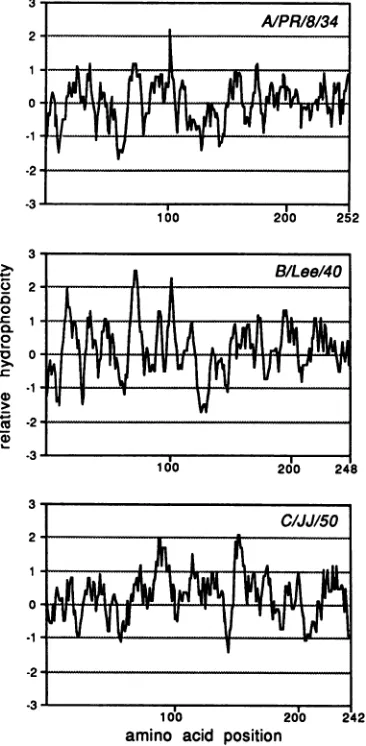
FIG. 8. Comparison of hydrophobicity plots of matrix proteins of influenzaA/PR/8134(2, 36),B/Lee/40(4),andC/JJ/50viruses. The MicroGenie (BeckmanInstruments,Inc.) program was usedforthe analysis.
to approximately 30%. Between A and C type and between B and C type M proteins, homologies are only about 20%. The conserved amino acids are spaced throughout the mol-ecules, but no stretch of more than three amino acids is conservedbetweenA andC or B andCtype Mproteins. In addition, hydrophobicity patternsofthe M proteinsare not superimposable (Fig. 8). Nevertheless, thereisaclear evo-lutionary relationship between the M genes of influenza C virus and thoseof influenza A and B viruses. For example, there are eight different regions in the influenza C virus M proteinwhich arehomologous (three out of four amino acids identical) with sequences in the influenza A or B virus M proteins.
It is not known whether the splicing pattern of the M mRNA is common to all isolates of influenza C viruses. However, Sugawaraet al. (34) reported that the Mproteins of sevendifferent influenzaCvirusisolates, includingthatof C/JJ/50 virus, have similar migration patterns on SDS-polyacrylamide gels. Furthermore, peptide maps ofthese proteinswere similar, suggesting that the structure of these proteins(and possiblythe splicingpatternof their mRNAs) is well conserved among the influenza C viruses.
Little is known about the precise function of matrix
LITERATURE CITED
1. Air, G. M., and R. W. Compans. 1983. Influenza B and C viruses, p. 280-304. In P. Palese and D. W. Kingsbury (ed.), Genetics of influenza viruses. Springer-Verlag, Vienna. 2. Allen, H., J.McCauley,M.Waterfield, and M.-J. Gething.1980.
Influenza virusRNAsegment 7has thecoding capacity fortwo polypeptides. Virology 107:548-551.
3. Ausubel, F. M., R. Brent, R. E. Kingston, D. D. Moor, J. A. Smith, J. G. Seidnian, and K. S. Struhl (ed.). 1987. Current protocolsinmolecularbiology. John Wiley & Sons, Inc.,New York.
4. Briedis, D. J., R. A. Lamb, and P. W.Choppin. 1982.Sequence ofRNA segment 7of influenzaB virusgenome: partial amino acidhomology between the membrane proteins (Ml) of influ-enzaAandBviruses and conservation ofasecondopenreading frame. Virology 116:581-588.
5. Bukrinskaya, A.G.,N. K.Vorkunova, G. V.Kornilayeva, R. A. Normanbetova, and G. K. Vorkunova. 1982. Influenza virus uncoating in infected cells and effect of rimantadine. J. Gen. Virol.60:49-59.
6. Bukrinskaya,A.G., N. K.Vorkunova,and N. L.Pushkarskaya. 1982. Uncoating ofarimantadine-resistant variant of influenza virus inthe presenceof rimantadine. J.Gen. Virol.60:60-66. 7. Buonagurio, D. A., S. Nakada, J. D. Parvin, M. Krystal, P.
Palese, and W. M. Fitch.1986.EvolutionofhumaninfluenzaA virusesover50 years:rapid, uniformrateofchangeinNSgene. Science 232:980-982.
8. Choppin,P.W.,R. W.Compans,A.Scheid, J.McSharry,and S. Lazarowitz. 1972. Structure andassemblyof viralmembranes, p. 163-179. InC. F. Fox(ed.),Membraneresearch. Academic Press, Inc., NewYork.
9. Cochet,M.,F.Permin,F.Gannon,A.Krust,and P.Chambon. 1979. Cloning of an almost full-length chicken conalbumin double-strandedcDNA. Nucleic AcidsRes.6:2435-2452. 10. Compans, R. W., D. H. Bishop, and H. Meier-Ewert. 1977.
Structuralcomponentsof influenzaC virions.J. Virol. 21:658-665.
11. Desselberger, U., V.R.Racaniello, J. J. Zazra, andP. Palese. 1980. The 3' and 5'terminalsequences of influenzaA, Band C virus RNA segments are highly conserved and show partial invertedcomplementarity. Gene8:315-328.
12. Gubler,U., and B.J.Hoffman.1983. Asimpleandveryefficient method forgeneratingcDNAlibraries.Gene25:263-269. A/PR/8/34
k~1A11
T1T
(V1_
IQ
.5
0
0
t-8)
J J
----1,11 A
.i
A1J
2
1 A
I
Irli II
-1-w-JA
I
I---e%
on November 10, 2019 by guest
http://jvi.asm.org/
[image:7.612.93.276.73.446.2]M PROTEIN OF INFLUENZA C VIRUS 3355
13. Herrler, G., R. W. Compans, and H. Meier-Ewert. 1977. A
precursorglycoprotein in influenza C virus. Virology 99:49-56. 14. Herrler, G., R. Rott, H.-D. Klenk, H.-P. Mueller, A. K. Shukla, and R. Schauer. 1985. The receptor-destroying enzyme of
influenzaC virus isneuraminate-O-acetylesterase. EMBO J. 4: 1503-1506.
15. Kendal, A. P. 1975. A comparison of influenza C virus with
prototype myxovirus: receptordestroying activity (neuramini-dase) andstructural polypeptide. Virology 65:87-89.
16. Kilbourne, E. D. 1975. The influenza viruses and influenza. Academic Press, Inc., New York.
17. Lamb, R. A.1983. The influenza virus RNAsegmentsand their encoded proteins,p. 21-69. In P. Paleseand D. W. Kingsbury
(ed.), Genetics of influenza viruses. Springer-Verlag, Vienna. 18. Lamb, R. A., and P. W. Choppin. 1981. Identification ofa
second protein (M2) encoded by RNA segment7 ofinfluenza virus. Virology 112:729-737.
19. Lamb, R. A., andC.-J. Lai.1981.Conservation of the influenza virusmembrane protein (Ml) amino acidsequenceandan open
reading frame of RNA segment 7 encoding a second protein
(M2) in HlNl and H3N2 strains. Virology 112:746-751. 20. Lamb, R. A., S. L. Zebedee, and C. D. Richardson. 1985.
Influenza virus M2 protein is an integral membrane protein
expressed ontheinfected cell surface. Cell 40:627-633.
21. Maniatis, T., E. F. Fritsch, and J. Sambrook. 1982. Molecular cloning:alaboratory manual. ColdSpring Harbor Laboratory, ColdSpring Harbor, N.Y.
22. Nakada,S., R. S. Creager, M.Krystal, R. P. Aaronson,and P.
Palese. 1984. Influenza C virushemagglutinin: comparison with influenza A and B virushemagglutinins. J. Virol. 50:118-124. 23. Nakada, S., R. S. Creager, M. Krystal, and P. Palese. 1984.
Complete nucleotide sequenceof the influenzaC/California/78 virusnucleoproteingene. Virus Res. 1:433-441.
24. Nakada, S., P. N. Graves, U. Desselberger, R. S. Creager, M.
Krystal, and P. Palese. 1985.Influenza C virus RNA 7codes for
anonstructural protein. J. Virol.56:221-226.
25. Nuss, D. L., H. Oppermann, and G. Koch. 1975. Selective blockage of initiation of host protein synthesis in
RNA-virus-infectedcells. Proc. Natl. Acad. Sci. USA 72:1258-1262. 26. Ohuchi, M., R. Ohuchi, and K.Mifune. 1982.Demonstrationof
hemolyticand fusionactivities of influenzaC virus. J.Virol.42: 1076-1079.
27. Palese, P., and J. F. Young. 1983. Variation ofinfluenza A, B andC viruses. Science 215:1468-1474.
28. Pfeifer, J. B., and R. W. Compans. 1984.Structure of influenza Cglycoprotein gene as determined from cloned DNA. Virus Res. 1:281-296.
29. Poncz, M., M. Solowiejczyk, E. Ballantine, E. Schwartz, and S. Surrey.1982. "Nonrandom" DNAsequenceanalysis in bacte-riophage M13 by the dideoxy chain-termination method. Proc. Natl. Acad. Sci. USA79:4298-4302.
30. Ritchey, M. B., P. Palese, and E. D. Kilbourne. 1976. RNAs of influenzaA, B,and C viruses.J. Virol. 18:738-744.
31. Saiki, R. K., D. H.Gelfand, S. Stoffel, R. Higuchi, G. T. Horn, K. B.Mullis, and H. A. Erlich. 1988. Primer-directedenzymatic amplification ofDNA with a thermostable DNApolymerase. Science239:487-491.
32. Sanger, F., S. Nicklen, and A. R. Coulson. 1977. DNA sequenc-ing with chain-terminating inhibitors. Proc. Natl. Acad. Sci. USA74:5463-5467.
33. Schultze, I. T. 1972. The structure of influenza virus. II. A model basedonmorphology and composition of subviral parti-cles. Virology47:181-196.
34. Sugawara, K., K. Nakamura, and M. Homma. 1983.Analyses of structuralpolypeptides ofsevendifferent isolates ofinfluenzaC virus. J.Gen. Virol. 64:579-587.
35. Vlasak, R., M. Krystal, M. Nacht, and P. Palese. 1987. The influenza C virusglycoprotein (HE) exhibits receptor-binding (hemagglutinin) and receptor-destroying (esterase) activities. Virology 160:419-425.
36. Winter, G., and S. Fields.1980.Cloning ofinfluenza cDNAinto M13:thesequenceof theRNAsegmentencodingtheAIPR/8/34 matrixprotein. Nucleic AcidsRes.8:1965-1974.
37. Yokota, M., K. Nakamura, K.Sugawara,and M.Homma.1983. The synthesis of polypeptides in influenza C virus-infected cells. Virology 130:105-117.
VOL. 62,1988