
City, University of London Institutional Repository
Citation:
Che, X. and Klumpp, T. (2016). Entry Deterrence in Dynamic Second-Price Auctions. American Economic Journal: Microeconomics, 8(2), pp. 168-201. doi:10.1257/mic.20140137
This is the accepted version of the paper.
This version of the publication may differ from the final published
version.
Permanent repository link:
http://openaccess.city.ac.uk/22461/Link to published version:
http://dx.doi.org/10.1257/mic.20140137Copyright and reuse: City Research Online aims to make research
outputs of City, University of London available to a wider audience.
Copyright and Moral Rights remain with the author(s) and/or copyright
holders. URLs from City Research Online may be freely distributed and
linked to.
Entry Deterrence in Dynamic Second-Price Auctions
∗
Xiaogang Che† Durham University
Tilman Klumpp‡ University of Alberta February 2016
Abstract
We examine a dynamic second-price auction with independent private values and sequential costly entry. We show that delayed revelation equilibria exist in which some buyers with sufficiently high valuations place coordinated low early bids, and bid their true valuations just prior to the end of the auction. Compared to the benchmarkimmediate revelation equilibrium, in which buyers bid their true values immediately after entry, fewer high-value bidders enter on expectation in some delayed revelation equilibria. We show that delayed revelation of buyer values decreases social welfare, but is necessary for bidders to have a strict participation incentive. Computations suggest that the welfare effect of delayed revelation consists primarily of transfer of surplus from the seller to bidders, while efficiency losses are relatively small.
Keywords: Dynamic second-price auctions, costly entry, sequential entry, bidder collusion, entry deterrence, early bidding, late bidding, incremental bidding.
JEL codes: D44, D83
∗
We thank Kunal Sengupta and Birendra Rai for insightful discussions and comments. We also thank Murali Agastya, Benjamin Bernard, Jian Hong, Hajime Katayama, Shravan Luckraz, Artyom Shneyerov, Abhijit Sengupta, Sergei Severinov, Yibai Yang, and John Wooders for helpful comments. This paper benefited from discussions at the Canadian Economic Theory Conference 2013, the 24th International Conference on Game Theory at Stony Brook, and seminars at the University of Sydney, Durham University, West Virginia University, Monash University, and the University of Nottingham (Ningbo campus).
†
Durham University Business School, Millhill Lane, Durham DH1 3LB, United Kingdom. E-mail: xiaogang.che @durham.ac.uk.
‡
1
Introduction
In dynamic auctions, a buyer’s decision to participate often depends on earlier bids submitted by
other buyers. For example, auctions on online marketplaces such as eBay typically run for many
days, and when a potential buyer discovers an auction for an item of interest several bids may have
already been placed. This buyer must then decide whether to participate and place his own bid,
or walk away. Participation is not costless, as a buyer needs to assess the condition of the item,
shipping charges to the buyer’s location, and so on, all of which may influence his willingness to
pay. On the other hand, information summarizing past bidding activity in the auction—the current
auction price, the price history, or the number of bids—is often readily available and can be used in
the potential buyer’s decision to participate.
To examine the interaction between bidding strategies and participation decisions in such settings,
we consider a single-object, second-price auction with independent private values and costly entry.
The auction is open during a fixed number of time periods. In each period one risk-neutral potential
bidder arrives, observes the price history, and decides whether to participate in the auction. If the
bidder decides to participate, he incurs a non-refundable entry cost, learns his private valuation,
and is then free to bid in every period thereafter. At the end of each period, the price is updated to
the second-highest bid thus far submitted. At the end of the final period, the highest bidder wins
and pays the ending price.
We show that multiple bidding equilibria exist that differ in terms of the expected number of
entering bidders, expected final price, and expected payoffs obtained by the buyers and the seller.
In all equilibria, buyers enter at sufficiently low prices, and every participating buyer eventually bids
his valuation. What happens before that, however, depends on which equilibrium is being played.
Let us begin by describing two equilibria:
1. In the first,immediate revelation equilibrium, a bidder enters if and only if the current price
is below some cutoff price p∗1. Then, if the bidder’s value exceeds the current auction price, he submits exactly one bid equal to his valuation immediately after entry. Once the auction
price reaches p∗1, entry ceases. This will be the case after two bidders with valuations above
2. In the second, simple delayed revelation equilibrium, a bidder enters if and only if the current
price is below a different cutoff price,p∗2 < p∗1. The entering bidder then bids as in the first equilibrium, with one exception: if the bidder’s valuation exceedsp∗2, he submits a bid equal top∗2. Once the auction price reaches p∗2 all further entry is deterred; this will be the case after two bidders with valuations abovep∗2 have entered. These two bidders then submit a pair of truthful late bids in the final period, and the one with the higher valuation wins and pays the
next highest valuation. Becausep∗2< p∗1, fewer bidders enter on average in this equilibrium than in the first.
The second equilibrium is tacitly collusive, in the following sense: By coordinating their opening
bids on the same low value, two of the early arriving bidders effectively deter participation by
potential rivals who would have entered in the first equilibrium (we will explain in a moment why
this is the case). These two bidders use the final period to compete against each other in a single
Vickrey auction to allocate the object among themselves. Because some potential competition is
eliminated, the expected surplus of these bidders is larger in the second equilibrium than in the
first. On the other hand, the expected price the seller obtains is lower in the second equilibrium.
How does “entry deterrence by bidding low” work? Consider an arriving bidder’s decision to
enter, which depends on the expectation this bidder holds about the valuations of competing bidders,
conditional on observed prices. This expectation, in turn, depends on the bidding strategies used
by competing bidders. In both equilibria discussed above, the auction price at any time provides
a lower bound on the highest valuation among currently participating bidders. The conditional
distribution of this valuation above its lower bound is different across the two equilibria, however.
In the first (immediate revelation) equilibrium, for any observed price exactly one participant has a
valuation above that price. The threshold pricep∗1 is then the price at which a potential entrant becomes indifferent between walking away from the auction and paying the entry cost for the right to
compete against one bidder with valuation abovep∗1. In the second (delayed revelation) equilibrium, the same is true except when the price is exactlyp∗2. In this case, the arriving bidder must believe that there aretwo participants with valuations above p∗2. Now set p∗2 equal to the price at which a potential entrant becomes indifferent between walking away from the auction and competing against
one,p∗2 < p∗1. Thus, two bidders who coordinate their bids onp∗2 can stop entry earlier than they would be able to if they revealed their valuations immediately after entry.1
After having established the basic mechanics of entry deterrence, we proceed to construct a
larger class of delayed revelation equilibria, in which more than two bidders coordinate their bids.
This is not a trivial extension of the two-bidder case. For example, one may wish to construct an
equilibrium in which three bidders coordinate their bids on p∗3—the price at which a new entrant becomes indifferent between walking away and competing against three rivals with valuations above
that price. But since the auction is still a second-price format, the communication possibilities that
the price mechanism provides are limited. In particular, the auction price will equal p∗3 once the firsttwo bidders have submitted bids equal top∗3. This difficulty is solvable, provided the history of past bids (and not only the price sequence) is observable. Under this assumption, a third type of
equilibrium exists in which three or more bidders delay revelation of their values in order to deter
entry by later arriving bidders. These equilibria involve a phase during which bidding proceeds in
small, gradual increments:
3. In anincremental bidding equilibrium withk coordinating bidders, the first two buyers with
valuations above p∗k bidp∗k. These bidders, along with any additional bidders whose valuations
are sufficiently high, then bid the previous period’s price plus a small incrementε in every
period (provided this does not exceed a bidder’s true valuation). Once kbidders have done so
in a single period, it is common knowledge that the valuations of kparticipants are above p∗k.
From this moment on, entry is deterred. The kbidders whose valuations are above p∗k now
wait until the final period, at which time they reveal their valuations to allocate the object
among themselves.
Bidding behavior in our delayed revelation equilibria is consistent with several empirical
reg-ularities observed in online auctions. First, on expectation, there is a concentration of bidding
activity in both the early periods of the auction and in the final period. Second, some participating
buyers submit more than one bid, and, in some equilibria, submit many small incremental bids.
These patterns have been documented in a large empirical literature on internet auctions, which
we review in the next section along with existing models that can explain these observations. Our
results provide a different and, to our knowledge, new explanation. We show that early bidding,
1
late bidding, and multiple and incremental bidding, emerge together as equilibria of a dynamic
second-price auction with costly entry.
Finally, we characterize some welfare properties of our equilibria. We show that social welfare is
highest in the immediate revelation equilibrium and then decreases as one moves through the set
of delayed revelation equilibria in whichk= 2,3, . . . bidders coordinate their bids. We also show
that buyers obtain a zero expected surplus in the immediate revelation equilibrium, and a positive
surplus in all delayed revelation equilibria. This implies that delayed value revelation is necessary
for buyers to have a strict participation incentive in dynamic second-price auctions with costly entry.
As far as the seller’s ranking is concerned, expected revenue is higher in the immediate revelation
equilibrium than in the simple delayed revelation equilibrium, and if buyer valuations are uniform
the immediate revelation equilibrium maximizes seller’s revenue across all equilibria.
The remainder of the paper is organized as follows. In Section 2 we review previous research on
bidder collusion, auctions with endogenous entry, and online auctions, and locate our paper within
this literature. In Section 3 we introduce our model. In Section 4 we characterize bidders’ optimal
entry decisions, given their beliefs and the bidding strategies of others. In Section 5, we construct
the immediate revelation equilibrium and the delayed revelation equilibrium, and in Section 6 we
construct incremental bidding equilibria. Section 7 contains our comparative results. Section 8
concludes with a discussion of some implications of our results for auction design. Most proofs are
in the Appendix.
2
Relation to the Literature
Our paper is related to three strands of previous work: The literature on auctions with endogenous
entry, the literature on bidder collusion, and the literature on bidding behavior in online auctions.
Below, we review previous research in each of these areas and place our model in relation to the
existing literature.
Auctions with endogenous participation. The literature on endogenous participation in auctions can
be divided into two main branches. The first branch originated in work by McAfee and McMillan
(1987) and Levin and Smith (1994) and assumes that potential bidders do not know their valuations
when making their entry decisions. Bidders learn their types after paying an entry cost, which
cost of introspection, or the monetary or time cost of due diligence). The second branch originated
in Samuelson (1985) and assumes that potential bidders know their valuations before deciding to
participate. In this case, the cost of entry can be interpreted as a participation fee charged by the
seller, or as the cost associated with preparing and delivering a formal bid.
Our model of bidder entry is based on the first branch. We assume that bidding commences
immediately after entry of the first bidder. In this context, Cr´emer, Spiegel, and Zheng (2009) show
that the seller can implement ex ante welfare maximizing allocations if she can control how many
buyers acquire information and set period-specific reserve prices; furthermore, through lump-sum
participation fees she can extract the entire social surplus. This implies that the seller ultimately
bears the information acquisition costs: When contemplating whether to invite one more buyer
to participate, it is the seller who needs to weigh the cost of having an additional buyer acquire
information against the social value created by having an additional bidder compete. Our focus, on
the other hand, is on auction environments where these features are not available to the seller.2 This implies that the buyers (instead of the seller) must weigh the cost of acquiring information
against the expected surplus from entering the auction. As we show, the number of buyers who
enter—and, therefore, social welfare and seller revenue—now depends entirely on which of several
possible equilibria the buyers coordinate on.
Fishman (1988), Bulow and Klemperer (2009), and Roberts and Sweeting (2012) compare the
outcomes of a sequential bidding and entry procedure to that of a simultaneous procedure. If all
bids must be submitted simultaneously, entry decisions cannot be conditioned on prices. With
sequential bidding, on the other hand, entry depends on the current price, and stops once the price
becomes high enough that further entry is not profitable on expectation. The latter effect is present
in our model as well. However, we compare different equilibria of the same sequential auction
format, instead of comparing equilibria across different formats.
Bidder collusion. Starting with seminal work by Graham and Marshall (1987), Mailath and Zemsky
(1991), and McAfee and McMillan (1992), the literature has examined the formation and effects
of bidding rings. Bidding rings are explicit agreements to limit competition in an auction, in
order to reduce the price for which the object is sold. The object is then reallocated among the
ring members in an internal auction. Aoyagi (2003), Athey, Bagwell, and Sanchirico (2004), and
Skrzypacz and Hopenhayn (2004) examine tacit bidder collusion in repeated auctions, where pre-play
2
communication and side payments can be replaced by an appropriately chosen intertemporal payoff
allocation. Garrat, Tr¨oger, and Zheng (2009) examine tacit collusion in a single English auction
without pre-play communication but with a resale stage. Finally, Campbell (1998), Peters and
Severinov (2006), Dequiedt (2007), Pavlov (2008), and Che and Kim (2009) examine collusion and
optimal auction design when bidders can coordinate their participation decisions.
Our delayed revelation equilibria resemble, in certain aspects, tacitly collusive behavior: Early
entrants coordinate their bidding strategies in order to deter participation by later potential entrants;
this limits competition and reduces the expected price received by the seller. Unlike in existing
models, however, reduced competition is achieved by preventing participation by potential bidders
who do not benefit from the scheme. Furthermore, our equilibria do not rely on either resale or
repeated interaction to divide surpluses. Instead, the “colluding” bidders use the final period of the
original auction to allocate the object among themselves.3
Bidding behavior in online auctions. Our paper is also related to the literature on online auctions,
surveyed in detail in Bajari and Horta¸csu (2004), Ockenfels, Reiley, and Sadrieh (2006), Hasker
and Sickles (2010), and Levin (2011). In these auctions, three types of bidding behavior have been
empirically documented: Early bidding, incremental bidding, and late bidding. Early bidding occurs
when bids are placed shortly after opening of an auction, while late bidding occurs when bids are
placed in the final seconds. Incremental bidding occurs when a bidder places multiple bids over the
course of the auction, with most of these bids resulting in only small price increases.4
To explain these bidding patterns, Ockenfels and Roth (2006) show that the presence of naive
players, who submit low early bids which they increase when outbid, can induce rational participants
to adopt a strategy of late bidding as a best response. Hossain (2008) constructs a model in which
some bidders are not completely aware of their private valuations and adopt the strategy of “learning
by bidding.” In this setting, bidders who know their valuations will bid late to prevent learning by
unaware bidders. Ely and Hossain (2009) examine competing second-price auctions with sequential
bidder arrival. In their model, sophisticated bidders can use an incremental bidding approach to
3
In particular, the winner still pays the second highest bid among those submitted by bidders who have entered, which, in equilibrium, will coincide with the second-highest valuation among the participating bidders.
4
discover the auction with the lowest high bid. It is then optimal for bidders who arrive early to bid
early, in order to deter participation by later bidders. Ambrus, Burns, and Ishii (2013) consider a
common value auction with random bidder arrival. In their model, equilibria exist in which bidders
submit incremental bids in order to conceal their private information about the object’s value. Bose
and Daripa (2014) show that late bidding is optimal in an eBay-like auction if buyers’ valuations
are correlated and sellers cannot be prevented from submitting secret shill bids.
Our model provides an alternative explanation for these phenomena. It involves fully strategic
play in a single auction with independent private values. Under these assumptions, early and
incremental bidding by some buyers deters entry by potential competitors, while late bidding
allocates the object efficiently among these buyers.
3
Sequential Second-Price Auctions with Costly Entry
A single indivisible object is sold to T >2 risk neutral potential bidders. All potential bidders are
ex ante symmetric. Bidder t∈ {1, . . . , T}has private value vt for the object. Allvtare independent
draws from a common cumulative distribution F over support [0, v] with densityf. Initially, a
bidder does not know his own private value, but knows only the distribution F.
3.1 Auction format
The auction format is a sequential second-price auction, or English auction, that is open over T
periods. The auction price at the end of periodt is denoted by pt≥0; the final ending price is pT.
The initial price at the beginning of the auction is p0 = 0.
The bidders arrive at the auction in sequence, with bidder tarriving in period t. Upon arrival,
the bidder observes the sequence of past prices p0, . . . , pt−1 and then decides whether to enter the auction. We denote these entry decisions by et ∈ {0,1}, where et= 1 means “entry” and et= 0
means “no entry” by biddertin period t. If t enters, he pays an entry costc >0, learns his private
valuevt, and is then free to bid in any periods≥t.5 If a bidder does not enter, he leaves the auction
5
and does not return.6 At the onset of the auction, the pool of participating bidders isB0 =∅. After potential entry in periodt≥1, the pool of participating bidders becomes Bt={1≤s≤t:es= 1},
so that B0⊆B1 ⊆. . .⊆BT.
In each period s∈ {1, . . . , T}, after potential entry, there is one round of simultaneous bidding
during which all bidders inBs submit bids simultaneously. We denote a bid submitted by bidder
t in period s by bs
t ∈ [0,∞).7 For t /∈ Bs, we automatically set bst = 0. For t ∈ Bs, we require
thatbst ≥bst−1. That is, bidders cannot withdraw bids that they previously submitted, or revise
previous bids downward. (bst =bst−1 can be interpreted astbeing “inactive” in periods.) We further
require thatbst > ps−1 if bst > bst−1. That is, if a bidder revises his bid upward, he must bid more
than the previous period’s price. Following submission of period-sbids, the current high-bidder is
determined and the auction priceps is set to the second-highest bid amongbs1, . . . , bss. (If there is more than one highest bid, the second-highest bid is equal to the highest bid and the high-bidder is
selected randomly among those players who submitted these bids.) Sincebst ≥bst−1 ∀t, s, we have
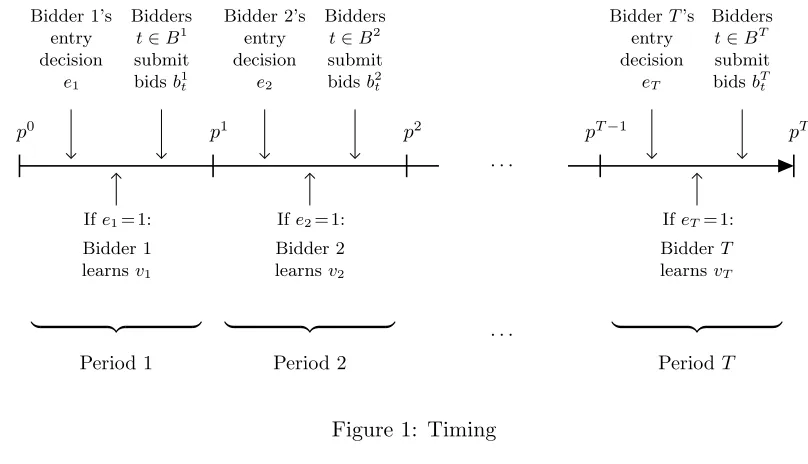
p0 ≤p1 ≤. . .≤pT. Figure 1 depicts the timing of events.
| {z } | {z } | {z }
p0 p1 p2 pT−1 pT
Period 1 Period 2
· · · · · · PeriodT Bidder 1’s entry decision e1
Ife1= 1:
Bidder 1 learnsv1
Bidders
t∈B1
submit bidsb1t
Bidder 2’s entry decision
e2
Ife2= 1:
Bidder 2 learnsv2
Bidders
t∈B2
submit bidsb2t
BidderT’s entry decision
eT
IfeT= 1:
BidderT
learns vT
Bidders
t∈BT
[image:10.612.99.503.373.605.2]submit bidsbTt
Figure 1: Timing
6This assumption is not crucial; even if a bidder who does not enter in the period he arrives were to remain in the
pool of potential bidders, he would not enter in any subsequent period in any of our equilibria.
7
At the end of the final period T, if BT = ∅ (i.e., if no bidders entered during the auction)
the seller retains the object. If BT 6=∅, the period-T high-bidder wins the object and pays pT.
Any bidder who does not win pays zero. We assume that the auction rules, the entry cost c, the
distributionF of values, and the arrival sequence of bidders are common knowledge. We also assume
thatc <R0v(1−F(v))F(v)dv. (This assumption ensures that at least two bidders can enter and obtain a positive expected surplus by bidding their valuations.)
3.2 Strategies and beliefs
A bidder must make two kinds of decisions: First, he must decide whether to enter the auction or
not in the period he arrives; second, conditional on having entered, he must decide how much to bid
in this period as well as in each subsequent period.
An entry strategy for bidder tis, in general, a mapping from the sequence of past auction prices
p0, p1, . . . , pt−1 to entry decisions (either 0 or 1):
et: [0,∞)t→ {0,1}.
(Since p0 =p1 = 0, inclusion of these variables in the entry strategy is not strictly necessary.) Note that entry never depends on the bidder’s valuation, as the bidder learns his valuation only after
having entered the auction.
A bidding strategy for bidder t prescribes, for each periods∈ {t, . . . , T}, a bid bst as a function
of t’s information in periods. This information set includes t’s valuationvt, the sequence of prices
p0, . . . , ps−1, and t’s previous bidsbtt, . . . , bst−1 (ifs > t). Thus, a bidding strategy is a mapping
bst : [0, v]×[0,∞)s×[0,∞)s−t→[0,∞)
that complies with the restrictions on bids imposed in Section 3.1 (that is, bst ≥ bst−1 ∀t, s and
bst > bst−1 ⇒bst > ps−1).
Finally, bidder t will also entertain beliefs about the distribution of opponents’ valuations,
conditional on observed information. The belief that will be relevant in our equilibria concerns the
highest valuation among the bidders in Bt, denoted wt ≡max{vj :j ∈Bt}. When bidder t >1
Gt(wt−1|p0, . . . , pt−1) : [0, v]→[0,1].
Note that in period 1 such a belief is not well-defined, as B0=∅.
Our solution concept is based on the notion of sequential equilibrium (Kreps and Wilson 1982).
We say that a profile of entry strategies (et)t=1,...,T, bidding strategies (bt)t=1,...,T, and beliefsGt(·),
constitutes an equilibrium of the auction game if the following conditions hold for all t= 1, . . . , T:
(i) Bidder t’s bidding strategy bt is optimal given (bj)j6=t and (ej)j6=t;
(ii) bidder t’s entry strategy et is sequentially rational given bidding strategies (bj)j6=t and, if
t >1, given beliefsGt(wt−1|p0, . . . , pt−1) for all p0, . . . , pt−1;
(iii) there exists a sequence of perturbed strategy profiles (ebt,eet)→(bt, et) such that any weakly
increasing price sequence is possible under (ebt, e
et), and for everyp0, . . . , pt−1∈[0, v] the belief
Gt(· |p0, . . . , pt−1) is the limit of conditional distributions derived from Bayes’ Rule under the perturbed strategies.
We further restrict our attention to equilibria that are in (weakly) undominated strategies.8 Whenever a strategy or belief depends on fewer variables than the ones included above, any unnecessary
arguments will be dropped.
4
A Look at Bidders’ Entry Decisions
In this section we establish a result (Lemma 2) that relates a bidder’s optimal entry decision to
bidding strategies and beliefs. This result will be used to construct all equilibria throughout the
paper.
For p∈[0, v], denote byF(v|p) the cumulative density ofv conditional onv ≥p:
F(v|p) ≡ F(v)−F(p) 1−F(p) .
8This rules out many uninteresting cases that generally arise in second-price auctions. For example, a trivial
Consider the final period of the auction,t=T. Fix somek and assume that bidderT believes that
exactlyk currently participating bidders have valuations above the current price pT−1:
GT(wT−1|p0, . . . , pT−1) = F(wT−1|pT−1)k.
Suppose further that each of thesek bidders submits a bid equal to his valuation in periodT. If
bidderT enters and bids his own valuation, his expected continuation payoff is
UT(pT−1) = Z v
pT−1
Z vt
pT−1
(vT −wT−1)dF(wT−1|pT−1)kdF(vT) = Z v
pT−1
F(v|pT−1)k 1−F(v)dv. (1)
Note that UT(pT−1) is strictly decreasing in pT−1, and UT(v) = 0. Thus, if UT(0) > c a unique
threshold pricep∗k∈(0, v) exists such that
Z v
p∗k
F(v|p∗k)k 1−F(v)dv = c. (2)
IfpT−1 < p∗k bidderT enters, and ifpT−1 ≥p∗k he does not enter. The following result characterizes
the thresholdp∗k.
Lemma 1. There exists K ∈N such that a solution p∗k to (2) exists if and only if k∈ {1, . . . , K}.
Furthermore, p∗k> p∗k+1 for all k= 1, . . . , K−1, andK → ∞ as c→0.
Now go back one period and consider the entry decision of bidder T −1 with the same belief.
Suppose that pT−2 ≥p∗
k. Since pT
−1 ≥pT−2, there will be no entry in period T, as shown above.
But this means that bidder T −1 is the new “final bidder” and should not enter, for the same
reason that prevents bidder T from entering when pT−1 ≥p∗
k. In fact, in the Appendix we show
that p∗k is the entry threshold used by all arriving buyers who believe thatk currently participating
bidders have valuations above the current price, regardless of their position in the arrival sequence.9 Formally, the result is the following:
9
The formal proof is less straightforward than the intuitive argument given here: One also needs to show that, for allt,pt−1 < p∗
Lemma 2. Fix k ∈ {1, . . . , K} and suppose bidding strategies have the following properties: A
bidder never bids above his valuation, bids at leastp∗k upon entry if his value is p∗k or higher, and
bids his valuation in the last period (if it exceeds the current price). That is,
bst ≤vt ∀s≥t, vt≥p∗k> pt
−1⇒
btt≥p∗k, vt> pT−1 ⇒ bTt =vt (3)
for all t. Then the following is true: If in period t bidder t believes that the highest valuation
among bidders inBt−1 has distribution F(wt−1|pt−1)k, an optimal entry strategy for t is to enter
the auction in periodt if and only if pt−1< p∗k.
Lemma 2 describes a best response entry strategy for a particular set of beliefs and bidding
strategies, and is at the core of all results to follow. Loosely speaking, we will show that for each
k≥2 an equilibrium exists in whichk bidders with valuations abovep∗k submit coordinated early
bids equal to, or close to, p∗k, in a way that will be made precise in the following sections. The
goal of this coordination is to manipulate the beliefs of potential entrants about the distribution
of the highest valuation among currently participating bidders, in order to deter these potential
competitors from entering. For k= 1, on the other hand, the equilibrium boils down to that of a
static second-price auction, with each participating buyer simply bidding his valuation upon entry.
5
Equilibrium: Two Simple Cases
In this section, we will describe two equilibria of the model—a benchmark equilibrium without bid
coordination (i.e., k= 1), and an equilibrium in which exactly two bidders coordinate their bids
(i.e, k= 2). We will assume that c is small enough for both equilibria to exist,
5.1 Immediate revelation equilibrium
We call a bidding strategy an immediate revelation strategy if, after entry, each bidder immediately
submits a bid equal to his private valuation (if it exceeds the current price) and never revises his
bid thereafter: For bidder t≥1 and periods∈ {t, ..., T},
bst(vt, ps−1, bst−1) =
0 ifs=tand vt≤ps−1
,
vt if
s=tand vt> ps−1
,
bst−1 otherwise.
This strategy closely mirrors equilibrium bidding behavior in a static second-price auction, and we
will show that it is also part of an equilibrium in our dynamic game.
Conditional on all other bidders following strategy (4), and conditional on a fixed set of
participants, a single bidder who enters the auction clearly cannot do better than bid his true
valuation at some point before the end of the auction. But since potential bidders enter if and only
if the observed price is sufficiently low (as will be shown below), it is optimal for every bidder who
has already entered the auction to bid his valuation immediately after entry—doing so results in a
weakly higher price path than delaying a truthful bid, and thus reduces the likelihood of entry by
competitors.
Let us now turn to the buyers’ participation decisions. Given bidding strategy (4) and observed
price pt−1, there is (a.s.) exactly one bidder in Bt−1 whose valuation is above pt−1. Thus, the
conditional distribution ofwt−1 in periodtis
Gt(wt−1|pt−1) = F(wt−1|pt−1). (5)
(Note that under the presumed bidding strategy, all weakly increasing price paths such that
p0 = p1 = 0 are possible. Hence, all beliefs in this equilibrium will be Bayesian.) By Lemma 2 biddert’s entry strategy is
et(pt−1) =
1 ifpt−1 < p∗1,
0 ifpt−1 ≥p∗1.
(6)
This establishes the following result:
Proposition 3. (Immediate Revelation Equilibrium) There exists an equilibrium of the
auc-tion game in which
(i) Each bidder uses the immediate revelation bidding strategy (4);
(ii) bidder t enters in period t if and only if pt−1< p∗1;
(iii) in every period t > 1, the arriving bidder’s belief about the distribution of the highest value
among bidders 1, . . . , t−1 is given by (5).
The outcome resulting from the equilibrium characterized in Proposition 3 is interim efficient, in
that the participating bidder with the highest valuation wins. However, the outcome is not necessarily
bidders learn their valuations it is possible that some non-participating bidder would have had
higher valuation than the winning bidder.
5.2 Delayed revelation and entry deterrence
We now demonstrate that early entrants can deter entry by later bidders via what we call adelayed
revelation strategy: After entry, a bidder submits a bid below his valuation but later revises this bid
to reflect his true valuation.
We will focus on the following bidding strategy: For biddert≥1 and period s∈ {t, ..., T},
bst(vt, ps−1, bst−1) = 0 if
s=tand vt≤ps−1
ors=t < T and ps−1 ≥p∗2, vt if
s=t < T and p∗2> vt> ps−1
ors=T and vt> pT−1
,
p∗2 if s=t < T and vt≥p∗2 > ps−1
,
bst−1 otherwise.
(7)
where p∗2 is defined via (2). Delayed revelation strategy (7) is identical to the immediate revelation strategy (4), with two exceptions: First, a bidder whose valuation is above the thresholdp∗2 does not bid his valuation upon entry if the current price is belowp∗2. Instead, this bidder submitsp∗2
after entry, but revises his bid to reflect his true valuation in the final period. Second, a bidder
who enters at pricep∗2 or above (an out-of-equilibrium event) does not bid until the final period, at which time he bids his valuation. Note that strategy (7) satisfies condition (3) in Lemma 2.
We will show that an equilibrium exists in which all bidders follow the delayed revelation strategy.
If all participating bidders adopt this strategy, we havept≤p∗
2 for allt < T. Furthermore, in period
tthe entering bidder’s belief about wt−1 is
Gt(wt−1|pt−1) =
F(wt−1|pt−1) if pt−16=p∗2, F(wt−1|pt−1)2 if pt−1=p∗
2.
This is so because the only possibility that price p∗2 is observed—under the presumed bidding strategy—is for exactly two bidders to have submitted a bid of p∗2. In this case, there must be exactly two bidders with valuations abovep∗2 inBt−1.10
By Lemma 2, bidder t does not enter ifpt−1 =p∗
2. If all participating bidders continue to follow strategy (7), the auction price will remain at p∗2 until the final round of bidding, so that entry is deterred in all subsequent periods as well. On the other hand, if pt−1 < p∗
2, then—given the presumed bidding strategy—exactly one bidder’s valuation exceeds pt−1. Because p∗1> p∗2 > pt−1, Lemma 2 implies that biddertshould enter in period t. Our equilibrium entry strategy is hence the
same as (6), except when the price equals p∗2:
et(pt−1) =
1 ifpt−1< p∗2 orp∗2 < pt−1 < p∗1,
0 ifpt−1=p∗2 orpt−1 ≥p∗1.
(9)
We now have the following result (fully proven in the Appendix):
Proposition 4. (Simple Delayed Revelation Equilibrium)There exists an equilibrium of the
auction game in which
(i) Each bidder uses the delayed revelation strategy (7);
(ii) bidder t enters in period t if and only if pt−1< p∗2 or p∗2 < pt−1< p∗1;
(iii) in every period t > 1, the arriving bidder’s belief along the equilibrium price path about the
distribution of the highest value among bidders 1, . . . , t−1 is given by (8).
By delaying the revelation of their true valuations until the final period, the first two bidders
with valuations abovep∗2 deter entry by potential rival bidders. These two bidders then compete against one another in a single Vickrey auction in the final period.
As was the case in the immediate revelation equilibrium, the object is awarded to the participating
bidder with the highest valuation, and this bidder pays the second-highest valuation among the
participants. However, the set of participants is different across the two equilibria: In the simple
delayed revelation equilibrium entry ceases once the auction price reaches p∗2, and becausep∗2< p∗1
there is a positive probability that the participants with the highest and second-highest valuations in
10
Note that pricespt−1> p∗2 cannot be observed under the prescribed bidding strategy; however, the equilibrium
the immediate revelation equilibrium do not participate in the simple delayed revelation equilibrium.
In this case, the final allocation and price are different across the two equilibria. More precisely, the
bidding and entry strategies characterized above imply that every bidder who enters in the delayed
revelation equilibrium also enters in the immediate revelation equilibrium, but not necessarily the
other way around. It follows that the seller’s revenue in the immediate revelation equilibrium
first-order stochastically dominates that in the delayed revelation equilibrium.11
5.3 An example
To illustrate the different outcomes across the equilibria characterized in Proposition 3 and
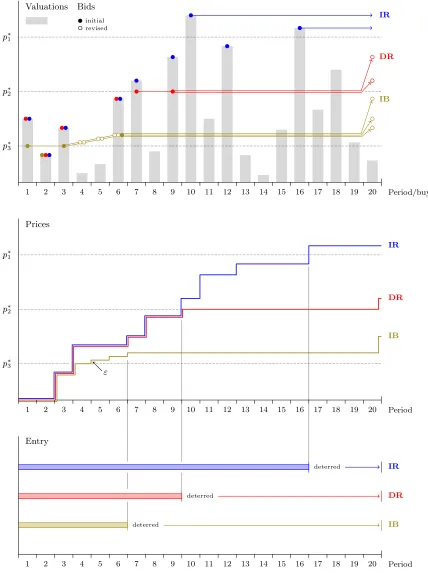
Propo-sition 4, we turn to an example with twenty periods/bidders, shown in Figure 2. The top panel
contains the buyers’ valuations depicted as shaded vertical bars, along with dots representing their
bids. Bids in the immediate revelation (IR) equilibrium are blue, and bids in the simple delayed
revelation (DR) equilibrium are red. Bids submitted by the entering bidders are shown as dots with
a sold center; dots with a white center represent revisions of earlier bids. The middle and bottom
panel display the price paths and entry decisions across equilibria, using the same color scheme.
(The yellow dots and lines are bids and prices in an incremental bidding (IB) equilibrium, which
will be introduced and discussed in the next section.)
The IR equilibrium is very simple: Entering participants bid their valuations if they exceed the
current price, and maintain these bids to the end. The price under this bidding strategy (the blue
line in the middle panel) first exceeds the entry thresholdp∗1 at the end of period 16, and no further bidders enter from period 17 onward. Bidder 10 eventually wins and paysv16.
Things are quite different in the DR equilibrium: Bidders 7 and 9 are the first two bidders
with valuations above p∗2. These bidders submit bids equal to p∗2 after entering in periods 7 and 9, respectively. Thus, the price equalsp∗2 at the end of period 9 and entry is deterred starting in period 10. Nothing changes from this moment on, until period 20 is reached. In the final round, the
two bidders reveal their valuations; bidder 9 wins and paysv7.
Figure 2 also illustrates the role of Lemma 2 for the DR equilibrium: If exactly two bidders
have valuations above the current price, and that price is at least p∗2, entry is not profitable on expectation. But since valuations and bids are private, potential entrants can only know that this is
1 2 3 4 5 6 7 8 9 10 11 12 13 14 15 16 17 18 19 20
Valuations Bids
initial revised
p∗3
p∗2
p∗1
IR
DR
IB
Period/buyer
1 2 3 4 5 6 7 8 9 10 11 12 13 14 15 16 17 18 19 20
Prices
p∗1
p∗2
p∗3
IR
DR
IB
ε
Period
Entry
deterred
deterred
deterred
IR
DR
IB
[image:19.612.86.514.73.653.2]Period 1 2 3 4 5 6 7 8 9 10 11 12 13 14 15 16 17 18 19 20
the case by observing patterns in the price path that reveal, in effect, the same information. In the
DR equilibrium, a price equal top∗2 is thus a signal that it is now better to “stay out.”
6
Entry Deterrence By More Than Two Bidders
The logic behind the simple delayed revelation equilibrium suggests that similar equilibria exist that
are based on entry deterring prices p∗k fork >2. For example, by Lemma 2, a potential entrant who
believed that three bidders’ valuations are above the current price would stay out of the auction at
pricep∗3. Thus, three bidders with sufficiently high valuations could submit post-entry bids equal to
p∗3 and thereby deter further entry. The problem with this argument is that the auction still follows a second-price format: Once the first two bidders in the hypothesized scheme submit bids equal
top∗3, the auction price jumps to p∗3. Therefore, price p∗3 does not signal that three bidders with valuations abovep∗3 have entered.
It is nonetheless possible fork >2 bidders to deter entry at a price close top∗k. However, this
requires a more complex bidding strategy, along with the assumption that the history of past bids
is available to all players. More precisely, we assume that, at any moment, each bidder observes not
only the sequence of past auction prices, but the value of all previously submitted bids except for
the bid submitted by the current high-bidder. This is the information available to buyers on most
eBay auctions, for example.
6.1 Incremental bidding
Our construction works through incremental bidding. The first two bidders with valuations above
p∗k bid exactlyp∗k. Once the second such bidder participates, the price equals p∗k. These two bidders
then begin to simultaneously raise their bids, period-by-period, from p∗k, to p∗k+ε, to p∗k+ 2ε, and
so on. Every new buyer who enters during this process, and draws a valuation larger than the next
ε-increment, bids in the same fashion. (If a bidders’ valuation is reached during the the process, he
bids his valuation and does nothing thereafter.) As long as the bid history is observable, all players
can deduce the number of participating bidders whose valuation is above the current price, and
will hence know when k such bidders are present. The valuations of these bidders must be above
the original deterrent price p∗k, so that entry is deterred from this period onward. As before, the
bidders now wait until the final period to reveal their valuations. The role of incremental bidding,
at the same time giving each existing bidder an opportunity to signal that they are still in this
group themselves, until the group reaches the required size k.
Formalizing this idea requires some additional notation, however. Fix an integer k such that
p∗k>0, and a bidding incrementε >0. Both will be equilibrium objects. εcan be chosen arbitrarily
small, and to simplify the analysis we assume that 0 < ε < [p∗k−1−p∗k]/T.12 This assumption ensures that the incremental bidding process that starts atp∗k does not surpass the next largest
thresholdp∗k−1. Now let
kt ≡
j∈Bt:btj ≥pt ≥1
denote the number of bidders who submitted period-t bids that are equal to, or greater than, the
period-tprice. The variablekt can be computed from the observable bid histories and thus becomes
part of the information set of all bidders in periodt+ 1. Next, forp≥p∗k, let
ι(p) ≡ min
m=1,2,3,...{p
∗
k+mε:p∗k+mε > p}
be the smallestε-increment overp∗k that strictly exceeds pricep.
The incremental bidding strategy can now be formally stated as follows: For each tands≥t,
biddertin periodssubmits bid
bst(vt, ps−1, bst−1, ks
−1 ) = 0 if
s=t andvt≤ps−1
ors=t < T and ks−1 ≥k and ps−1≥p∗k,
vt if
s=t < T and ps−1 < v
t< p∗k
ors < T and ps−1 ≥p∗k and ks−1< kand vt< ι(ps−1)
or
s=T and vt> pT−1
,
p∗k if s=t < T and vt≥p∗k > ps
−1
,
ι(ps−1) if s < T andps−1≥pk∗ and ks−1< k and vt≥ι(ps−1)
,
bst−1 otherwise.
(10)
12
Strategy (10) looks unwieldy, but it is in fact the strategy verbally described earlier.13 Note also that the delayed revelation strategy (7) is a special case of (10), withk= 2.
If all participating bidders adopt this strategy, the distribution of wt−1 conditional onpt−1 is
Gt(wt−1|pt−1, kt−1) = F(wt−1|pt−1)kt−1. (11)
Thus, by Lemma 2, the equilibrium entry strategy is
et(pt−1, kt−1) =
1 ifpt−1 < p∗kt−1,
0 otherwise.
(12)
This entry strategy is optimal assuming bidding proceeds as prescribed in (7). We thus have the
following result (fully proven in the Appendix):
Proposition 5. (Incremental Bidding Equilibrium) Fix k >2 such that p∗k >0, andε such
that 0< ε <[p∗k−1−p∗k]/T. Assume the number of high bidders is observable after every bidding
round, together with the current price. There exists an equilibrium of the auction game in which the
following holds for all t= 1, . . . , T:
(i) Bidder t uses the incremental bidding strategy (10);
(ii) bidder t’s entry strategy is given by (12);
(iii) bidder t’s belief about the distribution of the highest value among bidders 1, . . . , t−1 is given
by (11).
Figure 2 displays bids, prices, and entry decisions in an incremental bidding equilibrium (in
yellow), fork= 3. The “colluding” bidders are buyers 1, 3, and 6. Incremental bidding commences
after bidders 1 and 3 have submitted bids of p∗3. These two bidders then increment their bids in periods 4, 5, and 6, at which time bidder 6 submits the same incremental bid p∗3+ 3ε. Entry is deterred from period 7 onward. In period 20, the three buyers bid their valuations; bidder 6 wins
and paysv1.
13
6.2 Remarks
We now discuss some features of our incremental bidding equilibria. First, while there is always
weakly less entry in the delayed revelation equilibrium than in the immediate revelation equilibrium,
the same is not true when comparing incremental bidding equilibria. In an equilibrium with a lower
threshold price p∗k, a larger group of bidders with valuations abovep∗k must be assembled. Thus, for
some realizations of buyer valuations it is possible that entry is deterred later in this equilibrium,
compared to one with a larger p∗k.14 We will prove, in the next section, that among all incremental bidding equilibria entry stops lateron expectation when kis larger.
Second, the equilibrium bidding strategy (10) requires buyers to continue the incremental bidding
process even when the required number of coordinating bidders, k, is no longer attainable (that
is, when kt−1 < k−(T−t)). This is an optimal bidding strategy, provided all bidders follow it.
However, more complex strategy profiles could be constructed in which bidding moves to the next
incremental bidding equilibrium, based on threshold pricep∗k−1, whenever the number of remaining
periods in the auction becomes insufficient to assemble a group of kbidders.
Third, note that our construction relies on the assumption that new entrants have enough
information to compute the number of bids that are weakly greater than the current price. In
real-time auctions, no two bids can be timed to arrive at precisely the same time, so that the number
of such bids cannot exceed two at any point in time. Instead, there may be several agents who
submit similar bids in sequence. Within the context of our discrete-time model, these bidders can
be regarded as players who make the same bid in the same period. What is required, then, for
our construction to work in real-time auctions is not that the number of bidders who submitted a
particular bid is observable, but that each bidder’s identity is observable. This allows each a new
entrant to estimate the number of unique bidders who placed incremental bids in the past, and thus
the number of current participants whose valuations are above the current price.
7
Comparison Across Equilibria
In this section, we compare the equilibria of our model in terms of the number of participating
buyers, revenue, buyer surplus, and overall welfare. We call an equilibrium a k-equilibrium if it
14
For example, with k= 3 entry stops when the third bidder with valuation abovep∗3 has entered. If this happens
after the second bidder with valuation abovep∗2 has entered, then there is more entry in the incremental bidding
is based on threshold price p∗k: The immediate revelation equilibrium is the 1-equilibrium, the
simple delayed revelation equilibrium is the 2-equilibrium, and the incremental bidding equilibria
are k-equilibria withk≥3. Ak-equilibrium exists as long as p∗k exists, and by Lemma 1 this will be
the case for k= 1, . . . , K, for some K. We assume that cis small enough for K≥2. Furthermore,
for k-equilibria with k > 2, we restrict attention to those whose endogenous bid increment ε is
approximately zero.
7.1 Long auctions
Our analytical results in this section are asymptotic results forT → ∞. That is, we characterize
the limit of expected equilibrium outcomes in a sequence of auctions as the parameter T grows.
This limit serves as an approximation of the expected outcome of finite-T auctions that becomes
arbitrarily precise asT increases, which can be interpreted either as lengthening the duration of the
auction or, perhaps more realistically, as shortening the time unit in which each single potential
bidder becomes aware of the auction.15
To derive our approximations, note that as T → ∞, the probability that entry ceases before
the final period converges to one in any givenk-equilibrium. Since we focus on equilibria with bid
increments ofε≈0, this happens at a price of approximatelyp∗k. Thus, in the limit asT → ∞, entry
stops in 1-equilibrium once 2 bidders with valuation abovep∗1 have arrived, which takes 2/(1−F(p∗1)) periods on average. Ink-equilibrium fork≥2, entry stops oncek bidders with valuations abovep∗k
have entered; this takesk/(1−F(p∗k)) periods on average (again in the limit asT → ∞). Therefore,
the expected number of participating bidders in a large-T auction is approximately
Nk ≡
2
1−F(p∗k) ifk= 1,
k
1−F(p∗k) ifk >1.
Let vkr:m denote therth-smallest realization in a sample ofm independent draws from F(· |p∗k). The seller’s revenue is the price of the item at the end of the auction. Since all bidders bid truthfully
15
in the final period, expected revenue for the seller in a large-T aution is approximately
Rk ≡
E
v1:21
ifk= 1,
E
vkk−1:k
ifk >1.
The buyers’ aggregate surplus is the valuation of the winning bidder minus the price paid to the
seller minus the entry costs of all participating bidders.16 Again, since all bidders bid truthfully in the final period, expected surplus for the buyers in a large-T auction is approximately
Bk =
Ev2:21 −Ev1:21 −cN1 ifk= 1,
Evkk:k−Evkk−1:k−cNk ifk >1.
Finally, social welfare is the sum of seller revenue and buyer surplus; or, equivalently, the valuation
of the winning bidder minus the aggregate entry costs:
Wk = Rk+Bk =
Ev12:2−cN1 ifk= 1,
Evkk:k−cNk ifk >1.
The following result compares the immediate revelation equilibrium and the simple delayed
revelation equilibrium (k= 1 vs.k= 2) in terms of the variables defined above.
Proposition 6. (IR equilibrium vs. DR equilibrium) Fix F and c, and assume k-equilibria
exist for k= 1,2. Consider the limit of these equilibria as T → ∞.
(a) The number of participating bidders in IR equilibrium first-order stochastically dominates the
number of participating bidders in DR equilibrium (and, therefore, N1> N2).
(b) The price received by the seller in IR equilibrium first-order stochastically dominates the price
in DR equilibrium (and, therefore, R1 > R2).
(c) Expected buyer surplus is zero in IR equilibrium, and positive in DR equilibrium (i.e., 0 =
B1 < B2).
(d) Expected social welfare is larger in IR equilibrium than in DR equilibrium (i.e.,W1> W2).
16
Since bidders differ by their location in the arrival sequence, the valueBkdoes not necessarily reflect anindividual
bidder’s expected surplus in k-equilibrium. Suppose, however, that prior to the game Nature chooses an arrival sequence randomly and symmetrically from all possible such sequences. In this case, all buyers share anex ante
Note that in the IR equilibrium the buyers’ surplus is exactly zero: Even though buyers collect
an information rent from the seller (i.e., v12:2−v1:21 >0), they dissipate this rent on expectation through costly entry (i.e., Ev12:2−Ev11:2 = cN1). This observation is reminiscent of similar results in McAfee and McMillan (1987) and Levin and Smith (1994). On the other hand, in our DR
equilibrium buyers retain a positive expected surplus. In fact, below we will show thatBk>0 for
all k≥2. Because a buyer can guarantee a zero payoff by not participating in the auction, delayed
revelation of buyer valuations isnecessary if buyers are to have a strict participation incentive in
dynamic second-price auctions with costly entry.
From the seller’s perspective, the ranking among the two equilibria is the opposite of the buyers’
ranking. For any realization of buyer valuations, the seller’s revenue in IR equilibrium is at least
equal to the revenue in DR equilibrium. This implies that the seller prefers the IR equilibrium over
the DR equilibrium regardless of her risk preferences.
Establishing the welfare properties ofk-equilibria fork≥2 is considerably more complicated
than ranking the IR and DR equilibria. The latter exercise is a relatively straightforward
two-sample problem: Compare thesame order statistic obtained from different underlying probability
distributions. For instance, ranking the seller’s revenue across the IR and DR equilibrium requires us
to rank the expectations of the second-highest of two draws fromF(· |p∗1) and F(· |p∗2), respectively. Comparing the k-equilibria for k≥2, on the other hand, requires us to rank the expectations of
different order statistics fordifferent distributions. We are able to show the following:
Proposition 7. (Comparisons across all equilibria) Fix F and c, and assume k-equilibria
exist for k= 1, . . . , K (for k >2, focus on equilibria where the bid increment ε is approximately
zero). Consider the limit of these equilibria as T → ∞.
(a) The expected number of entering bidders, Nk, increases strictly in k fork≥2 and may exceed
N1. At the same time, expected buyer surplus, Bk, is positive for all k≥2. (b) Expected social welfare,Wk, decreases strictly in k for k≥2
Furthermore, if F is the uniform distribution on [0, v], then the following holds:
(c) The seller’s expected revenue, Rk, increases strictly in k for k ≥2 (but never reaches R1),
andBk decreases strictly in k for k≥2 (but never falls to zero).
Part (a) of Proposition 7 may seem counterintuitive: There can be more expected entry in some
average are better off in the incremental bidding equilibria (recall that B1 = 0).17 To explain this apparent contradiction, note that the two bidders who “effectively” compete in IR equilibrium have
valuations in [p∗1, v]. This interval is narrower than the corresponding interval [p∗k, v] from which the valuations of the kbidders are drawn who “effectively” compete in k-equilibrium with large k.
The higher aggregate entry cost that may be incurred in k-equilibrium is offset by the fact that the
possible gap between the winning bidder’s valuation and the next highest valuation is also larger.
Part (b) of Proposition 7, together with Proposition 6, implies that the IR equilibrium has the
highest social welfare among all equilibria considered. This result is independent of the distribution
from which buyer valuations are drawn. Part (c) implies that the IR equilibrium may also be the
most preferred equilibrium by the seller for certain value distributions, despite the fact that more
bidders may enter on expectation in some incremental bidding equilibria.18
7.2 Short auctions
To say more when T is relatively small, we now compare allocations, revenues, and welfare in the
immediate revelation equilibrium and delayed revelation equilibrium numerically. We consider the
case of uniform values on [0,1],c∈ {005, .01, .02}, andT ∈ {10,20,50}as well as the limit outcomes
asT → ∞. The results are in Table 1.
The probability that the choice of equilibrium changes the allocation or the price is not negligible.
However, the relative difference in revenue and welfare is less pronounced than what one might
expect given the probability of different allocations and prices. This is especially true for social
welfare, which in DR equilibrium is less than two percent below its value in IR equilibrium, even
when the DR equilibrium results in a different allocation than the IR equilibrium with probability
29%. The percentage decrease in the seller’s revenue, while modest, is about seven times the
percentage decrease in welfare. This implies that the primary consequence of delayed revelation in
the example is a transfer of surplus from the seller to the buyers.
The reason why the effect on welfare is low is three-fold. First, the transfer of surplus from the
seller to the buyers is welfare neutral. Second, while the DR equilibrium frequently allocates the
17For example, if values are drawn from the uniform distribution, expected participation ink-equilibrium (k≥2)
isk/p(k+ 1)(k+ 2)c, and expected participation in 1-equilibrium is 2/√6c. The former is less than the latter if and only ifk≤6. At the same time,Bk>0 forall k >1, whileB1= 0.
18
The reason is that while the seller’s revenue ink-equilibrium of a long auction is the second-largest ofkvaluations, conditional on these valuations being larger thanp∗k, andp
∗
kdecreases ink. If the seller’s revenue was the unconditional
Probability of Relative change in
T c p∗2 p∗1 Different price
Different
pwinnerp
Expected price
Expected
pwelfarep
10 .005 .7551 .8268 .2106 .1120 −2.07% −0.31%
20 .4372 .2470 −4.46% −0.67%
50 .4998 .2927 −5.40% −0.79%
∞ .5000 .2929 −5.41% −0.79%
10 .01 .6536 .7551 .3442 .1882 −5.14% −0.77%
20 .4895 .2835 −7.76% −1.15%
50 .5000 .2929 −8.08% −1.18%
∞ .5000 .2929 −8.08% −1.18%
10 .02 .5101 .6536 .4565 .2584 −10.83% −1.61%
20 .4996 .2923 −12.40% −1.82%
50 .5000 .2929 −12.44% −1.82%
[image:28.612.110.502.75.297.2]∞ .5000 .2929 −12.44% −1.82%
Table 1: Outcomes in DR vs. IR equilibrium, forvt∼U[0,1]
object to the “wrong” buyer, the expected difference between the respective winners’ valuations
is small if both p∗1 and p∗2 are relatively close to the upper bound of bidder valuations, which is the case for low entry costs. Third, the bidders who do not enter in DR equilibrium but enter
in IR equilibrium save their entry costs. If these cost savings were ignored, “welfare” in the DR
equilibrium would be up to 6% lower in DR equilibrium in the cases examined in the Table 1.
8
Conclusion and Implications
We examined a dynamic second-price auction with costly entry and sequential and deterministic
bidder arrival. We identified a novel way for some bidders to coordinate their bids in order to limit
entry by bidders who arrive at the auction later. The equilibria in which this happens exhibit
several bidding patterns observed in online auctions—low early bidding, late “sniping” bidding, and
incremental bidding. Our results would remain intact if bidder arrival was stochastic, which is a
more realistic assumption in online auctions. To see this, note that a time period in which a bidder
arrives, enters, and then draws valuation vt< pt would “look like” a period in which no bidder
arrival takes place. Thus, a straightforward way to model stochastic arrival within our framework is
Our analysis has some implications that can inform the design of actual auctions. First, recall
that our incremental bidding equilibria relied on entering bidders observing the history of past bids.
Not disclosing this information during the bidding process can thus inhibit coordination by more
than three buyers, as the seller effectively restricts the communication/coordination possibilities
the auction format provides to buyers. Second, in the analysis of incremental bidding equilibria
we assumed, for simplicity, that the bidders were unconstrained in the choice of the increment ε.
Many real-life auctions require a minimum bid increment, and a relatively large minimum increment
should mitigate the effects of incremental bidding, as a bidder’s private valuation is more quickly
reached in the progression of increasing prices.
On the other hand, it is not clear that sellersshould actually adopt these measures. Proposition 7
shows that the worst equilibrium for the seller can be the simple delayed revelation equilibrium with
just two coordinating bidders. This equilibrium requires neither incremental bidding nor knowledge
of the number of previous high bidders. The only coordination device required to implement this
equilibrium is the second-price mechanism itself. Thus, the simple delayed revelation equilibrium
cannot easily be prevented as long as the auction is a second-price auction that allows for multiple
bids from each buyer. Furthermore, even if there was a way to enforce the immediate revelation
equilibrium, doing so would leave bidders with noex ante incentive to participate in the auction in
the first place (Proposition 6).
Finally, sellers could use reserve prices. A reserve price r > 0 can be incorporated into our
model either by assuming that the initial auction price is p0 =r or by assuming that the seller submits a publicly observable bidb0
0 =r at time zero. A reserve price ofr≥p∗1 would then prevent the kind of bid coordination required in the delayed revelation equilibria of our model. Of course,
this requires that the seller knows the distribution of valuationsF as well as the entry cost c. If
this assumption holds, one can show that, whenT is large, the optimal reserve price results in a
stricly larger expected revenue compared to that in the immediate revelation equilibrium, while
leaving buyers with the same zero expected surplus (see Appendix B). Note that this conclusion
runs opposite to the result that sellers cannot benefit from setting reserve prices in independent
private value auction with simultaneous costly entry (Levin and Smith 1994; McAfee and McMillan
1987). With sequential costly entry, on the other hand, an appropriately determined reserve price
results in a strict gain in revenue and expected welfare, relative to the welfare-optimal equilibrium
References
[1] Ambrus, A., Burns, J., and Ishii, Y. (2013): “Gradual Bidding in eBay-like Auctions.” Economic
Research Initiatives at Duke (ERID) Working Paper No. 129
[2] Aoyagi, M. (2003): “Bid Rotation and Collusion in Repeated Auctions.”Journal of Economic
Theory 112, 79–105.
[3] Athey, S., K. Bagwell, and C. Sanchirico (2004): “Collusion and Price Rigidity.” Review of
Economic Studies 71, 317–349.
[4] Bajari, P. and A. Horta¸csu (2003): “The Winner’s Curse, Reserve Prices, and Endogenous
Entry: Empirical Insights from eBay Auctions,”RAND Journal of Economics 34, 329–355.
[5] Bajari, P. and A. Horta¸csu (2004): “Economic Insights from Internet Auctions.” Journal of
Economic Literature 42, 457–486.
[6] Bapna, R., P. Goes, and A. Gupta (2003): “Analysis and Design of Business-to-Consumer
Online Auctions.”Management Science 49, 85–101.
[7] Blume, A. and P. Heidhues (2004): “All equilibria of the Vickrey Auction.”Journal of Economic
Theory 114, 170–177.
[8] Bose, S. and A. Daripa (2014): “Shills and Snipes.” Working Paper No. 14/12, University of
Leicester.
[9] Bulow, J. and P. Klemperer (2009): “Why Do Sellers (Usually) Prefer Auctions?” American
Economic Review 99, 1544–75.
[10] Campbell, C. (1998): “Coordination in Auctions with Entry.”Journal of Economic Theory 82,
425–450.
[11] Che, Y.-K. and J. Kim (2009): “Optimal Collusion-Proof Auctions.” Journal of Economic
Theory 144, 565–603.
[12] Cr´emer, J., Y. Spiegel, and C. Zheng (2009): “Auctions With Costly Information Acquisition.”
[13] Dequiedt, V. (2007): “Efficient Collusion in Optimal Auctions.”Journal of Economic Theory
136, 302–323.
[14] Elfenbein, D. and B. McManus (2010b): “Last-Minute Bidding in eBay Charity Auctions.”
Economics Letters 107, 42–45.
[15] Ely, J. and T. Hossain (2009): “Sniping and Squatting in Auction Markets.”American Economic
Journal: Microeconomics 1, 68–94.
[16] Fishman, M. (1988): “A Theory of Preemptive Takeover Bidding.”RAND Journal of Economics
19, 88–101.
[17] Garratt, R. T. Tr¨oger, and C. Zheng (2009): “Collusion via Resale.” Econometrica 77, 1095–
1136.
[18] Graham, D. and R. Marshall (1987): “Collusive Bidder Behavior at Single-Object Second-Price
and English Auctions.”Journal of Political Economy 95, 1217–1239.
[19] Hasker, K. and R. Sickles (2010): “eBay in the Economic Literature: Analysis of an Auction
Marketplace.” Review of Industrial Organization 37, 3–42.
[20] Hossain, T. (2008): “Learning by Bidding.” RAND Journal of Economics 39, 509–529.
[21] Kreps, D. and R. Wilson (1982): “Sequential Equilibria.” Econometrica 50, 863–894.
[22] Levin, D. and J. Smith (1994): “Equilibrium in Auctions with Entry.” American Economic
Review 84, 585–599.
[23] Levin, J. (2011): “The Economics of Internet Markets.” NBER Working Paper 16852.
[24] Mailath, G. and P. Zemsky (1991): “Collusion in Second Price Auctions with Heterogeneous
Bidders.”Games and Economic Behavior 3, 467–486.
[25] Marshall, R. C., and L. Marx (2009): “The Vulnerability of Auctions to Bidder Collusion.”
The Quarterly Journal of Economics 124, 883-910.
[26] McAfee, P. and J. McMillan (1987): “Auctions with Entry.” Economics Letters 23, 343–347.
![Table 1: Outcomes in DR vs. IR equilibrium, for vt ∼ U[0, 1]](https://thumb-us.123doks.com/thumbv2/123dok_us/1445841.97009/28.612.110.502.75.297/table-outcomes-in-dr-vs-ir-equilibrium-vt.webp)
