City, University of London Institutional Repository
Citation: Suttle, C. M., Lawrenson, J. and Conway, M. L. (2018). Efficacy of Coloured
Overlays and Lenses for the Treatment of Reading Difficulty: An Overview of Systematic Reviews. Clinical and Experimental Optometry, doi: 10.1111/cxo.12676This is the accepted version of the paper.
This version of the publication may differ from the final published
version.
Permanent repository link: http://openaccess.city.ac.uk/19242/
Link to published version: http://dx.doi.org/10.1111/cxo.12676
Copyright and reuse: City Research Online aims to make research
outputs of City, University of London available to a wider audience.
Copyright and Moral Rights remain with the author(s) and/or copyright
holders. URLs from City Research Online may be freely distributed and
linked to.
City Research Online: http://openaccess.city.ac.uk/ [email protected]
Efficacy of Coloured Overlays and Lenses for the Treatment of Reading Difficulty: An Overview of Systematic Reviews
Catherine M. Suttle PhD, John G. Lawrenson PhD and Miriam L. Conway PhD
Centre for Applied Vision Research, School of Health Sciences, City, University of London, United Kingdom
Background
Coloured overlays or lenses are widely available for use by children and adults with difficulties or discomfort while reading. In recent years, systematic reviews have been conducted in an attempt to establish the strength of the evidence base for this intervention. The aims of this overview is to systematically review these reviews.
Method
The methodology was published prospectively as a protocol (Prospero CRD42017059172). Online databases Medline, Cinahl, Ovid and the Cochrane library were searched for
systematic reviews on the efficacy of coloured overlays or lenses for the alleviation of reading difficulty or discomfort. Included studies were appraised using the AMSTAR 2 checklist. Characteristics of included studies including aspects of methods, results and conclusions were recorded. Both processes were conducted independently by two reviewers and any discrepancies were resolved by discussion.
Results
Thirty-one studies were found via databases and other sources. After excluding duplicates and those not fitting the inclusion criteria, four reviews were included in the analysis. While all reviews were systematic, their methodology, results and conclusions differed. Three of the four concluded that there is insufficient good quality evidence to support the use of coloured overlays or lenses for reading difficulty, while one concluded that, despite research limitations, the evidence does support their use.
Conclusions
Coloured overlays and lenses are widely available for use by children and adults who experience a range of reading difficulties, including slow or inaccurate reading. Reading difficulties may be associated with perceived movement or other distortion of text and the presence of symptoms such as headache and eye strain.1-3 Interest in the potential benefits of coloured filters began when Meares and Irlen found, independently, that in schoolchildren experiencing such difficulties, symptoms could be relieved by viewing text on coloured paper or through coloured overlays (transparent sheets placed over text).4,5 These findings formed the basis of research on the effects of coloured filters on comfort, accuracy and speed when reading, and of the provision of coloured overlays or coloured spectacle lenses for children and adults experiencing such symptoms.6,7 Research findings have indicated that blue or yellow filters, or a variety of individually-specific coloured filters may be beneficial for people with reading difficulties.8 Individuals whose symptoms or signs (such as slow reading speed) are improved when using a coloured filter are sometimes diagnosed with visual stress, Meares-Irlen or Scotopic Sensitivity syndrome. Research groups have tended to adopt one of these terms (e.g. Wilkins et al coined the term visual stress,9 while Irlen first used the term scotopic sensitivity syndrome) but they refer to the same set of reading difficulties or
discomfort. Here, the term ‘visual stress’ will be used because much of the more recently published work has used this term. Recently, a consensus-based set of diagnostic indicators has been established3 which may offer more precision in identifying people with visual stress. However, in prior research visual stress has been diagnosed on the basis of any of a range of visual symptoms when reading, and the reduction of these symptoms when viewing through coloured filters.
no improvement.19-21 Third, a claim that coloured filters alleviate symptoms and/or enhance reading ability should be supported by an evidence base not only showing effectiveness but also explaining why the effect is found. In the case of coloured filters and their effect on reading, one hypothesis is that the visual cortex is hyperexcited by high contrast patterns of spatial frequency around 3 cycles per degree, and by black-white text around this
frequency.22 However, results from functional magnetic resonance imaging (fMRI) and visual evoked potential (VEP) studies of subjects with visual stress have included small samples or have focused on people who have migraine as well as visual stress.23-26
In addition, it should be noted that people with reading difficulties may be keen to find a solution to their problem, and parents or carers of a child with visual stress are likely to welcome an intervention that could enhance their child’s reading comfort and/or ability. In view of this, before suggesting coloured overlays or lenses for patients with reading difficulty, it is important to establish that the intervention has a solid, reliable evidence base
demonstrating clinically significant efficacy.
the various pieces of research evidence are sufficiently comparable, a meta-analysis may be included to provide a pooled estimate of effectiveness. A systematic review offers
advantages over a more narrative review in that it includes controls for an author’s conscious or unconscious bias. Specifically, the systematic review includes a wide search of published and unpublished research using appropriate key words, at least two people independently checking relevance, and appraising each relevant study using a set of pre-determined criteria. Several reviews including some systematic reviews have now been conducted into questions related to the effectiveness of coloured overlays or lenses in reading difficulty and/or visual stress. The aim of this review is to provide an overview28 and critical appraisal of the existing systematic reviews to determine whether coloured overlays or lenses are effective in alleviating reading difficulty or discomfort, including visual stress. A research question consistent with this aim was developed including the PICO components Patient or Problem (people with reading difficulties or discomfort), Intervention (coloured overlays or coloured spectacle lenses), Comparison (placebo or no comparison) and Outcome (alleviation of reading difficulties).
Methods
The protocol for this overview was prospectively published on the PROSPERO database (CRD42017059172;
http://www.crd.york.ac.uk/PROSPERO/display_record.asp?ID=CRD42017059172). The overview addressed the question ‘Do coloured filters alleviate reading problems?’ For this purpose, ‘coloured filters’ refers to both overlays and tinted lenses, and ‘reading problems’ includes any symptom affecting reading, including discomfort or perceptual distortion, and/or signs of reading difficulty such as slow reading. Systematic reviews that had addressed this question were eligible for inclusion in this overview. Studies that had searched more than one database and had conducted a critical analysis of their included studies were
systematic reviews28 and is aligned with the PRISMA (Preferred Reporting Items for
Systematic Reviews and Meta-Analyses) statement (http://prisma-statement.org).
Cinahl and Medline databases were searched via the EBSCOHost platform and Embase database was searched via the Ovid platform. In addition, the Cochrane library was searched. Searches were conducted on 17th March 2017 and were repeated on 29th June 2017 to check for any new studies. Within each database, the concepts ‘reading’, ‘coloured filter’ and ‘review’ were used. Within the concept ‘reading’, subject headings ‘reading’, ‘reading disorder’ and ‘dyslexia’ were searched. Keywords: ‘visual stress’, ‘Meares-Irlen’, ‘Reading difficulty’, ‘Scotopic sensitivity’ were searched separately. In the concept ‘coloured filter’ the subject heading ‘coloured filter’ was searched, and keywords ‘coloured overlay’, coloured lens’, ‘coloured filter’, ‘precision tint’ were searched separately. In the concept ‘review’, the subject headings ‘review’, ‘systematic review’ and ‘meta-analysis’ were searched, and the same terms were searched separately as keywords. Throughout the search, wild cards and other symbols appropriate to each database were used to ensure that plural, other variations and non-English terms were captured. Within each concept, the results of the subject heading and keyword searchers were combined using the OR Boolean operator. Results of the three concept searches were combined using the AND operator. The search was not limited by date or language except for the earliest year set by each database.
In addition to searches via these electronic databases, grey literature (e.g. conference abstracts and unpublished theses) was identified via the Bielefeld Academic Search Engine (https://www.base-search.net/about/en/; BASE) and Open Grey (http://www.opengrey.eu/)
databases. The Prospero database (http://www.crd.york.ac.uk/PROSPERO) was searched for ongoing systematic reviews. The reference lists of included studies (see below) were searched for relevant systematic reviews. The American Academy of Optometry and
for the ten years from 2007 to 2017. Finally, key experts in the field were contacted to ask about any systematic reviews not identified in the above process.
Two authors (MC and CS) independently reviewed the list of results and identified studies that were systematic reviews relevant to the efficacy of coloured overlays or lenses for any form of reading difficulty including visual stress. This decision was based on the title of each study and, when unclear from the title, the Abstract or full text. Studies that were not
considered relevant were excluded and those considered relevant were included for further analysis. Once this process was completed independently, the two reviewers met to
compare their results and to agree on a final list of included and excluded studies. When planning this overview, a scoping review revealed a small number of systematic reviews which had included different populations (different age ranges and types of reading difficulty) and it seemed unlikely that it would be possible to quantitatively synthesise the data. For this reason a qualitative synthesis only was planned.
Characteristics of each included systematic review were reviewed independently by authors MC and CS to identify methodology, results and conclusions of each review. Data extraction for this purpose was conducted using a template which was drafted and piloted before application, to ensure all relevant aspects of methods were addressed. Any differences between characteristics extracted by the two authors were resolved by discussion.
on their final appraisal for each study by consensus. It is possible to generate a score using this test, but this may be misleading29-33 and in the present study the checklist was used as a qualitative rather than quantitative indicator.
Results
Twenty-six studies were identified in the database search and a further five through other sources. After exclusion of duplicates and articles that did not fit the inclusion criteria, four studies were included. Figure 1 is a PRISMA diagram showing the number of studies
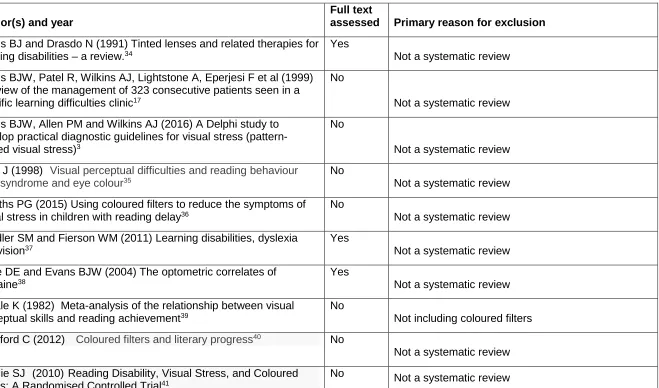
identified at each stage of the search and selection process. Studies that were excluded due to not fitting the criteria, and the reasons for exclusion, are provided in Table 1.3,17,34-46
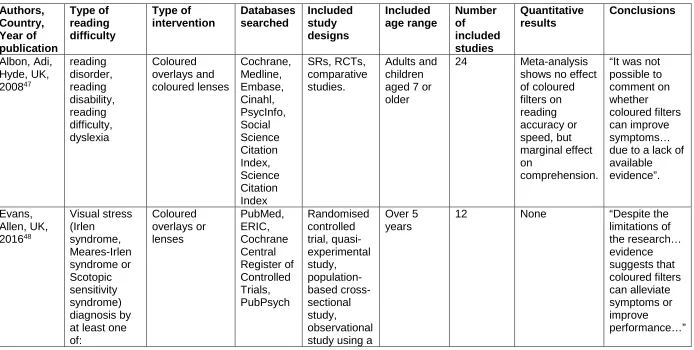
Table 2 provides a summary of the included studies and their characteristics, results of any quantitative analysis, and conclusions. Three47,48,50 of the four studies focused on coloured overlays and lenses, while one49 included this form of intervention along with a range of others. They had been published from 2008 to 2016. While all four focused on the effects of coloured filters on forms of reading difficulty, one was specifically on these effects in visual stress.48 The reviews all included studies on these effects in children; three of the four also included adults,47,48,50 while one included adolescents but not adults.49 Unsurprisingly, given the range of methods and scope, conclusions differed to some extent. All four systematic reviews found that studies on the efficacy of coloured filters for alleviating reading difficulty have limitations; three of the four concluded that the evidence is not sufficient to confirm any beneficial effect of coloured filters,47,49,50 while one concluded that the evidence does
suggest a beneficial effect.48
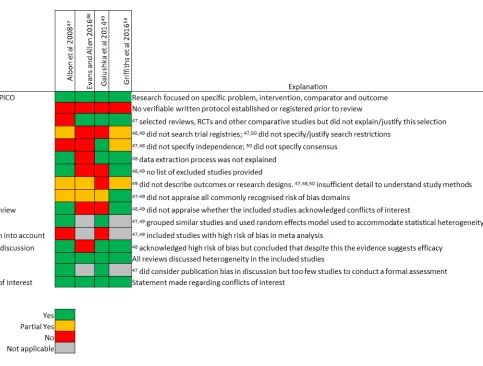
Figure 2 shows, for each of the 16 questions included in the AMSTAR 2 checklist, whether each of the four systematic reviews included here satisfied the criteria and gives a brief explanation for each decision.
Conversely, none of the reviews referred to an a priori protocol. On this question, the AMSTAR 2 tool indicates that the review should state that a protocol was developed and ideally registered prior to conducting the review, and that any deviations from it should be justified. The lack of an a priori protocol leaves the methods open to modification during the review process..
All four reviews provided information about the included studies, but key details were lacking. The reader of these systematic reviews would need to refer back to the individual studies in order to understand aspects of methods such as the information given to the participants within the study setting. One study49 gave no information on the outcomes (e.g. rate of reading) in each of the included studies.
All four reviews assessed risk of bias but three47-49 did not describe consideration of one or more recognised risk of bias indicators such as selective reporting of results.
Two of the four reviews47,49 included meta analyses. Both considered and discussed heterogeneity among the included studies, but neither justified the inclusion of individual studies with high risk of bias. In both cases, the review found that the studies were not of sufficient quality to support the use of coloured filters for reading, yet the data were included in the meta analysis. Poor quality data included in the analysis raises questions about the validity and interpretation of the analysis, but both reviews did discuss the risk of bias and quality of the included studies within their discussion and took quality into account when drawing conclusions.
Discussion
Coloured overlays and lenses are widely recommended for use by people with various forms of reading difficulty including those with or without a formal diagnosis of dyslexia. Parents of children with reading difficulty or discomfort may find claims of effective treatment appealing since they offer help during a period of life in which reading is important to achieve their full academic potential. Of the four systematic reviews found in this overview, three conclude that evidence is not sufficient to recommend the use of coloured overlays and lenses for reading difficulty. One systematic review48 acknowledged limitations to research quality in this area, but concluded that despite these the available evidence suggests that coloured overlays or lenses can alleviate symptoms in people with visual stress. The authors noted that the quality of evidence was lower than would be needed for medical interventions, but “coloured filters are a safer form of intervention.” In making any clinical recommendation, there is always a trade-off between benefits and harms. Strong recommendations based on a body of evidence usually require that the desirable effects clearly outweigh the undesirable effects.51 Undesirable effects could be psychological as well as physical. To take one
hypothetical example of a child whose teachers have identified a reluctance to read and possibly a reading difficulty; the child’s teachers or parents may be aware of coloured overlays or lenses being helpful for some children with reading difficulty, and may seek information independently. Information and resources are widely available via the Internet (e.g. http://www.crossboweducation.com/visual-stress-resources;
including optometrists, make use of the best (highest quality) available evidence, tailored to the patient’s needs, wishes and circumstances, as a basis for any such advice or
recommendation.39,40 The patient and/or parent may have a strong expectation and wish for coloured overlays/lenses to significantly improve reading, and this raises two concerns. One is a high likelihood of a placebo effect when reading is tested with and without colour, meaning that the effect (such as reduced symptoms, or faster reading through colour) may be influenced by a wish or expectation, rather than any real effect on the visual system. It could perhaps be argued that any positive effect is good, even if it is a placebo effect. However, this effect is not likely to deal with any neurophysiological basis of reading difficulty.54
The second concern is that, if the information gathered and the professional advice indicates that the intervention is likely to be effective, the patient and/or parent will have raised
expectations. They will be encouraged to spend time and money on the intervention and will expect it to have a positive effect on reading ability. Thus, as well as a financial cost there are costs in terms of raised hopes which, if the intervention is not likely to deal with the problem, may result in disappointment. This is clearly a concern in light of the conclusions of three of the four systematic reviews, that there is not sufficient evidence to recommend coloured overlays or lenses for the alleviation of reading difficulty or associated symptoms.
Figure 2 highlights the differences between the systematic reviews in terms of factors affecting quality as defined by AMSTAR 2.. None of the four published a protocol before conducting the review. Without an a priori protocol, it is not possible to know whether the methods were fixed throughout the process based on the research question, or whether the methods or the question were modified in any way as the review progressed.
disagreement between their findings, or provided details of excluded studies. Not all studies specified when their search was conducted, or what restrictions (e.g. language) were
imposed. It is possible that some of the apparent limitations reflect incomplete reporting, but in our review process we assumed, as recommended in the AMSTAR 2 guidance,31 that the reporting reflected the actual process.
References
1. http://irlen.com/reading-problems-dyslexia-learning-difficulties-the-irlen-method 2. http://www.crossboweducation.com/visual-stress-resources
3. Evans BJW, Allen PM and Wilkins AJ A Delphi study to develop practical
diagnostic guidelines for visual stress (pattern-related visual stress) J Optom 2016 http://dx.doi.org/10.1016/j.optom.2016.08.002
4. Meares O Figure/ground brightness contrast and reading disabilities. Vis Lang 1980 14: 13-29.
5. Irlen H , Lass MJ. Improving reading problems due to symptoms of scotopic sensitivity syndrome using Irlen lenses and overlays. Education 1989; 109: 413-417.
6. http://irlen.com/ Accessed 18th July 2017
7. http://www.crossboweducation.com/articles/dyslexia-coloured-overlays-and-visual-stress Accessed 18th July 2017.
8. Hall R, Ray N, Harries P and Stein J. A comparison of two-coloured filter systems for treating visual reading difficulties. Disabil Rehabil 2013 35(26): 2221-2226. 9. Wilkins A, Huang J and Cao Y Visual stress theory and its application to reading
and reading tests. J Res Read 2004 27(2): 152-162.
10. Wilkins AJ, Nimmo-Smith I and Jansons JE Colorimeter for the intuitive
manipulation of hue and saturation and its role in the study of perceptual distortion. Ophthalmic Physiol Opt 1992 12:381–5.
11. Harries P, Hall R, Ray N and Stein J. Using coloured filters to reduce the
symptoms of visual stress in children with reading delay. Scand J Occup Ther 2015 22: 153-160.
13. Bouldoukian J, Wilkins AJ and Evans BJW Randomised controlled trial of the effect of coloured overlays on the rate of reading of people with specific learning
difficulties. Ophthal Physiol Opt 2002 22: 55-60.
14. O’Connor PD, Sofo F, Kendall L and Olsen G. Reading disabilities and the effects of colored filters. J Learn Disabil 1990 23: 597-604.
15. Lightstone A, Lightstone T and Wilkins A Both coloured overlays and coloured lenses can improve reading fluency, but their optimal chromaticities differ. Ophthal Physiol Opt 1999 19(4): 279-285.
16. Evans BJW and Joseph F The effect of coloured filters on the rate of reading in an adult student population. Ophthal Physiol Opt 2002 22: 535-545.
17. Evans BJW, Patel R, Wilkins AJ, Lightston A, Eperjesi F, Speedwell L and Duffy J. A review of the management of 323 consecutive patients seen in a specific
learning difficulties clinic. Ophthal Physiol Opt 1999 19(6): 454-466.
18. Wilkins AJ, Evans BJW, Brown JA, Busby AE, Wingfield AE, Jeanes RJ and Bald J. Double-masked placebo-controlled trial of precision spectral filters in children who use coloured overlays. Ophthal Physiol Opt 1994 14: 365-370.
19. Ritchie SJ, Della Sala S, McIntosh RD Irlen colored overlays do not alleviate reading difficulties. Pediatrics 2011 128: 932-938.
20. Robinson GL and Foreman PJ Scotopic sensitivity/Irlen syndrome and the use of coloured filters: a long-term placebo-controlled study of reading strategies using analysis of miscue Percept Mot Skills 1999 88: 35-52.
21. Mitchell C, Mansfield D and Rautenbach S. Colored filters and reading accuracy, comprehension and rate: a placebo-controlled study. Percept Mot Skills 2008 106: 517-532.
23. Huang J, Zong X, Wilkins A, Jenkins B, Bozoki A and Cao Y fMRI evidence that precision ophthalmic tints reduce cortical hyperactivation in migraine. Cephalagia 2011 31(8): 925-936.
24. Chouinard BD, Zhou CI, Hrybouski S, Kim, ES and Cummine J. A Functional Neuroimaging Case Study of Meares–Irlen Syndrome/Visual Stress (MISViS) Brain Topgr 2012 25: 293-307.
25. Kim JH, Seo H, Ha S and Kim S Functional magnetic resonance imaging findings in Meares-Irlen syndrome: A pilot study. Korean J Ophthalmol 2015 29(2): 121-125.
26. Riddell PM, Wilkins A and Hainline L The effect of colored lenses on the visual evoked response in children with visual stress. Optom Vis Sci 2006 83(5): 299-305. 27. Khan KS, Kunz R, Kleijnen J and Antes G Five steps to conducting a systematic
review. J R Soc Med 2003 96(3): 118-121.
28. Smith V, Devane D, Begley CM and Clarke M. Methodology in conducting a
systematic review of systematic reviews of healthcare interventions. BMC Med Res Methodol 2011 doi: 10.1186/1471-2288-11-15.
29. Shea BJ, Grimshaw JM, Wells GA, Boers M, Andersson N, Hamel C, Porter AC, Tugwell P, Moher D and Bouter LM. Development of AMSTAR: A measurement tool to assess the methodological quality of systematic reviews. BMC Med Res Methodol 2007 doi: 10.1186/1471-2288-7-10.
30. Shea BJ, Hamel C, Wells GA, Bouter LM, Kristjansson E, Grimshaw J, Henry DA and Boers M. AMSTAR is a reliable and valid measurement tool to assess the methodological quality of systematic reviews. J Clin Epidemiol 2009 62: 1013-1020.
32. Wegewitz U, Weikert B, Fishta A, Jacobs A and Pieper D Resuming the discussion of AMSTAR: What can (should) be made better? BMC Med Res Methodol 2016 16(1): 111.
33. Burda BU, Holmer KH, Norris SL Limitations of a measurement tool to assess systematic reviews (AMSTAR) and suggestions for improvement. Syst Rev 2016 5: 58. doi: 10.1186/s13643-016-0237-1
34. Evans BJ and Drasdo N Tinted lenses and related therapies for learning disabilities – a review. Ophthalmic Physiol Opt 1991 11: 206-217.
35. Gray J Visual perceptual difficulties and reading behaviour Irlen syndrome and eye colour [thesis] Bristol University 1998.
36. Griffiths PG Using coloured filters to reduce the symptoms of visual stress in children with reading delay. Scand J Occup Ther 2015 22: 328-329. doi: 10.3109/11038128.2015.1033456
37. Handler SM and Fierson WM Joint technical report – learning disabilities, dyslexia and vision. Pediatrics 2011 127: 818-856. doi: 10.1542/peds.2010-3670
38. Harle DE and Evans BJ The optometric correlates of migraine. Ophthalmic Physiol Opt 24: 369-383.
39. Kavale K Meta-analysis of the relationship between visual perceptual skills and reading achievement. J Learn Disabil 1982 15: 42-51.
40. Mumford C Coloured filters and literary progress [thesis] Oxford University 2012. 41. Ritchie SJ Reading disability, visual stress and coloured filters – a randomised
controlled trial [thesis] University of Edinburgh 2010.
43. Uccula A, Enna M, Mulatti C Colors, colored overlays, and reading skills Front Psychol 2014 5: 1-4. doi: 10.3389/fpsyg.2014.00833
44. Virgili G, Acosta R, Grover LL et al. Reading aids for adults with low vision. Cochrane Database Syst Rev 2013 doi: 10.1002/14651858.CD003303.pub3
45. Wilkins A, Huang J, Cao Y Prevention of visual stress and migraine with precision spectral filters. Drug Dev Res 2007 68: 469-475.
46. Wilkins A Coloured overlays and their effect on reading speed: a review Ophthalmic Physiol Opt 2002 2: 448-454.
47. Albon E, Adi Y and Hyde C. The effectiveness and cost-effectiveness of coloured filters for reading disability: A systematic review. West Midlands Health Technology Assessment Collaboration, The University of Birmingham 2008.
48. Evans BJW and Allen PM A systematic review of controlled trials on visual stress using Intuitive Overlays or the Intuitive Colorimeter. J Optom 2016 9: 205-218. 49. Galuschka K, Ise E, Krick K and Schulte-Korne G Effectiveness of treatment
approaches for children and adolescents with reading disabilities: a meta-analysis of randomised controlled trials. PLoS One 2014 9: e89900.
50. Griffiths PG, Taylor RH, Henderson LM and Barrett BT. The effect of coloured overlays and lenses on reading: a systematic review of the literature. Ophthalmic Physiol Opt 2016 36: 519-544.
51. Grade Working group Grading quality of evidence and strength of
recommendations. BMJ 2004 328: 1490 doi: 10.1136/bmj.328.7454.1490 52. Haynes RB, Devereaux PJ and Guyatt GH Physicians’ and patients’ choices in
evidence based practice. BMJ 2002 324: 1350.
53. Anderton PJ Implementation of evidence-based practice in optometry. Clin Exp Optom 2007 90: 238-243.
Captions
Figure 1: PRISMA diagram, showing the number of systematic reviews at each stage from the search to the final selection of included studies.
Figure 2: Each of the 16 criteria on the Amstar 2 checklist are shown for each of the four included systematic reviews. Colour coding indicates whether the study satisfied each of these criteria. Red = No, Green = Yes, Yellow = Partial yes; Grey = Not applicable.
Table 1: Details of excluded studies, including whether the full text was assessed (if not, the study was excluded on the basis of information in the title or Abstract) and why it was excluded.
Table 1
Author(s) and year
Full text
assessed Primary reason for exclusion
Evans BJ and Drasdo N (1991) Tinted lenses and related therapies for learning disabilities – a review.34
Yes
Not a systematic review Evans BJW, Patel R, Wilkins AJ, Lightstone A, Eperjesi F et al (1999)
A review of the management of 323 consecutive patients seen in a specific learning difficulties clinic17
No
Not a systematic review Evans BJW, Allen PM and Wilkins AJ (2016) A Delphi study to
develop practical diagnostic guidelines for visual stress (pattern-related visual stress)3
No
Not a systematic review Gray J (1998) Visual perceptual difficulties and reading behaviour
Irlen syndrome and eye colour35
No
Not a systematic review Griffiths PG (2015) Using coloured filters to reduce the symptoms of
visual stress in children with reading delay36
No
Not a systematic review Handler SM and Fierson WM (2011) Learning disabilities, dyslexia
and vision37
Yes
Not a systematic review Harle DE and Evans BJW (2004) The optometric correlates of
migraine38
Yes
Not a systematic review Kavale K (1982) Meta-analysis of the relationship between visual
perceptual skills and reading achievement39
No
Not including coloured filters Mumford C (2012) Coloured filters and literary progress40 No
Not a systematic review Ritchie SJ (2010) Reading Disability, Visual Stress, and Coloured
Filters: A Randomised Controlled Trial41
Robinson R, Boyle P and Garvey P (2015) Ocular interventions, excluding correction of significant refractive error, for specific reading disorder42
No
Protocol only (withdrawn) Uccula A, Enna M and Mulatti C (2014) Colors, colored overlays, and
reading skills43
No
Not a systematic review Virgili G, Acosta R, Grover LL, Bentley SA and Giacomelli G. (2013)
Reading aids for adults with low vision44
Yes
Not including visual stress Wilkins A, Huang J and Cao Y (2007) Prevention of visual stress and
migraine with precision spectral filters45
No
Not a systematic review Wilkins A (2002) Coloured overlays and their effect on reading speed:
a review46
Yes
Table 2 Authors, Country, Year of publication Type of reading difficulty Type of intervention Databases searched Included study designs Included age range Number of included studies Quantitative results Conclusions Albon, Adi, Hyde, UK, 200847 reading disorder, reading disability, reading difficulty, dyslexia Coloured overlays and coloured lenses Cochrane, Medline, Embase, Cinahl, PsycInfo, Social Science Citation Index, Science Citation Index SRs, RCTs, comparative studies. Adults and children aged 7 or older
24 Meta-analysis shows no effect of coloured filters on reading accuracy or speed, but marginal effect on comprehension.
“It was not possible to comment on whether coloured filters can improve symptoms… due to a lack of available evidence”. Evans, Allen, UK, 201648 Visual stress (Irlen syndrome, Meares-Irlen syndrome or Scotopic sensitivity syndrome) diagnosis by at least one of: Coloured overlays or lenses PubMed, ERIC, Cochrane Central Register of Controlled Trials, PubPsych Randomised controlled trial, quasi-experimental study, population-based cross-sectional study, observational study using a
Over 5 years
12 None “Despite the
Questionnaire based rating scales; pattern glare test positive; sustained greater than 2 weeks overlay use;
improvement in reading or task with IO
comparison group (prospective or retrospective) Galuschka, Ise, Krick, Schulte-Korne, Germany, 201449 Reading disability specified in search as dyslexia, developmental reading disorder, developmental dyslexia, developmental reading disability, reading disorder, word blindness, spelling disorder. Phonemic awareness instruction, phonics instruction, reading fluency training, reading comprehension training, auditory training, medical treatment, coloured overlays (filters/overlays) ERIC, PsycInfo, Pubmed, Cochrane, Pro Quest, Clinical trials.com Randomised controlled trials only. Children and adolescents (age cut-off not specified) 22; 4 specifically on coloured filters or overlays Meta-analysis includes 4 studies using coloured overlay or tint. In each case, no significant effect. “This finding confirms earlier systematic reviews that could not prove any positive effect of coloured lenses…” Griffiths, Taylor, Henderson,
Any form of 'reading difficulty' or Coloured overlays and coloured lenses Medline, PsycInfo, Embase Experimental studies, reading Adults and children (age range
51 None “…the use of
Barrett, UK, 201650
'reading disability' as described by study authors
ability measure, effect of coloured filters, with control group.
not specified)