0022-538X/92/116509-08$02.00/0
Copyright © 1992, AmericanSociety for Microbiology
Functional
Characterization
of
Temperature-Sensitive
Mutants
of
Simian Virus
40 Large T
Antigen
SATYAJITRAY, MARY E. ANDERSON, GERHARD LOEBER, DUNCAN McVEY,
ANDPETERTEGTMEYER*
Departmentof Microbiology, State University of New
York,
StonyBrook;
New York 11794-8621 Received4June 1992/Accepted4August 1992Weinvestigatedthemolecularpropertiesofeight temperature-sensitive mutants of simian virus 40 large T antigen (tsA mutants). Themutantshavesingleaminoacid substitutions that block DNA replicationat39 to 41°C in vivo. In vitro, five of the mutant proteins were
highly
sensitive to a briefheatshock at39°C,while the threeremainingproteins wereonly
partiallysensitive at41°C.We characterized thefivemostdefective mutant proteins, using avariety
ofbiochemical assays for replicationfunctionsof Tantigen. Heat shock of purified T antigen with a mutation at amino acid 422significantly
impaired the oligomerization, origin-binding, origin-unwinding, ATPase,and helicasefunctions of Tantigen. In contrast, substitution of amino acid 186, 357, 427, or 438 had more selective, temperature-sensitive effects on T-antigen functions. Our findings are consistent with the conclusion that Tantigen functions via a hierarchy of interrelated domains.Only
the ATPase activity remained intact in the absence of all other functions. Hexamer formation appears to be necessary for coreorigin-unwinding and helicase activities; the helicasefunctionalso requiresATPase activity. All five tsA mutantswere impaired infunctions important for the initiation of DNA replication, but three mutantsretained significant elongationfunctions.Simianvirus 40(SV40) largeTantigen,theproductof the viral A gene,regulatestheinitiationandelongationstagesof SV40 DNAsynthesis inviral infection. Inthe presence of ATP, Tantigen assembles into adouble-hexamer structure thatcoversthe entirecoreoriginofreplication(1, 13, 33,38) andinduces changes inoriginDNAthat lead tothe forma-tion ofa replication bubble (2, 11, 37). After release from specificrecognitionsequencesin theorigin,Tantigenacts as ahelicase for the extension of theprimary replication bubble in both directions(15, 37,52). Tantigenalsointeracts with DNApolymeraseatoinitiateDNAsynthesisandto assem-ble a replication complex (16, 45). Presumably, T antigen coordinates thevarious functionsof thereplication machin-eryasitmovesthereplicationforks aroundthe circular viral DNA. Tantigen also interactswith theretinoblastoma (Rb) andp53 proteins,whicharesuppressorsofcellular prolifer-ation (14, 18, 24). The sequestration of Rb and
p53
by T antigen is thought to prime infected, permissive cells for viral DNAreplication.Many functionsofTantigenhave beenmappedtospecific domains of theprotein.Particularlywellcharacterizedis the T-antigen domain for specific binding tothe origin ofviral DNAreplication(39,43, 44, 48, 54). Isolated segments of T antigen extending from amino acids 132 to 246 bind in a site-specificmanner to the originofreplication (48). About 50amino acids away from the DNAbindingdomain,asingle zinc finger motif extends from amino acids 302to 320(29, 30). This region is requiredfor the formation ofT-antigen hexamers in the presence of ATP. The ATP
binding
and ATPase domains map toward the C terminus of Tantigen. The origin-unwinding and helicase activities of T antigen requirethe DNAbinding,zincfinger, andATPase domains (4, 30, 54). T antigen also has specific sites forbinding to DNApolymerasea,Rb,andp53
(14, 16, 17,27, 28,45, 56). Much of the early information about the replication and* Correspondingauthor.
transforming functions of T antigenwas obtained by using temperature-sensitive mutants with changes in the A gene (tsAmutants). Themutantsallowviralreplicationin permis-sive cells and transformation of restrictive cells at the permissive temperature of32°C but fail to do so at higher temperatures. Analysis of several tsA mutants led to the recognition of T antigen's role in the initiation of DNA replicationbut didnot
identify
anelongation functionin the replication cycle (6, 49,51). Temperatureshiftexperiments showed that T antigen was required continuously for the maintenance of thetransformation ofnonpermissivecells (5, 32, 35, 50). Theexpression oftemperature-sensitiveT anti-gensin transgenic mice has been useful for the conditional immortalization of differentiated cells from a variety of tissues (23, 55). Recently,Loeber etal. (31) sequencedthe DNA of all known tsA mutantsofSV40largeTantigenand identified single amino acid substitutions in each of eight mutated alleles. The temperature-sensitive phenotypes of themutants strongly suggestthat the mutatedamino acids play crucial roles inorganizing the structureof the protein forone ormorefunctionsof Tantigen.Our present results describethe biochemical defects of the tsAmutant T anti-gensin viral DNAreplication.MATERIALS AND METHODS
Construction of tsA mutants in an isogenic background. Because the tsAmutants were isolated from several wild-type (WT)strains ofSV40, we constructed alleight muta-tions in the T-antigen sequence of strain 776 to place the mutations inan isogenic background. Most of the mutants were constructed by using oligonucleotide-directed muta-genesis of the Bluescript vector BS*SV40 as described previously(29). Mutagenesisof562F-Swas carried outby using the vector
pSK(-)SVTC,
which containsT-antigen
cDNAfromSV40 strain 776 in the BamHI site ofBluescript (kindly provided byDan Simmons).Overexpressionof thetsA mutants. We chose to express
6509
on November 9, 2019 by guest
http://jvi.asm.org/
6510 RAY ET AL.
the WT and
temperature-sensitive
mutant T antigens byusing
a baculovirus expression system for a number ofreasons. First, T antigen overexpressed in insect cells is
remarkably
similartoTantigen isolated fromSV40-infectedmonkey cells in terms of its known biochemical functions
(25). Second,
insect cells(SF9)
in cultureare best grown at27°C.
This temperature isideal for theexpression
of nativetsA
proteins,
whicharepartially
inactivatedattemperaturesas low as
32°C
(53).
We transferred restriction fragmentscontaining
the DNA mutations from the Bluescriptvectorsto the
pVL941T
vector(25),
which has baculovirusse-quences on either side of the WT T-antigen gene, as de-scribed
by
Loeberetal.(30).
TheT-antigengeneswerethen recombined with baculovirus DNA by cotransfection with whole viral DNA, and occlusion-negative plaques were selected. After the viruses were screened for T-antigenexpression,
recombinant viral stocks were plaque purifieduntil free ofWTbaculovirus.
Purification ofTantigen.WT andmutant Tantigens were extracted from SF9 cells infected with recombinant
baculo-viruses,
and Tantigen
waspurified
by immunoaffinitypuri-fication, using
PAb419 as described by Simanis and Lane(42).
Tantigen
was eluted from the column with 20 mMTris-HCl
(pH
8.5)-i
mMEDTA-0.5MNaCl-10%glycerol-50%
ethylene glycol (33).
Afteranovernight dialysis againststorage buffer
containing
10 mM piperazine-N,N'-bis(2-ethanesulfonicacid)
(PIPES;
pH 7.0)-5 mM NaCl-0.1 mM EDTA-1 mMdithiothreitol(DTT)-50% glycerol,thepurifiedproteins
were stored at -20°C. T antigen was the onlypolypeptide
evident in stained sodium dodecyl sulfate(SDS)-gels
of thepurified
proteins.Conditions for heat shock. T antigen (1.0 p,g in 10 pl of storage
buffer)
was added to 15 plof30 mMN-2-hydroxy-ethylpiperazine-N'-2-ethanesulfonic
acid (HEPES; pH7.5)-7
mMMgCl2-1
mMDTTand heated at 39or at 41°C.These buffer components were designed for the efficient
replication
ofSV40DNAin vitro (47). Weomittednucleo-sidesand
deoxynucleosides
during preheating becauseDeanetal.
(10)
havereported
thatpreincubation
of Tantigen withATP interferes with
ATP-dependent
binding, unwinding,and
replication
ofSV40origin-containing
DNA. Weomittedprotein
componentsrequired
for in vitro DNA replicationbecause these would interfere with some ofour assaysfor
T-antigen
functions. It is important to note that buffercomponentsaffect therateof heatinactivation of Tantigen;
glycerol,
for example, has a protective effect on proteinfunction.
Therefore,
allheat shockswere doneunder iden-tical conditions. We used a transient heat shock undernonpermissive
conditions rather than continuousincuba-tionsat
permissive
andnonpermissivetemperaturestoallowsubsequent
measurement of various functions with andwithout
preheating
underasingleset of conditions. In vitro replication. T antigen (1.0 p,g) was incubated at32°C
for 2 h withSV40originDNA inplasmids (0.5 ,g) and 18 ,ulof 293 cell S100extractin 30 mM HEPES(pH 7.5)-7mM
MgCl2-1
mM DTT-40 mM creatine phosphate-4 mMATP-0.2 mM each GTP, UTP, and CTP-0.1 mM each
dCTP, dGTP,
and TTP-0.025 mM dATP and[a-32PJdATP
(800 Ci/mmol; specific
activity 1,000 cpm/pmol)-20 p,g ofcreatine
phosphokinase
per ml-0.1 mg of bovine serum albumin(BSA)
per ml-20% glycerol (replication buffer).DNA
synthesis
was stoppedwith 20 mM EDTA, and DNAwas
precipitated
with 8% ice-cold trichloroacetic acidcon-taining
1% sodium pyrophosphate. Precipitates werecol-lected on
GF/C
filterdisks, washedextensively, and dried. The amount of DNAsynthesis
was quantitated by liquidscintillation counting. Unless noted otherwise, we moni-tored the biochemical functions of the WT and mutant T antigensunder replication conditionsto allow a direct com-parison of the differentproperties ofTantigen under identi-cal conditions.
KMnO4 and DNase I footprinting. KMnO4 and DNase I footprinting were performed as described by Gralla (21), with minor modifications (37). T antigen (1
,ug)
was incu-bated for 2 h at 32°C with 0.5,ug
of core origin DNA in replication buffer in a50-p,l
volume. DNAs wereprobed at 32°C with 30 mM KMnO4 for 3minorwith 0.1 U of DNase I for 50 s. KMnO4 reactions were stopped with 3 ,ul of,B-mercaptoethanol,
and DNase I reactions werestopped
with 4,ul of 0.2 M EDTA. DNAs were extracted with phenol andwere spun through Sephadex G-50 (Pharmacia) to sus-pend the DNA in distilled H20. Isolated DNAs were an-nealed to aprimer5'endlabeled with[32P]ATP. The primer was extended with 1 U ofKlenow polymerase, and labeled products were separated on 8% polyacrylamide-8 M urea sequencinggels at50°C.
Hexamer formation. T antigen was added to replication buffer, without BSA or creatine phosphokinase, and incu-bated in a final volume of 50,ulfor2 h at32°C.Thereaction products were cross-linked with 0.1% glutaraldehyde for20 min at 32°C and analyzed immediately by nondenaturing, gradient gel electrophoresis as described previously(38).
ATPase assay. T antigen was added to replication buffer, without creatine phosphate and creatine phosphokinase, and incubated in a final volume of 50
pl
for 2 h at32°C.ATPase activity was measured by colorimetric quantitation ofPi
released from ATP at32°C as described by Lanzetta et al. (26).Helicase assay. Helicase substrates were prepared by elongating a primer on M13 single-stranded DNA in the presence of dideoxynucleotides as described by Stahl et al. (46).Tantigen was added to replication buffer containing 10 ng oflabeled substrate and incubated at 32°C for 2 h in a final volume of 50 ,ul. Creatine phosphate and creatine phospho-kinase were omitted to allow a direct correlation of the helicase assay with the ATPase assay. The reactions were stopped with 5
pl
of 3.3% SDS-0.5 M EDTA, and the products were resolved by 6% polyacrylamide gel electro-phoresis.RESULTS
Nomenclatureand locations of tsA mutations. Loeber et al. (31) sequenced all known tsA mutations in T antigen and changed the nomenclature of the mutants to identify the mutated aminoacid of each mutant. For example, tsA3900, which has an arginine-to-threonine substitution at amino acidposition 186, was renamed tsA186R-T. Many mutants isolated by different groups have identical amino acid sub-stitutions. Figure 1 shows the sequence alterations of the tsA mutants and the locations of the mutations relative to the functional domains of T antigen. The mutation tsA186R-T (22) maps in the region of the protein that is sufficient for specificbinding to theSV40origin of DNAreplication (48). Theregion around amino acid 186 is particularly important for DNAbinding; mutants with single amino acid changes at positions 185 and 187 in the protein are defective for DNA binding (44). Mutation tsA357R-K is located in a region withadistinctive pattern of repeated leucines and arginines that are conserved among all known polyomaviruses (31). Mutations causing the temperature-sensitive defects of tsA393W-C, tsA422W-C, tsA427P-L, tsA438A-V, and
J. VIROL.
on November 9, 2019 by guest
http://jvi.asm.org/
tsA MUTANTS OF SV40 T ANTIGEN 6511
RbBinding Zinc Finger Leu/Arg Repeats 102-1 15 302-320 345-370
1 82 NLS 126-132 272 517
Pol 131 246 p53&Polymerase Binding
Binding _ riginBinding 418 ATPBinding
627
1,ATPase I
OrginUwinding&Helicase Activities C
186 R-T: tsA3900
357 R-K: tsA30 tsA40 tsA47 tsA57 tsA 1609 tsA1637
1l) \
~~~708
ts5A238; ts438A-V:
tsA241 45 -S: l ~~~~~~tsA1642 422W-C:
[image:3.612.157.472.77.266.2].tsA255 427 P-L:| tsA209|
FIG. 1. Nomenclature and locations oftemperature-sensitivemutations in SV40largeTantigen. Functional domainsareshown at the top (17). NLS, nuclearlocalizationsignal;Pol,DNApolymerase a. Mutationsareshownatthe bottom. Mutationsareidentified by amino acid number,theWTaminoacid, and the substituted amino acid.Theamino acid numberscorrespondtothesequenceofTantigen in strain 776. Amino acids aregiveninthesingle-letter code. Below these designationsareprevious, lessspecificnamesfor the same mutations.
tsA453P-S arelocatedin or near a highly conserved region with structural homology to an ATP binding fold (4). The tsA562F-S mutationmaps distal to the ATPbinding fold but in the ATPasedomain. All of the tsAmutationsmapwithin the broad region required for the origin-unwinding and helicasefunctions ofTantigen.
In vitro DNA replication by mutant Tantigens. Loeber et al. (31) showed that all tsA mutants except tsA453P-S replicate DNA poorly at 39 to 41°C invivo. Their assay measuredtheaccumulationofviralDNAduring the course of several days atthe restrictive temperature, so the repli-cationdefects of some of themutationsmight have reflected arapid degradation ofthe mutant Tantigensintracellularly rather than aloss ofreplication function per se. Therefore, we measured the effects of a short heat shock on purified mutantproteinstodetermine theintrinsic effectsof thermal denaturation on T-antigen function. We made WT and mutant Tantigensin insect cells at27°C byusing baculovirus expressionvectors.Afterimmunoaffinity purificationat4°C, westoredthepurifiedTantigensat-20°C in50%glycerol. Thepurified proteinswereexposedto aheat shock in a390C waterbath for 5to10min. Immediately after heating,the T antigenswereaddedtocellularextractscontainingaplasmid with the SV40origin of replicationfor 2 h at
320C
(Fig. 2). WTT antigen, exposed toheat shock at39 to41°C, repli-catedthe testplasmidDNAnearlyaswell asunheatedWT proteindid. Five of the tsA mutants,thosewith amino acid substitutionsatpositions 186, 357, 422, 427, and438,were verysensitive to briefheatingat390C (Fig. 2A).The remain-ingthree tsA mutants,thosewithchangesatpositions393, 453,and562, were not sensitive toheatingat390Cbutwere moderatelysensitive toheating at41°Cfor 10min (Fig. 2). We immunoprecipitated T antigen from similar replication mixturesand found thatlittle,ifany, of theWTormutant T antigenswasdegraded
under the conditionsof the replica-tion assay (data notshown).
We conclude that heat shock leads to the irreversible loss of one or more intrinsic func-tions of the tsA mutantTantigens. Intheremainder of this report, we will describe the effects ofheatingonindividual functions of the five tsA mutants that are highly heatsensitive. Allsubsequentassays werecarriedoutunder the sameconditions as werethe replication assays unless indi-catedotherwise.
Hexamer
assembly
ofmutant Tantigens. Tantigen bindsto theSV40replication originasdouble hexamers(33, 38,52). After unwinding the origin, the double hexamers appear to act asbidirectional helicases by threadingDNAthrough the binary hexamer complex(52). The loss of hexamer assembly could interfere with theorigin-unwinding
or helicase func-tion andexplain the replication defect of the tsA mutants. Weused chemicalcross-linking andgradient gel electropho-resistodetermine the oligomericstructureof thetsA mutant T antigens(Fig. 3). The proteinswere heatedfor 10 min at 39°Cand thenincubatedinreplication
buffer for2h at32°C in the absence of otherproteins. The Tantigenswerethen cross-linked and analyzed by gradient gel electrophoresis and silver staining. In the absence ofATP, WT Tantigen consistedmostlyof monomers and dimers. Theaddition of ATPinduced the assembly of most of thesmaller forms into hexamers with orwithouta heat shock. Inthe presence of ATP, all of themutantT antigensformed hexamers and, in somecases, double hexamers veryefficientlyat32°C. Heat shock drastically reduced the number of 186R-T, 357R-K, and 422W-C mutant hexamers andpartiallyreduced 427P-L and 438A-V hexamers. Because the loss of hexamer forms was not accompanied by a dissociation intosmaller
oligo-mericforms,heating apparentlyresulted in theformation of protein aggregates that would not enter thegel efficiently. Indeed, a protein smearwas present in the stacking gel of lanes inwhichT-antigenhexamers werereducedbyheating (datanot shown). Weconclude that a brief heat shock has significant effects on the structures of most tsA mutant T antigens.Origin
binding by mutant T antigens. In the absence of ATP,T antigen binds toorigin sequences in asite-specific
manner at4°Ceven though Tantigen does not form hexa-mersunder these conditions(1, 13, 33, 34).Attemperatures over 30°C, however, T antigen binds the coreorigin
effi-ciently onlyinthepresence of ATP.Undertheseconditions,
WTT
antigen
assembles as hexamerson each half of theIly I
--Il
--v
VOL. 66,1992
-
;11.
on November 9, 2019 by guest
http://jvi.asm.org/
6512 RAY ET AL.
Tag WT 186 357 422 427 438
ATP - + - + + + + + + + + + + +
Heat + + _ +
Shock
6-mer of _ A
_ + _ + _ + +
[image:4.612.87.263.70.456.2]II~~~~~~~ ~~~~~~~.
FIG. 3. Hexamerformation by WT andtsAmutantTantigens. Purified Tantigens (T ag)wereeithernotexposed (-)orexposed
(+)toaheatshock, incubatedinreplication buffer in thepresence
(+)orabsence(-)of 4mM ATPfor 2 hat32°C, cross-linkedwith
0.1%glutaraldehyde, and analyzed by native gradient gel
electro-phoresis asdescribedin Materials and Methods. WT proteinwas
exposedtoa30-min heatshock, andmutantproteinswereexposed
to10-minheat shocks.Numbers identify the amino acidpositions of
the various mutations. The positions of monomers (1-mer) and
hexamers (6-mer)areshownatthe left.
B. CD
._-.C
E
(2 Cu
100
___
41°C
80-\60
@~~~~~~0393
40 m~~~~~~453
40
~~~~~A
562 205 10 heat shock (in minutes)
FIG. 2. DNA replication in vitro by WT and tsA mutant T
antigens. Purified Tantigenswereexposedtoaheat shock for0,5,
or10minateither39°C (A)or41°C (B).TheTantigenswerethen
added to reaction mixtures containing replication buffer, cellular
extracts,andplasmidDNAwithanSV40 originofreplication.After
mixtures were incubated for 2 h at 320C, replicated DNA was
precipitatedandquantitatedbymeasuring incorporationof
radiola-beled precursorsasdescribedin Materialsand Methods. Symbols identifythe variousmutantTantigens.
coreoriginofreplication (33, 38, 52).ATPnotonlyenhances the efficiency of T-antigen binding but also increases the
span oforigin DNAprotected from DNase I. Mutationsin
the zinc finger region ofT antigen block the formation of hexamers but have only minor effects on the efficiency of binding to the pentanucleotide (PEN) domain of the core
origin (30); they do, however,reduceDNaseprotectionover
the invertedrepeat(IR) domain of theoriginwhere T-anti-gen-induced meltingoccurs.
We used DNase footprinting to determine the effects of heat shockonthe DNAbinding propertiesof the tsAmutant
proteins in the presence of ATP (Fig. 4). Following heat shockat39°C,Tantigenwasincubated with
origin-contain-ing plasmidsat32°Cunderreplicationconditions. After 2h, the DNAwascutwith DNase I.Anend-labeledprimerwas
annealedtothecutDNAand extendedtothe nick sitewith theKlenow fragmentof Escherichiacoli DNApolymeraseI.
A primer that anneals to the upper strand and monitors
upper-strandscissionswasused. The primer-extended DNA
was then analyzed on a sequencing gel. WT T antigen
protected theentireorigin of replication from DNase in the
presence orabsence ofa39°C heatshock. Heat shock nearly
eliminated DNase protection of the core origin by tsA
mutant422W-Candcausedasignificant reduction in DNase
protection bymutants186R-T, 357R-K, 427P-L, and 438A-V
A. IR Domain PEN Domaln ATDomain
522' ~ 23, 4
.''-GAG7TS.-A'GAAC,,AACCTITA' (A fI G Ar!rv':I'A :"r"jT T' B.
Tag 0 WT
Heat - - +
Shock
Rt i
PENs W
t
AT
1 86 3 57 4 22 4 27 4 38 32 0
- +
-+M
*PI
ax a
.3
[image:4.612.315.556.78.208.2]-I
FIG. 4. Origin bindingby WT andmutantTantigens. (A)
Se-quenceof thecoreorigin.TheIR, PEN,and AT domainsareshown
above the origin sequence. (B) Footprinting assay. Purified T
antigens (T ag)wereeithernotexposed (-)orexposed (+)toaheat
shock for10 minat39°C,incubated inreplicationbuffercontaining plasmidswith theSV40 originofreplicationfor 2 hat32°C, treated
with DNaseI,andanalyzedasdescribed inMaterials and Methods. Numbersidentifythe aminoacidpositionsof the variousmutations. ThepositionsofIR, PEN, and AT domains of thecore originare
shownatthe left.
A.
C
E
CN
E
CD
0
Co -0
o-J. VIROL.
1
i
2* Mt
sum - -am*
on November 9, 2019 by guest
http://jvi.asm.org/
[image:4.612.323.544.419.636.2]Tag W 186 357 422 427 438
Heat - - + + + + + +
Shock
IR
t |t
PEN
AT
FIG. 5. Unwinding of origin DNA byWTandmutantTantigens.
Purified T antigens (T ag)wereeithernotexposed (-)orexposed
(+)toaheatshock for 10minat39°C, incubated in replication buffer containingplasmids with the SV40 origin of replication for 1 h at
32°C, treated with KMnO4, and analyzedasdescribed in Materials
and Methods. Numbers identify the amino acid positions of the
variousmutations. The positions of IR, PEN, and AT domains of thecoreoriginareshownattheleft.
(Fig. 4). The tsAmutantTantigens reduced the efficiency of DNaseprotectionovertheentirecoreorigin of replication;
in contrast, the zinc finger mutantT antigen 320H-L
pro-tected the PEN domain butnotthe IRdomain.
Origin unwinding bymutant T antigens. We and others have shownthat in thepresence of ATP, T-antigen double
hexamers bound to the origin melt about 10 bp in the IR domain anddistort about15bp in the A+T-rich (AT) domain (2, 12, 37). These alterations in DNA structure can be
monitoredwithKMnO4, which oxidizes thymines in
dena-tured or distorted DNA (3). We performed KMnO4
foot-printsonall tsAmutantsthatfailtoreplicate DNAat39°C (Fig. 5). The footprinting procedure was the same asthat
described for DNase footprinting exceptthat KMnO4was
used to modify DNA. KMnO4 modification blocks the primer extension reaction. WT T antigen induced KMnO4 modification ofthymines in the IR and AT domains of the
coreorigintosimilarextentsinthepresenceand absence of
a heat shock. In contrast, heat shock nearly eliminated KMnO4 modifications induced by tsA mutants 186R-T, 357R-K, 422W-C, and 438A-V and reduced the function of
mutant 427P-Lmore than 50%. We conclude that the tsA
mutations affectedone or more components of the origin-unwinding function of T antigen.
ATPase function ofmutantT antigens. Many of the tsA mutations mapin or nearthe putative ATP binding fold in
the ATPase domain of T antigen (Fig. 1). A defect in ATP binding or hydrolysis would account for the temperature sensitivity of these tsA mutants. We carried out ATPase
assays under replication conditions except that the ATP-regeneratingcomponentsof the reactionmixturewere
omit-ted. We used colorimetricassaystomeasurethe release of
Pi
from ATP sothatwecouldmeasureATPaseactivity in the
presenceof4mMATPunderreplication conditions (Table 1). WT T antigen had similar ATPase activities with and withoutheating. Heat shock ofmutants357R-K and 422W-C caused a 10-fold or greater reduction of ATPase activity. Heating caused a more limited reduction in the ATPase
TABLE 1. TemperaturesensitivityofWTand mutantT-antigen
ATPaseactIvitiesa
Tantigen
39/32°C
ATPase,(%)WT... 86
tsA mutants 186R-T... 88
357R-K... 9
422W-C... 7
427P-L... 27
438A-V... 52
Zincfingermutant320H-L... 90 aReactions werecarried out at 4 mM ATP. WT T antigen (1pg)released 2 nmol ofphosphate in 2h.
activities ofmutants427P-Land 438A-V and no significant reductionin the ATPase activity ofmutant 186R-T. With the possible exception ofmutant 357R-K, the effects of muta-tionsonATPaseactivitycorrelatedwell with the location of thetsAmutations relative to theputativeATPbinding fold. Mutationofposition 320 inthezincfingerregion caused no significantloss of ATPase activity after a heat shock.
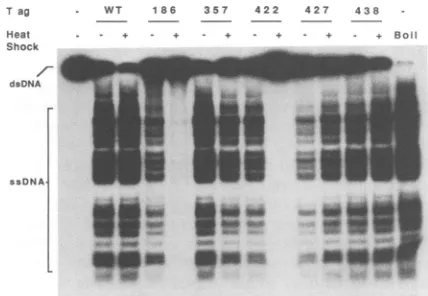
Helicase activities of mutant T antigens. The helicase activity ofT antigen is a complex function thatrequires a broadspanof theprotein, and all knowntsAmutationsmap within thissegmentof T antigen (Fig. 1). We compared the helicaseactivities ofWT and tsA mutant Tantigens withand without a heat shock. The substrate for the helicase assay consisted of M13 single-stranded DNA onwhich a primer hadbeenextended to various lengths up to several hundred bases. After incubation of Tantigen with the substrate for 2 hunderreplication conditions, displacement of the radiola-beledoligonucleotideswasmeasuredby gel electrophoresis (Fig. 6).Heatshockslightlystimulated the helicase activities of WT Tantigenand mutants 427P-L and 438A-V. Heating reduced thehelicase function of mutant 357R-K about 2-fold andthat ofmutants186R-Tand422W-C more than20-fold, regardless of the length of the substrate oligonucleotides.
Tag Heat Shock
dsDNA
WT 186 357 422 427 438
-- - + - + - + - + - + - + Boil
toowS
* *_1''-
a
-.
rsIO
_a_
m_ _ __ _ _
FIG. 6. Helicaseactivities ofWTandmutantTantigens.Purified Tantigens (Tag)wereeithernotexposed(-)orexposed (+)to a
heat shock for 10 minat39°Cand incubated inreplicationbuffer
containingpartiallydouble stranded M13DNA(dsDNA) for2 hat
32°C.Displaced single-strandedDNAs(ssDNA)of variouslengths
wereanalyzed by gel electrophoresisasdescribedinMaterialsand
Methods.Numbersidentifytheamino acidpositionsof the various
mutations. The double-stranded DNA substrate is shown in the leftmostlane;boiled,single-strandedDNAis shown in therightmost lane.
on November 9, 2019 by guest
http://jvi.asm.org/
[image:5.612.63.300.71.251.2] [image:5.612.317.562.96.195.2] [image:5.612.332.546.481.629.2]6514 RAY ETAL.
TABLE 2. Summary ofWT and mutantphenotypes
Level ofactivity'
Function tsA mutant at39'C Zinc
WT finger
mutant, 186 357 422 427 438 320
Replication ++++ - - - + +
-Hexamer ++++ - + - ++ ++
Origin binding ++++ + ++ - ++ ++ ++++
Ongin unwinding ++++ - - - + + +
ATPase ++++ ++++ + + ++ +++ ++++
Helicase ++++ - ++ - ++++ ++++ +
a Numbers identify the amino acidpositions of the mutations. Results for the zincfinger mutant were taken from Loeberetal.(30) and from Table 1. Although zinc finger mutantTantigens protected thePENdomain of the core
originfromDNase,they did not protect theIRdomain. + + ++,+ ++, ++, +, and-indicate 100 to 75, 75 to50, 50to25, 25to5, and 5to0% of the level of the WT function.
DISCUSSION
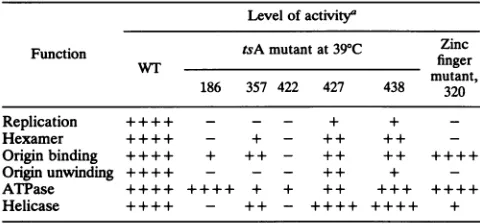
We have investigated the replication functions of all knowntsA mutants ofSV40largeT antigen. The tempera-ture dependence of the mutants strongly suggests that the mutated amino acidsplay crucialrolesin organizing protein structure. Wewanted todetermine whether the mutations haveglobaleffects on many functional domains of T antigen or affect onlythe domains in which the substituted amino acids reside. If the mutations affectonlyselectedfunctions, thenacomparison of results from a number of mutantsmight suggestwhich functionsareinterdependent. Table2 summa-rizes theeffects of heat shockonthereplication functionsof tsAmutantsand compares thesewiththefunctions of zinc fingermutantsdescribedby Loeberetal.(30).The data from eachassaywerequantitated bydensitometry, and theratios of mutant function with and without a heat shock were compared with the ratios of wild-type function with and without a heat shock. The levels of various functions are expressedinquartilesforeaseofcomparison. The quantita-tion of funcquantita-tions variedbyaboutt10% fromexperimentto experiment. Mutations that consistently reduced function morethan95% arerepresentedbyminuses.
Some mutations appear tohave global effectson protein functions.Mutant422W-C affected all of the tested functions of Tantigento asignificant extent. Itis notclearwhythis single amino acid substitution has such dramatic effectson protein structure. Tryptophan422 is located in a predicted beta sheet in aregionthat has the structural features ofan ATP binding fold (4). The substitution of a cysteine for tryptophan 422 wouldnot beexpected tochange the beta-sheet structure (7) even though this substitution is rare in conserved proteins (36). Apparently, heat shock of the 422W-Cmutantprotein eithercausesextensive denaturation ofTantigenorinterferes withacritical function upon which other functionsaredependent. For example, the absence of hexameric structures might contribute to the extent and severity of the defects of this mutant. The tsA mutation of amino acid 186 also caused extensive changes in protein function. However, incontrast to mutant422W-C, mutant 186R-T had no effect on ATPase activity even though all other functions tested were severely impaired. This finding indicatesthat the ATPase function does not depend on any of the other functions of T antigen that we tested. The differenteffects of thesetwomutations on ATPase function canbeexplained, in part, by their distance from the ATPase domain of theprotein (Fig. 1).Amino acid 186 islocated far
from the ATPase domain, while amino acid 422 is in the ATPasedomain. Ourfindingsareconsistent with and extend previous data showing that T antigens with deletions that block DNAbindingretainATPase activity (8, 9).
Mutants357R-K, 427P-L, and 438A-V haveanumber of common properties. After abrief heat shock, they are the only mutants that form hexamers in the presence of ATP. The same mutants have some ATPase activity and have significantlevels of helicaseactivity.These correlations are consistent with the idea that hexamers are needed for helicase activity. Recently, Wessel et al. (52) presented electronmicroscopicevidence that Tantigenformed hexa-mers at active helicase forks. It is not clear whyreduced numbers of hexamers andpartialATPase activityare suffi-cient forsignificant levels of helicaseactivityinourassays. The conditions forthese assays werethe same exceptthat hexamer
assembly
and ATPase assays were done in the absence of DNA.Perhaps
thesubstrateDNAin thehelicase assay enhanced the assembly of T-antigen hexamers and ATPase activity duringthecourse ofthe 2-h assay at32°C after the heat shock of Tantigen. Indeed, Parsonsetal. (38) havepresented direct evidence thatorigin DNA enhances thecooperative assembly ofT-antigen hexamers, and Gia-cherio et al.(20)
have shown that DNA increases the ATPaseactivity
of Tantigen.Mutants357R-K,427P-L, and 438A-V also bindreasonably
wellto core origin DNA but differ intheability
tounwindoriginDNA.Clearly,hexamer formation and DNA binding are not sufficient for originmelting.
Our studies of 438A-V are in agreement with theresults of
Reynisdottir
et al.(41),
even though different conditions were used for the heat shock of the mutantproteins
in their studies. Mutant 438A-V has been reportedtobe defective in
binding
toDNApolymerasea(19, 40);this defect may further contributetoits loss of DNAreplication.Our
findings together
withthose of Loeberetal. (30) andReynisdottir
et al.(41)
are consistent with a hierarchy ofinterrelated
T-antigen
functions. TheATPaseactivityis theonly
autonomousfunctionamongthose thatwetested.Theunwinding
oforigin
DNA and helicaseactivity areconsis-tently
associated with hexamerformation, and the helicasefunction is active
only
in the presence of ATPase activity. Thesecorrelationssuggestthat hexamersareneededfortheorigin-unwinding
andhelicase functions. TherelationshipofT-antigen
quaternarystructure tobindingof thecoreoriginremainsunclear.
Interestingly,
heatshockreducesnucleaseprotection by
tsAmutantTantigensoverthe entire span ofthe core
origin.
In contrast, zinc finger mutantT antigensprotectthePENdomain of thecoreorigineventhoughthey fail to protect the IR domain. This difference in DNase
protection
patterns suggests that the tsA mutations affectinteractionswith both the PEN and IRdomains, whilethe
zinc
finger
mutationstargetinteractions with theIRdomain,and is consistent with
previous
datashowing
that Tantigen can interactindependently
with isolated PEN and IR do-mains(34).
Because the helicase function of T antigen appears to
depend
on both hexamer formation and ATPasefunction,
one
might
expect that the helicase function would be thereplication
functionmostsusceptibletomutation.However,our assays
clearly
indicate that the origin-unwinding func-tion isevenmoresensitivetomutation. All five tsAmutantT
antigens
lostfunctionsimportant
for theinitiationof DNAreplication,
butthreemutantsretainedelongationfunctions.Reynisd6ttir
etal.(41)
reportedsimilar conclusions in theirstudy
ofmutant438A-V. Thespecificity
of theinteraction ofT
antigen
with recognition sequencesprobably explains whyJ.VIROL.
on November 9, 2019 by guest
http://jvi.asm.org/
origin-related functions are morefastidiousthan subsequent elongation functions. This difference may explain why in vivo studies of mutants like 357R-K, 427P-L, and 438A-V implicatedTantigen in the initiation of DNA replicationbut notin strand elongation (6, 49, 51).
ACKNOWLEDGMENTS
Thisinvestigation wassupported by PHS grants CA-18808 and
CA-38146 awardedbytheNational Cancer Institute. REFERENCES
1. Borowiec, J. A., and J. Hurwitz. 1988. ATP stimulates the
binding of simian virus 40 (SV40) large tumor antigen to the
SV40originofreplication. Proc. Natl. Acad. Sci. USA
85:64-68.
2. Borowiec, J. A., and J.Hurwitz. 1988. Localized melting and
structuralchangesin the SV40origin of replication induced by
T-antigen. EMBO J.7:3149-3158.
3. Borowiec, J. A.,L. Zhang, S. Sasse-Dwight, and J. D. Gralla.
1987. DNAsupercoiling promotes formation ofabent
repres-sionloop in lac DNA. J. Mol. Biol. 196:101-111.
4. Bradley,M.K., T. F.Smith, R.H.Lathrop,D. M.Livingston,
and T. A. Webster. 1987. Consensus topography in the ATP
bindingsite of thesimian virus40andpolyomavirus large tumor
antigens.Proc. Natl. Acad. Sci. USA 84:4026-4030.
5. Brugge, J.S.,andJ.S.Butel.1975. Role of simianvirus 40 gene A function in the maintenance of transformation. J. Virol.
15:619-635.
6. Chou, J. Y., J. Avila, and R. G. Martin. 1974. Viral DNA
synthesisin cells infectedby temperature-sensitive mutants of
simian virus 40. J. Virol. 14:116-122.
7. Chou,P.Y.,andG.D. Fasman. 1978.Empirical predictions of proteinconformation. Annu.Rev. Biochem. 47:151-276.
8. Clark, R., K Peden, J.M. Pipas, D. Nathans, and R. Tjian.
1983. Biochemical activities of T-antigen proteinsencoded by
simian virus 40 A gene deletion mutants. Mol. Cell. Biol.
3:220-228.
9. Cole,C.N., J. Tornow,R.Clark,and RTjian.1986. Properties
of the simian virus40(SV40) largeTantigensencoded bySV40
mutantswithdeletions ingeneA. J.Virol. 57:539-546. 10. Dean,F.B., J.A.Borowiec, T.Eki,and J.Hurwitz. 1992. The
simian virus40 Tantigendoublehexamerassembles around the DNAatthereplication origin.J. Biol. Chem.267:14129-14137. 11. Dean, F. B., M. Dodson, H. Echols, and J. Hurwitz. 1987.
ATP-dependentformation ofaspecialized nucleoprotein
struc-turebysimian virus 40(SV40) largetumorantigenattheSV40
replication origin. Proc. Natl.Acad. Sci. USA84:8981-8985. 12. Dean, F. B., and J. Hurwitz. 1991. Simian virus 40 large
T-antigen untwists DNA at the origin ofDNAreplication. J.
Biol.Chem.266:5062-5071.
13. Deb,S.P.,and P.Tegtmeyer. 1987.ATPenhancesthe binding
ofsimian virus40largeTantigentothe originofreplication. J.
Virol. 61:3649-3654.
14. DeCaprio, J. A., J. W. Ludlow, J. Figge, J.-Y. Shew, C.-M.
Huang,W.-H. Lee,E.Marsilio, E. Paucha, and D. M.
Living-ston. 1988.SV40largetumor antigen formsaspecificcomplex with theproductof theretinoblastomasusceptibility gene.Cell
54:275-283.
15. Dodson, M.,F. B.Dean,P.Bullock,H.Echols, and J. Hurwitz.
1987. Unwinding of duplex DNA from the SV40 origin of
replication byTantigen. Science238:964-967.
16. Dornreiter, I.,A. Hoss,A. K. Arthur,and E. Fanning. 1990.
SV40T-antigenbinds directly to the large subunitofpurified
DNApolymerase-a.EMBOJ. 9:3329-3336.
17. Fanning,E. 1992. Simianvirus 40largeTantigen: thepuzzle,
thepieces,and theemerging picture.J. Virol. 66:1289-1293. 18. Finlay,C. A., P. W. Hinds, and A. J. Levine. 1989. Thep53
proto-oncogenecanactas asuppressoroftransformation. Cell
57:1083-1093.
19. Gannon,J. V.,and D. P.Lane.1990. Interactions between SV40 Tantigenand DNApolymerasea.NewBiol.2:84-92.
20. Giacherio, D., and L. P. Hager. 1979. A poly(dT)-stimulated ATPaseactivityassociated with simian virus 40large Tantigen. J. Biol. Chem. 254:8113-8116.
21. Gralia, J.D. 1985. Rapid "footprinting" on supercoiledDNA.
Proc. Natl.Acad. Sci. USA 82:3078-3081.
22. Hutchinson, N. I., L.-S. Chang, M. M. Pater, N. Bouck, T. E.
Shenk, and G. diMayorca. 1985. Characterization of a new
simian virus 40 mutant, tsA3900, isolated from deletion mutant tsA1499. J. Virol. 53:814-821.
23. Jat, P. S., M. D. Noble, P. Ataliotis, Y. Tanaka, N. Yannoutsos, L. Larsen, and D. Kioussis. 1991. Direct derivation of condition-ally immortal cell lines fromanH-2Kb-tsA58transgenicmouse. Proc. Natl. Acad. Sci. USA 88:5096-5100.
24. Lane, D. P., and L. V. Crawford. 1979. T antigen is bound toa hostprotein inSV40-transformed cells. Nature (London) 278:
261-263.
25. Lanford, R. E. 1988. Expression of simian virus 40 T antigen in insect cells using a baculovirus expression vector. Virology 167:72-81.
26. Lanzetta,P.A.,L.J. Alvarez, P.S. Reinach, and 0. A. Candia. 1979. An improved assay for nanomole amounts ofinorganic phosphate. Anal. Biochem. 100:95-97.
27. Lin, J.-Y., and D. T. Simmons. 1991. The ability of large T antigen to complex with p53 is necessary for the increased life span and partial transformation ofhumancells by simian virus 40. J. Virol. 65:6447-6453.
28. Lin, J.-Y., and D. T. Simmons. 1991. Stable T-p53 complexes are not required for replication of simian virus-40 in culture or for enhanced phosphorylation ofT antigen and p53. J. Virol. 65:2066-2072.
29. Loeber, G.,R. Parsons, and P. Tegtmeyer. 1989. The zinc finger region of simian virus 40 large T antigen. J. Virol. 63:94-100. 30. Loeber, G., J. E. Stenger, S. Ray, R. E. Parsons, M. E.
Anderson, and P. Tegtmeyer. 1991. The zinc finger region of simian virus 40 large T antigen is needed for hexamer assembly and origin melting. J. Virol. 65:3167-3174.
31. Loeber, G.,M. J. Tevethia, J. F. Schwedes, and P. Tegtmeyer. 1989. Temperature-sensitive mutants identify crucial structural regions of simian virus 40 large T antigen. J. Virol. 63:4426-4430.
32. Martin,R. G., and J. Y. Chou. 1975. Simian virus 40 functions required for the establishment and maintenance of malignant transformation. J. Virol. 15:599-612.
33. Mastrangelo,I. A., P. V. C. Hough, J. S. Wall, M. Dodson, F. B. Dean, and J.Hurwitz. 1989. ATP-dependent assembly of double hexamersofSV40 T antigen at the viral origin of DNA replica-tion. Nature (London) 338:658-662.
34. Mastrangelo, I. A., P. V. C. Hough, V. G. Wilson, J. S. Wall,
J. F. Hainfeld, and P. Tegtmeyer. 1985. Monomers through trimers of large tumor antigen bind in region I and monomers through tetramers bind in regionIIofsimian virus 40 origin of replication DNA as stable structures in solution. Proc. Natl. Acad.Sci. USA 82:3626-3630.
35. Osborne, M., and K. Weber. 1975. Simian virus 40 gene A function and maintenance of transformation. J. Virol. 15:636-644.
36. Overington, J., D.Donnelly,M. S. Johnson, A. Sali, and T. L. Blundell. 1992. Environment-specific amino acid substitution tables: tertiary templates and prediction of protein folds. Protein Sci. 1:216-226.
37. Parsons, R., M. E. Anderson, and P. Tegtmeyer. 1990. Three
domains in the simian virus 40 core origin orchestrate the
binding,melting, and DNA helicase activities of T antigen. J. Virol. 64:509-518.
38. Parsons, R. E., J. E. Stenger, S. Ray, R. Welker, M. E.
Anderson, and P. Tegtmeyer. 1991. Cooperative assembly of
simian virus 40Tantigenhexamers on functional halves of the
replication origin. J.Virol.65:2798-2806.
39. Paucha, E., D.Kalderon,R. W. Harvey, and A. E. Smith. 1986.
Simianvirus40 origin DNA-binding domain on large T antigen.
J.Virol.57:50-64.
40. Pistillo, J. M., and J. K. Vishwanatha. 1991. Interaction of
simian virus 40 largeT-antigen with cellular DNA polymerase a:
on November 9, 2019 by guest
http://jvi.asm.org/
6516 RAY ET AL.
studies with variousT-antigen mutants of SV40. Arch. Virol. 118:113-125.
41. Reynisd6ttir, I., D. R. O'Reilly, L. K. Miller, and C. Prives. 1990. Thermally inactivated simian virus 40 tsA58 mutant T
antigen cannot initiate viral DNAreplication in vitro. J. Virol. 64:6234-6245.
42. Simanis, V., and D. P. Lane.1985.Animmunoaffinity purifica-tionprocedure for SV40largeTantigen. Virology 144:88-100.
43. Simmons,D. T.1986.DNA-binding region of the simian virus 40
tumorantigen. J. Virol. 57:776-785.
44. Simmons,D.T.,K.Wun-Kim,and W.Young. 1990. Identifica-tionofsimian virus 40 T-antigen residuesimportant for specific and nonspecific binding to DNA and for helicase activity. J. Virol.64:4858-4865.
45. Smale, S. T.,and R.Tjian. 1986.T-antigen-DNA polymerasea
complex implicated in simian virus40 DNA replication. Mol. Cell. Biol. 6:4077-4087.
46. Stahl, H., P. Droege, and R. Knippers. 1986. DNA helicase activity of SV40 largetumorantigen. EMBO J. 5:1939-1944.
47. Stiliman,B.W.,and Y. Gluzman.1985.Replication and super-coiling of simian virus 40DNAin cellextractsfromhuman cells. Mol. Cell. Biol. 61:2051-2060.
48. Strauss, M., P. Argani, I. J. Mohr, and Y. Gluzman. 1987. Studies onthe origin-specific DNA-binding domain of simian virus 40 largeTantigen. J. Virol. 61:3326-3330.
49. Tegtmeyer, P. 1972. Simian virus 40 deoxyribonucleic acid synthesis: the viral replicon. J. Virol. 10:591-598.
50. Tegtmeyer, P. 1975. Function of simian virus 40 gene A in transforming infection.J.Virol. 15:613-618.
51. Tevethia,M.J.,and L. W.Ripper. 1977. Isolation and charac-terization of additionaltemperature-sensitivemutantsof SV40. Virology 81:192-211.
52. Wessel, R., J. Schweizer, and H. Stahl. 1992. Simian virus 40 T-antigen DNA helicase is a hexamer which forms a binary complex during bidirectional unwinding from the viral origin of
DNAreplication. J. Virol. 66:804-815.
53. Wilson,V.G.,M.J. Tevethia,B.A. Lewton,and P.Tegtmeyer. 1982. DNAbinding properties of simian virus 40 temperature-sensitiveAproteins. J. Virol. 44:458-466.
54. Wun-Kim, K.,and D. T. Simmons. 1990.Mapping of helicase and helicase substrate binding domains on simian virus 40T
antigen. J. Virol. 64:2014-2020.
55. Yanai, N.,M. Suzuki,and M. Obinata. 1991. Hepatocytecell lines established from transgenic mice harboring temperature-sensitive simian virus-40 large T-antigen gene. Exp. Cell Res. 197:50-56.
56. Zhu, J.,M.Abate,P. W.Rice,andC.N.Cole. 1991. Theability of simian virus 40largeTantigentoimmortalizeprimarymouse
embryo fibroblasts cosegregates with its ability to bind to p53. J. Virol. 65:6872-6880.
J. VIROL.