R E S E A R C H
Open Access
Hybridization between two cestode species and
its consequences for intermediate host range
Tina Henrich, Daniel P Benesh and Martin Kalbe
*Abstract
Background:Many parasites show an extraordinary degree of host specificity, even though a narrow range of host species reduces the likelihood of successful transmission. In this study, we evaluate the genetic basis of host specificity and transmission success of experimental F1hybrids from two closely related tapeworm species (Schistocephalus solidus andS. pungitii), both highly specific to their respective vertebrate second intermediate hosts (three- and nine-spined sticklebacks, respectively).
Methods:We used anin vitrobreeding system to hybridizeSchistocephalus solidusandS. pungitii; hybridization rate was quantified using microsatellite markers. We measured several fitness relevant traits in pure lines of the parental parasite species as well as in their hybrids: hatching rates, infection rates in the copepod first host, and infection rates and growth in the two species of stickleback second hosts.
Results:We show that the parasites can hybridize in thein vitrosystem, although the proportion of self-fertilized offspring was higher in the heterospecific breeding pairs than in the control pure parental species. Hybrids have a lower hatching rate, but do not show any disadvantages in infection of copepods. In fish, hybrids were able to infect both stickleback species with equal frequency, whereas the pure lines were only able to infect their normal host species.
Conclusions:Although not yet documented in nature, our study shows that hybridization inSchistocephalusspp. is in principle possible and that, in respect to their expanded host range, the hybrids are fitter. Further studies are needed to find the reason for the maintenance of the species boundaries in wild populations.
Background
In interaction with their host organisms, many parasite taxa show an extraordinary degree of specificity, which is often regarded as indication of a long co-evolutionary history. In fact, parasites with a rather narrow range of suitable host species have been shown to be better adapted to sympatric host populations than generalist parasites [1,2]. However, the actual advantage of being restricted to only one or very few host species is still elu-sive. Particularly for parasites with complex life cycles, a narrow host range can be very disadvantageous since it decreases the probability for transmission when suitable host species are rare. Therefore, a good strategy for a parasite would be to become optimally adapted to one host species, but capable of a host-switch to avoid ex-tinction when under changing ecological conditions the specific host disappears.
One possibility for a rather fast expansion of the host range could be the introgression of host compatibility genes by hybridization between closely related parasites species [3]. Furthermore, this might also be a way to es-cape extinction, since specialization has been suggested as a one-way street [4,5]. Such a scenario is particularly conceivable in macroparasites with complex life cycles, where two parental species are highly specific to differ-ent intermediate hosts, but share a common final host where sexual reproduction takes place.
In all major taxa of helminth parasites, hybridization has been found in nature or been demonstrated between sympatric species in laboratory experiments. Most exam-ples have been described in digeneans [6-14], but there is also evidence from cestodes [15], monogeneans [16,17] and nematodes [18,19]. Testing whether or not hybridization may increase fitness by extending the range of suitable (intermediate) host species requires ex-perimental studies to determine transmission success in the different stages of a parasite life cycle. Particularly in * Correspondence:[email protected]
Department of Evolutionary Ecology, Max Planck Institute for Evolutionary, Biology, August-Thienemann-Strasse 2, Plön 24306, Germany
schistosomes, several studies have shown that hybrids between two species or strains inherited the ability to develop in both specific host snails of the respective par-ental lines and retain this increased host range over sev-eral generations [14,20,21]. Also for behavioral traits related to transmission, like diurnal cercarial shedding patterns [22] and specificity in host-finding behavior
[23], hybrids of different Schistosoma mansoni strains
have been shown to have trait values intermediate be-tween the parental strains,.
Schistocephalus solidus, a cestode with a complex life
cycle, is extremely specific for its second intermediate host, infecting only the three-spined stickleback Gasterosteus
aculeatus. This system has become a model system for
experimental studies on the evolutionary ecology of host-parasite interactions (reviewed by e.g. [24,25]).
Schistoce-phalus pungitiiis closely related toS. solidus, but uses the
nine-spined stickleback Pungitius pungitius as second
intermediate host, and shows the same host specificity at this level [26]. Both parasites potentially share the same final hosts [26] and often occur in sympatry [27,28]. Hence, natural encounters between adults of the sister species are plausible, making hybridization a possibility. However, a recent study by Nishimura and colleagues [29]
shows a deep lineage divergence in the Schistocephalus
genus, suggesting that separation of both species occurred shortly after the speciation of their respective stickleback lineages circa 20–25 million years ago. Hybrids have not been observed in nature yet and earlier experiments have
shown that both Schistocephalus species are not able to
infect the reciprocal intermediate hosts. Additionally, plerocercoids transplanted between three- and nine-spined sticklebacks stopped developing and later on showed destruction of the tegument [30,31]. Thus, these two species exhibit a high immunological specificity for their second intermediate host.
Many parasites undergo extensive growth in their final host, relative to that in their intermediate hosts [32].
However, Schistocephalus undergoes enormous growth
in its second intermediate host. The worm is extensively challenged by the host’s immune system [33,34], so it is possible that this rapid growth is facilitated by highly
specific adaptations to the host’s immune system. At
leastin vitro, the size of the worm is proportional to egg output [35,36], suggesting that specificity, growth, and fitness may be tightly linked in this system.
This system offers a unique possibility to investigate host specificity in two closely related parasite species with complex life cycles. It is likely that both parasite species meet in a bird’s gut for reproduction, which could facili-tate interspecies mating. Both parasites are simultaneous hermaphrodites and capable of self-fertilization (selfing). Since selfing is costly for the parasite in all stages of its life cycle [37-40], hybridization would seem to be
a good way to avoid the negative effects of inbreeding when outcrossing is not possible.
The aim of this study was to investigate the possibility of hybridization between the two cestode species of sticklebacks and the consequences of hybridization for host specificity and fitness at all stages of the parasite’s life cycle.
Methods
Study system
Schistocephalus solidusreproduces sexually in the
intes-tines of piscivorous birds – their final host. Eggs are
then released into the water with the bird’s feces, where they hatch into free swimming coracidia [41]. Copepods ingest coracidia and the worm develops into a procer-coid in the copepod body cavity. When a three-spined stickleback feeds on infected copepods, the tapeworm is transmitted to its second intermediate host where it develops into a plerocercoid and undergoes enormous growth. The life cycle is completed when a piscivorous
bird feeds on an infected stickleback [41]. S. pungitii
shares the main characteristics of this life cycle, but uses
P. pungitiusas a second intermediate host.
The two species of parasite can be maintained in the lab for all stages of their life cycle. Plerocercoids are
removed from the fish and can be bred in an in vitro
system that mimics the bird’s gut [42,43]. Worms are
usually size-matched for breeding, as this limits selfing [44]. After three weeks of incubation at 20°C in the dark, the coracidia start to hatch from eggs [26]. The coracidia
can then be used to infect copepods (e.g. Macrocyclops
albidus). After approximately two weeks of development
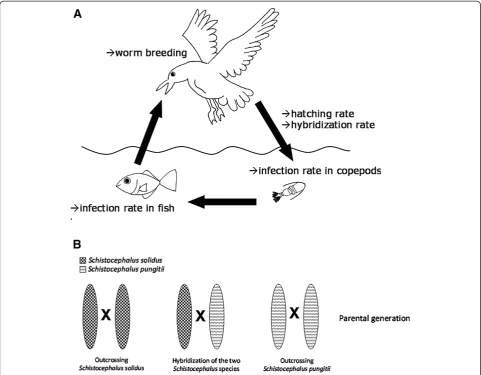
in copepods, worms are infective to sticklebacks [45-47]. Figure 1 shows the life cycle ofSchistocephalus, the most relevant traits measured in this experiment, as well as the breeding design for hybridizing the two parasite species.
Breeding design and worm origin
Lab-infected sticklebacks originated from two
allo-patric populations: Skogseidvatnet, Norway (60°310N,
05°130E) for three-spined sticklebacks with S. solidus
and Lebrader Teiche, Germany (54°220N, 10°420E) for
are likely due to hybridization per se rather than ran-dom genetic differences between groups.
Unfortu-nately, we were limited in the number of S. solidus
plerocercoids, so we bred seven pairs in total: one out-crossed S. soliduspair, two outcrossed S. pungitii, and four potential hybrid pairs.
Breeding conditions
The standardized laboratory breeding system [42,43] was slightly modified in that we diluted the medium with sterile filtered water, which we found was more suitable
forS. pungitii.In vitrocultured, adult worms were
trans-ferred into netbags with their respective partner and these netbags put into a bottle containing pre-warmed
medium (60% Eagle’s Minimal Essential Medium [Sigma]
and 40% sterile filtered tap water). The bottles were incubated in a 40°C shaking water bath in the dark for two days. After two days we assumed that reciprocal fertilization had happened (see e.g. 36) and we isolated
single worms in 50 ml tubes containing fresh pre-warmed medium. Eggs were collected from each worm for another three days in the breeding system. All col-lected eggs were washed with cold tap water (4°C) to prevent any larval development.
Estimation of hatching rate & hybridization rate
[image:3.595.57.539.89.464.2]in [48,49]) to estimate outcrossing/hybridization rates (see below).
The remaining eggs were left in a 16 hours light/8 hour dark room for another three weeks to ensure that every vi-able larva hatched. Afterwards, 100 eggs per worm were inspected visually to estimate the number of hatched coracidia.
Exposure of copepods
Cultured copepods (Marcrocyclops albidus) (see [50] for details on cultures) were each exposed to a single coraci-dium. We aimed to expose 96 copepods per single worm, which could not be achieved in every case be-cause of the low number of hatched coracidia in some worm sibships. The copepods were starved 1 day before exposure and afterwards fed every second day
alternat-ingly with two Artemia salina nauplii or ~100
Parame-cium caudatum. Copepods were checked visually for the
presence of procercoids on day 8 and 9 post exposure. Infected copepods were then fed to fish on day 16. By this time, at least in S. solidus, worms are essentially fully developed and infective to fish [51], so infection success in fish is unlikely to be attributable to develop-mental variation [47].
Infection of sticklebacks
Two German populations of naive lab bred sticklebacks
(G. aculeatusfrom Großer Plöner See (54°070N, 10°240E)
andP. pungitiusfrom Lebrader Teiche (54°220N, 10°420E))
were used to test the infection success of hybrids and pure parental parasite lines in the second intermediate host. We used an allopatric combination forS. solidus/G.
acu-leatus, since we did not have access to enough fish from
the sympatric population. Fish were put singly in plastic tanks containing approx. 1 L of water and starved for one day before exposure. Each fish was exposed to a single infected copepod. One day after the exposure the fish were moved in groups to 16 L tanks. The remaining water in the single tanks was filtered to ensure that all copepods were eaten by the fish. Fish were kept at 18°C and 16/8 h
light/dark period and were fed three times per week ad
libitumwith frozen daphnids and chironomid larvae.
Nine weeks after exposure the fish were killed with an overdose of MS222, measured, weighed, and the body cavity was opened to remove and weigh worms if present. A tissue sample was collected from each worm for microsatellite typing to check whether it was an out-crossed, selfed or hybrid individual.
Data analyses
We analysed the fitness relevant traits of the parasite separately. Two of the measured traits, hatching rates and outcrossing/hybridization rates, are characteristics of sibships and we analyzed them at this level. A
generalized linear model (GLM) with quasi-binomial errors and a logit link function was used to compare hatching rates in the three groups (pure S. solidus, pure
S. pungitii and hybrids). A similar GLM was used to
compare the hybridization rate of hybrid pairs to the outcrossing rate of S. solidus. Only S. solidus and the hybrids could be compared, because, unfortunately, the microsatellite markers developed for S. soliduswere not suitable to estimate outcrossing rate inS. pungitii, since all our individuals were homozygous across all loci.
Infection rates in copepods and fish were analyzed at the level of individual hosts. To evaluate whether infec-tion rates differ between hybrids and the pure species groups, we fitted GLMs with binomial errors and a logit link function [52]. For infection rates in fish, in addition to the parasite group, we also included fish species
(G. aculeatusandP. pungitius) as a factor. In some
com-binations of parasite group and fish species, no fish be-came infected (see Results). This kind of data structure (i.e. complete separation) causes inflated standard error and confidence interval estimates. Thus, we used the logistf R function (R package “logistf” [53]) to fit the GLM with penalized likelihood [54].
Finally, an analysis of covariance (ANCOVA) was used to test whether worm weight differs between fish species-worm species combinations while controlling for fish weight at dissection.
All statistical analyses were carried out using R 2.12.2 (R Development Core Team, Vienna). P-values lower than 0.05 were considered significant.
Ethical statement
All animal experiments described were approved by the
‘Ministry of Energy, Agriculture, the Environment and
Rural Areas’of the state of Schleswig-Holstein, Germany (reference number: V 313–72241.123-34).
Results & discussion
Hybridization rate / outcrossing rate
Analysis of six different microsatellite loci revealed a hybridization rate of 24 to 49% in three hybrid pairs (a total of 141 typed coracidia). The remaining 76 to 51% were selfed individuals. The outcrossing rate in
the S. solidus pair was 95% (91 coracidia typed). Both
a Fisher’s exact test (P < 0.0001) and a GLM at the level of sibships (n=4, F1, 2= 24.04, P = 0.039) indi-cated that there were significantly more selfed
indivi-duals in hybrid pairs than in conspecific S. solidus
pairs.
Our results show clearly that hybridization betweenS.
solidusandS. pungitiifrom two allopatric populations is
rate of hybridization or outcrossing remains unclear since the genetic markers cannot be used on unhatched eggs [44].
Hatching rate
A Fisher’s exact test indicated that overall hatching suc-cess differed significantly between groups (P = 0.0005). The hybrid pairs had the lowest hatching rate (mean
7.375%, n=4 worm pairs), followed by the S. pungitii
(15%, n=2) and S. solidus (24.5%, n=1). However, the
GLM with sibships as units did not indicate significant differences between the three groups (F-test comparing null model with model including treatment effect: F2, 4= 1.72, P = 0.29). Thus, we conclude that hybrids tend to have lower hatching rates than pure species sibships, but a larger number of sibships must be observed to confirm this difference.
The lower hatching rate in hybrids may be a conse-quence of the strong inbreeding depression of selfed individuals, as it was also previously shown by Christen
et al. [37] and Schjørring [40] that the hatching rate of
selfed worms was about 4 to 8 times lower than in out-crossed individuals.
Infection rate in copepods
A GLM indicated significant differences between groups (likelihood ratio test with an intercept-only model, χ2
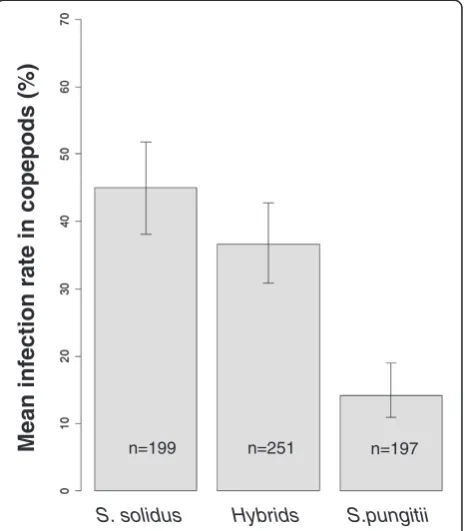
2 =109.43, P < 0.001). Worms bred in hybrid pairings showed an infection rate that was between the infection rates of S. solidus and S. pungitii (Figure 2). Below we address the possibility that the relatively high proportion of selfed offspring in the hybrid pairs biases the infection rate estimate for hybrids.
Infection rate in fish
When we compare the infection rates in fish (Figure 3), we see that worm species or fish host alone doesn’t have an effect on the infection rate. This was supported by a likelihood ratio test that showed the GLM with an inter-action term (fish species x worm group) was significantly better than the simpler model with just the two main effects (χ22 = 25.41, P < 0.001). Microsatellite analysis after removal of the worms from fish showed that most worms from hybrid pairs were hybrids and not selfed individuals. In total, we found five selfed worms among 32 individuals. Again, the infection rate estimates for hybrids might be biased by the unknown proportion of copepods harboring selfed worms that were fed to the fish. We address this issue in the section below.
In our study, each species of worm was only able to infect its specific host while their non-host stickleback was never infected. Strikingly, the hybrids were able to infect both fish hosts with equal probability, while the pure lines only infected their specific fish host.
S. solidus Hybrids S.pungitii
[image:5.595.307.540.90.356.2]Mean infection rate in copepods (%)
n=199 n=251 n=197Figure 2Mean infection rate in copepods.Error bars show 95% CI.
S.solidus
,n=38
S.pung
itii
,n
=11
S.solidus
,n=16
S.pung
itii
,n
=21
Hybrids
,n=39
Hybrids
,n=39
Mean infection rate in fish (%)
G.aculeatus P.pungitius
A
A
A
A
B
[image:5.595.306.540.417.703.2]B
Since the hybrids are able to infect both fish hosts at similar rates, they have expanded their host range. If the genes responsible for this trait were purely addi-tive, we would have seen ~20% infection rate of hybrids in fish (i.e. intermediate between the pure
lines). Instead, we see a kind of co-dominance where hybrids can infect both fish hosts just as well as the parental lines. This ability may be due to specific traits that facilitate invasion and infection of both host species.
Infection rate of selfers
0.2 0.4 0.6 0.8
Proportion
of
hybrid
coracidia
0.2 0.4 0.6
0.8 0.00.2
0.4 0.6 0.8 Hybrid infection
rate in copepods
Many selfed coracidia with high infection probability Hybrid infection rate cannot be low enough to produce observed infection rate. Hybrid infection rate
cannot be high enough to produce observed infection rate.
A
Infection rate of selfers
0.2 0.4 0.6 0.8
Proportion
of
hybrid
coracidia
0.2 0.4 0.6 0.8
Not enough copepods infected with hybrids to produce the observed
number of hybrid plerocercoids.
B
[image:6.595.58.543.88.579.2]0.0 0.2 0.4 0.6 0.8 Hybrid infection rate in fish
Are hybrid infection rate estimates biased by selfing?
Eggs collected from hybrid worm pairs represent a mix of self-fertilized and hybrid offspring. Up to 76% of the coracidia typed from hybrid sibships were selfed, yet, of the plerocercoids recovered from fish exposed to hybrids, 27 were hybrids and 5 were selfed. Even though more selfed coracidia were presumably taken for copepod infections, hybrid worms were more likely to be recov-ered from fish at the end of the experiment. This sug-gests the estimated infection rates of hybrids in copepods and fish may be downwardly-biased; but how much? The observed infection rate in copepods,Rc, equals:
Rc¼ðRchPchÞ þðRcsð1PchÞÞ
whereRchis the infection rate of hybrids in copepods,Rcs
is the infection rate of selfers in copepods, andPchis the
proportion of coracidia that are hybrids. The hybrid in-fection rate, our primary interest, thus equals:
Rch¼
RcðRcsð1PchÞÞ
Pch
AsRcis known (=0.375), the infection rate for hybrids
can be calculated for different combinations of Rcs and
Pch. This is shown in Figure 4A. Inbreeding depression
has been observed in S. solidus [37,40], so we may
ex-pect the infection rate of selfers to be lower thanRc(e.g.
for the S. solidus population used here, other
experi-ments determined the infection rate of selfed coracidia to be ~10%; D. Benesh, unpublished data). Moreover, the proportion of typed coracidia that were hybrids ran-ged from 24 to 49%. If we take these values to define a plausible range (Rcs< 0.375 and 0.24 < Pch < 0.49), then
Figure 4A indicates that the infection rate of hybrids in copepods may be substantially higher than estimated by the experiment.
This approach can be extended to calculate the infec-tion rates in fish necessary to produce the observed number of hybrid plerocercoids. Assuming the propor-tion of selfed and hybrid worms infecting copepods are the same proportions used for the fish exposure (i.e. there is no differential mortality in copepods between the two groups), then the proportion of fish exposed to hybrid worms,Pfh, equals:
Pfh¼
RchPch
Rc
The number of worms recovered from fish that are hybrids,nih, is then,nih=Pfh*ne*Rfh,
whereneis the number of fish exposed and Rfh is the
infection rate of the hybrids in fish. Rearranging for Rfh,
our parameter of interest, gives Rfh¼nih=ðPfhneÞ.nihand
neare known (29 and 78, respectively) andPfhis a
func-tion of the infecfunc-tion rate of selfers in copepods and the
proportion of coracidia that are hybrids. Consequently, we can calculate the hybrid infection rate in fish neces-sary to produce the observed results, given different
ini-tial conditions (Rcs and Pch), and this is shown in
Figure 4B. In the parameter space with the highest plausibility, hybrid infection rates were upwardly biased, but only slightly. Only with quite high selfer infection rates (>0.25) does this bias become large enough to sug-gest that hybrids have significantly higher infection rates in fish than the pure lines (>0.6).
In summary, our calculations indicate that the infec-tion rate for hybrid worms in copepods may be much higher than estimated by the experiment, perhaps even higher than the pureS. solidus group (Figure 2). On the other hand, infection rate estimates in fish do not appear to be so biased that the rate for hybrids should be con-sidered larger than that of the pure lines in their normal host (Figure 3). Thus, this analysis underscores our main conclusion; the hybrids do not experience any obvious fitness disadvantages compared to pure lines.
Relationship between worm and fish body size
There was a significant relationship between fish weight and worm weight (F1, 39 = 104.4, P < 0.001). Moreover, this relationship seemed to depend on the worm group (interaction between fish weight and worm group, F3, 33 = 8.68, P < 0.001) (Figure 5). Differences
between groups were biggest in large fish, with pure S.
solidusgrowing particularly large inG. aculeatus(Figure 5).
[image:7.595.305.540.475.675.2]Unfortunately, there were few data points in the largest
Figure 5Relationship between fish weight and worm weight. The figure shows the relationship of fish and worm weight in mg for the different treatment groups. (G. acwithS. solidus: n=12,G. ac with hybrids: n=11,P. puwithS. pungitii: n=4,P. puwith
fish, making these results tenuous. When we eliminated the data points from the largest fish (>0.7 g), there was no longer a significant interaction (F3, 29= 0.09, P = 0.96) nor were there significant differences in the mean weight of hybrids and pure species worms (F3, 29= 0.27, P = 0.84). Thus, these results suggest that hybrids and pure lines grow to quite comparable sizes in sticklebacks, although it remains possible that in larger fish worm sizes may diverge between groups.
Both the size of the host body cavity as well as its im-mune defenses are likely to limit worm growth. The host’s immune system is likely to interact with the para-site and interfere with its growth, as well as the space of the body cavity limits worm growth at a certain point.
Conclusion
What is the evolutionary advantage of being highly host
specific and why have no hybrid Schistocephalus been
found in nature so far? There are several possibilities and none are mutually exclusive.
Ecological factors could cause prezygotic isolation be-tween species. Both parasites species could have com-pletely independent life cycles by inhabiting different microhabitats in the bird’s gut or even by infecting
dif-ferent bird species. Although S. solidus is known to be
infective to a wide range of warm-blooded vertebrates
[26,42], much less is known about S. pungitii. We also
don’t know if the relatively high selfing rate observed in hybrid sibships is a consequence of the worms preferring to self instead of hybridizing or a consequence of a high proportion of unviable hybrids that did not hatch.
If the species are separated by postzygotic isolation, it may be that they hybridize frequently, but are either out-competed by the pure lines or show a F2 hybrid break-down [55-57]. We could show that at least the F1 generation of hybrids does not show obvious fitness dis-advantages, which argues against the fact that they are rapidly outcompeted. Finally, barriers to hybridization may exist only in sympatric populations (reinforcement, for example see [58]). The S. solidus used in this study originate from a population in western Norway, where no nine-spined sticklebacks occur in the whole area (Per J. Jakobsen & Tom Klepaker, personal communication); therefore, in this specific situation there was no selection pressure to evolve a barrier to mating, which might be the case in populations where both stickleback species together with their specific parasites co-occur.
As other studies have shown, hybridization occurs in natural populations of different parasite taxa and has also been shown as a mechanism to broaden the host range by introgression of new genes [14,20,21].
It is worth noting that most studies on S. solidusand
S. pungitii are based on morphological traits, which are
not easily distinguishable between the species. To date,
only a few studies have employed genetic markers [29,49] on a limited number of individuals, and therefore more extensive studies targeting the detection of hybrids are warranted.
Although we could observe hybridization in the la-boratory, it still remains unclear if hybridization also occurs in nature. Further experiments are needed to test whether the worms are located in the same compart-ment of the bird’s gut, if hybridization can occur in nat-ural hosts and if given the choice, worms choose mates of the same species over hybridization. Furthermore, it would be interesting to know how the possibility of hybridization and fitness parameters, such as infection rates in intermediate hosts, vary between sympatric and allopatric pairs of S. solidus and S. pungitii or if there even is a barrier to hybridization in nature. We are cur-rently collecting more species pairs from different popu-lations to test these ideas.
Competing interests
The authors declare that they have no competing interests.
Authors’contributions
MK conceived the study. TH and MK performed the experiment, collected the data and wrote the manuscript. DPB performed the analysis for the evaluation of the infection bias and helped with the statistics and the manuscript. All authors read and approved the final manuscript.
Acknowledgements
We would like to thank R. Leipnitz and M. Schwarz for help with the copepods, G. Augustin and D. Martens for fish husbandry, P. J. Jakobsen for help in collecting Norwegian sticklebacks. We also thank P. J. Jakobsen, I. Samonte-Padilla, K. B. Mobley and P. Rausch for helpful discussions.
Received: 21 December 2012 Accepted: 1 February 2013 Published: 7 February 2013
References
1. Poulin R:Large-scale patterns of host use by parasites of freshwater fishes.Ecol Lett1998,1:118–128.
2. Lajeunesse MJ, Forbes MR:Host range and local parasite adaptation. Proc Biol Sci2002,269:703–710.
3. Detwiler JT, Criscione CD:An infectious topic in reticulate evolution: introgression and hybridization in animal parasites.Genes2010, 1:102–123.
4. Nosil P:Transition rates between specialization and generalization in phytophagous insects.Evolution2002,56:1701–1706.
5. Poulin R, Krasnov BR, Shenbrot GI, Mouillot D, Khokhlova IS:Evolution of host specificity in fleas: is it directional and irreversible?Int J Parasitol 2006,36:185–191.
6. Leroux P:Hybridizationof Schistosoma mansoniandS. rodhaini.T Roy Soc of Trop Med H1954,48:3–4.
7. Taylor M:Hybridization experiments on 5 species of African schistosomes.J Helminthol1970,44:253–314.
8. Wright CA, Southgate VR, Van Wijk HB, Moore PJ: Hybrids between
Schistosoma haematobiumandS. intercalatumin Cameroon.T Roy Soc of Trop Med H1974,68:413–414.
9. Southgate VR, Wijk HB, Wright CA:Schistosomiasis at loum, Cameroun;
Schistosoma haematobium,S. intercalatumand their natural hybrid. Z Parasitenkd1976,49:145–159.
11. Agatsuma T, Arakawa Y, Iwagami M, Honzako Y, Cahyaningsih U, Kang S-Y, Hong S-J:Molecular evidence of natural hybridization betweenFasciola hepaticaandF. gigantica.Parasitol Int2000,49:231–238.
12. Morgan JT, DeJong RJ, Lwambo NJS, Mungai BN, Mkoji GM, Loker ES:First report of a natural hybrid betweenSchistosoma mansoniandS. rodhaini. J Parasitol2003,89:416–418.
13. Steinauer ML, Hanelt B, Mwangi IN, Maina GM, Agola LE, Kinuthia JM, Mutuku MW, Mungai BN, Wilson WD, Mkoji GM,et al:Introgressive hybridization of human and rodent schistosome parasites in western Kenya.Mol Ecol2008,17:5062–5074.
14. Huyse T, Webster BL, Geldof S, Stothard JR, Diaw OT, Polman K, Rollinson D: Bidirectional introgressive hybridization between a cattle and human schistosome species.PLoS Pathog2009,5:1–9.
15. Okamoto M, Nakao M, Blair D, Anantaphruti MT, Waikagul J, Ito A:Evidence of hybridization betweenTaenia saginataandTaenia asiatica.Parasitol Int2010,59:70–74.
16. Kuusela J, Zietara MS, Lumme J:H. Hybrid origin of Baltic salmon-specific parasiteGyrodactylus salaris: a model for speciation by host switch for hemiclonal organisms.Mol Ecol2007,16:5234–5245.
17. Schelkle B, Faria PJ, Johnson MB, van Oosterhout C, Cable J:Mixed infections and hybridisation in monogenean parasites.PLoS One2012, 7:e39506.
18. Martín-Sánchez J, Artacho-Reinoso ME, Díaz-Gavilán M, Valero-López A: Structure ofAnisakis simplex s.l. populations in a region sympatric for
A. pegreffiiandA. simplex s.s. Absence of reproductive isolation between both species.Mol Biochem Parasit2005,141:155–162.
19. Grabner DS, Dangel KC, Sures B:Merging species? Evidence for hybridization between the eel parasitesAnguillicola crassusand
A. novaezelandiae(Nematoda, Anguillicolidea).Parasit Vectors2012,5:244. 20. Mutani A, Christensen NO, Frandsen F:A study of the biological
characteristics of a hybrid line between maleSchistosoma haematobium
(Dar es salaam, Tanzania) and femaleS. intercalatum(Edea, Cameroun). Acta Trop1985,42:319–331.
21. Pagès JR, Southgate VR, Tchuem Tchuenté LA, Jourdane J:Experimental evidence of hybrid breakdown between the two geographical strains of
Schistosoma intercalatum.Parasitology2002,124:169–175.
22. Théron A, Combes C:Genetic analysis of cercarial emergence rhythms of
Schistosoma mansoni.Behav Genet1988,18:201–209.
23. Kalbe M, Haberl B, Hertel J, Haas W:Heredity of specific host-finding behaviour inSchistosoma mansonimiracidia.Parasitology2004, 128:635–643.
24. Hammerschmidt K, Kurtz J:Evolutionary implications of the adaptation to different immune systems in a parasite with a complex life cycle. Proc Biol Sci2005,272:2511–2518.
25. Barber I, Scharsack JP:The three-spined stickleback-Schistocephalus solidus
system: an experimental model for investigating host-parasite interactions in fish.Parasitology2010,137:411–424.
26. Dubinina MN:Tapeworms (Cestoda, Ligulidae) of the fauna of the USSR. New Dehli: Amerind Publishing Co. Pvt. Ltd.; 1980.
27. Zander CD, Reimer LW, Barz K:Parasite communities of the salzhaff (northwest Mecklenburg, Baltic Sea). I. Structure and dynamics of communities of littoral fish, especially small-sized fish.Parasitol Res1999, 85:356–372.
28. Morozińska-Gogol J:A checklist of parasites recorded on sticklebacks (Actinopterygii: Gasterosteidae) from Poland.Parasitol Int2006,55:69–73. 29. Nishimura N, Heins DC, Andersen RO, Barber I, Cresko WA:Distinct lineages
ofSchistocephalusparasites in threespine and ninespine stickleback hosts revealed by DNA sequence analysis.PLoS One2011,6:1–10. 30. Bråten T:Host specificity inSchistocephalus solidus.Parasitology1966,
56:657–664.
31. Orr T, Hopkins C, Charles G:Host specificity and rejection of
Schistocephalus solidus.Parasitology1969,59:683–690.
32. Benesh DP, Chubb JC, Parker GA, Complex Life Cycles:Why refrain from growth before reproduction in the adult niche?Am Nat2013,181:39–51. 33. Scharsack JP, Kalbe M, Derner R, Kurtz J, Milinski M:Modulation of
granulocyte responses in three-spined sticklebacksGasterosteus aculeatusinfected with the tapewormSchistocephalus solidus.Dis Aquat Organ2004,59:141–150.
34. Scharsack JP, Koch K, Hammerschmidt K:Who is in control of the stickleback immune system: interactions betweenSchistocephalus solidus
and its specific vertebrate host.Proc Biol Sci2007,274:3151–3158.
35. Wedekind C, Strahm D, Schärer L:Evidence for strategic egg production in a hermaphroditic cestode.Parasitology1998,117:373–382. 36. Schärer L, Karlsson L, Christen M, Wedekind C:Size-dependent sex
allocation in a simultaneous hermaphrodite parasite.J Evolution Biol2001, 14:55–67.
37. Christen M, Kurtz J, Milinski M:Outcrossing increases infection success and competitive ability: Experimental evidence from a hermaphrodite parasite.Evolution2002,56:2243.
38. Christen M, Milinski M:The consequences of self-fertilization and outcrossing of the cestodeSchistocephalus solidusin its second intermediate host.Parasitology2003,126:369–378.
39. Milinski M:Fitness consequences of selfing and outcrossing in the cestodeSchistocephalus solidus.Integr Comp Biol2006,46:373–380. 40. Schjørring S:Delayed selfing in relation to the availability of a mating
partner in the cestodeSchistocephalus solidus.Evolution2004, 58:2591–2596.
41. Smyth JD, McManus DP:The physiology and biochemistry of cestodes. Cambridge: Cambridge University Press; 1989.
42. Smyth JD:Studies on tapeworm physiology I. The cultivation of
Schistocephalus solidusin vitro.J Exp Biol1946,23:47–70. 43. Wedekind C:The infectivity, growth, and virulence of the cestode
Schistocephalus solidusin its first intermediate host, the copepod
Macrocyclops albidus.Parasitology1997,115:317–324.
44. Lüscher A, Milinski M:Simultaneous hermaphrodites reproducing in pairs self-fertilize some of their eggs: an experimental test of predictions of mixed-mating and Hermaphrodite’s dilemma.J Evolution Biol2003, 16:1030–1037.
45. Clarke AS:Studies on the life cycle of the pseudophyllidean cestode
Schistocephalus solidus.Proc Zool Soc Lond1954,124:257–302. 46. Hammerschmidt K, Koch K, Milinski M, Chubb JC, Parker G:When to go:
optimization of host switching in parasites with complex life cycles. Evolution2009,63:1976–1986.
47. Benesh DP, Hafer N:Growth and ontogeny of the tapeworm
Schistocephalus solidusin its copepod first host affects performance in its stickleback second intermediate host.Parasit Vectors2012,5:90. 48. Binz T, Reusch TBH, Wedekind C, Schärer L, Milinski M:Isolation and
characterization of microsatellite loci from the tapewormSchistocephalus solidus.Mol Ecol2000,9:1926–1927.
49. Andris M, Arias MC, Barthel BL, Bluhm BH, Bried J, Canal D, Chen XM, Cheng P, Chiappero MB, Coelho MM,et al:Permanent genetic resources added to molecular ecology resources database 1 February 2012–31 march 2012.Mol Ecol Resour2012,12:779–781.
50. van der Veen IT, Kurtz J:To avoid or eliminate: cestode infections in copepods.Parasitology2002,124:465–474.
51. Benesh DP:Developmental inflexibility of larval tapeworms in response to resource variation.Int J Parasitol2010,40:487–497.
52. Wilson K, Grenfell BT:Generalized linear modelling for parasitologists. Parasitol Today1997,13:33–38.
53. Ploner M, Dunkler D, Southworth H, Heinze G:The logistf Package; 2006. ftp://mirror.kanti-zug.ch/lib.stat.cmu.edu/R/CRAN/doc/packages/logistf.pdf. 54. Heinze G, Puhr R:Bias-reduced and separation-proof conditional logistic
regression with small or sparse data sets.Stat Med2010,29:770–777. 55. Dobzhansky T:Studies on hybrid sterility. II. Localization of sterility
factors inDrosophila pseudoobscurahybrids.Genetics1936,21:113–135. 56. Endler JA:Geographic Variation, Speciation, and Clines. Princeton, NJ:
Princeton University Press; 1977.
57. Burton RS, Ellison CK, Harrison JS:The sorry state of F2 hybrids: consequences of rapid mitochondrial DNA evolution in allopatric populations.Am Nat2006,168(Suppl):S14–S24.
58. Liou LW, Price TD:Speciation by reinforcement of premating isolation. Evolution1994,48:1451–1459.
doi:10.1186/1756-3305-6-33