ESTIMATES OF MOBILITY FOR PREDICTION OF
STRUCTURE-BORNE SOUND TRANSMISSION IN
BUILDINGS
Barry M. Gibbs
Acoustics Research Unit, School of Architecture, University of Liverpool, U.K. e-mail: [email protected]
Andreas R. Mayr
Hochschule Rosenheim, University of Applied Sciences, Germany e-mail: [email protected]
This paper aims to provide a practical approach to the prediction of structure-borne sound power of mechanical installations in buildings. For structure-borne power, two source quanti-ties, activity and mobility, are required, in combination with one receiver quantity, the re-ceiver mobility. The source activity, in the form of free velocity or blocked force, is usually measured. For source mobility and receiver mobility, estimates, based on simple expressions, can provide a useful starting point. Also, machine bases may be categorised as: compact, plate-like, flanged or framed. Receiver structures, floors and walls, may be categorised as: plate-like, ribbed plate or framed plate. The estimates of source mobility are based on the rig-id body value, the characteristic plate mobility and the fundamental plate frequency. For ribbed and framed plate structures, the mobility will vary with location, but again simple es-timates of mobility, based on characteristic values and distance from the ribs, are possible.
1. Introduction
2.
Single equivalent excitation
In general, machines impart structure-borne power into connected and supporting structures through all contacts. The general expression of complex power for multi-point and multi component excitation, such as in [5], is given by:
a.
f S R S R H R S H f S
W v Y Y Y Y Y 1 v (1)
where vSf is the r.m.s. source free velocity vector, YS and
Y
R is the complex mobility matrices of the source and the receiver, respectively. H is the Hermitian transpose, where [ ]H = [ ]T* and [ ]-H = [[ ]T*]-1. The total power is the sum of the complex products of the forces and moments and their associated translational and rotational responses at the contacts of interest. Con-sideration of all transmission paths is rarely possible.2.1. Single equivalent free velocity
Source activity can be expressed as a free velocity vector, see equation (1), or as a blocked force vector. In seeking a single value of source activity, reference is made to indirect measurement methods, using reception plates [6]. If a source is attached to a thin high-mobility plate, it can be demonstrated that the source free velocity is obtained indirectly as the sum of the squares of the free velocity over the contacts
N i i v 1 2
. The free velocity also can be obtained by direct measurement [3]. This form of single value is used throughout the following discussion.
2.2 Single equivalent source and receiver mobility
In general, mechanical and water installations in buildings transmit vibrations by forces per-pendicular to the surface of the receiving structure and other components of excitation can be ne-glected [7, 8]. A further simplification results by neglecting transfer terms, in the estimate of the real part and magnitude of the receiver mobility and the magnitude of the source mobility. Figure 1 shows the approximate power, where the transfer terms have been neglected, normalised with re-spect to the exact power, for ten locations of a fan unit on a timber floor. Neglect of the transfer terms gives an average overestimate of 3 dB at low frequencies. The overestimate reduces with in-crease in frequency because of the reduced contribution of transfer terms in the full expression. In-dividual approximate estimates can be 10 dB different from the exact values, depending on fre-quency and location. However, this simplification warrants further consideration, when assembling single equivalent values.
Figure 1. Normalised power assuming independent contacts, for a fan unit at ten positions on a timber joist floor, after [8].
The total structure-borne sound power now is given as:
Ni i
eq R eq
S
eq R
SR
v
Y
Y
Y
P
1 2 2
2
Re
(2)
The single equivalent free velocity is as defined earlier. The single equivalent mobility is expressed as the average of the point mobilities over the contacts. The source mobility is a magnitude. The receiver mobility is a magnitude and also a real part of the value. This allows source quantities to be assembled as band average values, favoured by consultants and test houses. However, the complex relationship between the source and receiver mobility terms has been lost, and through the transfer terms between contacts, and errors can be expected, particularly at low frequencies. The effect of using magnitudes and neglecting cross and transfer coupling was examined by comparing approxi-mate and exact powers.
The final simplification is through calculating, rather than measuring the source and receiver mobilities and it remains to estimate the point mobility of a range of machine bases and a ribbed-plate lightweight building structure.
3.
Point mobility of machines
Figure 2. Point mobility of a flange base of a fan unit.
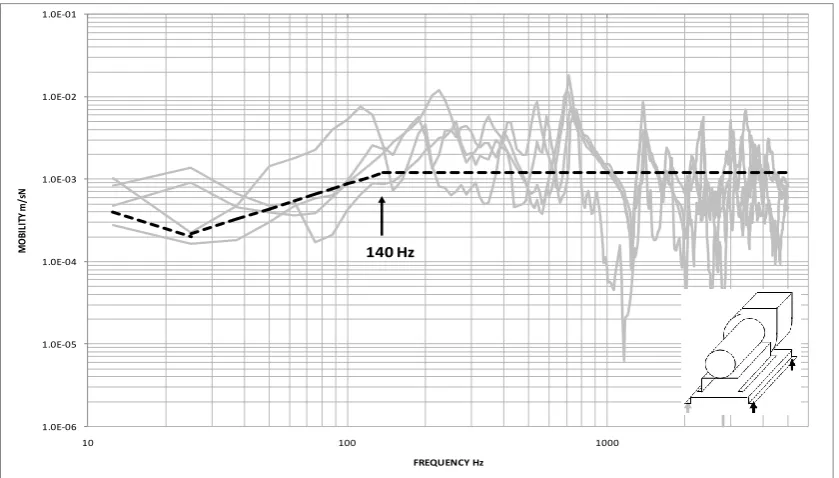
It is assumed that the first resonant frequency forms the transition between stiffness controlled and plate-like behaviour. The value depends on the plate thickness and material and the edge conditions [10]. In Figure 3 the same procedure is used for a fan unit on a base plate, likewise in Figure 4 for another unit. For these two machine bases, plate like behaviour is evident over much of the frequen-cy range of interest, although there are large fluctuations in the measured values.
1.0E-06 1.0E-05 1.0E-04 1.0E-03 1.0E-02 1.0E-01
10 100 1000
M
O
BI
LI
TY
m
/s
N
FREQUENCY Hz
140 Hz
Figure 3. Point mobility of plate base of a fan unit.
RB SC
CM
[image:4.595.89.509.423.662.2]0.000001 0.00001 0.0001 0.001 0.01 0.1
10 100 1000
M
O
BI
LI
TY
m
/s
N
[image:5.595.85.513.54.288.2]FREQUENCY Hz 87 Hz
Figure 4. Point mobility of plate base of a fan unit.
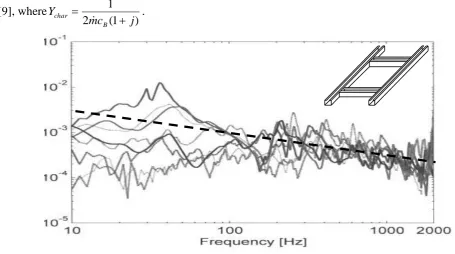
Frame structures are more variable in behaviour and difficult to characterise. In Figure 5 are shown the point mobility at eight mount positions of a frame base of a whirlpool bath [8]. Below 100 Hz, the mobilities are highly variable and sensitive to distance from structural discontinuities. Above 100 Hz, the measured values converge towards the characteristic (infinite) beam mobility [9], where
) 1 ( 2
1
j c m Y
B char
.
[image:5.595.59.515.379.633.2]
tions was recorded [11]. The measurements were at locations on, near and distant from ribs and frames (i.e. in bays). The point mobility ranged over two decades, with a mean value of 10-3 m/Ns in bays and 10-4 m/Ns at the ribs/frames. In Figure 6 the point mobility of a timber floor is shown for various distances from the nearest supporting timber joist. The mobility is normalised with re-spect to the characteristic mobility of the floor boarding and the distance is normalised with rere-spect to the bending wavelength on the boarding. At distances0.1wavelength, the mobility corresponds to the characteristic (infinite) beam mobility. At distances 0.25wavelength, the mobility corre-sponds to the characteristic (infinite) plate mobilityYchar. A monotonic transition occurs between the two regions and all three regions are shown as a dashed line.
Figure 6. Point mobility as a function of distance from a joist, after [12].
Using this idealisation, the point mobility at any location on the ribbed or framed lightweight struc-ture can be estimated. In Figure 7 are shown the calculated real parts of point mobility of the top plate (21 mm chipboard) at incremental distances from the nearest joist.
[image:6.595.69.527.494.711.2]5.
Predicted structure-borne power for a fan on a timber floor
The case study is of a fan unit (see point mobility in Figure 2) at ten locations on a timber joist floor. For each location, the exact power is calculated from equation (2) and from measured values of free velocity, complex source mobility, complex receiver mobility, for each of the four contacts, including complex transfer mobilities between contacts.
Figure 8. Power of a fan unit at ten locations on a timber floor; dashed line, approximate value.
For the approximate value, the receiver mobility is given by the characteristic plate mobility, which is a real value andYReq Re(YReq)Ychar. Therefore, the approximate value gives an overestimate at low frequencies and/or when near to the joists, but generally is within 5 dB of the exact values. Can the approximate method, with calculated values of mobility, be used to predict the effect of distance from ribs/frames on the structure-borne power? This is possible if all contacts are at the same distance. In Figure 9 is shown predicted power, as the fan unit is moved incrementally from the nearest joist to a central bay location.
[image:7.595.100.547.149.361.2] [image:7.595.102.546.507.732.2]
power level is 20 dB below the maximum level and can be assumed to be outside the frequency range of interest. This, in part, explains the relatively small spatial variation in total power shown in Figure 8.
6.
Concluding remarks
A practical approach to the prediction of structure-borne sound power of mechanical installa-tions in lightweight buildings is described. The required source activity, the free velocity, must be measured but the source mobility and receiver mobility can be calculated, based on characteristic dynamic properties. The described case study of a fan unit on a timber joist floor has applications to wall-mount installations, which are usually attached to the frame or ribs. This could provide sepa-rately the power into the structural frame and into the cladding, as a first step in the prediction of structure-borne sound propagation in lightweight buildings.
7. Acknowledgements
The authors wish to thank Professor Heinz-Martin Fischer and Dr. Jochen Scheck of Stuttgart University of Applied Sciences, also Christoph Hoeller of Liverpool University and Dr. Moritz Späh of the Fraunhofer-Institut für Bauphysik, Stuttgart, for sharing data, ideas and experiences. The au-thors gratefully acknowledge the financial support for this work provided by the Engineering and Physical Sciences Research Council of the UK.
REFERENCES
1. EN 15657-1: 2009: Laboratory measurement of airborne and structure-borne sound from building equipment.
2. EN 12354-5: 2009: Sound levels due to service equipment.
3. ISO 9611: 1996: Characterization of sources of structure-borne sound with respect to sound ra-diation from connected structures.
4. ISO 7626-5:1994: Vibration and shock - Experimental determination of mechanical mobility. 5. A.T. Moorhouse, On the characteristic power of structure-borne sound sources, J. Sound and Vib.
248(3), 441-459 (2001).
6. B.M. Gibbs, N. Qi and A.T. Moorhouse, 2007, Acta Acustica united with Acustica 93, 84-93, A practical characterization for vibro-acoustic sources in buildings.
7. M.M. Spaeh, B.M. Gibbs, Reception plate method for characterization of structure-borne sources in buildings: Assumptions and application, Applied Acoustics 70, 361-368, 2009.
8. A.R. Mayr, B.M. Gibbs, 2012, in press, Acta Acustica united with Acustica 98, Single equivalent approximation for multiple contact structure-borne sound sources in buildings.
9. L. Cremer, M. Heckl, B.A.T. Petersson, Structure-borne Sound, Springer, 2005. 10.A.W. Leissa, Vibration of Plates, 1993
![Figure 1. Normalised power assuming independent contacts, for a fan unit at ten positions on a timber joist floor, after [8]](https://thumb-us.123doks.com/thumbv2/123dok_us/8058443.225367/3.595.162.430.69.259/figure-normalised-power-assuming-independent-contacts-positions-timber.webp)
![Figure 6. Point mobility as a function of distance from a joist, after [12].](https://thumb-us.123doks.com/thumbv2/123dok_us/8058443.225367/6.595.69.527.494.711/figure-point-mobility-function-distance-joist.webp)