ULTRASONIC SCATTERING IN COMPOSITES
USING SPATIAL FOURIER TRANSFORM TECHNIQUES
INTRODUCTION
Lester W. Schmerr, Jr. Ames Laboratory, USDOE and
Department of Engineering Science and Mechanics Iowa State University
Ames, Iowa 50011
The heterogeneous nature of composite materials often makes their inspection using ultrasonics difficult unless the flaws are sufficiently large so that common B- or C- scans can be employed. Thus, flaw
scattering models are essential in order to interpret the measured ultrasonic responses. However, even at low frequencies where the com-posite may be able to be replaced by an equivalent homogeneous, aniso-tropic material, conventional direct scattering methods such as the T-Matrix and Boundary Element techniques are not effective. This is because both methods rely on the superposition of exact solutions to the governing equations of elastodynamics and, except for very special anisotropics, such exact solutions are not available in closed form. One way around this difficulty is to pose the scattering problem in a spatial Fourier frequency domain where exact fundamental solutions for elastodynamics are available, even for general anisotropic materials (1). Employing these solutions in a conventional volume or surface integral equation for the scattering wavefields then yields a spatial frequency domain formulation to the direct scattering problem. Because the boundary conditions are given in the real spatial domain, it is necessary to iteratively satisfy these conditions via fast Fourier transforms (2). This approach is called the Spectral-Iteration Tech-nique and has been applied successfully for a variety of electromagnetic scattering problems (3), (4). Here, we will obtain the equivalent elastic wave scattering formulations for cracks and volumetric flaws in a general anisotropic medium. Modifications of the standard Spectral-Iteration technique needed to ensure its convergence at low frequencies will also be discussed.
PLANAR CRACK MODEL
Consider first a plane harmonic wave incident on an open crack which occupies the surface S in the plane z
=
a
(Fig. 1).Figure One. Crack Scattering Geometry
The integral relation which governs this scattering problem is (5):
t:catt (X) -Crskm CiJ·qp ns nj ( a2G k(x-X)/Clx ax l>u.(x)dS(x)
Js
q - m p~ -
-(1)
scatt
where tr are the tractions at point
Z
due to the scattered waves, l>ui are the components of the displacement discontinuity on S, Cijk1 is the fourth order elastic constant tensor, and G k is thefundamental solution tensor for the equations of
e~astodynamics.
If the crack orientation is as shown in Fig. 1, ns .. Qs3 and nj .. Qj3 where Qij is the Kronecker delta symbol.On the surface of the crack the total tractions must vanish. Thus, for
X
in S in Eq. (1) we havet:catt (z) .. _trinc (X) (2)
where t inc are the tractions due to the incident waves. Now, consider taking ~patial Fourier transforms on x and y of both sides of Eq. (1) where the Fourier transform is defined as
,.. ((0 i~1x i~2Y
f(~1'~2'z) ..
JJ
_00 f(x,y,z) e e dx dy (3)Since the integral relationship is of the convolution type, we obtain on the plane z .. 0:
~t scatt .. -C C a2"'G /a a Af'!
r rskm ijqp ns nj qk xm xpwui
(4)
Equation (4) is a purely algebraic matrix equation relating these Fourier-transformed quantities which can be written symbolically as
't
scatt ..K
l>ur ri i (5)
ULTRASONIC SCATTERING IN COMPOSITES 55
Equation (4) shows that in order to determine the values of the coefficient matrix Kri in Eq. (5), the 2-D spatial Fourier transforms of the derivatives of the fundamental solution, Gqk, must be known. For an isotropic medium these are given simply as
2-d G k/dx ax q m p =
where G is the shear modulus, Ka
=
w/ca (a=
1,2) are the wavenumbers for di1ationa1 and shear waves, respectively, with ca (a = 1,2) being the dilatational and shear wavespeeds and W the frequency. Even in thegeneral anisotropic medium case, however, we have 2..,
a Gqk/dxmdxp
=
t
[;m;p f qk (;I';2';3)/S,3];3=
Ga (;I';2'w)(7)
where is an algebraic form that can be evaluated explicitly for special anisotropics and numerically in the general case (1). Thus, composite materials having many types of equivalent anisotropics can be handled effectively by this approach.
Although Eq. (5) is a purely algebraic equation, it cannot be used directly to solve for the unknown displacement discontinuities ~ui
scatt '" scatt .
because tr is unknown outside the crack surface S, and so tr 1S
also unknown. Equation (5) can, however, be used as part of the iterative method described by Kastner and Mittra (3).
THE SPECTRAL-ITERATION TECHNIQUE
The Spectral-Iteration technique re1ys on the ability to go rapidly between spatially transformed quantities and real quantities using the fast Fourier transform (FFT) algorithm. This capability is essential because Eq. (5) is a relationship between transformed quantities that guarantees that the equations of elastodynamics are satisfied while the boundary conditions on the crack surface, Eq. (2), must be enforced on actual (untransformed) variables. To simultaneously satisfy both the equations of motion and boundary conditions we can follow the following sequence of steps:
1. Begin with an initial guess for ~u. on the crack face. This
1
could simply be ~u.
=
0 or the values of ~ui obtained from the2. 3. 4.
Kirchoff approximation, for example. Use a 2-D FFT to compute ~~ ..
1
Form the matrix product
K .
r1 Compute the inverse 2-D FFTN
~ui •
to obtain t scatt on the plane z
5. 6. 7. 8. 9. 10. 11.
scatt inc .
Replace t r values on S by -t r (1.e., satisfy the boundary conditions) leaving the remaining values unchanged. Note that a convergence check on how well the boundary conditions are being satisfied is available at this step. Compute the 2-D FFT of the results of step
(01-1 .... scatt
5,
t
scatt.r
Form the matrix product tlu m = K mr r t •
Compute the inverse 2-D FFT to obtain a new tlu • m
Outside S, set tlu
=
0, keeping the remaining values inside S unchanged. Sin~e the exact tlu should automatically vanish outside S, a convergence check i~ also available at this step.Compute the 2-D FFT of this updated tlum, tlum' Go to step 3.
The above steps are analogous to those presented by Kastner and Mittra for electromagnetic problems (3). As they point out, the method is very storage efficient since no large matrices are ever inverted and the same storage can be used over and over during the iteration. Thus, very large scatterers can be treated. In fact, results up to non-dimensional frequencies of ka
=
50 have been obtained for certain electromagnetic problems (3). This capability greatly exceeds standard matrix scattering methods such as the T-Matrix or Boundary Elements.Very often, in scattering problems the end result desired is the far-field values of the scattered waves. Following the same procedures outlined by Gubernatis et. a1. (5), these far-field quantities for our crack problem can be shown to be directly obtained from the f-vectors defined as
,
f. (I;) 1
-3 A 2
J
-il;. r dS'-il; Cijk1 rj ~/4upw tlu1 e
-S
A
where
1 =
K1,2~(8)
Equation (8) shows that the f-vectors can be obtained from the spatial Fourier transform of llue which is band1imited to the "visible" region
III
~ K 2' This suggests that we need seek only to solve for afi1terea'version of tlue which has finite support in the spatial Fourier transform domain. Naturally, this can lead to greatly reduced sampling requirements.
INCLUSION MODEL
ULTRASONIC SCATTERING IN COMPOSITES 57
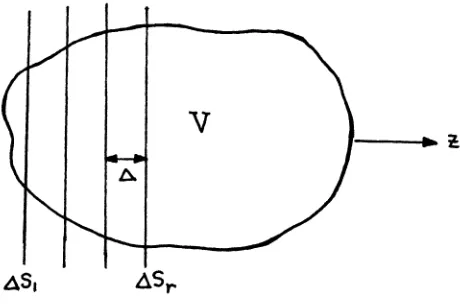
v
,----1 ...
~Figure Two. Stacked plane inclusion model.
Here, the governing equations are
u.scatt (y) =
f
opw2 G. (x - y) u (x) dV(x)~ - V ~m - - m-
-(9)
+Jv
oC
J 'k1 aG.. (x - y) laYk E1 m ~J - - m -(x) dV(_x) and(10)
where ui' Eip are the displacement and strain components, respectively, and 0 , 0 Cjk1m are the density and elastic constant differences between the i~c1usion and the host material. If these equations sampled at N planes, we obtain
N
L f:..
[f
s=l f:..SS 2
{opw aGim (u, v, (r-s)f:..)
[image:5.482.138.370.55.208.2]Taking the spatial Fourier transform on Y1' Y2 of both sides of Eqs. (11) and (12) then yields
N scatt N 2 ,.,
u. (E;1,E;2,rll) = L [oj::w G. (E;1' E;2' (r-s)lI)
1 S=l 1m (13)
~m(E;1,E;2,Sll)
+oC
jk1m oGij (E;l' E;2' (r-s)lI)/oYk £lm(E;l' E;2' sll)]and
(14)
Equations (13) and (14) are again purely algebraic equations that allow us to use the Spectral-Iteration technique one plane at a time, sweeping through the inclusion in the same fashion as was done for electro-magnetic problems (3). At each plane inside V the "constitutive" equation for the scatterer must be applied. For example, for a void these "constitutive" equations would be in V:
scatt inc
u. 1 u. 1
(15)
inc inc
E. lp - E. lp
Since the details of the iterative procedure again follow those of the electromagnetic case (3), we do not present any more explicit results here.
CONCLUDING REMARKS
Although the Spectral-Iteration technique is an effective tool for handling many previously intractable scattering problems, there are some difficulties in obtaining convergent solutions via the standard Spectral-Iteration method as described above at low frequencies.
However, by imbedding this technique within an iterative procedure which minimizes the error in the solution at each step in an integrated square error sense, Van den Berg (6) has shown how such convergence difficulties can be avoided.
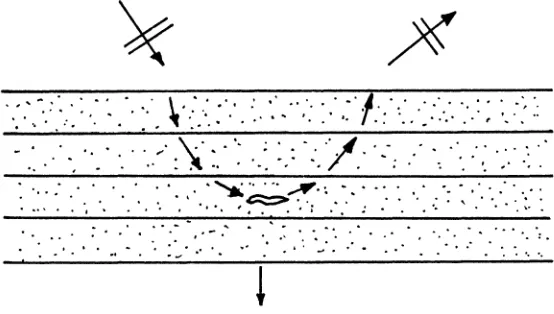
We are currently in the process of applying these iterative procedures to e1astodynamic crack and inclusion scattering problems. Initially, software is being developed for the special cases of isotropic and transversely isotropic media. The latter case is par-ticularly important since many fiber-reinforced composites can be modelled by such an equivalent anisotropy. Later, more general
ULTRASONIC SCATTERING IN COMPOSITES 59
'
..
.. ' :.
.,.,' \
..
:.:.
',' .',...
,..
,'....
.-',~,.. .....
, ...
~... ,
·.·1-... ··.·.·,
,
.
'.
-
,...
.
.
.
. 'Figure Three. Layered composite geometry.
ACKNOWLEDGEHENTS
This work was sponsored by the Center for Advanced Nondestructive Evaluation, operated by Ames Laboratory, USDOE, for the Naval Sea Systems Command under Contract No. U-7405-EN8-82 with IOv7a State University.
REFERENCES
1. Husgrave, H. J. P., Crystal Acoustics, Holden-Day, NY (1970). 2. Hittra, R., Ko, W. L. and Y. Rahmat-Samii, "Transform Approach
to Electromagnetic Scattering," Proc. IEEE, 67, 11, 1486-1503
(1979).
-3. Kastner, R. and R. Hittra, "A Spectral-Iteration Technique for Analyzing Scattering from Arbitrary Bodies, Part I: Cylindrical Scatteres with E-wave Incidence," IEEE Trans. Ant. and Prop., AP-31, 3, 499-506 (1983).
4. Kastner, R. and R. Mittra, "A Spectral-Iteration Technique for Analyzing Scattering from Arbitrary Bodies, Part II: Conducting Cylinders with H-wave Incidence," IEEE Trans. Ant. and Prop., AP-31, 3, 533-537 (1983).
5. Gubernatis, J. E., Domany, E. and J. A. Krumhansl, "Elastic Wave Scattering Theory with Application to Nondestructive Evaluation," LA-UR-79-2393, Los Alamos Scientific Laboratory, Los Alamos, New Hexico, 1979.
[image:7.482.99.376.57.214.2]