Vision and Language Learning:
From Image Captioning and Visual
Question Answering towards
Embodied Agents
Peter Anderson
A thesis submitted for the degree of
Doctor of Philosophy of
The Australian National University
April 2018
c
Except where otherwise indicated in the text, this thesis is my own original work. This thesis does not exceed the stipulated limit of 100,000 words.
Acknowledgments
First and foremost, this thesis would not have been possible without the guidance and support from my supervisor, Steve Gould. Steve is incredibly knowledgeable and technically adept, yet he remains patient, generous with his time and considered in his opinions, even when confronted with the half-baked ideas of research students. He is committed to the highest ethical and research standards and well-connected within the research community. In short, it’s hard to imagine a better supervisor. Thank you Steve.
I am also profoundly grateful to Mark Johnson and Macquarie University, for hosting me as a visiting student for an extended period of time. Thank you Mark, for adopting me into your group, for the many insightful discussions we had and for freely sharing your vast knowledge and expertise, which offered a crucial and different perspective on my research.
I would also like to thank Anton van den Hengel, who inspired and supported my two trips to Adelaide University, which resulted in some great collaborations with the very strong vision and language group there. Thank you Anton, for your advice and encouragement. Thanks also to Ian Reid and José Álvarez for taking an interest in my work and serving on my supervisory panel, and Basura Fernando for helping guide my research during my early stages at ANU.
During my PhD I have also benefited from discussions with many other col-leagues and collaborators, including Anoop Cherian, Rodrigo Santa Cruz, Edison Guo, Damien Teney, Qi Wu, Phil Roberts, Niko Sünderhauf, Jake Bruce, Mark Dras and others. I benefited enormously from participating in lively reading group discus-sions at ANU and Macquarie. I also had a great opportunity to intern at Microsoft Research in Seattle, and for that I am grateful to Xiaodong He and Lei Zhang. Thank you all for the ideas, advice, and contributions that you have made to my research.
I would also like to thank everyone involved with the Australian Centre for Robotic Vision (ACRV), including the Centre Executive, researchers, students and administrative staff. It was the formation of the ACRV that convinced me that it was the right time to start a PhD. The ACRV provided me with incredible opportunities to travel and attend summer schools and conferences, fostering a level of interaction across Australian universities that would ordinarily not be possible. Had the ACRV not existed, my PhD outcomes would have been greatly diminished.
Most importantly, I’d like to thank my wife, Christina, for her unwavering sup-port and encouragement. While I was producing papers, you brought our two beau-tiful kids into the world. While I was juggling travel commitments, you balanced the challenges of your own stellar career with the demands of running a household. You did all this and yet you still found time to care about my paper reviews. No words are adequate. Thank you for everything. To Mack and Sasha, I don’t know how you have already learned so much about the world. You guys amaze me every day.
Abstract
Each time we ask for an object, describe a scene, follow directions or read a document containing images or figures, we are converting information between visual and lin-guistic representations. Indeed, for many tasks it is essential to reason jointly over visual and linguistic information. People do this with ease, typically without even noticing. Intelligent systems that perform useful tasks in unstructured situations, and interact with people, will also require this ability.
In this thesis, we focus on the joint modelling of visual and linguistic information using deep neural networks. We begin by considering the challenging problem of automatically describing the content of an image in natural language, i.e., image captioning. Although there is considerable interest in this task, progress is hindered by the difficulty of evaluating the generated captions. Our first contribution is a new automatic image caption evaluation metric that measures the quality of generated captions by analysing their semantic content. Extensive evaluations across a range of models and datasets indicate that our metric, dubbedSPICE, shows high correlation with human judgements.
Armed with a more effective evaluation metric, we address the challenge of image captioning. Visual attention mechanisms have been widely adopted in image cap-tioning and visual question answering (VQA) architectures to facilitate fine-grained visual processing. We extend existing approaches by proposing a bottom-up and top-down attention mechanism that enables attention to be focused at the level of objects and other salient image regions, which is the natural basis for attention to be considered. Applying this approach to image captioning we achieve state of the art results on the COCO test server. Demonstrating the broad applicability of the method, applying the same approach to VQA we obtain first place in the 2017 VQA Challenge.
Despite these advances, recurrent neural network (RNN) image captioning mod-els typically do not generalise well to out-of-domain images containing novel scenes or objects. This limitation severely hinders the use of these models in real applica-tions. To address this problem, we proposeconstrained beam search, an approximate search algorithm that enforces constraints over RNN output sequences. Using this approach, we show that existing RNN captioning architectures can take advantage of side information such as object detector outputs and ground-truth image
viii
tations at test time, without retraining. Our results significantly outperform previ-ous approaches that incorporate the same information into the learning algorithm, achieving state of the art results for out-of-domain captioning on COCO.
Contents
Acknowledgments v
Abstract vii
1 Introduction 1
1.1 Bridging Vision and Language . . . 1
1.2 Image Captioning and Visual Question Answering . . . 1
1.3 Embodied Vision and Language Agents . . . 4
1.4 Contributions . . . 5
1.5 Thesis Outline . . . 7
1.6 List of Publications . . . 8
2 Background 9 2.1 Image Captioning . . . 9
2.2 Related Vision and Language Tasks . . . 11
2.3 Convolutional Neural Networks . . . 12
2.4 Recurrent Neural Networks . . . 13
2.4.1 Long Short-Term Memory (LSTM) Networks . . . 14
2.4.2 LSTM Encoders . . . 15
2.4.3 LSTM Decoders . . . 15
3 Datasets 19 3.1 ImageNet . . . 19
3.2 COCO . . . 21
3.3 VQA . . . 23
3.3.1 Version 1.0 . . . 23
3.3.2 Version 2.0 . . . 24
3.4 Visual Genome . . . 24
4 SPICE: Semantic Propositional Image Caption Evaluation 27 4.1 Image Caption Evaluation . . . 27
4.2 SPICE Metric . . . 29
4.2.1 Semantic Parsing from Captions to Scene Graphs . . . 31
x Contents
4.2.2 F-score Calculation . . . 33
4.2.3 Running Time . . . 35
4.2.4 Limitations . . . 37
4.2.5 Alternatives to Scene Graph Representations . . . 38
4.3 Experiments . . . 38
4.3.1 Human Judgements . . . 39
4.3.1.1 COCO . . . 39
4.3.1.2 Flickr 8K. . . 40
4.3.1.3 Composite Dataset. . . 40
4.3.1.4 PASCAL-50S . . . 40
4.3.2 System-Level Correlation . . . 41
4.3.3 Colour Perception, Counting and Other Questions . . . 42
4.3.4 Caption-Level Correlation . . . 44
4.3.5 Pairwise Accuracy . . . 44
4.4 Chapter Summary . . . 46
5 Bottom-Up and Top-Down Visual Attention for Image Captioning and VQA 51 5.1 Attention Networks . . . 51
5.1.1 Bottom-Up vs. Top-Down Attention . . . 53
5.2 Approach . . . 55
5.2.1 Bottom-Up Attention Model . . . 55
5.2.2 Captioning Model . . . 58
5.2.2.1 Top-Down Attention LSTM . . . 59
5.2.2.2 Language LSTM . . . 59
5.2.2.3 Objective . . . 60
5.2.3 VQA Model . . . 61
5.2.4 Implementation Details . . . 62
5.2.4.1 Bottom-Up Attention Model . . . 62
5.2.4.2 Captioning and VQA Models . . . 64
5.3 Evaluation . . . 64
5.3.1 Datasets . . . 64
5.3.1.1 COCO . . . 64
5.3.1.2 VQA v2.0 . . . 65
5.3.2 ResNet Baseline . . . 65
5.3.3 Image Captioning Results . . . 67
5.3.4 VQA Results . . . 69
Contents xi
6 Guided Image Captioning using Constrained Beam Search 77
6.1 Test-Time Novel Object Captioning . . . 77
6.2 Related Work . . . 79
6.3 Approach . . . 79
6.3.1 RNN Decoding with Beam Search . . . 79
6.3.2 Constrained Beam Search . . . 80
6.3.3 Application to Image Captioning . . . 84
6.3.4 Vocabulary Expansion . . . 86
6.4 Experiments . . . 86
6.4.1 Dataset Pre-processing . . . 87
6.4.2 Out-of-Domain Image Captioning . . . 87
6.4.3 Captioning ImageNet . . . 91
6.5 Chapter Summary . . . 94
7 Vision and Language Navigation in Real Environments 95 7.1 Vision and Language Navigation . . . 95
7.2 Related Work . . . 97
7.3 Matterport3D Simulator . . . 99
7.3.1 Matterport3D Dataset . . . 99
7.3.2 Simulator . . . 101
7.3.2.1 Observations . . . 101
7.3.2.2 Action Space . . . 101
7.3.2.3 Implementation Details . . . 103
7.3.2.4 Biases . . . 103
7.4 Room-to-Room (R2R) Navigation . . . 104
7.4.1 Task . . . 104
7.4.2 Data Collection . . . 104
7.4.3 R2R Dataset Analysis . . . 106
7.4.4 Evaluation Protocol . . . 106
7.5 Vision and Language Navigation Agents . . . 109
7.5.1 Sequence-to-Sequence Model . . . 109
7.5.2 Training . . . 110
7.5.3 Additional Baselines . . . 111
7.6 Results . . . 112
7.7 Chapter Summary . . . 114
xii Contents
8.2 Future Directions . . . 118
8.2.1 Complete Agents . . . 118
8.2.2 Large-scale 3D Datasets as Simulation Environments . . . 119
List of Figures
1.1 The image captioning and visual question answering (VQA) tasks. . . . 2
1.2 The Room-to-Room (R2R) navigation task. . . 5
2.1 An encoder-decoder neural network architecture for image captioning. 10 2.2 The joint-embedding approach to VQA. . . 11
2.3 An example of a convolutional neural network (CNN). . . 13
2.4 Diagram of a Long Short-Term Memory (LSTM) cell. . . 14
3.1 Examples from the ImageNet image classification dataset. . . 20
3.2 Examples of annotated images in the COCO dataset. . . 22
3.3 Examples of questions and answers from the VQA v1.0 dataset. . . 24
3.4 Examples of questions and answers from the VQA v2.0 dataset. . . 25
3.5 An example image annotation from the Visual Genome dataset. . . 26
4.1 SPICE uses semantic propositional content to assess image captions. . . 30
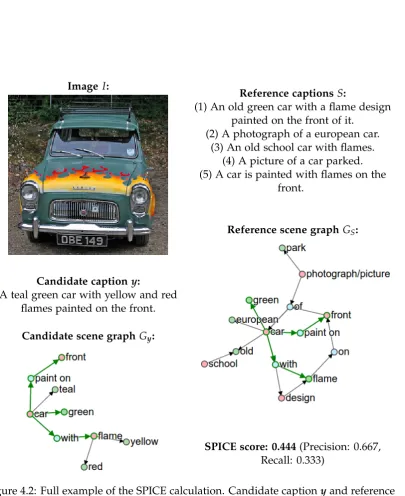
4.2 Full example of the SPICE calculation. . . 36
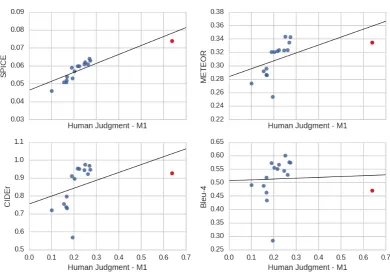
4.3 Automatic evaluations vs. human judgements for entries in the 2015 COCO Captioning Challenge. . . 42
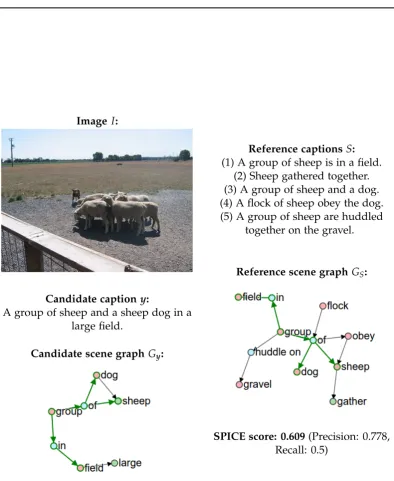
4.4 Pairwise classification accuracy of automated metrics on PASCAL-50S. 45 4.5 Additional example of the SPICE calculation. . . 48
4.6 Additional example of the SPICE calculation with parsing errors. . . 49
5.1 Calculating attention at the level of objects. . . 54
5.2 Example outputs from our Faster R-CNN bottom-up attention model. . 57
5.3 Overview of the proposed captioning model. . . 58
5.4 Overview of the VQA model used in experiments. . . 61
5.5 Example of a generated caption showing attended image regions. . . . 68
5.6 Qualitative differences between attention methodologies. . . 69
5.7 VQA example illustrating attention output. . . 71
5.8 Further examples of generated captions showing attended image regions. 73 5.9 Further examples of generated captions showing attended image regions. 74 5.10 Further examples of successful VQA results, showing attended image regions. . . 75
xiv LIST OF FIGURES
5.11 Examples of visual question answering (VQA) failure cases. . . 76
6.1 Captioning images containing previously unseen objects by incorpo-rating image tags during RNN decoding. . . 78
6.2 Example of constrained beam search decoding. . . 83
6.3 Examples of constrained captions generated on the COCO dataset. . . . 88
6.4 Examples of ImageNet captions constrained to include the ground-truth synset. . . 92
6.5 Human evaluations of ImageNet captions by super-category. . . 93
7.1 The Room-to-Room (R2R) navigation task. . . 97
7.2 Differences between Vision and Language Navigation (VLN) and VQA. 98 7.3 A snapshot of the visual diversity in the Matterport3D dataset. . . 100
7.4 An example navigation graph from the Matterport3D Simulator. . . 102
7.5 Randomly selected examples of R2R navigation instructions. . . 105
7.6 Distribution of instruction and trajectory length in R2R. . . 106
7.7 AMT data collection interface for the R2R dataset. . . 107
7.8 Distribution of navigation instructions based on their first four words. . 108
7.9 Distribution of navigation error in validation environments. . . 113
7.10 Validation loss, navigation error and success rate during training. . . 114
8.1 A light-hearted look at inter-disciplinary research in AI. . . 120
List of Tables
4.1 A summary of textual similarity metrics. . . 28
4.2 Runtime of SPICE vs. other metrics. . . 35
4.3 System-level Pearson’s ρ correlation between automatic evaluations and human judgements. . . 41
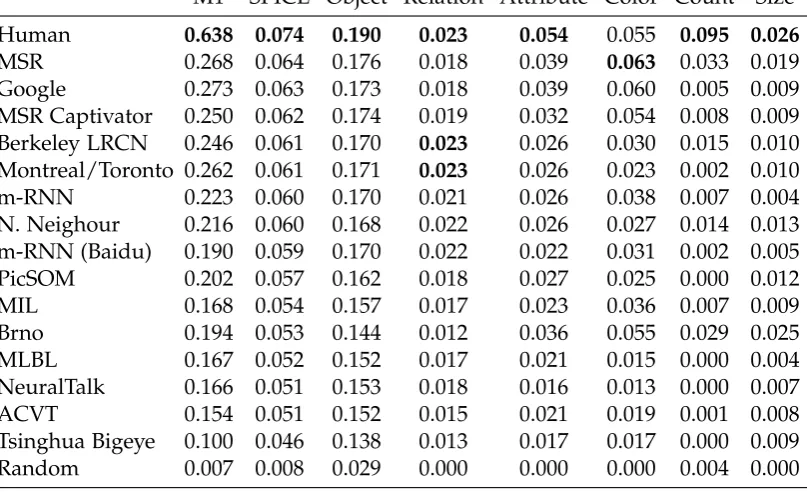
4.4 Human evaluations vs. SPICE scores by semantic proposition subcat-egory. . . 43
4.5 Caption-level Kendall’s τ correlation between automatic evaluations and human quality scores. . . 44
4.6 Caption-level classification accuracy of evaluation metrics at matching human judgement on PASCAL-50S. . . 45
5.1 Faster R-CNN detection scores on COCO vs. Visual Genome. . . 63
5.2 Single-model image captioning performance on the COCO Karpathy test split. . . 66
5.3 Breakdown of SPICE F-scores over various tuple subcategories. . . 66
5.4 Highest ranking published image captioning results on the online COCO test server. . . 68
5.5 Single-model performance on the VQA v2.0 validation set. . . 70
5.6 VQA v2.0 test-standard server accuracy. . . 70
6.1 Evaluation of captions generated using constrained beam search. . . 89
6.2 F1 scores for mentions of objects not seen during caption training. . . . 90
6.3 Human evaluations comparing ImageNet captions. . . 91
7.1 R2R navigation results on seen and unseen environments. . . 112
Chapter1
Introduction
1
.
1
Bridging Vision and Language
Each time we ask for an object, describe a scene, follow directions or read a document containing images or figures, we are converting information between visual and lin-guistic representations. Indeed, for many tasks it is essential to reason jointly over visual and linguistic information. People do this with ease, typically without even noticing. Intelligent systems that perform useful tasks in unstructured situations, and interact with people, will also require this ability. Consider domestic service robots, voice-controlled drones, visually-aware virtual personal assistants (i.e., the future descendants of Siri, Cortana, Alexa and Google Assistant), smart buildings and appliances that respond to natural language commands, intelligent surveillance and search systems for querying large image and video collections, language-based image and video editing software, and personal navigation systems that generate and comprehend visually-grounded instructions. Many of these applications will have far-reaching importance, and in each case, research that combines the tradi-tional fields of computer vision (CV) and natural language processing (NLP) is the only plausible approach.
1
.
2
Image Captioning and Visual Question Answering
Despite significant progress in CV and NLP, until recently the interaction between these fields had been much less explored. However, given the significant opportuni-ties that await, in recent years there has been an increase in research directed towards ambitious tasks that combine visual and linguistic learning. Two tasks have emerged as key focus areas within the vision and language research community. The first is the task of automatically describing the content of an image in natural language, i.e., image captioning [Vinyals et al., 2015; Xu et al., 2015]. As illustrated in Figure 1.1 left, image captioning is an excellent test of visual and linguistic understanding,
2 Introduction
Image Captioning Visual Question Answering
Input
What sort of bus is this?
Output
A man in a pink bow tie and a pink shirt is being hugged by a man in
a blue shirt.
[image:18.595.74.484.107.321.2]double decker
Figure 1.1: The image captioning (left) and visual question answering (right) tasks. Examples are taken from the COCO [Chen et al., 2015] and VQAv2 [Goyal et al., 2017] datasets respectively. Further background regarding these datasets is provided
in Chapter 3.
requiring a model to identify and describe the most salient elements of an image, such as the objects present and their attributes, as well as the spatial and semantic relationships between them [Fang et al., 2015]. The second task is the task of visual question answering, or VQA. As illustrated in Figure 1.1 right, a VQA model takes as input an image and an open-ended natural language question about the image, and must output one of possibly several correct answers [Antol et al., 2015]. Interest in these tasks has been driven in part by the development of new and larger benchmark datasets [Chen et al., 2015; Goyal et al., 2017]. However, these tasks also have di-rect applications, most obviously in terms of intelligent assistants for the low vision community [Gurari et al., 2018].
One way of evaluating the current state of the art in image captioning is by under-taking a user study. An analysis of the output of one recently proposed captioning model found that people considered 52% of the generated captions to be ‘bad’1, but this figure was only 13% for captions written by people [Liu et al., 2017a]. Clearly, there remains considerable scope for improvement. However, since user studies are expensive and difficult to replicate, generated image captions are more typically eval-uated using automated metrics such as Bleu [Papineni et al., 2002] and CIDEr [Vedan-tam et al., 2015]. Unfortunately however, these metrics have proven to be inadequate
§1.2 Image Captioning and Visual Question Answering 3
substitutes for human judgement, and they are difficult to interpret [Kulkarni et al., 2013; Hodosh et al., 2013; Elliott and Keller, 2014]. Motivated by these limitations, one of the contributions of this thesis is an improved automated evaluation metric. Our metric, dubbed SPICE (an acronym for Semantic Propositional Image Caption Evaluation), evaluates generated captions in terms of the truth value of the propo-sitions they contain. As we show in Chapter 4, SPICE substantially addresses the limitations of existing metrics, helping to track the state of the art and supporting the ongoing development of more effective captioning models.
In comparison to image captioning, the VQA task is much easier to evaluate as the answers are typically only one or two words. This makes it relatively straightforward to determine accuracy by comparing candidate answers to reference answers. How-ever, as with image captioning, there remains considerable scope for further research. For example, prior to the 2017 VQA Challenge2, the question answering accuracy of a VQA baseline model using the largest available dataset was only 62.3% [Goyal et al., 2017]. To improve the performance of both image captioning and VQA models, in Chapter 5 we propose a novel neural network architecture based on visual attention [Xu et al., 2015; Zhu et al., 2016]. In general, attention mechanisms focus on relevant inputs while ignoring irrelevant or distracting stimuli. Our approach leverages in-sights from neuroscience and psychology to make objects the basis of attention in our model [Egly et al., 1994; Scholl, 2001]. Using this approach we achieve state of the art performance in both image captioning and VQA, while simultaneously helping to improve the interpretability of the resulting systems. Our final (ensembled) entry in the 2017 VQA Challenge obtained first place with an overall accuracy of 69.0%, 0.8% ahead of the second-placed entry.
To put this result in context, a similar level of accuracy on this task could proba-bly be attained by a toddler. For example, our model is able to correctly answer sim-ple questions about common objects and colours, but struggles with counting and more difficult questions requiring a greater amount of prior knowledge, or ‘com-monsense’. However, this characterisation is subject to two strong qualifications. First, the VQA model can only perform this single narrowly defined task, while even very young children can obviously perform many tasks and learn new tasks very quickly. Second, the VQA model’s performance deteriorates catastrophically when tested on visual concepts that are not found in the training set. This limitation also holds for image captioning models [Tran et al., 2016]. To address this brittleness, in Chapter 6 we extend our image captioning model to make use of additional informa-tion sources, such as images tagged with keywords, when generating capinforma-tions. The resulting method—constrained beam search—is a general and principled approach to
4 Introduction
adding constraints to the output of a recurrent neural network (RNN). Using this ap-proach, we achieve state of the art performance on ‘out-of-domain’ images containing novel scenes or objects not seen in training.
1
.
3
Embodied Vision and Language Agents
The image captioning and VQA tasks are ideal for encouraging and quantifying progress in vision and language understanding, but they suffer from a serious limi-tation. Both tasks are passive. The input images are static, and the model (or agent) is not allowed to move or control the camera, seek clarification, or take any other ac-tion in the environment. This neglects a crucial aspect of the motivating applicaac-tions listed in Section 1.1, as each of these examples demands an agent that is embodied (or in control of some task-specific programming interface at least). In Chapter 7, the final technical chapter of this thesis, we address this limitation by connecting vision and language to actions. We focus on the problem of a robot executing a natural-language navigation instruction in a real 3D environment. We refer to this challenge as Vision-and-Language Navigation (VLN).
The idea that we might be able to give general, verbal instructions to a robot and have at least a reasonable probability that it will carry out the required task is one of the long-held goals of robotics, and artificial intelligence (AI). Although in-terpreting natural-language navigation instructions has already received significant attention [Chaplot et al., 2018; Chen and Mooney, 2011; Guadarrama et al., 2013; Mei et al., 2016; Misra et al., 2017; Tellex et al., 2011], previous approaches to the natural language command of robots have often restricted the visual complexity of the prob-lem. In contrast, we are motivated by recent work in image captioning and VQA in which natural images are used. We note that both VQA and VLN can be interpreted as visually grounded sequence-to-sequence translation problems, and many of the same methods are applicable. Therefore, to enable and encourage the application of vision and language methods to the problem of interpreting visually-grounded navigation instructions, in Chapter 7 we present the Matterport3D Simulator. The simulator is a large-scale interactive reinforcement learning (RL) environment con-structed from the Matterport3D dataset [Chang et al., 2017] which contains 10,800 densely-sampled panoramic RGB-D images of 90 real-world building-scale indoor environments. Compared to synthetic RL environments [Beattie et al., 2016; Kempka et al., 2016; Zhu et al., 2017], the use of real-world image data preserves visual and linguistic richness, maximising the potential for trained agents to be transferred to real-world applications.
§1.4 Contributions 5
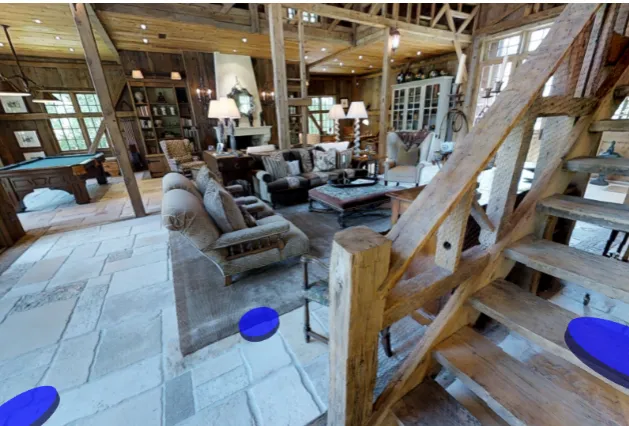
[image:21.595.159.474.112.325.2]Instruction: Head upstairs and walk past the piano through an archway directly in front. Turn right when the hallway ends at the pictures and table. Wait by the moose antlers hanging on the wall.
Figure 1.2: The Room-to-Room (R2R) navigation task. We focus on executing natu-ral language navigation instructions in previously unseen real-world buildings. The agent’s camera can be rotated freely. Blue discs indicate nearby (discretized)
naviga-tion opnaviga-tions.
navigation dataset containing 21,567 open-vocabulary, crowd-sourced navigation in-structions with an average length of 29 words. Each instruction describes a trajectory traversing typically multiple rooms. As illustrated in Figure 1.2, the associated task requires an agent to follow natural-language instructions to navigate to a goal loca-tion in a previously unseen building. We investigate the difficulty of this task, and particularly the difficulty of operating in unseen environments, using several base-lines and a sequence-to-sequence model based on methods successfully applied to other vision and language tasks [Antol et al., 2015; Chen et al., 2015; Goyal et al., 2017].
1
.
4
Contributions
In summary, this thesis makes four main contributions, beginning with image cap-tioning and visual question answering (VQA), before moving to consider embodied agents:
6 Introduction
agents that can communicate visual content, we need fast, accurate and inex-pensive metrics to evaluate the quality of the generated language. Our SPICE metric reflects human judgements significantly more accurately than other au-tomatic metrics. Even after widespread adoption, SPICE is still the only auto-matic evaluation metric that (correctly) judges human image descriptions to be superior to those from any proposed image captioning model3.
2. A combined bottom-up and top-down visual attention model. Visual atten-tion mechanisms have become an important component of many vision and language models [Xu et al., 2015; Zhu et al., 2016]. We leverage insights from neuroscience and psychology to make objects the basis of attention in our model. This is a general approach that more closely unifies tasks involving visual and linguistic understanding with recent progress in object detection [Ren et al., 2015a]. Using this approach we achieve state of the art performance in image captioning and VQA, while simultaneously helping to improve the interpretability of the resulting systems.
3. Constrained beam search for controlling the output of an RNN. Neural net-work captioning models typically generalise poorly to out-of-domain images containing novel scenes or objects not seen in training [Tran et al., 2016]. Mo-tivated by this problem, we propose constrained beam search, a principled ap-proach to completing partial sequences by adding constraints to the output of a recurrent neural network (RNN). Using this approach to incorporate additional text fragments, such as image tags, during caption generation, we achieve state of the art captioning performance on out-of-domain images without degrading in-domain performance.
4. The Matterport3D Simulator and the R2R navigation dataset. Datasets are a critical driver of progress in computer vision, not just as a source of train-ing data, but also as a means of measurtrain-ing and compartrain-ing the performance of competing algorithms [Torralba and Efros, 2011]. The proposed Room-to-Room (R2R) navigation task requires agents to follow natural language navigation in-structions in previously unseen environments (using the Matterport3D Simula-tor). This is the first visually realistic, interactive and reproducible benchmark for evaluating embodied vision and language agents.
§1.5 Thesis Outline 7
1
.
5
Thesis Outline
The remaining chapters of this thesis are summarised below:
Chapter2—Background. This chapter provides a general overview of the existing literature relating to image captioning, visual question answering (VQA), and related vision and language tasks, in order to put the contributions of this thesis in context. We also introduce some basic technical background that is assumed in the remainder of the thesis.
Chapter 3—Datasets. In this chapter, we outline the various pre-existing datasets that we use for training and evaluating our models, including datasets designed for image classification, image captioning, VQA and object detection.
Chapter4—SPICE: Semantic Propositional Image Caption Evaluation. In this chap-ter, we introduce the task of automatic image caption evaluation. We first review ex-isting automated evaluation metrics. Then, motivated by the role of semantic propo-sitions in human evaluations, we present the SPICE metric. Finally, we compare SPICE with existing metrics in terms of correlation with human judgements over a range of models and datasets.
Chapter5—Bottom-Up and Top-Down Visual Attention for Image Captioning and VQA. Using the SPICE evaluation metric from Chapter 4 and others, in this chapter we develop our image captioning model that places objects at the centre of the visual attention mechanism. We additionally illustrate the application of the same principle to VQA, and comprehensively evaluate the impact our bottom-up and top-down visual attention model on both tasks.
Chapter6—Guided Image Captioning using Constrained Beam Search. Address-ing the generalisation of captionAddress-ing models to images containAddress-ing novel scenes or objects, we propose constrained beam search to guarantee the inclusion of selected words or phrases in the output of an recurrent neural network, while leaving the model free to determine the syntax and additional details. We demonstrate that, when combined with image tag predictions, this approach outperforms prior work.
8 Introduction
90 real buildings Chang et al. [2017], and collect the Room-to-Room (R2R) dataset containing 21,567 open-vocabulary, crowd-sourced navigation instructions. Finally, we examine the performance of several baseline models, and human performance, on this newly established benchmark.
Chapter8—Conclusion and Future Directions. We conclude the thesis with a sum-mary of our main contributions and a discussion of future research directions for improving the work.
1
.
6
List of Publications
Much of the work described in this thesis has been previously published or accepted in conference proceedings, as follows:
• Our SPICE image caption evaluation metric (described in Chapter 4) was pub-lished at ECCV [Anderson et al., 2016].
• The bottom-up and top-down visual attention model (described in Chapter 5) has been accepted for publication and full oral presentation at CVPR [Anderson et al., 2018a].
• The constrained beam search approach to out-of-domain image captioning (de-scribed in Chapter 6) was published at EMNLP [Anderson et al., 2017].
• The work on vision-and-language navigation (described in Chapter 7) has been accepted for publication and spotlight presentation at CVPR [Anderson et al., 2018b].
The author also contributed to the following projects and publications. This work does not form part of this thesis:
• A video sequence encoding method for activity recognition based on hierarchi-cal rank pooling [Fernando et al., 2016],
• An exploration of architectures and hyperparameters identifying the tips and tricks that lead to the success of our competition-winning VQA model [Teney et al., 2018], and
Chapter2
Background
In this chapter we review existing literature relating to image captioning, visual ques-tion answering (VQA), and related vision and language tasks, in order to put the con-tributions of this thesis in context. We also provide a brief technical introduction to the convolutional neural network (CNN) and recurrent neural network (RNN) mod-els that we use as image encoders and language encoders/decoders in later chapters.
2
.
1
Image Captioning
Research interest in the task of image captioning arguably dates back to the origins of computer vision, when Marvin Minsky asked an undergraduate in 1966 to ‘spend the summer linking a camera to a computer and getting the computer to describe what it saw’ [Boden, 2008]. Although the distinction is becoming increasingly blurred, existing work can be broadly grouped into three categories: (1) template-based image captioning, (2) retrieval-based image captioning, and (3) models that generate novel captions.
In general, template-based natural language generation systems map their non-linguistic input directly (i.e., without intermediate representations) to non-linguistic sur-face structures (i.e., templates), which contain gaps or slots that must be filled to generate the final output [Reiter and Dale, 1997]. In template-based image caption-ing models such as Baby Talk [Kulkarni et al., 2013], slots typically correspond to object and attributes, and they are filled using the output of object detectors and other visual classifiers. In principle, template-based approaches assume that there are a limited number of salient syntactic patterns in descriptive language that can be encoded as templates, although in practice the final template may be the result of a number of consecutive transformations [Deemter et al., 2005], or even the output of a neural network [Lu et al., 2018].
In retrieval-based approaches, captions are produced by first finding similar im-ages, and then copying their captions [Oliva and Torralba, 2006; Farhadi et al., 2010;
10 Background
A group of people shopping at an outdoor market.
!
There are many vegetables at the fruit stand.
Vision!
Deep CNN
Language !
Generating!
RNN
Figure 2.1: A high-level illustration of an encoder-decoder neural network architec-ture for image captioning (reproduced from [Vinyals et al., 2015]).
Hodosh et al., 2013]. For example, Farhadi et al. [2010] learn to project image and sentence features to a common embedding space, allowing the similarity between images and sentences to be scored. Given a large enough dataset of images and captions, this score can be used to retrieve a caption for a given image, or to obtain images that illustrate a given caption. Naturally, the chances of finding an appro-priate caption depend strongly on the size and visual diversity of the underlying dataset, although with large datasets retrieval-based approaches can provide sur-prisingly strong baselines [Devlin et al., 2015b].
Although models that are capable of generating novel captions also have a long history [Barnard et al., 2003], it was the recent application of deep neural networks to this problem that led a resurgence of interest in this research area. Inspired by advances in automatic machine translation that used encoder-decoder architectures based on recurrent neural networks (RNNs) [Sutskever et al., 2014; Bahdanau et al., 2015a], a number of research groups concurrently proposed encoder-decoder neural network architectures for image captioning [Mao et al., 2015; Vinyals et al., 2015; Karpathy et al., 2014; Xu et al., 2015; Fang et al., 2015; Donahue et al., 2015]. Broadly, these models consist of convolutional neural network (CNN) based image encoders, which are used to extract feature representations from an image, combined with RNN-based language decoders to generate captions, as illustrated in Figure 2.1. We provide additional technical background related to the usage of CNNs as image encoders, and RNNs as language decoders, in Sections 2.3 and 2.4, respectively.
§2.2 Related Vision and Language Tasks 11
CNN
Joint embedding
Sentence
Top answers in a predefined set
What's in the background ? RNN
Classif.
A snow covered mountain range mountains
sky clouds
Variable-length sentence generation
RNN
CNN
What's in the background ? RNN
Classif.
RNN ...
Region-specific features
Attention weights ... ... ... Attent.
Figure 2.2: A high-level illustration of the joint-embedding approach to VQA, in which CNN and RNN encoders are used to encode the image and the question,
respectively (reproduced from [Wu et al., 2017]).
2017a], developing attention mechanisms [Xu et al., 2015; You et al., 2016; Lu et al., 2017] (which we address further in Chapter 5), and improving the diversity and ‘nat-uralness’ of the captions produced [Dai et al., 2017b]. To support these efforts, a number of image caption datasets have been collected, of increasing size and com-plexity [Rashtchian et al., 2010; Hodosh et al., 2013; Young et al., 2014; Lin et al., 2014b]. The main image captioning dataset used in recent work is COCO [Lin et al., 2014b], which is discussed further in Section 3.2.
2
.
2
Related Vision and Language Tasks
The task of Visual Question Answering (VQA) has also seen substantial interest from the research community, beginning with fairly restricted (sometimes synthetic) set-tings and small datasets [Bigham et al., 2010; Malinowski and Fritz, 2014; Geman et al., 2015]. More recently, much larger datasets have been introduced [Antol et al., 2015; Goyal et al., 2017], which are discussed further in Section 3.3. As illustrated in Figure 2.2, a common approach to this task involves mapping both the input image and the question to a joint embedding space using CNN and RNN encoders, with the output stage of the model taking the form of a classifier over a set of candidate answers, or an RNN decoder [Wu et al., 2017].
12 Background
over visual and linguistic information has been investigated through work on visual grounding [Rohrbach et al., 2016], refering expression generation and comprehen-sion [Kazemzadeh et al., 2014; Mao et al., 2016], video captioning [Venugopalan et al., 2015; Donahue et al., 2015] and visual dialogue [Das et al., 2017], to mention but a few papers from a large body of literature that is largely beyond the scope of this thesis.
Having introduced some of the existing literature relating to image captioning and VQA, we now provide a brief introduction to CNNs and RNNs, which function as the encoder and decoder ‘building blocks’ in these models. For further details we recommend consulting a recent textbook on artificial neural networks such as Goodfellow et al. [2016] and the provided references. Readers who are familiar with these models may skip Sections 2.3 and 2.4.
2
.
3
Convolutional Neural Networks
Convolutional neural networks (CNNs) [LeCun et al., 1989] are a class of artificial neural network used for processing gridlike data, such as the pixels of an image. More specifically, a CNN is a network that contains one or convolutional layers. These are computational units that produce an output feature map by convolving an input representation with linear kernels containing learned parameters. Each kernel operates independently to produce a 2D response map by sliding across the width and height of the input tensor. The convolution layer output is the concatenation of the individual response maps of multiple kernels, forming a 3D tensor.
Convolutions have several properties that are particularly desirable for image processing [Goodfellow et al., 2016]. First, convolutions are invariant to translation, meaning that objects and other features can be recognised regardless of their position in the image. Second, convolutions achieve efficient parameter sharing since the same kernels are used at every position in the input. Last, interactions are sparse (and therefore efficient) in a convolutional layer because only tensor elements that are nearby will interact through the kernel1.
To allow information in the individual filter responses of a convolutional layer to be intermingled, a typical CNN contains multiple stacked convolutional layers as illustrated in Figure 2.3. This allows a CNN to learn concepts at an increasing level of abstraction as information is processed through the network, and usually involves interspersing convolutional layers with non-linear activation functions and pooling operations. While various non-linear activation functions have been investigated, the rectified linear unit (ReLU) [Nair and Hinton, 2010] defined by f(x) = max(x, 0)is
§2.4 Recurrent Neural Networks 13
Figure 2.3: An example of a convolutional neural network (CNN) for image classifica-tion containing two convoluclassifica-tional layers, two pooling layers, and two fully connected layers. A non-linear activation function (not shown) is typically applied after each
convolution layer.
frequently used as it is non-saturating, which can result in faster training [Krizhevsky et al., 2012]. While activation functions operate in an elementwise fashion, pool-ing functions replace the output of a network at a certain location with a summary statistic—such as the mean or maximum—calculated over a rectangular neighbour-hood. This helps to make CNN feature maps approximately invariant to small trans-lations of the input. Pooling functions can also be used to reduce the size of the output representation, increasing the receptive field of the convolutional filters in subsequent layers Goodfellow et al. [2016].
As with most artificial neural networks, an entire CNN can express a single dif-ferentiable function. During training, kernel parameters are adapted by backprop-agating error gradients from an appropriate loss function defined over the network output [LeCun et al., 1989]. Although the details of CNN loss functions are task specific, it has been observed many times that CNN parameters trained for one task can function as effective visual feature detectors for many other tasks, for example by simply removing the final prediction layer(s) [Huh et al., 2016]. Consistent with this observation, in this thesis we make extensive use of CNNs that have been pre-trained for ImageNet image classification [Russakovsky et al., 2015] as generic image encoders for vision and language tasks such as image captioning.
2
.
4
Recurrent Neural Networks
14 Background
Figure 2.4: Long Short-Term Memory (LSTM) cell, illustrating the operation of the input gate, output gate and forget gate (reproduced from Graves et al. [2013]).
as each element in an input or output sequence is processed. This structure allows the network to process and remember signals, allowing the model to learn sequential dependencies in data.
2.4.1 Long Short-Term Memory (LSTM) Networks
Long Short-Term Memory (LSTM) networks [Hochreiter and Schmidhuber, 1997] are a particular RNN implementation that is capable of learning long-term dependencies. In this thesis, we make extensive use of LSTM networks as language encoders or decoders within larger models in Chapters 5, 6 and 7. In the chapters that follow we will refer to the operation of the LSTM over a single time step using the following notation:
ht=LSTM(xt,ht−1) (2.1)
where xt is an input vector to the LSTM, representing one element from a sequence
of input vectors {...,xt−1,xt,xt+1, ...}, and ht is the LSTM output vector which will
also be one element from an output sequence{...,ht−1,ht,ht+1, ...}.
§2.4 Recurrent Neural Networks 15
ot, and input modulation gate gtat timesteptare updated as:
it =sigm(Wxixt+Whiht−1+bi) (2.2) ft =sigm Wx fxt+Wh fht−1+bf
(2.3)
ot =sigm(Wxoxt+Whoht−1+bo) (2.4) gt =tanh(Wxcxt+Whcht−1+bc) (2.5)
where xt ∈ RK is the input vector, ht ∈ RN is the LSTM output, W’s and b’s are
learned weights and biases, and sigm(·)and tanh(·)are the sigmoid and hyperbolic tangent functions, respectively, applied element-wise. The above gates control the memory cell activation vectorct ∈RN and outputht ∈RN of the LSTM as follows:
ct = ftct−1+itgt (2.6)
ht =ottanh(ct) (2.7)
where represents element-wise multiplication. Note that both the previous LSTM output vectorht−1 and the previous LSTM memory cellsct−1 are taken as inputs in the current time step. However, in Equation 2.1 we have neglected the propagation of memory cells for notational convenience.
2.4.2 LSTM Encoders
When functioning as an encoder, the encoded representation of some input sequence
{x0, ...,xT} is usually taken to be the final LSTM output vector hT, or the entire
sequence of outputs{h0, ...,hT}if an attention mechanism is used (refer Section 5.1).
As the LSTM inputxtis a vector, when LSTMs are required to process discrete input
tokens such as words or characters from text, an input word embedding matrix can be used. In this case, the LSTM input vector will be a—possibly learned—encoding of a discrete token, given by:
xt =WeΠt (2.8)
whereWeis a word embedding matrix, andΠtis a one-hot column vector identifying
the input token at timestept.
2.4.3 LSTM Decoders
vocab-16 Background
ularyΣ, an LSTM can be augmented with an output projection layer and a softmax. For example, in Section 5.2.2 at each time step t the conditional distribution over possible output words is given by:
p(yt |y1:t−1) =softmax(Wpht+bp) (2.9)
where Wp ∈ R|Σ|×N and bp ∈ R|Σ| are learned weights and biases, and the softmax
function is defined as:
softmax(x)i = exp(xi)
∑jexp(xj)
(2.10)
Denoting the full set of model parameters byθ, the distribution over complete output
sequences can be calculated as the product of conditional distributions:
pθ(y) =
T
∏
t=1
pθ(yt|y1:t−1) (2.11)
Typically, in a decoder formulation the LSTM input xt will be defined to include
the previously generated output yt−1, but in general the formulation of the inputs
x and the first hidden state h0 is application specific. In recent years a large variety of sequence prediction problems have been formulated using LSTM decoders by appropriately defining x and h0, including dependency parsing [Kiperwasser and Goldberg, 2016], language modelling [Sutskever et al., 2011], machine translation [Sutskever et al., 2014], image captioning [Vinyals et al., 2015] and visual question answering (VQA) [Zhu et al., 2016].
As with CNNs, RNNs used for generating sequences can be trained in a super-vised fashion, typically using cross-entropy loss. Given a set of training sequencesD, the cross-entropy loss maximises the probability of the observed data by minimising:
LXE(θ) =− 1
|D|y
∑
∗∈Dlogpθ(y
∗) (2.12)
=− 1 |D|y
∑
∗∈DT
∑
t=1
logpθ(y ∗
t |y1:∗t−1) (2.13)
As illustrated in Equation 2.13, this formulation treats the sequence prediction task as a single-step supervised learning problem. The RNN is trained to predict the next token following a given a partial sequence, and every decision is weighted equally.
§2.4 Recurrent Neural Networks 17
known as the RNN decoding problem. As in Equation 2.13 the log probability of any partial sequenceyt of lengthtis typically given by:
logpθ(yt) = t
∑
j=1
logpθ(yj |y1:j−1) (2.14)
As it is computationally infeasible to solve this problem exactly, beam search [Koehn, 2010] is widely used to find an approximate solution. At each decoding time stept, beam search stores only the thebmost likely partial sequences, wherebis known as the beam size. We will denote the set of all partial solutions held at the start of time t byBt−1 ={yt−1,1, ...,yt−1,b}. At each time stept, a candidate set Et is generated by
considering all possible next word extensions:
Et =
(yt−1,w)|yt−1 ∈Bt−1,w∈Σ (2.15)
The beam Bt is updated by retaining only the b most likely sequences in Et. This
can be trivially implemented by sorting the partial sequences in Et by their
Chapter3
Datasets
In computer vision and natural language processing, high-quality datasets—along with well-specified tasks and evaluation protocols—have been crucial to advanc-ing the state of the art. In this section, we introduce the main existadvanc-ing vision and language datasets that are used in this thesis. Our proposed dataset for visually-grounded natural language navigation in real buildings—the Room-to-Room (R2R) dataset—is discussed in Chapter 7.
3
.
1
ImageNet
The ImageNet Large Scale Visual Recognition Challenge (ILSVRC or ImageNet) [Rus-sakovsky et al., 2015] is a large-scale benchmark dataset and challenge for image classification and object detection. The dataset contains photographs collected from Flickr1and other search engines, manually annotated by workers from the Amazon Mechanical Turk2 (AMT) crowd-sourcing platform. The challenge has been run each year from 2010 until its final year in 2017, with the size and format of the dataset expanding over time. Various annotations are available, as follows:
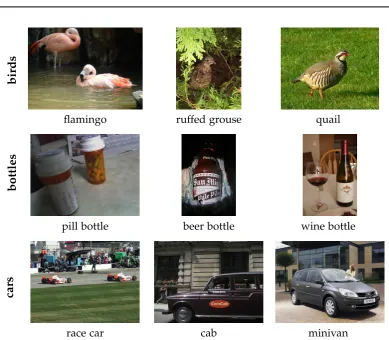
• Image Classification: The classification dataset consists of 1.4M images man-ually labelled with the presence of one of 1000 fine-grained object categories, including a huge variety of both natural and man-made visual phenomena. As illustrated in Figure 3.1, each image contains one ground-truth label. The fi-nal ILSVRC2012 version of this dataset consists of 1,281K training images, 50K validation images, and 100K test images.
• Single-Object Localisation: For single-object localisation, 524K training im-ages plus the validation and test imim-ages from the classification dataset are ad-ditionally annotated with an axis-aligned bounding box for every instance of
1www.flickr.com 2www.mturk.com
20 Datasets
birds
flamingo ruffed grouse quail
bottles
pill bottle beer bottle wine bottle
cars
[image:36.595.79.469.86.426.2]race car cab minivan
Figure 3.1: Examples from the ImageNet image classification dataset, illustrating the variety of fine-grained object classes.
the ground-truth object category. The object classes are the same as the object classes for the image classification task.
• Object Detection: The object detection dataset contains additional images col-lected from Flickr using scene-level (rather than object-level) queries. Each im-age is annotated with a list of object categories present in the imim-age, along with an axis-aligned bounding box indicating the position and scale of each instance of each object category. There are 200 object classes, representing basic-level object categories, and 457K training images, 21K validation images and 40K test images.
§3.2 COCO 21
3
.
2
COCO
COCO [Lin et al., 2014b], short for Common Objects in COntext, is a large-scale object detection, segmentation and captioning dataset. The dataset contains Flickr photographs depicting examples of 91 preselected object categories, such as ’person’, ’dog’, ’cow’, ’train’, ’car’, ’motorbike’, ’chair’, ’sofa’ and ’bottle’. Unlike previous ob-ject detection datasets such as PASCAL VOC [Everingham et al., 2010], images were deliberately selected to contain multiple objects viewed from non-canonical perspec-tives. In total, 328K images were collected, of which 204K have been annotated using AMT.
In the 2014/15 release, the dataset was split into 83K training images, 41K val-idation images, 41K test 2014 images, 81K test 2015 images, and 123K unlabelled images. However, based on community feedback, in 2017 the 80K/40K train/val split was revised to 115K/5K for train/val. Test images are divided equally into test-dev, test-standard, test-challenge, and test-reserve subsets.
Several different annotation formats are available, as described below and illus-trated in Figure 3.2. In each case annotations were collected using AMT.
• Object Segmentations: Images in the training and validation sets, as well as the 2015 test set are annotated with per-instance object segmentations for 80 of the 91 object categories. Segmentations were not collected for 11 categories for which instances were too common, too rare, or too easily confused. On average each image contains 3.5 object categories and 7.7 object instances. In total, 1.5M objects were annotated. To support object detection pipelines based on image bounding boxes, tight-fitting bounding boxes were also obtained from the annotated object segmentation masks.
• Image Captions: Images in the training and validation sets, as well as the 2014 test set, are annotated with image captions. To collect the captions, AMT work-ers were instructed to provide a sentence that describes all of the important parts of the scene, using at least eight words. Five captions were collected for each image, except for a random subset of 5K test images for which 40 captions were collected per image (comprising the C40 test set, as differentiated from the C5 test set). Finally, for each testing image, one additional caption was col-lected to quantify human performance when comparing scores with machine generated captions. In total 1M captions were collected [Chen et al., 2015].
22 Datasets
person
(1) a child sitting outside on a city street eats a sandwich. (2) young boy sitting down eating a hot dog (3) a boy takes a big bite out of a hot dog. (4) having a hot dog outdoors on the sidewalk. (5) a young boy munches on a hot dog at an outdoor table.
(1) a person watching as a kite flies through the air (2) a man watching people fly kites in a snowy park on a sunny day (3) a person wearing a red beanie and a yellow and red scarf. (4) some kites flying over some build-ings in the snow. (5) there are lots of kites being flown in the sky.
train
(1) several train cars going in different direc-tions at a depot. (2) a train yard with various trains and waiting passenger. (3) four electric trains are seen on the tracks beside this small town. (4) lots of cable cars, on lots of tracks (5) a picture of a trolley that is on some train tracks.
(1) people walk on the platform beside a steam train. (2) a group of people walking by a locomotive train. (3) a group of people standing next to a large train. (4) a train trav-eling down a track passing through a station. (5) a long train traveling down train tracks near a wall.
Figure 3.2: Examples of annotated images in the COCO dataset. Segmentations are illustrated only for the indicated class, although typically multiple objects are
§3.3 VQA 23
To ensure consistency in the evaluation of captioning agents, access to the test sets is restricted and a test evaluation server is maintained by the COCO organisers, providing standard automatic evaluation metrics. In the case of image captioning, the various evaluation metrics used are discussed in Chapter 4. Finally, we note that in the case of image captioning, an alternative partition of the offical training and validation split has been extensively reported in prior work for ablation studies and offline testing. Known as the ‘Karpathy’ split after its proposers [Karpathy and Fei-Fei, 2015], this split contains 113K training images, and 5K images respectively for validation and testing.
3
.
3
VQA
3.3.1 Version1.0
The Visual Question Answering (VQA) dataset [Antol et al., 2015] is a large-scale dataset containing free-form, open-ended, natural language questions and answers about images, as illustrated by the examples in Figure 3.3. The dataset (now referred to as v1.0) contains 614K questions and 6.1M answers associated with 205K images. The images used are the 123K training and validation images and 81K test images from the COCO 2014/15 dataset [Lin et al., 2014b], following the same train/val/test split strategy.
To create the dataset, questions and answers were collected in separate stages using AMT. To bias against generic image-independent questions, workers were in-structed to ask questions that require the image to answer. In order to encourage the submission of interesting and diverse questions, AMT workers were instructed to ask a question that a smart robot ‘probably can not answer, but any human can easily answer while looking at the scene in the image’. For each question, 10 ground-truth answers were collected from different AMT workers. Since most questions are quite specific, most answers consist of simple one to three word phrases.
Two modalities are offered for answering questions, multiple choice and open-ended. To evaluate the generated answers for the open-ended task, answers are preprocessed to standardise case, numbers and punctuation, then the following ac-curacy metric is used:
accuracy=min(# humans that provided that answer
3 , 1) (3.1)
24 Datasets
Q: What color are her eyes? Q: Does it appear to be rainy?
A: brown A: no
Q: What is the mustache made of? Q: Does this person have 20/20 vision?
A: bananas A: no
Figure 3.3: Examples of questions (Q) and answers (A) from the VQA v1.0 dataset. Although the questions are primarily visual in nature, some also require
’common-sense’ knowledge, e.g. ‘Does this person have 20/20 vision?’.
3.3.2 Version2.0
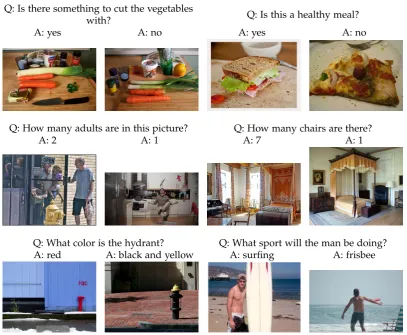
Several works pointed out that questions in the v1.0 dataset provide strong priors that can result in good performance, even if the visual content of the image is ignored [Agrawal et al., 2016; Jabri et al., 2016; Zhang et al., 2016a]. The Visual Question Answering (VQA) dataset v2.0 [Goyal et al., 2017] subsumes and extends the v1.0 dataset in order to reduce these biases in the answer distributions. Specifically, the VQA v2.0 dataset was created in the following way—given an (image, question, answer) triplet from the VQA v1.0 dataset, AMT workers were asked to identify a new image that is similar to the original but results in a different correct answer. This balances the answer distributions in the dataset such that each question in VQA v2.0 is associated with not just a single image, but rather a pair of similar images that result in two different answers to the question, as illustrated in Figure 3.4. In total the VQA v2.0 dataset, which was used for the 2017 VQA Challenge3, contains 1.1M questions and 11.1M answers associated with the same 205K images as the v1.0 dataset.
3
.
4
Visual Genome
The Visual Genome dataset [Krishna et al., 2016] contains 108K images annotated with scene graphs as well as 5.4M region descriptions and 1.7M visual question
§3.4 Visual Genome 25
Q: Is there something to cut the vegetables
with? Q: Is this a healthy meal?
A: yes A: no A: yes A: no
Q: How many adults are in this picture? Q: How many chairs are there?
A: 2 A: 1 A: 7 A: 1
Q: What color is the hydrant? Q: What sport will the man be doing?
[image:41.595.117.525.110.445.2]A: red A: black and yellow A: surfing A: frisbee
Figure 3.4: Examples of questions (Q) and answers (A) from the VQA v2.0 dataset il-lustrating images with different answers to the same question, as well as the different
question types, i.e. Yes/No (top), Number (middle), and Other (bottom).
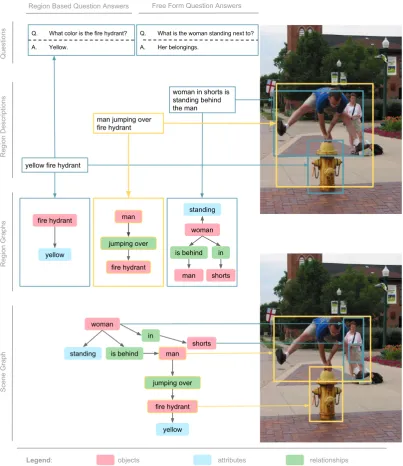
answers. Scene graph annotations consist of grounded objects, attributes associated with objects, and pairwise relationships between objects. Each image has an average of 35 objects, 26 attributes and 21 relationships. An example is illustrated in Figure 3.5.
26 Datasets
Questions
Region Descriptions
Region Graphs
Scene Graph
Legend: objects attributes relationships
fire hydrant
yellow
fire hydrant man
woman standing
jumping over
man shorts in is behind
fire hydrant man
jumping over woman
standing
shorts in
is behind
yellow
woman in shorts is standing behind the man
yellow fire hydrant
Q. What is the woman standing next to?
A. Her belongings. Q. What color is the fire hydrant?
A. Yellow.
man jumping over fire hydrant
[image:42.595.79.483.161.628.2]Region Based Question Answers Free Form Question Answers
Figure 3.5: An example image annotation from the Visual Genome dataset (repro-duced from Krishna et al. [2016]), illustrating questions and answers, region
Chapter4
SPICE: Semantic Propositional
Image Caption Evaluation
In this chapter, we address the problem of automatically evaluating image captions. While new datasets often spur considerable innovation—as has been the case with the COCO Captioning Challenge [Chen et al., 2015]—benchmark datasets also re-quire fast, accurate and inexpensive evaluation metrics to facilitate rapid progress. Although numerous automatic evaluation metrics have already been applied to the task of evaluating image captions, existing metrics have proven to be inadequate sub-stitutes for human judgement [Kulkarni et al., 2013; Hodosh et al., 2013; Elliott and Keller, 2014]. As such, there is an urgent need to develop new automated evaluation metrics for this task [Elliott and Keller, 2014; Bernardi et al., 2016]. To address this problem, we present a novel automatic image caption evaluation metric that mea-sures the quality of generated captions by analysing their semantic content. Our method more closely resembles human judgement while offering the additional ad-vantage that the performance of any model can be analysed in greater detail than with other automated metrics.
4
.
1
Image Caption Evaluation
Given a candidate captionyand a set of high-quality reference captionsS ={s1, . . . ,sm}
associated with an image I, our goal is to evaluate the quality ofygivenI. Typically, the source image I is disregarded during this evaluation, which is performed by computing a score that captures the similarity betweenyandS. This approach poses caption evaluation as a purely linguistic task that is similar to evaluating text sum-maries or machine translations (MT). As such, a number of textual similarity metrics designed for other tasks have been applied to image caption evaluation, including Bleu [Papineni et al., 2002], METEOR [Denkowski and Lavie, 2014] and ROUGE [Lin,
28 SPICE: Semantic Propositional Image Caption Evaluation
Metric Proposed Application Principle
Bleu Machine Translation n-gram precision
ROUGE Document Summarization n-gram recall
METEOR Machine Translation n-gram with synonym matching
CIDEr Image Captions tf-idf weighted n-gram cosine similarity
SPICE (ours) Image Captions scene graph synonym matching
Table 4.1: A summary of textual similarity metrics.
2004]. More recently, CIDER [Vedantam et al., 2015] has been proposed specifically for the image captioning setting.
As summarised in Table 4.1, existing metrics rely on matching or aligning n-grams1 between the candidate and reference texts. Bleu [Papineni et al., 2002] is an n-gram precision metric with a sentence-brevity penalty, calculated as a weighted geometric mean over different length n-grams. ROUGE [Lin, 2004] is a package of a measures for automatic evaluation of text summaries. ROUGE-L, the version com-monly used in the image captioning community, is an F-measure based on words in the longest common subsequence between candidate and reference sentences. ME-TEOR [Denkowski and Lavie, 2014] works by first performing an alignment between words in the candidate and reference sentences, taking into account exact matches as well as soft-similarity based on stem, synonym and paraphrase matches. The METEOR score is then computed as a parameterised harmonic mean of precision and recall with an added alignment fragmentation penalty. CIDER [Vedantam et al., 2015] is based on a term frequency-inverse document frequency (tf-idf) weighting of each n-gram in the candidate and reference sentences, which are then compared by summing their cosine similarity across n-grams.
Several studies have investigated the validity of these metrics when used for im-age caption evaluation by reporting correlation measures between these metrics and human judgements of caption quality. On the PASCAL 1K dataset, Bleu-1 was found to exhibit weak or no correlation with human judgements (Pearson’s r of -0.17 and 0.05 for captions generated by a language model and a template-based model respec-tively) [Kulkarni et al., 2013]. Using the Flickr 8K [Hodosh et al., 2013] dataset, Elliott and Keller [2014] found that METEOR exhibited moderate correlation (Spearman’s
ρof 0.524) with human judgements, outperforming ROUGE SU-4 (0.435) and Bleu-1
(0.345). Finally, using the PASCAL-50S and ABSTRACT-50S datasets, Vedantam et al. [2015] demonstrated that CIDEr and METEOR have a greater agreement with human consensus than Bleu and ROUGE.
§4.2 SPICE Metric 29
4
.
2
SPICE Metric
One of the problems with using metrics based on n-grams such as Bleu, ROUGE, CIDEr or METEOR to evaluate captions, is thatn-gram overlap is neither necessary nor sufficient for two sentences to convey the same meaning[Giménez and Màrquez, 2007]. To illustrate the limitations of n-gram comparisons, consider the following two captions (a,b) from the COCO dataset [Chen et al., 2015] (emphasis added):
(a) A young girlstanding on top of atennis court. (b) A giraffestanding on top of agreen field.
The captions describe two very different images. However, comparing these captions using any of the previously mentioned n-gram metrics produces a high similarity score due to the presence of the long 5-gram phrase ‘standing on top of a’ in both captions. Now consider the captions (c,d) that describe the same image:
(c) A shiny metal pot filled with some diced veggies. (d) The pan on the stove has chopped vegetables in it.
These captions convey almost the same meaning, but exhibit low n-gram similarity as they have no words in common. N-gram approaches suffer from serious deficiencies, particular when applied at the sentence level rather than the corpus level.
To help overcome these limitations, we re-frame the caption evaluation problem in terms of natural language semantics. As image captions are almost always assertions rather than performatives, i.e., they describe or report some state of affairs [Austin, 1962], they ought to be conditionally verifiable. We therefore adopt a conditional approach to semantics, reducing the meaning of a sentence to the truth-conditions of atomic propositions. In other words, we hypothesise that when people evaluate the quality of image captions, they primarily consider the truth-value of the claims about the image contained therein. For example, given an image with the caption ‘A young girl standing on top of a tennis court’, a conscientious human evaluator would interpret it as asserting the following atomic propositions2: (1) there is a girl, (2) the girl is young, (3) the girl is standing, (4) there is a court, (5) the court is for tennis, and (6) the girl is on top of the court. If each of these propositions is true—in the sense that it is true in the situation depicted by the image—we argue that many people would consider the caption to be acceptable3.
2Note that these propositions can be more formally represented by a predicate combined with an appropriate number of arguments, or equivalently with a tuple.
30 SPICE: Semantic Propositional Image Caption Evaluation
Figure 4.1: SPICE uses semantic propositional content to assess the quality of im-age captions. Both reference and candidate captions are mapped through depen-dency parse trees (top) to semantic scene graphs (right)—encoding the objects (red), attributes (green), and relations (blue) present. Caption quality is determined using
an F-score calculated over tuples in the candidate and reference scene graphs
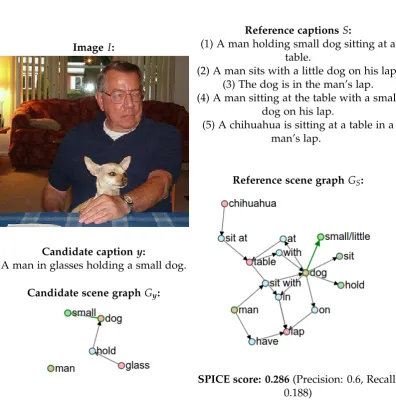
Taking this main idea as motivation, we estimate caption quality by transforming both candidate and reference captions into a semantic representation. Our choice of semantic representation is the scene graph. As illustrated in Figure 4.1, our scene graph implementation explicitly encodes the objects, attributes and relations found in image captions, abstracting away most of the lexical and syntactic idiosyncrasies of natural language in the process. While we are aware that there are other com-ponents of linguistic meaning—such as figure-ground relationships—that are almost certainly relevant to caption quality, in this work we focus exclusively on semantic meaning. We choose to use a scene graph representation as scene graphs and similar semantic structures have been used in a number of recent works within the context of image and video retrieval systems to improve performance on complex queries [Lin et al., 2014a; Johnson et al., 2015; Schuster et al., 2015]. Several of these pa-pers have demonstrated that semantic graphs can be parsed from natural language descriptions [Lin et al., 2014a; Schuster et al., 2015].
![Figure 1.1: The image captioning (left) and visual question answering (right) tasks.Examples are taken from the COCO [Chen et al., 2015] and VQAv2 [Goyal et al.,2017] datasets respectively](https://thumb-us.123doks.com/thumbv2/123dok_us/8116585.238336/18.595.74.484.107.321/figure-captioning-visual-question-answering-examples-datasets-respectively.webp)