Noam Rathaus
Charlie Miller
Robert Fly
Yoav Naveh
“Makers”) of this book (“the Work”) do not guarantee or warrant the results to be obtained from the Work. There is no guarantee of any kind, expressed or implied, regarding the Work or its contents. The Work is sold AS IS and WITHOUT WARRANTY. You may have other legal rights, which vary from state to state. In no event will Makers be liable to you for damages, including any loss of profi ts, lost savings, or other incidental or consequential damages arising out from the Work or its contents. Because some states do not allow the exclusion or limitation of liability for consequential or incidental damages, the above limitation may not apply to you.
You should always use reasonable care, including backup and other appropriate precautions, when working with computers, networks, data, and fi les.
Syngress Media®, Syngress®, “Career Advancement Through Skill Enhancement®,” “Ask the Author UPDATE®,” and “Hack Proofi ng®,” are registered trademarks of Elsevier, Inc. “Syngress: The Defi nition of a Serious Security Library”™, “Mission Critical™,” and “The Only Way to Stop a Hacker is to Think Like One™” are trademarks of Elsevier, Inc. Brands and product names mentioned in this book are trademarks or service marks of their respective companies.
PUBLISHED BY Syngress Publishing, Inc. Elsevier, Inc.
30 Corporate Drive Burlington, MA 01803
Open Source Fuzzing Tools
Copyright © 2007 by Elsevier, Inc. All rights reserved. Printed in the United States of America. Except as permitted under the Copyright Act of 1976, no part of this publication may be reproduced or distributed in any form or by any means, or stored in a database or retrieval system, without the prior written permission of the publisher, with the exception that the program listings may be entered, stored, and executed in a computer system, but they may not be reproduced for publication.
Printed in the United States of America 1 2 3 4 5 6 7 8 9 0
ISBN 13: 978-1-59749-195-2
Publisher: Amorette Pedersen Cover Designer: SPi Acquisitions Editor: Patrice Rapalus Page Layout and Art: SPi
Gadi Evron is Security Evangelist for Beyond Security, chief editor of the SecuriTeam portal and recognized globally for his work and leadership in Internet security operations. He is the founder of the Zeroday Emergency Response Team (ZERT), organizes and chairs worldwide conferences, working groups and task forces. He is considered an expert on corporate security and counterespionage, botnets, e-fraud and phishing. Previously, Gadi was CISO at the Israeli government ISP (eGovernment project) and founded the Israeli Government CERT. He has authored two books on information security and is a frequent lecturer.
Noam Rathaus is the co-founder and CTO of Beyond Security. He holds an electrical engineering degree from Ben Gurion University and has been checking the security of computer systems from the age of 13. He is also the editor-in-chief of SecuriTeam.com, one of the largest vulnerability databases and security portals on the Internet.
Robert Fly is a Director of Product Security at Salesforce.com where he works with the great folks there to help deliver a service that the world can trust. At Salesforce.com he heads up the company-wide effort for building security into the development lifecycle. Prior to Salesforce.com Robert worked at Microsoft for about eight years, the last few spent in the Real Time Collaboration Group as a Software Security Lead heading up a team of very talented individuals responsible for ensuring the security of those products.
Aviram Jenik is CEO of Beyond Security and contributor to SecuriTeam.com
David Maynor is CTO of Errata Security, a consulting and product testing cybersecurity company.
Charlie Miller spent fi ve years as a Global Network Exploitation Analyst for the National Security Agency. During this time, he identifi ed weaknesses
Contributing Authors
and vulnerabilities in computer networks and executed numerous successful computer network exploitations against foreign targets. He sought and discovered vulnerabilities against security critical network code, including web servers and web applications. Since then, he has worked as a Senior Security Architect for a fi nancial fi rm and currently works as a Principal Security Analyst for Independent Security Evaluators, a security fi rm. He has spoken at the Workshop on the Economics of Information Security, Black Hat, and DEFCON.
He has a B.S. from Truman State University and a Ph.D. from the University of Notre Dame.
Yoav Naveh works as an R&D team leader for McLean based Beyond Security, and one of the chief developers of the beSTORM fuzzing framework. He is a security researcher with 8 years of experience. He holds the rank of Captain in the Israeli Defense Force (ret.) and is a leading authority in the blackbox testing fi eld.
Contents
Chapter 1 Introduction to Vulnerability Research . . . 1
Statement of Scope . . . 2
Off-by-One Errors . . . 3
Programming Language Use Errors . . . 5
Integer Overfl ows . . . 5
Bugs and Vulnerabilities . . . 7
The Vaunted Buffer Overfl ow . . . 7
Finding Bugs and Vulnerabilities . . . 9
Source Code Review . . . 9
Black Box Testing . . . 10
Glass Box Testing . . . 10
Chapter 2 Fuzzing—What’s That? . . . 11
Introduction . . . 12
Introduction to Fuzzing . . . 12
Milestones in Fuzzing . . . 14
Fuzzing Technology . . . 16
Traffi c Sniffi ng . . . 18
Prepared Template. . . 19
Second-Generation Fuzzing . . . 19
File Fuzzing . . . 22
Host-side Monitoring . . . 22
Vulnerability Scanners as Fuzzers . . . 22
Uses of Fuzzing . . . 23
Open Source Fuzzers . . . 24
Commercial-Grade Fuzzers . . . 24
What Comes Next . . . 25
The Software Development Life Cycle . . . 25
Chapter 3 Building a Fuzzing Environment . . . 27
Introduction . . . 28
Knowing What to Ask… . . . 28
Basic Tools and Setup . . . 34
Data Points . . . 34
Crash Dumps . . . 34
Fuzzer Output . . . 36
viii Contents
Debuggers . . . 37
Recon Tools . . . 40
Linux . . . 41
OSX . . . 42
Summary . . . 44
Chapter 4 Open Source Fuzzing Tools . . . 45
Introduction . . . 46
Frameworks . . . 46
Special-Purpose Tools . . . 48
General-Purpose Tools . . . 52
Chapter 5 Commercial Fuzzing Solutions . . . 55
Introduction . . . 56
Chapter 6 Build Your Own Fuzzer . . . 67
Hold Your Horses . . . 68
Fuzzer Building Blocks . . . 70
One or More Valid Data Sets . . . 70
Understanding What Each Bytein the Data Set Means . . . 71
Change the Values of the Data Sets While Maintaining the Integrity ofthe Data Being Sent . . . 72
Recreate the Same Malformed DataSet Time and Time Again . . . 72
An Arsenal of Malformed Values, or the Abilityto Create a Variety of Malformed Outputs . . . 73
Maintain a Form of a State Machine . . . 74
Summarize . . . 75
Down to Business . . . 75
Simplest Fuzz Testing Find Issues . . . 88
Chapter 7 Integration of Fuzzing in the Development Cycle . . . 91
Introduction . . . 92
Why Is Fuzzing Important to Include in a Software Development Cycle? . . . 93
Security Testing Workload . . . 93
Setting Expectations for Fuzzers in a Software Development Lifecycle . . . 101
Fuzzing as a Panacea . . . 101
Fuzzing Tools versus … . . . 103
Setting the Plan for Implementing Fuzzers into a Software Development Lifecycle . . . 103
Setting Goals . . . 104
Building and Executing on the Plan . . . 111
Hidden Costs . . . 116
Finding More Vulnerabilities . . . 119
Summary . . . 126
Solutions Fast Track . . . 126
Frequently Asked Questions . . . 130
Chapter 8 Standardization and Certifi cation . . . 133
Fuzzing and the Corporate Environment . . . 134
Software Security Testing, the Challenges . . . 134
Testing for Security . . . 135
Fuzzing as a Viable Option . . . 137
Business Pressure . . . 138
Software Security Certifi cation . . . 139
Meeting Standards and Compliance . . . 139
Tester Certifi cation . . . 140
Industry Pressure . . . 140
Antivirus Product Testing and Certifi cation . . . 140
Chapter 9 What Is a File? . . . 143
Introduction . . . 144
Are File Fuzzers Special? . . . 145
Analyzing and Building Files . . . 149
Textual Files . . . 150
Binary Files . . . 151
Running the Test . . . 156
Monitoring the Application with the Test Cases . . . 161
Chapter 10 Code Coverage and Fuzzing . . . 163
Introduction . . . 164
Code Coverage . . . 164
Obtaining Code Coverage . . . 167
Instrumenting the Binary . . . 167
Monitoring a Closed Source Application . . . 169
Improving Fuzzing with Code Coverage . . . 171
Manual Improvements . . . 174
Dynamically Generating Code Coverage Improvements . . . 181
Statically Generating Code Coverage . . . 185
Weaknesses of Code Coverage . . . 188
Summary . . . 190
Solutions Fast Track . . . 190
Frequently Asked Questions . . . 192
1
Chapter 1
Introduction to
Vulnerability
Research
Solutions in this chapter:
■ Statement of Scope
■ Off-by-One Errors
■ Programming Language Use Errors
■ Integer Overfl ows
■ Bugs and Vulnerabilities
■ The Vaunted Buffer Overfl ow
Statement of Scope
Entire books exist on the topic of computer vulnerabilities and software testing, and it is beyond the scope of this chapter to provide the in-depth knowledge needed to perform software security testing. While fuzzing is one important way to test software for bugs and vulnerabilities, it is important to understand exactly what we are testing for.
This chapter is an introduction to software testing in general, and as such must describe some of the ways software errors come about. While this material is most-likely review, it will at least provide a common starting point for the less-experienced or novice vulnerability researcher.
A computer in and of itself is nothing more than a paperweight, a useless collection of components and circuitry. For the computer to do anything, a person must give it a set of instructions the computer can understand. This, in essence, is the art of computer programming.
But it’s not that simple. In reality, there is a vast difference between the instructions a computer can act on and the instructions the average person can understand. While it is entirely possible for humans to learn to issue commands in the language of the computer, this process is an extremely ineffi cient and time-consuming chore.
(A statement to which anyone who owned one of the early IMSAI 8080 computers can attest. The earliest IMSAIs accepted only this type of input.)
And, of course, the computer has no corresponding capability to learn a language that humans can understand—it’s a one-way street from intelligence to utility.
Consequently, “interpreters” (and compilers, which do the same thing as interpreters, but consider the instructions as whole instead of processing them one at a time) were developed that can take English-like phrases and translate them into the specifi c binary language a computer can act on.
Humans deal very well with abstraction, but computers choke on it. If you tell a three-year-old child to put on his shoes and socks, you will never see him fi rst put on his shoes and then put on his socks—he will instead put his socks on and then his shoes, because he has learned the abstract concept of footwear: your socks go on before
N
OTEThe best laid schemes o’ mice an’ men gang aft a-gley.
Introduction to Vulnerability Research • Chapter 1 3
your shoes. A computer has no understanding of even the simplest abstraction, and will proceed only as instructed. The greater the degree of abstraction from the minutia of what the computer can understand, the “higher” the language level is. In this regard, not all languages are created equally—some are far more abstract (higher level) than others.
The language with the closest approximation to the language upon which a computer can operate is “assembly language,” which is a one-to-one mnemonic representation of machine codes and values upon which the computer can operate. C, and its
successor C++, are the most common programming languages in use for commercial application development today, and are far more abstract than assembly is. Other languages are higher level still.
Lost in Translation(s):
“I know that you believe you understand what you think I said, but I’m not sure you realize that what you heard is not what I meant.”—Robert McClosky
Translation is the root cause of most programming errors. For example, a project manager translates the requirements from the desired end to the programming team, which members translate to individual programming assignments, which programmers translate the assignment into the proper syntax for the programming language (written by someone else), which programming language interpreter translates that into the corresponding machine code. All those translations are sources of potential programming errors, some of which we will cover in detail next. Keep in mind that the following descriptions of programming errors are not intended to cover all conceivable ways a programming error can lead to problems, but rather to provide a fl avor of the topic.
Off-by-One Errors
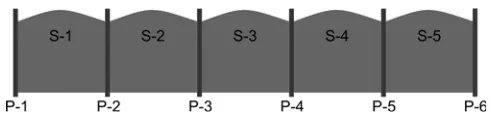
fence posts are needed to build a fence 25 feet long with posts placed every 5 feet? Well, you can compute this by dividing 25 by 5, getting the answer of 5. While this is the correct answer for the number of fence sections you need (S-1 though S-5), it is not
[image:14.612.174.420.197.257.2]the correct answer for the number of posts needed. That answer is 6 (P-1 though P-6), as shown in Figure 1.1.
Figure 1.1 Off-by-One Error
Another error in the off-by-one genre is the use of the wrong comparison operator, such as the “less than” operator (<) instead of the “less than or equal to” operator (<=). For example, an error in a routine printing the numbers 1 to 10 could manifest itself as:
#include <stdio.h> int main(void) {
int Count = 1; while (Count <10) {
printf(“%d”,Count); ++Count ;
} return 0; }
This would instead print the numbers less than 10, in this case the numbers 1 through 9. Changing the “while” statement to:
while (Count <=10)
corrects this problem.
Introduction to Vulnerability Research • Chapter 1 5
Programming Language Use Errors
The function strcpy can be used to make a copy of a string in a new location. To do this, it copies each byte from the source address to the destination address, stopping after it copies the special character that signifi es the end of the string. Unfortunately, this is all it does. There are no checks that the source or destination are actually valid addresses, no checks that the destination has enough space to hold the source string, and no checks that the locations don’t overlap. Provided the programmer uses this function in a safe way, ensuring that the source and destination are valid and that destination can hold all of the source string, no problems will occur. However, if the source string is longer than the space allocated for it, the function will still do exactly what it has been designed to do: copy all the bytes between the start and end of the string to the destination address, including those that are outside of the memory allocated for the second string. While this is probably not what the programmer meant, it is exactly what he asked the computer to do.
The use of strcpy has been banned by many programming shops in an effort to minimize the errors its misuse may cause. There is a safer (but not completely safe) function named strncpy, which limits the length of the copy to a specifi ed number of bytes. While this sounds better, there are still some “gotchas”: the specifi cation only guarantees that it will “null terminate” the string if there is room left at the end. If the programmer doesn’t explicitly put the end-of-string null character in, it may be longer than he intended. As an interesting aside, in places where strcpy use was
banned, programmers sometimes wrote their own functions that duplicated its behavior, right down to its capability to write out of bounds.
Programming language use errors such as this stem from programmers not considering exceptional circumstances.
Integer Overfl ows
An important data type in any programming language is the integer. Integers can be either signed (with a plus or minus sign) or unsigned.
0 0000 0000 0000 0000 0000 0000 0000 0000 4,294,967,295 1111 1111 1111 1111 1111 1111 1111 1111
Adding 1 to 4,294,967,295 will not give 4,294,967,295, but will instead give 0. To store a larger number would require 33 bits (a 1 followed by 32 0s). The CPU simply stores the lowest 32 bits and makes a note that the number was too big. Multiplying numbers together may also cause an integer overfl ow. If the programmer assumes that adding or multiplying any two numbers will make a bigger number (which “just makes sense”), and doesn’t check for integer overfl ows, he may
introduce a vulnerability. For example, to hold n items that are each m bytes long, the programmer may tell the program to allocate n∗m bytes. If m∗n is larger than the biggest number that can be represented, less memory will be allocated than intended. This may lead to a buffer overfl ow.
In the case of a signed integer, which can range from −2,147,483,648 to
+2,147,483,647, it becomes a bit more complicated, because the leftmost bit of the 32-bit is the sign bit—0 for positive and 1 for negative—and the numbers are represented as “two’s complements.” The binary representation of these values is shown here:
+2,147,483,647 0111 1111 1111 1111 1111 1111 1111 1111 −2,147,483,648 1000 0000 0000 0000 0000 0000 0000 0000
Two’s complement representation is the most common means of representing negative numbers, and has many advantages, such as being able to add positive and negative numbers without worrying about the sign bit.
If a programmer assumes that a variable contains only positive integers, but if the integer in question is actually a signed integer, arithmetic operations can cause the overwrite of the leftmost bit and make the results a negative number, possibly leading to exploitable behavior. This scenario is illustrated here:
Unsigned Integer Calculation
2,147,483,647 0111 1111 1111 1111 1111 1111 1111 1111 +1 0000 0000 0000 0000 0000 0000 0000 0001 2,147,483,648 1000 0000 0000 0000 0000 0000 0000 0000
Introduction to Vulnerability Research • Chapter 1 7
Bugs and Vulnerabilities
Not all programming errors are created equally. Some allow attackers to gain some thing or ability they didn’t already have. They may be able to deny other users access to the program by crashing it, or access information they shouldn’t be able to. In some cases, they may be able to cause the program to execute any command they tell it. These errors are vulnerabilities.
Other errors, while they may have the same causes, won’t give attackers any access they didn’t already have.
So, the fi rst task for a vulnerability researcher is to determine if the programming error is merely a bug or if it can lead to exploitation. If a bug can lead to exploitation, either by itself or when used in concert with other bugs, it is indeed a vulnerability.
The Vaunted Buffer Overfl ow
Most of the vulnerabilities discovered by security researchers are buffer overfl ows. These overfl ows are caused by bugs that allow the code to write past the end of a buffer. So, what is a buffer? A buffer is a fi xed-size region of memory, set aside for a
particular use, usually in the same general location in memory as other values the program uses.
Some vulnerabilities are caused by the application not checking space availability before copying untrusted data into the buffer. Other overfl ows are more complicated and, while a buffer overfl ow may be the fi nal effect, the initial cause is usually a bug or series of bugs (e.g., the m∗n integer overfl ows mentioned earlier, off-by-one errors, etc.) somewhere else in the code.
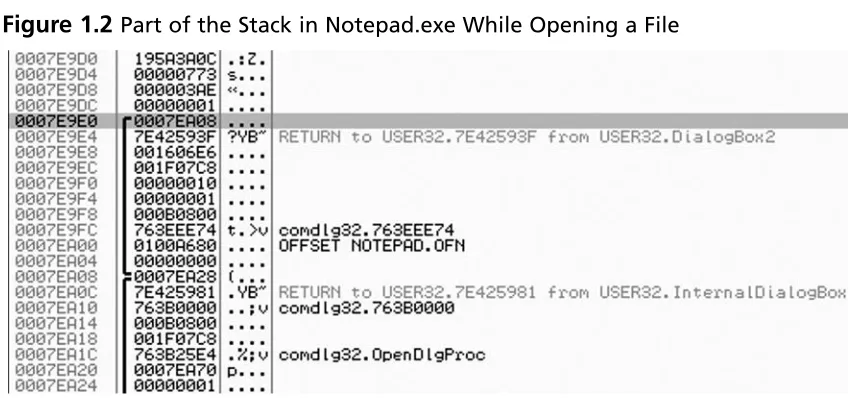
When a program is running, it requires that the system be in a consistent state. To achieve this, all control structures must contain valid data for the program to work as intended. One such control structure, the “stack,” is a section of memory that programs use to record previous activity. When the program calls a function, it must record where it was in the process by storing values on the stack. If attackers can overwrite these values with their own values, when the function ends, it will carry on execution from where they tell it, instead of where it was.
Before proceeding, a confusing subtlety must fi rst be clarifi ed. On mailing lists, sometimes people report a particular crash as a “stack overfl ow” and suggest that with a little work it could be turned into an exploit, while in reality their issue is (at best) a denial-of-service (DoS) vulnerability. The confusion arises because at least two things can be described as a stack overfl ow—stack-based buffer overfl ows and unbounded recursion—both of which are capable of crashing a program.
Buffer Overf low on the Stack (aka Stack-based
Buffer Overf low)
In this scenario, the program tries to store more data in a buffer located on the stack than it can accommodate. Ultimately, the program tries to use a value that has been overwritten and crashes.
Stack Overf low (aka Unbounded Recursion)
[image:18.612.83.507.80.279.2]This situation often occurs when a program calls a function that endlessly calls itself (i.e., recursion). Eventually, the “what I was doing” data (found on the stack)
Introduction to Vulnerability Research • Chapter 1 9
from the previous calls consumes all the available stack space. When the program attempts to call the function again, as there is no space left to store it,
it crashes.
While these defi nitions may sound similar and both cases involve accessing invalid memory, they are very different. A stack-based buffer overfl ow can allow attackers to execute code on the victim’s computer, as it overwrites memory addresses that will be used later, while a “stack overfl ow” typically results in a DoS, as it tries to write to memory that isn’t available.
In any case, the buffer overfl ow is among the most insidious errors security researchers can fi nd. In fact, the fi rst (known) exploited buffer overfl ow was in the fi ngerd service in the Unix systems exploited by the Morris worm. Other notable examples are the Code Red worm that exploiter Microsoft IIS 5.0 and the SQL Slammer worm that exploited MS SQL Server 2000, but researchers have found buffer overfl ows in practically every program written.
Finding Bugs and Vulnerabilities
Given the multitudinous ways programmers can make mistakes, looking for bugs and vulnerabilities in a piece of software should be an integral part of the development process. Until recently, that has not been the case—a software product is released without any security testing, and it was left up to independent security researchers to fi nd the errors and report them to the vendor for repair. Now, most software faces some kind of security review prior to its release, and many vendors now consider security from the onset of the development project, as is the case with Microsoft’s Secure Development Process. But testing the security of a particular product can be an expensive proposition, and vendors must weight that expense with the other cost factors involved in releasing the product to its customers. Because of this, even software developed in an environment stringently cognizant of security risks is most likely released without full testing. Once again, the burden of testing falls upon security researchers. Fortunately, security researchers have a vast array of tools and techniques to locate bugs and vulnerabilities.
Source Code Review
improperly used, it will not show cases where a programmer uses a similar technique or function to accomplish the same results.
While this approach has yielded a good many vulnerabilities in the past, its results are predicated on looking for instances of a known language problem or for instances of commonly used statements that are known to exist and cause problems.
Black Box Testing
As the name implies, black box testing does not take into account the actual programming of the application, but rather the input specifi cations of the program (what data the program is meant to receive) and output specifi cation of the program (what the program is supposed to do with the input data). Black box testing is intended to gauge whether the program complies with the design goals.
From a security perspective, it is important in black box testing to provide the program with input the program normally would not expect, to see how the program deals with this input.
Black box testing can be done manually, or its input and analysis of its output can be automated.
Glass Box Testing
Glass box testing is performed in a similar manner to black box testing, but the testers have a view of the program structure and data fl ow requirements. With this type of testing, it is easier to make sure the program will function as intended, as it is possible to directly test conditionals in the program fl ow. With glass box testing, it is possible to craft input that allows every line of code to be executed and tested.
From a security perspective, it is important in glass box testing to provide the program with input the program normally would not expect in order to see how the program deals with this input.
11
Chapter 2
Fuzzing—What’s
That?
Solutions in this chapter:
■ Introduction to Fuzzing
■ Milestones in Fuzzing
■ Fuzzing Technology
■ Second-Generation Fuzzing
■ File Fuzzing
■ Host-side Monitoring
■ Vulnerability Scanners as Fuzzers
■ Uses of Fuzzing
■ Open Source Fuzzers
■ Commercial-Grade Fuzzers
■ What Comes Next
Introduction
In this chapter, we describe in detail what fuzz testing, also known as fuzzing, is and how it works.
The purpose of this chapter is to reach common ground and establish basic terminology for the evolving fi eld of fuzzing, and describe the advances made recently in Protocol-based Fuzzing with the introduction of commercial fuzzing products into the market. By the end of this chapter, you will have a good understanding of how fuzzing works, and some steps you can take to implement and use fuzzing.
Fuzzing is often described as a black-box software testing technique. It works by automatically feeding a program multiple input iterations that are specially constructed in an attempt to trigger an internal error indicative of a bug, and potentially crash it.
Such program errors and crashes are indicative of the existence of a security vulnerability, which can later be researched and fi xed.
We begin with a short summary of the state of the practice of fuzzing and a quick overview of fuzzing history. We continue with a detailed description of how fuzzing works. We then describe new advances made with fuzzing technology, introduce second-generation fuzzing, and try to assess the usability of fuzzing and what the future holds for this new market.
Fuzzing as a black box testing fi eld, in our opinion, is going to turn into a signifi cant portion of the vulnerabilities and software/application security markets from all ends, prevention to countermeasures.
Fuzzing is not a perfect solution, but when done effi ciently it can eliminate many vulnerabilities in the code-space and provide a return-on-investment that far outweighs its implementation costs.
Introduction to Fuzzing
Fuzzing has several dictionary defi nitions, the most applicable of which is “to become blurred or obscure”; meaning to alter something so it becomes less obvious, or rather confusing. The relation of the term with fuzz testing in computer science is basic at best.
Fuzzing—What’s That? • Chapter 2 13
Professor Barton Miller spoke of the history in an e-mail conversation with Gadi Evron: “In the fall of 1989, I was on a dial-up modem to my campus computer. There was a big, Midwest thunderstorm that was causing noise on the phone line (this was before error-correction modems), so it was a race to type a command before a stream of nonsense characters would interfere. I was surprised that these seemingly random characters would occasionally cause Unix utilities to crash. So, as one of my suggested projects in my graduate OS class (CS736), I assigned a project of writing a random character generator and testing as many Unix utility programs as possible. I called this random stream “fuzz,” named after the noise on the phone line. It had nothing to do with fuzzy logic or any other fi eld. And I’m not sure why I picked the particular word fuzz.”
Fuzzing, fault injection, assumption violating, and other terms were used in the past to describe this technique. What it does is send input to a program (software or hardware) in an attempt to trigger an error indicative of a bug, and potentially a vulnerability (a successful test case). (In software testing, test cases pass or fail—rather than succeed—as defi ned at the offset.)
In this chapter, we use the term fuzzing to describe a continuous (automated) brute-force attack of mutated input iterations, attempting to break a program by using the right iteration or combination.
Testing operates under a few assumptions:
■ Testing can only prove the presence of bugs, not their absence—Edsger Dijkstra
■ Due to Turing completeness, testing may never fi nish.
■ Fuzzing operates under two more specifi c assumptions regardless of their correctness.
■ There are vulnerabilities to be found in the program.
■ Given enough input, these vulnerabilities will surface.
This can be a lengthy process; analogies to demonstrate this are drilling into a wall, driving up a hill, and water eroding a stone.
None of these analogies is perfect, as the parameters for them can vary considerably depending on the condition of the wall, road, or stone, and specifi cation of the drill, car, or river.
Fuzzing is dependent on technological parameters ranging from how well the code was written and how advanced the fuzzer is, to the strength of the CPU running the fuzzer. If the drill from our fi rst analogy was used on the weakest spot in the concrete wall fi rst, results may come quickly.
Wikipedia defi nes fuzzing as:
“Fuzz testing or fuzzing is a software testing technique. The basic idea is to attach the inputs of a program to a source of random data (“fuzz”). If the program fails (for example, by crashing, or by failing built-in code assertions), then there are defects to correct.
The great advantage of fuzz testing is that the test design is extremely simple, and free of preconceptions about system behavior.”
If we are to fi ne-tune this defi nition:
Fuzzing is a software testing technique that by providing a program with malformed input, attempts to reach an error indicating a potential vulnerability. Fuzzing does not require previous knowledge about the program tested such as its design or source code, although it can make use of them (black box and gray box testing).
Simplifi ed further, fuzzing is:
Creating malformed input for the program tested and seeing what happens.
This applies to a network service as much as it would to a CPU, a cell phone, program parameters, an API, a Web browser, or a fi le type.
Many different types of test software can be considered fuzzers by that defi nition, but not very effi cient ones. As an example, stress testing is a form of fuzzing, but an extremely limited and primitive one that measures the stability of the program by emulating a DoS attack.
Any program receiving input can be fuzzed.
Milestones in Fuzzing
Fuzzing has been around for a long time but was commonly referred to as “fault injection” (mostly used in the hardware world).
Fuzzing in the context of the security world was introduced in 1989 by Professor Barton Miller and his students at the University of Wisconsin Madison with the creation of fuzz. They have this to say about it:
Fuzzing—What’s That? • Chapter 2 15
1. The input is random. We do not use any model of program behavior, application type, or system description. This is sometimes called black box
testing. In the command-line studies (1990, 1995, and 2006), the random input was simply random ASCII character streams. For our X-Window study (1995), Windows NT study (2000), and Mac OS X study (2006), the random input included cases that had only valid keyboard and mouse events.
2. Our reliability criteria are simple: if the application crashes or hangs, it is considered to fail the test; otherwise, it passes. Note that the application does not have to respond in a sensible manner to the input, and it can even quietly exit.
3. As a result of the fi rst two characteristics, fuzz testing can be automated to a high degree and results can be compared across applications, operating systems, and vendors.”
In other words, fuzz was used to send random input to the application until it crashed or hanged.
Skipping a decade ahead, in 2002, Dave Aitel released a paper called “The Advantages of Block-Based Protocol Analysis for Security Testing” along with a fuzzing tool named SPIKE.
What was new about SPIKE’s approach was that the random data generated was tied in to regular input the application would expect to see. That in itself wasn’t completely new. What was new is that the randomness was tied in to specifi c parts of the input. Further, SPIKE offered a framework by which new data-set templates could be added to it so that other protocols can be fuzzed.
As an example, a basic protocol request Data-set template would look like this:
GET /fi le.name HTTP/1.1
The block-based approach could tell the fuzzer to send random data at a certain point, such as this block signifi ed by [ ]s:
GET /[]fi le.name HTTP/1.1
They are both very similar to SPIKE (being data-set based and using block-based fuzzing), with two main differences:
■ The framework and engine were built more robustly and for easier development.
■ They were built in Python (while SPIKE was built in C).
In the past year (2006), second-generation fuzzing was introduced with the appearance of several commercial-grade fuzzers.
If we are to quantify milestones in fuzzing, the main ones are:
■ Combining random input generation with application monitoring (fuzz)
■ Tying the random input generation with a data-set template (SPIKE)
■ Protocol-based fuzzing (beginning of “Second-Generation Fuzzing”)
Fuzzing Technology
Fuzzing works in mysterious ways, but there is not much magic to it. Fuzzing can be divided into three main components:
■ Fuzzing baseline
■ Input generation
■ Application monitoring
Input being sent is generated from the fuzzy baseline. There are two main approaches as to where this information is taken from:
■ Traffi c sniffi ng
■ Protocol template
Traffi c sniffi ng means that the fuzzer has a sniffer component or knows how to read a sample of a packet capture and generate the input iterations from what it observes being used.
Fuzzing—What’s That? • Chapter 2 17
The input generation (which generates attack vectors of legal, semi-legal, and completely broken input) is done by the engine using two main approaches:
■ Value manipulation
■ Protocol manipulation
Value manipulation is what SPIKE, Peach, smudge, and most fuzzers available as open source basically do. It bases the iterations of input generated on the data-set based template it is provided with using block-based fuzzing.
With SPIKE, for example, this request can become a template:
“GET /blah.[] HTTP/1.1”
Unrelated to SPIKE, a good example for a template to manipulate is the TCP packet header format:
TCP HEADER FORMAT
OCTET 1,2 Source Port (SRC_PORT) OCTET 3,4 Destination Port (DEST_PORT) OCTET 5,6,7,8 Sequence Number (SEQ) OCTET 9,10,11,12 Acknowledgement Number (ACK) OCTET 13,14 Data Offset (4 bit)+ Reserved
(6 bit)+ Control Flags(6 bit) (DTO, FLG) OCTET 15,16 Window (WIN) OCTET 17,18 Checksum (TCP_SUM) OCTET 19,20 Urgent Pointer (URP) OCTET 21,22,23 Options (OPT) OCTET 24 Padding
OCTET 25,26… Data
As an example for the preceding, we may choose to send a legal TCP packet and manipulate one fi eld to be malformed, such as the source port (SRC_PORT), which could be a negative number, a number higher than the allowed range as specifi ed in the RFC, etc.
Pre-chosen fi elds are being manipulated. These are then being manipulated mainly
for fi eld length and allowed input-type (such as a character vs. a Boolean value vs. an integer vs. a real value, etc.), and so on.
source products use multiple data-set templates to individually fuzz different aspects of a protocol, independently of one another. This is not protocol-based fuzzing).
For example, if the engine knows what HTTP looks like, it can then proceed to create input iterations such as:
“GET GET GET blah.blah HTTP/1.1”
“GET /blah.blah /blah.blah FFFFFFFFFFFFFFFFFFFFFFFFFFFFFFFF”
The application monitoring tells the fuzzer whether it was successful (pass or fail). After all, unless the fuzzer knows that an input sent caused a crash or another similar error, the whole exercise is pointless.
Application monitoring can vary from a watchdog that sees if the program is still running, to a remote check to see if the service is still available and responding, all the way to more advanced techniques like watching with a debugger for an anticipated exception.
Where fuzzing does become almost magical is by its actual capability to provide results. As fuzzing is based on generating often-random data as input until something actually happens (visualize while(1)), it can potentially run for eternity without ever causing a program crash.
The difference between fuzzers begins with their approach to fuzzing, as discussed previously.
Traffi c Sniffi ng
Network sniffers only see traffi c that was generated by a client communicating with a server. Whatever their engine may be able to produce, if a certain part of the protocol was never used it would never be tested, which is why they are likely to cover a
signifi cantly small part of the possible input iterations for the protocol space to fi nd potential vulnerabilities. After all, you don’t know what you don’t know—and it’s those “dark” sections of the protocol implementation nobody ever thinks about where the cruel bugs are hiding.
N
OTEFuzzing—What’s That? • Chapter 2 19
Prepared Template
Based on the prepared template, the fuzzer may lack some information about what the traffi c generated by the implementation tested looks like. However, its Achilles heel is that running over the entire space of possible input iterations can take
a signifi cant amount of time, if not forever, especially if the template is a protocol-based representation rather than a simple data-set template for value manipulation.
Further differences between the effi ciency of fuzzers are determined by the algorithms used to create the input iterations.
■ If value manipulation is used, only a specifi c data-set template can be tested and only for specifi c value changes.
■ If protocol manipulation is used, only the protocol structure implementation is tested. However, fuzzers that implement protocol manipulation often also implement value manipulation. How these are used and if they are combined will eventually determine how successful the attack iterations will be.
Beyond that point, many different technologies and techniques can be used, but they are based on these basic ones. The main difference between fuzzers using all these technologies and techniques would be what types of combinations they would produce, what algorithms would be used, and how effi cient the engine would be.
It is often impressive how a fuzzing engine can fuzz something new, mostly without requiring new algorithms or tricks but only the fuzzing baseline to base itself on.
Using protocol-based fuzzing certainly takes the fi eld to the next level, but there are many other advances achieved over the last year with the introduction of second-generation fuzzing.
Second-Generation Fuzzing
In the past year, with the introduction of second-generation fuzzing by commercial companies, major advancements in fuzzing have occurred.
These advances begin where we left off at the previous paragraph, with the wide acceptance and success of protocol-based fuzzing.
The rest of the advances brought forth by second-generation fuzzing are divided into two main categories:
■ Robustness
Robustness
Robustness simply means the fuzzer is stable. These new fuzzers, unlike some of the early tools, don’t crash every few minutes (or seconds) and actually deliver results (i.e., fi nd vulnerabilities).
By far, the fi eld of fuzzing has been dominated by either academic research or homegrown tools developed by researchers to perform specifi c tasks. As interesting and important to the development of this fi eld as these early efforts were, they were just that, early and perhaps at times even amateurish. This in turn slowed the wide adoption of these tools.
Technical Advances
Learning from the early fuzzing tools, the second-generation fuzzers use protocol manipulation as a framework for their operations. They add value manipulation on top of that to iterate more combinations of attacks to fi nd more potential vulnerabilities (“successful” test cases, meaning a pass result).
Attacking the way the protocol is implemented is the next step second-generation fuzzers are taking.
Being able to attack the actual implementation of the protocol by generating
attack vectors that target basic coding errors such as mishandling of input validation or boundary checking (defensive programming errors), design fl aws (logical, design specifi cation, and similar), and the implementation of the protocol itself, is how these fuzzers achieve better results.
The main problem with that is that the amount of possible attack combinations increases by a signifi cant factor, making the time-to-result (crash or similar) impractical in some cases. This problem is solved by using advanced algorithms in an attempt to utilize attacks that are more likely to cause an error fi rst, and then proceed to cover the entire combination space.
Still, these algorithms are not easy to develop. On some occasions, trying to exploit a large buffer or to send input of the wrong data-type makes for easy catches, but the more the fuzzer advances in its search, the more signifi cant the effi ciency of the algorithms used by individual fuzzers matters.
The use of more advanced manipulations based on the basic two types (value manipulation
Fuzzing—What’s That? • Chapter 2 21
Being able to work with more advanced protocols, requiring the fuzzer to wait for a response before sending the next request (basically establishing sessions with the attacked application—session-based fuzzing) is another step in fuzzing.
Some more advanced manipulation techniques based on the basic sets further increase bottom-line results and the success of the fuzzing. One such advanced
technique is logic manipulation. Based on protocol manipulation, the fuzzer attempts to fi nd logical programming errors resulting in a potential vulnerability. An example would be a login request sent twice, or in SMTP, RCPT-TO: being sent before EHLO.
Another advanced technique is session manipulation (also based on protocol manipulation), which manipulates the actual session. For example, sending a request for a key to be issued, and then when it is received using another one or proceeding without
it can cause other types of potential errors.
The main challenge faced by second-generation fuzzers when they employ these new techniques is the time required to cover the combination space exhaustively.
Some exotic vulnerabilities in a product can be located at the very end of the combination space. Developing the technology to try to fi nd the most likely attack vectors to trigger likely vulnerabilities in the shortest time possible is critical.
A good example for a vulnerability hiding in a not-often used function is the IIS ISAPI printer extension vulnerability (CVE-2001-0241) from 2001.
Although a vulnerability may still hide at the very end of the combination space and it is important to eliminate it during the test rather than wait for an attacker to do the same, effi ciency is an issue.
As a fuzzer can potentially run over the protocol space for eternity, the time frame within which a vulnerability will be found needs to be practical.
There are several technological solutions currently in use to handle this issue. One is the 80/20 rule.
The 80/20 rule stands for “Fuzzing What Counts, First.” Employing the 80/20 rule
means combinations likely to cause an error are tried fi rst, and the fuzzer advances to explore less likely and more complex attack vectors as it advances through the combination space. Further, as new attack vectors are being attempted, they can be organized by buffers-based (or branches-based) fuzzing, from most likely to least likely following the same standard.
File Fuzzing
Fuzz testing as a concept speaks of input and its manipulation. Much like with network protocols where the fuzzed program can be a client or a server, applications that take fi les as input can also be fuzzed.
When speaking of fi le fuzzing, there are two considerations:
■ Handling of the fi le itself
■ The standard under which the fi le is built
For the fi rst, a prime example would be a ZIP archive. If the ZIP fi le is too large for the application to be able to handle, an error may occur.
For the second, different parts of the fi le, whether the header in a Windows PE binary or some fi eld in a DOC fi le, could be malformed.
In some cases, applications could be fuzzed in many different ways. A Web browser could be fuzzed using fi le fuzzing (loading fi les such as HTML) and client fuzzing (having it connect to a server that will feed it malformed data).
Host-side Monitoring
As a best practice when fuzzing, the use of a debugger to catch exceptions in the fuzzed application is suggested. There are some other ways to monitor applications, some of which are now being developed on the forefront of fuzzing technology, including:
■ Using a profi ling and code coverage tools
■ Monitoring for memory leaks
■ CPU usage and memory usage monitoring
All can help fi ne-tune the fuzzing process, and assist in pinpointing the vulnerability point in the investigation that will follow.
Vulnerability Scanners as Fuzzers
Vulnerability assessment tools are considered by some to do a similar job as fuzzers do, but of a very basic form. Much like with stress testers, they make for rather primitive fuzzers.
Fuzzing—What’s That? • Chapter 2 23
another example would only check for the stability of the application, and how much input it can handle.
Scanners such as Nessus are effi cient at mapping a computer or a network of computers for known vulnerabilities—if a vulnerability is already known, a scan for it will detect whether you are vulnerable, and for example, let you know whether you need to update your software or risk attackers breaking in.
In some cases, tools such as Nessus have been known to trigger vulnerabilities in a new application unrelated to the one they were originally built to exploit. Still, as much as these tests are a good basic test for an application, they do not attempt to exploit it specifi cally unless they already know of a vulnerability for it that was released to the public.
Other similar scanners are test case based. These may not attempt to trigger known vulnerabilities, but rather test cases known to have caused problems in other imple-mentations of the same protocol in the past. These provide a good basic indication as to the security of the tested software, but do not guarantee (or offer) in any way to test the application being scanned for new, yet unknown vulnerabilities (“0-days”).
Uses of Fuzzing
At its most basic, fuzzing is used for black-box testing. What that testing is, what it is used for, and by whom are the main differences.
Fuzzing can be used for anything from stability and reliability testing, to security auditing, to QA security testing during development—any place code is developed and for anyone who touches code.
Fuzzing can be used for and by:
■ Automated QA security
■ Vulnerability research
■ Product testing
■ Vulnerability testing before deployment
■ Testing third-party products
■ Auditors
■ Developers
Open Source Fuzzers
There are many open source fuzzers available. These are either built for a specifi c protocol, or are a framework with which one can develop modules for fuzzing specifi c protocols.
We cover several open source fuzzing tools later in the book. For lists of available fuzzers, visit:
■ www.scadasec.net/secwiki/FuzzingTools
■ www.infosecinstitute.com/blog/2005/12/fuzzers-ultimate-list.html
Commercial-Grade Fuzzers
Commercial fuzzing is a new market trend. Several vendors announced commercial products that are supposed to use some of the advanced techniques described earlier, and their own proprietary technologies, to reach the goal of automated black-box software security testing by the use of fuzzing, and reaching results.
These different vendors employ several different approaches and techniques, diverting from the main ones described previously (traffi c sniffers, protocol-based fuzzing, etc.).
Open source fuzzing today still provides interesting tools and frameworks with which to work, but does not at this point stand at par with what some of the commercial products have to offer.
There are some in-house built (homegrown) fuzzing tools developed by specifi c software vendors, but these are often built for a specifi c target and are not public.
Three leading vendors in this fi eld today have their own approach to what fuzzing means and how it is done.
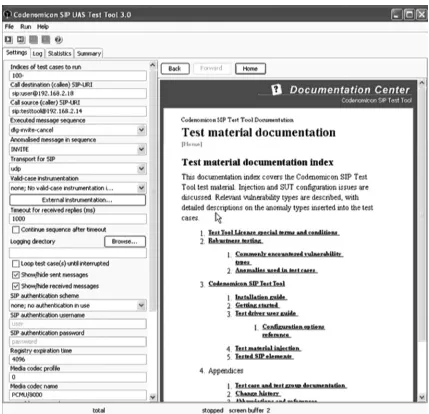
Codenomicon
Fuzzing—What’s That? • Chapter 2 25
Beyond Security
Beyond Security’s beSTORM is an exhaustive fuzzer. Although it supports testing for predetermined test cases and tries to exploit more likely vulnerabilities before
continuing with the full test, their main objective is to allow for the most complete testing that will cover as much of the protocol space as possible. With beSTORM, it is also possible to write custom modules for proprietary protocols using XML (www.beyondsecurity.com) (demo download available).
muSecurity
muSecurity’s mu4000 uses the man-in-the-middle or proxy approach; it sits on the network, learns the traffi c, and tries to manipulate the traffi c in a way that will trigger a vulnerability (www.musecurity.com).
What Comes Next
In the future, fuzzers will become much more advanced in regard to what techniques they use. Further, as experience is gathered by their authors, the algorithms for these techniques will be fi ne-tuned for a much higher success rate and effi ciency.
New techniques to use application monitoring (also known as host monitoring), and different types of network monitoring, will be implemented to fi nd new types of vulnerabilities and to optimize the current techniques.
The Software Development Life Cycle
With vendors announcing new fuzzing products every few months during 2006 and the increased awareness of different software companies for the need for security, fuzzing seems to be right on target.
Today, there are limited options for vendors to test their software:
■ Secure coding education for their developers
■ Source code and static analysis tools
■ Vulnerabilities being found and exploited once the product is in the market
Whether in eliminating false positives, educating staff, or handling patching (development, technical support, and PR) costs, fuzzing offers an alternative that is automated and requires little to no human interaction until the point the error is found.
One of the interesting things about fuzzing is that under normal running conditions, fuzzers have no false positives in what they do fi nd. Meaning, when an error is received it may not be an exploitable vulnerability, but something bad did happen with the code that at the very least affected the software stability, such as a DoS attack.
Fuzzing as a black-box testing fi eld, in our opinion, is going to turn into a signifi cant portion of the vulnerabilities and software/application security markets from all ends, prevention to countermeasures.
Fuzzing is not a perfect solution and it isn’t the silver bullet, but when done effi ciently it can help eliminate many vulnerabilities in the code space and provide a return-on-investment that far outweighs its implementation costs.
Although fuzzing stands by itself as an effi cient software testing technique, it is indeed not the silver bullet. Using fuzzing together with other techniques such as static analysis, whether in the same process or as separate tools, would yield better results with more secure applications.
27
Chapter 3
Building a Fuzzing
Environment
Solutions in this chapter:
■ Basic Tools and Setup
■ Data Points
■ Crash Dumps
■ Fuzzer Output
■ Debuggers
Introduction
Fuzzing is a funny thing and often misunderstood. A fuzzer is a tool used to produce a result, not the result itself, although often the development of the fuzzer is treated as the end of the story. The intended result of a fuzzer is to expose some sort of fl aw in a software application that can be used to twist the internal workings and application of the operating system. To make the most of the consequences of a fuzzer run, a researcher must be able to gather all the information possible about the state of the application, the output a fuzzer produces, and other seemingly small pieces of information that can prove the difference between a successful exploit discovery and just another software bug. To properly do this, a researcher must have a well-constructed environment that allows the capture of as much useful information as possible. An environment like this is not built by accident; instead, it requires a lot of time and conscious thought fi rst. Although informative steps to build a good fuzzer in a variety of different methods have been discussed, there has yet to be a good document on how to build a good fuzzing environment.
Knowing What to Ask…
Before you confi gure the operating system or even write a basic tool, the fi rst thing to do is consider the goal or intent of the testing. One of the basic questions to answer fi rst is, what is being tested? The type of code to be tested will have a large impact on how the environment is constructed. Enough information must be gathered to insure any fault uncovered will be able to be diagnosed and repeatable. This is a dangerous line because it is easy to increase the amount of data collected to the point of uselessness. The information overload state has been reached if more time is consumed sifting through the data of a fuzzer run than analyzing the potential fl aw and duplicating it.
Several different types of applications can be fuzzed, in many different ways, and a variety of different problems can be uncovered. For the sake of clarity in this chapter, everything will fi t into three different classes: local, network, and Web application.
Building a Fuzzing Environment • Chapter 3 29
The network class contains all the applications and servers that require network access and have no other way to exercise the code branches. Examples of this are DNS servers, Web servers, and operating system network stacks.
Web applications are technically a subset of the network class but have enough unique and special considerations to have their own class. These could be Web applications available on machine on the same subnet, or a hosted application that is not distributed, like Google mail. These are diffi cult to test because often a debugger cannot be attached if the only feedback that may be received is cryptic error messages.
After determining the goal, the next logical question to answer is, what class is the application? Having a network-based app, such as a Voice over IP ( VoIP) softphone, means there is another stream of data to record, all network-based traffi c. This is not hard to do with available tools such as tcpdump and Wireshark. The difference between successfully analyzing this traffi c and a time sink is fi nding which packet or string of packets caused the fault and which can be ignored.
Since Web-based applications are under the same type of scrutiny as any other, considerations for this class have to be made when determining how to build a fuzzer strategy. Since these applications are often remotely hosted, they require a way to determine if an error has occurred, how severe it is, and what could be done with it.
The best question to answer is, how do you know if a fuzzer run is not being
wasted? A Web server is a good example of this; what simple things can be done to verify that code branches are actually being exercised with the fuzzer and to assure the traffi c is not being discarded by an initial input validation function. This can be done with a variety of code coverage techniques like profi lers, and problems can be examined and corrected with debuggers. It’s kind of like a nightclub: it doesn’t matter if you are the best dancer if you can’t get past the doorman.
T
IPWith these basic questions answered, it time to begin construction of the environment. There are two major schools of thoughts on how to build the underpinnings of a good fuzzer environment, and the distinction is virtualization. Schools of thought may be a polite label; it is more in the area of holy war much like vi versus Emacs.
Some researchers are fans of using native machines as the basis and when necessary connecting with several machines with Ethernet or Wi-Fi. The upside of a native solution is a good strategy considering many fuzzing targets are devices that can’t be virtualized. Examples include routers, mobile devices (like cellular phones and mobile media players), and operating systems that can’t be or supposed to be virtualized, like VxWorks or Apple’s OSX. There is also a problem with new anti-exploitation technology built in to many machines that may make vulnerabilities that may trigger with the same software version on lesser hardware platforms. An example of this technology is the No-eXecute (NX) technology that prevents certain regions of code from executing. If a vulnerability triggers this feature, the operating system may handle it quietly without any notifi cation to the user, which means there may be no indication that the fuzzer was successful.
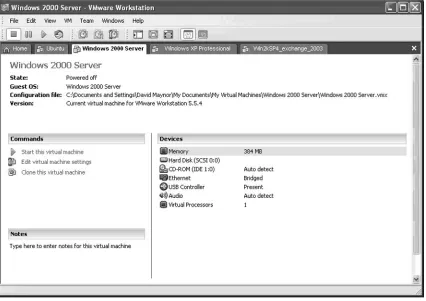
Other researchers are of the mindset that virtualization is the best path for using a fuzzer. Virtualization tools like VMware, Virtual PC, and xen are among the most popular virtualization solutions. Tools like these offer the capability to have many different operating systems in an easy to manage solution. One of the most useful features of a virtualization tool like VMware is the capability to create snapshots of the state a machine is in and return to that state quickly (Figure 3.1). This is incredibly useful if the fuzzing target requires a certain state. It is also useful for saving time: repeatedly triggering a vulnerability that may cause a machine to continually need to be restarted or rebooted can waste a lot of time waiting for actions to complete. Being able to revert quickly to a saved snapshot can save a lot of time and assure that re-runs of the fuzzer are targeting the same problem in subsequent runs.
Building a Fuzzing Environment • Chapter 3 31
[image:41.612.104.530.121.422.2]The answer advocated here is that both methods have strengths and weaknesses and should be used where appropriate. For application level vulnerabilities, and even vulnerabilities in basic operating system services, using a virtualization-based solution is timely and effi cient. A repeatable test bed is very important, but if a researcher has to spend more time getting the target to run in a VM, a native solution may be better suited.
Figure 3.1 A Typical VMware Setup with Images for a Variety of Operating Systems
T
IPReliance on third-party tools means that a researcher should create
a toolkit that can easily be copied between different machines and even OSes. Create a directory tree that breaks, and include a directory for environment and the necessary tools. The tools for Windows are easy since they are just binaries; they can be stuck in a subdir. Due to the diversity of operating systems like Linux, OSX, and the BSD variants, it is a good idea to keep the source code for those tools in the directories so a quick recompile can produce a working tool.
Tools & Traps…
Real-World Example: Windows 2000 Server SP4
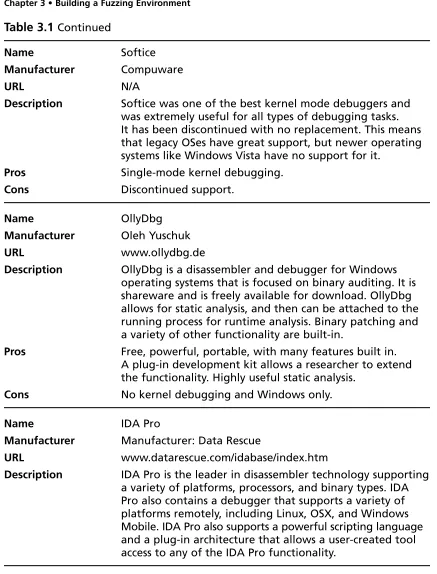
Windows 2000 is a staple in medium to enterprise class businesses across the globe. It is still used as a good basis for vulnerability auditing and discovery for the Windows platform. It is starting to show its age since newer Microsoft applications like Defender or Internet Explorer 7, which means it is best suited for legacy applications. This shouldn’t sour a researcher on this choice as a potential platform, because there is still a treasure trove of vulnerabilities in existing applications like Active Directory and small business applications like Great Plains.
A basic set of tools to aid in fuzzer use and vulnerability discovery is comprised mostly of open source or freely available tools like Process Monitor, TCPView, WinDbg, AccessChk, and AccessEnum. WinDbg is used as the primary debugger and has its symbol store set up to automatically retrieve necessary fi les. WinDbg has also set as the primary post mortem debugger by issuing the
windbg.exe –I command from a DOS prompt. This means that WinDbg will be launched automatically to examine any crash, which allows a researcher to quickly understand what crashed and why.
Since this is done in a VMware environment, a shared folder is set up with the host OS that contains the tools package and allows for quick sharing of fi les. This is useful for moving crash dumps, logs, or anything else that should be preserved.
Tools & Traps…
How a Researcher Makes Use of This Environment
A known vulnerability will be used in this test—CVE-2007-1748—the Microsoft DNS stack overfl ow. DNS is not essential to the operation of a Windows 2000 box, so crashing the process will result in a hung process at best. A process can be restarted from the Services console under Administrative tools. Since crashing the DNS does not risk crashing the box, Wireshark can be run locally to collect data for later analysis. A simple fuzzer can detect this vulnerability, since it is a stack-based overfl ow. Process Monitor is also running to record any fi le reads and writes, and access to any registry keys. This is useful to determine if there is a crash dump and where it is written to.
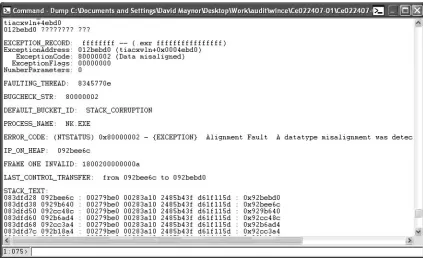
[image:43.612.102.525.399.657.2]The fuzzer is designed to stop sending data if the application becomes unresponsive. This ensures that the network logs are not full of data that occurs after the crash and are not essential to tracking down the cause. Figure 3.2 shows the result of the crash and the packet that caused it.
Basic Tools and Setup
Although modern operating systems have MANY facilities built in to log operations, they do not provide enough information to locate, debug, and reproduce a crash. To increase the amount of data used and the chance of understanding an uncovered vulnerability, third-party tools are used. Most of these tools are available for download and are often used by application developers to debug or understand how the
application actually operates.
Data Points
The data collected is almost as important as the traffi c the fuzzer generates. Several different things need to be collected so analysis of a potential fl aw can be done easier, and aid in reproduction of the fl aw if a problem arises. Many subtle bugs found by fuzzing may require an exact state that happens rarely, or could rely on another application doing something specifi c.
Crash Dumps
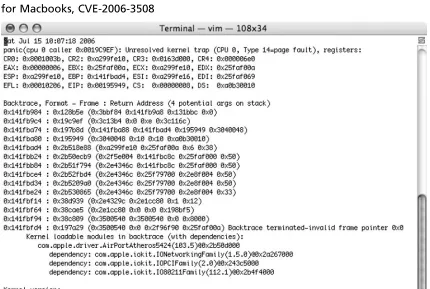
The most important piece of data to collect is the crash dump of the target. Where the crash dump is located and what it contains varies based on the operating system. In general, the crash dump contains the state of the application, the time of the fault, and register and memory contents. This information will provide the biggest assistance in understanding what the fl aw is, if it is exploitable or a software bug, and how to reproduce it.
Building a Fuzzing Environment • Chapter 3 35
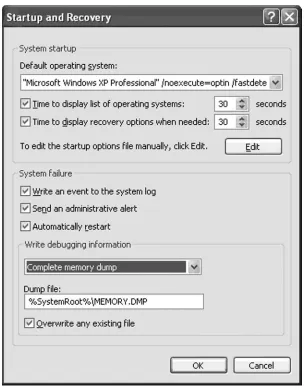
For Linux, enabling crash dumps, called core fi les on Linux, is just a matter of issuing a ulimit command with root privileges. For instance, ulimit –c unlimited will
allow a core fi le of any size to be created. Be careful because core fi les can be very large and use up all the available space on a partition.
A similar command is used in OSX. Adding the line limit core unlimited to /etc/launchd.conf will enable system core fi le creation. If the application is being
[image:45.612.163.468.100.490.2]launched from a terminal, you can enable core fi le creation in just the terminal environment by issuing the same command as Linux, ulimit –c unlimited.
Fuzzer Output
Although it may seem obvious, saving the output of a fuzzer is extremely important to diagnosing what happened and how to make it happen again. This is relevant if the application being tested is a network-based application like an RPC server, a host-based application like a word processor, or even a Web-based application like a Web mail front end.
Each of the types of application mentioned requires capturing data in a certain way. One common step among them all is data reduction. A fuzzer, by design, will create a tremendous amount of data, and reducing that data to what is important is essential. This can be handled in different ways, but one simple solution is to develop your fuzzer to interact with the testing environment. For example, a fuzzer should be aware of when its target has crashed or hung, so it no longer continues to send malformed data.
If a third-party fuzzer is being used and it doesn’t support that functionality, the data capture tools can be scripted easily enough to poll the application and stop collecting data if there is no response.
Client-side applications are some of the easiest to capture fuzzer output for. Generally, a fuzzer in these cases will create an output fi le that is then loaded into the application. If the application exits abnormally or hangs, the fi le can be put aside to be examined in conjunction with the crash dump or debugger output.
Capturing network traffi c is both easy and hard depending on the application and how the testing is carried out. Normally, it’s just a matter of running a sniffer like tcpdump or Wireshark to capture the traffi c, which is easy. The hard part occurs when it comes time to try to make sense of it all. An example would be a hung application that didn’t create a crash dump and didn’t have a debugger attached. It is hard to determine the state of an application just by looking at its network traffi c. Packets could be fi ltered for a number of reasons such as being malformed, or sent out of order, or at the wrong time. For this reason, its best to always run the target with a debugger attached so information like register contents and what is contained in the stack frame can be captured.