White Rose Research Online URL for this paper:
http://eprints.whiterose.ac.uk/75358/
Version: Accepted Version
Article:
Baker, Daniel H orcid.org/0000-0002-0161-443X and Graf, Erich W (2009) On the relation
between dichoptic masking and binocular rivalry. Vision Research. pp. 451-9.
https://doi.org/10.1016/j.visres.2008.12.002
[email protected] https://eprints.whiterose.ac.uk/ Reuse
Items deposited in White Rose Research Online are protected by copyright, with all rights reserved unless indicated otherwise. They may be downloaded and/or printed for private study, or other acts as permitted by national copyright laws. The publisher or other rights holders may allow further reproduction and re-use of the full text version. This is indicated by the licence information on the White Rose Research Online record for the item.
Takedown
If you consider content in White Rose Research Online to be in breach of UK law, please notify us by
On the relation between dichoptic masking and
binocular rivalry
Daniel H. Baker* and Erich W. Graf.
School of Psychology, University of Southampton, Highfield, Southampton, SO17 1BJ, UK
* Present address
: School of Life & Health Sciences, Aston University, Aston Triangle,
Birmingham, B4 7ET, UK,
: [email protected].
Abstract
When our two eyes view incompatible images, the brain invokes suppressive processes to inhibit one image, and favour the other. Two phenomena are typically observed: dichoptic masking (reduced sensitivity to one image) for brief presentations, and binocular rivalry (alternation between the two images), over longer exposures. However, it is not clear if these two phenomena arise from a common suppressive process. We investigated this by measuring both threshold elevation in simultaneous dichoptic masking and mean percept durations in rivalry, whilst varying relative stimulus orientation. Masking and rivalry showed significant correlations, such that strong masking was associated with long dominance durations. A second experiment suggested that individual differences across both measures are also correlated. These findings are consistent with varying the magnitude of interocular suppression in computational models of both rivalry and masking, and imply the existence of a common suppressive process. Since dichoptic masking has been localised to the monocular neurons of V1, this is a plausible first stage of binocular rivalry.
Keywords
: dichoptic masking, binocular rivalry, orientation, individual differences,
interocular suppression
1 Introduction
The visual system receives information from two different sources - the left and right eyes. Under most conditions, the brain readily combines corresponding features between the two eyes. This process breaks down, however, when the images shown to the two eyes are sufficiently different. There are two classic observations under these conditions. For brief presentations, sensitivity to a stimulus shown to one eye (the target stimulus) is reduced by an incompatible stimulus at the same location in the other eye (the mask). This is known as dichoptic masking (Legge, 1979). Over longer durations, perception will alternate between the two images as they compete for dominance; a phenomenon termed binocular rivalry (Levelt, 1966; Alais and Blake, 2005).
Despite dichoptic masking and binocular rivalry occurring under similar conditions, there has been little attempt to study the two in tandem using psychophysical techniques. This is surprising, as it has frequently been
Dichoptic masking using grating stimuli shows strong orientation tuning. It is maximal when mask and target have the same orientation, and minimal (but still substantial) when they are orthogonal (Baker and Meese, 2007; Levi et al., 1979; Harrad and Hess, 1992), following a Gaussian falloff (Baker and Meese, 2007). In binocular rivalry, the mean dominance duration increases as the angle between the stimuli is reduced (Schor, 1977; Kitterle & Thomas, 1980; OÕShea, 1998; Buckthought et al., 2008). This suggests that strong masking equates to long dominance durations, and vice versa, but this has yet to be shown in a single study using the same stimuli and observers. Such a demonstration would be valuable, as it might indicate whether a common neural process is responsible for the tuning effects. Computational models of binocular interactions have not explicitly integrated rivalry and masking effects, and these data may suggest ways in which existing models of both masking (Meese et al., 2006; Baker et al., 2007a) and rivalry (Wilson, 2003, 2007; Freeman, 2005; Noest et al., 2007; Laing and Chow, 2002; Stollenwerk and Bode, 2003) might be unified.
A second comparison concerns individual differences. There is evidence that the magnitude of orthogonal dichoptic masking varies across observers (Baker, 2008; Baker et al., 2007a; Meese and Hess, 2004, 2005), although thus far this has only been shown in small populations. This variation probably reflects differences in the amount of neural suppression across observers (see also Meese et al., 2005), which might differ in clinical conditions such as amblyopia (Harrad and Hess, 1992; Sengpiel et al, 2006). For binocular rivalry, individual differences in dominance durations are substantial (e.g. Sheppard and Pettigrew, 2006; Pettigrew and Miller, 1998), robust over time (Pettigrew and Miller, 1998), and correlate well with percept durations for other bistable phenomena within individuals (Carter and Pettigrew, 2003; Sheppard and Pettigrew, 2006). Relationships have been identified between dominance durations and several other factors, including stereoacuity (Halpern et al., 1987), attention (Paffen et al., 2006), drug intake (Donnelly and Miller, 1995; Carter and Pettigrew, 2003; Frecska, White and Luna, 2004; Carter et al., 2007), mood (Pettigrew and Miller, 1998; Sheppard and Pettigrew, 2006; Nagamine et al., 2007), bipolar disorder (Pettigrew and Miller, 1998; Miller et al., 2003) and meditation (Carter et al., 2005).
These findings support the notion that there is a common central cortical process underlying bistable switching (Carter and Pettigrew, 2003). However, it remains a possibility that early inhibitory processes (Sengpiel et al., 1995, 2001; Sengpiel and Vorobyov, 2005; Li et al., 2005; Baker et al., 2007a) also play a role, and that individual differences in rivalry and dichoptic masking may be linked by a common factor - the magnitude of interocular suppression. Studying rivalry and dichoptic masking in infants using VEP has shown that both phenomena follow a developmental trajectory (Brown et al., 1999), indicating that individual differences could be determined by early experience.
The present study directly compared the magnitude of dichoptic masking to dominance durations in binocular rivalry in two experiments. In the first, the relative orientation of grating stimuli was varied within observers. In the second, rivalry and masking were measured across a group of observers (N=41). The two measures were significantly correlated in both experiments.
2 Experiment I: orientation tuning
2.1 Apparatus and Stimuli
Stimuli were presented on a ViewSonic (California, USA) G90fB monitor (60cd/m2 mean luminance, gamma corrected), running at 75Hz, using an Apple Macintosh computer (Apple, California, USA). A BITS++ box (Cambridge Research Systems Ltd., Kent, UK) provided 14-bit greyscale resolution, allowing accurate presentation of very low contrast stimuli. The Psychophysics Toolbox routines (Brainard, 1997; Pelli, 1997), running under Matlab 7.4 (The Mathworks Inc., Massachusetts, USA) were used to display stimuli. Dichoptic presentation of images was achieved using a mirror stereoscope.
Michelson contrast expressed in percent, given
by C% = 100*
L
MAX
−
L
MINL
MAX
+
L
MIN, where L is
luminance. Decibel (dB) units, defined as CdB
= 20log10(C%), are also used to aid comparison
with previous studies and for calculating correlations (to provide a comparable scaling for mean durations, these were also converted to logarithms using the same equation).
2.2 Procedure
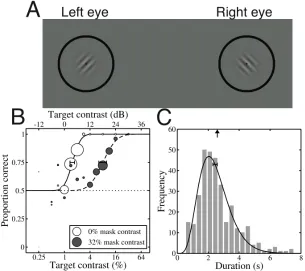
In the masking section, detection thresholds were measured for a low contrast target stimulus in the presence of a high contrast (32% = 30dB) mask shown to the other eye. Stimuli were presented for 200ms
(simultaneous onset and offset for mask and target) in a two interval forced choice (2IFC) design (500ms interstimulus interval), with each interval marked by a beep. One interval contained only the mask, and the other contained both the mask and the target. Observers reported which interval contained the target using a two-button mouse, and were
given feedback after each trial. Contrast levels for the target stimulus were determined by two pairs (one pair per eye) of interleaved 3-down, 1-up staircases (Levitt, 1971; Cornsweet, 1962).
[image:4.595.134.439.385.656.2]Observers were cued as to the orientation of the target before each block began, and completed a block at that orientation before moving onto the next. Each orientation condition was repeated twice, and the data pooled across repetition (>300 trials per condition). Probit analysis (Finney, 1971) was used to estimate a single threshold at the 75% correct point on the psychometric function (see Figure 1B). Thresholds were also measured (four repetitions ≈ 700 trials) at a mask contrast of 0% (i.e. baseline detection threshold) for a target orientation of 45¡ (pilot experiments found very little variation in sensitivity over the 30¡range (45-75¡) of target orientations). A bootstrapping technique was used to calculate 95% confidence intervals by resampling and refitting each psychometric function 2,000 times.
In the rivalry section, a pair of dichoptic stimuli (as described above) were presented at a contrast of 32% (30dB). Observers reported their percept continuously (left- or right-tilted grating; transition periods were not recorded in this study) using the mouse for trials of 2 minutes duration. Trials were completed in a random order, with stimuli counterbalanced across eye. Observers completed 8 repetitions (16 minutes) at each orientation difference. Dominance durations were calculated from the timecourse data, and pooled across eye, response (left- or right-tilted) and repetition. A gamma distribution was then fit to the histogram of dominance durations (see Figure 1C). This permitted calculation of the mean duration (the mean of a gamma distribution is the product of its two parameters) in an analogous fashion to threshold calculation (i.e. using a continuous function to smooth the data), and also allowed confidence intervals to be calculated by bootstrap resampling. This fitting procedure was also executed using a log-Gaussian function (e.g. Lehky, 1995), which produced very similar results.
For all experiments, observers were seated in a darkened room, at a viewing distance of 85.5cm. The masking section was completed first, followed by the rivalry section. Observers chose how many blocks to complete in a single sitting. All stimuli were displayed in the centre of a dark ring (5¡ diameter, 0.1¡ thick), present throughout each block, which was used to ensure binocular fusion. A small central fixation cross was also present throughout.
2.3 Observers
Both authors and two na•ve observers completed this experiment (1 female, mean age 28.5). All were psychophysically experienced, wore optical correction if required, and had no abnormalities of binocular vision.
2.4 Results
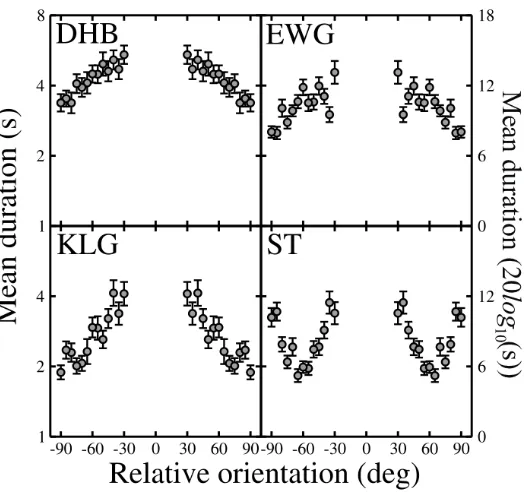
The results of the masking section are shown in Figure 2. The data are presented mirrored about zero, as previous work found no asymmetries due to absolute orientation (Baker and Meese, 2007). For all observers, threshold elevation (relative to the baseline detection threshold given by the dotted line) is substantial at all mask orientations. Thresholds increase as the angle between the gratings approaches zero, and is roughly Gaussian in
form, consistent with previous studies (Baker and Meese, 2007; Levi et al., 1979; Harrad and Hess, 1992). These data indicate that the interocular suppression thought to produce dichoptic masking is orientation tuned, being strongest for similar orientations.
Mean dominance durations for binocular rivalry using these stimuli (at equal contrast) are shown on log axes in Figure 3. All observers show a clear increase in mean duration as the relative orientation tends to zero, consistent with previous studies (Schor, 1977; Kitterle & Thomas, 1980; OÕShea, 1998; Buckthought et al., 2008). The main exception to this is for observer ST, who shows a W-shaped function, with minima around ±60¡ orientation difference. We have no definite explanation for this pattern, which differs from previous reports and from the other observers. Given that the absolute orientations for these conditions were close to ±45¡ the anomaly may relate to oblique effects described in other paradigms (Campbell, Kulikowski and Levinson, 1966; HupŽ & Rubin, 2004). Indeed, a similar result has been reported for monocular rivalry (Campbell, Gilinsky, Howell, Riggs & Atkinson, 1973), but remains unconfirmed by subsequent work (Georgeson & Philips, 1980; Kitterle & Thomas, 1980; OÕShea, 1998). We note that if the two extreme points are discounted the data are not substantially different from those of the other three observers.
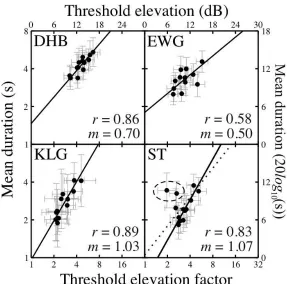
The similar orientation tuning across the two tasks means that threshold elevation in dichoptic masking must correlate with mean duration in binocular rivalry. This relationship is shown in Figure 4, and is significant for three observers (DHB: r = 0.86; p < 0.01. EWG: r = 0.58; p < 0.05. KLG: r = 0.89; p < 0.01). The correlation was not significant for observer ST (r = 0.25; p > 0.05) due to two outliers, i.e. the two points discussed above. Excluding these data points for observer ST produced a highly significant correlation (r = 0.83; p < 0.01). Best fitting regression lines were calculated in logarithmic units by minimising the absolute distance (in both x and
Figure 2. Results of Experiment I. Dichoptic masking data for four observers. All observers show greater threshold elevation as the relative orientation between mask and target approaches zero (data are mirrored about a vertical axis centered on zero). The horizontal dotted line gives the baseline detection threshold for a mask contrast of 0%. Error bars are 95% confidence limits, estimated by bootstrap resampling.
[image:6.595.167.429.458.704.2]Figure 4: Correlation between threshold elevation in dichoptic masking and mean duration in binocular rivalry. Threshold elevation is defined as the ratio between thresholds with a mask and the baseline detection threshold. For observer ST, the dotted line shows the best fit to all 13 data points, and the solid line (and quoted parameters) gives the fit excluding the circled points. Error bars are 95% confidence limits, estimated by bootstrap resampling.
3 Modelling masking and rivalry
In common with neurophysiological models (e.g. Heeger, 1992), pattern masking models typically invoke divisive suppression (e.g. Foley, 1994; Meese and Holmes, 2007) to produce threshold elevation (though see Manahilov et al., 2007), and models of binocular interactions are no exception (Baker et al., 2007a; Ding and Sperling, 2006). Recent models of dichoptic masking (Baker et al., 2007a; Baker and Meese, 2007; Meese et al., 2006) include a parameter which determines the magnitude of interocular suppression, such that large parameter values produce strong masking. Such an arrangement is robust, and can produce any observed level of threshold elevation from none (weight=0), through intermediate levels (Baker et al., 2007a), to the very high levels of masking observed with dichoptic pedestal masks (Legge, 1979; Baker and Meese, 2007).
Computational models of binocular rivalry (Noest et al., 2007; Freeman, 2005; Wilson, 2003, 2007; Lehky, 1988) also include suppression between left and right channels, although this tends to be implemented as subtractive (or ÔshuntingÕ) inhibition (see Holt
and Koch, 1997, for a discussion of subtractive and divisive inhibition in model neurons). As with masking models, a weight term typically modulates the level of interocular competition. Recently, Wilson (2007) has demonstrated that increasing the value of this weight in a minimal neural model of rivalry lengthens dominance durations. We found similar behaviour for the model of Noest et al. (2007), and also for WilsonÕs (2003) earlier model, indicating that this is a general property of rivalry models. The data of the present study can be considered evidence that this behaviour also occurs experimentally.
[image:7.595.153.440.82.366.2]include both processes, consistent with some physiological evidence (Sengpiel et al., 1998). Other model features are compatible. For example, the output nonlinearity in the model of Noest et al. (2007) is a Naka-Rushton function (e.g. Heeger, 1992); by slightly increasing the numerator exponent, this becomes equivalent to the contrast transducer model of Legge and Foley (1980), which is the basis of most masking models (this manipulation had no appreciable effect on rivalry behaviour in our implementation).
Of course, alternative arrangements are also possible. For example, suppose the interocular suppression which produces dichoptic masking were to occur prior to the rivalry alternation mechanism. As suppression at the early stage increased, input to the alternation mechanism would reduce, and alternations would slow down (following Levelt's (1966) fourth proposition) consistent with the experimental results here. However, since there is no compelling evidence to favour this configuration, a single process of interocular suppression is the more parsimonious arrangement.
Developing and characterising a single coherent model is beyond the scope of the present work. That the behaviour of existing rivalry and masking models is consistent with the empirical findings is reassuring, however, and provides further evidence that a common inhibitory process might underlie both dichoptic masking and binocular rivalry. We stress that the work here most likely pertains to the first stages of the rivalry hierarchy (see section 5.1 below), with further suppression occurring at later stages. This would ease the requirement that early suppression during rivalry be absolute (i.e. activity is reduced below threshold for the suppressed eye), as suppression is believed to become more profound at later stages in the hierarchy (e.g. Leopold and Logothetis, 1996). For dichoptic masking, if the signal in the target channel is already negligible after the first stage of suppression, later stages should have no appreciable effect.
4 Experiment II: individual
differences
Having identified a strong relationship between dichoptic masking and binocular rivalry within observers, the possibility that a similar relationship might exist for individual differences between observers was then explored. As discussed above, numerous
factors have been identified as contributing to individual variation in dominance durations, so we expect any relationship to be weaker than those identified for the within-observer orientation tuning data presented above.
4.1 Methods
The stimuli, experimental set-up and analysis procedures were as described above, except that only orthogonal gratings (±45¡) were used in this experiment. Furthermore, the three sections of the experiment were completed in a specific order (baseline thresholds, then masked thresholds, then binocular rivalry). This was necessary in order to keep the mask contrast and the contrast used during rivalry at the same level for each observer, relative to their individual baseline detection threshold. Measuring the baseline threshold first allowed the mask contrast (and the stimulus contrast for rivalry) to be set to 30dB above threshold (32 times threshold). Without such a manipulation, individual differences in masking and rivalry might be influenced by differences in sensitivity to the stimuli. Observers were given verbal and written instructions, as well as an opportunity to practise each task, before formal testing began. The entire experiment took between 45 minutes and one hour to complete.
4.1.1 Rejection criteria
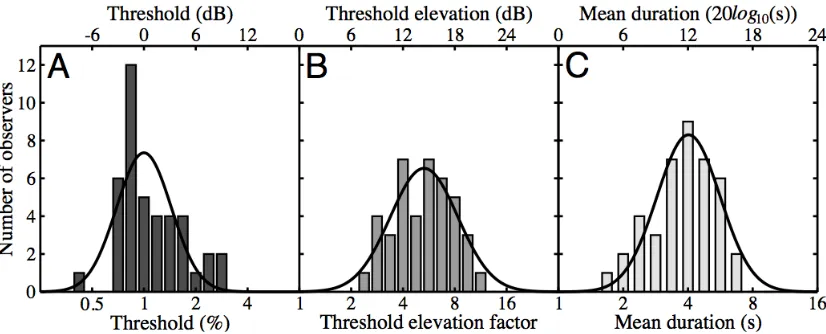
Figure 5. Histograms showing distributions of A) contrast detection thresholds, B) threshold elevation in dichoptic masking, and C) mean durations in binocular rivalry across a population of 41 observers. All abscissae are logarithmic, and curves show the best fitting Gaussian functions on these axes.
4.2 Observers
60 observers completed the experiment, however the data of some observers
were rejected according to the criteria described above. This left a group of 41 observers (15 male), with a mean age of 24, all of whom were staff and students in the School of Psychology at the University of Southampton (undergraduate students participated in return for course credit). All observers wore their normal optical correction during testing.
4.3 Results
Distributions of detection thresholds, threshold elevation for dichoptic masking, and mean durations in binocular rivalry are shown in Figure 5. The baseline detection thresholds (Fig 5A) are positively skewed, with most observers having thresholds between 0.5 and 1% (geometric mean = 1.1%). Dichoptic threshold elevation (Fig 5B, mean elevation factor = 5.7) and rivalry mean durations (Fig 5C, mean duration = 3.7s) showed a wide range of values across the population (over at least a factor of 4). One-sample Kolmogorov-Smirnov tests indicated that none of the three distributions were significantly different from normal in log-space.
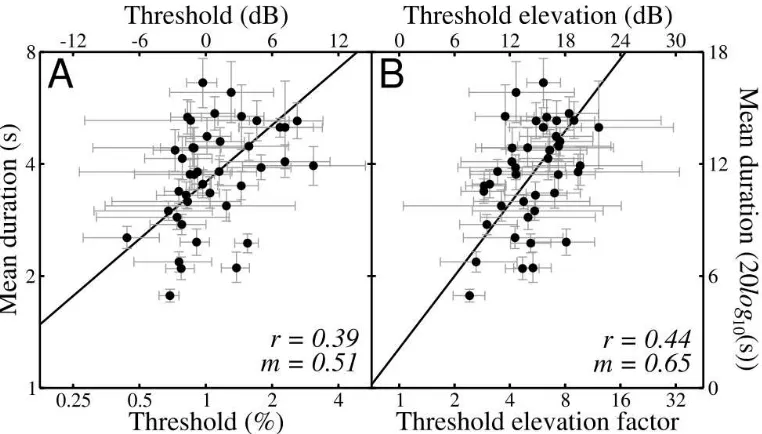
Figure 6 depicts the relationship between mean duration and baseline detection thresholds (Figure 6A) and threshold elevation caused by a dichoptic mask (Figure 6B). In the latter
case, a significant positive correlation is seen (r = 0.44; p < 0.01), accounting for 19% of the variance, with a regression slope comparable to those found within-observers in Experiment I. An unexpected finding was that detection thresholds also correlate significantly with mean durations (r = 0.39; p < 0.05), accounting for a further 15% of the variance as shown in Figure 6A. Had a fixed stimulus contrast been used for all observers, one might expect longer mean durations to correspond to higher detection thresholds, as stimulus contrast relative to detection threshold would be lower. Since the contrast of the rivalling gratings was adjusted to each observer's individual detection threshold, however, this relationship is surprising. Further exploration of this finding is deferred to the Discussion (section 5.4).
Figure 6: Correlation between baseline detection threshold and rivalry duration (A), and dichoptic threshold elevation and rivalry duration (B) for 41 observers. Both correlations are statistically significant (A: p<0.05, B:
p<0.01). Error bars give the bootstrapped 95% confidence limits. Correlation coefficients (r) and slope of best fitting regression lines (m) are shown in each panel. Note that the axes differ in their extent, so although the data appear vertically elongated, the variance is approximately equal in both directions (see Figure 5).
Finally, since the absolute dichoptic detection threshold is the product of detection threshold and threshold elevation factor (or their sum in dB units), a further significant correlation exists between absolute dichoptic threshold and mean rivalry duration (r = 0.55; p < 0.01). Indeed, this correlation (not shown) is stronger than either of those presented in Figure 6, accounting for 30% of the variance. This indicates that baseline detection thresholds and dichoptic threshold elevation may not be statistically independent, however the correlation between them was not significant in the present population (r = 0.28; p < 0.08). This observation, and the consistency with Experiment I (in which both mask contrast and detection thresholds were constant), provide evidence against the possibility that the relationship between threshold elevation and mean duration is a spurious product of the correlation between detection threshold and mean duration.
5 Discussion
Two experiments were devised to directly compare binocular rivalry and dichoptic masking for simultaneously presented stimuli. Mean dominance durations during rivalry were found to correlate with the magnitude of dichoptic masking over changes in stimulus orientation. Strong masking corresponded to long percept durations (slow rivalry). This
relationship can be explained by varying the weight of interocular suppression in computational models of rivalry and masking, and indicates that the two processes share common neural circuitry. We found a weaker, though still significant pattern across a population of observers. A significant correlation was also discovered between baseline detection thresholds and rivalry dominance durations. To our knowledge, this is the first report of such a relationship, and we discuss its implications below.
5.1 Constraining the first stage of binocular rivalry
Previous work has concluded that simultaneous dichoptic masking must occur, at least in part, before binocular summation of signals (Baker et al., 2007a). This is because the magnitudes of monocular1 and dichoptic
masking are independent functions of stimulus duration (Baker et al., 2007a), mask type (Baker et al., 2007a) and spatiotemporal frequency (Baker et al., 2007b; Meese & Baker, 2009). Dichoptic masking is weaker under some conditions, and stronger under others relative to monocular masking.
1 In simultaneous monocular masking, mask and
[image:10.595.106.487.82.299.2]Logically, this means that they must involve two separate processes, both of which occur prior to binocular combination, since after this point processing is agnostic regarding eye of origin (for further details see Baker et al., 2007a). Dichoptic masking therefore involves interocular suppression between monocular neurons, consistent with findings from neurophysiology (Sengpiel et al., 1995, 2001; Sengpiel and Vorobyov, 2005; Li et al., 2005). Since our data indicate that rivalry and dichoptic masking most likely involve a common process of interocular suppression, we hypothesize that the first stage of binocular rivalry also occurs between monocular neurons, as has been suggested previously (e.g. Blake, 1989).
5.2 Sequential presentation of stimuli
A recent study by van Boxtel et al. (2007) also compared binocular rivalry and dichoptic masking using repeated sequential presentation of orthogonal gratings to the left and right eyes. The stimulus onset asynchrony (SOA) between one presentation cycle (i.e. left stimulus, then right stimulus) and the next was varied. For small SOAs (< 350ms), the alternating percepts characteristic of rivalry were observed (see also O'Shea and Crassini, 1984). At larger SOAs (> 350ms), one stimulus was suppressed consistently, as with dichoptic masking. Comparison of these two conditions reveals several similarities: percept durations follow a gamma distribution, successive percepts are temporally independent, and Levelt's second proposition (Levelt, 1966) is obeyed (changing the strength of one stimulus affects the mean duration of the other stimulus). These results support the present finding that rivalry and dichoptic masking share common features.
We draw caution, however, in concluding that this finding supports our specific hypothesis that the key common process occurs between
monocular V1 neurons. A more recent study by van Boxtel et al (2008) has suggested that findings from their paradigm are more consistent with eye-independent stages of the rivalry system. This is because the temporal limit of rivalry (the maximum repetition period which produces rivalry-like alternations, about 350ms) is invariant over a range of manipulations, including swapping stimuli between eyes. Other studies of sequential dichoptic masking (Macknik and Martinez-Conde, 2004; Tse et al., 2005) have found little evidence for suppression between monocular neurons, indicating that sequential masking
may arise later between binocular neurons in higher visual areas. It is well established that rivalry suppression becomes more profound in later cortical areas (Tse et al., 2005; Logothetis and Schall, 1989; Logothetis et al., 1996; Leopold and Logothetis, 1996), a property reflected by multi-stage rivalry models (Wilson, 2003; Freeman, 2005). A plausible arrangement might be that sequential presentation bypasses the early stage of monocular suppression, but is subject to additional later suppressive processes, as has been proposed for specific rivalry conditions (Logothetis et al., 1996; Wilson, 2003) and as presumably must occur for other bistable stimuli (e.g. Brascamp et al., 2005; HupŽ and Rubin, 2003). This is consistent with a recent study which concluded that the early stages of binocular rivalry occur before backward (metacontrast) masking (Breitmeyer et al., 2008).
5.3 Individual variation in rivalry alternations
As discussed above, a large number of factors are believed to contribute to individual variation in alternation rates, besides those investigated here. Each individualÕs alternation rate is presumably determined by a number of factors, including mood, attention and neurotransmitter levels, in addition to the interocular suppression and sensitivity explored here. This might explain why the correlations for Experiment II are quite modest, accounting for 19% (suppression) and 15% (sensitivity) of the variance individually, and 30% when combined. We note, however, that this is typical of or better than studies using comparable methodologies, for example stereoacuity accounts for around 10% of the variance (Halpern et al, 1987).
5.4 Sensitivity and rivalry
contrast cannot be responsible for the relationship (i.e. through contrast constancy, Georgeson and Sullivan, 1975), since the fastest alternations here correspond to the lowest physical stimulus contrast, in conflict with Levelt's fourth proposition (Levelt, 1966). A plausible factor that could mediate the effect is differences in internal noise, which both limits thresholds (e.g. Pelli and Farrell, 1999) and influences rivalry alternations (Kim et al., 2006). Regardless of the explanation, it follows that an experiment in which stimulus contrast is fixed (i.e. not normalized) should produce an even stronger correlation with detection thresholds, owing to a combination of the correlation reported here and any increase in alternation rate attributable to relative stimulus contrast. We hope that future experiments will illuminate the relationship between sensitivity and dominance durations.
6 Conclusions
A consistent finding across two experiments is that mean dominance durations in binocular rivalry correlate with the magnitude of dichoptic masking. This pattern of results is consistent with the idea that both phenomena involve a common mechanism of interocular suppression between monocular neurons in primary visual cortex. Many previous studies on individual differences in binocular rivalry have focussed on central processes (such as mood or attention). The present results indicate that low-level factors, such as sensitivity, are key to fully understanding individual variations in perception during binocular rivalry.
7 Acknowledgements
We are grateful for the comments of two anonymous reviewers, and thank Jan Brascamp for comments on the manuscript and both him and Tomas Knapen for helpful discussions. Supported by BBSRC grant no BB/E012698/1.
References
Alais, D. and Blake, R. 2005. Binocular Rivalry, Bradford.
Baker, D. H. 2008. Interocular suppression and contrast gain control in human vision, PhD thesis, Aston University.
Baker, D. H. and Meese, T. S. 2007. Binocular contrast interactions: dichoptic masking is not a single process, Vision Res47: 3096-3107.
Baker, D. H., Meese, T. S. and Summers, R. J. 2007a. Psychophysical evidence for two routes to suppression before binocular summation of signals in human vision, Neuroscience 146: 435-48.
Baker, D. H., Meese, T. S., Patel, K. and Sarwar, W. 2007b. Interocular suppression is scale invariant, but ipsiocular suppression is weighted by flicker speed, Perception 36(S): 60.
Blake, R. 1989. A neural theory of binocular rivalry, Psychol Rev96: 145-167.
Brainard, D. H. 1997. The Psychophysics Toolbox, Spat Vis10: 433-436.
Brascamp, J. W., van Ee, R., Pestman, W. R. and van den Berg, A. V. 2005. Distributions of alternation rates in various forms of bistable perception, J Vis5: 287-98.
Breitmeyer, B.G., Ko•, A., …gman, H. and Ziegler, R. 2008. Functional hierarchies of nonconscious visual processing. Vision Res 48: 1509-1513.
Brown, R. J., Candy, T. R. and Norcia, A. M. 1999. Development of rivalry and dichoptic masking in human infants, Invest Ophthalmol Vis Sci 40: 3324-33.
Buckthought, A., Kim, J. and Wilson, H. R. 2008. Hysteresis effects in stereopsis and binocular rivalry, Vision Res48: 819-30.
Campbell, F. W., Kulikowski, J. J. and Levinson, J. 1966. The effect of orientation on the visual resolution of gratings, J Physiol, 187: 427-436. Campbell, F. W., Gilinsky, A. S., Howell, E. R., Riggs, L. A. and Atkinson, J. 1973. The dependence of monocular rivalry on orientation. Perception2: 123-125.
Carter, O. L. and Pettigrew, J. D. 2003. A common oscillator for perceptual rivalries?,
Perception32: 295-305.
Carter, O. L., Hasler, F., Pettigrew, J. D., Wallis, G. M., Liu, G. B. and Vollenweider, F. X. 2007. Psilocybin links binocular rivalry switch rate to attention and subjective arousal levels in humans, Psychopharmacology195: 415-24. Carter, O. L., Presti, D. E., Callistemon, C., Ungerer, Y., Liu, G. B. and Pettigrew, J. D. 2005. Meditation alters perceptual rivalry in tibetan buddhist monks, Curr Biol15: R412-3. Cornsweet, T. N. 1962. The staircase-method in
psychophysics, American Journal Of Psychology75: 485-491.
Ding, J. and Sperling, G. 2006. A gain-control theory of binocular combination, Proc Natl Acad Sci U.S.A.103: 1141-6.
Donnelly, M. and Miller, R. J. 1995. Ingested ethanol and binocular rivalry, Invest Ophthalmol Vis Sci 36: 1548-54.
Foley, J. M. 1994. Human luminance pattern-vision mechanisms: masking experiments require a new model, J Opt Soc Am A Opt Image Sci Vis11: 1710-1719.
Frecska, E., White, K. D. and Luna, L. E. 2004. Effects of ayahuasca on binocular rivalry with dichoptic stimulus alternation,
Psychopharmacology, 173: 79-87.
Freeman, A. W. 2005. Multistage model for binocular rivalry, J Neurophysiol 94: 4412-20. Georgeson, M. A. and Sullivan, G. D. 1975.
Contrast constancy: deblurring in human vision by spatial frequency channels, J Physiol 252: 627-56.
Georgeson, M. A. and Philips, R. 1980. Angular selectivity of monocular rivalry: experiment and computer simulation. Vision Res20: 1007-1013.
Halpern, D. L., Patterson, R. and Blake, R. 1987. Are stereoacuity and binocular rivalry related?,
Am J Optom Physiol Opt64: 41-4.
Harrad, R. A. and Hess, R. F. 1992. Binocular integration of contrast information in amblyopia, Vision Res32: 2135-50.
Heeger, D. J. 1992. Normalization of cell responses in cat striate cortex, Vis Neurosci9: 181-197.
Holt, G. R. and Koch, C. 1997. Shunting inhibition does not have a divisive effect on firing rates, Neural Comput9: 1001-13. HupŽ, J.-M. and Rubin, N. 2003. The dynamics of
bi-stable alternation in ambiguous motion displays: a fresh look at plaids, Vision Res43: 531-48.
HupŽ, J.-M. and Rubin, N. 2004. The oblique plaid effect, Vision Res44: 489-500.
Kertesz, A. E. and Jones, R. W. 1970. Human cyclofusional response, Vision Res10: 891-6. Kitterle, F. L. and Thomas, J. 1980. The effects of
spatial frequency, orientation and color upon binocular rivalry and monocular pattern alternation. Bulletin of the Psychonomic Society, 16: 405-407.
Kim, Y-J., Grabowecky, M. and Suzuki, S. 2006. Stochastic resonance in binocular rivalry.
Vision Res, 46: 392-406.
Laing, C. R. and Chow, C. C. 2002. A spiking neuron model for binocular rivalry, J Comput Neurosci12: 39-53.
Legge, G. E. 1979. Spatial frequency masking in human vision: binocular interactions, J Opt Soc Am69: 838-847.
Legge, G. E. and Foley, J. M. 1980. Contrast masking in human vision, J Opt Soc Am 70: 1458-1471.
Lehky, S. R. 1988. An astable multivibrator model of binocular rivalry, Perception17: 215-28. Lehky, S. R. 1995. Binocular rivalry is not
chaotic, Proc Biol Sci259: 71-6.
Leopold, D. A. and Logothetis, N. K. 1996. Activity changes in early visual cortex reflect monkeys' percepts during binocular rivalry,
Nature379: 549-53.
Levelt, W. J. M. 1966. The alternation process in binocular rivalry, Brit. J. Psychol. 57, 225-238. Levi, D. M., Harwerth, R. and Smith III, E. L.
1979. Humans deprived of normal binocular vision have binocular interactions tuned to size and orientation, Science206: 852-854.
Levitt, H. 1971. Transformed up-down methods in psychoacoustics, J Acoust Soc Am 49: Suppl 2:467-477.
Li, B., Peterson, M. R., Thompson, J. K., Duong, T. and Freeman, R. 2005. Cross-orientation suppression: monoptic and dichoptic mechanisms are different, J Neurophysiol 94: 1645-1650.
Logothetis, N. K. and Schall, J. D. 1989. Neuronal correlates of subjective visual perception,
Science245: 761-3.
Logothetis, N. K., Leopold, D. A. and Sheinberg, D. L. 1996. What is rivalling during binocular rivalry?, Nature380: 621-4.
Macknik, S. L. and Martinez-Conde, S. 2004. Dichoptic visual masking reveals that early binocular neurons exhibit weak interocular suppression: implications for binocular vision and visual awareness, J Cogn Neurosci 16: 1049-1059.
Manahilov, V., Gordon, G., Calvert, J. and Simpson, W. A. 2007. A new subtractive normalization model for contrast processing of visual stimuli [abstract], J Vis7: 9:256. Meese, T. S. and Baker, D. H. 2009.
Cross-orientation masking is speed invariant between ocular pathways but speed dependent within them. J Vis, 9(5):2, 1-15.
Meese, T. S., Georgeson, M. A. and Baker, D. H. 2006. Binocular contrast vision at and above threshold, J Vis6: 1224-1243.
Meese, T. S. and Hess, R. F. 2004. Low spatial frequencies are suppressively masked across spatial scale, orientation, field position, and eye of origin, J Vis 4: 843-859.
Meese, T. S. and Hess, R. F. 2005. Interocular suppression is gated by interocular feature matching, Vision Res45: 9-15.
Meese, T. S., Hess, R. F. and Williams, C. B. 2005. Size matters, but not for everyone: individual differences for contrast discrimination, J Vis5: 928-47.
Miller, S. M., Gynther, B. D., Heslop, K. R., Liu, G. B., Mitchell, P. B., Ngo, T. T., Pettigrew, J. D. and Geffen, L. B. 2003. Slow binocular rivalry in bipolar disorder, Psychol Med 33: 683-92.
Nagamine, M., Yoshino, A., Yamazaki, M., Obara, M., Sato, S.-i., Takahashi, Y. and Nomura, S. 2007. Accelerated binocular rivalry with anxious personality, Physiol Behav91: 161-5.
Noest, A. J., van Ee, R., Nijs, M. M. and van Wezel, R. J. A. 2007. Percept-choice sequences driven by interrupted ambiguous stimuli: a low-level neural model, J Vis 7: (8):10.
O'Shea, R. P. and Crassini, B. 1984. Binocular rivalry occurs without simultaneous presentation of rival stimuli, Percept Psychophys36: 266-76.
OÕShea, R. P. 1998. Effects of orientation and spatial frequency on monocular and binocular rivalry. In Kasabov, N., Kozma, R., Ko, K., OÕShea, R., Coghill, G. & Gedeon, T (Eds)
Progress in connectionist-based information systems: Proceedings of the 1997 International Conference on Neural Information Processing and Intelligent Information Systems, p67-70. Singapore: Springer Verlag.
Paffen, C. L. E., Alais, D. and Verstraten, F. A. J. 2006. Attention speeds binocular rivalry,
Psychol Sci17: 752-6.
Pelli, D. G. 1997. The VideoToolbox software for visual psychophysics: transforming numbers into movies, Spat Vis10: 437-442.
Pelli, D.G. and Farrell, B. 1999. Why use noise? J Opt Soc Am A Opt Image Sci Vis, 16: 647-653. Pettigrew, J. D. and Miller, S. M. 1998. A 'sticky'
interhemispheric switch in bipolar disorder?,
Proc Biol Sci265: 2141-8.
Schor, C. M. 1977. Visual stimuli for strabismic suppression, Perception6: 583-93.
Sengpiel, F. and Vorobyov, V. 2005. Intracortical origins of interocular suppression in the visual cortex, J Neurosci25: 6394-6400.
Sengpiel, F., Baddeley, R. J., Freeman, T. C., Harrad, R. and Blakemore, C. 1998. Different mechanisms underlie three inhibitory phenomena in cat area 17, Vision Res 38: 2067-2080.
Sengpiel, F., Blakemore, C. and Harrad, R. 1995. Interocular suppression in the primary visual cortex: a possible neural basis of binocular rivalry, Vision Res35: 179-195.
Sengpiel, F., Freeman, T. C., Bonhoeffer, T. and Blakemore, C. 2001. On the relationship between interocular suppression in the primary visual cortex and binocular rivalry, Brain and Mind2: 39-54.
Sengpiel, F., Jirmann, K-U., Vorobyov, V. and Eysel, U.T. 2006. Strabismic suppression is mediated by inhibitory interactions in primary visual cortex. Cereb Cortex, 16: 1750-1758. Sheppard, B. M. and Pettigrew, J. D. 2006. Plaid
motion rivalry: correlates with binocular rivalry and positive mood state, Perception35: 157-69.
Stollenwerk, L. and Bode, M. 2003. Lateral neural model of binocular rivalry, Neural Computation15: 2863-2882.
Tse, P. U., Martinez-Conde, S., Schlegel, A. A. and Macknik, S. L. 2005. Visibility, visual awareness, and visual masking of simple unattended targets are confine to areas in the occipital cortex beyond human v1/v2, Proc Natl Acad Sci U.S.A. 102:17178-83.
van Boxtel, J. J. A., van Ee, R. and Erkelens, C. J. 2007. Dichoptic masking and binocular rivalry share common perceptual dynamics, J Vis 7(14-3): 1-11.
van Boxtel, J. J. A., Alais, D., Erkelens, C. J. and van Ee, R. 2008. The role of temporally coarse form processing during binocular rivalry. PLoS
ONE 3: e1429.
doi:10.1371/journal.pone.0001429.
Wilson, H. 2003. Computational evidence for a rivalry hierarchy in vision, Proc Natl Acad Sci U.S.A.100: 14499-14503.