THETA: The Higher Education Technology Agenda. Hobart: 7-10 April 2013
1
A qualitative analysis of an LMS usage by staff
Kevin Ashford-Rowe and Claire Sinsua
Introduction
The Learning Management System (LMS) has emerged as one of the preferred information and communication technology solutions by which the higher education sector seeks to manage and support the learning experience that it provides to its students. It has also become an increasingly valuable tool which has the ability to record and capture data about users, unlocking the unprecedented potential of data captured for informed decision making and evidence- based strategies.
Present literature illustrates a growing interest and increased use of analytics within the LMS to support and enhance the quality of learning and teaching; however, much of the focus has been on student learning and engagement. While educators can greatly benefit from data on learners, there is also a potential value in exploring and understanding the usage and engagement from the teaching staff perspective, as they are the key technological interfaces in the education institutions (Noeth & Volkov, 2004) who provide access to virtual learning content and support to students as part of the enhanced overall student learning experience.
In 2008, the Learning Management System (LMS) Usage Framework was conceived by Griffith University and the University of Western Sydney as a joint initiative to undertake a benchmarking exercise to measure the level of uptake of the LMS and the associated tools at both universities This
project and its outcomes were reported at ASCILITE 2009; Benchmarking across universities: A
framework for LMS analysis (Rankine, Stevenson, Malfroy, Ashford-Rowe). This framework was a dynamic process model designed to define, describe and measure elements common to the online courses at given points in time, which enabled the selection of data according to specified criteria. Its principal elements were Content, Communication, Collaboration, Assessment, and Explicit Learner Support. Each element was then further broken into subcategories with respect to the use of particular online tools and educational content.
Since 2008, and in collaboration with Educational Designers embedded within the academic community known at Griffith as Blended Learning Advisors, the framework that was developed in 2008 has undergone an evolutionary transformation to better fit and reflect the current Griffith learning and
teaching context. However, its principal pedagogical delivery elements remain as Content,
Communication, Collaboration, Assessment, and Explicit Learner Support, noting that each element is further broken into subcategories, which contain data on the use of particular online tools and educational content.
In 2011/12 Griffith University initiated a further project, based upon this work, the purpose of which was to measure the level of academic uptake of the LMS. The revised LMS Usage Framework was adopted to develop algorithms capturing the relevant LMS data. This quantitative data was then analysed to measure the level of academic uptake and usage of the tools within the LMS. The data was structured to enable analysis at a range of academic grouping levels (Faculty/Department/School etc.) as well as to illustrate the overall performance of the respective academic element in terms of uptake and usage of technology tools in education delivery.
THETA: The Higher Education Technology Agenda. Hobart: 7-10 April 2013
2
Project Outline
The project was conducted over a number of stages, the first of which ensured the redevelopment of the original 2008 framework and the review of the methodology used. This activity enabled the enhancement of the audit tool to improve its accuracy in capturing the data, as well the development of a more sophisticated reporting tool that could be used by stakeholders to enable data-driven decision making to enhance and optimise the University’s LMS usage for learning and teaching.
Project Findings
THETA: The Higher Education Technology Agenda. Hobart: 7-10 April 2013
3
Total Usable Course SitesGenerally, all courses at many universities are automatically provided with their own Learning Management System (LMS) sites each semester. However, in the context of this project only a
proportion of these sites were what the project defined as ‘Usable Course Sites’ (the term ‘Usable Course Sites’ refers to sites within the LMS which are populated with instructors and enrolled students, thus it is considered that these sites are ready to be used by instructors to develop and manage online learning resources and activities).
To identify these sites the following approach was applied:
Exclude joined course sites: where multiple course sites have been merged into a single/primary
course site. For example course that are offered across multiple campuses are merged into the primary Course Site. This step is taken to avoid replication of results.
Exclude course sites where there are no students enrolled.
Exclude course sites where there are no instructors assigned to teach that specific course.
Although the Joined Course Sites are excluded from the analysis, it is important to note that this may affect the number of created Usable Course Sites. From time to time, academics may merge or combine multiple course sites into a single/primary course site of the same course and/or if the learning content and materials for these courses are identical. This can be helpful if academics teach cross-campus courses as it allows them to manage all learning materials and activities on one course site.
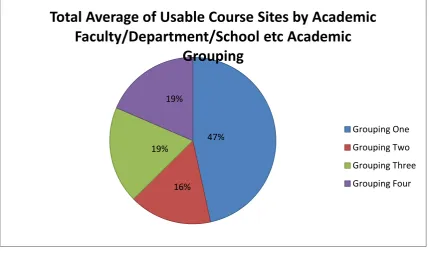
[image:3.595.85.515.423.679.2]Of the four academic groupings reviewed in this instance, be it at the Faculty, School or Departmental level the data suggests that Grouping 1 had the largest number of LMS sites, accounting for nearly half of the overall total of Usable course sites whereas the Grouping 3 and 4 had the smallest number of course sites (see Figure 1). This of course needs to take into account the relative size of each of the academic groupings being considered.
Figure 1: The above graph demonstrates the potential user groups of the LMS from within the academic community by specific academic grouping from 2008-2011 (averaged).
47%
16% 19%
19%
Total Average of Usable Course Sites by Academic
Faculty/Department/School etc Academic
Grouping
Grouping One
Grouping Two
Grouping Three
THETA: The Higher Education Technology Agenda. Hobart: 7-10 April 2013
4
Overall usage of the total Usable Course SitesWhilst the Usable Course Sites were provided as a resource to all academic staff as a means for distributing and managing learning materials and activities, only proportion of these sites are actually used.
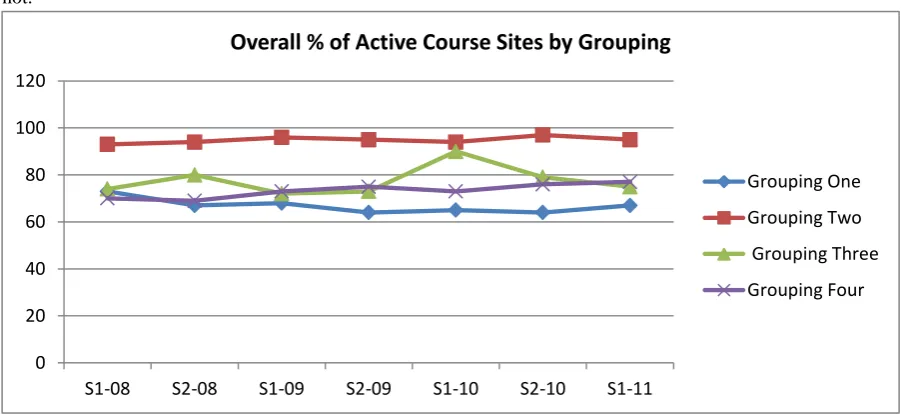
The following graph and accompanying table (Figure 2 and Table 2) show the percentage of course sites in each group that are actually being used. These figures were obtained by dividing the total number of identified Active Course Sites by the total number of the Usable Course Sites in each group. The term Active Course Site is defined as one that contained more than a course outline/profile indicating effort made by the academic staff to develop their course sites.
[image:4.595.84.537.262.469.2]The following sections provides an overview of the degree of LMS tools usage within the Active Course Sites and may provide some insight as to which aspects of the features were well used and which were not.
Figure 2: The percentage of courses each semester with active LMS sites from 2008 to 2011.
Study Period
S1-08 S2-08 S1-09 S2-09 S1-10 S2-10 S1-11
Grouping One 73% 67% 68% 64% 65% 64% 67%
Grouping Two 93% 94% 96% 95% 94% 97% 95%
Grouping
Three 74% 80% 72% 73% 90% 79% 75%
Grouping Four 70% 69% 73% 75% 73% 76% 77%
Table 2: Shows the total percentage of Active Course Sites in relation to Usable Course Sites within the academic community from 2008 to 2011.
0 20 40 60 80 100 120
S1-08 S2-08 S1-09 S2-09 S1-10 S2-10 S1-11
Overall % of Active Course Sites by Grouping
Grouping One
Grouping Two
Grouping Three
THETA: The Higher Education Technology Agenda. Hobart: 7-10 April 2013
5
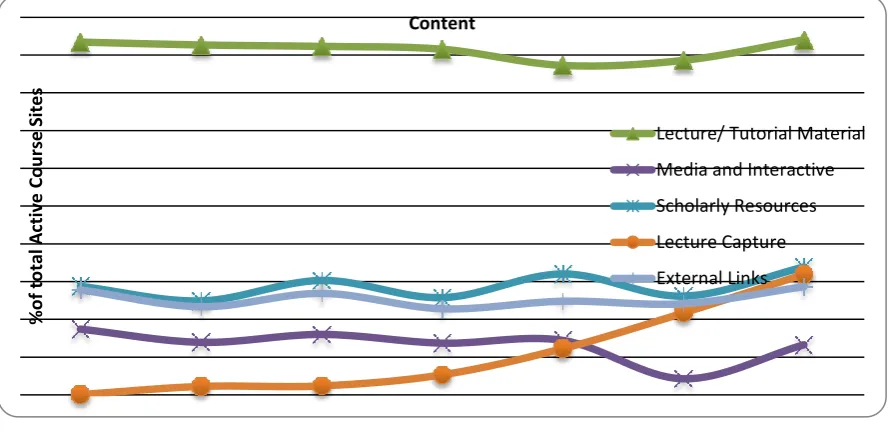
The use of the LMS to distribute ‘Content’ [image:5.595.86.531.200.416.2]Consistent with earlier results, the content area is the most commonly used feature for the provision of lecture and tutorial materials (an average of 91% of the total Active Course Sites over the teaching periods). The data also showed that the adoption rate of the Lecture Capture feature increased significantly from Semester 2, 2009 (see Figure 3). However, there is a significant drop in the provision of media and interactive resources particularly in Semester 2, 2010. The graph showed the peaks and throughs in the provision of Scholarly Resources where peaks are consistently occurring in Semester 1.
Figure 3: The figures above were obtained by dividing the number of Usable Course Sites containing a specified feature, by the overall total of active LMS sites. The study indicated that the ‘content’ area was mostly used for the provision of core learning materials (lecture and tutorial materials).
The use of LMS to facilitate ‘Communication and Collaboration’
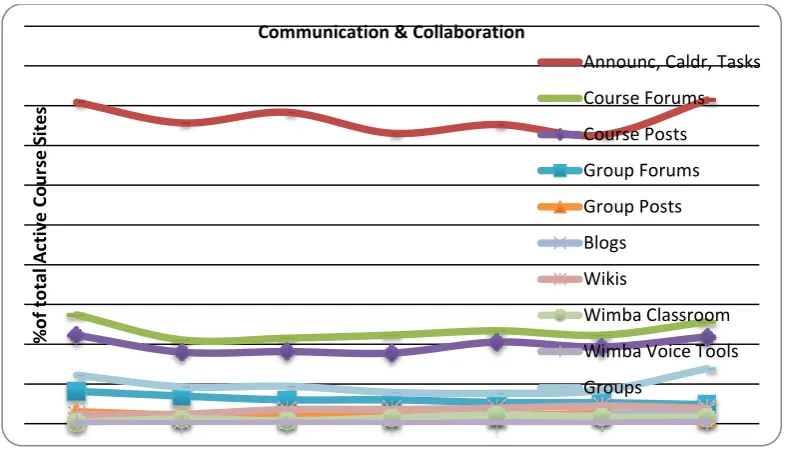
The results of the analysis this area indicated that the Announcement tool is the most widely used communication feature within LMS (averaged 77%) whereas the course features such as wiki, blog, and group forums are comparatively underused (below 20%). It should be emphasised here that the query tool couldn’t assess the quality of the usage. For example, during the process of data validation, it was observed that some course sites have used the course forum tool in lieu of the Announcement tool to communicate important time-sensitive information to students. The graph shows that an average of 23% of the course sites had course forums set up and 20% (averaged) of these had postings to the forums. However, statistics relating to third party tools were not stored by the LMS and therefore the query was unable to capture the level of usage for these tools.
%
o
f to
tal A
ctiv
e
Co
u
rse
Si
te
s
Content
Lecture/ Tutorial Material
Media and Interactive
Scholarly Resources
Lecture Capture
THETA: The Higher Education Technology Agenda. Hobart: 7-10 April 2013
6
Figure 4: Shows the percentage of courses using these specified features from 2008-2011.The use of LMS to facilitate ‘Assessment’
Figure 5 indicates that an average of 73% of the Active Course Sites contained assessment materials which included assessment information, assignment material, marking criteria sheets, assessment results in excel spreadsheet or word document, quizzes in document version, and sample past exams in pdf format. The data confirms the significant increase in the use of the Gradecentre and SafeAssign tools which was expected as this has been the focus of some staff development during late 2008.
Figure 5: Shows a percentage of Active Course Sites using the specified feature within the Assessment category.
%
o
f to
tal A
ctiv
e
Co
u
rse
Si
te
s
Communication & Collaboration
Announc, Caldr, Tasks
Course Forums
Course Posts
Group Forums
Group Posts
Blogs
Wikis
Wimba Classroom
Wimba Voice Tools
Groups
%
o
f to
tal A
ctiv
e
Co
u
rse
Si
te
s
Assessment
Assessment Material
Asmnt Drop Box & Rem Print
Quizzes and Test
Past Exams
SafeAssign
[image:6.595.85.494.441.663.2]THETA: The Higher Education Technology Agenda. Hobart: 7-10 April 2013
7
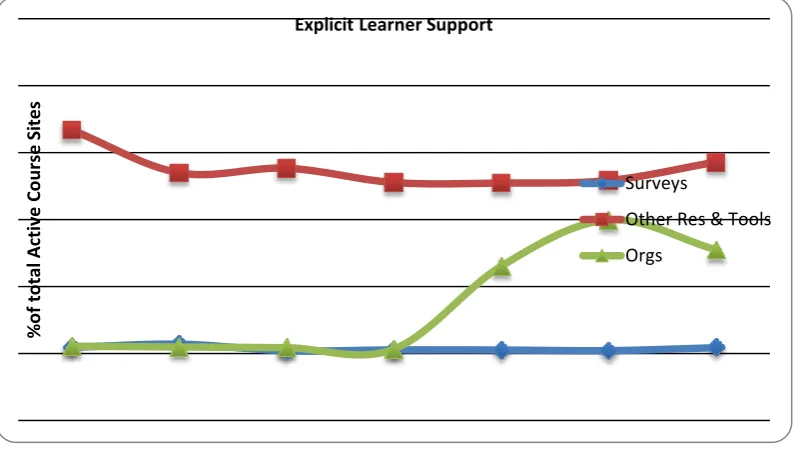
The use of LMS to provide ‘Explicit Learner Support’The graph indicated that there was a drop in the provision of ‘Other resources and Tools’ materials from Semester 1, 2008, which included information such as additional or supplementary readings uploaded by the academics, course information and study guide, referencing guides, and forms.
[image:7.595.87.484.249.475.2]However, there was significant increase in the use of the Organisational feature from Semester 2, 2009, with approximately 40% of the Active Course Sites having this feature set up in Semester 2, 2010, followed by slight drop to 31% in Semester 1, 2011. This feature is utilised to automatically enrol students to a suite of key student learning tools and/or Organisation sites containing additional support resources and materials. However, at this stage, the query tool is unable to provide specific information as to which Organisation sites or learning tools students are enrolled in.
Figure 6: The graph shows a percentage of Active Course Sites in each group using the specified feature in the Explicit Learner Support.
Trends in the usage of the LMS features by the academic community
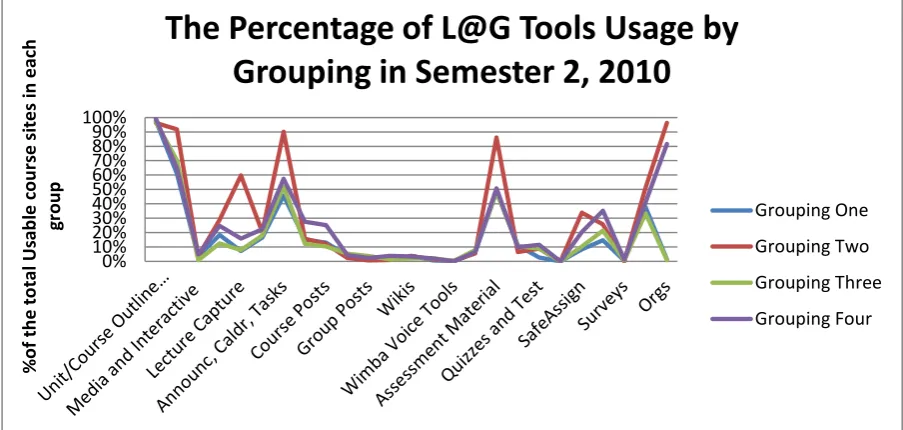
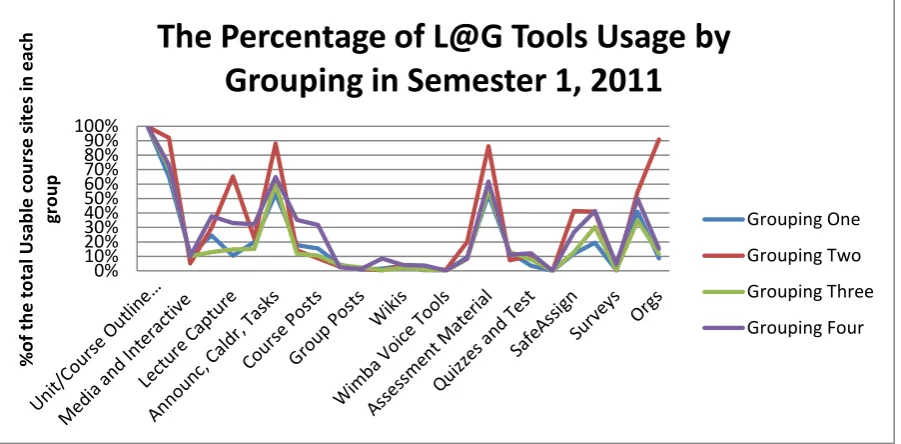
The following graphs have been selected to illustrate the most recent trends in the usage of the LMS tools by the academic community from Semester 1, 2010 to Semester 1, 2011. It should be noted that, whilst this analysis and report focussed upon the LMS usage at a higher organisational level the captured data could be further processed and analysed on the level of individual courses and units.
The percentage figures in this instance have been obtained by dividing the total number of Active Course Sites containing the specified feature by the total Active Course Sites in each group.
Overall, the selected graphs (Figure 7, 8 and 9) revealed that the usage patterns for the LMS tools within the Active Course Sites was similar across the academic community with sharp peaks occurring in the ‘Content’ area for the provision of lecture and tutorial materials; in ‘Communication and Collaboration’ for the use of Announcement tool; and in ‘Assessment’ to support and facilitate assessment. It also shows that the ‘Content’ area is the most used feature in the LMS for the provision of lecture and tutorial materials.
%
o
f to
tal A
ctiv
e
Co
u
rse
Si
te
s
Explicit Learner Support
Surveys
Other Res & Tools
THETA: The Higher Education Technology Agenda. Hobart: 7-10 April 2013
8
Figure 7: Shows the percentage of LMS tools usage by the academic community in Semester 1, 2010. Within the Active Course Sites, it shows that the content area is the most used feature in LMS for the provision of lecture and tutorial materials.Figure 8: This shows the percentage of LMS tools usage in Semester 2, 2010.
0% 10% 20% 30% 40% 50% 60% 70% 80% 90% 100% % o f th e to tal Us ab le c o u rse si te s in e ac h gr o u p
The Percentage of L@G Tools Usage by
Grouping in Semester 1, 2010
Grouping One Grouping Two Grouping Three Grouping Four 0% 10% 20% 30% 40% 50% 60% 70% 80% 90% 100% % o f th e to tal Us ab le c o u rse si te s in e ac h gr o u p
The Percentage of L@G Tools Usage by
Grouping in Semester 2, 2010
Grouping One
Grouping Two
Grouping Three
[image:8.595.84.536.366.581.2]THETA: The Higher Education Technology Agenda. Hobart: 7-10 April 2013
9
Figure 9: This shows the percentage of LMS tools usage in Semester 1, 2011.Conclusions
This analytical approach offers great potential for any organization interested in understanding the extent and application of technology in teaching delivery. Captured data can be used as supplementary data to augment and refine information about student learning and it can also be used to complement survey data to identify academic areas that may require assistance with online content development and engagement. Furthermore, it can be used to assist in the determination of trends in tools usage to promote best practice and encourage greater uptake through strategic training and support. Such an approach can also help to better monitor organisational performance against strategic objectives or KPIs and provide evidence on learning and teaching practice for the government quality assurance audits. The instruments used to capture and process the data offer a significant opportunity to deliver the capability to support real time data analysis. While initial investigation posed a number of limitations, it has also identified potential initiatives for future development.
As well as the results provided above, an additional outcome of this project has been the development of a consistent analytical method that can be re-applied in the capture of relevant data from Griffith’s LMS in the form of the Automated Query tool modelled around the contextualised framework. At this stage, the captured data does require some limited manual processing to enable its meaningful analysis and application in measuring, assessing and comparing the LMS uptake and usage; but there is potential to make this part of process automatic. This Automated Query tool as developed by this project team has a user-friendly format to enable data reporting to relevant internal stakeholders to guide their decisions regarding use of available technology to enhance student’s experience in support of quality learning outcomes.
There are numerous potential applications for the data captured by this tool. At the School level, this data can be used to determine areas, which require assistance in development of online content, or to identify e-learning champions to promote good practice. At the more strategic levels it could be used in monitoring performance against strategic objectives or KPIs. It can also be used to capture evidence on trends in the use of online tools to better support academic colleagues in achieving quality-teaching outcomes. Finally it could be used as a mechanism to evidence performance in support of any quality assuring audits. 0% 10% 20% 30% 40% 50% 60% 70% 80% 90% 100% % o f th e to tal Us ab le c o u rse si te s in e ac h gr o u p
The Percentage of L@G Tools Usage by
Grouping in Semester 1, 2011
Grouping One
Grouping Two
Grouping Three
THETA: The Higher Education Technology Agenda. Hobart: 7-10 April 2013
10
However, alongside these benefits, are a number of challenges and limitations, which should be acknowledged. To remain applicable, the framework has to be kept up to date to reflect any changes to the LMS and available online tools. As the data is recorded in excel spreadsheet format, it requires manual processing to enable meaningful interpretation, as well as random crosschecking with actual course sites to assure the accuracy. The inherent limitations of the query mean that captured data will never be 100% accurate and requires contextual interpretation to be utilised in a meaningful manner.Nonetheless, the developed framework and the Automated Query tool do present significant opportunities to assist in better focussing of the range of support services and initiatives that Griffith University provides in order to improve the student’s access to their virtual learning experience as a part of an enhanced overall student learning experience at Griffith. Whilst there are a number of limitations, it is recommended that this tool be used until the adoption of more sophisticated reporting tool, or the further development of this tool to enable it to reach a higher level of sophistication itself. This approach, as supported by the data provided by this tool offers a significant opportunity to deliver the capability to support real time data analysis and present it visually in an interactive format.
References
Rankine, L., Stevenson, L., Malfroy, J. & Ashford-Rowe, K. (2009). Benchmarking across universities: a
framework for LMS analysis. Ascilite Conference ‘Same places, different spaces’ 6-9 December 2009,
Auckland New Zealand.
Noeth, R.J., & Volkov, B.B. (2004). Evaluating the effectiveness of technology in our schools: ACT Policy Report. Retrieved 02 Jan 2012 from