i
Moral Decision Making Emily Reid
ii
I declare that this report is my own original work and that contributions of others have been duly acknowledged.
iii
Thank you to my supervisor, Dr. Matthew Palmer, for your: endless patience, calming words of wisdom, and support. I appreciate the dedication you have for this study and to helping me achieve something great – it shows, when I got emails on a Sunday afternoon. Thank you for allowing me to show up in your office and
commandeer your attention for an hour or more, just so I could wrap my head around something. Your optimism is infectious, and I definitely would have had 300% more breakdowns if you weren’t so sure I would be ok!
Thank you to Dr. Jim Sauer for your assistance in the early days, helping Matt and I bring this study to fruition. Also, for letting me commandeer your attention too!
A huge thank you to Laura Brumby for helping me not only create, but also troubleshoot and recreate my survey. I’m still baffled as to how you managed to help me and do your PhD; I am eternally grateful.
I would also like to thank my cohort; particularly Molly Port. It has been an exceptional year group to complete Honours with and I am thankful for the help, support and encouragement you all have provided. Molly, I could not have done this with anyone else – I hope that says it all.
Thank you to all the people who volunteered their time to participate in my research or pass it on to others; without you, I could not have achieved what I have. Thank you to my friends and team mates who have supported me and excused my lack of participation in events, not only this year, but the last 3 as well.
And last, but certainly not least, thank you to my wonderful family
v
Statements of Sources ... ii
Acknowledgments ... iii
List of Figures ... vii
Abstract ... 1
Introduction ... 2
Single Process Theories ... 4
Dual Process Theories ... 5
Recent Approaches to Understanding Moral Decision Making ... 7
Kill/Save Ratio ... 8
Process Dissociation Measures of Utilitarian and Deontological Principles. ... 9
Sex Differences and Moral Decision Making ... 12
The Current Study ... 12
Method ... 13
Design ... 13
Participants ... 14
Materials ... 14
Moral problems ... 14
Cognitive load ... 16
Manipulation Checks ... 17
vi
Procedure... 17
Results ... 19
Manipulation checks ... 19
Cognitive load ... 19
Congruence and kill/save ratio ... 19
Utilitarian (U) and Deontological (D) Inclinations ... 20
Discussion ... 23
References ... 30
Appendices ... 34
Appendix A: Ethics approval letter ... 34
Appendix B: Information Sheet and Consent ... 35
Appendix C: Moral Questions ... 37
vii
viii
Abstract
The present study investigated the underlying process of moral decision making, by comparing two prominent theories, and factors that can moderate this. The dual process model suggests cognitive load will selectively reduce utilitarian inclinations (as both the decision and increased cognitive load use cognitive resources), whilst having no effect on deontological inclinations; the Social Intuitionist Model stipulates cognitive load will have no effect on either. The more people saved (for the same number killed; efficient ratio) the more utilitarian the response should be. Method: One hundred and sixty-six participants (125 females; aged 18-73 years, 40 males; aged 19 to 68, and one 24-year-old who did not identify as either) were allocated into one of four conditions, manipulating both cognitive load and kill/save ratio (KSR). Participants remembered a digit string (easy or hard depending on condition) whilst answering a moral dilemma and then answered questions about the difficulty, of the questions and memory task, and some demographics. Results: Bayesian analysis provide some evidence in favour of the null hypothesis for an effect of cognitive load; thus, there is no effect – supporting the Social Intuitionist Model. There is definitive evidence suggesting there is an effect of KSR consistent with theory. Conclusion: Results suggest social and cultural influences determine one’s moral principles, and thus cognitive load will have no effect on the decision. KSR has an impact to an extent; however, some individual differences make it impossible to ever be utilitarian. Future research should look at more individual
Introduction
Consider the following: a train is out of control and will kill five people, you can save them if you switch the train lines – however in doing so you will kill one person; you must choose if switching the tracks is the moral thing to do (Thomson, 1985; Tinghog et al., 2016). Making moral decisions is a part of everyday life; however, people are often distracted or emotionally tied to the scenario and according to some theories, this may impact their response. Understanding the underlying processes and factors that shape moral decisions will alert us of potential biases and issues, and allow us to make informed decisions.
Scenarios such as this cause dilemmas because they create conflict. This conflict is between two primary moral principles that influence moral decision making. The two principles are Utilitarianism and Deontology.
Utilitarian decision making requires one to weigh the costs and benefits of a situation and make a decision that results in the best outcome for the greatest number of people (Mill; as cited in Conway & Gawronski, 2013). In the opening example, more specifically, the response is deemed utilitarian if the line is switched and one is killed to save five. The utilitarian response has been considered a reflective, logical approach, that requires greater cognitive resources than a deontological response (Green et al., 2004; Tinghog et al., 2016). Utilitarian responses require extra cognitive resources because one needs to make a conscious decision after weighing up the costs and benefits of each possible action.
be deemed deontological if the tracks were not switched. This is considered an intuitive and emotional approach that requires fewer cognitive resources than utilitarian
responses (Tinghog et al., 2016). Deontological responses require fewer cognitive resources because they are emotionally driven (Tinghog et al., 2016) and do not require deliberation of consequences. Some scenarios trigger a stronger emotional reaction, and therefore, a greater deontological response. These are often personal questions. Personal questions are those in which the question asks if the reader would personally harm or kill the target to save others. For instance, scenarios where the decision maker is asked to think about pushing someone in front of a train (Tinghog et al., 2016) or imitate cutting someone’s throat with a plastic knife (Cushman, Gray, Gaffey,, & Mendes, 2012) (as opposed to pulling a lever), are considered personal, and elicit a greater emotional response (Greene et al., 2001). Using personal questions to elicit more emotional responses and thus create more internal conflict, allows one to measure the underlying processes more easily.
The current research will investigate the effect of cognitive load on moral decisions. Cognitive load has become an integral part of moral decision-making
research. Different theoretical frameworks suggest varying levels of cognitive resources are needed in the decision-making process. As a result, each theory predicts that
Single Process Theories
Some theories suggest moral decisions are driven by a single process (one process or area of the brain underpins the decision (Tinghog et al., 2016)). In earlier years of cognitive psychology, the predominant theory claimed that moral decision making relied solely on reasoning and higher order thinking (Kohlberg & Piaget; as cited in Haidt, 2001); this is referred to as rationalist (Haidt, 2001). This theory suggests moral decisions are driven by logic and reasoning (Tinghog et al., 2016) and therefore, should require more cognitive resources than an emotional/intuitive response.
Rationalist theory suggests that logical reasoning determines moral decisions, and that there is no emotional component. This should result in people making utilitarian decisions all the time, even when under cognitive load. This can be considered an unlikely outcome, resulting in researchers developing and testing alternate theories.
which too supports the model. This theory allows people to make either deontological or utilitarian decisions quickly and without using cognitive resources; therefore, differing responses to the same dilemma stem from personal differences. Personal differences are due to influences such as cultural practices and reinforcement history; these change the extent to which an individual’s intuitive response is based on utilitarian principles or deontological principles. A key piece of evidence that lead Haidt to
develop the Social Intuitionist Model is that people have difficulty justifying their moral decisions, especially those that elicit strong emotions (Haidt, Bjorklund & Murphy, 2000). Haidt et al. suggest this is due to the emotional process underlying moral decision making; as well as learned social and cultural rules.
Dual Process Theories
The most prominent theory in moral psychology is the dual-process theory (Greene, Nystrom, Engell, Darley, & Cohen, 2004). The theory postulates that when making a difficult moral decision two processes are triggered. The first is an emotional response, which aligns with deontological principles. The secondary process is a cognitive judgement about the consequences of a decision, aligning with utilitarian principles. These are thought to occur in this order; however, the second (cognitive) competes with the first. The theory was supported through further fMRI studies that showed, when people made utilitarian decisions, areas in their brain that control
findings are in line with the dual process; if the VMPC is not intact, there is no emotional response, no competition between emotion and cognition and therefore the utilitarian response is most common. Additionally, Valdesolo and DeSteno (2006) hypothesised that if a moral dilemma caused minimal emotional anguish, the conflict between utilitarian and deontological responses would not be as great, and as such utilitarian responses would be more common. To test this, they induced positive
emotions in participants by showing them a comedy skit for five minutes before asking them to answer moral dilemmas. Results confirmed their hypothesis; inducement of neutral emotion allowed the dilemma to cause natural levels of conflict, which lead to more deontological responses. In comparison, when the induced emotion was positive, there was less internal conflict and utilitarian decisions were more common (Valdesolo & DeSteno, 2006).
participants in the cognitive load condition to answer difficult moral dilemmas whilst reading aloud and simultaneously hitting a computer key every time a specific number crossed the screen; the control group only answered the dilemmas. Tinghog et al. (2016) completed a similar study, testing the dual-process model using cognitive load,
however, their results showed no selective effect of cognitive load and concluded the results supported the Social Intuitionist model. Thus, results on the effect of cognitive load in moral decision making are mixed.
Gürçay and Baron (2017) suggest that the above findings support an alternate version of the dual process model; a simultaneous one. Gürçay and Baron showed this by recording participant’s computer mouse path after reading a moral dilemma (similar to the ones used in the current study) and examining whether the path changed from making a deontological decision to a utilitarian decision. Results indicated that there was no significant difference between changing from deontological to utilitarian and changing from a utilitarian to a deontological response; however, a large proportion did make a change both ways (which may have been why there was no significant
difference). Whilst both changing of response patterns occurred, they were caused by the specific dilemma (Gürçay & Baron, 2017). Koop (2013), whose experiment Gürçay and Baron loosely replicated, found the same results. Gürçay and Baron also showed that approximately five times the number of participants that did switch, did not change responses. This could be interpreted as the change happens sequentially or that there was no change at all, supporting the Social Intuitionist Model (Haidt, 2001).
Recent Approaches to Understanding Moral Decision Making
include varying the benefits of making a utilitarian decision and developing more sophisticated measures of deontology and utilitarianism.
Kill/Save Ratio
A study, by Trémolière and Bonnefon (2014), discovered a moderating factor on the effect of cognitive load; which they called the Kill/Save Ratio (KSR). Trémolière and Bonnefon (2014) suggested that if the number of people killed is far less than the number of people saved (e.g. 1 vs. 500) then the ratio is efficient, and people should be able to make a utilitarian decision with little to no cognitive resources. Trémolière and Bonnefon further suggested that if the number of people killed did not greatly differ to the number of people saved (e.g. 1 vs. 5) then the decision requires more cognitive effort. Therefore, when the ratio is efficient cognitive load should have no impact on utilitarian decision making. When the ratio is inefficient, however, utilitarian decision making will be harder (as the costs and benefits will be closer) and cognitive load will have a more pronounced effect on utilitarian responses. Neither an efficient nor inefficient KSR should affect deontological responses. To test this, Trémolière and Bonnefon asked participants to answer moral dilemmas where the KSR was
Gürçay and Baron’s (2017) study: asking moral questions and watching mouse paths to determine if there was a sequential switch from deontological to utilitarian responding, also manipulated the KSR. Gürçay and Baron varied the KSR each question, so participants were presented with an array of efficiencies (kill one to save: 100, 25075, 50050, 75025, 100000). Their results showed that as the ratio became more efficient (saving more people for the same one death), participants’ responses became more utilitarian; this lead to a small effect. Trémolière and Bonnefon found a larger effect of KSR than Gürçay and Baron. This may be due to the fact they only tested two extreme KSRs, rather than presenting a varying range of ratios with a single
presentation, as done by Gürçay and Baron (2017).
One limitation with Trémolière and Bonnefon’s (2014) experiments was the way they measured utilitarian responding. They manipulated KSR within-subjects, and only analysed data points where a participant made a different response to the efficient than they did in the inefficient ratio version of a dilemma (and vice versa). This may have led to an overestimation of the effects of KSR on utilitarian responding (because cases where KSR did not affect decisions were omitted), and a potentially misleading result regarding the interaction between KSR and load.
Process Dissociation Measures of Utilitarian and Deontological Principles.
Another big advance in the study of moral decision making was achieved by Conway and Gawronski (2013). They utilised Jacoby’s (1991) Process Dissociation (PD)
utilitarian or deontological, as if they were inversely related (i.e. if a participant responds mostly in a utilitarian manner, they may be classified utilitarian even though they answered some deontologically), which can distort results and lead to ambiguity. This means researchers cannot tell if manipulations are increasing one type of response or decreasing the other (Conway & Gawronski, 2013); and could be the reason studied effects of cognitive load are contradictory.
PD requires the decision maker to read two versions of a scenario; incongruent and congruent. Incongruent scenarios are those which are commonly used in moral decision-making research, such as the train problem described in the opening paragraph. These inherently create a conflict between utilitarian and deontological principles. One response would be acceptable by utilitarian standards (pulling the switch to change the train lines, saving five and killing one) whilst the other is not; but is acceptable by deontological standards (not touching the switch and letting five die, but not killing any). Congruent scenarios differ as they do not create conflict between the two
principles; that is – one (yes/no) response is acceptable by both principles and the other is unacceptable by both principles. For example, “You are driving through a busy city street when all of a sudden a young mother carrying a child trips and falls into the path of your vehicle. You are going too fast to brake in time; your only hope is to swerve out of the way. Unfortunately, the only place you can swerve is currently occupied by a group of children on their way to elementary school. If you swerve to avoid the young mother and baby, you will kill all of them. Is it morally acceptable to swerve and hit the schoolchildren in order to avoid the young mother and child?” In this example, taking action would be unacceptable for both principles (see appendix C for all questions).
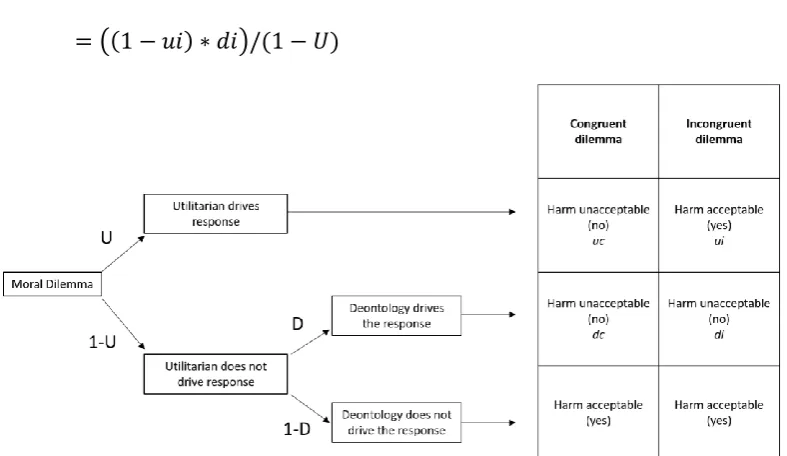
a utilitarian inclination and D is a deontological inclination; c denotes congruent questions and i denotes incongruent questions; u denotes the number of utilitarian responses and d denotes the number of deontological questions, as shown in Figure 1.).
𝑈 = 𝑝(𝑢𝑛𝑎𝑐𝑐𝑒𝑝𝑡𝑎𝑏𝑙𝑒|𝑐𝑜𝑛𝑔𝑟𝑢𝑒𝑛𝑡) − 𝑝(𝑢𝑛𝑎𝑐𝑐𝑒𝑝𝑡𝑎𝑏𝑙𝑒|𝑖𝑛𝑐𝑜𝑛𝑔𝑟𝑢𝑒𝑛𝑡)
= (𝑢𝑐 + [(1 − 𝑢𝑐) ∗ 𝑑𝑐]) − ((1 − 𝑢𝑖) ∗ 𝑑𝑖)
𝐷 = 𝑝(𝑢𝑛𝑎𝑐𝑐𝑒𝑝𝑡𝑎𝑏𝑙𝑒|𝑖𝑛𝑐𝑜𝑛𝑔𝑟𝑢𝑒𝑛𝑡)/(1 − 𝑈)
[image:19.595.112.506.255.483.2]= ((1 − 𝑢𝑖) ∗ 𝑑𝑖)/(1 − 𝑈)
Figure 1. Flow chart of processing adapted from Conway and Gawronski (2013) (2013). Yes and no, are responses to moral dilemmas, see appendix C (“is it morally acceptable to do kill/harm x to save y?”).
inclinations whilst having no effect on deontological inclinations, providing strong support for the dual-process model.
Sex Differences and Moral Decision Making
The effect of sex on moral decision making has been contested for many years. Tinghog et al., (2016) showed that males were more utilitarian in their responses to moral dilemmas, whilst women were more deontological. They suggest this may be due to different cognitive processes between men and women. Ward and King (2018) furthered this argument and suggested that women are more likely to make decisions based on emotion; thus, leading to greater deontological responses. They showed emotion was a key influence on moral decision making by asking women to answer moral dilemmas as unemotionally as possible and comparing this to a group of females and a group of males who had no instructions. Their study showed women who were answering unemotionally did not respond significantly differently to the group of males but did to the control group of females (Ward & King, 2018).
The Current Study
and there will be a weaker to null effect of cognitive load when the KSR is efficient. It is also expected there will be no effect of cognitive load on deontological inclinations.
The second aim is to test whether KSR affects the extent to which moral
decisions are driven by deontological inclinations. Several models predict deontological responding will be affected by various factors such as emotional and instinctual
reactions (e.g. personal problems). However, no theories make predictions about the effect of KSR on deontological inclinations. Hypothesis 2: We did not make specific predictions about the effects of KSR on deontological responses. but treated this as exploratory research.
Our secondary aim was to provide further evidence for the effect of sex on utilitarian decision-making, using the PD approach. Hypothesis 3: We expect males to have greater utilitarian inclinations than females.
Method
Design
Only one study has investigated the effect of cognitive load on PD measures of utilitarian and deontological responses to moral dilemmas (Conway & Gawronski, 2013). This study included approximately 30 participants per cell of their between-subjects design. The results showed a moderate to large effect of cognitive load on utilitarian responding. In the context of these findings, we conducted a power analysis to estimate the sample size required to detect a moderate size effect (Cohen’s f = .36; converted from the partial eta squared value reported in Conway & Gawronski, 2013), with power of 0.8. This analysis yielded a suggested sample size of 135 participants, which we treated as a desired minimum sample size.
inefficient). The dependent variables were a measurement of deontological and
utilitarian inclinations, derived from the congruent and incongruent problems, using the PD approach.
Participants
Participants were recruited via posts on Facebook and SONA. Participants were randomly allocated into one of four groups. Eligibility requirements were that
participants were at least 18 years of age. Three hundred participants were recruited. One hundred and thirty-four participants’ data was removed. Not finishing the study lead to 125 being removed. Failing to respond appropriately (i.e. not make an attempt) to six, or more, digit string replications resulted in eight participants’ data being removed. We counted the number of “blank” (or not appropriate) responses per participant and tested different cut offs. This did not make much difference to how many participants were omitted so we used six blanks (one third of responses) as our omission criteria. One person was removed as they admitted to giving up in the memory task replication section. The remaining 166 participants were aged 18-73 (M=33.5, SD=12.9); 125 females aged 18 to 73 (M=33.3, SD=12.4) and 40 males aged 19 to 68 (M=34.5, SD=14.4), and one 24-year-old who did not identify as female or male.
Materials
Moral problems
scenario as the person faced with the dilemma. All questions were framed in the first person. The literature shows a well evidenced difference in responding, such that problems framed in the first person rather than the third person (sometimes termed “personal” problems) elicit more conflict between utilitarian and deontological principles and tend to promote a stronger influence of deontological principles (e.g., Greene et al., 2001; Koenigs et al., 2007). However, we chose not to manipulate the personal framing of problems because our focus was on the effect of cognitive load and KSR on moral decisions.
Of the eight incongruent moral dilemma scenarios, two involved situations where the decision-maker (i.e., the participant) was also faced with death if he or she deemed the action unacceptable (i.e. responded in a deontological way and chose not to act). For example, the participant might be asked to imagine themselves as one of many passengers on an overcrowded lifeboat, and asked whether it is acceptable to throw one person out of a life boat to prevent it sinking (Tinghog et al. 2016). People are likely to make more utilitarian decisions in these types of scenarios (due to self-preservation) than ones where the decision-maker is not faced with death if he or she deems the action unacceptable. We did not have an a-priori reason to expect that the effects of cognitive load or KSR would vary systematically with this aspect of the dilemmas, and thus did not treat it as a manipulation.
The eight moral questions adapted from Conway and Garwonski’s study
note that if the cognitive load manipulation involves integers, it may reduce attention to that particular dimension (number of lives saved/lost) in the moral question.
Half of the questions asked participants if it was appropriate to kill someone in order to save others, whilst the remainder asked whether or not it was morally
acceptable. As these ultimately ask the same thing, to keep all problems consistent, half were changed so all asked if it were morally acceptable. See Appendix C for the
questions.
Cognitive load
Previous studies, such as that by Greene et al. (2008), utilised a number search task as a way of dividing attention and, hence reducing the cognitive resources available for a moral dilemma task being completed at the same time. In such tasks participants are required to hit a button each time they see the number “5” appear in a string of numbers running across the bottom of the screen; they are told their accuracy will be recorded. For the current study we utilised a common memory task to manipulate cognitive load (variations of this task have often been used in prior research; e.g. Conway &
the low cognitive load conditions, thereby weakening the experimental manipulation (e.g. Tinghog et al, 2016).
Manipulation Checks
Cognitive load
A space for replication of the digit string, to observe if the task was a cognitive priority (Trémolière & Bonnefon, 2014), was presented after the Likert scale, mentioned above. A self-report measure of whether remembering the digit string used a lot of energy (yes or no) (Tinghog et al., 2016) followed each replication of the digit string. If the
cognitive load manipulation was effective the measure would be answered ‘yes’ more often in the high cognitive load group than the low cognitive load group.
Congruence and kill/save ratio
A Likert scale measuring problem difficulty (Conway & Garwonski, 2013) was
presented after a response to each question was made. The scale had 5 points rated from “very easy (1)” to “very hard (5)” (Conway & Garwonski, 2013). This was used to note if participants had noted the congruence of questions (we would expect congruent problems to be rated as easier than the incongruent questions) and KSR (we would expect those in the efficient KSR groups to rate the problems as easier than the inefficient KSR groups).
Procedure
All participants were initially lead to a site, using LimeSurvey software (Version 2.06; Schmitz, 2015), that provided them with information about the study and required consent to move forward (see appendix A). Following this, they received instructions and a practice question with the exact format of the remainder of the study (see
load/ inefficient KSR, high cognitive load/ efficient KSR, low cognitive load/ efficient KSR.
Participants were asked not to use methods other than their memory to remember digit strings. They were then presented with either a hard (high cognitive load) or easy digit string (low cognitive load), depending on their allocated group; for 10 seconds. They were told they would be asked to recall the digit later. Participants could not move forward in the study until the 10 seconds had elapsed.
After the allocated time they were shown a moral question and asked to respond (by checking yes or no) to the moral acceptableness of the proposed action. cognitive load and KSR remained consistent for each participant and only varied between groups. After responding to the moral question, participants were asked: how difficult the question was to answer (1 = very easy, to 5 = very hard), then to recall the digit string, and finally, if remembering the digit string used a lot of energy (yes/no); in that order. This pattern was continued until all eighteen questions were answered. Participants were asked to provide demographic information (sex, age, English speaking).
Participants were thanked for their time and invited to enter the draw to win one of six $50 vouchers or receive 30 minutes of course credit (for psychology students). See appendix D for a further detail of the instructions, wording and layout.
Analysis
current study to provide support for the null hypothesis (and our alternate theory), if null results were found; something other studies have failed to do.
Results
According to criteria by Kass and Raftery (1995) a BF of 3.2 or greater is substantial evidence that the data support one hypothesis over the other (10 – 100 is strong and > 100 is decisive). Jeffreys (1961) suggests similar: BF > 3 is some evidence, > 10 is strong evidence and > 30 is classified as very strong evidence. A BF01 provides evidence in support of the null and a BF10 (1/ BF01) provides evidence for the alternate hypothesis.
Manipulation checks
Cognitive load
Replication of the digit string was used as a removal criterion. Participants were removed if they admitted to giving up trying to remember the digit string or leaving more than 6 (one third) of the digit recall sections blank/entering random words or symbols (e.g. no idea, ????, *, Jeremy).
The data show definitive evidence that the cognitive load manipulation was effective and had an impact on participants rating of whether or not remembering it used much energy, BF10 = 2.76e35. The proportion of responses stating that remembering the digit string used a lot of energy was greater in the high cognitive load condition (M = 85.14, SD = 14.32) than in the low cognitive load condition (M = 29.34, SD = 24.85).
Congruence and kill/save ratio
evidence that the data support the alternate hypothesis, and confirms people noted congruence.
There was definitive evidence of a difference between difficulty ratings for congruent and incongruent questions BF10 = 2.75e23. Average difficulty scores for the congruent questions (M = 2.47, SD = 0.76) were lower than those for incongruent questions (M = 3.18, SD = 0.88). These means suggest people scored congruent problems as easy to answer and rated incongruent ones as hard to answer, showing people noted congruence.
There is sufficient evidence to suggest that KSR has no effect on ratings of problem difficulty, BF01 = 5.84. Difficulty ratings were almost the same in the
inefficient group (M = 2.81, SD = 0.79) and the efficient group (M = 2.83, SD = 0.70). Overall, our manipulation check analyses indicate that the manipulations of cognitive load and KSR were effective, and that participants found it subjectively more difficult to respond to congruent problems than congruent ones.
Utilitarian (U) and Deontological (D) Inclinations
Data was analysed to see if it met the assumptions for an analysis of variance (ANOVA); normal distribution, no outliers, homogeneity of variance, and linearity of a residual plot. There was some skew in the distribution, however was not deemed severe enough to prevent running the analysis. Outliers were removed during the data cleaning phase; all other assumptions were met.
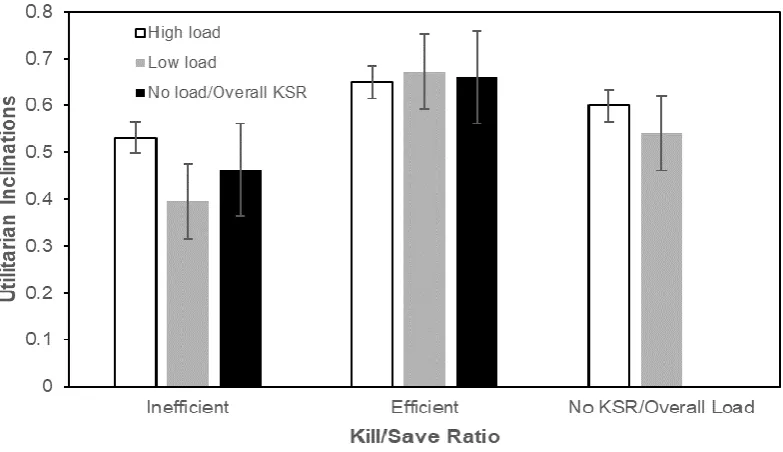
1203.25; where utilitarian responses were lower (M = 0.46, SD = 0.31) when KSR was inefficient, compared to efficient (M = 0.66, SD = 0.28).
[image:29.595.130.522.298.524.2]There is no evidence suggesting that cognitive load affected utilitarian inclinations. Collapsed across levels of KSR the mean utilitarian inclination for high cognitive load was 0.60 (SD = 0.27) and was 0.54 (SD = 0.34) for the low cognitive load group. The BF suggests some evidence in favour of the null hypothesis, rather than ambiguous evidence (Jeffreys, 1961), B01 = 3.10. There was no interaction between cognitive load and KSR.
Figure 2. Effects of cognitive load and KSR on utilitarian inclinations. Error bars denote standard error.
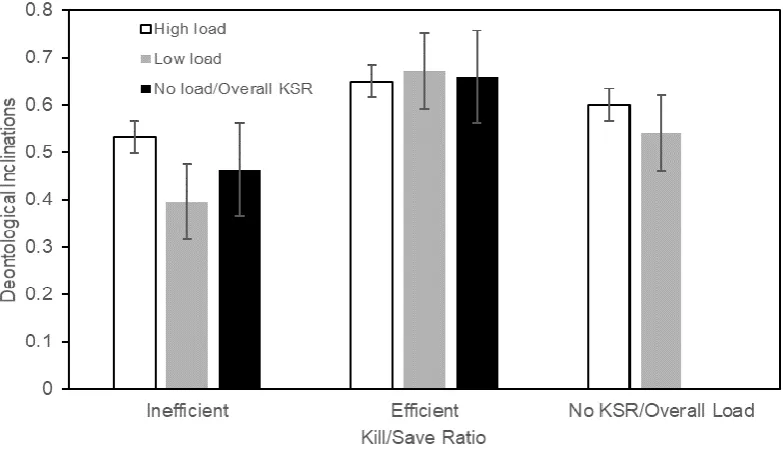
were higher (M = 0.80, SD = 0.29) when KSR was inefficient, compared to efficient (M = 0.66, SD = 0.38).
[image:30.595.129.521.299.526.2]There is no evidence suggesting that cognitive load affected deontological inclinations. Collapsed across levels of KSR the mean deontological inclinations for high cognitive load was 0.73 (SD = 0.34) and was 0.72 (SD = 0.36) for the low cognitive load group. The BF suggests sufficient evidence in favour of the null hypothesis, rather than ambiguous evidence (Kass & Raffety, 1995), B01 = 5.89. There was no interaction between cognitive load and KSR
Figure 3. Effects of cognitive load and KSR on deontological inclinations. Error bars denote standard error.
There was an effect of sex on utilitarian inclinations. As there was only one person who identified as neither male nor female, we assumed the difference was between males and females. Results show males were more utilitarian in their
Discussion
The main motivation for this study was to use the PD procedure to better assess the effects of cognitive load on utilitarian responding to moral dilemmas under different levels of KSR. The results did not support the first hypothesis that cognitive load would reduce utilitarian responding, and that this effect would be greater when KSR was inefficient. Our results showed that there was no effect of cognitive load overall, and this did not vary between efficient and inefficient KSR.
The manipulation check shows the memory task was successful at inducing cognitive load, as more people in the high cognitive load group rated remembering the digit string as requiring more effort, than in the low group. Therefore, an ineffective manipulation of cognitive load was not the reason for our null results.
Based on either primary theory (dual process or Social Intuitionist Model) our results support the hypothesis that cognitive load will have no effect on deontological inclinations. Although the best fitting model did not include an interaction, the pattern of means for utilitarian responding was also assessed to examine whether there was any evidence in support of the expected interaction. The pattern of results for the inefficient KSR conditions shows higher utilitarian responding in the high cognitive load group than in the low cognitive load group. This pattern is the opposite of what we would expect if the dual process model (Greene et al., 2004) was underpinning moral decisions; the dual-process model predicts that higher cognitive load will reduce
Thus, cognitive load can potentially decrease utilitarian responding, increase utilitarian responding, or have a null effect, depending on individual differences.
As we used Bayesian analyses, we have shown that there is increasing evidence in favour of the null hypothesis (rather than just not supporting the alternate), and thus, the Social Intuitionist Model, which is a new addition to the research.
We also found that KSR affected utilitarian decisions. This result was consistent with theory and previous findings (Trémolière & Bonnefon, 2014); when KSR was efficient, utilitarian decisions increased. Theory suggests this is due to an efficient KSR making utilitarian decisions easier to make. Our manipulation check for KSR, however, shows this may not be the underlying mechanism. Trémolière and Bonnefon (2014) suggest that KSR may not make the decision easier but make it harder to respond in a deontological way. Our manipulation check shows support for this theory: although KSR increased utilitarian responding, the decision was still rated as difficult. Although the manipulation check was conducted on all 18 questions, there remains no effect (BF01 = 5.39) when just using incongruent problems in the analysis (inefficient KSR: M = 3.21, SD = 0.90; efficient KSR: M = 3.15, SD = 0.86) This shows the congruent problems were not decreasing the difficulty ratings when averaged.
external factor that does lead to a trade-off of principles; increasing the KSR efficiency increases utilitarian responding and reduces deontological responding.
One possibility is that this effect could be caused by an inefficient KSR making the immoral act of killing someone more salient. This effect could be due to inefficient ratios making the scenario and hypothetical people more relevant and personable; thus, evoking more of an emotional state, leading to a deontological response (Sherman, Beike & Ryalls, 1999). When the ratio is efficient, however, the large number of people becomes a more abstract entity and the decision-maker loses the emotional connection; leading to logic driving the decision (i.e. a utilitarian response) (Sherman, et al., 1999). To test whether this is the case, future research could add a measure of emotional reactiveness, with the expectation that those in inefficient ratio groups, will have higher ratings of emotion than those in the efficient ratio groups.
Our results also supported the third hypothesis, that males would respond in a more utilitarian fashion. They showed an effect of sex on inclinations, such that males were more utilitarian than females. This supports hypothesis and results found by Tinghog et al., (2016). The fact that women answered more emotionally (deontological) builds on the work of Ward and King (2018).
The Social Intuitionist model may also play a role in determining the effect of KSR. Trémolière and Bonnefon (2014) found that even when they increased the KSR to 1:5000, 40% of people still responded in a deontological way; that is, some people develop and hold very strong deontological principles that tend to drive moral decisions, even when the utilitarian consequences are very large. Baron, Gürçay, Moore, and Starcke (2012) suggest this is due to strong individual beliefs about deontology. This is in line with the Social Intuitionist model, that external factors do not greatly, or
was able to provide a more accurate depiction of this by using the PD approach. The PD approach showed, similarly, that utilitarian inclinations did increase as the ratio became more efficient, however was still not 100% utilitarian. Trémolière, De Nays, &
Bonnefon, 2012) discovered that utilitarian responses were lower for questions that lead to hypothetical death, compared with those that lead to harm. This could be another reason out utilitarian responses were not higher, especially in the efficient KSR groups.
One main limitation to our study was that the sample was collected using first year university students and a snowball strategy, via sharing on Facebook (beginning with the student researcher and honours cohort). It is likely the sample was well educated and Australian dominant, due to the sampling method; however, this is unknown. This may have distorted results as cultural differences may not have been large. Many of the sample may have also had exposure to philosophy and the types of moral dilemmas used; thus, the sample is not greatly generalisable.
Another issue with the sample was that it was predominantly female. Our results showed males were more utilitarian inclined, but due to the greater proportion of
women the utilitarian inclinations may have been underestimated.
response becomes more overwhelming (due to physically pretending to harm someone, compared with imagining it).
Haidt (2001) also notes that the commonly used scenarios are unusual and non-representative moral judgements. Although this is true, it is likely that most moral decisions are made the same way within an individual. Therefore, using scenarios such as the ones used in the current study can determine the underlying processes – which can then be extrapolated onto other moral decisions.
Although the current results provide some evidence toward the null hypothesis, it should be noted that as only low and high cognitive load were used, and there may have been an effect between these and no cognitive load. Future studies should determine whether this is the case by using three cognitive load conditions (control, low, high). The finding that a KSR of 1:500 does not induce complete utilitarian inclinations could be caused by the current study only measuring two KSRs (1:5 and 1:500). Future research should use the PD to determine when or if there is a KSR where utilitarian inclinations near 1; or if there will always be a discrepancy caused by
individual differences. The three proposed cognitive load conditions should be tested alongside the four KSR ratios used in Trémolière and Bonnefon’s (2014) third experiment; to determine if there is a cognitive load or ratio where an interaction between the two becomes apparent.
From an applied perspective, the finding that cognitive load does not selectively affect one decision making strategy is good news for the public, especially those
cultural upbringing will determine their responses. For people in high power positions, such as army generals or a judge, this is most important and may need to be screened for; or taken into consideration. It is also important for this context to be aware that people may become more utilitarian when enough people will die otherwise (efficient KSR) and this could have negative impacts. Conversely, people may become more conservative and deontologically inclined as the KSR becomes more inefficient. Future research should aim to look at the effects of cognitive load and KSR in the above populations, as well as: criminals, different cultures, and including people from more diverse backgrounds (e.g. ranges of socioeconomic status) to determine if these are universal effects.
However, as our results suggest individual differences play the greatest role in determining how people will respond, it might be beneficial to test the effect of
cognitive load and KSR within one person. It may be possible that cognitive load has no effect due to the fact there is no universal, moral decision-making process. One may find an effect of cognitive load at an individual level (in line with the dual process model); such that those with utilitarian responding in the low cognitive load condition will make less utilitarian decisions in a high cognitive load condition, but those who respond deontologically in the low cognitive load condition would not see a change in responding.
(similarly to the KSR and congruent versions) and comparing responses of each condition (within subjects). Testing the first moderating factor should lead to more deontological responding when the decision maker is the protagonist, as it should elicit more of an emotional response. The second moderating factor, whether the participant would also die if they do not sacrifice another, should lead to greater utilitarian
responses and there should be less of an effect of KSR, as most people are likely to save their hypothetical self, no matter how many people die. Thus, the effects found in the current study may differ in scenarios where the participants would (hypothetically) die if they made a deontological choice.
As most of the results support the idea that the biggest influences on moral decision making are personal differences and social and cultural upbringing, this can be used to design future studies. Gürçay and Baron (2017) note that pscyhopaths make utilitarian responses easier, due to the different wiring of their brains. To confirm if KSR manipulates levels of empathy (or something else emotional), a sample of psychopaths could be compared with control sample. If empathy was the determining factor of the effectiveness of KSR, it would be expected that psychopaths had increased utilitarian inclinations when the KSR is efficient, but there should be no effect of KSR on deontological inclinations (which should be consistently low).
Overall, our manipulations were effective tests of our hypotheses. Results suggest social and cultural influences determine one’s moral principles, in line with the Social Intuitionist Model. Therefore, cognitive load will have no effect on one’s
decision when the KSR is efficient or inefficient. Collapsed across levels of cognitive load, we found an efficient KSR increases utilitarian inclinations and reduces
References
Baron, J., Gürçay, B., Moore, A. B., & Starcke, K. (2012). Use of a Rasch model to predict response times to utilitarian moral dilemmas. Synthese, 189, 107-117. doi: 10.1007/s11229-012-0121-z
Conway, P. & Gawronski, B. (2013). Deontological and utilitarian inclinations in moral decision making: A process dissociation approach. Journal of Personality and Social Psychology,104(2), 216-235. doi:10.1037/a0031021
Costa, A., Foucart, A., Hayakawa, S., Aparici, M., Apesteguia, J., Heafner, J., & Keysar, B. (2014). Your morals depend on language. PLoS One, 9(4), 1-7. doi:10.1371/journal. pone.0094842
Cushman, F., Gray, K., Gaffey, A., & Mendes, W. B. (2012). Simulating murder: The aversion to harmful action. Emotion, 12(1), 2-7. doi: 10.1037/a0025071 DeShon, R. P., Brown, K. G., & Greenis, J. L. (1996). Does self-regulation require
cognitive resources? Evaluation of resource allocation models of goal setting. Journal of Applied Psychology, 81, 595–608. doi:10.1037/ 0021-9010.81.5.595 Greene, J. D., Nystrom, L. E., Engell, A.D., Darley, J. M., Cohen, J.D. (2004) The
neural bases of cognitive conflict and control in moral judgment. Neuron 44, 389–400. doi: 10.1016/j.neuron.2004.09.027
Greene, J. D., Morelli, S. A., Lowenberg, K., Nystrom, L.E., & Cohen, J. D. (2008). Cognitive load selectively interferes with utilitarian moral judgment.
Cognition, 107, 1144-1154. doi:10.1016/j.cognition.2007.11.004
Gürçay, B., & Baron, J. (2017). Challenges for the sequential two-system model of moral judgement. Thinking & Reasoning, 23(1), 49-80. doi:
10.1080/13546783.2016.1216011
Haidt, J., Bjorklund, F., & Murphy, S. (2000). Moral dumbfounding: When intuition finds no reason. Unpublished manuscript, University of Virginia.
Haidt, J. (2001). The emotional dog and its rational tail: A social intuitionist approach to moral judgment. Psychological Review 108, 814–834. doi:
10.1037/0033295X.108.4.814
Jacoby, L. L. (1991). A process dissociation framework: Separating automatic from intentional uses of memory. Journal of Memory and Language, 30(5), 513–541. doi:10.1016/0749-596X(91)90025-F
Jeffreys, H. (1961). Theory of Probability. Oxford University Press, Oxford, UK. Kass, R. E., & Raftery, A. E. (1995). Bayes factors. Journal of the American Statistical
Association, 90(430), 773-795. Retrieved from:
http://xyala.cap.ed.ac.uk/teaching/tutorials/phylogenetics/Bayesian_Workshop/P DFs/Kass%20and%20Raftery%201995.pdf
Koenigs, M., Young, L., Adolphs, R., Tranel, D., Cushman, F., Hauser, M., & Damasio, A. (2007). Damage to the prefrontal cortex increases utilitarian moral
judgements. Nature, 446, 908-911. doi:10.1038/nature05631
Koop, G. J. (2013). An assessment of the temporal dynamics of moral decisions. Judgment and Decision Making, 8(5), 527–539. Retreived from:
http://eds.b.ebscohost.com.ezproxy.utas.edu.au/eds/pdfviewer/pdfviewer?vid=1 &sid= 1362a61d-86bb-403b-968a-fc919e0fb5ee%40sessionmgr103
Lord, C. G., Ross, L., & Lepper, M. R. (1979). Biased assimilation and attitude
Journal of Personality and Social Psychology, 37(11), 2098-2109. doi: 10.1037/0022-3514.37.11.2098
Nickerson, R. S. (1998). Confirmation bias: A ubiquitous phenomenon in many guises. Review of general psychology, 2(2), 175-220. Retrieved from:
https://pdfs.semanticscholar.org/70c9/3e5e38a8176590f69c0491fd63ab2a9e67c 4.pdf
Rouder, J. N., Morey R. D., Speckman P. L., & Province, J. M. (2012). Default Bayes factors for ANOVA designs. Journal of Mathematical Psychology, 56, 356-374. doi:10.1016/j.jmp.2012.08.001
Schmitz, C. (2015). LimeSurvey: An open source survey tool (Version 2.06). Hamburg, Germany: LimeSurvey Project
Sherman, S.J., Beike, D.R. & Ryalls, K.R. (1999) Dual-processing accounts of inconsistencies in responses to general versus specific cases, in Chaiken, S. & Trope, Y. (eds) Dual-Process Theories in Social Psychology. NY: The Guilford Press, pp. 203–227.
Thomson, J. J. (1985). The Trolley Problem. The Yale Law Journal, 94(6), 1395–1415. doi: 10.2307/796133
Trémolière, B., & Bonnefon, J. F (2014). Efficient kill-save ratios ease up the cognitive demands on counterintuitive moral utilitarianism. Personality and Social
Psychology Bulletin, 40(7), 923-930. doi:10.1177/0146167214530436 Trémolière, B., De Neys, W., & Bonnefon, J. F. (2012). Mortality salience and
morality: Thinking about death makes people less utilitarian. Cognition, 124, 379-384. doi: https://doi.org/10.1016/j.cognition.2012.05.011.
pressure and cognitive load on moral judgment and altruistic behavior. PLoS ONE, 11(10),1-19. doi:10.1371/journal.pone.0164012
Valdesolo, P., & DeSteno, D. (2006). Manipulations of emotional context shape moral judgment. Psychological Science, 17(6), 476-477. Retrieved from:
https://static1.squarespace.com/static/52853b8ae4b0a6c35d3f8e9d/t/528d2656e 4b0ce6fb73c1c55/1384982102150/manipulations-of-emotional-context-shape-moral- judgment.pdf
Appendices
Appendix A: Ethics approval letter
Dear Dr Palmer
Ethics Ref No: H0017588
Project title: Moral decision-making study
The above Minimal Risk application has been approved by the Chair of the Tasmania Social Sciences Human Research Ethics Committee, on behalf of the full committee. Approval is for four years and conditional upon receipt of an annual Progress Report. Ethics approval for this project will lapse if a Progress Report is not submitted.
A copy of the approval letter is attached for your records. The Ethics Committee wishes you all the best with the project. Kind regards
Ailin Ding --
Appendix B: Information Sheet and Consent
1. Invitation
You are invited to participate in a Moral Decision-making study. This study is being conducted as part of Emily Reid’s Honours degree. Emily is a fourth-year student under the supervision of Psychology Senior Lecturers Dr. Matt Palmer and Dr. Jim Sauer.
2. What is the purpose of this study?
The purpose of this study is to investigate factors that influence how people make moral decisions.
3. Why have I been invited to participate?
You have been invited to participate in the study as you expressed an interest and you meet all eligibility requirements. Your participation is completely voluntary and there will be no negative consequences if you decide to withdraw. Your responses will be completely anonymous. Withdrawing will have no impact on your studies, results or your involvement with the university. You can withdraw at any point during this study.
4. What will I be asked to do?
You will be asked to read some hypothetical scenarios and answer some questions about the scenarios. Some of the scenarios involve moral dilemmas. For example, you may be asked whether it is acceptable to sacrifice one person’s life to save a group of other people. You will also be asked to provide some basic information about yourself (e.g., age, sex). The study will take around 30 minutes in total, completed in a single session.
5. Are there any possible benefits from participation in this study?
Your participation in this study will not provide you with any direct benefits. However, this research will contribute to a greater understanding of how people make moral decisions.
6. Are there any possible risks from participation in this study?
There are no specific risks anticipated with participation in this study. However, in the unlikely event that you experience an emotional or personal response as a result of participation in this study, you can leave the study at any time.
7. What if I change my mind during or after the study?
You are not required to complete this study once you start. You can withdraw at any time with no explanation. If you leave the website or your data is not complete, it will be deleted. If you change your mind after completing the study, we will not be able to re-identify your data and will not be able to remove it (because it will be stored in anonymous form).
8. What will happen to the information when this study is over?
Your data will be stored in a password protected folder on the UTAS
9. How will the results of the study be published?
Results from the study will be used in Emily’s Honours thesis. Results from this study and other related studies will be submitted to an academic journal for publication.
10. What if I have questions about this study?
If you have any queries or concerns about the research, please do not hesitate to contact Matt Palmer: [email protected] or Jim Sauer [email protected]
“This study has been approved by the Tasmanian Social Sciences Human Research Ethics Committee. If you have concerns or complaints about the conduct of this study, please contact the Executive Officer of the HREC (Tasmania) Network on +61 3 6226 6254 or email [email protected]. The Executive Officer is the person nominated to receive complaints from research participants. Please quote ethics reference number [H0017588].”
If you click yes and continue you are giving your consent to participate in the study and for us to use your data.
Appendix C: Moral Questions
Efficient
INCONGRUENT CONGRUENT
Time Machine 01
You find a time machine and travel back to the year 1920. While checking into a hotel, you meet a young Austrian artist and veteran of the First World War. You realize this is Adolf Hitler before his rise to power in Nazi Germany. He is staying in the hotel room next to yours and the doors are not locked. It would be easy to simply smother him with a pillow in his sleep and disappear, stopping the Second World War and the Nazi party before they even start. However, he has not committed any crimes yet and it seems wrong to hurt an innocent person. Is it morally acceptable for you to kill an innocent young Hitler in order to prevent the Second World War?
Time Machine 02
You find a time machine and travel back to the year 1920. While checking into a hotel, you meet a young man who later abducted multiple children and held them comfortably for a week until their families paid him some ransom money. He is staying in the hotel room next to yours and the doors are not locked. It would be easy to simply smother him with a pillow in his sleep and disappear, stopping the abduction and ransom demands before they even start. However, he has not committed any crimes yet and it seems wrong to hurt an innocent person. Is it morally
acceptable for you to kill this man in order to prevent him from taking the children hostage? Car accident 03
You are driving through a busy city street when all of a sudden a large mother’s group carrying their children walk into the path of your vehicle. You are going too fast to break in time; your only hope is to swerve out of the way. Unfortunately, the only place you can swerve is currently occupied by an old lady on their way to an elementary school excursion. If you swerve to avoid the young mother and baby, you will kill the old lady. Is it morally acceptable to swerve and hit the old lady in order to avoid the mothers and children?
Car accident 04
You are driving through a busy city street when all of a sudden a young mother carrying a child trips and falls into the path of your vehicle. You are going too fast to break in time; your only hope is to swerve out of the way. Unfortunately, the only place you can swerve is currently occupied by a class of children on their way to an elementary school excursion. If you swerve to avoid the young mother and baby, you will kill all of them. Is it morally acceptable to swerve and hit the schoolchildren in order to avoid the young mother and child?
Torture 05
You are a police officer, and have recently caught a criminal you have been hunting for some time. He is allegedly responsible for rigging a series of explosive devices: some that have already gone off and some that have yet to detonate. He places explosives outside city cafes and sets them to go off at a time when many people are drinking coffee on the patios. In this manner, he has injured many people and might injure many more. Now that the criminal is in custody, you want to know where the unexploded bombs are so you can defuse them. He refuses to talk, so you decide to use “aggressive interrogation techniques” like holding his head under water and beating him. Is it morally acceptable for you to use “aggressive interrogation techniques” in order to find and defuse the unexploded bombs
Torture 06
You are a police officer, and have recently caught a criminal you have been hunting for some time. He is allegedly responsible for rigging a series of paint bombs: some that have already gone off and some that have yet to detonate. He places paint bombs outside city cafes and sets them to go off at a time when many people are around. His explosives will spray nearby objects with paint. He has sprayed many cafes with paint and might spray many more. Now that the criminal is in custody, you want to know where the unexploded paint bombs are so you can defuse them and stop people being covered in paint. He refuses to talk, so you decide to use “aggressive interrogation techniques” like holding his head under water and beating him. Is it morally acceptable for you to use “aggressive interrogation techniques” in order to find and defuse the unexploded paint bombs?
You are a soldier guarding a border checkpoint between your nation and one troubled by insurgent violence. You notice a young man in a cheap car approaching the checkpoint with a determined look on his face. You suspect he means to bomb the checkpoint, killing all the soldiers inside. He is rapidly approaching your station. Is it morally acceptable for you to shoot and kill the approaching man?
You are a soldier guarding a border checkpoint between your nation and one troubled by insurgent violence. You notice a young man in a cheap car approaching the checkpoint with a determined look on his face. You suspect he means to cross the border in order to work illegally inside your country; earning a lot of money. He is rapidly approaching your station. Is it morally acceptable for you to shoot and kill the approaching man?
Captive Soldier 09
You are a military officer who was captured by the enemy with your 500 soldiers. One of your soldiers managed to escape and is now hiding. An enemy leader is looking for this soldier, and announces that he will kill the 500 soldiers if he does not find the missing soldier within 2 hr. You know where the soldier is hiding, and if you reveal where the soldier is, they will be killed instead. The only way for you to save the 500 soldiers is to reveal where the soldier is. Is it morally acceptable for you to reveal where the soldier is to save the 500 captives? (Yes/No)
Captive Soldier 10
You are a military officer who was captured by the enemy with your 500 soldiers. One of your soldiers managed to escape and is now hiding. An enemy leader is looking for this soldier, and announces that he will hold the 500 soldiers captive for 2 days if he does not find the missing soldier within 2 hr. You know where the soldier is hiding, and if you reveal where they are, they will be killed. The only way for you to save your soldiers from being held captive is to reveal where the missing soldier is. Is it morally acceptable for you to reveal where the man is to stop 500 being held captive for 2 days? (Yes/No)
Bomb11
You work in a company that employs 500 people. One morning, a masked and armed man comes in the building and warns that he planted explosives in the building, and that the countdown has started. He turns to you and offers a deal: If you kill a random person on the street outside, the explosion will be cancelled. The only way for you to save 500 employees is to kill one at random. Is it morally acceptable for you to kill one at random to save 500 others? (Yes/No)
Bomb 12
You work in a company that employs 500 people. One morning, a masked man comes in the building and warns that he planted paint bombs in the building, and that the countdown has started. He turns to you and offers a deal: If you kill a random person on the street, the paint bombs will be cancelled. The only way for you to save 500 employees from being covered in paint is to kill one at random. Is it morally acceptable for you to kill one at random to save 500 others? (Yes/No) Antibodies13
You are an army doctor. After a massive attack from the enemy, 500 soldiers have been urgently transported in the military medical facility. They all need rare antibodies. Another soldier is also within the facility, who was put in an artificial coma a few days earlier. His life is not in danger. This soldier could be harvested for the antibodies that would save all the others. The only way for you to save the 500 soldiers is to harvest the antibodies of the other soldier, who will die in the process. Is it morally acceptable for you to harvest this soldier for antibodies and kill him in the process, to save the 500 other soldiers? (Yes/No)
Antibodies14
You are an army doctor. After a massive attack from the enemy, 500 soldiers have been urgently transported in the military medical facility. They all need rare antibodies. Another soldier is also within the facility, who was put in an artificial coma a few days earlier. His life is not in danger. This soldier could be harvested for the antibodies that would save all the others. Or you can order the antibodies from a lab; this will only take 30mins longer. Is it morally acceptable for you to harvest this soldier for antibodies and kill him in the process, to save the 500 other soldiers 30mins faster? (Yes/No)
You are in charge of a big pharmaceutical company. A terrible virus has spread in a part of the building where 500 people work. These people are now confined, and they will die if they do not get the proper antidote. Two chemical compounds were recently designed in the lab, one of which is the antidote, but you cannot tell which is which. There are two other men with you; both under your responsibility. The only way for you to save the 500 employees is to inject each compound into one of the men with you, killing one in the process. Is it morally acceptable for you to kill one of these men to save the 500 other employees? (Yes/No)
You are in charge of a big pharmaceutical company. The flu virus has spread in a part of the building where 500 people work. These people are now confined, and they will get sick if they do not get the proper antidote. Two chemical
compounds were recently designed in the lab, one of which is the antidote, but you cannot tell which is which. There are two other men with you; both under your responsibility. The only way for you to save the 500 employees from getting the flu is to inject each compound to one of the men with you, killing one in the process. Is it morally acceptable for you to kill one of these men to stop the 500 other employees getting sick? (Yes/No) Hacker17
You are an army general. You are based in a building in which 500 other people work. One day, the alarm unexpectedly warns people that a missile is about to be launched. A hacker announces by radio that he can direct this missile at any time on the building where You and the 500 other people are working. The hacker announces that if you accept to direct the missile yourself on the medical wing of the building, then you and the other 500 people will be saved. However, one person is working in the medical wing, and will be killed. The only way for you to save the 500 people is to direct the missile on the medical wing and kill the person who is working there. Is it morally acceptable for you to direct the missile on the medical wing and kill the person who is working there, to save 500 others? (Yes/No)
Hacker18
You are an army general. You are based in a building in which 500 other people work. One day, the alarm unexpectedly warns people that a missile is about to be launched. A hacker announces by radio that he can direct this missile at any time on a paddock nearby where you and the 500 other people are working. The hacker announces that if you accept to direct the missile yourself on the medical wing of the building, then the crops in the paddock will be saved. However, one person is working in the medical wing, and will be killed. The only way for you to save the crops is to direct the missile on the medical wing and kill the person who is working there. Is it morally acceptable for you to direct the missile on the medical wing and kill the person who is working there, to save the crops? (Yes/No)
Inefficient
INCONGRUENT CONGRUENT
Time Machine 01
You find a time machine and travel back to the year 1920. While checking into a hotel, you meet a woman. You realize this is a young Lawrence Scott Dame, a man who would go on to kill his sister’s family. He is staying in the hotel room next to yours and the doors are not locked. It would be easy to simply smother him with a pillow in his sleep and disappear, stopping the murder of an innocent family. However, he has not committed any crimes yet and it seems wrong to hurt an innocent person. Is it morally
acceptable for you to kill an innocent young
Time Machine 02
Lawrence in order to prevent the murder of an innocent family?
acceptable for you to kill George Brackman in order to prevent him from taking a child hostage? Car accident 03
You are driving through a busy city street when all of a sudden a young mother carrying a child trips and falls into the path of your vehicle. You are going too fast to break in time; your only hope is to swerve out of the way. Unfortunately, the only place you can swerve is currently occupied by a little old lady. If you swerve to avoid the young mother and baby, you will kill the old lady. Is it morally acceptable to swerve and hit the old lady in order to avoid the young mother and child?
Car accident 04
You are driving through a busy city street when all of a sudden a young mother carrying a child trips and falls into the path of your vehicle. You are going too fast to break in time; your only hope is to swerve out of the way. Unfortunately, the only place you can swerve is currently occupied by a group of children on their way to elementary school. If you swerve to avoid the young mother and baby, you will kill all of them. Is it morally acceptable to swerve and hit the schoolchildren in order to avoid the young mother and child? Torture 05
You are a police officer, and have recently caught a criminal you have been hunting for some time. He is allegedly responsible for rigging a series of explosive devices: some that have already gone off and some that have yet to detonate. He places explosives outside city cafes and sets them to go off late in the evening when very few people will be on the patios. He has not injured many people and may not injure any more. Now that the criminal is in custody, you want to know where the unexploded bombs are so you can defuse them. He refuses to talk, so you decide to use “aggressive interrogation techniques” like holding his head under water and beating him. Is it morally acceptable for you to use “aggressive interrogation techniques” in order to find and defuse the unexploded bombs
Torture 06
You are a police officer, and have recently caught a criminal you have been hunting for some time. He is allegedly responsible for rigging a series of explosive devices: some that have already gone off and some that have yet to detonate. He places explosives outside city cafes and sets them to go off at a time when very few people are around. His explosives will spray nearby objects with paint. He has sprayed few cafes with paint and may not spray any more. Now that the criminal is in custody, you want to know where the
unexploded paint bombs are so you can defuse them. He refuses to talk, so you decide to use “aggressive interrogation techniques” like holding his head under water and beating him. Is it morally acceptable for you to use “aggressive interrogation techniques” in order to find and defuse the unexploded paint bombs?
Border Crossing 07
You are a soldier guarding a border checkpoint between your nation and one troubled by insurgent violence. You notice a young man in a cheap car approaching the checkpoint with a determined look on his face. You suspect he means to bomb the checkpoint, killing a couple of guards outside. He is rapidly approaching your station. Is it morally acceptable for you to shoot and kill the approaching man?
Border Crossing 08
You are a soldier guarding a border checkpoint between your nation and one troubled by insurgent violence. You notice a young man in a cheap car approaching the checkpoint with a determined look on his face. You suspect he means to cross the border in order to live illegally inside your country. He is rapidly approaching your station. Is it morally acceptable for you to shoot and kill the approaching man?
Captive Soldier 09
You are a military officer who was captured by the enemy with your 5 soldiers. One of your soldiers managed to escape and is now hiding. An enemy leader is looking for this soldier, and announces that he will kill the 5 soldiers if he does not find the missing soldier within 2 hr. You know where the soldier is hiding, and if you reveal where the soldier is, they will be killed
Captive Soldier 10