Graph Aggregation
IUlle Endrissa, Umberto Grandib
aILLC, University of Amsterdam, The Netherlands bIRIT, University of Toulouse, France
Abstract
Graph aggregation is the process of computing a single output graph that constitutes a good compromise between several input graphs, each provided by a different source. One needs to perform graph aggregation in a wide variety of situations, e.g., when applying a voting rule (graphs as preference orders), when con-solidating conflicting views regarding the relationships between arguments in a debate (graphs as abstract argumentation frameworks), or when computing a consensus between several alternative clusterings of a given dataset (graphs as equivalence relations). In this paper, we introduce a formal framework for graph aggregation grounded in social choice theory. Our focus is on understanding which properties shared by the individual input graphs will transfer to the output graph returned by a given aggregation rule. We consider both common properties of graphs, such as transitivity and reflexivity, and arbitrary properties expressible in certain fragments of modal logic. Our results establish several connections between the types of properties preserved under aggregation and the choice-theoretic axioms satisfied by the rules used. The most important of these results is a powerful impossibility theorem that generalises Arrow’s seminal result for the aggregation of preference orders to a large collection of different types of graphs.
Keywords: social choice theory, collective rationality, impossibility theorems, graph theory, modal logic, preference aggregation, belief merging, consensus clustering, argumentation theory
1. Introduction
Suppose each of the members of a group of autonomous agents provides us with a different directed graph that is defined on a common set of vertices. Graph aggregation is the task of computing a single graph over the same set of vertices that, in some sense, represents a good compromise between the various individual views expressed by the agents. Graphs are ubiquitous in computer science and artificial intelligence (AI). For example, in the context of decision support systems, an edge from vertex xto vertexy might indicate that alternative xis preferred to alternative y. In the context of modelling interactions taking place on an online debating platform, an edge fromx to y might indicate that argument xundercuts or otherwise
attacks argument y. And in the context of social network analysis, an edge from x to y might express that personxis influenced by person y. How to best perform graph aggregation is a relevant question in
IThis work refines and extends papers presented at COMSOC-2012 [1] and ECAI-2014 [2]. We are grateful for the extensive
these three domains, as well as in any other domain where graphs are used as a modelling tool and where particular graphs may be supplied by different agents or originate from different sources. For example, in an election, i.e., in a group decision making context, we have to aggregate the preferences of several voters. In a debate, we sometimes have to aggregate the views of the individual participants in the debate. And when trying to understand the dynamics within a community, we sometimes have to aggregate information coming from several different social networks.
In this paper, we introduce a formal framework for studying graph aggregation in general abstract terms and we discuss in detail how this general framework can be instantiated to specific application scenarios. We introduce a number of concrete methods for performing aggregation, but more importantly, our framework provides tools for evaluating what constitutes a “good” method of aggregation and it allows us to ask questions regarding the existence of methods that meet a certain set of requirements. Our approach is inspired by work in social choice theory [3], which offers a rich framework for the study of aggregation rules for preferences—a very specific class of graphs. In particular, we adopt theaxiomatic method used in social choice theory, as well as other parts of economic theory, to identify intuitively desirable properties of aggregation methods, to define them in mathematically precise terms, and to systematically explore their logical consequences.
An aggregation rule maps any givenprofileof graphs, one for each agent, into a single graph, which we are often going to refer to as thecollective graph. The central concept we focus on in this paper is thecollective rationality of aggregation rules with respect to certain properties of graphs. Suppose we consider an agent rational only if the graph she provides has certain properties, such as being reflexive or transitive. Then we say that a given aggregation ruleF is collectively rational with respect to that property of interest if and only if F can guarantee that that property is preserved during aggregation. For example, if we aggregate individual graphs by computing theirunion (i.e., if we include an edge fromxtoyin our collective graph if at least one of the individual graphs includes that edge), then it is easy to see that the property ofreflexivity
will always transfer. On the other hand, the property oftransitivity will not always transfer. For example, if we aggregate two graphs over the set of verticesV ={x, y, z}, one consisting only of the edge (x, y) and one consisting only of the edge (y, z), then although each of these two graphs is (vacuously) transitive, their union is not, as it is missing the edge (x, z). Thus, the union rule is collectively rational with respect to reflexivity, but not with respect to transitivity.
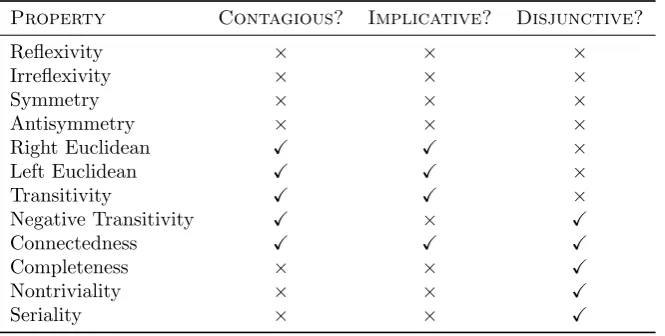
We study collective rationality with respect to some such well-known and widely used properties of graphs, but also with respect to large families of graph properties that satisfy certainmeta-properties. We explore both a semantic and a syntactic approach to defining such meta-properties. In our semantic ap-proach, we identify three high-level features of graph properties that determine the kind of aggregation rules that are collectively rational with respect to them. For example, transitivity is what we call a “contagious” property: under certain circumstances, namely in the presence of edge (y, z), inclusion of (x, y)spreads to (x, z). Transitivity also satisfies a second meta-property, which we call “implicativeness”: the inclusion of two specific edges, namely (x, y) and (y, z),implies the inclusion of a third edge, namely (x, z). The third meta-property we introduce, “disjunctiveness”, expresses that, under certain circumstances, at least one of two specific edges has to be accepted. This is satisfied, for instance, by the property ofcompleteness: every two vertices xand y need to be connected in at least one of the two possible directions. In our syntactic approach, we consider graph properties that can be expressed in particular syntactic fragments of a logical language. To this end, we make use of the language of modal logic [4]. This allows us to establish links between the syntactic properties of the language used to express the integrity constraints we would like to see preserved during aggregation and the axiomatic properties of the rules used.
First, it permits us to give conceptually simple proofs for powerful results with a high degree of generality. Second, it makes it easy to instantiate our general results to obtain specific results for specific application scenarios. For example, Arrow’s Theorem follows immediately from our more general result by checking that the properties of graphs that represent preference orders (namely transitivity and completeness) satisfy the meta-properties featuring in our theorem, yet our proof of the general theorem is arguably simpler than a direct proof of Arrow’s Theorem. This is so, because the meta-properties we use very explicitly exhibit specific features required for the proof, while those features are somewhat hidden in the specific properties of transitivity and completeness. Similarly, we show how alternative instantiations of our general result easily generate both known and new results in other domains, such as the aggregation of plausibility orders (which has applications in nonmonotonic reasoning and belief merging) and the aggregation of equivalence relations (which has applications in clustering analysis).
Related work. Our work builds on and is related to contributions in the field of social choice theory, starting with the seminal contribution of Arrow [5]. This concerns, in particular, contributions to the theory of voting and preference aggregation [6, 7, 8, 9, 10, 3], but also judgment aggregation [11, 12, 13, 14, 15, 16, 17]. In fact, in terms of levels of generality, graph aggregation may be regarded as occupying the middle ground between preference aggregation (most specific) and judgment aggregation (most general). In computer science, these frameworks are studied in the field of computational social choice [18]. As we shall discuss in some detail, graph aggregation is an abstraction of several more specific forms of aggregation taking place in a wide range of different domains. Preference aggregation is but one example. Aggregation of specific types of graphs has been studied, for instance, in nonmonotonic reasoning [19], belief merging [20], social network analysis [21], clustering [22], and argumentation in multiagent systems [23]. As we shall see, several of the results obtained in these earlier contributions are simple corollaries of our general results on graph aggregation.
Paper overview. The remainder of this paper is organised as follows. In Section 2, we introduce our frame-work for graph aggregation. This includes the discussion of several application scenarios, the definition of a number of concrete aggregation rules, and the formulation of various axioms identifying intuitively desirable properties of such rules. It also includes the definition of the concept of collective rationality. Finally, we prove a number of basic results in Section 2: characterisation results linking rules and axioms, as well as possibility results linking axioms and collective rationality requirements. In Section 3, we present our im-possibility results for graph aggregation rules that are collectively rational with respect to graph properties meeting certain semantically defined meta-properties. There are two such results. One identifies conditions under which the only available rules are so-calledoligarchies, under which the outcome is always the inter-section of the graphs provided by a subset of the agents (the oligarchs). A second result shows that, under slightly stronger assumptions, the only available rules are thedictatorships, where a single agent completely determines the outcome for every possible profile. Much of Section 3 is devoted to the definition and illus-tration of the meta-properties featuring in these results. Once they are in place, the proofs are relatively simple. In Section 4, we introduce our approach to describing collective rationality requirements in syntactic terms, using the language of modal logic. Our results in Section 4 establish simple conditions on the syntax of the specification of a graph property that are sufficient for guaranteeing that the property in question will be preserved under aggregation. The grounding of our approach in modal logic also allows us to provide a deeper analysis of the concept of collective rationality by considering the preservation of properties at three different levels, corresponding to the three levels naturally defined by the notions of Kripke frame, Kripke model, and possible world, respectively. In Section 5, we discuss four of our application scenarios in more detail, focusing on application scenarios previously discussed in the AI literature. We show how our general results allow us to derive new simple proofs of known results, how they clarify the status of some of these results, and how they allow us to obtain new results in these domains of application. Section 6, finally, concludes with a brief summary of our results and pointers to possible directions for future work.
2. Graph Aggregation
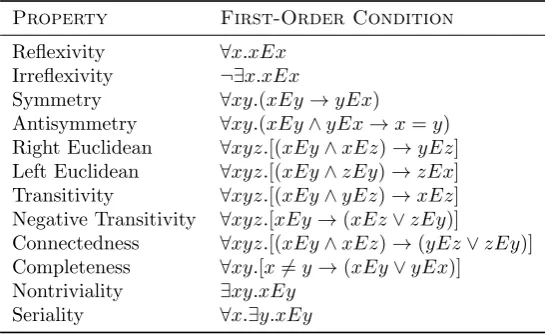
Property First-Order Condition
Reflexivity ∀x.xEx
Irreflexivity ¬∃x.xEx
Symmetry ∀xy.(xEy→yEx)
Antisymmetry ∀xy.(xEy∧yEx→x=y) Right Euclidean ∀xyz.[(xEy∧xEz)→yEz] Left Euclidean ∀xyz.[(xEy∧zEy)→zEx] Transitivity ∀xyz.[(xEy∧yEz)→xEz] Negative Transitivity ∀xyz.[xEy→(xEz∨zEy)]
Connectedness ∀xyz.[(xEy∧xEz)→(yEz∨zEy)] Completeness ∀xy.[x6=y→(xEy∨yEx)]
Nontriviality ∃xy.xEy
[image:4.595.161.434.111.278.2]Seriality ∀x.∃y.xEy
Table 1: Common properties of directed graphs.
and specific choices regarding the aggregation rule used, we briefly discuss several such specific scenarios in Section 2.2 and suggest definitions for several specific aggregation rules in Section 2.3. We then approach the analysis of aggregation rules from two different but complementary angles. First, in Section 2.4, we define several axiomatic properties of aggregation rules that a user may wish to impose as requirements when looking for a “fair” or “well-behaved” aggregation rule for a specific application. We also prove a number of simple results that show how some of these axioms relate to each other and to some of the aggregation rules defined earlier. Second, in Section 2.5, we introduce the central concept of collective rationality and we prove a number of simple positive results that show how enforcing certain axioms allows us to guarantee collective rationality with respect to certain graph properties.
2.1. Basic Notation and Terminology
Fix a finite set ofverticesV. A (directed)graphG=hV, Eibased onV is defined by a set ofedgesE⊆V×V. We writexEy for (x, y)∈E. AsV is fixed,Gis in fact fully determined by E. We therefore identify sets of edgesE ⊆V×V with the graphsG=hV, Ei they define. For any kind of set S, we use 2S to denote the powerset of S. So 2V×V is the set of all graphs. We use E(x) := {y ∈ V |(x, y) ∈E} to denote the set ofsuccessors of a vertexxin a set of edgesE and E−1(y) :={x∈V |(x, y)∈E} to denote the set of predecessors ofy in E.
A given graph may or may not satisfy a specific property, such as transitivity or reflexivity. Table 1 recalls the definitions of several such properties.1 We are often going to be interested in families of graphs
that all satisfy several of these properties. For instance, aweak order is a directed graph that is reflexive, transitive, and complete. It will often be useful to think of a graph property P, such as transitivity, as a subset of 2V×V (the set of all graphs over the set of vertices V). For two disjoint sets of edgesS+ andS−
and a graph propertyP ⊆2V×V, let P[S+, S−] = {E ∈ P | S+ ⊆E and S−∩E =∅} denote the set of
graphs inP that include all of the edges inS+ and none of those inS−.
LetN ={1, . . . , n} be a finite set of (two or more)individuals (oragents). We are often going to refer to subsets ofN as coalitions of individuals. Suppose every individuali∈ N specifies a graphEi ⊆V×V.
This gives rise to aprofile E = (E1, . . . , En). We use NeE :={i∈ N | e∈Ei} to denote the coalition of
individuals accepting edgeeunder profileE.
Definition 1. An aggregation rule is a function F : (2V×V)n → 2V×V, mapping any given profile of individual graphs into a single graph.
We are sometimes going to denote the outcome F(E) obtained when applying an aggregation rule F to a profileE simply as E and refer to it as thecollective graph. An example for an aggregation rule is the
majority rule, accepting a given edge if and only if more than half of the individuals accept it. More examples are going to be provided in Section 2.3.
2.2. Examples of Application Scenarios
Directed graphs are ubiquitous in computer science and beyond. They have been used as modelling devices for a wide range of applications. We now sketch a number of different application scenarios for graph aggregation, each requiring different types of graphs (satisfying different properties) to model relevant objects of interest, and each requiring different types of aggregation rules.
Example 1 (Preferences). Our main example for a graph aggregation problem is going to be preference aggregation as classically studied in social choice theory [5]. In this context, vertices are interpreted as alter-natives available in an election and the graphs considered are weak orders on these alteralter-natives, interpreted as preference orders. Our aggregation rules then reduce to so-called social welfare functions. Social welfare functions, which return a preference order for every profile of individual preference orders, are similar ob-jects as voting rules, which only return a winning alternative for every profile. While the types of preferences typically considered in classical social choice theory are required to be complete, recent work in AI has also addressed the aggregation of partial preference orders [10], corresponding to a larger family of graphs than the weak orders. In the context of aggregating complex preferences defined over combinatorial domains, graph aggregation can also be used to decide which preferential dependencies between different variables one should try to respect, based on the dependencies reported by the individual decision makers [24].
Example 2 (Knowledge). If we think ofV as a set of possible worlds, then a graph on V that is reflexive and transitive (and possibly also symmetric) can be used to model an agent’s knowledge: (x, y)being an edge means that, if xis the actual world, then our agent will consider y a possible world [25]. If we aggregate the graphs of several agents by taking their intersection, then the resulting collective graph represents the distributed knowledge of the group, i.e., the knowledge the members of the group can infer by pooling all their individual resources. If, on the other hand, we aggregate by taking the union of the individual graphs, then we obtain what is sometimes called the shared or mutual knowledge of the individual agents, i.e., the part of the knowledge available to each and every individual on their own. Finally, if we aggregate by computing the transitive closure of the union of the individual graphs, then we obtain a model of the group’s common knowledge [26, p. 512]. These concepts play a role in disciplines as diverse as epistemology [27], game theory [28], and distributed systems [29].
Example 3(Nonmonotonic reasoning). When an intelligent agent attempts to update her beliefs or to decide what action to take, she may resort to several patterns of common-sense inference that will sometimes be in conflict with each other. To take a famous example, we may wish to infer that Nixon is a pacifist, because he is a Quaker and Quakers by default are pacifists, and we may at the same time wish to infer that Nixon is not a pacifist, because he is a Republican and Republicans by default are not pacifists. In a popular approach to nonmonotonic reasoning in AI, such default inference rules are modelled as graphs that encode the relative plausibility of different conclusions [30]. Thus, here the possible conclusions are the vertices and we obtain a graph by linking one vertex with another, if the former is considered at least as plausible as the latter. Conflict resolution between different rules of inference then requires us to aggregate such plausibility orders, to be able to determine what the ultimately most plausible state of the world might be [19].
another might model family relations, and a third might have been induced from similarities in online pur-chasing behaviour. Social networks are often modelled using undirected graphs, which we can simulate in our framework by requiring all graphs to be symmetric. Aggregating individual graphs then amounts to finding a single meta-network that describes relationships at a global level. Alternatively, we may wish to aggregate sev-eral graphs representing snapshots of the same social network at different points in time. The meta-network obtained can be helpful when studying the social structures within the population under scrutiny [21].
Example 5 (Clustering). Clustering is the attempt of partitioning a given set of data points into several clusters. The intention is that the data points in the same cluster should be more similar to each other than each of them is to data points belonging to one of the other clusters. This is useful in many disciplines, including information retrieval and molecular biology, to name but two examples. However, the field is lack-ing a precise definition of what constitutes a “correct” partitionlack-ing of the data and there are many different clustering algorithms, such as k-means or single-linkage clustering, and even more parameterisations of those basic algorithms [31]. Observe that every partitioning that might get returned by a clustering algorithm induces an equivalence relation (i.e., a graph that is reflexive, symmetric, and transitive): two data points are equivalent if and only if they belong to the same cluster. Finding a compromise between the solutions suggested by several clustering algorithms is what is known as consensus clustering [32]. This thus amounts to aggregating several graphs that are equivalence relations.
Example 6 (Argumentation). In a so-called abstract argumentation framework, arguments are taken to be vertices in a graph and attacks between arguments are modelled as directed edges between them [33]. A graph property of interest in this context is acyclicity, as that makes it easier to decide which arguments to ultimately accept. If we think of V as the collection of arguments proposed in a debate, a profile E = (E1, . . . , En) specifies an attack relation for each of a number of agents that we may wish to aggregate into a collective attack relation before attempting to determine which of the arguments might be acceptable to the group. Recent work has addressed the challenge of aggregating several abstract argumentation frameworks from a number of angles, e.g., by proposing concrete aggregation methods grounded in work on belief merging [34], by investigating the computational complexity of aggregation [35], and by analysing what kinds of profiles we may reasonably expect to encounter in this context [36].
Example 7 (Logic). Graph aggregation is also at the core of recent work on the aggregation of different logics [37]. The central idea here is that every logic is defined by a consequence relation between formulas. Thus, given a set of formulas, we can think of a logic L as the graph corresponding to the consequence relation definingL. Aggregating several such graphs then gives rise to a new logic. Thus, this is an instance of our graph aggregation problem, except that for the case of logic aggregation it is more natural to model the set of vertices as being infinite.2
Recall that we have assumed that every individual specifies a graph onthe same set of verticesV. This is a natural assumption to make in all of our examples above, but in general we might also be interested in aggregating graphs defined on different sets of vertices. For instance, Coste-Marquis et al. [34] have argued that, in the context of merging argumentation frameworks, the case of agents who are not all aware of the exact same set of arguments is of great practical interest. Observe that also in this case our framework is applicable, as we may think ofV as the union of all the individual sets of vertices (with each individual only providing edges involving “her” vertices).
We are going to return to several of these application scenarios in greater detail in Section 5.
2.3. Aggregation Rules
Next, we define a number of concrete aggregation rules. We begin with three that are particularly simple, the first of which we have already introduced informally.
Definition 2. The (strict)majority ruleis the aggregationFmajwithFmaj:E7→ {e∈V×V :|NeE|> n 2}.
Definition 3. Theintersection rule is the aggregation rule F∩ withF∩:E7→E1∩ · · · ∩En.
Definition 4. Theunion rule is the aggregation rule F∪ with F∪:E7→E1∪ · · · ∪En.
In related contexts, the intersection rule is also known as the unanimity rule, as it requires unanimous approval from all individuals for an edge to be accepted. Similarly, the union rule is anomination rule, as nomination by just one individual is enough for an edge to get accepted.
Under aquota rule, an edge will be included in the collective graph if the number of individuals accepting it meets a certain quota. Auniform quota rule uses the same quota for every edge.
Definition 5. A quota ruleis an aggregation rule Fq defined via a functionq:V×V → {0,1, . . . , n+1}, associating each edge with a quota, by stipulatingFq:E7→ {e∈V×V :|NeE|>q(e)}. Fq is calleduniform in caseq is a constant function.
The class of uniform quota rules includes the three simple rules we have seen earlier as special cases: the (strict)majority ruleFmajis the uniform quota rule withq=dn+12 e, theintersection ruleF∩ is the uniform
quota rule with q=n, and the union rule F∪ is the uniform quota rule with q= 1. We call the uniform
quota rules with q = 0 and q =n+1 thetrivial quota rules; q = 0 means that all edges will be included in the collective graph and q = n+1 means that no edge will be included (independently of the profile encountered). The idea of using quota rules is natural and widespread. For example, quota rules have also been studied in judgment aggregation [13].
We now introduce a new class of aggregation rules specifically designed for graphs that is inspired by approval voting [38]. Imagine we associate with each vertex with an election in which all the possible successors of that vertex are the candidates (and in which there may be more than one winner). Each agent votes by stating which vertices she considers acceptable successors and, based on this information, a choice function selects which edges to include in the collective graph.
Definition 6. Let v : (2V)n → 2V be a function associating any given vector of sets of vertices with a single set of vertices. Then thesuccessor-approval rule based on v is the aggregation ruleFv defined by stipulatingFv :E7→ {(x, y)∈V×V |y∈v(E1(x), . . . , En(x))}.
Example 8 (Successor-approval based on classical approval voting). Consider a graph with four vertices:
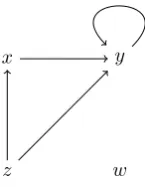
V ={x, y, z, w}. Suppose two individuals report the graphs E1 ={(x, y),(x, z)} and E2={(x, z)}. When deciding which vertices to connect from x using a successor-approval rule, we look at E1(x) = {y, z} and
E2(x) = {z} as approval ballots, and we use v to decide which vertex is the winner. If v is the classical approval voting rule, which selects the candidate with the most approvals, thenz is the winner with a score of two approvals, followed by y with one approval, andxandwwith none. Since all other vertices have no outgoing edges at all, we have thatFv(E) ={(x, z)}.
We callv thechoice function associated withFv. It takes a vector of sets of vertices, one for each agent,
and returns another such set. For example, the classical approval voting rule is formally defined as v : (S1, . . . , Sn)7→argmaxx∈S1∪···∪Sn|{i∈ N :x∈Si}|. Note how the argmax-operator ranges over the union of all successors mentioned by any of the agents rather than the full set of verticesV. This ensures that, in case none of the agents approve any vertex as a successor, we do not end up accepting all vertices for all having the same “maximal” support. We are only going to be interested in choice functionsvthat are (i)anonymous
and (ii)neutral, i.e., for which (i)v(S1, . . . , Sn) =v(Sπ(1), . . . , Sπ(n)) for any permutationπ:N → N and
for which (ii) {i ∈ N | x ∈ Si} = {i ∈ N | y ∈ Si} entails x ∈ v(S1, . . . , Sn) ⇔ y ∈ v(S1, . . . , Sn).
There are a number of natural choices for v. Apart from the classical approval voting rule mentioned before, we might want to accept all edges receiving above-average support. While classical approval voting will typically result in very “sparse” output graphs, intuitively the latter rule will return graphs that have similar attributes as the input graphs. A third option is to use “even-and-equal” cumulative voting with v : (S1, . . . , Sn)7→ argmaxx∈S1∪···∪Sn
P
i|x∈Si
1
where agents specifying fewer edges might be considered more certain about those edges. Finally, observe that the uniform quota rules (but not the general quota rules) are a special case of the successor-approval rules. We obtainFq with the constant functionq:e7→k, mapping any given edge to the fixed quotak, by
usingv: (S1, . . . , Sn)7→ {x∈V :|{i∈ N :x∈Si}|>k}.
While we are not going to do so in this paper, it is also possible to adapt the distance-based rules— familiar from preference aggregation, belief merging, and judgment aggregation [39, 40, 41]—to the case of graph aggregation. Such rules select a collective graph that satisfies certain properties and that minimises the distance to the individual graphs (for a suitable notion of distance and a suitable form of aggregating such distances). A downside of this approach is that distance-based rules are typically computationally intractable [42, 43, 44, 45], while quota and successor-approval rules have very low complexity.
We can also adapt therepresentative-voter rules [46] to the case of graph aggregation. Here, the idea is to return one of the input graphs as the output, and for every profile to pick the input graph that in some sense is “most representative” of the views of the group.
Definition 7. A representative-voter ruleis an aggregation ruleF that is such that for every profileE
there exists an individuali?∈ N such thatF(E) =E i?.
For instance, we might pick the input graph that is closest to the outcome of the majority rule. This majority-based representative-voter rule also has very low complexity. While we are not going to study any specific representative-voter rule in this paper, in Section 4.4 we are going to briefly discuss this class of rules as a whole.
We conclude our presentation of concrete (families of) aggregation rules with a number of rules that, intuitively speaking, are not very attractive.
Definition 8. Thedictatorship of individuali?∈ N is the aggregation ruleFi? with Fi?:E7→Ei?.
Thus, for any given profile of input graphs,Fi?always simply returns the graph submitted by the dictatori?. Note that every dictatorship is a representative-voter rule, but the converse is not true.
Definition 9. The oligarchy of coalition C? ⊆ N, with C? being nonempty, is the aggregation rule F C?
withFC?:E7→
\
i∈C? Ei.
Thus,FC? always returns the intersection of the graphs submitted by the oligarchs in the coalitionC?. So an individual inC? can veto the acceptance of any given edge, but she cannot enforce its acceptance. In
caseC? is a singleton, we obtain a dictatorship. In caseC?=N, we obtain the intersection rule.
2.4. Axiomatic Properties and Basic Characterisation Results
When choosing an aggregation rule, we need to consider its properties. In social choice theory, such properties are calledaxioms [9]. We now introduce several basic axioms for graph aggregation. The first such axiom is an independence condition that requires that the decision of whether or not a given edgeeshould be part of the collective graph should only depend on which of the individual graphs includee. This corresponds to well-known axioms in preference and judgment aggregation [5, 17].
Definition 10. An aggregation ruleF is called independent of irrelevant edges (IIE) ifNE
e =NE 0
e implies
e∈F(E)⇔e∈F(E0).
That is, if exactly the same individuals accepteunder profiles E and E0, then eshould be part of either both or none of the corresponding collective graphs. The definition above applies to all edges e ∈ V×V andall pairs of profiles E,E0 ∈(2V×V)n. For the sake of readability, we shall leave this kind of universal
quantification implicit also in later definitions.
property that is hard to satisfy if we are interested in richer forms of aggregation. Indeed, IIE will turn out to be at the very centre of our impossibility results.
While very much a standard axiom, we might be dissatisfied with IIE for not making reference to the fact that edges are defined in terms of vertices. Our next two axioms are much more graph-specific and do not have close analogues in preference or judgment aggregation. The first of them requires that the decision of whether or not to collectively accept a given edgee= (x, y) should only depend on which edges with the same sourcexare accepted by the individuals. That is, acceptance of an edge may be influenced by what agents think about other edges, but not those edges that are sufficiently unrelated to the edge under consideration. Below we writeF(E)(x) for the set of successors of vertexxin the set of edges in the collective graphF(E), and similarlyF(E)−1(y) for the predecessors of y inF(E).
Definition 11. An aggregationF is called independent of irrelevant sources (IIS) ifEi(x) =Ei0(x)for all individualsi∈ N impliesF(E)(x) =F(E0)(x).
Definition 12. An aggregation ruleF is called independent of irrelevant targets (IIT) ifEi−1(y) =E0i−1(y)
for all individualsi∈ N implies F(E)−1(y) =F(E0)−1(y).
Both IIS and IIT are strictly weaker than IIE. That is, we obtain the following result, which is easy to verify (simple counterexamples can be devised to show that the converse does not hold):
Proposition 1. If an aggregation rule is IIE, then it is also both IIS and IIT.
The fundamental economic principle ofunanimity requires that an edge should be accepted by a group in case all individuals in that group accept it.
Definition 13. An aggregation ruleFis calledunanimousif it is always the case thatF(E)⊇E1∩· · ·∩En.
A requirement that, in some sense, is dual to unanimity is to ask that the collective graph should only include edges that are part of at least one of the individual graphs. In the context of ontology aggregation this axiom has been introduced under the namegroundedness [47].
Definition 14. An aggregationF is called groundedif it is always the case that F(E)⊆E1∪ · · · ∪En.
The next axiom expresses a basic symmetry requirement, namely that the aggregation rule should treat all individuals the same. It is used in the exact same form in both preference and judgment aggregation [5, 17].
Definition 15. An aggregation rule F is called anonymous if F(E1, . . . , En) = F(Eπ(1), . . . , Eπ(n)) for any permutationπ:N → N.
The axiom ofneutrality, loosely speaking, postulates symmetry with respect to different parts of the graphs to be aggregated. We are going to mostly work with the following formalisation of this intuitive idea, which is inspired by the way in which neutrality is often defined in judgment aggregation [48].
Definition 16. An aggregation rule F is calledneutralif NeE =NeE0 impliese∈F(E)⇔e0 ∈F(E).
Thus, this axiom says that, if two edges are accepted by the same coalition of individuals, then either both or neither should be included in the collective graph. (Observe that, while IIE speaks about one edge and two profiles, neutrality speaks about two edges within the same profile.) When we restrict attention to graphs that can be interpreted as preference orders, e.g., weak orders, this notion of neutrality, however, is different from how neutrality is usually defined in the preference aggregation literature [3], where it is taken to represent symmetry with respect to alternatives (i.e., vertices) rather than pairwise preferences (i.e., edges). The following alternative definition generalises this idea to arbitrary graphs. It is formulated in terms of a permutationπ:V →V on vertices. Any suchπnaturally extends to edges e= (x, y), graphsE, and profilesE: π((x, y)) = (π(x), π(y)),π(E) ={π(e)|e∈E}, andπ(E) = (π(E1), . . . , π(En)).
The following two examples show that there are neutral aggregation rules that are not permutation-neutral and that there are permutation-neutral aggregation rules that are not neutral. However, as we shall see next, in the presence of IIE, the two definitions have the same logical strength.
Example 9 (Neutral yet not permutation-neutral rule). Let V ={x, y} and consider the aggregation rule
F that returns the empty graph ∅ in case agent 1 accepts edge (x, y) and that returns the complete graph
{(x, x),(x, y),(y, x),(y, y)} in all other cases. This rule is easily seen to be neutral, as the output graph always agrees on all edges. However,F is not permutation-neutral: if we swap xand y in a profile where agent 1 accepts only(x, y), then the output will change from the empty to the complete graph.
Example 10(Permutation-neutral yet not neutral rule). LetV ={x, y, z}and consider the aggregation rule
F that first computes the intersection of all individual graphs and then, in certain special cases, removes one further edge: namely, if the intersection graph happens to be exactlyπ({(x, y),(y, z)}), for some permutation
π:V →V, then the edgeπ((y, z))is removed. In other words: if the intersection graph is a “line” of length 2, then the second half of that line is removed. This rule is permutation-neutral by definition. However, it is not neutral. For instance, if all agents accept both(x, y)and(y, z), and no other edges, then these two edges nevertheless are not treated symmetrically in the output.
Proposition 2. Let F be an aggregation rule that is IIE. ThenF is neutral if and only if it is permutation-neutral.
Proof. It suffices to observe that both (i) aggregation rules that are IIE and neutral and (ii) aggregation rules that are IIE and permutation-neutral have the following property in common. Any such rule can be completely described by specifying which coalitionsCof agents are such that it is the case that a given edge will get accepted by the rule if and only if exactly the agents inC accept it.3
The following monotonicity axiom expresses that additional support for a collectively accepted edge should never cause that edge to be rejected. It applies in case profilesE and E0 are identical, except that some individuals who do not accept edgeein the former profile do accept it in the latter. Its definition is closely modelled on its counterpart in judgment aggregation [17].
Definition 18. An aggregation ruleF is calledmonotonicif eitherEi0=Ei or E0i=Ei∪ {e} holding for all individualsi∈ N impliese∈F(E)⇒e∈F(E0).
The link between aggregation rules and axiomatic properties is expressed in so-called characterisation results. For each rule (or class of rules), the aim is to find a set of axioms that uniquely define this rule (or class of rules, respectively). A simple adaptation of a result by Dietrich and List [13] yields the following characterisation of the class of quota rules:
Proposition 3. An aggregation rule is a quota rule if and only if it is anonymous, monotonic, and IIE.
Proof. To prove the left-to-right direction we simply have to verify that the quota rules all have these three properties. For the right-to-left direction, observe that, to accept a given edge (x, y) in the collective graph, an IIE aggregation rule will only look at the set of individualsisuch thatxEiy. If the rule is also anonymous,
then the acceptance decision is based only on the number of individuals accepting the edge. Finally, by monotonicity, there will be some minimal number of individual acceptances required to trigger collective acceptance. That number is the quota associated with the edge under consideration.
If we add the axiom of neutrality, then we obtain the class of uniform quota rules. If we furthermore impose unanimity and groundedness, then this excludes the trivial quota rules. Similarly, it is easy to verify that IIS essentially characterises the class of successor-approval rules:
Proposition 4. An aggregation rule is a successor-approval rule (with an anonymous and neutral choice function) if and only if it is anonymous, neutral, and IIS.
An extreme form of violating anonymity is to use adictatorial or anoligarchicaggregation rule, i.e., a rule that is either a dictatorship or an oligarchy (unless the oligarchy in question is the full setN).
Sometimes we are only going to be interested in the properties of an aggregation rule as far as the
nonreflexiveedgese= (x, y) withx6=yare concerned. Specifically, we call F neutral on nonreflexive edges
(or justNR-neutral) ifNE
(x,y)=N
E
(x0,y0) implies (x, y)∈F(E)⇔(x0, y0)∈F(E) for allx6=y andx0 6=y0.
Analogously, we call F dictatorial on nonreflexive edges (or NR-dictatorial) if there exists an individual i? ∈ N such that (x, y)∈F(E)⇔(x, y)∈E
i? for allx6=y. Finally, we call F oligarchic on nonreflexive
edges (or NR-oligarchic) if there exists a nonempty coalition C? ⊆ N such that (x, y)∈F(E)⇔(x, y)∈
T
i∈C?Ei for allx6=y.
2.5. Collective Rationality and Basic Possibility Results
To what extent can a given aggregation rule ensure that a given property that is satisfied by each of the individual input graphs will be preserved during aggregation? This question relates to a well-studied concept in social choice theory, often referred to ascollective rationality [5, 11]. In the literature, collective rationality is usually defined with respect to a specific property that should be preserved (e.g., the transitivity of preferences or the logical consistency of judgments). Here, instead, we formulate a definition that is parametric with respect to a given graph property.4
Definition 19. An aggregation ruleF is calledcollectively rationalwith respect to a graph propertyP if
F(E)satisfiesP whenever all of the individual graphs in E= (E1, . . . , En) do.
To illustrate the concept, let us consider two examples. Both concern the majority rule, but different graph properties. The first is a purely abstract example, while the second has a natural interpretation of graphs as preference relations.
Example 11(Collective rationality). Suppose three individuals provide us with three graphs over the same setV ={x, y, z, w}of four vertices, as shown to the left of the dashed line below:
x y z
w
x y z
w
x y z
w
x y z
w
If we apply the majority rule, then we obtain the graph to the right of the dashed line. Thus, the majority rule is not collectively rational with respect to seriality, as each individual graph is serial, but the collective graph is not. Symmetry, on the other hand, is preserved in this example.
Example 12 (Condorcet paradox). Now suppose three individuals provide us with the three graphs on the set of verticesV ={x, y, z} shown on the lefthand side of the dashed line below:
x
y z
x
y z
x
y z
x
y z
The graph on the righthand side is once again the result of applying the majority rule. Observe that each of the three input graphs is transitive and complete. So we may interpret these graphs as (strict) preference orders on the candidates x, y, and z. For example, the preferences of the first agent would bexy z. The output graph, on the other hand, is not transitive (although it is complete). It does not correspond to a “rational” preference, as under that preference we should preferxtoy andy toz, but alsoz tox. This is the famous Condorcet paradox described by the Marquis de Condorcet in 1785 [49].
So the majority rule is not collectively rational with respect to either seriality or transitivity. On the other hand, we saw that both symmetry and completeness were preserved under the majority rule—at least for the specific examples considered here. In fact, it is not difficult to verify that this was no coincidence, and that the majority rule is collectively rational with respect to a number of properties of interest.
Fact 5. The majority rule is collectively rational with respect to reflexivity, irreflexivity, symmetry, and antisymmetry. In case n, the number of individuals, is odd, the majority rule furthermore is collectively rational with respect to completeness and connectedness.
Proof sketch. We give the proofs for symmetry and completeness. The other proofs are very similar. First, if the input graphs are symmetric, then the set of supporters of edge (x, y) is always identical to the set of supporters of the edge (y, x). Thus, either both or neither have a strict majority. Second, if the input graphs are complete, then each of them must include at least one of (x, y) and (y, x). Thus, by the pigeon hole principle, whennis odd, at least one of these two edges must have a strict majority.
Rather than establishing further such results for specific aggregation rules, our main interest in this paper is the connection between the axioms satisfied by an aggregation rule and the range of graph properties preserved by the same rule. For some graph properties, collective rationality is easy to achieve, as the following simplepossibility results demonstrate.
Proposition 6. Any unanimous aggregation rule is collectively rational with respect to reflexivity.
Proof. If every individual graph includes all edges of the form (x, x), then unanimity ensures the same for the collective graph.
Proposition 7. Any grounded aggregation rule is collectively rational with respect to irreflexivity.
Proof. If no individual graph includes (x, x), then groundedness ensures the same for the collective graph.
Proposition 8. Any neutral aggregation rule is collectively rational with respect to symmetry.
Proof. If edges (x, y) and (y, x) have the same support, then neutrality ensures that either both or neither will get accepted for the collective graph.
Unfortunately, as we are going to see next, things do not always work out that harmoniously, and certain axiomatic requirements are in conflict with certain collective rationality requirements.
3. Impossibility Results
In social choice theory, animpossibility theorem states that it is not possible to devise an aggregation rule that satisfies certain axioms and that is also collectively rational with respect to a certain combination of properties of the structures being aggregated (which in our case are graphs). In this section, we are going to prove two powerful impossibility theorems for graph aggregation, theOligarchy Theorem and the
Dictatorship Theorem. The latter identifies a set of requirements that are impossible to satisfy in the sense that the only aggregation rules that meet them are the dictatorships. The former drives on somewhat weaker requirements (specifically, regarding collective rationality) and permits a somewhat larger—but still decidedly unattractive—set of aggregation rules, namely the oligarchies.
following subsections are devoted to developing the framework in which to present and then prove our results. Section 3.2 introduces winning coalitions, i.e., sets of individuals who can force the acceptance or rejection of a given edge, discusses under what circumstances an aggregation rule can be described in terms of a family of winning coalitions, and what structural properties of such a family correspond to either dictatorial or oligarchic aggregation rules. Sections 3.3 and 3.4 introduce three so-calledmeta-properties for classifying graph properties and establish fundamental results for these meta-properties. Our impossibility theorems, which are formulated and proved in Section 3.5, apply to aggregation rules that are collectively rational with respect to graph properties that are covered by some of these meta-properties. Section 3.6, finally, discusses several variants of our theorems and provides a first illustration of their use.
3.1. Background: Arrow’s Theorem for Preference Aggregation
The prime example of an impossibility result is Arrow’s Theorem for preference aggregation, with preference relations being modelled as weak orders on some set of alternatives [5]. We can reformulate Arrow’s Theorem in our framework for graph aggregation as follows:
For |V| >3, every unanimous, grounded, and IIE aggregation rule that is collectively rational with respect to reflexivity, transitivity, and completeness must be a dictatorship.
Thus, Arrow’s Theorem applies to the following scenario. We wish to aggregate the preferences of several agents regarding a set of three or more alternatives. The agents are assumed to express their preferences by ranking the alternatives from best to worst (with indifferences being allowed), i.e., by each providing us with a weak order (a graph that is reflexive, transitive, and complete), and we want our aggregation rule to compute a single such weak order representing a suitable compromise. Furthermore, we want our aggregation rule to respect the basic axioms of unanimity (if all agents agree thatxis at least as good as y, then the collective preference order should say so), groundedness (if no agent says thatxis at least as good as y, then the collective preference order should not say so either), and IIE (it should be possible to compute the outcome on an edge-by-edge basis). Arrow’s Theorem tells us that this is impossible—unless we are willing to use a dictatorship as our aggregation rule.
This result not only is surprising but also deeply troubling. It therefore is important to understand to what extent similar phenomena arise in other areas of graph aggregation. We are going to revisit Arrow’s Theorem in Section 3.6, where we are also going to be in a position to explain why the standard formulation of the theorem, given in that section as Theorem 19, is indeed implied by the variant given here.
In the sequel, we are sometimes going to refer to aggregation rules that are unanimous, grounded, and IIE asArrovian aggregation rules.
3.2. Winning Coalitions, Filters, and Ultrafilters
As is well understood in social choice theory, impossibility theorems in preference aggregation heavily feed on independence axioms (in our case IIE). Observe that an aggregation rule F satisfies IIE if and only if for each edgee∈V×V there exists a set of winning coalitions We⊆2N such thate∈F(E)⇔NeE ∈ We.
That is,F acceptseif and only if exactly the individuals in one of the winning coalitions foredo. Imposing additional axioms onF corresponds to restrictions on the associated family of winning coalitions{We}e∈V×V:
• IfF isunanimous, thenN ∈ Wefor any edgee(i.e., the grand coalition is always a winning coalition).
• IfF isgrounded, then∅ 6∈ We for any edgee(i.e., the empty set is not a winning coalition).
• IfF ismonotonic, then C1∈ WeimpliesC2∈ Wefor any edgeeand any set C2 ⊃C1 (i.e., winning
coalitions are closed under supersets).
• IfF is (NR-)neutral, thenWe=We0 for any two (nonreflexive) edgeseande0 (i.e., every edge must
Thus, an aggregation rule that is both IIE and neutral can be fully described in terms of a single setW of winning coalitions. Any suchW is a subset of the powerset ofN, the set of individuals. The proofs of our impossibility results are going to exploit the special structure of such subsets of the powerset ofN, enforced by both axioms and collective rationality requirements. Specifically, in our proofs we are going to encounter the concepts offilters andultrafilters familiar from model theory [50].
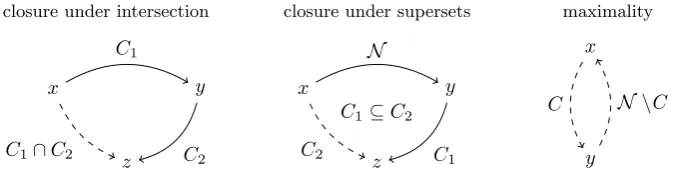
Definition 20. AfilterWon a setN is a collection of subsets ofN satisfying the following three conditions:
(i) ∅ 6∈ W;
(ii) C1, C2∈ W impliesC1∩C2∈ W for any two sets C1, C2⊆ N (closure under intersection);
(iii) C1∈ W impliesC2∈ W for any set C2⊆ N with C2⊃C1 (closure under supersets).
Definition 21. An ultrafilterW on a set N is a collection of subsets of N satisfying the following three conditions:
(i) ∅ 6∈ W
(ii) C1, C2∈ W impliesC1∩C2∈ W for any two sets C1, C2⊆ N (closure under intersection);
(iii) C or N \C is inW for any set C⊆ N (maximality).
Every ultrafilter is a filter; in particular, the ultrafilter conditions imply closure under supersets. Note that the condition ∅ 6∈ W directly corresponds to groundedness, while closure under supersets corresponds to monotonicity.
The use of ultrafilters in social choice theory goes back to the work of Fishburn [6] and Kirman and Sondermann [7], who employed ultrafilters to prove Arrow’s Theorem and its generalisation to an infinite number of individuals. The ultrafilter method also has found applications in judgment aggregation [15], and also filters have been used in both preference aggregation [8] and judgment aggregation [12]. The relevance of filters and ultrafilters to aggregation problems is due to the following simple results, which interpret well-known facts from model theory in our specific context.
Lemma 9(Filter Lemma). LetF be an IIE and NR-neutral aggregation rule and letWbe the corresponding set of winning coalitions for nonreflexive edges, i.e.,(x, y)∈F(E)⇔NE
(x,y)∈ W for allx6=y ∈V. Then
F is NR-oligarchic if and only ifW is a filter.
Proof. (⇒) Recall thatF being NR-oligarchic means that there exists a nonempty coalitionC?such that a
given nonreflexive edge is accepted if and only if all the agents inC?accept it. Thus, the winning coalitions
are exactly C? and its supersets. This family of sets does not include the empty set and is closed under
both intersection and supersets.
(⇐) Suppose F is determined by the filter W as far as nonreflexive edges are concerned. Let C? :=
T
C∈CC, which is well-defined due toN being finite. Observe thatC
? must be nonempty, due to the first
two filter conditions. Now note thatF is NR-oligarchic with respect to coalition C?.
Lemma 10 (Ultrafilter Lemma). Let F be an IIE and NR-neutral aggregation rule and let W be the corresponding set of winning coalitions for nonreflexive edges, i.e., (x, y) ∈ F(E) ⇔ NE
(x,y) ∈ W for all
x6=y∈V. Then F is NR-dictatorial if and only ifW is an ultrafilter.
Proof. (⇒)F being NR-dictatorial means that there exists an i?∈ N such that the winning coalitions for
nonreflexive edges are exactly{i?}and its supersets. This family of sets does not include the empty set, is
closed under intersection, and maximal.
(⇐) SupposeF is determined by the ultrafilterW as far as nonreflexive edges are concerned. Take an arbitraryC ∈ W with|C|>2 and consider any nonemptyC0 (C. By maximality, one of C0 andN \C0
must be inW. Thus, by closure under intersection, one ofC∩C0=C0andC∩(N \C0) =C\C0must be in
(i)x (ii) (iii)
y
z
x
y
z x
y z
x
[image:15.595.225.370.112.211.2]y z
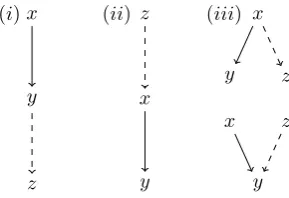
Figure 1: Illustration of Definition 23, indicating given edges (solid) and implied edges (dashed).
we have just shown for any C ∈ W with|C| >2 at least one nonempty proper subset ofC is also in W. By maximality, W is not empty. So take anyC ∈ W. Due to N being finite, we can apply our reduction rule a finite number of times to infer thatW must include some singleton {i?}
(· · ·(C. Hence, F is an
NR-dictatorship with dictatori?.
3.3. The Neutrality Axiom and Contagious Graph Properties
Recall that the neutrality axiom is required to be able to work with a single family of winning coalitions as outlined earlier, yet this axiom does not feature in Arrow’s Theorem. As we shall see soon, the reason we do not need to assume neutrality is that, in Arrow’s setting, the same restriction on winning coalitions is already enforced by collective rationality with respect to transitivity. This is an interesting link between a specific collective rationality requirement and a specific axiom. In the literature, this fact is often called the Contagion Lemma [9], although the connection to neutrality is not usually made explicit. The same kind of result can also be obtained for other graph properties with a similar structure. Let us now develop a definition for a class of graph properties that are going to allow us to derive neutrality.
Recall thatP[S+, S−] denotes the set of graphs with propertyP that include all of the edges inS+ and
none of those inS−. We start with a technical definition.
Definition 22. Let x, y, z, w∈V. A graph property P ⊆2V×V is calledxy/zw-contagious if there exist two disjoint setsS+, S−⊆V×V such that the following conditions hold:
(i) for every graphE∈P[S+, S−] it is the case that(x, y)∈E implies (z, w)∈E; and
(ii) there exist graphs E0, E1∈P[S+, S−] with(z, w)6∈E0 and(x, y)∈E1.
Part (i) of Definition 22 says that, if you accept edge (x, y), then you must also accept edge (z, w)—at least if the side condition of you also accepting all the edges inS+ but none of those in S− is met. That is, the property ofxy/zw-contagiousness may be paraphrased as the formula [V
S+∧ ¬W
S−]→[xEy →zEw]. Part (ii) is a richness condition that says that you have the option of accepting neither or both of (x, y) and (z, w). It requires the existence of a graphE0where neither (x, y) nor (z, w) are accepted, and the existence
of a graphE1where both (x, y) and (z, w) are accepted.
Contagiousness with respect to two given edges will be useful for our purposes if those two edges stand in a specific relationship to each other. The following definition captures the relevant cases.
Definition 23. A graph property P ⊆2V×V is called contagious if it satisfies at least one of the three conditions below:
(i) P isxy/yz-contagious for all triples of distinct verticesx, y, z∈V.
(ii) P isxy/zx-contagious for all triples of distinct vertices x, y, z∈V.
That is, Definition 23 covers pairs of edges where (i) the second edge is a successor of the first edge, where (ii) the second edge is a predecessor of the first edge, and where (iii) the two edges share either a starting point or an end point. This covers all cases of two edges meeting in one point. The three cases are illustrated in Figure 1. As will become clear in the proof of Lemma 12, case (iii) differs from the other two, as only one of these two types of connections would not be sufficient to “traverse” the full graph.
Fact 11. For|V| >3, the two Euclidean properties, transitivity, negative transitivity, and connectedness are all contagious graph properties.
Proof. Let us first consider the property of being a right-Euclidean graph. It satisfies condition (i) of Definition 23. To prove this, we are going to show that the right-Euclidean property isxy/yz-contagious for all triplesx, y, z∈V. LetS+ ={(x, z)} andS−=∅, i.e., P[S+, S−] is the set of all right-Euclidean graphs containing (x, z). Condition (i) of Definition 22 is met: any graph inP[S+, S−] contains (x, z); therefore, by
the right-Euclidean property, (y, z) needs to be accepted whenever (x, y) is. Condition (ii) is also satisfied. LetE0 be the graph only containing the single edge (x, z), and let E1 be the graph containing exactly the
three edges (x, y), (y, z), and (x, z). Both graphs are right-Euclidean and, since they include (x, z), they also belong toP[S+, S−].
An alternative way of seeing that the right-Euclidean property is contagious is to observe that it is equivalent to the formula [xEz]→ [xEy → yEz], with all variables universally quantified. Similarly, the left-Euclidean property, which can be rewritten as [zEy]→[xEy→zEx], is contagious by condition (ii). Transitivity satisfies condition (iii), as we can rewrite it either as [yEz] → [xEy → xEz] or as [zEx] → [xEy→zEy]. Negative transitivity can be rewritten either as [¬(zEy)]→[xEy→xEz] or as [¬(xEz)]→ [xEy→zEy], and this property thus also satisfies condition (iii). Connectedness, finally, can be rewritten as [xEz∧ ¬zEy] → [xEy → yEz] and thus satisfies condition (i). For all these properties, the richness conditions are easily verified to hold as well.
We are now ready to prove a powerful lemma, theNeutrality Lemma, showing that any Arrovian aggregation rule that is collectively rational with respect to a contagious graph property must be neutral (at least as far as nonreflexive edges are concerned). This generalises a result often referred to as theContagion Lemma in the literature on preference aggregation [9], and our proof generalises the standard proof of that lemma.
Lemma 12 (Neutrality Lemma). For|V|>3, any unanimous, grounded, and IIE aggregation rule that is collectively rational with respect to a contagious graph property must be NR-neutral.
Proof. We are first going to establish a generic result for collective rationality with respect to xy/zw -contagiousness. Let x, y, z, w ∈ V. Take any graph property P that is xy/zw-contagious and take any aggregation rule F that is unanimous, grounded, IIE, and collectively rational with respect to P. Let {We}e∈V×V be the family of winning coalitions associated withF. We want to show thatW(x,y)⊆ W(z,w).
So letCbe a coalition inW(x,y). LetS+, S− ⊆V×V andE0, E1∈P[S+, S−] be defined as in Definition 22.
Consider a profileE in which the individuals inCpropose graphE1and all others proposeE0. That is, all
individuals accept the edges inS+, none accept any of those inS−, exactly the individuals in Caccept edge (x, y), and exactly those in C also accept (z, w). Now consider the collective graph F(E). By unanimity S+⊆F(E), by groundednessS−∩F(E) =∅, and finally (x, y)∈F(E) due toCbeing a winning coalition for (x, y). By collective rationality, F(E)∈P and thus also F(E)∈P[S+, S−]. But then, due to xy/zw
-contagiousness ofF(E), we get (z, w)∈F(E). As it was exactly the individuals inC who accepted (z, w), coalitionC must be winning for (z, w), i.e.,C∈ W(z,w), and we are done.
We are now ready to prove the lemma. Take any graph property P that is contagious and take any aggregation rule F that is unanimous, grounded, IIE, and collectively rational with respect to P. Let {We}e∈V×V be the family of winning coalitions associated with F. We need to show that there exists a
uniqueW ⊆2N such thatW =Wefor every nonreflexive edgee. By unanimity, the setsWeare not empty
(because at leastN ∈ We). Consider any three vertices x, y, z∈V and any coalition C∈ W(x,y). We are
x
z
y N
C
[image:17.595.257.341.110.185.2]C
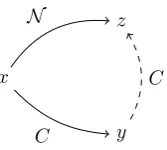
Figure 2: Collective rationality with respect to the right-Euclidean property implies neutrality.
For each of the three possible ways in whichP can be contagious (see Definition 23), we are going to use different instances of our generic result forxy/zw-contagiousness above:
• First, if P is contagious by virtue of condition (i), then we can use xy/yz-contagiousness to get C∈ W(y,z)and its instancexy/yx-contagiousness (with z:=x) to obtain alsoC∈ W(y,x).
• Second, ifP is contagious due to condition (ii), we usexy/yx-contagiousness to getC ∈ W(y,x), and
thenyx/zy-contagiousness to getC∈ W(z,y)andzy/yz-contagiousness to get C∈ W(y,z).
• Third, suppose P is contagious by virtue of condition (iii). We first use xy/zy-contagiousness to obtain C ∈ W(z,y) and then zy/zx-contagiousness to get C ∈ W(z,x). From the latter, via zx/yx
-contagiousness we getC∈ W(y,x). Finally,yx/yz-contagiousness then entailsC∈ W(y,z).
Hence, we obtain the required transfer from one edge (x, y) to both its successor (y, z) and its inverse (y, x) in all three cases, and our proof is complete.
Figure 2 provides an illustration of a specific instance of the main argument in the proof of Lemma 12 when the right-Euclidean property is considered, which isxy/yz-contagious by Fact 11. We have S+ ={(x, z)} andS−=∅. E1is the graph that accepts all three edges (x, y), (y, z) and (x, z), andE0 accepts only edge
(x, z). Consider profile E, in which the individuals inC choose E1 and all others choose E0. That is, the
individuals in C accept (x, y) and (y, z), while (x, z) is accepted by all individuals inN. By unanimity, (x, z) must be accepted, and due toC∈ W(x,y) also (x, y) should be accepted. We can now conclude, since
F is collectively rational with respect to the right-Euclidean property, that (y, z) should also be accepted, and hence thatC∈ W(y,z). It is then sufficient to consider all ordered triples to obtain neutrality over all
(nonreflexive) edges.
3.4. Implicative and Disjunctive Graph Properties
Let us briefly recapitulate where we are at this point. We now know that any Arrovian aggregation ruleF that is collectively rational with respect to some contagious graph property P can be fully described in terms of a single family W of winning coalitions, at least as far as F’s behaviour on nonreflexive edges is concerned. To prove our impossibility results, we need to derive structural properties ofW that allow us to infer thatWis either a filter or an ultrafilter (so we can use Lemma 9 or 10, respectively). These structural properties are going to be shown to follow from collective rationality requirements with respect to graph properties belonging to a certain class of such properties.
We are now going to introduce two such classes of graph properties, or “meta-properties” as we shall also call them. Recall that we have already seen one meta-property, namely contagiousness (which, however, is much more complex than the following meta-properties). First, a graph property is implicative if the inclusion of some edges can force the inclusion of a further edge, as is the case, for instance, for transitivity. The following definition makes this precise.
Definition 24. A graph propertyP ⊆2V×V is called implicativeif there exist two disjoint sets S+, S− ⊆ V×V and three distinct edgese1, e2, e3∈V×V \(S+∪S−)such that the following conditions hold:
(i) for every graphE∈P[S+, S−] it is the case thate
(ii) there exist graphsE0, E1, E2, E13, E123∈P[S+, S−]withE0∩ {e1, e2, e3}=∅,E1∩ {e1, e2, e3}={e1},
E2∩ {e1, e2, e3}={e2},E13∩ {e1, e2, e3}={e1, e3}, and{e1, e2, e3} ⊆E123.
Part (i) expresses that all graphs with property P (that also include all edges in S+ and none from S−)
must satisfy the formulae1∧e2→e3. Part (ii) is a richness condition saying that accepting/rejecting any
combination ofe1 and e2 is possible, thate3 need not be accepted unless both e1 and e2 are, and thate3
can be accepted even if only the first antecedente1is.5 Observe that Definition 24 has an existential form,
i.e., we simply need to find two subsets S+ and S− for the precondition, and three edges e1, e2 and e3
that satisfy the two requirements (i) and (ii). In this sense, implicativeness is much less demanding than contagiousness, which imposes conditions across the entire graph. Implicativeness may be paraphrased as the formula [V
S+∧ ¬W
S−]→[e1∧e2→e3].
Fact 13. For|V|>3, the two Euclidean properties, transitivity, and connectedness are all implicative graph properties.
Proof (sketch). LetV ={v1, v2, v3, . . .}. To see that transitivity satisfies Definition 24, chooseS+=S−=∅,
e1= (v1, v2),e2= (v2, v3), ande3= (v1, v3). Transitivity implies that, if bothe1ande2 are accepted, then
also e3 should be accepted. All remaining acceptance/rejection patterns of e1, e2, and e3 are possible, in
accordance with condition (ii). The proofs for the Euclidean properties are similar. Rewriting connectedness as [¬yEz]→[(xEy∧xEz)→zEy] shows that it is implicative as well.
Note that implicativeness is a very weak requirement: even transitivity restricted to a single triple of edges is sufficient to satisfy it. Next, we definedisjunctive graph properties as properties that force us to include at least one of two given edges, as is the case, for instance, for completeness.
Definition 25. A graph propertyP ⊆2V×V is called disjunctiveif there exist two disjoint sets S+, S− ⊆ V×V and two distinct edges e1, e2∈V×V \(S+∪S−)such that the following conditions hold:
(i) for every graphE∈P[S+, S−] we havee
1∈E ore2∈E; and
(ii) there exist two graphs E1, E2∈P[S+, S−] withE1∩ {e1, e2}={e1}andE2∩ {e1, e2}={e2}.
Part (i) ensures that all graphs with property P (that meet the precondition of including all edges inS+
and none fromS−) satisfy the formulae1∨e2. Part (ii) is a richness condition ensuring that there are at
least two graphs that each include only one ofe1and e2. Definition 25 also has an existential form, and it
may be paraphrased as the formula [VS+∧ ¬WS−]→[e 1∨e2].
Fact 14. For|V|>3, negative transitivity, connectedness, completeness, nontriviality, and seriality are all disjunctive graph properties.
Proof. LetV ={v1, . . . , vm}. For negative transitivity, chooseS+ = {v1, v2}, S− =∅, e1 = (v1, v3), and
e2 = (v3, v2) to see that the conditions are satisfied. For connectedness, choose S+ ={(v1, v2),(v1, v3)},
S− = ∅, e1 = (v2, v3), and e2 = (v3, v2). For completeness, choose S+ = S− = ∅, e1 = (v1, v2), and
e2 = (v2, v1). For nontriviality, choose S+ = ∅, S− = {(vi, vj) : {i, j} 6= {1,2}}, e1 = (v1, v2), and
e2= (v2, v1). Finally, for seriality, chooseS+=∅,S−={(v1, v1),(v1, v2), . . . ,(v1, vm−2)},e1= (v1, vm−1),
ande2= (v1, vm).
Note that some of these results could be strengthened to the case of |V| = 2, but doing so would not be useful for our purposes here.
5In our earlier work, we did not require the existence ofE