CONTRACEPTIVE KNOWLEDGE, ATTITUDE
AND PRACTICE SURVEY
Dissertation Submitted to
THE TAMIL NADU DR. M.G.R. MEDICAL UNIVERSITY
in partial fulfilment of the regulations for the award of the degree of
M.D. BRANCH – I I
OBSTETRICS AND GYNAECOLOGY
GOVT. R.S.R.M. LYING-IN HOSPITAL AND GOVT. STANLEY MEDICAL COLLEGE & HOSPITAL THE TAMIL NADU DR. M.G.R. MEDICAL UNIVERSITY
CHENNAI, INDIA.
CERTIFICATE
This is to certify that the dissertation entitled “CONTRACEPTIVE
KNOWLEDGE, ATTITUDE AND PRACTICE SURVEY” is the bonafide
original work of Dr. E. INDHUMATHY THAYAR in partial fulfilment of the
requirements for M.D. Branch – II (Obstetrics and Gynaecology) Examination
of the Tamilnadu Dr. M.G.R. Medical University to be held in March 2008. The
period of study was from July 2006 to June 2007.
Dr. MYTHLI BHASKARAN, M.D., D.G.O.
DEAN
Govt. Stanley Medical College & Hospital, Chennai-600 001.
Dr. AMRITA PRESCILLA NALINI, M.D., D.G.O.
Superintendent i/c
Govt. R.S.R.M. Lying-in Hospital
DECLARATION
I, Dr. E. INDHUMATHY THAYAR, solemnly declare that dissertation
titled, “CONTRACEPTIVE KNOWLEDGE, ATTITUDE AND PRACTICE
SURVEY” is a bonafide work done by me at Govt. Stanley Medical College &
Hospital during 2005-2008 under the guidance and supervision of my Chief Prof.
Dr. FAMIDHA, M.D. , D.G.O.
The dissertation is submitted to Tamilnadu, Dr. M.G.R. Medical
University, towards partial fulfillment of requirement for the award of M.D.
Degree (Branch – II) in Obstetrics and Gynecology.
Place : Chennai.
Date :
ACKNOWLEDGEMENT
I gratefully acknowledge and sincerely thank Dr. MYTHILI
BHASKARAN, M.D. D.G.O., Dean, Stanley Medical College, Chennai for
granting me permission to utilize the facilities of the institution for my study.
I am grateful to Dr. AMRITA PRESCILLA NALINI, M.D., D.G.O.,
Superintendent i/c, Govt. R.S.R.M. Lying-in Hospital, Royapuram, Chennai for
her guidance.
I am grateful to Dr. FAMIDHA, M.D., D.G.O., Govt. R.S.R.M. Lying-in
Hospital for her guidance, support and encouragement for conducting this study.
I thank Dr. RUPA, M.D., D.G.O., Dr. ANURADHA, M.D., D.G.O. and
Dr. SASIREKA, M.D.,D.G.O., and Registrar Dr. VASANTHAMANI
M.D,DGO, for their valuable opinions and guidance.
I also thank all my assistant professors for their help and guidance.
Finally my heartfelt thanks goes to the patients without whom this work
CONTENTS
Sl. No Title Page No.
1. INTRODUCTION 1
2. OBJECTIVES OF THE STUDY 5
3. REVIEW OF LITERATURE 6
4. MATERIAL AND METHODS 33
5. RESULTS 34
6. DISCUSSION 40
7. FURTHER SCOPE AND
RECOMMENDATION
47
8. SUMMARY 50
9. CONCLUSION 53
10. BIBLIOGRAPHY
11. PROFORMA
12. MASTER CHART
INTRODUCTION
With a Population of 1049 million by the year 2002, India is the second
must popular country in the world next only to china, where as seventh in land
area with only 2.4% of World’s land area, India is supporting about 16.87% of
World’s population.
Demographic & Socioeconomic features of India are as follows :
¾ Literacy rate in 2001 was 65.38%, the female literacy being 54.16%
(Census report 2001)
¾ In 1991, about 37% of Indian population was under the age of 15 (Census
report 1991)
¾ The Gross National Product (GNP) per capita in 1997 was US $370 or
about Rs.17,000.00(PRB.1991)
¾ Sex ratio is 933 females per 1000males (Census 2001)
¾ The projected life expectancy at birth during 2001-2006 is 64.1 for males
and 65.4 for females (Register general of India. Report of the Technical
group on population Projection, 1996)
¾ The infant mortality rate was 46.2% in 2000 (Govt. of India)
¾ The Total Fertility rate in 1999 was 3.2 (SRS India 1999)
¾ The Couple protection rate was 46.2% in 2000 (Govt. of India)
FAMILY WELFARE PROGRAMME
India was the first country in the world to formulate demographic goal
and take up a government sponsored Family Planning Programme in
Conjunction with first five year plan as early as in 1951 (1951-56).
In 1962-63, during the third plan period was a major change of strategy
in the family planning programme. In the place of the clinic approach an
extension approach was taking up.
Gradually a massive infrastructure was built up exclusively for the
family planning programme with in the existing infrastructure of the health
services. From the time onwards, the programme became a time bound target
Another important feature of the programme is its complete integration
with the Maternal and Child Health (MCH) care programme.
Family planning is a pillar of safe motherhood and is now seen as a
human right. It is a cost effective method reducing maternal morbidity and
mortality. Contraceptive methods have a considerable positive impact on
maternal and infant health and population growth. It is a however unfortunate
that a unwanted pregnancies and unsafe abortion still occur in large number.
The WHO estimates that there are approximately 20 million unsafe abortion
every year and estimates of maternal death as a result of abortion ranged
between 60,000 to 1,00,000 per year (Bernstein & Rosenfield 1998) therefore
Family Planning Programme are very important and should be readily
accessible to the community.
KAP Survey was under taken to established the current situation with
regard to contraceptive use . KAP surveys were started in the 1950 to measure
the spread of Family Planning thought out the world by showing that there
were many women who would like to space or limit their birth but who don’t
know about or have access to family planning services (sometimes called the
KAP gap) they provided the first estimate of the need for FP.
In recent years, the need for such kind of studies was very important.
Because most specific knowledge can be acquired about factor that determine
the fertility and family acceptance. This inturn can be used to develop suitable
OBJECTIVE OF THE STUDY
1. To study the knowledge about contraception,
2. Attitude towards contraceptive methods
3. Practice of Contraception in antenatal, postnatal women and women
seeking MTP.
4. To identify the relationship between family planning and educational
level.
REVIEW OF LITERATURE
The expert committee of WHO defined family planning “as a way of
thinking & liking that is adopted voluntarily, upon the basis of Knowledge,
attitudes and responsible decisions by individuals and couples in order to
promote the health and welfare of the family group and thus contribute
effectively to the social development of a country”.
Another expert committee defined and described family planning as follows
: Family planning refers to practices that help individuals or couples to attain
certain objectives :
a) To avoid unwanted birth
b) To bring about wanted birth
c) To regulate the interval between pregnancies
d) To control the time at which birth occur in relation to ages of the parent
and
BASIC HUMAN RIGHTS
The United Nations conference on human rights of Teheran in 1968
recognized family planning as a basic human rights
The Bucharest conference on the world population held in August 1974
endorsed the same view and stated in its “Plan of Action” that all couples have
the right to decide freely and responsibly the member and spacing of their
children to have information and education and means to do so.
SMALL FAMILY NORM :
The objectives of the family welfare programme in India is that people
should adopt the small family norm to stabilize the country’s population at the
level of some 1533 million by 2050 AD. And adopted the model of 3- child
family.
In view of the seriousness of the situation, the 1980s campaign has
ELIGIBLE COUPLE:
An Eligible couple refers to a currently married couple where in the wife
is in the reproductive age, which is generally assumed to lie between the ages
of 15 and 45. There will be at last 150 to 180 couples per 1000 population in
India. These couples are in need of family planning services. About 20%
eligible couples are found in the age group 15-24years.
TARGET COUPLES
In order to pinpoint the couples who are a priority group within the
broad definition of eligible couples, the term target couple was applied to
couples who have had 2-3 living children and family planning was largely
directed to such couples.
COUPLE PROTECTION RATE:
Couple Protection Rate (CPR) is an indicator of the prevalence of
Contraceptive practice in the community. It is defined as the percent of eligible
couples effectively protected against child birth by one or other approved
methods of family planning via sterilization, Intrauterine Device, condom or
oral pills. Demographer are of the view that the demographic goal of Net
Reproductive
NATIONAL POPULATION POLICY 2000(NPP)
Population policy in general refers to policies intended to decrease the
birth rate or growth rate.
National population policy 2000 reaffirms the commitment of the
government towards target free approach in administrating family planning
services.
The objective of National Population Policy 2000 is to bring the Total
Fertility Rate to replacement levels by 2010. The long term objective is to
achieve requirements of suitable growth, social development and environment
protection.
Some of the important aspects of this policy are:
Reduction of fertility rate to near replacement level by lowering total
fertility rate to 2.1 by the year 2010 & to achieve a stable population by
2045.
Freezing the proportional quota of Loksabha at the current level till the year
2026 to enable the State Government to pursue population stabilisation
without being unfairly found to give up their representation.
Reducing Infant Mortality Rate to below 30 per 1000 live births by the year
2010, live birth by the year 2010 and universal in immunization of children
against vaccine preventable diseases.
Encouraging late marriage for girls- not earlier than 18yrs and preferably
after 20yrs
School education up to 14 years of age free and compulsory bringing down
the drop out rate to below 20%
Rewards for couples below poverty line who may after 18 and have their
first child after the mother is 21.
Below poverty line mothers who go for sterilization after second child
would be eligible for a health insurance not exceeding Rs.5000/- and a
personal accident insurance cover for the spouse.
Cash incentive of Rs.500/- when a girl child is born (to limit family to two
children)
100% deliveries by trained persons and 80% institution deliveries
CONTRACEPTIVE METHODS
Contraceptive methods are by definition, preventive methods to helps
women avoid unwanted pregnancies. They include all temporary and
Ideal contraceptive should be safe, effective, acceptable, inexpensive,
reversible, simple to administer, independent of coitus, long lasting enough to
obviate frequent administration and requiring little or no medical supervision.
The present approach of family planning programme is to provide a
‘cafeteria choice’ that is to offer all methods from which an individual can
choose avoiding to his needs and wishes and to promote family planning as a
way of life.
The contraceptive methods can be broadly grouped as
I. Spacing methods
1. Barrier Methods
a) Physical methods
b) Chemical Methods
c) Combined methods
2. Intra uterine Devices
3. Hormonal Methods
4. Post Conceptional Methods
5. Miscellaneous
II. Terminal Methods
1. Male sterilization
2. Female Sterilization
Barrier methods prevent live sperm from meeting the ovum. The main
advantages include protection against Sexually Transmitted Diseases (STD).
They require a high motivation from the part of the user. They are only
effective if they are used consistently and carefully.
1. Condoms
Condom is the most widely known and used barrier device by the males
around the world. It is better known by its trade name “NIRODH”. The
condom is fitted on erect penis before inter course. The air must be expelled
from the teat to make room for ejaculate. The effectiveness if condom can be
increased by using it in conjunction with a spermicidal jelly.
Condoms are highly effective method of contraception if they are used
correctly at every coitus. Failure late vary enormously, varying from 2-3/100
WY to 14/100 WY. Most failures are due to incorrect use.
Advantages:
They are easily available, safe & in expensive, easy to use, do not
require medical supervision, no side effect, light, compact & disposable. It also
protects against STDs.
Disadvantages:
(a) It may slip off or tear during coitus due to incorrect use.
(b) Interferes with sex sensation locally about which some complain while
1) Female Condoms :
Female condom is a pouch made of Polyurethane which lines the vagina.
An internal ring in the close end of the pouch covers the cervix and an external
ring remains outside the vagina. It is prelubricated with silicon & spermicidal
need not be used. It is an effective barrier to Sexually Transmitted Diseases
infection. Failure rates during first year use very from 5per 100WY pregnancy
rate to about 21in typical users
2) Diaphragm :
The Diaphragm is a vaginal barrier, also known as “Dutch Cap” the
diaphragm is a shallow cup made of synthetic rubber or plastic material. It
ranges in diameter from 5-10cm (2-4 inches). It has to remain in place for at
least 6hrs. Failure rate with spermicidal very from 6-12/ 100WY.
INTRAUTERINE METHODS
There are two basic types of Intra Uterine Device.
Medicated and non-medicated
Both are made of polyethylene or other polymers in addition, the
medicated or bioactive Intrauterine Device release either metal ions (copper)
The non medicated Intrauterine Devices comprise the first generation
intrauterine devices. The copper intrauterine devices were the second
generation intrauterine devices and the hormone- releasing intrauterine devices
the third generation intrauterine devices. The medicated intrauterine devices
were developed to reduce the incidence of side effects and to increase the
contraceptive effectiveness.
First generation intrauterine devices
They comprise the inert or non-medicated devices usually made of
polyethylene or other polymers. They appeared in different sizes shapes –loops,
spirals, coils, rings and bows. The best known and commonly used is Lippes
loop.
Second generation intrauterine devices
Metallic copper had a strong ant fertility effect. The addition of copper
had made it possible to develop smaller devices where are easier to fit, even in
nulliparous women.
Earlier devices
Copper 7
Copper T-200
Newer devices
Variants of T Device
Nova T
Multi load devices
ML - Cu- 250
ML - Cu- 375
Advantages of Copper devices
¾ Lower expulsion rate
¾ Lower incidence of side effects e.g. Pain bleeding
¾ Easier to fit even in Nulliparous women
¾ Better tolerated by Nullipara
¾ Increased contraceptive effectiveness
¾ Effectiveness as postcoital contraceptives, if inserted with in
3-5days of unprotected intercourse.
Third generation intrauterine devices
The most widely used is progestasert, which is a T- shaped device filled
with 38mg of progesterone releases hormone slowly in the uterus at a rate of
65mcg daily. It has direct effect locally on the uterine lining, on the cervical
Mechanism of action
Intrauterine device causes a foreign body reaction in the uterus causing
cellular and biochemical changes in the endometrium and uterine fluids and is
believed that these changes impair the viability of the gamete and thus reduces
its chance of fertilization, rather than its implantation.
Copper enhances the cellular response in the endometrium, it also affects
the enzymes in the uterus copper ions may effect sperm motility, capacitation
and survival.
Progesterone increase the viscosity of the cervical mucus and thereby
prevent sperm from entering the cervix. High levels of progesterone and low
levels of estrogen sustain endometrium unfavorable to implantation
Effective ness
Lippes Loop 2-3/100WY
Cu T-200 3/100WY
Cu T-380A 05-0.8/100WY
Advantages:
• Simplicity, no hospitalization is required
• Insertion take only few minutes
• Once inserted intrauterine device stays in place as long as required
• Inexpensive
• Effect is reversed by removal
• Virtually free of systemic side effects
• Highest continuation rate
• No need for continual motivation
Contraindication
Absolute:
Suspected pregnancy, Pelvic Inflammtory Diseases,Vaginal bleeding of
undiagnosed etiology, cancer of cervix, adnexa, uterus, previous ectopic
pregnancy
Relative
Anemia, menorrhagia, history of pelvic inflammatory disease, purulent
Complication
¾ Bleeding
¾ Pain
¾ Pelvic infection
¾ Uterine perforation
¾ Pregnancy
¾ Ectopic pregnancy
¾ Expulsion
Hormonal contraceptives
Classification
A. Oral Pills
1. Combined pill
2. Progesterone only pill (POP)
3. Post coital pill
4. Once –a-month (Long acting pill)
5. Male pill
B. Depot(Slow release)formulations
1. Injectables
2. Subcutaneous implants
3. Vaginal rings
At the present time, combined pill contain no more than 30-35μg of
synthetic estrogen and 0.5 to 1.0mg of a progesterone
Mala - D - Package of 28pills (21 oral contraceptive pills and
7 brown film coated ferrous fumarate tablets)
- Available at a prize of Rs.2/- per packet
Mala-N - free of cost
2. Progesterone only pill
It is commonly referred to as “Mini pill” or “Micro pill”. It contains only
progesterone, which is given in small does thought the cycle the commonly
used progestogens are Norethisterone and Levonergesterol.
3. Post coital contraception:
It is recommend with in 48hrs of unprotected intercourse two methods are
a) Hormonal
i. High dose oral estrogen –Diethyl stilbesterol 50mg daily in divided
doses for 5days
ii. Yuzpe regimen: double dose of standard pill, when most pills contain
50μg estrogen of the recommended regimen is 2 pill immediately
followed by another 2 pills 2 hrs later. Today’s pill contain 30-35μg
iii. Levonogesterol 0.75mg pill- one pill as soon as possible with a
second dose of same amount after 12hrs,both being administered
within 72hrs
b) Intrauterine device : the simplest technique is to insert an Intrauterine
device if acceptable, especially a copper device with in 5days.
4. Once a month pill
Quinesterol a long acting estrogen is given in combination with short
acting progesterone
5. Male Pill
It is made of gossypol a derivative of cotton seed oil, effective in
producing oligozoospermia or azoospermia, but as many as 10% of them may
be permanently azoospermic after taking it for 6months.
Effectiveness
Combined pills are almost 100% effective. Some women don’t take
them regularly, so actual rate is lower.
Risks
1) Cardiovascular side effects
40% higher death rate than women who had never taken the pill,
positively associated with estrogen content of the pill.
Increasing risk of cervical cancer with increasing duration of use.
2) Metabolic effects
Elevated blood pressure decreased high density lipoproteins, blood
clotting and the ability to modify carbohydrate metabolism with resultant
elevation of blood glucose and plasma insulin. This is related to progestogen
content.
4) Liver disorders- hepatocellular adenoma
5) Lactation – adversely affect lactation- quantity and constituents of breast
milk
6) Ectopic pregnancies –more likely with progesterone only pills
7) Others: Beast tenderness, weight gain, headache and migraine, bleeding
CONTRAINDICATIONS
Absolute: Cancer of Breast and genitals, Liver diseases, previous or
present history of thromboembolism, congenital hyperlipidemia, undiagnosed
abnormal uterine bleeding
Relative: Age >40yrs, smoking and age >35yrs
Mild hypertension, chronic renal disease, epilepsy, migraine, diabetes
mellitus nursing mothers in first 6 months.
DEPOT FORMULATIONS:
(1) Injectables
(i) Progestogen only pills
- DMPA (Depot Medroxy Progresterone Acetate)
- NET- EN (Northisterone Enanthate)
(ii) Combined injectables contraceptives
(2) Subdermal implants : Norplant
(3) Vaginal rings
(1) Menstrual regulation:
It consists of aspiration of uterine contents 6-14days of a missed period,
but before pregnancy test can accurately determine whether a women is
pregnant or not.
(2) Menstrual induction: Abortion
Abortion is theoretically defined as termination of pregnancy before the
fetus becomes viable (capable of living independently)
Legalization of Abortion
The medical termination of pregnancy act was passed by the Indian
Parliament in 1971 and came to force April 1,1972 except in Jammu Kashmir,
where it came to effect from Nov.1,1976.
MISCELLANEOUS
Abstinence
The only method of birth control which is completely effective, as
sexual abstinence. It is sound in theory, in practice, an over simplification. It
amounts to repression of a natural force and is liable to manifest itself in other
direction such temperamental changes and even nervous breakdown, therefore
it can hardly be considered as a method of contraception to be advocated to the
masses.
The male with draws before ejaculation and therefore tries to prevent
deposition of semen into the vagina. The drawback is that the precoital
secretion of the male contains sperm, even as drop of semen is sufficient to
cause pregnancy. Therefore failure rate may be as high a 25%.
Safe period
This also known as calendar method, is based on the fact that ovulation
occurs from 12 to16 day before the onset of menstruation the days in which
conception is likely to occur is shortest cycles minus 18 days gives the first
day of the fertile period. The longest cycle minus 10days gives the last day of
the fertile period.
Natural methods
Basal body temperature methods (BBT)
The rise of BBT at the time of ovulation as a result of increase in
progesterone. The rise is very small 0.3-0.50C measured before getting out of
the bed. Basal Body Temperature Methods is reliable if intercourse is
Cervical mucus method: Billings method
At the ovulation, cervical mucus becomes watery clear resembling raw
egg white, smooth, slippery &profuse. After ovulation, under the influence if
progesterone, the mucus thickens and lessens in quantity. This method needs a
high degree of motivation than others.
SYMPTOTHERMIC METHOD
This method combines the temperature, cervical mucus and calendar
techniques for identifying fertile period.
BREAST FEEDING
Lactation prolongs postpartum amenorrhea and provides some of
protection against pregnancy .No more than 5-10% of women conceive during
lactational amenorrhea.
TERMINAL METHODS
MALE STERILIZATION
In vasectomy it is customary to remove a piece of vas at least 1cm after
clamping the ends are ligated and then folded back on themselves and sutured
NO SCALPEL VASECTOMY
This is a new technique that is safe, convenient and acceptable to makes
this is funded by UNFPA.
FEMALE STERILIZATION
This can be done as a interval procedure, postpartum, or at the time of
abortion. Two procedures are common;
Laparoscopy
The abdomen is approached though laparoscope and once the tubes are
accessible the falope rings or clips are applied to occlude the tubes.
Minilaparotomy
This is a modification of abdominal tubectomy, a smaller abdominal
incision of only 2.5-3cm, conducted under local anesthesia. This is suitable for
postpartum sterilization.
UNMET NEED AND FAMILY PLANNING PROGRAMS
Many women who are sexually active would prefer to avoid becoming
pregnant but nevertheless are not using any method of contraception. These
women are considered to have an ‘unmet need’ for family planning. The
concept of unmet need points to gap between some women’s reproductive
intention and their contraceptive behavior. In doing so, it poses a challenge to
reproductive attitude resembles those of contraceptive users but who for some
reasons or combination of reasons are not using contraception.
Among the most common reasons for unmet need are:
1. Inconvenient or unsatisfactory services
2. Difficulties with access to and quality of services and supplies
3. Lack of information
4. Health concerns about contraceptives and side effects
5. Opposition from husbands, families and communities
1) In 1972, based on analysis of women’s responses to three KAP surveys in
Taiwan, Ronald Friedman and colleagues first identified a specified group
of women who might be expected to adopt contraception – even without
changing their desired family size because they wanted to have no more
children but were not using contraception. In 1974, Friedman and Lolagene
coombs for the first time used survey data to identify the size of this group
in several countries, and they found it to be substantial. They carried the
term “discrepant behaviour” to describe the status of such women. Similar
evidence of discrepant behaviour cause from surveys of young people in the
early 1970s, where Leo Morris found a significant gap between the need for
family planning and its use.
2) One of the first published uses of the term “unmet need” appeared in 1977,
when Bruce Stokes, citing both the evidence from KAP studies in
developing countries and fertility surveys in the US, wrote that “in disparate
ways, the number of ill timed pregnancies and wide spread reliance of
abortion among all social classes and groups signal an unmet need for
contraception.
3) The world fertility survey (WFS), conducted from 1972 to 1984, was the
first to report extensively about unmet need. The concept was so important
first topics analyzed. In 1978, based on WFS data from five Asian
countries, Charles West off published the first comparative estimates of
unmet need for limiting births. The WFS questionnaire did not ask women
above their desire to space births. Also, at that time West off excluded
pregnant and amenorrhoeic women because they did not currently need
contraception.
4) John Mao, Chandigarh, India in his study on knowledge, Attitude, practice
of family planning. A study of Tezu village, Manipur (India), has shown
that maximum educational level of the respondents is Matric . 48% of
respondents had the knowledge of tubectomy. 60% are satisfied about the
method of family planning they are using, 44% say that is through friends
they come to know about contraception. The percentage is high regarding
the attitude towards approval of abortion 56% of the respondents agrees to
use a method to delay or avoid pregnancy26.
5) Virginia Morrison (2000) in the study on contraceptive need among
Cambodian refugees in Khao Phlu Camp collected data on KAP from a
sample of 102 women in refuges camp in Thailand, revealed that 82% of
women wanted to stop or delay child bearing, only 12% of all women
interviewed reported using a modern method of contraception. Reasons for
nonuse include: 24% lack of information, 20% current illness, 42%
attendant and none of the women or men knew about emergency
contraception33.
6) Minazur Rahman Ph.D. Matlab Bangladesh, in his evidence from Mattlab,
Bangladesh has shown that abortion rates are significantly lower in areas
with better family planning practices. Abortion may increase during
fertility transition in developing countries as the desire to limit family size
increases, unless there is widespread availability of quality family planning
services.
7) Sreevatsava et al in their study on contraceptive KAP survey have shown
that 82.2% of women were aware of the existence of a contraceptive
method, but only 44.2% ever used one. The commonly used method was
condom (34.5%) 82.6% were willing to undergo tubectomy in future
whereas only 20.3% were willing to use intrauterine contraceptive device18.
8) Dabral S & Malik SL in their demographic study of Gujjars of Delhi (2004)
analyzed the attitude of ever married women towards family planning
messages on Radio / TV reflects that media messages are acceptable to 4/5th
of women. Broadcasting of family planning messages are acceptable to
women who have completed primary school as well as those below 30 years
of age. Over 90% of currently married nonsterilised women approved of
discussed about family planning methods with their husbands reflecting lack
MATERIALS AND METHODS
This study called the KAP survey –Knowledge, attitude and practices
survey was conducted on a small sample of specific population, and is more
descriptive in character.
The study was conducted in Govt. R.S.R.M Hospital during the period
July 2006- June 2007.
Women were categorized into three groups namely
Group A : Women coming for antenatal visit
Group B : Postnatal women
Group C : Women seeking MTP
Total number of women surveyed were 1969 of which 950 in Group A,
969 were in group B and 50 women in group C,
The study was done using a predesigned questionnaire.
The data were analyzed to know the factors which affected their
knowledge about contraception and their attitude towards contraception which
RESULTS
TABLE 1SOCIODEMOGRAPHIC CHARACTERISTICS
Characteristics Group A Group B Group C Total
Age
14-19 yrs 155 (16.3) 347 (35.8) 3 (6.0) 505 (25.6)
20-29 yrs 759 (79.8) 615 (63.4) 31 (62.0) 405 (71.3)
30-39yrs 36 (3.7) 7 (0.7) 15 ( 30.0) 58 (2.9)
40-45yrs 1 (1.0) 1 (0.05)
Martial status
Married 950 (100) 969 (100) 45 (90) 1964 (99.7)
Unmarried 5 (10) 5 (0.2 )
Separated
Education
Illiterate 156 (16.4) 243 (25) 14 (28.0) 413 (20.9)
Primary 145 (15.6) 110 (11.3) 11 (22.0) 266 (13.5 )
High School +Higher secondary
625 (65.7) 579 (59.7) 25 (50.0) 1229 (62.4)
Graduate/Diplo ma
24 (2.5) 37 (3.811) - 61 (3.0)
Religion
Hindu 868(9.13) 882 (91.0) 47(94.07) 1797 (91.2 )
Muslim 60 (6.3) 69 (7.1) 1 (2.0) 130 (6.6)
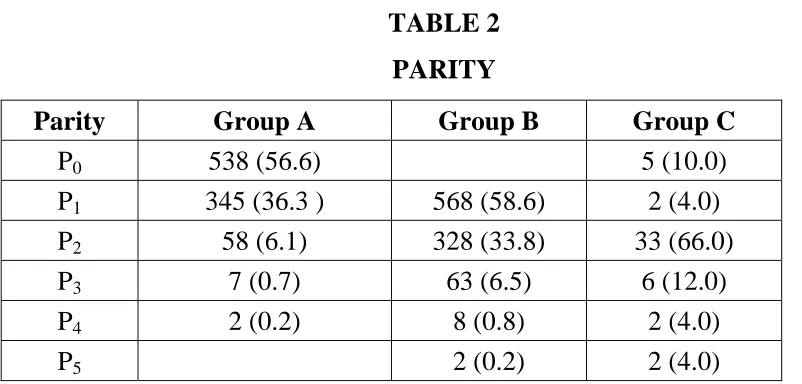
TABLE 2
PARITY
Parity Group A Group B Group C
P0 538 (56.6) 5 (10.0)
P1 345 (36.3 ) 568 (58.6) 2 (4.0)
P2 58 (6.1) 328 (33.8) 33 (66.0)
P3 7 (0.7) 63 (6.5) 6 (12.0)
P4 2 (0.2) 8 (0.8) 2 (4.0)
P5 2 (0.2) 2 (4.0)
[image:40.612.85.485.359.636.2]Figures in brackets represent percentages
TABLE 3
AWARENESS OF CONTRACEPTIVE METHODS
Method Group A Group B Group C Total Naturala 238 (24.8) 190 (19.6) 2 (4.0) 430 (21.8) Condom 583 (61.3) 578 (59.6) 36 (72.0) 1197 (60.7) Cral Pills 164 (17.2) 246 (25.3) 15 (30.0) 425 (21.5 ) Injectables 25 (2.6) 36 (3.7) - 61 (3.0) Intrauterine
Contraceptive Device
316 (33.2) 395 (40.7) 20 (40.0) 731 (37.1)
Emergency Contraception
1 (0.1) - - 1 (0.05)
Female sterilization
678 (71.3) 843 (86.9) 46 (92.0) 1567 (79.5)
Male
Sterilization
135 (14.2) 253 (26.1) 22 (44.0) 410 (20.8)
Medical Abortionb
168 (17.6) 354 (36.5) 45 (90.0) 567 (28.7)
None 89 (9.0) 76 (7.8) 3 (6.0) 165 (8.3) Figures in brackets represent Percentages
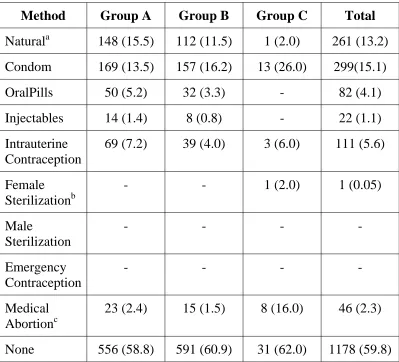
TABLE :4
CONTRACEPTIVE METHODS PREVIOUSLY USED
Method Group A Group B Group C Total
Naturala 148 (15.5) 112 (11.5) 1 (2.0) 261 (13.2)
Condom 169 (13.5) 157 (16.2) 13 (26.0) 299(15.1)
OralPills 50 (5.2) 32 (3.3) - 82 (4.1)
Injectables 14 (1.4) 8 (0.8) - 22 (1.1)
Intrauterine Contraception
69 (7.2) 39 (4.0) 3 (6.0) 111 (5.6)
Female Sterilizationb
- - 1 (2.0) 1 (0.05)
Male Sterilization - - - - Emergency Contraception - - - - Medical Abortionc
23 (2.4) 15 (1.5) 8 (16.0) 46 (2.3)
None 556 (58.8) 591 (60.9) 31 (62.0) 1178 (59.8)
Figures in brackets represent percentages
a. Natural methods –breast feeding withdrawal and calendar method b. Female sterilization failure cases
TABLE.5
LITERACY AND USE OF CONTRACEPTIVE METHODS
Group A Group B Group C Education
station
No % No % No %
Illiterate 44 28.2 46 18.9 5 35.7
Primary 41 28.2 40 36.3 4 36.3
High School + Higher secondary
292 46.7 290 50.0 10 40.0
Graduate 17 70.8 19 57.3 - -
TABLE 6
CHOICE OF METHOD FOR FUTURE USE
Method Group A Group B Group C Total Condom 134 (14.1) 115 (11.8) - 249 (12.6) Oral Pills 53 (5.5) 44 (4.5) - 97 (4.9) Injectables 22 (2.3) 23 (2.3) - 45 (2.2) Intrauterine
Contraception device
106 (11.1) 136 (14.0) 4 (8.0) 246 (12.4)
Emergency Contraception
56 (5.8) 49 (5.0) - 105 (5.3)
Female Sterilization
625 (65.7) 818 (84.4) 41.(82.0) 1484 (175.3)
Male Sterilization - - - -
Medical Abortiona 9 (0.9) 21 (2.1) - 30 (1.5) None 69 (7.2) 44 (4.5) 5 (10.0) 118 (5.9) Undivided 54 (5.6) 91 (9.3) - 145 (7.3)
[image:42.612.85.479.350.616.2]TABLE 7
REASONS FOR NOT UNDERGOING STERILIZATION
Reason No
Want of Male/ Female Child 5
Health does not permit 3
Worry of side effects 1
Afraid of sterilization/ Surgery 1
Opposition of Husband/Relatives 2
Total 12
TABLE 8
ATTITUDE TOWARDS FAMILY PLANNING
S.No Attitude Percentage Number
1. Approve 86.1 1695
2. Disapprove 4.1 82
[image:43.612.84.480.442.553.2]TABLE 9
ACCEPTABILITY OF MEDIA MESSAGE
Acceptability of media Message
Total % Age in
yrs
Yes No Yes No
No. of Women
14-19 476 29 94.2 5.8 505
20-29 1334 71 94.9 5.1 1405
30-39 42 16 72.4 27.6 58
40-49 1 - 100 - 1
TABLE 10
SOURCE OF KNOWLEDGE
Source Group A Group B Group C Total
Family/friends/ relatives
225 (23.6) 382 (39.4) 34 (68.0) 641 (32.5)
TV/Radio 150 (15.7) 214 (22.0) 18 (36.0) 382 (19.4)
Newspaper / Magazine
96 (10.1) 101 (10.4) 4 (8.0) 201 (10.2)
Medical Personal 229 (24.1) 186 (19.1) 21 (42.0) 436 (22.1)
School/ Collage 11 (1.1) 23 (2.3) - 34 (17)
Do not Know 86 (9.0) 76 (7.8) 3 (6.0) 165 (8.3)
DISCUSSION
SOCIODEMOGRAPHIC CHARACTERS
The Socio demographic characters of the group studied were shown in
Table: 1 Among all the women studies 25.6% of them are in the age group of
14-19yrs. Majority if them were in the age group of 20-29yrs (71.3%). Few
were in the age group of 30-39yrs (2.92%).
Among the antenatal and postnatal women all were married 10% of
women seeking MTP were unmarried.
Education is the Prime influencing factor. It may have direct influence
on fertility, since education affects the attitudinal and behavioral patterns in the
individuals. In the present study, a substantial proportion of the populations
were illiterate (20.9 %). About 13.5% of them were educated till primary
school. Majority of them 02.4% had high school and higher secondary
education. Only a minority of them (3.0%) were graduate.
This group was reflective of the general population with majority of
them being Hindus (91.2%), 6.6% them being Muslims and 2.1% of them
Christians.
Among the antenatal women, majority of them were primi (56.6%), and
the number decreased as parity increased, the same had reflected on the
postnatal women as shown in table2. Majority of Women (66.0%) seeking
medical termination of pregnancy were mostly carrying their third pregnancies.
Higher order pregnancies (P3,P4,P5) were fewer in number.
AWARENESS
The Knowledge among the women studied was wide spread as shown in
Table-3. Almost 91.9% were aware of at least one method of Contraception.
Almost 70% of them were aware of at least one modern method of
contraception.
The most popular method was female sterilization among 79.5% of
women followed by condoms (60.7%).
Intrauterine contraception device was known by 37.1% of women.
The Popularity of the condoms was due to the awareness created in the
hospital during admission or antenatal visits by the National AIDS control
organization (NACO) for pretest counseling during HIV Screening.
It is shocking to see that almost nobody was aware of the existence of
This differed from the study done by Sreevatsava et al in which most
common temporary method was intrauterine contraceptive device (61.2%) and
Emergency contraception was known to only 1.1% of women18.
PREVIOUS USE OF CONTRACEPTIVE
Previous use of any contraceptive method was shown in
table 3.
Though 91.7% of the women were aware of any method of
contraception, only 40.2% had used contraception.
The most commonly used method was condom, (15.1%), followed by
natural methods (13.2%).
There was only one women came for MTP, following sterilization
failure.
Majority of them (59.8%) have not used any method of contraception.
23% of them had previous medical termination of pregnancy.
LITERACY
Literacy is an important factor influencing the attitude towards family
use family planning practices as shown in
Table 5. Better education leads to improved use of family planning practices.
CHOICE OF METHOD FOR FUTURE USE
Most of the women opted for a permanent method than temporary
method as shown in table 6.
Female sterilization was the method of choice for 75.3% women.
Condoms were chosen by 12.6% of women for their future use,
Intrauterine device by 12.4% of women.
About 5.9% of women refused any form of contraception and 7.3% of
women told that they were undecided at present and would choose any one in
future.
Among antenatal women, 8.4% of women did not prefer temporary
method and they wished for permanent method in future after completing their
family.
Among postnatal women, 6.0% of women did not prefer a temporary
method. Twelve women (91.2%) were not willing to undergo sterilization,
husband / relatives as shown in
Table 7.
Majority of the women were not able to say whether their husbands
would undergo male sterilization. This showed lack of spousal communication
in the couples as shown in the study by Dabral S et al who showed more than
half of women have discussed about family planning methods with their
husbands11.
ATTITUDE
The analysis of attitude of the women towards approval of family
planning practices showed that, 86.1% of women approved family planning
practices, 9.8% did not know about the influences and consequences of FP
practices, but 4.1% disapproved its use, as shown in table 8.
Attitude of women towards acceptability of FP messages via Radio / TV
was 90.6%. Relatively older women, women who are illiterate did not consider
broad casting of FP messages acceptable as shown in table 9. On the other
hand, attitude towards acceptability of FP messages are highly favorable among
women who have completed primary school and above, as well as those below
30 years of age. Education is a significant factor that influences the attitude and
similarly shown by Dabral S et al in their study of attitude towards family
SOURCE OF KNOWLEDGE
The most important source of information was family including relatives
and friends, about 32.5% as shown in Table 10. Mass media accounts to 19.4%.
Newspaper & magazine account for 10.2% of the source of knowledge though
cheaper, it was used only by literate people. 8.3% of women were not aware of
any method of contraception as shown by John Mao in his study26. Family,
FURTHER SCOPE AND RECOMMENDATIONS
Approaches to meeting unmet need: An illustrative checklist.
i) To improve access to good quality.
Offer a choice of more contraceptive method, such as injectables.
Encourage wider commercial sales of contraception, through more
outlets.
Start or expand social marketing programs.
Train providers in empathic, respectful counseling and interpersonal
relation with clients.
Provide privacy for client counseling and procedures.
Reduce clients waiting time and paperwork. Improve client flow pattern
in health care facilities.
ii) To address health concerns and side effects.
Address facts and truth about family planning and health in mass media
communication discuss specific methods.
Train providers to manage side effects and counsel clients who return
with complaints.
That counseling covers side effects thoroughly including whether they
are likely to go away, what can be done about them and whether they are
signs of more serious problems that need medical attention.
Employ a broad range of FP methods so that clients easily switch
methods without risking pregnancy.
Empty the testimonials of satisfied contraceptive users to address the
concerns of those who have never used methods.
iii) To increase knowledge
Expand mass media communication to provide information about
methods and their use, using especially Radio / TV but also printing
Inform communities about methods at pubic meeting and community
events such as theatres.
Train FP providers to answer clients’ questions and concerns about
contraceptive methods.
iv) To overcome husband’s opposition
Address men directly with information about benefits and safety of
family planning, recognizing men’s often – dominating role in decision
making but promoting equal participation of women too.
Offer FP services for men and offer them in sittings that men find
comfortable.
Demonstrate that FP is the community norm and responsible behavior,
endorsed by religious and civic leaders.
Help women learn how they can talk with their partners about FP
SUMMARY
The main objective of family planning programme is to spread the
knowledge of family planning method and develop among people, the attitude
favorable for adoption of contraceptive method. The progress achieved in this
sphere is normally assessed from the result of KAP survey.
The aim of the study was to know the knowledge attitude towards
contraception and practice of contraception, to identify relationship between FP
practices and educational level, as well as the source of knowledge.
Women were categorized into three groups, with antenatal women in
group A, postnatal women in group B women seeking Medical Termination of
Pregnancy.
The study was done using a predesigned questionnaire.
Majority of them were in the age group of 20-29 years (77.3%). Almost
all of them were married (62.4%) of women were educated till high school and
higher secondary level.
At least 70% of them were aware of any one of modern method of
contraception. Condoms were the most popular temporary method (60.7%) and
Only 40.2% had used at least one method of contraceptive. Most
commonly used method was condom (15.7%) followed by natural method
(18.2%).
Most women preferred permanent method to temporary method. Female
sterilization was the method of choice in 75.3% of women.
The important source of information was family including friends and
relatives to about 32.5%. Other important sources include Radio / TV +
Medical personnel.
Reasons for unmet needs are:
1) Difficulties with access and quality of family planning services and
supplies
2) Health concerns about contraception and side effects
3) Lack of information
4) Opposition from husbands, families and communities.
5) Little perceived risk of pregnancy.
ii) Strengthening existing strategies and to sharpen the forms of existing
infrastructure for delivery of quality service.
iii) Expand the basket of choices for contraceptive taking into account a
variety of new demands arising from latent and manifest changes and
to improve easy availability of wider choice through more channels
for distribution.
iv) Link FP services to new opportunities arising from decentralization
and economic reforms such as health insurance, concern for human
CONCLUSION
This study reveals good knowledge and favorable attitude towards
family planning, though practices are poor.
The knowledge of Family Planning is wide spread among the
respondents though it is more among literate women. The important source of
information are family and friends and relatives. Ongoing motivation and
spread of knowledge about Family Planning measures is important to improve
BIBLIOGRAPHY
1) Park .K, Park’s, text book of Preventive and social medicine, 17edition, 325
-58.
2) National population Policy 2000
3) Censes Report, Census Report 2001, Govt of India, New Delhi.
4) Census Report, Census Report,1991, Govt of India, New Delhi,
5) SRS India; Sample Registration System, Register General and Census
Commissioner, Govt of India, New Delhi; 1989,1990,1999,2001,2003.
6) 4th 5year Plan
7) Bongaarts J. Population and development Review. 1978;(4);105.
8) WHO Contraceptive Method Mix Geneva; WHO, 1994.
9) WHO Health Benefits of family planning Geneva ;WHO 1995
10)WHO Natural family Planning Geneva ;1993.
11)Debral S & Malik SL-Demographic Study of Gujjars of Delhi IV-KAP of
FP-J of Human Ecology, 16(4) ;231-237(2004)
12)Bora RS& Jha MS ;Factors influencing the use of contraceptive. A study of
Rural Delhi-Demography India,30(2); 299-311(2001)
13)Bora RS, Malik P, Kulkarni; Operational Research on spacing, methods; A
comparative study for rural Delhi Report Submitted to the Ministry of
14)Bumpers LL-The Risk of an unwanted birth the changing content of
contraceptive sterilization in the US Population studies, 41;347-363(1987)
15)Chako, CK; Fertility and Contraceptive practice among religions minorities
in to districts of Tamil Nadu Research Compendium; funding and
implication of population &health studies 1964-87, The Gandhi gram
Institute of Rural Health & FW Trust, Gandhi gram, TN 1998.
16)Dharmaligam A, the Social context of Family planning in South Indian
Village, International FP perspective 21(3);98-103,sep 1995.
17)RamaRao S. and Townsend J.N- Unmet need and the situation of women in
India. Presented Association in America, Sanfracisco ,April 1995.12p
18)Sreevatsava,Reena and Collages, Contraceptive knowledge Altitude and
Practices Survey – JOGI vol 55, No6, Nov/Dec P8 546-550.
19)Unmet need for contraceptive –Economic and Political week by, Jan
18,2003
20)N.PDas and Urvi Shah –PRCs and other governmental Health organization
(D&E) cells & officers of the directors of the respective states –
Understanding of the Women’s Reproductive health needs in rural areas of
Gujarat.
21)KAP Studies among prostitutes- Journal for china AID/STD Preventive
control Vol 6,No.1, Feb 2000
22)Male involvement in FP Series through KAP, NIFHW-1998 & 1999.
23)ROY SK, study of KAP of the private medical practitioners about national
24)Ashok mandaletal, KAP of Emergency contraception among beneficiaries
and providers- JIMA-out 2006
25)Chatterjea T, study of contraceptive use in slum community of Kolkata –
IMJ 2006 100(8) 274-276.
26)John Mao Knowledge attitude and Practice of family planning a study Tezu
Village, Manipur ( India) The internet Journal of Biology
Anthropology2007.vol1,No.1
27)Bhat PNM.Contours of fertility decline in India A district level study based
on the 1991 census Srinivasam K. editor, Population Policy and
reproduction Health New Delhi; Hindustan Publications 1996.
28) Ramesh BM,Gulathi \SC, Rutherford RD, Contraceptive use in India
1992-93. IIPS ,Mumbai and Honolulu East-west center National Family Health
Survey Subject Report No. 1996.
29)Gautam AC,sethu PK, Appraisal of the Knowledge attitude and practices
(KAP) of family control devices among rural Rajputs and schedules caste of
Hatwar area of Bilaspur district Himachalpradesh 2001; Anthropologist,
4(4) ;289-292.
30)Takkar.N Goel P, Sha PK, Dua D, Contraceptive practices and awareness of
emergency contraceptive in educated working women. Indian J.Med
sci(Serial online) 2005 (Cited april4), 59;143-149.
31)Amonker RG, Brinker GD, The level of development and knowledge
attitude and practice and practice of FP in India, Social Development issues
32)Rao AAK, Client demand approach (CDA)in the revise family welfare
programme –A feasibility study Regional health Forum WHO East Asia
Region 2005;5(2).
33)Virginia Morrison, Contraceptive Need among Cambodian refugees in
Khao Phlu Camp, International Family planning Perspectives, 2000 26(4)
188-192.
34)Das Gupta N, Selective Discrimination against female children in Rural
Punjab, India Population and development Review ,B; 77-100(1987)
35)Gandotra MM, Das NP, Contraceptive choice shifted and VSE
contamination , A prospective study- Journal of family welfare, 36(3) 54-69
(1990)
36)Gold Schneider C, & Moshe W.D; Religion affliction and contraceptive
usage changing American pattern 1951-82, studies in FP 19;48-57 (1998)
37)International Institute of Population science National family heath survey
(NFHS) 1998-99, Delhi ,Mumbai(2002)
38)Kamal N, inter spousal communication on FP as a determinant of use of
modern conception in Bangladesh, Journal of FW, 45(1); 31-43 (1993)
39)Raja ram S, Timing of sterilization in two low fertility states, Demography
India, 27.8; 179-191(1998)
40)Rajarethnam T, Socio cultural determinates of contraceptive method choice
in Goa & Kerala, India, Journal of FW ;46(2) ;1-11(2000)
41)WHO. Health education in health aspects of family planning technical
42)Charles F, Westoff: Is the KAP gap real - population and Development
Review Vol14, No, 2,225-232, Jun 1998.
43)Bangarrts J. The KAP gap and unmeet need for contraception Population
Development Review 17(2); 293-313, June 1991.
44)Manoj Kumar Raut communication and contraceptive behaviors. Insight
and evidence from India and Bangladesh. Seminar papers submitted in
partial fulfillment of month of population studies for the year 2005 – 2006.
45)Kaur KP – Knowledge regarding FP methods among rural women of
Faridkot district of Punjab, India Journal of Behavior 191 Jul; 15(3) 49-55.
46)Sharma V. Sharma A – Family planning practices among tribal of south
Rajasthan, India – Journal of Resident education of Indian Medicine 1991 –
Oct. – Dec. 10(4) : 5-9.
47)Roy M, Lahini BC, Ghosh BN – A KAP study on MTP acceptors and their
contraceptive practice. Indian Journal of Public Health 1975 Apr – Jun;
22(27) 89-96.
48)Taneja RN – Fertility, knowledge, attitude and practices (KAP) study in
relation to FP via selected population of the Armed forces – Armed forces
Med. J. India – 1972; 28(1) : 1022 – 107.
49)Young LK, Farguhar CM, the Cowan LME et al. The contraceptive
practice of women seeking termination of pregnancy in an Auckland Clinic.
NZ Med. J. 1994; 107 : 189 – 191.
50)Broham DR, Cartmill RS. Knowledge in use of secondary contraception
among patients requesting termination of pregnancy. BMJ 1993; 306;
PROFORMA
Knowledge, attitude and Practices of Contraception
Name : Address:
Age : Occupation:
I.P.No. : Parity Status:
1. Socio demographic Characters:
a. Age
b. Marital Status
c. Educational Status
d. Religion
2. Abortion / Parity
3. Awareness of contraceptive methods
Natural methods
Condoms
Oral pills
Emergency contraception
IUD
Male Sterilization
Female Sterilization
Medical Abortion
None
4. Contraceptive methods previously used.
5. Contraceptive methods for future use
6. Source of knowledge
Radio
TV
Newspaper
Family / Relatives / Friends
Medical Personnel
School
Don’t’ know
7.Reasons for not accepting sterilization procedure
8. Acceptability of family planning messages in media Yes/No
9. Attitude towards family planning
Approve
Disapprove
GLOSSARY
WHO - World Health Organization
FP - Family Planning
KAP - Knowledge, Attitude and Practices
MTP - Medical Termination of Pregnancy
WY - Women Years
IUD - Intra uterine Device
C - Condoms
FS - Female Sterilisation
MS - Male Sterilisation
OCP - Oral Contraceptive Pills
NAT MET - Natural Methods
WDM - Withdrawal Method
MP - Medical Personnel