0022-538X/95/$04.0010
Copyrightq1995, American Society for Microbiology
Sequential Addition of Temperature-Sensitive Missense Mutations into
the PB2 Gene of Influenza A Transfectant Viruses Can Effect
an Increase in Temperature Sensitivity and Attenuation
and Permits the Rational Design of a Genetically
Engineered Live Influenza A Virus Vaccine
E. KANTA SUBBARAO,* EUN JU PARK, CASSANDRA M. LAWSON,†
ALICE Y. CHEN,ANDBRIAN R. MURPHY
Respiratory Viruses Section, Laboratory of Infectious Diseases, National Institute of Allergy and Infectious Diseases, Bethesda, Maryland 20892-0720
Received 11 April 1995/Accepted 26 June 1995
We have previously described a strategy for the recovery of a synthetic influenza A virus wild-type (wt) PB2
gene (derived from influenza A/Ann Arbor/6/60 [AA] virus) into an infectious virus. It was possible to introduce
an attenuating temperature-sensitive (ts) mutation at amino acid residue 265 of the AAwtPB2 gene and to
rescue this mutant gene into infectious virus. Application of this new technology to influenza A virus vaccine development requires that multiple attenuating mutations be introduced to achieve a satisfactorily attenuated
virus that retains the attenuation (att) phenotype following replication in vivo. In this report, we demonstrate
that putativetsmutations at amino acids 112, 556, and 658 each indeed specify thetsandattphenotypes. Each
of these mutations was introduced into a cDNA copy of the AA mutant mt265 PB2 gene to produce three double-mutant PB2 genes, each of which was rescued into an infectious virus. In general, the double-mutant
PB2 transfectant viruses were moretsand attenuated in the lower respiratory tracts of hamsters than the
single-mutant transfectant viruses, and the ts phenotype of two of three double-mutant PB2 transfectant
viruses was stable even after prolonged replication in the upper respiratory tracts of immunocompromised mice. Two triple-mutant PB2 transfectant viruses with three predicted amino acid substitutions resulting from five nucleotide substitutions in the cDNA were then generated. The triple-mutant PB2 transfectant viruses were
moretsand more attenuated than the double-mutant PB2 transfectant viruses. These results indicate that
sequential introduction of additionaltsmutations into the PB2 gene can yield mutants that exhibit a stepwise
increase in temperature sensitivity and attenuation compared with the preceding mutant(s) in the series. Furthermore, the level of temperature sensitivity of the transfectant viruses correlated significantly with the level of attenuation of these viruses in hamsters. Although the triple-mutant PB2 transfectant viruses were attenuated in hamsters, intranasal administration of these viruses elicited a vigorous serum hemagglutination-inhibiting antibody response, and this was associated with resistance of the lower respiratory tract to
subse-quentwtvirus challenge. These observations suggest the feasibility of using PB2 reverse genetics to generate
a live influenza A virus vaccine donor strain that contains three attenuating mutations in one gene. It is predicted that reassortant viruses derived from such a donor virus would have the properties of attenuation,
genetic stability, immunogenicity, and protective efficacy against challenge withwtvirus.
A wide variety of conventional approaches have been used in attempts to develop a candidate live attenuated influenza A virus vaccine (14). Each of these approaches involves the se-lection or production of attenuating mutations in one or more genes of an influenza A virus that do not encode the two protective antigens of the virus (the hemagglutinin [HA] and neuraminidase [NA] glycoproteins). These attenuating genes are then transferred from the attenuated donor virus, by ge-netic reassortment, to new epidemic or pandemic influenza A virus variants that appear in nature. Reassortant viruses that bear the HA and NA genes of the wild-type (wt) virus and the attenuating gene(s) of the donor virus are then selected as the
new candidate vaccine virus. Although many approaches for the production or identification of attenuating genes have been investigated, most have been unsuccessful because of incom-plete attenuation of candidate vaccine viruses bearing these genes or instability of the attenuation (att) phenotype of sat-isfactorily attenuated strains following replication in vivo (14). Only one candidate vaccine developed by using these conven-tional techniques, the cold-adapted influenza A vaccine, still shows promise and is in an advanced stage of development as a vaccine for use in humans (11). The success of this vaccine likely stems from the presence of three attenuating gene seg-ments in the donor strain (22). In the context of the many unsuccessful attempts at vaccine development, there is a need for a more rational approach to vaccine design that involves the sequential introduction of specific, defined attenuating mu-tations into a virus to produce a donor strain that is satisfac-torily attenuated and that exhibits a stable att phenotype dur-ing replication in vivo. The present study describes one such approach.
By using the techniques of reverse genetics, a process by
* Corresponding author. Mailing address: RVS/LID/NIAID/NIH, Building 7, Room 106, 7 Center Dr. MSC 0720, Bethesda, MD 20892-0720. Phone: (301) 496-4205. Fax: (301) 496-8312.
† Present address: Australian Neuromuscular Research Institute, Queen Elizabeth II Medical Centre, Nedlands, Western Australia 6009, Australia.
5969
on November 9, 2019 by guest
http://jvi.asm.org/
which a synthetic influenza A virus RNA gene that is tran-scribed in vitro from a cDNA copy of the gene is rescued into an infectious virus, it is possible to introduce site-specific mu-tations into selected gene segments (3, 4). Several studies have demonstrated that attenuating mutations can be introduced into the noncoding or coding regions of the HA and NA genes of influenza A viruses (1, 16), but such attenuating genes can-not be used to confer attenuation on new epidemic or pan-demic viruses, since vaccine viruses must contain the HA and NA genes of the newly emerged antigenic variant to be useful in immunization.
We have previously reported the development of a success-ful strategy for the rescue of a synthetic influenza A virus wt gene that encodes an internal viral polymerase protein, PB2. This strategy was also applied successfully to the rescue of a mutant PB2 gene bearing a single site-specific mutation (at amino acid [aa] 265) that conferred the temperature-sensitive (ts) and att phenotypes upon the transfectant virus (25). We have been exploring the possibility of sequentially introducing additional mutations into the same gene segment in order to generate a single attenuating influenza A virus PB2 gene seg-ment that might be used alone in a vaccine donor strain or in combination with another attenuating gene segment. The PB2 gene, and its associated att phenotype, could then be readily transferred from the attenuated donor virus to new antigenic variants of influenza A virus as they emerge (9, 15). The major assumption inherent in this approach was that the PB2 trans-fection rescue system would operate efficiently for selection of PB2 gene segments containing more than one ts mutation. A second assumption was that putative ts mutations identified by genetic and sequence analysis in a series of influenza A ts viruses (7, 10, 31) would confer the ts phenotype when intro-duced into the closely related but nonhomologous influenza A/Ann Arbor/6/60 (AA) virus PB2 gene. It was also unclear whether two or more mutations that independently conferred the ts phenotype on transfectant viruses would be additive and produce a virus that was more attenuated than viruses bearing only a single mutation. This study establishes the feasibility of the PB2 transfection rescue system for the rescue of double-and triple-mutant ts transfectant viruses double-and demonstrates that the sequential introduction of mutations into the PB2 gene can lead to a progressive increase in temperature sensitivity and attenuation.
MATERIALS AND METHODS
Viruses.The helper virus used in transfection experiments, as described pre-viously, was a PB2 single-gene reassortant virus that derived its PB2 gene seg-ment from the avian influenza A/Mallard/NY/78 virus and the remaining seven gene segments from the human influenza A/Los Angeles/2/87 (H3N2) (A/LA/2/ 87) virus. This single-gene reassortant virus is useful as a helper virus because of its host range restriction phenotype; i.e., the helper virus replicates efficiently in avian cell culture but replicates very poorly in mammalian cell culture (2, 25). Thus, the recovery of transfectant viruses bearing the PB2 gene of a human influenza A virus is favored in mammalian cell culture. The generation of the A/LA/2/87 AA wt PB2 transfectant virus and the A/LA/2/87 AA mutant mt265 PB2 transfectant virus by transfection rescue techniques has been described previously (25). The isolation and passage histories of the A/LA/2/87 wt virus which was used as a challenge virus and the influenza B/Ann Arbor/1/86 (B/AA/ 1/86) virus which was used as an immunologically irrelevant control virus for immunogenicity and challenge experiments have been described previously (2, 25).
Cells.Transfections were carried out in primary chicken kidney cell monolay-ers prepared from kidneys of 3- to 5-day-old specific-pathogen-free chicks as indicated previously (25). Transfection harvests were subsequently plaqued on Madin-Darby canine kidney (MDCK) cell monolayers. Virus titration for quan-titation of virus (50% tissue culture infective dose [TCID50]) produced in vitro or in vivo and the plaque assay for determining the effect of temperature on plaque formation and for cloning transfectant virus progeny were performed in MDCK cell monolayers as previously described (12).
Plasmids.pTZ18U plasmid DNA with the full-length PB2 gene from the AA
virus (pT3AAwtPB2) generated as described previously (25) was used as the template for site-directed mutagenesis to generate the mt112, mt556, and mt658 PB2 plasmids, which each contained a single amino acid substitution at the indicated position of PB2. pTZ18U plasmid DNA containing the full-length PB2 gene from the AA virus bearing a single nucleotide substitution at position 821 (amino acid change at position 265) (pT3AAmt265) was generated as described previously (25) and was used as the template for site-directed mutagenesis to generate the double-mutant mt2651112, mt2651556, and mt2651658 PB2 plas-mids. The mt2651556 and mt2651658 PB2 plasmids were then used as tem-plates for further site-directed mutagenesis to generate the triple mutants mt26511121556 and 26511121658, respectively. Mutated PB2 plasmid DNA was digested overnight with HgaI (New England Biolabs, Beverly, Mass.) and filled in with Klenow fragment (New England Biolabs) before use as a template in transcription reactions as previously described (25).
Site-directed mutagenesis.The procedure outlined for the Muta-gene phage-mid in vitro mutagenesis kit (Bio-Rad Laboratories, Richmond, Calif.) was followed, using oligonucleotides designed to achieve the substitutions listed in Table 1.
Ribonucleoprotein preparation.Ribonucleoprotein was prepared from virus purified from 500 embryonated eggs inoculated with the avian influenza A/Duck/ Oklahoma/4/77 virus as described previously (18, 25).
Transfection system.T3 polymerase ribonucleoprotein transcription reaction mixtures were incubated at 378C for 55 min, treated with DNase for 5 min, and then transfected into DEAE-dextran-treated primary chicken kidney cells in-fected with the PB2 single-gene reassortant helper virus by a modification (25) of the technique described by Luytjes et al. (8). Transfection mixtures were incu-bated at 328C overnight and were harvested 22 to 24 h later.
Generation and nucleotide sequence analysis of PB2 transfectant viruses.By using a method described previously, PB2 transfectant viruses that derived their PB2 gene from the plasmid were selected in MDCK cells, which are restrictive for replication of the PB2 single-gene reassortant helper virus, at 328C (25). Plaque progeny, which underwent a total of three plaque-to-plaque passages on MDCK cell monolayers, were amplified first in MDCK cells and next in the allantoic cavity of embryonated eggs. The nucleotide sequence of the coding region of the PB2 gene of each transfectant virus was determined as previously described (25).
Efficiency of plaque formation.The efficiency of plaque formation was deter-mined at 32, 36, 37, 38, 39, and 408C in two to four separate experiments using MDCK cell monolayers as described previously (27). Virus titers were expressed as mean log10PFU per milliliter.
Level of replication, immunogenicity, and protective efficacy of transfectant viruses in hamsters.The level of virus replication and the immunogenicity of the
wt and mutant PB2 transfectant viruses were determined in female golden Syrian
hamsters as indicated in the footnotes to Tables 3 and 4, respectively. Titers of hemagglutination-inhibiting antibodies in sera were measured against the A/LA/ 2/87 wt virus as described previously (17).
Level of genetic stability of double-mutant transfectant viruses after pro-longed replication in nude mice.The A/LA/2/87 AA wt virus or a double-mutant PB2 transfectant virus derived from it was inoculated intranasally into 4- to 6-week-old female nude (nu/nu) BALB/c or nude (nu/nu) NIH Swiss mice (105.0 or 106.0TCID
50in a 0.05- or 0.1-ml inoculum, respectively), and virus was allowed to replicate in these mice for 14 days. The AA mt2651112 PB2 trans-fectant virus was evaluated in 15 nude BALB/c and 100 nude NIH Swiss mice, while the other two double-mutant transfectant viruses were each evaluated in 120 nude NIH Swiss mice. Four additional nude BALB/c mice were infected with the A/LA/2/87 AA wt PB2 transfectant virus. The animals were sacrificed after 14 days, and lungs and nasal turbinates were removed and homogenized. Each specimen of lung and nasal turbinate suspension was cultured for virus, and the resulting isolates were then tested for their efficiencies of plaque formation at 32 and 398C (for mt2651556 and mt2651658) or 39.58C (for mt2651112) to de-termine the ts phenotype of virus isolated after prolonged replication in vivo. The choice of the nonpermissive temperature was based on the temperature at which the replication of the mutant PB2 transfectant virus was completely restricted. The ts phenotype of isolates that produced plaques at the restrictive temperature was evaluated further by characterization of plaque progeny (amplified at the permissive temperature) for efficiency of plaque formation at 32 or 39.58C. Those isolates that produced plaques efficiently at restrictive temperature were consid-ered to contain ts1revertant virus.
RESULTS
Generation of single-, double-, and triple-mutant PB2
trans-fectant viruses.We previously described the rescue of the AA
wt PB2 gene into infectious virus designated A/LA/2/87 AA wt
PB2 transfectant virus. Similarly, a mutant derivative of the gene with a substitution mutation at aa 265 was rescued into infectious virus that was designated A/LA/2/87 AA mt265 PB2 transfectant virus (25). The mutation at aa 265 conferred the ts and att phenotypes on the transfectant virus, indicating that
on November 9, 2019 by guest
http://jvi.asm.org/
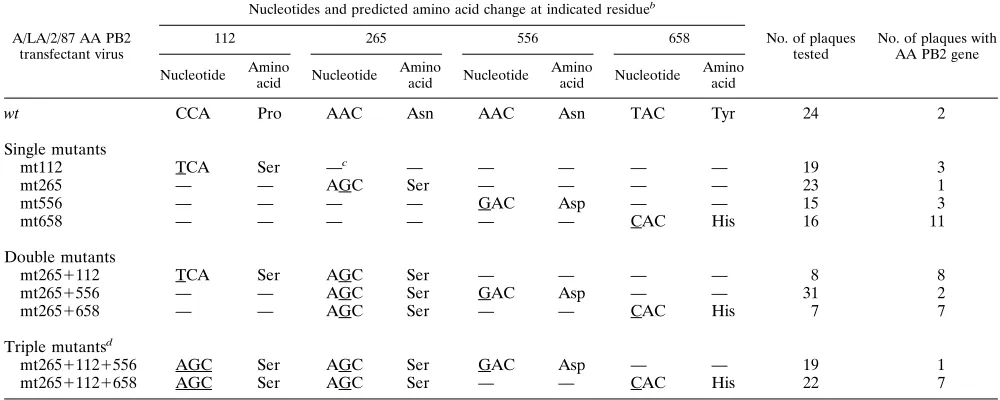
this mutation originally identified in the PB2 gene of the AA cold-adapted donor virus specified these phenotypes (25). We next selected three additional separate putative ts mutations for introduction into the AA wt PB2 gene (Table 1): (i) at aa 112, the site of a mutation that was present in three indepen-dently derived influenza A/Udorn/72 ts mutants; (ii) at aa 556, the site of a mutation that was present in another influenza A/Udorn/72 ts mutant in a region with homology to the cap-binding motifs of human and yeast proteins; and (iii) at aa 658 (in an influenza A/Great Lakes/65 virus PB2 gene), the site of a mutation that was present in the ts-1E mutant virus, which was previously evaluated as a vaccine candidate (7, 23). In this manner, it was possible to determine if ts mutations identified in a different influenza A virus (A/Udorn/72 or A/Great Lakes/ 65) could specify the ts phenotype when introduced by reverse genetics into a related but nonhomologous AA wt PB2 gene. Each of the mutant PB2 genes was successfully rescued into infectious virus; in each instance, viral progeny of several plaques were shown to possess a PB2 gene with the predicted amino acid mutation (Table 1). Progeny of a single positive plaque were selected from each group, and these clones were designated A/LA/2/87 AA mt112 clone 12D1, mt556 clone A, and mt658 clone 8B1, respectively.
Following demonstration that a mutation at aa 112, 556, or 658 specified the ts phenotype (Table 2), we sought to combine two mutations in the AA PB2 gene to determine whether the transfection rescue system would operate efficiently enough to rescue presumably more defective double-mutant viruses. Three different double-mutant PB2 transfectant viruses were successfully rescued, and in each instance, a single
represen-tative clone (designated A/LA/2/87 AA mt2651112 clone 6A1,
mt2651556 clone 30A1, and mt2651658 clone 4A1) was
se-lected for further study, plaque purified, and confirmed by nucleotide sequencing to differ in its sequence from the A/LA/ 2/87 AA wt PB2 gene only at the predicted amino acid residues 265 and 112, 556, or 658. In addition, we recovered two triple-mutant viruses that contained three amino acid substitutions,
namely, aa 265, 112, and 556 and aa 265, 112, and 658, as a result of five nucleotide substitutions (Table 1). The observa-tion that the PB2 reverse genetics system worked as efficiently for rescue of an AA double- or triple-mutant PB2 gene as for an AA single-mutant PB2 gene (Table 1) was encouraging because it clearly established the technical feasibility of insert-ing multiple ts mutations into the PB2 gene.
Sequential introduction of two or threetsmutations into the
PB2 gene of transfectant viruses results in a progressive
in-crease in temperature sensitivity. The efficiencies of plaque
formation of the PB2 transfectant viruses with one, two, or three predicted amino acid substitutions in the PB2 gene were compared at different temperatures with that of the A/LA/2/87 AA wt PB2 transfectant virus (Table 2). The A/LA/2/87 AA mutant PB2 transfectant viruses bearing a single mutation
showed a restriction of replication at 39 and 408C that was
greater than that of the AA wt PB2 transfectant virus. The finding that each of the three putative ts mutations (aa 112, 556, and 658) specified the ts phenotype confirmed that these amino acid substitutions were indeed ts mutations as had been shown previously for the aa 265 mutation. The substitution at aa 556 effected the greatest suppression of replication at an elevated temperature. The addition of a second mutation (at aa 112, 556, or 658) to the AA mt265 PB2 transfectant virus led to a restriction of replication at an elevated temperature greater than that conferred by a single ts mutation in one of the
three instances, i.e., mt2651112. However, an increase in
tem-perature sensitivity was clearly seen for the triple-mutant PB2 transfectant viruses, which displayed a shutoff temperature that was 1 degree lower than that of its parental double-mutant PB2 transfectant virus. Thus, the addition of two predicted amino acid substitutions to a PB2 gene bearing a single amino acid substitution led to further restriction of replication in vitro at an elevated temperature over the level of restriction im-posed by one or two of these mutations. Reduction in the level
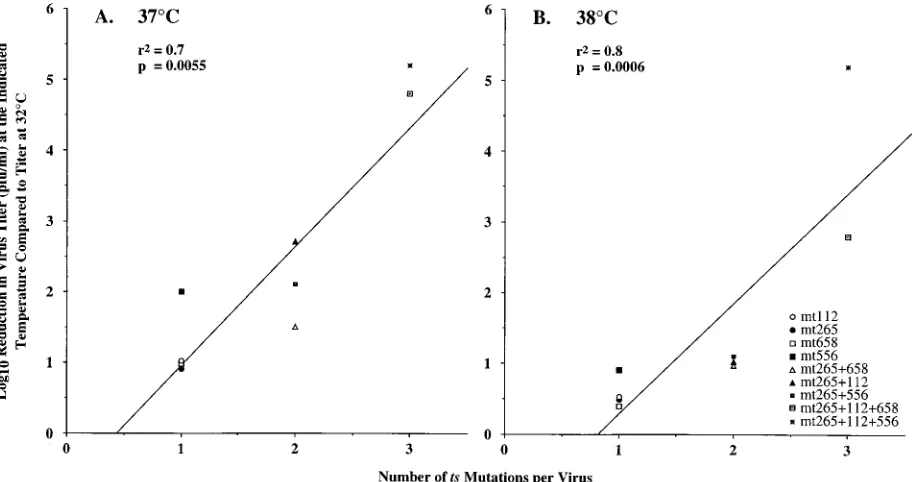
of replication of mutant transfectant viruses at 37 and 388C
[image:3.612.56.556.95.295.2]correlated significantly with the number of ts mutations (Fig.
TABLE 1. Nucleotide and predicted amino acid substitutions inserted by site-directed mutagenesisainto the AA PB2 gene
rescued into transfectant viruses
A/LA/2/87 AA PB2 transfectant virus
Nucleotides and predicted amino acid change at indicated residueb
No. of plaques tested
No. of plaques with AA PB2 gene
112 265 556 658
Nucleotide Amino
acid Nucleotide Amino
acid Nucleotide Amino
acid Nucleotide Amino
acid
wt CCA Pro AAC Asn AAC Asn TAC Tyr 24 2
Single mutants
mt112 TCA Ser —c — — — — — 19 3
mt265 — — AGC Ser — — — — 23 1
mt556 — — — — GAC Asp — — 15 3
mt658 — — — — — — CAC His 16 11
Double mutants
mt2651112 TCA Ser AGC Ser — — — — 8 8
mt2651556 — — AGC Ser GAC Asp — — 31 2
mt2651658 — — AGC Ser — — CAC His 7 7
Triple mutantsd
mt26511121556 AGC Ser AGC Ser GAC Asp — — 19 1
mt26511121658 AGC Ser AGC Ser — — CAC His 22 7
aMutagenic oligonucleotide primers were designed to achieve the changes listed.
bThe coding region of the PB2 gene in each selected and cloned transfectant virus was confirmed to differ from that of the wt AA PB2 gene only at the indicated sites (underlined).
c—, codon identical to that of the wt virus.
dTriple-mutant PB2 genes had five nucleotide substitutions encoding three ts mutations.
on November 9, 2019 by guest
http://jvi.asm.org/
1). The single- and triple-mutant transfectant viruses bearing
the aa 556 mutation were more ts at 37 and 388C than their
counterparts (Fig. 1), indicating that the specific mutation it-self is also an important determinant of the level of tempera-ture sensitivity exhibited by the transfectant virus.
Introduction of two or three additionaltsmutations into the
PB2 gene of transfectant viruses results in greater degrees of restriction of replication in the upper and lower respiratory
tracts of hamsters.The replication of the wt and mutant PB2
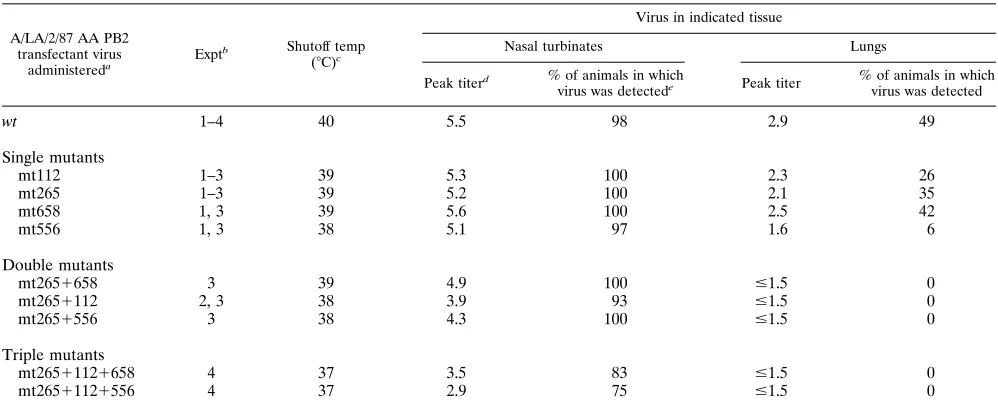
transfectant viruses in hamsters was next studied (Table 3). The A/LA/2/87 AA single-mutant PB2 transfectant viruses
[image:4.612.60.556.84.271.2]rep-licated in the upper respiratory tract (nasal turbinates) to a level similar to that of the A/LA/2/87 AA wt PB2 transfectant virus; the level of replication of these mutants in the warmer lower respiratory tract (lungs) also did not appear to be dimin-ished significantly. The AA double-mutant PB2 transfectant viruses, on the other hand, replicated to lower titer in the nasal turbinates and were not detectable in the lungs. Similarly, the triple-mutant PB2 transfectant viruses were not detectable in the lungs and exhibited a greater degree of attenuation in the upper respiratory tract than the double-mutant transfectant viruses. It should be noted that the AA wt PB2 transfectant
[image:4.612.83.539.473.714.2]FIG. 1. Correlation between the number of ts mutations introduced into the PB2 gene and restriction of plaque formation at 37 and 388C in MDCK cell culture. TABLE 2. Addition of sequential mutationsainto the PB2 gene of influenza A virus yields transfectant viruses that are progressively more ts
A/LA/2/87 AA PB2 transfectant virus
Titer at 328Cb
Mean log10reduction in titer (PFU/ml) at indicated temp compared
with titer at permissive temp (328C) Shutoff temp (8C)c
368C 378C 388C 398C 408C
wt 6.760.1 20.1 0.1 0.6 1.6 4.2 40
Single mutants
mt112 6.560.1 0.2 0.5 1.0 2.7 5.3 39
mt265 6.360.1 0.1 0.5 0.9 2.9 5.2 39
mt658 6.260.1 0.2 0.4 1.0 4.3 $5.5d 39
mt556 6.160.1 0.4 0.9 2.0 5.0 $5.4d 38
Double mutants
mt2651658 6.160.0 0.4 1.0 1.5 >5.4d $5.4d 39
mt2651112 6.360.1 0.4 1.0 2.7 5.5 $5.6d 38
mt2651556 6.160.0 0.6 1.1 2.1 $5.4d $5.4d 38
Triple mutants
mt26511121658 5.560.2 1.3 2.8 $4.8d $4.8d $4.8d 37
mt26511121556 5.960.1 1.4 >5.2d $5.2d $5.2d $5.2d 37
a
Indicated by amino acid position in the PB2 gene. b
Mean of two to eight experiments6standard error. c
The shutoff temperature, indicated by boldface numbers, is defined as the lowest restrictive temperature at which there is a$2 log10reduction in titer from the titer at the permissive temperature of 328C.
d
No plaques were observed at the indicated temperature in any of the experiments.
on November 9, 2019 by guest
http://jvi.asm.org/
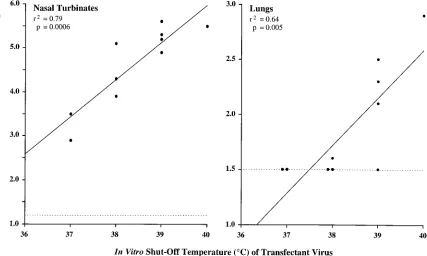
virus appears partially attenuated for the lungs of hamsters for reasons that remain undefined. Possibly, this reflects a mixed polymerase gene constellation effect observed previously for influenza A virus reassortants that derived one of their merase protein genes from one parent and the other two poly-merase protein genes from the other parent (5). Therefore, the effects of the introduced ts mutations on replication in the lower respiratory tracts of hamsters must be interpreted in this context. The level of temperature sensitivity of the transfectant viruses correlated significantly with the peak level of virus replication in the upper and lower respiratory tracts of ham-sters (Fig. 2), indicating that the level of temperature sensitiv-ity achieved by site-directed mutagenesis was the predominant determinant of attenuation. The incremental nature of the restriction of replication conferred by the addition of second and third ts mutations is presented in Fig. 3. It is apparent that the addition of second- and third-site mutations to mt265 led to progressive increases in the level of attenuation for the upper respiratory tracts of hamsters and that the splays in restriction of replication manifested by the double- and triple-mutant viruses suggest that specific mutations can make dif-ferent contributions to the level of attenuation manifested by the transfectant virus.
PB2 transfectant viruses with two or threetsmutations in
the PB2 gene are immunogenic and protect the lower
respira-tory tracts of hamsters fromwtvirus challenge.We next
eval-uated whether selected AA double- and triple-mutant PB2 transfectant viruses were immunogenic and exhibited protec-tive efficacy in vivo. Since a single-mutant PB2 transfectant virus (AA mt265) was previously shown to be immunogenic and protective in hamsters (25), we focused our evaluation on one of the AA double-mutant PB2 transfectant viruses (AA
mt2651112) and the two triple-mutant PB2 transfectant
vi-ruses (Table 4). The influenza A/LA/2/87 wt virus was chosen as the virus to be used for challenge since it bears HA and NA
genes that are homologous with those of the transfectant vi-ruses and replicates to considerably higher titer in hamster lungs than the A/LA/2/87 AA wt PB2 transfectant virus, which possesses an AA PB2 gene in an A/LA/2/87 virus background (Tables 3 and 4). This mixture of polymerase protein genes from two different viruses might result in partial attenuation of the AA wt PB2 transfectant virus for hamsters as described above. The challenge virus was administered 30 days after
immunization with the A/LA/2/87 AA wt, mt2651112, mt2651
1121556, or mt26511121658 PB2 transfectant virus. The
im-munologically irrelevant influenza B/AA/1/86 wt virus was also used to immunize mice which served as negative controls in the evaluation of protective efficacy. Lungs and nasal turbinates were harvested on the day following challenge because prelim-inary experiments indicated that peak titers following infection with the A/LA/2/87 wt challenge virus were achieved at this time. Despite the attenuation of the double- and triple-mutant PB2 transfectant viruses in hamsters (Table 3), the viruses,
except for the triple mt26511121556, were highly
immuno-genic, and each of these viruses induced resistance of the lower respiratory tract to wt virus challenge (Table 4).
PB2 transfectant viruses bearing two mutations in the PB2
gene display stability of thetsphenotype after prolonged
rep-lication in the respiratory tracts of mice.The level of stability
of the ts phenotype of the double-mutant PB2 transfectant viruses was evaluated by determining the ts phenotype of vi-ruses isolated after prolonged replication (14 days) in vivo in an immunocompromised host (i.e., T-cell-deficient nude [nu/
nu] mice). Day 14 was selected as the time for harvesting lungs
[image:5.612.57.556.91.294.2]and nasal turbinates because data from the evaluation of live influenza A virus vaccines in humans suggested that vaccine viruses can replicate for up to 11 days in fully susceptible seronegative humans (30), a considerably longer time than the 6 to 8 days of virus replication observed in immunocompetent rodents. The A/LA/2/87 AA wt and mutant PB2 transfectant
TABLE 3. Relationship of the number of ts mutations present in the PB2 genes of transfectant viruses and the restriction of replication in the respiratory tracts of hamsters
A/LA/2/87 AA PB2 transfectant virus
administereda
Exptb Shutoff temp (8C)c
Virus in indicated tissue
Nasal turbinates Lungs
Peak titerd % of animals in which
virus was detectede Peak titer % of animals in which virus was detected
wt 1–4 40 5.5 98 2.9 49
Single mutants
mt112 1–3 39 5.3 100 2.3 26
mt265 1–3 39 5.2 100 2.1 35
mt658 1, 3 39 5.6 100 2.5 42
mt556 1, 3 38 5.1 97 1.6 6
Double mutants
mt2651658 3 39 4.9 100 #1.5 0
mt2651112 2, 3 38 3.9 93 #1.5 0
mt2651556 3 38 4.3 100 #1.5 0
Triple mutants
mt26511121658 4 37 3.5 83 #1.5 0
mt26511121556 4 37 2.9 75 #1.5 0
aOn day 0, 105.0TCID
50of the indicated virus was administered intranasally in a 0.1-ml inoculum to anesthetized 5-week-old golden Syrian hamsters. On days 2 through 5, nasal turbinates and lungs were harvested and homogenized, and mean virus titers in the tissues were determined.
bData from four experiments are summarized.
cDefined as the lowest restrictive temperature at which there is a$2 log
10reduction in titer from the titer at the permissive temperature of 328C. dExpressed as mean log
10TCID50per gram. The lowest detectable titers in nasal turbinates and lungs were 1.2 and 1.5 log10TCID50/g, respectively.
eCalculated as number of animals with virus detected in the indicated tissue/total number of animals tested. The range of the number of animals tested in each group was 18 to 84.
on November 9, 2019 by guest
http://jvi.asm.org/
viruses could not be recovered from the lungs of nude mice after 14 days; however, isolates were recovered at that time from the nasal turbinates. The single-mutant PB2 transfectant virus isolates were not studied systematically in mice because two of the four mutants and the AA wt PB2 transfectant virus
as well produced some plaques at 408C (Table 2). We therefore
concentrated our efforts on characterization of the double-mutant PB2 transfectant viruses, two of which showed
com-plete restriction of replication at 398C, whereas replication of
the remaining mutant, mt2651112, was completely shut off at
39.58C (data not shown) (Table 2). Isolates obtained from each
of four animals infected with the A/LA/2/87 AA wt PB2 trans-fectant virus retained the ts phenotype as expected (data not
shown). The mt2651112 virus was administered to 115 nude
mice, but only 10 isolates were recovered; all were ts. The
mt2651556 virus was administered to 120 mice, 69 isolates
were obtained, and all were ts. Similarly, the mt2651658 virus
was administered to 120 mice, 89 isolates were obtained, and 7
produced plaques at 398C. The original nasal turbinate tissue
homogenates of the seven mice that yielded isolates with ts1
virus were next tested, and five of the seven specimens failed to
produce plaques at 398C (all were positive at 328C). In
addi-tion, plaque progeny of these five isolates picked at 398C and
amplified at 328C were all ts. These five isolates and their
corresponding original nasal turbinate homogenates were
therefore considered free of ts1 virus. The remaining two
animals had ts1viruses in the original nasal turbinate tissue
homogenates, at a titer that was 5- to 20-fold lower at 398C
than the titer at 328C. Plaque progeny picked from the isolates
at 398C were ts1after amplification at 328C. Thus, only 2 of 89
(2%) of isolates from animals infected with mt2651658
con-tained ts1 virus. The triple-mutant transfectant viruses were
not studied because the frequency of isolating ts1viruses from
the double-mutant viruses was so low.
DISCUSSION
It has traditionally been difficult to satisfactorily attenuate influenza A viruses by conventional techniques. The major impediment to the generation of a satisfactorily attenuated donor virus has been our inability to add or subtract
attenuat-FIG. 2. Correlation between the level of temperature sensitivity of the AA PB2 transfectant viruses and level of replication in the respiratory tracts of hamsters. Dotted lines indicate the lower limit of detection.
FIG. 3. Progressive increase in attenuation for the upper respiratory tracts of hamsters with sequential addition of ts mutations to the mt265 transfectant virus.
on November 9, 2019 by guest
http://jvi.asm.org/
[image:6.612.96.523.72.328.2]ing mutations to incompletely attenuated or overattenuated vaccine viruses in a controlled fashion. In some instances in which a satisfactory level of attenuation was achieved by com-bining two genes with attenuating mutations in one donor virus, the attenuation phenotype of the virus was not suffi-ciently stable following replication in fully susceptible seroneg-ative individuals (6, 13, 27). The findings from the present study suggest that it may be possible to overcome these diffi-culties.
The use of PB2 reverse genetics for influenza A virus vaccine development now allows us to optimize attenuation by step-wise addition of attenuating mutations to one gene segment until a satisfactory level of attenuation has been reached. A systematic design and assessment of the effect of each serially added mutation is possible with this technique because each new mutant gene differs from its predecessor by one defined mutation, and the biological properties of transfectant viruses bearing these mutant genes can be evaluated directly in vivo at each stage of development. In the present study, we observed that although specific single mutations resulted in only a very modest increase in temperature sensitivity and attenuation, an incremental increase in the level of temperature sensitivity and attenuation could be achieved by the addition of a second and a third ts mutation to a PB2 gene segment that already had a single ts mutation. In this way, it was possible to produce two
triple mutants with a 378C shutoff temperature of replication
in vitro. It is important to note that a previously evaluated
influenza A virus with a 378C shutoff temperature appeared
satisfactorily attenuated in humans, but it was not stable with respect to its ts and att phenotypes after replication in sero-negative humans (19, 27). From the results of extensive eval-uation of ts viruses in humans, it is reasonable to suggest that
the triple-mutant viruses with a 378C shutoff temperature will
likely be satisfactorily attenuated even in seronegative infants and children (19). Although it is possible to combine attenu-ating genes into one virus by the process of genetic reassort-ment, there are practical limits to the number of viral genes that can be transferred efficiently in a timely manner from a donor virus to a new antigenic variant of influenza A virus. The advantage of adding mutations to the same gene segment
rather than distributing mutations among several gene seg-ments is that the transfer of a single attenuating gene segment (with accompanying identifying markers such as temperature sensitivity) to a wt virus, by reassortment, will be easier than transfer of several gene segments that specify optimal attenu-ation only when present as a constellattenu-ation. This technical ad-vantage should permit the rapid generation of new reassortant vaccines in a timely manner to meet production deadlines for vaccines to be used against a predicted influenza virus epi-demic or panepi-demic. While we anticipate that reassortant vi-ruses bearing the triple-mutant AA PB2 gene in different wt virus backgrounds will be reproducibly attenuated, this can be ascertained only after several such reassortants are generated and studied systematically.
Immunization of hamsters with virus containing one, two, or three ts mutations in the PB2 gene induced hemagglutination-inhibiting antibodies and protected hamsters against wt virus challenge. The lower respiratory tract was protected even by immunization with the highly defective triple-mutant viruses. Although the triple-mutant PB2 transfectant viruses did not protect the upper respiratory tract from a locally administered large inoculum of challenge virus, this is not likely to pose a problem for use of the triple-mutant transfectant viruses in humans for two reasons. First, attenuated influenza viruses replicate and are shed from the human respiratory tract for 7 to 11 days following vaccine administration (30), while in the hamster model, these viruses are cleared rapidly, i.e., by days 5 to 6. The longer duration of influenza virus replication in humans should induce a greater mucosal antibody response. Second, influenza virus vaccines are likely to be used in a two-dose format to immunize young seronegative infants and children (11). The longer duration of virus replication in sus-ceptible humans and the use of a two-dose schedule should result in higher levels of antibody than was observed in ham-sters. Hence, we anticipate that vaccine viruses containing a triple-mutant PB2 gene will be sufficiently immunogenic in humans, but this remains to be demonstrated.
[image:7.612.64.556.93.234.2]Another obstacle to influenza A virus vaccine development is instability of the desired att phenotype following prolonged replication in a susceptible host (26, 27). In the present study,
TABLE 4. Infection with PB2 transfectant viruses with one to three ts mutations induces antibodies and resistance to virus replication in the upper or lower respiratory tracts of hamsters during subsequent challenge with wt virusa
Immunizing virus Exptb No. of
animals
Serum hemagglutination-inhibiting antibody titer (reciprocal of mean log2
6SE on day 28)
Response to A/LA/2/87 wt virusc challenge (virus titer [mean log10 TCID50/g6SE] in indicated tissued)
Nasal turbinates Lungs
B/AA/1/86 2, 3 12 ,2.060.0 6.260.1 5.260.7
A/LA/2/87 AA PB2 transfectant viruses
wt 2 6 6.760.6 2.760.5 2.260.7
Single mutant mt265e 1 6 6.860.2 2.760.5 1.660.2
Double mutant mt2651112 2 6 5.560.2 2.860.6 2.160.6
Triple mutants
mt26511121658 3 6 5.360.3 5.660.2 #1.560.0
mt26511121556 3 6 3.860.6 5.760.5 2.460.8
aOn day 0, 105.0TCID
50of the indicated virus was administered intranasally in a 0.1-ml inoculum to anesthetized 5-week-old golden Syrian hamsters. On day 28, the animals were bled, and on day 30, they were similarly challenged with 105.0TCID
50of wt A/LA/2/87 virus. bData from three experiments are summarized.
cThe A/LA/2/87 wt challenge virus is not a transfectant virus and therefore replicates to a higher titer than the A/LA/2/87 wt AA PB2 transfectant virus bearing an AA PB2 gene in a background of gene segments derived from A/LA/2/87 virus (compare Tables 3 and 4).
dAnimals were sacrificed 1 day after challenge, and lung and nasal turbinate homogenates were quantitated for virus titer. The lowest detectable titers in nasal turbinates and lungs were 1.2 and 1.5 log10TCID50/g, respectively.
eResults previously reported (25) are included for comparison.
on November 9, 2019 by guest
http://jvi.asm.org/
we evaluated the stability of the ts phenotype rather than the
att phenotype itself because the cumulative experience with the
transfectant viruses indicated that the ts mutations themselves specified attenuation and therefore are an appropriate surro-gate marker for the att phenotype. The ts or att phenotype of influenza A viruses can be modified by reversion of mutant sequences as well as by the development of intragenic or ex-tragenic suppressor mutations (21, 26, 27, 29). Since diverse genetic mechanisms can act to alter the ts and att phenotypes, it is not surprising to observe that viruses with single ts muta-tions, or even those with two ts mutations on different genes, readily undergo genetic modification resulting in the loss of the
ts or att phenotype following replication in vivo (13, 24, 26, 27).
In the present study, we evaluated the double-mutant PB2 transfectant viruses for stability of the ts phenotype, and two of the three double-mutant PB2 viruses exhibited complete sta-bility of this phenotype even after prolonged replication in an immunocompromised host. The third transfectant exhibited a high but not complete stability. Previous findings with ts mu-tant viruses that had ts lesions on two different gene segments demonstrated that they, like single-lesion mutants, also lose
their ts phenotype following replication in vivo, with.50% of
isolates exhibiting a loss of the ts phenotype after 12 to 15 days of replication in immunocompromised animals (13). The present findings suggest that the ts phenotype of a single gene with two ts mutations is more stable genetically, with 2% or fewer isolates manifesting a loss of the ts phenotype, than a virus with a ts mutation on two separate gene segments. These observations have several implications for the direction of in-fluenza A virus vaccine development. First, since ts mutants with two ts mutations can lose their ts and att phenotypes in vivo, it seems reasonable to conclude that more than two ts mutations will be needed to provide a satisfactory level of genetic stability of the ts phenotype. Fortunately, the present findings indicate that the PB2-specific host range selection system is efficient enough to isolate PB2 transfectant viruses containing three ts mutations, and it is reasonable to suggest
that the triple-mutant transfectant viruses that have a 378C
shutoff temperature and that possess five mutations contribut-ing to the ts and att phenotype will be even more stable than the double-mutant transfectant viruses. The triple-mutant transfectant virus that is of most interest as a vaccine donor
virus is mt26511121556 because both of the double-mutant
viruses with a pair of these mutations were completely stable in
nude mice. Second, since ts1revertants of two different ts PB2
mutants developed suppressor mutations on the PA gene (27, 28), it seems reasonable to explore the possibility of combining, by reassortment, a triple-mutant PB2 gene with a PA gene that itself bears an attenuating mutation. It is anticipated that the presence of a mutant PA gene should decrease the likelihood of the development of PA mutations that suppress the ts phe-notype specified by the mutant PB2 gene. It is interesting to speculate that the stability of the ts phenotype specified by ts PB2 and PB1 genes of the cold-adapted influenza A reassor-tant viruses in vivo is a partial consequence of the presence of an attenuating non-ts mutation on the PA gene (28).
In this study, we observed that the PB2 reverse genetics technique can be used to introduce additional attenuating mu-tations into an already mutant PB2 gene and that this resulted in a parallel increase in temperature sensitivity and level of attenuation. Clearly, the PB2 reverse genetics system is a pow-erful tool for the construction of live attenuated influenza A virus vaccines for use in humans. Also, since infectious virus can be rescued from RNA transcribed from the full-length genome of a nonsegmented negative-strand virus (20), it is reasonable to suggest that the principles established in this
study could be applied to vaccine development for such viruses. For example, when rescue techniques are established for non-segmented negative-strand RNA viruses that cause severe dis-ease in the respiratory tract, e.g., respiratory syncytial virus and parainfluenza virus type 3, it should be possible to attenuate these viruses by the introduction of ts mutations by site-di-rected mutagenesis in their polymerase protein genes.
ACKNOWLEDGMENTS
We thank Frank Wood for technical assistance, Todd Heishman for editorial assistance, and Myron Hill for synthesizing oligonucleotides.
REFERENCES
1. Bilsel, P., M. R. Castrucci, and Y. Kawaoka. 1993. Mutations in the cyto-plasmic tail of influenza A virus neuraminidase affect incorporation into virions. J. Virol. 67:6762–6767.
2. Clements, M. L., E. K. Subbarao, L. F. Fries, R. A. Karron, W. T. London, and B. R. Murphy.1992. Use of single-gene reassortant viruses to study the role of avian influenza A virus genes in attenuation of wild-type human influenza A virus for squirrel monkeys and adult human volunteers. J. Clin. Microbiol. 30:655–662.
3. Enami, M., W. Luytjes, M. Krystal, and P. Palese. 1990. Introduction of site-specific mutations into the genome of influenza virus. Proc. Natl. Acad. Sci. USA 87:3802–3805.
4. Garcı´a-Sastre, A., and P. Palese. 1993. Genetic manipulation of negative-strand RNA virus genomes. Annu. Rev. Microbiol. 47:765–790.
5. Florent, G. 1980. Gene constellation of live influenza A vaccines. Arch. Virol. 64:171–173.
6. Kim, H. W., J. O. Arrobio, C. D. Brandt, R. H. Parrott, B. R. Murphy, D. D. Richman, and R. M. Chanock.1976. Temperature-sensitive mutants of in-fluenza A virus: response of children to the inin-fluenza A/Hong Kong/68-ts-1[E] (H3N2) and influenza A/Udorn/72-ts-Kong/68-ts-1[E] (H3N2) candidate vaccine viruses and significance of immunity to neuraminidase antigen. Pediatr. Res. 10:238–242.
7. Lawson, C. M., E. K. Subbarao, and B. R. Murphy. 1992. Nucleotide se-quence changes in the polymerase basic protein 2 gene of temperature-sensitive mutants of influenza A virus. Virology 191:506–510.
8. Luytjes, W., M. Krystal, M. Enami, J. D. Parvin, and P. Palese. 1989. Amplification, expression, and packaging of a foreign gene by influenza virus. Cell 59:1107–1113.
9. Massicot, J. G., B. R. Murphy, K. Van Wyke, K.-Y. Huang, and R. M. Chanock.1980. ts P1 and P3 genes are responsible for satisfactory level of attenuation of ts-1A2 recombinants bearing H1N1 or H3N2 surface antigens of influenza A virus. Virology 106:187–190.
10. McCauley, J. W., and C. R. Penn. 1990. The critical cut-off temperature of avian influenza viruses. Virus Res. 17:191–198.
11. Murphy, B. R. 1993. Use of live, attenuated cold-adapted influenza A reas-sortant virus vaccines in infants, children, young adults, and elderly adults. Infect. Dis. Clin. Pract. 2:174–181.
12. Murphy, B. R., V. S. Hinshaw, D. L. Sly, W. T. London, N. T. Hosier, F. T. Wood, R. G. Webster, and R. M. Chanock.1982. Virulence of avian influenza A viruses for squirrel monkeys. Infect. Immun. 37:1119–1126.
13. Murphy, B. R., L. J. Markoff, N. T. Hosier, J. G. Massicot, and R. M. Chanock.1982. Production and level of genetic stability of an influenza A virus temperature-sensitive mutant containing two genes with ts mutations. Infect. Immun. 37:235–242.
14. Murphy, B. R., and R. G. Webster. 1990. Orthomyxoviruses, p. 1091–1152. In B. N. Fields, D. M. Knipe, et al. (ed.), Virology. Raven Press, Ltd., New York.
15. Murphy, B. R., F. T. Wood, J. G. Massicot, and R. M. Chanock. 1978. Temperature-sensitive mutants of influenza virus. XVI. Transfer of the two ts lesions present in the Udorn/72-ts-1A2 donor virus to the Victoria/3/75 wild-type virus. Virology 88:244–251.
16. Muster, T., E. K. Subbarao, M. Enami, B. R. Murphy, and P. Palese. 1991. An influenza A virus containing influenza B virus 59 and 39 noncoding regions on the neuraminidase gene is attenuated in mice. Proc. Natl. Acad. Sci. USA 88:5177–5181.
17. Noble, G. R., H. S. Kaye, W. B. Yarborough, B. K. Fielder, C. J. Reed, M. B. Felker, A. P. Kendal, and W. R. Dowdle.1977. Measurement of hemagglu-tination-inhibiting antibody to influenza virus in the 1976 influenza vaccine program: methods and test reproducibility. J. Infect. Dis. 136(Suppl):443– 449.
18. Parvin, J. D., P. Palese, A. Honda, A. Ishihama, and M. Krystal. 1989. Promoter analysis of influenza virus RNA polymerase. J. Virol. 63:5142– 5152.
19. Richman, D. D., and B. R. Murphy. 1979. The association of the tempera-ture-sensitive phenotype with viral attenuation in animals and humans: im-plications for the development and use of live virus vaccines. Rev. Infect. Dis. 1:413–433.
on November 9, 2019 by guest
http://jvi.asm.org/
20. Schnell, M. J., T. Mebatsion, and K.-K. Conzelmann. 1994. Infectious rabies viruses from cloned cDNA. EMBO J. 13:4195–4203.
21. Scholtissek, C., and S. B. Spring. 1981. Suppressor recombinants and sup-pressor mutants, p. 399–413. In D. P. Nayak (ed.), Genetic variation among influenza viruses. Academic Press, New York.
22. Snyder, M. H., R. F. Betts, D. DeBorde, E. L. Tierney, M. L. Clements, D. Harrington, S. D. Sears, R. Dolin, H. F. Maassab, and B. R. Murphy.1988. Four viral genes independently contribute to attenuation of live influenza A/Ann Arbor/6/60 (H2N2) cold-adapted reassortant virus vaccines. J. Virol. 62:488–495.
23. Spring, S. B., S. R. Nusinoff, J. Mills, D. D. Richman, E. L. Tierney, B. R. Murphy, and R. M. Chanock.1975. Temperature-sensitive mutants of influ-enza virus. Virology 66:522–532.
24. Spring, S. B., S. R. Nusinoff, E. L. Tierney, D. D. Richman, B. R. Murphy, and R. M. Chanock.1975. Temperature-sensitive mutants of influenza. VIII. Genetic and biological characterization of ts mutants of influenza virus A (H3N2) and their assignment to complementation groups. Virology 66:542– 550.
25. Subbarao, E. K., Y. Kawaoka, and B. R. Murphy. 1993. Rescue of an influenza A virus wild-type PB2 gene and a mutant derivative bearing a site-specific temperature-sensitive and attenuating mutation. J. Virol. 67: 7223–7228.
26. Tolpin, M. D., M. L. Clements, M. M. Levine, R. E. Black, A. J. Saah, W. C.
Anthony, L. Cisneros, R. M. Chanock, and B. R. Murphy.1982. Evaluation of a phenotypic revertant of the A/Alaska/77-ts-1A2 reassortant virus in hamsters and in seronegative adult volunteers: further evidence that the temperature-sensitive phenotype is responsible for attenuation of ts-1A2 reassortant viruses. Infect. Immun. 36:645–650.
27. Tolpin, M. D., J. G. Massicot, M. G. Mullinix, H. W. Kim, R. H. Parrott, R. M. Chanock, and B. R. Murphy.1981. Genetic factors associated with loss of the temperature-sensitive phenotype of the influenza A/Alaska/77-ts-1A2 recombinant during growth in vivo. Virology 112:505–517.
28. Treanor, J., M. Perkins, R. Battaglia, and B. R. Murphy. 1994. Evaluation of the genetic stability of the temperature-sensitive PB2 gene mutation of the influenza A/Ann Arbor/6/60 cold-adapted vaccine virus. J. Virol. 68:7684– 7688.
29. Treanor, J. J., R. Buja, and B. R. Murphy. 1991. Intragenic suppression of a deletion mutation of the nonstructural gene of an influenza A virus. J. Virol. 65:4204–4210.
30. Wright, P. F., S. H. Sell, T. Shinozaki, J. Thompson, and D. T. Karzon. 1975. Safety and antigenicity of influenza A/Hong Kong/68-ts-1 [E] (H3N2) vac-cine in young seronegative children. J. Pediatr. 87:1109–1116.
31. Yamanaka, K., N. Ogasawara, M. Ueda, H. Yoshikawa, A. Ishihama, and K. Nagata.1990. Characterization of a temperature-sensitive mutant in the RNA polymerase PB2 subunit gene of influenza A/WSN/33 virus. Arch. Virol. 114:65–73.