EFFECTIVENESS OF STRUCTURED TEACHING PROGRAM REGARDING EYE DISORDERS INTERMS OF
KNOWLEDGE AND PRACTICE AMONG ADOLESCENT CHILDREN IN
SELECTED SCHOOLS, AT DHARAPURAM
Certified Bonafide Project Work Done by
Ms. S.Ilavarasi
M.Sc., Nursing II Year Bishop’s College of NursingDharapuram
Internal Examiner External
Examiner
COLLEGE SEAL
A DISSERTATION SUBMITTED TO THE TAMILNADU DR. MGR MEDICAL UNIVERSITY, CHENNAI IN
PARTIAL FULFILLMENT OF THE REQUIREMENT FOR THE DEGREE OF MASTER OF SCIENCE
CHAPTER - I
INTRODUCTION
“Eye sight efficient – life proficient
Vision defective – future ineffective“
Garrow
BACKROUND OF THE STUDY
Nutrition is the basic component of child health. It is one of the
prime importance for the attainment of normal growth and
development. Nutrition is an important throughout childhood, it is
more crucial during the first five years of a child’s life. Children are the
most valuable asset for any society. A nature of physical growth and
development of children depends primarily upon the genetic
endowments, nutritional status and surrounding physical environment
conditions. Good nutrition is an indispensable component of healthy
growth of mind and body. It plays a vital role in the physical, mental
and emotional development of a child. Good health increases the brains
ability to enhances children achievement and helps to avoid academic
barriers.
In nutrition vitamins are essential food factors to be included in
diet for maintaining proper health and vitality. Vitamins are organic
compounds occurring in small quantities in the different natural foods
and necessary for the growth and maintenance of good health in
children.
Swaminathan, C., (2002) (26)
Eyes have been the most precious human organ for the function
of vision, expression and beauty. 85% of all information’s received from
the environment is visual. If a child’s vision is lost or any changes the
growth and development can be delayed, with repercussions for the
family structure .Eyes are endangered commonly in deficiency of
vitamin A and Refractive Errors.
Achar, K., (2000 ) (6)
Vision is an important sense for normal child development from
the moment of birth. Through sight, the child learns to read, move
about the environment and interact with the world. Impaired vision
requires early assessment and intervention to ensure the child’s optimal
development.
Vision is an integral part of effective communication and
learning. Because of its significant impact on children’s life and
impairment of vision is an important health problem. Vision changes
are common during the teenage years. The onset of refractory errors or
worsening of previous errors peaks in adolescence as a result of the
growth spurt. The main goal is to detect new refractive errors.
Adolescent with refractive changes are referred for contacts or glasses
as appropriate.
Wongs, ( 2007 ) (5)
Many countries and regions may not realize that vitamin A
deficiency is a problem, since they do not have up-to-date national level
assessment. Some countries have carried out assessments using ocular
indicators, such as the Bitots spots. The ocular signs are associated with
advanced stages of vitamin A deficiency. A high infant mortality or
under five mortality rate (U5MR>70) Should be taken as an indicator of
a likely vitamin A deficiency problem ,especially if it is also known that
over all child malnutrition and low birth weight are prevalent and
consumption of vitamin A rich food is low
Refractive error in children affect their performance in school and
at work and have strong positive influence on the future life of the
child. It is estimated that 2.30 million people world wide have refractive
error. The vast majority of people could have sight restored by
spectacles, but only 1.80 billion people have access to eye exams and
affordable correction. This leads to appropriately 500 million people
mostly in developing countries (close to 1/3 are in Africa) and many
children with uncorrected error causing blindness and impaired vision.
Holen, A. B., (2003) (14)
It is believed that feeding of locally available carotene rich foods,
such as green leafy vegetables, yellow and orange vegetables and fruits
like pumpkin, carrot, papaya, mango, oranges etc to the school children
helps to prevent vitamin A deficiency. The recommended allowance of
vitamin A is 5000 IU per day. National prophylaxis programme for
prevention of blindness due to vitamin A deficiency aims at protecting
children from vitamin A deficiency and is in operation in the country
since 1970.It is carried by paramedical personnel in public health
department.
The eye disorders and deficiency disorders are associated with
poverty, low purchasing and unavailability of food, population
explosion, poor weaning practices, social justice and customs,
unhygienic environments, sanitary living conditions, infection and
communicable diseases. Because of vitamin A deficiency, the school
children are suffering from conjunctival xerosis, Bitot’s spots, corneal
xerosis, Night blindness, corneal ulceration, Keratomalacia, corneal
scar, xeropthalmia, Dry skin and growth failure. Deficiency of vitamin
A is a leading cause of blindness among school children.
Voke, R., (2001) (63)
Infants and children depend on sensory input from their
environment to achieve normal growth and development. They learn
about themselves, families and world through visual stimulation and
through vision. Eighty five percent (85%) of all information received
from the environment is visual. If a child vision is lost or any changes,
growth and development can be delayed with repercussion for family
structure.
Debre Ann, M., (2002) (16)
The national programme for prophylaxis against blindness due to
vitamin A deficiency was launched in 1970.India was the first country
of blindness in children.An evaluation of the programme has shown
that in areas where it has been implemented well,there was significant
reduction in the signs of vitamin A deficiency .The reason for poor
coverage have been inadequate supplies of vitamin A adaptation of
clinic approach instead of house to house visit for the distribution.
Park,K., (2007) (21)
Vision 2020 ,The right to sight:Global initiatives for elimination of
avoidable blindness after the realization that unless blindness will
double by 2020 AD, WHO along with an international partnership
committee launched the vision 2020 initiative in 1995.Under global
initiative for the elimination of all avoidable blindness by 2020AD. The
diseases identified for global elimination includes:Avoidable causes of
childhood blindness refractive errors and low vision,the target have
been set up for each of the component diseases for the next 20 years.
Park,K., (2007) (23)
Avoidable blindness and low vision can restrict progress in
education, limit motor development in children, affect mobility and
restrict access to information. By correcting uncorrected refractive
errors we can dramatically improve the quality of life and access to
balanced diet with in the limits of locally available. Vitamin A rich
foods and care of eyes to prevent vitamin A deficiency and Refractive
errors. It is a pity, that though WHO has recognized vitamin A
deficiency as “one of the major preventable causes of blindness” for
over a decade, it is far from having been controlled. This paradoxical
situation appears to be the result of such factors as public ignorance,
lack of nutrition, education, failure to suspect the disease at an early
stage
NEED FOR STUDY:
The vast bulk of India’s children continue to be in a sub standard
state of health and nutrition. These children grow into adults of
tomorrow with varying degrees of physical stamina and productivity.
Good nutrition is essential for maintaining life. The objectives of good
nutrition for children are to promote optimal growth and development
to prevent nutritional deficiency states and help to prevent acute and
chronic illness.
Milwanker,N., (2002) (49) vitamin A deficiency is most often
associated with protein calorie malnutrition and affect over 120 million
children world wide. It is also a leading cause of childhood blindness.
WHO, (2001) (66) reported that Vitamin A deficiency exist as a
problem of public health significance in varying degrees in 158
countries. The highest prevalence of clinical vitamin A deficiency occurs
in Africa and South East Asia has the highest number of children
affected clinical vitamin A deficiency involving signs and symptoms of
eye damage and xeropathalmia affects 3 million children globally. It is
estimated that 140-250 million children under 5 years of age are at risk
of sub clinical Vitamin A deficiency. They showed that none of the
Vitamin A deficiency causes blindness 250,000 to 500,000 children and is
a major factor contributes to 1 to 3 million child death.
Davidson,L., (2004) (38) Visual impairment is a common problem
during childhood. In the United States the prevalence of blindness and
serious visual impairment in pediatric population is estimated at 30 to
64 children per 100,000 populations. Another 400 children per 100,000
have less serious impairment. How well a child vision affects learning
process, social development, coordination, and safety. One in 1,000
children of school age has serious vision impairment.
Mihora,V et.al., (2004) (50) conducted a study to evaluate children
6 years old and younger, lactating mothers, and women of childbearing
age for vitamin A deficiency in the districts of Kabul City, Afghanistan.
Randomly selected patients in all 13 districts of the city limits were
examined between August and September 2000 for ocular signs of
vitamin A deficiency. The results showed that Night blindness, Bitot's
spot, corneal ulceration, and corneal scars were seen in increased
amounts as defined by the World Health Organization among the
sampled population. The study concluded that Vitamin A deficiency is
a moderate to severe public health problem in children and lactating
Khan, M et.al., (2005) (44) conducted a study to 154 cases of
clinical vitamin A deficiency in Pakistani children. The results showed
that the data on age, sex, date of presentation and clinical stage of
vitamin A deficiency was recorded. A total of 154 children aged 0-15
years suffering from clinical vitamin A deficiency (xerophthalmia) were
recorded. One hundred and twenty three (79.9%) children were 0-6
years with 99 (64.3%) male children. Blinding xerophthalmia (corneal
xerosis and keratomalacia) was present in 94 (61%) children. The study
concluded that this report indicates the clinical cases of vitamin A
deficiency in children.
Moorthy,G., (2000) (51) In India 5.1%school children had a visual
acuity of <6/12 in the better eye. In Botswana a survey of children in
schools and community showed that 1.5%of children aged 5-15 years
had a visual acuity of <6/18 in the better eye due to refractive error.
Chowdhury,R ., (2002) (35) According to WHO reports more than
half a million children become blind every year due to lack of vitamin
A. In India about 40,000 children are visually handicapped due to
keratomalacia, on an average one child is going to blind every
Swami, R et.al., ( 2001) (61) Vitamin A deficiency is an important
public health problem in approximately 118 countries including India.
It contributes about 2 percentages of cases of total blindness in the
country which is preventable. According to an estimate in 30,000 to
40,000 children may lose their eye sight due to vitamin A deficiency. In
India each year with another 50,000 to 1,00,000 becoming partially blind
nearly eight percentage of the children in India show an apparent
occular sign and symptoms of xeropthalmia. A recent estimation of the
magnitude of the problem world wide reveals that 25 to 50 million
children may be suffering from physiological consequences of vitamin
A deficiency with 0.5 million of them developing xeropthalmia
annually.
Gogate, P et.al., (2009) (42) Conducted a study to determine the
causes of severe visual impairment and blindness children in schools
for the blind in southern Karnataka state of India. Children’s are aged
16 years of age selected as samples. The results showed that a total of
1,179 students were examined, 891 of whom fulfilled the eligibility
criteria. Corneal conditions (mainly scarring due to vitamin A
deficiency, measles, trauma) (133, 14.9%), cataract in 102 (11.4%), and
retinal disorders (mainly dystrophies) in 177 children (19.9%). Nearly
been prevented or treated (27.8%), 87 of whom were referred for
surgery. Low vision devices improved near acuity in 27 children (3%),
and 43 (4.8%) benefited from refraction. The study concluded that
congenital anomalies, cataract, and retinal conditions account for most
of the blindness in children.
Prakash,B et.al.,(2003) (55) conducted a study on vision screening
programme for primary school children in Madhya Pradesh reported
that out of 1000 children, 656 children had refractive errors, our of the
471 had myopia, 161 had hyper Metropia and 21 had high hyper
Metropia.
Nirmalan, P et .al .,(2002) (53) conducted a study on 24 focus group
discussions for parents and grandparents as part of a population-based
survey of ocular morbidity to determine awareness and perceptions of
eye diseases in children among parents and guardians of children in a
rural south Indian population in Madurai. Focus group discussions
were conducted separately for mothers, fathers and grandparents. They
were audio taped and subsequently transcribed to the local language
and English. Content analysis of the focus group discussions was done
to identify key concepts, and this yielded five broad areas of interest
children, 4) existing health practices, and Vision impairment did not
figure in the top ten eye problems cited for children. There was a
predominant belief that children below 4 years should not wear
spectacles. The discussions also brought out that eye doctors were
approached last for eye care, after traditional healers and general
physicians. The discussions raise several issues of relevance that eye
care programs need to address for better community involvement with
programs.
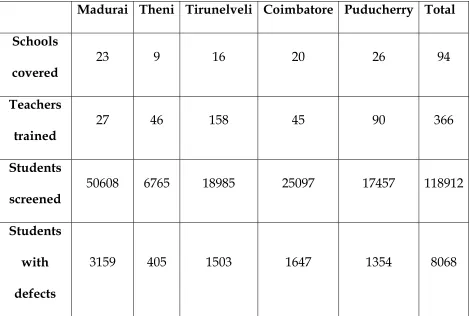
EYE SCREENING FOR SCHOOL CHILDREN (2007)
Madurai Theni Tirunelveli Coimbatore Puducherry Total Schools
covered 23 9 16 20 26 94
Teachers
trained 27 46 158 45 90 366
Students
screened 50608 6765 18985 25097 17457 118912 Students
with defects
In addition, during clinical experience the investigator,, have
attended many eye camps most of the children have near sightness and
long sightness due to eye disorders. They have complained about
difficulty in reading, head ache, dizziness. This was happened due to
lack of knowledge and practice regarding eye disorders. This made
investigator to create an awareness regarding eye disorders among
adolescent children.The investigators felt that there is a need of
structured teaching programme which impart the knowledge and
STATEMENT OF THE PROBLEM
A study to assess the effectiveness of structured teaching
program regarding eye disorders in terms of knowledge and practice
among adolescent children in selected schools, Dharapuram, Tiruppur
District.
OBJECTIVES
1. To assess the Pretest knowledge and practice regarding eye
disorders among adolescent children.
2. To assess the Post test knowledge and practice regarding eye
disorders among adolescent children.
3. To compare the Pre test and Post test level of Knowledge and
practice scores regarding eye disorders among adolescent children.
4. To correlate the posttest knowledge and practice scores regarding
eye disorders among adolescent children.
5. To find the association between Post test knowledge scores
regarding eye disorders among adolescent children with their
selected demographic variables.
6. To find the association between Post test practice scores regarding
eye disorders among adolescent children with their selected
0PERATIONAL DEFINITION Effectiveness
It means producing an intended result. In this study it refers to
determine the extent to which structured teaching program has
achieved the desired effect in improving the knowledge and practice
regarding eye disorders by using statistical measurement.
STRUCTURED TEACHING PROGRAMME :-
It is a planned series of information to educate group of people.
In this study it refers to a structured set of information provided in
sequence by researcher to spread knowledge to adolescent children
regarding eye disorders using a compact disc with laptop for a period
of 45 minutes. It includes vitamin A deficiency disorders and Refractive
errors, definition, types, clinical features, treatment and preventive
measures.
EYE DISORDERS
It is an impairement of health, or condition of abnormal
functioning of the eye.
a) Night Blindness
b) Bitot’s Spots
Bitot’s spots are triangular pearly white or yellowish foamy spots
on the bulbar conjunction on either side of the cornea.
c) Conjunctival Xerosis
This is the 1st clinical sign of vitamin A deficiency. Conjunctiva
appears muddy and wrinkled.
d. Keratomalacia
Keratomalacia or liquefaction of the cornea is a grave medical
emergency.
e. Myopia
Short sight. The images are brought to focus infront of the retina.
h. Hyperopia
Long sight. Eye ball is too short for the power of the lens and
cornea
KNOWLEDGE
Information gained through experience or education. In this
study it refers to the written response of understanding of adolescent
children about eye disorders, which is measured by self administered
PRACTICE
It means way of doing something. In this study knowledge on
practice refers to the written response of the activities performed by the
children regarding eye disorders which is measured by Dichotomonous
questionnaire.
ADOLESCENTS
The period between puberty and attainment of complete growth
and maturity. In this study it refers to the children studying in 9th
standard between the ages of 14-16 years.
HYPOTHESES
H1: The mean post test knowledge scores is significantly higher than
the mean pretest knowledge scores regarding eye disorders.
H2: The mean post test practice scores are significantly higher than
the mean pretest practice scores regarding eye disorders.
H3: There will be a significant correlation between post test
knowledge and practice scores regarding selected eye disorders.
H4: There will be a significant association between post test
knowledge scores with their selected demographic variables
H5: There will be a significant association between post test practice
scores with their selected demographic variables among
adolescent children.
ASSUMPTION
1. The adolescent children may have some knowledge regarding
selected eye disorders.
2. Teaching enhances the knowledge and practice regarding eye
disorders among adolescent children.
3. Adequate knowledge my help the adolescent children to overcome
from eye disorders
DELIMITATION
The study is delimited to :
o The adolescent children studying in 9th standard.
o Data collection period 4 weeks.
PROJECTED OUTCOME
The Structured teaching programme will improve the knowledge
among adolescent children regarding eye disorders which will help
them to gain knowledge, disseminate the knowledge to others, and
identify the problems earlier for appropriate treatment and prevent the
CONCEPTUAL FRAMEWORK
Conceptual framework helps to express abstract ideas in a more
reality understandable or precise form of the original conceptualization.
The conceptual framework for this study was direction from Wieden
Bach’s helping art of clinical nursing theory (1969).
According to Ernestine Wieden Bach (1969) nursing is nurturing
and caring for someone in a motherly fashion. Nursing is a helping
service that is rendered with compassion, skill and understanding to
those in need for care, counsel and confidence in the area of health. The
practice of nursing comprises a wide variety of services each directed
toward the attainment of one of its three components.
Step I : Identification of a need for help.
Step III : Ministration of help needed.
Step II : Validation that need for help was met.
CENTRAL PURPOSE:
According to the theorist the nurse’s central purpose defines the
quality of health she desires to effect or sustain in her patient and
specifies what she recognizes to be her special responsibility in caring
for the patient.
In this study the central purpose is to gain knowledge and
practice regarding eye disorders through structured teaching
programme.
STEP I- Identification of a need for help:
According to the theorist within the identifying component there
are four distinct steps. First the nurse observes the patient, looking for
an inconsistency between the expected behaviour of the patient and the
apparent behaviour. Second she attempts to clarify what the
inconsistency means. Third she determines the cause of the
inconsistency. Finally she validates with the patient that her help is
needed.
In this study the general information which comprises the age,
sex,type of family,diet pattern,resistance,and presence of eye disorders,
inclusion criteria, stratifird random sampling technique was used to
assign the adolescent children.
STEP II: Ministration of the needed help
According to the theorist in ministering to the patient the nurse
may give advice or information, make a referral, apply a comfort
measures or carry out a therapeutic procedures. The nurse will need to
identify the cause and if necessary make an adjustment in the plan of
action.
Ministration of the help neededhas two components
Prescription
Realities
PRESCRIPTION:
According to the theorist a prescription is directive to activity. It
specifies both the nature of the action that will most likely lead to
fulfillment of the nurse’s central purpose and the thinking process that
determines it.
In this study prescription is plan of care to achieve the purpose
programme of knowledge and practice regarding eye disorders by
using laptop with compact disc for 45 minutes.
REALITIES
Accordingto the theorist the realities of the situation in which the
nurse is to provide nursing care. Realities consist of all factors -physical,
physiological, emotional and spiritual that are at play in a situation in
which nursing actions occur at any given moment. Wiedenbach’s
defines the five realities as the agent, the recipient, the goal, the means
and the framework.
• AGENT:
According to the theorist, the agent is the practicing nurse or her
delegate is characterized by personal attribute capacities, capabilities
and most importantly commitment and competence in nursing. In this
study the investigator is the agent.
• RECIPIENT:
According to the theorist the recipient is the patient, is
characterized by the personal attributes, problem, capabilities,
aspirations and most important the ability to cope with the concerns or
problems being experienced. In this study the recipients are adolescent
• GOAL:
According to the theorist the goal is the desired outcome the
nurse wishes to achieve. The goal is the end result to be attained by
nursing action. In this study it refers to gain knowledge and practice
regarding eye disorders among adolescent children through structured
teaching programme.
• MEANS:
According to the theorist the means comprise the activities and
devices through which the practitioner is enabled to attain her goal. The
means include skills, Techniques, procedures and devices that may be
used to facilitate nursing practice. In this study it refers to the
implementation of structured teaching programme regarding eye
disorders,by using compact disc with laptop for 45 minutes.
• FRAMEWORK:
According to the theorist the framework is consists of the human
environmental, professional and organizational facilities that not only
make up the context within which nursing is practiced but also
constitute is currently existing limits. In this study it refers selected
STEP:III Validation that need for help was met.
According to the theorist the third component is validating. After
help has been ministered the nurse validates that the actions were
indeed helpful. Evidence must come from the patient that the purpose
of the nursing actions has been fulfilled.
In this study the validating need for help was met by means of
post test assessment of knowledge and practice regarding eye disorders
STEP - I
IDENTIFICATION OF THE NEED FOR HELP
STEP - II
MINISTRATION OF HELP NEEDED
STEP – III
VALIDATION THAT NEED WAS MET
Demographic variables : Age, Sex, Religion,
Type of family, diet pattern, residence , presence of eye disorders.
Pre-test
Assessment of knowledge and practice regarding eye disorder among adolescent children. before structured teaching programme
Prescription
Developing and
validation of structured teaching
programme which includes vitamin A deficiency and refractive errors
Realities Agent : Investigator
Recipient : Adolescent
children who are studying 9th
standard.
Goal :
To gain knowledge and practice regarding eye disorder
Means:
Implement structured teaching programme
regarding eye disorders ,by using compact disc with laptop for 45 minutes.
Framework:selected Schools at Dharapuram Adequate knowledge Moderately adequate knowledge Inadequate knowledge Adequate knowledge Moderately adequate knowledge Inadequate knowledge POST TEST Assessment of knowledge and practice regarding eye disorder after strutered teaching programme CENTRAL PURPOSE
CHAPTER – II
REVIEW OF LITERATURE
Review of literature for present study aimed at identifying eye
disorders prevalent among school children and its management. The
literature available on the subjects in the filed of nursing is limits of the
relevance literature under the following headings.
Part 1:
Over view about the vitamin A deficiency and refractive errors.
Part 2 :
A: Studies related to eye disorder.
B: Studies related to vitamin A deficiency.
C: Studies related to refractive errors.
PART 1:
OVER VIEW ABOUT THE VITAMIN A DEFICIENCY AND REFRACTIVE ERRORS.
INTRODUCTION
Vitamin A deficiency result in blinding several hundred thousand
children a year. It is now recognized not only to harm the eye but also
to increase childhood and maternal mortality. Globally 21% of children
have vitamin a deficiency and suffer increased rates of death from
diarrhea, measles and malaria. About 800,000 deaths in children and
women of reproductive age are attributable to vitamin A deficiency
which, along with the direct effects on eye disease account for 1.8% of
global DALYs (disability adjusted life years). This appear to be lower
than previous estimates possibly because of vitamin supplementation
or for fortification programs during the last decade.
Swami, R et.al.,(2003)
TYPES
Vitamins are divided in to two groups
1) Fat soluble vitamins eg –A,D,E,K.
CAUSES
1. In adequate diet
Delayed supplementary feeding
Lack of foods containing vitamin A
2. Poverty
Low purchasing power
In accessible village
3. Ignorance
Traditional beliefs and ignorance prevents the utilization of
available resources.
Excluding of vitamin A rich foods like green leafy
vegetables and papaya to children and pregnant women.
Low literacy
4. Infections
Diarrhoea and respiratory tract infection ,impaired the
appetite
Food intake will be reduced
Infections, infestations interfere with the absorption of
vitamin A deficiencies.
FUNCTIONS OF VITAMIN A
Essential for maintenance and function of body tissue.
It is necessary for vision
It contributes the production of retinal pigments.
It supports especially skeletal growth
It is anti-infective
SIGNS AND SYMPTOMS CONJUNCTIVAL XEROSIS:
This is a first clinical sign of vitamin A deficiency.
Conjunctiva becomes dry and non wetable.
Instead of looking smooth and shiny it appears muddy and
wrinkled
BITOTS SPOTS
Bitots spots are triangular pearly white or yellowish, fomy spots
on the bulbar conjunctiva on the either side of the cornea.
Frequent bilateral
CORNEAL XEROSIS
The cornea appears dull, dry, and not wettable and eventually
opaque.
It does not have a moist appearance
In more severe deficiency there may be corneal ulceration
KERATOMALACIA
The cornea may become soft and may burst open.
Process is rapid
If the eye collapses, vision is lost
NIGHT BLINDNESS
Inability to see in dim light.
Unless vitamin A intake is increased, the condition may get
worse, especially may get worse, especially when children also
suffer from diarrhoea and other infections.
Park,K.,(2007)
TREATMENT
Should be tested urgently
Administration of a massive dose 200,000 IU or 110 mg of retinal
palmitate
50,000 IU in children with age group of below 6 months
One lakh of IU in children with age group of 6 to 12 month
2 lakh IU in children aged >1year
Swaminathan,M.,(2002)
AVAILABLE PLACES FOR VITAMIN A ORAL SOLUTION
Government hospital
Meternity centre
Primary health center
Subcenter
District hospital
Private hospital
Interval between 6 month to 6 year
Mahajan,D., (2000)
PREVENTION OF VITAMIN A DEFICIENCY
Prompting consumption of vitamin A rich foods
Regular dietary intake of vitamin A rich foods by pregnant and
lactating mother
Feeding of locally available B carotene rich food such as green leafy
vegetables,yellow and orange vegetables and fruits .
Park, K., (2007)
REFRACTIVE ERROR
A Refractive error is an optical defect of the eye that prevents
light from being brought to a sharp focus by the cornea and lens on to
the retina. Varying degrees of decreased vision visual disability or
blindness result from refractive error depending on the type and
severity.
Hockenberry(2007)
TYPES Myopia
The image is brought to focus infront of the retina. The eye ball is
too long for the refractive power of the lens and the cornea. Myopia is
corrected with concave or minus lenses
Hyperopia
People say ‘farsighted’because they have good vision at
distance,but poor vision at near.In hyperopia the eye ball is too short for
the power of the lence and cornea. Hyperopia is corrected with convex
Refractive errors are described in diabters as follows:
1. The refractive error of myopic eyes is given in minus(-)
diapter,because concave or minus lenses are required for
correction of myopia
2. The refractive errors of hyperopia eyes is expressed in
plus(+)diapter,because convex or plus lenses are required to
correct hyperopia.
Nikki L pots(2007)
SPECIAL CONSIDERATION
Spectacles are readily available and even small refractive errors
are often corrected with eye glasses. People who cannot afford to
purchase commercially produced spectacles optical correction can be
provided. Service clubs such as lions club, and rotary clubs collect un
used and second hand spectacles for donation and free distribution to
indigent patients.
PART -11
A) STUDIES RELATED TO EYE DISORDERS AMONG CHILDREN
Jialiang, z et.al., (2000) (12) studies refractive error in children aged
5- 15 years in china reported that,A total of 6,134 children from 4,338
household were enumerated and 5,884 children (95.9%)were examined.
The prevalence of uncorrected,presenting and best visual acquity of 0.5
%or worse in atleast one eye was 12.8%,10.9%and 1.8% respectively
0.4%had best visual acquity 0.5 or worse in both eyes. Refractive error
was the cause in 87.5%of the 1.236 eyes with reduced vision.
Asphat, T et .al., (2000) (4) A comprehensive survey was carried
out to assess the vitamin A status of (0-17 years)children of socio
economically back ground families from slums of Bombay and its sub
urban. The vitamin A , protein and iron from the rice and dhal based
diet was found to be below recommended dietary allowances. Among
the 1956 children surveyed 20%of the children showed low serum
vitamin A levels 4-8 %of the children were suffering from one of the
B) STUDIES RELATED TO VITAMIN A DEFICIENCY
Mathenge,S et.al.,(2007) (52) conducted a study on vitamin A
deficiency disorders in adult male prisoners. The aim of study was to estimate the prevalence and causes of vitamin A deficiency
disorders.The study was conducted at nakuru Kenya.It was a
randomized study.Two hundred and forty one cases with xeropthalmia
and 448controls randomly selected from the remaining prisons
populations were interviewed about risk factors for xeropthalmia and
blood samples were taken to measure serum retinol and heamoglobin.
Results showed that 23.6% (95%- (I =21.1-26.31%) of examined inmate
showed at least one sign of xerophthalmia. Mostly night blindness
98.8% of cases. The study concluded that Vitamin A deficiency was a
significant public health problem among these Kenyan male prison
indicating may be important vulnerable groups other than young
children and pregnant women.
Singh, V et .al., (2004) (60) conducted study on vitamin A
deficiency and xerophthalmia among school aged children. The aim of
the study to determine provisional estimates of the extent of vitamin A
deficiency and xerophthalmia. The Design of the study was , literature
prevalence rates and numbers of children affected by 1) vitamin A
deficiency 2) xerophthalmia. Settings was used the countries with in
the WHO south East Asian region. The subject are 5 -15 years of age
.Results showed that the estimated prevalence of vitamin A deficiency
is 23.4% of 10.9% have mild xeropthalmia (night blindness or bitot’s
spots) This study concluded that vitamin A deficiency including mild
xerophthalmia appears to affect large numbers of school – aged children
in south – east Asia.
Wednerst, D et.al.,(2003) (67) conducted study to assess the
validation of night blindness reports among children. The aim of the
study validates different definitions of reported night blindness in a
vitamin A deficiency. This study was conducted at different population
in rural Tanzania. Design was used case- control study with follow up
after treatment settings used eight primary school and health centers
in rural Tanzania. Subjects of this study A total of 1214 participants
were screened for reported night blindness and other eye signs of
xerophthalmia 9,461 children aged 24 – 71 months 562 primary school
age children and 191 pregnant or breast feeding women. The result
showed that the over all prevalence of reported night blind ness was
d/m(2).P=0.501) .This study concluded that night blindness are a poor
indicator of vitamin A deficiency in this population.
Czeptita, D et.al., (2002) (37) conducted study on the influence of
low birth weight on the prevalence of refractive errors among school
children. The aim of the study was to determine in a large population
whether low birth weight has an influence on the prevalence of
refractive errors among school children. The samples are used 3603
school children were examined Data analysis was performed using
chi-square test P value of test than 0.05 were considered statistically
significant. The results showed that the hyperopia was observed more
frequently in 6-14 year old children whose birth weight was 2500
grams. This study concluded that the low birth weight may have an
effect of the prevalence of refractive errors among school children.
Kartha, C et. al., (2000) (45) A Descriptive study to assess the
impact of national vitamin A supplementation programme among 3143
children using simple random method. Overall prevalence of
xeropthalmia was 17.25%.The prevalence was significantly higher
(27.6%)in children who did not receive vitamin A supplements than
those who received (6.48%)at P<0.001 level significance. Similarly the
bitots spots and corneal xerosis were also higher than the WHO
standards.
Tarik,K., (2000) (63) Conducted a descriptive study to determine
the prevalence of vitamin A deficiency among 824 children aged 6-16
years using random sampling in northern India. A questionnaire was
administered at home to mothers or female care givers in order to
collect demographic and children studied and on socio economic and
environmental factors of relevance to the households of the 824
children,48 had clinical signs of xeropthalmia. Most of them exhibited
bitots spots and a few had conjunctival xerosis, corneal lesions, none
had corneal scars. Girls had significantly lower liver vitamin A reserves
than boys (P<0.004).
WHO,(2000) (66) states that a randomized controlled trial carried
out in northern of sumatra provided a high dose of vitamin A
supplement given to 12 to 20 years old children every six months in 229
villages(treated)and a supplement given only to those diagnosed with
xeropthalmia in 221 villages( control).The impact of vitamin A
supplementation on mortality was found to be significant in children 12
to 20 years of age 34% effectiveness of supplementation (RR=0.66,
CI=0.44, 0.97) and on the prevalence of xeropthalmia decline from 1.9%
C) STUDIES RELATED TO KNOWLEDGE REGARDING REFRACTIVE ERRORS.
Uzma, N et.al.,(2009) (64) conducted a study to assess the
prevalence of refractive error and common ocular diseases in
school-aged children in urban and rural populations in and around
Hyderabad, India. It was a cross-sectional study. A total of 3314 school
children, 1789 from urban areas and 1525 from rural areas. The study
results showed that myopia measured with auto refraction was
observed in 51.4% of urban children and 16.7% in rural children.
Hyperopia with auto refraction was found to be 3.3% in the urban and
3.1% in the rural group. Hyperopia was associated with younger age in
the study group. Night blindness was reported in 3.2% of children in
the rural group and 0.33% in the urban group. The study concluded that
provision of health education, periodic visual screening programs, and
primary eye care by trained health care personnel in the elementary
schools will prevent the prevalence of refractive errors and common
ocular diseases in school children.
Congdo,N et.al.,(2008) (36) conducted study on prevalence and
determinants of spectacle non wear among rural secondary school
Methods used visual acuity refraction, spectacle wear, and visual
function were measured. Results showed that among 1892 subjects
(84.7% of the sample, the mean age was 14.7 (0.8) years. Among 580
children 1 +9% did not wear them at school 476 children 25 %could not
improve their visual acuity to better than 6/12 refractive errors of 2.06
(1.15) diopter (D) and 2.78 (1.32) A common reason for non wear
(17.0%) was the belief that spectacles weaken the eyes. This study
Concluded that half of the children could benefit from spectacle wear
62.3% were not wearing appropriate correction. These children have
significant uncorrected refractive errors.
Sapkotu, D et.al., (2008)(59) Conducted study on the prevalence of
visual impairment in school children. The aim of this study to assess visual impairment in school children. It was a randomized study. Study
conducted on 43 schools in kathmand for comparison with rural jhapa
district. Result showed that a total of 4.50%.children in grades 5-9 were
enumerated. 4282 were examined. The prevalence of uncorrected,
presenting and best – corrected visual impairment (< or = 20/40 better
eye 18.6% rerfractive errors was a cause in 93.3% of children with
uncorrected visual impairment. This study Conclude that visual
impairment with myopic a among upper- middle socio economic school
Adeoti,A et.al., (2008) (33) condcted study on refractive errors
among hospital patients. The aim of the study to determine the magnitude and pattern of refractive errors in order to provide facilities
for its management. It was a prospective study. The study was
conducted at Mercyl and specialist hospital western Nigeria. The data
was analyses using statistical package for social sciences 11.0 version
.The Result showed that refractive errors was found in 1824 (53%7)
patients there were 832 (45.61) males and 992 (54.39%) female with a
mean age of 35.55 myopia was commonest – 1412 (39.21%) eyes
hypermetropia 840 (23.33% eyes).This study concluded that refractive
errors is common in this environment.
Robaei,I et.al., (2008) (57) conducted study on prevalence of
hyperopia and association with eye findings in 6-12 years old. The aim
of the study to describe the prevalence of hyperopia. It was a cross
sectional study. The study was conducted at Sydney among 6 and 12
year children. The randomly selected samples. The result showed that
prevalence of moderate hyperopic among children 6 and 12 were 13.2%
and 5.% respectively.This study concluded that moderate hyperopia
Ackinct, A et. al., (2008) (32) conducted study on the correlation
between head ache and refractive errors among children. The aim of the
study to compare the prevalence of refractive errors in patients with
headache and a control population. It was a retrospective study. The
study was conducted at children hospitals turkey. The two test was
done chi square and student t-test were used. The result showed that
total prevalence of refractive errors was higher in the headache group
(p=0.002) the rate of astigmatism was higher in the head ache (<0.0001)
while that of myopia and hyperopia were similar in both groups.
Prema raju .K.,(2007)(56) conducted study on prevalence of
refractive errors in rural south India. It was population based study.
Association of refractive errors with age, sex, eye disorders were
analysed. The result shows that 3924 responders. 2508 were eligible.
Myopia (<0.50), high myopia (>0.50) were 50.60%, 26.99%, 3.71% and
18.70% and age and gender adjusted for the rural Tamilnadu
population were 46.77%, 30.97%, 4.32%, and 17.94%, respectively. The
prevalence of myopia and high myopia increased significantly with age
(p<0.001) the study concluded that the refractive errors in this rural
south Indian population is similar to those reported in other tropical
Ustianowska ,R et.al., (2007) (65) conducted study on the
prevalence of refractive errors in school children 6 to 18 years of age.
The aim of the study prevalence of myopia, hyperopia and astigmatism
in school children. methods used for this study 5724children from
elementary schools. Junior high schools and high schools were
examined. [2765 boys and 295 a girls. Aged 6 – 18 years. The statistical
analysis of data was performed by calculating the linear correlation
coefficient and the coefficients for the regression equation. Results
showed that 13% students in the age group of 6 to 18 were myopia 38%
- students were hyperopia, 4% were astigmatic. This study concluded
that positive correlation was found between the prevalence of myopia
and age (P <0.001) as well as in negative correlation between prevalence
of hypropia and age (P<0.001).
Nitm,U et.al., (2007) (54) conducted study on prevalence of
refractive error and other eye diseases in school children. The aim of
study to determine the prevalence of refractive error and other eye
diseases .The study was conducted at accra region of Ghana in school
children. It was a randomized study. The Result showed that 957
students aged 6 to 22 years were screened 67 had myopia with visual
observed were congenitual glacoma (1), verbal conjunctives (2),
infective conjunctivitis (6) the prevalence of refractive error reducing
vision to at least 6/12 was 7.0%This study .concluded that the most
common eye defect in the students were refractive error.
Jeddi and blouzan, L et.al.,(2007) (43) conducted study on
management of hyperopia in children. The aim of the study prevalence
of hyperopia in school – aged children. Methods used to 300 eyes of 150
children with hyperopia were selected. The mann_whitney test and chi
square test was done. The result showed that the mean age was
9.5+/-2.7 years) girls were statistically more represented than boys the mean
sphere measured over all was +2D (+/-/.65) Severe hyperopia was
detected in 19%of the children it was latent in 35% children .This study
concluded that children with hyperopia of +3.5 D or greater have an
increased risk of amblyopia and squint that their visual function.
Bhatt and janardan ,T et.al.,(2006) (34) conduced study on
prevalence of refractive errors in children age group 7 to 15 yrs. The aim of the study to assess the prevalence of refractive error and related
visual impairment. It was a .Randomized study. The Result showed
that a total of 452 children form 500 households was enumerated, and
417 (92.3%) were examined. The prevalence of uncorrected, baseline
better eye was 2.7%, 2.6% and 078% respectively. This study Concluded
that Refractive error was the main cause of visual impairment in
children aged between examination. Because visual impairment can
have a significant impact on a child’s life in terms of education and
development, it is important that effective strategies be developed to
eliminate this easily treated cause of visual impairment.
Ellwein, L et.al., (2002) (40) conducted a study to assess the
prevalence of refractive error and related visual impairment in
school-aged children in an urban population in New Delhi, India. The
sampling technique was used to select as samples 5 to 15 years of school
children were selected as a samples. Children in 22 selected clusters
were enumerated through a door-to-door survey and examined . The
results showed that total of 7008 children from 3426 households were
enumerated, and 6447 (92.0%) examined. Refractive error was the cause
in 81.7% of eyes with vision impairment. There was an age-related shift
in refractive error from hyperopia in young children (15.6% in
5-year-olds) toward myopia in older children (10.8% in 15-year-5-year-olds). Overall,
hyperopia was present in 7.7% of children and myopia in 7.4%.
Hyperopia was associated with female gender. Myopia was more
error is a major public health problem in urban school-aged children in
India
Arlappa,C et .al.,(2002) (34) conducted study on prevalence of
clinical and sub clinical vitamin A deficiency among pre school
children. The aim of the study to assess the prevalence of vitamin A
deficiency among rural School children. It was a cross sectional study.
The study was conducted at Madhya Pradesh India among pre school
children. Multi stage stratified random sampling technique was used .A
total of 16 strata were selected randomly from the state. A sub – sample
of 80villages 5 village per stratum. sample size for children vitamin A
deficiency assuming the prevalence of bitot’s spots as 1% assuming the
prevalence of sub clinical vitamin A deficiency among school children
of 95% The data was analyzed by using statistical package for social
science version 15.0 for windows Bi variate analysis was shows that the
prevalence of bitot’s spots (1.4%) was more than the public health
significance the bitot’s spots was significantly (p<.001).
Dandona, R et.al., (2002) (39) conducted a study to assess the
prevalence, distribution, and demographic associations of refractive
error in the population of the southern Indian state of Andhra Pradesh.
A total of 10 293 people underwent an interview and detailed dilated
= 15 years of age, the prevalence of myopia was 3.19% (95% confidence
interval [CI] 2.24-4.13%) and of hyperopia was 62.62% (95% CI
57.10-68.13%). In this age group, myopia increased with increasing age and
was more prevalent in the urban study area, and hyperopia prevalence
was greater in the participants < 10 years of age. In participants > 15
years of age, the prevalence of myopia was 19.45% (95% CI
17.88-21.02%) and of hyperopia was 8.38% (95% CI 6.91-9.85%). The study
concluded that there is significant refractive error in this population.
Ajaiyeoba.A et. al., (2001) (31) conducted study on use of bitot’s
spot in screening for vitamin A deficiency in Nigerian. It was a cross –
sectional study. Using a two – stage stratified stratified cluster sampling
method. A total of 290s children between 6 and 71 months of age were
screened for xeropthalmia and vitamin A deficiency. The result showed
that vitamin A deficiency was 25% 95% confidence interval 25-4 31.0%
and severe retinal deficiency /dl or 0.35% and was 7.0% (9 5%
confidence interval 5.5-8.8%)
Sethis, G., (2000) (59) conducted study on prevalence of refractive
errors in school children. The Aim of the study to prevalence of
refractive errors in school children (12-17 years) of The study conducted
and 819 females. The chi square test was done The result shows that
25.32 percent of the students were found to be having refractive errors
of these 47 percent were females and 53 percent were males. Myopia
63.5 % hypermetropia 11.2%.This study concluded that these data
support the assumption that vision screening of school children in
developing countries could be useful in detecting correctable causes of
decreased vision especially refractive errors and in minimizing long
term visual disability.
Maul, E et .al., (2000) (47) conducted a study to assess the
prevalence of refractive errors in school-age children in a sub urban
area (La Florida). Children in the 26 selected clusters. The results
showed that a total of 6,998 children from 3,830 households were
enumerated, and 5,303 children (75.8%) were examined. The study
concluded that Refractive error, associated primarily with myopia, is a
major cause of reduced vision in school-age children in La Florida.
More than 7% of children could benefit from the provision of proper
spectacles.
D) STUDIES RELATED TO STRUCTURED TEACHING PROGRAMME REGARDING EYE DISORDERS.
Anitha,R (2004) (60) conducted study on eye defects among
adolescent children. The aim of the study was to estimate the
prevalence of selected eye defects. The study was conducted at
Madurai. It was a randomized study. The samples are used 60
adolescent school children were examined .The pretest was conducted
by using multiple choice questions. Structured teaching programme
was given to children with flashcards. The post test was conducted The
result showed that the mean posttest knowledge of eye defect is
15.78(SD 3.74),Which was increased than the mean pretest knowledge
score 6.5(SD 2.41) and the mean posttest practice score is 10.93(SD
2.6)Which was increased than the mean pretest score 5.5(SD 2.41) For
knowledge ‘t’ value is 21.74 (p<0.05),For practice ‘t’ value is 21.6
(p<0.05)Which shows the over all gain in knowledge and practice were
highly significant. There was not associated with demographic
Chitra,N (2001) (61) conducted study an experimental study to
assess the effectiveness of structured teaching programme on vitamin A
to mothers with under five children sixty mothers with under five
children were selected using stratified random sampling technique. The
pretest was conducted by using multiple choice questionnaire.
Structured teaching programme was given to the mothers with slide
show. On the 8th day after structured teaching programme, the post test
was conducted. In pre test 60 (100%mothers had inadequate knowledge
on vitamin A in pre test. In post test 48 (80%) mothers had adequate
CHAPTER III
METHODOLOGY
The chapter deals with the Methodology adopted for the study. It
includes Research approach, Research Design, Setting, Sample and
Sampling technique, tool and scoring procedure, pilot study, method of
data collection Procedure and Plan for Data analysis.
RESEARCH APPROCH
The evaluative approach is used to assess the effectiveness of
structured teaching programme on eye disorders in terms of knowledge
and practice among adolescent children.
RESEARCH DESIGN
The Research design selected for this study was Quasi
experimental design as the study fulfils the criteria such as
randomization and manipulation, the investigator has selected the
Quasi experimental design, which includes the pre test and post test
Group Pre test Intervention Post test
THE SYMBOLS USED
GROUP 1 : The adolescent children between the age group of
14-16 years.
RQ1 : Collectionof demographic data,Pre test was done by
structured self administered Questionnaire and
Dichotomonous questionnaires.
X : structured teaching programme by using
compact disc with Laptop.
Q2 : Collection of demographic data, Post test was done
by structured self administered,
Questionnaires and Dichotomonous questionnaires.
SETTING OF THE STUDY
A study was conducted in four selected Higher Secondary School
at Dharapuram who are studying 9th standard within the age group of
14-16 years of age. (St.Aloysious Girls Higher Secondary School with 5 sections, In each section having 60-70 students. C.S.I Girls Higher
Secondary School with 3 sections, In each section having 40 students
Vivegam higher secondary school with 5 sections , In each section
having 50-55 students and, C.S.I Boys Higher secondary school with 2
POPULATION
The target populations of the study are adolescent children.
SAMPLE
The samples consists of adolescent children, who are studying in
9th standard.
CRITERIA FOR SAMPLE SELECTION INCLUSION CRITERIA
¾ The age group between 14-16 years.
¾ Tamil medium students.
¾ Both boys and girls
¾ Children who are willing to participate in this study.
EXCLUSION CRITERIA
¾ Students who are absent on the day of data collection period
¾ Sick children.
SAMPLE SIZE
The sample size comprised of 200 children, Who met inclusion
SAMPLING TECHINIQUE
The samples are selected by stratified randam sampling
technique. In each schools 50 samples were selected. 200 samples were
selected from 4 higher secondary schools by using the same method.
INSTRUMENT AND SCORING PROCEDURE DESCRIPTION OF THE TOOL
The tool consists of 4 parts.
PART I
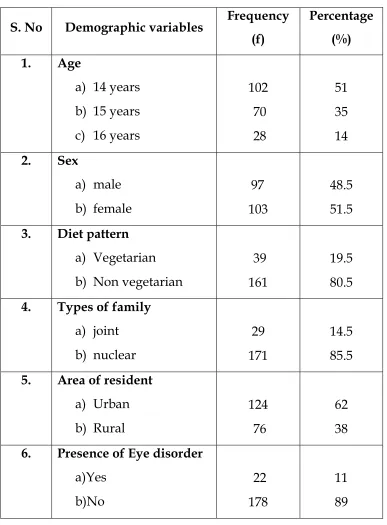
It deals with demographic variables such as age, sex, type of
family, diet pattern, residence and presence of any eye disorders.
PART II
It consist of Structured self administered questionnaire, to assess
the knowledge regarding eye disorder among adolescent children. It
consists of 25 multiple choice questions with four options among which
one is the correct answer.
PART III
It consists of dichotomous questionnaire, to assess the practice
questions with alternative response of ‘yes” or “no”. It has 6 positive
questions, and 4 negative questions
SCORING PROCEDURE AND INTERPRETATION PART I– Self administered questionnaire
The multiple choice questions are used to assess the knowledge
regarding eye disorder. i). Correct answer was given a score of (1) one
and wrong answer was scored as (0) zero. The total score on knowledge
was 25 the Scores were interpreted as follows
LEVEL OF KNOWLEDGE SCORE PERCENTAGE
Adequate Knowledge 19-25 67-100
Moderatly adequate knowledge 9-17 34 – 66
Inadequate knowledge 0-8 0-33
PART II: Self administered dichotomonous questionnaire is used to assess the practice regarding eye disorders.
It consists of 10 questions. There were 2 responses ‘yes” or “no”.
A score of one (1) was allotted to the correct response and zero(0)to the
wrong response. The total score on practice was 10 .The scores were
LEVEL OF PRACTICE SCORE PERCENTAGE
Adequate practice 7-10 67-100
Moderately adequate practice 4 -7 34 -66
In adequate practice 1-3 0-33
VALIDITY AND RELIABILITY OF THE TOOL
VALIDITY
The validity of the tool was established by consultation with
guide, five experts in the field of child health nursing and one medical
expert. The tool was modified according to the suggestions and
recommendations of experts.
RELIABILITY
The reliability of the self administered knowledge
questionnaire regarding eye disorders was established by the test
re -test method, the Karl Pearson co –efficient formula was used to
find out the stability of the tool and found to be reliable (r=0.90).
The split half method, where the spearman’s brown prophecy test
was used to find out the internal consistency of the tool and found
The reliability of the Dichotomonous practice questionnaire
regarding eye disorders was established by the test re test
method, the Karl Pearson co –efficient formula was used to find
out the stability of the tool and found to be reliable (r=0.8 ).The
split half method, where the spearman’s brown prophecy was
used to find out the internal consistency of the tool and found to
be reliable (R=0.9).
PILOT STUDY
The pilot study was conducted in government higher secondary
school, Thalavaipattinam. Formal permission was obtained from the
District educational officer and headmaster of the school. The data
collection was done for a period of one week. 20 Children who fulfilled
the inclusion criteria were chosen as samples. Stratified random
sampling technique was used to allot the adolescent children. There
were two stratum (two sections).The investigator selected 20 study
subjects by using lottery method, from two stratums, ten in each
section.The self introduction about the investigator and information of
nature of the study was explained. Selected subjects were combined
programme was given for 10 students regarding eye disorders by using
compact disc with laptop for 45 minutes . The post test was conducted
on 7th day from the last day of teaching using the same structured self
administered questionnaire. The findings of the pilot study showed that
the mean pre test score is 8.02 and post test knowledge score is (20.2).
The mean pre test of practice score is 6.48 (and post test practice score is
(13.4) so the post test score is significantly higher than the mean pre test
score. The pilot study showed that it is feasible and practicable to
proceed with main study.
DATA COLLECTION PROCEDURE :
The data collection was done in 4 higher secondary schools in
Dharapuram. Formal approval was obtained from the District
educational officer and Head masters of the schools. The data collection
was done for a period of four weeks in the month of August. It was
done an all week days. The four higher secondary schools were
included in the study, 50 students were selected per school. The school
children who fulfills the inclusion criteria were selected by stratified
random sampling technique. Each section of 9th standard was
considered as a single stratum. The investigator selected the study
participants from each stratum (each section) by using lottery method.
nature of the study was explained. Selected participants were combined
together in class room to administer the pre test questionnaire. The
investigator imparted the teaching on eye disorders for 40 to 45 minutes
by using compact disc with laptop on 2nd 3rd day for 6-7 children.
Evaluation of structured teaching programme was done by conducting
post test on 7th day from the last day of teaching programme. The same
procedure was followed for 3 schools to obtain data from 200 samples.
PLAN FOR DATA ANALYSIS
The collected data was tabulated and analyzed using descriptive
and inferential statistical method.
S.
No Analysis Data Methods Remarks
1. Descriptive statistics
Frequency percentage
To describe the demographic variables of adolescent children with eye disorder.
Mean,
Standard deviation
1.To assess the pre test and post test knowledge regarding eye disorders among adolescent children.
2.To assess the pre test and post test practice regarding eye disorders among adolescent children.
2. Inferential statistics
Z – test To compare the pre test and posttest level of knowledge and practice scores
pearson Correlation
practice score regarding eye disorders among adolescent children.
Chi Square test
1. To association post test knowledge scores regarding eye disorders with selected demographic variables.
2. To association post test practice scores regarding eye disorders with selected demographic variables.
PROTECTION OF HUMAN SUBJECT
The research was conducted after the approval of the dissertation
committee prior to conducting the pilot study and the main study. The
written consent was obtained from the Educational officer,
Headmasters of higher secondary schools. The written consent of each
study subjects were obtained by explaining the purpose of the study
before collecting the data. It is assured that confidentiality will be
CHAPTER IV
DATA ANALYSIS AND INTERPRETATION
This chapter deals with analysis and interpretation of data
collected from ninth standard adolescent children with their
demographic variables.
The present study was designed to assess the effectiveness of
structured teaching program regarding eye disorders in terms of
knowledge and practice among adolescent children. The collected data
was organized and interpreted by using descriptive and inferential
statistics and data were analyzed as per objectives of the study ..
ORGANIZATION OF DATA
The data has been tabulated and organized as follows:
Section A: Distribution of demographic variables.
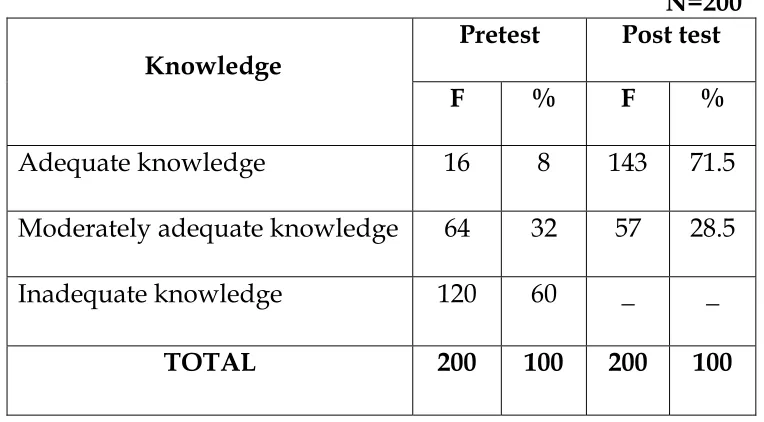
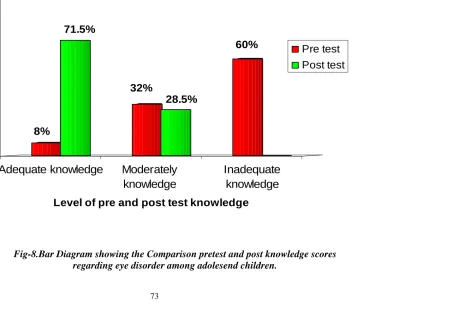
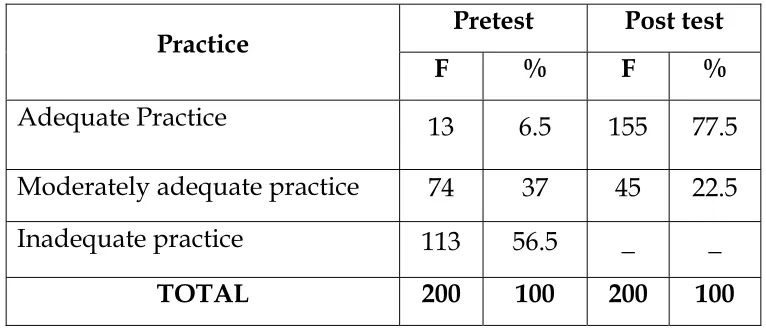
Section B: Comparison between pre test and post test knowledge and practice score regarding eye disorders among adolescent
children.
Section D: Association between Post test knowledge scores regarding eye disorders among adolescent children with their
selected demographic variables.
: Association between Post test practice scores regarding eye disorders among adolescent children with their
selected demographic variables.