EFFECTIVENESS OF AMBULATION UPON FETOMATERNAL PARAMETERS DURING FIRST STAGE OF LABOUR
BY
MS A. SUJATHA
A DISSERTATION SUBMITTED TO THE TAMILNADU DR.M.G.R.MEDICAL UNIVERSITY, CHENNAI, IN PARTIAL FULFILMENT OF THE
REQUIREMENTS FOR THE DEGREE OF MASTER OF SCIENCE IN NURSING
EFFECTIVENESS OF AMBULATION UPON FETOMATERNAL PARAMETERS DURING FIRST STAGE OF LABOUR
Approved by the Dissertation Committee on: ____________________________
Research Guide : _____________________________ Prof. Lizy Sonia, M.Sc (N)., Ph.D, Vice Principal,
Apollo College of Nursing, Chennai - 600 095.
Clinical Guide : ____________________________ Dr. Latha Venkatesan,
M.Sc (N)., M.Phil., Ph.D.,
Principal and Professor in Nursing, Apollo College of Nursing,
Chennai - 600 095.
Medical Guide : ____________________________ Dr. Sarat Battina, MD., D.G.O.,
Coordinator,
Dept.of Obstetrics and Gynecology, Apollo Hospitals,
Chennai – 600 006.
A DISSERTATION SUBMITTED TO THE TAMILNADU DR.M.G.R.MEDICAL UNIVERSITY, CHENNAI, IN PARTIAL FULFILMENT OF THE
REQUIREMENTS FOR THE DEGREE OF MASTER OF SCIENCE IN NURSING
DECLARATION
I hereby declare that the present dissertation entitled “Effectiveness of Ambulation Upon Fetomaternal Parameters During First Stage of Labour” is the outcome of the original research work undertaken and carried out by me under the guidance of Dr. Latha Venkatasen, M.Sc (N)., M.Phil., Ph.D., Principal and Professor in Obstetric and Gynecological Nursing, Apollo College of Nursing, Chennai. I also declare that the material of this has not found in any way, the basis for the award of any degree or diploma in this university or any other university.
A.SUJATHA
ACKNOWLEDGEMENTS
Lord God almighty is praised for uttering profusely HIS blessings and guidance on me throughout my endeavor and sustained me in my hour of need.
I owe my deep sense of whole hearted gratitude to Dr. Latha Venkatesan, M.Sc (N)., M.Phil., Ph.D., Principal, Apollo College of Nursing for her elegant direction, expert guidance, innovative suggestion and constant motivation and extreme patience without which I would not have completed the dissertation successfully. I express my sincere gratitude to Prof. Helen M. Perdita, M.Sc (N)., Ph.D., Vice Principal and Research Cell coordinator, Apollo College of Nursing, for her splendid guidance and perusal in the study.
I express my heartfelt gratitude to my medical guide Dr. Sarat Battina, MD, D.G.O, Coordinator, Dept of Obstetrics & Gynecology, Apollo Hospitals, for his kind support and encouragement.
With special references, I thank the Directorate of Medical and Rural Health Services, Chennai, and I owe my genuine gratitude to Medical Superintendent, Government District Head Quarters Hospital, Kancheepuram for permitting me to conduct research study in the hospital.
I am indeed grateful to Ms. Lizy Sonia, M.Sc(N)., professor and Research Guide, Apollo College of Nursing for her tremendous support and loving concern. I owe my genuine gratitude to Faculties of Obstetric and Gynecological Nursing Department, Apollo hospital, for their enlightening and brain storming ideas, continuous support, timely help and constructive efforts.
I extend my earnest gratitude to G.K. Venkatraman for his expert support in statistical analysis amidst of his hectic schedule.
It’s my privilege to thank the experts who validated the study tool with their constructive and valuable suggestions. My special word of thanks to Dr. Sushila, M.Sc (N)., Ph.D., Principal cum Professor, Billroth College of Nursing, for validating the study tool.
I wish to acknowledge my heartfelt gratitude to all the HOD’s and faculty members of Apollo College of Nursing. I extend my special thanks to the Librarians at Apollo College of Nursing and the Tamil Nadu Dr. M.G.R. Medical University.
I express my deep sense of gratitude to all the Participants in this study for their tremendous co-operation. At this juncture, it’s my privilege to thank my colleagues who were the cornerstone in completion of this research work. An ovation of thanks to all the persons who have sailed with me and involved in the successful completion of this dissertation.
SYNOPSIS
An experimental study was conducted to assess the effectiveness of Ambulatory Nursing Care among the parturient mothers during the first stage of labour at Government District Head Quarters Hospital, Kancheepuram.
The objectives of the study were
1. To assess the fetomaternal parameters and level of labor pain before and after therapy in control and experimental group of parturient mothers.
2. To compare the feto-maternal parameters and level of labor pain before and after the therapy in control and experimental group of parturient mothers.
3. To determine the level of satisfaction upon experimental group of parturient on ambulatory nursing care.
4. To find out the association between selected demographic variables and feto maternal parameters after the therapy in the control and experimental group of parturient mothers.
5. To find out the association between selected obstetric variables and feto maternal parameters after the therapy in the control and experimental group of parturient mothers.
The conceptual frame work of the study was developed on the basis of Roy’s adaptation model. The study variables were the effectiveness of ambulatory nursing care
at random, of which 30 were assigned to the control group and 30 were assigned to experimental group by systematic random sampling method.
Demographic variable proforma, obstetric variable proforma, modified pain intensity scale, WHO modified partogram and rating scale on satisfaction of ambulatory nursing care were the tools used. The tools were validated and reliability was established. After pilot study, the data for the main study was collected. The collected data was tabulated and analyzed using descriptive and inferential statistics.
Major findings of the study were:
¾ The frequency and percentage distribution of demographic variables of primi mothers in control group revealed that most of the parturient mothers were in the age group of 21-25 years (56.67%), doing moderate work (60%), and residing at urban area (53.33%). Half of them were living in joint family (50%).
¾ Most of the parturient mothers in the experimental group were belonged to the age group of 21-25 years (66.67%). Majority of them were doing moderate work (80%). Lived in joint family (76.67%), were residing at rural area (86.67%) and significant percentage of parturient mothers were educated up to primary school in control and experimental group (46.67%), (26.67%) respectively.
antenatal visits 1- 3 times (53.33%) and half of the parturient mothers were in the gestational age between 39-40 weeks (50%).
¾ Majority of the study participants in the experimental group were in gestational age between 39-40 weeks (80%), obtained weight gain about 12 kg in the antenatal period (90%), were above 145cm in height (90%). Most of them were attended antenatal clinic more than three times (56.67%).
¾ All the participants in the control and experimental group had delivered through normal vaginal delivery without maternal and fetal complications, received no pain management during first stage of labour.
¾ The mean and standard deviation of pain scores of the control group parturient mothers were high in after therapy (M=7.99, SD= 0.534) compared to the level of pain score before therapy (M=6.64, SD=0.994). In the experimental group the pain score after therapy was low (M=5.05, SD=0.72) compared to the level of pain score before therapy (M=6.75, SD=0.75). The difference was found statistically significant at p<0.001. And can be attributed to the effectiveness of ambulatory nursing care.
frequency of uterine contraction in experimental group was high before therapy (M=3.15, SD=0.30) in comparison with after therapy (M=2.22, SD=0.24). Duration of uterine contraction was low in before therapy (M=53.69, SD=6.31) than after therapy (M=68.10, SD=7.86). This shows that ambulation during first stage of labour increases the duration of uterine contraction and decreases the frequency of uterine contraction. The result was statically significant at 99.9% level of significance. Hence Null hypothesis Ho1 was rejected. The mean score of cervical dilation in the experimental group mothers was more (M=2.45, SD=0.17) than the control group of parturient mothers (M=2.03, SD=0.35).
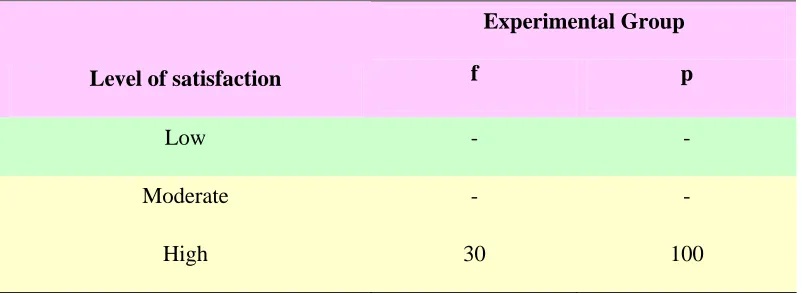
¾ All the mothers in the experimental group were (100%) highly satisfied with ambulatory nursing care during the first stage of labour and none of them expressed low satisfaction with ambulatory nursing care.
Recommendations
¾ The same study can be conducted on a lager sample to generalize the results. ¾ A comparative study can be conducted between primi and multigravidae.
¾ A comparative study can be conducted in different settings with similar facilities.
TABLE OF CONTENTS
Chapter Content Page No.
I INTRODUCTION 1-14
Background of the Study 1
Need for the Study 3
Statement of the Problem 6
Objectives of the Study 6
Operational Definitions 6
Assumptions 8
Null Hypotheses 8
Delimitations 9
Conceptual Frame work 9
Projected Outcome 14
Summary 14
Organization of the Report 14
II REVIEW OF LITERATURE 15-24
Literature related to physiology of labour 15 Literature related to nursing intervention in the first stage of
labour
17
Literature related to ambulation during first stage of labour 20
III RESEARCH METHODOLOGY 23-32
Research Approach 23
Research Setting 26 Population, Sample, Sampling Technique 27
Sampling Criteria 28
Selection and Development of the study instruments 28
Validity of the instruments 30
Reliability of the Study Instruments 30
Pilot Study 30
Intervention Protocol 31
Data Collection Procedure 31
Problems faced during data collection 32
Plan for Data Analysis 32
Summary 32
IV ANALYSIS & INTERPRETATION 33-59
V DISCUSSION 60-67
VI SUMMARY, CONCLUSION, IMPLICATIONS AND RECOMMENDATIONS
68-74
REFERENCES 75-78
LIST OF TABLES
Table No Description Page No 1 Frequency and Percentage Distribution of Demographic Variables inthe Control and Experimental Group of the Parturient Mothers.
34
2 Frequency and Percentage Distribution of Obstetric Variables in the Control and Experimental Group of Parturient Mothers
37
3 Comparison of Mean and Stand Deviation of Feto Maternal Parameters Before and After Ambulation in Control and Experimental Group of Parturient Mothers.
41
4 Comparison of Man and Standard Deviation of Level of Labour Pain Before and After Therapy in Control and Experimental Group of Parturient Mothers.
43
5
6
Frequency and Percentage Distribution of Level of Satisfaction After Ambulatory Nursing Care in Experimental Group of Primi Parturient Mothers.
Association between the Selected Demographic Variables and Fetal Heart Rate in Control and experimental Group of Parturient Mothers.
46
47
7 Association between the Selected Demographic Variables and Maternal Pulse Rate in Control and Experimental Group of Parturient Mothers.
48
8 Association between the Selected Demographic Variables and Contraction Duration in Control and Experimental Group of Parturient Mothers.
9 Association between the Selected Demographic Variables and Contraction Frequency in Control and Experimental Group of Parturient Mothers.
50
10 Association between the Selected Demographic Variables and Cervical Dilatation in Control and Experimental Group of Parturient Mothers.
51
11 Association between the Selected Demographic Variables and Station of Fetal Head in Control and Experimental Group of Parturient Mothers.
52
12 Association between the Selected Obstetric Variables and Fetal Heart Rate in Control and experimental Group of Parturient Mothers.
53
13 Association between the Selected Obstetric Variables and Maternal Pulse Rate in Control and Experimental Group of Parturient Mothers.
54
14 Association between the Selected Obstetric Variables and Contraction Duration in Control and Experimental Group of Parturient Mothers.
55
15 Association between the Selected Obstetric Variables and Contraction Frequency in Control and Experimental Group of Parturient Mothers.
56
16 Association between the Selected Obstetric Variables and Cervical Dilatation in Control and Experimental Group of Parturient Mothers.
57
17 Association between the Selected Obstetric Variables and Station of Fetal Head in Control and Experimental Group of Parturient Mothers.
LIST OF FIGURES
Fig No. Description Page No.
1. Conceptual framework based on Roy’s Adaptation Model. 13 2. Schematic Representation of Research Design. 25 3. Percentage Distribution of Educational Status of Parturient
Mothers in Control and Experimental Group.
36
4. Percentage Distribution of Duration of First stage of Labour in Control and Experimental Group of Parturient mothers.
40
5. Comparison of Mean and Standard Deviation of Cervical Dilatation Before and After Ambulation in Control and Experimental Group of Parturient Mothers.
44
6. Comparison of Mean and Standard Deviation of Station of Fetal Head Before and After Ambulation in Control and Experimental Group of Parturient Mothers.
LIST OF APPENDICES
Appendix No.
Title Page No.
A Letter seeking permission to conduct the study xiv B Letter permitting to conduct the study xv
C Ethics committee clearance letter xvi
D Plagiarism Originality Report xviii
E Letter seeking permission for content validity xix
F Content validity certificate xx
G List of experts for content validity xxi
H Research participants consent form xxii
I Certificate for English Editing xxiv
J Certificate for Tamil Editing xxv
K1 Demographic Variable Proforma xxvi
K2 Obstetric Variable Proforma xxviii
K3 Modified Pain Intensity Scale xxxi
K4 Modified Partograph xxxiii
K5 Ambulation Chart xxxv
K6 Rating Scale on the level of Satisfaction of Ambulatory Nursing Care
xxxvii
K7 Item wise Frequency and Percentage Distribution xli
L Data Code Sheet xliii
CHAPTER – I
INTRODUCTION
Background of the study
The instant of birth is exquisite pain and joy are one at this moment
- Madline
Childbirth is the culmination of a human pregnancy or gestation period with the birth of one or more newborn infants from a women’s uterus. Every woman giving birth is embarking on a wondrous journey. The labour process is an exciting and anxious time for the women and her significant others. They experience one of the most profound changes in their lives. The process normal human childbirth is categorized in three stages of labour, the first stage of labour starts classically when the effaced cervix is 3cm dilated.
Lowe (1987) through a descriptive study on parity and pain during parturition suggested pain during early labour and less pain during second stage than multiparous. Johansson et al (2000) assessed dimensions of pain during the progression of labour in 520 primiparous and 88 multiparaous and found that primiparous reported more intense sensory intense affective pain in all three stages of labour than the multiparas. Labour pain as stimuli of receptive neurons arising from contraction of the uterine muscles, which is referred to as visceral, pelvic and lumbar sacral areas .Champman (2002)
junctions. The basis of uterine contractility is the interaction between action and myocin in myometrial smooth muscles cells. Each contraction begins at the point and then sweeps down over the uterus as a wave. After a short rest period, another contraction is initiated and the downward sweep begins again. A contraction consists of three phases : the increment, when the intensity of the contraction increases, the acene, when the contraction is at its strong, and decrement, when the intensity decreases. Dilatation of cervix occurs for two reasons: first, uterine contractions gradually increases the cervical canal lumen by pulling the cervix up over the presenting part of the fetus. Second, the fluid filled membranes press against the cervix. Descent is the downward movement of the biparietal diameter of the fetal head within the pelvic inlet occurs because of pressure on the fetus by the uterine fundus (Pillitri)
Various positions that are commonly adopted by the mothers during first stage of labour are upright or vertical position and horizontal or lying down position. Robert (1981). Zalar elaborates that upright positions include standing, walking, sitting and squatting. Among these one of the best position is that ambulation which keep the mothers upright enabling them to move around as they feel as they need. Smith et al (1991) found that when given the choice, women changed position an average of 7-8 times in the course of their labour.
concluded that mothers who ambulated for a significant amount of time during labour had half the rate of operative delivery.
In early day no special attention or care was given to women during child birth, as birth and death were considered natural with pregnancy and delivery. Later, it was understood that when labour pain starts a healthy relaxed, homely atmosphere helped the women to undergo the physiological changes without risk. Major concern of mother during this labour is how they cope up with the pain. When the mother is offered with help to cope up with the pain, her natural process of labour becomes fruitful and meaningful. To have this fruitful experience, skillful maternity is essential right from the early first stage of labour. This is the ideal time for the midwife to identify any deviations that could arise intranatally, either in the mother or in the fetus which is to delivered in few hours.
Thus, the care during the first stage of labour is to provide comforts that would help the mothers to feel more confident in their ability to control pain and progress of labour and maintain physiological stability.
Need for the study
Delivery of children is a natural process .Do it with minimum medical interventions, drugs etc. Modern medical methods are more suitable for the doctor than the mother. Walking around during labour is much more helpful to shorten the labour and make it easier than lying in bed. A Primigravida woman who was proud of pregnancy is fear some about the labour pain and outcome of labour. Jebapriya (2001).
In united kingdom among the live births only 46.7% had normal vaginal delivery was 23.5% had Cesarean section and 11% had instrumental delivery whereas in India nearly one third of the (4.3 million) child births in 2006 were delivered via Cesarean section, compared with one fifth in 1997 (birth choice professionals in 2006).
It is important for the nurse and the labouring mother to develop mutually acceptable goals for pain relief. The nurse can best facilitate this process by conducting through assessment implement timely interventions, provide non-pharmacological methods of pain relief alongside or separate from pharmacological methods and provide comprehensive health teaching regarding post partum pain.
Enkin et al (2000), ambulation should be encouraged if membranes are intact, if the fetal presenting part has not received medication for pain. Flynn (1978) in his randomized study on ambulation in labour, revealed that duration of labour was significantly shorter in the ambulant group than the when compared to recumbent group. Jebpriya (2001) highlighted in her study that ambulatory position is the best position than that of side lying and semi sitting position in view of the existence of positive relationship between the duration of labour. But it suggests ambulation appeared to be safe for the mother and fetus.
Trained birth attendants generally managed first stage of labour by providing back rub, emotional support while encouraging her to walk about. (Nandhini, 1990). Today in health care setting, health care consumers encounter economic climate that scrutinizes their health care services, so as health care personnel, it is our responsibility to think serious, how to provide quality patient care that constraints health care cost. Muni kumar (2002).
Statement of the Problem
An experimental study to assess the effectiveness of ambulatory nursing care upon fetomaternal parameters among primiparturient mothers during first stage of labour at Govt Head Quarters Hospital, Kancheepuram.
Objectives of the study
1. To assess the fetomaternal parameters and level of labor pain before and after ambulatory nursing care in control and experimental group of parturient mothers.
2. To compare the fetomaternal parameters and level of labor pain before and after the therapy in control and experimental group of parturient mothers.
3. To determine the level of satisfaction upon experimental group of parturient mothers on ambulatory nursing care.
4. To find out the association between selected demographic variables and feto maternal parameters after the ambulatory nursing care in the control and experimental group of parturient mothers.
5. To find out the association between selected obstetric variables and fetomaternal parameters after the ambulatory nursing care in the control and experimental group of parturient mothers.
Operational Definition Effectiveness
of labor pain, progress in cervical dilatation, advancement in descent of fetal head and duration of length of labor which are assessed before and after therapy by modified pain intensity scale, modified WHO partograph and ambulation chart .
Ambulatory nursing care
The series of physical position given to women in labour including standing with legs apart, walking around for 20-30 minutes without any supportive aids.
First stage of labour
It begins with the onset of true labour contractions and ends with complete dilatation (10cm) and effacement (100%) of the cervix.
Fetomaternal parameters
The fetal heart rate, the maternal pulse rate, blood pressure, cervical dilatation, descents of head, frequency interval and duration of uterine contractions and duration of labour were the fetomaternal parameters assessed before and after the ambulatory nursing care through WHO Modified partograph.
Primi parturient
Assumptions The study assumes that:
¾ Ambulation enhances fetomaternal circulation.
¾ As the primiparous encounters labour for the first time at care compliance will be positive.
¾ Behaviour of the individual is influenced by the individual differences ¾ Pain in labor is progressive in nature. ¾ Women’s pain during childbirth is influenced by a variety of physiological,
psychological and environmental factors. ¾ The alleviation of pain is important.
¾ Non –pharmacological measures are simple, safe and inexpensive.
Null Hypotheses
Ho1: There will be no significant difference in feotomaternal parameters and level of labor pain before and after the therapy between control and experimental group of parturient mothers.
Ho2: There will be no association between selected demographic variables and feotomaternal parameters after the therapy in the control and experimental group of parturient mothers.
Delimitations
The study design was limited to primiparturient mothers who were
¾ admitted for delivery in Government District Head Quarters Hospital, Kancheepuram.
¾ willing to participate in the study.
¾ between 37-42 weeks of gestation in the first stage of labor. ¾ able to understand and speak Tamil and English.
Conceptual Frame work
The conceptual frame work deals with the inter-related concepts that are assessable together in some rationale schemes by virtue of their relevance to a common theme (Polit & Beck, 2004). Conceptual framework is a process of ideas, which are formed and utilized for the development of a research design. It helps the researcher to know what data needs to be collected and gives directions to an entire research process.
The conceptual frame work for the present study is based on Roy;s adaptation model. The Roy’s adaptation model views the person as an adaptive system in constant interaction with an internal and external environment .The adaptive level made by the pooled effect of three classes of stimuli.
Focal stimuli
Contexual stimuli
The contextual stimuli are all other stimuli existing in a situation that strengthen the effect of the focal stimulus.
Residual stimuli
Residual stimuli are other phenomena arising from a person’s internal or external environment that may affect the focal stimulus but whose effects are unclear. The residual stimuli of the primiparturient mothers were age, education, type of work and type of family.
Control process
Regulator is sub –system of coping mechanism which responds automatically through neuro-chemical and endocrine functions. A cognator is the system coping mechanism which responds through complex process of perception and information processing, learning, judgement and emotion. In this present study administration of ambulation is the regulator the cognator is the act of coping mechanism.
Effectors
The physiological adaptive mode
Refers to the way a person responds as a physical being to stimuli from the environment. Labour process, pain perception and coping mechanism were the physiologic mode of parturient mothers.
The self concept adaptive mode
The women’s feeling towards outcome of the labor process , acceptance and positive response were the self concept adaptive mode of parturient mothers.
Interdependent adaptive mode
The interdependent adaptive mode refers to coping mechanism arising from close relationship results in the giving and receiving love, respect and value. Lack of family support are causing indepent adaptive problems.
Role function adaptive mode
A role as the functioning unit of society is defined as a set of expectation about how a person occupying one position behaves toward a person occupying another person. In this present study coping abilities, health care provider, nurse-patient relationship, dependence on others and sharing needs.
Adoptive response
Nurses play a vital role in pain management during first stage of labour by adopting various modalities in modern midwifery practice, (Non-pharmacological). So that the mothers will, co-operate effectively. Ambulation in first stage of labour empowers the women in labour, with confidence and support, that enhances independence and acts as self supportive throughout labour.
INPUT • Age • Height • Previous Information obtained Residual stimuli Processes
Level of pain experienced by the parturient mothers in control group
Faces pain rating scale
Post assessment of the level of the pain
Experimental group
Control group Level of pain
experienced by the experimental group Effectors
Numerical categorized Pain scale *
[image:29.612.45.775.78.499.2]Pain Contexual Stimuli * Parity * Gestational age Focal Stimuli * Pain * Uterine contraction Pain not relieved Pain Pain Management Administration of ambulation for experimental group Reassessment Hospital routine for control group THROUGHPUT OUTPUT
Fig.1 Conceptual Frame work based on Roy’s Adaptation Model
Projected Outcome
Projected outcome of the study will reduce the intensity of level of pain, enhancement of uterine contraction, progress in cervical dilatation, advancement in descent of fetal head and shortening of length of labour.
Summary
This chapter has dealt with background of the study, need for the study, statement of the problem, objectives of the study, operational definitions, assumptions, Null hypotheses, delimitations and conceptual frame work.
Organisation of the report
Further aspects of the study are presented in the following five chapters Chapter II - Review of literatures is presented.
Chapter III - Research methodology is presented which includes research design, setting, population, sample and sampling technique, data collection procedures and plan for data analysis.
Chapter IV - Analysis and interpretation of data is presented in terms of descriptive and inferential statistics.
Chapter V - Discussion is presented
CHAPTER - II
REVIEW OF LITERATURE
A literature review is an organized written presentation of what has been published on a topic by scholars (Burns & Groove, 2004)
This chapter deals with a review of published and unpublished research studies and from related material for the present study. The review helped the researcher to develop an insight into problem area. This helped the researcher in building the foundation of the study.
The review literature in this chapter has been presented under the following heading:
¾ Literatures related to physiology of labour
¾ Literatures related to various nursing intervention in the first stage of labour ¾ Literatures related to ambulation during first stage of labour.
Literatures related to physiology of labor
A study was conducted on chronbiology of labour pain perception. The observation study was conducted in 222 consecutive nulIiparous women with uncomplicated pregnancy. Spontaneous labour, cervical dilation (3-5cm) ruptured membranes and normal fetal heart rate were studied. Visual analogue pain scores were analyzed and divided into four periods; nights, morning and evening VAPs were also compared between day time (morning and after noon) and nocturnal (evening and night) periods.Day time mean VAPs were lower than nocturnal scores (75.6 (15.1) Vs 85.7 (14.7), p<0.0001). The study concluded that labour pain perception appears to be chronobiological and this might be taken into account when enrolling parturient in studies designed to assess or treat labour pain. (Aye et al., 2004).
Greenberg et al .,(2007) conducted a retrospective cohort study between 1980-2001. Median length of labor were compared among 6 maternal age groups.Statistical comparisons were made using Krusal-wallis and Wilcoxon rank sum tests. Multivariable linear and logistic regression models were performed. Among 31,976 births ,length of labor differed significantly by maternal age for both nulliparous and multiparous women. Younger nulliparous women (age,<20 years) had a shorter median second stage by upto 97 minutes (P<.001)than older multiparas women (age,>39 yrs). The study concluded that length of labor and prolonged labor increases with increasing maternal age.
membranes, and no other medical or obstetric complications that might influence admission. Each woman received external fetal monitoring for a minimum of one hour. Among 768 women studied, labor was diagnosed within 24 hours in 268(76%) with 12 or more contractions per hour P<.001. Cervical condition and fetal station were advanced on presentation in women with fewer than 12 or more contractions per hour.
In the year 2008, record of mechanisms of biochemical aspects of labour was dealt by Bernal. This study revealed that successful parturition requires an increases in coordinated uterine contractility together with changes in connective tissue so that it would allows cervical ripening and dilatation. The basis of uterine contractility is the interaction between action and myosin in myometrial smooth muscle cells.
Johansson et al., (2008) conducted a quantitative study to assess dimensions of Labor Stage. First physiology pain during the progression of labour in 50 primiparas and 88 multiparas and found that primiparas reported more intense sensory pain in stages one and three and more intense affective pain in all three stages of labour than the multiparas.
Literatures related to nursing intervention in the first stage labour
education concerning labor and non-pharmacological pain control methods were effective in reducing the perception of pain by pregnant women, leading to a more satisfactory birth experience.
Dawson (2001) conducted a descriptive study to assess the pain perception by laboring women and their attendant midwife from the onset of labor to delivery in Australia. The short form McGill Pain Questionnaire was used to determine pain perception. 13 labouring women and 9 midwives completed the SF-MPQ every 15 minutes beginning at the time of admittance to the delivery suite. On each measure of pain on the SF-MPQ, the midwives scores correlated with the mothers scores across the entire pain range. The result showed that mothers and midwives scores were similar at mild-moderate pain levels that mothers described as severe .The survey responses indicated that midwives rely on both verbal and nonverbal cues to assess pain levels.
An experimental study was conducted by Adachi & stimada (2003) to determine the effect of the maternal position on labouring pain. The mothers assumed sitting and supine position alternately for 15 minutes during cervical dilatation from 6 to 8 hrs. the study concludes sitting positions offers an effective method to relieve lower back labour pain, pain on contraction and as well as those with continuous pain.
Cluet (2004) attempted a randomized controlled trial of labouring in water compared with standard of augmentation in first stage labour to evaluate the impact of labour in water during first stage of labour on rates of epidermal analgesia and operative delivery in nulliparous women. Primary outcome measure included epidural analgesia and operative delivery rates, while secondary outcome measures included length of labour, finally the study concluded that labouring in water under midwifery care may be an option for progress in labour and offers an alternative pain management strategy.
A clinical study has been undertaken by chany et al., (2006) to compare massage effects on labour pain. Sixty primiparas in labour were randomly assigned to either a massage or control group of three phases of cervical dilatation phase 1dilation (3-4cm), phase 2 dilatation (5-7cm) and phase 3 dilatation (8-10cm). The results of the study indicate that, although massage cannot change the characteristics of pain experienced by women in labour, it can effectively decreases labour pain intensity at phase 1 and phase 2 of cervical dilatation during labour.
measured every two hours for six hours after admission. During the latent phase of labor, women using patterned breathing exhibited significantly more fatigue but not in active phase of labor. The result of the study indicate that patterned breathing cam be encouraged in active labour.
Clin (2008) conducted a study on augmentation to assess the labour pain, contractions and fatigue among primiparous. This randomized Cohart study was conducted at Sweden with 164 Primiparous as experimental group and 88 primiparous as control group. The result interpreted that duration of that second stage of labour was prolonged and more frequent operative deliveries in augmented group.
Literature related to ambulation during first stage of labour
Cito et al., (2005) conducted a study to determine whether maternal positions during the non-stress test (NST) influences fetal heart rate patterns. A total of 1055 NST lasting 30 minutes were performed in 368 mothers with low-risks pregnancies. Maternal positions were divided into three groups: reclining, sitting and walking. The cardiotocographic parameters considered were: number of minutes of reactive NST with minimum length, number of fetal movements, fetal heart rate baseline, and number of variable decelerations. Differences in heart rate were found in relationship to both gestational age and maternal position. The result of the study emphasized that Non – stress test during walking should be encouraged as fetal reactivity is more quickly observed.
demonstrated in the ambulant group, the mean length of second stage of labour was shorter and the mother themselves had positive views on their experiences.
Evaluation of ambulation during the first stage of labor on pain, patient satisfaction, obstetrical and perinatal outcomes in nullipara women was conducted by Miquelutti et al., (2007). This prospective, randomized, controlled trial included a group of 54 women who were informed and encouraged to walk, and control group of 53 women who were not given information. The study proved that ambulation is a safe and well accepted option for the women during first stage of labor.
A comparative study was conducted between walking and recumbent position among parturient mothers who were in the first stage of labour to asses the length of labor, type of labor and important outcomes of labor. A minimum of two review authors independently assessed each study in Townsville Hospital, Australia. A randomized quasi experimental study was used among 3706women. Overall ,the first stage of labor was approximately one hour shorter for women randomized to upright as opposed to recumbent positions (MD-0.99,95% CI-1.60 –0.39).Women randomized to walking were less likely to have epidural analgesia (RR0.83 95% CI 0.72-0.96). Lawrence et al., (2010).
Benragaya et al., (2009)conducted a prospective randomized study at Tunisia with two hundred uncomplicated term mothers who were randomly assigned to assess improvement of maternal out come and fetal out come by ambulation. The study results showed that ambulation reduces significantly the duration of first stage of labour (p<0.001), the pain intensity, the oxytocin consumption ,t he rate of delivery by cesarean section and of instrumental deliveries and also net improvement in the maternal and fetal outcome.
A comparative study was conducted between walking and recumbent position among parturient mothers who were in the first stage of labour to asses the length of labor, type of labor and important outcomes of labor. A minimum of two review authors independently assessed each study in Townsville Hospital, Australia. A randomized quasi experimental study was used among 3706women. Overall ,the first stage of labor was approximately one hour shorter for women randomized to upright as opposed to recumbent positions (MD-0.99,95% CI-1.60 –0.39).Women randomized to walking were less likely to have epidural analgesia (RR0.83 95% CI 0.72-0.96). Lawrence et al., (2010).
Summary
CHAPTER – III
RESEARCH METHODLOGY
This chapter deals with the methodology adopted by the researcher for the study includes research approach, research design, the setting, population, sample and sampling technique, development and description tool, validity, reliability, pilot study, data collection procedure, plan for data analysis.
Research Approach
According to Polit and Beck (2008) experimental research the investigator controls the independent variable and randomly assigns subjects to different conditions. An experimental research is generally applied where the primary objective is to determine the extent to which a given procedure meets the desired results. In this study as the researcher wanted to assess the effectiveness of Ambulatory nursing care upon fetomaternal parameters, the experimental approach seemed to be the most appropriate approach.
Research Design
A research design incorporates the most important methodological design that a researcher works in conducting a research study (Polit and Beck 2004).
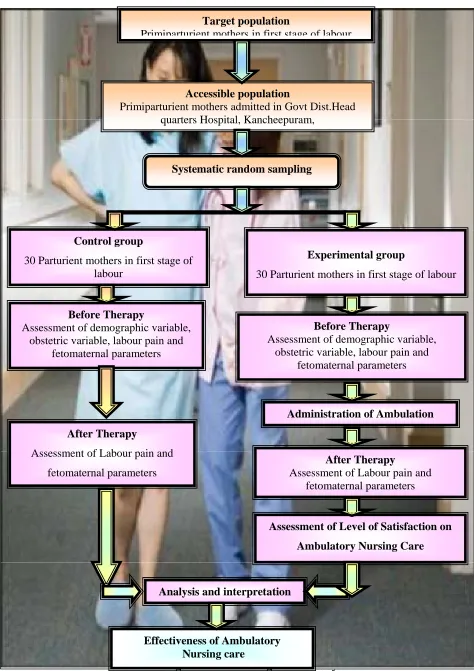
the control and experimental group before the therapy, then manipulated the independent variable. Ambulatory nursing care was administered only to the experimental group of primi parturient mothers.
Ambulatory nursing care was given for 20-30 minutes in latent phases of labour. The effectiveness of Ambulatory nursing care on dependent variable after therapy level of labour pain and feutomaternal parameters of the primiparturient mothers were assessed. Then the level of satisfaction on Ambulatory nursing care was assessed using rating scale only to experimental group.
The research design is represented diagrammatically as follows:
R O1 X 02, 03 X 04, 05 X 06 --- 013 X 014 R 01-02, 03-04, 05-06, --- 013-014 R - Randomization
01, 03, 05, 07, 09, 013 - Assessment before Ambulation every hour
X - Administration of Ambulation
Fig.2. Schematic design of the study Fig.2. Schematic design of the study Control group
30 Parturient mothers in first stage of labour
Experimental group
30 Parturient mothers in first stage of labour
Analysis and interpretation Target population
Primiparturient mothers in first stage of labour
Accessible population
Primiparturient mothers admitted in Govt Dist.Head quarters Hospital, Kancheepuram,
Systematic random sampling
Before Therapy
Assessment of demographic variable, obstetric variable, labour pain and
fetomaternal parameters
Administration of Ambulation
After Therapy
Assessment of Labour pain and fetomaternal parameters
Assessment of Level of Satisfaction on Ambulatory Nursing Care Before Therapy
Assessment of demographic variable, obstetric variable, labour pain and
fetomaternal parameters
After Therapy
Assessment of Labour pain and fetomaternal parameters
Research setting of the study
The study was conducted in Government District Head Quarters Hospital, Kancheepuram. The hospital has labour room, postnatal ward, operation theatre, post operative ward, neonatal ICU, pediatric ward and outpatient department with scan facilities. An average of 80-100 primi parturient mothers are delivering through normal vaginal delivery in a month. The hospital has counseling for couple and family. . They give health teaching regarding antenatal care, reproductive health includes HIV and VDRL screening postnatal care, importance of breast feeding and immunization. The labour room has eight labour tables with all special equipments such as CTG machine, life saving equipments and emergency medications to manage the mothers on both normal and obstetrical emergencies.
Population
Sample
Polit and Beck (2008) said that sample is a subset of population, selected to participate in a study. A sample of 60 primi parturient mothers in first stage of labor were selected for the study. In this 30 mothers were randomly assigned to control group and 30 mothers were assumed to experimental group.
Sampling technique
It was stated by Polit & Beck (2008) that sampling refers to the process of selecting a portion of the population to represent the entire population. The subject of the present study was selected by systematic random sampling technique, in which every odd number parturient mother was assigned to control group and every even number mother was assigned to experimental group. The mother who satisfied with the inclusion criteria was selected for the study
Sampling Criteria Inclusion Criteria
The study includes mothers who: Were delivering for first time
¾ Were between 38-42 weeks of gestation ¾ Were having labour pain in latent phase of 1st stage of labor ¾ could speak and understand Tamil & English
Exclusion criteria The study excluded
¾ Mothers with any underlying disease such as pregnancy induced hypertension and diabetes mellitus.
¾ Mothers with complicated pregnancy like obstructed labour, multiple pregnancies and preterm labour
¾ Mothers who were not willing to participate in the study ¾ Mothers who cannot understand and speak Tamil or English.
Selection and development of the study instruments
As the study aimed to evaluate the effectiveness of Ambulatory nursing care in first stage of labour, the data collection instruments were developed through an extensive review of literature. The instruments used in this study were demographic variable proforma, obstetric variable proforma, modified pain intensity scale, with modified partograph, Ambulation chart and Rating scale on satisfactory of Ambulatory nursing care.
Demographic Variable Proforma
Obstetric Variable Proforma
The Obstetric variable proforma includes gestational age in weeks, height, and weight gain during pregnancy, number of antenatal visits till date, and complications during antenatal period,pain management during first stage of labour, type of labour ,duration of first stage of labour, maternal and fetal complications during labour
Pain Rating Scale
0-10
pain intensity scale was used to assess the level of pain perceived by parturient mothers before and after Ambulatory nursing care by interviewing the mother.WHO modified Partograph
This graph was used to asses the fetomaternal parameters such as fetal heart rate, blood pressure, maternal pulse rate, uterine contraction frequency and duration, cervical dilatation, and station of the fetal head.
Rating scale on level of satisfaction of Ambulatory Nursing Care
The rating scale was designed to assess the level of satisfaction of the parturient mothers regarding Ambulatory nursing care and this is assessed after the mother’s delivery.
The satisfaction score were classified into 3 levels.
Validity of Study Instruments
Content validity of the tool was obtained by getting opinion from seven experts in the field of Obstetrics and Gynecology. Three of the experts were doctors and three were nursing personnel and one biostatistician. The valuators had suggested some specific modification in the objectives and rating scale. The modification and suggestions of experts of experts were incorporated in the final preparation of the rating scale to assess the level of satisfaction of Ambulatory nursing care among parturient mothers.
Reliability of study instruments
The reliability of the tool was elicited by using the inter rater technique, karl Pearson’s ‘r’ was computed for finding out the reliability. For pain scale, and WHO modified partograph. The ‘r’ was found to be 0.9 which shows positive correlation, indicates that the tools are highly reliable.
Pilot study
Polit and Hungler (2004) states that a pilot study is a miniative of some parts of actual study in which the instruments are administered to the subjects drawn from the same population. It is a small scale version or trial run done in preparation for a major study. The purpose is to find out the feasibility and practicability of the study.
obstetric variable proforma pain intensity scale rating scale on satisfaction, data were collected and analysis was done. The study was found to be feasible, accepted and easy to understand by the parturient mothers.
Intervention Protocol
Ambulatory nursing care is one of the non-pharmacological interventions which is used to reduce the length of labour, improve, the duration of contraction ,enhance the station descent and reduce the intensity of pain level. Ambulation can be given to parturient mothers for 20-30 minutes without any supportive aid.
Data collection procedure
Data collection is gathering of information and needed to address a research problem. The research proposal was presented to the ethical committee, Apollo Hospital for the ethical and scientific consideration to proceed with data collection. Data was collected round the clock from June to July 2010.
Researcher collected data from parturient mothers and from their case sheet. The parturient mothers were selected by using systematic random sampling technique i.e. odd number was assigned to control group and every even number was assigned to the experimental group. Written consent was taken from the parturient mothers, rapport was established by a brief introduction about the research purpose and tool used by the investigator. The subject was assured for confidentiality and explained about Ambulatory nursing care.
variables, level of labor pain using Pain Scale, Fetomaternal parameters with the help of the WHO modified Partograph. Every one hour, after the therapy the level of pain and fetomaternal parameters were assessed in both control and experimental group of parturient mothers. After the delivery in the experimental group the level of satisfaction was assessed using the rating scale on the level of satisfaction on ambulatory nursing care.
Problems faced during data collection
¾ Some of the primigravidae were not willing to participate in the study.
Plan for data analysis
Data analysis is the systematic organization and synthesis of research data and testing of research hypothesis by using the obtained data (Polit & Beck 2004). Analysis and interpretation of data were carried out with descriptive statistics like frequency distribution, percentage, mean, stand deviation and inferential statistics like paired ‘t’ test. The association between the demographic variables, obstetric variables and dependent variables were analyzed with the help of ANOVA.
Summary
CHAPTER – IV
ANALYSIS AND INTERPRETATION
This chapter includes both descriptive and inferential statistics. Statistics is a field of study concerned with techniques or methods of data collection, classification, summarizing, interpretation, drawing, inferences, testing of hypothesis, making recommendations, etc. Mahajan, (2004).
The data collected from 60 parturient mothers, 30 mothers in experimental group and 30 in control group to assess the effectiveness of ambulation during first stage labour upon feotomaternal parameters. The data were analysed according to the objectives and hypotheses of the study. Data analysis was completed after all the data was transferred to master coding sheet by the researcher using descriptive and inferential statistics.
Organization of Findings
¾ Frequency and percentage distribution of demographic variables, obstetric variables before and after ambulatory nursing care in the control and experimental group of parturient mothers.
¾ Comparison of mean and standard deviation of fetomaternal parameters, level of labour pain before and after ambulatory nursing care in the control and experimental group of parturient mothers.
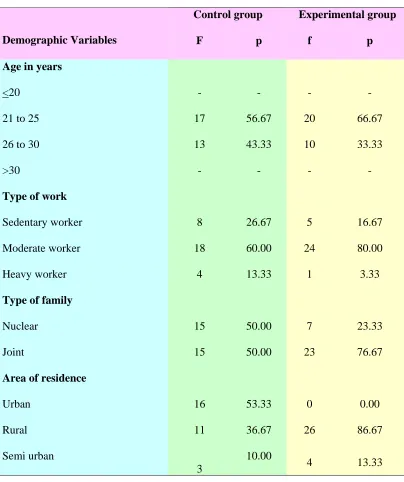
Table 1
Frequency and Percentage Distribution of Demographic Variables of Parturient Mothers of Control and Experimental Group (Age, Education, Type of work, Type of family, Area of residence)
(N=60) Control group Experimental group
Demographic Variables F p f p
Age in years
<20 - - - -
21 to 25 17 56.67 20 66.67
26 to 30 13 43.33 10 33.33
>30 - - - -
Type of work
Sedentary worker 8 26.67 5 16.67
Moderate worker 18 60.00 24 80.00
Heavy worker 4 13.33 1 3.33
Type of family
Nuclear 15 50.00 7 23.33
Joint 15 50.00 23 76.67
Area of residence
Urban 16 53.33 0 0.00
Rural 11 36.67 26 86.67
Semi urban
3
10.00
It can be noted from Table 1 that in the control group most of the study participants were in the age group of 21-25 years (56.67%), belonged to moderate worker (60%), half of them were living in Joint family (50%) and residing at urban area (53.3%).
Most of the parturient mothers in the experimental group were in the age group between 21-25years(66.67%),majority of them were moderate workers (80%), were living in joint family(76.67%), residing at rural area (86.67%).
Fig 3 Percentage distribution of educational status in control and experimental group of parturient mothers
0
46.67
40
10
3.33
0 10
36.67
30
16.67
6.67
0 0
5 10 15 20 25 30 35 40 45 50
No formal education Primary school High school Higher secondary Graduate Post graduate
Educational Status
Pe
rcent
age
Table 2
Frequency and Percentage Distribution of Obstetric Variables of Parturient Mothers of Control and Experimental Groups (gestational age in weeks, height in cms, weight gain during pregnancy, number of antenatal visits, complications during antenatal period, pain management during labour,type of delivery ,duration of labour ,maternal and fetal complications during labour).
(N=60)
Obstetric l Variables
Control group (n=30)
Experimental group (n=30) f p f p Gestational Age in weeks
37 to 38 1 3.33 - -
39 to 40 15 50.00 24 80.00
41 to 42 14 46.67 6 20.00
Height in cms
<145 cm 9 30.00 3 10.00
>145 cm 21 70.00 27 90.00
Weight gain during pregnancy
10 kg - - - -
12 kg 24 80.00 27 90.00
>12 kg 14 20.00 3 10.00
Number of antenatal visit
No visit 4 13.33 - -
1 to 3 times 16 53.33 13 43.33
Pain management during first stage of labour
Systemic analgesia - - - -
Inhalation analgesia - - - -
Epidural analgesia - - - -
Combined Spinal Epidural analgesia - - - -
None 30 100 30 100
Type of delivery
Normal vaginal delivery 30 100 30 100
Forceps delivery - - - -
Vacuum delivery - - - -
Lower segment cesarean section - - - -
Maternal complications during delivery
Shoulder dystocia - - - -
Postpartum hemorrhage - - - -
Dysfunctional labour - - - -
None
Fetal Complications
30 100 30 100
Prolapsed cord - - - -
Respiratory distress syndrome - - - -
Meconium Aspiration Syndrome - - - -
Asphyxia Neonatorum - - - -
The data presented in the Table 2 shows that half of the parturient mothers in control group belonged to the gestational age between 39-40weeks (50%), most of them were above 145cm in height (70%). Majority of them were gained weight about 12kg during pregnancy (80%), most of them had antenatal visit 1-3 times (53.33%).
Majority of the study participants in the experimental group were in the gestational age between 39-40 weeks (80%), obtained weight gain about 12kg in the antenatal period (80%). Most of them had attended antenatal clinic more than 3 times (56.67%). All of them delivered normally received no pain management and none of them developed either maternal or fetal complications during labour in both the groups.
Fig. 4 Percentage distribution of Duration of First stage of Labour in Control and Experimental Group of Parturient mothers.
70%
0%
23.63%
36.70%
6.37%
36.60%
0%
26.70%
0% 10% 20% 30% 40% 50% 60% 70% 80% 90% 100%
Percentage
< 6hrs 7-8 hrs 9-10 hrs >10 hrs
Ho
u
rs
Control Group
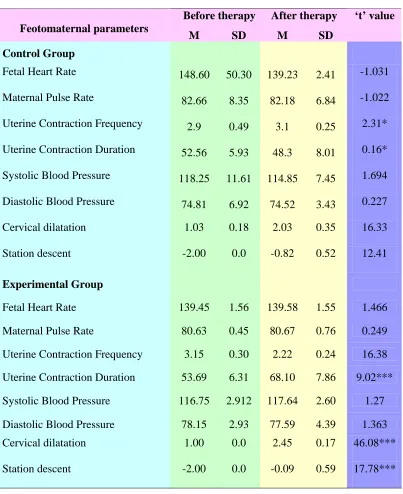
Table 3
Comparison of Mean and Standard Deviation of Feotomaternal Parameters Before and After Ambulation in Control and Experimental Group of Parturient Mothers.
(N=60) Before therapy After therapy
Feotomaternal parameters
M SD M SD
‘t’ value
Control Group
Fetal Heart Rate 148.60 50.30 139.23 2.41 -1.031 Maternal Pulse Rate 82.66 8.35 82.18 6.84 -1.022 Uterine Contraction Frequency 2.9 0.49 3.1 0.25 2.31* Uterine Contraction Duration 52.56 5.93 48.3 8.01 0.16* Systolic Blood Pressure 118.25 11.61 114.85 7.45 1.694 Diastolic Blood Pressure 74.81 6.92 74.52 3.43 0.227 Cervical dilatation 1.03 0.18 2.03 0.35 16.33
Station descent -2.00 0.0 -0.82 0.52 12.41
Experimental Group
Fetal Heart Rate 139.45 1.56 139.58 1.55 1.466 Maternal Pulse Rate 80.63 0.45 80.67 0.76 0.249 Uterine Contraction Frequency 3.15 0.30 2.22 0.24 16.38 Uterine Contraction Duration 53.69 6.31 68.10 7.86 9.02*** Systolic Blood Pressure 116.75 2.912 117.64 2.60 1.27 Diastolic Blood Pressure 78.15 2.93 77.59 4.39 1.363 Cervical dilatation 1.00 0.0 2.45 0.17 46.08*** Station descent -2.00 0.0 -0.09 0.59 17.78***
It can be inferred from Table 3 that mean and standard deviation of frequency of uterine contraction in control group was high in after therapy (M=3.1,SD=0.25) in comparison with before therapy(M=2.9,SD=0.49) .The difference was found statistically significant at 95% level of significance. Hence the Null hypothesis Ho1 was rejected.
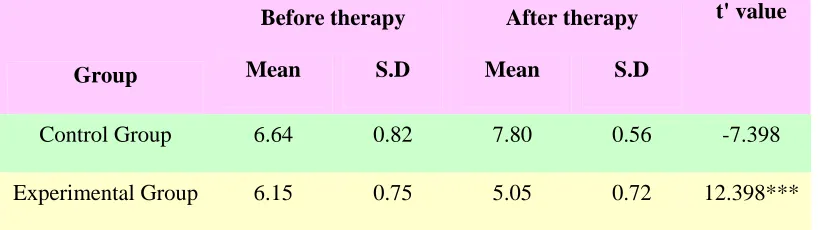
Table 4
Comparison of Mean and Standard Deviation of Level of Labour Pain Before and After Therapy in Control and Experimental Group of Parturient Mothers.
(N=60)
Before therapy After therapy
Group Mean S.D Mean S.D
t' value
Control Group 6.64 0.82 7.80 0.56 -7.398
Experimental Group 6.15 0.75 5.05 0.72 12.398***
***p<0.001
Fig. 5. Mean Distribution of Cervical Distribution in Control and Experimental Group of Parturient Mothers
1 2.45 0.17
46.08
16.33
0
0.35 2.03
0.18 1.03
0 5 10 15 20 25 30 35 40 45 50
Pre test Post test t' value
Cervical Dilation
Perce
nt
age
Experimetal Group
Fig 6 Mean Distribution of Fetal Head Descent in Control and Experimental Group of Parturient Mothers.
Pre test, -2
t' value, 17.78
t' value, 12.41
, 0.59
, 0
Post test, -0.09
, 0.52 , 0
Post test, -0.82 Pre test, -2
-5 0 5 10 15 20
0
1
2
3
4
5
6
Fetal Head
P
erc
en
ta
ge
Table 5
Frequency and Percentage Distribution of Level of Satisfaction on Ambulatory Nursing Care in Experimental Group of Parturient Mothers.
(N=30) Experimental Group
Level of satisfaction f p
Low - -
Moderate - -
High 30 100
Table 6
Association between the Selected Demographic Variables and Fetal Heart Rate after therapy in Control and Experimental Group of Parturient Mothers. (Age, Educational status, Type of work, Type of Family, Area of Residence)
(N=60) Control group (n=30) Experimental group (n=30) Demographic
variables Mean SD ’t’ Value Mean SD ’t’ Value
Age in years
<20 - - - -
21 to 25 138.84 2.76 139.64 1.30
26 to 30 139.74 1.83 139.44 2.03
>30 - -
-1.076 - - 0.290 Education No formal education 138.20 3.75
Primary school 139.27 2.25 139.98 1.08
High school 139.82 1.82 139.11 2.09
Higher secondary 138.12 3.31 139.63 0.78
Graduate 140.05 2.19 139.20 -
Post graduate - -
0.572
- -
0.912
Type of work
Sedentary worker 140.27 1.06 138.98 2.85 Moderate worker 138.85 2.78 139.66 1.22 Heavy worker 138.80 2.31
1.040
140.50 -
1.799
Type of family
Nuclear 139.10 2.69 139.68 1.25
Joint 139.35 2.17
-0.284
139.22 2.39
-0.701
Area of residence
Urban 139.27 2.69 - -
Rural 138.98 2.28 139.57 1.65
Semi urban 139.87 1.52
0.157
139.62 0.63
0.249
Table 7
Association between the Selected Demographic Variables and Maternal Pulse Rate in Control and Experimental Group of Parturient Mothers. (Age, Educational Status, Type of work, Type of Family, Area of Residence).
(N=60) Control Group (n=30) Experimental Group (n=30) Demographic variables
Mean SD ’t’ Value Mean SD ’t’ Value Age in years
<20 - - - -
21 to 25 81.16 1.02 80.73 0.68
26 to 30 80.67 0.96 80.55 0.93
>30 - -
1.359
- -
0.545
Education
No formal education 80.63 1.70 - -
Primary school 81.25 0.81 80.56 0.63
High school 80.57 0.86 80.82 0.89
Higher secondary 81.22 1.16 80.23 0.68
Graduate 80.80 1.69 81.60 -
Post graduate - -
0.718
- -
1.096
Type of work
Sedentary worker 80.47 0.76 80.84 1.20
Moderate worker 81.24 1.01 80.66 0.67
Heavy worker 80.60 1.20
1.984
80.00 -
0.497
Type of family
Nuclear 81.00 1.13 139.68 1.25
Joint 80.90 0.91
0.267
139.22 2.39
-0.701 Area of residence
Urban 81.02 1.12 - -
Rural 80.83 0.93 139.57 1.65
Semi urban 81.00 1.00
0.121
139.62 0.63
0.249
Table 8
Association between the Selected Demographic Variable sand Contraction Duration in Control and Experimental Group of Parturient Mothers. (Age, Educational status, Type of work, Type of Family,Area of Residence)
(N=60) Control Group Experimental Group
Post test Post test
Demographic Variables Mean S.D
ANOVA/
’t’ Value Mean S.D
ANOVA/ ’t’ Value Age in years
<20 - - - -
21 to 25 34.38 4.54 44.08 15.77
26 to 30 35.15 4.99 43.55 15.46
>30 - -
-0.436
- -
0.089
Education
No formal education 31.33 2.31 - -
Primary school 35.27 4.97 44.03 13.19
High school 32.89 3.10 41.40 14.70
Higher secondary 37.56 2.82 53.43 30.76
Graduate 37.85 11.81 43.50 -
Post graduate - -
1.581
- -
0.461
Type of work
Sedentary worker 32.37 2.68 39.02 4.24
Moderate worker 35.58 5.04 45.05 17.0
Heavy worker 34.12 5.20
1.677
40.80 -
0.323
Type of family
Nuclear 35.05 5.74 43.71 14.34
Joint 34.39 3.48
0.381
44.56 19.80
-0.105
Area of residence
Urban 34.77 5.13 - -
Rural 33.68 2.98 43.02 14.00
Semi urban 38.23 7.12
1.130
49.65 24.67
-0.524
Table 9
Association between the Selected Demographic Variable and Contraction Frequency in Control and Experimental Group of Parturient Mothers. (Age, Educational status, Type of work, Type of Family,Area of Residence)
(N=60) Control Group Experimental Group
Post test Post test
Demographic Variables Mean S.D
ANOVA/
’t’ Value Mean S.D
ANOVA/ ’t’ Value Age in years
<20 - - - -
21 to 25 13.13 2.20 15.99 10.39
26 to 30 12.13 2.69 11.87 5.08
>30 - -
1.094
- -
1.461
Education
No formal education 13.10 2.42 - -
Primary school 12.36 2.69 15.48 10.00
High school 13.37 2.63 13.97 8.86
Higher secondary 11.23 1.56 14.77 9.79
Graduate 14.55 0.07 9.90 -
Post graduate - -
0.983
- -
0.140
Type of work
Sedentary worker 12.50 3.14 10.84 0.78
Moderate worker 12.88 2.19 15.59 9.96
Heavy worker 12.26 2.59
0.132
10.30 -
0.666
Type of family
Nuclear 13.18 2.34 15.22 9.87
Joint 12.21 2.52
1.097
12.66 6.01
0.835
Area of residence
Urban 13.25 1.69 - -
Rural 11.71 3.16 14.80 9.33
Semi urban 13.37 2.49
1.459
13.42 8.44
0.300
Table 10
Association between the Selected Demographic Variable and Cervical Dilatation in Control and Experimental Group of Parturient Mothers. (Age, Educational status, Type of work,Type of Family, Area of Residence)
(N=60) Control Group Experimental Group
Post test Post test
Demographic Variables Mean S.D
ANOVA/
’t’ Value Mean S.D
ANOVA/ ’t’ Value Age in years
<20 - - - -
21 to 25 1.59 0.37 2.41 0.18
26 to 30 1.81 0.41 2.53 0.10
>30 - -
-1.545
- -
2.267
Education
No formal education 1.43 0.11 - -
Primary school 1.63 0.44 2.41 0.19
High school 1.70 0.33 2.48 0.15
Higher secondary 1.77 0.47 2.43 0.21
Graduate 2.12 0.53 2.60 -
Post graduate - -
1.030
- -
0.605
Type of work
Sedentary worker 1.41 0.18 2.54 0.13
Moderate worker 1.78 0.45 2.42 0.17
Heavy worker 1.81 0.24
2.970
2.60 -
1.391
Type of family
Nuclear 1.71 0.42 2.44 0.17
Joint 1.67 0.39
0.293
2.48 0.17
-0.639
Area of residence
Urban 1.80 0.41 - -
Rural 1.51 0.26 2.44 0.18
Semi urban 1.75 0.66
1.879
2.50 0.08
-1.071
Table 11
Association between the Selected Demographic Variable and Station of Fetal Head in Control and Experimental Group of Parturient Mothers. (Age, Educational status, Type of work, Type of Family,Area of Residence)
(N=60) Control Group Experimental Group
Post test Post test
Demographic Variables Mean S.D
ANOVA/
’t’ Value Mean S.D
ANOVA/ ’t’ Value Age in years
<20 - - - -
21 to 25 -1.41 0.94 -0.81 0.60
26 to 30 -1.23 1.01 -0.83 0.34
>30 - -
-0.500
- -
0.088
Education
No formal education -1.33 1.15 - -
Primary school -1.45 0.93 -0.89 0.34
High school -1.33 1.00 -0.62 0.69
Higher secondary