0022-538X/96/$04.0010
Copyrightq1996, American Society for Microbiology
Rescue and Replication of Adeno-Associated Virus Type 2 as
well as Vector DNA Sequences from Recombinant Plasmids
Containing Deletions in the Viral Inverted Terminal Repeats:
Selective Encapsidation of Viral Genomes in Progeny Virions
XU-SHAN WANG,1SELVARANGAN PONNAZHAGAN,1ANDARUN SRIVASTAVA1,2,3* Division of Hematology/Oncology, Department of Medicine,1Department of Microbiology and Immunology,2and
Walther Oncology Center,3Indiana University School of Medicine, Indianapolis, Indiana 46202
Received 26 July 1995/Accepted 12 December 1995
The adeno-associated virus type 2 (AAV) genome can be successfully rescued from recombinant plasmids following transfection in adenovirus-infected human cells. However, following rescue, the AAV genome under-goes preferential replication and encapsidation, whereas little replication and packaging of the vector DNA sequences occur. In view of the crucial role in the rescue, replication, and packaging of the proviral genome played by the AAV inverted terminal repeats (ITRs), which consist of a palindromic hairpin (HP) structure and a 20-nucleotide stretch, designated the D-sequence, that is not involved in the HP formation, we evaluated the involvement of the individual ITRs as well as their components in the selective viral DNA replication and encapsidation. A number of recombinant AAV plasmids that contained deletions-substitutions in different regions of the individual ITRs were constructed and examined for their potential to allow rescue, replication, and/or packaging in adenovirus-infected human cells in vivo. The results reported here document that (i) two HP structures and one D-sequence are sufficient for efficient rescue and preferential replication of the AAV DNA, (ii) two HP structures alone allow a low-level rescue and replication of the AAV DNA, but rescue and replication of the vector DNA sequences also occur in the absence of the D-sequences, (iii) one HP structure and two D-sequences, but not one HP structure and one D-sequence, also allow rescue and replication of the AAV as well as the vector DNA sequences, (iv) one HP structure alone or two D-sequences, but not one D-sequence alone, allow replication of the full-length plasmid DNA, but no rescue of the AAV genome occurs, (v) no rescue-replication occurs in the absence of the HP structures and the D-sequences, (vi) in the absence of the D-sequences, the HP structures are insufficient for successful encapsidation of the AAV genomes, and (vii) the AAV genomes containing only one ITR structure can be packaged into biologically active virions. Thus, the D-sequence plays a crucial role in the efficient rescue and selective replication and encapsidation of the AAV genome. Furthermore, the D-sequence specifically interacts with a hitherto unknown host-cell protein that we have designated the D-sequence-binding protein (D-BP). These studies illustrate that the D-sequence–D-BP interaction constitutes an important step in the AAV life cycle.
The adeno-associated virus type 2 (AAV) is a nonpatho-genic human parvovirus that contains a single-stranded DNA genome of 4,680 nucleotides (41). AAV undergoes optimal replication in the presence of a helper virus such as adenovirus or herpesvirus (2–4). The AAV genome integrates into the host chromosomal DNA to establish a latent infection in the absence of a helper virus (8, 20–23, 36). Upon superinfection of latently infected cells by a helper virus, the AAV proviral genome undergoes rescue and proceeds through a normal pro-ductive replication (2, 27, 28). The proviral genome can also be rescued from recombinant plasmids containing the wild-type (wt) AAV genome by transfecting the plasmid DNA into ad-enovirus-infected human cells in vivo (32, 35). Thus, the re-combinant plasmids serve as a useful model for studying rescue and replication of the latent proviral AAV genome. However, previous in vitro studies have demonstrated that following res-cue of the AAV genome from recombinant plasmids, only the viral sequences undergo selective DNA replication (15, 45).
The molecular mechanisms underlying the selective replication of the AAV genome and the lack of replication of the vector sequences in vivo have not been fully explored.
Previous studies have established that two AAV sequences are required for viral DNA replication. These include the viral
rep gene, which codes for four nonstructural proteins that are
synthesized from a single open reading frame by the use of alternate promoters and splicing (41), and the viral origin of DNA replication, which consists of a 145-nucleotide inverted terminal repeat (ITR) sequence (11, 24). Two of the viral Rep proteins (Rep78 and Rep68) have been shown to be site-specific and strand-site-specific endonucleases that site-specifically bind to, and cleave at, the terminal resolution site (trs) within the AAV ITRs (1, 17–19, 39). The other two viral Rep proteins (Rep52 and Rep40) are responsible for generating the viral single-stranded progeny genomes (7). The AAV rep gene mu-tants are defective for viral DNA replication (12, 30, 42). The terminal 125 nucleotides that are palindromic and form T-shaped hairpin (HP) structures are used as primers for initia-tion of viral DNA replicainitia-tion (2, 24, 26, 40). Previous in vivo as well as in vitro studies have demonstrated that intact ITRs are required in cis for the successful rescue of the AAV genome from recombinant plasmids followed by the viral DNA repli-cation (9, 15, 32, 35, 37).
* Corresponding author. Mailing address: Department of Microbi-ology and ImmunMicrobi-ology, Medical Science Building 255, Indiana Uni-versity School of Medicine, 635 Barnhill Dr., Indianapolis, IN 46202-5120. Phone: (317) 274-2194. Fax: (317) 274-4090. Electronic mail address: [email protected].
1668
on November 9, 2019 by guest
http://jvi.asm.org/
It is, therefore, clear that the AAV ITRs in general, and the HP structures in particular, play a crucial role in the viral DNA replication. However, the role of these individual structures in the viral genome rescue and encapsidation is less clear. Fur-thermore, although our recent studies have documented that the additional 20 nucleotides, designated the D-sequence, that are not involved in the HP formation are required for efficient rescue of the AAV genome (44), the underlying mechanism of selective replication and packaging of the AAV genome re-mains largely unexplored. In this pursuit, we systematically constructed a number of recombinant AAV genomes contain-ing deletions and substitutions within the viral ITR sequences and examined in detail the effects of these alterations on the rescue, replication, and encapsidation of the AAV genome in vivo. In this report, we present evidence that in addition to the high-efficiency rescue, the D-sequence is also required for se-lective replication of the AAV genome as well as for generat-ing the viral sgenerat-ingle-stranded DNA genomes prior to their en-capsidation into progeny AAV virions. We also document the existence of a hitherto unknown cellular protein that specifi-cally interacts with the D-sequence and propose a model that helps explain the available data on the AAV DNA rescue, replication, and encapsidation.
MATERIALS AND METHODS
Cells, viruses, and plasmids.Human nasopharyngeal carcinoma cell line KB was obtained from A. C. Antony, Indiana University School of Medicine, Indi-anapolis, and maintained as monolayer cultures in Iscove’s modified Dulbecco’s medium supplemented with 10% fetal bovine serum and penicillin and strepto-mycin as previously described (40). AAV and the human adenovirus type 2 (Ad2) virus stocks were obtained, respectively, from K. I. Berns, Cornell University Medical College, New York, N.Y., and Kenneth H. Fife, Indiana University School of Medicine, Indianapolis, and propagated as previously described (27, 28). The recombinant AAV plasmid pSub201 (33) was supplied by R. J. Samul-ski, University of North Carolina, Chapel Hill.
Construction of recombinant AAV plasmids.Most of the recombinant AAV plasmids used in the present studies have recently been described (44). Plasmids pXS-31 and pXS-32, in which the trs was repaired by a substitute oligonucleotide sequence (S-sequence) with the oligomer pair 59-CTAGTGATATCAGATCTA ATATTGG-39and 59-CCAATATTAGATCTGATATCA-39, were constructed as follows. The S-sequence was inserted between the XbaI and BalI sites of plasmid pXS-27 described previously (44) to generate plasmid pXS-31. To con-struct plasmid pXS-32, together with the S-sequence, the XbaI-HindIII insert from a plasmid, pXS-30, which contained the PvuII-XbaI fragment from plasmid pSub201 cloned between the XbaI-EcoRV sites of pBluescriptSK(1) but lacked the AAV left ITR, was ligated between the BalI-HindIII sites of a plasmid, pXS-29 (43), which contained the PvuII-XbaI fragment of plasmid pSub201 cloned into the XbaI-HincII sites of pBluescriptSK(1) but lacked the viral right ITR. Standard cloning techniques were used for constructing all recombinant plasmids (31).
AAV DNA rescue and replication assays.DNA-mediated transfections were carried out by the DEAE-dextran procedure (32, 35) with 4mg of each plasmid per 100-mm-diameter dish of 50% confluent KB cells. The transfection mixture also contained 10 PFU of Ad2. At various times posttransfection, low-MrDNA
samples were isolated by the procedure described by Hirt (13), digested exten-sively with DpnI, and analyzed on Southern blots by using32P-labeled DNA
probes specific for the AAV-coding sequences and the plasmid vector (ampicillin resistance gene, Apr) sequences as previously described (44).
Preparation of WCE.HeLa cells were either mock infected, infected with AAV, or coinfected with AAV and Ad2 as previously described (1). Cultures were incubated for 30 to 36 h prior to harvesting the cells. Whole-cell extracts (WCE) were prepared according to the method of Muller (25). Total protein concentration was determined, and the extracts were frozen in liquid N2and
stored at2808C.
EMSA.Electrophoretic mobility shift assays (EMSA) were performed accord-ing to the method of Carthew et al. (6). DNA-bindaccord-ing reactions were performed in a volume of 20ml with 2mg of poly(dI-dC), 2mg of bovine serum albumin, and 12% glycerol in HEPES (N-2-hydroxyethylpiperazine-N9-2-ethanesulfonic acid) buffer (pH 7.9). Tenmg of proteins of each WCE was preincubated for 10 min at 128C; this was followed by the addition of 10,000 cpm of32
P-labeled duplex D-sequence oligomer (59-AGGAACCCCTAGTGATGGAG-39) in the reaction mixtures. The binding reaction was allowed to proceed for 30 min at 258C, and the bound complexes were separated from the unbound probe on 5% low-ionic-strength polyacrylamide gels with recirculating Tris-acetate-EDTA buffer (pH 7.9) containing 6.72 mM Tris-HCl, 3.3 mM sodium acetate, and 1 mM EDTA. In
competition experiments, increasing concentrations of unlabeled D-sequence, the S-sequence (59-CCAATATTAGATCTGATATCA-39), the AAV cap se-quence (59-ACCGTGGATACTAATGGCGTG-39), and the AAV HP sequence (PvuII-BalI fragment from pSub201), respectively, were added to the reaction mixtures prior to the addition of the radiolabeled D-sequence probe for 10 min; this was followed by incubation (as described above) with the labeled probe. The gels were dried and autoradiographed as previously described (1).
RESULTS
Rescue and replication of AAV as well as vector DNA se-quences occur from plasmids containing deletions in viral ITR
sequences. The recombinant AAV genomes in which various
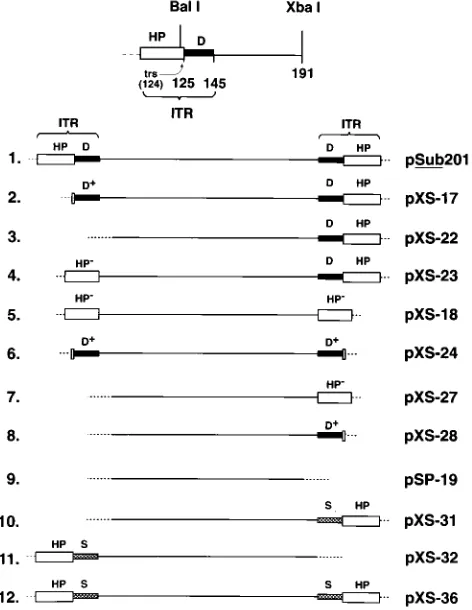
[image:2.612.319.555.74.379.2]deletions were introduced within one or both AAV ITRs are depicted in Fig. 1. The ITR consists of the terminal 125 nucle-otides that form the HP structure, which also contains the trs at nucleotide 124 (29, 41), and the 20-nucleotide-long D-se-quence (24). The terminal 121 nucleotides of the left ITR were deleted in plasmid pXS-17, which retained the 4 nucleotides from the HP and the D-sequence (D1). In plasmid pXS-22, the entire left ITR was deleted. Plasmid pXS-23 contained dele-tions of the left D-sequence and 4 nucleotides in the left HP structure (HP2) including the left trs. In plasmid pXS-18, both D-sequences as well as the two trss were deleted. Plasmid FIG. 1. Schematic representation of the recombinant AAV genomes con-taining various deletions-substitutions in the ITR sequences. The details of the AAV left ITR, which includes a palindromic HP structure (open box) and the D-sequence (closed box), are illustrated at the top. The trs as well as the relevant restriction endonuclease sites are also indicated. The dotted and the solid lines represent the plasmid and the AAV DNA sequences, respectively. Plasmid pSub201 has been described before (33), and the details of construction of each of the 11 recombinant AAV plasmids have been described previously (44). D1 indicates that the D-sequence contains four additional nucleotides that extend into the TRS, and HP2indicates that those four nucleotides are deleted from the HP sequences. The cross-hatched boxes represents a synthetic 20-nucleotide substitute sequence (S-sequence) that contains the trs.
VOL. 70, 1996 AAV DNA RESCUE, REPLICATION, AND PACKAGING 1669
on November 9, 2019 by guest
http://jvi.asm.org/
pXS-24 contained deletions of both the HP structures. The entire left ITR and the right D-sequence as well as the right trs were deleted in plasmid pXS-27. The entire left ITR and the right HP structure were deleted in plasmid pXS-28. In plasmid pSP-19, both AAV ITRs were deleted. The trs was restored in plasmid pXS-27 by the strategy outlined in Materials and Methods. Briefly, a synthetic oligonucleotide substitute, S-se-quence, which contained the 4 nucleotides that were missing from the HP2structure in pXS-27, was inserted at appropriate sites to generate two recombinant plasmids, designated pXS-31 and pXS-32, respectively, that contained one complete HP structure at either end of the viral genome. Plasmids pXS-31 and pXS-32 were used to generate a recombinant plasmid, designated pXS-36, that contained both the trss in the
HP structures and the 20-nucleotide inverted repeat sequence that mimicked the D-sequence.
These plasmids were transfected separately into Ad2-in-fected KB cells, and low-Mr DNA samples were isolated at
various times posttransfection, digested with DpnI (46) to de-grade unreplicated input plasmid DNA, and analyzed on Southern blots by using 32P-labeled DNA probes specific for
the AAV-coding sequences and the plasmid vector (ampicillin resistance gene, Apr) sequences. The results of rescue and
replication from plasmid pXS-17 are shown in Fig. 2a. As is evident from Fig. 2a, panel A, the AAV probe detected the characteristic monomeric and dimeric forms of the AAV DNA replicative intermediates, suggesting that the viral genome un-derwent successful rescue and replication despite the lack of FIG. 2. (a) Southern blot analysis of rescue and replication from plasmid pXS-17 (A and B). Equivalent amounts of low-MrDNA samples isolated at 24 h (lanes
1 and 4), 48 h (lanes 2 and 5), and 72 h (lanes 3 and 6) posttransfection, either with (1) or without (2) prior cleavage with ClaI, were digested with DpnI, electrophoresed on agarose gels, and analyzed on Southern blots with the AAV (A) and the Apr(B) DNA probes. d and m denote the dimeric and monomeric forms
of the AAV DNA replicative intermediates, respectively, and fmIII and V represent the DpnI-resistant replicated linear plasmid and rescued vector sequences, respectively. Incomplete rescue of both AAV and the vector sequences occurs, and the plasmid also undergoes DNA replication, if it is not linearized with ClaI, which cleaves the plasmid upstream of the deleted left HP structure, prior to transfection. The AAV genome undergoes selective rescue and replication, if the plasmid DNA is cleaved with ClaI prior to transfection and no replication of the vector DNA occurs. (b) Southern blot analysis of rescue and replication from plasmid pXS-22. These experiments were carried out essentially as described above. No rescue of the AAV genome occurs if one of the ITRs is deleted, although the plasmid undergoes DNA replication (A and B, lanes 2 and 3). If the plasmid is linearized with ClaI prior to transfection, selective rescue-replication of the AAV, but not the vector sequences, occurs (A, lanes 5 and 6). Abbreviations are as for panel a. (c) Southern blot analysis of rescue and replication from plasmid pXS-23. Preferential rescue-replication of the AAV genome occurs if one of the D-sequences is deleted (A, lanes 2 and 3), although a low-level rescue-replication of the vector sequences is also apparent (B, lanes 2 and 3). Abbreviations are as for panel a. (d) Southern blot analysis of rescue and replication from plasmids pXS-18 and pXS-24. Rescue-replication of both AAV (A) and the vector sequences (B) occurs if both D-sequences are deleted (A and B, lanes 2 and 3). A low-level replication of plasmid pXS-24 also occurs in vivo if both HP structures are deleted (lane 6). This was not observed with a similar plasmid in previous studies, presumably because of low-efficiency replication in vitro (15). Abbreviations are as for panel a. fmII, DpnI-resistant replicated relaxed, circular plasmid sequences.
on November 9, 2019 by guest
http://jvi.asm.org/
one HP structure. Interestingly, however, in addition to the viral replicative DNA intermediates, the probe also detected an additional DNA band that corresponded to the linear full-length plasmid pXS-17 DNA, suggesting that the plasmid also underwent DNA replication. This band was not detected when the plasmid DNA was digested with ClaI prior to transfection, which cleaves this plasmid upstream of the left D-sequence. When the same DNA samples were analyzed on Southern blots with the Aprprobe (Fig. 2a, panel B), the same DNA
bands were detected. In addition, rescue and replication of the vector sequences were also detected. However, these bands were not detected when the plasmid was digested with ClaI prior to transfection. These results suggest that rescue-repli-cation of the AAV genome can occur in the absence of one HP structure, provided that both D-sequences are retained in the recombinant plasmid. This possibility was further tested by analyzing rescue and replication of the AAV genome from plasmid pXS-22, in which the entire left ITR is deleted. These results are shown in Fig. 2b. Again, replication of the full-length plasmid DNA was readily apparent as detected by both AAV (Fig. 2b, panel A) and Apr(panel B) DNA probes, and
prior digestion of this plasmid with ClaI resulted in the detec-tion of the characteristic AAV DNA replicative intermediates. Interestingly, however, no rescue-replication of the vector se-quences was apparent, suggesting that in addition to the HP structure, the D-sequence plays an important role in the rescue and replication of the AAV genome. Since the left HP struc-ture was also deleted in plasmids pXS-17 and pXS-22, we next examined rescue and replication from plasmid pXS-23, which contains this structure. The results of these experiments are presented in Fig. 2c. Although rescue and replication of the AAV genome occurred, replication of the full-length plasmid was also evident again, suggesting that in addition to the HP structures, the efficient rescue and replication of the AAV genome require two copies of the D-sequence.
To further distinguish between the roles played by the D-sequence and the HP structure in the efficient rescue and replication of the AAV DNA, we analyzed plasmids pXS-18 and pXS-24, which lacked these two components, respectively. Results of the rescue-replication analyses of these plasmids are
shown in Fig. 2d. It is evident that whereas the AAV genome was successfully rescued from plasmid pXS-18, followed by viral DNA replication (Fig. 2d, panel A), the full-length plas-mid also underwent DNA replication (Fig. 2d, panels A and B). However, efficient rescue-replication of the vector DNA sequences was also noted (Fig. 2d, panel B). Plasmid pXS-24, on the other hand, underwent DNA replication, but no rescue of the AAV genome or the vector sequences occurred. These results further indicate that although the HP structure is suf-ficient for excision, the D-sequence is crucial for the high-efficiency rescue and replication of the AAV genome.
Since plasmid pXS-18, which contains two HP structures, allowed rescue of the AAV genome, and plasmid pXS-24, which contains two D-sequences, allowed replication of the full-length plasmid DNA, albeit at low-efficiency, it was of interest to examine whether the recombinant AAV genomes containing only one HP and one D-sequence, respectively, could also undergo rescue and/or replication. Plasmids pXS-27 and pXS-28 were analyzed as described above, and the results are presented in Fig. 3. It is interesting to note that with plasmid pXS-27, which contains one HP structure, two bands that hybridized with the AAV (Fig. 3A) as well as the Apr(Fig.
3B) DNA probes and represented the fmIII and the fmII of the replicated plasmid DNA, respectively, were detected. Interest-ingly, however, efficient rescue-replication of the vector se-quences was also detected. Under these conditions, no rescue and/or replication of the AAV genome or the vector sequences could be detected from plasmids pXS-28 and pSP-19, which contain only one D-sequence and no ITRs, respectively.
We have recently documented that although no rescue of the AAV genome occurs from plasmids pXS-22 and pXS-27 (44), the efficiency of the full-length plasmid replication of pXS-27 is significantly lower than that of pXS-22. Since previ-ous studies have demonstrated that the trs is important for resolution and replication of the AAV genome (18, 29, 38, 39) and since this trs was deleted in pXS-27, because BalI restric-tion enzyme, which deleted 4 nucleotides from the HP struc-ture (HP2) to generate this plasmid, was used, we next wished to examine rescue-replication from plasmids in which this trs was restored. A synthetic oligonucleotide substitute, S-se-FIG. 3. Southern blot analysis of rescue and replication from plasmids pXS-27, pXS-28, and pSP-19. The presence of only one HP structure in the AAV genome allows the plasmid to undergo DNA replication (lanes 2 and 3), as detected by both the AAV (A) and the Apr
(B) DNA probes, but rescue and replication of the vector sequences occur only from plasmid pXS-27 and not from plasmid pXS-28 or pSP-19. The lack of both HP structures, the presence of only one D-sequence, or the lack of both ITRs results in the failure of these plasmids to undergo DNA rescue and replication. Abbreviations are as for Fig. 2.
VOL. 70, 1996 AAV DNA RESCUE, REPLICATION, AND PACKAGING 1671
on November 9, 2019 by guest
http://jvi.asm.org/
quence, which contained the 4 nucleotides that were missing from the HP2structure in pXS-27, was inserted at appropriate sites to generate two recombinant plasmids, designated pXS-31 and pXS-32 that contained one complete HP structure at either end of the viral genome, respectively. Results from rescue-replication assays with these plasmids were compared with results from those with plasmids pXS-22 and pXS-27. The results of these experiments are shown in Fig. 4a. As is evident, the restoration of the trs in these plasmids did not significantly
increase the efficiency of full-length plasmid DNA replication (Fig. 4a, panel A). However, rescue and replication of the vector DNA sequences from plasmids pXS-27 and pXS-31, but not from pXS-32, were also evident (Fig. 4a, panel B). A plausible mechanism that involves the Rep-mediated cleavage at a functional trs-like site in close proximity of the AAVp5 promoter sequences leading to vector rescue from plasmids that lack only the left ITR has been suggested by our recent studies (43).
FIG. 4. (a) Southern blot analysis of rescue and replication from plasmids pXS-22, pXS-27, pXS-31, and pXS-32. Equivalent amounts of plasmids pXS-22 (lanes 1 to 3), pXS-27 (lanes 4 to 6), pXS-31 (lanes 7 to 9), and pXS-32 (lanes 10 to 12) were analyzed with the AAV (A) and the Apr
(B) DNA probes as described in the legend to Fig. 2. Restoration of the trs by the S-sequence is insufficient to compensate for the D-sequence, without which low-level replication of the plasmid DNA, but no rescue of the AAV genome, occurs. Molecular sizes (in kilobases) are indicated on the right. (b) Southern blot analysis of rescue and replication from plasmids pSub201, pXS-18, and pXS-36. Equivalent amounts of plasmids pSub201 (lanes 1 to 3), pXS-18 (lanes 4 to 6), and pXS-36 (lanes 7 to 9) were analyzed with the AAV (A) and the Apr
(B) DNA probes as described in the legend to Fig. 2. Restoration of both the trss by the S-sequences is also insufficient to compensate for the D-sequences, without which approximately the same low level of rescue and replication of the AAV as well as of the vector sequences occurs. Abbreviations are as for Fig. 2.
on November 9, 2019 by guest
http://jvi.asm.org/
We have recently described the crucial role that the D-sequences play in the efficient rescue of the AAV genome from recombinant plasmids (44). In the next set of experiments, we examined the extent of rescue and/or replication of the vector DNA sequences from plasmids pXS-18 and pXS-36, which lack both D-sequences, and compared it with that from plasmid pSub201. These results are presented in Fig. 4b. Although the rescue-replication data for the AAV genome (Fig. 4b, panel A) have recently been published (44), they are included here to provide an easy comparison with those of the vector DNA sequences (Fig. 4b, panel B). It is interesting to note that whereas little rescue of the vector sequences occurred from pSub201, the extent of rescue and replication of these se-quences was significantly increased from plasmids pXS-18 and pXS-36, although the rescue was not complete and plasmid DNA replication was also evident (Fig. 4b, panel B). These results indicate that the D-sequence plays a crucial role in the efficient as well as precise rescue followed by selective replica-tion of the AAV genome.
D-sequence interacts with a host cell protein(s).How might
the D-sequence play a role in the rescue and preferential replication of the AAV genomes? Previous studies have doc-umented that the AAV Rep proteins specifically interact with the AAV ITRs that are present in a cruciform structure (1, 17) and catalyze replication and resolution of the viral genome (18, 19). We reasoned that the D-sequence might also be involved in interacting with an infected-cell protein(s) in order to facil-itate efficient rescue and replication of the AAV genomes. In this pursuit, WCE were prepared from uninfected, Ad2-in-fected, and Ad2-plus-AAV-coinfected HeLa cells, respectively, incubated with a32P-labeled D-sequence synthetic
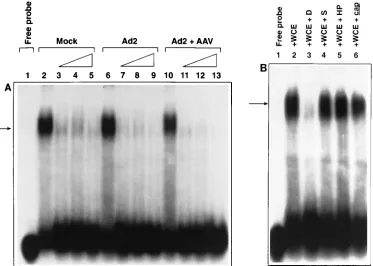
oligonucle-otide probe, and analyzed by EMSA as previously described (1). These results are presented in Fig. 5. It is evident that the D-sequence formed a complex with a protein(s) present in uninfected as well as virus-infected cells and that this complex formation was specific, since the binding could be effectively inhibited by 50- to 100-fold excess amounts of the unlabeled D-sequence probe (Fig. 5A). Furthermore, this complex for-mation was not affected by incubations with a 100-fold excess of unlabeled 20-nucleotide DNA probes specific for the S-sequence, the AAV HP S-sequence, or the AAV cap sequences, (Fig. 5B). These results document the existence of a hitherto unknown cellular protein(s) that specifically interacts with the D-sequence and may be recruited by AAV to ensure efficient rescue and replication of the viral genomes. We designate this protein a D-sequence-binding protein (D-BP).
D-sequence is required for packaging of the AAV genomes.
Since the AAV genome could be successfully rescued from several AAV plasmids containing deletions in the ITRs sche-matically represented in Fig. 1, we wished to examine whether following DNA replication, these aberrant genomes were also packaged into mature AAV virions. Equivalent volumes of culture supernatants from Ad2-infected KB cells transfected with various recombinant plasmids were digested exhaustively with DNase I to degrade any unencapsidated DNA, deprotein-ized to release the AAV DNA, and analyzed on quantitative DNA slot blots with a32P-labeled AAV DNA probe. Such a
[image:6.612.118.491.71.337.2]blot is presented in Fig. 6a. A strong hybridization signal with virions (vSub201) produced from plasmid pSub201 was tected, as expected. A significant hybridization was also de-tected with virions vXS-17 and vXS-23 produced from plas-mids pXS-17 and pXS-23, respectively, from which the AAV FIG. 5. EMSA for the D-sequence-binding protein (D-BP). These assays were carried out as described in Materials and Methods. (A) End-labeled D-sequence probe (lane 1) was incubated with WCE prepared from mock-infected (lane 2), Ad2-infected (lane 6), and Ad2-plus-AAV-infected (lane 10) cells as well as and in the presence of up to a 100-fold molar excess of unlabeled D-sequence oligonucleotide (lanes 3 to 5, 7 to 9, and 11 to 13, respectively). The arrow indicates the formation of a specific DNA-protein complex. (B) Competition experiments were also carried out in the presence of a 100-fold molar excess of the S-sequence (lane 4), AAV HP sequence (lane 5), and AAV cap sequence (lane 6) oligonucleotides. The D-sequence–protein complex formation (lane 2) is specifically inhibited with unlabeled D-sequence (lane 3) but not with any of the other three sequences.
VOL. 70, 1996 AAV DNA RESCUE, REPLICATION, AND PACKAGING 1673
on November 9, 2019 by guest
http://jvi.asm.org/
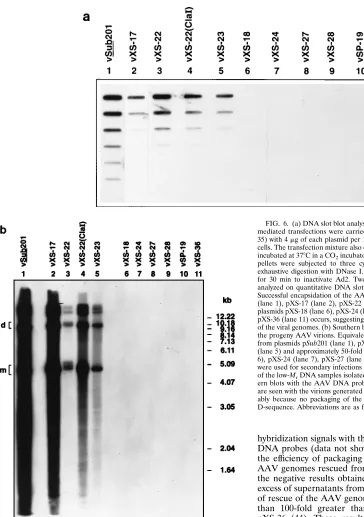
genome could be rescued, indicating that these genomes were also encapsidated into AAV capsids. Curiously, a significant hybridization was observed with virions (vXS-22) produced from plasmid pXS-22, from which no detectable rescue of the AAV genome was apparent (Fig. 2b, panel A). The basis of this observation is presently unclear. No hybridization was observed with virions produced from plasmids 24, pXS-27, pXS-28, and pSP-19, since the AAV genomes could not be rescued from these plasmids. Surprisingly, however, no hybrid-ization signal was obtained with plasmids pXS-18 and pXS-36, from which the AAV genome could be rescued (44). Pro-longed exposures of these blots also failed to yield positive
hybridization signals with the AAV as well as the vector (Apr)
DNA probes (data not shown). An additional possibility that the efficiency of packaging was below the detection limit for AAV genomes rescued from these plasmids was ruled out by the negative results obtained with the analyses of a 100-fold excess of supernatants from these cultures, since the efficiency of rescue of the AAV genome from plasmid pSub201 was less than 100-fold greater than that from plasmid pXS-18 or pXS-36 (44). These results strongly suggest that the D-se-quence plays an important role in the successful and selective packaging of the viral genomes into progeny AAV.
Progeny virions containing deletions in ITR sequences are
biologically active. We next examined whether following
en-capsidation, the AAV virions were infectious. Appropriate vol-umes of the culture supernatants collected and processed as described above were used to infect KB cells in the presence of Ad2. Equivalent amounts of low-MrDNA isolated 48 h
postin-fection were analyzed on Southern blots with a 32P-labeled
AAV DNA probe. These results are shown in Fig. 6b. It is apparent that the virions produced from plasmids pSub201, pXS-17, pXS-22, and pXS-23 were infectious, since the char-acteristic viral DNA replicative intermediates could be readily observed. No replication occurred in the absence of coinfec-FIG. 6. (a) DNA slot blot analysis of packaging of the AAV genomes. DNA-mediated transfections were carried out by the DEAE-dextran procedure (32, 35) with 4mg of each plasmid per 100-mm-diameter dish of 50% confluent KB cells. The transfection mixture also contained 10 PFU of Ad2. The cultures were incubated at 378C in a CO2incubator for 60 h, and cells were harvested. The cell
pellets were subjected to three cycles of freezing and thawing, followed by exhaustive digestion with DNase I. Clarified supernatants were heated at 568C for 30 min to inactivate Ad2. Twofold dilutions of equivalent amounts were analyzed on quantitative DNA slot blots with a32
P-labeled AAV DNA probe. Successful encapsidation of the AAV genomes rescued from plasmids pSub201 (lane 1), pXS-17 (lane 2), pXS-22 (lane 3), and pXS-23 (lane 5) but not from plasmids pXS-18 (lane 6), pXS-24 (lane 7), pXS-27 (lane 8), pSP-19 (lane 10), or pXS-36 (lane 11) occurs, suggesting that the D-sequence is crucial for packaging of the viral genomes. (b) Southern blot analysis of the efficiency of replication of the progeny AAV virions. Equivalent volumes of the progeny virions generated from plasmids pSub201 (lane 1), pXS-17 (lane 2), pXS-22 (lane 3), and pXS-23 (lane 5) and approximately 50-fold higher volumes from plasmids pXS-18 (lane 6), pXS-24 (lane 7), pXS-27 (lane 8), pSP-19 (lane 10), and pXS-36 (lane 11) were used for secondary infections in the presence of Ad2. Equivalent amounts of the low-MrDNA samples isolated 72 h postinfection were analyzed on
South-ern blots with the AAV DNA probe. No AAV DNA replicative intermediates are seen with the virions generated from plasmids pXS-18 and pXS-36, presum-ably because no packaging of the viral genome occurs in the absence of the D-sequence. Abbreviations are as for Fig. 2.
on November 9, 2019 by guest
http://jvi.asm.org/
[image:7.612.58.422.66.583.2]tion with Ad2 (data not shown). Interestingly, no infectious virions were produced from plasmids pXS-18 and pXS-36, although the AAV genome could be rescued from these plas-mids (44). These studies corroborate our contention that the D-sequence plays an important role in the packaging of the viral genomes.
The lack of packaging is not due to limited production of
viral capsid proteins.The lack or the low efficiency of
encap-sidation of the AAV genomes from plasmids pXS-18 and pXS-36 could also be due to inadequate production of the viral capsid (cap) proteins which, in turn, would drastically reduce the packaging efficiency. To test this possibility experimentally, a recombinant AAV plasmid containing the cytomegalovirus promoter-drivenb-galactosidase gene (CMVp-LacZ) between the two AAV ITRs was cotransfected either with pXS-36 or with pAAV/Ad, a helper plasmid previously shown to provide all AAV-encoded proteins in trans for successful encapsidation of the recombinant AAV genomes into progeny AAV virions (34), into Ad2-infected human 293 cells. Recombinant AAV– CMVp-LacZ virions were generated separately from these cells as previously described (34). The virus stocks were ana-lyzed on quantitative DNA slot blots with either the LacZ or the AAV DNA probe. Similar intensities of hybridization sig-nals were obtained with the LacZ probe, but not with the AAV probe, indicating roughly equivalent production of the wt AAV-free, recombinant AAV–CMVp-LacZ virions and ap-proximately similar levels of expression of the viral cap genes from plasmids pAAV/Ad and pXS-36. The biological activity of the recombinant AAV–CMVp-LacZ virions thus produced was evaluated as follows. Equivalent numbers of 293 cells were either mock infected or infected at a multiplicity of infection of 10 and then were stained with X-Gal (5-bromo-4-chloro-3-indolyl-b-D-galactopyranoside) 48 h postinfection. These re-sults indicated that whereas no expression of the LacZ gene was apparent in mock-infected cells, abundant expression of the transduced gene was observed with the recombinant AAV virions generated either with pAAV/Ad or with pXS-36 as a helper plasmid. Thus, lack of expression of the cap genes from the latter could not account for the failure to encapsidate the recombinant AAV genome rescued from this plasmid (data not shown). These results further suggest that the D-sequence may be the packaging signal for AAV.
D-sequence is required for production of single-stranded
progeny viral DNA.Because the AAV genomes could be
res-cued and the capsid proteins could be produced from plasmids pXS-18 and pXS-36, we wished to examine the possibility that the D-sequences were involved in the resolution of the duplex viral DNA replicative intermediates into the single-stranded progeny AAV genomes. Plasmids pSub201, pXS-18, and pXS-36 were transfected separately into 293 cells, and low-Mr
DNA samples were isolated 48 h posttransfection by the mod-ified Hirt’s procedure (5) to prevent reannealing of the AAV single strands. Equivalent amounts of low-MrDNA samples
were electrophoresed on agarose gels and directly transferred onto nitrocellulose membranes without prior denaturation in order to exclude duplex DNA strands. Two identical Southern blots were probed with the32P-labeled DNA probes specific
for the AAV or the Aprgene sequence. These data are
pre-sented in Fig. 7. As can be seen, whereas abundant production of the AAV single-stranded DNA from pSub201 was evident, no single-stranded AAV DNA could be generated from plas-mids pXS-18 and pXS-36 (Fig. 7A). Similarly, no single-stranded vector DNA sequences, which are known to lack the D-sequences (44, 45), could be observed from any of the plas-mids (Fig. 7B). These studies suggest that the D-sequence and/or the D-sequence–D-BP interaction plays a crucial role in
the generation of the progeny single-stranded AAV genomes prior to their encapsidation.
DISCUSSION
Previous studies have documented that following excision, the cruciform structures of the ITRs are cross-linked to both ends of the linear duplex molecules of the AAV as well as to the plasmid vector sequences (15, 16, 45), but only the AAV DNA is replicated. How might this be accomplished? Using an in vitro system, Ward and Berns (45) did not directly test but suggested that the inability of the plasmid sequences to un-dergo DNA replication was a consequence of the lack of the D-sequences from the AAV ITRs that were cross-linked to these sequences. We tested this possibility in intact cells that were infected with Ad2 and transfected with recombinant AAV plasmids that contained various deletions and substitu-tions in the D-sequence within the AAV ITRs. Our data indi-cate that the D-sequences indeed play an important role in the selective replication of the AAV genome. This was evident by the fact that following deletions of both the D-sequences from a wt AAV plasmid, both the AAV and the plasmid vector sequences underwent DNA replication to nearly the same ex-FIG. 7. Southern blot analysis of the single-stranded progeny AAV DNA. Plasmids pSub201, pXS-18, and pXS-36 were transfected separately into Ad2-infected human 293 cells, and 48 h posttransfection, low-MrDNA samples were
isolated and analyzed for the presence of the single-stranded (ss) DNA with the AAV (A) and the Apr
(B) DNA probes. The production of the progeny single-stranded AAV genomes from pSub201 (lane 1), but not from pXS-18 (lane 2) or pXS-36 (lane 3), indicates that in the absence of the D-sequences, neither the AAV nor the vector DNA replicative intermediates are resolved to generate the single strands. Molecular sizes are indicated (in kilobases) on the right.
VOL. 70, 1996 AAV DNA RESCUE, REPLICATION, AND PACKAGING 1675
on November 9, 2019 by guest
http://jvi.asm.org/
tent following what initially appeared to be less-than-optimal rescue, presumably due to deletions of the two trss. However, when the two trss were restored and the D-sequences were substituted by a non-AAV synthetic oligonucleotide sequence, there was no appreciable increase in the extent of the AAV DNA replication (44), the efficiency of which was nearly iden-tical to that of the vector sequences.
In our studies, a low-level rescue and replication of the vector sequences could also be detected even with plasmid pSub201 (Fig. 4b, panel B, lanes 2 and 3). In previous studies with a recombinant plasmid containing the wt AAV genome transfected into Ad2-infected cells, replication of the vector sequences could not be observed (32) because of the unavail-ability of DpnI at that time (46). Similarly, replication of the vector sequences was not detected in an in vitro assay system because only about 1% of the input plasmid DNA underwent excision and replication (15). The EMSA revealed that the D-sequence interacted specifically with a protein(s) present in uninfected cells. Therefore, neither the AAV Rep proteins nor the Ad2-encoded gene products were involved in this interac-tion. Taken together, our data suggest that the D-sequence plays a critical role in the selective replication and encapsida-tion of the AAV sequences.
A possible mechanism for production of defective
interfer-ing AAV particles. A surprising finding was that despite the
absence of detectable rescue of the AAV genome from plas-mid pXS-22, the progeny virions contained AAV DNA se-quences and were biologically active and infectious in the pres-ence of Ad2. Following replication of the viral genome, however, three distinct monomeric forms of the replicative DNA intermediates, which migrated more slowly than that from the wt AAV genomes, were clearly seen (Fig. 6b, lane 3). This would imply that a random cleavage within the vector sequences by intracellular enzymes and/or Rep proteins (9, 10, 38, 43) led to a low-level rescue followed by packaging of the AAV genomes. Because dimeric forms of the replicative DNA intermediates were also observed, it would appear that either the DNA end that lacked the ITR could also serve as an HP primer or that the deleted ITR was duplicated by a novel mechanism. We surmise that excision and packaging of the subunit-length AAV genomes also occur, but the progeny viri-ons are not infectious presumably because excision within the viral sequences would effectively abolish viral transcription and/or replication. We have indeed identified novel TRS-like sites that map outside the AAV ITRs that are involved in the excision and replication of the vector sequences (43). That AAV genomes containing only one ITR are packaged into progeny virions provides at least one clue as to how the natu-rally occurring defective interfering AAV particles might be generated and why only one of 100 to 200 AAV particles is infectious (2, 26).
A model for AAV genome rescue, replication, and
encapsi-dation.We now propose a model for AAV rescue, replication,
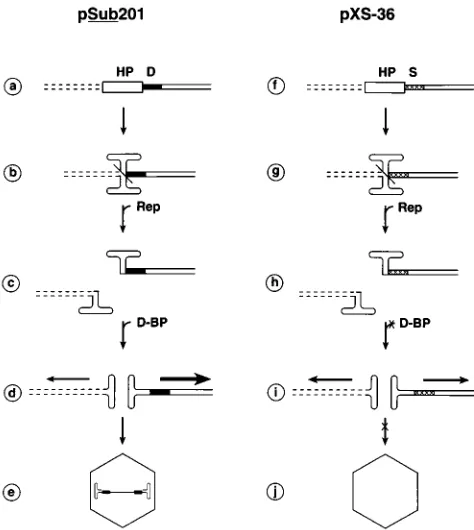
and encapsidation that appears to encompass all available data. This model is depicted in Fig. 8. For the sake of clarity, rescue and replication of only the left AAV ITR (HP plus D-sequence or HP plus S-sequence) cross-linked to the vector sequences in plasmids pSub201 (Fig. 8a) and pXS-36 (Fig. 8f), respectively, are shown. First, the HP forms a Holliday-struc-ture (14), which is cleaved symmetrically by the AAV Rep proteins (Fig. 8b and g), leading to excision of the AAV and the vector sequences that are cross-linked to the cruciform structures of the AAV ITRs (Fig. 8c and h), except that only the AAV sequences retain the D-sequence (from pSub201) and the S-sequence (from pXS-36). The vector DNA lacks these sequences. A host cell protein, present even in
unin-fected cells, designated the D-sequence-binding protein (D-BP), which specifically interacts with the D-sequence but not with the S-sequence, catalyzes the AAV DNA replication in a preferential manner (Fig. 8d). In the absence of the interaction with the D-BP, both the AAV and the vector sequences un-dergo DNA replication, but the efficiency of replication is significantly reduced (Fig. 8i). The D-sequence–D-BP interac-tion is also necessary to generate the progeny single-stranded AAV genomes prior to, or concomitant with, encapsidation (Fig. 8e), and in the absence of this interaction, the progeny single-stranded viral genomes are not generated, leading to failure in encapsidation (Fig. 8j).
Further studies are warranted to examine whether a portion of the D-sequence is required for a functional trs. This might involve the following two possibilities. First, the D-sequence is required for the AAV Rep proteins to efficiently and correctly recognize the trs. And second, the D-BP facilitates recognition of the trs by the Rep protein. These studies will shed light on the underlying molecular mechanisms of the AAV life cycle.
ACKNOWLEDGMENTS
We thank Richard J. Samulski for providing pSub201 and pAAV/Ad plasmids and Nicholas Muzyczka for helpful discussions. We also thank Ann Roman and Robert H. Schloemer for a critical review of the manuscript.
[image:9.612.315.552.70.335.2]This research was supported in part by Public Health Service grants (HL-48342, HL-53586, and DK-49218; Centers of Excellence in Mo-lecular Hematology) from the National Institutes of Health and by the Phi Beta Psi Sorority. A.S. was supported by an Established Investi-gator Award from the American Heart Association.
FIG. 8. A model for the rescue and selective replication and encapsidation of the AAV genomes. Rescue and replication of the AAV genomes from plasmids pSub201 (steps a to e) and pXS-36 (steps f to j) are depicted. Each of the steps is discussed in the text. The D-sequence and the S-sequence are denoted as solid and hatched boxes, respectively. The horizontal arrows reflect the direction and the relative levels of replication of the plasmid (dotted lines) and the AAV (solid lines) DNA sequences.
on November 9, 2019 by guest
http://jvi.asm.org/
REFERENCES
1. Ashktorab, H., and A. Srivastava. 1989. Identification of nuclear proteins that specifically interact with adeno-associated virus type 2 inverted terminal repeat hairpin DNA. J. Virol. 63:3034–3039.
2. Berns, K. I., and R. A. Bohenzky. 1987. Adeno-associated viruses: an update. Adv. Virus Res. 32:243–306.
3. Berns, K. I., R. M. Kotin, and M. A. Labow. 1988. Regulation of adeno-associated virus DNA replication. Biochim. Biophys. Acta 951:425–429. 4. Buller, R. M., J. E. Janik, E. D. Sebring, and J. A. Rose. 1981. Herpes
simplex virus types 1 and 2 completely help adeno-associated virus replica-tion. J. Virol. 40:241–247.
5. Carter, B. J., C. A. Laughlin, L. M. de la Maza, and M. W. Myers. 1979. Adeno-associated virus auto-interference. Virology 92:449–462.
6. Carthew, R. W., L. A. Chodosh, and P. A. Sharp. 1985. An RNA polymerase II transcription factor binds to an upstream element in the adenovirus major late promoter. Cell 43:439–448.
7. Chejanovsky, N., and B. J. Carter. 1989. Mutagenesis of an AUG codon in the adeno-associated virus rep gene: effects on viral DNA replication. Vi-rology 173:120–128.
8. Cheung, A. K. M., M. D. Hoggan, W. W. Hauswirth, and K. I. Berns. 1980. Integration of the adeno-associated virus genome into cellular DNA in latently infected human Detroit 6 cells. J. Virol. 33:739–748.
9. Gottlieb, J., and N. Muzyczka. 1988. In vitro excision of adeno-associated virus DNA from recombinant plasmids: isolation of an enzyme fraction from HeLa cells that cleaves DNA at poly(G) sequences. Mol. Cell. Biol. 8:2513– 2522.
10. Gottlieb, J., and N. Muzyczka. 1990. Purification and characterization of HeLa endonuclease. J. Biol. Chem. 265:10836–10841.
11. Hauswirth, W. W., and K. I. Berns. 1977. Origin and termination of adeno-associated virus DNA replication. Virology 78:488–499.
12. Hermonat, P. L., and N. Muzyczka. 1984. Use of adeno-associated virus as a mammalian DNA cloning vector: transduction of neomycin resistance into mammalian tissue culture cells. Proc. Natl. Acad. Sci. USA 81:6466–6470. 13. Hirt, B. 1967. Selective extraction of polyoma DNA from infected mouse cell
cultures. J. Mol. Biol. 26:365–369.
14. Holliday, R. 1964. A mechanism for gene conversion in fungi. Genet. Res.
5:282–304.
15. Hong, G., P. Ward, and K. I. Berns. 1992. In vitro replication of adeno-associated virus DNA. Proc. Natl. Acad. Sci. USA 89:4673–4677. 16. Hong, G., P. Ward, and K. I. Berns. 1994. Intermediates of adeno-associated
virus DNA replication in vitro. J. Virol. 68:2011–2015.
17. Im, D.-S., and N. Muzyczka. 1989. Factors that bind to adeno-associated virus terminal repeats. J. Virol. 63:3095–3104.
18. Im, D.-S., and N. Muzyczka. 1990. The AAV origin binding protein Rep68 is an ATP-dependent site-specific endonuclease with DNA helicase activity. Cell 61:447–457.
19. Im, D.-S., and N. Muzyczka. 1992. Partial purification of adeno-associated virus Rep78, Rep52, and Rep40 proteins and their biochemical character-ization. J. Virol. 66:1119–1128.
20. Kotin, R. M., and K. I. Berns. 1989. Organization of adeno-associated virus DNA in latently infected Detroit 6 cells. Virology 170:460–467.
21. Kotin, R. M., J. C. Menninger, D. C. Ward, and K. I. Berns. 1991. Mapping and direct visualization of a region-specific viral DNA integration site on chromosome 19q13-qter. Genomics 10:831–834.
22. Kotin, R. M., M. Siniscalco, R. J. Samulski, X. Zhu, L. Hunter, C. A. Laughlin,
S. McLaughlin, N. Muzyczka, M. Rocchi, and K. I. Berns.1990. Site-specific integration by adeno-associated virus. Proc. Natl. Acad. Sci. USA87:2211–2215. 23. Laughlin, C. A., C. B. Cardellichio, and H. C. Coon. 1986. Latent infection of
KB cells with adeno-associated virus type 2. J. Virol. 60:515–524.
24. Lusby, E., K. H. Fife, and K. I. Berns. 1980. Nucleotide sequence of the inverted terminal repetition in adeno-associated virus DNA. J. Virol. 34:402–409.
25. Muller, M. T. 1987. Binding of herpes simplex virus immediate-early gene product ICP4 to its own transcription start site. J. Virol. 61:858–865. 26. Muzyczka, N. 1992. Use of adeno-associated virus as a general transduction
vector for mammalian cells. Curr. Top. Microbiol. Immunol. 158:97–129. 27. Nahreini, P., and A. Srivastava. 1989. Rescue and replication of the
adeno-associated virus 2 genome in mortal and immortal human cells. Intervirology
30:74–85.
28. Nahreini, P., and A. Srivastava. 1992. Rescue of the adeno-associated virus 2 genome correlates with alterations in DNA-modifying enzymes in human cells. Intervirology 33:109–115.
29. Ni, T.-H., X.-H. Zhou, D. M. McCarty, I. Zolotukhin, and N. Muzyczka. 1994. In vitro replication of adeno-associated virus DNA. J. Virol. 68:1128– 1138.
30. Owens, R. A., and B. J. Carter. 1992. In vitro resolution of adeno-associated virus DNA hairpin termini by wild-type Rep protein is inhibited by a dom-inant-negative mutant of Rep. J. Virol. 66:1236–1240.
31. Sambrook, J., E. F. Fritsch, and T. Maniatis. 1989. Molecular cloning: a laboratory manual, 2nd ed., p. 1.53–1.110. Cold Spring Harbor Laboratory Press, Cold Spring Harbor, N.Y.
32. Samulski, R. J., K. I. Berns, M. Tan, and N. Muzyczka. 1982. Cloning of adeno-associated virus into pBR322: rescue of intact virus from the recom-binant plasmid in human cells. Proc. Natl. Acad. Sci. USA 79:2077–2081. 33. Samulski, R. J., L.-S. Chang, and T. Shenk. 1987. A recombinant plasmid
from which an infectious adeno-associated virus genome can be excised in vitro and its use to study viral replication. J. Virol. 61:3096–3101. 34. Samulski, R. J., L.-S. Chang, and T. Shenk. 1989. Helper-free stocks of
recombinant adeno-associated viruses: normal integration does not require viral gene expression. J. Virol. 63:3822–3828.
35. Samulski, R. J., A. Srivastava, K. I. Berns, and N. Muzyczka. 1983. Rescue of adeno-associated virus from recombinant plasmids: gene correction within the terminal repeats of AAV. Cell 33:135–143.
36. Samulski, R. J., X. Zhu, X. Xiao, J. Brook, D. E. Houseman, N. Epstein, and
L. A. Hunter.1991. Targeted integration of adeno-associated virus (AAV) into human chromosome 19. EMBO J. 10:3941–3950.
37. Senapathy, P., J.-D. Tratschin, and B. J. Carter. 1984. Replication of adeno-associated virus DNA. Complementation of naturally occurring rep2 mu-tants by a wild-type genome or an ori2mutant and correction of terminal palindrome deletions. J. Mol. Biol. 179:1–20.
38. Snyder, R. O., D.-S. Im, T.-H. Ni, X. Xiao, R. J. Samulski, and N. Muzyczka. 1993. Features of the adeno-associated virus origin involved in substrate recognition by the viral Rep protein. J. Virol. 67:6096–6104.
39. Snyder, R. O., R. J. Samulski, and N. Muzyczka. 1990. In vitro resolution of covalently joined AAV chromosome ends. Cell 60:105–113.
40. Srivastava, A. 1987. Replication of the adeno-associated virus DNA termini in vitro. Intervirology 27:138–147.
41. Srivastava, A., E. W. Lusby, and K. I. Berns. 1983. Nucleotide sequence and organization of the adeno-associated virus 2 genome. J. Virol. 45:555–564. 42. Tratschin, J.-D., I. L. Miller, and B. J. Carter. 1984. Genetic analysis of adeno-associated virus: properties of deletion mutants constructed in vitro and evidence for an adeno-associated virus replication function. J. Virol.
51:611–619.
43. Wang, X.-S., N. Muzyczka, and A. Srivastava. A novel terminal resolution-like site in the adeno-associated virus 2 genome. Submitted for publication. 44. Wang, X.-S., S. Ponnazhagan, and A. Srivastava. 1995. Rescue and replica-tion signals of the adeno-associated virus 2 genome. J. Mol. Biol. 250:573– 580.
45. Ward, P., and K. I. Berns. 1991. In vitro rescue of an integrated hybrid adeno-associated virus/simian virus 40 genome. J. Mol. Biol. 218:791–804. 46. Wobbe, C. R., F. Dean, L. Weissbach, and J. Hurwitz. 1985. In vitro
repli-cation of duplex circular DNA containing the simian virus 40 DNA origin site. Proc. Natl. Acad. Sci. USA 82:5710–5714.
VOL. 70, 1996 AAV DNA RESCUE, REPLICATION, AND PACKAGING 1677