A COMPARATIVE ANALYSIS OF PSYCHIATRIC PROFILE,
DEPRESSION AND BODY DYSMORPHIC DISORDER IN
PATIENTS WITH AMPUTATION AND POST STROKE
Dissertation Submitted to the
THE TAMILNADU DR. M.G.R. MEDICAL UNIVERSITY
In partial fulfilment of the requirements for the award of degree of
M.D. (Branch-XVIII) PSYCHIATRY
GOVERNMENT STANLEY MEDICAL COLLEGE & HOSPITAL
Chennai
THE TAMILNADU DR. M.G.R. MEDICAL UNIVERSITY, CHENNAI, TAMILNADU
CERTIFICATE
This is to certify that this dissertation entitled “A COMPARATIVE ANALYSIS OF PSYCHIATRIC PROFILE, DEPRESSION AND BODY DYSMORPHIC DISORDER IN PATIENTS WITH AMPUTATION AND POST STROKE”, submitted
by Dr.ASHOKA KUMAR K.S to the faculty of PSYCHIATRY, The Tamil Nadu Dr. M.G.R. Medical University, Chennai, in partial fulfillment of the requirement in the award of degree of M.D. Branch - XVIII (PSYCHIATRY), for the April 2013 examination is a bonafide research work carried out by him during the period of June 2012 to November 2012 at Government Stanley Medical College and
Hospital, Chennai, under our direct supervision and guidance of
Prof. Dr. G.S.CHANDRALEKA, Professor and Head, Department of Psychiatry at Stanley Medical College, Chennai.
Prof. Dr .G.S.CHANDRALEKA, M.D., DPM. Guide and HOD,
Department of Psychiatry,
Stanley Medical College and Hospital, chennai – 600 001.
Prof . Dr. S.GEETHA LAKSHMI, M.D, Ph.D
Dean
Government Stanley Medical College,
CERTIFICATE
This is to certify that the dissertation presented herein by
“A COMPARATIVE ANALYSIS OF PSYCHIATRIC PROFILE, DEPRESSION AND BODY DYSMORPHIC DISORDER IN PATIENTS WITH AMPUTATION AND POST STROKE”, Dr. ASHOKA KUMAR K S, is an original work done in the Department
of Psychiatry, Government Stanley Medical College and Hospital, Chennai in partial fulfilment of regulations of the Tamilnadu Dr. M.G.R. Medical University for the award of degree of M.D. (PSYCHIATRY) Branch XVIII, under my supervision during the academic period 2010-2013.
Prof. Dr. G.S.CHANDRALEKA, M.D., D.P.M,
Professor and H.O.D.
Department of Psychiatry,
Stanley Medical College
and Hospital, Chennai – 600 001.
Prof. Dr. S. GEETHA LAKSHMI, M.D.,Ph.D.
Dean
Stanley Medical College,
DECLARATION
I, Dr .ASHOKA KUMAR K.S, Solemnly declare that the dissertation “A COMPARATIVE ANALYSIS OF PSYCHIATRIC PROFILE, DEPRESSION AND BODY DYSMORPHIC DISORDER IN PATIENTS WITH AMPUTATION AND POST STROKE”, is a bonafide work done by me during the period of June 2012 to
November 2012 at Government Stanley Medical College and Hospital, under the expert supervision of Prof. Dr. G.S.CHANDRALEKA, M.D, D.P.M., Professor and
Head of Department Of Psychiatry, Government Stanley Medical College, Chennai.
This thesis is submitted to The Tamil Nadu Dr .M.G.R. Medical University in partial fulfilment of the rules and regulations for the M.D. degree examinations in Anaesthesiology to be held in April 2013.
Chennai-1 Dr .ASHOKA KUMAR K.S.
ACKNOWLEDGEMENT
With sincere gratitude, I wish to acknowledge the expert guidance and precise suggestions of my HOD Prof. Dr .G.S.CHANDRALEKA MD., DPM., without
whose guidance this study would not have been possible, and
Prof. Dr.T.V. ASOKAN MD., DPM., Department of Psychiatry, Stanley Medical College, Chennai for the able guidance, inspiration and encouragement rendered at every stage of this study.
My profound thanks to Prof Dr.S. GEETHALAKSHMI MD, Ph.D, Dean,
Stanley Medical College and Hospital, Chennai for permitting me to utilize the clinical materials of this hospital for my dissertation.
I am grateful to Dr.M.MOHAMMED ILYAS RAHAMATHULLA and
Dr.VENKATESH MATHAN KUMAR, Asst. Professor, Dept. of Psychiatry, Stanley Medical College for their guidance.
I am also deeply indebted to Dr. M. SURESHKUMAR MD, DPM, consultant Psychiatrist, Chennai for their valuable guidance and suggestions.
I also thank DR.PRADEEP MENON, MD, DPM, Psychiatrist, ICMR and also
Dr.S.Venkatesan, Director, Dept. Of statistics and Mr.T.Srinivas, who helped me
in statistical analysis.
I gratefully acknowledge my patients who gave their consent and co-operation for this study.
CONTENTS
S.NO. TITLE PAGE
NO.
1. INTRODUCTION
2. REVIEW LITERATURE 3. AIMS AND OBJECTIVES 4. MATERIALS AND METHODS 5. OBSERVATIONS AND RESULTS 6. DISCUSSION
7. SUMMARY 8. CONCLUSION
9. LIMITATIONS AND SUGGESTIONS 10. ANNEXURES
(a) BIBLIOGRAPHY (b) PROFORMA (c) SCALES
Introduction
Amputation is defined as the removal of extremities of body part by trauma or by surgical procedure. Amputees may feel empty, and mutilated. Amputation due to trauma is a catastrophic injury and causes major disability in most of the cases (Wald 2004)1. Loss of limb is associated with low self-esteem, body image disturbance, social isolation and also a sense of stigmatization (William et al. 2004). In many conditions amputation is unavoidable. Irrespective of the aetiology, amputation is considered as a mutilating surgery and it definitely affects the lives of the patients (De Godoy et al. 2002). Limb amputation is a more commonly occurring event in the present society.
the social, vocational, familial and marital milieu. Individuals having an overt mental breakdown will need active psychiatric intervention whereas careful psychiatric interview is necessary for the ones whose mental symptoms are not so obvious.
Limb loss is a major event that can severely impact the psychological health of the individual concerned. Studies show that 20-60% of the amputees attending follow up clinics are assessed to be clinically depressed. Individuals with traumatic amputation irrespective of the age are likely to suffer from body image problems, but these findings are more common in younger individuals. The psychological reactions to amputation are clearly diverse ranging from severe disability at one extreme; and a determination to effectively resume a full and active life at other end. In adults the age at which an individual receives the amputation is an important factor. Studies by Bradway JK et al (1984)2, Kohl SJ Et al (1984)3, Livneh H (1999)4, on the psycho-social adaptation to amputation has led to a
plethora of clinical and empirical findings. Kingdon D et al 1982 equated amputation with loss of one’s perception of wholeness, while (Parkes CM 1976)5 with loss of spouse and (Block WE et al (1963)6 with symbolic castration & even
prolonged disability of traumatic events, lack of social support and inadequate coping strategies. Previous studies on amputation mainly focused on demographic profile, coping skills and outcome; with there being a scarcity of literature on prevalence of various specific psychiatric disorders in the post-amputation period. Most patients with a limb loss irrespective of whether due to traumatic injury or surgical procedures go through a series of complex psychological reactions reported by Cansever et al (2003)8. Most people try to cope with it, those who don’t succeed develop psychiatric symptoms Frank et al (1984)7. Shukla et al9 noted that psychological intervention in some form is needed in about 50% of
all amputees, and Shukla et al9 reported depression to be the most common psychological reaction following amputation.
The three major problems faced by many amputees are anxiety, depression and physical disability (Green 2007)
Horgan & MacLachlan (2004)10 found that anxiety is associated with depression, low self esteem, poorer quality of life and higher level of general anxiety. Both anxiety and depression are associated with higher disability as age increases.
MacLachlan 2004)10. Each person has an idealized body image, which he uses for measuring perceptions and concepts of his or her own body (Fishman, 1959)11. From another perspective, Flannery & Faria (1999) body image is viewed as a dynamic, changing phenomenon occurring in a person and it is formed by the constantly changing perceptions about his body. According to Newell (1991)13, attractive people after amputation will receive less reinforcement from others leading to low self-esteem and reduced positive self-image. Jacobsen et al (1997) supports this stating i.e. amputation leads to disfigurement which in turn leads to a negative body image and greater loss of social acceptance. The relationship between disability experience and stigma are interwoven and inter-dependent. The reason for the amputee’s subjective perception of being unfit for the society probably is that body image provides a sense of ‘’self’ ’and also affects the persons thinking (Wald 2004)1. According to Kolb (1975)14, changes in body image may cause series of psychological reactions.
the leading psychiatric disorders in amputees; only 35% of the total sample in the later study had nil psychiatric disorders. The paucity of literature in this field has prompted us to study about amputation and its co morbid psychiatric conditions so that proper care & management for the patients can be planned. The present study was undertaken with the aim of studying the psychiatric problems especially anxiety, depression and Body Dysmorphic Disorder which may be associated with disability or changed life circumstances in the immediate post-amputation period. A comparison was made with Stroke patients, as these patients often experience physical and social handicaps similar to amputees.
Depression is the most common mood disorder to follow stroke (Starkstein & Robinson, 1989), with major depression affecting around one quarter to one third of patients (Hackett16)..
may vary over time with an apparent peak 3months after the stroke and subsequently decline in prevalence at 1 year. Robinson and colleagues studies showed a spontaneous remission in the natural course of major depression occurring post stroke in the first to second year following stroke. However in few cases depression may become chronic and persist for a longer period.
While some propose that post stroke depression is due to stroke affecting the neural circuits concerned with mood regulation (thereby supporting a primary biological mechanism), others in the scientific community claim it to be due to the ensuing psycho-social stressors occurring as a result of stroke. Though an integrated bio- psycho- social model is warranted, most studies clearly suggest biological mechanism to have an upper hand in the later post stroke period than in the immediate phase.
In the same way Anxiety is also common in post stroke individuals with the incidence rate being 20%, and it is most common in first three to four months after
the stroke.
Studies and literatures on post stroke anxiety are very few still remain in its
functions and laterality as examined for post stroke depression. Many studies show
that there is correlation between anxiety and right hemisphere lesions and also that
co-morbid post stroke anxiety and depression are associated with left hemisphere
lesions [Astrom, (1996)17]. Many studies have shown the relationship between post
stroke anxiety, age and gender. Women and younger individuals are more
vulnerable to develop post stroke anxiety (Morrison, walter et al 200069), while
REVIEW LITERATURE:
Amputation:
Sociodemographic factors:
Several studies have revealed that major depressive disorders and greater depressive symptomatology were more prevalent at lower levels of socioeconomic status [Stansfeld et al 1992]. However, income level of people with an amputation was not related to depressive symptoms [Behel J M et al 2004].
Dunn’s20 assessment of amputees personal profile (138 subjects) using the CES-D for depression and Rosenberg self esteem (RSE) for self esteem assessment showed that young age was closely associated with depression (p < 0.05) which could be accounted for by the societal acceptance of activity restriction as one ages, a finding suggested by Williamson and Frank et al8 studies.
diseases in the elderly population and the percentages are higher for upper limb amputation than lower limb(Cheung et al).
Darnall et al23 suggested from his cross sectional study conducted through telephone that the presence of co morbidity increased the risk for depression and this rose with the number of co morbidities.
Hanley et21 al studied 70 individuals over a period of one month post amputation of lower limb, and assessed the level of functioning, pain and coping, etc. On follow up these patients were again assessed at 12 and 24 months of post amputation, Graded Chronic Pain Scale (GCPS) was used to measure the limb pain and pain interference was assessed by using part of the Brief Pain Inventory (BPI). The results showed that the most common physical factor which contributed to the development of depression was the severity of phantom limb pain.
Singh et al26 studied 105 subjects at a rehabilitation ward by using HADS and showed that factors like age, gender, level of amputation and time since
Dunn20 in his study mainly concentrated on risk factors like sex, marital status and level of amputation whereas income, employment and education were not reported as risk factors. However this study supports the study of Wald et al. It was later found that apart from young age there were some more risk factors in the psychological and emotional domains that were associated with the development of depression. Individuals who were having less optimistic thinking were more vulnerable for developing depression, as they could not find any meaning in their amputation experience and also they felt to have little control over their treatment. Participants who felt gloomy about the future and could think only about the negative effects, thought it was not of any use in expressing their depressed symptoms as duration increased.
were acutely aware of their perceptions, i.e. how they were perceived in the society.
Several studies, including Darnall et al23 reported that negative social support was the risk factor for developing depression. The study also reported that those individuals who were, immediately after the amputation, single, widowed or separated were more prone to developing depressive symptoms. Also there is an increase rate of depression in individuals living near the poverty line; while higher education reduces the risk of developing depression.
However, few studies contradict the above said sentence. Hanley et al suggested in his study that severe pain or pain catastrophizing in individuals decreased the incidence of depression. The authors speculate that such patients, especially in the immediate post amputation period attracted more attention from acquaintances & health care professional and hence the incidence of depression turned out to be lower than in the less attention seeking patients.
Apart from seeking help for pain, Seidel et al24 & Desmond et al25 found that subjects in denial avoided discussions about their amputation and were at higher risk for depression both in the acute and long run, this not only had an impact on their mood status but also affected their rehabilitation with avoidance of prosthesis.
Depression and anxiety:
Many studies reported that about 20% to 30% amputees develop major depression.
Most of the studies concentrated on prevalence and incidence of depression among the patients with amputation and showed higher rates in comparison to general population, especially soon after the amputation.
An Indian study shows that more than 70% of the individuals with amputation are having depression (Shukla et al)9
A study done by Grunert et al., showed that 62.4% individuals had depressive symptoms during the initial period of hand amputation and this was supported by wald et al.1
A review by, Horgan et al, cited in Caplan et al reports that about 58% of the individuals had major depression after 18 months post amputation and another study done by Bodenheimer et al showed about 30% depression rate in amputees.
the amputation of a lower extremity as opposed to the more socially noticeable upper extremity and hands.
Desmond25 determined that 28.3% of the subjects had scores to indicate possible MDD and 35.5% qualified for clinical anxiety.
Singh et26 al did a prospective cohort study on 105 individuals with lower limb amputation at a rehabilitation ward and admitted HADS to each subjects and results showed that 26.7% of them were suffering from depression and 24.8% from anxiety.
A cross-sectional survey done by Atherton et al using 67 individuals with lower limb amputation who were using prosthesis, assessed the long term psychological adjustment and reported 13.4% individuals to be depressed and 29.9% to be anxious.
Schubert et al29 1992; Cansever et al 20038; Atherton and Robertson 2006; Seidel et al 2006)24.
Most studies have found no significant relationship between the time ensuing amputation and psychological disturbances (Rybarczyk et al22 1992; Thompson et al 1984)30. Horgan and Maclachlan(2004)10 in their publication on amputation’s psychological adjustment concluded that depression and anxiety apparently are higher in the first two years post amputation and thereafter decline to levels prevalent in the general population. Singh and Hunter (2007)26 in their recent study concluded depression and anxiety symptoms to resolve after in patient rehab for a short duration.
reactions and its outcome (Shukla et al 19829, Weinstein 1985, kashani et al27 1983 and Williamson et al 1996).
Studies done by Thompson et al(1984)30 and Rybarczyk et al (1992,1995)22, showed that social isolation and low social support leads to higher incidence of depression and the amputee’s current family reactions to have a significant effect on adjustment.
Weinstein et al(1985) observed that anxiety, depression ,social discomfort and other psychiatric conditions were not increased in magnitude among patients with above knee amputation in spite of the prognosis being poor in comparison to the below knee amputees also supported by (Shukla et all 19829). O’Toole et al (1984) reported that individuals with Below Knee amputees to be more depressed when compared with above knee amputees because below knee is less severely disabling than Above Knee in terms of functioning.
Body Dysmorphic Disorder
the body such as amputation, brain disease and other conditions. Removal of the body parts especially in amputation is the condition where we can come across such body image disturbance. The patients with emergency amputation or those with other situations which leads to perceivable bodily changes may have profound impact on their psyche, regarding perception of their body image, this might lead to an apprehension regarding social interactions on account of their misinterpretations about the external appearance and perceiving it as a defective and unacceptable change in the cosmetic context.
There is a paucity of literature on body dysmorphic disorder in amputees.
Post stroke:
Sociodemographic profile:
The prevalence of depression in the general population is higher in women than men hence it would be logical to conclude the same in post stroke scenario but studies do not support this While the results from some studies support the association between female sex and PSD (Desmond et al. 200325; Paradiso & Robinson 199835; Ouimet et al. 200132, Eriksson et al., 200434, Paolucci et al. 200536), others do not (Ouimet et al. 200132; Berg et al. 200337; Whyte et al50, Spalletta et al. 200538). However, there may be real differences between men and women in terms of the relative importance of risk factors for PSD. Among men, physical impairment may be a more influential risk factor (Paradiso & Robinson 199835; Berg et al. 200337), while among women, previous history of psychiatric disorder may be more important (Paradiso & Robinson 1998)35.
Depression and anxiety:
previously held job, etc.) and a neurotransmitter imbalance as a result of cerebral damage caused by the stroke(has a less likelihood).
Well-documented cases have proven that depression as a sequel to stroke in most cases. Data pooled in from published prevalence studies (Robinson 2003) suggest that the mean prevalence of depression (amongst in-patients in acute or rehabilitation settings) was 18.5% and 19.3% for minor and major depression respectively whilst among individuals in community settings; it was reported to be 14.1% and 9.1% for major and minor depression. Amongst those included in outpatient studies, mean prevalence (reported) was 23.3% for major depression and 15% for minor depression (Robinson 2003). Overall mean prevalence ranged from 31.8% in the community studies to 35.5% in the acute and rehabilitation hospital studies. A relatively recent systematic review of prospective, observational studies of post-stroke depression (Hackett et al 2005)16 reported that 33% of stroke survivors exhibited depressive symptoms at some time following the occurrence of stroke (acute, medium-term or long-term follow-up).
been reported in the first month following stroke (Andersen et al 199533, Aben et al 200340a, Bhogal et al 200443, Morrison et al 200542, Aben et al 2006)40b.
Paolucci et al (2005)36 reported that, out of the 1064 patients included in the DESTRO study, nearly 36% developed depression of which eighty percent of them developed depression within the first three months(post stroke)- (Paolucci et al2005).
The incidence of major depression might significantly decrease over the first 2 years following stroke (Astrom et al)17 but minor depression tends to persist or rather increase over the aforementioned time period (Burvill et al. 199545; Berg et al. 200338, Verdelho et al. 200467). Berg et al (2003)38 reported nearly one-half of the individuals experiencing depression during the acute phase(post stroke), to see it in the subsequent one and half year; though more women than men have been identified in the acute phase while there is a male predominance in the latter half period (Berg and others 2003)37.
2000; Morris, & Robinson, 199846; Parikh, Lipsey, Robinson, & Price, 198846; Schubert, et al 199228; Schwartz et al 199347; Starkstein & Robinson, 199168). PSD has an unconstructive impact on case fatality and rehabilitation (Whyte & Mulsant, 2002)50, and functional outcomes (Herrmann, Black, Lawrence, Szekely, & Szalai, 1998)57. Distinguishingly, PSA has only lately started to be investigated (Castillo, Schultz, & Robinson, 199518; Castillo, Starkstein, Fedoroff & Price, 1993; Chemerinski & Robinson, 200053; Dennis, O’Rourke, Lewis, Sharpe, & Warlow, 200054; Robinson, 1997, 1998; Shimoda & Robinson, 199855) with prevalenceinformation ranging from 4 to 28% (Astrom, 199617; House and others, 1991). As with the case of PSD, the course of PSA has been found to stay on moderately constant up to 3 years post stroke (Astrom, 1996)17. Co-morbidity of PSA and PSD is elevated, with as many as 85% of people with generalised anxiety having co-morbid depression during the 3 years time period post stroke (Castillo et al., 1993, 1995)18.
Robinson et al in 1984 studied patients suffering from stroke in 2 groups with relation to onset of depression- faction of patients with acute commencement of depression, within few weeks post stroke and 2nd group with delayed commencement of depression, over 24 months and established no disparity in clinical characteristics or course of depression in the two groups. In 1986 Lapse et al compared a group of patients with PSD with 43 pts with functional depression and concluded that the two groups did not differ in the symptom profile of depression in their study.
Although post-stroke depression (PSD) is a common consequence of stroke, risk factors for the development of PSD have not been clearly delineated. In a recent systematic review, Hackett and Anderson (2005) included data from a total of 21 studies. Of the many different variables assessed, physical disability, stroke severity and cognitive impairment were most consistently associated with depression.
functional impairment, living alone and dysphasia (Ouimet et al. 2001)32. Since the time of the Hackett et al. (2005)16 and Ouimet et al. (2001)32 reviews, more recent studies have confirmed the importance of severity of initial neurological deficit and physical disability as predictors of the development of depression after stroke (Carota et al. 200534, Christensen et al. 200779). In addition, Storor and Byrne (2006) examined post-stroke depression in the acute phase (within14 days of stroke onset) and identified significant associations between prestrike neuroticism (OR = 3.69, 95% CI 1.25 – 10.92) and a past history of mental disorders (OR = 10.26, 95% CI 3.02 – 34.86) and the presence of depressive symptoms.
Stroke Location and Depression:
There have been 2 meta-analyses examining this relationship (Singh et al. 1998, Carson et al. 2000).
Singh et al. (1998) reviewed 26 original articles done on the relation between
Singh et al. (1998) were unable to make any definitive conclusions concerning stroke lesion location and the risk for depression.
Carson et al. (2000) did a systematic review on the same. All reports on the
association of post stroke depression with location of brain lesions were included in the review. In the majority of the reports included, no significant relationship between the two was found.
Robinson & Szetela (1981USA)56: 18 patients with left hemispheric stroke were
compared to 11 patients with traumatic brain injury for frequency and severity of depression, more than 60% of the stroke patients had clinically significant depression compared with about 20% of the trauma patients.
Hermann et al. (1995 Germany)49: 47 patients with single demarcated unilateral
Morris et al.(1996a Australia): 44 first episode stroke patients with single lesions
on CT were examined and higher frequency of depressive disorder was demonstrated in those with left hemisphere prefrontal / basal ganglia lesions than other lesions.
Bhogal et al. (2004)43 meta-analysis showed some evidence that PSD may be related to specific brain site lesions, although it is not evidently clear (Bhogal et al. 2004;).
depression only had a significantly higher frequency of subcortical (basal ganglia) stroke (Starkstein et al.1987).
While the literature on PSA remains in its infancy, studies have begun to examine its relationship to sociodemographic factors, injury, cognitive, and physical characteristics as those examined for PSD. PSA correlates significantly with right hemisphere especially posterior lesions, while co-morbid PSA and PSD are linked to left hemisphere lesions ( Astrom, 199617). Castillo et al. (1993), Morrison, Johnston, & Walter, 200069; Schultz, Castillo, Kosier, & Robinson, 199719 report younger patients (<59 years) are more susceptible to PSA while Dennis et al., 200054 report no significant relationship.
Castillo et al (1993, 1995)18report that PSA is not significantly correlated with physical functioning, cognitive functioning, or social functioning. While some authors similarly report no significant correlation (Starkstein et al., 1990), others report that anxiety is linked to greater impairment in activities of daily living both acutely and up to 3 years post stroke (Schultz et al., 1997)19.
Suzanne L. Barker-Collo (2007) found in his study the prevalence rates for moderate to severe depression and anxiety in their sample were 22.8 and 21.1%, respectively.
AIM AND OBJECTIVES
AIM
To Compare the Psychiatric profile, Depression and Body Dysmorphic
Disorder in patients with Amputation and Post Stroke.
OBJECTIVES
1. To study the incidence of psychiatric morbidity in patients with amputation and compare it with stroke patients.
2. To compare the incidence of depression in amputees and post stroke subjects.
3. To compare the incidence of anxiety in amputees with that in post stroke patients.
4. To compare Body Dysmorphic Disorder in amputees and post stroke individuals.
HYPOTHESIS
1.
Depression is same in amputees and post stroke subjects.
2.
Anxiety is same in amputees and post stroke individuals.
3.
Body Dysmorphic Disorder is same in amputees and post stroke
patients.
4.
Psychosocial factors between the amputees and post stroke
MATERIALS AND METHODS
Setting of study
Study was carried out in out-patient and in-patient Department of Orthopaedics, Plastic Surgery, General Medicine at Govt. Stanley Medical College.
Period of study
:From May 2012 to November 2012 (7months)
Design of study:
Case –control study
Selection of sample
A total of 30 patients consecutively chosen, form the sample for cases and consecutive sample of 30 patients with stroke constitute the control group.
INCLUSION AND EXCLUSION CRITERIA:
CASES (PATIENTS WITH AMPUTATION)
Inclusion criteria:
Patients who underwent elective as well as emergency amputation. Age between 18 years to 60 years.
Exclusion criteria:
Patients with age less than 18 years and with age more than 60 years Previous history of psychiatric illness
Patients with history of psychiatric illness before the amputation Patients with other medical illness
CONTROLS
Inclusion criteria:
Patients with stroke
Exclusion criteria:
Patients with age less than 18 years and with age more than 60 years Patients with aphasia and incomprehensive
Previous history of psychiatric illness
Patients with history of psychiatric illness before the onset of stroke Patients with other medical illness
Tools used:
1. A structured interview schedule to study the demographics, clinical features and other relevant factors in history.
2. General Health Questionnaire (GHQ-28)
3. Hospital Anxiety and Depression Scale (HADS) 4. Hamilton Depression rating Scale (HDRS/HAM-D)
General Health Questionnaire (GHQ 28)
The GHQ 28 was developed by Goldberg in 1978. Developed as a screening tool to detect those likely to have or to be at risk of developing psychiatric disorder. GHQ 28 is a 28 item measure of emotional depression in medical settings, through factor analysis GHQ 28 has been divided into 4 subscales.
They are:
Somatic symptoms (1-7) Anxiety/insomnia (8-14) Social dysfunction (15-21) Severe depression (22-28)
Each item is occupied by 4 possible responses not at all, no more than usual, rather more than usual and much more than usual.
score 0, and rather more than usual and much more than usual score 1, using this method any score above 4 indicates the presence of distress.
Numerous studies have investigated reliability and validity of the GHQ 28 in various clinical populations. Test-Retest reliability has been reported to be high (0.78+00.09)(Robinson and price(1982) and intra rater and inter rater reliability have both been shown to be excellent (crnballi’s 20.9-0.95) . High internal consistencies have also been reported. (Failde and Ramos 2000). GHQ 28 correlates well with the hospital depression and anxiety scale (HADS) (Sakakibara 2009) and other measures of depression (Robinson and price 1982).
Hospital anxiety and depression scale (HADS)
HADS was originally developed by Zigmond and Snaitn (1983), it is usually used for assessing the levels of depression and anxiety. Total of 14 items in that 7 items for anxiety and 7 for depression. Each item has sub scoring 0 to 3 and total score ranges between 0 to 21 for each domain and its grouped in to mild 8-10, moderate 11-15 and severe greater or equal to 16.
gave a specificity of 0.78 sensitivity of 0.9. For depression this gave specificity of 0.78 and sensitivity of 0.83.
Hamilton Rating Scale for Depression
M.Hamilton developed this measuring instrument, and this is the most commonly used scale for measuring the severity of depression. The HAMD is an observer rated scale consisting of 17 to 21 items (individually 2 part items, weight and decimal variation). Rating is done based on the clinical assessment and also from information given by close relatives (like wife, father, etc) (family members). The items are scored on either 0-4 spectrum or a 0-2 spectrum.
The HAM-D mainly depends on the clinical technique. Majority of the individuals score 0 on rare items (paranoid symptoms, obsession and depersonalization) the total score usually is the sum of first 17 items.
The strength of the HAMD has good validation and very easy to administer. Its use is limited in individual who have psychiatric disorder other than primary
depression.
Scoring
0-7 Normal
14-18 Moderate depression 19-22 severe depression
Greater than 23 Very severe depression
Yale Brown Obsessive compulsive Scale for BDD
YBOCS is a rating scale used to measure the severity of OCD symptoms.
Scale was developed by Dr.Wayne Goodman and his colleagues and it is a widely used scale both in clinical practice as well as in research.
Modified YBOCS scale is used to measure to severity of symptoms of obsession and compulsion in a patient having pre occupation with perceived defect in appearance (BDD). It is having 12 items and in that 5 questions are on preoccupation, 5 on behaviour with compulsion, one item for avoidance and one item for insight.
It mainly measures on time spent by preoccupation with perceived defect about their appearance; distress developed due to defect, interference in functioning and measures compulsive behaviour.
Score on this 12 items ranges from 0-48 and YBOCS-BDD has good inter rated, test retest reliability and good internal consistency. First 3 items in the scale is shows the diagnostic criteria for BDD(DSM IV).
The advantage or BDD-YBOCS is that it assists in comparing clients across studies. It is based on the YBOCS and is therefore bound to a model of an obsessive compulsive spectrum disorder. An important difference between YBOCS BDD and YBOCS for OCD is that the thoughts about the body defect combine the rating for both the stimulus and cognition response. In OCD rumination would be rated under the compulsion.
Procedure
A total of 30 patients with amputation consecutively chosen form the sample for cases and a concurrent sample of 30 patients with stroke constitute the control group who after filling the exclusion and inclusion criteria were taken for study. A written informed concern was obtained. HAMD, BPRS, HADS, GHQ-28,YBOCS-BDD scales were administered after clinically evaluation.
The study was submitted for ethical committee approval at Govt. Stanley hospital and approval was obtained.
Statistical method
The data was analysed using SPSS and appropriate statistical test such as t test, chi square test were employed.
The socio-demographical profile and HAMD, YBOCS-BDD, HADS, GHQ-28 scales were given in frequencies with their percentage. HAMD, HADS, GHQ-28, YBOCS-BDD scores difference between cases and controls were analyzed.
OBSERVATIONS AND RESULTS:
[image:46.595.65.497.330.562.2]A)
Socio-demographic characteristics of cases and control
groups.
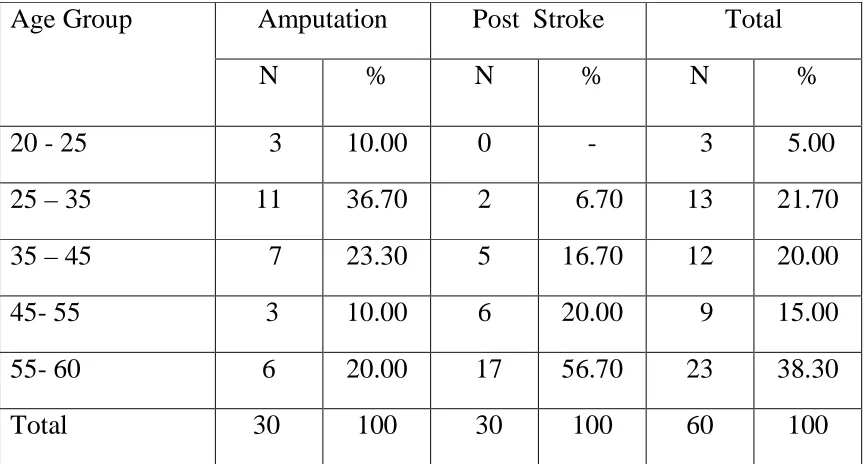
TABLE 1
AGE DISTRIBUTION
Age Group Amputation Post Stroke Total
N % N % N %
20 - 25 3 10.00 0 - 3 5.00
25 – 35 11 36.70 2 6.70 13 21.70
35 – 45 7 23.30 5 16.70 12 20.00
45- 55 3 10.00 6 20.00 9 15.00
55- 60 6 20.00 17 56.70 23 38.30
Mean Age
Amputation Post Stroke
Mean 39.17 52.13
Sd 13.43 9.61
t-Value 4.30
Df 58
p-value 0.000 ( Significant )
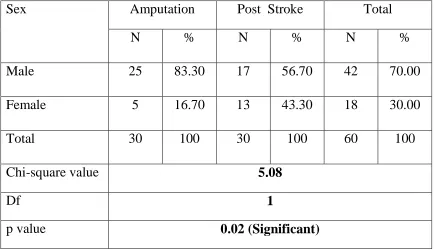
TABLE-2
SEX DISTRIBUTION OF THE SAMPLE
Sex Amputation Post Stroke Total
N % N % N %
Male 25 83.30 17 56.70 42 70.00
Female 5 16.70 13 43.30 18 30.00
Total 30 100 30 100 60 100
Chi-square value 5.08
Df 1
p value 0.02 (Significant)
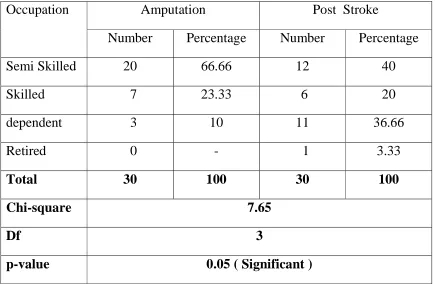
TABLE-3
OCCUPATIONAL STATUS
Occupation Amputation Post Stroke
Number Percentage Number Percentage
Semi Skilled 20 66.66 12 40
Skilled 7 23.33 6 20
dependent 3 10 11 36.66
Retired 0 - 1 3.33
Total 30 100 30 100
Chi-square 7.65
Df 3
p-value 0.05 ( Significant )
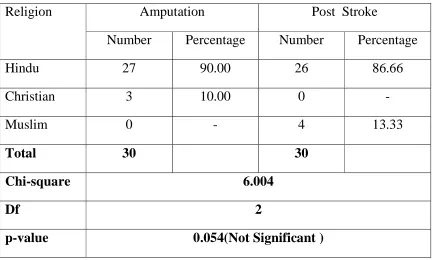
Table-4 RELIGION
Religion Amputation Post Stroke
Number Percentage Number Percentage
Hindu 27 90.00 26 86.66
Christian 3 10.00 0 -
Muslim 0 - 4 13.33
Total 30 30
Chi-square 6.004
Df 2
p-value 0.054(Not Significant )
TABLE-5 LOCALITY
Religion Amputation Post Stroke
Number Percentage Number Percentage
Rural 13 43.30 6 20.00
Semi Urban 8 26.70 11 36.70
Urban 9 30.00 13 43.30
Total 30 100 30 100
Chi-square 3.78
Df 2
p-value 0.15 ( Not Significant )
TABLE-6 EDUCATION
Education Amputation Post Stroke
Number Percentage Number Percentage
Illiterate 6 20.00 10 33.30
Primary 12 40.00 10 33.30
High School 8 26.70 8 26.70
Higher Secondary
3 10.00 1 3.30
Graduation 1 3.30 1 3.30
Total 30 100 30 100
Chi-square 2.18
Df 4
p-value 0.70 ( Not Significant )
Table-7
Socio Economics Status
Amputation Post Stroke
Number Percentage Number Percentage
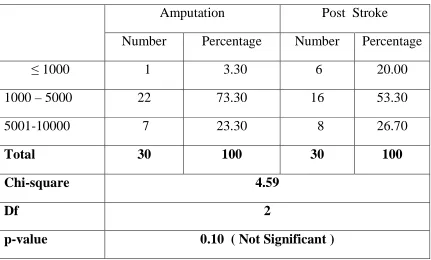
≤ 1000 1 3.30 6 20.00
1000 – 5000 22 73.30 16 53.30
5001-10000 7 23.30 8 26.70
Total 30 100 30 100
Chi-square 4.59
Df 2
p-value 0.10 ( Not Significant )
TABLE-8 FAMILY TYPE
Amputation Post Stroke
Number Percentage Number Percentage
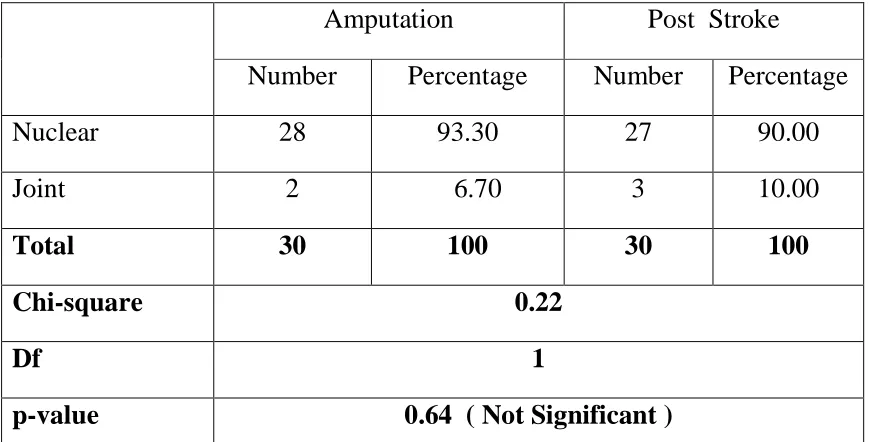
Nuclear 28 93.30 27 90.00
Joint 2 6.70 3 10.00
Total 30 100 30 100
Chi-square 0.22
Df 1
p-value 0.64 ( Not Significant )
TABLE-9
MARITAL STATUS
Amputation Post Stroke
Number Percentage Number Percentage
Married 22 73.30 18 60.00
Unmarried 6 20.00 2 6.70
Divorced 0 - 1 1.70
Separated 1 3.30 0 -
Widowed 1 3.30 9 30.00
Total 30 100 30 100
Chi-square 10.80
Df 4
p-value 0.03 ( Significant )
TABLE-10 RANK IN FAMILY
Amputation Post Stroke
Number Percentage Number Percentage
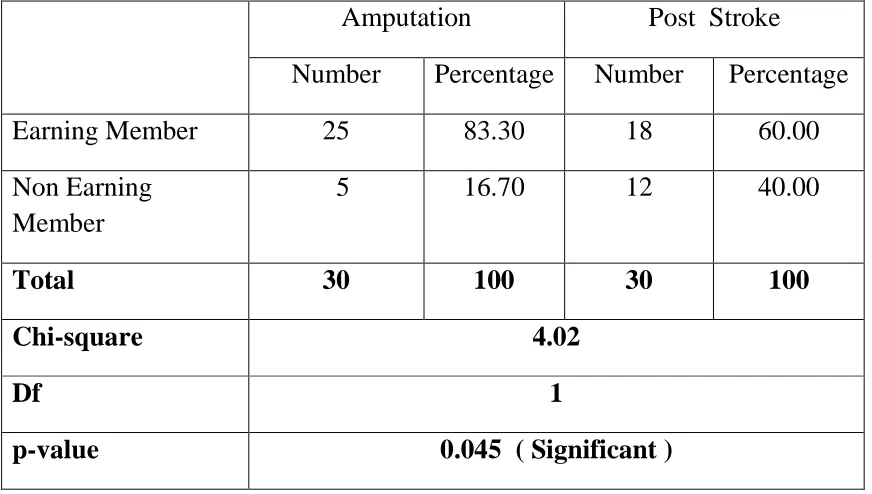
Earning Member 25 83.30 18 60.00
Non Earning Member
5 16.70 12 40.00
Total 30 100 30 100
Chi-square 4.02
Df 1
p-value 0.045 ( Significant )
TABLE-11
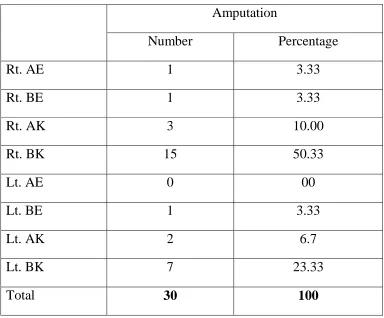
AMPUTATION LEVEL
Amputation
Number Percentage
Rt. AE 1 3.33
Rt. BE 1 3.33
Rt. AK 3 10.00
Rt. BK 15 50.33
Lt. AE 0 00
Lt. BE 1 3.33
Lt. AK 2 6.7
Lt. BK 7 23.33
Total 30 100
TABLE 12
FUNCTIONAL DIAGNOSIS OF STROKE.
side involved
Type frequency percentage
Rt. Hemiparesis 5 16.7
Rt. Hemiplegia 5 16.7
Lt. Hemiparesis 10 33.3
Lt. Hemiplegia 6 20
Rt. Facio-brachial monoparesis 1 3.3
Lt. Facio-brachial monoparesis 3 10
Total 30 100
Total –Rt 11 36.7
Total-Lt 19 63.3
TABLE-13 SOCIAL SUPPORT
Amputation Post Stroke
Number Percentage Number Percentage
Negative 3 10.00 6 20.00
Positive 27 90.00 24 80.00
Total 30 100 30 100
Chi-square 1.18
Df 1
p-value 0.28 ( Not Significant )
Table-14
PREVIOUS PHYSICAL ILLNESS
Amputation Post Stroke
Number Percentage Number Percentage
DM 0 - 4 13.33
HTN 1 3.30 9 30.00
DM + HTN 0 - 5 16.70
Asthma 4 13.33 1 3.30
ARF 0 1 3.30
Cancer 0 0 -
NIL 25 83.30 10 33.30
Total 30 100 30 100
Chi-square 24.83
Df 6
p-value 0.000 ( Significant )
TABLE-15 SUBSTANCE USE
Amputation Post Stroke
Number Percentage Number Percentage
Alcohol 20 66.70 15 50.00
Nil 10 33.30 15 50.00
Total 30 100 30 100
Chi-square 1.71
Df 1
p-value 0.19 (Not Significant )
TABLE 16
SPECIFIC PSYCHIATRIC MORBIDITY
Specific psychiatric morbidity
Amputation Post stroke p value
n % N %
1 Depressio n
HADS-D
22 73.3 19 63.3 t =
2.9284 p =
0.031
HAM-D
29 96.7 23 76.66 t=2.92
p=0.004
9
2 Anxiety 11 36.6 2 7.7 t =
2.9353 p =
0.0048
3 BDD 2 6.7 0 0 t =
1.7818 p = 0.0800
Table 17 GHQ -28
GHQ28 Amputation Mean ± SD
Post Stroke Mean ± SD
t-value (Df=58) p-value
A 15.90 ± 1.49 15.70 ± 1.12 0.59 0.56
B 16.90 ± 1.99 15.77 ± 1.01 2.79 0.01*
C 15.77 ± 2.89 14.90 ± 1.09 1.87 0.07
D 17.23 ± 2.24 15.67 ± 1.47 3.20 0.002*
* Significant
Table 18 HADS scoring
HADS
Amputation Post stroke
1 HADS - A MEAN 6.200 3.700 t = 2.9353
SD 4.1223 2.1838 p = 0.0048
2 HADS - D MEAN 12.200 8.06 t = 2.2100
SD 4.01 3.44 p = 0.0311
3 HADS TOTAL MEAN 16.066 11.766 t = 2.7564
SD 6.812 5.157 p = 0.0078
TABLE 19
HAM D SCORING HAM – D
Amputation Post stroke
n % n %
Normal 1 3.3 7 23.3
t = 2.9284 p = 0.0049
Mild 13 43.33 17 56.66
Moderate 12 40 5 16.6
Severe 2 6.66 0 0
Very severe
2 6.66 1 3.33
Table 20
YBOCS_BDD Scoring
YBOCS-BDD
Amputation Post stroke
Mean 3.800 2.33 t = 1.7818
SD 4.3975 0.9942 p = 0.0800
TABLE-21
SCORES ON SCALES
GHQ Amputation
Mean ± SD
Post Stroke Mean ± SD
t-value (Df=58) p-value
HADS_A 6.20 ± 4.12 3.70 ± 2.18 2.94 0.01*
HADS_D 10.20 ± 4.01 8.07 ± 3.44 2.21 0.03*
HADS_TOT 16.07 ± 6.81 11.77 ± 5.16 2.76 0.01*
HAM-D 14.07 ± 5.38 10.37 ± 4.36 2.93 0.0049*
YBOCS-BDD
03.80 ± 4.40 2.33 ± 0.99 1.78 0.08
SOCIODEMOGRAPHIC VARIABLES
Variables Amputation
Post Stroke
Statistical Analysis
n % n %
Age
MEAN 39.166 52.13 t = 4.3020
p = 0.0001
SIG
SD 13.426 9.605
Sex distribution
Male 25 83.30 17 56.70 χ2 = 5.08
p = 0.02
SIG
Female 5 16.70 13 43.30
Occupational status
Semi Skilled 20 12 χ2 = 7.65
p = 0.05
SIG
Skilled 7 6
Unemployed/dependent 3 11
Retired 0 1
Religion
Hindu 27 90.00 26 86.66 χ2 = 6.004
p = 0.054
NS
Christian 3 10.00 0 -
Muslim 0 - 4 13.33
Locality
Rural 13 43.30 6 20.00 χ2 = 3.78
p = 0.15
NS
Semi Urban 8 26.70 11 36.70
Urban 9 30.00 13 43.30
Education Illiterate 6 20.00 10 33.30
High School 8 26.70 8 26.70 χ2
= 2.18
p = 0.70
NS Higher Secondary 3 10.00 1 3.30
Graduation 1
3.30
1 3.30
Socio economics status
≤ 1000 1 3.30 6 20.00 χ2 = 4.59
p = 0.10
NS
1000 - 5000 22 73.30 16 53.30
5001-10000 7 23.30 8 26.70
Family type Nuclear 28 93.30 27 90.00 χ2 = 0.22
p = 0.64
NS
Joint 2
6.70
3 10.00
Marital status Married 22 73.30 18 60.00 χ2
= 10.80
p = 0.03
SIG
Unmarried 6
20.00
2 6.70
Divorced 0 - 1 1.70
Separated 1
3.30
0 -
Widowed 1
3.30
9 30.00
Rank in family Earning Member 25 83.30 18 60.00 χ2 = 4.02
p = 0.045
SIG Non Earning Member 5 16.70 12 40.00
Social support Negative 3 10.00 6 20.00 χ2 = 1.18
p = 0.28
NS
Positive 27
90.00
DISCUSSION
SOCIO DEMOGRAPHIC VARIABLES
In our study males are more than the females (25). 83.3% males and 16.7 % females (5) as compare to the control group which was 56.7 males and 43.3% are females this was statistically significant which is similar to the other studies done by Imtiyaz, mansoor et al (2010)80 and majority of males in the adult age group with the mean age of 39.6, as compared with the controls in which mean age was 52.13.
This is similar with the previous studies done by JO Oladiji, srakimbo et al61 2009. The reason for this could be the area being industrialized and young people are more exposed to violent situation than elder once and being a male dominant society, males are the main earners and susceptible to get exposed to the external world.
This finding similar to the previous study done by Ebrahim zadeh et al and shukla et al9 and cavanagh et al 79 reported in this study that 75% ever males.
In our study we found more number of married persons both in amputees and strokes and more number of widow persons in stroke than amputees which is statistically significant (P < 0.029). This could be due to majority of sample belongs to marrying age, this finding similar to previous study done by Margoob et al80.
We also observed that more number of our sample where from rural areas as compare to controls but it was not statistically significant and majority of samples were belonging to low-literacy and lower socio economic state and it was not statistically significant between two groups.
This finding accordance with the previous study done by Shukla et al 9where he found majority of cases was uneducated and belonging to low socio economic status.
The explanation for this could be most of the population in our state is from rural background and majority of people who visit to government hospital are poor and very difficult for them to offer higher/formal education.
All the samples in our study due to traumatic injury, in that majority are train traffic accidents and road traffic accidents.
PREVALENCE OF PSYCHIATRIC MORBIDITY AMPUTEES
Many studies have investigated the psychiatric morbidity among the amputees and majority of which mainly focused on depression and anxiety.
In our study common conditions were depression and anxiety.
In our study 73% of amputees on HADS –D and 96% of patients were having abnormal scores on HAM-D and 36.5 were shown abnormal scored and HADS-A (Anxiety).
Our results were in accordance with the study done by Shukla et al (70.2%)9 and similar findings have also been reported by Rendal et al , and anxiety results were similar to the results shown from previous studies done by Funkunishi et al 33.9%, also supported by other studies done by Kashani et al 198327, Atherton et al 2006, Seidel et al 200624.
In our study among the depressed individual 53% were falling in the group of moderate to severe depression and 43 were showing mild depression.
According to kingdom (1982) and Pearce (1984) and also Cansever et al (2003)8 reported that age, sex, type and level of amputation influences the psychological reactions.
In our study we could not find any seen findings. It accordance with the other study done by Singh et al (2007)26, he reports that none of the factor seen as age, gender and other fact to be influential for developing psychological reactions. Most of the studies found no difference between men and women [Bradway et al 19842, Williamson and Walter at al 1996] and in contrary Kashani et al 198327 and O Toole et al 1984 reports that women’s are more likely to experience depression. In our study we found younger age group than older age and most of the study says younger age suffers more than older age. (Ward et al and Dunn’s et al 1996)1,20 but we found no scene statistically significant differences. Coming to the etiological factor, many studies reports that traumatic amputees as higher anxiety and depression than amputation due to disease.
et al 2001 and Darnal et al 1996) and increased social isolation associated with higher level of depression (Williamson et al 1984, Thomson et al 1984), supported by another study done by Rybarczyk et al 1992 and 199522. But in our study we could not find such findings this could be due to less sample size. However our results similar to study done by Singh et al (2007)22.
Several studies established a relationship between time since amputation and depressive symptoms. Depressive symptoms are higher during the initial period of amputation and gradually decline in the latest stages. Singh et al reported rapid decrease in the symptoms of depression and anxiety after a period of inpatient rehabilitation.
In our study we could not establish any relationship between time since amputation and depression symptoms this could be because all are data (samples) are taken within 6 weeks of amputation since patient was interviewed in the treatment setting we not able to establish any relationship. Further follow up is needed after proper social interaction of the individual which is possible after the discharge from the hospital.
90% of lower limb (22) 73.3% were below Knee and 16.7% (5) were above knee amputees
Previous study shows that below knee amputees were more likely to be depressed and anxious than above knee amputees O Toole et al.
In contrary our study did not show any significance difference between above knee and below knee amputees because most of the subject in our study were bed hidden i.e. in treatment setup, and they are not yet exposed to the social interaction to experience difficulty pertaining to the day today activities.
Psychiatric Morbidity in stroke Patient
In our study majority of individuals were old age with mean 52.13 with SD 9.61 and there is no significant difference in sex among the stroke patient. This finding is similar to the previous study JO Oladigi et al (2009)61 and in our study most of the individuals were from poor economic background and lower literacy and majority of people belonging to the Hindu religion.
This could be explained by geographical distribution of the population and economic status among the people in the state. Coming to the proper psychiatric conditions among the stroke majority of the studies concentrated / focused mainly on depression and few studies on anxiety.
We found 63.3% individuals found depressed on HADS and 76.6% found depressed on HAM-D and 7.7 % individuals were suffering from anxiety. [The difference in depression scoring between two scales may due to the HAM-D will pick up the somatic compliance also but it lacks in case of HADS].
depression. In our study we could not find any association between age and post stroke which is similar to other study done by Robinson et al 1993 and Anderson et al 199458. However reason study shows that risk for depression is stroke patient is being younger than old age Eriksson et al 200434, Carota et at 200535.
In contrary to general population, higher prevalence of depression among women was not found in our study. Our results are similar with the previous studies Johnson and Anderson et al 1995 and these was supported by other studies done by Haskin et al 200062, Ramasubbu and Robinson et al 1998, Berge et al 2003. However these may be real difference in men and women that physical impairment is more influential risk factor in men [Robinson et al 1998] and women previous history psychiatric disorder Berge et al 200338.
Some study shows that prevalence of depression and anxiety may affect by time from the stroke of onset.
In fact highest rates of incidence of depression and anxiety have been reported during the 1st month of stroke.
In our study also we found higher incidence of depression. Similar to the previous study done by Berger et al (2005), he reported that at least one half of the individuals identified as experiencing depression during the acute post stroke and other studies showed ranges from 40-50% (Dauloci et al 2005, Morison et al 2005).
In contrast post stroke anxiety has recently begins to be investigated with prevalence from 4 to 28% Astrom et al 199617.
In our study we found 7.7% prevalence is very much similar to the previous studies. Coming to the laterality, many studies showed various relationships between side of lesion and symptomatology.
Our Study found no significant association between frequency of depression and left hemispheric stroke. This finding contrasts with Robinson et al study which found depression to be significantly associated with left hemispheric stroke, but compares favorably with the study of Ebrahim et al , House et al who found no association between left hemisphere stroke and frequency of depression.
Recent studies shows that psychosocial factors are greater contribution to the development of post stroke depression than lesion location (Singh et al 2000, Berg et al 2003, Carotal et al 2004).
While literature on PSA remains in infancy stage, in our study could not find any significance between prevalence of anxiety and laterality. This finding contrasts with Astorm 1996. Castillo et al 1993, study which found significance association between anxiety and right hemisphere lesion. There is a scarcity of literature in this area.
Comparison between amputation and post stroke
There are very less comparative studies available till date. However psychiatric morbidity across the amputees and post stroke patient has been accessed separately. Previous studies report that anxiety and depression is more in post stroke patient Jenkins and Andrews et la. But in our study results are different anxiety and depression appears to be more in amputation patients than post stroke patients.
The explanation for this could be majority of the samples in our case were of younger age group, and they are earning member of the family they have the more responsibility their life pertaining to their family. Majority were consider the amputation as a catastrophic as it occurs all of sudden.
Where as in post stroke patient majority individuals are old age group, were they tend to accept deficits readily than the young people and there will be no anatomical loss hence the patient may having the hope that recovery may be possible.
Coming to body dysmorphic disorder in case of amputee limb will be destroyed, disfigured and finally removed and in case of stroke patient limb will be disabled. So both the group will be more concerned about their body defect.
In this study we found 6.6% among the amputees scored high (abnormal) on YBOCS – BDD and non post stroke patients. This is not significant statistical difference.
SUMMARY
The present study has attempted to compare the psychiatric morbidity, mainly concentrating on anxiety and depression, and socio-demographic variables in patients with amputation and post stroke.
The sample in this study consists of 30 amputation patients and 30 post stroke patients from orthopaedic and general medicine inpatient and outpatient department of Stanley Medical College and Hospital chosen after obtaining ethical committee clearance and informed consent.
Used appropriate statistical tests for data analysis like Chi-Square, t- test, multiple regression analysis using SPSS.
Our results showed that psychiatric morbidity is higher in amputation patients than in post stroke patients.
Shows higher level of depression in amputees in comparison to post stroke patients.
We observed a male predominance in cases than control groups. Our study revealed more number of earning member of the family in case of patients with amputation than post stroke which is statistically significant.
Most of the individuals with post stroke were having DM and HTN as co-morbidity in comparison to amputees.
CONCLUSION
Incidence of depression is higher in amputation patients than patient with post stroke.
Incidence of anxiety is higher in amputation patients than post stroke patients. Commonly young patients are involved in amputation than elderly.
Males are predominant in amputation.
Majority of them are the earning member of the family. Post stroke individuals also more prone for depression.
BDD is not statistically significant between the two groups, the real picture will be revealed only after the discharge hence follow up is needed.
LIMITATION AND SUGGESTIONS
:Sample size of this study is small hence the findings cannot be generalized. Larger population and young stroke sample would have strengthened our study. Patients with aphasia and impaired comprehension (in controls) were not included in this study.
A confounding effect due to medical illness like hypertension and diabetes mellitus could not be avoided.
Follow up study could have given better idea about the development and course of the psychiatric disorder.
In spite of these limitations our study shows similarity with the previous studies. And this is an initial step made to compare both the groups.
ABBREIVATIONS
AK : Above Knee
BK : Below Knee
AE : Above Elbow
BE : Below Elbow
PSD : Post Stroke Depression
PAS : Post Stroke Anxiety
BDD : Body Dysmorphic Disorder
GHQ-28 : General Health Questionnaire -28
HADS : Hospital Anxiety and Depression Scale
HAM-D : Hamilton Scale for Depression
Scale for Body Dysmorphic Disorder.
CES-D :
Center for Epidemiologic Studies Depression ScaleBIBLIOGRAPHY
1. Wald J, Alvaro R. Psychological factors in work-related amputations: considerations for rehabilitation counselors.Journal of Rehabilitation 2004;70(4):6-15.
2. Bradway JK, Malone JM, , Racey J et.al.: Psychological adaptation to amputation: an overview. Orthotics and prosthetics.1984; 38:46-50
4 Livneh H, Antonak RF, Gerhardt J. 1999. Psychosocial adaptation to amputation: The role of sociodemographic variables, disability-related factors, and coping strategies. Int J Rehabil Res, 22:21-31.
5 Parkes CM. 1976.The psychological reactions to loss of a limb: The first year after amputation. In: Howells JG (ed). Modern Perspectives in the Psychiatric Aspects of Surgery. New York, Brunner-Mazel, pp. 515-32. 6 Block WE, Ventur PA: A study of the psychoanalytic concept of
castration anxiety in symbolically castrated amputees. Psychiatr Q 1963; 37: 518-26.
a. 11 . Cansever A, Uzun O, Yildiz C, et al. 2003. Depression in men with traumatic lower part amputation: A comparison to men with surgical lower part amputation. Mil Med, 168:106-9.
7 Frank RG, Kashani JH, Kashani SR, et al. 1984. Psychological response to amputation as a function of age and time since amputation. Br J Psychiatry, 144:493-7.
9 . Shukla. G.D., Sahu, S.C., Tripathi, R.P. & Gupta, D.K. (1982a) A psychiatric aspects of am- utees. British Journal of Psychiatry, 141,
50-53.
10Horgan O, MacLachlan M. Psychosocial adjustment to lower-limb amputation: a review. Disability and Rehabilitation 2004;26(14/15):837-850
11 Fishman S. Amputee needs, frustrations and behavior. Rehab Lit 1959;20:322-9
12Robinson RG, Kubos KL, Starr LB, Rao K, Price TR. Mood changes in
stroke patients: relationship to lesion location. Compr
Psychiatry.1983;24:555-566.
13Newell R. Body-image disturbance: cognitive behavioral formulation and intervention. J of Adv Nurs 1991;16:1400-5.
14Kolb LC. Disturbances in body image. In: Arieti S, Reiser MF, eds. American Handbook of Psychiatry. New York: Basic Books 1975;4:810-
16.Hackett, M. L., & Anderson, C. S. (2005). Predictors of depression after stroke: A systematic review of observational studies. Stroke, 36, 2296-2301.
17.. Astrom, M. (1996). Generalised anxiety disorder in stroke patients: A 3 year longitudinal study. Stroke, 27, 270–275
18.. Castillo, C. S., Schultz, S. K., & Robinson, R. (1995). Clinical correlates of early-onset and late-onset poststroke generalised anxiety. American Journal of Psychiatry, 152(8), 1174–1181
19.. Schultz, S. K., Castillo, C. S., Kosier, J. T., & Robinson, R. G. (1997). Generalized anxiety and depression: Assessment over 2 years after stroke. American Journal of Geria