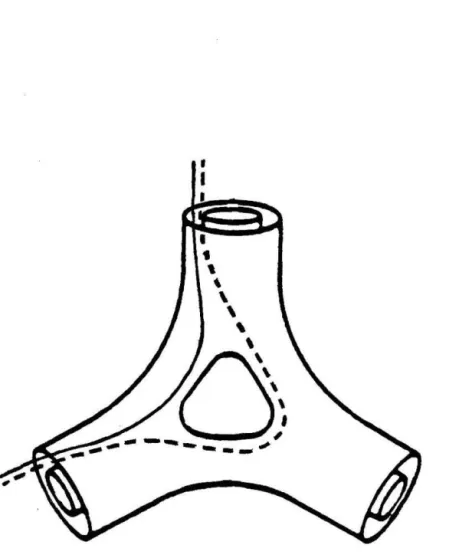
THE
GEOMETRIC
PHASE EFFECT
Thesis by Yi-Shuen Mark Wu
In Partial Fulfillment of the Requirements for the Degree of
Doctor of Philosophy
Division of Chemistry and Chemical Engineering California Institute of Technology
Pasadena, California
1992
ACKNOWLEDGEMENTS
It is with great pleasure that I acknowledge the quidance of Prof. Aron Kuppermann, my advisor. Much of the work contained in this thesis resulted directly from his ideas and suggestions. I wish to thank him especially for his encouragement, patience and seemingly tireless dedication to his research group over the years.
Other members of the Kuppermann group, both past and present, have contributed to this thesis in many ways, and for this I would like to thank them all. l owe special thanks to Dr. Steve Cuccaro who was an inexhaustible source of information about reactive scattering in particular and computers in general, Prof. G. C. Fox and Dr. Paul Messina who initiated me into the world of parallel computing, and Dr. Bruno Lepetit who taught me about hyperspherical harmonics. lowe a special debt of gratitude to Maria Giorgi and Mary Rodgers for their friendship during my stay at Caltech. The innumerable discussions we had doubtless have had an impact on the work reported in this thesis, and perhaps on a few things as well. I also wish to thank the members of my committee, Prof. R. A. Marcus, Prof. H. B. Gray and Prof. B. V. McKoy for their interest in my work. I would also like to thank the following Kuppermann group members: Paul Hipes, Tim Mattson, Joseph Wong , Zhengwei Peng, Jin Qiu, Diane Hood, S¢ren Padkjaer, N. Vaidehi, Amy Shaw and Sandor Kristyan for their invaluable stimulating scientific discussions as well as the sharing of their experiences. I am also grateful to Carrie Stroud who deserve enormous thanks for helping in the preparation of this thesis.
ABSTRACT
Accurate quantum mechanical reactive scattering calculations within the framework of symmetrized hyperspherical coordinate techniques are presented for several processes involving collisions of an electron with a hygrogen atom and an atom with a diatomic molecule in three-dimensional space, and the collinear collision of an atom with a diatomic molecule. In addition to the interest of the processes themselves, the results are compared with previous experimental and theoretical results in such a way as to provide tests of the general usefulness of the methods used.
The general theory for the calculation of accurate differential cross sections
III the reactive collision of an atom with a diatomic molecule including the
geometric phase effect in three-dimensional space is described. This methodology has permitted, for the first time, the calculation of integral and differential cross sections over a significantly larger range of collision energies (up to 2.6 e V total energy) than previously possible for the system H
+
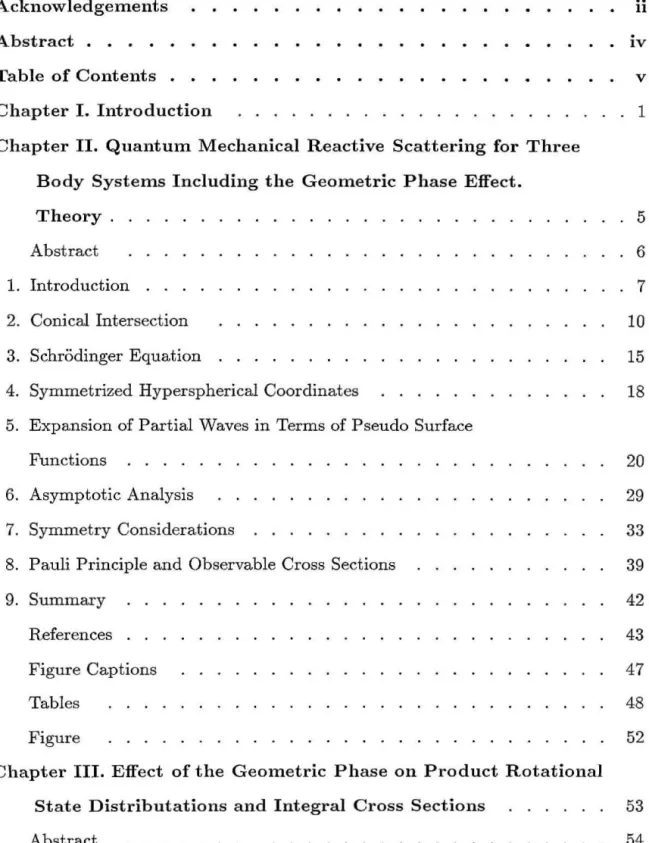
H2 •TABLE OF CONTENTS
Acknowledgements Abstract . . . .
Table of Contents
Chapter I. Introduction
Chapter II. Quantum Mechanical Reactive Scattering for Three
Body Systems Including the Geometric Phase Effect.
Theory. Abstract l. Introduction
2. Conical Intersection 3. Schrodinger Equation
4. Symmetrized Hyperspherical Coordinates
5. Expansion of Partial Waves in Terms of Pseudo Surface Functions
6. Asymptotic Analysis 7. Symmetry Considerations
8. Pauli Principle and Observable Cross Sections 9. Summary
References Figure Captions Tables
Figure
Chapter III. Effect of the Geometric Phase on Product Rotational State Distributations and Integral Cross Sections
Abstract
1. Introduction 2. Methodology
3. Numerical Parameters
4. Results of Scattering Calculations 5. Summary
References Figure Captions Figures
Chapter IV. Theoretical Calculation Of Experimentally
Observable Consequences of the Geometric Phase on
Chemical Reaction Cross Sections
Abstract 1. Introduction 2. Methodology
3. Numerical Parameters 4. Results and Discussion 5. Conclusions
Acknowledgement References Figure Captions Table Figures 55 57 60
62
66 67 72 75 81 82 83 84 89 90 95 95 97 101 102 103Chapter V. Quantum Mechanical Reactive Scattering Using a
High-Performance Distributed-Memory Parallel Computer. 106
Abstract 107
2.
Methodology3.
Parallel Algorithm4.
Results and Discussion5.
SummaryAcknowledgements
References
Figure Captions Tables
Figures
Chapter VI. Quantum Chemical Reaction Dynamics on a Highly Parallel Supercomputer.
Abstract l. Introduction
2
.
Quantum Chemical Dynamics3.
Parallel Algorithm4
.
Results and Discussion5.
SummaryAcknowledgements References
Figure Captions Tables
Figures
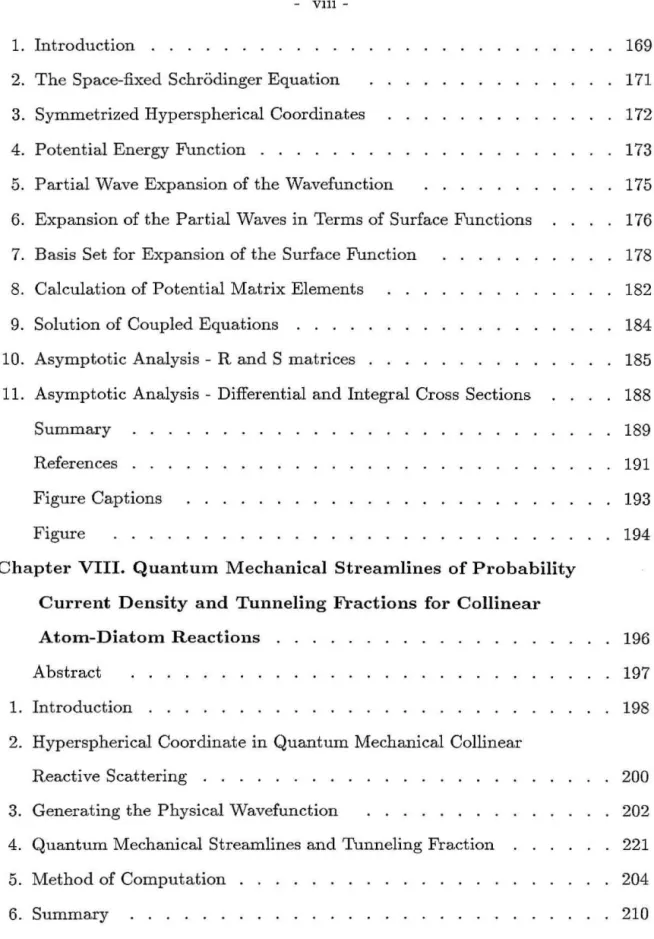
1. Introduction . . . 169
2. The Space-fixed Schrodinger Equation 171
3. Symmetrized Hyperspherical Coordinates 172
4. Potential Energy Function . . . 173
5. Partial Wave Expansion of the Wavefunction 175
6. Expansion of the Partial Waves in Terms of Surface Functions 176 7. Basis Set for Expansion of the Surface Function 178 8. Calculation of Potential Matrix Elements 182
9. Solution of Coupled Equations . . . . 184
10. Asymptotic Analysis - R and S matrices 185
11. Asymptotic Analysis - Differential and Integral Cross Sections 188
Summary 189
References 191
Figure Captions 193
Figure . . . . 194
Chapter VIII. Quantum Mechanical Streamlines of Probability
Current Density and Tunneling Fractions for Collinear
Atom-Diatom Reactions
Abstract 1. Introduction
2. Hyperspherical Coordinate in Quantum Mechanical Collinear Reactive Scattering . . . .
3. Generating the Physical Wavefunction
4. Quantum Mechanical Streamlines and Tunneling Fraction 5. Method of Computation
6. Summary
196 197 198
Apendix A. 211
References . 214
Figure Captions 216
Figures . . . . 217
Appendix A. Quantum Mechanical Study on the Barrier Height
Dependence of the Dynamics for the Collinear
CI'
+
HCI ... CI'H + CI Reaction 220Abstract 221
1. Introduction 222
2. Potential Energy Surface 223
3. Methodology . . . . 224
4. Results and Discussion 225
5. Summary 229
References 230
Figure Captions 232
Table . 236
Figures 237
Appendix B. Chemical Reaction Dynamics: Integration of Coupled
Sets of Ordinary Differential Equations on the Caltech
Hypercube 246
Abstract 247
1. Introduction 248
2. Methodology Based on Symmetrized Hyperspherical
Coordinates
3. Logarithmic Derivative Integrator
4. Future Work . . . .
250
253
Acknowledgement
References . . Figure Caption Figure
258
259
262
CHAPTER I
Introduction
This thesis is composed of a senes of papers in which different aspects of
computational methodology and results are presented. Four of these papers are already in the literature. The focus of this thesis is the use of symmetrized
hyperspherical coordinate technique to study reactive collision in three-dimensional space. Since each chapter is individual paper that contains its own background
materials, they can be read more or less independently. This introduction will give only a summary for each chapter in order to bring a measure of coherence to the
thesis as a whole.
Chapter two present a method for accurately solving the Schrodinger equation
for the reactive collision of an atom with a diatomic molecule in three dimensions on a single Born-Oppenheimer potential energy surface including the geometric
phase effect. The Schrodinger equation is first expressed in symmetrized princi
pal-axis body-fixed hyperspherical coordinates. The formal expansion in a basis set, the local hyperspherical pseudo-surface functions, and the resulting coupled set of ordinary differential equations are discussed. Symmetry considerations that simplify the calculations are analyzed in detail. The formalism for the calculation
of the differential and integral cross sections is given. This method permits a very complete description of the atom-diatom scattering processes.
Chapter three gives a numerical detail about the method of chapter two. We
apply the method to the H
+
H2 system to explore the behavior of the productrotational state distributions and the integral cross sections. Convergence test are performed and comparison are made to previous independent calculations and the
Chapter four is a reprint of the publication presenting results from the first successful reactive scattering calculations that include the geometric phase effect. The calculations are for H
+
H2 on the LSTH potential energy surface. Differential cross sections for or tho to ortho transition are shown both with and without the inclusion of the geometric phase effect. The calculations are extended to all total angular momenta needed to obtain converged integral and differential cross sections over the enrgy range from 0.7 eV to 1.2 eV.Chapter five and six are reprint of publications that explore the three-dimensional quantum mechanical reactive scattering calculations on high-performance distribut ed-memory parallel computer. Parallel algorithm is presented for Caltech/JPL Mark IIIfp hypercube and J = 2 resonances for H
+
H2 system are also analyzed.Chapter seven presents a method that uses hyperspherical coordinates for accurately solving the Schrodinger equation for the scattering of an electron from a hydrogen atom in three dimensions.
Chapter eight describes the work of quantum mechanical streamlines of probability current density calculation. Both the formal and numerical aspects of the method are discussed in detail. The dynamics of the collinear Cl
+
HCI reaction on a low and high barrier potential energy surface is investigated by the help of the quantum streamlines and the results are presented in Appendix A. It is found that the vibrational exci tation leads to enhancement of the reaction rate on the high barrier surface but inhibition of reaction on the low barrier surface.Chapter II
Quantum Mechanical Reactive Scattering for Three Body
Quantum Mechanical Reactive Scattering for Three Body
Systems Including the Geometric Phase Effect. Theory
Yi-Shuen Mark Wu a and Aron Kuppermann
Arthur Amos Noyes Laboratory of Chemical Physics Division of Chemistry and Chemical Engineering
California Institute of Technology Pasadena, CA 91125, USA
Abstract
A method is present for accurately solving the Schrodinger equation for the reactive collision of an atom with a diatomic molecule in three dimensions on a single Born-Oppenheimer potential energy surface including the geometric phase effect. The Schrodinger equation is expressed in symmetrized principal-axis body-fixed hyperspherical coordinates. The formal expansion in a basis set, the local hyperspherical pseudo-surface functions, and the resulting coupled set of ordinary differential equations are discussed. We show how permutational symmetry of the total wave function with respect to the interchange of nuclei can be enforced both in the presence and the absence of the geometric phase effect. Expressions have been obtajned for the integral and differential cross sections in helicity representation including two and three identical nuclei.
1. Introduction
The reactive atom-diatom collision is the fundamental microscopic event that
underlies the chemical reaction. The ability to describe this process from the
knowledge of forces operating at the molecular level has long been the goal of
the theoretical dynamicist. However, accurate quantum mechanical solutions for
reactive atom-diatom scattering have proved to be difficult and computationally expensive to obtain[l]. In fact, only a few groups to date have published accurate
integral and differential cross sections, and most of these calculations are based on
the system H + Hd2-1O].
The exchange reaction between a hydrogen atom and a hydrogen molecule
IS the prototype example of an elementary bimolecular reaction. This reaction
provides the simplest case where, for neutral species, the fundamental kinetic
process of bond breal<ing under the influence of new bond formation can be studied
experimentally and theoretically. Most of the quantum theoretical calculations
of experimentally observable reaction cross sections for the H
+
H2 systemperformed so far have used the Born-Oppenheimer adiabatic approximation[2-21),
and assumed the reaction occurs on the single ground electronic potential energy surface. This approximation is expected to be quite accurate below about 2.6 eV
of total energy (with respect to the bottom of the H2 potential well) since this
is about 0.1 eV below the energy of the minimum of the first excited electronic
potential.
However, a complication may arise in using the Born-Oppenheimer approxi
-mation when two electronic potential energy surfaces display a conical intersection.
It has been shown[22] that in a triangular system of three hydrogen-like atoms the
electronic wave function (considered as a function of the nuclear coordinates) must undergo a change in sign when one follows a closed path in nuclear configuration
sapce around the curve along which two potential surfaces intersect
conically[23-28]. There must be a compensating sign change on the part of the nuclear wave
function if the full electronuclear wave function is to be continuous and single valued[22-26]. This sign change is a particular case of Berry's geometric phase[29]
and is sometimes referred to as the molecular Aharonov-Bohm effect[30]. Berry's
geometric phase is an example of holonomy, the phenomenon by which some
vari-ables change when other variables or parameters characterizing a system return to
their initial values[31,32]. It is a purely geometric phenomenon that depends solely
on the area and curvature of the surface enclosed by the circuit. This effect may
have nonnegligible effects on the results for
H
+
H2
system and other cases wherethe potential energy hypersurface involves a conical intersection.
Mead and Truhlar[24] have shown formally for
H
+
H2
system that, if thecondition that the wave function is zero in a certain region of nuclear configuration
space separating different arrangement channels is fulfilled, the only effect of the
geometric phase is to change the sign of the corresponding exchange scattering
matrix elements and of the associated total scattering amplitude, while leaving
the absolute value of their real and imaginary parts unchanged. This condition is likely to be satisfied for the para -> ortho and ortho -> para transition cross
sections at low collision energies considered in the earlier quantum studies[2-21]. It
has been recently shown however[27], that in the absence of coupling to the ground
electronic state, the geometric phase completely modifies the energy spectrum and
the permutation symmetry properties of the quasi-bound rovibrational states of
for this system are significantly changed by this effect. Therefore, to perform a numerical study including the geometric phase effect is necessary to find out if this condition remains valid at higher energy and accurately asses the magnitude of its effect on this system. In addition, it is even more important to develop a general methodology for a system composed of three atoms, which may be dissimilar, that can take the geometric phase effect into account in the absence and the presence of conical intersections.
In this paper and the subsequent papers to follow, we present a method for accurately solving the Schrodinger equation for the reactive collision of an atom with a diatomic molecule in three dimensions on a single Born-Oppenheimer potential energy surface including the geometric phase effect. This method is developed within the framework of the symmetrized hyperspherical coordinate technique[27,28,33-35]. It easily allow inclusion of the full permutation symmetries of the three body system and permits inclusion of the effect of the conical intersection on the phase of the nuclear wave function.
sections from irreducible representation scattering amplitudes. A summary of the main points are provided in section 9.
2. Conical Intersection
Geometric phase is known to appear in problems involving the Born-Oppenheimer approximation, in which electronic and nuclear degrees of freedom are separated. This separation of electronic and nuclear motion provides' a widely used framework for interpreting molecular energy levels and collision processes. As we recall, in this approximation the electronic problem is solved for each configuration of the nuclei; the positions of the nuclei define a slowly varying environment, which the electrons "follow" adiabatically[36]. Surprisingly, this well-understood procedure gives rise to apparently anomalous results, especially near electronic degeneracies. One such example is the E
®
e Jahn-Teller effect[37] which involves the vibronic interaction of a doubly degenerate electronic state (E) with a doubly degenerate vibrational mode (e). The nuclear motion lifts the electronic degeneracy and distorts nuclear configurations of lower energy than the symmetric state. The two surfaces diverge linearly from one another at the origin, at a point called the conical intersection. Of course, near the origin the adiabatic approximation breaks down, and this point is a singularity of the Born-Oppenheimer prodecure. The conical intersection at the degeneracy is the source of geometric phase for the evolution of adiabatic states. The simplest molecules subject to this effect are trimers, with an electronic degeneracy at the symmetric D3h configuration of the nuclei.the electronuclear wave function corresponding to the ith electronic state can be written as
W(r;
R
)
=.p(
R
)
! .pie(r;R»)
(2.1
)
where r and
R
represents the electronic and nuclear coordinates respectively. ! .pje(r;R»)
is the ith member of the set of orthonormal eigenstates of the electronic Hamiltonian fleer;R
),
such thatfleer;
R
)
!.p;e(r;R
»)
=
Ui(
R) !.pie(r;
R»).
(2.2)
To obtain the equation for the nuclear wave function we retain all derivatives of the electronic wave function with respect to nuclear coordinates. By this we mean simply that all coupling to other electronic states is neglected. If we choose a scaled coordinate system such that the effective mass of every nucleus is M, the total nuclear kinetic energy operator becomes
(2
.3
)
where
R'
is a 3N-dimensional vector formed by 3N nuclear coordinates. In these mass-scaled coordinates, the nuclear wave functionw
(
R'
)
satisfieswhere
F(R')
=
(.pi.(R')
! 'VR' !.pie
(R'
»)
G(R')
=
(.pie(R')
!
'V~,!
.pie(
R'
»)
(2.4)
(2.5)
In general,
F(R')
must vanish if.pie
(R')
is chosen to be real. Even if it doesnot vanish, we can multiply the electronic wave function by a phase factor eif(R') for which i'VR' J(R') equal to
-F(R')
in order to cancel out theF
(
R')
term.be determined along any path to make F(R') vanish, but there may be a net change in the phase of ,pi.(R') on traversing a closed path, which means that ,pie(R') is no longer a single-valued function of the nuclear configuration
R'.
Consider a case[22] in which one may neglect the spin terms in the electronic Hamiltonian, so that the electronic wave function may always be taken in real form. We can examine the behavior of the electronic wave function near the vicinity of the conical intersection. We imagine, that all but two of the electronic wave functions have been found, and that \01 and \02 are any two functions which, together with the found solutions, consititude a complete orthonormal set. These functions are assumed independent to the nuclear configuration. It is then possible to express each of the two electronic eigenfunction in the form
The matrix elements of the electronic Hamiltonian
He
are expressed asHll
=
(\01I
He
1
\01)
H22
=
(\02I
He
1\02)
H'2
=
H21=
(\01I
He
1\02)
where, the following secular equation must be satisfied
(
Hll - E
H21
H'2 )
(c
1 ) _ 0H22
- E
C2-All quantities in this equation are real.
(2.6)
(2.7)
(2.8)
In order for equation (2.8) to have degenerate solutions, it IS necessary to satisfy two independent conditions, namely,
and this reqUIres the existence of at least two independently variable nuclear coordinates. We denote a local
(x,y,z)
coordinate system where the conical intersection happens at x=
y=
0 with any fixed z. The secular equations may be cast in the following form without any loss of generality:(
W+hIX - E
ly
The eigenvalues are
ly )
(CI)
_
0 W+
h2x - E C2-E
=
W+
mx±
)(k2x2+
[2y2)(2.10)
(2.
11
)
where m
=
~(h, + h2), and k=
~(h,-
h2). It is easy to see that this equation corresponds a double cone with vertex at the origin, as the two potential energy surfaces would form around the conical intersection.If we define an angle q, by the equations
kx
=
dcosq" ly=
dsinq,where
The eigenvalues and eigenfunctions are then expressed as
and
E±
=
W+
d(cosq,±
1)I
1/;+)=
si
n~
1101)+
cos~
1102)I
1/;- ) =cos~
1101) -sin~
I
102)(2.12)
(2.13)
(2.14)
(2.15)
(2.16)
The choice of phase factor in equations (2.15) and (2.16) comes from convention alone, since one can easily verifies that
so that
(2.18)
When one traverses a closed path around the conical intersection, the angle tjJ, increases by 271", so both eigenfunctions
.p
+ and.p -
undergo a change of sign (phase cbange of1r).
This sign-change is a particular case of Berry's geometric phase[29]which holds not only in the vicinity of the conical intersection point but for any closed path enclosing the conical intersection.
In order to make the electronic wave function single valued, one must draw a cut to the conical intersection point, and have the function change sign on going
through the cut. Since the full wave function must be continuous, this would
require a compensating discontinuity in the nuclear function. Alternatively, one can add extra complex phase factors to the electronic and nuclear parts of the wave function to enforce the continuity and single-valuedness of each of them. These extra phases add to the nuclear Scbriidinger equation a term formally similar to a
vector potential associated to a delta-function magnetic field located on the conical
intersection line[24,25].
The case of three identical hydrogen atoms near the vertices of an equilateral triangle is shown in the center of Figure 1. According to both the valence-bond
and molecular orbital theories, the ground state is of species 2
E'
in the D3hconfiguration. Let 'PA be the valence-bond wave function for a situation in which
the electron on A has spin up and the electrons on B and C are spin-paired; let 'P B and 'PC be similarly defined, so that
'PA+'PB+'PC = O. (2.19)
We now take the system around a series of continuous loops in the nuclear geometry
the electronic wave function to be real, this cyclic set of deformations changes the sign of that wave function, which as a result is not single-valued. Since the total
electronuclear wave function is continuous and single-valued, there has to be a compensating sign change in the nuclear part of the wave function.
3. Schrodinger Equation
In this section, the Schrodinger equation in Jacobi coordinates and in the
mass-scaled coordinates of Delves for a three particle system is examined. This
discussion is entirely general with regard to the nature of the particles.
We begin with a system of three atoms AA, Av and A~ with masses mA , mv
and m~, respectively. Let A,
V,"
be an arbitary cyclic permutation of a, (3, 7. Thereare three sets of body-fixed Jacobi coordinates, (R~, r~), for this system, where r~
is the vector from atom Av to atom A~ and R~ is the vector from the center of mass
of {Av, A~} to the atom AA. The index A can be any of the values a, (3 or 7. In
the present calculations, we neglect all spin-orbit and spin-spin interactions. Under
conditions of validity of the Born-Oppenheimer approximation, the electronuclear
wave function can be written as a product of the electronic part ..pe, which we chose
to be real, and the nuclear part. The latter can be factored into a nuclear spin part
and a spacial part ..pJMrrr J is the total angular momentum quantum number, M
its projection onto a laboratory-fixed axis, II the parity with respect to inversion of
the nuclei through the system's center of mass and
r
the irreducible representationof the nuclear permutation group (P3 for the H3 system) to which qrJMrrr, the
electro-nuclear wave function excluding the nuclear spin part, belongs:
Here qe refers to the set of all, spacial and spin, electronic coordinates. "if; J Mrrr is an eigenfunction of the nuclear motion hamiltonian[1l-13] which is required to be single-valued, continuous and differentiable. The Hamiltonian for the three particles in this Jacobi, center of mass coordinate system is
(3.2)
in which the reduced masses are
(3.3)
The Born-Oppenheimer potential energy surface V~ depends on the interatomic distances
R~
andr~
and on the angle "f>. = arccos(~~ .~
,
r
,
,,)
The Hamiltonian can be pu"t in a simpler form by the introduction of Delves'
mass-scaled coordinates[38,39], defined as
(3.4)
where
J.'= (3.5)
The Hamiltonian in this mass-scaled, center of mass coordinates is
(3.6)
A change of coordinates, A - t 1.1, is a simple orthogonal transformation in the six-dimensional configuration space spanned by (R>., r>.) when the mass scaled coordinates are used. The mass-scaled Schrodinger equation has the same form as that for a single particle of mass J.' in a six dimensional space.
which follow naturally from the character of the symmetry operations. Rotational invariance of the Hamiltonian permits us to choose the spatial wave function to belong to an irreducible representation of the subgroup SO(3) of the complete symmetry group of the Hamiltonian. Therefore, the wave function can be chosen to transform as an irreducible representation of SO(3) and it is a simultaneous eigenfunction of
j2
andjz
.
The discrete symmetry subgroups of the symmetry group of the Hamiltonian are the inversion group, the time-reversal group, and the group of permutations of the identical particles among the system. The inversion group consists of two operators j and
E,
whereE
denotes the identity and j inverts the spatial coordinates of all the particles through the center of mass. The inversion group has two irreducible representations labelled II =±.
The time reversal subgroup permits us to chose the time-independent wave function to be real function which leads to a symmetric scattering matrix. The final symmetry group is the set of all possible permutations of identical particles. For the H3 system, it belongs to theP
3permutation group. It has irreducible representations labelled by
r
E (AI, A2, E) and is isomorphic with the point group C3v • The E representation is doubly degenerate while Al and A2 are nondegenerate.In
the asymptotic regions of configuration space, the spatial solutions which transform as Al (A2) are composed of even (odd) rotational states of the diatomic molecules while those that transform as E contain both even and odd rotational diatomic states.both in the presence and the absence of conical intersections. The treatment
of nuclear motion wave functions in the presence of conical intersections and
the treatment of nuclear interchange symmetry in general both require careful
consideration of the phases of the electronic and nuclear motion wave functions,
and this will discussed in detail latter .
4. Symmetrized Hyperspherical Coordinates
It has been proposed[34,35] and validated[1l-14,17] that symmetrized hyp
er-spherical coordinates which are derived from the RA, rA, IA coordinates are well
suited for three dimensional reactive atom-diatom scattering. There is more than
one possible set of hyperspherical coordinates [40-45] which may be used for the
cal-culations. All these coordinates share the same spirit to treat all three arrangement
channels in equivilent ways.
We use a set of principal-axis body-fixed hyperspherical coordinates closely
related to the modified Whitten-Smith coordinates[41,42,46]. Three of the 5
hyperangles are the Euler angles (
a(J,)
which specify the orientation of the bodyframe in space. The other two are the symmetrized hyper angles (8,
<h)
obtained bya rotation of the internal configuration space axis described previously[34] through
Euler angles
(f, f,
7r). The anglee
is in the [0,f]
range and 1> A in the [0, 27r) range.These two angles describe the shape of the molecular triangle, such that
e
=
7r /2corresponds to linear configurations and
e
= 0 to symmetric top configurations.The quantization axis Z for the internal motion is chosen to be the axis of least
inertia and the
Y
axis is associated to the axis of maximum inertia, perpendicular tothe molecular plane. This choice enables one to minimize coupling due to rotation
The cartesian components of r>. and R>. in this body-fixed frame are given by
r>.X
=
-psin(7r/4 - e/2)COS(fh/2);r>.Z
=
pcos(7r/4 - e/2)sin(¢>./2);R>.X = psin(7r/4 - e/2)sin(¢>./2);
R>.y = 0;
R>.z
=
pcos(7r/4 - e/2)cos(¢>./2).The corresponding Hamiltonian is expressed as
(4.1a)
( 4.1b)
( 4.1c)
( 4.1d)
(4.1e)
( 4.11)
(4.2)
where we have defined the quantity (>. to represent all five hyperangles in the
.x
arrangement channel: 01., (3, 'Y,
e,
¢>.. The hyperradial kinetic energy operatorT(p)
has the form
, n2 -5 0 5 0 n2 _~ 02 .. 15n2 T(p)
=
- - p - p -=
- - p ' - P '+--2J.L op op 2J.L Op2 8J.Lp2
and the surface hamiltonian
h>.(
(>.;p)
is( 4.3)
(4.3)
The square of the grand canonical angular momentum operator
A
2 can beexpressed in terms of these angles as
where A~ and
R
are given by'2
' 2 ' 2 4J
z
'
A
=
Ao+
---Ze +
cosR
(4.4)A2 A2 A2 A2 A2 A2
R
A=
cos2(~-£) 1 [J - Jz
+
J+
+
J _-
JAz
2+
-
1-
[_J--;:-- _J.£.Z2 4 sin28 2
A2 A2
_ J+ + J_)] _ 21i cosO
(J
L)~
4 sin28
+
+
EN).
(4.6)
Jz
being the body-fixedZ
component of the total angular momentumJ
,
andThis principal-axis hyperspherical formalism has an attractive feature in which the quantization axis for the internal motion is the axis of lowest inertia where the Coriolis coupling remains minimal in that frame. Calculations[17,47] neglecting them still yield good results for low partial waves at low energy, while strongly coupled states are notably reduced.
5. Expansion of the Partial Waves
in
terms of Pseudo Surface FunctionsSince the Hamiltonian operator (4.2) commutes with
J2,
J"
i
and permutation operatorft, we can expand the wave function of the system
in terms of their simultaneous eigenfunctions \liJMIIr. (p, ().):(X) J 1 nr
\Ii(p, ().)
=
L L
elML L L
\liJMIIr.(p, ().).(5.1)
J=O M=-J II=O r k=l
We now define a set of five-dimensional pseudo surface functions q,~ffIIr at
the hyperradius
p
for the expansion of the six dimensional scattering wave functionThe functions Nr[Mil are linear combinations of Wigner rotation matrices with
definite parity II
=
±1[17,48J.Nn JMII -_ (5.8)
where
n
::::
0 is the absolute magnitude of the quantum number for the projectionof the total angular momentum onto the body-fixed Z axis.
The cp~IIr are
n-
and p-dependent eigenfunctions of the hamiltonian(5.9)
These eigenfunctions are obtained variationally by expanding them in a body-fixed
basis x~;~. built from products of simple analytical functions[17J:
(5.10)
where no and n", are integers or half-odd integers, and
f;;,
(B) and g~;n(¢
>.)
aresimple linear combinations of trigonometric functions.
The functions
1;;,
(B) can be chosen as the functions cos(noB) or sin(noB), withno integer or half-odd integer, in terms of which the hyper spherical harmonics
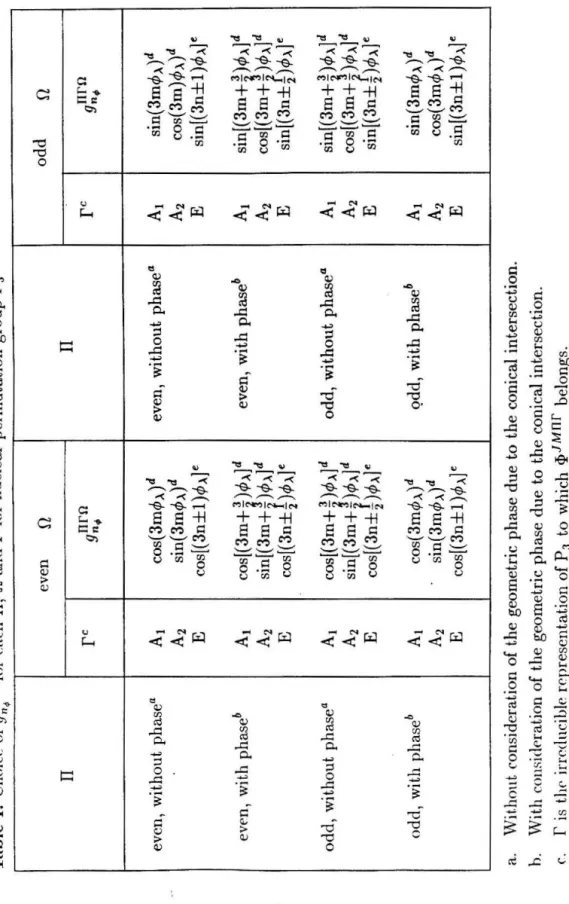
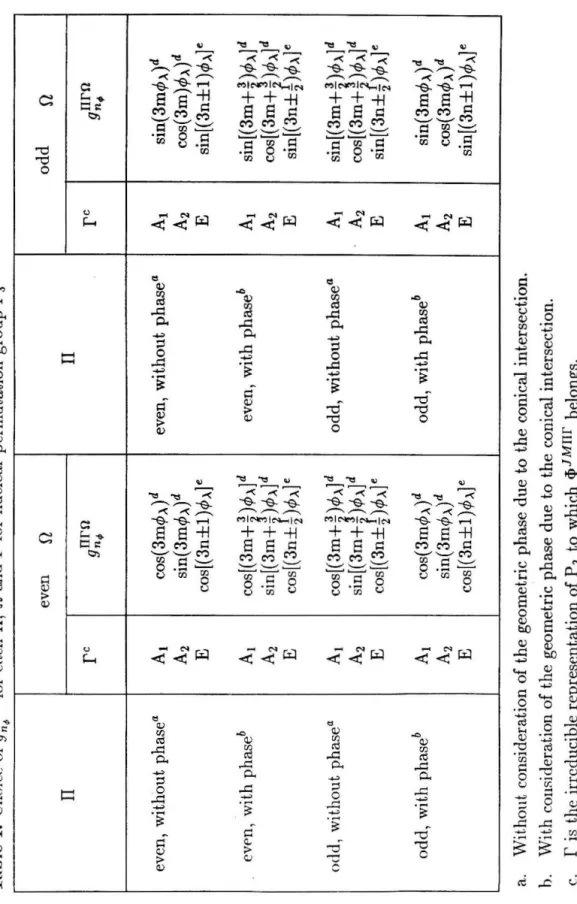
can be written as polynomials in cosB [7,49-51J. Table 1 indicates how to choose the functions of g~;n( ¢>.) to obtain electronuclear wavefunctions with correct Pa
We now focus our attention on the special case of three identical nuclei and describe how to build electronuclear wave function q;,JMIIr which are bases for the irreducible representation of the
P3
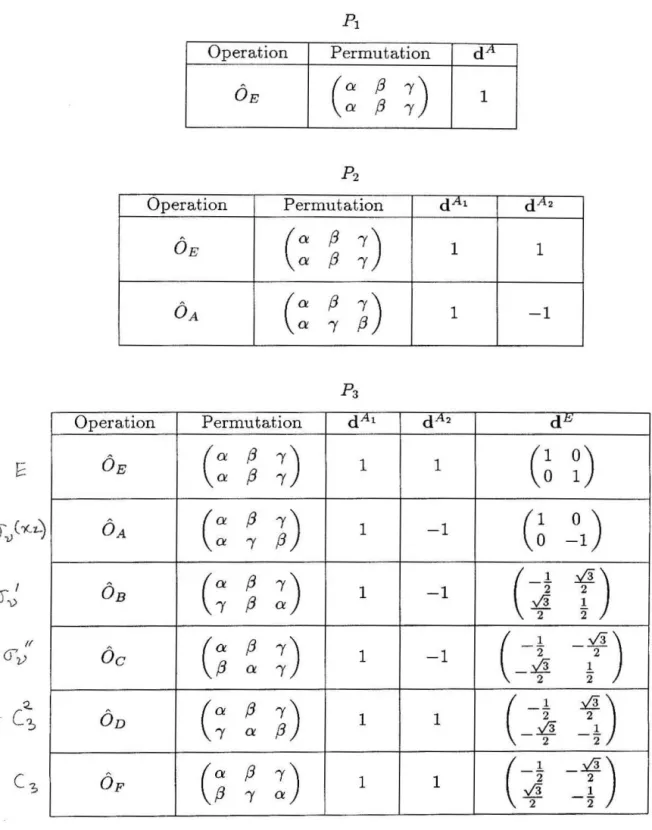
permutation group of the three identical nuclei. The operations of this group correspond to simple changes in ¢). (which are related to the isomorphism betweenP
3 andC
3v ) as indicated in Table II.If there is no conical intersection between electronic states, a non-degenerate electronic wave function
,p
e
(qe;
p~) belongs to a one-dimensional representation of the nuclear permutation group(A,
for symmetric with respect to paIrWISe permutation of nuclei, orA2
for antisymmetric with respect to pairwise permutation of nuclei), and is also single-valued with respect to the nuclear configuration. For this reason, the nuclear wave function also needs to be single-valued, which subsequently means that 1 n", 1 has to be an integer.For even parity, even
n
quantum number, with1
n¢1=
3m, basis functionsdefined in Table I will give sin(3m¢).) (an A2-type function) or cos(3m¢).) (an A , -type function). For even parity, even
n
quantum number, with1
n¢1=
3m±
1,pairs of basis functions of the form
(:~~g:
~
~~)
with m integer can be easily proven to form an E irreducible representation of theP
3 permutation group.If there is a conical intersection between two electronic states for the equilteral triangular configuration of the nuclei and if the geometric phase effect is taken into account, in the vinicity of the conical intersection (¢). = 0) the ¢). dependence of those two non-degenerate Born-Oppenheimer electronic wave function is given by (2.15) and (2.16)
l,p;)
= cos ¢2).1
'ljJ~')
- sin ¢;1
'ljJ~2)
(lower energy) (5.11)where
.p[
t
,
.p['
are two degenerate p-dependent but'P>
.
independent states at,h.
=
0 which form a basis for the E irreducible representation of P3 (.p[
t
being symmetric for the pairwise permutation of nuclei and.p['
being antisymmetric forthe pairwise permutation of nuclei). Under the permutation operation of the P
a
permutation group, although
.pf
l
and.pf
'
do not depend on1>>.
explicitly, the permutation operation does change the internal coordinate system in which.p[
t
and
.pf'
are described. If we take the active view of those symmetric operations,then
.pft
and.pf'
would behave like a pair of unit vectors under theC
3v point group operations, except that the rotation angles are -1200and -2400
instead of
1200
and 2400
as described in Table II.
As mentioned before,
.p;
and,;;t are both singlet (non-degenerate) electronic states with their phase factors to be chosen in such a way as make both of them real functions. Their behavior under the operation of the P3 nuclear permutationis also listed in Table II. It can be seen that although permutation of the nuclei
can only change the sign
of,;;t
and ';;; , these Born-Oppenheimer electronic wavefunctions do not belong to any one-dimensional irreducible representation of
P
3 and they are discontinuous in the internal configration space when crossing the plane of1>>.
=
o.
However, we can build continuous electronuclear wave functions that do form irreducible representation of
P
a by using the new set of nq, values as indicatedin Table I. For example, with even parity, even fl quantum number, and with the choice of nq,
=
3m+ ~, we can form basis functions sin(3m+ ~)1>>.
and cos(3m+ ~)1>>.
which behave assin(3m +
~)1>>.
l
.p;)
--+ At7
(5.
13
)
and
It can also be proven that for even parity, even
n
quantum number, the pairs offunctions
and
(
sin(3m ± ~)
11/;-:-) )
cos(3m± 2)
11/;-:-)
( cos(3m sin(3m ± ± 2)
~) 11/;;))
11/;;)
form E irreducible representation of
P3
nuclear permutation group.(5.15)
(5.16)
The pseudo surface functions iI'>~KIIr, in addition to being discrete, span the
three arrangement channels and provide an effective basis set in which to expand
the scattering wave function. We expand the six-dimensional sacttering wave
functions as
(5.17)
where the pseudo surface functions are calculated at
p
This is an efficient expansionwhen p is near
p.
In this sense we say that the pseudo surface function basis set isa local basis set. In addition, due to the factorization of pseudo surface functions
into an internal part 'P~IIr, which is independent of total angular mementum J,
and an external part NifMII, the evaluation of matrix elements from the expansion
become easy. As a result of the isotropicity of space and the indistinguishability of
the particles, it can be shown that the coefficients in the expansion are independent
of M, so these labels do not appear in the differential equation for the coefficients.
Since the parameter rb is considered to be fixed in any given expansion, the pseudo
surface function basis set is diabatic in p.
The expansion in pseudo surface functions yields the following set of coupled
/i2
~
WIIrf!( .-)bmr( . -
)
/i2~
XIIr,u ( -) mr ( _+2"2
~ nn' P,P n'O P,P+--2
~ nn',O±1 P;P bn',U±1 p;p)I-'P n' I-'P n'
where
IJ.
= {
O,1,2, .... J1,2,3, .... J
for
J
+
II even; forJ
+
II odd;with coupling matrix elements given by
-2
U;;J,n(p;
p)
=<
'P
~rf!
I
V((!, <P>., p) - P2 V((!,¢>.;
p)
I
'P~rn
>
P
WIIrn( . -) _
[J(J
1)] IIrnI
1 1I
IIrnnn' P, P -
+
<
'Pn 1+ .
B+
2 . 2B 'P",>
SIn SIn
>
yIIrn _
~
(J
IJ.)~
(J
IJ.+
1)7]J,O+2<
'PIIroI
.,--_1
~
nn' ,n±2 - <,+ , <,+ , 7] n 1+
sinBJ,n
H_(J,IJ.)~_(J,IJ.
_ 1)7]J,n-2<
'P~
rf!
I
1.7]J,n 1
+
smB(5.18)
(5.19a)
(5.19b)
(5.19c)
(5.19d)
where 7]J,n, 7]J,n±1, 7]J,n±2 are normalization constants for
NifMII(a,{3,I')
,
Nifr;n(a,{3,I')and Niffl{F(a,{3,I')
functions. The coupling constants ~±(i,k) are defined as~±(i,
k
)
=
[i(
i
+
1) -k(k
±
1)]1/2. (5.20)W,X,Y, the integrals over ()¢>. are independent of J, the J dependence arising from the analytically known matrix elements of the total angular momentum body -fixed frame components.
Pseudo surface functions at single
rb
are not efficient for expanding the wave function for all values of p. The strategy is to calculate a set of pseudo surface functions at each of a family of values of the hyperradiusPi,
i = 0,1,2,3 ... For each value ofPi,
the system of ordinary differential equations is integrated as an initial value problem. The range of p over which a single pseudo surface function set is used is called a sector. With the exception of the very first sector beginning at Po, the initial conditions follow from continuity of the wave function and its pderivative between sectors. This is accomplished by imposing the conditions
b~r(pi.i+I;
Pi+l)
=L
b~fIr(pi
.
i+l; Pi)[Omr]~'
(Pi+l, Pi);
(5.21) n'(5.22) in which the overlap matrices
Omr
are defined by[Omr]n'cn Pi+l, Pi - - ) = \ / q;JMrrrkC( n A; Pi+l - ) I.-..JMUrkC( "*'n' Ai Pi - ) \
/0
C5.23)These matrices are also independent of M.
For small values of the hyperradius for which the three atoms interact strongly, simple trigonometric basis functions proved to form an efficient set in which to expand the electronuclear wavefunctions I]!JMur. However, for large values of the
hyperradius for which the system has nearly separated into an atom and a diatom,
WA, 'YA[34,35] defined by WA
=
2arctan(rAI R A) and 'YA=
arccos(RA . rAI RATA), instead. These are related to B,,!>A
by the transformationsinBcosB
=
COSW A ; sinBsin¢>A = sinwAcos'YA;(5.24a)
(5.24b)
(5.24c)
The basis set based on WA and 'YA for large values of p has previously been shown to be very efficient[13]. The pseudo surface functions are now expanded in a product basis[13] of Legendre polynomials in COS'YA and vibrational type functions in W A . Since product bases associated to different arrangement channels do not overlap for large values of p, the pseudo surface functions which include the geometric phase differ from the ones which exclude it only by simple changes in the signs of the pieces of the wave function within each arrangement channel. The geometric phase can be included straightforwardly in this region since it does not change the overlap and potential coupling matrices.
Equation (5.18) for the p-dependent part of the wavefunction has as many linearly independent solutions as there are pseudo surface functions in the expansIOn. We may write (5.18) in matrix form as
(5.25)
where
2" 1 2 1 2
K = - U
+
-
w
+
- X+
- y - k'h2 p2 p2 2p2 (5.26)
in which
(5.27)
If we define the logarithmic derivative[52] of the b JIIr matrix of coefficients to be
we find by differentiation of (5.28) and using (5.25) that
Y
satisfies the matrixRicatti-Bessel equation
. mr
_
_
(mr
_)2
Y
(p;p;)=K(p,Pi) -Y
(P;Pi) (5.29)We have used a version of Johnson's logarithmic derivative integrator[52],
modified to include the improvements suggested by Manolopoulos[53], for
integrating the matrix Ricatti-Bessel equation. In this method, the initial log
derivative matrix is set to correspond to a wavefunction with very small amplitude,
and the matrix is propagated according to the rules
where
[pr'
=
on' {6.PPn coth(6.PPn)n n 6.PIPnl cot(6.PIPnl)
[Qr' =
on' {6.PPn/ sinh(6.pPn)n n 6.PIPnl/ sin(6.pIPnl)
p~:::: 0 p~
<
0 p~:::: 0p~
<
0(5.30)
(5.31)
(5.32)
and there are Nr steps of size 6.p = (PNI - Po)/Nr between calculations of the log
derivative
y.
The potential terms Vi are given bywith the matrix U defined as
where
i = 0, Nr
i
=
2,4,6, ... Nr-2
i=1,3,5, ... Nr - l
U = K-Kref
_
sn'
2- n Pn
(5.33)
(5.34)
with K .rc being the value of K at the center of the interval between calculations of 2
y
.
Because U is independent of E, this version of the logarithmic derivative integrator[53] can effectively eliminate
t
of operations and computer time necessary for the second and subsequent energies. In addition, it allows one to start theintegration at a larger value of
p
than the previous version would permit.6. Asymptotic Analysis
In this section, the asymptotic boundary conditions are considered. To obtain
differential and integral cross sections, it is necessary to use an asymptotic form
which corresponds to the physical conditions of a scattering process. The numerical solutions to the Schrodinger equation are labelled by J,
II,
andr
whereas theasymptotic boundary conditions which represent a scattering experiment have no such labels. Therefore, construct the
P
3 irreducible representation space-fixedscattering wave function first and then transforming it to the helicity form will be a most straightforward procedure
An asymptotic form which describes a scattering experiment has an incident
plane wave multiplying the initial state wave function of the diatomic molecule and outgoing spherical waves multiplying each energetically accessible diatom state.
One possible form for the asymptotic scattering spatial wave function arises if we
energy are given as:
(6.1 )
where
{A/
,
v',
n:/}
is a cyclic permutation of the arrangement channel indices{a
,
{3, I} and >.. is a fixed but otherwise arbitrary channel index which corresponds to the asymptotic arrangement channel under examination. The coefficientsj~'v~.'j~,m~,
are the space-fixed scattering amplitudes and contain the informationAV;\.}>. m ).
needed for the cross section determination. The diatomic wavefunction
I"~t,j,
m,
is given in space-fixed coordinates by(6.2)
where Or
,
andtP
r
,
are the polar coordinates of r A with respect to the space-fixed Z axis. The quantum number VA labels the vibrational levels for a given jA wherejA(jA
+
1)n2) is the square of the diatom rotational angular momentum. Theprojection of the diatom rotational angular momentum onto the space-fixed Z axis is mAn. The quantum numbers VA, jA and m A are labeled with the subscript A to differentiate between the states of distinguishable diatomic molecules.
The corresponding boundary conditions for the body-fixed helicity represen-tation are given by[2]
(6.3)
where the body-fixed expression for the diatomic wavefunction is given by
and the quantum number
l"h
labels the orientation of the diatom with respect tothe body-fixed ZA axis so that the projection of the diatomic angular momentum
on the ZA axis is nAn.
The transformation of the final diatom projection quantum number to the
corresponding helicity quantum number is accomplished by using the definition of
the Wigner rotation matrices[54]:
j
L
(6.5)n=-j
Combining equations (6.5), (6.2), (6.1) and (6.3), yields the relation
(6.6)
Since the Hamiltonian commutes with the operators of SO(3), so any
solution to the Schrodinger equation can be written as a linear combination of solutions which seprately transform as irreducible representation of SO(3). IT the
decomposition is done using body-fixed coordinates, then the partial wave series
is given in terms of the Wigner rotation matrices. Here we define the asymptotic
form for a partial wave body-fixed solution to the Schrodinger equation for an
atom-diatom collision at energies below dissociation of the diatom to be
where the function 'Df~ is defined as
with Wigner rotation functions[54]
D
im
,
and normalized[2] associated Legendre functionsp
r.
The coefficientsGf~'
(
R),
.)
are given by[2](6.9)
where the term v X is the channel velocity, defined by
(6.10)
For open states, i.e., those states with E
>
eX' the resulting wavenumber is real and positive; for closed states(E
<
eX) the wavenumber is positive imaginary, so that the parts of the wavefunction in equation (6.7) which are associated to closed states of the system decay exponentially. The sum over the diatomic quantum numbers in equation (6.7) is over all open and closed states for the system.The preceeding scattering asymptotic boundary conditions involve plane waves and spherical waves because these are familiar boundary conditions for a scattering wave function; however it is most convenient for numerical purposes to calculate solutions to the Schrodinger equation which are real functions. These are the well known reactance matrix formalism given by
open closed
(6.11) open closed
trigonometric functions, and we can write,
open
(6.12)
closed
From the matrices A J and BJ, we obtain the reactance matrix by usmg the
expreSSion
(6.13)
The reactance matrix is unique, real, and the open part OR is symmetric[56J.
The relationship between the open-channel parts of the scattering and reactance matrices is also well known[56J. For a fixed collision energy, the number of open initial states and final states is equal. It is simple to show that
(6.13)
where the left hand superscript 0 indicates that we are referring to the open parts
of the corresponding matrices. Physical quantities such as reaction cross sections can be easily related to the scattering matrix.
7. Symmetry Considerations
There are three possible permutation groups for three particles, depending
on the number of these particles which are indistinguishable, and the number
of operators needed in each case differs. These three permutation groups are:
P
l , which corresponds to a system in which all three particles A, Band C are(the AB2 system), and for which the hamiltonian is invariant under the identity and one two-particle permutation; and P3, for a system with three indistinguishable particles (the A3 system), with six permutations under which the hamiltonian is invariant, the identity, two three-particle permutations and three two-particle permutations.
A' f · , ,
The distinguishable atom representation asymptotic form, Wx
_,d"m",
does not transform according to any irreducible representation of permutation group. To find spatial asymptotic forms that do transform as irreducible representations of permutation group, the distinguishable atom asymptotic form is multiplied by the appropriate group theoretic projection operator[57j. This projection operator is given by'r lr
L
r. ' ,p 1,1 . . ,
=
-
h M· ., (R)R I,t (7.1) Rwhere
r
is the irreducible representation, i, i' are the row and column of the representation, lr is the dimensionality of the representation, h is the order of the group and Mr.,(R) , is the i, i' element of the matrix representing the operatorR
for ther
irreducible representation. The sum is over all of the operators in the group. The transformationsR
and the permutations which generate them are defined in TableIII.
function. With this information, the irreducible asymptotic form is
(7.2)
where W may stand for either R or S matrix. Since the arrangement channels of
type T are all identical, the form of the functions in these arrangement channels must all be the same, and therefore we may replace the label
.x
in these functionswith the label T. The composite index
-r
is defined similarly toX,
i. e.,-r
= {TVT jT }.The coefficients c~lj, are easily determined from the transformation matrices from
Table III and are given in Table IV; they are defined so that a summation over .\ will
result in non-zero contributions from all channels of type T and zero contributions
from channels of types T'
=f
T, and a summation over both .\ and T will resultin a single term from each arrangement channel. The irreducible representation
asymptotic form (7.2) has a interesting characteristic that the matrix W has the
same functional form in all arrangement channels.
By taking the appropriate projection for the PI group, the irreducible
asymptotic wave functions are
>l1~M{r.=Aj,n'
>l1 JM {r.=Aj,n'
r;
>l1 JM {r.=A},n'
-y
=
>l1~M,n'
) _ .T.JM,n'P
-'J!r; 1=
'l'JM,n'-y
(7.3)
which in this case are the same functions defined in each arrangement channel. For
the P2 permutation group, we have
>l1 ~M {r.=A'j,n'
>l1 ~M {r .=A" },n'
>l1 JM {r.=A'j,n'
r;
wJM{rk::;::A"},n'
r;
If the three particles are identical, all three arrangement channels are indistinguish-able, giving
W~M{r.=Ad,n' = pA1W;M,n' )
W~M{r.=A,j,n'
=
pA'W;M,n' P3 WJM{r.=E.},n' _ pE WJM,n''" - kk fJ
(7.5)
We can apply the permutation operators (shown in Table III) to the equation (7.3), and take group theoretic projections which leads to expressions between the irreducible representation Rand S matrices and the corresponding distinguishable particle matrices. The
P
2 permutation group can be expressed asA " , ., n'
W
Qt/al a 01fJv~j~np
j", and j~ even
j" or j~ odd j", and j~ odd ja or j~ even
j~ even
j~ odd j~ odd j~ even
J", even j", odd j" odd
Ja even
(7.6)
(7.7)
The inverse of these relations is
= _ 1 (
W
A' aVCt.!a U I -/ 01+
W
All avOlI · f !o.un/)
v'2
flvpjpOp flvpJpop (7.9)= _ 1 (
W
A'f3v' j' p .p fl'+
W
A"p vpI J./ pQ')
P-v'2
aVooJafla aVQJccnc._ (- l)jp ( W A'fI' Vp J" P"P n' _ W AUfi vp' J., p"p n' )
- 2 flvpjpOp flvpjpOp
For the three identical particles
(P3),
we can derive the set of relation betweenRand S matrices for the irreducible representation and those for distinguishable
particles:
WvjO A1 t/ j'O' _
-The inverses of these relations are:
j and j' even
j or j' odd
j and j' odd
j or j' even
j
+
j' even j even, j' odd j odd, j' evenj and j' even
j and j' odd
j
+
j' oddj and j' even
j and j' odd j even, j' odd
j odd, j' even
(7.10)
(7.11)
The parity label has not appeared in the foregoing analysis but is a label for
the numerical solutions, so it is desirable to have the asymptotic form expanded
in the corresponding parity components. The parity labeled components have a
Multiplying by the parity projection operators, which are special cases of
equation (7.1), we can find the parity components of the asymptotic form and
express the asymptotic form as an expansion in the parity components. Since the
inversion parity operator acts only on the generalized Wigner rotation function as
iv
JM = (_l)JV JM we get from (72) thatJO JI-O' .
(7.12)
where the function Vf~rr is defined by
(7.13)
With some manipulation this can be reorganized into the form
in which both indices
nr
and n~ are greater than or equal to zero. Furthermore,(7.15)
A s a resu tI ,
(W
mr)Tlv~.fj~fn~1 h as t h e symmetry propertyTVrJr,nr
(7.17)
so if the parity labelled scattering matrix elements with .It ;:0: 0 are calculated, then the elements with .It
<
0 are known by equation (7.17).8. Pauli Principle and Observable Cross Sections
The differential cross section is defined as the outgoing flux into a unit solid angle for some final state of the diatomic molecule divided by the total incident flux. Before writing down this expression in terms of the helicity scattering amplitude, it is necessary to undo the effects of mass-scaling on the latter.
The use of mass scaled coordinates affects the normalization of the diatomic molecule wave functions, the wave vectors, and the spherical wave terms of the asymptotic form. First, consider the diatomic molecule normalization.
(8.1)
If the diatomic molecule wave functions in unsealed Jacobi coordinates are defined to have normalization
(8.2)
then the following relationship exists between the mass-scaled and unsealed diatomic wave functions:
(8.3)
where we have defined
Also, the wave vector corresponding to unsealed coordinates is
(8.5)
which implies that
k~vjR~ = k).vjR).
(8.6)
The unsealed scattering amplitude can be related to scaled scattering amplitude by
(8.7)
From the scaled helicity scattering amplitude, the irreducible representation differential cross section can be defined
rrfvlj'm'(8 " ' ) _ -2 Vrvj
Urvjn ..\, 'f'>' - art
VT'v'j'
(8.8)
which can be rewritten as[2]
2 rrlvfjlm'(8 ) _ 1
(J rvjr! ). - 4k,2
T'V'j'
(8.9)
where
(8.10)
The integral cross section
Q~;~~j'm'
is obtained by integration of (8.10) over 8). andq,
).
and using the orthonormality property of the dJ functions givingQrr'v'j'm' = 7r
~(2J+1)I[TJrlr'
v.'j'm
'12
TVJO k,2 L-t TVJO
r'v' j' J=o
(8.11)
therefore, the complete wave function can be written as a direct product of a spatial waVe function, which satisfies the Schrodinger equation, and a spin wave function for the three particles. In earlier sections we have discussed the explicit construction of the spatial part of the scattering wave function. From the direct product of the spatial and spin functions, differential cross sections for appropriately antisymmetrized scattering wave functions can be extracted. The existence of nuclear spin does not affect the previous sections and becomes important here in connection with the Pauli principle.
Rotational invariance implies conservation of the spin total angular momenta squared and one of its space-fixed components. The spin functions that we will use are chosen to be eiqenfunctions of 52, the square of the total spin angular momentum operator and
5z,
its space-fixed Z component.The permutation operators also affect the spin functions. Since the operators of permutation group all commute with those of SO(3), the spin functions just chosen form irreducible representations of permutation groups. For example, the direct product for the P3 representations are (spin 181 spatial)
Al 181 Al = A2 181 A2 = Al
A2 181 Al
=
Al 181 A2=
A2E 181 Al
=
Al 181 E=
EE 181 A2
=
A2 181 E=
EE 181 E = Al Ell A2 Ell E
(8
.12
)
spatial solutions that transforms as Al and
E.
If the initial rotational state of thediatomic j is even (para-hydrogen), then the corresponding spatial wave function
must belong to the
E
irreducible representation because A2 solutions contain noeven rotational states. The explicit form for the observable cross sections in this
case IS
Ev'i'm'
(Y vjfl
2 A2v' l' m'
+
1 Ev' j' m'aO"
vjQ 30" vjr! 1 EtI'i'm':30" vjO
Ev'j'm'
fJ vjO
j and j' even
j and j' odd
j even, j' odd j odd, j' even
(8.13)
Summing up for this example, all differential cross sections are composed solely
of
E
differential cross sections except the ortho to ortho ones which are simple linearcombination of the E and A2 differential cross sections.
9. Summary
We have presented in detail a methodology for performing accurate quantum
mechanical reactive scattering calculations based on symmetrized principal-axis
moment inertia hyperspherical coordinates. The formalism includes the expansion
of the wave function in terms of local hyperspherical pseudo surface functions which
are independent of total angular momentum. The geometric phase effect due to the
conical intersections requires careful consideration of the phases of the electronic
References
[lJ D. G. Truhlar and R. E. Wyatt, Ann. Rev. Phys. Chem. 27 1 (1976);
G. C. Schatz, in: Theory of Chemical Reaction Dynamics, ed. by D. C. Clary,
Proceeding of NATO Workshop, Orsay, France, 1988, p.1;
B. C. Garrett and D. G. Truhlar, Ann. Rev. Phys. Chem. 35 159 (1984);
J. M. Bowman, Adv. Chem. Phys. 61 115 (1985).
[2J A. Kuppermann and G. C. Schatz, J. Chem. Phys. 62, 2502 (1975).
[3J G. C. Schatz and A. Kuppermann, J. Chem. Phys. 65, 4642,4668 (1976).
[4J A. B. Elkowitz and R. E. Wyatt, J. Chem. Phys. 62, 2504 (1975).
[5J A. B. Elkowitz and R. E. Wyatt, J. Chem. Phys. 63, 702 (1975).
[6J R. B. Walker, E. B. Stechel and
J.
C. Light, J. Chem. Phys. 69,2922 (1978).[7J D. E. Manolopoulos and R. E. Wyatt, Chem. Phys. Lett. 159, 123 (1989).
[8J J. Z. H. Zhang and W. H. Miller, J. Chem. Phys. 91, 1528 (1989); 92, 1811
(1990).
[9J J. Z. H. Zhang and W. H. Miller, J. Chem. Phys. 88,4549 (1988); 90, 7610
(1989); Chem. Phys. Lett. 159, 130 (1989).
[10J M. Zhao, D. G. Truhlar, D. W. Schwenke and D.
J.
Kouri, J. Phys. Chem.94, 7074 (1990).
11. P. Siegbahn and B. Liu, J. Chem. Phys. 68,2457 (1978); D. G. Truhlar and C. J. Horowitz, J. Chem. Phys. 68,2466 (1978); 71, 1514E (1979).
[11J A. Kuppermann and P. G. Hipes, J. Chem. Phys. 84,5962 (1986).
[12J P. G. Hipes and A. Kuppermann, Chem. Phys. Lett. 133, 1 (1987).
[13J S. A. Cuccaro, P. G. Hipes and A. Kuppermann, Chem. Phys. Lett. 154,
155 (1989); 157, 440 (1989).
[15] G. C. Schatz, Chem. Phy.s. Lett. 150,92 (1988).
[16]
J.
Linderberg, Int. J. Quant. Chem. Symp. 19,467 (1986);J
.
Linderberg andB. Vessal, Int. J. Quant. Chem. 31,65 (1987); J. Linderberg, S. B. Padkjaer,
y.
Ohrn and B. Vessal, J. Chem. Phys. 90, 6254 (1989).[17]
J
.
M. Launayand M. Le Dorneuf, Chem. Phy.s. Lett. 163, 178 (1989).[18] R. T. Pack and G. A. Parker, J. Chem. Phy.s. 87, 3888 (1987); 90, 3511
(1989).
[19) M. Mladenovic, M. Zhao, D. G. Truhlar, D. W. Schwenke,
Y.
Sun andD. J. Kouri, Chem. Phys. Lett. 146,358 (1988).
[20] M. Mladenovic, M. Zhao, D. G. Truhlar, D.

![Table IV: Symmetry coefficients c~Aj for Pp A fa T ev (J "f A 1 0 0 A B 0 1 0 C 0 0 1 A fkk T ev (3 "f A' A 1+( _1)' 2 0 0 B 0 7i 1 ( ;]f' A" A 1-( 2 - 1)' 0 0 B 0 1 - ("it V2 A fkk T ev](https://thumb-us.123doks.com/thumbv2/123dok_us/13454.916/61.806.93.701.116.589/table-iv-symmetry-coefficients-aj-pp-fkk-fkk.webp)