UNIVERSITI TEKNIKAL MALAYSIA MELAKA
EXPERIMENTAL STUDY ON VIBRATION ISOLATION
METHOD USING COCONUT FIBER AS AN ADDITIONAL
DAMPING
This report submitted in accordance with requirement of the Universiti Teknikal Malaysia Melaka (UTeM) for the Bachelor’s Degree in Mechanical Engineering
Technology (Maintenance Technology) (Hons.)
by
AEINA JANNAH BINTI ZAINAL B071110231
920406016400
UNIVERSITI TEKNIKAL MALAYSIA
MELAKA
BORANG PENGESAHAN STATUS LAPORAN PROJEK SARJANA MUDA
TAJUK: Experimental Study on Vibration Isolation Method Using Coconut Fiber as an Additional Damping
SESI PENGAJIAN: 2014/15 Semester 2
Saya AEINA JANNAH BINTI ZAINAL
mengaku membenarkan Laporan PSM ini disimpan di Perpustakaan Universiti Teknikal Malaysia Melaka (UTeM) dengan syarat-syarat kegunaan seperti berikut: 1. Laporan PSM adalah hak milik Universiti Teknikal Malaysia Melaka dan penulis. 2. Perpustakaan Universiti Teknikal Malaysia Melaka dibenarkan membuat salinan
untuk tujuan pengajian sahaja dengan izin penulis.
3. Perpustakaan dibenarkan membuat salinan laporan PSM ini sebagai bahan pertukaran antara institusi pengajian tinggi.
4. **Sila tandakan ( )
SULIT
TERHAD
TIDAK TERHAD
(Mengandungi maklumat yang berdarjah keselamatan atau kepentingan Malaysia sebagaimana yang termaktub dalam AKTA RAHSIA RASMI 1972)
(Mengandungi maklumat TERHAD yang telah ditentukan oleh organisasi/badan di mana penyelidikan dijalankan)
Alamat Tetap:
NO, 41 KG. PT. HJ. Salleh Khairon, Ayer Hitam, Batu Pahat,
Johor.
Tarikh: ________________________
Disahkan oleh:
Cop Rasmi:
i
DECLARATION
I hereby, declared this report entitled “Experimental Study on Vibration isolation Method Using Coconut Fiber as an Additional Damping” is the results of my own
research except as cited in references.
Signature : ……….
Author’s Name : AEINA JANNAH BINTI ZAINAL
ii
APPROVAL
This report is submitted to the Faculty of Engineering Technology of UTeM as a partial fulfillment of the requirements for the degree of Bachelor of Engineering Technology ( Maintenance Technology) (Hons.). The member of the supervisory
is as follow:
iii
ABSTRAK
iv
ABSTRACT
v
DEDICATION
vi
ACKNOWLEDGEMENT
First of all, I would like to thank to Allah S.W.T to allow me to finish my thesis successfully. Without his help and blessings, I might not able to finish this project.
I would like to express the deepest appreciation to my supervisor Encik Ahmad Yusuf Bin Ismail who has shown the attitude and he continuously encourage by convayed a spirit of adventure in regard to research, and an excitement in regard to teaching.
I would like to thank to my partner Mariam Haryati Binti Abdul Raman that always support and help during the project progress.
In addition i would like to thank you to Encik Rabani the technician for allowing me to use the lab that he takes care off.
I also want to thanks to all my friends Alia Mastura, Farid Anuar, Nor Shadatul Akmar, Mohamad Amirul, Nurul Marina and to all my classmate that always encourage and support me to always not giving up.
vii
TABLE OF CONTENT
Abstrak iii
Abstract iv
Dedication v
Acknowledgement vi
Table of Content vii
List of Tables viii
List of Figures ix
List Abbreviations, Symbols and Nomenclatures x
CHAPTER 1: INTRODUCTION 1
1.1 Vibration 1
1.1.1 Whole Body Vibration 2
1.1.2 Hand Arm Vibration 3
1.2 Gloves as Vibration Absorber 5
1.3 Natural Fiber 8
1.4 Problem Statement 11
1.5 Objectives 12
1.6 Scope 12
CHAPTER 2: LITERATURE REVIEW 13
2.1 Vibration Damping 13
2.4.1. Type of Damping 14
2.2 Vibration Reduction Index 15
2.3 Type of Gloves 15
2.4.1. Medical Gloves 16
2.4.2. Impact Protection Gloves 17
viii
2.4 Natural Fiber 21
2.4.1. Mineral Fiber 22
2.4.2. Animal Fiber 23
2.4.3. Plant Fiber 24
2.4.3.1. Coconut Fiber 25
2.5 Summary 29
CHAPTER 3: METHODOLOGY 32
3.1 Research Design 32
3.2 Preparation of Coconut Fiber 34
3.4.1 Coconut selection 35
3.4.2 Removing Husk 35
3.4.3 Clean and Dry the Husk 35
3.4.4 Cut to Small Pieces 36
3.3 Fabrication of gloves prototype 37
3.4 Experimental Test 38
3.5 Record Data 40
CHAPTER 4: RESULT &DISCUSSION 41
4.1 Percentage Different 42
4.2 Comparison of Speed for Each Gloves 44
4.3 Vibration Reduction Index 48
CHAPTER 5: CONCLUSION 59
5.1 Conclusion 59
5.2 Improvement 60
5.3 Recommendation 60
ix
LIST OF TABLES
1.1 Glove Chart 7
2.1 Properties of Fiber 20
2.2 Comparison of Chemical Composition of Coir with other Plant Fibers 25
2.3 Physical Properties of Coir Fiber 25
2.4 Summary of Literature Review 28
3.1 Percentage of Coconut Fiber and Sponge 38
4.1 Root Mean Square Values of Vibration levels for Different Percentage of Coconut Fiber
42
4.2 Root Mean Square Values of Vibration Levels for All Gloves with Different Speed
46
4.3 Summarize Level of Vibration Reduction Index After Being Calculated
x
LIST OF FIGURES
1.1 Coordinate System for the Whole Body 3
1.2 Coordinate System of the Hand-Arm System 5
1.3 Type of Natural Fiber 10
2.1 Single Degree of Freedom System With Damping 14
2.2 Force Excitation Model 15
2.3 Motion Excitation Model 16
2.4 Surgical Gloves 18
2.5 Examination Gloves 18
2.6 Engineers Composite Yarn 19
2.7 Protective Gloves 21
2.8 Example of Mineral Fiber Sound Insulation Board with PVDA Coating and Mold Resistance
23
2.9 Wool Fibers with Outer Scale Coverings 24
2.10 Cross-Section of Wool 25
2.11 Cross Section of Coconut 26
3.1 Research Flow Chart 34
3.2 Process Preparation for Coconut Fiber 35
3.3 Steps for Gloves Fabrication 38
3.4 Experimental Test Set Up 40
4.1 Comparison between Levels of Vibration Absorbed for Different Percentage of an Additional Damping
43
4.2 Comparison of Speed for Gloves with 100% of Coconut Fiber and 0% of Sponge as an Additional Damping
45
4.3 Comparison of Speed for Gloves with 80% of Coconut Fiber and 20% of Sponge as an Additional Damping.
46
4.4 Comparison of Speed for Gloves with 60% of Coconut Fiber and 40% of Sponge as an Additional Damping.
xi 4.5 Comparison of Speed for Gloves with 20% of Coconut Fiber and
80% of Sponge as an Additional Damping
48
4.6 Level of Vibration Between Gloves Without Additional Damping with Gloves Contain 100% of Coconut Fiber and 0% of Sponge Before Being Calculated In VRI.
49
4.7 Level of Vibration between Gloves without Additional Damping with Gloves Contain 100% of Coconut Fiber and 0% of Sponge After Being Calculated In VRI
50
4.8 Level of Vibration between Gloves without Additional Damping with Gloves Contain 80% of Coconut Fiber and 20% of Sponge Before Being Calculated In VRI
52
4.9 Level of Vibration between Gloves without Additional Damping with Gloves Contain 80% Coconut Fiber and 20% of Sponge After Being Calculated In VRI.
53
4.10 Level of Vibration between Gloves without Additional Damping with Gloves Contain 60% of Coconut Fiber and 40% of Sponge Before Being Calculated In VRI.
54
4.11 Level of Vibration between Gloves without Additional Damping with Gloves Contain 60% of Coconut Fiber and 40% of Sponge After Being Calculated In VRI
55
4.12 Level of Vibration between Gloves without Additional Damping with Gloves Contain 20% of Coconut Fiber and 80% of Sponge Before Being Calculated In VRI.
56
4.13 Level of Vibration between Gloves without Additional Damping with Gloves Contain 20% of Coconut Fiber and 80% of Sponge Before Being Calculated In VRI.
xii
LIST OF ABBREVIATIONS, SYMBOLS AND
NOMENCLATURE
ASTM American Standard Test Method FFT Fourier Tranform
HAV Hand- Arm Vibration
HAVS Hand-Arm Vibration Syndrome
ISO International Organization For Standardization
KN Kilo Newton
N Newton
NA Not Available PVC Polyvinyl Chloride PVA Polyvinyl Alcohol T Transmissibility
VWF Vibration-Induced White Finger
VS Versus
VRI Vibration Reduction Index
𝑉𝐿𝑑 Vibration Level Of Gloves With Additional Damping Materials. 𝑉𝐿𝑜 Vibration Level Of Gloves Without Any Additional Damping
Materials.
WBV Whole Body Vibration cm Centimeter
G Gram
mm Millimeter
rms Root Mean Square
1 .
1.1 Vibration
Vibration is a system that consists of mass of inertia for storing kinetic energy, springs for storing potential energy and damper where the energy is gradually lost. The altering transfer of energy between its potential and kinetic forms involves in the vibration of a system. Besides that, vibration is also being known as mechanical stimulus characterized by an oscillatory motion. The amplitude (peak to peak displacement, in mm) is determined by the extent of the oscillatory motion (Cardinale and Wakeling, 2005). In vibration, the frequency of the vibration (measured in Hz) determined by repetition rate of the cycle of oscillation (Cardinale and Wakeling, 2005). In our daily life routine, people were always exposed to the vibration which desirable or undesirable. For example, grass trimmer vibration, noise vibration from car on the streets and mostly vibration comes from industrials.
Moreover, it also happened in our body like in lungs and heart where consist of low-frequency oscillations. There also a high-low-frequency oscillations of the ear, and vibration form by body motion such as walking, jumping, and dancing. Many people that working in industrial experience vibration. For example, any unbalance in machines with rotating parts such as ventilators, fans, washing machines, centrifugal separators, lathes, centrifugal pumps, rotary presses, and turbines can cause vibrations.
INTRODUCTION
2 Besides that, building and structure can experience vibration from natural phenomena such as earth quakes and wind, and also vibration from machinery, rail traffic, air and vehicle (Futatsuka et al., 1998). Fatigue failure can happened on structural system result from fluctuating stress due to vibration. For example, pedestrian bridges and floor in building experience fatigue failure due to vibration from human movement on them. When performing measurement, vibration are also undesirable such as while conducting an electron microscope and when fabricating micro-electromechanical systems.
Vibration can also be seen as a periodic motion that moving repeatedly after a certain interval time. This is known as the period of vibration. Other than that, harmonic motion is the simplest periodic motion that shows displacement as a harmonic function of angular velocity and time t. It also referred as circular frequency and
measured in radians per second.
1.1.1 Whole Body Vibration
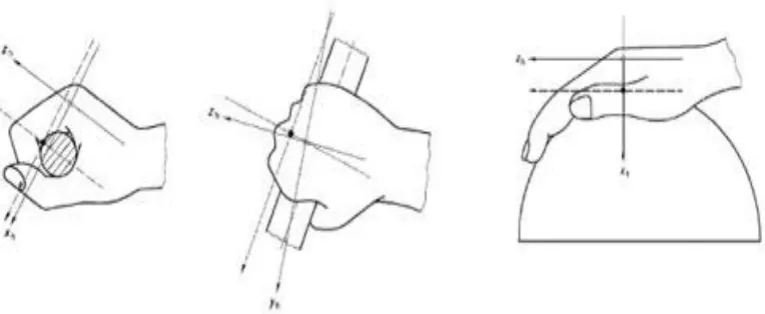
3 Figure3.1: Coordinate System for the Whole Body. (Berlanga et al., 2010)
The whole body vibration (WBV) consist the transfer of low-frequency environmental vibration to human body through a wide contact area as shown in Figure 1.1. In addition, each individual organ and the body as a whole have natural frequencies that can resonate with vibration energy received at their natural frequencies. Resonance that happened on the body or its parts due to WBV is suspected to cause adverse health effects, starting with chronic exposure. In reality, human are not normally exposed to the vibration of a simple, pure, single wave exposures include a multitude of simultaneous waves of differing magnitude, frequency and direction.
1.1.2 Hand-Arm vibration.
4 There are few symptoms at an early stage of HAV:
i. Numbness and tingling in the fingers. ii. Cannot feel things properly.
iii. Weakening strength in the hands.
iv. Blanching on fingers and become red and painful on recovery.
This symptom can cause:
i. Distress, pain and sleep disturbance. ii. Inability to do work properly.
iii. Reduce ability to work in damp or cold conditions which would trigger painful finger blanching attacks.
iv. Loss grip strength, which might affect the ability to do work safely.
5 Figure 1.2: Coordinate System of the Hand-Arm System. (Berlanga et al., 2010)
1.2 Glove as vibration absorber
In an early century, gloves are used to warmed hands, holding hot pots, as decoration and to difference between worker and master. This is because only a reach man or family can own the gloves. In addition, in prehistoric times, a caveman worn a glove to protect their hands and took the form of bags resembling a primitive type of mitten. Today, gloves have been used widely in every sector including engineering, medical and many more. There are many kind of glove created with different function and materials.
Nowadays, there are many types of gloves has been created for a various function. There are gloves that used to protect hands from heat, cold, sharp object and excessive impact or fiction to the hands. For example, gloves that used to hold a hot pot is functioning as heat conductor to prevent hands from burns (Metastudio, 2005). In addition, gloves can be as a symbolism such as the white gloves is for wedding ceremony and black gloves for the funeral ceremony (Star, 1898). In the past, gloves is used to protect hands and as a fashion accessory, but because of gloves have a long history of being associated with numerous practice, rituals, customs and symbolisms makes it so special.
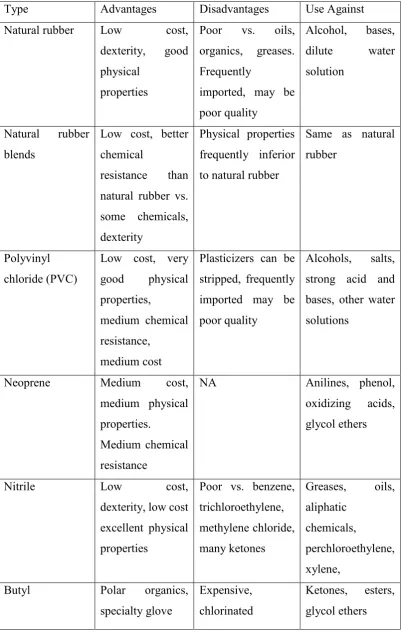
7 Table 1.1: Glove Chart.(Argonne National Laboratory, 2013)
Type Advantages Disadvantages Use Against
Natural rubber Low cost, dexterity, good physical
properties
Poor vs. oils, organics, greases. Frequently
imported, may be poor quality
Alcohol, bases, dilute water solution
Natural rubber blends
Low cost, better chemical
resistance than natural rubber vs. some chemicals, dexterity
Physical properties frequently inferior to natural rubber
Same as natural rubber
Polyvinyl chloride (PVC)
Low cost, very good physical properties,
medium chemical resistance,
medium cost
Plasticizers can be stripped, frequently imported may be poor quality
Alcohols, salts, strong acid and bases, other water solutions
Neoprene Medium cost, medium physical properties.
Medium chemical resistance
NA Anilines, phenol,
oxidizing acids, glycol ethers
Nitrile Low cost,
dexterity, low cost excellent physical properties
Poor vs. benzene, trichloroethylene, methylene chloride, many ketones
Greases, oils, aliphatic
chemicals,
perchloroethylene, xylene,
Butyl Polar organics, specialty glove
Expensive, chlorinated
8 solvents, poor vs
hydrocarbons Polyvinyl alcohol
(PVA)
Resists a very broad range of organics, good physical
properties,
Water sensitive, poor vs. light alcohols, very expensive
Aromatics, aliphatics, chlorinated
solvents, ketones , esters, ethers Fluoro-elastomer
(Viton)
Organic solvents, specialty glove
Poor physical properties,
extremely
expensive, poor vs. some ketones, esters,
Chlorinated solvents, aromatics,
aliphatics and alcohols
Norfoil (Silver Shield)
Good chemical resistance
Easily punctures, poor fit, poor grip, stiff
Use for hazmat work
1.3 Natural fiber
Nowadays, the increased consciousness and environmental awareness throughout the world has developed an increasing interest in natural fibers and its applications in various fields. The use of natural fiber as reinforcing materials in both thermoset and thermoplastic matrix composites gives positive environmental advantage with respect to ultimate disposability (Singha & Thakur, 2008). This natural fiber can be found anywhere, even in a climatic zone people still can utilize the fiber to make product such as buildings, cloth and cordage.
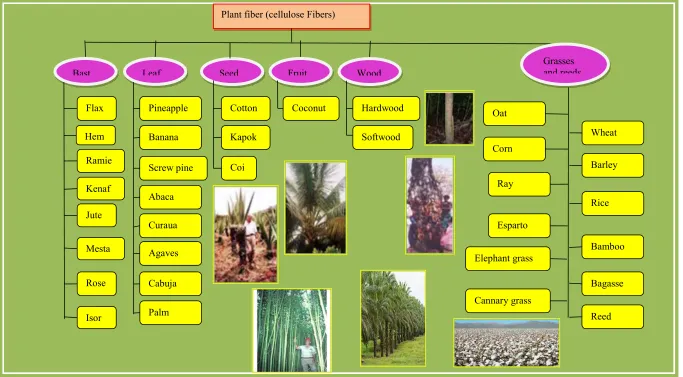
9 Natural fiber from jute, coir and oil palm is an example of good reinforcement thermoset and thermoplastic materials (Bujang et al., 2007). Besides that, there are also man- made natural fiber such as rayon, acetate, nylon, polyester an d many more. Figure 1.3 shows type of plant fibers that consist of bast, leaf, seed, fruit, grasses and reeds.
India and Seri Lanka is the most places that commercially produced coir that starting with food crop as its primary product. Coir fiber can be categorized into two categories which are immature coconut husks and fully ripened coconut husks. The immature coconut husk is very white in color, soft, thin and its coir still green. While for fully ripened coconut have a yield brown coir strong and highly resistance to abrasion (Hall, 2014).
10 Figure 1.3: Type of Natural Fiber. (Wladyka, 2014)
Plant fiber (cellulose Fibers)
Bast Leaf Seed Fruit Wood Grasses and reeds
Flax Hem p Kenaf Jute Mesta Isor Ramie e Rose lla Pineapple Banana Screw pine Abaca Curaua Agaves Cabuja Palm Cotton Kapok Coi r
Coconut Hardwood
Softwood Wheat