“THE STUDY OF PATTERN OF INJURIES
IN FATAL CASES OF FALL FROM HEIGHT”
Dissertation submitted in partial fulfilment of
the requirements for the degree
M.D. (Forensic Medicine)
BRANCH- XV
INSTITUTE OF FORENSIC MEDICINE
MADRAS MEDICAL COLLEGE
CHENNAI–600003
THE TAMILNADU
Dr. M.G.R. MEDICAL UNIVERSITY CHENNAI
BONAFIDE CERTIFICATE
This is to certify that the work embodied in this dissertation entitled
“
THE STUDY OF PATTERN OF INJURIES IN FATAL CASES
OF FALL FROM HEIGHT
”
has been carried out by
Dr.S.YUHESH,
a Post Graduate student under my supervision and guidance for his study
leading to Branch XV M. D. Degree in Forensic Medicine during the period
of
May
- 2015 to
May
- 2018.
Prof. Dr. R. Narayana Babu M.D.,
Prof. Dr. P. Parasakthi M.D.,
DEAN
DIRECTOR AND PROFESSOR
Madras Medical College &
Institute of Forensic Medicine
Rajiv Gandhi Govt. General
Madras Medical College
Hospital
Chennai-3
Chennai-3
DECLARATION
I,
Dr.S.YUHESH,
solemnly declare that this dissertation entitled
“THE STUDY OF PATTERN OF INJURIES IN FATAL CASES OF FALL
FROM HEIGHT
” is the bonafide work done by me under the expert guidance and
supervision of
Dr.P.PARASAKTHI,
M.D.,
Professor and Director, Institute of
Forensic Medicine, Madras Medical College, Chennai–3.This dissertation is
submitted to the Tamil Nadu Dr.M.G.R Medical University towards partial
fulfilment of requirement for the award of M.D., Degree (Branch XV) in Forensic
Medicine.
Place:
Dr. S.YUHESH
ACKNOWLEDGEMENT
I am greatly obliged to the Dean, Dr.R.Narayana Babu M.D., D.C.H., Madras Medical College and Rajiv Gandhi Govt. General hospital, Chennai-3 for allowing me to complete this study. I am greatly obliged to the then Dean, Dr.R.Vimala M.D.,
Madras Medical College and Rajiv Gandhi Govt. General hospital, Chennai-3 for allowing me to conduct this study.
I would like to express my heart felt gratitude to my esteemed Professor & Director, Dr.P.Parasakthi M.D., who has been a constant source of inspiration and encouragement.
I am especially thankful to my former Professor & Director, Dr.V.Murugesan M.D., D.A., F.C.C.P., Associate Professor Dr.M.N.Rajamani Bheem Rao M.D.,
Honorary Professor Dr.V.Sathyamoorthy M.D., Associate Professor, Dr.T.Vedanayagam M.D., for their valuable guidance in conducting the study and Assistant Professors, Dr.S.Ramalingam M.D., Dr.R.Narendar M.D., Dr.M.Guhan M.D., Dr.T.Ezhilkothai M.D., Dr.S.Sylvia M.D., Institute of Forensic Medicine, Madras Medical College, Chennai-3 for their interest and encouragement, in bringing out this dissertation for my MD exam.
I thank all my Colleagues & friends for their help in collecting material for my study. I thank the Almighty and my father Mr.S.Somasundaram (late) for everything what I am today. I thank my mother Mrs.J.Vasanthi for her faith and support all the time in all my endeavors. I thank my wife Dr.J.K.Thaarani priya M.D and my son
ABBREVIATIONS
VDI
-
Vertical deceleration injury
HDI
-
Horizontal deceleration injury
MCV
-
Motor vehicle collision
MOI
-
Methods of injury
SLF
-
Same level fall
HLF
-
High level fall
IHF
-
Intentional high fall
ATD
-
Anthropomorphic test dummies
UE
-
Upper extremity
LE
-
Lower extremity
ED
-
Emergency department
LOS
-
Length of stay
FT
-
Feet
LT
-
Left
RT
-
Right
LAC
-
Laceration
ICH
-
Intracranial haemorrhage
EDH
-
Extradural haemorrhage
SDH
-
Subdural haemorrhage
SAH
-
Subarachnoid haemorrhage
ACC
-
Accident
INDEX
S.NO. DESCRIPTION
PAGE
NO.
1 INTRODUCTION 1
2 AIMS AND OBJECTIVES 4
3 REVIEW OF LITERATURE 6
4 MATERIALS & METHODS 29
5 ANALYSIS AND RESULTS 30
6 DISCUSSION 60
7 CONCLUSION 77
8 BIBLIOGRAPHY 79
9
ANNEXURE
1
INTRODUCTION
“The higher you climb, the harder you fall”- Chinese Idiom2.
Deaths due to fall from height is increasing yearly as many work activities involve working at height is randomly increasing. Many workers in maintenance, construction and many other people in a wide range of jobs could be at risk of falling from height, includes painters, construction site workers, carpenters and those who undertake one off jobs without proper training, planning and equipment.
The International Classification of Diseases (ICD9) states that a fall from height is an event where a person falls to ground from upper level whereas Frailty and Injuries Co-operative Studies of Intervention studies (FICSIT) define fall from height as unintentionally coming to rest on the lower most surface on the ground5. A more recent definition off all from height is to
be a descent from upright, sitting or horizontal position, the descent height being less than or equal to 1m5.
Falls from height can be classified in several ways:
Depending on the height of fall which may vary from high raising building to same or low level falls like ladder, chairs, tables or staircases, etc are classified into:
High falls
2
Depending on condition affecting, into:
Intrinsic(where some events or condition affects postural control)
Extrinsic (where an environmental factor is the main contributing reason)
Victims of fall from height are prone to sustain a unique pattern of injuries that depends on inertia of the body, movement of the body, resistance of stationary objects and the nature of surface of ground on which the person falls7.At the point of contact, a falling body decelerates and amount of kinetic
energy transferred to the point of contact on the ground reacts with an equal amount against the falling body itself. The body reabsorbs the energy lost in the form of sustained injuries2.
Falls are examples of vertical deceleration injuries (VDI) and pattern of injury differ from horizontal deceleration injuries (HDI) associated with motor vehicle accidents. Vertical deceleration injuries characteristically involve major weight bearing structures with forces transmitted through the foot, leg, pelvis and vertebral column4.
3
4
AIM OF THE STUDY
PRIMARY OBJECTIVE:
To study the pattern of injuries in fatal cases of fall from height.
SECONDARY OBJECTIVES:
Take a statistical analysis of 100 cases of fall from height subjected to autopsy in the Institute of Forensic Medicine, Madras Medical College, Chennai-3.
To conduct a extensive study of pattern of injuries sustained to the victim in various types of impact.
To study the pattern of injuries with the primary site of impact.
To draw conclusions regarding the manner of death.
To identify age dependent variations of injury patterns within fall types.
To identify mechanism dependent variations in injury patterns. PLACE OF STUDY : Institute of Forensic Medicine,
Madras Medical College, Chennai – 3. STUDY DESIGN : Prospective study
DURATION OF STUDY : 1 year
5
SELECTION OF CASES :
Study was conducted on those cases, coming for Medico Legal autopsy to the Institute of Forensic Medicine, Madras Medical College, Chennai – 600003.
Inclusion Criteria : All fatal cases of fall from height
6
REVIEW OF LITERATURE
Injury is recognized as a major health problem and a leading cause of death globally1. Falls are the second greatest reason for unintentional injury in
the western world, which is exceeded by motor vehicle collisions (MVCs). The “falls” mechanism of injury category encompasses many different types of events, including falls on stairs or steps, from buildings, into holes, from ladders, from one level to another such as from playground equipment, from furniture or cliffs and falls on ground level as a result of slipping, stumbling or tripping.
Sports injuries involving fall due to slipping, pushing or tripping and collisions due to pushing or shoving by another person are also included.
Methods of injury (MOI) can be grouped in 3 major groups: same level falls (SLF), high level falls (HLF) and intentional high falls (IHF). People sustaining an HLF are termed fallers and those sustaining an IHF are called jumpers.
7
DETERMINING FACTORS:
The pattern of injuries in cases of fall from heights is dependent on the height and weight of the body, nature of surface impacted, velocity on which it hit the ground, special orientation of body at the moment of contact and the flexibility and viscosity of part of the contact body region. Among these, height of fall is the major determining factor.
WHO FALLS?
SLFs (same level falls) happens to all people, but most common in people with impaired balance especially in old age. Risk factor includes age, medical conditions, environment, medication, nutrition and lack of exercise. Repetitive falling is the greatest predictor of falling again 10.Falls from heights
can be divided into accidental and intentional falls. Accidental falls are by far the most common in rural areas 6, 12 whereas in urban and western societies
intentional falls are more common 8, 16, 20. IHFs are heavily associated with
psychiatric disorders where depression, schizophrenia, drug abuse and bipolar disease 3,29. Most intentional falls happen with a suicidal intent and a few during a psychosis (e.g. under the conviction that one can fly or is immortal).
AHFs have a diverse demography ranging from infants to elderly people. Falls occur at work, at home and at recreational places. Risk-taking behavior, faulty equipment, and absence of building regulations are common risk factors 9,12,22,41. Alcohol is a very important risk factor in men, being
8
of SLF and 13% of HLF. Alcohol also results in a various patterns of injury, causing more injuries to the face, brain and internal organs 5. There is a linear
dose-response risk of falling compared to alcohol intake per day26. In a Greek
study on fatal fall injuries there was 16% alcohol intoxication and 3.2% intoxication with other psychoactive drugs34.In suicides by IHF in Sweden,
alcohol intoxication is present in 19%, which is less than in other types of suicide29.
RISK FACTORS FOR FALLS OR FALL INJURY IN THE
ELDERLY
Biological:
Advanced age (80+) Muscle weakness Chronic diseases Cognitive impairments Poor Physical Fitness Gender (Women) Physical disability Sensory deficits
Behavioural:
9
Handbags
Inappropriate footwear Frequent history of falls Inadequate diet / exercise Medication use
Risk-taking behaviours
Environmental:
Home hazards Community hazards Institutional hazards
Socio – economic :
Inadequate access to services Inadequate housing
Lower educational levels
Income inadequacy Social Isolation
Lack of support networks
HOW DO PEOPLE FALL?
10
gravity. This ability is slowly lost with age and hence the balance provoking stimulus needed to prevent a fall is reduced. Other falls occur because of changes in the supporting material, or by an uncontrollable shift of supportive area, e.g. when a ladder breaks or when we slip on ice and this applies to SLFs and AHFs. The mechanism in intentional high falls (IHF) is slightly different, in that the center of gravity is willfully placed outside the supportive area.
The trajectory of a fall is important, but other aspects of a fall, such as the launch and landing phases of the fall, can be investigated using physical measurements and calculations. And these include measurements of the speeds at which a person can run, be pushed or thrown, dive, jump, an estimate of the rotational speed associated with each launch method, measurements or estimates of runup and takeoff distances, calculations of possible trajectories based on launch angles and wind speeds, location of the center of mass of a person on video data, and an analysis of possible bounce and impact events. When all the collected data are correlated with other evidence obtained by the police and forensic specialists, the circumstances surrounding a fall can sometimes be determined accurately. Often, there is insufficient evidence to arrive at a definite conclusion.
TRAJECTORY CALCULATIONS
The horizontal distance traveled by a person from a given launch point to the first point of impact has three components:
Take off
11 Landing distances.
Takeoff distance dt, - horizontal distance from the center of mass to the foot on the ground,
Flight distance - horizontal distance traveled by the center of mass of the person through the air.
If a person lands at a horizontal distance d=9 m from a building after falling from a height h=30 m, The fall time is t=_2h/g=2.474 s and the horizontal launchspeed is vx=d/ t=3.64 m/ s.
12
The above figure clearly explain A trajectory calculation needs to take into account the takeoff and landing distances, as well as the flight distance in order to estimate the required launch speed. The available run up distance, together with athletic ability, helps to determine whether such a launch is possible.
The drag force is negligible in the vertical direction for speeds up to about 30 m/ s, but it can reduce the horizontal speed of a 70 kg person from say 5.0 m/ s to about 4.7 m/ s during a fall time of 3.0 s depending on the orientation and the horizontal component of the drag force.
RUN, JUMP, DIVE AND THROW SPEEDS
13
Above Figure shows Horizontal launch speeds for four adult females, with run up distances from 4.0 m to 5.0 m, and the run speed after a 20 m run up, as indicated. The 20 m run data indicates that all four females were above average in terms of athletic ability, as determined from a much larger sample of females.
14
no danger of the male thrower falling into the pool after a short run up because all his forward momentum was transferred to the female during the throw. By contrast, a man running toward the edge of a cliff while throwing a light weight could easily fall off the cliff himself. Two men can swing a person back and forth in a pendulum-like motion by holding her arms and feet, and the resulting throw speed is typically about 2.7 m/ s, about the same as that when a pendulum falls through a height of about 0.4 m. If a person accelerates from rest in a 100 m sprint, maximum speed is reached at about the 30–40 m mark. The speed does not increase linearly with time.
FORWARD ROTATION
15
When a person is pushed from behind, the horizontal launch speed is typically only about 1.5 m/ s. To avoid injury to volunteers the essential physics can be extracted by pushing a heavy object.
16
STANDING JUMP
17
LOCATION OF THE CENTER OF MASS
A measurement of the horizontal launch speed and launch angle of a person jumping or diving into a swimming pool can be obtained by filming the event with a video camera. The horizontal and vertical distance needs to be calibrated by filming an object of known length located in the same plane, while the time scale is determined by the frame rate, typically 25 or 30 frames/ s. The object is to determine the launch speed and angle of the center of mass. If the jumper or diver maintains the same orientation through the air, the speed of the center of mass would be the same as that of any other part of the body, and there would be no need to locate the center of mass.
18
MECHANISM OF INJURY PRODUCTION:
Mechanism of injury production can be explained mainly under the following headings18, 20.
1. Velocity of fall: In fall from height, tissue injury is due to rate of change of the direction and speed of movement. In a vertical free fall, extensive and severe injuries were sustained by the victims would be due to abrupt halt upon impact with the ground or with structure and absorbing the forces of deceleration 20.
2. Elastic property of surface of impact: The surface on which a body falls determines the pattern of injury, pattern of deceleration and energy discharge. The magnitude of the accompanying forces of deceleration may be appreciated by considering the corresponding Gravitational forces (G) which measures the rate of change of movement 30, 35. In most
19
the swimmer or scuba driver experiences 1g (full weight) buoyancy largely cancels weight of the body.
3. Region of contact: The wound producing potential of energy mainly depends upon the area of impact. Orientation of the body at the point of impact is important in determining injury pattern and mortality36.
4. Rate of energy release: Fall from height fail to produce the wound, If the kinetic energy is discharged slowly to overcome the inertia of the tissue mass as a whole and to impart a relatively uniform motion to it.
18,20
5. Other factors include hydraulic ram effect, resulting from the upward forceful acute displacement of the abdominal organs and consequent cardiac injury in the absence of direct thoracic trauma 18.
SIGNIFICANT INJURY IN A FALL?
The bodily damage caused by a fall is due to the absorbed energy at impact. This energy relates to the kinetic energy, Ek, of the moving body right
before impact and this is explained by equation: E=mv2
where m is the mass of the body and v is the speed of the body. The speed is closely related to the height of the fall, but affected by the air friction, or air drag. The higher the fall, the greater the effects of air drag up to 32 floors where the drag force equals the gravitational force14. Falls from these heights
20
Mass acts at centre and this is the reason why children can survive higher falls than adults 3. The other great determinant of injury is the stopping
distance, i.e. the penetration of the falling object into the landing material. The shorter the distance, i.e. the more un-yielding the landing material, the greater is the deceleration. This affects the impact force, which is explained in equation
F=m*Δv
The body’s ability to absorb energy without significant injury depends on the landing position, neuromuscular reflexes dampening the impact by lowering the peak deceleration force22 and energy absorbing properties of
different tissues. In SLF, younger and stronger bones can absorb more energy before breaking. Studies made on anthropomorphic test dummies (ATD) have given important insights in injury mechanisms 40.
According to Gordon and Shapiro38, regardless of the position on landing, however, for falls more than 5m there is high incidence of deceleration injuries to intra thoracic and inter abdominal structures, particularly where these are relatively immobile or tethered, For eg the aortic root and the mesenteric arteries38. Another literature review (Robertson C.E) shows that in a
21
For an average man of 60 kg , a 5m fall on to a concrete surface produces a deceleration force of approximately 700 gm, but if the landing is into a soft, yielding surface the stopping distance may be several centimetres, decreasing the force 10 to 20 fold 42. Buoyancy of the water largely cancels weight of the
body 32,44.
COMMON INJURIES CAUSED BY FALL FROM HEIGHT:
Not all falls result in significant injury, but studies have shown that 40-70% of fallers seeking medical attention in the ED (emergency department) have sustained injuries43. The injuries most commonly associated with falls are:
Extremity skeletal injuries ranging from 20% in SLFs 47 to 77% in high falls12
where hip and upper extremity (UE) injuries predominate in SLFs and other lower extremity (LE) injuries are more common in high falls. Spine injuries are very common ranging from 13% in mixed falls12 to 36% in high falls9,17.
Lumbar spine injuries are completely predominating. Spine injuries are not confined to high falls, but can happen from even below 2 m17. Head injuries are
22
hematoma 16,21,33,46. In SLFs, brain injury is also common. Brain and spine
injury was seen in 25% of same level fallers in one study; hence it was more common than fractures 19.
Thoracic injuries are more common in high falls, the commonest specific injuries being rib fractures, lung contusion, pneumothorax and hemothorax16. Cardiac and aortic rupture are common23 in very high falls. Abdominal injuries in fall victims surviving long enough to reach the hospital are uncommon, especially as an isolated injury and from falls below 7m12,17,21,28. Retroperitoneal hemorrhage has been reported as a culprit in
hemodynamically unstable patients, but intra abdominal injuries are much more common and conservatively treated17,45. Many pre-existing conditions can
aggravate the injuries sustained by a fall e.g. warfarin treatment for hypercoagulability48or beta-blockers impairing the response to hypovolemia14. Mortality in falls obviously depends on the height of the fall but there is no safe height and there are reports of survival after extremely high falls31. The 50%
mortality threshold is passed between 4 and 5 floors13. Mortality in SLF is
mainly due to complications and co-morbidities27.Young fall victims tend to
die shortly after the fall or if they survive complications are minimal as the healing is better, while old people often die in complications during the first weeks13,24. In one study on high falls 63% of mortalities were suicides 16. Head and/or thoracic injuries is almost exclusively involved12,16.
23
pulmonary contusion, ruptured bronchus or aorta, sternal fracture resulting from hyperflexion of the chin are common, while in spinal burst vertebral bodies &in abdominal shearing of the bowel at the junction of fixed and mobile portions injuries are common. However ,most often skeletal injuries predominate11.
HOW ARE FALL VICTIMS TREATED?
Falls make up for 7-8% of ambulance calls and 70% of dispatches are to a home or residential institution 47. As much as 40% of fallers are not brought
to the ED and studies are being made on which patients that are better handled by the primary care than in the ED setting43. Orthopedic surgery is the
dominating form of surgery in fall victims and makes up 71-77% of operations in two studies on mixed high falls 16,17. Its relative dominance is even greater in SLF in which 13% was abdominal, 5% neuro,3% thoracic and 1% vascular surgery 17. The hospital length of stay (LOS) and intensive care unit LOS
increases with height of fall 17, age 12,24, co-morbidities 27and is also greater for
at-home fallers (as opposed to at-work fallers), probably because of them being older 28.
LONG-TERM OUTLOOK AFTER A FALL:
24
can be a bigger handicap than the actual physical injuries49. We have been
unable to find reliable data on long-term outcome specific for fallers. There are studies on old people (65+) that after a severe trauma due to fall 98% are living independently before the accident, only 63% do so 3 years afterwards50.
Family physicians should regularly test individuals gait and balance, and inquire whether their elderly patients have fallen since their last visit. Those who have fallen or for whom gait/balance problems exist should receive a complete risk assessment and recommendations for appropriate intervention or referral.
Hip protector use should be encouraged in long-term care homes and among the frail elderly or among community-dwellers who have significant osteoporosis. Facilities should work with physiotherapists and occupational therapists to assist in falls prevention for individuals and programming initiatives.
Detailed falls assessments should be conducted upon discharge for elderly patients. Identified risk factors should be followed up with a targeted intervention (e.g., medical, modification, exercise program, or an environmental intervention).
FALL PROTECTION CATEGORIES
Fall protection products fit into four functional categories:
positioning
25
retrieval
suspension
Positioning
This system holds the worker in place while keeping his/her hands free to work. The system gets activated when the worker leans back. However, the personal positioning system is not specifically designed for fall arrest purposes.
Fall Arrest
As a general rule, the fall arrest system should be used anytime a working height of more than or equal to six feet is reached. A fall arrest system is required if any risk exists that a worker may fall from an elevated position, Working height is the distance from the walking/working surface to a grade or lower level. A fall arrest system will only come into service should a fall occur. A full-body harness with a shock-absorbing lanyard or a retractable lifeline is the only product.
Retrieval
Preplanning for retrieval in the event of a fall should be taken into consideration when developing a proactive fall management program.
Suspension
26
fall, a backup fall arrest system should be used in conjunction with the suspension system.
Fall Protection Systems
Different types of fall safety equipments are :-
Class I – Body belts
Class II – Chest harnesses
Class III – Full body harness
Class IV – Suspension belts Recommended usage of these equipments are,
Class 1 BODY BELTS (single or double D-ring) are designed to restrain a person in a hazardous work position and to reduce the possibility of falls. They should not be used when fall potential exists; positioning only.
Class 2 CHEST HARNESSES are used when there are only limited fall hazards (no vertical free fall hazard), or for retrieving persons such as removal of persons from a tank or a bin.
Class 3 FULL BODY HARNESSES are designed to arrest the most severe free falls.
27
Web Lanyard ideal for restraint purposes where fall hazards are less than 2 feet.
Rope Lanyard offers some elastic properties for all arrest; used for restraint purpose.
Shock Absorbers When used, the fall arresting force will be greatly reduced if a fall occurs.
Rope Grabs A deceleration device which travels on a lifeline, used to safely ascend or descend ladders or sloped surfaces and automatically, by friction, engages the lifeline and locks so as to arrest the fall of an employee.
Cable Positioning Lanyards designed for corrosive or excess heat environments and must be used in conjunction with shock absorbing devices.
Retractable Lifeline Systems
Gives fall protection and mobility to the user when working at height or in areas where there is a danger of falling. Safety Nets can be used to lesson the fall exposure when working where temporary floors and scaffolds are not used and the fall distance exceeds 25 feet. Rail Systems When climbing a ladder, rail systems can be used on any fixed ladder as well as curved surfaces as a reliable method of fall prevention.
Rescue Procedures
28
rescue themselves." This should include identifying rescue procedures that address the potential for orthostatic intolerance and suspension trauma. Rescue procedures also should address how the rescued worker will be handled to avoid any post-rescue injuries. Rescue procedures should include the following contingency based actions:
Footholds can be used to alleviate pressure, delay symptoms, and provide support for "muscle pumping."
If self-rescue is impossible, or if rescue cannot be performed promptly, the worker should be trained to "pump" his/her legs frequently to activate the muscles and reduce the risk of venous pooling.
The worker should be hospitalized when appropriate. Possible delayed effects, such as kidney failure, which is not unusual in these cases, are difficult to assess on the scene.
If the worker is unconscious, keeping the worker’s air passages open and obtain first aid.
Ensuring that a worker receives standard trauma resuscitation once rescued.
Some authorities recommend that the patient be transported with the upper body raised.
Monitoring the worker after rescue, and ensuring that the worker is evaluated by a health-care professional.
29
METHODOLOGY & MATERIALS
This study was carried out in the Institute of Forensic Medicine, MadrasMedical College, Chennai-3. One hundred cases of fall from heights was subjected to detailed postmortem examination.
Apart from recording the nature and pattern of injuries, data regardingthe nature of fall, site of primary impact, nature of floor on which they fall, height from which they fall, period of survival etc., was obtained from the investing officers. In all the cases, the height of fall was determined by visiting the scene of crime and taking measurements.
Special effort was made to find out precipitating causes like epilepsy,mental illness, natural diseases and use of drugs or alcohol.
A detailed examination was made and data entered in a proforma. Dataincludes external and internal injuries, their nature, dimensions and location.
Autopsy was conducted by Letulle’s method of an en masse removal ofviscera and dissection of organs.
Primary impact injuries was noted. Photographs was taken wherevernecessary. Blood and urine was collected and sent for analysis of alcohol or drugs if there is suspicion.
ANALYSIS AND
30
ANALYSIS AND RESULTS
[image:44.595.203.430.260.551.2]Autopsy cases of fall from height brought to RGGGH mortuary from August 2016 to August 2017 were taken for the study. The observation and results are as follows:
TABLE 1: AGE DISTRIBUTION OF STUDY POPULATION
AGE (YRS)
NO. OF CASES
1-10
1
11-20
9
21-30
16
31-40
30
41-50
18
51-60
18
31
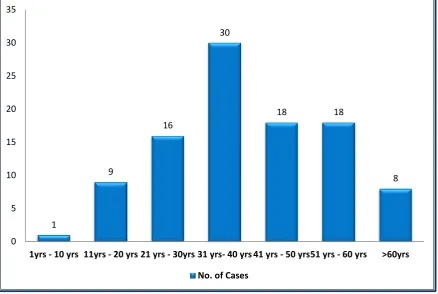
FIG 1: AGE DISTRIBUTION OF STUDY POPULATION
In this study of 100 death cases of fall from height ,30% cases were in the age group 31-40 years,18% cases were in the age group 41-50 years,16% cases were in the age group 21-30 years,18% cases were in the age group 51-60 years,9% cases were in the age group 11-20 years,8% cases were in the age group >60 years,1% cases were in the age group 1-10 years.
1
9
16
30
18 18
8
0 5 10 15 20 25 30 35
32
TABLE 2: SEX DISTRIBUTION OF STUDY POPULATION
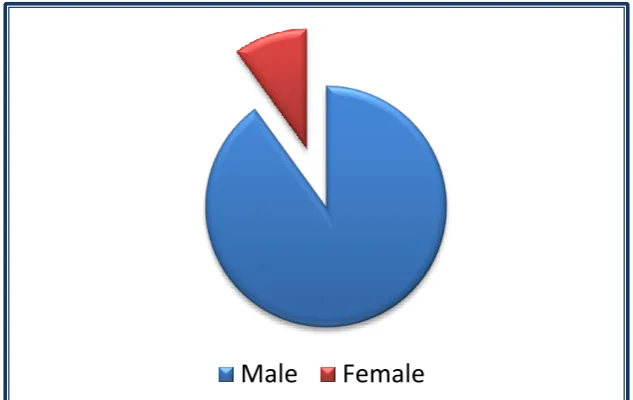
FIG 2: SEX DISTRIBUTION OF STUDY POPULATION
In the study population, 90% of person who fell from height and died were male and 10% were female.
Male
Female
SEX NO. OF CASES PERCENTAGE
Male
90
90 %
[image:46.595.158.475.312.512.2]33
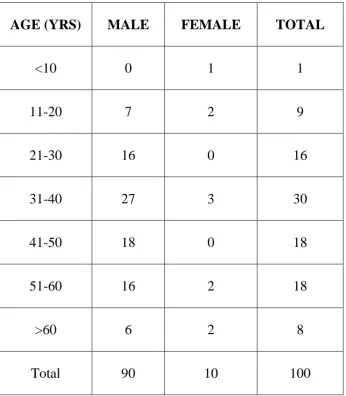
TABLE 3: AGE AND SEX DISTRIBUTION OF STUDY
POPULATION
AGE (YRS)
MALE
FEMALE
TOTAL
<10
0
1
1
11-20
7
2
9
21-30
16
0
16
31-40
27
3
30
41-50
18
0
18
51-60
16
2
18
>60
6
2
8
34
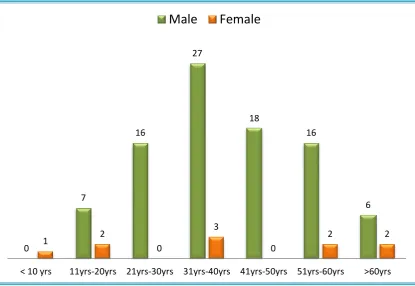
FIG 3: AGE AND SEX DISTRIBUTION OF STUDY
POPULATION
In the study population, 90% are male and 10% are female. Among men, 27/90 belong to age group 31-40 years and 18/90 belong to age group 41-50 years. Among women, 3/10 belongs to age group 31-40 years.
0
7
16
27
18
16
6
1 2
0
3
0
2 2
< 10 yrs 11yrs-20yrs 21yrs-30yrs 31yrs-40yrs 41yrs-50yrs 51yrs-60yrs >60yrs
35
TABLE 4: DISTRIBUTION OF STUDY POPULATION BASED ON
OCCUPATION
OCCUPATION
NO OF CASES
Construction worker
15
Daily Labour
34
Painter
7
Student
10
Farmer
2
Own business
2
IT worker
2
Unemployed
14
Driver
5
36
FIG 4: DISTRIBUTION OF STUDY POPULATION BASED ON
OCCUPATION
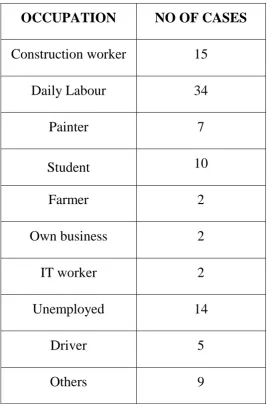
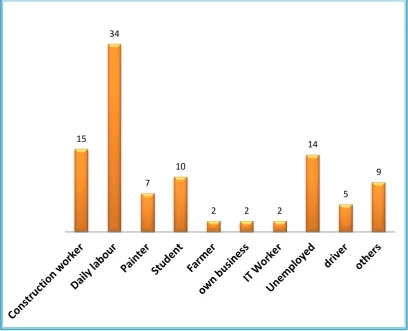
In our study population, 34% were daily labourers, 15% were construction workers, 14% were unemployed, and 10 % were students
15 34
7
10
2 2 2
14
37
TABLE 5: DISTRIBUTION OF STUDY POPULATION
ACCORDING TO THE HEIGHT OF FALL
HEIGHT OF FALL
(FEET)
NO. OF CASES
< 10
21
11 - 20
58
21 - 30
9
31 - 40
9
38
FIG 5: DISTRIBUTION OF STUDY POPULATION ACCORDING
TO THE HEIGHT OF FALL.
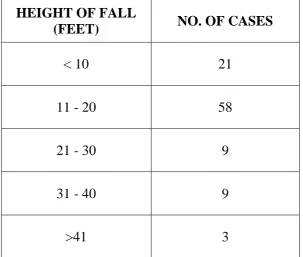
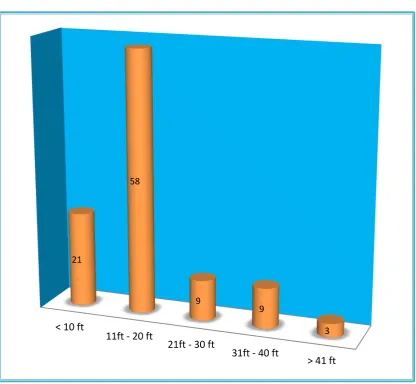
In our study, 58 % of victims fell down from a height of 11-20 feet and 21% of victims fell down from height <10 feet.
< 10 ft
11ft - 20 ft
21ft - 30 ft
31ft - 40 ft
> 41 ft
21
58
9
9
39
TABLE 6: DISTRIBUTION OF STUDY POPULATION
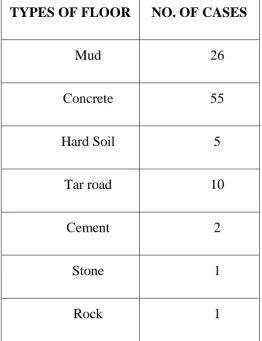
ACCORDING TO FLOOR
TYPES OF FLOOR
NO. OF CASES
Mud
26
Concrete
55
Hard Soil
5
Tar road
10
Cement
2
Stone
1
40
FIG 6: DISTRIBUTION OF STUDY POPULATION ACCORDING
TO THE SURFACE OF FALL
In our study, most victims died due to injury sustained by fall on a concrete floor (55%).
Mud Concrete Hard soil Tar road Cement Stone Rock 26
55
5
10
41
TABLE 7: DISTRIBUTION OF STUDY POPULATION
ACCORDING TO ALCOHOL AND/OR DRUG INTOXICATION
FIG 7: DISTRIBUTION OF STUDY POPULATION
ACCORDING TO ALCOHOL INTAKE AND / OR
DRUG INTOXICATION
Out of 100 cases, 28% of cases had history of intake of alcohol
Alcohol intaken Not on any drugs
Alcohol Intake
28 %
Not On Any Drugs And Or
42
TABLE 8: DISTRIBUTION OF STUDY POPULATION
ACCORDING TO MANNER AND PLACE OF DEATH
MANNER
PLACE
ACCIDENTAL SUICIDAL
TOTAL
HOME
41
5
46
WORK
PLACE
40
2
42
43
FIG 8: DISTRIBUTION OF STUDY POPULATION ACCORDING
TO MANNER AND PLACE OF DEATH
In our study, 93 victims died due to accidents and 7 due to suicide.
0 5 10 15 20 25 30 35 40 45
HOME WORK PLACE OTHERS
44
TABLE 9: DISTRIBUTION OF STUDY POPULATION
ACCORDING TO SITE OF PRIMARY IMPACT
SITE OF PRIMARY IMPACT NO OF CASES
Head
50
Face
5
Neck
9
Chest
10
Shoulder
7
Back
12
Foot
7
45
FIG 9: DISTRIBUTION OF STUDY POPULATION ACCORDING
TO SITE OF PRIMARY IMPACT
In our study, for 50% of the victims head is the target region of the body of impact and the second most common site of primary impact being the back.
Head Face Neck Chest Shoulder Back foot Hand 50
5
9 10
7
12
7
46
TABLE 10: DISTRIBUTION OF STUDY POPULATION
ACCORDING TO VARIATIONS IN TYPES OF INJURY
TYPE OF INJURY NO OF PERSONS
MULTIPLE ABRASIONS 90
FRACTURE OF SKULL 40
FRACTURE BASE OF SKULL 37
INTRACRANIAL HEMORRHAGE 82
FRACTURE FACIAL BONES
10
PERIORBITAL CONTUSION 11
FRACTURE BONES OF UPPER LIMB 5
FRACTURE BONES OF LOWER LIMB 6
FRACTURE RIBS 32
INJURY TO CHEST ORGANS 5
INJURY TO ABDOMINAL ORGANS 26
FRACTURE PELVIS 2
47
FIG 10: DISTRIBUTION OF STUDY POPULATION
ACCORDING TO VARIATIONS IN TYPES OF INJURY
In our study, Intracranial haemorrhage were observed in 82 cases, fracture of skull and fracture of base of skull were 40 and 37 cases respectively. Vertebral column fractures were noted in 3 cases. Multiple abrasions were present in almost 90 cases.
0 10 20 30 40 50 60 70 80 90
48
TABLE 11: DISTRIBUTION OF STUDY POPULATION
ACCORDING TO CAUSE OF DEATH
CAUSE OF DEATH NO OF CASES
Head injuries
34
Spinal injuries
17
Cerebrospinal injuries
11
Blunt injury abdomen
2
Blunt injury thorax
4
Pelvic injury
1
Multiple
31
49
FIG 11: DISTRIBUTION OF STUDY POPULATION
ACCORDING TO CAUSE OF DEATH
In our study, 34 victims were died due to head injury. Spinal injuries (17%) were the second common cause whereas cerebrospinal injuries were 11%. Blunt injury abdomen, Blunt injury thorax and pelvic injury were seen in 2, 4 and 1 cases respectively. Multiple injuries were noted in 31 cases.
34%
17% 11%
2% 4% 1%
31%
CAUSE OF DEATH
HEAD INJURIES SPINAL INJURIES CEREBROSPINAL
BLUNT INJURY ABDOMEN BLUNT INJURY THORAX PELVIC INJURIES
50
TABLE 12: DISTRIBUTION OF STUDY POPULATION
ACCORDING TO INJURY TO HEAD
HEAD INJURIES
NO OF PERSONS
SCALP CONTUSION
31
SKULL FRACTURE
40
BASE OF SKULL FRACTURE
37
BRAIN LACERATION
7
INTRACRANIAL HEMORRHAGE
82
51
FIG 12: DISTRIBUTION OF STUDY POPULATION
ACCORDING TO INJURY TO HEAD
Among head injury cases, 82 victims had intracranial hemorrhage and 10 victims had facial bone fractures. Brain laceration is noted in 7 cases.
31
40
37 7
82
10
SCALP CONTUSION SKULL FRACTURE
BASE OF SKULL FRACTURE BRAIN LACERATION
52
TABLE 13: DISTRIBUTION OF STUDY POPULATION
ACCORDING TO PATTERN OF INTRACRANIAL
HEMORRHAGE
INJURY
NO OF PERSONS
SAH ALONE
2
SAH+SDH
76
SAH+SDH+EDH
2
53
FIG 13: DISTRIBUTION OF STUDY POPULATION
ACCORDING TO PATTERN OF INTRACRANIAL
HEMORRHAGE
In victims died of Head injury, 76 cases had both subarachnoid hemorrhage and fubdural hemorrhage. Along with this extra dural hemorrhage was noted in 2 cases.
0 10
20 30
40 50
60 70 80
54
TABLE 14: DISTRIBUTION OF STUDY POPULATION
ACCORDING TO INJURY TO SPINAL COLUMN
SPINAL COLUMN INJURED
NO OF PERSONS
CERVICAL
26
THORACIC
7
LUMBAR
3
SACRAL
2
55
FIG 14: DISTRIBUTION OF STUDY POPULATION
ACCORDING TO INJURY TO SPINAL COLUMN
In our study, 26 victims were died due to cervical spine injuries. thoracic and lumbar spinal injuries were observed in 7 and 3 cases respectively.
0 5 10 15 20 25 30
CERVICAL THORACIC LUMBAR SACRAL MULTIPLE
56
TABLE 15: DISTRIBUTION OF STUDY POPULATION
ACCORDING TO INJURY TO THORAX
INJURIES
NO OF PERSONS
FRACTURE RIBS
32
FRACTURE STERNUM
3
FRACTURE SCAPULA
3
HEART
0
LUNGS
5
57
FIG 15: DISTRIBUTION OF STUDY POPULATION
ACCORDING TO INJURY TO THORAX
In our study, lung laceration were observed in 5 cases and fracture of ribs were seen in 32 cases. Fracture of sternum and scapula were noted in 3 cases each respectively.
0 5 10 15 20 25 30 35
FRACTURE RIBS FRACTURE STERNUM FRACTURE SCAPULA LUNG HEART DIAPHRAGM
58
TABLE 16: DISTRIBUTION OF STUDY POPULATION
ACCORDING TO INJURY TO ABDOMEN AND PELVIS
INJURIES
NO OF CASES
Liver
8
Spleen
2
Pancreas
1
Kidney
8
Intestine
3
Thoracolumbar Vertebra
10
Mesentry
4
Fracture Pelvis
4
59
FIG 16: DISTRIBUTION OF STUDY POPULATION
ACCORDING TO INJURY TO ABDOMEN AND PELVIS
In our study, victims died due to injury in abdomen and pelvis, injury to organs such as liver, spleen, kidney, bladder were 8,2,8 and 4 cases respectively.
0 1 2 3 4 5 6 7 8 9 10
COLOUR PLATES
Scene of suicidal fall from height
Extradural hemorrhage
Diffuse Subarachnoid hemorrhage.
Fracture lower end of femur
60
DISCUSSION
Autopsy cases of fall from height brought to RGGGH mortuary from August 2016 to August 2017 were taken for the study .In children, Falls from heights are most commonly due to accidents but in adults it is due to suicide, accident and other crime related incidents. Out of 2704 cases of autopsy in our study period, from August 2016-2017, fall from height constitutes about 3.68%.
Fall from heights results in two types of injury: injury resulting from direct impact (mainly fractures) and deceleration type of injury. From the table 1, it is observed that maximum number of fall from height cases was seen in the age group 31-40 years (30%) and the least number of cases were in the age group 0-10 years (1%). Males contributed to majority of cases (90%) whereas females contribute 10%. Among men, 30% belongs to age group 31-40 years and 20% belongs to age group 41-50 years.
From the table 4, it is evident that the highest incidence of fall from height occurred in daily laborers (34%) followed by construction workers (22%) which is slightly in contrary with other studies where construction workers are expected to be more prone for fall from height. Students also contributed about 10% of the cases. Also from the table 7, history of intake of alcohol was found in 28% of cases which is similar to the Greek study mentioned34. It was found that in 58 % of cases of falls occurred from 11 to 20
61
among the total cases, 93 cases were accidental (41 in home, 40 in work place and others-12) and 7 were suicidal (5 in home and 2 in work place).
The frequency and extent of the injured body regions and organs are directly related to the height of fall and the primary impact. If a person falls on the head, both vault and base of skull can fracture, with extrusion of brain. Head is the most common site of primary impact in majority of cases(50%) which is evident from table 9 from our study .In this study population most people fell from high levels , where people tend to land on their head striking the surface resulting in more fatality. Peri-orbital contusion was seen in 11 cases. Variety of injuries varying from scalp contusions to fractures of skull, base of skull, variety of intracranial haemorrhages like EDH, SDH, SAH, ICH was found in majority of the cases. The fracture of vault and fracture of base of skull were observed in 40 and 37 cases respectively which is shown in table 10. With High falls, head receive serious injury causing multiple fractures involving skull and facial bones often with brain laceration and exenteration of portion of brain parenchyma.
62
however the severity of head injury is independent of extent of scalp contusion. Cases without scalp contusion or with mild scalp contusion can suffer severe internal injuries and vice versa. Table 6 shows majority of cases (55%) were fell onto hard surface (concrete) followed by mud and cement. Hard surfaces always almost cause serious injuries when compared with soft surfaces like sand, mud, grass. Brain and spine injury are more common than fractures which is similar to FRAILCO study19. Multi-organ involvement was noticed where the nature of ground was hard surface whereas isolated fatal injuries were common in falls over the soft surface.
Among the spinal injuries, cervical spine injuries were noted in 26 cases followed by thoracic spine injuries which is in contrary to study mentioned where lumbar spine injury was predominating. Sacral spine injury was noted in 2 cases of pelvic fractures which is shown in table 14. Associated bladder contusion seen in 1 case.
63
Laceration of liver and kidney injury were observed in 8 cases, splenic tear in 2 cases, bladder injury in 4 cases. Bowel injury was noticed in 3 cases. Injury to pancreas is noticed in 1 case which is mentioned in table 16. Fractures of upper limb and lower limb were found to be in 5 and 6 cases respectively.
Multiple abrasions were found in almost 90% of cases. Vertebral column fractures were found in 36 cases since the second most common site of primary impact is back. However multiple vertebral column involvement is seen very rarely about 1 in 100 cases.
Based on the results obtained few guidelines are strongly recommended to reduce the deaths due to fall from height which are as follows
64
RECOMMENDATIONS
This guidance is recommended to illustrate some measures to reduce the likelihood of injuries from falls. The Occupational Health and Safety (Prevention of Falls) Regulations 2003 and the OHS Act determines the legal requirements that relate to fall from height. Legal requirements, adequate amendments are always mandatory so as to establish a safe working atmosphere
STEP 1 – INDIVIDUAL RESPONSIBILITY FOR MANAGING FALL PREVENTION AT THE WORKPLACE
Each individual at the workplace is responsible for health and safety including managing the prevention of falls and this differ depending on the job, the site, the specific task(s) required, the height, who is in control of the job or the site and whether the person has duties as an occupier, an employer or an employee or an administrator. Designers, manufacturers, importers and suppliers of equipment used in workplaces also have responsibilities regarding fall prevention. Pre-fixation of roles specified for each job needs to be decided who has specific responsibilities for particular tasks so a safe work environment can be maintained throughout. This requirement includes
1) Responsibilities for ensuring adequate fall prevention is in place 2) Correct usage of equipment
65
Under the Occupational Health and Safety Act 2004, all employers are responsible for ensuring a safe work environment. Incharge persons who manage or control workplaces must ensure that the work area and the entry and exit are safe. There shouldn’t be any risks to health. Manufacturers, importers and suppliers of equipment and machineries must ensure any equipment or machinery for use at a workplace is designed, constructed and tested so it’s safe to use when used for the purpose it was designed, manufactured or supplied. Such managers must also ensure adequate information is available about the equipment and any conditions necessary to ensure safe use. A demo should be shown to all workers ensuring that all of them are capable to perform the work with the equipment. Anyone who erects or installs plant for use at a workplace must ensure it is erected or installed so well when used properly it can be used safely. Under the Occupational Health and Safety (Prevention of Falls) Regulations 2003, employees are responsible for carrying out determined work according to information, instruction and training provided by an employer. With all these responsibilities there will be times when duty holders other than employers will also have specific responsibilities to ensure fall prevention measures are put in place, used correctly as intended and maintained. This is the case particularly where workers are working alone or are supervising staff such as apprentices and trainees.
66
illustrate some measures that can be taken to reduce the likelihood of injuries from falls, both above and below two metres. The Occupational Health and Safety (Prevention of Falls) Regulations 2003 and the OHS Act to determine the legal requirements that relate to your specific situation
STEP 2 – IDENTIFY ALL FALL HAZARDS
To comply with the OHS Prevention of Falls Regulations 2003, employers must identify all tasks that involve the possibility of someone falling more than two metres. Tasks may include:
construction, demolition, repairs or maintenance on any plant or structure
work on fragile or unstable surfaces
the need for equipment to gain access
work on sloping or slippery surfaces
work near an edge, hole, pit or shaft.
67
the identification process. Workers are usually aware of such tasks and therefore should be able to assist.
STEP 3 – ASSESS RISKS AND SITUATIONS WHERE SOMEONE MAY FALL FROM HEIGHT
For every task found above, in charge person need to find whether there is a risk of a fall from height and consider the surroundings that may increase the risk of a fall. To cope up with legislative requirements, a periodic examination must involve looking at how work is done, how often, the conditions or physical surroundings where such work is happening and consulting relevant OHS representatives. Following things should be considered:
The Location, area, atmosphere and layout of the workplace.
The shift timings, duration and nature of work to be undertaken.
The height in which they work
Whether adequate Training and experience are there for the employees who are undertaking the work.
How to get access to the work area. (Consider terrain, travel distance, ease of access for equipment.)
68
prevention measures? Do their movements cross paths with one another increasing the likelihood of a fall?)
Conditions of work. (Example: Is it windy or slippery? Is there poor lighting, sloping surfaces or other hazards above or below work area such as power lines, impaling hazards or trees?)
If an assessment shows a risk of a fall from height, or if the work is to be conducted at a height of more than two meters, then by law safety measures need to be put in place to stop someone falling. If it’s not practicable to take measures to eliminate the risk of a fall from height, then precautions are needed to bring down the likelihood of a fall and/or the person being injured.
STEP 4 – SAFETY MEASURES WHICH ARE NEEDED TO PREVENT A FALL OR MINIMISE THE RISK
Where the fall height is greater than two metres,the OHS (Prevention of Falls) Regulations 2003 refer to an order for considering and implementing measures (commonly known as a hierarchy of control).
The criteria requires a duty holder to reduce risk as far as is reasonably practicable by reference to the highest order control measure that is reasonably practicable. Relevant OHS representatives and organizers must be consulted when considering the measures to use. This is a legal requirement.
69
risks involved with such work. The Victorian Occupational Health and Safety Act 2004 wants a safe work environment needs to be provided without risks to health. This includes preventing falls two meters or less.
CONSIDERABLE EXPECTED SAFETY MEASURES TO USE:
1. Can the work or some of the work be done from the ground or a solid construction?
2. Can a passive fall prevention device be used?
(Note: a passive fall prevention device is material or equipment or a combination there of that is used for preventing falls and, after initial installation, does not require any ongoing adjustment, alteration or operation by any worker to ensure the device’s integrity) (Example: elevated work platforms – fixed work platforms, cherry pickers, step platforms, building maintenance units; scaffolding; guard railing; safety mesh; special forklifts such as order picking forklifts, purlin trolleys, etc.)
3. Can a work positioning system be used?
E.g. travel restraint system or industrial rope access system.
4. Can a prevention of fall injury system be used?
E.g. safety net, catch platform or fall arrest harness system.
70
In many cases, number of measures will be required to eliminate or reduce the risk of a fall.
STEP 5 – IMPLEMENT FALL PREVENTION MEASURES
If it is expected there is a risk of a person falling from height a duty holder must implement measures that control the risk as far as is reasonably practicable. This requirement includes establishing adequate information, instructions and training to staff members.
(Note: if using an administrative control then a record must be kept in relation to the task to which it applies.)
Ensure that relevant OHS members are also consulted at this stage. These actions are required by law.
STEP 6 – ENSURE EMERGENCY PROTOCOLS AND
INFRASTRUCTURES ARE IN PLACE IN CASE OF A FALL
71
STEPS 7 & 8 – ENSURE PLANT PREVENTION MEASURES ARE ADEQUATE AND WELL MAINTAINED
Ensure any plant being used is planned and constructed for the work at hand and that it can be used safely. Ensure fall prevention devices used by employees are properly maintained and used as advised. These actions are enforced by law. Emergency Services workers are excluded in certain conditions from these demands where they are not affordably practicable given the condition
STEP 9 – CHECK RISK ASSESSMENTS AND SAFETY MEASURES AT EVERY SITE AND AS THE SITUATION REQUIRES
Conditions, equipment, tasks and personnel can change from place to place and while a task is being undertaken. It is essential to ensure work can be undertaken safely at all times. Checking assessments and safety measures at each spot and as conditions change assists in establishing a safe work environment.
72
Lot of human life can be prevented if proper safety precautions are followed.
Awareness campaigns stressing on the need for safety practices and screening of people working at heights, to emphasize on supervision /restriction of people on the roof top of public buildings.
Ensure safety of residence like- high parapet wall for the roof/ building.
Establishing adequate safer working techniques for those who work at heights like painters, window cleaners etc
Active and effective management of cases of falls from heights at centers well equipped with modern diagnostic facilities and advanced techniques so that precious human lives can be saved.
Publicizing safety standards for grills on windows.
73
Prevention of fall at the construction/ work place as suggested by health safety regulations
The photograph shows about the safety measures which could be incorporated to prevent falls at high level working sites.
Loss of human life can be prevented and reduced effectively if safety measures like
Self-retracting life lines
Locking snap hooks which hold the worker
Head gear
Rope grab which grabs in case of fall
Life line anchor which anchors the person during slip
74
Fall prevention practises are classified into two groups so as to target specifically in order to reduce the maximum number of deaths due to fall from height. They are
1. CHILDHOOD FALLS PREVENTION
2. ADULT FALLS PREVENTION
Few recommendations are strongly put forth which is abided by law and many other additional recommendations are formulated to reduce the overall incidence and to enhance the workers safety.
CHILDHOOD FALLS PREVENTION BEST PRACTICES STRONGLY RECOMMENDED:
Ensure compliance with current playground surfacing guideline
Use Window and Stairway Guards
Limit bunk beds to children ages 5 and over
Use operable window bars above the ground floor
Spaces between balcony and other guardrails are not to exceed 10 cm
Play structure maximum fall height is 1.5 m
All play structures comply with guardrail and handrail recommendations
75
RECOMMENDATIONS BASED ON EXPERT OPINION
Infants not to sleep on adult beds, sofas or other furniture
Use manufacturers restraints and follow instructions for all nursery equipment
Legislate landlords to install window guards above the ground floor
Provide anticipatory guidance on falls prevention to parents of young children
Building codes limit opening to balconies, decks, etc. to 10cm
Ban baby walkers
Certified playground inspectors assess playgrounds for CSA compliance
Children under 5 years old not to use equipment higher than 1.5m
Encourage safe physical activity: using proper equipment and a safe environment
Ban trampoline use at home, for routine physical education, and in playgrounds
FALLS PREVENTION AMONG THE ELDERLY BEST PRACTICES STRONGLY RECOMMENDED:
A Thorough Assessment and Management Program For At-Risk Elderly
76
Home Hazard Assessment and Modification
Individually Targeted Exercise Programs Following Assessment
Medication Reviews and Withdrawing from Medications That Increase Fall Risk
Multifactorial Screening and Intervention Programs For Community-dwelling Elderly
Recommendations Based On Expert Opinion
Providing Fall Prevention Education as Part of a Larger Program
Personal and Home Environment Changes to Reduce Fall Risk.
77
CONCLUSION
A study of pattern of injuries in fatal cases of fall from height subjected to Medicolegal autopsy at RGGGH, Chennai from August 2016 to August 2017 concludes as follows:
Fall from height cases subjected for medico legal autopsy contributed for 3.68% of total autopsies conducted in our study period.
Most cases of fall from height were accidental in nature (93%).
Males (90%) outnumbered females (10%).
31-40 yrs age group contributed in highest number (30%).
28% of victims had history of intake of alcohol.
58% of victims fell down from a height of 11-20 feet.
Head injury is the most common cause of death among fall victims
Subarachnoid and subdural haemorrhage were observed in 76 cases. Along with these extradural haemorrhage was noticed in 2 cases.
Facial bone fractures were noted in 10 cases.
Fall from height is most frequently seen among daily labourers.
Cervical spine injuries were observed in 26 cases.
Liver and Kidney (8%) are the most common organ to be damaged, followed by bladder (4%). Splenic rupture seen in 2 cases.
Fracture of ribs were noticed in 32 cases.
Facial bone fractures were obtained in 10 cases.
78
Multi organ trauma was seen when fall on to hard surface such as concrete (55 cases).
Multiple injuries were observed in 31 cases leading to death
Recommended guidelines should be strictly followed and adequate legal regulations are mandatory so as to provide safety for all age group of people.
79
BIBLIOGRAPHY
1. Sethi D, Habibula S, McGeeK, Peden M, Bennet S,Hyder AA, Klevens J, Odero W, Suriyawongpaisal P. Guidelines for conducting community surveys on injuries and violence.WHO;2004.
2. Manson J.K. The pathology of trauma 3rdeditions Arnold publication,
New York:2000;313-326
3. Tan S, Porter K (2006) Free fall trauma. Trauma 8: 157-167.
4. Maull KI, Whitley RE,Cardea JA. Vertical deceleration injuries.Surg.Gynecol.obstet.1981;153(2):233-6
5. TahirMasud and Robert O Morris, “Epidemiology of falls” Age and Aging2001;30(4):3-7
6. Al B, Yildirim C, Coban S (2009) Falls from heights in and around the city of Batman. UlusTravmaAcilCerrahiDerg 15: 141-147..
7. Albert Goonetillekke U.K.D, “Injuries caused by a falls from height”
Medicine Science and Law 1980; 20(4):262-27
8. Reddy KSN.The Essentials of Forensic Medicine and Toxicology. 26th edition. Suguna publisher, India.2007; 238.
9. Gates RL, Helmkamp JC, Wilson SL, Denning DA, Beaver BL (2002)Deer stand-related trauma in West Virginia: 1994 through 1999. J Trauma 53:705.
1