1
Determination of the Usage of Shade
Structures via a Dosimetry Technique
A.V. Parisi*,1, R.Eley2 & N. Downs2
1
Faculty of Sciences, University of Southern Queensland, Toowoomba, Queensland 4350, Australia.
2
Centre for Rural and Remote Area Health, University of Southern Queensland, Toowoomba, Queensland 4350, Australia.
*To whom correspondence should be addressed: Tel. +61 7 46312226; email: [email protected].
Abstract
A measurement system is described that allows an objective review and evaluation of the amount of use by different population groups of provided shade structures. It employs the comparison of the erythemal UV exposure measured with dosimeters to either the vertex or the forehead to that in full sun. The technique has been developed using three shade structures and found to provide a linear relationship with an R2 of 0.99 between the exposure ratio and the time spent in the shade for the solar zenith angle range of 19 to 53o and for both low and high cloud levels. It provides an objective determination of the amount of shade use by population groups that have set periods of time outdoors.
Authors’ Accepted Version of Parisi, Alfio V. and Eley, Robert and Downs, Nathan (2012) Determination of the usage of shade structures via a dosimetry technique. Photochemistry and Photobiology, 88 (4). pp. 1012-1015. ISSN 0031-8655, doi:
2
Introduction
The incidence rate of skin cancer in Australia is the highest in the world. Non melanoma skin cancers are the most diagnosed cancer in Australia with melanoma the fourth most common cancer in Australia (1). The use of shade is widely promoted as a UV minimization strategy to reduce the risk of skin cancer, for example see Sunsmart (2). General guidelines exist for the provision, design and erection of shade structures (3-6). However, there is no objective measurement system for the amount of use of shade to reduce UV exposures in outdoor environments.
As recommended by the World Health Organization (7) monitoring of personal UV exposures is important in order to establish the percentage of the ambient solar UV received by the population. A multi-faceted approach including the combined use of sunscreens, protective clothing, avoiding sunlight during the middle of the day, shade and personal dosimetry is essential for the minimization of solar UV exposures. Each part of this approach, including shade, maximises the effectiveness of reducing exposure and consequently, every facet requires research on the use of and the amount of protection provided by each.
Researchers have modeled the annual erythemal exposures (8-11) and the UV exposures during normal daily activities (for example 12-14). The protection from UV radiation provided by different types of shade structures has been demonstrated (15, 16) and the reduction in UV exposure to a horizontal plane and a vertical plane under shade structures in New Zealand primary schools has been reported (17). A study employing polysulphone dosimeters on the left shoulder of year 1 school children measured the amount of shade use on this age group (18).
However, as behavioural patterns differ with age, studies need to be extended to the entire age group in primary school, to older school age children and to other population groups to determine the use of shade structures among population groups and the reduction in the UV exposures. This is essential in order to determine the effectiveness of the skin cancer prevention strategy of shade that is widely promoted. An effective and efficient method to employ is required to enhance the ability of researchers to collect these data. This paper will focus on a new technique that will allow collecting quantitative information on the amount of shade usage during outdoor activities.
Materials and Methods
3 Comparative Mode UV Dosimetry
The technique employs the erythemal UV (specifically the UV radiation weighted with the action spectrum for erythema (19)) exposures measured to anatomical sites of the vertex of the head and the forehead on a human head form under shade structures (UVsite) for different
periods of time. In order to determine the amount of shade use, the UV exposures to each of these sites were compared during the same period relative to the erythemal UV exposures measured by dosimeters placed in full sun on a horizontal plane (UVsun).
The total exposure period employed in the development of the technique was one hour and the three cases considered were i) 60 minutes in shade, ii) 30 minutes in shade and 30 minutes in full sun and iii) 60 minutes in full sun. For each of the cases, the exposure ratio for a particular anatomical site was calculated as:
The exposure ratio is specific for each anatomical site and will be dependent on the amount of time spent in the shade compared to full sun. The objective of the research was to establish a relationship between the proportion of the time spent in shade and the exposure ratio for a particular site.
Data Collection
The UV exposures to each of the sites were measured at a sub-tropical site in Toowoomba, Australia (27.6o S, 151.9o E) from 9th February 2011 (summer) to 10th March 2011 (early autumn) with measurement times between 8.40 Australian Eastern Standard Time (AEST) to 14.40 AEST. The erythemal exposures to a horizontal plane ranged from 3.9-8.9 SED for the measurement periods. Polysulphone dosimeters that measure the integrated erythemal UV exposures over a given period (20) were employed. Each of the dosimeters have a sensitive area of approximately 13 mm x 16 mm and have been used previously in personal UV exposure measurements (for example, 11, 21, 22-25). The dosimeters are produced from polysulphone film (approximately 40 m thick) cast on a specifically designed polymer film casting table (21). They undergo a change in optical absorbance due to UV wavelengths. This change was measured at 330 nm in a UV spectrophotometer (model 1604, Shimadzu Co., Japan). Calibration of the dosimeters to erythemal UV against a calibrated Biometer (Solar Light Co,PA) was undertaken on 18 Feb 2011. The calibration on a horizontal plane is expected to apply to differently inclined surfaces for incidence angles up to 70o (26).
4 high SZA was in the range of 40o to 53o. The cases of less than five octas cloud cover as determined by an observer were classified as low cloud and five or more octas as high cloud (27).
For each of the cases, the data were collected under a minimum of three different shade structures in the form of a transportable marquee, and two different shade structures located in park grounds. The park structures were fixed wooden structures located in relatively open locations away from the shading of any tree or other additional surface objects. The manikin head with the dosimeters under one of the shade structures is shown in Figure 1. The surrounding ground surface was predominantly grass with an albedo of less than 5%. The largest structure consisted of a hexagonal roof supported by a wooden framework and was manufactured of sheet metal. The smaller fixed structure roof was manufactured from wooden shingles and was of a rectangular form. The total shaded area of the hexagonal structure was greater than that provided by the rectangular shingle roof structure, with these structures consequently being classified as having a large and medium shade value respectively.
Analysis
The general linear model (SPSS, ver. 18) (28) was used for regression analysis and for analysis of variance to determine the influence of the dependent variable exposure ratio by one or more factors of time in the shade, anatomical site, amount of cloud cover, SZA and type of shade. The F-ratio of variances was used to determine significance between variables. Post hoc comparisons of means were undertaken by the Bonferroni procedure. The threshold for significance for all tests was set at an alpha level of 0.05.
Results
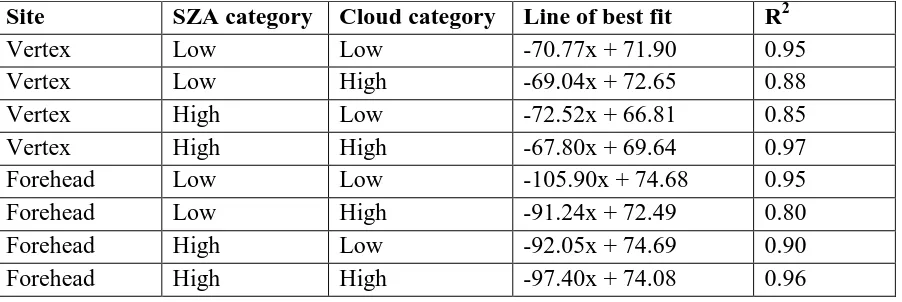
The relation between the time spent in the shade and the exposure ratio for each of the vertex and forehead for each of the cases of low and high SZA and each of the low and high cloud cases are shown in Table 1. The uncertainty in the exposure ratio is of the order of ±20% (26). There is a highly significant effect on the exposure ratio of the time in the shade (F=295.49, p<0.001) and also of the position of the dosimeter on the head (F=34.83, p<0.001). Comparisons of 0 shade versus 30 minutes shade, 0 versus 60 minutes shade and 30 versus 60 minutes shade are all significant at p<0.001. There was no significant effect due to the amount of cloud cover on the ER (p=0.641), no significant effect due to the type of shade structure (p=0.472) and no significant effect due to SZA (p=0.141).
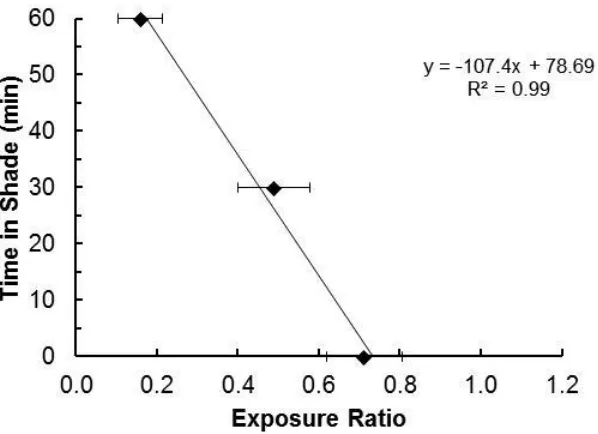
5 minutes shade, there is no significant difference (p=0.661) between the two sites. The lines fitted to the data in Figure 2 and Figure 3 show the relationship with an R2 of 0.99 between the amount of time spent in the shade over the one hour period and the measured ER.
Discussion
The development of a measurement system described in this research will allow for a more objective review and evaluation of the amount of use by different population groups for the basic shade structures provided. This will provide an increased understanding of the effectiveness of the provision of shade structures as a UV minimisation strategy. Currently the method employed to determine the amount of use of shade structures is either through surveys or having to rely on reliable recall by study subjects. The more objective method described in this research will provide an improved technique to evaluate the utilisation of shade.
There was a difference in the ER values between the two anatomical sites when time was spent in the sun. However, there was no difference when all the time was spent in the shade. This is due to the additional component of diffuse UV for the 60 minute exposure time (29). In comparison, the values for 0 and 30 minutes shade are due to both direct and diffuse UV leading to a higher ER at the horizontal plane site of the vertex. Given that the vertex is equivalent to a horizontal surface, the exposure ratio for zero minutes shade should be close to one. The mean value and respective standard deviation obtained for this case is within the ±20% error associated with the exposure ratio measurements. Although the method was tested for both the sites of the vertex and the forehead and shown to work for both, the use of the vertex site is the preferable one. This will allow the attachment of the dosimeter to the hat or headwear of the subjects and allow the subject to continue with normal daily activities without any interference from the dosimeter.
6 The results on the method developed in this project will allow future research to identify what are the barriers or behavioural restrictions to use of shade structures. The current research has provided proof of concept for the method and future research is intended to address the specific calibrations for the cases that take into account the orientation of the headform, other shade structures, the SZA range below 19o and the albedo of different ground surfaces for shade structures in the settings of schools and public facilities. The information will be an essential component in the provision of a healthy outdoor lifestyle and the prevention of skin cancer and sun-related eye disorders, with the potential to reduce the health costs associated with their treatment.
Acknowledgements: The authors acknowledge the funding from the University of Southern Queensland provided for this project.
References
1. Department of Health and Ageing (2011) Key statistics. Available at: http://www.health.gov.au/internet/skincancer/publishing.nsf/Content/fact-2. Accessed on 1 Nov 2011.
2. Sunsmart (2011) Seek shade. Available at:
http://www.sunsmart.com.au/sun_protection/seek. Accessed on 1 Sep 2011.
3. DAUQ, Department of Architecture, University of Queensland (1995) Shade for sports fields. Brisbane, Queensland Health.
4. DAUQ, Department of Architecture, University of Queensland (1996) Shade for public pools. Brisbane, Queensland Health.
5. DAUQ, Department of Architecture, University of Queensland (1997) Shade for young children. Brisbane, Queensland Health.
6. Greenwood, J. (2002) Designing sun safe environments. In Proceedings of UV Radiation and its Effects: an update (2002) Conference, Christchurch, New Zealand, 26-28 Mar 2002.
7. WHO (World Health Organization) (1994) Environmental Health Criteria 160: Ultraviolet Radiation. Geneva, p256.
8. Airey, D.K., J.C.F. Wong, R.A. Fleming and L.R. Meldrum (1997) An estimate of the total UV-B exposure for outdoor workers during a south-east Queensland summer. Health Phys. 72, 544-549.
9. Gies, P., C. Roy, S. Toomey, R. MacLennan and M. Watson (1995) Solar UVR exposures of three groups of outdoor workers on the Sunshine Coast, Queensland. Photochem.Photobiol. 62, 1015-1021.
10. Parisi, A.V., L.R., Meldrum, J.C.F. Wong, J. Aitken R.A. Fleming (1999) Lifetime erythemal ultraviolet exposure estimates for selected population groups in South East Queensland. Phys. Med. Biol. 44, 2947-2953.
7 12. Guy, C., R. Diab and B. Martincigh (2003) Ultraviolet radiation exposure of children and
adolescents in Durban, South Africa. Photochem. Photobiol. 77, 265-270.
13. Vishvakarman, D., J.C.F. Wong and B.W. Boreham (2001) Annual occupational exposure to ultraviolet radiation in Central Queensland. Health Phys. 81, 536-544.
14. Gies, H.P. and J. Wright (2003) Measured solar ultraviolet radiation exposures of outdoor workers in Queensland in the building and construction industry. Photochem. Photobiol. 78, 342-348.
15. Turnbull, D. and A.V. Parisi (2004) Annual variation of the angular distribution of the UV beneath public shade structures. J. Photochem. Photobiol. B: Biol. 76, 41-47.
16. Turnbull, D. and A.V. Parisi (2005) Effective shade structures. Med. J. Aust. 184, 13-15. 17. Gies. P. and C. Mackay (2004) Measurements of the solar UVR protection provided by
shade structures in New Zealand primary schools. Photochem. Photobiol. 80, 334-339. 18. Milne E., D.R. English, B. Corti, D. Cross, R. Borland, P. Gies, C. Costa and R. Johnston
(1999) Direct measurement of sun protection on primary schools. Prev. Med. 29, 45-52. 19. CIE (Commission Internationale de l'Eclairage) (1998) Erythema reference action
spectrum and standard erythema dose. CIE S007E-1998.
20. Diffey, B.L. (1989) Ultraviolet radiation dosimetry with polysulphone film. In Radiation Measurement in Photobiology. (Edited by B.L. Diffey), pp.136-159. Academic Press, New York.
21. Parisi, A.V., L.R. Meldrum and M.G. Kimlin (1999) Polysulphone film thickness and its effects in ultraviolet radiation dosimetry. In proceedings of Protection Against the Hazards of UVR, Internet Conference, 18 Jan – 5 Feb 1999.
22. Parisi, A.V., M.G. Kimlin, R. Lester and D. Turnbull (2003) Lower body anatomical distribution of solar ultraviolet radiation on the human form in standing and sitting postures. J. Photochem. Photobiol. B: Biol. 69, 1-6.
23. Siani, A.M., G.R. Casale, H. Diemoz, G. Agnesod, M.G. Kimlin, C.A. Lang, and A. Colosimo (2008) Personal UV exposure in high albedo alpine sites. Atmos. Chem. Phys. 8, 3749–3760.
24. Siani, A.M., G.R. Casale, R. Sisto, M. Borra, M.G. Kimlin, C.A. Lang and A. Colosimo (2009) Short-term UV exposure of sunbathers at a Mediterranean sea site. Photochem. Photobiol. 85, 171-177.
25. Siani, A.M., G.R. Casale, R. Sisto, A. Colosimo, C.A. Lang and M.G. Kimlin (2011) Occupational exposures to solar ultraviolet radiation of vineyard workers in Tuscany (Italy). Photochem. Photobiol. 87, 925-934.
26. Casale, G.R., A.M. Siani, H. Diemoz, M.G. Kimlin and A. Colosimo (2012) Applicability of the polysulphone horizontal calibration to differently inclined dosimeters. Photochem. Photobiol. 88, 207-214
27. Downs, N. and A.V. Parisi (2009) Measurements of the anatomical distribution of erythemal ultraviolet: a study comparing exposure distribution to the site incidence of solar keratoses, basal cell carcinoma and squamous cell carcinoma. Photochem. Photobiol. Sci. 8, 1195–1201.
28. SPSS (2012) IBM SPSS. Available at:
8 29. Turnbull, D., A.V. Parisi and J. Sabburg (2003) Scattered UV beneath public shade
9 Table 1 – The line of best fit between time in shade and the exposure ratio (x) for each of the sites and each of the SZA and cloud categories.
Site SZA category Cloud category Line of best fit R2
Vertex Low Low -70.77x + 71.90 0.95
Vertex Low High -69.04x + 72.65 0.88
Vertex High Low -72.52x + 66.81 0.85
Vertex High High -67.80x + 69.64 0.97
Forehead Low Low -105.90x + 74.68 0.95
Forehead Low High -91.24x + 72.49 0.80
Forehead High Low -92.05x + 74.69 0.90
10 Figure legends
Figure 1 – (a) Setup of the manikin under one of the shade structures, (b) North facing manikin head form showing the vertex and forehead dosimeters.
Figure 2 –The exposure ratios for the vertex averaged for the different SZA, amount of cloud and shade structure. The error bars are the standard deviation of the data. The line shows the relation between the time spent in the shade over the one hour period and the measured exposure ratio.
11
(a) (b)
[image:11.595.70.531.108.276.2]12 Figure 2 –The exposure ratios for the vertex averaged for the different SZA, amount of cloud and shade structure. The error bars are the standard deviation of the data. The line shows the relation between the time spent in the shade over the one hour period and the measured exposure ratio.
[image:12.595.87.386.433.650.2]