ResearchOnline@JCU
This is the author-created version of the following work:
Lupton, Mandy, and Bruce, Christine (2010)
Craft, process and art: teaching and
learning music composition in higher education.
British Journal of Music
Education, 27 (3) pp. 271-287.
Access to this file is available from:
https://researchonline.jcu.edu.au/55459/
Copyright © Cambridge University Press 2010
Please refer to the original source for the final version of this work:
Craft, Process and Art: Teaching and learning music
composition in higher education
Mandy Lupton and Christine Bruce
Mandy Lupton
Corresponding author - Lecturer, School of Cultural and Language Studies in Education, Faculty of
Education, Queensland University of Technology, Victoria Park Road, Kelvin Grove QLD 4059 Australia
Ph: +61 7 3138 3283 Fax:+61 7 3138 3988 [email protected]
Christine Bruce
Professor, School of Information Technology, Faculty of Science and Technology, Queensland University of
Technology, 2 George St, Brisbane, Qld 4000
This paper explores models of teaching and learning music composition in higher education. It analyses the pedagogical approaches apparent in the literature on teaching and learning composition in schools and universities, and introduces a teaching model as: learning from the masters; mastery of techniques; exploring ideas and developing voice. It then presents a learning model developed from a qualitative study into students’ experiences of learning composition at university as: craft, process and art. The relationship between the students’ experiences and the pedagogical model is examined. Finally, the implications for composition curricula in higher education are presented.
Introduction
composition classes which emphasise learning composing as a way of understanding music, rather than to necessarily train professional composers. As Wiggins (2007 p. 465) concludes, ‘since all people are capable of inventing musical ideas, it would seem that all music learners should, at some time in their education, have opportunities to explore this capability as part of their learning.’
Given the development of general composition courses in higher education, one might expect there to be a body of research into teaching and learning music composition in higher education. However, as Barrett (2006 p. 196) argues, ‘our understanding of those factors that contribute to teaching and learning in musical composition is still limited’. We have found a range of case studies of primary and secondary school students’ experiences of composing (see for example Stauffer, 2002; Kennedy, 2002; Kennedy, 1999; Hogg, 1994; Younker, 2000; Folkestad et al., 1998; van Ernst, 1993; Bunting, 1988; Bolden, 2009), and some of professional composers (see for example Collins, 2005; Nuhn et al., 2002; Reed, 1990; Han, 2004; Emmerson, 1989), but few that examine student’s experiences of composing in universities and conservatoires.
One small body of research in higher education used case studies to illustrate the contrast between novice and expert composers (Barrett, 2006; Barrett & Gromko, 2007; Younker & Smith, 1996; Kennedy, 1999), while another study looked at the compositional process of a group of university music students being introduced to composition (Martin, 2002).Other studies investigated the processes of pre-service education students undergoing composition tasks designed to model teaching composition at school level (Byrne et al., 2003; Hewitt, 2002; Kennedy, 2004). Finally, a small body of work explicitly addresses composition pedagogy at university level (Carbon, 1986; Barrett, 2006; Barrett & Gromko, 2007; Beck, 2001).
In this paper, we explore pedagogical approaches to teaching and learning composition. We present this paper in 2 parts. In part 1, we present a teaching model based upon our analysis of the literature. In part 2, we present a learning model based upon an empirical study into
students’ experiences of learning composition in two distinct third-year university courses. We conclude the paper by discussing the relationship between the models and proposing the implications of the pedagogical models for music composition curricula.
Part 1 – Teaching composition
section, we will discuss the latter two areas as the former is explored in another paper (Lupton & Davidson, manuscript). Even though our emphasis is on higher education pedagogy, we have drawn on the school composition literature due to the more extensive body of research into teaching and learning composition at school level versus higher education.
It should be noted that we have drawn upon a sample of the literature in order to extrapolate pedagogies of music composition that seem to be prominent, and that our analysis is not exhaustive. Thus, we see our examination as exploratory. Accordingly, we recommend that more work be carried out in identifying a range of pedagogies of music composition, both theoretically and empirically.
Can composition be taught?
Before examining pedagogies of music composition, a debate that should first be addressed is regarding whether composition can actually be taught. Brindle claims that that ‘there are two strongly held opinions: one is that composition cannot be taught; the other that composition should not be taught’ (1986 p. 1) [our emphasis]. Further, Brindle declares ‘we are born composers and not made’ (1986 p. 1). But there must be some belief that composition can be taught and that composers can be ‘made’, otherwise there would not be courses and textbooks devoted to teaching composition.
Perhaps it is possible to teach some aspects of composition such as knowledge, techniques and processes, while other aspects such as creativity, intuition, aesthetics and imagination are qualities that are somehow learned, or that one is born with them (Brindle, 1986; Wilkins, 2006; Hindemith, 1942; Miller, 2005; Cope, 1997; Dogani, 2004). In addressing this issue, some authors propose that the role of the teacher is to draw out creativity (Lockwood, 1955; Beck, 2001). Such views are exemplified by Beck (2001 p. 55):
within my students and then encourage their journey to its realization. Along this journey it is also my job to help the student find his or her own creative voice.
At this point, it is worth noting that the literature on teaching composition at school level does not seem to engage in the above debate, rather, this perspective seems to be expressed primarily in the literature relating to higher education. This may be due to composition being a compulsory part of the national school music curriculum in many countries where children and young adults are encouraged to engage in composition for ‘self-expression’ and ‘individual growth’ (Barrett, 2003 p. 5), rather than as training to be professional musicians and composers.
Composition pedagogical model
We developed our composition pedagogical model through analysing the selected literature for the implicit and explicit aspects relating to teaching and learning music composition. In particular we asked ‘what are the conceptions of music composition pedagogy portrayed in this source?’ and ‘what are the processes of teaching and learning music composition presented by this source?’ Our analysis was necessarily coloured by the empirical study, as we naturally noticed aspects of similarity and difference between the experience of students in our study and the pedagogies of music composition as presented in the literature. Thus the empirical study to some degree informed the theoretical model.
The outcome of our analysis was a group of themes which we have constructed as a composition pedagogical model. The themes are: 1) Learning from the masters; 2) Mastery of techniques; 3) Exploring ideas; and 4) Developing voice. The first two themes deal with content to be learned, while the third and fourth themes deal with the creative process.
It should be noted that the themes do not exist independently of one another; rather they are all used to a greater or lesser degree within all composition pedagogies examined in the selected literature. Also, as we will demonstrate, some themes are more prominent and developed in the literature than other themes.
Learning from the masters
The first theme, Learning from the masters, is a time-honoured approach based on knowledge. In the traditional sense of Learning from the masters, the student is apprenticed to the master and learns from watching and emulating the style of the master (Hindemith, 1942p. 3). In a more contemporary approach, this theme may involve explicit imitation of particular composers and reproduction of musical styles. It would also incorporate listening, transcription and score analysis of various composers, time periods, styles and genres (Cope, 1997 p. 11; Miller, 2005 p. 7; Beck, 2001). These activities would result in students building a knowledge base with which to frame their own compositions (Wiggins, 2005; Wilkins, 2006; Beck, 2001; Berkley, 2001; Berkley, 2004), and to broaden their ‘musical perspective...so that they are less apt
subconsciously to plagiarise the styles, ideas, or contexts of other composers’ music’ (Cope, 1997 p. 8).
This theme lends itself to the use of teaching strategies such as lecture, demonstration and modelling. As described above, learning activities and assessment tasks might consist of the completion of short exercises emulating particular composers or styles, and where students identify compositional techniques through score analysis and listening.
Mastery of techniques
The second theme, Mastery of techniques is based on skill. It holds that one must learn the compositional techniques for them to become a set of tools which are then drawn upon
Like Learning from the masters, teaching strategies would include lecture, demonstration and modelling, and learning activities and assessment tasks might consist of the completion of short exercises demonstrating understanding and application of particular techniques.
Both Mastery of techniques and Learning from the masters concern the learning of disciplinary content in the form of knowledge and skills. Teaching strategies involve creating an environment where students will learn and practise content knowledge and skills deemed important by the teacher. As such, both these themes could be regarded as teacher-centred. The remaining two themes are qualitatively different as they concern the creative process.
Exploring ideas
The third theme, Exploring ideas is based on process. In this theme, students are encouraged to work continually to refine their compositions (Miller, 2005; Brindle, 1986). The emphasis is on students ‘revising and extending’ their work (Wiggins, 2005; Webster, 2003), and engaging in action learning where self-reflection is an important part of the process (Emmerson, 1989; Wiggins, 2003; Burnard & Younker, 2002). Trial and error and experimentation is an accepted and encouraged problem-solving approach (Hewitt, 2002; Kennedy, 2004; Bolden, 2009; Berkley, 2004; Burnard & Younker, 2004) .
The stimuli that students draw upon to explore ideas may be the skills and techniques from the previous two themes, but might also be objects, sound samples, literature, visual art and other musical and non-musical stimuli (Martin, 2002; Kennedy, 2004; Hewitt, 2002). Students may also be encouraged to draw upon their senses, feelings and intuition (Carbon, 1986; Keane, 1980).
In this theme, teaching strategies allow freedom and space for compositional ideas to develop and opportunities are provided for students to receive formative feedback (Miller, 2005; Wilkins, 2006; Wiggins, 2003; Cope, 1997; Bolden, 2009; Wiggins, 2007). The teacher’s role is as consultant, guide and advisor (Burnard, 1995; Ruthmann, 2007; Barrett, 2006; Berkley, 2004). Learning activities include presenting and workshopping work-in-progress, collaborative
As a ‘creative’ theme, Exploring ideas is inclusive of both the content themes (Learning from the masters and Mastery of techniques). Accordingly, Exploring ideas depends upon the previous two themes to provide the material to develop. Thus, this theme could be considered holistic, as the emphasis is on the whole composition and ‘learn[ing] from the process’ (Miller, 2005 p. 7) rather than on discrete exercises and techniques of particular composers.
It seems that Exploring ideas is particularly prominent and developed in the school-based music composition literature where trial and error and experimentation is actively encouraged (Hickey, 2003; Kennedy, 2004), where composition is taught as ‘creative problem-solving’ (Berkley, 2004), and where the process is usually deemed more important than the product (Younker & Smith, 1996). It is also prominent in group composition approaches (Kaschub, 1997; Fautley, 2005; Faulkner, 2003). Not surprisingly, it is also seen in the research on teaching and learning composition with pre-service teachers in higher education, where group composition tasks are used to model approaches that pre-service teachers might be expected to use in their own classroom (Hewitt, 2002; Byrne et al., 2003; Kennedy, 2004) .
Developing voice
The fourth theme, Developing voice is based on expression. Developing voice is an overarching theme, as it includes the previous three themes. It is assumed that if a student learns
composition based on the previous three themes, that they may ‘discover the spark of creativity’ (Beck, 2001 p. 55) which will allow them to develop their personal style (Cope, 1997p. xii), individual voice (Miller, 2005; Barrett, 2006; McMillan, 1999) and ownership of their work (Berkley, 2004).
This theme is the most underdeveloped in terms of suggesting teaching strategies, which is consistent with a more ‘hands-off’ approach to allowing creativity to emerge (Beck, 2001). Thus, the role of the teacher recedes, with the emphasis on giving the student freedom to find their own creative impetus resulting in a personal style and individual expression. The teacher’s role is as advisor and mentor as in the previous theme. Teaching strategies that are explicit are based on ‘probing intentions’, ‘picking up cues’ and problem-solving where the teacher’s intention is not to impose their own views or be prescriptive (Barrett, 2006 p. 211-212; Beck, 2001). As for Developing ideas, teaching and assessment strategies are student-centred in allowing the student a range of choice and freedom without constraints or limitations (Burnard, 1995; Burnard & Younker, 2002).
appropriate, given that in the case of school-based composition, the emphasis seems to be on expression, meaning making (Barrett, 2003) and empowerment (Hogg, 1994) rather than necessarily the development of a unique and individual voice.
To summarise, four themes were identified in the literature on teaching and learning composition which we have combined to form the pedagogical model (see
Table 1
). We will return to themodel later in this paper.
Table 1 - Composition pedagogical model
1. Learning from the masters knowledge content teacher-centred 2. Mastery of techniques skill content teacher-centred 3. Exploring ideas process creativity student-centred 4. Developing voice expression creativity student-centred
In the next section we report on the results of an empirical study into university students’ experiences of learning composition.
Part 2 - Learning composition
The students participating in the study were drawn from two distinct university composition courses at an Australian university. The courses were not designed for students who wanted to major in composition; rather they were general composition courses that were offered as electives within the music degree. The first course was entitled Sound Composition, and was offered as a third year elective in the Bachelor of Music Technology degree. The second course was entitled Jazz Composition, and was offered as a third year elective in the Bachelor of Music degree (jazz studies).
Sound Composition
The Sound Composition course was designed with creativity as its basis. The course description stated:
This course is designed to facilitate creativity in students who wish to produce original compositions for audio, MIDI and/or multimedia. Lectures and tutorials include compositional techniques, basic aesthetic principles, listening and analysis of seminal works and individual tuition (Coulter, 2005).
were then invited to submit their composition for the end of semester public concert. The teacher presented compositional techniques and listening examples, modelled the composition process and acted as a guide and mentor. The class learning activities were based around listening, discussion, formative feedback, trial and error and experimentation. The assessment for the course was entirely based around the one composition. This was broken down into work-in-progress reports on the composition, public performance of composition and a digital portfolio presenting the composition, artwork and program notes.
Jazz Composition
The Jazz Composition course was designed with craft as its basis. The course description stated:
This course examines the work of key figures in jazz composition from Ellington to the present. The craft of composition, including rhythmic and melodic phrasing, motivic development, and form and structure is addressed. The emphasis will be on composing in various representative jazz styles (Denson, 2005).
The jazz students (J) worked individually on nine compositions (in the form of lead sheets) in the style of particular composers (e.g. Thelonious Monk, Antonio Carlos Jobim, Charles Mingus) that were submitted piecemeal over the semester. There was no concert or performance of the compositions. The teacher presented compositional techniques and listening examples. The class learning activities were based around listening and discussion. The assessment for the course consisted entirely of the submission of the nine compositions.
Participants
The participants were 19 students studying music composition (8 females, 11 males) as part of their music degree (only one participant was studying composition as their major study). The students were aged from 19 to 51 years, with 18 of the students aged between 19 and 24. The participants had a varied musical background. To enter the music technology degree, students were required to have a music background but were not required to be of performance standard. By contrast, the jazz students were enrolled in a performance degree and were required to pass an audition to enter the program. Over half of the students had previous experience with
composition, at school and/or as a private endeavour. Therefore, when asked about composing, many of the students drew upon their previous experience, and often compared their experience in the course with their other composing experiences.
Methodology
The research approach underpinning the study was phenomenography. Phenomenography is a qualitative, interpretative approach that maps variation in the ways people experience a phenomenon (Marton, 1996). Phenomenography holds that there are a limited number of critically or qualitatively different ways that people experience a phenomenon (Marton, 1996).
The outcome of a phenomenographic study is a set of logically ordered categories, presented in an ‘outcome space’. The categories are delimited from each other by the critically different aspects of the phenomenon as it is experienced. The categories are related, thus each of the categories gives meaning to the other. The categories are often related in an inclusive hierarchy (Marton & Booth, 1997).
Phenomenography is regarded as a reduced and ‘stripped’ description as it is only the critical variation that is represented, that is, the non-critical features are not described. The categories and outcome space map the variation in the experience of the group rather than of the
individual. Thus, the experience of individuals can be distributed across the categories (Marton & Booth, 1997p. 114).
The study data consisted of semi-structured interviews with 12 students from music technology and 7 from jazz. The interviews ranged from 50-90 minutes and were subsequently transcribed verbatim. In the interview students were asked about learning to compose in the course and about the information they used to create their compositions. Specifically, they were asked what they learned by creating the composition/s, how they would use what they had learned, what information sources they used to create their composition/s and how they drew on that
information. They were also asked about the practices of professional composers in relation to information sources. The students’ compositions were not part of the data collection as the study was focused on their reported experience of learning to compose rather than on the product of this experience.
The transcripts were analysed via an iterative, non-linear process where similarities and
Learning composition: Craft, Process and Art
Three categories were created as a result of the data analysis. The categories are an aggregation of the two student groups, and as such they represent the similarities and differences between the ways students’ experienced learning composition in the two courses. Overall, the music students reported experienced learning composition as:
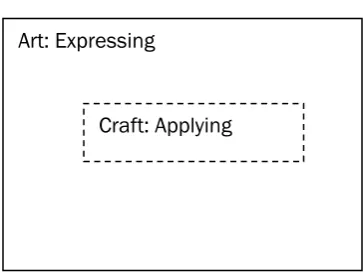
1. Craft: Creating a composition through applying techniques 2. Process: Creating a composition through a process of discovery 3. Art: Creating a composition through expressing oneself
The categories are inclusive and hierarchical i.e. Art includes the experience of Process and Craft. There are two pathways that represent the two distinct groups of students. The music technology students experienced learning composition as Craft, Process and Art (see Figure 1) while the jazz students experienced learning composition as Craft and Art (see Figure 2). In other words, the jazz students did not experience Process, a finding that will be discussed later in the paper.
[image:12.595.197.379.402.531.2]
Figure 1 - Music technology students
Figure 2 - Jazz students Art: Expressing
Process: Discovering
Craft: Applying
Art: Expressing
[image:12.595.201.383.592.732.2]Category 1 –Craft: Applying
In Category 1, students experienced the Craft of creating a composition through applying techniques. The music technology students applied technical skills and techniques in using sound manipulation software, while the jazz students applied compositional techniques that involved using the characteristics of particular composers, styles and genres. The students’ aim was to demonstrate they understood and could use the techniques.
Thomas (MT): The main reason I did that was so I could test out the software... It started off for me as an exercise and then the composition bit came afterwards really.
Emma (J): I drew on the information, the dot point characteristics of the artists that we studied …I was just pretty much going by the formula.
The music technology students used a range of technical and sensory stimuli based around manipulating the sound. Thus, technical information consisted of using and understanding the sound manipulation software (such as Pro Tools and Cecilia). Sensory information included the student’s aesthetic and affective reaction to the sound sample and subsequent manipulation; and their visual and aural analysis of the acoustic characteristics of the sound sample.
The jazz students drew on traditional music structures. These included the characteristics of a particular composer’s approach (melodic, rhythmic, harmonic, stylistic, influences on the
composer) and the characteristics of a particular musical genre (melodic, rhythmic, harmonic and stylistic).
Students developed their technical skills while creating their composition. The music technology students learned the software in order to manipulate sound, while the jazz students identified the characteristics of composers in order to reproduce the style of the composer and to
demonstrate they understood the elements of music theory. Students were focused on doing the composition assignment as an end in itself, rather than self expression as will be seen in
Category 3: Art.
Category 2 – Process: Discovering
In Category 2, creating a composition was experienced as applying techniques (Category 1) within a cyclic Process of discovery (Category 2). It is notable that this category was seen only in the experience of the music technology students, not the jazz students. This could be as a result of the course design, as the music technology students had the luxury of developing their
composition over a semester, with frequent opportunities to present work-in-progress for formative feedback, while the jazz students were required to submit a composition for summative assessment almost weekly throughout the semester and did not gain formative feedback on their compositions in class.
The music technology students experimented with sound manipulation techniques using a process of trial and error. The composition was a two-stage process as students created the individual sounds and then created a composition using the sounds. The process was seen as individual problem-solving.
Nicole (MT): [It was a ] bit of a shock at first because I wasn’t expecting independent learning…this course did say in the course outline it wasn’t going to be teaching technical skills, it was up to you to use the programs and find your own way to achieve things, so it was very much an independent learning course… maybe it encouraged me to get out and find more information on my own…It very much encouraged me, the class, to go out and find your own answers or solutions because they weren’t going to provide answers and why should they? Or why could they? It’s a very personal thing composition, you can’t really tell someone exactly what to do in the creative process.
Information was generated by the process itself. Each time the student experimented with sound, information was created that would further inform the process. The particular sounds generated their own intrinsic information which not only included the acoustic qualities of the sound (envelope, harmonics, frequency, sound wave), but the mood and feeling the sound evoked. The students’ personal aesthetic was heavily involved in this creative process.
by applying the software and trying different things. Guess and check kind of method….It was so time consuming because you’re learning as you go but it’s more than that, it’s that you’re finding the best ways to use the information that you’ve got, so I would say that if I took a sound and I’ve treated it five different ways then those five different ways or five different sounds would be the information I’ve got.
Thomas (MT): I drew on the information I got from experimenting
Students’ found that responding to this cyclic process led them to ‘letting go’ of the composition and not trying to control it. This included allowing the sounds to ‘do their own thing’.
Craig (MT): I think most of the class realised that the composition actually took a form of its own. It actually took some of the control away from the composers themselves, but we were all actually quite surprised in how we thought we were the ones in control making this whole thing up, and in the end it was controlling us, making us do what it needed us to do for it… I had to let it go.
Margaret (MT): I’d hear this sound and the other sound was telling me to put it in so, then it’d have its own information… it ended up just being completely drawing on the sounds to do their own thing and follow their own noses.
Category 3 – Art: Expressing
In Category 3 creating a composition was experienced as the Art of expressing oneself. This category includes the preceding categories; however (as described above) this inclusivity is different for the two groups of students. The music technology students used the Craft of applying techniques in a cyclic Process of discovery in order to express themselves through an Art form. By contrast, the jazz composition students did not experience the Process category. Their experience consisted of using the Craft of applying techniques to express themselves through an Art form.
The students’ aim was to create a composition that expressed their personal aesthetic and identity.
Aaron (J): I think the most important thing is that you sort of, build your identity. Not just build a bunch of techniques [Category 1] but build your own identity [Category 3] …The idea is not to just be a base of like compositional techniques or whatever because then you’ll just be like a robot or a computer…So the idea is to learn the techniques [Category 1] and then you can free yourself up to make your identity known [Category 3].
Students said that it was important to understand the compositional techniques in order to draw on their own creativity.
Anne (MT): You’ve got to know those principles to start off with [Category 1] but really they don’t matter because the creativity comes from inside of you [Category 3].
The music technology students in particular made a strong distinction between the ‘craft‘ of music technology and sound engineering, and the ‘art’ of abstract sound composition.
Margaret (MT): I’ve always wanted to do an art of some type and then when I started here you learn [sound] engineering, and you learn [sound] production and it’s all general knowledge that it’s good to know but there’s no art in it whatsoever. It’s all just craft and so I’ve been waiting, and waiting and waiting for a discipline inside music technology to come along where I could apply art…I learnt the actual discipline of sound composing… It [music technology] was being taught as a craft and not as an art.
Craft, Process and Art
As evidenced by the empirical study, students experienced learning composition as Craft, Process and Art. The categories are nested, where Process includes Craft, and Art includes Craft and Process. There are a number of similarities between the empirical study and the pedagogical model presented in Part 1 of this paper. In the next section, we discuss the implications of these similarities for music composition pedagogy.
Teaching and learning music composition
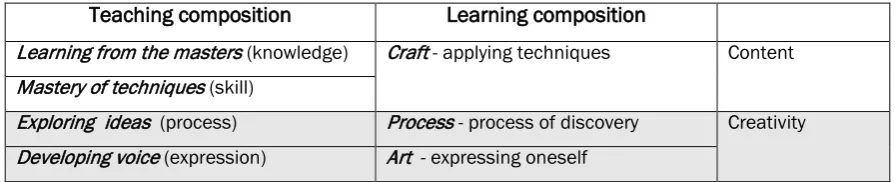
In juxtaposing the pedagogical model with the model from the empirical study a strong relationship can be seen (see Table 2). In both models, the themes and categories form an inclusive hierarchy. Both models include knowledge and skills in relation to compositional techniques and both include the creative process that seems essential in developing the composers’ identity and self expression.
while Jazz Composition seemed to be teacher-centred. Thus, in Sound Composition the emphasis was on Mastery of techniques and Exploring ideas, while in Jazz Composition the emphasis was on Learning from the masters and Mastery of techniques.
Table 2 - Teaching and learning composition
Teaching composition Learning composition
Learning from the masters (knowledge) Craft- applying techniques Content
Mastery of techniques (skill)
Exploring ideas (process) Process - process of discovery Creativity
Developing voice (expression) Art - expressing oneself
How, then, does the pedagogical model and empirical study inform pedagogies of composition in higher education? The contrast between the experiences of students in the courses seems to confirm that there is a relationship between the design of composition curriculum and the learning experience. We therefore propose that academics designing and teaching composition courses in higher education could use both models to analyse existing curricula and to design curricula. For instance, a methodology to analyse composition curricula would be to analyse where particular pedagogical approaches may emphasise particular themes, and to consider the implications of this emphasis. This will serve to make pedagogical choices more explicit and purposeful for both teachers and students.
The empirical study was based on the experience of students in general, elective composition courses in higher education, while the pedagogical model was based on both school and higher education research. We recommend that more research be conducted into teaching and learning in composition courses in a variety of higher education contexts in order to build a range of pedagogical models.
Conclusion
but going beyond lower levels of the hierarchy. Likewise, it means that the lower levels of the hierarchy are necessary as a foundation for the upper levels. For instance, a higher education curriculum that was designed for Developing voice / Art would incorporate activities that encourage:
• understanding of stylistic context including prominent composers, time periods, styles and genres;
• application of compositional techniques;
• extensive experimentation and exploration, workshopping, presentation of work-in-progress and revision;
• informal and formal self-reflection;
• formative feedback from peers and teachers;
• individual and collaborative work; and
• student choice and freedom.
Assessment items that would target Developing voice / Art would include:
• submission of work-in-progress for formative feedback;
• reflective portfolio where students document their personal learning journey through developing their compositions, including the meaning they make from the process; and the way they have expressed themselves through their compositions;
• exegesis explaining the context of the work; and
• summative performance of compositions (live or recorded).
References
ÅKERLIND, G. (2005) 'Variation and commonality in phenomenographic research methods'. Higher Education Research & Development, 24, 4, 321-334.
BARRETT, M. (2003) 'Freedoms and constraints: Constructing musical worlds through the dialogue of composition'. In Hickey, M. (Ed), Why and how teach music composition: A new horizon for music education, (pp. 3-27). Reston, VA, The National Association for Music Education.
BARRETT, M. (2006) ''Creative collaboration': An 'eminence' study of teaching and learning in music composition'. Psychology of Music, 34, 2, 195-218.
BARRETT, M. & GROMKO, J. (2007) 'Provoking the muse: A case study of teaching and learning in music composition'. Psychology of Music, 35, 2, 213-230.
BECK, J. (2001) 'Discovering the composer within'. Teaching Music, 8, 4, 54-57. BERKLEY, R. (2001) 'Why is teaching composing so challenging? A survey of classroom
observation and teachers' opinions'. British Journal of Music Education, 18, 2, 119-138. BERKLEY, R. (2004) 'Teaching composing as creative problem solving: Conceptualising
composing pedagogy'. British Journal of Music Education, 21, 3, 239-263.
BOLDEN, B. (2009) 'Teaching music composition in secondary school: A case study analysis'. British Journal of Music Education, 26, 2, 137-152.
BOWDEN, J. A. & GREEN, P.(Eds) (2005) Doing developmental phenomenography, Melbourne, RMIT University Press.
BRINDLE, R. S. (1986) Musical composition, Oxford, Oxford University Press.
BUNTING, R. (1988) 'Composing music: Case studies in the teaching and learning process'. British Journal of Music Education, 5, 3, 269-310.
BURNARD, P. (1995) 'Task design and experience in composition'. Research Studies in Music Education, 5, December, 32-46.
BURNARD, P. & YOUNKER, B. (2002) 'Mapping pathways: Fostering creativity in composition'. Music Education Research, 4, 2, 245-246.
BURNARD, P. & YOUNKER, B. (2004) 'Problem-solving and creativity: Insights from students' individual composing pathways'. International Journal of Music Education, 22, 1, 59-76. BURNARD, P. & YOUNKER, B. (2008) 'Investigating children's musical interactions within the
activities systems of group composing and arranging: An application of Engestrom's Activity Theory'. International Journal of Educational Research, 47, 60-74.
BYRNE, C., MACDONALD, R. & CARLTON, L. (2003) 'Assessing creativity in musical compositions: Flow as an assessment tool'. British Journal of Music Education, 20, 3, 277-290.
CARBON, J. (1986) 'Toward a pedagogy of composition: Exploring creative potential'. College Music Symposium, 26.
COLLINS, D. (2005) 'A synthesis process model of creative thinking in music composition'. Psychology of Music, 33, 2, 193-216.
COPE, D. (1997) Techniques of the contemporary composer, Australia (no city), Schirmer. COULTER, J. (2005) 'Sound Composition course outline'. Griffith University.
DENSON, L. (2005) 'Jazz Composition course outline'. Griffith University.
DOGANI, K. (2004) 'Teachers' understanding of composing in the primary classroom'. Music Education Research, 6, 3, 263-279.
EMMERSON, S. (1989) 'Composing strategies and pedagogy'. Contemporary Music Review, 3, 133-144.
FAULKNER, R. (2003) 'Group composing: Pupil perceptions from a social psychological study'. Music Education Research, 5, 2, 101-124.
FAUTLEY, M. (2005) 'A new model of the group composing process of lower secondary school students'. Music Education Research, 7, 1, 39-57.
FOLKESTAD, G., HARGREAVES, D. & LINDSTRÖM, B. (1998) 'Compositional strategies in computer-based music-making'. British Journal of Music Education, 15, 1, 83-97. HAN, S.-A. (2004) 'Composers' perspectives regarding computer technology's impact on the
HEWITT, A. (2002) 'A comparative analysis of process and product with specialist and generalist pre-service teachers involved in a group composition activity'. Music Education Research, 4, 1, 25-36.
HICKEY, M.(Ed) (2003) Why and how teach music composition: A new horizon for music education, Reston, VA, The National Association for Music Education.
HINDEMITH, P. (1942) Craft of musical composition, Mainz, Schott.
HOGG, N. (1994) 'Strategies to facilitate student composing'. Research Studies in Music Education, 2, June, 15-24.
KASCHUB, M. (1997) 'A comparison of two composer-guided large group composition projects'. Research Studies in Music Education, 8, July, 15-28.
KEANE, D. (1980) 'Beyond technique: Teaching the unteachable in composition'. Proceedings of the American Society of University Composers, pp. 70-90.
KENNEDY, M. (1999) 'Where does the music come from? A comparison case-study of the compositional processes of a high school and a collegiate composer'. British Journal of Music Education, 16, 2, 157-177.
KENNEDY, M. (2002) 'Listening to the music: Compositional processes of high school composers'. Journal of Research in Music Education, 50, 2, 94-110.
KENNEDY, M. (2004) 'Opening the doors to creativity: A pre-service teacher experiment'. Research Studies in Music Education, 23, 32, 32-41.
KLEIMAN, P. (2008) 'Towards transformation: Conceptions of creativity in higher education'. Innovations in Education and Teaching International, 45, 3, 209-217.
LOCKWOOD, N. (1955) 'Composition can be taught!'. Music Journal, 13, 2, 16, 28, 30. LUPTON, M. (2008) Information literacy and learning, Adelaide, Auslib Press.
LUPTON, M. & DAVIDSON, R. (manuscript) 'Enacting composition curricula'.
MARTIN, J. (2002) 'Categorising the compositional thinking of tertiary-level students: A provisional taxonomy'. Research Studies in Music Education, 18, 3, 3-12.
MARTON, F. (1996) 'Cognosco ergo sum - Reflections on reflections'. In Dall'Alba, G. &
Hasselgren, B. (Eds), Reflections on Phenomenography, (pp. 163-187). Goteborg, Acta Universitatis Gothoburgensis.
MARTON, F. & BOOTH, S. (1997) Learning and awareness, Mahwah, Lawrence Erlbaum Associates.
MCMILLAN, R. (1999) ''To say something that was me': Developing a personal voice through improvisation'. British Journal of Music Education, 16, 3, 263-273.
MILLER, M. (2005) The complete idiot's guide to music composition, New York, Alpha Books. NUHN, R., EAGLESTONE, B., FORD, N., MOORE, A. & BROWN, G. (2002) 'A qualitative analysis of
composers at work'. ICMC ?
REED, A. (1990) 'How a composer works'. The Instrumentalist, June, 48-49.
RUTHMANN, A. (2007) 'The composers' workshop: An approach to composing in the classroom'. Music Educators Journal, 93, 38, 38-43.
STAUFFER, S. (2002) 'Connections between the musical and life experiences of young composers and their compositions'. Journal of Research in Music Education, 50, 4, 301-322.
STAUFFER, S. (2003) 'Identity and voice in young composers'. In Hickey, M. (Ed), Why and how teach music composition: A new horizon for music education, (pp. 91-111). Reston, VA, The National Association for Music Education.
STEPHENS, J. (2003) 'Imagination in education: Strategies and models in the teaching and assessment of composition'. In Hickey, M. (Ed), Why and how teach music composition: A new horizon for music education, (pp. 113-138). Reston, VA, The National Association for Music Education.
STERNBERG, R. & LUBART, T. (1999) 'The concept of creativity: Prospects and paradigms'. In Sternberg, R. (Ed), Handbook of creativity, Cambridge, Cambridge University Press. VAN ERNST, B. (1993) 'A study of the learning and teaching processes of non-naive music
students engaged in composition'. Research Studies in Music Education, 1, December, 22-39.
composition: A new horizon for music education, (pp. 55-65). Reston, VA, The National Association for Music Education.
WIGGINS, J. (2003) 'A frame for understanding children's compositional processes'. In Hickey, M. (Ed), Why and how teach music composition: A new horizon for music education, (pp. 141-165). Reston, VA, The National Association for Music Education.
WIGGINS, J. (2005) 'Fostering revision and extension in student composing'. Music Educators Journal, 91, 3, 35-42.
WIGGINS, J. (2007) 'Compositional process in music'. In Bresler, L. (Ed), International Handbook of Research in Arts Education, (pp. 453-469). Dordrecht, The Netherlands, Springer. WILKINS, M. (2006) Creative music composition. The young composer's voice, New York,
Routledge.
YOUNKER, B. A. (2000) 'Thought processes and strategies of students engaged in music composition'. Research Studies in Music Education, 14, June.