Yvonne Masters University of New England
[email protected] Stephen Winn University of New England
Abstract
Professional experience (or practicum) is one aspect of teacher education that crosses several perceived boundaries including those between theory and practice, university and school. A further boundary in many institutions is believed to exist between on-campus and off-campus (distance education/external) study. Crossing these boundaries presents challenges with both preparation and support for professional experience. These challenges have been exacerbated as higher education institutions pursue new ways of delivering courses in an era of rapid change and increased accountability. Professional experience is regulated by state accreditation bodies and by the Commonwealth Government and new national teaching standards and national accreditation of teacher education courses are currently being implemented. This is resulting in further examination of how professional experience can be enhanced for all stakeholders. At a university where more than 75% of students study off-campus it is imperative that approaches to professional experience actively engage the students in a positive and productive manner.
At the end of 2010, all teacher education students at the University of New England who had completed at least one school placement were invited to participate in a pilot survey. This survey was designed to explore their perceptions of the effectiveness of their preparation for placement and the support structures available during placement. The survey was also designed to ascertain whether there was any difference in perception not only between on-campus and off-on-campus students, but also across courses and across age groups. The discussions presented here focus on student perceptions of their preparedness for professional experience placements. In particular, the perceptions of off-campus students are compared and contrasted with those of the on-campus cohort. While there has been a general presumption that on-campus students would feel better prepared than off-campus students, the data show nuances in the perceptions based not predominantly on mode of study, but rather other determinants such as age. These data will provide directions for enhanced preparation for all students.
Key Words
Professional experience, teacher preparation, distance education
Introduction
Higher education is in an era of change, largely due to the publication of the Review of Australian Higher Education Report (Commonwealth of Australia, 2008), otherwise known as the Bradley Review. This report, with its range of recommendations, has resulted in higher education institutions (HEIs) exploring strategies to both attract and retain students and to provide relevant courses delivered to students in a variety of modes. Teacher education sits within this milieu of change and is equally affected by it.
2
closely examined (Mayer, Reid, Santoro & Singh, 2011). While these mandated requirements for teacher education affect all aspects of teacher education courses, the focus in this paper is on professional experience (also described as practicum). This integral component of teacher education courses that has been a subject of discussion and contention for some time (Darling - Hammond, 2006; Lord & McFarland, 2007; Moyles & Yates, 2003; Smith & Lev-Ari, 2005).Professional experience: the current milieu
Professional experience bridges the boundary between university study and school experience and provides the practical component of teacher education awards which is regarded as pivotal in preparing pre-service teachers for the world of the classroom (Keogh, Dole & Hudson, 2006). This contention is supported by Zeichner and Gore (1990) who suggested that professional experience is the second most influential factor in teachers’ socialisation into the profession. The literature further reveals that students frequently identify professional experience as the most important part of their course requirements (Koerner, Rust & Baumgartner, 2002; Brandenburg & Ryan, 2001; Brown, 2008).
One important aspect of professional experience is the provision of quality experiences, as highlighted in Top of the Class (House of Representatives Standing Committee on Education and Training, 2007). Quality experience was partly interpreted by government as meaning an increased number of days of placement, as evidenced in 2007 when such an increase was mandated by the Department of Education, Science and Training (DEST) in its document “Administrative Guidelines: Improving the Practical Component of Teacher Education Programme 2008-2011” (Department of Education, Science and Training, 2007). There was also extra funding made available if HEIs could demonstrate that they were meeting a range of quality indicators (DEST, 2007, p.4). One such indicator was demonstrating that students were prepared for their professional experience. This is a task that has been perceived as more readily accomplished through face-to-face teaching rather than via delivery in an off-campus mode (Simpson, 2006).
Professional experience and off-campus study
‘The tyranny of distance’ (Blainey, 1996) has become an iconic phrase that could be applied to professional experience. It has been argued that professional experience can, of itself, promote isolation and practical expediency for any pre-service teacher (Goodlad, 1990) and Simpson (2006) posits that professional experience “for distance education students ... is often minimalised because of administrative costs and a range of supervision factors” (p.241). She further argues that:
... in traditional on-campus initial teacher education programmes lecturers (or faculty) work with their students to prepare them for field experience and often supervise them while in the field. Such preparation and support is more challenging to provide for distance education students (Simpson, 2006, p.242).
The challenges of off-campus study are apparent at the University of New England (UNE) where 81% of students in the School of Education, higher than the rest of the university average, study in the external mode (Corporate Intelligence Unit, 2011). One student, commenting in a professional experience online forum just before an initial placement, stated that “I’m a distance student - this is so-o-o overwhelming” (2008). Another felt overwhelmed enough to report that:
3
These comments, and others like them, prompted a study to explore the perceptions of students, with a view to critically evaluate how students feel prepared for and engage with professional experience.Project Rationale
With teacher education and, in particular, professional experience being increasingly placed under the spotlight of the Commonwealth government and teacher accreditation bodies UNE has made changes in the ways in which students in preservice teacher education awards have been prepared for and then supported during (and indeed after) professional experience placements. While considerable changes were made, there had been no systematic research undertaken with students in relation to their perceptions of their preparedness or of their needs prior to or while on placement. This is a significant gap in the data that needs bridging as new initiatives are introduced. Academic and professional staff members of the School of Education, UNE, need to acknowledge the mandated quality indicators and work toward not only meeting, but exceeding these. It also behoves us to acknowledge the voices of the preservice teachers.
Project Method
In December 2010, with the aid of a small School of Education research grant, the professional experience research project was commenced. All students in the primary and secondary preservice teacher awards1 (a total of 5 primary and 9 secondary awards) who had completed at least one professional experience placement (1100 students) were invited, by email, to complete an online survey (HE10-182). This survey gathered both quantitative and qualitative data. The survey tool used demographic and Likert scale questions to provide an overview of general trends. The qualitative questions enabled a deeper understanding of the general responses. These qualitative responses provide important data to inform the development of new initiatives in professional experience based on student need as well as School of Education capacity.
Participants
Following two email reminders, two hundred and fifty four students responded to the survey invitation (a 23.1% response rate), of which 248 were valid. The breakdown of the demographic data is provided below.
Mode of Study
Of the total responses, 73% were provided by off-campus students, a lower percentage than the off-campus enrolment generally. A further breakdown of the responses into those who had completed only one placement, as contrasted with respondents who had completed multiple placements, is presented in Table 1.
Table 1: Off-campus and On-campus Placement Data
Off-campus 1 Placement
On-campus 1 Placement
Off-campus Multiple Placements
On-campus Multiple Placements 38.3% (n = 95) 6.9% (n = 17) 35.1% (n = 87) 19.7% (n = 49)
1 The students enrolled in the two early childhood awards were not surveyed due to the impending change to
4
Age of participantsThe age profile of the participants is shown in Table 2.
Table 2: Off-campus and On-campus Placement Data
Age Bracket
18 - 24 25 - 34 35 - 44 45 - 54 55+ Total
Number 79 52 80 36 1 248
Percentage 31.9 21 32.2 14.5 0.4 100
University age statistics are available in the age brackets of under 21, 21 - 24 and 25 and over and it is noted that when the age data for this survey are converted to the ranges 18 - 24 and 25 and over (31.9% and 68.1% respectively), they are similar to the institutional data of 27.7% and 72.3% in the same ranges (Corporate Intelligence Unit, 2011).
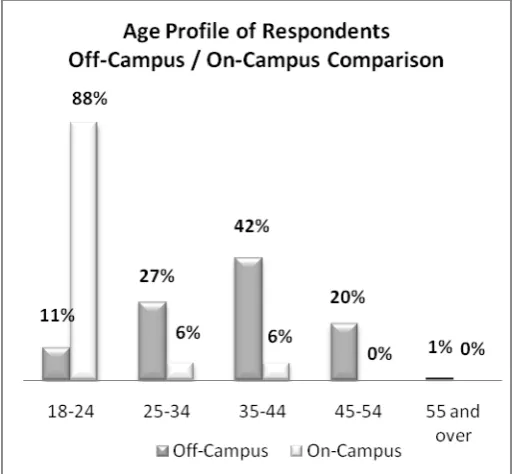
[image:4.595.144.402.324.561.2]The breakdown of the age profile into off-campus and on-campus participants, as shown in Figure 2, provides interesting data.
Figure 1: Age Profile of Respondents - Off and On Campus
A significantly large proportion of on-campus participants are aged between 18 and 24 years of age and none more than 44 years of age. In contrast nearly two-thirds (63%) of all off-campus participants were 35 years of age or older.
Further demographic data
5
ResultsProfessional Experience and its importance
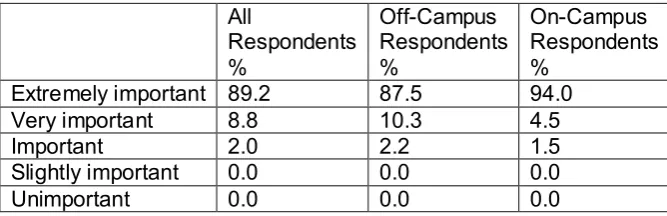
[image:5.595.130.464.232.340.2]The survey tool had a 5 point Likert scale question about the importance of professional experience. Participants were asked to rate the importance and the results overwhelmingly support the view from the literature that professional experience is extremely important (Brandenburg & Ryan, 2001; Keogh, Dole & Hudson, 2006; Zeichner and Gore, 1990). No participant responded that professional experience was only slightly important or unimportant and 98% of all respondents believed that professional experience is very or extremely important as shown in Table 3.
Table 3: The Importance of Professional Experience
Qualitative responses to the open-ended questions about professional experience also demonstrate the strong emphasis placed on this aspect of the courses by the participants. Comments from off-campus students such as:
… practical professional experience is without doubt the most important aspect of this course because it gives authenticity and validation of the subjects teachers study in preparation for teaching
and
… teaching is essentially a practical subject, which is not to diminish the importance of theory but rather stress the centrality of practice to the professional development of a teacher's skill set
were replicated by on-campus students with comments that:
... professional experience is extremely important in the teaching course, as it gives training teachers the opportunity to put theory into practice and helps us to develop skills in a real hands on school and classroom environment
and
...professional experience gives us, as pre-service teachers, the chance to find out if we are truly committed to putting in the hard work and effort that goes into being a teacher. Also, it places everything we learn in the classroom into a context that is relevant and we have the chance to put into practice everything we have learnt.
The student comments reinforce the position that school placements were perceived to be invaluable. Many of the comments also show that professional experience is seen as crossing the boundary between theory and practice. While the response to the question concerning the importance of professional experience was not unexpected, the overwhelming importance registered by the students makes more critical the responses regarding preparation.
Professional Experience readiness
One of the main aims of the study was to ascertain not only whether the forms of preparation provided for preservice teachers were viewed by the students as being effective, but also to more generally explore whether the students considered they were prepared.
All
Respondents %
Off-Campus Respondents %
On-Campus Respondents %
Extremely important 89.2 87.5 94.0
Very important 8.8 10.3 4.5
Important 2.0 2.2 1.5
Slightly important 0.0 0.0 0.0
6
The participants were asked to rank their readiness for school placements in three areas; professional, psychological and cognitive. The ranking was a four point Likert scale of ‘not at all prepared’, ‘slightly prepared’, ‘prepared’ and ‘very prepared’. Examples were provided for each area to indicate for the participants what was meant.(a) Professional readiness
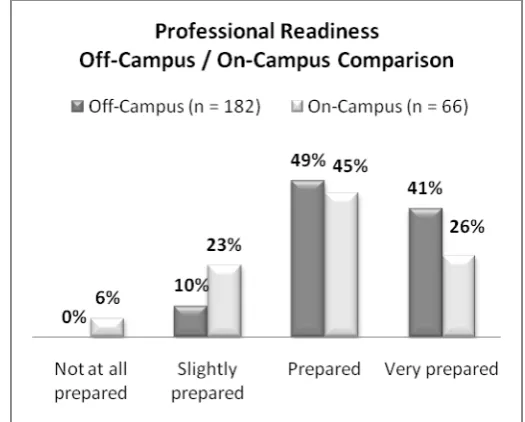
Professional readiness was described as knowing how a teacher is expected to behave, psychological was described as feeling confident and ‘on top of things’. Figure 2 highlights that off-campus students felt generally prepared in terms of their understanding of professional readiness with 90% reporting that they felt either ‘prepared’ or ‘very prepared’ and no students reporting that they felt ‘not at all prepared’. Only 71% of the on-campus students felt ‘prepared’ or ‘very prepared’. The percentage of on-campus students who reported feeling only ‘slightly prepared’ is just more than double that of the off-campus students. 6% of on-campus participants reported that they did not feel at all prepared.
[image:6.595.146.409.271.482.2]
Figure 2: Professional Readiness - Off and On Campus Comparison
The survey responses suggest that the supposition that on-campus students, with their regimen of lectures and tutorials, are well-prepared is debatable.
(b) Psychological readiness
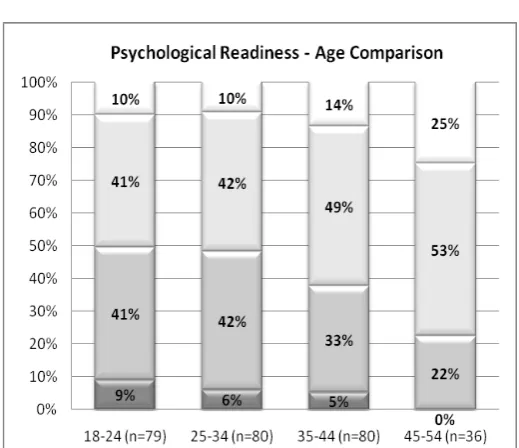
Psychological readiness was defined for the participants as a feeling of confidence, of ‘being on top of things’ and the aim in this question was to ascertain whether the participants considered they were psychologically ready for professional experience.
7
Figure 3: Psychological Readiness - Off and On Campus ComparisonQualitative responses to the open-ended question about readiness tend to be grouped around areas of content knowledge and behaviour management skills, rather than feelings of confidence. This will be elaborated in the discussion section of this paper.
(c) Cognitive readiness
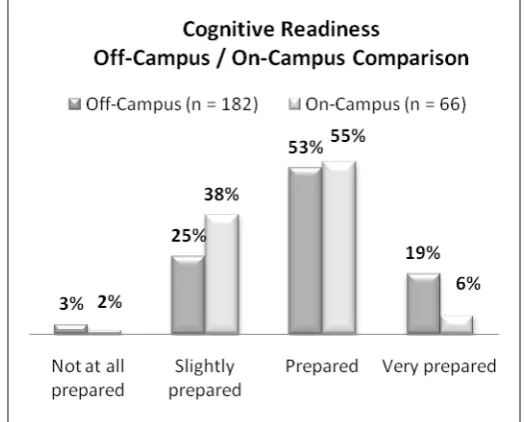
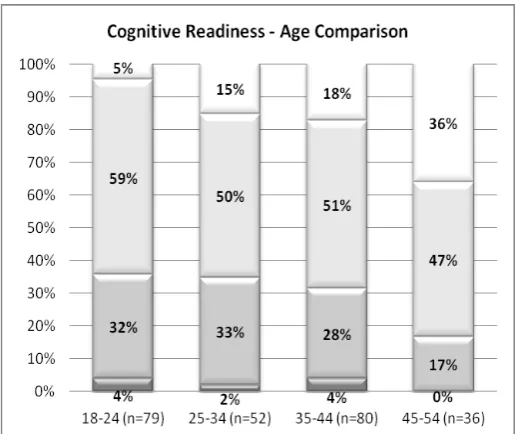
Cognitive readiness was defined as knowledge of content, teaching strategies and classroom management. While the results indicate that the on-campus and off-campus participants considered they were equally prepared, only a small percentage of on-campus participants reported being very prepared. Figure 4 highlights this difference. Here the data point to nearly two-thirds (72%) of the off-campus students indicating that they were cognitively ready (as previously defined). The on-campus students were not as positive with only 61% considering they were either prepared or very prepared.
[image:7.595.141.404.499.710.2]8
An oversight in the development of the survey was to use only one open-ended question for responses about both readiness and methods of preparation. It was also an optional question. The poor response rate of 33.8% (84 responses) means that caution needs to be taken with conclusions. This low response rate was further compounded in the off-campus/on-campus split: 39.5% of the off-campus participants (72 responses) compared with 18.1% of on-campus participants (12 responses).The participants’ responses to the open-ended question tended to dwell on behaviour management above all other aspects of the course. This was common to both off-campus and on-campus participants with comments such as “would have loved a unit devoted to behaviour management” (off-campus) and “would have been great to do some behaviour units before first prac” (on-campus) being common. This view was supported in the open-ended question about improvements to be made with over 50% of all students making a comment regarding behaviour management, concurring with the sentiment that:
... there was almost no behaviour management skills and strategies taught before we were sent out and this is a worry. I believe behaviour management should be taught in the first semester of your first year and then built on from then on. You need to know how to manage your class if you intend on teaching successfully!! (On-campus student).
Very few of the on-campus students directly commented in this question about the benefit of curriculum and teaching and learning units, although statistical analysis showed that 60.6% of the participants found them ‘reasonably’ or ‘extremely’ helpful. The off-campus participants commented more frequently, with an 87.3% rating of ‘reasonably’ or ‘extremely’ helpful. The comments were generally positive: for example:
... the overall units of study were enlightening and very helpful in grounding a solid foundation
and
... I like the way that the course has been structured - it has been helpful to me. The programming assignments were particularly useful.
There were some negative comments from off-campus participants and these tended to be more detailed as evidenced by:
... I am afraid that my curriculum units were extremely repetitive ... I think that these units could have been so much more useful instead I felt like they were padding. This I feel is a real problem as my curriculum units should have been the ones that helped me to really implement my chosen field. ... Where I felt that my curriculum units particularly fell down was in the assessment side of things. We have two units on assessment. At no stage were we actually directed to anything other than the support documents for the curriculum to learn how to write assessments and how to mark or how to make sure we are doing well written and easily understandable assessment criteria. ... This is a huge oversight and one that I am very concerned about.
While this comment is from one student many aspects of what is reported here were included in other responses.
(d) Age as a factor in the responses
9
Figure 5: Professional Readiness – Age Comparison [image:9.595.143.403.350.574.2]10
Figure 7: Cognitive Readiness – Age ComparisonThese data raise many questions which will be discussed in the next section. Are younger students overly optimistic about their teaching readiness, particularly in relation to cognitive readiness? Do off-campus students, being typically older, bring confidence from their life-experience to teaching and, if this is the case, are they perhaps overly confident?
Discussion
Caution needs to be exercised with interpreting too much into the responses regarding readiness as there were only three questions asked of the participants. Other questions were asked about the helpfulness of particular aspects of preparation such as the professional experience handbook, online modules, curriculum units and contact with the professional experience office, but they were not directly linked to readiness.
There also needs to be caution due to the small sample size, where the 248 respondents reflect only 23.1% of the pre-service teacher education students who had completed at least one placement in 2010. Also, this study focussed on the initial professional experience placement. Participants may well report variations in attitude and confidence, as well as knowledge, by the time they have completed all the required professional experience placements.
In spite of the limitations, the results of the parts of the survey addressing preparation are indicative that presumptions about off-campus students feeling unprepared are misplaced. One possible reason for this difference in results could lie in the larger number of off-campus respondents (a ratio of 2.76:1). While acknowledging this, we believe that other factors could be influencing this difference between cohorts.
11
... the single background characteristic that strongly predicted teacher attrition was age: younger teachers ... are more likely to leave than older teachers” (p.1).
What this study may indicate is that off-campus study is not an indicator of poor preparation for professional experience due to limited face-to-face engagement. If face-to-face engagement is perceived as being more positive than remote engagements, the benefits of the former may be mitigated against by youth and limited life experience.
Professional readiness is an integral component of preparation for professional experience placements. Providing students with an understanding of the professional expectations of them as teachers is critical as all educational systems have professional codes of conduct. Also, both the New South Wales Professional Teaching Standards (New South Wales Institute of Teachers, 2005) and the National Professional Standards for Teachers (Australian Institute for Teaching and School Leadership, 2011) make reference to this aspect of teaching. This understanding covers areas such as ethics, confidentiality and codes of conduct, as well as more routine topics such as professional dress, behaviour and language. Whether on-campus students have an advantage in this form of preparation because they have dedicated lectures regarding these areas, as well as online support, is debatable. Off-campus students can access on-line tutorials, although these are limited to mandatory online modules, but currently there is no tutorial style interaction. From the data regarding the efficacy of lectures and tutorials it is clear that on-campus students rate these as ‘reasonably’ or ‘extremely’ helpful (71.2%) and ways of delivering this experience to off-campus students effectively is required. This is being explored and will use a range of technologies.
Psychological readiness for professional experience is difficult to measure. It is reliant on self-report, which is open to concerns about lack of validity, and it can be difficult to judge one’s own level of readiness before actually stepping into a classroom. We recognise that starting a placement can be daunting, and the research supports this (Anderson, Bartholomew & Moeed, 2009; Prince, Snowden & Matthews, 2010). This was an aspect that was alluded to by an off-campus participant who commented that “it is always going to be daunting walking into a school for the first time as a pre-service teacher”. The purpose in asking the question was to determine whether being professionally and cognitively prepared led to a greater degree of psychological readiness. However, on initial analysis, the correlation between these areas is not strong. It is perhaps indicative that this is a difficult area to examine as one student, who rated ‘prepared’ levels for professional and cognitive readiness, commented:
... psychologically - I don’t think anything can really prepare you mentally for walking into the classroom for the first time!!!
Despite uncertainty about being emotionally ready to step into the classroom, the students, as reported earlier, were strong in their belief that this experience is one of the most important aspects of their course, a view supported in the literature (Darling-Hammond, 2005; Hastings & Page, 2006; Keogh, Dole & Hudson, 2006; Smith & Lev-Ari, 2005; Zeichner & Gore, 1990).
Whether the participants have enough knowledge when they finally finish their courses cannot yet be determined as this is some time in the future, from a few months in some cases, to a few years in others. How high a degree of cognitive readiness is required is a matter for debate. Tsui (2005) argues that:
12
Swabey, Castleton and Penney (2010) also examine the preparedness of pre-service teachers for their eventual career and comment that the pre-service teacher participants in their study had:... concerns with some elements of professional knowledge: specifically, knowledge and understanding of numeracy, ICT and literacy ... ; and behaviour management (p.29).
Each of these, but particularly behaviour management and ICT (Information and Communication Technology) were the subject of open-ended responses in our survey.
Conclusion
There has always been fierce debate over the best way to prepare teachers (Boyd, Grossman, Lankford, Loeb, & Wyckof, 2009). There is also contention about how training institutions examine and integrate early professional development, as well as develop and promote standards based teaching and conventional and unconventional methods of engaging and training pre-service teachers (Feiman-Nemser, 2001). A DEST report (2002) into the transition from preservice to beginning teacher argues that:
... there is limited, but increasing evidence of growth in school-university partnerships, within the context of a professional learning continuum, uniting initial teacher training, induction and continuing professional development (p.17).
This situation is being addressed with some universities offering professional development for schools who take their preservice teachers for professional experience. However, it is still not a common practice and is a recommendation that being approached in different ways at UNE. Working through Centres for Excellence, the School of Education is not only looking at en-culturating preservice teachers in local communities, but also having practising teachers assist with the ongoing study of the preservice teachers at the school site. This seeks to address the criticism made in the 2002 DEST report that teachers and preservice teachers:
... were dubious about the capacity of University-based personnel to deliver behaviour management training effectively. While they wanted it to be given more prominence at University, they felt it was essential that school-based practitioners be brought in to deal with it, and that theory should be balanced with practice through scenarios, role-plays and microteaching sessions (p.102).
13
a live classroom experience, or even offering expanded experiential options (Aldrich, 2004). Trials have already commenced.Trials of synchronous videoed lessons by experienced practitioners are also underway in a project known as Virtual Synchronous Engagement of Experienced Practitioners (VSEEP). Students are able to watch a lesson with the teacher available to take questions at appropriate moments via a small microphone. There is also a ‘Question and Answer’ session at the end of the lesson.
While the study reported in this paper needs to be replicated with more students, the preparation of external students for professional experience appears to be as good as that for on-campus students. It is also clear that there are areas for improvement with both. With new technology and stronger school-university partnerships we believe that the challenge of crossing the off-campus/on-campus boundary is significantly mitigated.
References
Aldrich, C. (2004). Simulations and the future of learning. San Francisco: Pfeiffer.
Anderson,D., Bartholomew, R. & Moeed, A. (2009). Confidence, knowledge and teaching strategies: A study of pre-service Science teachers in a New Zealand university. British Educational Research Association Annual Conference. Manchester: United Kingdom. http://www.leeds.ac.uk/educol/documents/187731.pdf.
Antonacci, D.M., & Modaress, N. (2005). Second Life: The educational possibilities of a massively multiplayer virtual world (MMVW).
http://www2.kumc.edu/tlt/SLEDUCAUSESW2005/SLPresentationOutline.htm. Australian Institute for Teaching and School Leadership. (2011). National Professional
Standards for Teachers. Education Services Australia as the legal entity for the Ministerial Council for Education, Early Childhood Development and Youth Affairs (MCEECDYA). Australia.
Blainey, G. (1966). The Tyranny of Distance: How Distance Shaped Australia’s History. Melbourne: Sun Books.
Boyd, D., Grossman, P., Lankford, H., Loeb, S. & Wyckof, J. (2009). Teacher preparation and student achievement. Educational Evaluation and Policy Analysis, 31, (4), 416-440. Brandenburg, R. & Ryan, J. (2001). From "Too little too late" to "This is the best part": studentsʼ perceptions of changes to the practicum placement in teaching. Australian Association for Research in Education Annual Conference (AARE), Fremantle: Western Australia. http://www.aare.edu.au/01pap/bra01557.htm.
Brown, N. (2008). Assessment in the Professional Experience Context, Journal of University Teaching & Learning Practice, 5(1), 89 - 101. http://ro.uow.edu.au/jutlp/vol5/iss1/8.
Commonwealth of Australia (2008). Review of Australian Higher Education Final Report. Canberra: Commonwealth of Australia. www.deewr.gov.au/he_review_finalreport. Corporate Intelligence Unit (2011). Facts and Figures, 2010. University of New England: Armidale. http://planning.une.edu.au/Statistics/overview/index.htm.
14
Department of Education, Science and Training. (2002). An ethic of care: Effectiveprogrammes for beginning teachers. Canberra, ACT: Commonwealth of Australia.
http://www.dest.gov.au/NR/rdonlyres/C7FB21EA-4FF2-434D-96BD-77F0216C7E7B/4117/BeginningTeachers.pdf.
Department of Education, Science and Training (2007). Administrative Guidelines: Improving the Practical Component of Teacher Education Programme 2008-2011. Canberra: Commonwealth of Australia.
Eifler, K. & Potthoff, D. (1998). Nontraditional teacher candidates: A synthesis of the literature. Journal of Teacher Education, 49(3) 187-195.
Feiman-Nemser, S. (2001). From preparation to practice: Designing a continuum to strengthen and sustain teaching. Teachers College Record, 103(6), 1013-1055. Ferry, B, Cambourne, B., Jonassen, D., Turbill, J., Hedberg, J., Kervin, LL. & Puglisi, S. (2006). Online classroom simulation: using a virtual classroom to support preservice teacher thinking. In A. J. Herrington & J. A. Herrington (eds.), Authentic Learning Environments in Higher Education. Hershey, USA: Information Science Publishing, 135-161.
Foley, J. A., & McAllister, G. (2005). Making it real: Sim-school a backdrop for contextualizing teacher preparation. AACE Journal, 13 (2), 159–177.
Goodlad, J. I. (1990). Studying the education of educators: from conception to findings. Phi Delta Kappan, 71, (9), 698 - 701.
Girod, M., & Girod, G. (2006). Exploring the efficacy of the Cook School District simulation. Journal of Teacher Education, 57 (5), 481–497.
Hastings, W. & Page, J. (2006). How can we make professional experience better: a
bandaid or a genuine possibility. Australian Association for Research in Education Annual Conference (AARE). Adelaide: South Australia.
House of Representatives Standing Committee on Education and Training (2007). Top of the Class. Canberra: Commonwealth of Australia.
http://www.aph.gov.au/house/committee/evt/teachereduc/report.htm.
Keogh, J., Dole, S., & Hudson, E. (2006). Supervisor or mentor? Questioning the quality of pre-service teacher practicum experiences. Australian Association for Research in Education Annual Conference (AARE). Adelaide: South Australia.
http://www.aare.edu.au/06pap/keo06101.pdf.
Klausewitz, S. (2005). How prior life experiences influence teaching: Multiple case studies of mature-age elementary student teachers. Electronic Doctoral Dissertations for UMass Amherst. Paper AAI3179892. http://scholarworks.umass.edu/dissertations/AAI3179892.
Koerner, M., Rust, F. & Baumgartner, F. (2002). Exploring roles in student teaching placements. Teacher Education Quarterly, 29, 35-58.
Lord, A. & McFarland, L. (2007). Bringing Professional Experience to the Rural University Classroom: Authentic Learning and Engagement with Communities. Australian
15
Mayer, D., Reid, J., Santoro, N. & Singh, M. (2011). Quality teacher education: thechallenges of developing professional knowledge, honing professional practice and managing teacher identities. Asia-Pacific Journal of Teacher Education, 39, (2), 79 - 82. DOI: 10.1080/1359866X.2011.562863.
Miron, G. & Applegate, B. (2007). Teacher Attrition in Charter Schools. Arizona: Education Policy Research Unit, Division of Educational Leadership and Policy Studies, University of Arizona. http://epsl.asu.edu/epru/documents/EPSL-0705-234-EPRU.pdf.
Moyles J. & Yates, R (2003). What is known about successful models of formative
assessment for trainee teachers during school experiences and what constitutes effective practice? In Research Evidence in Education Library. London: EPPI-Centre, Social
Science Research Unit, Institute of Education, University of London.
New South Wales Institute of Teachers (2005). Professional Teaching Standards. New South Wales Institute of Teachers. Sydney: Australia.
http://www.nswteachers.nsw.edu.au/Main-Professional-Teaching-Standards/.
Prince, T., Snowden, E. & Matthews, B. (2010). Utilising peer coaching as a tool to improve student-teacher confidence and support the development of classroom practice. Literacy Information and Computer Education Journal (LICEJ), 1, (1), 73-82.
http://infonomics-society.org/LICEJ.
Simpson, M. (2006). Field experience in distance delivered initial teacher education programmes. Journal of Technology and Teacher Education, 14(2) 241 - 254.
Smith, K. & Lev-Ari, L. (2005). The place of the practicum in pre-service teacher education: the voice of the students. Asia-Pacific Journal of Teacher Education, 33 (3), 289 - 302. Swabey, K., Castleton, G. & Penney, D. (2010). Meeting the standards? Exploring
preparedness for peaching. Australian Journal of Teacher Education, 35 (8),29-46. http://ro.ecu.edu.au/ajte/vol35/iss8/3.
Tsui, A. (2005). Learning as boundary-crossing in school-university partnership. In M. Cooper (Ed.) Teacher Education: Local and Global. Griffith University, Queensland, pp. 3-14.