Impact of e-learning in
Further Education:
Survey of Scale and Breadth
Sarah Golden, Tami McCrone,
Matthew Walker and Peter Rudd
Impact of e-learning in
Further Education:
Survey of Scale and Breadth
Sarah Golden, Tami McCrone,
Matthew Walker and Peter Rudd
National Foundation for Educational Research
The views expressed in this report are the authors’ and do not necessarily reflect those of the Department for Education and Skills.
page Acknowledgements i
Executive summary iii
1. Introduction 1
1.1 Introduction 1
1.2 Background 2
1.3 Aims and objectives 6
1.4 Research methods 8
1.5 Profile of respondents 11
2. Extent and nature of use of e-learning 15
2.1 Introduction 15
2.2 Frequency and nature of use by lecturers 16 2.3 Lecturers’ perception of the frequency and nature of use of
e-learning by learners 18 2.4 Access to e-learning facilities 20 2.5 Lecturers’ views on support received 21 2.6 Lecturers’ views on current experience of using e-learning 23 2.7 Effective use of e-learning 24 2.8 Lecturers’ confidence in the use of e-learning 26
2.9 Conclusion 30
3. Lecturers’ views on the impact of e-learning 33
3.1 Introduction 34
3.2 Lecturers’ views on the impact of e-learning on their teaching 34 3.3 Lecturers’ views on the impact of e-learning on learners 38 3.4 Lecturers’ views on the potential of e-learning 42
3.5 Conclusion 44
4. Factors associated with the impact of e-learning 47
4.1 Introduction 48
4.2 Impact on end-point outcomes 51 4.3 Impact on intermediate learner outcomes 55 4.4 Impact on lecturers’ confidence and attitudes towards e-learning 61 4.5 Conclusion – what was the impact of e-learning on intermediate
and end-point outcomes? 71
5. Conclusions 73
5.1 End-point and intermediate outcomes 73 5.2 Uses of e-learning 74 5.3 Differences between the three subject areas 75 5.4 Barriers and enablers to e-learning use in further education 76 5.5 Implications for policy and practice 77
References 79
Appendix A: Profile of respondents 81
Appendix B: Details of factor analysis 85
The authors would like to express their thanks to the members of the project steering group and, in particular, to the project managers at DfES, Rachel Barker and Stephen Witt, and John Davies of the Post-16 e-learning policy team, for their guidance and support in completing the research.
We are indebted to all of the college lecturers who made the time to complete the questionnaire and provide details of their views and experience of using e-learning. We are grateful also to the Heads of Department who were kind enough to distribute the questionnaires to their colleagues. We appreciate the support for the survey from Sally-Anne Saull at the Association of Colleges (AoC) and Barry Lovejoy at NATFHE.
Executive summary
Introduction
Whilst there is apparent universal agreement that e-learning is becoming more important in the further education (FE) sector, there is a shortage of empirical evidence regarding the impact of these processes, and of variations across subject areas, within further education. It is in this context that the Department for Education and Skills (DfES) commissioned the National Foundation for Educational Research (NFER) to undertake a survey of all further education and sixth form colleges and to supplement a recent qualitative study of e-learning use in FE.1 The research aimed to establish the scale and extent of e-learning use among FE lecturers in three subject areas, examine the associations between the use of e-learning and intermediate outcomes for learners and staff and explore the policy implications of the use of e-learning in FE.
Key findings
Use
• The majority of lecturers surveyed used e-learning in their teaching practice, most commonly to research, access and create teaching materials and prepare lesson plans. E-learning was used less frequently to communicate with learners, track learners’ progress and provide one-to-one attention. Few lecturers used e-learning all the time for any task, while those using it over a wide range of tasks were also in the minority. This suggests that the pool of ‘e-sophisticates’ amongst FE lecturers is still relatively small.
• Use by learners showed some similarities to lecturers’ use: overall learners were commonly reported to use e-learning to undertake research, present work and work independently, but less to catch up missed work, contact the lecturer out of class, or work collaboratively with peers out of class. These similarities appeared to be partly the result of a link between learners’ and lecturers’ use. For example, learners were said to use e-learning more to develop their understanding where their lecturers used it more in this way.
Impact
• A minority of lecturers reported that e-learning had increased retention (one fifth) or achievement (just under one-third) and there was limited evidence of a direct relationship between e-learning use (whether by learners or lecturers) and the end-point outcomes in the institutions as a
1
whole. However e-learning did appear to be having a noticeable impact on some intermediate learner outcomes and on some aspects of teaching practice.
• The teaching tasks where e-learning was felt to have most impact largely reflected those where it was most used. Lecturers reported themselves to be effective in planning, preparation and sharing materials. Fewer felt that they were more effective in meeting learners’ needs, tracking progress or being more efficient.
• For learners, lecturers reported they were more effective at researching and presenting work, again reflecting use patterns, but also that e-learning helped in reinforcing their knowledge and developing their understanding. Fewer said that learners’ personal organisation was more effective due to e-learning.
Attitudes and confidence
• Overall, lecturers were using e-learning and were positive and proactive in their attitude towards the role of e-learning in supporting their teaching practice. Around three-quarters said that they could readily identify opportunities for using e-learning and were enthusiastic about its use.
Factors associated with the impact of e-learning
• Lecturers’ use of e-learning was associated more with their own attitudes
and confidence than with their personal background characteristics or the context of their institution. In addition, the extent to which lecturers felt that they had sufficient access to e-learning resources, and support, were associated with having a positive attitude. These are not proven causal relationships but it seems likely that the interrelationships between use, confidence, attitude and access operate multi-directionally, working to reinforce one another, either positively or negatively.
Summary of research methods
This research was based on responses to a questionnaire survey from 2,295 lecturers in 319 general FE and sixth form colleges in England. Questionnaires were sent to lecturers teaching all levels and types of qualifications in three subject areas – business, health and social care and science in all 355 general FE and sixth form colleges in England, in October 2005. It is estimated that the response represents around 27 per cent of lecturers in the three subject areas. At least one response was obtained from 90 per cent of colleges.
Respondent characteristics
Half of the respondents were course leaders and around one-fifth were heads of department. Seven per cent said that they were coordinators of information learning technologies (ILT) in their department and a quarter did not undertake any of these roles. While the respondents were broadly representative in terms of gender, the majority (79 per cent) said that they were employed full-time while 21 per cent were part-time. This contrasts with the picture nationally where the majority of lecturers are part-time.
Analysis of the likely effect of this bias showed that, overall, the views of part-time and part-time lecturers did not differ markedly, but where they did, full-time lecturers used e-learning more and were slightly more confident and satisfied with access. While the associations in this brief take these differences into account, the descriptive analyses presented may reflect the slightly more positive perspective of full-time lecturers than would be the case were the responding sample more representative of part-time lecturers.
Findings:
Extent and nature of use of e-learning in further education
The majority of lecturers who were surveyed said that they were using e-learning in their teaching and learning practice. The most widely reported ways in which e-learning was used related to its use for preparation and planning for teaching. For example, around three-quarters used e-learning all of the time or frequently for researching and accessing teaching materials, and for creating teaching materials, and around two-thirds used it all of the time or frequently to prepare lesson plans and schemes of work.
E-learning was reported to be used less often to facilitate and manage learning such as to make course materials available to learners, or to colleagues, (each mentioned by around three-fifths of respondents), or to communicate with learners outside of the classroom (around one-third). E-learning was also used less often to manage individual target setting (one fifth) or track learners’ progress (two-fifths). Moreover, while around half of respondents said that they used e-learning to develop their learners’ understanding, fewer used it to deliver differentiated lessons (around two-fifths) or to provide one-to-one attention in the class (one-fifth).
Impact of e-learning on teaching
There were strong similarities between the areas where lecturers used e-learning and where they perceived it to be effective, with the most commonly reported impacts being on planning, preparation and sharing materials with lesser effects on aspects of the teaching-learning interface and the smallest impacts on administration and management or efficiency. For instance, around three-quarters of lecturers considered that they were able to prepare for teaching, through researching and creating materials, more effectively as a result of e-learning. A smaller proportion (around two-thirds) felt that they were more effective in presenting information in front of the class and in making course materials available to learners due to e-learning use, with around a half believing they were more effective at developing learners’ understanding. However, just over a quarter felt they were more effective at tracking learners’ progress, and only one third felt that e-learning had assisted them to save time.
Impact of e-learning on learners
There were also similarities between lecturers’ use of e-learning and their perceptions of its impact on learners. The majority felt that e-learning had helped learners become more effective at creating visual presentations, presenting written work and researching topics. Seven out of ten thought e-learning had helped make learners more effective at reinforcing their knowledge, half felt that learners engaged more effectively with the subject in the classroom and nearly half felt that learner motivation had increased because of e-learning use. E-learning was less widely noted to have made learners more effective in working in collaboration with their peers either inside (37 per cent) or outside (35 per cent) the classroom.
Use of e-learning had a positive impact on some aspects of learners’ ability to independently manage their own learning. Just over half of respondents felt that learners were more effective at working independently as a result of e-learning, and a similar proportion said that learners were better able to work at their own pace, and contact staff with queries. However, fewer felt that learners were more effective at catching up on missed lectures, organising their work, or submitting work on time.
The findings indicate that the majority of lecturers perceived an impact on some aspects of both their own, and their learners’, teaching and learning experiences as a result of e-learning. However, they were more circumspect in their assessment of the impact on retention and achievement. One-fifth of lecturers said that retention had increased due to e-learning and just under one-third felt that achievement had increased as a result of e-learning.
In addition to lecturers’ personal experience of the impact of e-learning, the majority felt that e-learning had potential to contribute to teaching and learning in the future. In particular, around eight out of ten lecturers believed that e-learning could help stimulate better understanding, increase flexibility in learning provision, and help equip learners more effectively for future employment. However, they were more uncertain about the potential of e-learning to help widen participation and to help tailor learning (around a quarter were uncertain) and were less likely to agree that e-learning had the potential to save lecturers’ time.
Lecturers’ attitudes and confidence
On the whole, most respondents to the survey indicated that they were confident in their use of e-learning to plan and prepare lessons, to communicate with learners and to teach in front of the class. However, fewer indicated that they were confident using e-learning to track and monitor learners’ progress.
Overall, lecturers were positive and proactive in their attitude towards the role of e-learning in supporting their teaching practice. Around three-quarters felt that they could readily identify opportunities for using e-learning and a similar proportion said that they were enthusiastic about its use. Moreover, there appears to be an expectation that e-learning would be used in the majority of colleges. Nearly nine out of ten lecturers said that senior managers in the college expected lecturers to use e-learning and just over half felt that learners expected e-learning use. E-learning appeared, nevertheless, to be regarded as complementing other aspects of teaching practice, as nine out of ten lecturers said that it was only one useful tool.
Access to e-learning
The majority of lecturers who were surveyed (three-fifths or more) said that they had sufficient access to e-learning resources to plan, prepare, share materials and communicate with learners. However, around half said that the access that they and their learners had to e-learning resources in the classroom
was insufficient.
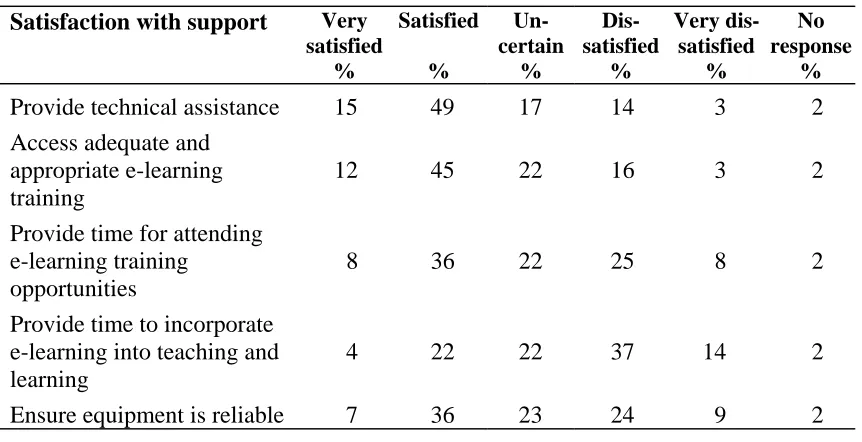
Most of the survey respondents were satisfied with the support provided in relation to technical support and training. However, they were less satisfied with the reliability of equipment and, even less satisfied with the time provided to incorporate e-learning into teaching and learning.
Factors associated with the impact of e-learning
achievement in a college was higher where lecturers used e-learning more frequently for preparation and research for teaching.
The extent and nature of learners’ reported use of e-learning was associated more with their lecturers’ attitudes and use of e-learning than with background and contextual factors. The evidence suggested that there was an association between the way in which lecturers used e-learning and their learners reportedly using it in a similar way. More specifically, lecturers who used e-learning to support a learner-centred approach tended to consider that learners used e-learning more for independent learning and were more effective as independent learners as a result of e-learning.
There appeared to be a close inter-relationship between lecturers’ confidence in, and attitudes towards, e-learning. Moreover, lecturers’ confidence and attitudes were associated with their use of e-learning and perceptions of the outcomes for their learners. Overall, the evidence suggests that there is a complex inter-relationship between these factors and, therefore, that a change in any one could be associated with a change in a number of others.
Having sufficient access was also positively associated with the extent to which lecturers used e-learning when teaching to develop understanding and for sharing materials, suggesting that lecturers may use e-learning more in these ways where they have sufficient access.
Conclusions and implications
In a context of overall positive attitudes, on the part of lecturers, towards e-learning, the research findings indicated that there were some possible barriers and enablers to e-learning use in further education. These included:
• Having an ethos and environment within an institution through which lecturers can improve their confidence, see the potential for e-learning, and have a positive attitude towards its use, could contribute to increasing its use among lecturers and, in turn, learners.
• Ensuring that lecturers have sufficient access to e-learning resources to use in the classroom, in addition to outside class, could be a key enabler in developing lecturers’ confidence in the use of e-learning and increasing its use at the teaching and learning interface. In turn, increased use by lecturers could lead to an increase in the use of e-learning in this way by learners.
1. Introduction
1.1 Introduction
This report sets out the findings from a research study into the impact of e-learning in further education (FE) carried out by a team at the National Foundation for Educational Research (NFER) between August 2005 and February 2006. The study was commissioned by the Department for Education and Skills (DfES) in order to address the need for further empirical evidence regarding the impact of e-learning in FE, including variations across subject areas within FE colleges.
The research was based on a survey questionnaire on the scale and breadth of e-learning, sent to all general FE and sixth form colleges. The survey facilitated detailed exploration of the probable scale of impact of e-learning and the associations between various e-learning inputs and outputs. In order to cover in-college variations, the survey questionnaire was sent to staff in three different subject areas within each institution:
• Business
• Science
• Health and social care.
The detailed findings from the survey, including various forms of statistical analyses of the survey outcomes, are presented in the following chapters. This opening chapter sets out details of the context of the survey, the aims and objectives of the study and the research methodology used. The remainder of this report is divided into four chapters:
• Chapter 2 sets the context by providing an overview of the extent and nature of the use of e-learning: it also presents findings on a variety of contextual factors, including respondents’ perceptions of access to e-learning facilities and the levels of support received.
• In Chapter 3 the focus turns to lecturers’ views on the impact of e-learning: this includes consideration of their views of the impact of e-learning on their own teaching and on their learners.
• Chapter 4 explores the factors which contribute to the impact of e-learning. This chapter examines the extent to which there appears to be a
• A final chapter draws all of this together and sets out the key conclusions arising from the research findings, along with a number of recommendations for policy makers and practitioners.
1.2 Background
The survey of e-learning in FE and sixth form colleges was carried out in a period when the FE sector was experiencing a period of considerable change. The changes that were occurring were of both a general nature and more specifically to do with e-learning and the use of information and learning technologies (ILTs).2
Many of the general discussions about the future of FE were stimulated by the publication of the Foster Review in November 2005. In his report, Realising the Potential – A review of the future role of further education colleges, Sir Andrew Foster summarises a broad review of FE and offers advice on ‘the key strategic issues, challenges and opportunities facing FE colleges over the next five to ten years’ (Foster, 2005, p. v).
Whilst the review does not include a specific chapter on e-learning or ILT, Foster clearly acknowledges and recognises the importance of e-learning for the future of FE, particularly in relation to issues of infrastructure. He notes that: ‘There is much scope for the use of e-learning to enhance the learner’s experience…’, and calls for ‘more and smarter investment in networked colleges and systems’ (Foster, 2005, p. 66, para. 261). In addition, he reiterates the importance of the aims of the Harnessing Technology strategy and makes some specific suggestions about the kinds of ILT tools for which there is a need for further deployment in the FE sector:
The use of technology however is about more than capital investment and there has to be a strategic approach to staff development and the personalisation of learning through, for example, learner tracking tools, diagnostic tools and multi media approaches that improve recruitment, retention and achievement. Technologies should be harnessed to transform teaching and learning in the classroom and beyond... Developing tools and resources for practitioners must be a priority. (Foster, 2005, p. 67, para. 262).
Foster’s emphasis on harnessing technology is consistent with the official approach of promoting the importance of e-learning in recent years. The DfES
2
document Success for All outlined a long-term reform strategy for the further education and training sector, and explicitly recognised the importance of the use of electronic technology to deliver, support and enhance teaching and learning:
E-learning continues to grow in importance in widening post-16 participation and in improving learner retention and achievement… Our aim now is to improve quality, raise standards and increase coherence in e-learning across all post-15 delivery routes (DfES, 2002, p. 32).
A common theme in recent Government documents is to stress the ways in which e-learning can go beyond the traditional classroom context and engage many types of learners. E-learning is flexible and interactive and can shape the opportunities open to all learners to fit around their particular needs and
preferences. As the DfES consultation document, Towards a Unified e-learning Strategy, noted:
It is relevant to all subjects and to learners at every stage of learning or training. E-learning can even reach out and re-engage people who are currently not involved in education because it is interactive, and can adapt to their needs (DfES, 2003, p. 7).
More recently, in March 2005, Harnessing Technology: Transforming learning and children’s services, was published. The e-strategy set out in this document describes the use of digital and interactive technologies to achieve a more personalised approach within all areas of education and children’s services. The strategy is designed to harness technology to the needs of children, learners, parents, teachers, carers, employers and all stakeholders (DfES, 2005, p. 3).
Another aim stressed in the Harnessing Technology guidance on the development of the new technologies in learning is to do with ‘the embedding of e-learning and ICT across the curriculum’ (DfES, 2005, p. 27). At a national level, the promotion of this new, broader emphasis on ILT has been called the Government’s ‘e-learning vision’, which includes the development of ‘e-confidence’. The principle of establishing e-learning across the whole curriculum, currently being promoted in both school and college contexts, is a response to the situation whereby the use of ILT can become ‘locked in’ to particular subject areas or departments.
contribution of e-learning to improvements in the standard of teaching and learning in colleges. In other words, a view may be taken that a large part of the e-learning infrastructure is in place (though this needs a constant process of replacement and updating), but there seem to be considerable variations in terms of the effectiveness of use of this infrastructure. This raises questions about differences in the extent and the nature of use of e-learning across subject, departmental and institutional contexts, and about the capacity of colleges to use e-learning, along with variations in technological progress.
In relation to this issue, and the question of whether ILTs are ‘embedded’ in colleges, a recent report by the British Educational Communications and Technology Agency (Becta) for the Learning and Skills Council revealed that e-learning is still being used in conjunction with traditional teaching and ‘blended learning’ – where use is made of a variety of learning resources and techniques. Moreover the report suggested that:
ICT and e-learning are still largely peripheral to classroom teaching and are most widely used for additional support activities to extend independent learning (Becta, 2004, p. 3).
The Becta research report ‘ICT and e-learning in Further Education: the challenge of change’ (2005) found that:
The average number of staff considered to be competent or advanced in their personal use of ICT grew steadily after 2000 to a level of 77%. Alongside this an average of 59% of college staff were reported to be competent or advanced in using ICT with learners (e-learning skills)
(Becta, 2005, p. 5).
Another research report, The developing impact of ILT, produced by the Learning and Skills Development Agency (LSDA) and Sheffield Hallam University found evidence that while staff often had access to a wide range of technologies, students reported that ‘many of them were only used infrequently’ and ‘teaching staff never used many aspects of ILT’ (2004, p. 10). There is some evidence then, from a student perspective, that e-learning technologies are not being fully utilised.
Frequent reference is made in this report to the use of e-learning, but it needs to be remembered that the term ‘use’ here covers a wide variety of possible activities. A research team from Sheffield Hallam University, based on case
studies of six FE colleges, have examined the various ways in which e-learning is put to use in an FE context (categorised as e-learning uses or
‘ELUs’). These uses are based on the purpose for which the technology is employed and broadly fall into three main groups (Finlayson et al., 2006, p. 9):
A. e-learning as a Medium for facilitating and managing learning. This includes using a VLE [virtual learning environment]… or an intranet to access learning materials including video and online assessment, submit assignments electronically, and using email to send feedback and support…
B. e-learning as a Presentation Tool. This… includes teacher preparation of materials e.g. PowerPoint presentations, worksheets; and presentations on interactive whiteboards. It also includes student use of word processors, desk top publishers, and… presentations to peers and tutors…
C. e-learning as a Learning Tool. The focus here is the use of technology by the students in supervised or unsupervised sessions, with interactive use of interactive whiteboards or distributed computers using software for: engaging with information… calculations and predictions… online data collection… and modelling….
These distinctions between ELUs have been used to inform instrument design in the present study and are also considered in the relevant sections on the findings from the questionnaire survey.
Another factor that may affect the use and effectiveness of e-learning and use in an FE or sixth form college is the extent of the institution’s ‘e-maturity’. The concept of e-maturity is currently an emerging theme in planning around the e-strategy and consequently features as a key concept throughout this
report. It is useful to make a distinction between e-maturity and ‘e-sophistication’, another phrase that is used in this report. The former is
mainly used as a term for the organisational, institutional or ‘systems’ characteristics of e-learning, whereas the latter term is used to describe how sophisticated individuals are as users of e-learning.
In the context of this project, the term e-maturity refers to where the college is in terms of the development and the embedding of its e-learning infrastructure and processes. The Sheffield Hallam University study mentioned above investigated the concept of ‘maturity of ILT development’ and found that:
ILT or targets for creating particular resources to focus on the development of ILT appropriate to the learning being supported. In less mature ILT contexts the focus tended to be on weak uses of ILT, such as use as a rather expensive filing system…[and] The college priorities for VLE and internet use, usually for management of learning rather than enhancement of learning… (Finlayson et al., 2006, p. 22).
The term ‘e-enablement’ overlaps with the notion of ‘e-maturity’. An ‘e-enabled’ institution is one where: ‘there is clear evidence of strategic
thinking around the use of ICT, [and] self-assessment and future willingness to embed ICT are high’ (PricewaterhouseCoopers, 2004, p. 70). A research team from PricewaterhouseCoopers has recently investigated the importance of e-enablement in a school and college context, based primarily on a survey sent to 1,290 institutions (with a 29 per cent response rate) and 24 case-study visits. This study found that ‘Schools all have different starting points…[and] a point that was made frequently is that planning must take account of the pace at which teaching and other staff can accommodate change’
(PricewaterhouseCoopers, 2004, p. 24). This point was also made by Finlayson et al. (2006) who noted that: ‘Colleges in the study varied in how far they had travelled… [and] only in rare and isolated instances was the full potential of ILT harnessed to support teaching and learning’ (2006, p. 18).
All of this illustrates that there are a number of consistencies in the research and policy literature on the uses and effectiveness of e-learning in FE colleges. Common themes include a stress on the importance of harnessing technology for the benefit of teaching and learning, the need to integrate the use of technology in college planning and delivery, and the need to acknowledge variations in such factors as e-maturity and e-enablement. In addition, further themes include the contribution of e-learning to supporting personalised learning, learners’ understanding and efficiency savings for staff and learners. These themes, however, need to be set in a context where there is still only limited research on the impact of e-learning in FE colleges, and where acknowledgement needs to be made that there are numerous complexities in the relationship between e-learning input and student and lecturer outcomes.
1.3 Aims and objectives
A key aim of the research has been to establish relationships between e-learning use and outcomes for learners and staff in FE. In addressing this
aim, the research had the following objectives:
• to examine the associations between the use of ILT and e-learning and intermediate outcomes for learners and staff, taking into consideration a range of influential factors related to the institutions, teaching staff, subjects and learners
• to explore the policy implications of the use of ILT and e-learning in the FE sector.
As noted above, it needs to be acknowledged that the relationships between the use of e-learning and outcomes for learners are complex and influenced by a wide variety of factors. This makes it very difficult to measure, even indirectly, the impact of using these technologies on achievement and attainment. In exploring these issues the research has investigated a number of key research questions, including the following:
Research questions
• Does frequency of use have any impact on outcomes: e.g. does greater ILT use lead to better learner motivation?
• What forms of organisation of e-learning (or managed learning environments) are associated with more positive learner outcomes, e.g. use of a Virtual Learning Environment (VLE) or intranet?
• What are the patterns of ILT use and e-learning exposure across different subject areas and courses?
• What are the characteristics of tutors who are (a) most experienced in using e-learning; (b) more positive about the impact of e-learning?
• Are there any links between the levels of e-learning/ILT use within a college and other college level variables such as size of college, retention rates and average student points score?
• What relationships (if any) exist between tutors’ confidence and ILT competence levels and their perceptions of student autonomy, skills and motivation?
• What are tutors’ views regarding the advantages and disadvantages of e-learning over other types of learning? What are tutors’ suggestions regarding maximising the uses of new technology in FE colleges?
• What constitutes good practice in e-learning? What forms of professional development and support would be most beneficial?
1.4 Research
methods
The questionnaire
The questionnaire was designed by the research team in collaboration with the steering group, and development was informed by a pilot exercise with 17 staff in three colleges. Questions for Heads of Department and teaching staff were integrated into one questionnaire. The questionnaire aimed to ascertain details of lecturers’ use of e-learning and to explore their views of its impact on teaching and learning. The questionnaire consisted predominantly of pre-coded questions with two open-ended questions, and provided information regarding lecturers’:
• background characteristics
• use of e-learning and their perception of learners’ use
• perceptions of the impact of e-learning on teaching and learning
• views on their current experience and practice of using e-learning
• views on the potential of e-learning to improve teaching and learning.
The survey focused on three subject areas – health and social care, science, and business – in order to take into account possible within-college variations in the use of e-learning. Respondents had the choice of completing either a paper copy of the questionnaire or an online version.
As noted in Section 1.2, the research reported on here builds on the findings from a qualitative study of the use of e-learning in FE conducted by Sheffield Hallam University. This qualitative research also focused on three subject areas: health and social care, science and mathematics. (Business was substituted for mathematics in the present study because of the large numbers of lecturers involved in business and because business is an area of FE which includes high levels of e-learning and ILT use).
The sample
A total of 10,110 questionnaires were dispatched across 355 general FE colleges and sixth form colleges in England. Heads of Department in each of the three subject areas were identified and were each sent a batch of ten questionnaires. Their help was requested in completing a questionnaire and in distributing the remaining questionnaires to colleagues in their department. This approach enabled a large enough sample of lecturers to be surveyed to facilitate an exploration of the ways in which e-learning is used in the main types of further education providers.
Table 1.1 Sample breakdown
Type of institution Number contacted
Returns (number)
Response (%)
General FE colleges 251 235 94
Sixth form colleges 102 84 82
Total 353 319 90
Source: NFER Survey of college lecturers, 2005.
The sample was derived from Edubase data held on all sixth form colleges (including voluntary aided and voluntary controlled) and general FE colleges (including tertiary colleges) in England. Sixth form centres and specialist colleges, including art and design colleges and agricultural colleges, were excluded from the sample.
Questionnaire returns and coverage of subject areas
The survey was undertaken between October and November 2005. Two reminder letters were sent, one with an additional copy of the questionnaire, and a targeted telephone reminder of non-responding colleges was conducted. A total of 2,295 questionnaires were returned, representing 23 per cent of all those dispatched. Five per cent of these were completed online (see Table 1.2 below).
Table 1.2 Questionnaire level returns by subject area
Department Sent Returned (paper)
Returned (online)
Returned (total)
Response (%)*
Business 3500 777 39 816 23
Health and Social
Care 3420 764 30 794 23
Science 3190 645 40 685 21
Total 10110 2186 109 2295 23
Source: NFER Survey of college lecturers, 2005.
*The response rate is the resulting percentage of the number of questionnaires returned divided by the number sent out. The response rate can also be calculated by using the mean figure for the size of departments reported by Heads of Department in the questionnaire, divided by the number of completed questionnaires. This produces a total response rate of 27 per cent.
As can be seen in Table 1.2, a similar response rate was achieved in each of the three subject areas. Overall, the response represents a good coverage of the departments and colleges.
[image:22.595.84.512.387.506.2]• size of institution (in terms of number of learners)
• average pass rates
• average retention rates
• assessment of quality of teaching in each of the focus subject areas.
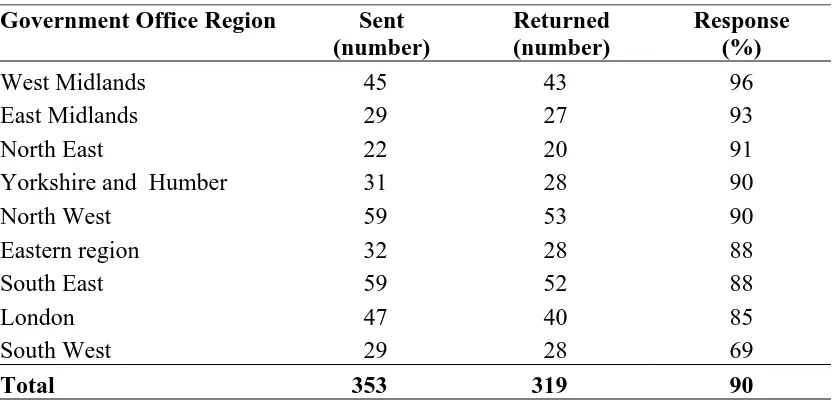
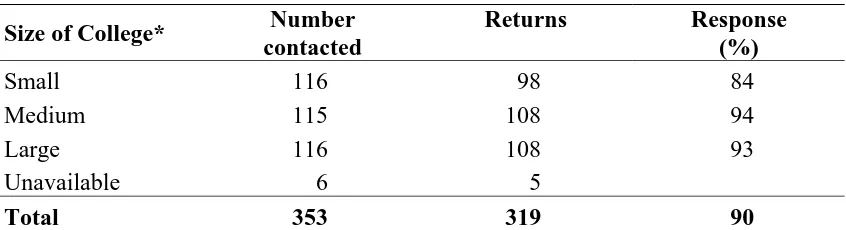
[image:23.595.90.506.239.440.2]The regional breakdown of those who responded, presented in Table 1.3, and the size of the responding colleges, detailed in Table 1.4, are further evidence that the responses received reflect the picture nationally.
Table 1.3 General FE and sixth form colleges by regional location
Government Office Region Sent (number)
Returned (number)
Response (%)
West Midlands 45 43 96
East Midlands 29 27 93
North East 22 20 91
Yorkshire and Humber 31 28 90
North West 59 53 90
Eastern region 32 28 88
South East 59 52 88
London 47 40 85
South West 29 28 69
Total 353 319 90
Source: NFER Survey of college lecturers, 2005.
In general a higher proportion of colleges from the north of England and the midlands submitted responses along with a correspondingly lower proportion from the south. However, the general profile of the respondents is still representative of the sector in terms of institutional type and geographical distribution.
Table 1.4 General FE and sixth form colleges by size
Size of College* Number contacted
Returns Response (%)
Small 116 98 84
Medium 115 108 94
Large 116 108 93
Unavailable 6 5
Total 353 319 90
*Using data from ALI/Ofsted, three designations for size of college have been established. A small college is defined as having fewer than 10,363 students, a medium sized college as having between 10,364 and 21,018 students, and a large college as having more than 21,019 students. No information was available for six of the colleges.
This information indicates that the colleges from whom questionnaire responses were received were broadly representative of all colleges nationally. Therefore the views of the lecturers reflect the experience of those from a suitable range of institutions.
1.5 Profile of respondents
The following represents a summary of the main characteristics of the lecturers who responded to this survey: full details are outlined in Appendix A.
The majority of respondents were female (60 per cent), with 34 per cent male, and six per cent declined to answer. This proportion is broadly in line with national figures for FE colleges which are 59 per cent female and 41 per cent male. This contrasts with employment status where 79 per cent of respondents were full time and 21 per cent part time, whereas nationally in FE colleges 38 per cent are full time and 62 per cent part time.
were significantly more likely to consider that they were confident in using e-learning and were more content with their access to resources.
These findings suggest that, while overall the views of part-time and full-time lecturers did not differ markedly, where they did, the full-time lecturers used e-learning more and were slightly more confident and satisfied with access. While the regression analysis presented in Chapter 4 takes these differences into account, the descriptive analyses presented in Chapters 2 and 3 may, therefore, reflect a slightly more positive perspective of full-time lecturers than would be the case were the responding sample more representative of part-time lecturers.
The majority of respondents (74 per cent) were based in FE colleges and 26 per cent in sixth form colleges. In terms of levels of experience, 49 per cent of respondents had over ten years of teaching in post-16 institutions overall and 33 per cent had this level of experience in their present college. Fifty per cent had ten years or less experience of teaching in the post-16 environment and 64 per cent had taught for ten years or less in their present institution. Lecturers had been teaching for an average of 12 years in the post-16 environment.
In addition to lecturing responsibilities, half of respondents were course leaders, 21 per cent were Heads of Department and seven per cent held the role of coordinator of e-learning within their subject-based department. This varied by subject department: in health and social care 57 per cent of respondents were course leaders and 17 per cent Heads of Department, whilst corresponding figures for business were 55 and 22 per cent. Science had the lowest proportion of course leaders (43 per cent) and the highest proportion of Heads of Department (30 per cent). Heads of Departments reported having an average3 number of 13 full and part-time teaching staff in their department. Although the majority of respondents to the survey did not have an e-learning specific role, it is possible that lecturers who were enthusiastic about the use of e-learning may have been more likely to respond to the questionnaire. Consequently, the views of lecturers who responded to this survey may reflect a more positive and proactive viewpoint than may be the case among further education lecturers as a whole.
In terms of the Levels of qualification taught by respondents, Level 3 was the predominant Level as the majority of lecturers (82 per cent) reported doing at least some teaching at Level 3 and 51 per cent said that they taught predominantly at this Level. Level 2 was also important with over half (58 per cent) teaching at this Level and 13 per cent concentrating on it. There were diverse qualifications taught, with nearly two-thirds (64 per cent) of lecturers teaching NVQs, National Certificates and Diplomas and other vocational qualifications, and 44 per cent teaching AS/A2 levels and AVCEs. Other
qualifications taught by respondents included GCSEs (16 per cent), professional qualifications (15 per cent), Foundation degrees (12 per cent) and GNVQs and other Higher Education courses (nine per cent).
2. Extent and nature of use of e-learning
Key findings
• The majority of lecturers were using e-learning extensively as a preparation and presentational tool, and in some areas as a medium for facilitating teaching and learning (making course materials available to learners and sharing them with colleagues) and as a learning tool (developing learners’ understanding).
• Lecturers’ perceptions were that e-learning was being used by learners most for researching topics, and presenting written work and least for catching up on missed lectures, working collaboratively with peers outside of the classroom and contacting lecturers with queries.
• Nearly all lecturers reported that their institutions had used an intranet and two-thirds said that they had access to a Virtual Learning Environment (VLE).
• Most lecturers felt they had sufficient access to e-learning resources. However, lecturers appeared to be less satisfied with access to e-learning resources to use in the classroom.
• Lecturers were broadly satisfied with the support available, but were least satisfied with the amount of time provided to incorporate e-learning into teaching and learning practice.
• The majority of lecturers were positive about their current e-learning practice. Although many were determined to use e-learning to its full potential, nearly all pointed out that e-learning was only one useful tool.
• Overall teaching staff claimed to feel fairly confident about using e-learning in their teaching and learning with the notable exception of the
activity of tracking and monitoring learner progress.
2.1 Introduction
Before exploring lecturers’ perceptions on the impact of e-learning on their teaching, on learners and their views on the potential of e-learning (Chapter 3), it is necessary to explore the extent and nature of their use of e-learning. This
chapter provides contextual information on the levels and patterns of e-learning use by lecturers and learners from the lecturers’ viewpoint. It
2.2 Frequency and nature of use by lecturers
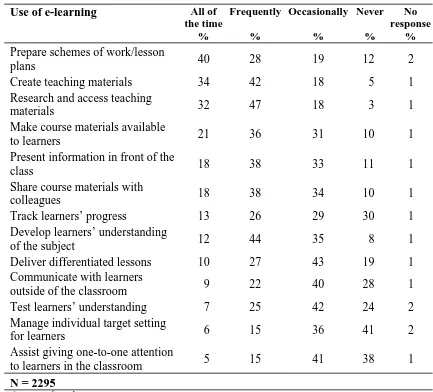
Teaching staff used e-learning in a variety of ways as can be seen in Table 2.1 below. It is worth exploring these in light of the way Finlayson et al. (2006) categorised e-learning uses and in terms of how the uses outlined in Table 2.1 fit within these, as detailed below. It is worth noting that, the three categorisations identified by Finlayson et al. (2006) do not refer to lesson preparation as a single entity, but divide this between presentation and the management of teaching and learning (e-learning as a medium). However, lesson preparation in this survey was not divided in this way. Therefore, the classification of ‘presentational use’ has been extended in this report to incorporate lesson planning and preparation of schemes of work and is referred to as ‘preparation and presentational tool’.
• e-learning as a medium for facilitating and managing learning:
! make course materials available to learners
! share course materials with colleagues
! communicate with learners outside the classroom
! manage individual target setting
! test learners’ understanding
! track learners’ progress.
• e-learning as a preparation and presentational tool:
! prepare schemes of work
! research and access teaching materials
! create teaching materials
! present information in front of the class.
• e-learning as a learning tool:
! provide one-to-one attention
! develop understanding
! deliver differentiated lessons.
Table 2.1 Frequency of use of e-learning by lecturers
Use of e-learning All of the time
%
Frequently %
Occasionally %
Never %
No response
%
Prepare schemes of work/lesson
plans 40 28 19 12 2
Create teaching materials 34 42 18 5 1 Research and access teaching
materials 32 47 18 3 1
Make course materials available
to learners 21 36 31 10 1
Present information in front of the
class 18 38 33 11 1
Share course materials with
colleagues 18 38 34 10 1
Track learners’ progress 13 26 29 30 1 Develop learners’ understanding
of the subject 12 44 35 8 1
Deliver differentiated lessons 10 27 43 19 1 Communicate with learners
outside of the classroom 9 22 40 28 1
Test learners’ understanding 7 25 42 24 2 Manage individual target setting
for learners 6 15 36 41 2
Assist giving one-to-one attention
to learners in the classroom 5 15 41 38 1
N = 2295
A series of single response items
Due to rounding, percentages may not always sum to 100
A total of 2292 respondents answered at least one item in this question Source: NFER Survey of college lecturers, 2005.
Lecturers were using e-learning as a medium for facilitating and managing learning in some respects quite extensively, namely for making course materials available to learners (57 per cent were using it all of the time or frequently) and for sharing course materials with colleagues (56 per cent were using it all of the time or frequently). In both cases only one in ten respondents were never using e-learning for these purposes. On the other hand, the evidence points to less e-learning use in the areas of:
• Tracking learners’ progress (39 per cent reported doing this all of the time or frequently and 30 per cent were never doing this)
• Testing learners’ understanding (32 per cent reported doing this all of the time or frequently and 24 per cent were never doing this)
• Managing individual target setting for learners (21 per cent were doing this all of the time or frequently and 41 per cent were never doing this).
E-learning was being used as a learning tool in terms of developing learners’ understanding of the subject (56 per cent were using e-learning in this way all of the time or frequently) and only eight per cent were never using e-learning in such a way. However, e-learning was not being used as extensively as a learning tool in other aspects, namely for delivering differentiated lessons (37 per cent were using e-learning in this way all of the time or frequently and 19 per cent were never using it) and for giving one-to-one attention to learners in the classroom (20 per cent all of the time or frequently and 38 per cent never).
This would indicate that although e-learning was being used quite extensively as a preparation and presentational tool, and in some areas as a medium for facilitating teaching and learning (making course materials available to learners and sharing them with colleagues) and as a learning tool (developing learners’ understanding), it is not being used as comprehensively in other ways associated with use as a medium and as learning tool. The reasons for this disparity of use are explored in subsequent sections in this chapter and in Chapter 4.
2.3 Lecturers’ perception of the frequency and nature of use
of e-learning by learners
This survey was of lecturers in sixth form and FE colleges, and not of learners. However, in order to explore the extent of learners’ use, lecturers were asked about their perceptions of the ways in which learners were using e-learning.
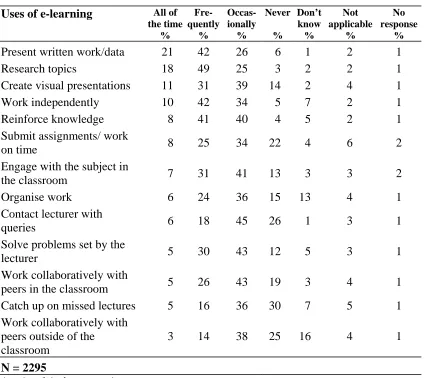
Table 2.2 Frequency of use of e-learning by learners in the last academic year
Uses of e-learning All of the time % Fre- quently % Occas- ionally % Never % Don’t know % Not applicable % No response % Present written work/data 21 42 26 6 1 2 1
Research topics 18 49 25 3 2 2 1
Create visual presentations 11 31 39 14 2 4 1 Work independently 10 42 34 5 7 2 1 Reinforce knowledge 8 41 40 4 5 2 1 Submit assignments/ work
on time 8 25 34 22 4 6 2
Engage with the subject in
the classroom 7 31 41 13 3 3 2
Organise work 6 24 36 15 13 4 1
Contact lecturer with
queries 6 18 45 26 1 3 1
Solve problems set by the
lecturer 5 30 43 12 5 3 1
Work collaboratively with
peers in the classroom 5 26 43 19 3 4 1
Catch up on missed lectures 5 16 36 30 7 5 1 Work collaboratively with
peers outside of the classroom
3 14 38 25 16 4 1
N = 2295
A series of single response items
Due to rounding, percentages may not always sum to 100
A total of 2292 respondents answered at least one item in this question Source: NFER Survey of college lecturers, 2005.
The two main ways in which lecturers perceived learners were using e-learning (presenting written work and researching topics) were ways
outside of the classroom 17 per cent all of the time and frequently and 25 per cent never).
It is worth noting that approximately one in five respondents felt unable to comment on the degree to which learners used e-learning to work collaboratively with their peers outside of the classroom or to organise their work.
The previous two sections have described the frequency and use of e-learning by lecturers and learners from the perspective of the lecturer. But what are the factors that influence these patterns of use? The following sections examine lecturers’ perceptions of their access to e-learning facilities, their views on the support received, their current experience and their confidence in the use of e-learning. This examination goes some way to explaining patterns of use, but further illumination of these relationships is offered in Chapter 4.
2.4 Access to e-learning facilities
Nearly all lecturers reported that their institutions had used an intranet and two-thirds said that they had access to a Virtual Learning Environment (VLE), as can be seen in Table 2.3 below.
Table 2.3 Existence of VLE and intranet in college
Yes
%
No
%
Don’t know
%
No response
% Virtual Learning Environment (VLE) 66 16 13 5
Intranet 95 1 1 4
N = 2295
A series of single response items
Due to rounding, percentages may not always sum to 100
A total of 2295 respondents answered at least one item in this question Source: NFER Survey of college lecturers
There was evidence that a greater proportion of lecturers in larger colleges reported having an intranet or a VLE: this was particularly apparent with regard to the VLE, where 74 per cent of lecturers in medium and large colleges maintained that they had access to a VLE whilst 56 per cent in small colleges had access.
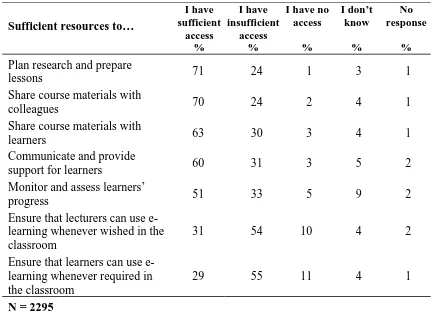
monitor and assess learners’ progress (although one in ten either did not know or did not respond to this item).
[image:34.595.82.515.282.593.2]Lecturers appeared to be less satisfied with the extent to which they had sufficient access to e-learning resources to use in the classroom. Two-thirds (66 per cent) reported that they had insufficient or no access to resources to ensure that learners could use e-learning whenever required in the classroom, or whenever lecturers wished to use it in the classroom (64 per cent). This apparent constraint on possible e-learning use in classroom-based teaching and learning activities may affect the extent to which lecturers and learners used e-learning in this way, and it seems that lecturers would like to be able to make greater use of e-learning in the classroom.
Table 2.4 Lecturers’ satisfaction with access to e-learning resources
Sufficient resources to…
I have sufficient access % I have insufficient access %
I have no access % I don’t know % No response %
Plan research and prepare
lessons 71 24 1 3 1
Share course materials with
colleagues 70 24 2 4 1
Share course materials with
learners 63 30 3 4 1
Communicate and provide
support for learners 60 31 3 5 2
Monitor and assess learners’
progress 51 33 5 9 2
Ensure that lecturers can use e-learning whenever wished in the classroom
31 54 10 4 2
Ensure that learners can use e-learning whenever required in the classroom
29 55 11 4 1
N = 2295
A series of single response items
Due to rounding, percentages may not always sum to 100
A total of 2283 respondents answered at least one item in this question Source: NFER Survey of college lecturers, 2005
2.5 Lecturers’ views on support received
Table 2.5 Satisfaction with the support available to assist use of e-learning
Satisfaction with support Very satisfied % Satisfied % Un- certain % Dis- satisfied % Very dis- satisfied % No response %
Provide technical assistance 15 49 17 14 3 2 Access adequate and
appropriate e-learning training
12 45 22 16 3 2
Provide time for attending e-learning training
opportunities
8 36 22 25 8 2
Provide time to incorporate e-learning into teaching and learning
4 22 22 37 14 2
Ensure equipment is reliable 7 36 23 24 9 2 N = 2295
A series of single response items
Due to rounding, percentages may not always sum to 100
A total of 2271 respondents answered at least one item in this question Source: NFER Survey of college lecturers, 2005.
Dissatisfaction was apparent in terms of not having enough time to attend e-learning training opportunities and not having sufficient support to ensure the reliability of equipment (33 per cent dissatisfied or very dissatisfied in both cases). However, it is in the area of teaching and learning where most dissatisfaction was expressed, with around half of respondents unhappy with the amount of time provided for lecturers to incorporate e-learning into teaching and learning (51 per cent dissatisfied or very dissatisfied).
There was significantly more dissatisfaction shown amongst lecturers in medium and large colleges, than amongst smaller institutions, in relation to:
• the provision of time for attendance at e-learning training
• the provision of time for incorporating e-learning into teaching and learning practice, and
• the level of support to ensure the availability of reliable equipment.
2.6 Lecturers’ views on current experience of using
e-learning
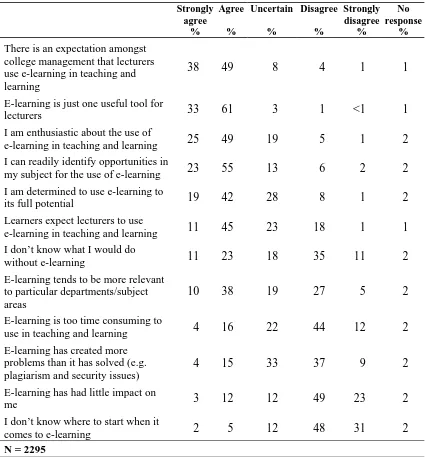
[image:36.595.86.511.242.699.2]On the whole lecturers were positive when reflecting on their current experience and practice of using e-learning. As can be seen in Table 2.6 below, 78 per cent of lecturers agreed, to some extent, that they could readily identify opportunities in their subjects for the use of e-learning and three-quarters (74 per cent) professed to be enthusiastic about the use of e-learning in teaching and learning.
Table 2.6 Lecturers’ views on e-learning
Strongly agree % Agree % Uncertain % Disagree % Strongly disagree % No response %
There is an expectation amongst college management that lecturers use e-learning in teaching and learning
38 49 8 4 1 1
E-learning is just one useful tool for
lecturers 33 61 3 1 <1 1
I am enthusiastic about the use of
e-learning in teaching and learning 25 49 19 5 1 2
I can readily identify opportunities in
my subject for the use of e-learning 23 55 13 6 2 2
I am determined to use e-learning to
its full potential 19 42 28 8 1 2
Learners expect lecturers to use
e-learning in teaching and learning 11 45 23 18 1 1
I don’t know what I would do
without e-learning 11 23 18 35 11 2
E-learning tends to be more relevant to particular departments/subject areas
10 38 19 27 5 2
E-learning is too time consuming to
use in teaching and learning 4 16 22 44 12 2
E-learning has created more problems than it has solved (e.g. plagiarism and security issues)
4 15 33 37 9 2
E-learning has had little impact on
me 3 12 12 49 23 2
I don’t know where to start when it
comes to e-learning 2 5 12 48 31 2
N = 2295
A series of single response items
Due to rounding, percentages may not always sum to 100
Lecturers tended to agree (to some extent) that there was an expectation that they should be using e-learning in their teaching and learning, particularly from college management (87 per cent), but also from learners (56 per cent). And nearly two-thirds (61 per cent) were determined to use e-learning to its full potential. Furthermore, just seven per cent of respondents admitted that they did not know where to start with e-learning and only 15 per cent felt that e-learning had had little impact on them. This suggests that the majority of
respondents to this survey were positive and proactive in their use of e-learning and intention to use it. Nevertheless, a notable minority were less
confident and their views may reflect the experience of a wider cohort of lecturers who did not respond to the survey.
Despite their overall enthusiasm and positive attitudes, lecturers were aware of some limitations. More than nine out of ten lecturers (94 per cent) qualified their enthusiasm by agreeing (to some extent) that e-learning was just one useful tool for lecturers, nearly half (48 per cent) agreed that e-learning tended to be more relevant to particular subject areas and only a third (34 per cent) felt they didn’t know what they would do without e-learning.
One in five respondents believed that e-learning was too time consuming to use in teaching and learning, and a further 22 per cent were uncertain about this. Plagiarism and other problems associated with e-learning were another area of unease: one in five lecturers believed e-learning had created more problems than it had solved and an additional one-third were undecided about this issue.
2.7 Effective use of e-learning
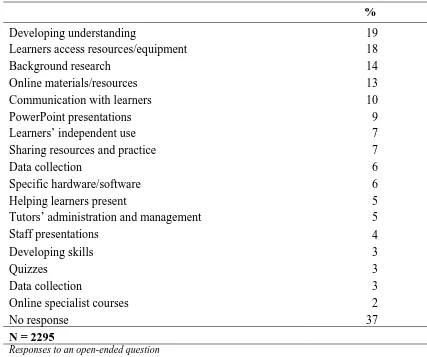
Table 2.7 Examples of effective use of e-learning
%
Developing understanding 19
Learners access resources/equipment 18
Background research 14
Online materials/resources 13
Communication with learners 10
PowerPoint presentations 9
Learners’ independent use 7
Sharing resources and practice 7
Data collection 6
Specific hardware/software 6
Helping learners present 5
Tutors’ administration and management 5
Staff presentations 4
Developing skills 3
Quizzes 3
Data collection 3
Online specialist courses 2
No response 37
N = 2295
Responses to an open-ended question
More than one answer could be given so percentages do not sum to 100 Source: NFER Survey of college lecturers, 2005.
As shown in Table 2.7, approximately one in five lecturers provided examples of effective use of e-learning which indicated a cognitive use, predominantly in the development of learners’ understanding. Such uses included:
• the interactive use of e-learning, for example:
We visit computer rooms during lessons so the students can use interactive sites to reinforce the subject material (science lecturer).
We use interactive maths software to gain insight into graphs etc.
(health and social carelecturer).
• learners’ increased engagement with online provision, for example:
Ten hours per week are devoted to online tutorial access for students. This has proved very effective (healthand social carelecturer).
• animations/visual representations of complex concepts, for example:
Animations showing processes occurring at a sub microscopic cellular level are a great aid to visualising activities which are too small a scale to be observed (sciencelecturer).
We use medical animations to highlight particular processes in the body (health and social carelecturer).
• demonstrations of equipment/experiments that are not available in college, for example: ‘Simulations of experiments we’re not able to do in the lab’
(sciencelecturer).
• supports reinforcement, for example, ‘We reinforce knowledge via summaries and revision using online interactive quizzes and multi-choice questions’ (businesslecturer).
• demonstration of approaches/techniques/structure, for example:
We demonstrate approaches, for example how to research subjects or topics and how to complete a spreadsheet or use formulae (business lecturer).
Many lecturers gave examples of effective use of e-learning which referred to learners’ access to resources and equipment. These included references to accessing practice papers, online tests, course materials, including primary, secondary and extension materials, for example:
I have found putting resources on the VLE, particularly for GCSE Applied ICT, very useful as this saves them hunting around the examining body’s website. It means I can also make it available in a compatible format (businesslecturer).
Another effective use of e-learning mentioned by a large proportion of teaching staff was background research. Many indicated that the internet was widely used for sources for coursework and essays, to obtain up-to-date information and to conduct independent research. Some lecturers mentioned the fact that they could direct learners to appropriate websites and embed links into their lesson materials.
2.8 Lecturers’ confidence in the use of e-learning
disagreed (to some extent) or were uncertain about using e-learning to track and monitor learners’ progress.
Table 2.8 Lecturers’ confidence in using e-learning
I feel confident using e-learning: Strongly agree % Agree % Uncertain % Disagree % Strongly disagree % No response % To plan and prepare lessons 44 39 9 6 1 2 To communicate with learners 31 41 16 9 2 2 With learners in the classroom 30 43 15 8 2 2 To track and monitor learners’
progress 20 33 27 15 3 2
N = 2295
A series of single response items
Due to rounding, percentages may not always sum to 100
A total of 2265 respondents answered at least one item in this question Source: NFER Survey of college lecturers, 2005.
E-sophistication
Further analysis was conducted in order to gain an idea of how conversant lecturers were with digital technology in teaching and learning. To understand this, both the depth and breadth of their use was explored. Those who used e-learning extensively either in terms of the amount of time they spent using it (depth) or in terms of the range of uses to which they commonly put it (breadth) could be described as e-sophisticated. In terms of depth, the analysis examined whether there was a sub-group of lecturers within the responding sample who used e-learning as a medium, a preparation and presentation tool, or learning tool, all of the time. Where this was the case, these lecturers could be described as ‘sophisticated’ e-learning users. Conversely, the analysis explored whether there was a sub-group of lecturers who never used e-learning in the respects suggested by Finlayson et al. (2006). These lecturers could be described as not yet e-sophisticated.
The responses of lecturers to the groups of questions that were associated with e-learning use as a medium, as a preparation and presentation tool, and as a learning tool were examined. Although there did not appear to be a clear pattern of responses to the use of e-learning as a medium, it appeared that:
• eleven per cent of lecturers (241 individuals) used e-learning all of the time
for all aspects of use as a preparation and presentation tool
• two per cent of lecturers (42 individuals) never used e-learning as a preparation and presentation tool
• three per cent of lecturers (77 individuals) used e-learning all of the time as a learning tool
Further analysis revealed that just over a fifth (22 per cent) of respondents indicated that they used e-learning frequently or all of the time in most (between ten and 13) of the different ways identified in Table 2.1. Again, this suggests that there is a minority of respondents among this sample who are commonly using e-learning in a wide range of different aspects of their teaching and learning practice.
This suggests that lecturers’ use of e-learning was not necessarily clustered such that they used e-learning all of the time in one particular way, nor that their range of use was all-encompassing, rather they used it in a limited number of associated ways. The factors that were associated with the frequency of use of e-learning in different ways are explored more fully in Chapter 4.
Subject differences
Lecturers in the three subject areas of business, science and health and social care were most consistent in their use of e-learning as a presentational tool (apart from in relation to presenting in front of the class, where fewer health and social care lecturers were using e-learning). In terms of e-learning as a medium for facilitating and managing learning, business lecturers were using e-learning more frequently and health and social care least frequently.
Business lecturers were also more open to using e-learning as a learning tool, with significantly fewer saying they never used e-learning to deliver differentiated lessons and to give one-to-one attention to learners than their colleagues in other departments.
E