This report has been commissioned by the Office of Qualifications and Examinations Regulation.
Comparative Analysis of A Level Student Work
Final Report
Contract Ref. OF151
Alpha
Plus
Consultancy Ltd
Jenny Smith, Angus Alton, Tom Mitchell
Contents
Executive summary ... i
Methodology ... i
Limitations of the study ... ii
Summary and conclusions ... iii
1
Introduction to the final report ... 1
1.1 Background to the research ... 1
1.2 Research objectives ... 2
1.3 Introducing the concept of stretch and challenge ... 2
2
Methodology ... 4
2.1 Approach to the research ... 4
2.2 Sources and methods of data collection... 4
2.2.1 Materials used in the research ... 4
2.2.2 Personnel involved in the review ... 5
2.2.3 Research approach... 6
2.3 Limitations of the study ... 8
2.4 The scope and limitations for this report ... 11
3
Research findings ... 12
3.1 Main changes to specifications in 2010 ... 12
3.2 Stretch and challenge evidenced across the grade profiles ... 15
3.3 Link between stretch and challenge and breadth and depth of subject knowledge ... 18
3.4 Compression in assessment of subject knowledge ... 19
3.4.1 Reframing or classification of the subject ... 21
3.5 The relationship between specifications and assessment ... 21
3.6 The A* grade in terms of stretch and challenge and mastery of subject ... 22
3.6.1 French ... 22
3.6.2 Geography ... 23
3.6.3 Media studies... 25
3.6.4 Physics ... 26
3.6.5 Psychology ... 28
3.6.6 English literature (1) ... 30
3.6.7 English literature (2) ... 31
3.6.8 English literature (4) ... 32
3.7 Evidence of development of skills between AS and A2 ... 33
3.8 The extent and impact of variation observed within English literature specifications across awarding organisations ... 34
Executive summary
The Awarding Body Data Archive (ABDA) is a longitudinal project designed to explore the impact of the changes to the structure of GCSE and A level qualifications.1 One of the areas it was set up to investigate was the impact of the changes to the structure of A levels in terms of the quantity and quality of student work produced in response to the new awards for 2010.
This research project, The Comparative Analysis of A Level Student Work, was commissioned by Ofqual as part of the ABDA study. The research was undertaken by AlphaPlus Consultancy Ltd over a three-month period between December 2011 and February 2012, using a methodology employed by Ofqual in previous comparative studies. The research focused on evidence of any difference, or similarities, between the 2008 and 2010 specifications and students’ performance in the examinations with particular reference to stretch and challenge and the introduction of the A* grade. Research questions developed by Ofqual for the study were:
1. Have the change from six to four units and the introduction of stretch and challenge been effective in improving breadth of knowledge and understanding of the subject?
2. Is there any evidence of stretch and challenge in the responses across the grade levels?
3. How do candidates progress between AS and A2?
4. Is there evidence that candidates can achieve A* without doing the stretch and challenge elements?
5. Has the introduction of A* made it possible to differentiate the most able candidates?
6. What does A* performance look like?
In isolation from other datasets, this initial work can only give an indication of the impact that the changes to A levels have had in practice on the syllabus and student outcomes. It is very important to note that the specifications were selected as likely to highlight an interesting range of subjects and to balance the data collection burden evenly across awarding
organisations. It was not the intention of the study to identify individual awarding organisation practice, and for this reason no awarding organisation names are associated with any
specification in this report.
Methodology
This project uses a range of methods and includes the analysis of a sample of candidate work and accompanying documents from the 2008 and 2010 examination series collected as part of the ABDAproject. The subjects included were English literature, French, geography, media studies, physics and psychology. For all the subjects except English literature a single
1
awarding organisation supplied the materials for their specification. For English literature, all five awarding organisations supplied materials.2 This was to allow investigation of the range of ways the changes were effected within a subject as well as across a range of subjects.
The initial phase of the research design focused on developing a set of non-subject-specific stretch and challenge indicators as a research framework to support the identification of stretch and challenge across students’ work from different A level subjects.3
The approach used for the review of materials was essentially qualitative, building on existing ways of investigating examination materials. It involved a two-stage process. The first stage involved a structured analysis of the assessments, gathering factual information about the exact nature of those assessments and then evaluating them in terms of demand. The second stage involved evaluation of the work produced by candidates in response to those assessments. Subject reviewers were asked to rate candidate work in terms of its stretch and challenge qualities, and to put the candidates into an overall rank order in terms of their overall level of attainment.
For the rating exercise, reviewers were asked to provide a qualitative comment on each candidate’s work in terms of the extent to which it displayed the key aspects of stretch and challenge, and then to rate each candidate on a 10-point scale, where 0 indicated no evidence of the higher-order skills associated with stretch and challenge.
For the ranking exercise, the task for reviewers was to place each candidate into an overall rank order (covering the candidates from both years), again providing a comment to explain which factors were decisive. The reviewers were instructed to base their ranking on a general view of subject ability, using the assessment objectives and published performance descriptions for grades A and E to inform them.
Limitations of the study
Although the exercise has generated a great deal of qualitative data, and it has been
possible to subject some of this data to statistical analysis, it is important to note a number of caveats, and as a result to treat the outcomes cautiously.
Choice of specifications – For most of the subjects, only one of the specifications available was reviewed for a given year.
Number of reviewers – Subject reviewers were chosen from Ofqual’s panel of subject experts, and there were a maximum of three reviewers per subject.
Nature of materials – Although there was a wide range of scripts reviewed, there were very few at each grade. Any a-typicality in any of these scripts (and a balanced
2 Where the awarding organisation offered more than one specification in the subject, the materials were supplied for the specification which was closest to the ones supplied by the other awarding organisations.
3
The indicators developed were: creating connections: identification of related concepts and making comparisons,
performance across the units is, of itself, relatively unusual) would inevitably have a large impact on the outcomes in an exercise such as this.
Summary and conclusions
Research question 1
Have the change from six to four units and the introduction of stretch and challenge been effective in improving breadth of knowledge and understanding of the subject?
One of the main findings of this study relates to the introduction of stretch and challenge at the same time as the reduction in assessment (typically from six units to four). The net effect of introducing these two changes concurrently has not been entirely uniform across subjects, but often the reduction in assessment is seen to have worked against the introduction of stretch and challenge. This was not just an issue for specifications that had been reduced to two units at A2. In physics, for example, the removal of the synoptic unit meant that
candidates in 2010 had less opportunity to show an overall grasp of the whole course and to show their ability to connect different topics.
Research question 2
Is there any evidence of stretch and challenge in the responses across the grade levels?
The analysis of the scripts suggested that there is a strong positive relationship between A level UMS score and the level of stretch and challenge evidenced within the candidate work, which supports the view that stretch and challenge is being seen at all grades. The qualitative data, however, suggests that for some subjects although stretch and challenge is evidenced in the work of higher-attaining candidates and mark schemes often reward this, some aspects of stretch and challenge are prioritised above others to the detriment, in the view of the subject reviewers, of the study and understanding of the subject as a discipline. There is not sufficient evidence therefore to suggest that the introduction of stretch and challenge has had a widespread positive impact on breadth of knowledge and
understanding of a subject, with the exception of media studies and, to some extent, English literature and French.
Research question 3
How do candidates progress between AS and A2?
The pattern of progression between AS and A2 is uneven across the subjects. The gap between AS and A2 is perceived to have widened (to varying degrees) in English literature, psychology and French. The gap between AS and A2 is perceived to have got narrower
Research question 4
Is there evidence that candidates can achieve an A* without doing the stretch and challenge elements?
There are two aspects to this question. First, in subjects such as English literature, media studies and, to an extent, geography, the nature of the assessment consists almost entirely of extended writing. Here, as the banded mark schemes make clear, the stretch and
challenge elements are almost impossible to disentangle from those specific to subject knowledge, and it would be almost impossible to score consistently high marks without showing considerable evidence of higher-order skills. In French, similarly, the nature of linguistic development means that it is essentially synoptic; again, it would be impossible to gain very high marks without, for example, the ability to synthesise. In subjects such as physics and, to an extent, psychology, which use a much greater proportion of short-answer questions focused on specific parts of the subject content, the precise theoretical answer to this question depends on exactly how much credit is given to questions meeting stretch and challenge requirements and where the raw grade boundaries are set. This question can be addressed in terms of the reviewers’ ratings, which for stretch and challenge correlated very highly with the candidates’ UMS scores. Moreover, the ratings for the A* candidates were very high, typically 8, 9 or 10 on the 10-point scale. Thus, the evidence from this exercise is that candidates did not achieve an A* without achieving considerable success with the stretch and challenge elements.
It should, however, be noted that the type of assessment is sometimes at odds with what some reviewers consider the nature of the subject as a discipline. The higher-levels of stretch and challenge available in extended writing assessments in geography, for example, do not necessarily reward the best geographers unless they can write essays. In the A level specification reviewed in this study, these higher-order skills appear to be prioritised above fieldwork skills. Any findings therefore need to be considered within the wider context of decision making in relation to the skills, knowledge and understanding prioritised for a subject at this level of study.
Research question 5
Has the introduction of A* made it possible to differentiate the most able candidates?
It has already been noted that the correlations between UMS scores, reviewers’ rankings and reviewers’ ratings were very high, suggesting that there was a high degree of consensus about the most able candidates, whether viewed in terms of general subject ability or higher-order skills. Further analysis shows that, with a few exceptions, reviewers ranked the
Research question 6
What does A* performance look like?
Findings suggest that the A* generally rewards consistently high performance and evidences both higher-order skills and understanding of the subject at A2. Further data is needed to provide a more robust explanation for some anomalies – for example, where students appear to warrant an A* grade based on the quantitative and qualitative data available but have not been awarded the grade, or where a very few students appear to have been awarded an A* without a high rating for stretch and challenge. Given the small number of reviewers and scripts, however, it is not possible to judge whether anomalies are likely to be systemic or not.
With the necessary caveats, A* candidate performance could be described as displaying many of the higher-order skills effectively within the context of the subject, as characterised by the stretch and challenge indicators:
creating connections: identifying related concepts and making comparisons, generalisation, transfer and recontextualisation
constructing an argument
using explanation, application and synthesis of ideas rather than just recall of facts using strategies for investigation and problem solving
1 Introduction to the final report
The Awarding Body Data Archive (ABDA) is a longitudinal project designed to explore the impact of the changes to the structure of GCSE and A level qualifications. One of the areas it was set up to investigate was the impact of the changes to the structure of A levels in terms of the quantity and quality of student work produced in response to the new awards for 2010. The ABDA project has collated a range of evidence on the legacy and current specifications.
The Comparative Analysis of A Level Student Work research project was commissioned by Ofqual as part of the longitudinal ABDA study. The ABDA evidence data is collected in two blocks:
Activity One: Sample scripts and associated assessment documentation Activity Two: Examination data
The research reported here focuses on evidence from Activity One. The aim of this research is to understand the impact of the changes to the structure of A levels under the legacy model and current arrangements focusing on the effects of stretch and challenge, the reduction from six to four units, the introduction of the A* grade, and how these features are embedded in the qualification.
The research was undertaken over a three-month period between December 2011 and February 2012.
1.1 Background to the research
The AS/A2 structure for A levels was introduced in 2000. There have been changes to the specifications since then, with the most recent revisions implemented for teaching in 2008 and first awards of the full new-specification A levels in 2010. The changes were first outlined in the 14–19 Education and Skills White Paper (2005):
introduce stretch and challenge within A levels through the introduction of advanced extension award-style questions and the ‘extended project’, with the aim of stretching young people and assessing a wider range of higher-level skills
reduce the assessment burden by reducing the number of units from six to four but without any change in the overall content of A levels
ensure universities have more information on which to make judgements about candidates, by ensuring that they have access to the grades achieved by young people in individual modules.
The main changes implemented for A levels (2008–10) as a result of the White Paper were:
a reduction in the number of units from six to four in the majority of subjects
changes to coursework weightings in some subjects and the removal of coursework in others
the introduction of stretch and challenge in A2 the introduction of an A* grade.
Mathematics A level is the exception, where the only change at this time was the introduction of an A* grade.
1.2 Research objectives
This project uses a range of methods and includes the analysis of a sample of candidate work4 and accompanying documents from the 2008 and 2010 examination series collected as part of the ABDA5 project. The research reported here focuses on evidence of any difference, or similarities, between the 2008 and 2010 specifications and students’
performance in the examinations with particular reference to stretch and challenge and the introduction of the A* grade. Research questions developed by Ofqual for the study include:
1. Have the change from six to four units and the introduction of stretch and
challenge been effective in improving breadth of knowledge and understanding of the subject?
2. Is there any evidence of stretch and challenge in the responses across the grade levels?
3. How do candidates progress between AS and A2?
4. Is there evidence that candidates can achieve A* without doing the stretch and challenge elements?
5. Has the introduction of A* made it possible to differentiate the most able candidates?
6. What does A* performance look like?
AlphaPlus Consultancy Ltd was commissioned to undertake the study, using a methodology employed by Ofqual in previous comparative studies.
1.3 Introducing the concept of stretch and challenge
The original concept of stretch and challenge for A levels outlined in the 14–19 Education and Skills White Paper (2005) was intended to help universities to differentiate between the highest-performing candidates and, through the use of additional extension assessment (AEA) material, offer stretch and challenge opportunities to all students across all types of institution.
In addition, discussions on how to identify the highest-attaining candidates resulted in an A* grade, awarded for the first time in summer 2010 to candidates who achieved a grade A on the A level overall and who also achieved at least 90% or more on the uniform mark scale (UMS) across the A2 units. An analysis of the available literature and policy documents indicates that the two initiatives – stretch and challenge and the introduction of the A* grade – are often conflated. The literature is often ambiguous in terms of how stretch and
4 The subjects included were English literature, French, geography, media studies, physics and psychology. 5
challenge is realised in teaching and learning, and also whether assessment should
recognise and reward stretch and challenge across all the grade levels or just with the A and A* grade.
In terms of how A levels should be assessed, QCA’s advice to awarding organisations in October 2006 was that A level examinations should:
use significantly fewer structured questions and significantly more open-ended questions, which require the response to be constructed by the candidate
test understanding and connectivity through synoptic questions require significantly more extended writing.6
Awarding organisations were specifically asked to:
use a variety of stems in questions – for example, ‘analyse’, ‘evaluate’, ‘discuss’, ‘compare’ – to elicit a full range of response types and thereby avoid a formulaic approach
ensure connectivity between sections of questions, thereby avoiding questions that are too atomistic
develop questions that require extended writing in all subjects, except where inappropriate (as, for example, in mathematics)
use a wider range of question type to address different skills – not just short answers and structured questions, but open-ended questions, case studies, and so on
improve synoptic assessment.
The guidance to awarding organisations stated ‘how’ A level students should be assessed, which implied rather than defined what was expected in terms of the stretch and challenge evidenced in student performance at A2. With the introduction of a new specification for a high-stakes qualification such as A level, where predictive validity is important for
progression pathways, there are inevitable tensions when maintaining qualification standards over time – for example, students experiencing a different challenge in an
examination with a new specification should not be awarded a different grade from what they would have received under the old specification.7
6
QCA (2006) Letters to AQA, CCEA, Edexcel, OCR and WJEC from Ken Boston, Chief Executive, QCA.
2 Methodology
2.1 Approach to the research
This study makes a clear distinction between stretch and challenge within teaching and learning and how these skills are elicited within the qualifications and evidenced in student responses. The focus of this study is on the promotion of these skills, but the potential for negative and/or positive impact on teaching and learning will be implicit in the research findings. In order to identify evidence of stretch and challenge in assessment, the underlying assumptions of ‘what’ was to be assessed needed to be unpicked from ‘how’ awarding organisations had been asked to develop examination questions.
The initial phase of the research design focused on developing a set of non-subject-specific stretch and challenge indicators (see section 2.2.3.1) as a research framework to support the identification of stretch and challenge across students’ work from different A level subjects. The approach used for the review of materials was essentially qualitative, building on existing ways of investigating examination materials. It involved a two-stage process. The first stage involved a structured analysis of the assessments, gathering, first, factual
information about the exact nature of those assessments and then evaluating them in terms of demand. The second stage involved evaluation of the work produced by candidates in response to those assessments, considering them in terms of both overall attainment and the extent to which they evidenced the higher-order skills implied by the stretch and challenge initiative and the generic indicators defined for this study.
2.2 Sources and methods of data collection
Data sources for this work included:
awarding organisation materials for 2008 and 2010 specification
question papers and mark schemes examiner’s report
any other key documents for evaluating demand (e.g. listening tapes, specification grids)
a sample of candidate work policy documents
expert group feedback on stretch and challenge paper lead reviewer workshop
expert group focus group.
2.2.1 Materials used in the research
were chosen to cover a range of subject types and coursework weightings. Mathematics was not included, because its assessment did not change over the period. For all the subjects except English literature a single awarding organisation supplied the materials for their specification. For English literature, all five awarding organisations supplied materials.8 This was to allow investigation of the range of ways in which the changes were effected within a subject as well as across a range of subjects.
The materials supplied can best be seen in two parts, syllabus materials and candidate work, corresponding with the two stages of the research. The syllabus materials were the specification, the question papers and accompanying marking schemes and the chief examiner’s report. AS as well as A2 materials were supplied. In some cases, not all of these materials were available for both years (see Appendix 1 for a full list of the materials that Ofqual provided to the research team).
In terms of candidate work, awarding organisations were given target A2 UMS scores and asked to supply the complete A2 work of three candidates at each grade (18 candidates in total), including any coursework.9 A parallel sample of candidates was requested at AS. As with the syllabus materials, not all the samples of work were complete (Appendix 1 provides full details). For the purposes of this project, the scripts were, as far as possible, anonymised and marks removed, so that the experts would be making judgements independently of the candidates’ actual outcomes.
2.2.2 Personnel involved in the review
2.2.2.1 Subject reviewers
Ofqual directly recruited three subject experts for each subject. For the purposes of this study, English literature was treated as five separate subjects, with a team of three looking at materials from each awarding organisation. In the event, only two experts were appointed to review psychology and CCEA English literature.10 One member of each team was appointed lead reviewer, with the task of co-ordinating and summarising the responses of the other members. For English literature, one of the lead reviewers was also asked to take on the role of looking across the outcomes for all five awarding organisations and reporting on key issues raised.
2.2.2.2 Expert group
An expert group with members nominated by Ofqual, including academics and awarding organisation staff, was invited to respond to an initial questionnaire on the stretch and challenge indicators. Responses were received from 6 of the 16 invited to take part (or from an alternative person nominated). In addition, members of the expert group were invited to a focus group with lead subject reviewers to review the initial findings.
8
Where the awarding organisation offered more than one specification in the subject, the materials were supplied for the specification which was closest to the ones supplied by the other awarding organisations.
9 For 2008, when there was no A*, candidates were selected on the basis that their A2 UMS score would have qualified for the award.
10
2.2.3 Research approach
Copies of the research instruments used at each stage of the study are included in Appendix 2.
2.2.3.1 Defining stretch and challenge
The range of definitions of stretch and challenge in the literature suggested that a definition that could be recognised across all grades might be problematic. In the first instance, therefore, a set of non-subject-specific indicators was developed (based on the guidance to awarding organisations and the initial literature review) as a research framework to support the identification of stretch and challenge across students’ work from different A level subjects and to test the robustness of the indicators within subject contexts.
The indicators developed were:
creating connections: identification of related concepts and making comparisons, generalisation, transfer and recontextualisation, rather than seeing topics or skills in isolation
use of reasoning – construction of an argument
use of explanation, application and synthesis of ideas rather than just recall of facts use of strategies for investigation and problem solving
use, and understanding, of specialist language and methods of enquiry.
A small-scale consultation was undertaken with an expert group identified by Ofqual, including academics and awarding organisation staff, who were invited to respond to an initial questionnaire on the stretch and challenge indicators. Overall, the indicators were accepted as an appropriate ‘working definition’ for identifying stretch and challenge for this study.
2.2.3.2 Syllabus review
All the subject reviewers attended an initial briefing meeting in January 2012 at which the project team explained the background to the project, and the nature of the work required of the reviewers. Here, they also considered the documentation they were going to have to complete and tailored it to the requirements of their own subject. This meeting also provided an opportunity to explore the nature of stretch and challenge in the context of A levels.
Each member of the team then independently reviewed the set of materials provided for each of the two years concerned.11 For each year they completed a Form A, which consisted largely of factual information about the materials, such as how the content was assessed, the structure of the qualification, the types of question used in the external assessment and so on. Once these forms were completed, the reviewers then completed a Form B. This required the rating of each main factor in the syllabus in terms of demand, and the writing of comments to explain the ratings, especially where they differed across years. As part of this process, the reviewers also rated each external question paper in terms of four factors (CRAS – the Complexity of the tasks, the extent to which the Resources needed to carry out the tasks were provided to the candidate, the Abstractness of the concepts involved and
11
how far the candidates had to generate their own Strategy for performing the tasks). These factors have been established as key mechanisms by which the demand of tasks can be raised or lowered, and they relate closely to the ideas of stretch and challenge.
For this part of the work, the reviewers considered the AS materials alongside those from the A2.
Once this stage was completed, the subject reviewers re-convened and the lead reviewer had the opportunity to explore the team’s findings with them, and in particular to consider the implications of any major disagreements.
2.2.3.3 Script review, A2
The nature of the research meant that it was important to consider candidate performance in terms of both the extent to which the candidate displayed the elements of stretch and
challenge and the overall level of attainment in the subject. To tease these key concepts apart, reviewers were asked to rate the work in terms of its stretch and challenge qualities, and to put the candidates into an overall rank order in terms of their overall level of
attainment.
For the rating exercise, reviewers were asked to provide a qualitative comment on each candidate’s work in terms of the extent to which it displayed the key aspects of stretch and challenge, and then to rate each candidate on a 10-point scale, where 0 indicates that there was no evidence of the higher-order skills. Here, the ratings given to the benchmark work would be a crucial guide in the process. For the ranking exercise, the task for reviewers was to place each candidate into an overall rank order (covering the candidates from both years), again providing a comment to explain which factors were decisive. The reviewers were instructed to base their ranking on a generalised view of subject ability, using the
assessment objectives and published performance descriptions for grades A and E to inform them, For this part of the work, reviewers were not permitted to give any pair of candidates equal ranking.
At the start of this phase of the work, the subject reviewers attended a further meeting (the
cross-moderation meeting), for briefing and cross-moderation purposes. They were provided with hard copies of six candidates’ work and asked to work together to rank and
rate these scripts. The scripts could then be used as benchmarks for the rest of the process. Reviewers were then provided with all the remaining candidate work –again in hard copy – and worked independently at home to complete the rating and ranking process.12 The experts recorded all their comments and their rankings and ratings on a spreadsheet provided for the purpose.
2.2.3.4 Meeting to review findings at A2
Once the process was completed, the teams of subject experts reconvened (at the lead reviewers’ meeting) to come to a view on the effects of the various changes between 2008 and 2010, taking into account evidence from both the assessment document review and the
12
review of candidate work. The lead reviewers then reported on the key issues raised, to explore the extent to which there was any overlap across the different subjects.13
2.2.3.5 Script review: AS
A key drawback of the AS work supplied (though it was drawn on essentially the same basis as that of the A2 material), in terms of the research question about progression between AS and A2 was that it was not the AS work of the candidates who were considered at A2.14 A somewhat different approach was therefore taken to the ranking of the AS work, with the experts being provided with all the AS work, on-line, and in rank order of their UMS mark; they were asked to compare this work with the A2 work in their own rank order, and to provide a general, qualitative report on performance at AS in the two years. They were asked to focus, in particular, on any differences between the two years, in terms of
performance at AS and at A2, and on the extent to which the AS work displayed any of the higher-order skills associated with stretch and challenge.
2.2.3.6 Focus group
Once the subject experts had completed their task, the lead reviewers attended a focus group meeting with some of the assessment experts who had responded to the original paper on stretch and challenge. In this meeting, the lead reviewers outlined the key issues raised in their subjects and the assessment experts were invited to comment on these and other relevant issues, using the key research questions to structure the discussion.
2.3 Limitations of the study
Although the exercise has generated a great deal of qualitative data, and it has been
possible to subject some of the data to statistical analysis, it is important to note a number of caveats, and as a result to treat the outcomes cautiously.
Choice of specifications – For most of the subjects, only one of the specifications available was reviewed for a given year. The way the ABDA project was set up to some extent
mitigates this, in that it was set up to identify the largest specification in the market place and then to identify comparable specifications from other awarding organisations over time. However, it would be dangerous to assume that the particular specification under review was typical of the way the subject was considered by other awarding organisations. Even with English literature, several of the awarding organisations offer more than one specification, with the second one by definition distinctive from the first.15 Restricting the choice of
specifications was of course necessary from a practical viewpoint, but it is important to bear in mind that it can be dangerous to assume that findings for one specification would apply to another.
Number of reviewers – Subject reviewers were chosen from Ofqual’s panel of subject experts. Most have long experience of involvement in evaluative exercises of this type, and a further factor in their selection was that they had no personal connection with the awarding organisation whose specification they were evaluating. Given the practicalities, there were a
13
Here, only the co-ordinating lead reviewer reported on English literature, to avoid unbalancing the process. 14 In practice, obtaining representative candidates who score consistently across AS and A2 is problematic. 15
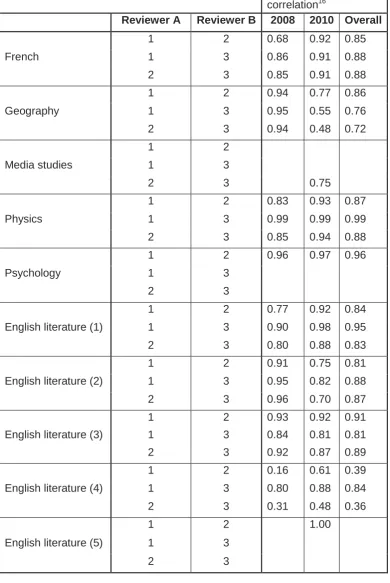
maximum of three reviewers per subject. This is a small sample and therefore potentially unreliable. Table 1 shows the correlations between each reviewer’s rankings for the student work. As the ranks are ordinal in nature (i.e. they are necessarily ordered, but the distance between their values is not meaningful), Spearman’s rank order correlation is used. As Table 1 shows, generally there was agreement between the reviewers, with the exception of English literature (4) where reviewer 2 was not closely in line with the decisions of the other two reviewers. There were higher correlations in 2010 in French, and slightly higher
correlations in English literature (1) and physics. There were lower correlations in 2010 in geography and English literature (2). The differences in opinion are reflected in the
Table 1: Correlation between subject reviewer ranking by year and subject
Spearman rank correlation16
Reviewer A Reviewer B 2008 2010 Overall
French
1 2 0.68 0.92 0.85
1 3 0.86 0.91 0.88
2 3 0.85 0.91 0.88
Geography
1 2 0.94 0.77 0.86
1 3 0.95 0.55 0.76
2 3 0.94 0.48 0.72
Media studies
1 2
1 3
2 3 0.75
Physics
1 2 0.83 0.93 0.87
1 3 0.99 0.99 0.99
2 3 0.85 0.94 0.88
Psychology
1 2 0.96 0.97 0.96
1 3
2 3
English literature (1)
1 2 0.77 0.92 0.84
1 3 0.90 0.98 0.95
2 3 0.80 0.88 0.83
English literature (2)
1 2 0.91 0.75 0.81
1 3 0.95 0.82 0.88
2 3 0.96 0.70 0.87
English literature (3)
1 2 0.93 0.92 0.91
1 3 0.84 0.81 0.81
2 3 0.92 0.87 0.89
English literature (4)
1 2 0.16 0.61 0.39
1 3 0.80 0.88 0.84
2 3 0.31 0.48 0.36
English literature (5)
1 2 1.00
1 3
2 3
16
Please note that in the table a figure of 1.0 would indicate a perfect linear agreement, a figure of –1 would indicate a negative correlation (i.e. the higher the UMS score, the lower the reviewer ranking seen), and a figure of 0 would indicate no identifiable relationship between UMS score and reviewer ranking.
Nature of materials – Although there was a wide range of scripts reviewed, there were very few at each grade. Any a- typicality in any of these scripts (and a balanced performance across the units is, of itself, relatively unusual) would inevitably have a large impact on the outcomes in an exercise such as this. There were also some gaps in the evidence base, across the full range of subjects, and on occasion some samples of candidates’ work were incomplete. For media studies and English literature (5), there was no work from 2008. The exercise looking at French was particularly constrained: the limited oral work available made it difficult to match what was provided with the other units, so a separate, and very limited, ranking and rating exercise had to be carried out on the orals.17
Nature of the numerical data provided – It was not possible to access comparable
background data on the candidates across all specifications. In many cases, both the A2 and total A level UMS scores were provided; in several, only the total A level score was provided; in one, only the A2 UMS score was provided. Moreover, because of the nature of the
anonymisation, it was impossible to derive both sets of scores where one was missing. With the one exception, correlations are based on the total A level UMS score. However, in addition to this one exception, it is worth noting that in some ways it would be preferable to use the A2 score, since differentiation of A* from the A grade is also based on that score, and the stretch and challenge elements are likely to be more concentrated in the A2 units.
2.4 The scope and limitations for this report
This study is part of the ongoing work of the ABDA programme and is restricted to the size and sample of candidates’ work that has been archived from 2008 and 2010 (the scope of the candidate work available is included in Appendix 1). It should also be recognised that the findings here are discussed largely in isolation from any analysis of the examination
statistical data18 and any background data on candidates and centres, or the teaching and learning. It should also be noted that candidate work from 2010 is from the first year of awarding for the new-specification A level. Candidates and teachers are therefore likely to be less familiar with the specifications and assessments, and this could affect candidate performance in the examinations.
This initial work gives an indication of how the changes to A levels have had an impact in practice on the syllabus and student outcomes. It is very important to note that the specifications were selected as likely to highlight an interesting range of subjects and to balance the burden evenly across awarding organisations. The study is not intended to identify individual awarding organisation practice, and for this reason no awarding
organisation names are associated with any specification in this report. The assumption is that roughly the same conclusions could be drawn from any subject/specification considered, and the review of all English literature specifications was intended to test this assumption.
17
There were two oral units available for AS at 2010 and four for A2 at 2010. 18
3 Research findings
Stretch and challenge is reported in this section in terms of the stretch and challenge indicators developed (see Methodology, section 2.2.3.1):
creating connections: identification of related concepts and making comparisons, generalisation, transfer and recontextualisation, rather than seeing topics or skills in isolation
use of reasoning – construction of an argument
use of explanation, application and synthesis of ideas rather than just recall of facts use of strategies for investigation and problem solving
use, and understanding, of specialist language and methods of enquiry.
The research findings are discussed in the following sections:
main changes in the subject specifications in 2010
stretch and challenge evidenced across the grade profiles
stretch and challenge in relation to breadth and depth of subject knowledge, skills and understanding
the relationships between specification and assessment
the A* grade in terms of stretch and challenge and mastery of subject/discipline progression from AS to A2
the extent and impact of variation observed within subject specifications across awarding organisations for English literature.
3.1 Main changes to specifications in 2010
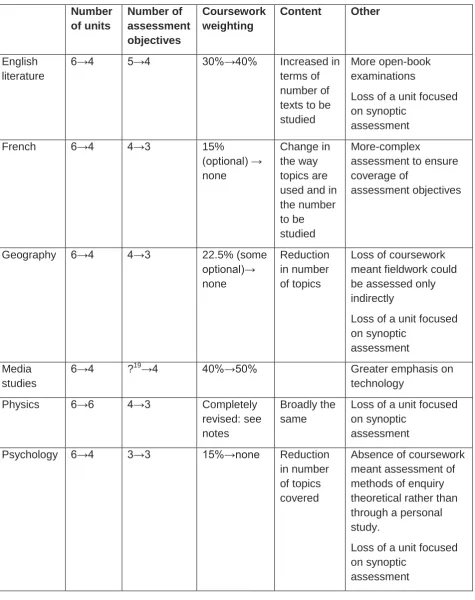
The main changes seen between 2008 and 2010 in the specifications for each subject are outlined in Table 2. A summary of the findings for each subject can be found as an appendix to this report (see Annexes 1–6).
Notes on Table 2:
Although the number of units in physicsnominally stayed the same, the 2008 syllabus had two split units, one at AS and one at A2. Each comprised an external written paper and an assessment of investigative and practical skills, so that there were eight discrete pieces of assessment. The assessment objectives in physics saw the loss of a specific objective for synoptic assessment and significantly greater explicit reference to how science works.
In the 2008 physicsA level, one AS sub-unit (weighted 7.5%) and one A2 sub-unit (weighted 5% of the A level) offered the option of coursework or a practical
The 2008 assessment objectives in English literature were further complicated by being slightly different at AS and A2, as well as differently weighted. The greater number of texts to be covered in English literature involved greater expectations of wider reading for context and comparisons, and there was a subsequent reduction in emphasis on close reading.
The 2008 specification for media studies was not available for a clear statement about the assessment objectives and their weightings.
Table 2: Main changes seen in 2010 for specifications reviewed Number of units Number of assessment objectives Coursework weighting
Content Other
English literature
6→4 5→4 30%→40% Increased in
terms of number of texts to be studied
More open-book examinations
Loss of a unit focused on synoptic
assessment
French 6→4 4→3 15%
(optional) → none
Change in the way topics are used and in the number to be studied
More-complex
assessment to ensure coverage of
assessment objectives
Geography 6→4 4→3 22.5% (some
optional)→ none
Reduction in number of topics
Loss of coursework meant fieldwork could be assessed only indirectly
Loss of a unit focused on synoptic
assessment
Media studies
6→4 ?19→4 40%→50% Greater emphasis on
technology
Physics 6→6 4→3 Completely
revised: see notes
Broadly the same
Loss of a unit focused on synoptic
assessment
Psychology 6→4 3→3 15%→none Reduction
in number of topics covered
Absence of coursework meant assessment of methods of enquiry theoretical rather than through a personal study.
Loss of a unit focused on synoptic
assessment
19
3.2 Stretch and challenge evidenced across the grade profiles
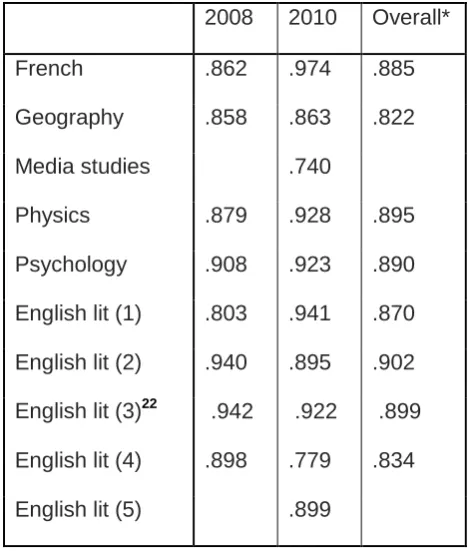
Half of the members of the expert group who responded to the stretch and challenge questionnaire considered that stretch and challenge should be evidenced at all grades; this response was, however, always qualified in some way.20 The analysis of the scripts
suggested that there is a strong positive relationship between A level UMS score and the level of stretch and challenge evidenced within the candidate work, which supports the view that stretch and challenge is being seen at all grades. Table 3 shows the level of correlation between A level UMS score21 and the mean subject reviewer rating for stretch and
[image:24.595.200.435.249.525.2]challenge.
Table 3: Pearson correlation between A level UMS scores and the mean subject reviewer rating for stretch and challenge
2008 2010 Overall*
French .862 .974 .885
Geography .858 .863 .822
Media studies .740
Physics .879 .928 .895
Psychology .908 .923 .890
English lit (1) .803 .941 .870
English lit (2) .940 .895 .902
English lit (3)22 .942 .922 .899 English lit (4) .898 .779 .834
English lit (5) .899
*This is the correlation between the UMS score, as a proportion of 1, and average stretch and challenge rating. The two year columns consider the correlations for candidates in that year, whereas the overall column considers all candidates regardless of year.
There is also a strong positive correlation between the A level UMS score and the mean subject reviewer ranking for all scripts.23 This is in line with expectation – reviewers were asked to put the candidates into an overall rank order in terms of their overall level of
20
One respondent thought that the higher-attaining students were more likely to provide evidence of stretch and challenge. Another felt that each indicator signified a ‘spectrum of a class of attainment’ rather than a dichotomy; context, audience and level of complexity were considered relevant variables. The inverse of the descriptors (e.g. ‘unable to explain any ideas’ or ‘can’t use any methods of enquiry’) was thought unlikely to justify any grade at all. A third respondent felt that the ability to question facts, to discuss answers rather than just get the right answer was an important part of teaching and learning for all students as well as of what is examined.
21 A2 UMS score is not available for all specifications. 22
This data is based on A2 UMS as A level UMS is not available 23
attainment, and so the rank order would be expected to correlate strongly with UMS. When the data for A level UMS score and stretch and challenge mean rating24 was analysed separately for 2008 and 2010,25 the UMS score was found to be highly significant in predicting stretch and challenge rating for all subjects.
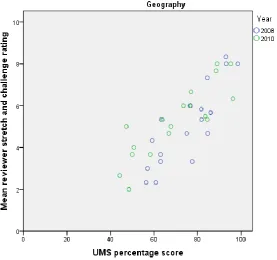
In terms of differences between stretch and challenge between 2008 and 2010, year was found to be a significant predictor of stretch and challenge rating only for psychology, French and geography (see Figures 1–3 below). In the case of psychology this was because, for a given UMS, the stretch and challenge rating tended to be slightly higher in 2008 than in 2010, especially in the lower half of the mark range, whereas in geography the opposite was true, again particularly in the lower half of the mark range. In French, the outcome arose because, for the 2008 candidates in the lower half of the mark range, there was very little correlation between UMS and stretch and challenge rating, while, for the 2010 candidates, the correlation was strong throughout the range.
What is particularly noticeable about all three results is that it was lower-attaining candidates who were affected. The UMS marks and stretch and challenge ratings for higher-attaining candidates correlated well in both years for all subjects.
24 Mean average of reviewers’ rates for a particular subject. 25
Figure 1: Psychology – mean stretch and challenge rating against UMS score (percentage) by year
[image:26.595.83.361.440.699.2]Figure 3: Geography – mean stretch and challenge rating against UMS score (percentage) by year
There was also a very strong correlation between the subject reviewers’ own rankings and their stretch and challenge ratings, typically well over 0.9. Interestingly, even for the lowest-ranked candidates, it was relatively unusual for their stretch and challenge rating to be below 3 on the 10-point scale used. This was true for both 2008 and 2010 candidates. It clearly suggests that the relevant skills are present in the work of almost all candidates, while the extent to which they are displayed depends strongly on the overall level of subject
knowledge and understanding.
Scatter diagrams showing grade, year and stretch and challenge for all subjects can be found in Appendix 4.
3.3 Link between stretch and challenge and breadth and depth of subject
knowledge
In French, for example, there is a tension when defining breadth and depth of subject knowledge, and the removal for 2010 of an assessment objective focusing on study of the culture was thought to emphasise skills over content. While it could be argued that depth and breadth is primarily knowledge and application of the language, it could equally be considered that breadth and depth should include knowledge of the culture and study of its literature (for example) as part of the subject as a discipline. Although some opportunities for stretch and challenge could be seen to have been lost (creating connections, for example), however, stretch and challenge was felt to be embedded within the synoptic element of language anyway e.g. the spoken and written word. In 2010 candidates had to show their linguistic skills at a greater level.
There were some tensions evident in the 2010 examination papers between the assessment of stretch and challenge and the breadth and depth of subject knowledge. In geography, for example, how some aspects of stretch and challenge were assessed – e.g. longer essay-style questions – was considered to be at the expense of identifying depth and breadth of subject skills, knowledge and understanding. The removal of coursework likewise meant that students were not assessed on their actual fieldwork skills but on their ability to evaluate aspects of it in the examination (e.g. the risk assessment). Overall, the subject reviewers commented that they did not feel that they ‘knew the 2010 candidates as well as
geographers’ compared with the 2008 candidates. In terms of stretch and challenge, although the essay-style questioning attempted to promote synoptic assessment in 2010 (creating connections), it could be argued that this was at the expense of the stretch and challenge that relates directly to the subject as a discipline (use of specialist language and methods of enquiry). Geography was the most problematic of the specifications in terms of allowing for differentiation at the higher grades, a point that is reflected in the findings from the statistical analysis of the ranking, rating and UMS scores, with less agreement seen in decisions between the reviewers.
In 2008 physics candidates earned marks roughly in proportion to the amount of explanation and calculation in the questions themselves, although there was some variation, particularly where the total marks were low. In 2010, candidates usually scored a greater proportion of their marks in calculations when compared with the proportion in the questions, as
suggested by comments in the examiners’ reports such as ‘Answers to numerical sections were usually approached much more confidently, and completed much more competently, than those to parts requiring description, explanation, or even straightforward recall’. This loss of a whole assessment objective (AO4: synthesis of knowledge, understanding and skills) was felt to make the overall assessment easier and was likely to lead to less differentiation at the top end of the ability range. Marks for AO4 could provide a cushion where candidates demonstrate knowledge without the higher-level skills of evaluation and analysis, which particularly effected middle- and lower-attaining candidates. The questions for the research-based essay in 2010 are more general and provide less structure for extended responses which the subject reviewers considered more challenging for the whole range of candidates.
3.4 Compression in assessment of subject knowledge
changes concurrently has had an effect on all subjects. Although these effects have not been the same in each subject or specification, often the elements of stretch and challenge were judged to have been compromised by the reduction in assessment.
In French in 2010, the reduction in the number of units has in some ways increased the stretch and challenge in that many of the same skills are assessed in a reduced number of units. In some senses, therefore, the assessment has become more complex, with
candidates needing to demonstrate multiple skills in particular questions. The external assessment of this specification means that the emphasis is on productive skills, which affects middle- and lower-attaining candidates as there are fewer opportunities to achieve and candidates have to think much more on their feet throughout. For higher-attaining candidates there are fewer opportunities to demonstrate their knowledge and receptive skills. There is also a greater pressure on time as all the skills and knowledge except for speaking have to be assessed in a single unit; as a result, assessment activities that are actually very similar across the two years, such as the discursive essay, assume a larger proportion of the whole assessment. The reduction to two units also means that there is a reduction in the breadth of knowledge, as one aspect of study for the culture and society of the country is required as opposed to two in 2008 for either option.
The tension between stretch and challenge and the opportunities to demonstrate knowledge and skills was not just an issue for specifications that had been reduced to two units at A2. The removal of the synoptic unit meant that physics candidates in 2010 had less opportunity to show an overall grasp of the course and to show their ability to connect different topics. In geography the range of unit options was thought to lead to fewer opportunities to make links across the different elements of the course. This made synoptic assessment across the course more problematic.
Across both years in English literature there are opportunities for synoptic assessment implicit within the skills of the discipline (e.g. comparing and contrasting texts and thematic approaches to textual analysis). There is less evidence in the specifications for 2010 of a requirement for close textual analysis in terms of form, structure and language. Typically, this has been replaced by an emphasis on thematic study, breadth of reading, reader response and tasks which are rooted in comparison and contrast between texts. This change may appear to diminish the notion of a demanding set text examination as a precursor to advanced literary study, but it may also allow candidates to achieve a greater understanding of the subject as a whole. For some, but not all, of the English literature specifications reviewed, the changes to the assessment objectives, the reduction in the number of units and a focus on wider reading and thematic study have arguably led to an improved performance in the examination papers and more evidence of candidates employing the kind of skills associated with stretch and challenge.
In English literature, geography, physics and psychology there was the loss of a unit focused on synoptic assessment.26 Most reviewers saw this as a retrograde step because, although in theory for 2010 synopticity was intended to be embedded across A2, there were issues identified in practice (geography and physics are examples where looking across the subject and making connections became much more limited in form and degree). For the majority of subjects, however, there was little option but to remove the synoptic unit, given that there are only two units at A2 and the assessment of other skills would have to be squeezed into the other unit.
3.4.1 Reframing or classification of the subject
For the majority of the subjects, with the exception of English literature, there had been some reframing/reclassification of the subject as a discipline at A level in the 2010 subject criteria. In physics there has been a move (already discussed above) to an emphasis on explanation and away from mathematical skills. The increased emphasis in French on linguistic skills rather than close study of the culture has also already been discussed. In geography the emphasis is much less on a more science-based process and much more on an approach to ‘softer’ values and attitudes.
A key change for media studies is for candidates to be taught how to use ‘appropriate media facilities and technologies’ ‘before embarking upon assessed work’ and the need for
‘adequate software, equipment and staff training’. The need for the last two points has major implications for the delivery of the syllabus. Conceptually, and in terms of practical work, the demand of the A level has increased considerably from 2008 to 2010.
One of the main changes in the 2010 specification is the introduction of the notion of psychology as a science. The 2010 psychology specification states that it has been designed to provide a broad introduction to the scope and nature of psychology as a
science, bringing the content up to date while at the same time retaining the existing features of the previous psychology specification. This in its turn brought the expectation that
psychology should conform to a number of set criteria, identified as ‘How Science Works’. This change in identity has not led to significant changes in demand in terms of content requirements. In fact, the majority of criteria identified under How Science Works were met in the 2008 specification through the coursework and research methods elements.
3.5 The relationship between specifications and assessment
For the majority of specifications there is less assessment time in 2010 and often different types of question that may or may not offer what is considered to be sufficient opportunity to evidence stretch and challenge and/or subject knowledge and skills within the mark
allocation and overall time frame for an examination paper. Concerns were raised by a number of the subject reviewers that this had led to a reduction in the content and skills being assessed.
In some subjects, such as French, less assessment means that there is less predictability, which makes the assessments more demanding. For other subjects, such as geography, the lack of variation in question types, in particular the over-reliance on extended writing
26
questions, increases predictability because there are fewer topic areas and skills that are suited to the question style.
One of the key findings of this study, therefore, is that the assumption that an increase in questions requiring extended writing will identify greater stretch and challenge and breadth of subject knowledge and skills has not always been realised in candidate performance. Equally, however, short-answer questions, while effective in assessing certain types of subject knowledge, do not necessarily offer opportunities for candidates to evidence the higher-order skills associated with stretch and challenge (this was particularly noted in psychology, where there had been an increase in this type of assessment).
Where stretch and challenge is not firmly immersed within a thorough understanding of the subject through the use of focused questions or, for example, the development of specialist language and methods of enquiry; the higher-order skills may detract from rather than enhance subject knowledge, skills and understanding. In geography and psychology (and to some extent, English literature), the development of some methods of enquiry associated with the subject (such as close textual analysis of a text in English literature and research skills in geography and psychology) may be lost if teachers adopt the minimalist
approaches.27 Subject reviewers suggested this is possible by only covering the part of the specification expected to be assessed.
3.6 The A* grade in terms of stretch and challenge and mastery of subject
An analysis of stretch and challenge ratings across all candidate scripts was carried out against stretch and challenge ratings for A and A* candidates.28 The results are summarised in Tables 4–8 and Figures 4–8. Please note that there are no tables and figures for English literature specifications 3 and 5 because some of the relevant data was not available.29
A2 UMS score was not available for several of the specifications, so it is not always clear why some A grade candidates with high UMS did not receive an A*. The emphasis on A2 scores in the awarding of the A* does mean that candidates cannot gain an A* without focusing on the (theoretically) more challenging A2.
Overall, it would appear that the A* is differentiating the most able candidates with a few exceptions, which are outlined in the discussion below.
3.6.1 French
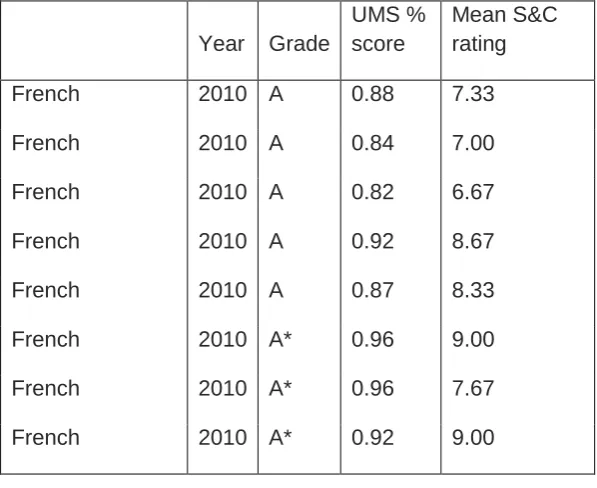
One A grade candidate has a much higher stretch and challenge rating than one of the A* candidates. It is highly likely that the 90% A2 rule prevented the candidate from getting an A*, as their overall UMS score and mean stretch and challenge ratings are on a par with those of A* candidates. The stretch and challenge rating is acting as a distractor here. This is an example of a candidate who shows that stretch and challenge does not tie in perfectly with subject ability.
27
In geography, for example, reviewers suggest this may manifest itself in formulaic approaches to essay writing as well as to cutting fieldwork beyond minimal preparation for the external assessment..
28
Generally for 2008 we had six A grade scripts, while for 2010 we had three A grades and three A* grades (A* grades were awarded in 2010 but not 2008). It would have been possible to treat the top three 2008 scripts (by UMS score) as A*, but this would not necessarily have been strictly correct (it is not known if the candidates achieved at least 90% or more across the A2 units). We therefore look here at A and A* together.
29
Figure 4: Mean stretch and challenge rating by UMS score (%) and grade: French
Table 4: Mean stretch and challenge rating by UMS score (%) and grade: French
Year Grade
UMS % score
Mean S&C rating
French 2010 A 0.88 7.33
French 2010 A 0.84 7.00
French 2010 A 0.82 6.67
French 2010 A 0.92 8.67
French 2010 A 0.87 8.33
French 2010 A* 0.96 9.00
French 2010 A* 0.96 7.67
French 2010 A* 0.92 9.00
3.6.2 Geography
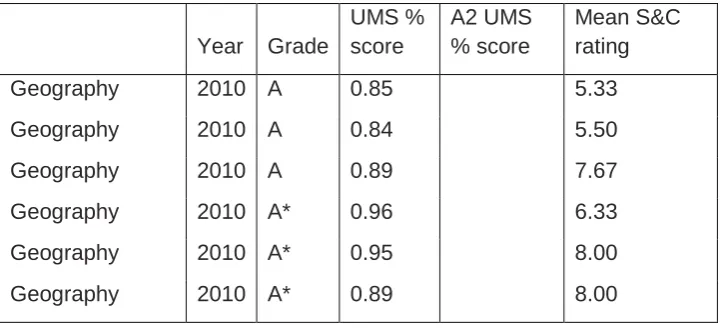
[image:32.595.71.370.386.630.2]than would be expected for an A* grade. The mean average had not been skewed by one reviewer giving substantially lower scores; the consensus was that the candidate offered descriptive rather than analytical analysis and showed limited conceptual understanding.
The analysis by subject reviewers suggests that in 2010 it was more difficult to differentiate student performance in some subjects, especially that of higher-attaining candidates. The reviewers reported that the geography candidates in 2010 across the grades showed a very formulaic and simplistic approach to essay writing; on a positive note, lower-attaining
[image:33.595.79.338.262.500.2]candidates could structure an essay. However, the lack of focus for many of the questions set in the assessment meant that it was difficult to differentiate between candidates in the upper quartile, and the mark schemes were not tight enough to enable this to occur.
Figure 5: Mean stretch and challenge rating by UMS score (%) and grade: Geography
Table 5: Mean stretch and challenge rating by UMS score (%) and grade: Geography
Year Grade
UMS % score
A2 UMS % score
Mean S&C rating
Geography 2010 A 0.85 5.33
Geography 2010 A 0.84 5.50
Geography 2010 A 0.89 7.67
Geography 2010 A* 0.96 6.33
Geography 2010 A* 0.95 8.00
[image:33.595.67.430.576.740.2]3.6.3 Media studies
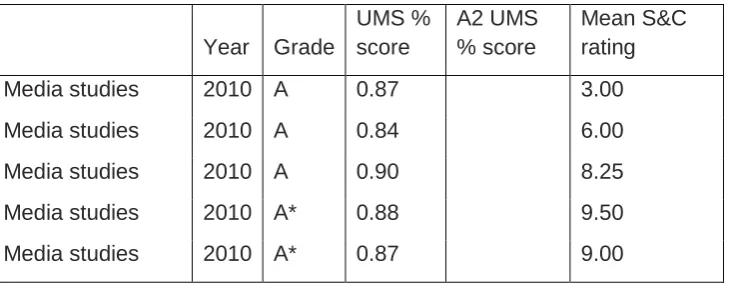
[image:34.595.75.440.275.419.2]One A grade candidate has a UMS score higher than the two A* candidates, but their mean stretch and challenge rating is lower. It looks as if the A* candidates have been differentiated well from the A candidates, although that same A candidate still has a high stretch and challenge rating, particularly when compared with the other A grade candidates. Without the A2 UMS score it is difficult to tell whether this candidate was close to receiving an A* grade and whether their A2 UMS score was perhaps the only reason they were not awarded one. Although, media studies candidates in 2010 could be differentiated, there was evidence that even the higher-attaining students were rarely going beyond descriptive recount in their evaluation for the A2 external paper. This was considered to be due to the invitation to ‘describe’ a process (or processes), which was not considered to be a suitable command word at this level in terms of intrinsic demand or discrimination.
Table 6: Mean stretch and challenge rating by UMS score (%) and grade: Media studies
Year Grade
UMS % score
A2 UMS % score
Mean S&C rating
Media studies 2010 A 0.87 3.00
Media studies 2010 A 0.84 6.00
Media studies 2010 A 0.90 8.25
Media studies 2010 A* 0.88 9.50
Media studies 2010 A* 0.87 9.00
[image:34.595.115.365.483.707.2]3.6.4 Physics
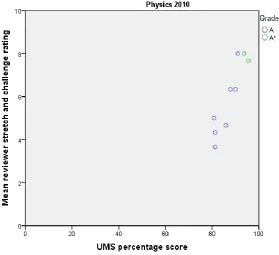
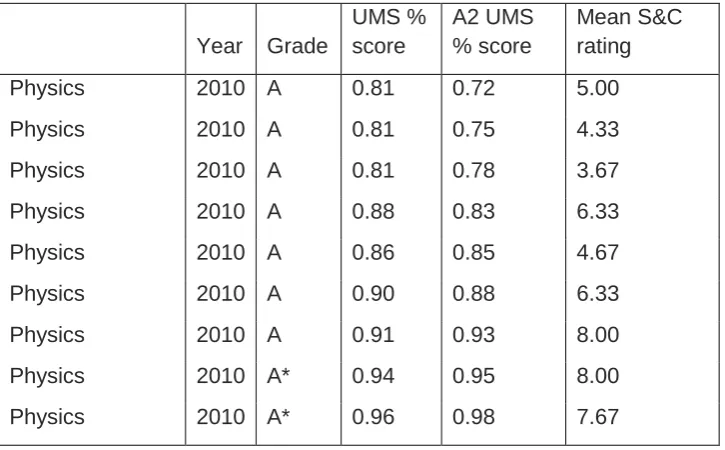
[image:35.595.79.359.283.538.2]One A grade candidate has very good mean stretch and challenge rating, and very good UMS score, both overall and at A2 (above 90% for both). Based on stretch and challenge and UMS score, this candidate looks like an A* candidate but was in fact only awarded an A.30 The loss of one theory paper was judged to have resulted in fewer questions that might involve stretch and challenge for the really able, as the marks available were needed to provide discrimination among the current A level grades. This, therefore, was a change for the worse in the opinion of the subject reviewers in terms of assessing and establishing the real ability of all candidates. The increase in ‘explanation’ over mathematical calculation in physics meant there were fewer complex multi-stage calculations requiring some of the higher-order skills to stretch or reward the stronger mathematicians. It was noted, however, that all the candidates found the questions requiring explanation challenging.
Figure 7: Mean stretch and challenge rating by UMS score (%) and grade: Physics
30
Table 7: Mean stretch and challenge rating by UMS score (%) and grade: Physics
Year Grade
UMS % score
A2 UMS % score
Mean S&C rating
Physics 2010 A 0.81 0.72 5.00
Physics 2010 A 0.81 0.75 4.33
Physics 2010 A 0.81 0.78 3.67
Physics 2010 A 0.88 0.83 6.33
Physics 2010 A 0.86 0.85 4.67
Physics 2010 A 0.90 0.88 6.33
Physics 2010 A 0.91 0.93 8.00
Physics 2010 A* 0.94 0.95 8.00
3.6.5 Psychology
[image:37.595.80.371.227.486.2]There appears to be some overlap between the A and A* candidates here. In particular, one candidate has a mean stretch and challenge rating and a UMS score higher than that of one of the A* candidates, but has been awarded an A apparently because their A2 UMS scores were not high enough. In this case, the mechanical calculation of the A* grade appears to have disadvantaged some candidates who may otherwise have been awarded an A*. The relatively low stretch and challenge rating reflects the subject reviewers’ concerns that the 2010 papers offered less opportunity for stretch and challenge.
Table 8: Mean stretch and challenge rating by UMS score (%) and grade: Psychology
Year Grade
UMS % score
A2 UMS % score
Mean S&C rating
Psychology 2010 A 0.81 0.75 5.00
Psychology 2010 A 0.81 0.78 5.50
Psychology 2010 A 0.81 0.88 7.00
Psychology 2010 A 0.88 0.83 6.50
Psychology 2010 A 0.88 0.85 7.50
Psychology 2010 A* 0.87 0.93 7.00
Psychology 2010 A* 0.91 0.96 8.00
3.6.6 English literature (1)
[image:39.595.80.369.183.440.2]One A* candidate has a mean stretch and challenge rating and UMS score that are not particularly high compared with A grade candidates, but the candidate managed to average above 90% in their A2 modules and so received an A* grade. Another candidate, despite getting a high stretch and challenge rating, did not average an A grade at A2.
Figure 9 : Mean stretch and challenge rating by UMS score (%) and grade: English literature (1)
Table 9: Mean stretch and challenge rating by UMS score (%) and grade: English literature (1)
Year Grade
UMS % score
A2 UMS % score
Mean S&C rating
English lit (1) 2010 A 0.82 0.73 6.67
English lit (1) 2010 A 0.83 0.76 6.33
English lit (1) 2010 A 0.87 0.85 7.00
English lit (1) 2010 A 0.85 0.88 7.00
English lit (1) 2010 A 0.82 0.77 8.67
English lit (1) 2010 A 0.84 0.83 8.00
English lit (1) 2010 A* 0.88 0.93 8.00
English lit (1) 2010 A* 0.91 0.95 9.00
[image:39.595.73.432.521.745.2]3.6.7 English literature (2)
[image:40.595.84.440.195.511.2]One A grade candidate has an extremely high mean stretch and challenge rating compared with even