RESPONSIVE ATTENDANCE SYSTEM BASED ON THUMB SCANNING
BONG YU JING
This report is submitted in partial fulfillment of the requirements for the award of
Bachelor of Electronic Engineering (Industrial Electronics) With Honours
Faculty of Electronic and Computer Engineering Universiti Teknikal Malaysia Melaka,
JUNE 2013
UNIVERSTJ TEKNIKAL MALAYSIA MELAKA
FAKULTI KEJURUTERAAN ELEKTRONlK DA KEJURUTERAA KOMPUTER BO RANG PENGESAHAN STA TVS LA PO RAN
PROJEK SARJANA MUDA II
Tajuk Projek RESPONSIVE A TTE DANCE SYSTEM BASED 0 THUMB
SCANNING
Sesi Pengajian
Saya BO G YU JJNG
2 3
mengaku membenarkan Laporan Projek Sarjana Muda ini disimpan di Perpustakaan dengan syarat-syarat kegunaan seperti berikut:
I. Laporan adalah hakmilik Universiti Teknikal Malaysia Melaka.
2. Perpustakaan dibenarkan membuat salinan untuk tujuan pengajian sahaja.
3. Perpustakaan dibenarkan membuat salinan Iaporan ini sebagai bahan pertukaran antara institusi pengajian tinggi.
4. Sila tandakan ( '1 ) :
D
SULIT*D
TERHAD**0
TIDAK TERHAD~·
*(Mengandungi maklumat yang berdarjah keselamatan atau kepentingan Malaysia seperti yang termaktub di dalam AKT A RAHSIA RASMI 1972)
**(Mengandungi maklumat terhad yang telah ditentukan oleh organisasi/badan di mana penyelidikan dijalankan)
Dis~kan oleh:
"I hereby declare that this report is the result of my own work except for quotes as
cited in the references."
Signature
...
...
~.
..
...
...
...
....
Name
: ....
~QNG.:DJ. J.™Q ...
.
...
.
... .
Date
....
...
13
fl...JutJE .2.013
...
...
...
"I hereby declare that I have read this project report and in my own opinion this project report is sufficient in terms of the scope and quality for the award of Bachelor
of Electronic Engineering (Industrial Electronic) With Honors."
Signature :
....
~
. .
. . . .
... .
. ENGR ..
~-:~·
~~~~
~
BTE ANAS... Name
Lovingly dedicated to my
beloved family and friends
For being a
constant source of Inspiration and Support.
ACKNOWLEDGEMENT
I would like to take this opportunity to express my upmost gratitude towards
those who have contributed in the completion of this project.
First and foremost, I would like to thank my helpful supervisors, Engr Siti
Aisyah bte Anas and Engr. Ranjit Singh Sarban Singh. They have given me
wonderful supervision and support which truly aided in the smooth progression in
the completion of this project. The encouragement and guidance given by them is
much appreciated as without I would not be where I am today.
Not to be forgotten, I would like to thank my family for their support and
motivation which allows me stays for more days to complete the project. Without
their kind support and encouragement, the completion of this final year project is not
vii
ABSTRAK
Tujuan projek ini dilaksanakan untuk mereka bentuk dan membangunkan
sistem kehadiran pelajar untuk pelajar pasca siswazah sebagai Pembantu Penyelidik
Siswazah (GRA). Sistem ini akan menggunakan cap jari sebagai subjek untuk
merekodkan kehadiran pelajar. Semua maklumat akan direkodkan ke dalam aplikasi
pangkalan data dan boleh dipantau oleh penyelia individu masing-masing. Dengan
adanya sistem m1, secara langsungnya ia akan meningkatkan kecekapan pelajar
lepasan ijazah dan akan membantu penyelia untuk memantau kemajuan pelajar.
Selain daripada itu, sistem ini juga dapat mengesan pelajar yang hadir lewat dan
secara automatiknya sistem ini akan menghantar emel kepada penyelia yang
bertanggungjawab terhadap pelajar tersebut. Sistem yang dicipta ini juga merupakan
satu sistem yang mudah alih, ini bermakna pengguna dapat membawa peranti ini ke
dalam kelas untuk menggantikan kertas kehadiran biasa. Sistem ini boleh digunakan
dalam organisasi yang memerlukan pengurusan kehadiran pelajar atau pekerja.
viii
ABSTRACT
The motivation for this project is to design and develop a responsive attendance
system based on thumb scanning for postgraduate students during their appointment
as Graduate Research Assistant (GRA). The development of this system is using the
thumb print scanning as platform for attendance recording into the system. The
system functions to record all the incoming and outgoing activities. All infonnation is
recorded into a database application and can be monitored by the respective
individual supervisor. Development of this system increases the efficiency of the
postgraduate student and helps the supervisor to monitor the student's progress. Apart
from that, this system also able to detect the late attendance and intennittently sends a
notification to the respective candidate. Also, the respective candidate is required to
update his or her status by just sending an update notification to the system. Besides,
this system is portable, which mean lecturers are able to carry the device into the
classes. Besides, this developed system is portable, thus lecturers able to bring the
device into the classroom to replace the conventional attendance sheet. This system
ix
TABLE OF CONTENTS
CHAPTER DESCRIPTION PAGE
PROJECT TITLE
VERICATION FORM ii
DECLARATION iii
DEDICATION v
ACKNOWLEDGEMENT vi
ABSTRAK vii
ABSTRACT viii
TABLE OF CONTENTS xi
LIST OFT ABLE xii
LIST OF FIGURE xiii
LIST OF APPENDIX xv
I INTRODUCTION 1
I. 1 Introduction
1.2 Objective 2
1.3 Problem Statement 2
1.4 Scope of Work 3
1.5 Project Planning 5
II LITERATURE REVIEW 8
2.1 Existing Attendance System 8
2.1.1 Manual Attendance Taking System 8
2.1.2 Time Clock Attendance Taking System 9
2.1.3 Barcode Attendance Taking System 9
x
2.1.4
Magnetic Stripe Attendance Taking System10
2
.1
.
5
Smart Card Attendance Taking System10
2.1.6
Radio Frequency Identification Attendance11
Taking System
2.1.7
Biometric Attendance Taking System12
2.2
Comparison between Existing Attendance Systems13
2.3
Fingerprint Processing Process13
2.3
.
1
Capturing of Fingerprint Image15
2.3.2
Preprocessing of Fingerprint Image18
2.3.3
Recognition of Minutiae19
2.3.4
Post Processing of Minutiae20
2.3.3
Matching of Minutiae20
2.4
Structured Query Language21
III METHODOLOGY 23
3.0
System Overview23
3.1
System Operation24
3.2
Thumbprint Modules Comparison28
3.3
Expected Result29
IV RESULT AND DISCUSSION 34
4
.
0
Overview34
4.1
Hardware34
4.2
Software40
4.2.1
Responsive Attendance System Graphic User40
v
CONCLUSION5.1
5.2
Conclusion
Future Recommendation
5.2.1 Web-based Monitoring System
49
49
49
50
5.2.2 Storage Capacity of the Standalone Device 50
5.2.3 Statistical Report 50
5.2.4 Rechargeable Battery 51
REFERENCES
APPENDIX A
©
Universiti Teknikal Malaysia Melaka52
55
xii
LIST OFT ABLE
TABLE 2.1 COMPARISON TABLE OF EXISTING A TIENDA CE SYSTEMS I TERM OF CO VENIE CE, TIME
CONSUMPTION, ACCURACY AND RELIABILITY ... 13
xiii
[image:13.514.56.463.189.737.2]LIST OF FIGURE
FIGURE I. I BLOCK DIAGRAM OF THE OVERALL SYSTEM ·s TECH 'ICAL STRUCTURE ... 5
FJGURE 1.2 FLOWCHART OF PROJECT METHODOLOGY ... 7
FIGURE 2.1 IMAGE OF A Fl GERPRINT WITH ITS IMPORTANT FEATURES [22) ... 14
FIGURE 2.2 DIAGRAM SHOWING THE DIFFERENT BETWEE RIDGE A D FURROW [24) ... 14
FIGURE 2.3 MINUTIAE POINTS [22) ... 14
FIGURE 2.4 OPERATION OF THE FRUSTRATED TOTAL INTER AL REFLECTJON SENSOR [26) ... 15
FIGURE 2.5 OPERA TIO OF FTIR WITH A SHEET PRISM [26) ... 16
FIGURE 2.6 0PERATIO OF CAPACITIVE SENSOR [26). ... 16
FIGURE 2.7 OPERA TIO OF ULTRASOUND SENSOR [26) ... 17
FIGURE 2.8 PREPROCESSI G OF FINGERPRI T IMAGE ... 18
FIGURE 2.9 SPURIOUS MINUTIAE STRUCTURE ... 20
FIGURE 2.10 RELATIONSHIP BETWEE APPLICATIONS, DATABASE MANAGEME T SYSTEM (DBMS) A D DATABASE ... 21
FIGURE 3.1 BLOCK DIAGRAM OF THE OVERALL SYSTEM ... 23
FIGURE 3.2 FLOWCHART OF THE OVERALL SYSTEM ... 24
FJGURE 3.3 FLOWCHART OF THE USER MODE SUBSYSTEM ... 25
FIGURE 3 .4 FLOWCHART OF ADM IN MODE SUBSYSTEM ... 26
FIGURE 3.5 FLOWCHART OF ADMIN MODE SUBSYSTEM PART 2 ... 27
FIGURE 3.6 EXTER AL VIEW OF THE HARDWARE PART ... 30 FIGURE 3.7 EXTER AL VIEW OFTl-IE HARDWARE PART wrrn CASING ... 30 FIG RE 3.8 PLA fNED INTERNAL VIEW OF THE HARDWARE PART ... 30
FIGURE 3.9 HOMEPAGE OF THE USER I TERFACE (VERSION I) ... 31
FIGURE 3.10 REGISTER PAGE OF THE USER INTERFACE (VERSION I) ... 31
FIGURE3.1 I DIRECTED REGISTER PAGE OF THE USER I 'TERFACE(VERSION I) ... 31
FIGURE 3.12 SETTING PAGE OF THE USER INTERFACE (VERSION I) ... 32
FIGURE 3.13 SEARCH PAGE OF THE USER INTERFACE (VERSION I ) ... 32
FIGURE 3.14 INDIVIDUAL ·s ATTENDANCE (VERSJON I ) ... 33
FIGURE 3.15 ATTENDANCE OF THE STUDENTS BY DATE (VERSION I) ... 33
FIGURE 4.1 SCHEMATIC DIAGRAM FOR POWER SUPPLY PART ... ~ ... 35
FIGURE 4.2 SCHEMATIC DIAGRAM FOR MICROCO TROLLER PART ... 35
FIGURE 4.3 SCHEMATIC DIAGRAM FOR LCD PART ... 36
FIGURE4.4 SCHEMATIC DIAGRAM FOR HARDWARE A D SOFTWARE UART PART ... 36
FIGURE 4.5 HARDWARE BLOCK DIAGRAM ... 37
FIGURE 4.6 HARDWARE INTERFACE WITH THUMBPRINT MODULE AND PER SO AL COMPUTER ... 37
FIGURE 4.7 ACTUAL HARDWARE MODULES ... 37
FIGURE4.8 PCB LAYOUT ... 38
FIGURE 4.9 PCB CIRCUIT BOARD ... 38
FIGURE4.IOPRODUCTOFVERSIO I 1 ... 39
FIGURE 4.11 OPERATIONS OF MODE SWJTCHES ... 39
FIGURE4.12 FI ALHARDWAREPICTURE ... .40
FIGURE4.13 LOGIN PAGE ... .41
xiv
FIGURE 4.14 HOME PAGE ... .41
FIGURE 4.15 ADD/DELETE/EDIT USER PAGE ... 42
FIGURE 4.16 ATTE DANCE MARKI G PAGE ... 42
FIGURE4.17ATTE1 DANCEVIEWI GPAGE ... 43
FIGVRE4.18 STATISTICALATTE 'DANCE VCEWJ G PAGE ... 43
FIGURE 4.19 CLOCK IN/OUT SETTING TIME ... .44
FIGURE 4.20 USERIADMJN MODE SETTI G PAGE ... .44
FIGURE4.21 RAS DATA TRANSFER SYSTEM GUI ... .45
FIGVRE4.22 STUDENTS' DETAILS DATABASE ... .45
FIGURE 4.23 ATTENDANCE RECORD DATABASE ... .46
FIGURE4.24 LATENOTJFICATIO EMACL ... 46
[image:14.514.50.466.69.287.2]FIGURE4.25 ABSENTNOTfflCATION EMAIL ... 46
FIGURE 4.26 MO THL YA TTENDANCE REPORT ... .47
FIGVRE4.27 RESULT OF FI GER IDENTCFICATION TEST ... .47
FIGURE4.28 RESULT OF E VCRONMENTTEST ... ... .48
xv
LIST OF APPENDIX
APPENDIX A FINGERPRINT PROCESSING STEP ... 55
CHAPTER 1
INTRODUCTION
1.1 Introduction
The motivation for this project is to design and develop a responsive
attendance system based on thumb scanning for postgraduate students during their
appointment as Graduate Research Assistant (GRA). Currently there is no attendance
recording practice is restricted to the postgraduate students. The development of this
system uses the thumb print scanning as attendance recording into the developed system. The developed system functions to record all the incoming and outgoing
activities. All information is recorded into a database application and can be
monitored by the respective individual supervisor. Development of this system increases the efficiency of the postgraduate student and helps respective supervisor to
monitor the student's progress. Apart from that, this system also able to detect the late attendance and intermittently will send a notification to the respective person. Also, the respective person will have to update his or her status by just sending a
notification to the system. Besides, this developed system is portable, thus lecturers able to bring the device into the classroom to replace the conventional attendance
2
1.2 Objective
The objective of this project is to design and develop a responsive attendance
system based on thumb scanning for postgraduate students. Hence it will improve the
self-responsibility awareness among the postgraduate students. By using this
developed attendance system, there will be no more cards needed, no more paperwork
needed, hence no more hassle! In the end, this system is able to improve the
attendance recording system for postgraduate students and at the same time increase
the awareness of self-responsibility among postgraduate students.
1.3 Problem Statement
Employee absenteeism is a worldwide phenomenon which, due to the
financial impact on a nation's economy, is an important subject on the international
agenda. Absenteeism according to Collins English Dictionary, defines as persistent
absence from work, school, etc. In most of the institutions, the attendance is an
important factor for several purposes and important principles to be follow by the
students or even organization employees. Decreasing the amounts of student
absenteeism is an aim of any schools and school systems.
The worker, who is hired, is expected to perform a job and attend to work
regularly, so that the scheduled work projects can be carried out successfully. All
workers are expected to create working environment that are conducive to good
attendance [ 1]. However, due to the intrinsic factors such as interest, motivation,
learning styles and preferences, and extrinsic factors such as socio-economic
considerations, family commitments, and task deadlines [2] the attendance of the
students that are appointed as Graduate Research Assistant (GRA) are not as good as
expected.
According to Yasmin Khan based on her Punch Card Attendance Monitoring
System Feasibility Report, she stated that the pervious approach which is manually
taking and monitoring the attendance records was very inconvenient task, as users
need to record their attendance on the log book daily [3]. Manual attendance
3
checking is one of the oldest methods to record the attendance, but it is a hard process
to carry out during the attendance which gets more time consuming [3]. Manual
attendance record book will result in late compilation of attendance data because of
collecting and compiling process needs to be done by each supervisor [3]. Then the
total attendance record has to be entered into a computerized system manually.
Mismanagement may occur due to human error. It increases the pay roll processing
time and one of the major reasons is that it lacks security [3].
Later, another approach which is to record the attendance using card punching,
was introduced to solve time consuming issue for the manual attendance record book
system. However, this card punching system leads to other problems [3], which are
the reliability of the system and the troublesomeness of carrying the card. Buddy
punching is the act where one person clocks into the payroll system using another
person's card, creating it look as that a person, who did not actually come to work, is
in fact worked for the full period of their shift [ 4].
1.4 Scope of Work
1.4.1 Deliverables
The designs and developments of this Responsive Attendance System Based
on Thumb Scanning are divided into two parts, which is external deliverables and
internal deliverable.
1.4.1.1 External deliverables
4
an indicator to inform the user about the status of the overall system. While Graphical
User Interface is to allows the user to access to the database.
1.4.1.2 Internal deliverable
The internal deliverable in this imposed project is the database. Database is
required in order to allow the system to store the data of the respective required users
such as their respective attendance. These data can be fetched and executed in the
user interface.
1.4.2 Functionalities
The proposed Responsive Attendance System Based on Thumb Scanning will
operates according to as following:
1. Users able to record their attendance efficiently.
11. Supervisor will be instantly being notified through email for the
student's attendance status.
n1. Increase the accuracy, reliability and the security of the attendance
system.
1v. Time and cost saving.
v. Improve the self-responsibility awareness among the postgraduate
students.
1.4.3 Technical Structure
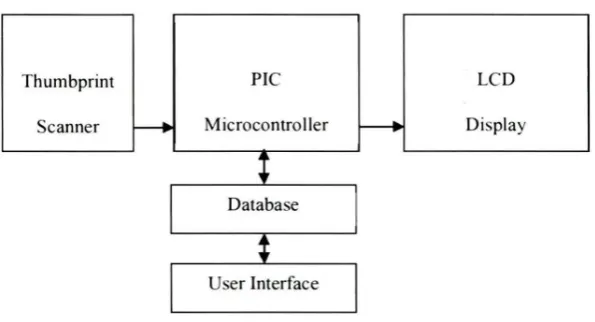
The technical structure of this system is divided into two parts as shown in
Figure 1.1, which included Hardware (Thumbprint Scanner, microcontroller and LCD
Display) and Software (Database and Graphical User Interface).
5
Thumbprint PIC LCD Scanner M icrocontroller Display
Database
[image:20.501.122.420.60.221.2]User Interface
Figure 1.1: Block Diagram of the Overall System's Technical Structure
1.5 Project Planning
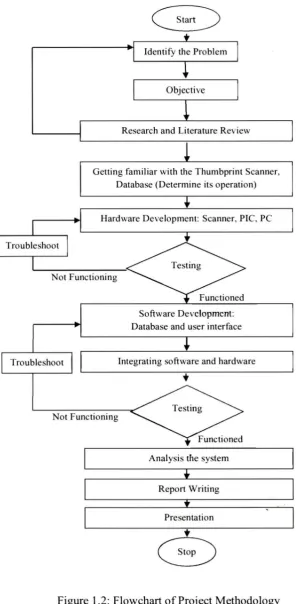
There are seven phases of work need to be done in order to complete this
project. The first phase that needs to be settled first is problem statement
identification. The problem faced by the previous approaches [3] included inaccuracy,
time consuming, reliability, and security. The problem statements are reviewed
throughout the project, to make sure the new system created able to solve the problem
facing by the previous approaches [3].
Beside problem statements, the objectives of the project need be determined
first in order to understand the purpose of the project and keep the project on the
correct track. In this project, the objectives is to design and develop responsive
attendance system based on thumb scanning for postgraduate students and improve
the self-responsibility awareness among the postgraduate students.
After the problem statements and the objectives are identified. During Phase
6
Once the researches are done, Phase Four was continued by getting familiar
with the components. The main components and software required in this project are
Thumbprint Scanner, PIC Microcontroller, Structured Query Language (SQL) and
Microsoft Visual Basic. These components and software need be fully understand
first before it can be integrated together to fonn one system.
During Phase Five, the hardware part of the system was assembled. Then the
project is followed with the development of the software part of the system which
included the Database and the User Interface.
Finally, in the Phase Seven, the hardware and software part of the system is
been integrated and troubleshoot to test the functionality of the system and make sure
the system can perform as expected. The overall project flow is shown in Figure I .2.
Troubleshoot
Identify the Problem
Objective
Research and Literature Review
Getting familiar with the Thumbprint Scanner, Database (Determine its operation)
Hardware Development: Scanner, PIC, PC
Not Functioning
Software Development: Database and user interface
Troubleshoot Integrating software and hardware
•
Not Functionjng
Analysis the system
Report Writing
Presentation
t
8
[image:22.501.84.381.63.669.2]CHAPTER2
LITERATURE REVIEW
2.1 Existing Attendance System
The several kind of attendance systems that are available in the market.
2.1.1 Manual Attendance Taking System
The Manual Attendance Taking System also known as Traditional Attendance
Taking System. This system involves recording the attendance in books or papers [5].
The attendance is taken and maintained by the user. According to Yasmin Khan based
on her Punch Card Attendance Monitoring System Feasibility Report, she stated that
the manually taking and monitoring the attendance records was very inconvenient
task, as users need to record their attendance on the log book daily [3]. Manual
attendance checking is one of the oldest methods to record the attendance, but it is a
hard process to carry out during the attendance which gets more time consuming [3].
Manual attendance record book will result in late compilation of attendance data
because of collecting and compiling process needs to be done by each supervisor [3].
Mismanagement may occur due to human error. It increases the pay roll processing
time and one of the major reasons is that it lacks security [3].
9
2.1.2 Time Clock Attendance Taking System
On 20th November 1888, the first time clock was invented [6]. Time clocks
also known as punch clock or clock card machine or time stamp. The time clock is
basically a clock with the function of recording the time on an inserted heavy paper
card, which named as timesheet. It is a recording mechanism with typewheels [7].
First, user needs to insert the timesheet into the prepared slot and when the timesheet
move against the typewheels, the mechanism will activated [7] and the clock will
print or stamp the date and time on the timesheet. The time clock increases the
accuracy of the clock in and clock out time of the user. It is more efficient in
recording the time. However, this time clock cause another problem arises, which is
named as overstamping. This problem is when the recorded time is stamped over by
another one. Besides, this system also leads to other problems [3], which are the
reliability of the system and the usages of paper card. Buddy punching is the act
where one person clocks into the payroll system using another person's timesheet,
creating it look as that a person, who did not actually come to work, is in fact worked
for the full period of their shift [ 4]. Besides, the attendance of the employees is
recorded on the timesheet; if the timesheet is stolen or misplace [8] then the employee
will lost his or her attendance record.
2.1.3 Barcode Attendance Taking System
The barcode attendance taking system use the shape of symbol either in bar,
square, or dots which is difference in term of width as a method of° identification. The
specific sensor will use light beam to strike on the barcode and by measuring the
intensity of the light on the black and white area, the system may able to identify the