EUROPEAN ORGANIZATION FOR NUCLEAR RESEARCH (CERN)
CERN-PH-EP-2015-112 LHCb-PAPER-2015-019 May 13, 2015
Search for the Λ
0
b
→
Λ
η
0
and
Λ
0
b
→
Λ
η
decays with the LHCb
detector
The LHCb collaboration†
Abstract
A search is performed for the as yet unobserved baryonic Λ0b→Λη0 and Λ0b→Λη
decays with 3 fb−1 of proton-proton collision data recorded by the LHCb experiment.
The B0→K0Sη
0 decay is used as a normalisation channel. No significant signal is
observed for the Λ0b→Λη0 decay. An upper limit is found on the branching fraction of
B(Λ0b→Λη0)<3.1×10⁻⁶ at 90% confidence level. Evidence is seen for the presence
of the Λ0b→Λη decay at the level of 3σ significance, with a branching fraction
B(Λ0b→Λη) = (9.3+7−5..33)×10−6.
Published as JHEP 09 (2015) 006
c
CERN on behalf of the LHCb collaboration, licence CC-BY-4.0.
†Authors are listed at the end of this paper.
1
Introduction
One of the interesting features of SU(3) flavour symmetry breaking in the light neutral meson sector is the mixing of singlet and octet states in the pseudoscalar mesons. The physical η and η0 particles can be expressed as an admixture of light quark and strange quark flavour eigenstates [1],
|ηi |η0i
=
cosφp −sinφp
sinφp cosφp
|ηqi |ηsi
, (1)
where the quark states are defined as
|ηqi=
1
√
2|uu + ddi and |ηsi=|ssi, (2) and φp is the mixing angle between light and strange quark states. In principle all
possible SU(3) flavour singlet states that contribute to the physical particles, including the gluonic wavefunction, |ggi, and the heavier quarkonia wavefunctions, |cci and |bbi, must be considered. Of these states, only |ggi is considered to contribute to the mass eigenstates [2–4], and this only occurs in the heavier η0 meson [1, 5]. Introducing the gluon mixing angle φG, the η0 wavefunction becomes
|η0i= cosφGsinφp|ηqi+ cosφGcosφp|ηsi+ sinφG|ggi. (3)
Many phenomenological and experimental studies have been carried out to determine the values of the mixing angles, and measurements are in the range φp ≈ 38−46◦ [6–17].
Refs. [15–17] also contain measurements of the gluonic mixing angle, which are consistent with zero, albeit with large uncertainties. Most recently, the mixing angles have been measured by the LHCb experiment using B0(s)→ J/ψ η(0) decays, and are found to be
φp= (43.5+1−2..85)◦ and φG = (0±25)◦ [18].
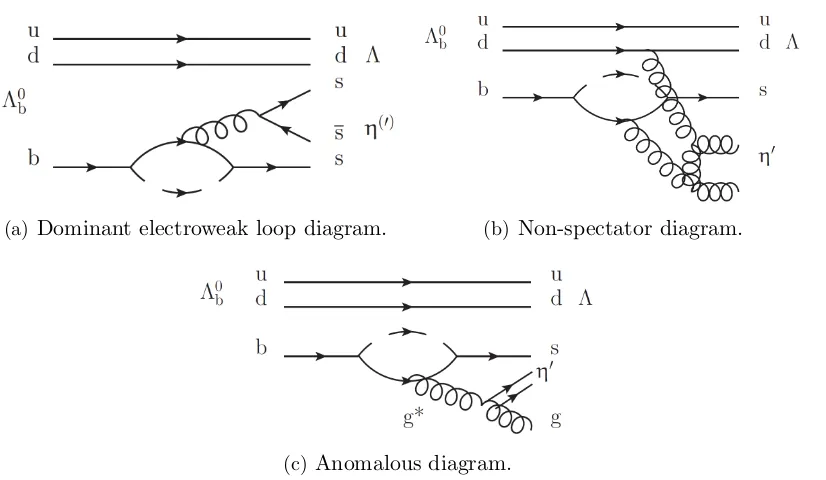
One consequence of the mixing is the difference in branching fractions for b-hadron decays to final states containingη andη0 mesons. The gluonic mixing alters the branching fraction for the decays to η0 mesons compared with the equivalent decay to η mesons. Possible Feynman diagrams for amplitudes contributing to the Λ0
b→Λη(
0)decays are shown
in Fig. 1, with Fig. 1(a) showing the dominant b→s transition via a penguin diagram. Due to the gluonic contribution of the wavefunction, extra Feynman diagrams of similar amplitude are available for the η0 decay [19]. These include the possible non-spectator contribution, where the light quark radiates a gluon which can form an η0 meson, as shown in Fig. 1(b), and the anomalous contribution, where an excited gluon in the decay can radiate an η0 meson, as shown in Fig. 1(c). The amplitudes for these extra processes can interfere to enhance or reduce the branching fraction to η0 mesons. For example, the branching fraction for the B0→K0η0 decay1 has been measured to be (6.6±0.4)×10−5 which is over 50 times larger than the branching fraction for the B0→K0η decay [20].
(a) Dominant electroweak loop diagram. (b)Non-spectator diagram.
[image:4.595.114.527.100.340.2](c) Anomalous diagram.
Figure 1: Feynman diagrams for the Λ0b→Λη(0) decay. The non-spectator and anomalous
diagrams are available only to the η0 through the gluonic contribution.
By measuring the relative branching fractions of many different decays to final states containing ηandη0 mesons, it is possible to extract a measurement of the mixing angleφp.
Decays of b-baryons to final states containing ηor η0 mesons have not yet been observed; however, the branching fractions of the Λ0
b decays have been estimated to be in the range
(1.8−19.0)×10−6 [21], depending on the model used to calculate the hadronic form factors. The interference between the anomalous and non-spectator contributions cancel in such a way that the branching fractions for the Λ0
b→Λη
0 and Λ0
b→Λη decays are expected
to be similar. Using the QCD sum rules approach to calculate the hadronic form factors, the branching fractions are predicted to be in the range (6.0−19.0)×10−6. The pole model approach predicts smaller branching fractions, in the range (1.8−4.5)×10−6. For
comparison, if the anomalous contribution is neglected, the branching fraction for the Λ0b→Λη0 decay would increase to (33−40)×10−6 [21].
This paper describes the search for the Λ0
b→Λη
0 and Λ0
b→Ληdecays and measurement
of the relative branching fractions with respect to the B0→K0η0 decay, using the 3 fb−1 of data in pp collisions collected in 2011 and 2012 by the LHCb experiment.
2
LHCb detector, trigger and event simulation
includes a high-precision tracking system consisting of a silicon-strip vertex detector surrounding the pp interaction region [24], a large-area silicon-strip detector located upstream of a dipole magnet with a bending power of about 4 Tm, and three stations of silicon-strip detectors and straw drift tubes [25] placed downstream of the magnet. The tracking system provides a measurement of momentum, p, of charged particles with a relative uncertainty that varies from 0.5% at low momentum to 1.0% at 200 GeV/c. The minimum distance of a track to a primary vertex, the impact parameter, is measured with a resolution of (15 + 29/pT)µm, where pT is the component of the momentum
transverse to the beam, in GeV/c. Different types of charged hadrons are distinguished using information from two ring-imaging Cherenkov (RICH) detectors [26]. Photons, electrons and hadrons are identified by a calorimeter system consisting of scintillating-pad and preshower detectors, an electromagnetic calorimeter and a hadronic calorimeter. Muons are identified by a system composed of alternating layers of iron and multiwire proportional chambers [27].
The trigger [28] consists of a hardware stage, based on information from the calorimeter and muon systems, followed by a software stage, in which all charged particles with
pT > 500 (300) MeV/c are reconstructed for 2011 (2012) data. The software trigger
requires a two-, three- or four-track secondary vertex with a significant displacement from any primary pp interaction vertex (PV). At least one charged particle must have a transverse momentum pT>1.7 GeV/c and be inconsistent with originating from a PV. A
multivariate algorithm [29] is used for the identification of secondary vertices consistent with the decay of a b-hadron.
In the simulation, pp collisions are generated using Pythia [30] with a specific LHCb configuration [31]. Decays of hadronic particles are described by EvtGen [32], in which final-state radiation is generated using Photos [33]. The interaction of the generated particles with the detector, and its response, are implemented using theGeant4toolkit [34] as described in Ref. [35].
3
Event selection
Candidate signal events are identified by reconstructing the Λ0
b→Λη
0 and Λ0
b→Ληdecays.
The decay B0→K0 Sη
0 is used as a normalisation channel for the measurement of the
branching fractions of the signal decays. The long-lived K0
S and Λ particles are reconstructed through the K 0
S → π
+π− and Λ→pπ− decays. The reconstruction of these particles is labelled according to where in the LHCb detector the decay occurs. If the particle decay products produce hits in the vertex detector then the candidate is classified as Long (L); otherwise the candidate is referred to as Downstream (D). Since the track resolution is different for the two categories, the selection is optimised separately for Land D candidates.
The candidateη0 mesons in the Λ0
b→Λη
0 decay are reconstructed as η0→π+π−γ and
with theπ0 meson decaying into two photons. Since the charged tracks in the η→π+π−π0
decay can be used for the trigger selection, the analysis is based on this mode rather than the neutral decays of the η meson, which would have a lower efficiency.
Events that pass the trigger selection are subject to further requirements consisting of kinematic, particle identification and multivariate selections. A minimum requirement is placed on the fit quality of the reconstructed vertices. When reconstructing the B0
and Λ0b candidates, the direction angle2 and the impact parameter are required to be consistent with the reconstructed particle originating from a PV, and the calculated lifetime should be significantly different from zero. The B0 (Λ0
b) candidates are required to
havepT >1.5 (1.0) GeV/c. The K0S mesons are required to havepT >1.2 GeV/cand a flight
distance significantly different from zero. The invariant mass of the π+π− pair should be within 14 MeV/c2 of the known K0 mass [20] for events in the L category, and be within
23 MeV/c2 for events in theD category, where the mass window is chosen to be three times the resolution of the invariant mass. The Λ baryon should have pT > 1 GeV/c and an
invariant mass within 15 MeV/c2 of the known Λ mass [20] for theL category, and within
20 MeV/c2 for the D category. The η0 and η mesons from B0 and Λ0b decays are required to have pT>2 GeV/c. Reconstructed π+π−γ andπ+π−ηcandidates are required to have
an invariant mass in the range [0.9,1.05] GeV/c2 andπ+π−π0 candidates should have an
invariant mass in a 150 MeV/c2 window around the known η meson mass [20]. Charged tracks are required to be of good quality with pT > 300 MeV/c. The η mesons from η0
decays, and π0 mesons fromη decays are reconstructed from two photons which can be
resolved in the calorimeter, with an invariant mass in a 50 MeV/c2 window around the η
or π0 mass [20], and the η or π0 mesons are required to have p
T >200 MeV/c. Finally,
photons are required to have a transverse energy ET >200 MeV, and a large p-value for
the single photon hypothesis, in order to reject background from misidentified π0 mesons where both decay photons form a single merged cluster in the calorimeter.
To improve the resolution of the reconstructed invariant mass, the full decay chain is refitted, where the tracks and displaced vertices are constrained, with the position of the PV of the B0 or Λ0
b candidate fixed to the PV refitted using only tracks not associated to
the b-hadron decays, and the invariant mass of the K0 S, Λ, η
0 and η particles fixed to their known masses [36]. Candidates with a poor quality in this constrained fit are rejected, which removes approximately 90% of background from the L category and 20% of the background from the D category.
Information from the RICH detectors and the LHCb calorimeter system is used in a neural network to construct a probability that a track is a pion, a kaon or a proton. This particle identification (PID) information is used to reduce the background from misidentified kaons, protons and pions.
A boosted decision tree (BDT) [37, 38] is used to obtain further discrimination between signal and background events. A different BDT is trained for each signal channel and the normalisation channel, separately for the Land D categories and the 2011 and 2012 data samples. Samples of simulated events are used to model the signal decays, and events
2The direction angle is defined as the angle between the momentum vector of the particle and the
in data with a reconstructed invariant mass greater than 100 MeV/c2 above the B0 or Λ0b mass [20] are used to model the combinatorial background.
In this analysis, the numbers of candidates in both the signal and the background samples are limited and the performance of the BDT is improved in two ways. In the simulated signal sample no requirements are placed on the trigger selection. Instead, the kinematic distributions of the candidates are reweighted in order to match the harder distributions of candidates which pass the trigger selection. In addition, the signal and background samples are split in two, and two BDTs are trained for each channel. The first half of the sample is used to train a BDT which is applied to the second half of the data, and vice versa for the second BDT. This way, all data are available in the training of the BDTs, while any bias in the multivariate selection is avoided.
The BDT uses a set of variables with discriminating power between signal and back-ground, including kinematic variables and vertex and track quality variables, and combines them into one variable which separates signal and background well. The selection is optimised using the figure of merit MVA/(a2 +
√
NB) [39], where MVA is the selection
efficiency for a particular BDT selection, a= 3 is the targeted signal significance in stan-dard deviations, and NB is the number of combinatorial background events reconstructed
within the signal region and passing the BDT selection, found by performing an unbinned extended maximum likelihood fit to the sidebands of the data and extrapolating this fit into the signal region.
The final stage is to ensure that each event passing the selection contains exactly one B0 or Λ0b candidate. Due to the poor invariant mass resolution of the η(0) mesons, it is possible for low energy photons from the underlying event to be reconstructed with signal pions to create a second η(0) candidate. This happens in about 10%−20% of events which
pass the selection. In this situation the candidate with the highest ET photon is kept, and
all other candidates in the event are rejected.
The efficiency of this selection is (0.032±0.001)% in theLcategory and (0.030±0.001)% in theD category. This includes the efficiency of reconstructing and selecting events which are simulated within the LHCb detector acceptance.
4
Results
4.1
Fit results and signal yields
)
2 c
') ( MeV/ η
0
s
M(K
5000 5100 5200 5300 5400 5500 5600
)
2c
Candidates / (20.3 MeV/
0 10 20 30 40 50 60 70
80 LHCb 0
s
Long K Data
Fit Model ' η 0 s K → 0 B Background ) 2 c
') ( MeV/ η
0
s
M(K
5000 5100 5200 5300 5400 5500 5600
)
2c
Candidates / (20.3 MeV/
0 10 20 30 40 50 60 70 80
90 LHCb 0
s
[image:8.595.100.515.108.260.2]Downstream K Data Fit Model ' η 0 s K → 0 B Background
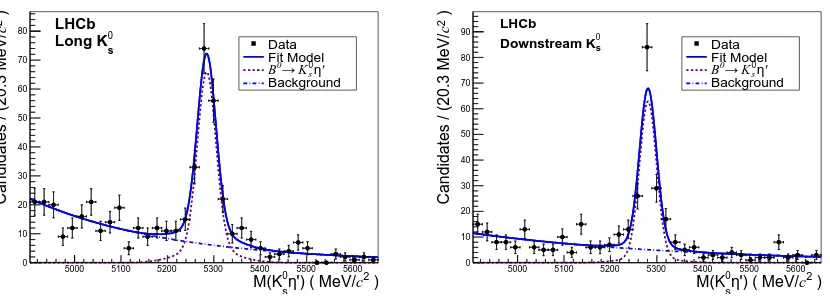
Figure 2: Mass distribution of the selected B0→K0Sη
0 (η0→π+π−γ) candidates in the 2011
and 2012 data, reconstructed in the L (left) andD (right) categories. The results of the fit, as
described in the text, are overlaid.
K0 Sη
0 invariant mass is 30.0±1.5 MeV/c2 for L candidates and 29.4±1.3 MeV/c2 for D
candidates. For the signal channels, the resolution of the reconstructed Λη0 invariant mass is 29.1±1.8 MeV/c2 (31.1±4.5 MeV/c2) for candidates reconstructed with η0→π+π−γ in theL(D) category, and 47.8±9.2 MeV/c2 (56.6±10.9 MeV/c2) for candidates reconstructed
with η0→π+π−η in the L (D) category. Reconstructed Λη candidates have an invariant mass resolution of 49.4±3.4 MeV/c2 in the L category and 47.6±9.2 MeV/c2 in the D
category. The parameters of the fit are found to be consistent between the 2011 and 2012 data samples, and so the two samples are added together to perform an overall fit.
The possible presence of physics backgrounds has been investigated. The most likely backgrounds are: b-hadron decay modes to mesons with open charm and an η(0) meson, with aπ0 meson which is not reconstructed; the nonresonant decays to K0
S or Λ particles
with two charged pions which are combined with a combinatorial photon,π0 or ηmeson to form an η(0) meson candidate; or, in the case of the η0→π+π−γ decays, the nonresonant B0→ K0
Sπ
+π−γ or Λ0
b→ Λπ+π
−γ decays. These backgrounds are rejected well by the BDT selection, and there are expected to be fewer than one candidate from each category passing the selection.
For the normalisation channel, the mass distribution of the selected K0 Sη
0 candidates is
shown in Fig. 2, with the result of the fit superimposed. The signal yields are 188±16 L
candidates and 149±14 D candidates, and the signal to background ratio is 1.8 in the L
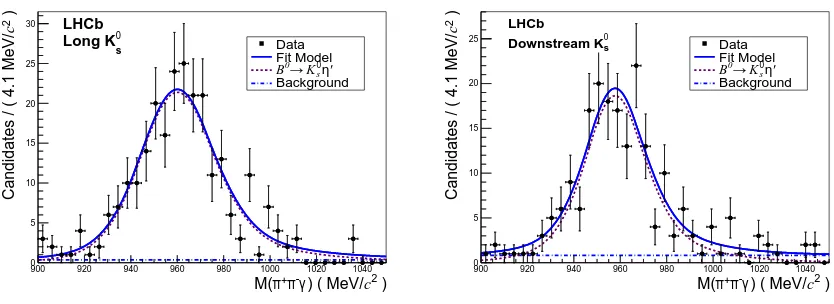
category, and 1.7 in the D category. Fig. 3 shows the invariant mass distribution of the reconstructed η0 mesons for these decays. The distribution is fitted with two Crystal Ball functions [40], and the parameters are found to be consistent with fits to the simulated samples, with a core resolution of 16±6 MeV/c2 for Lcandidates and 13±1 MeV/c2 forD
candidates.
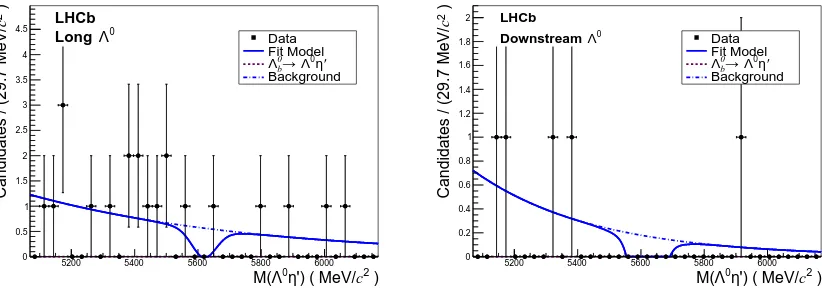
For the signal channel, Fig. 4 shows the Λη0 invariant mass distribution for candidates reconstructed in the Λ0
b→Λη
)
2 c
) ( MeV/ γ -π + π M(
900 920 940 960 980 1000 1020 1040
)
2c
Candidates / ( 4.1 MeV/
0 5 10 15 20 25 30 LHCb 0 s
Long K Data
Fit Model ' η 0 s K → 0 B Background ) 2 c
) ( MeV/ γ -π + π M(
900 920 940 960 980 1000 1020 1040
)
2c
Candidates / ( 4.1 MeV/
0 5 10 15 20 25 LHCb 0 s
[image:9.595.96.513.108.260.2]Downstream K Data Fit Model ' η 0 s K → 0 B Background
Figure 3: Mass distribution of the reconstructedη0 meson for selected B0→K0Sη
0 (η0→π+π−γ)
candidates, in the L (left) andD (right) categories. The results of the fit, as described in the
text, are overlaid.
)
2 c
') ( MeV/ η
0
Λ M(
5200 5400 5600 5800 6000
)
2c
Candidates / (29.7 MeV/
0 2 4 6 8 10 12 14 16 LHCb 0 Λ
Long Data
Fit Model ' η 0 Λ → 0 b Λ Background ) 2 c
') ( MeV/ η
0
Λ M(
5200 5400 5600 5800 6000
)
2c
Candidates / (29.7 MeV/
0 1 2 3 4 5 6 7 LHCb 0 Λ
[image:9.595.102.513.350.499.2]Downstream Data Fit Model ' η 0 Λ → 0 b Λ Background
Figure 4: Mass distribution of the selected Λ0b→Λη0 (η0→π+π−γ) candidates in the 2011 and
2012 data, reconstructed in the L (left) and D (right) categories. The results of the fit, as
described in the text, are overlaid.
for candidates in the Λ0
b→Λη
0 (η0→π+π−η) channel, and Fig. 6 shows the Λη invariant mass distribution for Λ0
b→Λη(η→π+π
−π0) candidates. An unbinned extended maximum
likelihood fit is performed using the same model as for the B0 decay, with an exponential function to describe the combinatorial background and a sum of two Gaussian functions to model the signal; all parameters are fixed to the values found from fits to the simulation, and only the numbers of signal and background events are allowed to float in the fit. No significant signal is observed above the expected background for the Λ0
b→Λη
0 channel,
)
2 c
') ( MeV/ η
0
Λ M(
5200 5400 5600 5800 6000
)
2c
Candidates / (29.7 MeV/
0 0.5 1 1.5 2 2.5 3 3.5 4
4.5 LHCb 0
Λ
Long Data
Fit Model ' η 0 Λ → 0 b Λ Background ) 2 c
') ( MeV/ η
0
Λ M(
5200 5400 5600 5800 6000
)
2c
Candidates / (29.7 MeV/
0 0.2 0.4 0.6 0.8 1 1.2 1.4 1.6 1.8 2 LHCb 0 Λ
[image:10.595.100.511.111.259.2]Downstream Data Fit Model ' η 0 Λ → 0 b Λ Background
Figure 5: Mass distribution of the selected Λ0b→Λη0 (η0→π+π−η) candidates in the 2011 and
2012 data, reconstructed in the L (left) and D (right) categories. The results of the fit, as
described in the text, are overlaid.
)
2 c
) ( MeV/ η
0
Λ M(
5300 5400 5500 5600 5700 5800 5900
)
2c
Candidates / (20.3 MeV/
0 0.5 1 1.5 2 2.5 3 3.5 LHCb 0 Λ
Long Data
Fit Model η 0 Λ → 0 b Λ Background ) 2 c
) ( MeV/ η
0
Λ M(
5300 5400 5500 5600 5700 5800 5900
)
2c
Candidates / (20.3 MeV/
0 0.5 1 1.5 2 2.5 3 3.5 LHCb 0 Λ
[image:10.595.100.513.352.499.2]Downstream Data Fit Model η 0 Λ → 0 b Λ Background
Figure 6: Mass distribution of the selected Λ0b→Λη (η→π+π−π0) candidates in the 2011 and
2012 data, reconstructed in the L (left) and D (right) categories. The results of the fit, as
described in the text, are overlaid.
Λ0
b→Λη
0 (η0→π+π−η) candidates. Evidence is seen for the presence of the Λ0
b→Λη
Table 1: Components contributing to the scale factorα.
Λη0(π+π−γ) Λη0(π+π−η) Λη(π+π−π0)
Factor L D L D L D
tot(B0)/tot(Λ0b) 2.3±0.1 1.55±0.08 7.4±0.6 9.5±1.4 4.6±0.3 3.4±0.2
fB/fΛ0
b 2.5±0.2 2.5±0.2 2.5±0.2
1/Cγ 1 (fixed) 0.95±0.04 1.13±0.04
0.5· B(K0S)/B(Λ) 0.541±0.004 0.541±0.004 0.541±0.004 B(η0)/B(η(0)) 1 (fixed) 1.71±0.05 1.31±0.03
α 3.1±0.3 2.1±0.2 17.7±2.3 22.8±4.0 9.5±1.2 7.0±0.8
4.2
Branching fraction measurement
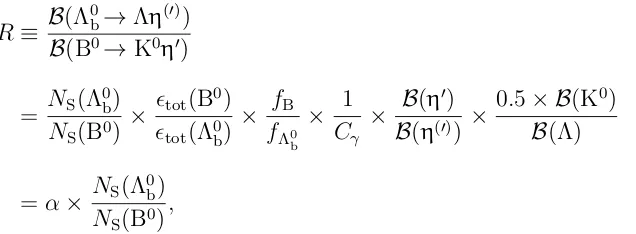
The ratio of branching fractions can be measured for each signal decay with respect to the normalisation channel using
R ≡ B(Λ
0
b→Λη(
0))
B(B0→K0η0)
= NS(Λ
0 b)
NS(B0)
×tot(B 0)
tot(Λ0b)
× fB
fΛ0
b
× 1
Cγ
× B(η
0)
B(η(0)) ×
0.5× B(K0) B(Λ)
=α×NS(Λ 0 b)
NS(B0)
,
(4)
where: NS is the number of signal events determined from the fits to data; tot is
the total efficiency, which is the product of the detector acceptance, reconstruction and selection efficiencies; fB/fΛ0
b is the ratio of B
0 to Λ0
b production fractions, previously
measured by LHCb [41]; 1/Cγ is a correction factor applied to account for the photon
re-construction efficiency in the Λ0
b→Λη
0 (η0→π+π−η) and Λ0
b→Λη(η→π+π
−π0) decays,
which have more photons in the decay than the normalisation channel; and B(η0)/B(η(0)) and B(K0
S)/B(Λ) are the ratios of η
0 to η(0) branching fractions and K0
S to Λ branching
fractions, respectively, from Ref. [20], where the factor 0.5 accounts for the fact that only half the K0 mesons decay as K0S mesons. Each of these factors have been measured, as
described in Sec. 5, and are given in Table 1 along with the calculated value of α for each signal channel.
5
Systematic uncertainties
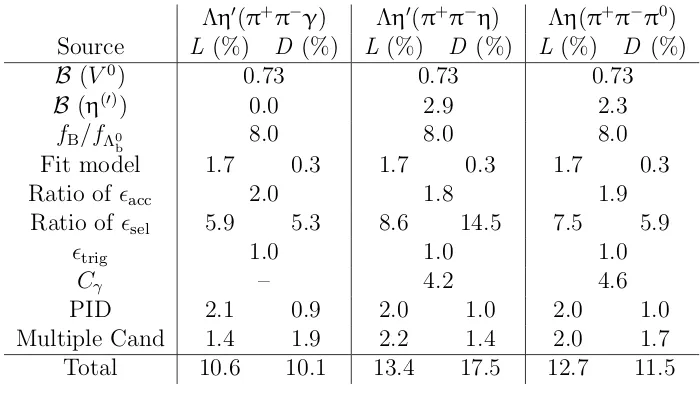
A summary of systematic uncertainties is given in Table 2. The largest systematic uncertainty for this analysis is due to the limited knowledge of the ratio of production fractions, fB/fΛ0
b, which was measured in Ref. [41] as a function of the Λ 0
Table 2: Fractional systematic uncertainties, in percent, on the ratio of branching fractions.
Λη0(π+π−γ) Λη0(π+π−η) Λη(π+π−π0)
Source L (%) D (%) L (%) D (%) L (%) D (%)
B (V0) 0.73 0.73 0.73
B (η(0)) 0.0 2.9 2.3
fB/fΛ0
b 8.0 8.0 8.0
Fit model 1.7 0.3 1.7 0.3 1.7 0.3
Ratio of acc 2.0 1.8 1.9
Ratio of sel 5.9 5.3 8.6 14.5 7.5 5.9
trig 1.0 1.0 1.0
Cγ – 4.2 4.6
PID 2.1 0.9 2.0 1.0 2.0 1.0
Multiple Cand 1.4 1.9 2.2 1.4 2.0 1.7
Total 10.6 10.1 13.4 17.5 12.7 11.5
For the average Λ0
b pseudorapidity in our signal sample, the ratio fB/fΛ0
b has a value of
2.5±0.2.
The systematic uncertainty on the ratio of the branching fractions of the K0
S, Λ and
η(0) decays is calculated from the average values from Ref. [20].
There is an uncertainty on the number of signal decays due to the fit model. To evaluate this uncertainty, the parameters that are fixed in the extended unbinned maximum likelihood fit are varied within the uncertainties obtained from the fit to the simulated samples, and the systematic uncertainty is the relative change in the yield obtained from the fit. This is found to be a small effect, 1.7% for the Lmodel and 0.3% for theD model.
The selection efficiencies are calculated with independent simulated samples, produced with different trigger conditions. The uncertainty on the measured ratio of efficiencies is the statistical uncertainty due to the number of simulation events generated. In addition, there is a systematic uncertainty due to the measured efficiency of the trigger selection as the software trigger changed during the data taking in 2012. The early 2012 setup is not modelled in the simulated samples, and so it is assumed that the efficiency of this stage of the trigger selection is the same for both periods. The uncertainty due to this assumption is taken to be 5%, which is consistent with differences in the efficiencies measured in analyses of similar decays. Since this data comprises ∼20% of the total data sample, the overall uncertainty on the trigger efficiency is 1%.
The reconstruction efficiency of the photons cannot be determined using the simulated samples, and so a data-driven method is used to correct for this efficiency [42]. The correction factor, Cγ, is found in bins of photon pT by comparing the relative yields of
reconstructed B+→ J/ψK∗+(→ K+π0) and B+→ J/ψK+ decays. Since the Λ0b→Λη0
(η0→π+π−γ) decay contains the same number of photons as the normalisation channel, this correction cancels in the ratio of efficiencies. However, for the Λ0
b→Λη
Λ0b→Λη (η→π+π−π0) decays, there is an extra photon in the signal channel compared to the normalisation channel. The correction factor is therefore applied to these channels, and an uncertainty is introduced due to the limited size of the data sample used to measure it.
The systematic uncertainty of the PID selection is estimated by the difference between the efficiency estimates obtained in data from calibration samples, and the efficiency extracted from the simulation after reweighting the PID variables to match the respective distribution observed in data.
Finally, there is an uncertainty due to the procedure for handling events with more than one candidate. The efficiency for selecting the best candidate using the procedure described earlier, and the fraction of events which contain more that one candidate are both estimated using simulated samples of signal decays. The estimated uncertainty on each of these quantities is around 10%, which is chosen as a conservative uncertainty. This introduces an overall systematic uncertainty of 1.4% to 2.2% depending on the signal channel.
6
Confidence Intervals
The number of signal events observed in each of the signal decays can be used to place a limit on the ratio of branching fractions of the signal decay with respect to the normalisation channel. The unified approach method presented in Ref. [43] is used to place a limit on the branching fraction. This method constructs confidence intervals based on a likelihood ratio method using the probability of observing Nobs signal events for a given branching
fraction. For this analysis the probability is assumed to follow a Gaussian distribution with a resolution of σ= qσ2
syst+σ2stat, where σsyst is the systematic uncertainty described
above and σstat is the statistical uncertainty on the number of events observed.
The 68% and 90% confidence level (CL) intervals are obtained for the Λ0b→Λη and Λ0
b→Λη
0 decays respectively, by combining the likelihoods of each category. The weighted
average of the observed ratio of branching fractions is calculated from the number of events observed in each signal channel with their uncorrelated systematic uncertainties and the values ofα in Table 1, and this is used to construct the confidence intervals. The combined
L and D categories are used to construct confidence intervals for the Λ0
b→Λη decay.
The likelihoods from the Λ0b→Λη0 (η0→π+π−γ) and Λ0b→Λη0 (η0→π+π−η) decays are then combined, with the L and D combined, to give a limit on the branching fraction for the Λ0
b→Λη
0 decay. The limit on the ratio of branching fraction with respect to the
normalisation channel is found to be
B(Λ0
b→Λη
0)
B(B0→K0η0) <0.047 at 90% CL, for the Λ0
b→Λη
0 decay, and for the Λ0
b→Λη decay the 68% CL intervals are B(Λ0
b→Λη)
B(B0→K0η0) = 0.142
+0.11
Multiplying by the known value of B (B0→K0η0) gives a limit on the branching fraction of the Λ0
b→Λη
0 decay
B(Λ0
b→Λη
0)<3.1×10⁻⁶ at 90% CL,
and the 68% CL intervals for the Λ0
b→Λη decay are B(Λ0
b→Λη) = (9.3 +7.3
−5.3)×10
−6.
7
Conclusions
A search is performed for the Λ0
b→Λη
0 and Λ0
b→Λη decays in the full dataset recorded
by the LHCb experiment during 2011 and 2012, corresponding to an integrated luminosity of 3 fb−1. No significant signal is observed above background for the Λ0
b→Λη
0 decay, and
some evidence is seen for the Λ0
b→Λη at the level of 3σ. The B0→K0η
0 decay is used
as a normalisation channel, so that a limit is placed on the ratio of Λ0b→Λη(0) branching fractions with respect to the B0→K0η0 branching fraction using the unified approach. With the known value of the B0→K0η0 branching fraction, the upper limit on the absolute branching fraction of the Λ0b→Λη0 decay is B(Λ0b→Λη0)<3.1×10⁻⁶ at 90% CL. The branching fraction of the Λ0
b→Λη decay isB(Λ0b→Λη) = (9.3 +7.3
−5.3)×10
−6.
These values can be compared with the branching fractions calculated in Ref. [21], and given in Sec. 1. The predicted branching fractions depend strongly on the method used to calculate the hadronic form factors, and on the parameters used in the calculation, as discussed earlier. Our results favour the branching fractions calculated using the pole model to estimate the hadronic form factors. In addition, our results are inconsistent with the prediction for B (Λ0
b→Λη
0) obtained by neglecting the anomalous contribution to the
decay amplitude, indicating that a gluonic component of the η0 wavefunction should be present.
Acknowledgements
(Russia). Individual groups or members have received support from EPLANET, Marie Sk lodowska-Curie Actions and ERC (European Union), Conseil g´en´eral de Haute-Savoie, Labex ENIGMASS and OCEVU, R´egion Auvergne (France), RFBR (Russia), XuntaGal and GENCAT (Spain), Royal Society and Royal Commission for the Exhibition of 1851 (United Kingdom).
References
[1] C. Di Donato, G. Ricciardi, and I. Bigi, η−η0 mixing: from electromagnetic transi-tions to weak decays of charm and beauty hadrons, Phys. Rev. D85 (2012) 013016,
arXiv:1105.3557.
[2] J. L. Rosner, Quark content of neutral mesons, Phys. Rev.D27 (1983) 1101.
[3] M. R. Ahmady and E. Kou, A more careful estimate of the charm content of η0,
arXiv:hep-ph/9903335.
[4] E. V. Shuryak and A. R. Zhitnitsky, The gluon and charm content of the η0 meson and instantons, Phys. Rev. D57(1998) 2001, arXiv:hep-ph/9706316.
[5] G. Li, Q. Zhao, and C.-H. Chang, Decays of J/ψ and ψ0 into vector and pseu-doscalar meson and the pseupseu-doscalar glueball-qq¯mixing, J. Phys.G35 (2008) 055002,
arXiv:hep-ph/0701020.
[6] A. Bramon, R. Escribano, and M. D. Scadron, Mixing of η− η0 mesons in J/ψ
decays into a vector and a pseudoscalar meson, Phys. Lett. B403 (1997) 339,
arXiv:hep-ph/9703313.
[7] T. Feldmann, P. Kroll, and B. Stech, Mixing and decay constants of pseudoscalar mesons, Phys. Rev. D58(1998) 114006, arXiv:hep-ph/9802409.
[8] A. Bramon, R. Escribano, and M. D. Scadron,The η−η0 mixing angle revisited, Eur. Phys. J. C7 (1999) 271,arXiv:hep-ph/9711229.
[9] F.-G. Cao and A. I. Signal, Two analytical constraints on the η−η0 mixing, Phys. Rev. D60 (1999) 114012, arXiv:hep-ph/9908481.
[10] A. Bramon, R. Escribano, and M. D. Scadron, Radiative V P γ transitions and η−η0
mixing, Phys. Lett. B503 (2001) 271, arXiv:hep-ph/0012049.
[11] B.-W. Xiao and B.-Q. Ma, Photon-meson transition form factors of light pseudoscalar mesons, Phys. Rev. D71(2005) 014034, arXiv:hep-ph/0501160.
[13] T. Huang and X.-G. Wu,Determination of theη−η0 mixing angle from the pseudoscalar transition form factors, Eur. Phys. J.C50 (2007) 771, arXiv:hep-ph/0612007.
[14] LHCb collaboration, R. Aaij et al., Evidence for the decayB0 →J/ψω and measure-ment of the relative branching fractions of Bs0 meson decays to J/ψη and J/ψη0, Nucl. Phys. B867 (2013) 547, arXiv:1210.2631.
[15] F. Ambrosino et al., A global fit to determine the pseudoscalar mixing angle and the gluonium content of the η0 meson, JHEP 07 (2009) 105, arXiv:0906.3819.
[16] R. Escribano and J. Nadal, On the gluon content of the η and η0 mesons, JHEP 05 (2007) 006, arXiv:hep-ph/0703187.
[17] R. Escribano, J/ψ → V P decays and the quark and gluon content of the η and η0, Eur. Phys. J. C65(2010) 467, arXiv:0807.4201.
[18] LHCb collaboration, R. Aaij et al., Study of η–η0 mixing from measurement of
B0
(s)→J/ψη(
0) decay rates, JHEP01 (2015) 024, arXiv:1411.0943.
[19] D. Atwood and A. Soni, B →η0+X and the QCD anomaly, Phys. Lett. B405(1997)
150, arXiv:hep-ph/9704357.
[20] Particle Data Group, K. A. Olive et al., Review of particle physics, Chin. Phys.C38 (2014) 090001.
[21] M. R. Ahmady, C. S. Kim, S. Oh, and C. Yu, Heavy baryonic decays of Λb →Λη(0),
Phys. Lett. B598(2004) 203, arXiv:hep-ph/0305031.
[22] LHCb collaboration, A. A. Alves Jr. et al., The LHCb detector at the LHC, JINST 3 (2008) S08005.
[23] LHCb collaboration, R. Aaij et al., LHCb detector performance, Int. J. Mod. Phys. A30 (2015) 1530022, arXiv:1412.6352.
[24] R. Aaij et al., Performance of the LHCb Vertex Locator, JINST 9 (2014) P09007,
arXiv:1405.7808.
[25] R. Arink et al., Performance of the LHCb Outer Tracker, JINST9 (2014) P01002,
arXiv:1311.3893.
[26] M. Adinolfi et al.,Performance of the LHCb RICH detector at the LHC, Eur. Phys. J. C73(2013) 2431, arXiv:1211.6759.
[27] A. A. Alves Jr.et al.,Performance of the LHCb muon system, JINST8(2013) P02022,
arXiv:1211.1346.
[28] R. Aaijet al.,The LHCb trigger and its performance in 2011, JINST8(2013) P04022,
[29] V. V. Gligorov and M. Williams, Efficient, reliable and fast high-level triggering using a bonsai boosted decision tree, JINST8 (2013) P02013, arXiv:1210.6861.
[30] T. Sj¨ostrand, S. Mrenna, and P. Skands,A brief introduction to PYTHIA 8.1, Comput. Phys. Commun. 178 (2008) 852, arXiv:0710.3820.
[31] I. Belyaev et al., Handling of the generation of primary events in Gauss, the LHCb simulation framework, J. Phys. Conf. Ser. 331 (2011) 032047.
[32] D. J. Lange, The EvtGen particle decay simulation package, Nucl. Instrum. Meth. A462 (2001) 152.
[33] P. Golonka and Z. Was,PHOTOS Monte Carlo: A precision tool for QED corrections in Z and W decays, Eur. Phys. J. C45(2006) 97, arXiv:hep-ph/0506026.
[34] Geant4 collaboration, J. Allison et al.,Geant4 developments and applications, IEEE Trans. Nucl. Sci. 53 (2006) 270; Geant4 collaboration, S. Agostinelli et al., Geant4: A simulation toolkit, Nucl. Instrum. Meth. A506 (2003) 250.
[35] M. Clemencic et al.,The LHCb simulation application, Gauss: Design, evolution and experience, J. Phys. Conf. Ser. 331 (2011) 032023.
[36] W. D. Hulsbergen, Decay chain fitting with a Kalman filter, Nucl. Instrum. Meth. A552 (2005) 566, arXiv:physics/0503191.
[37] L. Breiman, J. H. Friedman, R. A. Olshen, and C. J. Stone, Classification and regression trees, Wadsworth international group, Belmont, California, USA, 1984.
[38] B. P. Roe et al., Boosted decision trees as an alternative to artificial neu-ral networks for particle identification, Nucl. Instrum. Meth. A543 (2005) 577,
arXiv:physics/0408124.
[39] G. Punzi, Sensitivity of searches for new signals and its optimisation,
arXiv:physics/030863.
[40] T. Skwarnicki, A study of the radiative cascade transitions between the Upsilon-prime and Upsilon resonances, PhD thesis, Institute of Nuclear Physics, Krakow, 1986, DESY-F31-86-02.
[41] LHCb collaboration, R. Aaijet al.,Study of the kinematic dependences ofΛ0b production in pp collisions and a measurement of the Λ0
b →Λ+cπ
− branching fraction, JHEP 08
(2014) 143, arXiv:1405.6842.
[42] E. Govorkova, Study of photon reconstruction efficiency usingB+ →J/ψK(∗)+ decays in the LHCb experiment, arXiv:1505.02960.
LHCb collaboration
R. Aaij38, B. Adeva37, M. Adinolfi46, A. Affolder52, Z. Ajaltouni5, S. Akar6, J. Albrecht9,
F. Alessio38, M. Alexander51, S. Ali41, G. Alkhazov30, P. Alvarez Cartelle53, A.A. Alves Jr57,
S. Amato2, S. Amerio22, Y. Amhis7, L. An3, L. Anderlini17,g, J. Anderson40, M. Andreotti16,f,
J.E. Andrews58, R.B. Appleby54, O. Aquines Gutierrez10, F. Archilli38, P. d’Argent11,
A. Artamonov35, M. Artuso59, E. Aslanides6, G. Auriemma25,n, M. Baalouch5, S. Bachmann11,
J.J. Back48, A. Badalov36, C. Baesso60, W. Baldini16,38, R.J. Barlow54, C. Barschel38,
S. Barsuk7, W. Barter38, V. Batozskaya28, V. Battista39, A. Bay39, L. Beaucourt4, J. Beddow51,
F. Bedeschi23, I. Bediaga1, L.J. Bel41, I. Belyaev31, E. Ben-Haim8, G. Bencivenni18, S. Benson38,
J. Benton46, A. Berezhnoy32, R. Bernet40, A. Bertolin22, M.-O. Bettler38, M. van Beuzekom41,
A. Bien11, S. Bifani45, T. Bird54, A. Birnkraut9, A. Bizzeti17,i, T. Blake48, F. Blanc39,
J. Blouw10, S. Blusk59, V. Bocci25, A. Bondar34, N. Bondar30,38, W. Bonivento15, S. Borghi54,
M. Borsato7, T.J.V. Bowcock52, E. Bowen40, C. Bozzi16, S. Braun11, D. Brett54, M. Britsch10,
T. Britton59, J. Brodzicka54, N.H. Brook46, A. Bursche40, J. Buytaert38, S. Cadeddu15,
R. Calabrese16,f, M. Calvi20,k, M. Calvo Gomez36,p, P. Campana18, D. Campora Perez38,
L. Capriotti54, A. Carbone14,d, G. Carboni24,l, R. Cardinale19,j, A. Cardini15, P. Carniti20,
L. Carson50, K. Carvalho Akiba2,38, R. Casanova Mohr36, G. Casse52, L. Cassina20,k,
L. Castillo Garcia38, M. Cattaneo38, Ch. Cauet9, G. Cavallero19, R. Cenci23,t, M. Charles8,
Ph. Charpentier38, M. Chefdeville4, S. Chen54, S.-F. Cheung55, N. Chiapolini40, M. Chrzaszcz40,
X. Cid Vidal38, G. Ciezarek41, P.E.L. Clarke50, M. Clemencic38, H.V. Cliff47, J. Closier38,
V. Coco38, J. Cogan6, E. Cogneras5, V. Cogoni15,e, L. Cojocariu29, G. Collazuol22, P. Collins38,
A. Comerma-Montells11, A. Contu15,38, A. Cook46, M. Coombes46, S. Coquereau8, G. Corti38,
M. Corvo16,f, B. Couturier38, G.A. Cowan50, D.C. Craik48, A. Crocombe48, M. Cruz Torres60,
S. Cunliffe53, R. Currie53, C. D’Ambrosio38, J. Dalseno46, P.N.Y. David41, A. Davis57,
K. De Bruyn41, S. De Capua54, M. De Cian11, J.M. De Miranda1, L. De Paula2, W. De Silva57,
P. De Simone18, C.-T. Dean51, D. Decamp4, M. Deckenhoff9, L. Del Buono8, N. D´el´eage4,
D. Derkach55, O. Deschamps5, F. Dettori38, B. Dey40, A. Di Canto38, F. Di Ruscio24,
H. Dijkstra38, S. Donleavy52, F. Dordei11, M. Dorigo39, A. Dosil Su´arez37, D. Dossett48,
A. Dovbnya43, K. Dreimanis52, L. Dufour41, G. Dujany54, F. Dupertuis39, P. Durante38,
R. Dzhelyadin35, A. Dziurda26, A. Dzyuba30, S. Easo49,38, U. Egede53, V. Egorychev31,
S. Eidelman34, S. Eisenhardt50, U. Eitschberger9, R. Ekelhof9, L. Eklund51, I. El Rifai5,
Ch. Elsasser40, S. Ely59, S. Esen11, H.M. Evans47, T. Evans55, A. Falabella14, C. F¨arber11,
C. Farinelli41, N. Farley45, S. Farry52, R. Fay52, D. Ferguson50, V. Fernandez Albor37,
F. Ferrari14, F. Ferreira Rodrigues1, M. Ferro-Luzzi38, S. Filippov33, M. Fiore16,38,f,
M. Fiorini16,f, M. Firlej27, C. Fitzpatrick39, T. Fiutowski27, K. Fohl38, P. Fol53, M. Fontana10,
F. Fontanelli19,j, R. Forty38, O. Francisco2, M. Frank38, C. Frei38, M. Frosini17, J. Fu21,
E. Furfaro24,l, A. Gallas Torreira37, D. Galli14,d, S. Gallorini22,38, S. Gambetta50,
M. Gandelman2, P. Gandini55, Y. Gao3, J. Garc´ıa Pardi˜nas37, J. Garofoli59, J. Garra Tico47,
L. Garrido36, D. Gascon36, C. Gaspar38, U. Gastaldi16, R. Gauld55, L. Gavardi9, G. Gazzoni5,
A. Geraci21,v, D. Gerick11, E. Gersabeck11, M. Gersabeck54, T. Gershon48, Ph. Ghez4,
A. Gianelle22, S. Gian`ı39, V. Gibson47, O. G. Girard39, L. Giubega29, V.V. Gligorov38,
C. G¨obel60, D. Golubkov31, A. Golutvin53,31,38, A. Gomes1,a, C. Gotti20,k,
M. Grabalosa G´andara5, R. Graciani Diaz36, L.A. Granado Cardoso38, E. Graug´es36,
E. Graverini40, G. Graziani17, A. Grecu29, E. Greening55, S. Gregson47, P. Griffith45, L. Grillo11,
G. Haefeli39, C. Haen38, S.C. Haines47, S. Hall53, B. Hamilton58, T. Hampson46, X. Han11,
S. Hansmann-Menzemer11, N. Harnew55, S.T. Harnew46, J. Harrison54, J. He38, T. Head39,
V. Heijne41, K. Hennessy52, P. Henrard5, L. Henry8, J.A. Hernando Morata37,
E. van Herwijnen38, M. Heß63, A. Hicheur2, D. Hill55, M. Hoballah5, C. Hombach54,
W. Hulsbergen41, T. Humair53, N. Hussain55, D. Hutchcroft52, D. Hynds51, M. Idzik27,
P. Ilten56, R. Jacobsson38, A. Jaeger11, J. Jalocha55, E. Jans41, A. Jawahery58, F. Jing3,
M. John55, D. Johnson38, C.R. Jones47, C. Joram38, B. Jost38, N. Jurik59, S. Kandybei43,
W. Kanso6, M. Karacson38, T.M. Karbach38,†, S. Karodia51, M. Kelsey59, I.R. Kenyon45,
M. Kenzie38, T. Ketel42, B. Khanji20,38,k, C. Khurewathanakul39, S. Klaver54,
K. Klimaszewski28, O. Kochebina7, M. Kolpin11, I. Komarov39, R.F. Koopman42,
P. Koppenburg41,38, M. Korolev32, L. Kravchuk33, K. Kreplin11, M. Kreps48, G. Krocker11,
P. Krokovny34, F. Kruse9, W. Kucewicz26,o, M. Kucharczyk26, V. Kudryavtsev34, A.
K. Kuonen39, K. Kurek28, T. Kvaratskheliya31, V.N. La Thi39, D. Lacarrere38, G. Lafferty54,
A. Lai15, D. Lambert50, R.W. Lambert42, G. Lanfranchi18, C. Langenbruch48, B. Langhans38,
T. Latham48, C. Lazzeroni45, R. Le Gac6, J. van Leerdam41, J.-P. Lees4, R. Lef`evre5,
A. Leflat32,38, J. Lefran¸cois7, O. Leroy6, T. Lesiak26, B. Leverington11, Y. Li7,
T. Likhomanenko65,64, M. Liles52, R. Lindner38, C. Linn38, F. Lionetto40, B. Liu15, X. Liu3,
S. Lohn38, I. Longstaff51, J.H. Lopes2, D. Lucchesi22,r, M. Lucio Martinez37, H. Luo50,
A. Lupato22, E. Luppi16,f, O. Lupton55, F. Machefert7, F. Maciuc29, O. Maev30, K. Maguire54,
S. Malde55, A. Malinin64, G. Manca7, G. Mancinelli6, P. Manning59, A. Mapelli38, J. Maratas5,
J.F. Marchand4, U. Marconi14, C. Marin Benito36, P. Marino23,38,t, R. M¨arki39, J. Marks11,
G. Martellotti25, M. Martinelli39, D. Martinez Santos42, F. Martinez Vidal66,
D. Martins Tostes2, A. Massafferri1, R. Matev38, A. Mathad48, Z. Mathe38, C. Matteuzzi20,
K. Matthieu11, A. Mauri40, B. Maurin39, A. Mazurov45, M. McCann53, J. McCarthy45,
A. McNab54, R. McNulty12, B. Meadows57, F. Meier9, M. Meissner11, M. Merk41,
D.A. Milanes62, M.-N. Minard4, D.S. Mitzel11, J. Molina Rodriguez60, S. Monteil5,
M. Morandin22, P. Morawski27, A. Mord`a6, M.J. Morello23,t, J. Moron27, A.B. Morris50,
R. Mountain59, F. Muheim50, J. M¨uller9, K. M¨uller40, V. M¨uller9, M. Mussini14, B. Muster39,
P. Naik46, T. Nakada39, R. Nandakumar49, I. Nasteva2, M. Needham50, N. Neri21, S. Neubert11,
N. Neufeld38, M. Neuner11, A.D. Nguyen39, T.D. Nguyen39, C. Nguyen-Mau39,q, V. Niess5,
R. Niet9, N. Nikitin32, T. Nikodem11, D. Ninci23, A. Novoselov35, D.P. O’Hanlon48,
A. Oblakowska-Mucha27, V. Obraztsov35, S. Ogilvy51, O. Okhrimenko44, R. Oldeman15,e,
C.J.G. Onderwater67, B. Osorio Rodrigues1, J.M. Otalora Goicochea2, A. Otto38, P. Owen53,
A. Oyanguren66, A. Palano13,c, F. Palombo21,u, M. Palutan18, J. Panman38, A. Papanestis49,
M. Pappagallo51, L.L. Pappalardo16,f, C. Parkes54, G. Passaleva17, G.D. Patel52, M. Patel53,
C. Patrignani19,j, A. Pearce54,49, A. Pellegrino41, G. Penso25,m, M. Pepe Altarelli38,
S. Perazzini14,d, P. Perret5, L. Pescatore45, K. Petridis46, A. Petrolini19,j, M. Petruzzo21,
E. Picatoste Olloqui36, B. Pietrzyk4, T. Pilaˇr48, D. Pinci25, A. Pistone19, A. Piucci11,
S. Playfer50, M. Plo Casasus37, T. Poikela38, F. Polci8, A. Poluektov48,34, I. Polyakov31,
E. Polycarpo2, A. Popov35, D. Popov10,38, B. Popovici29, C. Potterat2, E. Price46, J.D. Price52,
J. Prisciandaro39, A. Pritchard52, C. Prouve46, V. Pugatch44, A. Puig Navarro39, G. Punzi23,s,
W. Qian4, R. Quagliani7,46, B. Rachwal26, J.H. Rademacker46, B. Rakotomiaramanana39,
M. Rama23, M.S. Rangel2, I. Raniuk43, N. Rauschmayr38, G. Raven42, F. Redi53, S. Reichert54,
M.M. Reid48, A.C. dos Reis1, S. Ricciardi49, S. Richards46, M. Rihl38, K. Rinnert52,
V. Rives Molina36, P. Robbe7,38, A.B. Rodrigues1, E. Rodrigues54, J.A. Rodriguez Lopez62,
J. Rouvinet39, T. Ruf38, H. Ruiz36, P. Ruiz Valls66, J.J. Saborido Silva37, N. Sagidova30,
P. Sail51, B. Saitta15,e, V. Salustino Guimaraes2, C. Sanchez Mayordomo66,
B. Sanmartin Sedes37, R. Santacesaria25, C. Santamarina Rios37, M. Santimaria18,
E. Santovetti24,l, A. Sarti18,m, C. Satriano25,n, A. Satta24, D.M. Saunders46, D. Savrina31,32,
M. Schiller38, H. Schindler38, M. Schlupp9, M. Schmelling10, T. Schmelzer9, B. Schmidt38,
O. Schneider39, A. Schopper38, M. Schubiger39, M.-H. Schune7, R. Schwemmer38, B. Sciascia18,
A. Sciubba25,m, A. Semennikov31, I. Sepp53, N. Serra40, J. Serrano6, L. Sestini22, P. Seyfert11,
M. Shapkin35, I. Shapoval16,43,f, Y. Shcheglov30, T. Shears52, L. Shekhtman34, V. Shevchenko64,
A. Shires9, R. Silva Coutinho48, G. Simi22, M. Sirendi47, N. Skidmore46, I. Skillicorn51,
T. Skwarnicki59, E. Smith55,49, E. Smith53, I. T. Smith50, J. Smith47, M. Smith54, H. Snoek41,
M.D. Sokoloff57,38, F.J.P. Soler51, F. Soomro39, D. Souza46, B. Souza De Paula2, B. Spaan9,
P. Spradlin51, S. Sridharan38, F. Stagni38, M. Stahl11, S. Stahl38, O. Steinkamp40,
O. Stenyakin35, F. Sterpka59, S. Stevenson55, S. Stoica29, S. Stone59, B. Storaci40, S. Stracka23,t,
M. Straticiuc29, U. Straumann40, L. Sun57, W. Sutcliffe53, K. Swientek27, S. Swientek9,
V. Syropoulos42, M. Szczekowski28, P. Szczypka39,38, T. Szumlak27, S. T’Jampens4,
T. Tekampe9, M. Teklishyn7, G. Tellarini16,f, F. Teubert38, C. Thomas55, E. Thomas38,
J. van Tilburg41, V. Tisserand4, M. Tobin39, J. Todd57, S. Tolk42, L. Tomassetti16,f,
D. Tonelli38, S. Topp-Joergensen55, N. Torr55, E. Tournefier4, S. Tourneur39, K. Trabelsi39,
M.T. Tran39, M. Tresch40, A. Trisovic38, A. Tsaregorodtsev6, P. Tsopelas41, N. Tuning41,38,
A. Ukleja28, A. Ustyuzhanin65,64, U. Uwer11, C. Vacca15,e, V. Vagnoni14, G. Valenti14,
A. Vallier7, R. Vazquez Gomez18, P. Vazquez Regueiro37, C. V´azquez Sierra37, S. Vecchi16,
J.J. Velthuis46, M. Veltri17,h, G. Veneziano39, M. Vesterinen11, B. Viaud7, D. Vieira2,
M. Vieites Diaz37, X. Vilasis-Cardona36,p, A. Vollhardt40, D. Volyanskyy10, D. Voong46,
A. Vorobyev30, V. Vorobyev34, C. Voß63, J.A. de Vries41, R. Waldi63, C. Wallace48, R. Wallace12,
J. Walsh23, S. Wandernoth11, J. Wang59, D.R. Ward47, N.K. Watson45, D. Websdale53,
A. Weiden40, M. Whitehead48, D. Wiedner11, G. Wilkinson55,38, M. Wilkinson59, M. Williams38,
M.P. Williams45, M. Williams56, T. Williams45, F.F. Wilson49, J. Wimberley58, J. Wishahi9,
W. Wislicki28, M. Witek26, G. Wormser7, S.A. Wotton47, S. Wright47, K. Wyllie38, Y. Xie61,
Z. Xu39, Z. Yang3, J. Yu61, X. Yuan34, O. Yushchenko35, M. Zangoli14, M. Zavertyaev10,b,
L. Zhang3, Y. Zhang3, A. Zhelezov11, A. Zhokhov31, L. Zhong3.
1Centro Brasileiro de Pesquisas F´ısicas (CBPF), Rio de Janeiro, Brazil 2Universidade Federal do Rio de Janeiro (UFRJ), Rio de Janeiro, Brazil 3Center for High Energy Physics, Tsinghua University, Beijing, China
4LAPP, Universit´e Savoie Mont-Blanc, CNRS/IN2P3, Annecy-Le-Vieux, France
5Clermont Universit´e, Universit´e Blaise Pascal, CNRS/IN2P3, LPC, Clermont-Ferrand, France 6CPPM, Aix-Marseille Universit´e, CNRS/IN2P3, Marseille, France
7LAL, Universit´e Paris-Sud, CNRS/IN2P3, Orsay, France
8LPNHE, Universit´e Pierre et Marie Curie, Universit´e Paris Diderot, CNRS/IN2P3, Paris, France 9Fakult¨at Physik, Technische Universit¨at Dortmund, Dortmund, Germany
10Max-Planck-Institut f¨ur Kernphysik (MPIK), Heidelberg, Germany
11Physikalisches Institut, Ruprecht-Karls-Universit¨at Heidelberg, Heidelberg, Germany 12School of Physics, University College Dublin, Dublin, Ireland
18Laboratori Nazionali dell’INFN di Frascati, Frascati, Italy 19Sezione INFN di Genova, Genova, Italy
20Sezione INFN di Milano Bicocca, Milano, Italy 21Sezione INFN di Milano, Milano, Italy
22Sezione INFN di Padova, Padova, Italy 23Sezione INFN di Pisa, Pisa, Italy
24Sezione INFN di Roma Tor Vergata, Roma, Italy 25Sezione INFN di Roma La Sapienza, Roma, Italy
26Henryk Niewodniczanski Institute of Nuclear Physics Polish Academy of Sciences, Krak´ow, Poland 27AGH - University of Science and Technology, Faculty of Physics and Applied Computer Science,
Krak´ow, Poland
28National Center for Nuclear Research (NCBJ), Warsaw, Poland
29Horia Hulubei National Institute of Physics and Nuclear Engineering, Bucharest-Magurele, Romania 30Petersburg Nuclear Physics Institute (PNPI), Gatchina, Russia
31Institute of Theoretical and Experimental Physics (ITEP), Moscow, Russia
32Institute of Nuclear Physics, Moscow State University (SINP MSU), Moscow, Russia
33Institute for Nuclear Research of the Russian Academy of Sciences (INR RAN), Moscow, Russia 34Budker Institute of Nuclear Physics (SB RAS) and Novosibirsk State University, Novosibirsk, Russia 35Institute for High Energy Physics (IHEP), Protvino, Russia
36Universitat de Barcelona, Barcelona, Spain
37Universidad de Santiago de Compostela, Santiago de Compostela, Spain 38European Organization for Nuclear Research (CERN), Geneva, Switzerland 39Ecole Polytechnique F´ed´erale de Lausanne (EPFL), Lausanne, Switzerland 40Physik-Institut, Universit¨at Z¨urich, Z¨urich, Switzerland
41Nikhef National Institute for Subatomic Physics, Amsterdam, The Netherlands
42Nikhef National Institute for Subatomic Physics and VU University Amsterdam, Amsterdam, The
Netherlands
43NSC Kharkiv Institute of Physics and Technology (NSC KIPT), Kharkiv, Ukraine
44Institute for Nuclear Research of the National Academy of Sciences (KINR), Kyiv, Ukraine 45University of Birmingham, Birmingham, United Kingdom
46H.H. Wills Physics Laboratory, University of Bristol, Bristol, United Kingdom 47Cavendish Laboratory, University of Cambridge, Cambridge, United Kingdom 48Department of Physics, University of Warwick, Coventry, United Kingdom 49STFC Rutherford Appleton Laboratory, Didcot, United Kingdom
50School of Physics and Astronomy, University of Edinburgh, Edinburgh, United Kingdom 51School of Physics and Astronomy, University of Glasgow, Glasgow, United Kingdom 52Oliver Lodge Laboratory, University of Liverpool, Liverpool, United Kingdom 53Imperial College London, London, United Kingdom
54School of Physics and Astronomy, University of Manchester, Manchester, United Kingdom 55Department of Physics, University of Oxford, Oxford, United Kingdom
56Massachusetts Institute of Technology, Cambridge, MA, United States 57University of Cincinnati, Cincinnati, OH, United States
58University of Maryland, College Park, MD, United States 59Syracuse University, Syracuse, NY, United States
60Pontif´ıcia Universidade Cat´olica do Rio de Janeiro (PUC-Rio), Rio de Janeiro, Brazil, associated to 2 61Institute of Particle Physics, Central China Normal University, Wuhan, Hubei, China, associated to3 62Departamento de Fisica , Universidad Nacional de Colombia, Bogota, Colombia, associated to8 63Institut f¨ur Physik, Universit¨at Rostock, Rostock, Germany, associated to11
64National Research Centre Kurchatov Institute, Moscow, Russia, associated to31 65Yandex School of Data Analysis, Moscow, Russia, associated to31
aUniversidade Federal do Triˆangulo Mineiro (UFTM), Uberaba-MG, Brazil
bP.N. Lebedev Physical Institute, Russian Academy of Science (LPI RAS), Moscow, Russia cUniversit`a di Bari, Bari, Italy
dUniversit`a di Bologna, Bologna, Italy eUniversit`a di Cagliari, Cagliari, Italy fUniversit`a di Ferrara, Ferrara, Italy gUniversit`a di Firenze, Firenze, Italy hUniversit`a di Urbino, Urbino, Italy
iUniversit`a di Modena e Reggio Emilia, Modena, Italy jUniversit`a di Genova, Genova, Italy
kUniversit`a di Milano Bicocca, Milano, Italy lUniversit`a di Roma Tor Vergata, Roma, Italy mUniversit`a di Roma La Sapienza, Roma, Italy nUniversit`a della Basilicata, Potenza, Italy
oAGH - University of Science and Technology, Faculty of Computer Science, Electronics and
Telecommunications, Krak´ow, Poland
pLIFAELS, La Salle, Universitat Ramon Llull, Barcelona, Spain qHanoi University of Science, Hanoi, Viet Nam
rUniversit`a di Padova, Padova, Italy sUniversit`a di Pisa, Pisa, Italy
tScuola Normale Superiore, Pisa, Italy
uUniversit`a degli Studi di Milano, Milano, Italy vPolitecnico di Milano, Milano, Italy