1962 N o .
3
euratom
I IVI
Bulletin of the European
Atomic Energy Community (Euratom)
1 9 6 2
No. 3
Contents:
1 Foreword
2 Euratom and Nuclear Research 11 Can tricks be played on life?
16 Euratom and the problems of liability and insurance in nuclear energy
21 The Ispra research establishment 26 Words and Keywords
13 Euratom News
Edited by:
Euratom, Dissemination of Information Directorate, 51-53 rue Belliard, Brussels.
Telephone: 13 40 90
Published by:
A. W. Sythoff, Leiden, Netherlands
Autoradiograph of cultured cancerous cell· containing thymidine marked with tritium (a radioactive form of hydrogen). The black «pots in the picture represent the marked molecules; consequently, since thymidine i» s basic ingredient of the nucleic a d d s , it is possible to obtain accurate information on the internal mecha-nisms of these cells.
Quarterly
Five editions:
English, German, French, Italian and Dutch
Yearly subscription:
United Kingdom 18/— Western Germany DM 10.— France N F 12.—
Belgium B.fr. 125.— Italy Lit. 1500 Netherlands f 9.— United States $ 3.50
Single copies:
United Kingdom 6/— Western Germany DM 3.— France N F 4.—
Belgium B.fr. 40.— Italy Lit. 500 Netherlands f 2.75 United States $ 1 . —
euratom
Information Bulletin of the European Atomic Energy CommunityPower reactors
Nuclear Physics
Reactor Technology
Nuclear Fusion
Radioisotopes
19 6 2
No. 3
Mineralogy and Geochemistry
Ship Propulsion
Alchemy!
On the 25th March 1957 in Rome, six states, namely:
THE KINGDOM OF BELGIUM
THE GERMAN FEDERAL REPUBLIC
THE FRENCH REPUBLIC
THE ITALIAN REPUBLIC
THE DUCHY OF LUXEMBOURG
THE KINGDOM OF THE NETHERLANDS
signed the treaty which instituted the European Atomic Energy Community (Euratom).
Biology
Automatic Information
Methods
Health Protection
L a w
Insurance
Economics
Education and Training
We had almost forgotten it.
At best the word brings to mind some
shadowy mediaeval figure hunched over his
alembics and engaged in feverish toil.
And yet it is tempting to see in the advent of
nuclear science a rebirth of this ancient and
visionary lore. And rightly so. The urge to
change lead into gold may have gone, but it
is beyond doubt that the atom has opened
the way
to
prodigious wealth.
Euratom
•f.
:
;
■WWUrs.
Dr. Jules Guéron, Director General of Research and Training at Euratom addressed the "Arbeitskreis für Recht und Verwaltung" of the German Atomic Forum in Bonn on 20th March 1962.
This is the text of his address.
Some readers may be surprised at the brevity with which some important aspects of Euratom research are treated. On the other hand they will realize that it is impossible to give a full account when the aim is to make it comprehensive.
1 Since E u r a t o m c a m e into being, somewhat over four years ago, two significant sets of facts have occurred in a t o m i c energy in the E u r o p e a n C o m m u n i t y .
First, the national a t o m i c p r o g r a m m e s have progressed. Research establishments have been finished a n d have as sumed full activity, or continued their work. Some in dustrial action has developed, b o t h in design a n d in m a n u facturing. Some reactors have been completed a n d have started operation, b u t they are all test reactors, or reactor experiments. N o n e of t h e m deserve to be considered as industrial machines, or even as prototypes, in the t r u e m e a n i n g of the word. However the construction of a few such machines has continued, or has been started, d u r i n g the period u n d e r review.
This state of affairs stems, of course, from the well known comfortable situation of the conventional power industry. But, especially if the delays a n d troubles which befell the experimental machines are b o r n e in m i n d , it emphasizes the youth a n d i m m a t u r i t y of atomic development. I t
brings out the m a g n i t u d e a n d diversity of the problems which must be solved before a huge new industry can b e cre ated : not only new machines, b u t new m a t e r i a l s , a n d new safety problems must be studied, m a s t e r e d a n d reduced to m a n u f a c t u r i n g a n d o p e r a t i n g conditions all at once. Secondly the C o m m u n i t y has become a reality a n d , as a scientific a n d technical working organization, it has over come its worst teething troubles. W h i l e you m a y legiti m a t e l y accuse m e of being a t the same time j u d g e a n d p a r t y , I shall take the liberty of saying t h a t we a r e , now, on a level with most national organizations, a n d t h a t we are considered as valid a n d serious p a r t n e r s by t h e m as well as by powerful atomic energy establishments outside the six countries.
2 2.1 W e are now finishing our first fiveyear p r o g r a m m e (195862) ; by the e n d of the year we shall have committed practically all the money which the T r e a t y h a d stipulated for us, n a m e l y $215 million. As, for various rea sons, the p r e p a r a t o r y a n d build u p periods have lasted over two years of the five, it m e a n s t h a t this spending will have taken place mostly in twoandahalf years, starting in m i d i960.
Ispra Geel
and Nuclear Research
From the first t o the second Five-year Programme
Jules Guéron
from one country to another, not only when one looks at
the overall amount, but also if one considers the expense
in relation to population or to gross national income.
It is therefore clear that we are now a significant factor in
the field, but by no means a major one, and, still less, in
a position to dictate policy even if we wished to do so
—which is not the case.
2.2 Since we are now approaching the end of our first
five-year programme, and about to start on our second,
this is a convenient time to summarize what we have done,
explain why we did it so, and state what we want to do,
and how.
2.3 According to the provisions of the Euratom Treaty,
which happen to coincide with those of common sense,
we have, on one side helped national programmes, and,
on the other, carried out independent actions.
These latter are unavoidable for two reasons. First, many
things need doing which are not included in the national
plans, and we are doing some of them—not all, by far.
Second we could not wisely and efficiently help, advise,
or associate with, national activities if we did not possess
independent means of action and of judgement.
2.4 2.4.1 Our own activities are carried out in, and
through, the establishments of the Community's Research
Centre. There are four such establishments: the main one
is at Ispra (Italy) ; another one will start at Petten
(Netherlands) ; the third, at Geel (Belgium) is the Bureau
of Nuclear Standards and the fourth, at Karlsruhe, now
under construction, will be the "European Institute for
Transuranium Elements". The names of the last two
explain clearly what they are destined to do, and I shall
not say any more about them now.
The first two are described as "general purpose
establish-ments". This means that they should be able to do all
sorts of things in atomic energy. It does not imply that
they have license to do
anything.
We aim, on the contrary,
at clear cut programmes.
In addition some projects are managed from Brussels by
my direct assistants, together with the smallest possible
staff, and with the help of the establishments.
2.4.2 A fundamental feature of our establishments is
that they are based on previously existing national centres.
This was imperative for many reasons, namely :
a)
it emphasizes the fact that the Community is not
dis-tinct from the member countries;—
b)
it saves time;—
c)
above all it gives us means of our own without adding
to the dispersion which, in our judgement, handicaps the
development of an independent European nuclear
industry in comparison with the situation in the other
great atomic powers.
to create efficient a n d thrifty general services—adminis trative a n d technical.
T h e next is to carry on the operation of the special facili ties existing there. This applies in the case of the Ispra a n d P e t t e n reactors.
Finally, an establishment must h a v e m a i n aims in life. T h e y direct its activities; their achievement gives a m e a s u r e of the efficiency of the organization ; they create a sense of urgency a n d polarize the t e a m work. At the same time, the various technical needs create nearly infinite opportunities for the f u n d a m e n t a l studies which m a i n t a i n the scientific s t a n d a r d , a n d are necessary to m o r a l e in a p o p u l a t i o n of skilled engineers a n d scientists. But it is a basic rule with us t h a t to divorce applied a n d fundamental research would be fatal to a n a t o m i c energy research establishment.
2.4.4 Ispra possesses i m p o r t a n t c o m p u t i n g machines (digital a n d analogue) which are n e e d e d for reactor work, b u t they are also used for computations asked for by the o t h e r E u r o p e a n C o m m u n i t i e s , by national centres a n d industries. T h e y are also at the service of an i n d e p e n d e n t research p r o g r a m m e in a u t o m a t i c translation a n d a u t o m a t i c d o c u m e n t a t i o n . T h e first derives from the Babel situation in the world, w h e r e the n e e d for a c o m m o n vehicular language has not yet been recognized a n d cared for. T h e second is a necessity in front of the exponential increase of the factual capital of science a n d technology. T h e s e two very active p r o g r a m m e s have provided us with valuable a n d stimulating i n t e r n a t i o n a l connexions. 2.4.5 T h e m a i n centre of interest for I s p r a is the deve l o p m e n t of the " O r g e l " type of reactors. T h e y use n a t u r a l u r a n i u m as fuel, (in the form of ceramic c o m p o u n d s , p e r h a p s even of alloys), heavy w a t e r as m o d e r a t o r , high boilingpoint organic c o m p o u n d s as h e a t transfer m e d i a , a n d special p r e p a r a t i o n s of light metals as structural components. T h i s c o m b i n a t i o n holds reasonable promise of a n industrial future. A t the same time it can profit from, a n d c o n t r i b u t e to, the development of other heavy w a t e r reactors developed at the national level.
I shall limit myself here to saying t h a t the m a i n d e p a r t ments in Ispra (reactor physics, materials, engineering) are for the time being m a i n l y or wholly engaged in Orgel problems. T h e work, coordinated u n d e r m y direct super vision by a project leader a n d his staff, gives rise in a d d i t i o n to n u m e r o u s a n d i m p o r t a n t research contracts placed in the m e m b e r countries.
O r g e l is also the occasion for very active cooperation with A m e r i c a n a n d C a n a d i a n laboratories. This shows — if it were necessary — t h a t the Orgel concept is considered of value by respectable organizations.
CE.T.I.S. (European Centre for the Treatment k of Scientific Information), Ispra r
• <
A ^Ê Euratom research establishments
•
•
1
•
AL'SSSSISSS. ^ ^
■HI..1....H IsTflslllW.· ^ V
* Γ
•
2.5 A great fraction of our funds (over one third) are
spent outside our own establishments*. But our outside
spending never takes the character of grants. Giving grants
is the business of numerous national and international
organizations. While this is an efficient and valuable
method of promoting and orienting research, it is not ours.
We deal either through definite research contracts,
through "associations" aiming at wide objectives, or
through the power reactors participation scheme.
2.5.1 The main body of research contracts is linked with
the US-Euratom agreement. This aims at the
construc-tion in Europe of American type reactors, it being
under-stood that European industry must take the greatest
pos-sible share in construction as well as in related research
and development work. However part of the work is to
be carried out in America. The Euratom Commission
pays for work in Europe, the United States Atomic
Energy Commission pays for work in the US, and
the amounts are to balance at the end. Decisions on the
selection of projects are taken by a joint US-Euratom
board; results are available without restriction to both
parties.
So far, 94 such contracts have been placed, most of
them in the Community. They deal with problems related
to water reactors, and mainly concern fuel elements,
reactor tank construction, special materials, fuel
chemi-cal processing, recycling of plutonium and waste
treat-ment.
In addition to good quality research in Europe — and
to the construction of one boiling and one pressurized
5 * In addition to this, one must of course take account of the
important development and construction contracts placed
by the establishments themselves.
water reactor — this agreement has led to the increase
of intimate relationship between European and American
laboratories.
2.5.2 The general condition of the power industry,
alluded to above, has led the Commission to recognize
that, in order to promote in good time a European
nuclear industry, incentives are now necessary for the
building of nuclear reactors. The participation
program-me is, therefore, open to electricity producers who
intend to build industrial nuclear plants — I mean good
enough and big enough plants — and who accept to
share completely the know-how so obtained with others,
under the aegis of the Commission. The Commission
contributes moderate amounts towards various expenses
which will help establish European industries. Three
reactors have been so far accepted in this framework
(one graphite gas-cooled; one boiling water; one
pres-surized water).
2.5.3 As f°r "associations", they are created when the
Commission finds national long term research projects
which can usefully be extended. This is done in the
fol-lowing way : the national undertaking is transformed into
a joint operation in which the two parties contribute to
funds and to management. In addition, and this is the
most important feature, the actual work is carried out
by a mixed team, the original group being increased by
non-nationals belonging to, or sponsored by, the
Commis-sion. The proportion of such Euratom staff may reach
50% of the graduates working on the project.
Such associations have been established, or are being
negotiated, in many important fields.
But before giving some details, I would like to say that:
from the scientific as from the administrative and — why not say so — political points of view ; —
b) a very great a m o u n t of patience, diplomacy and
firmness of purpose has often been necessary to persuade the desirable partners. M a n y years of persistent efforts have sometimes been necessary. This is one more case when it would have been easy to yield to the temptation of isolated action, a n d it shows again how strongly we are toiling towards cooperation and coordination. Associations cover the following fields:
T h e r m o n u c l e a r f u s i o n
Nearly all non-military research in this field is, or will soon be, carried out in the framework of Euratom asso-ciations. This is already the case in France and Italy and
partly the case in Germany. Another G e r m a n association a n d one in the Netherlands are in the making. Belgium has found it sufficient to send good scientists to the staff of our associations.
F a s t r e a c t o r s
W e can hope for a similar consolidation of all Community work, in the near future, in the most important field of fast neutron breeder reactors. An association with the French CEA (Commissariat à l'énergie atomique) is nearly ready and negotiations are getting under way with Germany. Such a consolidation will, of course, help to establish and increase collaboration with the U S and U K in this field.
As always we have not waited for formal agreements before starting on actual work.
Here again, the pressure in favour of a n d temptation toward undertaking independent action were very strong and we have steadfastly had to resist m a n y of our advisers or senior staff members in order to follow the above described course.
H i g h flux r e a c t o r s
T h e most modern of such reactors in Europe, BR 2 in Mol, is run by an association between Euratom and the Belgian C E N (Centre d'étude de l'énergie nucléaire). M i s c e l l a n e o u s
Homogeneous reactors, some nuclear physics, applied radiobiology in agriculture and in animal studies, as well as isotopie geology have given occasion for other associations with French, Belgian, Dutch and Italian organizations. Some exist also (in particular in Germany) in the most controversial field of nuclear merchant ships.
O E C D u n d e r t a k i n g s
W e can consider as associations the Halden and the Dragon O E C D projects (in which the Commission has joined on behalf of the six countries) because these projects, like our associations, are characterized by a national start, followed by joint financing, joint manage-ment, and international teams.
asso-s.
■n r
*Λri
il
WS&
i
J
-'Ί
m
i
«
*## ■■»»»»»■■■■■i^BBB
/
Thermonuclear fusion —a. view of the Garching laboratory (German Federal Republic)
Diagram of the BR 2 materials testing reactor in Mol (Belgium)
Λ 'Λ
ciation which we have been looking to, for well over three years now, and which has been recently accepted, at last, by the G e r m a n authorities.
3. Having thus given a short — yes, short — account of w h a t has been, and is being, done since 1958, I would like to present some general basic considerations underly-ing the second five-year plan proposals, which should bring us from 1963 to the end of 1967.
a) T h e activities described above are under way b u t
they are far from being finished, and thus will be the major undertakings of the second plan. Some of them have nearly reached a steady operation volume (Orgel) ; others must increase considerably (fast reactors).
b) While the scope and r h y t h m of past development has
been gratifying, we must realize that E u r a t o m is living dangerously, in particular as far as senior staff is concerned. M e n having at the same time the necessary general calibre and the particular training and experience are very scarce. But the success of our action lies in our ability to recruit enough of them, or, failing this, in our daring a n d good j u d g e m e n t in promoting young m e n to posi-tions of responsibility. Both courses of action are not too m u c h helped by the conditions of service at E u r a t o m (salaries as well as recruitment and promotion proce-dures), which, more and more, become less favourable than those offered by public or private atomic enter-prises to the key men we are considering.
c) This makes it all the more imperative to maintain a
m i n i m u m rate of growth in our activities so as to ensure the feelings of urgency and opportunity necessary to heal-thy establishments, a n d without which the best of the staffare tempted to leave. A 10 to 1 5 % yearly increase is none too big.
d) In the same connexion, a n d with unforeseen
develop-ments in view, it is necessary to provide for a reasonable a m o u n t of u n p r o g r a m m e d a n d of marginal research. This does not cost m u c h in equipment, as no new heavy machines can be involved at early stages.
e) T h e time has definitely come when national and
Community programmes can a n d must be intimately connected. It is possible because, as we said, both national organizations and the Community's Research Centre are m a t u r e institutions. It is necessary for obvious reasons of sound m a n a g e m e n t of our resources. It is therefore a duty of all of us to perform, casting away on all sides all institutional selfishness. T h e Treaty provides all the neces-sary mechanisms, particularly after they have been supplemented by the "Consultative Committee for Nuclear Research" where the m e n responsible for
pro-grammes in the member states a n d in the Commission jointly discuss all matters relevant to plans a n d budgets. This Committee, a n d its sub-committees, have been very active a n d useful in the last year. It will have reached its goal when it has really become the joint planning group, for nuclear affairs, of the whole Community (member
states and Commission).
T h e S e c o n d Five-year P l a n
4 It is now rather easy to figure out w h a t the second five-year plan must look like.
Its three main features are :
a) active furthering of activities already in h a n d ; —
b) within the m i n i m u m healthy rate of g r o w t h ; —
c) with just enough leeway to maintain a sensible measure
of exploration in new fields.
4.1 Both a global approach a n d an item by item reckon-ing led us to total appropriations of the order of $ 480 million for the five years 1963 to 1967. At the same time the staff numbers should progress from somewhat over 1900 to over 3500, with an average n u m b e r u n d e r 3000. 4.2 4.2.1 No new establishments of the Community's Research Centre should be created; those already in existence should reach a rather steady condition of activity.
4.2.2 T h e main lines of reactors to be developed should be those already defined, namely:
T w o reactors rich in promise for Europe's nuclear future: Left: an ORGEL circuit. Right: a fast reactor circuit 1. Heavy water moderator
2. Organic coolant 3. Steam-generating system
A. Primary liquid sodium circuit B. Secondary liquid sodium, circuit C. Steam-generating system
- !
a)
"Orgel" mostly by our own work in Ispra and
by-contracts;—
b)
fast reactors, using plutonium as fuel, mainly by
asso-ciation contracts, gathering the forces of the Community
in the national projects already under way;—
c)
high-temperature gas-cooled reactors, again by the
development of existing or new associations.
4.2.3 Accessorily other industrial reactor types will be
considered or contributed to:
a)
The research and development programme already
un-der way in the framework of the US-Euratom agreement
should be continued, and adapted to industrial and
tech-nical circumstances as they develop.
b)
Variants of reactor types can be usefully worked on
without involving the same sort of expense as the setting
up of an entirely new family (that is up to $ 400 million
from first experiment to really industrial models).
Never-theless one must be very careful—perhaps all the more
careful—in embarking on such work. This is why further
development of ordinary water, or heavy water reactors,
involving for instance integral superheat, spectral shift, or
fog cooling, must not be entered into without full
consider-ation.
However some development work along these lines is
useful and does not commit too many resources.
So-called reference designs and/or economic studies can
be very badly misleading when, as is too often the case, they
are based on insufficient nuclear and engineering data.
The construction of very small industrial plants may be
a somewhat more expensive manner of making essentially
the same mistake and we shall try to avoid encouraging
it. Let me give a somewhat excessive example of what I
mean : does anyone here imagine that the construction
and operation of a nuclear-powered fishing trawler would
be a significant step towards the advent of a nuclear
merchant fleet? Might it not rather ridiculize the whole
undertaking?
Let us therefore commit ourselves to an open-minded but
lucid and deep exploration of any such schemes, and
resolve not to be drawn into operations which, from the
start, are insufficiently well defined in their scope or
insufficiently desirable.
Most likely any such operations would be of a definite
industrial character. They would therefore go beyond the
Commission's research programme. But they might be
dealt with as "joint enterprises" as defined in Chapter V
of the Treaty, and they might need a research and
devel-g opment prodevel-gramme in which the Commission could take
an active interest.
4.2.4 The Commission will continue to operate, or share
in the operation of materials-testing reactors. It will also
further cooperation in this field and in the neighbouring
questions of ancillary equipment and of "hot" laboratories.
4.2.5 The knowledge of solid materials, in particular
metals, ceramics, and cermets, can very much be enhanced
by the use of neutrons both as probes to explore structures
and as projectiles to disturb them. It has therefore been
suggested that Euratom, alone or in association with
member states, might build in Ispra a "hyperflux" reactor
for studies of that sort. This most interesting project shall
be very carefully examined, because such a reactor raises
by itself important and difficult problems, and because
its operation and use would exert a great influence on the
very spirit of the Ispra establishment.
4.2.6 We should keep alert and informed in some
side-lines which may assume importance in the future, so as to
be ready to get into action when needed. The auxiliary
power sources for space probes, for instance, fall naturally
in the field of the Karlsruhe Transuranium Elements
Institute from the chemical point of view, and, from the
physics point of view, in that of the direct conversion group
of Ispra.
Our interest in high-temperature reactors may lead into
the very high-temperature machines which are considered
for space propulsion.
When member nations decide to get together for their
endeavours in space it might be considered logical, and
appropriate, that they entrust to an already existing and
competent Community the relevant nuclear parts of such
programmes.
4.2.7 Without going into details the following must be
mentioned, for the sake of completeness :
a)
thermonuclear work will go on;—
b)
activity will be maintained in the various branches of
chemistry associated with atomic energy, from fuel
pro-cessing to waste products treatment and disposal, and to
isotope applications;—
c)
in addition to the regulatory role entrusted by the
Treaty to the Commission in matters of safety and public
health, research relevant to these problems will be
maintained. From this stems a biology programme which,
prepared and begun in the last 18 months, should go into
regular steady operation during the second five-year
period. Here again we shall mostly work by association
with national institutions.
4.2.8 Documentation (current and futuristic) and
teaching cannot be neglected.
information on worthwhile matters. W e shall take no lesser pains to avoid overloading the communication channels with irrelevant or immature material.
Documentation must also digest a n d direct to its place of use information on what the rest of the world does. W e shall therefore keep u p the work mentioned earlier on machine-processing of non-numerical data, including languages.
In teaching, our j o b is not to increase the formal university and engineering school courses (although we are, of course, willing to help in harmonizing specialized nuclear depart-ments). We would rather concentrate on furthering the links between universities, engineering schools, a n d nuclear centres (this is the trainee system already in operation) and to contribute, in all possible manners, to the trans-formation of specialists of all disciplines, at various stages of their professional life, into nuclear engineers, or into users of nuclear a n d paranuclear techniques.
Since we have issued, somewhat over three months ago, the first outline of our second five-year p r o g r a m m e , active and continuous discussions have been taking place between the m e m b e r states and the Commission.
It has been a great satisfaction to us that the exchange of views has been lively, but that—in our opinion—there has been no fundamental opposition to our proposals. Indeed, in quite a n u m b e r of cases, they have been con-sidered too modest, and we have been urged to increase the intended appropriations.
This exchange of views will continue. A revised edition of the tentative p r o g r a m m e will be prepared, a n d we hope that it will be possible to have a decision from the Council of Ministers before the summer holidays. W e could then prepare and submit in due time the 1963 budget estimates, which would embody the new thrust of the Community towards its nuclear aims.*
So far we have considered the Community as it exists now. W e all are deeply aware that, early in the second five-year-period, it might be increased by the entry of new partners, a m o n g them the United Kingdom, the major nuclear nation of Western Europe.
Fortunately the nuclear world is now open enough for us to know that such an event, however momentous, would not change the basis of development outlined above. O f course m a n y adjustments would be necessary, including major ones. But I a m confident that the main lines would stand and only be strengthened. It is too early to say any more on this subject which, however, could not but be mentioned here to-day.
* Since the date of this address, the Council of Ministers has taken a decision on the second five-year programme, keeping to the broad principles outlined above, but including a few other items. The total sum has been brought down to S 425 million until the end of 1967, which will necessitate several adjustments.
Radiation can bring about minute molecular changes in the basic components of living organisms. These changes, when amplified by the continual renewal of living matter, can result in very serious disorders and even death. Research has in fact demonstrated that biological systems have a very low tolerance of changes sustained by their constituent elements. In an attempt to study this tolerance factor, biologists have conceived the idea of inducing the organism to incorporate a series of "false" components.
Can tricks be played on life?
Albert J. Bertinchamps
Biology Division, Directorate-General for Research and Training, Euratom
11
Living matter is composed of a limited number of
che-mical elements accounting for a relatively constant
percentage of the total mass in the body of an individual
— a fact which may be most clearly demonstrated by
comparison between individuals of the same types (same
race, same weight, same age, same sex). But even between
very different species there is a certain tendency towards
uniformity in chemical structure. This invariability in
chemical make-up is found in cells and is therefore even
more apparent on the molecular level. For instance,
the quantity of nitrogen and phosphorus contained by
a given number of cells of a rat's liver is relatively constant.
The quantity of iron present in a haemoglobin molecule
never varies.
All these elements, however, are in a constant process of
renewal and they are maintained at a steady level by
means of a dynamic equilibrium. This immutability
in the chemical composition of living matter is not due
to inertia but to the incessant interplay of a complex but
exact system of checks and balances designed to ensure
that, irrespective of the structure and physico-chemical
state of the external medium with which the unceasing
exchanges are effected, the organism will maintain a
constant make-up and continue to function in a regular
way. The living organism has been defined, with some
justice, as merely the momentary meeting place for
elements of a given medium. For all that, such meetings
are not of a fortuitous character. They occur as if each
atom entering the organism has first been subjected to an
extremely rigorous process of selection in line with precise
criteria. And indeed, besides useless or even harmful
ele-ments, there are a number of simple elements whose
presence is absolutely essential to the preservation of
life. They are sometimes extremely unobtrusive and
many of them appear only as traces in living matter.
These traces are, however, indispensable, for otherwise
the organism would suffer serious disorders, or even
death. This applies to such elements as copper, zinc,
manganese, etc.
These absolute requirements may relate not only to
simple elements but also, and especially, to the more
complex molecules, such as amino-acids, vitamins, etc.
that some organisms are incapable of synthesizing
them-selves despite the availability of the simple constituent
elements.
The molecules in question, then, enter metabolic chains
whose purpose is to ensure continuity of important
func-tions such as the generation of energy, growth,
reproduc-tion, etc. ; for this reason they are called essential
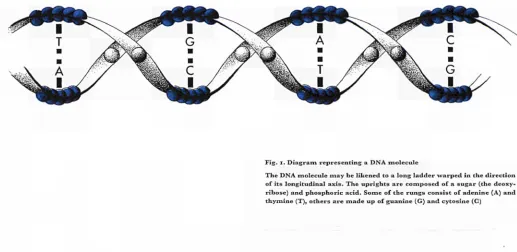
Fig. I. Diagram representing a DNA molecule
The DNA molecule may he likened to a long ladder warped in the direction of its longitudinal axis. The uprights are composed of a sugar (the deoxy-ribose) and phosphoric acid. Some of the rungs consist of adenine (A) and thymine (T), others are made up of guanine (G) and cytosine (C)
A habit which is becoming increasingly popular these days is the use of slot-machines. For a few francs, it is possible to obtain in m a n y places, at any hour of the day or night a n d without any h u m a n agency, a variety of goods or services.
This is assuredly a most convenient device and we should be very grateful to those whose ingenuity has m a d e these machines available to the general public, thus bene-fiting both anonymous parties in the transaction. If all our fellow-humans were honest, it would have sufficed to p u t cigarettes, chocolates and thousands of other articles on display everywhere, with a label, show-ing the price in each case and invitshow-ing customers to put the required sum in a receptacle conveniently placed for the purpose. All the shopkeeper would have had to do would be to restock his display counter from time to time and to collect his money. Unfortunately, allowance has to be m a d e for the lightfingered, and the goods have to be protected by making delivery subject to the prior payment of an adequate a m o u n t of h a r d cash. For instance, if the price of a stick of barley sugar is three francs and if instead of three one-franc pieces you try to put in only two coins, or if you try to get the machine to take three 25-centime pieces or three peppermints, in every case you will fail to obtain delivery of the article you covet. Even supposing you endeavour to insert three five-franc pieces or even a 1,000 franc note, you will have no better luck. If, on the other hand, you make a series of attempts with pieces of metal having the same general shape, approximately the same diameter and thickness a n d roughly the same weight as a one-franc-piece, a n d if by gradually filing them down you come nearer and nearer to achieving the ideal one-franc-piece, the probability is that your efforts will finally be crowned with success. T h e machine will accept your spurious coins and will give you a real stick of barley sugar.
T h e trouble that you have to take to cheat the machine depends on how sharp the designer is. It would not be beyond the wit of m a n to devise machines which would check not only the shape, weight, diameter and thickness of the coins but also the n u m b e r of grooves around the edge, the fineness, etc., thus virtually ruling out the possibility of fraud.
W e have seen that, in the same way as these highly per-fected machines, living organisms are extremely exacting as regards the entry of elements into their metabolic chains. This, however, has not prevented biologists from attempting to " c h e a t " and to " p u t one over" on this well-nigh perfect machine. T h e purpose of the present article (and we apologize for the rather r o u n d a b o u t analogy which we have adopted) is to describe a n u m b e r of instances in which they have been successful, to the greater benefit of biology a n d medicine.
T h e idea of replacing a diseased or useless organ by a similar organ originating from a different organism is by no means new. By all the rules, however, all attempts of this kind are theoretically doomed to failure.
A n y alien protein introduced into the organism is imme-diately recognized for what it is and judged undesirable. It triggers off a complex immunological response which sooner or later culminates in its rejection. T h e sharpness of this reaction is directly proportionate to the difference between the donor and the host.
Uniovular twins, however, are an exception to this rule. If an organ taken from one is properly grafted on to the other, there is no immunological reaction and the graft "takes". It is probable that, in such an instance, the word trickery is not applicable in its strict sense. T h e tissues are no doubt as alike in all respects as the twins are themselves.
Attempts have also been made to minimize or eliminate
the immunological reaction by chemical or phsyical
means (e.g. radiation). These efforts have on several
occasions met with a limited degree of success. In the
case of a corneal or plastic grafting, the organism's
immunological reaction is precluded by the absence of
any blood circulation in the organ grafted. As we know,
it is possible, and has even become quite a usual practice,
to transfuse all the blood or elements of the blood
(erythrocytes, platelets) from one person to another. This
practice is, generally speaking, permissible subject to
the observance of a number of rules arising from the
more or less pronounced incompatibility between the
various blood groups and subgroups to which the indivi
duals belong. Moreover, it must be pointed out that the
fact that a transfusion causes no reaction does not in any
way mean that nature has been "taken in". The refine
ment of immunological techniques has led to the discove
ry of a very considerable number of subgroups, which
shows that nature is well aware of what is going on. It
simply tolerates these happenings, which is quite a dif
ferent thing.
Deoxyribonucleic acid (DNA) is present in the nucleus
of every cell and is involved in cell division, protein
synthesis and the mechanisms which operate to transmit
hereditary characteristics. The DNA molecule may be
likened to a long ladder warped in the direction of its
longitudinal axis. The uprights are composed of a
sugar (deoxyribose)
and phosphoric acid. Some of
the rungs consist of adenine and thymine, others are
made up of guanine and cytosine. There are thus four
kinds of rungs, corresponding to the four possible con
figurations (see Fig. ι ). It is the sequence of these rungs
which constitutes the
code
governing the structure of the
various proteins. The DNA molecule is a very long one.
Its weight is several million times that of a hydrogen
atom. There is therefore a multitude of rungs and an
astronomically high number of possible sequence per
mutations. This accounts for the extraordinary diversity
of living creatures. When the cell divides, the DNA lad
der splits longitudinally and each daughter cell takes
with it a single upright to which all the halfrungs re
main attached in their initial order. The code is thus
handed down from one generation to the next.
It can therefore be seen that any interference with this
jo
system may result in the synthesis of abnormal proteins,
the impairment of the hereditary characteristics or the
blocking of the cell division process. Radiations may for
instance induce these anomalies precisely because of the
direct effect which they have on DNA.
It is also known that folic acid plays a part in the syn
thesis of guanine and thymine and that paraaminoben
zoic acid is a precursor of folic acid. It is thus possible to
establish a sketchy picture of the metabolic chain, which
in no way prejudices the precise relations between one
stage and the next, except for a certain cause and effect
relationship which we shall intentionally leave unclear
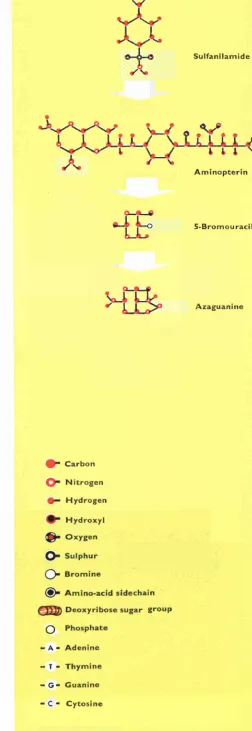
for purposes of simplification (cf. Fig. 2A).
One must admit that it was very tempting to try and
interfere with this apparently perfect mechanism. This
is why a number of molecules have been synthesized whose
overall chemical structure resembles each of the links in
this chain but which nevertheless betray more or less
pronounced differences (fig. 2B).
When these bodies are introduced into the organism in
sufficient quantity, one of the following phenomena may
result :
ï. The synthetic molecule differs too much from the
natural molecule and is not incorporated in the metabolic
process.
2. It is accepted, plays the same part as the natural
molecule and no discernible anomaly ensues.
3. It is accepted, and produces no noteworthy metabolic
alteration, except in the last stage, where it finally gives
rise to the appearance of abnormal proteins.
(4) On entering into competition with the natural mole
cule, the synthetic molecule gives rise to a deficiency in
one of the organism's essential metabolites; hence the
name of aniz'metabolite commonly given to them.
One is immediately struck by the various interesting uses
to which these molecules can be put :
During the research into the functions of certain essential
metabolites, it is possible, using a judiciously selected
anti
metabolite,
to create in the living organism a deficiency
of the metabolite involved. The anatomical, biochemical
or functional changes observed may subsequently yield
valuable information on the function of the substance
under examination. When these changes resemble the
symptoms of a disorder which can readily be described
but whose mechanism is unexplained, some pointers may
be gained as to its cause.
Para-am ¡nobenzoic acid
®m
<Folic acid
TT~*
·—· " - * £ Thymine
/* Τ T L V » Guanine
o · cr
CfSäS . aSÈB G ' Av ' C
: OO : OO : OO :
A C Τ G
e^> QÎS> ej» os
Nucleic acids ( A D N )
Proteins
Living cell
'
t
Manthe source materials, inhibits the entry of this material into the metabolic chain.
I n some cases, antimetabolite research has shed a certain a m o u n t of light on the n a t u r e of infectious diseases. T h e r e is a tobacco plant disease caused by Pseudomonas tabaci. T h e toxin released by this organism is an a n t i m e t a b o l i t e of methionine, which itself is a n essential aminoacid. Serotonin is a h o r m o n e which causes contraction of the unstripcd muscles. M o r e particularly, this essential meta bolite is present mainly in the nervous system. Successful a t t e m p t s have been m a d e to synthesize a whole r a n g e of ¿zrctóserotonins which h a v e the r e m a r k a b l e p r o p e r t y of bringing a b o u t m e n t a l disorders (depressions, attacks of epilepsy, hallucinations, etc.).
I t has further been discovered that several p r o d u c t s long known for their effects on the nervous system, such as yohimbine, certain alkaloids of ergot of rye, etc., are antimetabolites of serotonin.
These considerations p r o m p t e d Wooley a n d Shaw to a d v a n c e the hypothesis t h a t schizophrenia is the result of a disorder of the serotonin metabolism. T h i s is still an extremely controversial question, b u t there can h a r d l y be a n y d o u b t that a n t i m e t a b o l i t e research will provide a substantial contribution to our knowledge of this serious affliction.
S u l p h a n i l a m i d e exerts a highly depressing effect on the development of m a n y microorganisms. This p h e n o m e n o n , which has been t u r n e d to considerable a d v a n t a g e in infectious disease therapy, is p r o b a b l y a t t r i b u t a b l e to the antimetabolite p a r t played by sulphanilamide in relation to p a r a a m i n o b e n z o i c acid, an essential m e t a b o l i t e for such microorganisms. T h e absence of this inhibitory effect in the higher animals is p r o b a b l y to be ascribed to the fact t h a t they are by themselves i n c a p a b l e of synthesizing folic acid from p a r a a m i n o b e n z o i c acid a n d use only exoge nous folic acid.
M a n y other examples could be a d d u c e d of "false"
molecules being p u t into circulation by biologists. However, as we shall see, they have not stopped t h e r e ; with the a d v e n t of nuclear energy they have conceived the idea of e x p e r i m e n t i n g with "false" atoms.
Iodine is a constituent of the hormones which are syn thesized in the thyroid a n d exert an influence on the energy process in living cells. T h e iodine a t o m , like all atoms, consists of a nucleus a n d peripheral electrons. I n
Figs. a-A (left) and a-B (right)
Fig. 2-A is a sketch of a natural metabolic chain. On the other hand fig. 2-B s h o w s synthetic molecules whose overall chemical structure resembles each of the links of the natural chain, but which nevertheless betray m o r e or l e s s pronounced differences (hatched areas).
V
AJL
X
S u l f a n i l a m i d ethis case there are 53 electrons, while the nucleus contains
53 protons and 74 neutrons. As soon as it enters the
organism, this atom is quickly seized upon by the thyroid
and incorporated in the thyroid hormones, which in turn
are distributed via the bloodstream throughout the organ
ism. In this way, a number of iodine atoms are taken up
into the metabolic chain of the thyroid hormones every
second. As a general rule, they are never accumulated.
The hormones are disposed of steadily as they are pro
duced, so that the quantity of both the iodine and the
hormones remains constant. As the chain is unbroken and
never stops, and as, moreover, it is impossible to observe
a single atom in isolation, it is also impossible to form an
idea of the rate at which the chain progresses or how much
it produces. No solution could be provided to the question
of whether certain diseases did not originate from a slow
ingdown, a stoppage or a speedingup of thyroid hormone
synthesis until one day biologists, with the connivance of
the physicists, hit upon the notion of mixing with the
innumerable iodine atoms a number of atoms a chemist
would identify as iodine but which differ from the normal
element: instead of 74 neutrons, they contain 78, which
means that they are radioactive and hence detectable and
measurable to a high degree of accuracy. It appears that
this time the organism was duped and accepted this
counterfeit as legal tender. Insofar as the radiation effect
can be discounted, radioactive iodine is metabolized in
the same way as stable iodine. However, it emits discreet
signals which enable biologists and doctors to follow
accurately the rate of production of the thyroid and to
detect any alterations which it may undergo.
The countless uses to which radioisotopes are being put
in modern biology are thus based on what is at bottom
nothing but a swindle, a swindle which has enabled us to
study a tremendous variety of metabolisms and to fathom
many secrets.
It must not, however, be thought that the organism is
wholly blind to the changes which take place in the
atomic mass of its constituent parts. In the case outlined
above, the radioactive iodine only weighs about 3 % more
than the stable element. On the other hand, when dealing
with heavy water, whose molecules weigh 10% more than
those of light water, most organisms clearly discriminate
between the two, giving rise to what is known as an
isotopie effect.
As will be seen, one can scarcely reply by a simple yes or
I c
no to the question put in the title of this article: can tricks
be played on life ? The best answer, no doubt, is : yes, but it
is very difficult. At all events, it seems to be worth trying.
4 V
U
HJb
H&
Aminopterin
5-Bromouracil
Azaguanine
· "
0
·
-· "
&
0-0
<§>-m>
0
■ A
■ Τ
, G C
-Carbon Nitrogen Hydrogen Hydroxyl Oxygen Sulphur Bromine
Amino-acid sidechain Deoxyribose
Phosphate Adenine Thymine Guanine
Cytosine
[image:19.601.342.594.12.743.2]E u r a t o m and
Reinhart Bauer
Directorate-General for Industry and Economy, Euratom
¡iiii HiS ¡iiii iiiii
liisi
• ¡im ¡|¡¡¡ umT h e p r o b l e m s o f l i a b i l i t y a n d i n s u r a n c e
It was the Hiroshima b o m b which m a d e the public aware of the existence of nuclear energy ; it is therefore not surprising that nuclear risks should be exaggerated. Although any occupation which has to do with the atom, even in its peaceful applications, tends to be considered by the layman as particularly dangerous, it is a fact that only very few nuclear incidents have occurred. Among these not even one can be singled out as disastrous. T h e experts agree that in the case of the reactor types adopted hitherto an explosion such as that which is set off by an atomic b o m b is completely inconceivable. Thanks to the comprehensive safety provisions laid down in all states, even the possibility of a chain reaction running out of control in an atomic reactor is highly unlikely. Similarly, radiation hazards are so effectively restricted by safety regulations that from available statis tics it is apparent that the accident rate in nuclear installa tions is lower than in conventional industrial enterprises. However, in spite of all precautions, the possibility of incidents cannot be completely ruled out and account must be taken, at least in theory, of the fact that they may yet reach greater proportions. Therefore, apart from accident prevention, one must tackle the question of dealing satisfactorily with damages which could be sustained by third parties. Moreover, prescriptions regarding liability must be adapted both to the nuclear risk involved and to the available insurance facilities.
16
■
«i in nuclear energy
Fuel element
Lead
Basket
Cooling fins
17
The usual legal principles relating to accident liability
do not satisfy these requirements. For instance, if the
usual concept of negligence is accepted, liability is
contingent on the injured party's ability to prove the
negligence of the party causing the damage. When
one considers the complexity of the processes occurring
inside a nuclear reactor and the consequences to which
the radioactive contamination of an installation might
lead, how would it be possible to follow up a claim?
Con-versely, unlimited liability could burden the responsible
party with excessive risks, perhaps to the extent of
threatening his very existence. Even the suppliers of
certain parts of the nuclear installation or branches of
industry which contributed to its construction or
opera-tion, would have to carry a risk which could exceed,
many times over, the value of their share of the work.
Apart from these difficulties, the coverage of nuclear
risks through insurance cannot be effected in a
conven-tional manner because special uncertainty factors are
involved. It is particularly difficult to estimate what
technical reserves have to be made available in the
absence of statistical data on case histories. Moreover, the
dominant principle of insurance, namely the spreading of
risks, cannot be fully applied : there are as yet only a small
number of nuclear installations both inside and outside
the Community. The present state of our knowledge does
not allow us to rule out the possibility of a particular type
of damage requiring the deployment of resources beyond
the capacity of a single insurance company. Hence no
insurer has alone assumed the third party risk for nuclear
installations; individual companies have preferred to
form pools on a national basis and combine their resources
for the coverage of nuclear risks. Although these pools
achieve a good measure of coordination between
compa-nies and make them, thanks to mutual reinsurance,
A container designed for the transport of fuel elements
capable of handling larger business, they can only
guaran-tee a limited cover. Self-insurance is also ruled out in
most cases.
In the case of far-reaching damage the operator of an
installation could therefore very well find himself without
sufficient cover. It is clear that no one would be prepared
to plan, build or operate nuclear installations if he found
himself exposed to the risk of having to meet liabilities
against which he could not fully cover himself. This is
why a reasonable solution to the problem of liability and
insurance is an essential condition of the development of
a nuclear industry.
The solution of the liability problem
a) Fully alive to this correlation, a number of states
concerned with the development of nuclear energy have
tried to resolve these questions through national
legisla-tion; this applies in particular of the German Federal
Republic, Japan, Sweden, Switzerland, the United
Kingdom and the United States. They have either
developed new principles concerning liability or
ampli-fied the existing principles.
It goes without saying that national legislation cannot,
in a satisfactory manner, cope with the consequences of
nuclear incidents the effects of which extend beyond
national frontiers. This is true, for instance, in the case
of an accident bringing about the formation of a
radio-active cloud, of the infiltration of radioradio-active substances
into waters which border several states, or of liability
problems raised by the transport of radioactive materials
from country to country.
The reactor of the Società Elettronucleare Nazionale (SENN) on the banks ^ of the Garigliano in Southern Italy. The reactor will soon be completed, ' and yet it will not be possible to start it up until a satisfactory solution has been found for the liability problems involved.
Energy Agency of OEEC on an international
conven-tion dealing with third party liability in the field of
nu-clear energy; the discussions culminated in the signature
of this convention in Paris on 29 July i960 by sixteen
European states. The most important principles of the
Paris Convention, which is not yet in force, can be
sum-marized as follows:
— Liability exists even when no negligence can be proven
(absolute liability) ;
— Only one person is liable, namely the operator of the
nuclear installation which caused the accident. In
parti-cular suppliers are free from liability (channelling
liability) ;
— Recourse against third parties is ruled out on
prin-ciple;
— Liability is not only limited in time by prescription but
also in extent; it is in principle limited to 15 million
units of account ($ 15 million);
— In order to cover his liability the operator of any
nuclear installation is bound to obtain a financial
guaran-tee (insurance policy or another guaranguaran-tee) up to the
amount laid down ;
— As for the transportation of radioactive materials on
the territory of one or more of the contracting parties,
liability devolves on the operator effecting their dispatch
until such time as they have been taken over by another
operator.
b) The member States of the European Atomic Energy
Community have signed the Paris Convention. They are,
however, of the opinion that it needs to be supplemented
because the liability ceiling of 15 million units of account
could prove to be too low. They have therefore decided
to conclude another agreement, supplementary to the
Paris Convention, on the basis of a draft submitted a
few years ago to the member States by the Commission
of the European Atomic Energy Community.
The spirit of this agreement consists in supplementing the
cover which must be obtained by the operator by bringing
up to 120 million units of account the ceiling of
compensa-tion. As this amount cannot at the moment be raised
through private insurance, only individual states or
all contracting parties together come into consideration
as guarantors.
The system of liability arising from this principle is as
follows :
1. In accordance with the Paris Convention, the operator
must cover himself up to the stipulated ceiling through
insurance or some other form of financial guarantee.
2. Compensation over and above this amount is dealt
with in two stages:
— For the amount between the previously mentioned
ceiling of 15 million units of account and 70 million, the
state on the territory of which the installation responsible
for the damage is situated guarantees compensation.
— Between 70 millions and 120 millions the member
States are collectively responsible for compensation.
The supplementary conven ion is applicable to all nuclear
installations operated for peaceful purposes. As this may
lead to difficulties of interpretation, the installations
covered by the supplementary convention must be
en-tered on a special list.
At the present stage of negotiations compensation will be
applied if
— the installation causing damage is situated in the
territory of one of the contracting parties,
— the nuclear incident has occurred on the territory of
one of the contracting parties or on the high seas
(im-portant in the case of transport) and
— the damage has been suffered on the territory of one
of the contracting parties or on (or above) the high seas,
on board a ship or aeroplane registered in one of the
contracting countries, or, without reference to the means
of transport, when
— the victim is a national of one of the contracting
parties.
These provisions are applicable only in so far as a court
of a contracting party is competent to pronounce
judg-ments on claims for reparations.
A special difficulty arose in connection with the stage
where the contracting parties guarantee payments
col-lectively (i.e. between 70 and 120 million units of
ac-count), because it was necessary to determine in the
text of the convention the financial contribution of each
contracting party. The following system was finally
established: one half of the contribution is a function
of each state's gross national income, and the other half
a function of the installed thermal power of the nuclear
reactors situated in the territory of each contracting party. jo
The advantage of this system is that, even should other
19