FACULTY OF ELECTRICAL ENGINEERING UNIVERSITI TEKNIKAL MALAYSIA MELAKA
LAPORAN PROJEK SARJANA MUDA
DEVELOPMENT OF VOICE RECOGNITION ON NAVIGATION SYSTEM FOR VISUALLY IMPAIRED PERSON
Ng Wan Teng
“I hereby declare that I have read through this report entitle “Development of voice recognition on navigation system for visually impaired person” and found that it has comply the partial fulfillment for awarding the degree of Bachelor of Mechatronic Engineering”.
Signature : ...
Supervisor’s Name : ENGR. Anuar Bin Mohamed Kassim
DEVELOPMENT OF VOICE RECOGNITION ON NAVIGATION SYSTEM FOR VISUALLY IMPAIRED PERSON
NG WAN TENG
A report submitted in partial fulfilment of the requirements for the degree of Bachelor of Mechatronic Engineering
Faculty of Electrical Engineering
UNIVERSITI TEKNIKAL MALAYSIA MELAKA
I declare that this report entitle “Development of voice recognition on navigation system for visually impaired person” is the result of my own research except as cited in the references. The report has not been accepted for any degree and is not concurrently submitted in candidature of any other degree.
Signature : ...
Name : NG WAN TENG
iii
Acknowledgement
First of all, I would like to express my gratitude towards all helpful people during my project. Without their help, I would not be able to complete my second semester of Final Year Project successfully.
Secondly, a very special thanks to my supervisor, ENGR. Anuar Bin Mohamed Kassim for his guidance during the period of my Final Year Project. The other person that I really like to thanks is Mr. Chan Xin Zhi who is now pursuing his master program in navigation for visually impaired person for spending his time for me.
v
Abstract
Abstrak
vii
CONTENTS
CHAPTER TITLE PAGE
Acknowledgement iv
Abstract v
Abstrak vi
LIST OF TABLE ix
LIST OF FIGURE x
LIST OF EQUATION xii
1 INTRODUCTION 1
1.1 Project background 1 1.2 Motivation 1 1.3 Problem statement 2 1.4 Objectives 3 1.5 Scope of research 3 1.6 Contribution of research 3 1.7 Report outlines 4 2 LITERATUREREVIEW 5
2.1 Introduction 5 2.2 Methods of navigation for visually impaired person 5 2.3 Studies on navigation methods 9 2.4 Summary of review 10 3 METHODOLOGY 11
3.1 Introduction 11
3.2 System Overview 12
3.5 Program Flowchart 15
3.6 EasyVRModule 17
3.7 Arduino Uno 17
3.8 Digital Storage Oscilloscope (DSO) 18
3.9 Sound Waves 19
3.9.1 Sound Properties 20
3.9.2 Average Voltage of AC Waveform 20
3.9.3 Envelope of Sound 21
3.9.4 Sound Intensity Level 23
3.10 Implementation of Voice Recognition on Navigation System 24
3.11 Experimental Setup 25
3.11.1 Experiment on Sound Waveform 26 3.11.2 Experiment on Sound Intensity Level 27 4 RESULTS, ANALYSIS AND DISCUSSION 30
4.1 Introduction 30
4.2 Waveform analysis for each facilities 30 4.2.1Performance of method proposed with different sound
intensity level 38
4.3 Discussion on experiments 40
4.3.1 Discussion on Sound Waveform 40
4.3.2 Discussion on Sound Intensity Level 45 5 CONCLUSION 46
5.1 Conclusion 46
5.2 FutureWork 46
REFERENCES 47
ix
LIST OF TABLE
TABLE TITLE PAGE
1.1 Statistic for Blindness in Malaysia (Estimated) 2
2.1 Analysis on methods studied 9
3.1 Characteristic of electret condenser microphone 19
3.2 Intensity level of surrounding 23
3.3 Apparatus used in each experiment 25
4.1 Voice detection for voice “Toilet” 32
4.2 Voice detection for voice “ATM” 34
4.3 Voice detection for voice “Platform” 36
4.4 Voice detection for voice “Surau” 38
LIST OF FIGURE
FIGURE TITLE PAGE
2.1 Navigation with colour navigation line, RFID and white cane 6
2.2 Sensor glove 7
2.3 CYCLOPS wearable aid 8
2.4 Video sunglass 8
3.1 System overview 12
3.2 K-Chart 13
3.3 Project Flowchart 15
3.4 Program Flowchart 16
3.5 Easy VR Module 17
3.6 Arduino Uno 18
3.7 Digital Storage Oscilloscope (GW Instek GDS-3000 Series) 18 3.8 Variation in Air Pressure and Corresponding Waveform 19
3.9 Properties of Sound Waves 20
3.10 Average value of non-sinusoidal waveform 21
3.11 ADSR envelope 22
3.12 Sound waveform with envelope of sound 22 3.13 Implementation of EasyVR on navigation system 24 3.15 Circuit constructed for microphone and oscilloscope 26 3.16 Connection between the circuit and oscilloscope 27 3.17 Ceria Lab with sound intensity level of 50-59 dB 28 3.18 Cafe 1 UTeM with sound intensity level of 60-69 dB during sunny day 28
3.19 Noise meter 29
LIST OF EQUATION
EQUATION PAGE
(3.1) 21
CHAPTER 1
1 INTRODUCTION
1.1 Project background
Undeniably, mobility is the main concern for visually impaired person throughout their life. The ability for a person to move independently from one point to the other loses with the lost of eyesight. Navigation tool such as white cane has been developed for decades to assist visually impaired person in detecting and avoiding obstacles along their pathway. However, it is still insufficient to guide them to their desired destination precisely and independently especially when the surrounding environment is new to them. Besides that, visually impaired person tend to feel helpless wherever there are. Hence, a complete navigation system which is able to provide correct path for them to reach their desired destination and simple to use is required so that they can travel around without one’s assistant.
1.2 Motivation
developing countries which include Malaysia[1]. According to the information collected by the International Agency for the Prevention of Blindness as shown in Table 1.1, it shows that around 0.5% (144 295) of peoples in Malaysia are visually impaired[2].
Table 1.1: Statistic for Blindness in Malaysia (Estimated) [2]
Indicator Value
Population 28,859,000
National Prevention of Blindness Committee Active No
National Eyes Health Plan Developed Yes
Number of ophthalmologists 380
Blindness prevalence 0.5%
1.3 Problem statement
3
1.4 Objectives
The main objective of this research is
1. To design and develop a voice recognition system by using EasyVR Shield to allow visually impaired person to reach desired destination.
2. To evaluate the performance of the developed voice recognition system.
1.5 Scope of research
The scope of this project covers the voice recognition and implementation on navigation system for visually impaired person to walks from current position to facilities set for voice recognition according to RFID tag set on tactile paving.
1. Voice recognition covers only voice set to recognize facilities (toilet, ATM, platform and surau)
2. Performance of the voice navigation will be tested in different environment with different sound intensity level.
1.6 Contribution of research
i. Chapter 1
This chapter gives a brief introduction on the research of navigation system for visually impaired person and also set the objectives and limitations of the research. ii. Chapter 2
This Chapter provides a better understand on the project background and also the methods of navigation proposed by other researcher. Comparison is made and the best method is stated.
iii. Chapter 3
This chapter provides the flow of the project and how the experiment is setup to evaluate the performance of method proposed.
iv. Chapter 4
This chapter will analyze and discuss on the result obtain from the experiments conducted.
v. Chapter 5
CHAPTER 2
2 LITERATURE REVIEW
2.1 Introduction
With the advancement of technology, many researchs have been done to improve the navigation tools or system for visually impaired person. Several methods were invented in the past to assist mobility of visually impaired person. These methods which include the use of white cane, sensor based shoe, eyeglasses, capasitive touch braille keypad, CYCLOPS glove, video sunglass and INSIGHT are studied and analyzed in detail by comparing each method with the type of system involve and how the methods proposed by other researchers are able to help and improve the mobility of invisually impaired person. Lastly the review on each methods on whether it is sufficient in navigating visually impaired person to their desired destination is summarized.
2.2 Methods of navigation for visually impaired person
A total of 7 methods proposed by different researchers in the world are studied. Each method proposed shows different way of navigation for visually impaired person.
i. Coloured navigation line, RFID tag and white cane
swing so that the colour sensor can detectand find the navigation line on the floor[4]. Swinging can be done when surrounding of the user is empty but in a crowded area, swinging maybe difficult to perform. Figure 2.1 shows the navigation with colour navigation line, RFID and white cane.
Figure 2.1: Navigation with colour navigation line, RFID and white cane[3]
ii. Sensor based shoe
Another method for navigation is by wearing a sensor based shoe. This method uses IR sensors that attached infront and underneath the shoe to detect obstacles infront and the reflectivity of the standing surface repectively. On the other side, a feedback unit will be wear by the user where it will infrom user by vibration according to the obstacles and surfaces detected[5].
iii. Cane and eyeglass
7 hand of user[6]. However, it does not give the actual guidance to visually impaired person to arrive at their desired destination.
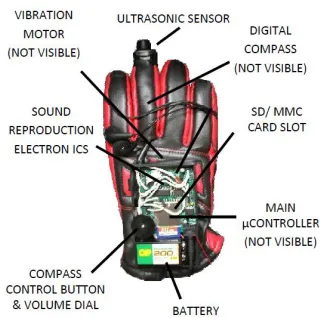
[image:21.612.205.406.307.513.2]iv. GPS-GSM based navigation with Braille capacitive touch keypad and sensor glove This method uses Global Positioning System (GPS) to detect the position of the user and GSM module to send SMS regarding information of user location. The Braille capacitive touch keypad allow visually impaired person to key in notes and control operation of the device while sensor glove with sound navigation and ranging to detect obstacles and notify user with vibrator installed[7]. GPS is more suitable to use in indoor as GPS signal is extremely low inside the buildings [8]. Figure 2.2 shows the sensor glove.
Figure 2.2: Sensor glove[7]
v. CYCLOPS glove
Figure 2.3 shows the CYCLOPS wearable aids.
Figure 2.3: CYCLOPS wearable aid[9]
vi. Video Sunglass
[image:22.612.220.406.494.611.2]One of the methods of navigation is by using video sunglass with detection of yellow line. A tiny video camera is attached in the center of the glasses to capture the pattern and image recognition in order to detect Braille tiles to aid mobility and the information obtained will be informed through audio message [10]. To be reminded, Braille tiles are not necessary yellow in colour. Figure 2.4 shows the video sunglass.
9 vii. INSIGHT
This method is used for indoor navigation to guide visually impaired person moving in a building. RFID and Bluetooth technology is used in this method direct and track users. Precise localization and convey zone based localization is provided by passive RFID tags (R tags) and Bluetooth tracking unit (B-tracks) respectively. Visually impaired person can go to their desire destination by reading the R-tag representing their destination using personal digital assistant (PDA) provided in the building and the direction to the destination will be given in audio form by using Text To Speech Engine [11]. This navigation method is able to direct and guide visually impaired person to their destination by reading the R-tag placed from place to place.
2.3 Studies on navigation methods
[image:23.612.85.544.445.708.2]Table 2.1 shows the analysis on methods studied. Each method is classified according to the type of system.
Table 2.1: Analysis on methods studied
Methods Type of system
Obstacle avoidance Directional with output voice command Directional with sensor Input command (destination)
Coloured navigation line,
RFID tag and white cane
Sensor based shoe
Cane and eyeglass
GPS-GSM based navigation
with Braille capacitive touch
keypad and sensor glove
CYCLOPS glove
Video Sunglass
visually impaired person. The methods such as sensor based shoe, cane and eyeglasses, GPS-GSM based navigation with Braille capacitive touch keypad and sensor glove, CYCLOPS glove and video sunglass is non-directional navigation with obstacle avoidance while others methods are directional navigation with obstacles avoidance.
![Table 1.1: Statistic for Blindness in Malaysia (Estimated) [2]](https://thumb-us.123doks.com/thumbv2/123dok_us/93417.8783/16.612.118.510.193.314/table-statistic-blindness-malaysia-estimated.webp)
![Figure 2.1: Navigation with colour navigation line, RFID and white cane[3]](https://thumb-us.123doks.com/thumbv2/123dok_us/93417.8783/20.612.192.429.205.361/figure-navigation-colour-navigation-line-rfid-white-cane.webp)
![Figure 2.2: Sensor glove[7]](https://thumb-us.123doks.com/thumbv2/123dok_us/93417.8783/21.612.205.406.307.513/figure-sensor-glove.webp)