The Role of the Two-Factor Model of Impulsivity and Conscientiousness in Risk-Taking and Harm Reduction Behaviours among Regular Ecstasy Users
by
Ashley Dawn Lynch
B.Sc.(Psych), PostgradDip(Psych)
Submitted in partial fulfillment of the requirements for the Degree of Doctor of Psychology (Clinical)
Declaration of Originality
I declare that this thesis is my own work and that, to the best of my knowledge and belief, it does not contain material from published sources without proper
acknowledgement, nor does it contain material which has been accepted for the award of any other higher degree or graduate diploma at any university, nor does it contain any material that infringes copyright.
Statement of Authority of Access
This thesis may be made available for loan and limited copying in accordance with the Copyright Act 1968.
Statement of Ethical Conduct
Acknowledgements
First and foremost I gratefully acknowledge the supervision of Dr. Raimondo Bruno for his generous support, expertise, guidance and flexibility. I would also like to recognise and thank Dr. Bruno and the Psychopharmacology and Clinical
Table of Contents
Declaration of Originality ... 2
Statement of Authority of Access ... 3
Statement of Ethical Conduct ... 4
Acknowledgements ... 5
Table of Contents ... 6
List of Tables ... 10
List of Figures ... 12
List of Appendices ... 13
Abstract ... 14
Thesis Rationale and Aims ... 16
Chapter 1: Ecstasy: An Introduction ... 18
Ecstasy: Two Distinct Groups of Users? ... 24
Chapter 2: Models of Personality ... 26
Eysenck’s Three Factor Model of Personality ... 27
Extraversion ... 29
Neuroticism ... 30
Psychoticism ... 31
The Five Factor Model of Personality ... 32
Extraversion ... 33
Neuroticism ... 34
Conscientiousness ... 34
Openness to Experience ... 34
Agreeableness ... 35
Gray and the Two Dimensional Model of Personality ... 39
Behavioural Inhibition System (BIS) ... 40
Behavioral Activation System (BAS) ... 41
Cloninger and the Tridimensional Model of Personality ... 44
Harm Avoidance (HA) ... 45
Novelty Seeking (NS) ... 46
Reward Dependence (RD) ... 47
Personality Models: Relevance to REU and Risk-Taking ... 50
Chapter 3: Sensation Seeking / Impulsivity ... 52
Rash-Spontaneous Impulsivity and Risk-Taking ... 57
Rash-Spontaneous Impulsivity and Substance Use ... 58
Rash-Spontaneous Impulsivity and Sexual Risk Taking... 60
Rash-Spontaneous Impulsivity and Driving under the Influence ... 63
Chapter 4: Conscientiousness ... 72
Conscientiousness and Substance Use ... 75
Conscientiousness and Sexual Risk-Taking ... 76
Conscientiousness and Driving under the Influence ... 76
Chapter 5: Rash-Spontaneous Impulsivity and Conscientiousness – ... 81
One Trait or Two? ... 81
Chapter 6: The Role of Demographic Factors on Risk-Taking Behaviours ... 82
Chapter 7: Study 1 Research Aims and Hypotheses ... 83
Chapter 8: Study 1 Method ... 85
Party Drugs Initiative (PDI) ... 85
Procedure ... 89
Materials ... 90
PDI Questionnaire ... 90
Arnett Inventory of Sensation Seeking (AISS) ... 91
International Personality Item Pool Responsibility Scale (IPIP: Re) ... 92
Alcohol Use Disorders Identification Test (AUDIT) ... 93
Severity of Dependence Scale (SDS) ... 95
Development of Risk Categories ... 96
Sexual Risk Category ... 96
Alcohol Driving Risk Category ... 96
Cannabis Driving Risk Category ... 97
Party Drug Driving Risk Category ... 97
Crime Risk Category ... 97
Binge Risk Category ... 98
Overdose Risk Category ... 98
Injecting Risk Category ... 98
Statistical Analyses ... 99
Chapter 9: Study 1 Results ... 100
Exploratory Analyses ... 100
Demographic Variables ... 100
Sex ... 100
Age ... 102
Sensation Seeking ... 103
AISS Intensity ... 103
AISS Novelty ... 104
Conscientiousness ... 106
Summary of Exploratory Analyses: At-Risk Group versus Non-Risk Group ... 106
Binary Logistic Regression Findings ... 111
Prediction of Sexual Risk-Taking Behaviours ... 111
Prediction of Driving Risk-Taking Behaviours ... 113
Alcohol Driving Risk ... 113
Cannabis Driving Risk ... 114
Party Drug Driving Risk ... 115
Prediction of Crime Risk-Taking Behaviours ... 117
Prediction of Binge Risk-Taking Behaviours ... 117
Prediction of Overdose Risk Taking Behaviours ... 118
Prediction of Injecting Risk-Taking Behaviours ... 120
Chapter 10: Study 1 Discussion ... 122
Drug Use Patterns ... 122
Demographic Variable Differences between REU at Risk and REU Not at Risk, and their Ability to Predict Engagement in Risk-Taking Behaviour ... 122
Rash-Spontaneous Impulsivity: Differences between REU at Risk and REU Not at Risk, and its Ability to Predict Engagement in Risk-Taking Behaviour ... 125
Conscientiousness: Differences between REU at Risk and REU Not at Risk, and its Ability to Predict Engagement in Risk-Taking Behaviour ... 129
Limitations ... 130
Conclusions and Future Research ... 132
Chapter 11: Study 2 Research Aims and Rationale ... 134
Reward Sensitivity, Substance Use and Risk-Taking ... 135
Health Psychology Models of Risk-Taking Behaviour ... 138
The Influence of Sexual Attitudes on Sexual Risk-Taking Behaviours ... 139
The Influence of Driving Attitudes on Risky Driving Behaviours ... 141
Harm Reduction Practices in Ecstasy Users ... 143
Chapter 12: Study 2 Hypotheses ... 151
Chapter 13: Study 2 Method ... 153
Participants ... 153
Procedure ... 158
Materials ... 158
Online Questionnaire ... 158
Demographic Information and Patterns of ERD Use ... 159
Health and Harm Reduction Behaviours ... 159
Driving Practices ... 160
Sexual Experiences ... 161
Personality ... 163
International Personality Item Pool Responsibility Scale (IPIP: Re) ... 163
BIS / BAS Scales ... 164
Barratt Impulsiveness Scale (BIS-11) ... 165
EPQ-R Short Scale Lie Scale ... 166
Data Analysis: Dependent Variables of Risk-Taking and Harm Reduction ... 167
Sexual Risk Category ... 167
Drug Driving Risk Category ... 167
Binge Risk Category ... 168
Overdose Risk Category ... 168
Injecting Risk Category ... 169
Harm Reduction Category ... 169
Statistical Analyses ... 170
Chapter 14: Study 2 Results ... 171
Measurement Models ... 171
Multiple Regression Assumption Testing ... 172
Prediction of Sexual Risk-Taking Behaviour ... 176
Prediction of Drug Driving Behaviour ... 178
Prediction of Binge Risk-Taking Behaviour ... 180
Prediction of Overdose Risk-Taking Behaviour ... 182
Prediction of Injecting Risk-Taking Behaviour ... 183
Prediction of Harm Reduction Behaviour ... 184
Chapter 15: Study 2 Discussion ... 186
Demographic Variables as Predictors of Risk-Taking and Harm Reduction ... 186
Attitude Variables as Predictors of Risk-Taking ... 189
Sexual Attitudes as Predictors of Risky Sexual Behaviour ... 189
Driving Attitudes as Predictors of Drug Driving ... 190
Personality Variables as Predictors of Risk-Taking and Harm Reduction ... 192
Rash-spontaneous Impulsivity ... 192
Reward Sensitivity ... 194
Evaluation of the Two Factor Model of Impulsivity ... 195
Conscientiousness ... 197
Limitations ... 198
Chapter 16: Overall Discussion ... 202
Clinical Application and Usefulness of Results ... 203
List of Tables
Table 1. Description of facets within the Five Factor domains
Table 2. Descriptors of high / low scorers on Cloninger’s temperament dimensions Table 3. Summary of personality traits included in Eysenck, Costa and McCrae, Gray and Cloninger’s Models
Table 4. Two independent factors of impulsivity
Table 5. Influence of rash-spontaneous impulsivity on health behaviours in terms of variance explained in a meta-analysis of 194 studies
Table 6. Details of impulsivity related studies by health-related outcome Table 7. Facets of conscientiousness
Table 8. Major personality measures coded for the six lower order conscientiousness facets
Table 9. Influence of conscientiousness on health behaviours
Table 10. Details of conscientiousness related studies by health-related outcome Table 11. Demographic characteristics of participants
Table 12. Participants’ ecstasy use history
Table 13. Participants’ patterns of lifetime and recent use of other drugs
Table 14. Percentage of participants considered to be at risk in each risk category Table 15. Differences in predictor variables for behavioural risk domains:
participants at risk versus participants not at risk
Table 16. Differences in predictor variables for overall risk domains: participants at risk versus participants not at risk
Table 17. Summary of logistic regression analyses of variables predicting sexual risk-taking behaviour
Table 18. Summary of logistic regression analyses of variables predicting alcohol risk behaviour
Table 19. Summary of logistic regression analyses of variables predicting cannabis driving risk behaviour
Table 21. Summary of logistic regression analyses of variables predicting binge risk-taking behaviour
Table 22. Summary of logistic regression analyses of variables predicting overdose risk-taking behaviour
Table 23. Demographic characteristics of participants
Table 24. Participants’ patterns of lifetime and recent use of ecstasy and other drugs Table 25. Distributional properties of dependent variables
Table 26. Pearson’s correlation matrix for Study 2 variables
Table 27. Summary of hierarchical regression analyses of variables predicting sexual risk-taking behaviour
Table 28. Summary of hierarchical regression analyses of variables predicting drug driving behaviour
Table 29. Summary of hierarchical regression analyses of variables predicting binge risk-taking behaviour
Table 30. Summary of MPlus analyses of variables predicting overdose risk-taking behaviour
Table 31. Summary of hierarchical regression analyses of variables predicting injecting risk-taking behaviour
List of Appendices
Appendix A. Study 1 PDI Questionnaire
Abstract
Previous research has shown the personality factors of impulsivity and conscientiousness are linked to engagement in health related risk-taking behaviours in the general population. Study 1 aimed to investigate how useful the personality traits of rash-spontaneous impulsivity (as conceptualised by Dawe and Loxton’s (2004) two factor model of impulsivity) and conscientiousness were in
differentiating between regular (at least monthly) ecstasy users (REU) who engaged in additional risk-taking behaviours (e.g., sexual risk-taking, drug driving) versus REU who did not, as well as their ability to predict REU’s engagement in additional risk-taking behaviours. Rash-spontaneous impulsivity scores were significantly higher in REU deemed at risk for the categories of sexual, alcohol driving and binge risk. Interestingly, rash-spontaneous impulsivity scores were significantly lower in REU who engaged in injecting risk-taking behaviours than REU who did not. In a predictive fashion, rash-spontaneous impulsivity successfully predicted REU who drove under the influence of alcohol, cannabis and party drugs. There were no differences in conscientiousness scores between REU who engaged in risk-taking behaviours versus REU who did not for any domain of risk-taking, and
conscientiousness did not predict engagement in any risk-taking behaviour. On a whole, findings from Study 1 contributed to the validity of models that implicate rash-spontaneous impulsivity in contributing to substance use and risk-taking behaviours, whilst providing contrary results to models that implicate
Study 2 aimed to further investigate the extent to which both factors of Dawe and Loxton’s (2004) model of impulsivity, rash-spontaneous impulsivity and reward sensitivity, as well as conscientiousness were able to predict engagement in risk-taking behaviours as well as harm reduction behaviours in a larger, online sample of REU. Study 2 also measured and controlled for the role that attitudes towards sex and driving practices may play in predicting sexual and driving risk-taking
behaviours. Results indicated that riskier attitudes towards safer sex were predictive of a greater frequency of engagement in risky sexual behaviours. Notably, driving attitudes were not successful predictors of drug driving behaviour. In relation to personality, rash-spontaneous impulsivity was a significant predictor of injecting risk-taking behaviours, and it approached significance in relation to predicting binge and overdose risk-taking behaviours. Additionally, rash-spontaneous impulsivity was a significant predictor of harm reduction behaviours in an inverse fashion. Reward sensitivity and conscientiousness were not significant predictor variables in relation to any domain of risk-taking or of engaging in harm reduction behaviour. On a whole, findings from Study 2 contributed to the validity of models that
implicate rash-spontaneous impulsivity in substance use and risk-taking behaviours, whilst providing contrary results to the involvement of reward sensitivity and
The Role of the Two-Factor Model of Impulsivity and Conscientiousness in Risk-Taking and Harm Reduction Behaviours among Regular Ecstasy Users
Thesis Rationale and Aims
Through two separate research studies, the current thesis seeks to examine the role Dawe and Loxton’s (2004) two-factor model of impulsivity and
conscientiousness may play on predicting regular ecstasy users’ (REU) engagement in other health related risk-taking behaviours (e.g., sexual risk-taking and drug driving), over and beyond regular ecstasy use, as well as REU’s engagement in harm reduction behaviours.
Study 1 investigates the usefulness of rash-spontaneous impulsivity and conscientiousness in differentiating between REU who engaged in risk-taking behaviours versus REU who did not, as well as their ability to successfully predict REU’s engagement in risk-taking behaviours. Study 2 investigates the usefulness of both factors of impulsivity, rash-spontaneous and reward sensitivity, as well as conscientiousness in predicting REU’s engagement in risk-taking behaviours. Additionally, Study 2 measures and controls for the sexual and driving attitudes of REU, and includes an attempt to predict engagement in harm reduction practices in addition to involvement in risk-taking behaviours.
Chapter 1: Ecstasy: An Introduction
The use of mind altering substances is a centuries old practice that has been part of virtually every culture and society throughout the world. Recently, the Australian Institute of Health and Welfare (AIHW, 2008) surveyed nearly 25,000 Australians in relation to their lifetime and recent use of licit and illicit drugs. Results revealed that 90% of Australians aged 14 and older had tried alcohol at some point in their lives, with 83% consuming alcohol in the 12 months prior to the
survey. With regards to illicit substances, almost 2 in every 5 Australians aged 14 and older (38%) had used an illicit drug at some point in their life, with more than 1 in 7 (13%) having used an illicit drug within the preceding 12 months. The most commonly reported illicit drug used in the previous 12 months was cannabis (9%), followed by ecstasy (4%), the drug at the focus of this research (AIHW, 2008).
3,4-Methylenedioxymethamphetamine (MDMA) or ‘ecstasy’ was originally synthesised by a German scientist in 1912, becoming patented in 1913. Despite a lack of any meaningful, controlled clinical trials, it is believed that human
consumption began in the late 1960s, with many psychotherapists using it with their patients as a regular part of therapy to enhance communication and lower inhibitions. By 1984 ecstasy was still legal and its use was widespread among youth in North America. Ecstasy is thought to have come to Australia in 1984-85, with its
made ecstasy a controlled substance, with Australia following suit in 1987 (ABC, 2001; NIDA, 2001).
MDMA is a chemical belonging to the amphetamine family. It has properties of both stimulant and hallucinogenic drugs, in that it increases the speed of activities in the nervous system, and users may also experience distorted perception (ADF, 2006; NIDA, 2001). The majority of users take ecstasy orally in a tablet or capsule form, but the drug may also be taken as a powder, smoked, injected or snorted. A ‘typical’ dose of ecstasy has been reported to contain between 60-120 milligrams of MDMA (NIDA, 2001), or 80-150 milligrams of MDMA (Oesterheld, Armstrong & Cozza, 2004). However, in reality, the pharmacological content of drugs sold and consumed as ecstasy could contain any combination of a number of various
substances that may or may not be related to MDMA. For the purposes of this paper, the term ecstasy will be used to describe the drug that people consume intentionally as they believe to be MDMA, regardless of the actual drug content.
Pharmacologically, MDMA works in the brain by increasing the activity of particular neurotransmitters. It is known that MDMA triggers a large increase in release of the neurotransmitter serotonin (5-hydroxytryptamine, or 5-HT), causing an atypical flood of serotonin into the synapse. MDMA also prevents the re-uptake of serotonin, allowing it to remain in the synapse for a longer period of time. In
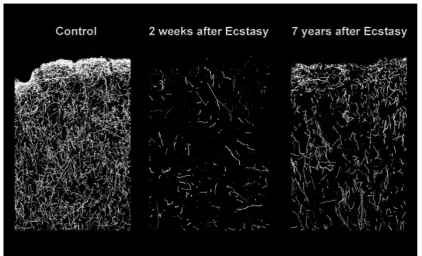
The impact of MDMA on dopaminergic neurons appears to be transient, whilst its impact on serotonergic neurons appears to be longer lasting (NIDA, 2001). Evidence from both animal and human studies suggests that one long-term
Figure 1
Serotonin depletion in squirrel monkeys, persisting after seven years. Dark-field photomicrograph of serotonin axons in the frontal cortex of a control squirrel monkey, two weeks post MDMA treatment and 7 years post MDMA treatment (Hatzidimitriou, McCann & Ricaurte, 1999).
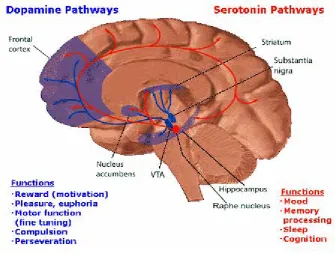
The serotonin neurotransmitter system (Figure 2) is one of the most
widespread in the central nervous system, extending from the brain stem and lower brain regions to virtually every region throughout the rest of the brain, with
exception of the cerebellum. Brain serotonin neurons have been shown to be heavily involved in mood regulation, as well as playing a role in memory and cognition, impulse control, aggression, appetite / thirst control, sexual function, body temperature, sleep and hormonal control (NIDA, 2001).
‘comedown’ symptoms, which may include mood fluctuations, poor concentration, loss of energy, irritability, restlessness, nausea, chills, sweating, teeth clinching, muscle cramping and blurred vision (Curran & Travill, 1997; Degenhardt & Hall, 2010; NIDA, 2008; NIDA, 2001). These effects are typically transient with recovery usually occurring 1 – 3 days later (Curran & Travill, 1997; Degenhardt & Hall, 2010).
MDMA also acutely affects the dopamine neurotransmitter system (Figure 2). Dopamine is a neurotransmitter present in regions of the brain that regulate movement, emotion, cognition, motivation and feelings of pleasure. The dopamine system rewards natural behaviours, such as eating and sex, by producing pleasant effects. MDMA acutely increases synaptic dopamine levels; however, these increases are generally smaller than serotonin increases (Degenhardt & Hall, 2010; NIDA, 2008).
that occurs through a sensitizing or hyper-responsivity of motivational processes in response to drug cues. It is this reinforcement value that is thought to contribute to drug dependence, cravings and relapse (Dawe, Gullo & Loxton, 2004). The effects of drugs within these cortical regions is also believed to underlie some of the alterations in learning, memory, attention and cognition that are associated with long-term drug use (Jentsch & Taylor, 1999).
Figure 2
Serotonin and Dopamine Pathways in the Brain (Ensor, 2005)
Despite its illegality and long-term adverse effects, the popularity of ecstasy has been increasing. The AIHW (2008) national survey revealed that in Australia, the use of ecstasy has risen significantly over recent years, from 2.4% of the
prior to survey), the prevalence of ecstasy use rose from 0.9% in 1995 to 3.5% in 2007. Of Australians aged 18-19 who had ever used illicit drugs, 9.1% of them had used ecstasy, second only to cannabis (19%). Furthermore, in 2007, the group most likely to have ever used ecstasy were 20-29 year old males (25.7%), with 13.8% of this group reporting recent ecstasy use. For males and females collectively, the 20-29 year age group had the highest prevalence of recent ecstasy use (11.2%) than any other age group.
Ecstasy: Two Distinct Groups of Users?
Human beings are indeed complex, as are the influences that contribute to why people behave as they do. Specifically, why some individuals partake in risk-taking behaviours whilst others do not poses an interesting and important research question. In the realm of alcohol and drug research, understanding the differences that distinguish between risk-takers and non risk-takers is of particular interest, as the implications of engaging in risk-taking behaviour whilst under the influence of substances may not only affect the individual, but society at large.
sub-groups – those individuals who regularly consume ecstasy but do not partake in other risk-taking behaviours, and those individuals who regularly consume ecstasy as well as engaging in other risk-taking behaviours.
There could be many influences as to why an individual who regularly takes ecstasy chooses to engage or not engage in other risk-taking behaviours. Sex and age are probable influences. Another such influence may be that the individual engages in risk-taking behaviours due to a side effect of the drug(s) itself; for example, experiencing disinhibition when under the influence of alcohol. An individual’s attitudes towards the behaviour are also likely to be important. However, in addition to these influences, it also stands to reason that there is
something intrinsic within the individual, something in their personality, which may either be a contributing or protective factor with regards to the extent to which the individual engages in other risk-taking behaviours.
Chapter 2: Models of Personality
This chapter aims to review key models of personality and how they
potentially relate to explaining differences between REU who engage in risk-taking behaviours versus REU who do not.
There are many diverse theories of personality that have been proposed by a range of philosophers and psychologists over the centuries. Despite fundamental differences between theories, the goals of each personality theorist are the same – to postulate a theory of personality that depicts what human beings are like, and to explain why individuals are like the way they are. With these common goals, all personality theories therefore attempt to explain both human nature and individual differences. The differences between personality theories are largely due to theorists offering diverse descriptions, explanations and methodologies, with each theorist using their own language and terms in order to describe their unique personality theory. However, despite the varied personality theories that abound, elements that are generally focused upon in most personality theories include the role of genetics, traits, culture / society, learning, personal choice, unconscious mechanisms and / or cognitive processes (Hergenhahn & Olson, 1999).
There are several theories of personality that are particularly pertinent to the current discussion of risk-taking behaviours amongst individuals who regularly use ecstasy. This paper will focus on theories postulated by Eysenck, Costa and
(Ajzen & Fishbein, 1980) may well have explanatory power in relation to health risk-taking behaviour, and are discussed in detail in subsequent chapters relating to Study 2.
Eysenck’s Three Factor Model of Personality
Eysenck developed his initial theory of personality in the 1940s, making revisions throughout the 1970s. He emphasised empirical determination and measurement of basic psychological qualities possessed by all people, as he was primarily concerned with explaining the personality of normal adults as opposed to psychopathology. His measures include the Eysenck Personality Inventory (EPI), the Eysenck Personality Questionnaire (EPQ) and the Revised EPQ (EPQ-R) (Hergenhahn & Olson, 1999).
Eysenck’s model of personality placed importance on the role that biological and genetic factors have on determining personality. His theory is based primarily on two neurobiological systems: the ascending reticular activating system (ARAS) and the limbic system (of which Eysenck referred to as the visceral brain). The ARAS is responsible for patterns of excitation and inhibition of the cerebral cortex, whilst the limbic system regulates emotional expression and controls autonomic responses such as heartbeat, blood pressure and sweating (Hergenhahn & Olson, 1999).
this focus, Eysenck believed important traits are those that are relatively permanent, have clear biological origins and that influence secondary behavioural patterns acquired through learning. In other words, he postulated that traits are biologically influenced by the ARAS and limbic system, rather than being learned (Hergenhahn & Olson, 1999).
Eysenck based his personality theory on the statistical technique of factor analysis, and his model and associated measures are hierarchical in nature. A
hierarchical model is one in which items at the narrowest level are factor analysed to derive factors at the second level, these factors are again factor analysed to derive factors at the third level, and so forth. At the bottom and narrowest level of Eysenck’s hierarchy are behaviours, such as talking with a friend on a single
Extraversion
Eysenck’s first factor, extraversion (vs. introversion), is the degree to which a person is outgoing, talkative, has a high degree of positive affect, is interactive with other people and desires external stimulation (Acton, 2003). Individuals with high scores on the extraversion dimension may be characterised as active, sociable, expressive, assertive, ambitious, enthusiastic, spirited, vivacious and zestful (Costa & McCrae, 1995).
According to Eysenck’s arousal theory of extraversion, different degrees of extraversion may be attributed to different levels of arousal in the cerebral cortex. Arousal can be measured by skin conductance, brain waves or sweating. There is some ‘optimal’ level of cortical arousal, and performance deteriorates as one becomes more or less aroused than this optimal level. Thus, at very low and very high levels of arousal, performance is low, but at a more optimal midlevel of arousal, performance is maximised (Acton, 2003). According to Eysenck’s theory,
Neuroticism
Eysenck’s second factor, neuroticism (vs. emotional stability), is the enduring tendency to experience negative emotional states such as depression and anxiety (Acton, 2003). Individuals with high scores on the neuroticism dimension may be characterised as anxious, unhappy, dependent, hypo-chondriacal, guilty, obsessive, fearful, nervous and having inferior self-esteem (Costa & McCrae, 1995).
Psychoticism
Individuals with high scores on Eysenck’s third factor, psychoticism (vs. impulse control), may be characterised as tough minded, nonconformists, uncooperative, hostile, risk-takers, manipulators, sensation seekers, being irresponsible and behaving in an impulsive manner. Although Eysenck also maintained that this factor is also intended to assess a predisposition to psychotic disorders, Costa and McCrae (1995) suggest it measures something closer to a lack of conventional socialization, in that high scorers are guided neither by sympathy for others, nor by respect for rules. The physiological basis suggested by Eysenck for psychoticism involves high levels of testosterone and low monoamine oxidase enzyme levels; however, these are not well established (Acton, 2003; Hergenhahn & Olson, 1999; Jang, 1998; Costa & McCrae, 1995).
In summary, Eysenck’s model of personality, derived from factor analysis and grounded in neurobiology, maintains there are three crucial factors that describe human personality: extraversion, neuroticism and psychoticism. In applying
Eysenck’s theory, the development of personality is directed by genetically endowed traits but is tempered by environmental factors. Eysenck maintained that person variables (genetics and biological dispositions) and situation variables always interact to cause behaviour. Therefore, personality traits influence the kinds of situations individuals find aversive and avoid, as well as those that individuals enjoy and seek. Because our personalities guide us toward some environments and turn us away from others, our personalities can influence the kinds of behaviours,
In relation to the current study, Eysenck’s theory of personality provides a reasonable explanation as to why some individuals may take ecstasy, as well as why some may take part in other risk-taking behaviours. Based on Eysenck’s theory, the risk-taker as subject in this research may be particularly well explained by the extraversion and psychoticism factors, in that persons with low cortical arousal (i.e. extraverts) seek sensation and excitement, and persons high in psychoticism are characterised as sensation seekers and risk-takers. Therefore, Eysenck’s theory would imply that regular consumers of ecstasy who partake in risk-taking behaviours are likely to score high on the extraversion and psychoticism factors.. For example, while this has not been examined directly in ecstasy consumers, in a study
comparing never, current and ex- tobacco smokers on the EPQ-R, Arai, Hosokawa, Fukao, Izumi and Hisamichi (1997) found that current and ex-smokers scored higher on the extraversion and psychoticism scales than never smokers for both sexes. Heavy smokers and those who commenced smoking prior to the legally permitted age scored higher on the psychoticism scale than light smokers and those who started smoking after the legally permitted age. Therefore, both the extraversion and
psychoticism factor appeared to have played a part in this risk-taking behaviour.
The Five Factor Model of Personality
the Revised Neuroticism, Extraversion, Openness Personality Inventory (NEO-PI-R) (Costa & McCrae, 1992; Goldberg, 1993; Zuckerman, Kuhlman, Joireman, Teta & Kraft, 1993).
The FFM, like Eysenck’s model, is based on the statistical method of factor analysis and is hierarchical in nature. The FFM organises personality traits into five broad domains: extraversion, neuroticism, conscientiousness, openness to experience and agreeableness, each described below (Bogg & Roberts, 2004).
Extraversion
Neuroticism
Neuroticism in the FFM is again essentially identical to the description in the Eysenck model. To briefly summarise, neuroticism refers to the tendency to
experience negative emotions. Individuals with a high degree of neuroticism tend to experience a range of unpleasant emotions easily, are emotionally reactive and respond emotionally to events that would not affect people with a lower degree of neuroticism (Lynam, Leukefeld & Clayton, 2003; Goldberg, 1993).
Conscientiousness
The conscientiousness factor of the FFM is concerned with the way people control, regulate and direct impulses. A high degree of conscientiousness is characterised by a tendency to show self-discipline, act dutifully and aim for
achievement. Highly conscientiousness people have a high ability to plan, organise and complete tasks and tend to mostly engage in planned rather than spontaneous behaviour. High scorers on this factor may be characterised as organised, thorough and reliable, whereas low scorers on this factor may be characterised as careless, negligent and unreliable (Lynam, Leukefeld & Clayton, 2003; Goldberg, 1993).
Openness to Experience
emotion, adventure, and unusual ideas as well as enjoying a variety of experiences. Higher levels of openness to experience have been linked to activity in the ascending dopaminergic system and the functions of the dorsolateral prefrontal cortex (Lynam, Leukefeld & Clayton, 2003; Goldberg, 1993).
Agreeableness
Agreeableness describes the degree to which a person is concerned with cooperation and social harmony. Individuals with a high degree of agreeableness have a tendency to be compassionate and cooperative, rather than being suspicious and antagonistic towards others. Individuals who score high on the agreeableness factor value getting along with others, and are generally trusting, straightforward, empathic, considerate, generous, friendly, and have an optimistic view of human nature. People who score low on the agreeableness factor tend to be characterised as arrogant, hostile, selfish, manipulative, and unconcerned about others (Lynam, Leukefeld & Clayton, 2003; Goldberg, 1993).
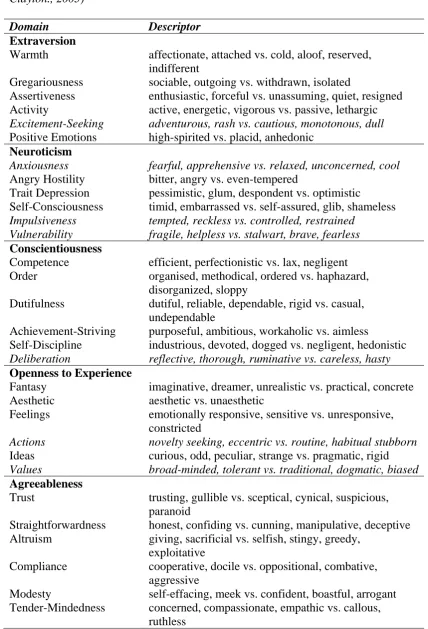
Table 1
Description of Facets within the Five Factor Domains (Lynam, Leukefeld & Clayton., 2003)
Domain Descriptor
Extraversion
Warmth affectionate, attached vs. cold, aloof, reserved, indifferent
Gregariousness sociable, outgoing vs. withdrawn, isolated
Assertiveness enthusiastic, forceful vs. unassuming, quiet, resigned Activity active, energetic, vigorous vs. passive, lethargic Excitement-Seeking adventurous, rash vs. cautious, monotonous, dull Positive Emotions high-spirited vs. placid, anhedonic
Neuroticism
Anxiousness fearful, apprehensive vs. relaxed, unconcerned, cool Angry Hostility bitter, angry vs. even-tempered
Trait Depression pessimistic, glum, despondent vs. optimistic
Self-Consciousness timid, embarrassed vs. self-assured, glib, shameless Impulsiveness tempted, reckless vs. controlled, restrained
Vulnerability fragile, helpless vs. stalwart, brave, fearless
Conscientiousness
Competence efficient, perfectionistic vs. lax, negligent Order organised, methodical, ordered vs. haphazard,
disorganized, sloppy
Dutifulness dutiful, reliable, dependable, rigid vs. casual, undependable
Achievement-Striving purposeful, ambitious, workaholic vs. aimless
Self-Discipline industrious, devoted, dogged vs. negligent, hedonistic Deliberation reflective, thorough, ruminative vs. careless, hasty
Openness to Experience
Fantasy imaginative, dreamer, unrealistic vs. practical, concrete Aesthetic aesthetic vs. unaesthetic
Feelings emotionally responsive, sensitive vs. unresponsive, constricted
Actions novelty seeking, eccentric vs. routine, habitual stubborn Ideas curious, odd, peculiar, strange vs. pragmatic, rigid Values broad-minded, tolerant vs. traditional, dogmatic, biased
Agreeableness
Trust trusting, gullible vs. sceptical, cynical, suspicious, paranoid
Straightforwardness honest, confiding vs. cunning, manipulative, deceptive Altruism giving, sacrificial vs. selfish, stingy, greedy,
exploitative
Compliance cooperative, docile vs. oppositional, combative, aggressive
In relation to the current discussion, the FFM also provides a reasonable explanation as to why some individuals may take ecstasy, as well as why some may take part in other taking behaviours. The FFM would likely describe the risk-taker, as per the subject in this research, as high on the extraversion and openness to experience factors, whilst low on the neuroticism and conscientiousness factors. A study by Schmitt (2004) examined how the FFM personality traits related to risky forms of sexual behaviour across the general population in 52 countries. He found that impulsive sensation seeking (combined low scores on the agreeableness and conscientiousness factors), was the strongest personality correlate of risky sexual behaviour. Results also indicated that low scores on either the agreeableness or conscientiousness factor were associated with higher levels of relationship infidelity, and that sexual promiscuity was significantly related to higher levels of extraversion.
In addition, Flory, Lynam, Milich, Leukefeld and Clayton (2002) examined the relationship of the FFM to symptoms of alcohol and cannabis abuse, after controlling for symptoms of antisocial personality disorder and internalizing psychopathology. Results indicated that symptoms of alcohol abuse / dependence could be described by a pattern of high extraversion and low conscientiousness, whereas symptoms of cannabis abuse / dependence were characterised by low extraversion and high openness to experience. For both sets of symptoms, the personality variables accounted for more than 10% of the variance.
agreeableness factors of the FFM to be components of psychoticism (Zuckerman et al., 1993). In reply, Costa and McCrae (1995) stated the view that agreeableness and conscientiousness are facets of a broader domain of psychoticism suggests they should show similar patterns of correlates. The authors argue their data provides little support for this view, and that the data suggest that agreeableness and
conscientiousness appear to have distinct correlates, thus constituting different dimensions of personality.
In comparing the two, Jang (1998) argued that Eysenck’s model combines both descriptive and causal aspects of personality in one theory. By doing so, Eysenck’s model is supported by more credible evidence than purely descriptive models, such as the FFM. Secondly, Eysenck’s model is descriptively
Gray and the Two Dimensional Model of Personality
Gray’s reinforcement sensitivity theory (Gray, 1970) and its later revised version (Gray & McNaughton, 2000) proposes there are individual differences in the sensitivity, or the reactivity, of basic brain behavioural systems that respond to reinforcing stimuli. Based on this theory, Gray postulates there are two independent dimensions of personality and motivation, namely impulsivity and anxiety (or proneness to these), that represent individual differences in the sensitivity of two neurological systems when the individual is responding to environmental cues. The trait of anxiety is based on an avoidance, “behavioural inhibition system” (BIS) and the trait of impulsivity is based on an appetitive, “behavioural approach system” (BAS). As BIS and BAS are theorised to represent different structures in the
nervous system, these sensitivities are presumed to be orthogonal; therefore, within a given population, there should be people with all combinations of high and low BIS and BAS sensitivity. In Gray’s model, impulsivity is closely related to Eysenck and the FFM’s extraversion factor, whereas Gray’s anxiety is closely related to Eysenck and the FFM’s neuroticism factor (Carver & White, 1994; Acton, 2003).
statements that are indicative of a willingness to seek out and spontaneously
approach potentially rewarding experiences (Dawe & Loxton, 2004; Acton, 2003).
Behavioural Inhibition System (BIS)
The major brain structure theorised to underlie the BIS is the
septohippocampal system, part of the limbic system, comprising the hippocampus proper, dentate gyrus, entorhinal cortex, subicular area (subiculum) and the posterior cingulate cortex, its monoaminergic afferents from the brainstem, and its neocortical projection in the frontal lobe (Dawe, Gullo & Loxton, 2004; Carver & White, 1994).
Gray (1970; Gray & McNaughton, 2000) has argued that this physiological mechanism controls the experience of anxiety in response to anxiety-relevant cues. The BIS, according to Gray, is sensitive to signals of punishment, non-reward, and novelty, and inhibits behaviour that may lead to negative or painful outcomes. Thus, BIS activation causes inhibition of movement toward goals. Gray also theorises that BIS functioning is responsible for the experience of negative feelings such as fear, anxiety, frustration and sadness in response to these cues. In terms of individual differences in personality, a greater BIS sensitivity should be reflected in greater proneness to anxiety, provided the person is exposed to the proper situational cues. Additionally, individuals with a more reactive BIS are more likely to inhibit
approach behaviour that is accompanied by subjective feelings of anxiety /
negative and such individuals would then avoid this behaviour. However, previous research regarding the role of BIS sensitivity in substance use behaviour is unclear. Some studies report a significant negative correlation between substance use
problems and BIS sensitivity (e.g., Franken & Muris, 2006; Genovese & Wallace, 2007; Hundt et al., 2008; Kimbrel et al., 2007; Pardo et al., 2007; Simons et al., 2008), some suggest substance use problems are associated with high BIS sensitivity (e.g., Kambouropoulos & Staiger, 2004; Taylor et al., 2006) and others failed to find a significant association (e.g., Jorm et al., 1999; Knyazev, 2004; Loxton & Dawe, 2006, 2007; Loxton et al., 2008; O’Connor et al., 2009). Clearly more research is needed to clarify this relationship, both in community samples and within drug using populations.
Behavioral Activation System (BAS)
The BAS is the physiological mechanism thought to control appetitive motivation. The underlying neural substrate of BAS is proposed to involve dopaminergic systems, in particular the mesolimbic dopaminergic pathways. As stated previously, this is one of the critical (although not only) pathways underlying the positively reinforcing effects of natural reinforcers such as food, sex and drugs of abuse. Further, the dopamine circuits have been found to activate in response to conditioned cues of reward, prior to the consummation of reinforcing substances (Dawe & Loxton, 2004; Dawe, Gullo & Loxton, 2004).
increase, movement toward goals. Gray (1970; Gray & McNaughton, 2000) also theorises the BAS is responsible for the experience of positive feelings such as hope, elation and happiness. In terms of individual differences in personality, those with a higher BAS sensitivity are more prone to engage in goal-directed efforts and to experience positive affect in situations containing cues of impending reward (Dawe & Loxton, 2004; Carver & White, 1994). Thus, it would be expected that high BAS sensitivity would likely be positively associated with substance use and other risk-taking behaviours. In line with this, previous research has shown that higher BAS sensitivity is associated with ecstasy use (Egan, Kambourpoulos & Staiger, 2010), and that individuals with problematic substance use such as drug addicted inpatients (Franken, Muris & Georgieva, 2006), alcohol misusing high school girls (Loxton & Dawe, 2001) and hazardous drinking men and women (Kambouropoulos & Staiger, 2007) reported hjgher levels of BAS sensitivity when compared to controls (for a more comprehensive review see Bijttebier, Beck, Claes & Vandereycken, 2009).
In summary, Gray (1970; Gray & McNaughton, 2000) proposes there are two general motivational systems that underlie behaviour and affect: the behavioural inhibition system and the behavioural activation system. In relation to the focus of the current study, Johnson, Turner and Iwata (2003) assessed how levels of
In conclusion, the BAS is of particular interest to the current research, given its known association with the dopaminergic systems and its well established reinforcing links with illicit drugs. Gray’s (1970) theory could therefore be used to understand the motivational influences behind continued substance use, as well as other risk-taking behaviours. To apply Gray’s theory, for example, an individual with a higher BAS and lower BIS sensitivity may be more likely to both use ecstasy and drive under the influence, whereas an individual with high BAS and BIS
sensitivities may be more likely to use ecstasy, but may be less likely to drive under the influence.
In comparing Gray’s model with Eysenck’s, Gray does not concur that extraversion and neuroticism are crucial factors of personality. In Gray’s opinion, extraversion and neuroticism are secondary consequences of the interactions between the impulsivity and anxiety systems. Gray’s impulsivity (BAS) factor would be consistent with individuals that are high on both neuroticism and extraversion, whilst Gray’s anxiety (BIS) factor is consistent with individuals that are high on
neuroticism but low on extraversion. In Gray’s view, a person whose BIS is more powerful than their BAS becomes introverted, whilst a person whose BAS is relatively more powerful than their BIS becomes extraverted. Thus, from Gray's perspective, the superfactor of extraversion reflects the relative strength of both impulsivity and anxiety, whereas neuroticism reflects their joint strength, in which a rise in the sensitivity of either system provides an increase in the degree of
to drug use, Gray’s theory could imply that extraverts would become dependent more quickly following substance use.
Cloninger and the Tridimensional Model of Personality
Cloninger’s biosocial tridimensional model of personality postulates there are three genetically independent, but functionally interactive, dimensions of
personality: harm avoidance (HA), novelty seeking (NS) and reward dependence (RD). Cloninger considered each of these factors to be moderately heritable, normally distributed, developmentally and situationally stable, and associated with specific neural systems that mediate various stimulus-response relationships. Cloninger proposed that individual differences in the expression of these three
dimensions are a reflection of genetic sensitivity in neurological systems, as the three factors are postulated to be related to brain systems regulated principally by
dopamine, serotonin and noradrenaline (Dawe & Loxton, 2004; Howard, Kivlahan & Walker, 1995). Cloninger (1987) proposed that NS is related to activity in the
dopaminergic system, HA is related to activity in the serotonergic system and RD is related to the influence of noradrenaline on the association of conditioned signals of reward or punishment. The Tridimensional Personality Questionnaire (TPQ; Cloninger, Przybeck, & Svrakic, 1991) and the Temperament and Character
this paper will focus on the 3 aforementioned factors of Cloninger’s tridimensional model.
Unlike Eysenck and the FFM model, Cloninger’s model is not based on factor analysis; rather, his theory ties phenotypical variation in personality (i.e., the observable characteristics of personality) to neurobiological substrates, emphasising the importance of gene-environment interaction (Howard, Kivlahan & Walker, 1995). Conceptually, Cloninger’s theory of personality is most similar to Gray’s model. Cloninger’s HA dimension is nearly equivalent to Gray’s BIS, and Cloninger’s NS and RD factors are conceptually equivalent to Gray’s BAS. Therefore in essence, Cloninger’s HA factor is similar to Eysenck and the FFM’s neuroticism factor, whilst NS and RD dimensions are similar to the aforementioned extraversion factor (Acton, 2003).
Harm Avoidance (HA)
Loxton, 2004). Harm avoidance consists of four lower order traits: anticipatory worry and pessimism versus uninhibited optimism, fear of uncertainty, shyness with strangers and fatigability and asthenia versus vigour (Cloninger et al., 1994).
Individuals with a high degree of harm avoidance may be described as cautious, careful, tense, apprehensive, nervous, timid, doubtful, discouraged, insecure, passive, fearful, pessimistic, inhibited, shy, easily fatigable and apprehensive worriers. Such people tend to be inhibited and shy in most social situations, have low energy levels, require more reassurance and encouragement and are unusually sensitive to criticism and punishment. In contrast, individuals with a low degree of harm avoidance may be described as bold, confident, daring,
courageous, composed, relaxed, optimistic, carefree, uninhibited, outgoing and energetic. Such people tend to be outgoing and confident in most social situations, have high energy levels and impress others as dynamic, lively and vigorous (Carver & White, 1994; Cloninger et al., 1994; Dawe & Loxton, 2004; Howard, Kivlahan & Walker, 1995).
Novelty Seeking (NS)
Walker, 1995). Novelty seeking consists of four lower order traits: exploratory excitability versus stoic rigidity, impulsiveness versus reflection, extravagance versus reserve and disorderliness versus regimentation (Cloninger et al., 1994).
Individuals with a high degree of novelty seeking may be described as impulsive, exploratory, curious, enthusiastic, exuberant, easily bored, fickle,
excitable, quick-tempered, extravagant and disorderly. Such people are enthusiastic and quick to engage with whatever is new and unfamiliar, leading to an exploration of potential rewards. In contrast, individuals with a low degree of novelty seeking may be described as reflective, rigid, loyal, stoic, indifferent, uninquiring,
unenthusiastic, frugal, reserved, tolerant of monotony, systematic, slow tempered, orderly and persistent (Carver & White, 1994; Cloninger et al., 1994; Dawe & Loxton, 2004; Howard, Kivlahan & Walker, 1995).
Reward Dependence (RD)
The dimension of reward dependence reflects differences in resistance to extinction of previously rewarded behaviour, and a tendency towards maintaining behaviour previously associated with reward. Cloninger associated this dimension with the behavioural maintenance neural system that mediates resistance to
sentimentality versus tough mindedness, attachment versus detachment and dependence versus independence (Cloninger et al., 1994).
Individuals who have a high degree of reward dependence may be described as tender-hearted, loving, warm, sensitive, dedicated, dependent, sociable, persistent, ambitious and sentimental. Such people seek social contact and are open to
communication with others, finding people they like everywhere they go. They are sensitive to social cues, which facilitates warm social interactions and understanding other people’s feelings. Individuals with a low degree of reward dependence may be described as practical, detached, tough-minded, cold, socially insensitive and
irresolute. Such people are content to be alone, prefer to keep their distance, rarely initiate communication with others and have difficulty finding something in common with other people. Their views are often practical and objective(Carver & White, 1994; Cloninger et al., 1994; Howard, Kivlahan & Walker, 1995).
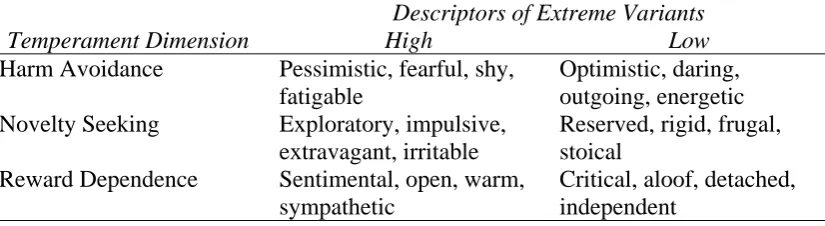
In summary, Cloninger’s tridimensional model postulates there are three main factors of personality: harm avoidance, novelty seeking and reward dependence (Table 2). Cloninger relates these factors to the dopaminergic and serotonergic neural pathways, which are both of interest to the current research given their well established links to natural reinforcers, such as illicit drugs. In a meta-analysis of studies utilising the TPQ in a population of substance users, Howard, Kivlahan and Walker (1995) conclude that some studies indicate the three factors are
substance use. However, evidence for the discriminant, convergent, concurrent and predictive validity of NS is much stronger than for HA and RD.
Table 2
Descriptors of High / Low Scorers on Cloninger’s Temperament Dimensions (Cloninger & Svrakic, 1997)
Descriptors of Extreme Variants
Temperament Dimension High Low
Harm Avoidance Pessimistic, fearful, shy, fatigable
Optimistic, daring, outgoing, energetic Novelty Seeking Exploratory, impulsive,
extravagant, irritable
Reserved, rigid, frugal, stoical
Reward Dependence Sentimental, open, warm, sympathetic
Critical, aloof, detached, independent
Moreover, a large number of studies have concluded that high NS consistently predicts alcohol and other substance abuse and problems (see Sher, Bartholow & Wood, 2000). These authors aimed to predict substance use disorders from the TPQ and EPQ. Results indicted that within each personality system, traits that relate most clearly to disinhibition or behavioural undercontrol (i.e., TPQ-NS and EPQ-Psychoticism) were the most consistent predictors of substance use disorders, as individuals with higher baseline scores on these measures were more likely than their lower scoring peers to receive a substance use disorder diagnosis (Sher, Bartholow & Wood, 2000).
Personality Models: Relevance to REU and Risk-Taking
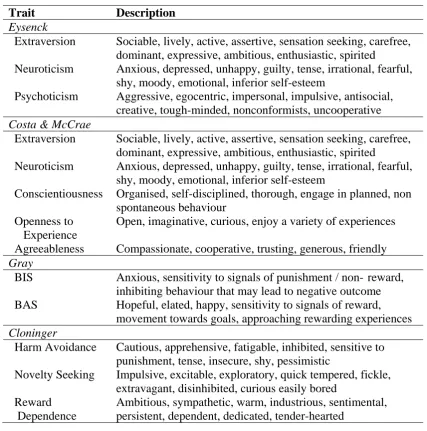
Four diverse theories of personality have been presented (see Table 3). Each of these theories is particularly pertinent to the current discussion of risk-taking behaviours amongst individuals who regularly use ecstasy. All of these theories, despite different theoretical foundations and language, have elements of similarity. In particular, two important aspects of personality are noted in each theory – which will be broadly referred to here as sensation seeking and conscientiousness. The sensation seeking aspect relates to elements of personality that might describe a person as adventurous, carefree, reckless, excitement-seeking, extraverted, social, desiring external stimulation, risk-taking, impulsive, uninhibited, confident, novelty seeking, exploratory and enjoying a variety of experiences. Of the personality theories presented, this overall aspect represents high scorers on Eysenck’s extraversion and psychoticism factors, Costa and McCrae’s extraversion and openness to experience factors, Gray’s BAS and Cloninger’s novelty seeking and reward dependence factors.
The second aspect, conscientiousness, relates to elements of personality that might describe a person as self-disciplined, dutiful, cautious, controlled, ruminative, inhibited, reflective and engaging in planned as opposed to spontaneous behaviour. Of the personality theories presented, this overall aspect represents high scorers on Eysenck and Costa and McCrae’s neuroticism factor, Costa and McCrae’s
It is these two elements, sensation seeking and conscientiousness, that are of particular interest to the current research, due to their hypothesised implications in the realm of substance use and abuse, as well as engagement in additional risk-taking behaviours, such as driving under the influence of drugs, taking sexual risks, and the like. Each of these aspects of personality and related research findings will be explored in the next section.
Table 3
Summary of Personality Traits Included in Eysenck, Costa and McCrae, Gray and Cloninger’s Models
Trait Description
Eysenck
Extraversion Sociable, lively, active, assertive, sensation seeking, carefree, dominant, expressive, ambitious, enthusiastic, spirited
Neuroticism Anxious, depressed, unhappy, guilty, tense, irrational, fearful, shy, moody, emotional, inferior self-esteem
Psychoticism Aggressive, egocentric, impersonal, impulsive, antisocial, creative, tough-minded, nonconformists, uncooperative Costa & McCrae
Extraversion Sociable, lively, active, assertive, sensation seeking, carefree, dominant, expressive, ambitious, enthusiastic, spirited
Neuroticism Anxious, depressed, unhappy, guilty, tense, irrational, fearful, shy, moody, emotional, inferior self-esteem
Conscientiousness Organised, self-disciplined, thorough, engage in planned, non
spontaneous behaviour
Openness to Open, imaginative, curious, enjoy a variety of experiences Experience
Agreeableness Compassionate, cooperative, trusting, generous, friendly Gray
BIS Anxious, sensitivity to signals of punishment / non- reward, inhibiting behaviour that may lead to negative outcome BAS Hopeful, elated, happy, sensitivity to signals of reward, movement towards goals, approaching rewarding experiences Cloninger
Harm Avoidance Cautious, apprehensive, fatigable, inhibited, sensitive to punishment, tense, insecure, shy, pessimistic Novelty Seeking Impulsive, excitable, exploratory, quick tempered, fickle, extravagant, disinhibited, curious easily bored
Chapter 3: Sensation Seeking / Impulsivity
The concept of sensation seeking is based on the idea that different
individuals have different optimal levels of stimulation or arousal. Sensation seeking is that aspect of personality that describes a person as adventurous, risk-taking, impulsive, uninhibited and exploratory. It is represented in research literature by many names, with each term having a slightly different focus. For example,
Zuckerman (1979, p.10) described sensation seeking as “the need for varied, novel, and complex sensations and experiences, and the willingness to take physical and social risks for the sake of such experiences.” Similarly, Arnett (1994, p. 290) considered sensation seeking as “a predisposition, a potential, which may be expressed in a variety of ways depending on other aspects of the individual’s
personality and (especially) depending on how the socialization environment guides, shapes, or suppresses that predisposition. Sensation seeking is not only a potential for taking risks, but is more generally a quality of seeking intensity and novelty in sensory experience, which may be expressed in multiple areas of a person’s life.”
The term impulsivity is often used interchangeably with sensation seeking. The definition of impulsivity, which Evenden (1999, p.348) aptly quotes as covering a wide range of “actions that are poorly conceived, prematurely expressed, unduly risky, or inappropriate to the situation and that often result in undesirable outcomes” is generally accepted. However, research on this broad concept of impulsivity has illustrated that impulsivity is likely multi-factorial. Monterosso and Ainslie (1999) concluded that the construct of impulsivity has been imprecise in the clinical
been created to measure it. They suggest that given the modest inter-correlations between many of the existing impulsivity measures, there are different underlying conceptions of the construct. Similarly, Evenden (1999) believes impulsivity is the end result of several different, independent factors, which interact to change
behaviour. In what he terms “varieties of impulsivity,” Evenden (1999) postulates there are several related phenomena, each potentially influenced by different biological mechanisms, which lead to different forms of impulsive behaviour. In a similar vein, Enticott and Ogloff (2006) separate impulsivity into three distinct levels: the individual level (i.e., who is impulsive), the expression level (i.e., the behavioural expression, observation, and quantification of impulsivity), and the causal level (i.e., the processes/ mechanisms causing the behavioural expression of impulsivity).
The rash-spontaneous component of impulsivity is characterised by a generalised sensation seeking / impulsiveness temperament, and refers to the tendency to act spontaneously and with little regard for future consequences. This factor is proposed to reflect individual differences in the functioning of the
orbitofrontal cortex and the ventromedial prefrontal cortex, which are areas of the brain involved in impulse control and decision making (Dawe & Loxton, 2004). Rash-spontaneous impulsivity is typically measured by self-report questionnaires such as Eysenck and Eysenck’s Impulsivity Scale, Cloninger’s Novelty Seeking Scale, Zuckerman’s Sensation Seeking Scale and the Barrett Impulsiveness Scale. Behavioural measures of rash impulsivity involve tasks where participants show a tendency to make high risk choices that may result in a potential payoff despite potential losses, such as gambling tasks (Loxton, Wan, Ho, Cheung, Tam, Leung & Stadlin, 2008).
Table 4
Two Independent Factors of Impulsivity (Dawe & Loxton, 2004)
Impulsivity
Reward Sensitivity / Drive Rash-spontaneous A purposeful drive to obtain rewarding
stimuli Measured by:
Gray’s BAS-Drive and BAS-Reward Responsiveness scales
Sensitivity to Reward (SPSRQ)
The tendency to act rashly and without consideration of consequences
Measured by:
Eysenck Impulsiveness Scale Cloninger Novelty-Seeking Scale Zuckerman’s Sensation Seeking Scale Barrett Impulsiveness Scale
Arnett Inventory of Sensation Seeking
equation modelling to compare the fit of one- and two-factor models of impulsivity to alcohol and drug use data provided by British and Australian young adults. Results supported the two-factor model, with rash impulsiveness being the more robust predictor.
Conceptualising the construct of impulsivity as having two independent dimensions proves powerful in the drug and alcohol field. Historically, drug and alcohol research has focussed on definitions of impulsivity as behaving rash and spontaneously, without forethought of negative consequences. Although true in part, it is also true that the acquisition and use of substances typically requires a
Furthermore, these two factors of impulsivity have paralleled developments in neuroscience research, where changes in the incentive value of rewarding
substances has been linked to alterations in neural substrates involved in reward seeking, and with a diminished capacity to inhibit behaviour due to chronic drug exposure (Dawe, Gullo & Loxton, 2004). These two components may reflect different underlying neural processes implicated in addictive behaviours, such that individuals prone to abuse drugs may have a more sensitive BAS. As a result, those individuals are more receptive to the reinforcing effects of drugs and other rewarding stimuli. At the neurobiological level, this is reflected in the less efficient inhibitory dopaminergic synapses on striatal neurons believed to exist in persons with high BAS sensitivity (Dawe, Gullo & Loxton, 2004). Rash-spontaneous impulsivity may also be a predictor of addiction proneness. In an interesting study, Evans, Lawrence, Potts, Appel and Lees (2005) investigated risk factors for the development of
dopamine dysregulation syndrome (DDS) in patients with Parkinson Disease. Parkinson Disease is a disorder of movement associated with the progressive degeneration of the dopaminergic nigrostriatal pathway. During treatment, some patients’ motivation to take dopaminergic drugs becomes enhanced, and they subsequently develop a harmful pattern of compulsive dopaminergic drug use. The sensitization of brain dopamine systems mediating reward by dopaminergic drugs is thought to underlie the development of DDS. Results from this study indicated that novelty seeking personality traits (as measured by Cloninger’s TCI), greater past experimental drug use and greater alcohol intake were significant predictors of DDS. In their conclusions, the authors reported a clear relationship between
moderately low oral dose of d-amphetamine (0.3 mg/kg) significantly increased the amount of extracellular dopamine in the human striatum. This is not surprising given the pharmacology of this drug; however, importantly, a relatively high score on Novelty Seeking measures predicted greater amphetamine-induced dopamine release and amphetamine induced drug wanting, despite the dosage levels of these drugs being insufficient to directly affect mood.
In conclusion, in the current thesis, the impulsivity construct will be viewed as having two independent factors: reward sensitivity and rash-spontaneous
impulsivity. In relation to the current research, Study 1 will focus only on the rash-spontaneous factor of impulsivity and its links to risk-taking behaviours, whilst Study 2 focuses on both factors.
Rash-Spontaneous Impulsivity and Risk-Taking
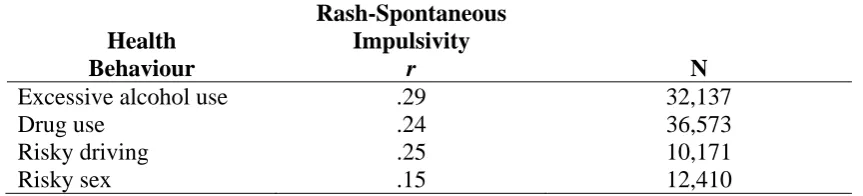
Table 5
Influence of rash-spontaneous impulsivity on health behaviours in terms of variance explained in a meta-analysis of 194 studies (Bogg & Roberts, 2004)
Health
Behaviour
Rash-Spontaneous Impulsivity
r N
Excessive alcohol use .29 32,137
Drug use .24 36,573
Risky driving .25 10,171
Risky sex .15 12,410
Generally speaking, there are an abundance of research studies that indicates the higher a person scores on measures of rash-spontaneous impulsivity, the more likely they are to engage or have engaged in risk-taking behaviours. Table 6 reviews the current literature and details the relationship of rash-spontaneous impulsivity with health-related behaviours, such as substance use and risky sex, as well as other risky behaviours, such as risky driving and partaking in crime, and some key studies are summarised in the following sections. For ease of comparison between studies, Table 6 only includes studies whose statistical methods included correlation and related techniques.
Rash-Spontaneous Impulsivity and Substance Use
impulsivity and alcohol use, in that alcohol consumption was strongly related to an individual’s stimulus-seeking needs. In particular, the disinhibition subscale (of Zuckerman’s Sensation Seeking Scale; SSS) was the most powerful predictor of drinking behaviour. In relation to illicit substances, Dughiero, Schifano and Forza (2001) compared ecstasy users to a control group made up of drug-naïve controls, cannabis users, and users of illicit drugs other than ecstasy on Cloninger’s TPQ. Results indicated that the group of ecstasy users scored significantly higher on the Novelty Seeking scale than the control group as a whole. The authors concluded that high Novelty Seeking scores are characteristic of people who use ecstasy, and the propensity to look selectively for novelties could possibly act as a pre-disposing factor for ecstasy use itself.
In a similar study, Butler and Montgomery (2004) administered the Impulsiveness, Venturesomeness and Empathy Questionnaire (IVE; Eysenck, Pearson, Easting & Allsopp, 1985) and Cloninger’s TPQ to 254 undergraduate university students. The students were grouped according to their past drug use: non-drug users, cannabis only users, polydrug users that had not used ecstasy, low polydrug ecstasy users (used ecstasy less than 20 times), and polydrug high ecstasy users (used ecstasy more than 20 times). Results indicated that all 3 polydrug groups had higher impulsiveness, venturesomeness and novelty seeking scores than the non-drug user group. Furthermore, Satinder and Black (1984) investigated the
Recently, Loxton, Wan, Ho, Cheung, Tam, Leung and Stadlin (2008) investigated the relationship between personality, ecstasy and related drug use and high risk drug related behaviour in 360 club drug users and 303 non-drug users in Hong Kong. Club drug users scored significantly higher on the Chinese version of Zuckerman’s SSS than non-drug users. Rash-spontaneous impulsivity was also significantly associated with risky drug related behaviour, such as cross border drug use and polydrug use.
Rash-Spontaneous Impulsivity and Sexual Risk Taking
Sexual risk-taking is influenced by multiple and complex interactions among various relationship, situational and dispositional factors, one of which is rash-spontaneous impulsivity. It is important to gain an understanding of the
determinants of sexual risk behaviour, as these factors are essential to the effective implementation of HIV/AIDS prevention programs (Kalichman, Heckman & Kelly, 1996).