Sheet Metal Lift Trolleys: Effects of Design Differences on Muscle
Activity and Subjective Perceptions of Operators
Submitted in accordance with requirement of the University Teknikal Malaysia Melaka (UTeM) for Bachelor Degree of Manufacturing Engineering (Hons.)
By
YAP PEEI YONG B051410145 940826-07-5974
Disahkan oleh:
_____________________________ ______________________________
Alamat Tetap: Cop Rasmi:
BLK 3-5-1,
LEBUH PADANG TEMBAK, 11400, PULAU PINANG
Tarikh: _______________________ Tarikh: _______________________
*Jika Laporan PSM ini SULIT atau TERHAD, sila lampirkan surat daripada pihak berkuasa/organisasi berkenaan dengan menyatakan sekali sebab dan tempoh laporan PSM ini perlu dikelaskan sebagai SULIT atau TERHAD.
UNIVERSITI TEKNIKAL MALAYSIA MELAKA
BORANG PENGESAHAN STATUS LAPORAN PROJEK SARJANA MUDA
Tajuk: SHEET METAL LIFT TROLLEYS: EFFECTS FO DESIGN DIFFERENCES ON MUSCLE ACTIVITY AND SUBJECTIVE PERCEPTION OF OPERATORS.
Sesi Pengajian: 2017/2018 Semester 2
Saya YAP PEEI YONG (940826-07-5974)
mengaku membenarkan Laporan Projek Sarjana Muda (PSM) ini disimpan di Perpustakaan Universiti Teknikal Malaysia Melaka (UTeM) dengan syarat-syarat kegunaan seperti berikut:
1. Laporan PSM adalah hak milik Universiti Teknikal Malaysia Melaka dan penulis. 2. Perpustakaan Universiti Teknikal Malaysia Melaka dibenarkan membuat salinan
untuk tujuan pengajian sahaja dengan izin penulis.
3. Perpustakaan dibenarkan membuat salinan laporan PSM ini sebagai bahan pertukaran antara institusi pengajian tinggi.
4. *Sila tandakan (√)
(Mengandungi maklumat yang berdarjah keselamatan atau kepentingan Malaysiasebagaimana yang termaktub dalam AKTA RAHSIA RASMI 1972)
(Mengandungi maklumat TERHAD yang telah ditentukan oleh organisasi/ badan di mana penyelidikan dijalankan)
SULIT
TERHAD
DECLARATION
I hereby, declared this report entitled “Sheet Metal Lift Trolleys: Effects of design differences on muscle activity and subjective perceptions of operators” is the result of my
own research except as cited in references.
Signature : ……….
Author’s Name : YAP PEEI YONG
APPROVAL
This report is submitted to the Faculty of Manufacturing Engineering of Universiti Teknikal Malaysia Melaka as a partial fulfilment of the requirement for Degree of Manufacturing Engineering (Hons). The member of the supervisory committee is as
follow:
i
ABSTRAK
Keletihan otot disebabkan apabila manusia melakukan tugas-tugas yang berulang dan dalam postur yang janggal dalam tempoh yang panjang. Penggunaan jack gerobak meja angkat memerlukan pengguna membungkuk untuk memegang logam lembaran yang boleh menyebabkan keletihan otot. Pengangkat troli direka cipta untuk mengurangkan postur subjek yang tertekan ketika menjalankan tugas pemuatan dan pemunggahan.
ii
ABSTRACT
Muscle fatigue are caused when human is performing the manual tasks repetitively and in awkward posture for prolonged period. The using of lift table cart jack required subject to bend down to hold the sheet metal may causing the muscle fatigue. Trolley lifter was designed to reduce the awkward posture of the subject during performing the loading and unloading tasks.
An experiment was conducted in order to examine the effect of differences in the two sheet metal handling devices which is lift table cart and trolley lifter. The objective of this study is to compare the muscle activity and subjective perceptions of the subjects using the sheet metal handling devices to performing tasks. Surface electromyography has been used to measure and analysed the muscle activity in order to compare the effect differences between two sheet metal handling devices. The surface electromyography data were collected at biceps brachii, triceps brachii, lower back muscle and trapezius by using Noraxon EMG device. sEMG data predicted compression at 90th percentile by using the repeated measures
iii
DEDICATION
Dedicated to
My beloved mother, Ung Saw Ean
My beloved father, Yap Eng Lee
My beloved sister, Yap Peei San
My beloved teammates, Ching Yung En, Tan Yu Qi for giving me moral support,
iv
ACKNOWLEDGEMENT
First of all, I would like to thank my supervisor, Dr. Nadiah binti Ahmad for her help and advice. She has given me the full freedom to decide and work on problems. Besides, she also has been a great source of ideas, valuable feedback and encouragement through the thesis writing and presentation.
v
TABLE OF CONTENT
ABSTRAK i
ABSTRACT ii
DEDICATION iii
ACKNOWLEDGEMENT iv
TABLE OF CONTENT v
LIST OF FIGURES ix
LIST OF TABLES xi
LIST OF ABBREVIATIONS xii
CHAPTER 1 INTRODUCTION 1
1.1 Research Background 1
1.2 Problem Statement 3
1.3 Objectives 4
1.4 Scope of the Research 4
1.5 Rational of the research 5
1.6 Thesis Organization 6
CHAPTER 2 LITERATURE REVIEW 7
2.1 Human muscles 7
2.1.1 Skeletal Muscle 7
2.1.2 Biceps brachii 9
2.1.3 Triceps brachii 9
2.1.4 Lower back muscle (Erector spinae) 10
vi
2.2 Muscle Fatigue 11
2.2.1 Causes of Muscle fatigue 13
2.3 Surface Electromyography (sEMG) 13
2.3.1 Measurement of Surface Electromyography 14
2.3.2 Types of electrodes 15
2.3.3 Placement of the Electrode 16
2.4 Risk factor for musculoskeletal disorder 17
2.4.1 Low Back Pain 19
2.5 Manual Material Handling (MMH) 20
2.5.1 Lift Table Cart Jack 21
2.5.2 Trolley Lifter 22
2.6 Previous study on using sEMG application to compare work design alternating 22
2.7 Summary 26
CHAPTER 3 METHODOLOGY 27
3.1 The relationship between objective and methodology 27 3.2 Measure and analyse the muscle activity of the operators when using sheet metal
handling device. 28
3.2.1 Subjects for experiment 28
3.2.2 Preparation for sEMG experiment 29
3.2.3 Skin preparation 29
3.2.4 Equipment used in surface electromyography 30
3.2.5 Maximum voluntary contraction 33
3.2.6 Design of experiment for sEMG 34
3.2.7 Placements of electrodes 36
3.2.8 Pilot Study 37
vii
3.3 Evaluate the subjective perceptions on using sheet metal handling device 38
3.3.1 Questionnaires development 38
3.4 Compare the differences between lift table cart jack and trolley lifter in term of muscle activity and operator subjective perception. 40
3.4.1 Statistical analysis 40
3.4.2 Comparison for subjective perceptions 40
3.5 Summary 41
CHAPTER 4 RESULT AND DISCUSSION 43
4.1 Measure and analyse the muscle activity of the operators when using sheet metal
handling devices. 43
4.1.1 Raw data collection 43
4.1.2 Remove the outliers of the raw data 44
4.1.3 Analyse of the maximum voluntary contraction (MVC) 45 4.1.4 Analyse the raw data for the loading and unloading tasks 48 4.2 Compare the differences between lift table cart jack and trolley lifter in term of muscle activity and operator subjective perception. 49
4.2.1 Normality test for the data distribution 49
4.2.2 Comparison of muscle activity for 1mm galvanized iron sheet metal
loading task 50
4.2.3 Comparison of muscle activity for 3mm aluminium sheet metal loading
task 51
4.2.4 Comparison of muscle activity for 6mm aluminium sheet metal loading
task 53
4.2.5 Comparison of muscle activity for 1mm galvanized iron sheet metal
unloading task 54
4.2.6 Comparison of muscle activity for 3mm aluminium sheet metal unloading
viii
4.2.7 Comparison of muscle activity for 6mm aluminium sheet metal unloading
task 57
4.3 Evaluate the subjective perception on using the sheet metal handling devices 59 4.3.1 Mean and median of the subjective perception based on the usability 59 4.3.2 Mean and median of the subjective perception based on the usefulness 60 4.3.3 Mean and median of the subjective perception based on the desirability 61 4.3.4 Comparison of the subjective perceptions based on usability 62 4.3.5 Comparison of the subjective perception based on the usefulness 64 4.3.6 Comparison of the subjective perception based on the desirability 65
4.4 Summary 66
CHAPTER 5 CONCLUSIONS AND RECOMMENDATIONS 67
5.1 Conclusions 67
5.2 Recommendations 68
REFERENCES 69
APPENDIX A 77
ix
LIST OF FIGURES
Figure 2.1: Structure of a Skeletal Muscle (SEER Training Modules, 2017) 8 Figure 2.2: Schematic diagram of Flexion and extension of the arm (Newcastle University,
2017) 8
Figure 2.3: Schematic diagram of the biceps brachii (University of Washington, 1997) 9 Figure 2.4: Schematic diagram of triceps brachii (University of Washington, 1997) 10 Figure 2.5: Schematic diagram of lower back muscle (University of Washington, 1997) 10 Figure 2.6: Schematic diagram of trapezius muscle (Human Body Anatomy System, 2017) 11 Figure 2.7: Leakage and storage of Calcium ions during muscle contraction and relaxion
(The New York Times, 2008) 12
Figure 2.8: The raw EMG recording of three contributions burst of the muscle biceps
(Merzouki, 2012) 15
Figure 2.9: Schematic diagram of recommended distance between electrodes 16 Figure 2.10: Schematic diagram of lift table cart jack 21
Figure 2.11: Schematic diagram of trolley lifter 22
Figure 3.1: Maximum voluntary contraction for biceps brachii and triceps brachii 33 Figure 3.2: Maximum voluntary contraction position for trapezius muscle 33 Figure 3.3: Maximum voluntary contraction position for lower back muscle (erector spinae) 34 Figure 3.4: The placement of electrodes at the biceps brachii 36 Figure 3.5: The placement of electrodes at the triceps brachii 36 Figure 3.6: The placement of electrodes at the lower back muscle 37
Figure 3.7: The placement of reference electrodes 37
Figure 3.8: Schematic diagram of raw EMG data 38
Figure 3.9 Flow chart of methodology 42
Figure 4.1: Example of the raw data collection 44
x
Figure 4.3: Maximum voluntary contraction for biceps brachii 45 Figure 4.4: Maximum voluntary contraction for triceps brachii 46 Figure 4.5: Maximum voluntary contraction for lower back 46 Figure 4.6: Maximum voluntary contraction for upper trapezius 47
Figure 4.7: Example of the test of normality 49
Figure 4.8: Loading task: 90th percentile and standard deviation of muscle activity for 1mm
galvanized iron sheet metal 50
Figure 4.9: Loading task: 90th percentile and standard deviation of muscle activity for 3mm
aluminium sheet metal 51
Figure 4.10: Loading task: 90th percentile and standard deviation of muscle activity for 6mm
aluminium sheet metal 53
Figure 4.11: Unloading task: 90th percentile and standard deviation of muscle activity for
1mm galvanized iron sheet metal 54
Figure 4.12: Unloading task: 90th percentile and standard deviation of muscle activity for
3mm aluminium sheet metal 56
Figure 4.13: Unloading task: 90th percentile and standard deviation of muscle activity for
6mm aluminium sheet metal 57
xi
LIST OF TABLES
Table 2.1: Previous study on using sEMG application 23
Table 3.1: Table of the relationship between the objectives and methodology 27
Table 3.2: Tools used for sEMG experiment 30
xii
LIST OF ABBREVIATIONS
sEMG - surface Electromyography
WMSD - Work-related musculoskeletal disorders
% - Percentage
MVC - Maximum Voluntary Contraction
SENIAM - surface EMG non-invasive assessments of muscles MSDs - musculoskeletal disorders
MHH - manual material handling
1
CHAPTER 1
INTRODUCTION
This chapter explains the information regarding to research background, problem statement, objectives, and scope of the research. The organization of study is also presented in this chapter.
1.1 Research Background
Skeletal muscle can be regarded as the largest organ within the human body. It is essential for all activities involving spontaneous movement. Skeletal muscle is the muscle attached to the bone. These muscles are subjected to contracting and relaxing when the person is moving. Continuous or repetitive actions, exerted force and speedy movements may be stimulated pain receptors in muscles (Bridger, 2003). The repeated or sustained activities may cause muscle fatigue and back injury to the low back muscle.
Work-related musculoskeletal disorders (WMSDs) are a group of painful disorders of muscles, tendons and nerves. The subject occupation frequently exposed to elevated physical risk factors such as repetitive task, awkward posture and lifting task, which represent the major causes of WMSDs. The symptoms of WMSDs may include lower back pain, neck/shoulder pain (Li et al, 2017).
2
all these activities require continuous movement of the back extensors (Bridger, 2003). The extensors are the muscles work to straighten/extend or contract the body part.
Material handling processes are one of the most significant aspects of demanding environments such as loading and unloading of the materials from one place another place. Lift table cart jack is a device that commonly used in manufacturing industrial to raise and lower large, heavy loads. Some common activity of the lift table cart jack is used to transfer and lift the sheet metal or other material from work cell to work cell. Lift table cart jack that are manually pushed and elevated through the use of a foot pedal.
By using the lift table cart jack, during transporting the sheet metal from one work cell to another work cell, the worker need to support the other end of the sheet metal manually while another worker pushing the lift table cart jack. Furthermore, during the elevation period, the worker also need to support the other end of the sheet metal while another worker pumping the foot pedal. The subject may expose to injuries during the repetitive lifting tasks and awkward posture.
To prevent injuries to the muscles from operating the lift table cart jack, a trolley lifter has been designed as an alternative sheet metal handling device. The trolley lifter consists of which does not require two workers to carry the material during transport period. Besides that, the trolley lifter also does not require the worker to bend down for support the end of the sheet metal during transportation period and elevation period. The design of the trolley lifter could help to eliminate and reduce the awkward posture.
3
1.2 Problem Statement
4
1.3 Objectives
The objectives are as follows:
(a) To measure and analyse the muscle activity of the operators when using sheet metal handling device.
(b) To analyse the subjective perceptions on using sheet metal handling device.
(c) To compare the differences between lift table cart jack and trolley lifter in term of muscle activity and operator subjective perception.
1.4 Scope of the Research
In order to achieve the objectives of the study, there are a few scopes as listed. Research on the of design differences on muscle activity and subjective perceptions of operators. In this research the gender for the subject only focus on male and 25 subjects will be recruited for the experiment.
In this study, the measurement of the muscle activity is concentrated on the sheet metal loading and unloading process as it is potentially contributing to muscle fatigue. The muscles analysed in this study are biceps trachii, triceps trachii, and lower back muscle and shoulder muscle as well trapezius. For the lift table cart jack, the electrical signal is only measure for the subject who is doing similar tasks with the trolley lifter which is loading and unloading the sheet metal and pushing the lift table cart jack from the storage rack to the laser cutting machine.
The surface EMG has been used to detect the electrical signal produce by the muscle during carry out the experiment. The equipment used to detect the electrical signal is Noraxon EMG.
5
1.5 Rational of the research
The finding of this research will help to eliminate and reduce the awkward posture and low back pain of the subject when using the lift table cart jack for material handling process. Therefore, creating and designing a safe and comfortable new material handling device could be beneficial to the workers who works in the iron and steel company. The small and medium sized company may not afford to buy an automation machine for material handling process and they still depend on the manual handling process by using the lift table cart jack. The trolley lifter could be beneficial to those workers that works in the small and medium sized company and reduce the muscle fatigue and awkward posture when performing the material handling process.
6
1.6 Thesis Organization
This report will mainly comprise of 5 chapter, which included introduction, literature review, methodology, result and discussion and lastly conclusion.
Chapter 2 literature review will consider about the previous study or researches such as journals and books study the effect on muscle activity by using EMG device, muscle fatigue, human muscle types, lift table cart jack and trolley lifter. It is essential to contribute the overview on the research title.
Chapter 3 methodology will discuss about the process flow of the developing the experiment and conducting the survey. Furthermore, it also explains about the methods to prepare and conduct the experiment for collecting the EMG activity.
Chapter 4 result and discussion will discuss about EMG activity result after conduct the experiment by using different type of trolley lifter. Besides that, it will also about the subjective perception after using both of the trolley lifter.
7
CHAPTER 2
LITERATURE REVIEW
This chapter proceeds with the detailed literature review. It includes the various type of human body muscles, muscle fatigue, surface electromyography signal, the placement of the electrode and the work-related musculoskeletal disorders (WMSDs). The information is obtained through online manual handbook, journal article, and references text.
2.1 Human muscles
Human muscle system is performing the posture and movement of the human body. The muscle performance essential roles in human body, which is produce movement, maintain postures, stabilizes the joints and generates beats (Marieb, 2006). Human muscle is classified into three different types of muscle, which is cardiac muscle, skeletal muscle and smooth muscle. Each type of muscle plays specific and different role in the human body.
2.1.1 Skeletal Muscle
8
The role of the skeletal muscle utilize tension between the bone points to which they are attached. Skeletal muscles develop the active force for the static and dynamic motor actions within the human body when acting upon the bone and the joint system (Disselhorst-Klug et al., 2009). Tension is applying when a muscle is changing from resting to active
[image:24.595.188.426.220.351.2]state in responses to impulses to central nervous system (Bridger, 2003). Figure 2.1 shows the structure of skeletal muscle (SEER Training Modules, 2017).
Figure 2.1: Structure of a Skeletal Muscle (SEER Training Modules, 2017)
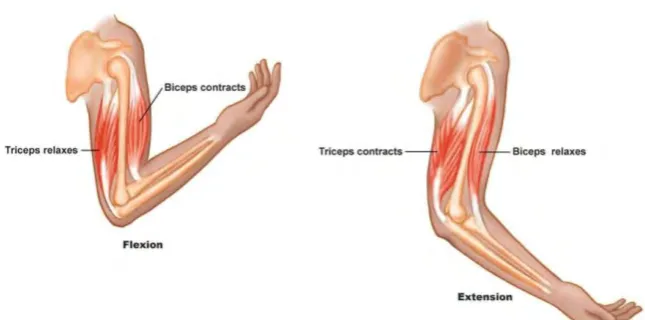
The skeletal muscle generally occurs in pairs, which means one of the muscle is act as dominant mover and the other acts as an antagonist. Such as, during the subject bends the arm, the biceps trachii will contract and the triceps brachii is relaxed. When the arm returns to the extended position and the triceps brachii is contracts while biceps is relaxing. The repetitive movements or awkward posture may cause the subject exposed to muscle fatigue and muscle injuries on the muscle. Figure 2.2 shows the flexion and extension of the arm (Newcastle University, 2017).
[image:24.595.147.470.572.732.2]