A CASE STUDY IN THE RISE
OF PUBLIC SECTOR TRANSPARENCY:
UNDERSTANDING THE GLOBAL DIFFUSION OF
FREEDOM OF INFORMATION LAW
By
Rhys Stubbs, BSocSc (Hons) (International Relations/Political Science) Submitted in fulfillment of the requirements for a Degree of
Doctor of Philosophy, University of Tasmania,
DECLARATION OF ORIGINAL AUTHORSHIP
This thesis contains no material which has been accepts for a degree or diploma by the University or any other institution, except by way of background information and duly acknowledged in the thesis, and to the best of the candidate’s knowledge and belief no material previously published or written by another person except where due acknowledgement is made in the text of the thesis, no does the thesis contain any material that infringes copyright.
STATEMENT OF AUTHORITY OF ACCESS
This thesis may be available for loan or limited copying in accordance with the Copyright Act 1968 (Cth)
3
ABSTRACT
The thesis presents an analysis of the rise of public sector transparency by examining in depth the global spread of a chief reform, freedom of information law. The thesis utilizes a socio-legal approach to examine the diffusion of the law and this distinguishes it from much of the FOI literature, which tends towards legal formalism or empiricism (Chapter Two). The thesis provides an overview of the diffusion of FOI law amongst adopter countries and examines statistical similarities and differences between adopters and non-adopters (Chapter Three). It finds that levels of globalization are an important factor differentiating adopters and non-adopters, a finding that is later supported and explored within the thesis.
Theoretical foundations for understanding the rise of public sector transparency and the diffusion of FOI law are assessed. The largely implicit theoretical assumptions of existing studies are drawn out and critiqued (Chapter Four). Two foundations are identified as prominent within the literature: a ‘modernization foundation’ suggests the spread of FOI law is driven by capitalist development, while an ‘agent foundation’ suggests the spread of the law is best understood with reference to competing social actors. While these foundations have their own strengths and weaknesses, the thesis provides an alternative theoretical foundation: ‘transnational historical materialism’ (Chapter Five). The alternative foundation, grounded in global political economy, places the diffusion of the law and the rise of public sector transparency within an understanding of the changing nature of state institutions in modern history. Central to this understanding is the way the state apparatus relates to society within a given historical context, not just within particular countries, but across countries within historical periods of the modern world system.
‘Lockean’ states because the relationship between state apparatuses and society within those states developed as a consensual social contract facilitating a ‘right to know’. Outside these ‘Lockean’ states throughout much of modern history so-called ‘Hobbesian’ states prevented the further diffusion of the law. Within ‘Hobbesian’ states the authority of the state apparatus overshadowed weak civil societies and prevented the development of a ‘right to know’. However, towards the end of the twentieth century the ‘Lockean’/‘Hobbesian’ dichotomy of modern states began to break down and FOI law proliferated widely. ‘Hobbesian’ structures underwent a process of transformation in the context of an emergent global political economy that facilitated the further diffusion of the law, and public sector transparency.
5
ACKNOWLEDGEMENTS
I am indebted to my academic mentors at James Cook University—Surin Maisrikrod, Janine Hiddleston and Douglas Hunt—for the encouragement they gave me as a bewildered undergraduate. I might never have approached a PhD otherwise.
Family, supervisors and friends supported me in beginning and finishing this research project.
I am thankful for Maria’s patience and love. She tolerated my thesis-related dramas and acted as a soundboard for my tangled ideas.
I am grateful also to my supervisors at the University of Tasmania. I originally moved to Hobart not knowing what to expect of them. As it turned out, they were enormously capable and considerate, and each brought something unique to the project.
Rick Snell was hands-on. He provided critical commentary on the chapters as they developed. On the other hand, Kate Crowley gave big picture encouragement and motivation from day one; while Richard Eccleston was an ever supportive research advisor.
TABLE OF CONTENTS
ABSTRACT... 3
ACKNOWLEDGEMENTS... 5
TABLE OF CONTENTS... 6
ABBREVIATIONS... 8
LIST OF TABLES ... 9
LIST OF FIGURES... 9
1: INTRODUCTION... 10
1.1 Introduction ... 10
1.2 Rise of Public Sector Transparency... 11
1.3 Case Study: the Diffusion of FOI Law ... 17
1.4 Theoretical Perspective: Transnational Historical Materialism... 22
1.5 Methods: Macro-Historical Analysis with Comparative Case Studies ... 27
1.6 Chapter Outline ... 31
1.7 Conclusion ... 34
2: FOI LAW AND FOI LITERATURE ... 36
2.1 Introduction ... 36
2.2 FOI Law... 37
2.3 FOI Literature... 42
2.4 Lack of Socio-Legal Understanding ... 49
2.5 Conclusion ... 52
3: DIFFUSION OF THE LAW ... 53
3.1 Introduction ... 53
3.2 Mapping the Diffusion of FOI Law ... 54
3.3 Similarities and Differences amongst Adopters... 63
3.4 Difference between Adopters and Non-adopters ... 75
3.5 Conclusion ... 76
4: THEORETICAL FOUNDATIONS OF CURRENT EXPLANATIONS ... 78
4.1 Introduction ... 78
4.2 Drawing Out Assumptions of Current Explanations ... 79
4.3 Modernization Foundation ... 87
4.4 Agent Foundation... 96
4.5 A ‘Critical Turn’ in Foundations ... 107
4.6 Conclusion ... 112
5: TRANSNATIONAL HISTORICAL MATERIALISM ... 114
5.1 Introduction ... 114
5.2 Transnational Historical Materialism ... 115
5.3 State Formation and FOI Law ... 134
5.4 Contemporary State Formation and the Proliferation of FOI Law ... 145
5.5 Conclusion ... 155
6: MACRO-HISTORICAL VIEW I: EMERGENCE AND EARLY DIFFUSION... 156
6.1 Introduction ... 156
6.2 Advent and Diffusion within the Modern Dichotomy of States ... 157
7
6.4 Hobbesian Contender States... 184
6.5 Conclusion ... 197
7: MACRO-HISTORICAL VIEW II: PROLIFERATION AND FUTURE... 198
7.1 Introduction ... 198
7.2 Transformation in World Order and State Forms ... 199
7.3 Emergence of Transnational Support for Transparency... 207
7.4 Passive Revolutions in Freedom of Information... 214
7.5 The Future of Diffusion ... 218
7.6 Conclusions ... 223
8: COMPARATIVE CONTEMPORARY CASES I: HISTORY... 225
8.1 Introduction ... 225
8.2 A Preface to Case Study Analysis... 226
8.3 Comparative Twentieth Century Hobbesian States ... 230
8.4 Relative Information Restrictions ... 234
8.5 Late-Twentieth Century State Transformations... 243
8.6 ‘Surrendering Secrecy’ in Different Ways ... 247
8.7 Conclusions ... 252
9: COMPARATIVE CONTEMPORARY CASES II: ADOPTION ... 254
9.1 Introduction ... 254
9.2 Supportive Transnational Factors ... 255
9.3 Primary National Factors... 266
9.4 Signposts for the Future... 282
9.5 Conclusion ... 289
10: CONCLUSIONS... 291
10.1 Introduction ... 291
10.2 Understanding the Rise of Public Sector Transparency and FOI Law... 292
10.3 Contribution to the FOI Literature... 293
10.4 Macro-historical Diffusion ... 300
10.5 Contemporary Case Studies ... 305
10.6 Conclusion... 311
ABBREVIATIONS
CCP Chinese Communist Party
CHRI Commonwealth Human Rights Initiative
EU European Union
IFAI Federal Institute for Access to Public Information (Mexico) ILO International Labor Organization
IMF International Monetary Fund
INC Indian National Congress
MKSS Mazdoor Kisan Shakti Sangathan (Workers’ and Farmers’ Power Organization) (India)
NAFTA North American Free Trade Agreement
NCPRI National Campaign for Peoples’ Right to Information (India)
NPM New Public Management
OAS Organization of American States
OECD Organization for Economic Co-operation and Development OGI Regulations Open Government Information Regulations (China)
PRI Institutional Revolutionary Party (Mexico)
UN United Nations
UNDP United Nations Development Programme
UNESCO United Nations Environmental, Scientific and Cultural Organization
USAID United States Agency for International Development
WB World Bank
LIST OF TABLES
Table 1: The Periodic Diffusion of FOI Law ... 19
Table 2: Economic Similarities and Differences of Adopters ... 65
Table 3: Social Similarities and Differences of Adopters... 68
Table 4: Political Similarities and Differences of Adopters ... 71
Table 5: Comparative Levels of Globalization: Average versus Adopter, 2000... 74
Table 6: Adoption amongst Most Globalized Countries, 2006 ... 74
Table 7: Adoption amongst Least Globalized Countries, 2006... 76
Table 8: Forms of Study in Current Diffusion Research ... 80
Table 9: Form and Foundation within Current Diffusion Research... 86
Table 10: Lockean and Hobbesian State Forms ... 159
Table 11: State-Society Hobbesian Relations: Post-independence/ Post-Cold War ... 206
Table 12: Diversity: China, Mexico and India ... 230
Table 13: Political and Economic Globalization of Cases, 1970-2007... 244
Table 14: Variable Concepts of Public Sector Transparency... 289
LIST OF FIGURES
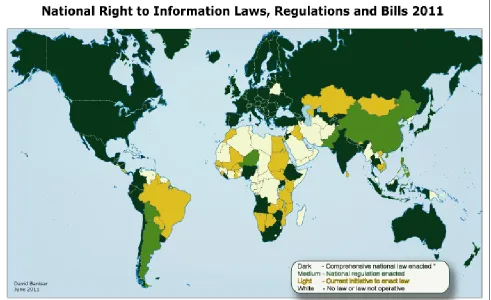
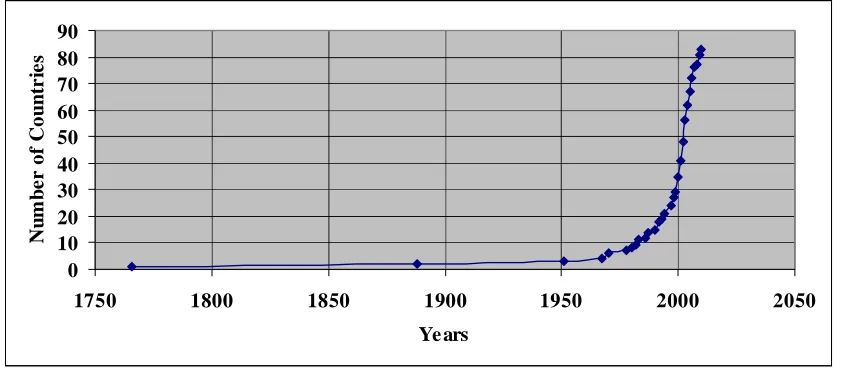
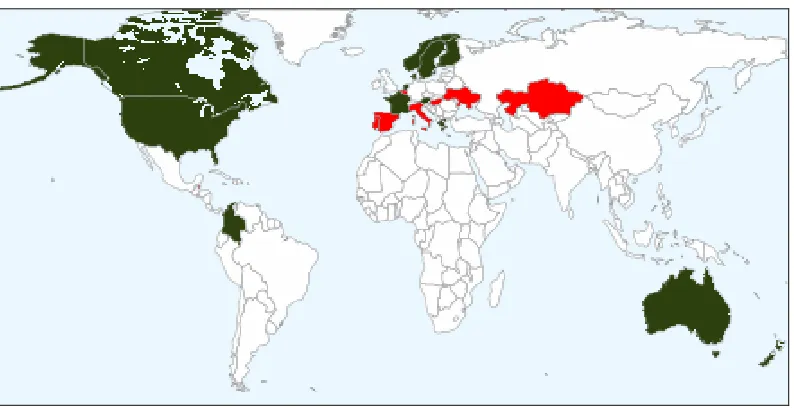
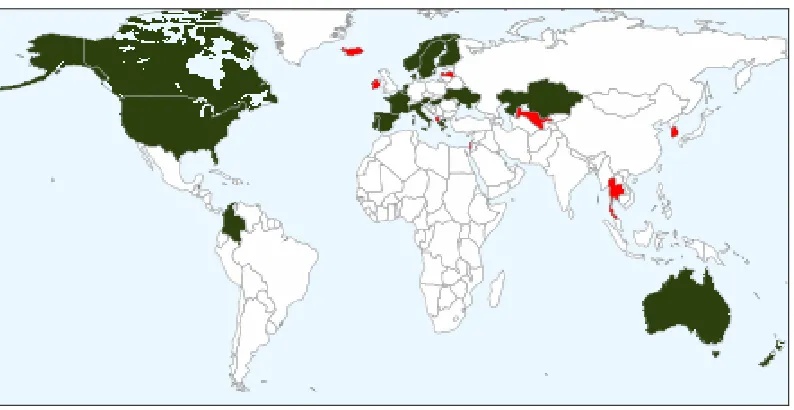
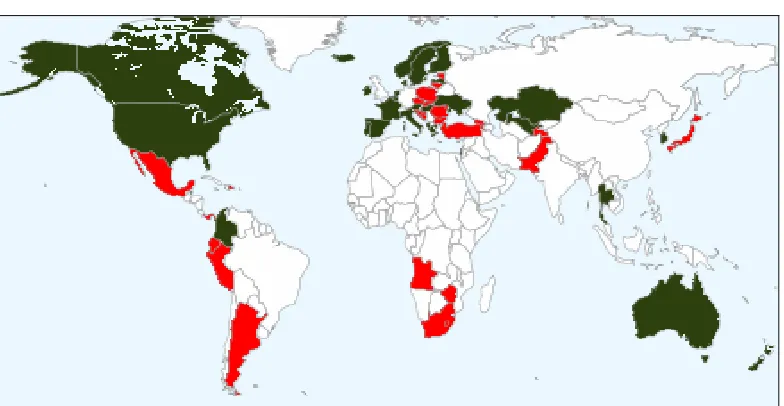
Figure 1: Banisar's 2011 Map of FOI Law ... 55Figure 2: The International Diffusion of FOI Law 1766 – 2010... 57
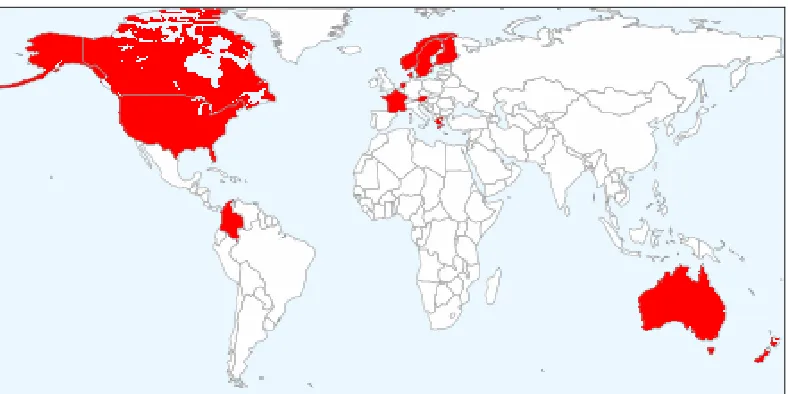
Figure 3: The Diffusion of FOI law, 1990 ... 58
Figure 4: The Diffusion of FOI Law, 1995... 60
Figure 5: The Diffusion of FOI Law, 2000... 61
Figure 6: The Diffusion of FOI Law, 2005... 62
Figure 7: The Diffusion of FOI Law, 2010... 63
Figure 8: Historical Structures... 123
Figure 9: World Orders ... 128
Figure 10: Rupert Cartoon (1) ... 178
Figure 11: Rupert Cartoon (2) ... 179
Figure 12: Levels of Globalizaton, 2008... 219
1: INTRODUCTION
History will probably call the 10 years from the collapse of the Soviet Union to the collapse of the World Trade Center towers the Decade of Openness.
Thomas Blanton1
1.1 Introduction
The recent rise of public sector transparency marks a historical break in the modern state. Secrecy has been replaced by openness as a guiding principle in public information management. Most governments throughout modern history have operated on the premise that information should be restricted unless there are specific reasons for releasing it, but now many governments around the world operate on the premise that information should be free unless there are specific reasons for withholding it. The importance of this change has been understood by some as equal to the emergence of universal suffrage.2 Such a comparison is fair given the significance of access to information on electoral choices and democratic accountability; and also the comparison has the added benefit of highlighting the dramatic nature of the rise of public sector transparency, for while the right to vote developed as an international norm over fifty years (from the 1910s to the 1960s), the right to information developed as an international norm over only twenty years (from the 1990s to the 2010s).3
Public sector transparency has risen over the past two decades at an unprecedented rate, and yet its diffusion remains a phenomenon not well understood, despite the fundamental and dramatic nature of change in bureaucratic practices. The
1 T. S. Blanton, "The Openness Revolution: The Rise of a Global Movement for Freedom of Information,"
Development Dialogue no. 2 (2002): 7.
1: Introduction
11 current study therefore seeks to provide an understanding of the rise of public sector transparency and it does so by focusing on a chief reform: freedom of information law.4 Tim Mclean writes: ‘Using these laws as an indicator of overall levels of transparency is commonplace, and for good reason.’5 The laws principally guarantee the public a presumptive right of access to government-held information.6
The thesis provides an interdisciplinary socio-legal understanding of the diffusion of FOI law.7 Theoretical tools from the discipline of global political economy are applied to develop an alternative understanding of the gradual emergence of FOI law and public sector transparency (as discussed at 1.4). These tools provide a multi-level mode of analysis that may be used to examine the broad historical rise of the law and/or its adoption (or non-adoption) within specific cases. Overall the thesis provides an understanding of the rise of FOI law as a case study in public sector transparency that incorporates its initial emergence, its early diffusion, its contemporary proliferation and, more tentatively, its future prospects.
1.2 Rise of Public Sector Transparency
The first section of this introduction briefly surveys the rise of public sector transparency and highlights a lack of understanding regarding this rise. It notes secrecy has been traditionally a key feature of the modern state and bureaucracy (see 1.2.1 below). Yet openness has emerged to challenge this tradition as the guiding principle of public administration: numerous reforms aimed at transparency in government have been championed around the world and their impact has come under scrutiny, as the section explains (see 1.2.2 below). Research suggests recent transparency reforms have increased international coordination, reduced corruption,
4 The terms FOI law, access law, transparency law, or simply ‘the law’ are used interchangeably to refer to
the same legal measures, unless otherwise specified.
5
T. McClean, "Who Pays the Piper? The Political Economy of Freedom of Information," Government Information Quarterly 27, no. 4 (2010): 392.
6 P. Birkinshaw, "Freedom of Information and Openness: Fundamental Human Rights?," Administrative
Law Review 58, no. 1 (2006): 188.
7 See R. Banakar and M. Travers, eds., Theory and Method in Socio-Legal Research (Portland: Hart, 2005),
1: Introduction
improved economic development, and facilitated trust in government.8 However, researchers have tended (in the recent rush of change and reform) to focus overwhelmingly on the effects of transparency, while neglecting to address the fundamental causes of reform—an oversight the thesis seeks to address (see 1.2.3 below).
1.2.1 The Modern Tradition of State Secrecy
Tensions between secrecy and openness in public administration have conceivably existed since the earliest days of collective public authority.9 However, modern tensions between secrecy and openness linked to secular authority, in particular, date back to the emergence of the modern state in Europe during the seventeenth and eighteenth century. The absolutist state, which was controlled by and for the monarchy, then gave way to the modern state, with government for and by the people, and the privilege of secrecy enjoyed by the monarch was passed to secular executive government—Kirsten Bishop explains:
In times of absolute monarchy the monarch was in effective control of virtually all information relating to the government and its administration. As the executive government developed, becoming responsible to the Parliament, it preserved this element of control such that information could be kept from the public at the government’s convenience.10
Nevertheless, this privilege of secular executive government to withhold information for its own convenience was immediately challenged with Enlightenment ideas of publicity, knowledge and progress, although the challenge remained at the margins, unable to effectively counter strong tendencies towards secrecy in public administration.11
Secrecy and the withholding of information in public sector administration predominated for much of modern history. The privilege of executive government to
8 A. Grigorescu, "International Organizations and Government Transparency: Linking the International and
Domestic Realms," International Studies Quarterly 47 (2003): 644.
9 For example, limited transparency and accountability was a key concern within the Tang Dynasty of
China (618-907). S. Lamble, "Freedom of Information, a Finnish Clergyman's Gift to Democracy,"
Freedom of Information Review, no. 97 (2002): 3.
10 K. Bishop, "Openness in Public Administration: Can the Government Keep a Secret?," Australian
Journal of Administrative Law 5, no. 1 (1997): 36-37.
11 C. Hood, "Transparency in Historical Perspective," in Transparency: The Key to Better Governance?, ed.
1: Introduction
13 withhold information was enshrined in principles and regulations such as the British
Official Secrets Act (first adopted in 1889), which ensured much official information, especially information of potential concern to national security and public order, remained concealed from the public as a state secret.12 In addition, the growth of modern bureaucracies added to the secretive nature of the state: the newly established departments and agencies, as well as individual public servants, tended to conceal information from each other and from the public in order to maintain any position of privilege that may be gained from such information.13 Max Weber wrote:
Every bureaucracy seeks to increase the superiority of the professionally informed by keeping their knowledge and intentions secret. Bureaucratic administration always tends to be an administration of “secret sessions”: in so far as it can, it hides its knowledge and action from criticism. 14
By the early-to-mid twentieth century the modern administrative state routinely adopted secrecy as a form of information regulation that saw a rigorous classification of documents under systems of restriction.15
1.2.2 The Contemporary Rise of Transparency
Widespread advocacy and reform directly challenged the tradition of secrecy in the modern state in the second half of the twentieth century. A ‘semantic shift’ in information handling began to emerge in opposition to traditional state secrecy with the establishment of the United Nations in the aftermath of World War II.16 Article 19 of the Universal Declaration of Human Rights, adopted in 1948, stated:
Everyone has the right to freedom of opinion and expression; this right includes freedom to hold opinions without interference and to seek, receive
12 A. Rogers, Secrecy and Power in the British State: A History of the Official Secrets Act (London: Pluto
Press, 1997).
13
M. Weber, From Max Weber: Essays in Sociology, trans. C. W. Mills and H. H. Gerth (London: Routledge & Kegan Paul, 1948), 233.
14 Ibid.
15 See for example D. P. Moynihan, Secrecy: The American Experience (New Haven Yale University Press,
1998).
16 C. Darch and P. G. Underwood, Freedom of Information and the Developing World: The Citizen, the
1: Introduction
and impart information and ideas through any media and regardless of frontiers.17
Although Article 19 was not intended at the time of its establishment to apply to access to government-held information, secretive executives and bureaucracies harboring the potential for arbitrary or unjust behavior, concealed behind closed doors, were gradually challenged, especially by media outlets within Western countries; these advocates of openness demanded the state make more information of procedures and activities more readily available, to make affairs of departments and agencies more transparent.18 A new paradigm of public sector information sharing grew to privilege the notion that information concerning the function and activity of executive government and bureaucracy should be made readily available to the public.
Transparency challenged secrecy as the underlying principle in public sector information regulation in the second half of the twentieth century. In contrast to secrecy, transparency necessitates openness in information regulation, although the meaning of the term varies depending on context.19 Transparency is often understood within the unique requirements of particular policy issues, such as, for example, fiscal practices, auditing standards, environmental protection or multilateral development assistance.20 But at its most basic level, Ann Florini writes, ‘transparency is the opposite of secrecy. Secrecy means deliberately hiding your actions; transparency means deliberately revealing them… Transparency is a choice, encouraged by changing attitudes about what constitutes appropriate behaviour.’21 Christopher Hood, on the other hand, defines transparency more specifically as ‘government according to fixed and published rules, on
17 General Assembly of the United Nations, "Declaration of Human Rights,"
http://www.un.org/en/documents/udhr/, (Date Accessed: 24 July, 2010). Emphasis added. See: C. Binder, "Freedom of Information and the United Nations," International Organization 6, no. 2 (1952).
18 H. C. Relyea, "Freedom of Information, Privacy, and Official Secrecy: The Evolution of Federal
Government Information Policy Concepts," Social Indicators Research 7, no. 1/4 (1980): 139. On the early development of a right to access government-held information, especially within the United States in the mid-twentieth century, see ‘6.3.2 Lockean FOI Pioneers: Sweden and the United States’.
19 There is no single definition of transparency. See for example Hood, "Transparency in Historical
Perspective," 3-5. C. Hood, "Transparency," in Encyclopedia of Democratic Thought, ed. P. B. Clarke and J. Foweraker (London: Routledge, 2001), 700-04..
20 A. M. Florini, "Does the Invisible Hand Need a Transparency Glove? The Politics of Transparency"
(paper presented at the Annual World Bank Conference on Development Economics, Washington D.C., 1999), 1.
21 ———, "The End of Secrecy," in Power and Conflict in the Age of Transparency, ed. B. Finel and K.
1: Introduction
15 the basis of information and procedures that are accessible to the public, and (in some usages) within clearly demarcated fields of activity.’22
Voices for transparency reform especially grew around the world at the dawn of the twenty-first century. Advocates argued from a variety of utilitarian and moral viewpoints on the importance of pubic sector transparency: collectively they suggested elevating transparency above secrecy would reduce corruption and maladministration, and boost administrative performance, economic activity and democratic participation.23 This advocacy achieved results, and public sector transparency gradually emerged in many parts of the world through various reforms requiring the disclosure of certain information. For example, the International Monetary Fund’s ‘Code of Good Practices on Fiscal Transparency’ (first published in 1998) requires substantial openness and transparency in the budgeting of central governments within member states.24 Similarly, FOI law, which now exists in 80+ countries, requires government departments and agencies to pro-actively publish certain information, in addition to providing a legal and procedural mechanism though which otherwise unpublished (and potentially unfavorable) information can be requested by the public.25
1.2.3 Causes of Public Sector Transparency?
The rise of transparency has been accompanied by a growing body of literature on the subject. This literature tends to be focused almost solely on the benefits or outcomes of transparency reforms.26 On the topic of outcomes, research indicates transparency reforms have opened up international communication and subsequently contributed to cooperation amongst states on collective problems.27 Here an increase in information
22
Hood, "Transparency," 701.
23 For a critical review of the arguments presented by some of the key advocates of contemporary
transparency see Darch and Underwood, Freedom of Information and the Developing World: The Citizen, the State and Models of Openness, 13-47.
24 The International Monetary Fund, "Code of Good Practices on Fiscal Transparency,"
http://www.imf.org/external/np/fad/trans/code.htm, (Date Accessed: 24 July 2010).
25
D. Banisar, "Freedom of Information around the World 2006: A Global Survey of Access to Government Records Laws," (London: Privacy International, 2006). T. Mendel, "Freedom of Information: A
Comparative Legal Survey," (Paris: UNESCO, 2008).
26 Grigorescu, "International Organizations and Government Transparency: Linking the International and
Domestic Realms."
27 See for example: A. M. Florini, "A New Role for Transparency," Contemporary Security Studies 18, no.
1: Introduction
flows is understood to improve coordination. The reforms are also credited, although not without debate, with improving public administration: analysis indicates increased information flow from the public sector to society may reduce corruption, increase economic performance, and/or facilitate legitimacy and trust in government.28 However, while the impact of public sector transparency has received widespread attention from researchers, much less attention has been paid to the question of what drives contemporary transparency reforms; Alexandru Grigorescu made the point in 2003: ‘The political science literature has tended to focus on the effects of government transparency; there have been few studies on the causes of transparency.’29
Studies of the causes behind the rise of public sector transparency, in general, remain preliminary and underdeveloped. Only a handful of suggested understandings of the contemporary rise of transparency (explored at more length later in Chapter Four) can be found throughout a number of minor studies, and these tend to highlight several key themes, such as norm diffusion, the rise of new transnational social actors and functional adaptation in government, especially within the post-World War II international community.30 Perhaps the only major study to address the rise of public sector transparency in a comprehensive manner to date was published by Burkart Holzner and Leslie Holzner in 2006.31 The authors presented a broad cultural shift towards transparency as part of a global change in favor of ‘open societies’ within which freedom
43 (1999), ———, eds., Power and Conflict in the Age of Transparency (New York: St. Martin's Press, 2000).
28 See for example: L. Stirton and M. Lodge, "Transparency Mechanisms: Building Publicness into Public
Services," Journal of Law and Society 28, no. 4 (2001), G. Kopits and J. Craig, "Transparency in
Government Operations," (Washington: International Monetary Fund Occasional Paper No. 158, 1998). A number of these claims, particularly the claim that freedom of information increases trust, have been critically reviewed and challenged: B. Worthy, "More Open but Not More Trusted? The Effect of the Freedom of Information Act 2000 on the United Kingdom Central Government," Governance 23, no. 4 (2010), R. Hazell, B. Worthy, and M. Glover, Does FOI Work? The Impact of the Freedom of Information Act 2000 Upon British Central Government (London: Palgrave Macmillan, 2010), Darch and Underwood,
Freedom of Information and the Developing World: The Citizen, the State and Models of Openness, 13-46.
29 Grigorescu, "International Organizations and Government Transparency: Linking the International and
Domestic Realms," 645. Emphasis in original.
30
See for example: A. M. Florini, "The Evolution of International Norms," International Studies Quarterly
40, no. 3 (1996), C. Hood, "Beyond Exchanging First Principles? Some Closing Comments," in
Transparency: The Key to Better Governance, ed. C. Hood and D. Heald (Oxford: Oxford University Press, 2006), 215-17, Grigorescu, "International Organizations and Government Transparency: Linking the International and Domestic Realms."
31 B. Holzner and L. Holzner, Transparency in Global Change (Pittsburgh: University of Pittsburgh Press,
1: Introduction
17 in public information flows is valued as a mechanism for responsiveness and tolerance in government.32 Indeed, this view is generally reflected in the current study, which draws attention to the importance of liberalism (especially twentieth century American neo-liberalism) to the rise of government openness (as shown at 6.3 and 7.2). However, unlike the Holzners, who spend a great deal of time assessing the general rise of transparency on a conceptual level as relative to secrecy, the current study presents a theoretically informed and historically grounded understanding of the rise of transparency that focuses on a specific case study reform.
1.3 Case Study: the Diffusion of FOI Law
The rise of public sector transparency is explored in the thesis via the case study reform of FOI law. The central research question of the thesis is therefore: how can the causes of the rise of FOI law, which has now spread to 80+ countries, be understood? Chapters Two and Three cover in detail the basic elements of this question, which include the definition of FOI law, the constitution of the FOI literature and the history of the diffusion of the law. At this point is perhaps most important to briefly focus on a) the status of FOI law as a case study in public sector transparency (see 1.3.1 below), and b) the socio-legal contribution of the current study specifically to the FOI literature (see 1.3.2 below).
1.3.1 FOI Law as a Case Study
Openness and accountability reforms have been widely implemented in association with administrative reform agendas. FOI law presents itself as an ideal case study reform within this wider context. As mentioned above, the rise of openness in government since the 1990s has been linked to a variety of reforms, which include FOI law and the IMF’s ‘Code of Good Practices on Fiscal Transparency, as well as others such as, for example, the Canadian Federal Accountability Act (2006), which aims to bring a level of oversight to political financing.33 Obmudsman agencies, another example, have been adopted
32 Ibid., 1-3.
33 I would like that thank an anonymous examiner for bringing this Act, and those similar, to my attention.
1: Introduction
around the world as a means of oversight and representation in the interests of the public against the state.34 FOI law is well placed as a case study reform within the this openness revolution because the law focuses specifically on challenging the right of the state to secrecy, to withholding information from the public, while other reforms tend to focus either on openness in a particular area of activity, such as fiscal policy or political financing, or on more than just openness, as in the multiple roles of the ombudsman.
FOI law is central to public sector transparency, principally because it provides the presumptive right of access to government-held information. In spite of some variation between laws (discussed in more depth in section 2.2), the laws principally guarantee the public a presumptive right of access to government-held information.35 The laws provide the public with a legal and procedural mechanism through which to request to view personal and/or policy information in the possession of departments and agencies. These requests are subject to exemptions seeking to protect the public interest regarding national security and privacy, amongst other things. Requestors may therefore receive all, part or none of the information requested and they generally have recourse to review mechanisms if they are unhappy with the initial outcome. More broadly than a request mechanism, the laws also generally enshrine a principle of openness that requires governments to proactively publish and make information available to the public, via websites or otherwise, especially information relating to the structure and function of government. FOI law essentially commits government to openness and transparency, not with reference to specific areas, but in general.
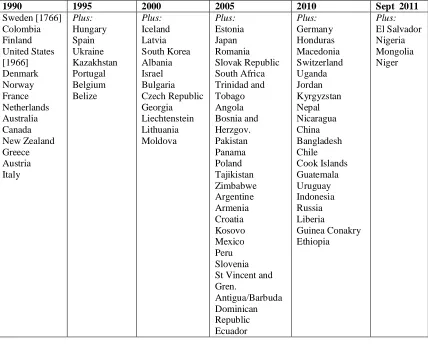
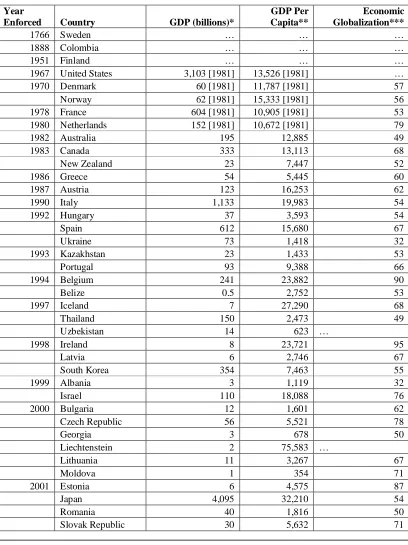
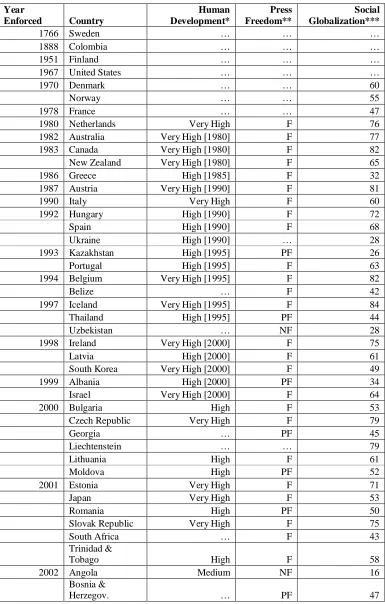
The diffusion of FOI law has been at the forefront of the ‘rise and rise’ of open government and public sector transparency.36 Table 1 below shows that the spread of the law began slowly in eighteenth century Sweden, before continuing at an ‘unprecedented’ rate in recent years.37 The law remained an isolated and fragile innovation in Sweden for
34 Hans Peter Olsen, "From Idea to Institutions: The Global Diffusion of the Ombudsman" (paper presented
at the Annual Meeting of the American Political Science Association, Philadelphia, 2008).
35
Birkinshaw, "Freedom of Information and Openness: Fundamental Human Rights?," 188.
36 Ives, "The Rise and Rise of Open Government."
37 R. Snell and W. Xiao, "Freedom of Information Returns to China," Public Administration Today, no. 10
1: Introduction
[image:19.595.85.513.332.683.2]19 two centuries, until the adoption of similar law in the United States in 1966. Around the time of adoption in the United States, similar law was adopted by a handful of wealthy democracies. The law began to migrate beyond this select group of rich democratic adopters into a more diverse range of regional and political contexts in the early 1990s. The reform was adopted by countries ranging from Hungary (1992), Belize (1994), Thailand (1997), and Israel (1998) in the 1990s. Towards the end of the 1990s the rate of adopters increased significantly: it is estimated that an ‘explosion’ of forty countries adopted the law between 1999 and 2006.38 In particular, Eastern Europe and Latin America provided fertile ground for the law reform.39
Table 1: The Periodic Diffusion of FOI Law
1990 1995 2000 2005 2010 Sept 2011
Sweden [1766] Colombia Finland United States [1966] Denmark Norway France Netherlands Australia Canada New Zealand Greece Austria Italy Plus: Hungary Spain Ukraine Kazakhstan Portugal Belgium Belize Plus: Iceland Latvia South Korea Albania Israel Bulgaria Czech Republic Georgia Liechtenstein Lithuania Moldova Plus: Estonia Japan Romania Slovak Republic South Africa Trinidad and Tobago Angola Bosnia and Herzgov. Pakistan Panama Poland Tajikistan Zimbabwe Argentine Armenia Croatia Kosovo Mexico Peru Slovenia St Vincent and Gren. Antigua/Barbuda Dominican Republic Ecuador Plus: Germany Honduras Macedonia Switzerland Uganda Jordan Kyrgyzstan Nepal Nicaragua China Bangladesh Chile Cook Islands Guatemala Uruguay Indonesia Russia Liberia Guinea Conakry Ethiopia Plus: El Salvador Nigeria Mongolia Niger
38 J. M. Ackerman and I. E. Sandoval-Ballesteros, "The Global Explosion of Freedom of Information
Laws," Administrative Law Review 58, no. 1 (2006): 98.
39 The diffusion of FOI law has been less notable in the Middle East and Africa; see ‘7.5.1: Obstacles
1: Introduction
Jamaica Serbia Turkey Azerbaijan India Montenegro Taiwan
United Kingdom
1.3.2 Socio-Legal Understanding of Diffusion of the Law
The thesis makes a general contribution to the study of public sector transparency, and a specific contribution to the study of FOI law. As already explained, the thesis provides a basis for understanding the rise of public sector transparency; it makes a general contribution to understanding the rise of public sector transparency by examining from a socio-legal perspective the diffusion of FOI law as a case study reform. That is the general contribution of the thesis—toward the study of public sector transparency. Yet the key contribution of the thesis must be understood with reference to the case study reform of FOI law. The principle, academic contribution of the thesis is in the field of FOI literature.
The literature on FOI law can be divided into a handful of overlapping themes with strong legal and empirical tendencies. These themes include ‘legal analysis’, ‘media analysis’, ‘government investigation’, ‘administrative analysis’ and ‘socio-legal analysis’ (as elaborated at 2.3). Of these themes ‘socio-legal analysis’—analysis with a theoretical and methodological base in the social sciences—is a potentially fruitful but underdeveloped approach. Therefore, recent studies have begun the process of building and strengthening social-legal understandings of FOI law (as shown at 2.4). For example, Colin Darch and Peter Underwood sought to move forward in their 2010 study from initial steps at a ‘more self-conscious social science perspective’ by employing diffusion analysis, historical analysis and political theory to examine FOI law in the context of developing countries.40 The current study contributes to the construction of socio-legal
40 These steps were initially taken by John M. Ackerman and Irma E. Sandoval-Ballesteros in 2006.
1: Introduction
21 understandings by drawing on social and political theory to explore the diffusion of the law.
The theoretical assumptions informing current explanations of the diffusion of FOI law are largely implicit, due to the lack of socio-legal understanding, and research tends to be partial and fragmented in pointing to a variety of ‘factors’ to explain the recent proliferation of the law; these ‘factors’ include: international human rights trends;41 anti-corruption efforts;42 a growth in civil society advocates;43 and the development of international pressure.44 Current studies generally provide an empirical account of one or more such factors with minimal reference to broader historical or theoretical concerns (as shown at 4.2). For instance, existing explanations suggest the contemporary rise of FOI law has been heavily facilitated by the activities of transnational advocacy groups, and yet the same studies fail to place the influence of such groups within any frame of reference that might facilitate an understanding of their emergence, type and/or activity in the diffusion of the law.45 Similarly, suggestions ‘globalization’ has facilitated the spread of FOI law are generally not supported with any systematic understanding of the process of globalization or how it drives the law reform.46
The thesis aims to address these deficiencies within current studies of the diffusion of the law by explicitly utilizing theoretical foundations from social and
41 See for example: Darch and Underwood, Freedom of Information and the Developing World: The
Citizen, the State and Models of Openness, 75-77.
42 T. S. Blanton, "The World's Right to Know," Foreign Policy no. 131 (2002): 52-53. Transparency
International, "Using the Right to Information as an Anti-Corruption Tool," (Berlin: Transparency International, 2006).
43 Blanton, "The Openness Revolution: The Rise of a Global Movement for Freedom of Information."
Ackerman and Sandoval-Ballesteros, "The Global Explosion of Freedom of Information Laws," 19-23. A. Puddephatt, "Exploring the Role of Civil Society in the Formulation and Adoption of Access to
Information Laws: The Cases of Bulgaria, India, Mexico, South Africa and the United Kingdom," in Access to Information Working Paper Series, ed. The World Bank (Washington: 2009).
44 Blanton, "The Openness Revolution: The Rise of a Global Movement for Freedom of Information,"
16-17. Grigorescu, "International Organizations and Government Transparency: Linking the International and Domestic Realms."
45
For example: Puddephatt, "Exploring the Role of Civil Society in the Formulation and Adoption of Access to Information Laws: The Cases of Bulgaria, India, Mexico, South Africa and the United Kingdom." Although see some progress in J. Pinto, "Transparency Policy Initiatives in Latin America: Understanding Policy Outcomes from an Institutional Perspective," Communication Law and Policy 14, no. 1 (2009). Darch and Underwood, Freedom of Information and the Developing World: The Citizen, the State and Models of Openness, 5-6.
1: Introduction
political science. This allows the thesis to first appreciate the largely implicit theoretical assumptions that pervade current explanations. Chapter Four critiques two prominent theoretical foundations from the social sciences, explicit in a few studies, that provide the basis for the majority of current explanations: a ‘modernization foundation’ (see 4.3) suggests the spread of FOI law is driven by capitalist development, while an ‘agent foundation’ (see 4.4) suggests the spread of the law is best understood with reference to competing actors.47 The thesis then draws on its own theoretical foundation, setout in Chapter Five, to provide a unique understanding of the diffusion of the law. This theoretical foundation positions ‘factors’ in the diffusion of the law, such as transnational advocacy groups, and globalization, within a interlocking theoretical framework.
1.4 Theoretical Perspective: Transnational Historical Materialism
The thesis addresses the rise of FOI law as a case study in public sector transparency by drawing from theoretical and methodological tools provided within the humanities, especially social science, political science and international relations. This standpoint provides a variety of theoretical foundations by which to approach the question. For example, as mentioned already, current explanations tend to draw from either a ‘modernization foundation’ or an ‘agent foundation’. Both options embody relative strengths and weaknesses. Nevertheless, the thesis selects and applies an alternative theoretical foundation: ‘transnational historical materialism.’48 This alternate foundation provides a historical interpretative foundation centered on the changing structures of state institutions within the modern (capitalist) world system.
47 See C. J. Bennett, "How States Utilize Foreign Evidence," Journal of Public Policy 11, no. 1 (1991). —
——, "Understanding Ripple Effects: The Cross-National Adoption of Policy Instruments for Bureaucratic Accountability," Governance 10 (1997). Grigorescu, "International Organizations and Government Transparency: Linking the International and Domestic Realms." Pinto, "Transparency Policy Initiatives in Latin America: Understanding Policy Outcomes from an Institutional Perspective.".
48 The foundation is also often referred to as ‘neo-Gramscianism’ because of they way it draws heavily
from the work of Antonio Gramsci. For introductions, see: A. D. Morton, "Social Forces in the Struggle over Hegemony: Neo-Gramscian Perspectives in International Political Economy," Rethinking Marxism 15, no. 2 (2003), H. Overbeek, "Transnational Historical Materialism: Theories of Transnational Class
1: Introduction
23
1.4.1 Why Transnational Historical Materialism?
Theory can be used in a number of ways to address the diffusion of FOI law. The ‘modernization foundation’ and ‘agent foundation’ are examples of this. In the first instance, a number of studies are set within a ‘modernization foundation’ that provides a macro evolutionary perspective of socio-political change (as explored at 4.3.1). These studies draw from a theoretical foundation of structural functionalism that understands social and political change with reference to a form of socio-political evolution inherent within capitalism that leads to political development and modernization; from this perspective FOI law is driven by capitalist development (see 4.3.2). On the other hand, a number of studies are set within an ‘agent foundation’ that provides a social exchange perspective of socio-political change (see 4.4.1). These studies draw from a micro theoretical foundation of rational exchange theory that explains social and political change with reference to bargaining and negotiation between social actors; from this perspective FOI law is driven by competing actors and social preferences (see 4.4.2).
These foundations, identifiable throughout current studies, have the potential to provide insight into the rise of public sector transparency, but they also have important limitations. The strengths of each foundation come from their respective macro and micro focuses. The ‘modernization foundation’ is adept at explaining the diffusion of FOI law with reference to socio-economic development and globalization (as discsussed at 4.3.3). It is a foundation that appreciates the structural element. On the other hand, the ‘agent foundation’ is adept at explaining the diffusion of the law with reference to the actual motives and behavior of the social actors involved in the process of law reform, especially civil society organizations (see 4.4.3). It is a foundation that appreciates the agency element. However, both foundations exhibit important limitations. Each has weaknesses that spring from their strengths, from the respective emphasis on structure or agency. The ‘modernization foundation’ tends to emphasis the former at the expense of the latter (see 4.3.4), while the ‘agent foundation’ tends to emphasis the latter at expense of the former (see 4.4.4).
1: Introduction
historical materialism’, which draws from the critical, neo-Marxist tradition in social and political science, presents a viable alternative foundation to those already discussed. Transnational historical materialism, as a historical and structural approach, provides a platform for understanding the history of FOI law, from its initial emergence to its contemporary explosion, within a totality of social reality. This is unlike the traditional modernization and agent approaches, which tend to focus specifically on variables in the contemporary rise of the law reform. Trasnational historical materialism presents a holistic, comprehensive understanding of the diffusion of FOI law (and public sector transparency). The rise of public sector transparency and access law is understood in this way not just with reference to specific variables but with reference to dynamic forces in the history of the law, whether structural or agent. Above all, the critical foundation of transnational historical materialism necessarily calls into question the dynamic forces behind the diffusion of the law in order to assess not just their influence on the law, but also their interest in the law and how the interests of variable forces may inform the emergence and diffusion of the law in various ways.
1.4.2 Critical Approach to the Rise of Transparency
Transnational historical materialism, as a foundation, presents a variety of approaches and perspectives that share a similar historical interpretative root (see 5.2). At its core the foundation embraces the classical method of historical materialism, first developed by Karl Marx in the middle of the nineteenth century, with the view of history as transformation in economic and political spheres.49 But transnational historical materialism moves beyond classical historical materialism by incorporating key twentieth century thinkers of Western Marxism, such as Antonio Gramsci (1891-1937) and Nicos Poulantzas (1936-1979).50 As a Marxist socio-legal foundation, transnational historical materialism is structural rather than instrumental; it views political and legal phenomena as historical expressions of broader social, material and institutional configurations,
49 K. Marx, A Contribution to the Critique of Political Economy (Moscow: Progress Publishers, 1977
[1859]).
50 A. Gramsci, Selections from the Prison Notebooks, trans. Q. Hoare and G. N. Smith (London: Lawrence
1: Introduction
25 rather than deliberate instrumentas of class rule.51 FOI law is therefore understood from this perspective as a specific aspect of a much larger and dynamic historical picture that involves the transformation of structures involving a mix of actors with varying access to resources and power. The theoretical foundation is informed by ‘world systems theory’ with its concern for core and peripheral states within world orders, although it tends to be more holistic than ‘world systems theory.’52 It is called transnational historical materialism because a large proportion of the foundation’s innovative nature comes from the way in which it incorporates the increased relevance of transnational social relations.53
A central feature of transnational historical materialism, also important in understanding the rise of FOI law and public sector transparency, is analysis of the transformation of states in modern history. The state is understood by transnational historical materialists as an ‘extended’ structure that incorporates both the essential institutions of government—the state apparatus—plus the social relations immediately surrounding such institutions (as elaborated at 5.2.2). This perspective harks back to Marx’s proposition that ‘state power is not suspended in mid-air.’54 The state apparatus is seen in direct relation to social and economic surroundings. But unlike structural Marxists, such as Louis Althusser, who view the state as an ontologically static phenomenon, transnational historical materialists view the extended state as a fluent and historically informed structure that finds quasi-permanency in ‘historical structures.’55 Of particular interest to transnational historical materialists are the formation of state-society
51 P. Beirne and R. Quinney, "Marxist Theories of Law: An Introduction," in Marxism and Law, ed. P.
Beirne and R. Quinney (1982: John Wiley & Sons, 1982), 16-19. D. Milovanovic, An Introduction to the Sociology of Law, 3rd ed. (New York: Criminal Justice Press, 2003), 79.
52 On world systems theory see: I. Wallerstein, The Modern World-System: Capitalist Agriculture and the
Origins of the European World-Economy in the Sixteenth Century, III vols., vol. I (New York: Academic Press, 1974). ———, "The Rise and Future Demise of the World Capitalist System: Concepts for
Comparative Analysis," Comparative Studies in Society and History 16, no. 4 (1974). ———, The Modern World-System: Mercantilism and the Consolidation of the European World-Economy, III vols., vol. II (New York: Academic Press, 1980).
53 Overbeek, "Transnational Historical Materialism: Theories of Transnational Class Formation and World
Order," 181.
54 K. Marx, "The Eighteenth Brumaire of Louis Bonaparte," in Collected Works, ed. K. Marx and F. Engels
(London: Lawrence and Wishart, 1979 [1852]), 186.
55 On the differences between ‘transnational historical materialism’ and ‘structural Marxism’, see: R. W.
Cox, "Social Forces, States and World Orders: Beyond International Relations Theory," Millennium 10 no. 2 (1981): 133. Althusser’s perspective on the state: L. Althusser, "Ideology and Ideological State
1: Introduction
relations within quasi-permanent historical structures, and, particularly, the influence of increased social and economic transnational relations in the formation of states and the function of the state apparatus (see 5.3).
From the viewpoint of transnational historical materialism, transparency in the state apparatus is an expression of its relation to society. Initially, prior to the late twentieth century, transparency was an expression of national state-society relations. Some nation-states embodied a relation favorable to transparency, others did not. The countries that championed transparency, such as Sweden and the United States, tended to embody a state-society relation in which the former is seen to be subservient to the latter—information held by government departments and agencies is therefore seen as the property of the polity (as discussed at 6.3). On the other hand, countries traditionally antagonistic towards transparency, such as those of the former Soviet Union and former British colonies, for example, tended to embody a state-society relation in which the former is seen to lead the latter. Information held by government departments and agencies in such countries was therefore the privilege of the state apparatus (see 6.4).
However, with the onset of globalization and the contemporary increase in transnational relations, public sector transparency has become an expression of state-society relations penetrated by transnational influences. Especially following the collapse of the ideological divisions of the Cold War, an intertwining of national and transnational actors advocating for transparency reform has seen a ‘passive revolution’ in information handling within a wide range of states (as discussed at 7.2 and 7.3). These actors and agendas have varied in purpose, power and influence; for example, the thesis suggests that powerful interests connected with the emergent global political economy have provided fundamental support for the recent explosion in FOI law in an attempt to reduce, through increased information sharing, volatility and risk in the global economy from government action (see 7.3).56 However, each contemporary national case of ‘passive revolution’ must be understood on its own terms, not simply as a case of imposition, but as a unique national reflection of international developments that intertwines such
56 S. Gill, "The Global Panopticon? The Neoliberal State, Economic Life and Democratic Surveillance,"
1: Introduction
27 powerful interests, and international advocacy groups and local campaigners within unique national circumstances (as discussed at 7.4).
1.5 Methods: Macro-Historical Analysis with Comparative Case
Studies
Transnational historical materialism provides multiple levels of analysis, ranging from the history of the modern world system to the history of particular state formations. These multiple levels of analysis are utilized in the thesis as methods to investigate the diffusion of FOI law on several levels and there are two key areas of interest: a) the overall historical diffusion of the law, especially prior to the late-twentieth century and b) the contemporary proliferation of the law from the late twentieth century onwards. These areas of interest are addressed within the thesis with the use of two specific levels of analysis. The first method examines the long term history of FOI law as part of a broader evolution in state forms within the modern world system (see 1.5.1 below). The second method of analysis adopted within the thesis brings the focus of analysis more directly into state formation and the unprecedented contemporary diffusion of FOI law (see 1.5.2 below). China, Mexico, and India are adopted, on the basis that they are unique and influential adopters, as contemporary comparative case studies to be examined in depth in order to explore the internal dynamics of the recent explosion of the law.
1.5.1 Macro-Historical Diffusion of FOI Law
Transnational historical materialism is above all concerned with the long-term. It is a foundation concerned fundamentally with what Stephen Gill refers to as ‘socio-historical time.’57 This is the terrain of the longue durée, a concept used to refer to a realm of social time that rests above everyday ‘events-time’ and involves repeated collective human action over time that forms historical structures of reality.58 Analysis of the longue durée
of global capitalism may be called macro-historical analysis and it is a method used within the thesis to provide an overview of the long term diffusion of FOI law. This
57 ———, "Reflections on Global Order and Sociohistorical Time," Alternatives 16, no. 3 (1991). ———,
Power and Resistance in the New World Order (New York: Palgrave Macmillan, 2003), 41-49.
1: Introduction
method moves beyond historical narrative to examine the emergence and transformation of structures involved in the rise of FOI law and public sector transparency. In examining the macro-historical diffusion of FOI law, the method allows for an appreciation of the political geography and internal structural dynamics in the history of the diffusion of FOI law.
The macro-historical analysis, which covers roughly three centuries of modern history, focuses solely on the key elements and transformations within the development and spread of FOI law. The analysis cannot possibly capture the expansive, dynamic and fluent nature of all the history in question. It only purports to exhibit growth and transformation in ideal types of state structures (i.e. extended states, discussed above at 1.4.2) within the history of global capitalism and how they have (or have not) contributed to the diffusion of FOI law.59 These ideal types, useful as tools for comparison, provide ‘a simplified representation of a complex reality and an expression of tendencies limited in their applicability to time and space, rather than fully realized developments.’60 The macro-historical method charts the course and evolution of ideal types of state structures within the modern world system and their relation to FOI law from the eighteenth century until the late-twentieth century.
The principle ideal types of state structures examined in the thesis are the ‘Lockean’ and the ‘Hobbesian’. The formation of these is discussed below and throughout the thesis, but at this stage it is perhaps important to flag the issue of their names. Each is named after the political philosopher most representative of the essential state-society relation embodied by the ideal type.61 The Lockean form is named after John Locke (1632-1704), the ‘Father of Liberalism’, because it principally embodies Locke’s philosophy of self rule and limited representative government.62 On the other hand, the Hobbesian form is named after Thomas Hobbes (1588-1679), proponent of the
59 R. W. Cox, Production, Power and World Order: Social Forces in the Making of History (New York:
Cambridge University Press, 1987), 129.
60 Cox, "Social Forces, States and World Orders: Beyond International Relations Theory," 137. ———,
Production, Power and World Order: Social Forces in the Making of History, 4.
61 Kees van der Pijl developed the concept of ‘Lockean’ and ‘Hobbesian’ state forms in the modern world
system: K. van der Pijl, Transnational Classes and International Relations (London: Routledge, 1998), 65-98., ———, Global Rivalries: From the Cold War to Iraq (London: Pluto Press, 2006), 1-12. ———, "Ruling Classes, Hegemony, and the State System," International Journal of Political Economy 19, no. 3 (1989): 16-20.
1: Introduction
29 Leviathan, because it essentially embodies Hobbes’ philosophy of absolutism for the sovereign (state apparatus) as guardian of the collective social contract.63 Admittedly these ideal types and their embodiment of respective political philosophies may be criticized as too general. However, there is room for further distinctions within the ideal types and, in any case, what the ideal types lose in particularity they make up for in explanatory power, both in terms of modern world history and the rise of public sector transparency, as the thesis demonstrates.
1.5.2 Comparative Case Studies: China, Mexico and India
The second method of analysis adopted in the thesis complements the first. Macro-historical analysis of ‘ideal types’ of state structures in the history of FOI law provides a sophisticated overview of the historical diffusion of the law, but it tends to overlook the uniqueness of the contemporary proliferation of the law amongst ‘Hobbesian’ states. In order to mend this oversight the thesis utilizes an alternative level of analysis provided by transnational historical materialism. This level of analysis is focused more narrowly on the transforming composition of particular state structures. It is concerned with the historical evolution of specific state-society relations. The thesis examines comparative case studies in changing ‘Hobbesian’ state structures and adoption of FOI law. These include China, Mexico and India, which represent important and interesting ‘Hobbesian’ case studies in the contemporary explosion of the law.
The comparative cases of China, Mexico and India provide insight into a) the importance of state-society relations in access to information and b) the intertwining of national and transnational factors in the recent adoption of FOI law. In the first instance, the cases show the historically weak notions of access to information within comparative ‘Hobbesian’ states and the importance of changes to state structures alongside the emergence of the global political economy to the rise of FOI law. The case study analysis highlights the socio-legal context of the rise of FOI law within a much broader transformation in ‘Hobbesian’ state structures. In the second instance, the comparative case study analysis allows for an appreciation of variable relations between national and transnational factors in contemporary adoption. The cases demonstrate the utility of the
1: Introduction
concept of ‘passive revolution’ as a theoretical tool (as defined at 5.4) for understanding the recent proliferation of FOI law amongst ‘Hobbesian’ states as a process of national reflection of international developments.
Case study selection in the thesis is based on the importance of the cases themselves, not on the importance of the cases to affirming or disproving the theoretical foundation of transnational historical materialism.64 In other words, the aim of the approach to case study selection is to utilize theoretical propositions to shed light on case studies of interest, rather than to improve theoretical generalization in any meaningful way.65 The special interest of China, Mexico and India is explored in more depth later (see 8.2.2). Here it may suffice to mention the special interest of the cases begins with their unique positions within the recent proliferation of FOI law: China is a seemingly strange case wherein an authoritarian regime has adopted transparency regulation, Mexico, on the other hand, adopted one of the most innovative and progressive reforms anywhere, whereas law reform in India has been champion by unique grassroot social forces. The importance of the cases also extends beyond their status as special cases of adoption, to their important positions within the global political economy as geopolitically significant countries likely to influence future trends in state formation and public sector transparency, especially within the developing world (elabored further at 8.2.2).
The analysis of processes of adoption of national FOI reform within the three case studies is conducted with the use of information available from a variety of sources. John Ackerman and Irma Sandoval-Ballesteros note there is already a large body of existing empirical information on the spread of FOI reform that needs to be systematically studied from a social scientific perspective.66 There is a wealth of primary information sources online provided by the actors involved in the diffusion of FOI reform within the case
64 This approach to case study selection is referred to as ‘interpretative’ or ‘disciplined-configurative’: A.
Lijphart, "Comparative Politics and the Comparative Method," The American Political Science Review 65, no. 3 (1971): 692. H. Eckstein, "Case Study and Theory in Political Science," in Handbook of Political Science, ed. F. I. Greenstein and N. W. Polsby (Reading: Addison-Wesley, 1975), 99-104. J. Kaarbo and R. K. Beasley, "A Practical Guide to the Comparative Case Study Method in Political Psychology," Political Psychology 20, no. 2 (1999): 374.
65 Lijphart, "Comparative Politics and the Comparative Method," 692.
1: Introduction
31 study countries.67 This information is collected and analyzed within the thesis. In addition to such primary data, secondary information sources are also used within the case studies.68 Together these primary and secondary sources of information enable the in-depth analysis required to properly execute the case studies in the contemporary diffusion of FOI law from the perspective of transnational historical materialism.
1.6 Chapter Outline
The thesis is divided into ten chapters: this introduction, eight major chapters, and a conclusion. The major chapters of the thesis can be thought of as falling to four interrelated groups. The first group (Chapters Two and Three) establishes the basis for the study by reviewing the FOI literature and providing an overview of the diffusion of FOI law. The second group (Chapters Four and Five) builds on this basis by examining the theoretical foundations for existing explanations of the diffusion of the law and presenting an alternative foundation. The third group (Chapters Six and Seven) applies transnational historical materialism on a macro-historical level that considers broad changes in state-society relations within the modern world system. Finally, the fourth group (Chapters Eight and Nine) applies transnational historical materialism to the contemporary comparative cases discussed above, examining the comparative evolution of state-society relations within them and the relationship between national and transnational factors in adoption.
The first group of chapters, which provide the basis for the study, includes Chapter Two and Chapter Three. The first of these chapters argues FOI law essentially provides a presumptive right of access to government-held information but that beyond this essential meaning the law may be thought of as an ‘empty signifier’ that gets filled by the context of each adopting country (as discussed at 2.2). This is demonstrated later in the thesis by the fact that FOI law in China, Mexico and India is understood in
67 For example, freedominfo.org provides a wealth of primary material supplied by advocates from around
the world: freedominfo.org, "Freedominfo.org: The Global Network of Freedom of Information Advocates," http://www.freedominfo.org/, (Date Accessed: 13 March, 2011).
68 For example: G. Michener, "The Surrender of Secrecy: Explaining the Emergence of Strong Access to