The Lattice of Case and Agentivity
MSc Thesis(
Afstudeerscriptie
)written by
Scott M. Grimm
(born July 23rd, 1976 in San Mateo, CA, United States of America)
under the supervision ofDr Henk Zeevat, and submitted to the Board of
Examiners in partial fulfillment of the requirements for the degree of
MSc in Logic
at theUniversiteit van Amsterdam.
Date of the public defense: Members of the Thesis Committee:
December 6, 2005 Dr Andrej Malchukov
Contents
1 Introduction 4
2 Case: An Overview 8
2.1 Case: Morphological, Syntactic, Semantic and Functional Properties 8
2.2 Varieties of Case . . . 10
2.2.1 Core Case Markers . . . 10
2.2.2 Peripheral Cases . . . 11
2.3 Diachronic Perspective on Case . . . 12
3 The Agentivity Lattice 16 3.1 Case and Thematic Content . . . 18
3.1.1 Grammatical Roles and Thematic Roles . . . 18
3.1.2 From Thematic Roles to Proto-Roles . . . 19
3.2 Reformulating the Proto-Role Approach . . . 20
3.2.1 Primitive Properties of Agentivity . . . 20
3.2.2 Causation and Affectedness . . . 22
3.2.3 Psychological Facets of the Agentivity Primitives . . . 26
3.3 Hierarchization of the Agentivity Properties . . . 27
3.3.1 Construction of the Lattice . . . 27
3.3.2 The Transitivity Region . . . 32
3.3.3 Lexical Classes . . . 33
4 Typological Applications: Core Case-Marking Systems 36 4.1 Transitivity and Markedness . . . 37
4.1.1 Hopper and Thompson’s Transitivity Parameters . . . 37
4.1.2 Tsunoda’s Effectiveness Condition . . . 39
4.2 Mapping Core Case-Marking Systems . . . 41
4.2.1 Accusative and Ergative Marking Systems . . . 42
4.2.2 Agentive Marking . . . 44
4.3 Animacy, Definiteness and Differential Object Marking (DOM) . 47 4.3.1 A Feature-Based Account of DOM . . . 49
4.4 Discriminatory and Indexical Case-Marking Strategies Reconsidered 61
5 Language Particular Applications: Non-Canonical Case Marking 63
5.1 Instrumental Subjects . . . 64
5.2 Dative Experiencers . . . 66
5.3 Subject-Marking in Hindi . . . 67
5.3.1 The Ergative . . . 68
5.3.2 The Dative . . . 69
5.3.3 Ergative/Dative Alternation . . . 71
5.3.4 The Instrumental . . . 72
5.4 Object Marking in Russian . . . 75
5.4.1 The Genitive/Accusative Alternation in Russian . . . 76
5.4.2 The Accusative/Dative Alternation in Russian . . . 78
5.5 Case Attraction in Ancient Greek . . . 79
5.5.1 Distribution of Case Attraction . . . 81
5.5.2 Mapping the Cases of Ancient Greek . . . 85
5.5.3 Deriving the Case Hierarchy . . . 90
5.5.4 The Harmonic Alignment of Case . . . 91
6 Implications for Formal Semantics 94 6.1 Extensional Semantics . . . 95
6.1.1 Uninterpretability . . . 97
6.1.2 Semantic Vacuity . . . 98
6.1.3 Thematic Content . . . 99
6.2 Functionalism in Semantics . . . 100
Acknowledgements
Chapter 1
Introduction
Case-marking is at the crossroads of syntax, morphology, semantics and even oc-casionally pragmatics. The goal of this investigation is to examine the semantics underlying case-marking. Modulation of parameters such as agency, object in-dividuation and affectedness are known to affect the realization of case-marking (Hopper and Thompson, 1980), especially in the form of case alternations. Yet, explicitly connecting individual parameters with the semantic contribution of case alternations has largely proven elusive.
From a syntactic viewpoint, especially within generative syntactic theories, case has been viewed as partitioned into syntactic case (“structural case”) or case as-signed in the lexicon (“inherent case”). However, many uses of case can neither be explained in purely syntactic terms, and yet, are too regular to be idiosyncratic and individually assigned elements of lexical entries. This deficiency has been pointed out many times before (e.g., the discussion of the status of the indirect object in (Butt, 2006)) and it is increasingly recognized that there are regular, semantic prin-ciples at work in case-marking which are more general than the notion of “inherent case” predicts.
There is an acute need for investigation of the semantics of case-marking. Indi-vidual case-markers can be used in a surprisingly wide variety of manners, and without a thorough understanding of the semantics involved in a given case, de-livering a unified analysis for such variety is without much hope. Some uses of case are largely semantically transparent; for instance, in many languages, the in-strumental case has a consistent and coherent semantic contribution—it marks that the nominal marked by the instrumental was used in the event. The temptation to directly link cases with a semantic contribution is great, but attempts in this direc-tion have been hampered by a lack of serious investigadirec-tion into what the semantic contribution is grounded in.
Of-ten, case-marking is associated with various grammatical roles such asagent, recip-ient, patientand so forth, allowing to associate a given case marker with a semantic role or concept, as in (Fillmore, 1968). This is an attractive approach, since intu-itively, a semantic continuity is found throughout the distribution of a given case marker. In general, such attempts have failed to make progress because such gram-matical roles are too coarse-grained to provide the necessary flexibility to match the actual distribution of case-markers. The technique followed here of
decom-posing broad semantic concepts such as anagent into more primitive properties,
and then establishing the structure that inheres among these properties, allows to represent a facet of the semantics of a case-marker in more fine-grained detail. In turn, this move provides more depth to the semantics of a given case, which then can be used to explain the different interpretations a case can receive in different contexts.
Much research, especially from typology, has demonstrated that there appear to be (partial) universals at work, which continue to motivate the search for the connec-tion between semantic factors and case-marking. In very oversimplified terms, the primary facts about syntactic and semantic prominence, known as thematic promi-nence, can be represented by the following prominence scales:
(1) a. Syntactic Prominence: Subject>Object
b. Thematic Prominence (Fillmore, 1968): Agent>Theme
Looking at these two scales, there is a great temptation to imagine a one-to-one mapping onto (1a) from (1b)—for instance, with agents mapped to subjects and patients mapped to objects. However, once these prominence relations are ex-panded to include indirect objects and complements for syntax, and other sorts of
grammatical roles, such asexperiencers or recipientsfor the thematic scale, the
enterprise becomes enormously complicated. In fact, attempts to establish such a linear scale incorporating all the types of grammatical roles have led to a prolifera-tion of different thematic hierarchies, some contradicting others (cf. discussion in (Levin and Hovav, 2005). Even so, there do appear to be some universals which can be stated with a good deal of empirical certainty, such as that an instrument cannot be realized as subject in the presence of an agent, or a moving entity cannot be an object in the presence of an entity that changes state (Levin, 2005). Pro-viding a framework which allows to capture such generalizations, and connecting them with how such arguments are realized by case-marking, will be a central part of this work.
(2) a. Animacy Scale (Aissen, 2003):
Human>Animate>Inanimate
b. Definiteness Scale (Aissen, 2003):
Pronoun>Name>Definite>Indefinite Specific>Non-Specific c. Person Scale (Aissen, 1999):
First, Second>Third
In (Aissen, 2003), the scales (2a) and (2b) are conjoined to account for Differential Object Marking, a phenomena whereby objects are case-marked if they appear to-wards the higher end of the prominence scales. Again, the influence of these scales upon case-marking is most often neither direct nor simple. Then, the question arises concerning how all the parameters mentioned interact—for example, what are the ways in which the parameter of animacy influences that of agentivity.
The tactic used here to provide a manner of associating case-markers with semantic properties is two-fold. First, extending the work of (Dowty, 1991), the parameter of agentivity is decomposed into more primitive semantic properties. Second, the resulting properties are organized in a hierarchical manner, into a lattice, a move inspired by the work of (Aissen, 2003), who organized the above animacy and definiteness hierarchies into a lattice representation as well.
If this analysis is taken as correct, several results follow. First, it is possible to give an account of both canonical uses of case, i.e., the general sense of a case, and its less typical uses. This account is a result of the use of the semantic properties of agentivity as the common denominator of the various uses of a case. Further, this model can then be applied to successfully explain in a principled manner case al-ternations in a variety of languages—Hindi and Russian are considered here—and other puzzling phenomena associated with case, such as case attraction in Ancient Greek. Finally, and perhaps most importantly for further research, the construction of the lattice of agentivity properties provides a first step for modelling the interac-tion of several different semantic parameters via a feature-based representainterac-tion.
It should be mentioned from the outset that this study does not directly engage in the logical formalisms frequently found in work on semantics. The central rea-son is that in order to engage in such formalisms, a clear idea of what is being formalized must be present. This is precisely what is lacking in the current state of knowledge about the semantics underlying case. Instead, this study attempts to render conspicuous exactly what are the semantic factors contributing to case realization. It turns out that both the data and the analysis of case phenomena pose clear challenges to the view of formal semantics focussing on extensions.
in argument structures, i.e., agentivity, patientivity, etc., is constructed via a lattice. This chapter contains the core theoretical contribution of this study. The next two chapters focus on applications of the lattice approach. In Chapter 4, typological
generalizations surrounding the notion oftransitivityare treated, followed by an
Chapter 2
Case: An Overview
2.1 Case: Morphological, Syntactic, Semantic and
Func-tional Properties
The study of case has not arrived at a satisfactory definition of case which is suc-cinct and properly circumscribes the range of functions of case-marking. What the
nature of caseis is largely undetermined in most studies of case. (Blake, 1994)
gives a tentative definition of case as “a system of marking dependent nouns for the type of relationship they bear to their heads.” Yet, this definition, as is almost immediately admitted in (Blake, 1994), does not hold for all cases. To give only one troublesome example among many, Ancient Greek disposes of a case known as the vocative, which is used primarily with names of persons and whose force is that the speaker is addressing the person whose name is put into the vocative. In this situation, the vocative case makes no reference to the relation of the noun to its head, but instead serves in a discourse function. More crucially, certain cases are primarily used to indicate a semantic relation to its head rather than a strictly syntactic one, and vice versa. The instrumental case is an instance of the former, since the instrumental case marks that the argument was used as an instrument in the event, and the nominative case is an instance of the latter, marking that the argument is the subject of the predicate. While there is truth to the statement that various cases designate a type of relation, succinctly defining which relations are appropriate to case-marking is nearly as difficult as the initial task of defining case.
truth-conditional, semantics (the relation between the semantic elements I discuss and formal semantics will be discussed in 6).
Case is a complex notion in terms of morphological definition as well. The distinc-tion between cases which are fused to nominals (i.e., inflected cases) and adposi-tions which are syntactically separate units (i.e., preposiadposi-tions and postposiadposi-tions) is often a contentious one. Functionally, there seems to be little distinction since both serve to mark nouns for their relation to the predicate. A striking example of the proximity of postpositions and case-markers occurs in languages of the Dravidian family. The same root surfaces in some members of the family as a postposition,
and in others as a suffix, i.e., a case-marker. For example, in Tamil,-ul
˙ is a
post-position, designating ‘inside’. However, the related-l¯o in Telugu is used as both
a postposition and case marker, e.g., in-t
˙i-l¯o, ‘in the house’ (Krishnamurti, 2003).
Here too, I will use the term ‘case’ in a morphologically broad sense, not trou-bling about the fuzzy boundary between inflections and adpositions, since it is the functional and semantic properties that will be of interest.
The dismal picture that emerged in the preceding paragraphs of case as an un-defined concept should not depress us for very long, since there are quite a few things known about case systems. The very fact that linguists can discuss differ-ent languages while using the same labels of ‘nominative’, ‘accusative’, ‘dative’, etc., referring to case-markers found in the different languages is telling of a uni-versal component to case marking. A cursory glance at the case systems of the world shows that languages whose geographical and historical circumstances are completely disjoint make use of case-markers with quite similar functions. For instance, Australian languages dispose of a dative case, the case responsible for marking an indirect object, just as Indo-European languages do. There are uses particular to each language which distinguish the dative case of a given Australian language from the dative case of a given Indo-European language, but it is worth-while to emphasize that there is enough in common between the two to merit the use of the same label, ‘dative’, in describing each language.
What all these case systems have in common is that they use case to mark how nominals are integrated into the predicate, syntactically and/or semantically. An argument structure representation of a predicate states that a predicate requires
cer-tain types of participants as its subject, object, etc. For instance, the verbhit in
Having discussed these generalities about case, I now turn to two more specific discussions. First, I will outline the general architecture of case systems, which will introduce the type of data with which this study is concerned. Second, I discuss how cases arise in the first place, that is, the process of grammaticalization which results in case systems. This second topic will give a historical basis to one of my main claims, that cases have a central semantic content, which while possibly extended during the process of grammaticalization, is still very relevant for any treatment of case.
2.2 Varieties of Case
2.2.1 Core Case Markers
Core case-markers are responsible for marking the arguments of one- and two-place predicates. The strategies used to achieve this task fall into two main cat-egories, either aligning the subject position with the Agent or the Patient, which correspond to accusative and ergative systems, respectively. In accusative systems, the subject aligns with the Agent and is usually unmarked (nominative) while the Patient stands in the marked (accusative) case, as in (3).
(3) LATIN (Palmer, 1994)
Puer boy.NOM
hominem man.ACC
planxit hit.3.SG
The boy hit the man.
Conversely, ergative systems mark the Agent (ergative marking), and the Patient is aligned with the subject and typically unmarked (absolutive).
(4) DYRIBAL ((Dixon, 1979) taken from (Palmer, 1994)) a. numa
father.ABS
banaga-ju return.PAST Father returned.
b. numa father.ABS
yabu-ngu mother.ERG
buó-n see.PAST Mother saw father.
The accusative system is the more frequent, comprising over seventy percent of the world’s case systems.
is marked as Agent with some verbs and as Patient with others, depending on the verb. Occasionally, the same verb permits both possibilities.
(5) EASTERN POMO ((McLendon, 1978), taken from (Palmer, 1994)) a. h´a
1SG.AGT
c’ex´elka slip I’m sliding b. w´ı
1SG.PAT
c’ex´elka slip I’m slipping
From the outset, it should be made clear that the use of ‘Patient’ has at least two different uses which should be kept in mind. In literature on Thematic Roles (which investigates the semantic classification of participants in events or states, such as ‘Agent’, ‘Patient’, and so forth), ‘Patient’ is used in a specific, although still too often vague, sense: the entity which submits to the affects of the action of the event designated by the predicate. In the typological literature, ‘Patient’ is used much more generally, as in the above, and is often equivalent to ‘Non-Agent’. In
describing different alignment systems, i.e., ergative vs. accusative, the symbolsA
andPare used rather than Agent or Patient. In what follows, the context should
make clear which sense is pertinent, but I shall try to add clarification where there could be doubt.
In summary, the three systems can be schematically represented by table 2.1.
Table 2.1:
System Alignment
Accusative S=A
Ergative S=P
Agentive S=A/P
2.2.2 Peripheral Cases
Dative: Most often associated with the indirect object of ditransitive verbs, es-pecially when the indirect object designates a benefactive or recipient function. The term dative actually has its etymological origins in the Latin, ‘dativus’, which signifies “appropriate to giving”.
Genitive: The case used to designate possession, and as such, usually marks relations between nouns rather than between a noun and a verb.
Instrumental: The case which marks a noun as the instrument or means by which the action depicted by the predicate is effected.
Locative: This case designates location, and roughly corresponds to prepositions in English such as ‘in’, ‘on’, or ‘at’.
Comitative: The case of accompaniment, designating with whom the subject or object participated in the event.
There are dozens of other cases which have many specific functions, but I will only be directly concerned with the core cases and the first three peripheral cases listed.
2.3 Diachronic Perspective on Case
Throughout the following chapters, it is helpful to keep grammaticalization pat-terns in mind as providing a semantic foundation to case-marking. It has been argued that case markers have “general meanings” (Jakobson, 1984), i.e., a se-mantics that transcends the often quite diverse uses of a case in different contexts. The source of a case-marker can be seen as an underlying general meaning, which through high frequency of usage and idiomatization, extends its range of particular uses. Even though the range of meanings of case-markers develops by the process of grammaticalization to be much wider than the meaning of their source mate-rial, their original senses often still influence both the eventual semantics of the case-marker and potentially its distribution.
(6) EWE ((Heine et al., 1991), found in (Blake, 1994)) a. me-n´a
1SG.give ga money
kof´ı Kofi I gave Kofi money
b. me-wOdO´ 1SG.do
v´ev´ı´e work.hard
n´a give
dod´okpOl´a exam.DEF I worked hard for the exam
In Kwe, the verb is bound to its subject, as in (6a). In (6b), it stands alone, indicat-ing that it is no longer functionindicat-ing as a verb, but rather as an adposition denotindicat-ing the ‘beneficiary’.
Verbs recruited for service in serial constructions become stripped of their ability to mark all the grammatical categories that finite verbs do, such as tense, aspect or mood. Gradually, these serial verbs become adpositions, that is they become “functionally equivalent to a preposition” (Blake, 1994, p.164). This process is both widespread and follows a general pattern. The relation between the meaning of the lexical source and the general meaning of the adposition is most clearly seen with oblique cases, e.g., the Kwe example of ‘give’ above being used for benefac-tive. The second object of ‘give’ is by default a beneficiary, so it is unsurprising that this verb is recruited to mark beneficiaries in general.
The path from verb to postposition to case is paved with much reanalysis and ex-tension of meaning; however, the original distribution properties associated with the verb often linger when used as a postposition or suffix. One illustrative
exam-ple is the Mandarin Chinese object markerb˘aas discussed in (Li and Thompson,
1974), (Li and Thompson, 1981) and (Lord, 1989). B˘awas initially employed in
Classical Chinese as a verb, meaning ‘take hold of’, ‘grasp’, then figured in serial verb constructions, as in (7).
(7) CHINESE (Li and Thompson, 1974)
Sh¯i poem
j`u sentence
w´u no
r´en man
sh`ı appreciate
y´ın should
b˘a hold
ji`an sword
k`an see
Since no one appreciates poetry, I should take hold of the sword to contem-plate it.
In Modern Chinese,b˘ahas become a direct object marker, as in (8).
(8) CHINESE (Li and Thompson, 1974)
Zh¯ang-s¯an Zhang-san
b˘a ba
L˘i-s`ı Li-si
p¯iping criticize
Zhang-san criticized Li-si.
However, the distribution ofb˘ashows signs of its former meaning in that it isnot
allowed to mark objects of verbs such as`ai, ‘to love’, orxi˘ang, to miss (someone),
being “generally confined to definite and generic patients.”(Blake, 1994) However,
it must be noted in passing thatb˘aonly occurs as a direct object marker when the
object is fronted before the verb, a construction with is much less frequent than the regular position of the direct object in Chinese, after the verb. The restricted use of
b¯acould aid in explaining the retention of its selectional traits.
Similarly, in the West African language G¯a, the object marker k`e, once a verb
meaning ‘take’, disallows marking on Experiencer-Patient circumstances, as in (9):
(9) G¯a (Lord, 1989) a. T`et`e
Tete n`a saw
K`Ok´o Koko Tete saw Koko.
b. * T`et`e
Tete k`e ke
K`Ok´o Koko
n`a saw Tete saw Koko.
Verbs and nouns are not the sole sources of case markers. It often happens that markers of core grammatical relations are derived from markers of oblique cases, i.e., a case-marker extends its distribution to a new context. For instance, in
Urdu/Hindi, the direct object, or “accusative”, markerkois directly derived from
the dative markerko. Significantly,kodoes not mark all direct objects, but is
over-whelmingly used to mark humans as direct objects, and less regularly with animate objects and definite inanimates. Anticipating slightly, the dative case is primar-ily associated with recipients and beneficiaries, which are mostly human. Thus, in these cases too, there is a correlation between the meaning of the source of a marker, e.g., dative from accusative, and its usage in its new context.
Pronouns provide another frequent lexical source of eventual case-markers, espe-cially for the nominative case. For instance, in Georgian, the nominative
singu-lar ending-i has its origins in the 3rd person singular deictic pronoun igi orisi
(Schmalstieg, 1980). Here, too, the source material influenced the distribution of the case ending. In Old Georgian, the influence of the deictic/definite sense was still in effect, and personal names did not possess a nominative case. In current-day Georgian however, the nominative case applies generally.
Chapter 3
The Agentivity Lattice
As discussed in the last chapter, since case-marking serves a variety of functions, one over-arching definition of case has remained elusive. However, there are differ-ent claims as to what, on a general level, is the primary function of case-marking. Two principal views on case-marking are what have been termed as discriminatory and indexical (Song, 2001). The discriminatory view of case-marking contends that case-marking serves to distinguish the arguments of a predicate from one an-other. This accounts for the distribution of case found with primary arguments of verbs, namely the subject and object in transitive clauses. In accusative systems, the subject is unmarked and the object is formally marked with the accusative case. The case-marking on the direct object fulfills the function of distinguishing the ob-ject from the subob-ject, preventing any confusion while interpreting the phrase. In contradistinction to accusative systems, ergative systems leave the object unmarked and mark the subject. While the details surrounding these different systems are no-toriously difficult to deal with in a summary way, the end result of the marking, in functional terms, is identical—the subject and object are formally distinguished from one another.
While the discriminatory view clearly makes sense, it remains silent on many other facets of case-marking. One central fact of case-marking that is left unaccounted for is case alternations, the phenomenon whereby the case typically assigned to a nominal can vary with a different case when the semantic circumstances permit. While both cases of the alternation serve to mark the subject (object), they differ in their semantic contribution. A common phenomenon cross-linguistically is dative “experiencer” marking, where the subject of clauses in which the predicate involves an emotional or psychological event, as in the following:
(10) HINDI (Narasimhan, 1998)
Raam-ko Raam.DAT
dar fear.NOM
lagaa
Raam became afraid.
While “dative experiencer” subjects in Hindi retain all the properties of the subject with respect to all relevant tests of subjecthood (Masica, 1991), it is difficult to claim that the subject and object are marked only in accordance with a discrimi-natory function, especially since the dative can also be used, and primarily is, to mark (indirect) objects. A further difficulty is that many languages show a certain level of tolerance for subject and object to be both unmarked with certain verbs.
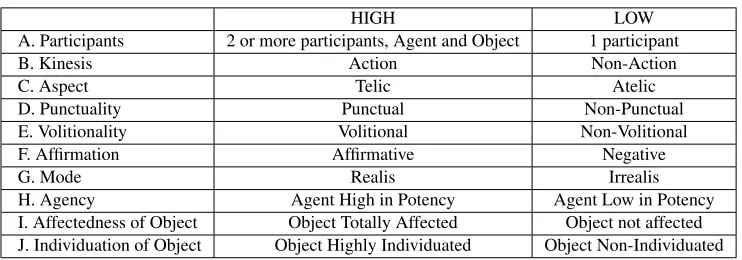
The indexical view of case-marking proposes that case marking on subjects and objects does not exist merely to distinguish one from the other, but, in effect, en-codes the relative value of subjects qua subjects and objects qua objects. This view, first argued in detail in (Hopper and Thompson, 1980), proposes that this
encoded value is relative to thetransitivityof the clause. In the view of (Hopper
and Thompson, 1980), transitivity is loosely defined as “a carrying-over or trans-ferring an action from one participant to another,” with canonical examples being of the type “John struck Bill”. Transitivity is then viewed as a quality that phrases can possess, the prototypical transitive phrases being closer to ‘Cardinal Transitiv-ity’, i.e., the highest level of transitivity. It is argued that phrases which are higher (lower) in transitivity are encoded as such. The primary empirical evidence of the encoding presented is case alternations, which are posited to explicit the phrases’ degree of transitivity. Thus, in the dative experiencer example above, marking by the dative indicates that the experiencer, while the subject, is not a full agent, in contrast to the subjects of clauses high in transitivity, which would be in the nom-inative (ergative). It is notable that according to this analysis, transitivity is taken to be the over-arching concept and case-marking is predictable in that the marked argument is marked in as much as it is consonant or dissonant with ‘Cardinal Tran-sitivity’.
3.1 Case and Thematic Content
The primary claim that will be developed in what follows is that the semantics of case-marking envelopes thematic content, i.e., information about participants, and types of participation, in events designated by the predicate. Theories of thematic content have been hotly debated in modern linguistics, and I will be extending and restructuring one particular approach pioneered in (Dowty, 1991). This will lead to a treatment of core case-marking in terms of thematic content. In preparation for the reformulation of this approach, I briefly discuss first the development of the theory of Thematic Roles, and then the original proposal laid out in (Dowty, 1991).
3.1.1 Grammatical Roles and Thematic Roles
The concept of grammatical roles, which I use here as a theory-neutral term as opposed to ‘Thematic Roles’, such as ‘Agent’, ‘Patient’ or ‘Instrument’ is not a new idea at all, and had been elaborated by the Sanskrit grammarian Panini as early as the 6th century BCE. The attempted integration of the notions of ‘Agent’ et al. into formal grammars and an investigation into their semantic contribution to phrasal structure was articulated in the theory of Thematic Roles, originating in the works (Gruber, 1965) and (Fillmore, 1968). The distinction made between the Agent and the Patient in the Thematic Roles literature not only owed a debt to the older ideas of grammatical roles but had considerable overlap with the tradi-tional grammarians’ distinction between logical subject and grammatical subject. Among many other reasons, the theory of Thematic Roles failed to progress be-cause it was consistently shown that taking roles such as “Agent” as primitive, while pre-theoretically appealing, led to many difficulties. In particular, roles such as ‘Agent’ and ‘Patient’ resisted precise definitions and there was no one-to-one mapping from different roles to, say, cases. One result was that a particular strain of work on grammatical roles, Fillmore’s Case Grammar, was forced to propose an ever increasing list of roles for particular lexical situations.
confusion, and it must be borne in mind throughout that the Agentivity (Patien-tivity) of a fully interpreted phrase is not the same as the Agentivity (Patien(Patien-tivity) inherent in the lexical semantics of the predicate. For instance, it has been noted the pre-theoretical notion of an agent as a volitional actor should not be taken as a primitive, since very few predicates in English actually require such an agent (Van Valin and Wilkins, 1996).
3.1.2 From Thematic Roles to Proto-Roles
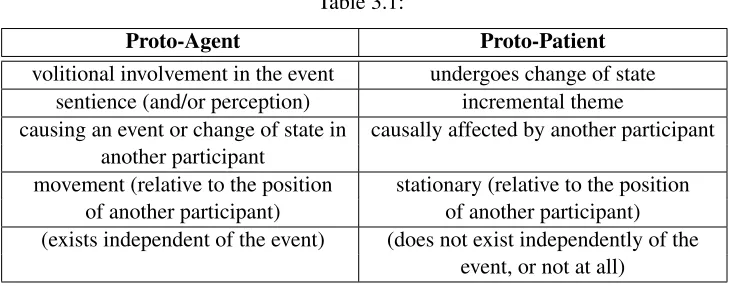
In an effort to untangle the mess that had become of the notion of Thematic Roles, (Dowty, 1991) recast the various roles that had been proposed at the time, such as Agent, Benefactive, Patient, Instrument, etc., in terms of two overarching terms, Proto-Agent and Proto-Patient. The essence of the idea is that the proposed The-matic Roles were not in themselves primitive, but emergent properties that could be described using event-based entailments of the predicate. Agent and Proto-Patient are defined as “cluster concepts” of more fine-grained concepts, such as ‘causally affecting’ and ‘undergoing a change of state’, which are (second order) event-based properties entailed by the predicate. Thus, the Agent in a transitive ar-gument would probably possess qualities such as ‘causally affecting’ another entity with respect to the event depicted by the predicate, and the Patient would probably possess the property of ‘undergoing a change’. Yet, no one property defined agen-tivity, but it was rather arrived at accumulation of sufficient amount of properties relative to the other arguments of the predicate.
[image:20.595.115.480.505.648.2]The essence of Dowty’s proposal is the following Proto-role properties:
Table 3.1:
Proto-Agent Proto-Patient
volitional involvement in the event undergoes change of state
sentience (and/or perception) incremental theme
causing an event or change of state in causally affected by another participant
another participant
movement (relative to the position stationary (relative to the position
of another participant) of another participant)
(exists independent of the event) (does not exist independently of the
event, or not at all)
In (Dowty, 1991), these proto-properties are shown to be independently entailed by various predicates.
b. Sentience/perception alone: John knows/believes/is disappointed at the statement. John sees/fears Mary.
c. Causation alone: His loneliness causes his unhappiness.
d. Movement alone: The rolling tumbleweed passed the rock. Water filled the boat. He accidentally fell.
e. ((e) Independent existence: John needs a car.)
Upon these properties, he founds an ‘Argument Selection Principle’:
“In predicates with grammatical subject and object, the argument for which the predicate entails the greatest number of Proto-Agent properties will be lexicalized as the subject of the predicate; the argument having the greatest number of Proto-Patient entailments will be lexicalized as the subject.”
In general, this principle performs adequately, accounting for, say, verbs of percep-tion, where the argument which entails the property ‘sentient’ is realized as subject and the argument which has no entailments is realized as object. It will be noted, however, that both participants potentially could satisfy all the properties, as in the phrase “John looked at Suzy,” where Suzy has cleverly positioned herself volition-ally in order to be seen. The question of the adequacy of the Argument Selection Principle will be taken up again in section 4.2.2.
3.2 Reformulating the Proto-Role Approach
3.2.1 Primitive Properties of Agentivity
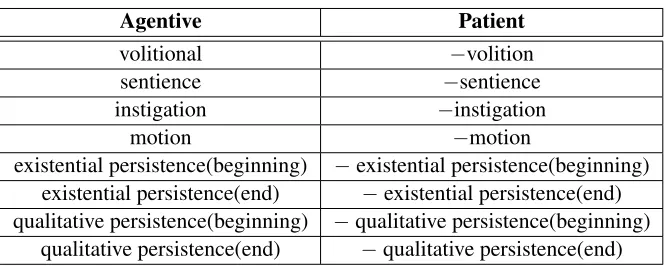
I adopt the groundwork established by Dowty and revise his original categorization and nomenclature. Rather than have two independent, but related sets of properties, I use one set of properties, which roughly correlate to the Proto-Agent entailments. In privative opposition to these properties is the lack of entailed properties. Then, Proto-Patient properties are seen as a lack of Proto-Agent properties, as shown in table 3.2. The resulting set of features gives two diametrically opposed classes, one an existing, active, causal, willful and moving substance, and the other whose existence is not even proclaimed.
Before proceeding, it is useful to give a set of informal definitions pertaining to these properties.
Table 3.2:
Agentive Patient
volitional −volition
sentience −sentience
instigation −instigation
motion −motion
existential persistence(beginning) −existential persistence(beginning)
existential persistence(end) −existential persistence(end)
qualitative persistence(beginning) −qualitative persistence(beginning)
qualitative persistence(end) −qualitative persistence(end)
(12) CHEPANG ((Caughley, 1982), found in (Naess, 2004))
a. h@w-kay
YoBro.GOAL
puP-nis-Pi
OBro.DUAL.AGENT
sat-Pa-the@y
kill.PAST.DUAL.AGENT The two older brothers killed the younger brother.
b. puP-nis-Pi
OBro.DUAL.AGENT h@w YoBro
sat-Paka-c-u
kill.PAST.DUAL.AGENT
The two older brothers killed the younger brother (accidentally).
Sentient: Sentient is adopted following the description found in (Rozwadowska,
1988): “conscious involvement in the action or state.” Clearly, [+ sentient] is
entailed by, among others, emotional, psychological and cognition predicates.
Motion: Motion is entailed just in case the argument is required to be in motion, which is most obviously the case with verbs of motion, such as ‘come’, ‘go’ and so forth, but also verbs such as ‘throw’ or ‘scrub’.
Instigation: Any argument effecting the event designated by the predicate is entailed—in short, any argument “doing something” will have the Instigation prop-erty. Typically, one thinks of the initiators of events as instigators, but one also wants to allow for the causal arguments of experiencer verbs, such as the subject argument of “The portrait frightened Kenneth.”
essence remains the same during the course of the event/state, or it can persist qual-itatively, that is it persists in all its particulars. This notion is nothing new, and can
be traced back to Aristotle (On Generation and Corruption I:4 (Ackrill, 1987)).
Persistencehas been further divided according to whether it is entailed at the be-ginning of the event or at the end. This distinction is visible in verbs of creation or destruction, which entail that the object shifts from non-existence to existence and from existence to non-existence, respectively, during the course of the event.
Thus, in “Juan baked a cake”, ‘bake’ will entail that its object is−existential
per-sistence(beginning)while in “Kim destroyed the car”, ‘destroy’ would entail on
its object that the object is−existential persistence(end). Qualitative persistence
covers any other change besides an existential one. Merely to remain with Aristotle for a moment, we can the think of the primary changes covered as quality, quantity or location. For instance, if Juan moves his newly-baked cake to the counter-top, the cake has not persisted in location, and the second argument would be noted as
−qualitative persistence(end). In what follows, if the type of persistence is not
at issue, I will denote the properties by+/−persistence, which is meant to range
over bothqualitative persistenceandexistential persistence.
3.2.2 Causation and Affectedness
There are several significant differences between this arrangement and that of (Dowty,
1991) which should be noted. First, the proto-propertyinstigationhas been added,
which marks whichever argument instigates the event.Instigationis a weaker
prop-erty than “causing an event or change of state in another participant”. Second, while Dowty only reluctantly included “existence” as one of the proto-roles, the
corresponding category in the above table,persistence, is now a full proto-property.
Further, this property now serves also to account for the notion of affectedness. Also, there are some of Dowty’s original proto-properties that are missing, namely “causing an event or change of state in another participant”, “causally affected by another participant”, “undergoes change of state” and “incremental theme”. The
latter two are replaced by qualitative persistence. If an entity is entailed to
un-dergo a change of state, in the system of proto-properties outlined above, it
re-ceives−qualitative persistence(end). Thus, there is a reversal of the manner of
marking here that is consistent with the adoption of privative opposition that is assumed—the proto-patient property of being affected is defined here as the lack
of a proto-agent property, persistence1. Causation and affectedness are complex
notions, and just as Agent and Patient are best not taken as primitive, I argue di-rectly below that it is not necessary to take causation or affectedness as primitive
1Even though the above discussion ofPersistencehas made reference to Aristotelian conceptions,
either. Finally, it should be noted that Dowty’s analysis takes the transitive situ-ation, i.e., two participants mediated by an event, as the primitive situation. This appears in his formulation of the proto-properties, several of which are defined rel-ative to another participant, namely “causing an event or change of state in another participant”, “causally affected by another participant”, “movement (relative to the position of another participant”, and “stationary (relative to the position of another participant)”. In the formulation of the agentivity properties in the above section, the properties were left neutral with respect to their involvement with other partic-ipants. This will be shown to be preferable in that it results in a capacity to treat a greater number of constructions.
It has long been noted that affectedness is not a binary concept (i.e., being affected or not), but rather a three-way distinction between unaffected, partially affected and totally affected. Not taking affectedness as primitive, but rather defining it in
terms ofpersistenceallows to express this three-way distinction, at least with
re-spect to existence. Unaffected arguments correspond to those entities which persist throughout the event both existentially and qualitatively, partially affected argu-ments correspond to those entities which persist existentially, but not in all their qualities, throughout the event, and totally affected arguments correspond to those entities which do not persist existentially, and therefore also not qualitatively, by the end of the event. The more subtle effects of the “partially”/“totally” affect-edness phenomenon, such as the much discussed spray/load alternations, are not treated here, as they depend on greater specificity of lexical information that I as-sume here. There is certainly much more to say about the nature and meaning of “affectedness”, a concept which has thus far resisted a clear definition within the literature. I will not be concerned with stating more here than that the distinction
made byqualitative changeis the minimal property of being affected.
Causation is a complex notion, and in fact a composite one. Causation implies at least two participants, and some sort of direct link between them. Therefore, cau-sation is better seen as a relation between arguments rather than as a property of a single argument. This composite property can be replaced by two more
prim-(1)
holds at(P, T2) ← happens(E, T1),
T1 < T2,
initiates(E, P),
persists(T1, P, T2).
itive ones2: instigation and−persistence(end) (either qualitative or existential).
Causation, then, can be represented as a pair: (ArgX: [+instigation], ArgY: [−
persistence(end)]), whenever we need to appeal to the notion. This Ockham’s ra-zor argument is only appealing since the results that can be attained by the proposed primitives are conservative with respect to the results achieved in (Dowty, 1991).
Another notion which has been prominent in the typological literature concerning transitivity and related concepts is that of control. Again, while appeal to control as property gives broad explanatory power, it is doubtful that is should be taken as primitive, for just like causation, control is a relation on arguments. (Klaiman, 1991) distinguishes between ‘external’ control, which holds of two arguments, the controller and the controlled, and ‘internal’ control, which designates that the agent of one-place verbs has control over the event. In both instances, the controller is seen as volitional and the initiator of the event. Therefore, the controller can be
replaced by the primitivesvolition, sentient, and instigationwhile the controlled
argument in ‘external control’ clauses simply must not be marked volitional or
instigation. Thus, control as well can be defined as a pair: (ArgX: [+instigation,+
sentient,+volition], ArgY: [−instigation,−volition]).
In addition to taking complex relations as primitive, (Dowty, 1991) also defines his proto-properties with the transitive construction as given. This assumption cannot be maintained once one wants to account for constructions which are not strictly transitive. First, it should be noted that defining properties relative to other
partic-ipants often leads to awkward predictions. For instance,motionis required to be
“relative to the position of another participant”. But there are clearly cases where motion is bilateral, as in ‘Ernest threw the ball’, where both Ernest and the ball would seem to both be necessarily in motion.
One of Dowty’s central concerns is constructing a theory which correctly accounts for alignment between subject and agent and between patient and object, and devi-ations thereof. While this is generally captured, in the above reformulation of the proto-properties, predictions are also made for one-argument predicates, specifi-cally those classified as ‘middle’ verbs. The ‘middle voice’, as far as I know, has resisted a typologically adequate and formally pleasing definition, but a good de-scription is found in (Lyons, 1968, 373): “The implications of the middle (when it is in opposition to the active) are that the ‘action’ or ‘state’ affects the subject of the verb or his interests.” One prominent class of verbs that take the middle voice when it is a grammatical option is ‘grooming’ verbs, e.g., ‘wash’, ‘comb’, etc. These verbs alternate between the active and middle voice. In the active voice, they do participate in a transitive situation, as in the following examples from An-cient Greek show (expanded from the discussion in (Lyons, 1968)):
(13) ANCIENT GREEK (Lyons, 1968)
a. Lo´u¯o
Wash.1st.SING.ACTIVE I am washing (something). b. Lo´uomai
Wash.1st.SING.MIDDLE I am washing myself. c. Lo´u¯o
Wash.1st.SING.ACTIVE
khitˆona shirt I am washing a shirt.
d. Lo´uomai
Wash.1st.SING.MIDDLE
khitˆona shirt I am washing myself a shirt.
In terms of Dowty’s proto-properties, the transitive use of “wash” in (13a) and (13c) would entail that the realized subject “causes a change of state in another partici-pant” and that the realized object is “causally affected by another participartici-pant” and that it “undergoes a change of state” (abstracting from properties not relevant to the discussion, e.g., “movement”). In (13b), since there is no other participant, the argument of ‘lo´uomai’ would not entail “causes a change of state in another participant”, but only “undergoes a change of state”. From this it would seem that this active/middle voice alternation could be captured by stating that in the middle voice the sole argument is entailed by “undergoes a change of state”. However, the middle voice in Ancient Greek can also be used if the action carries along with it a benefit for the subject, as in (13d) where the subject receives a clean shirt for his
efforts, a usage which (Lyons, 1968) tentatively titles ‘reflexive-causative’3. The
crucial point is that (13b) and (13d) will receive inconsistent assignments of proto-properties. In (13d), the subject will have “causes a change of state in another participant” and the object will have “causally affected by another participant” and
“undergoes a change of state”. The subject of (13d) doesnot“undergo a change of
state”, in contrast to (13b), since it is the shirt, not the subject, who is washed. What one would like to see is that the subject ‘causally affects’ himself, but this does not seem possible as long as causation is defined with respect to distinct participants.
Thus, while there is a formal distinction realized in the voice of the verbs in (13b) and (13d), this is not captured by Dowty’s proto-properties because of their bias towards two-participant transitive situations. Further, this distinction is one that approximately says that the initiator of the event is the beneficiary of the event, beneficiary being among the notions that proto-properties were designed to cap-ture. This forces the conclusion that causation should not be defined with respect to distinct participants. If instead, causation is defined, as discussed above, as a
(third-order) property for pairs (ArgX:+instigation, ArgY:−persistence) where
3This construction is not limited to languages with an overtly realized middle voice, but occurs
ArgX and ArgY are not taken to be necessarily distinct, and we assume that
bene-ficiaries are noted as+sentienceand−qualitative persistence, then this relation
is applicable to both pairs, the washer and himself, and the washer and the shirt.
In summary, the reformulation of agentivity properties in the manner outlined in section 3.2.1 is able to account for complex relations as such, a theoretical gain in itself, and is substantiated by greater empirical reach, both in capacity to treat partial and total affectedness, and to extend to constructions other than transitive ones.
3.2.3 Psychological Facets of the Agentivity Primitives
The choice of these primitives receives support from studies of cognitive develop-ment, especially perceptual development. Perceptual development offers insights into what is most learnable for infants, and if the above agentivity properties can be linked with categories of phenomena which are learnable, it implies that they would be more quickly adopted as abstract linguistic notions.
PersistenceandInstigationcorrespond to the most fundamental stage of perceptual development. Infants learn, essentially from birth, to distinguish between what is continuous and what is novel. One of the first stages of perceptual development involves mastering the concept of ‘object permanence’—the capacity for “under-standing that an object continues to exist in the world even though it is hidden or
cannot be seen” (Cohen and Cashon, 2003), clearly related to our notion of
per-sistence. In various experiments, infants are shown objects, which are then hidden from their vision. At the earliest stages of development, the infant displays surprise and increased attention after the object has been removed from sight. But already between the ages of 1 1/2 to 4-5 months, infants are capable of retrieving partially hidden objects and by 8 months they are capable of retrieving a completely hid-den object, demonstrating that they are aware of the object’s continued existence. While, on the one hand, infants develop a notion of the continuity of their surround-ings, infants also demonstrate early on that they shift the focus of their attention to entities that begin to do something, which correlates with the loose definition of instigation, whether visual (blinking lights) or auditory (rattles coming from speakers).
Infants between four and six months are further capable of distinguishing between motion and biological motion (Fox and McDaniel, 1982). Given two types of mo-tion, one of an inanimate object and one of an animate creature, the child will focus attention on the animate creature. From this follows an understanding of the distinction between sentient and non-sentient.
While the above perceptual capacities emerge either essentially at birth or within the first two to four months of life, causal perception only begins around six months, presumably antecedent to having mastered to some degree the concepts outlined above. There have been speculations that causation is a nativist concept, but these have generally been shown to be problematic (Cohen et al., 1998). This lends sup-port to the decision not to take causation as primitive concept, but to found it upon
instigationandpersistence.
Finally, volition, while a rather abstract concept, also appears in the pre-linguistic stage. Current theories posit that an awareness of intentional acts emerges be-tween 9 and 15 months of age, by the end of which infants can successful imitate intentional/goal-oriented behavior (Meltzoff, 2002).
The research cited from work on cognitive development demonstrates that the agentivity properties correlate to what infants discover in the pre-linguistic stage, therefore, as linguistic concepts, these properties should be easily acquired. Fur-ther, while these features all are simple and demonstrably acquired at an early age,
it is questionable if this holds for the proto-propertyincremental theme, and there
is evidence that causation should raise similar doubts.
3.3 Hierarchization of the Agentivity Properties
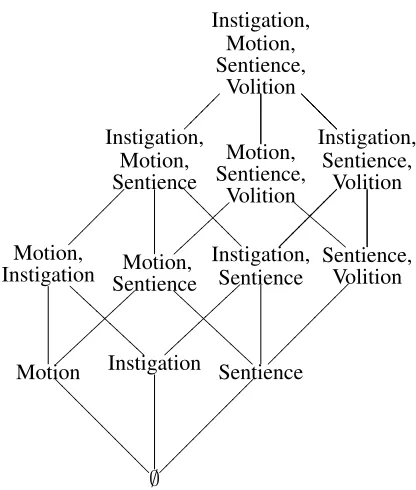
Having developed and justified the choice of the primitives, I now turn to putting them into use. I begin by organizing them into hierarchical relations which are an outgrowth of the logical relations between the primitives. This will result in the construction of a lattice, ordered by inclusion, which will take the primitives as atoms.
3.3.1 Construction of the Lattice
In the last section, a number of agentivity properties were established. Taking these as primitive, one can regard these properties as atoms from which “proto-roles” are composed. These atoms and their combinations can be ordered in terms of
inclusion—thus bothmotionandinstigationare included in the composite term
Motion Motion, Instigation ∅ Instigation Motion, Sentience Instigation, Motion, Sentience Sentience Instigation, Sentience Motion, Sentience, Volition Instigation, Motion, Sentience, Volition Sentience, Volition Instigation, Sentience, Volition AAA AAA AAAAA ? ? ? ? ? ? ? ? ? ? ? ? ? ? A A A A A A A A A A A ÄÄÄÄ ÄÄÄÄ ÄÄÄÄ ÄÄ ??? ??? ??? Ä Ä Ä Ä Ä Ä Ä Ä } } } } } } } } } } } } } } } } } } } } } } }}}} }}}} C C C C C C C ? ? ? ? ? ? ? ? ? ? ? ? ÄÄÄÄ ÄÄ ÄÄÄÄ ÄÄÄÄ Ä ÄÄÄÄ ÄÄÄÄ Ä Ä Ä Ä Ä Ä Ä Ä Ä Ä Ä Ä Ä
Figure 3.1: Agentivity properties organized via a lattice
is a lattice if every finite subset has a least upper bound and a greatest lower bound. This lattice then provides a structure upon which argument structures can be mapped. In the chapters that follow, this lattice will be used as a tool to account for both broad generalizations as well as language-particular phenomena involving thematic content and how it is marked by case.
In order to organize the primitives, it must first be established if any relations hold among them which would constrain the possible combinations. Among the
agen-tivity properties, it is quickly seen that volition entails sentience4. In practical
terms, this means that entailments that includevolitionalso necessarily entail
sen-tience.
Thus, takingmotion, instigation, sentienceand volitionas atomic elements, it is
a simple matter to construct a lattice which hierarchically organizes the possible combinations of these features, as seen in figure 3.1. As the atoms of the lattice concern properties of agentivity, I will refer to it for the moment as the agentivity lattice.
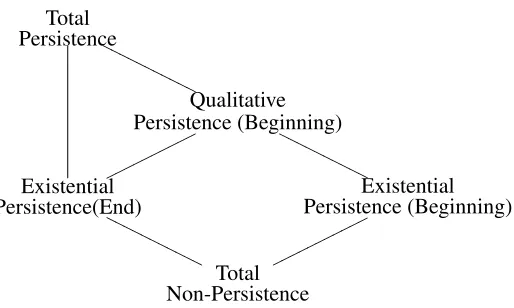
The four types of persistence and their combinations can be similarly ordered. The
subcategories ofpersistence, according to the distinctionsbeginning/endand
exis-tential/qualitative, yield many logically impossible combinations which will
con-4Metaphorical usage of volition, e.g.,“The car doesn’t want to start” should not pose any
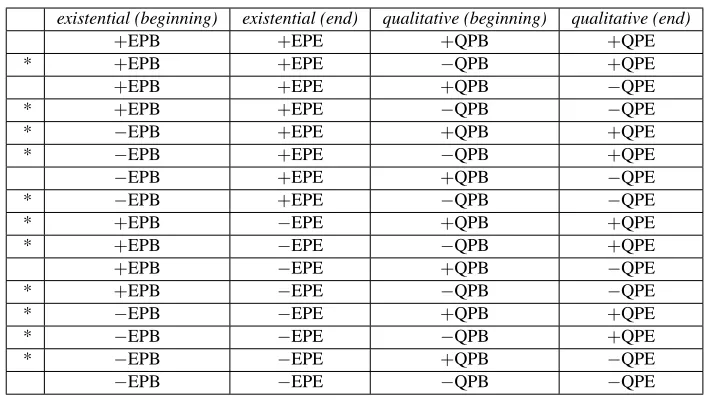
strain the eventual number of complex configurations of features possible. Since there are four features, the total number of combinations is 16. For simplicity, I
give a list in table 3.3, where I use the following abbreviationsexistential
[image:30.595.121.473.241.441.2]persis-tence (beginning)=EPB,existential persistence (end)= EPE,qualitative persistence (beginning)= QPB, andqualitative persistence (end)= QPE, and * marks impos-sible combinations.
Table 3.3:
existential (beginning) existential (end) qualitative (beginning) qualitative (end)
+EPB +EPE +QPB +QPE
* +EPB +EPE −QPB +QPE
+EPB +EPE +QPB −QPE
* +EPB +EPE −QPB −QPE
* −EPB +EPE +QPB +QPE
* −EPB +EPE −QPB +QPE
−EPB +EPE +QPB −QPE
* −EPB +EPE −QPB −QPE
* +EPB −EPE +QPB +QPE
* +EPB −EPE −QPB +QPE
+EPB −EPE +QPB −QPE
* +EPB −EPE −QPB −QPE
* −EPB −EPE +QPB +QPE
* −EPB −EPE −QPB +QPE
* −EPB −EPE +QPB −QPE
−EPB −EPE −QPB −QPE
There are two main principles of exclusion at work. If an entity exists in the begin-ning of the event, it does so with a certain amount of qualities, and thus it does not make sense to speak of existential persistence at the beginning of the event without qualitative persistence. Second, if an entity does not exist at the beginning (end) of an event, its qualities will not exist at the beginning (end) of the event either, and similarly for when an entity does not exist both at the beginning and at the end of an event. Five possible combinations remain:
Total Persistence (+EPB,+EPE,+QPB,+QPE): The entity persists existen-tially and qualitatively at the beginning and end of the event. This is the case in proto-typical transitive subjects, e.g., “Peter broke the dish”, where the subject is unaffected by the action. Also, arguments typically display total persistence in states (e.g.,“Gene lives in the suburbs”).
Existential Persistence (Beginning) (+EPB, −EPE , +QPB , −QPE): The entity exists prior the event’s happening, but ceases to after the event, as in verbs of destruction (‘ruin’, ‘destroy’), or dying.
Existential Persistence (End) (−EPB,+EPE,+QPB,−QPE): The entity does not exist at the beginning of the event but does at the end, found in verbs of creation, (‘bake’, ‘invent’).
Total Non-Persistence (−EPB,−EPE, −QPB, −QPE) : The entity does not persist existentially either at the beginning or the end of the event. This category comes up for statements of non-existence (“There are no unicorns”) and impersonal semelfactives (“A light flashed”). Cognate object constructions, such as “sing a song”, fit under this rubric since the object only persists as long as the action of the predicate continues, but neither before nor after. Similarly, objects that have been incorporated, such as ‘deer’ in ‘to go deer-hunting’, are not seen as persisting existentially before or after the event.
These five combinations can then be ordered by inclusion as well, again
view-ing the positively marked persistence properties as atomic elements. First, Total
Non-Persistenceis vacuously included in every other combination since it does not
have any positively marked members. Next,Existential Persistence (Beginning)is
included in Affected which is in turn included in Total Persistence. Finally,
Ex-istential Persistence (End)is included inTotal Persistence. These last two can be schematically represented as follows:
(14) (+EPB, −EPE , +QPB , −QPE)⊆ (+EPB, +EPE, +QPB, −QPE) ⊆
(+EPB,+EPE,+QPB,+QPE)
(15) (−EPB,+EPE,−QPB,+QPE)⊆(+EPB,+EPE,+QPB,+QPE)
These features as well can be hierarchically organized in a lattice, as in figure 3.2.
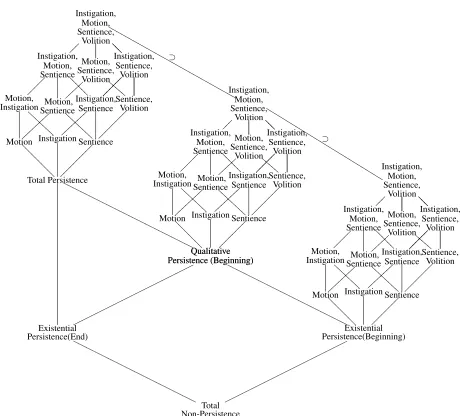
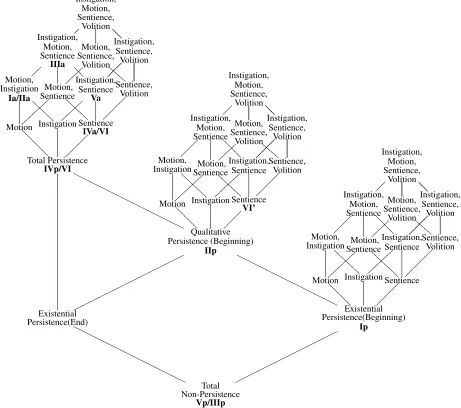
We now possess two structures organizing the sets of properties resulting from the reformulation of Dowty’s proto-properties. One of the advantages of working with lattices is that it is a simple matter to combine them by taking their Cartesian product. The Cartesian product of the agentivity and the persistence lattices is simply the set of all pairs with componentwise relations, inherited from the original lattices. Informally stated, it is a matter of inserting at each node of the persistence lattice the entirety of the agentivity lattice and then establishing the connections between all the nodes by inclusion.
However, the product of the two lattices is constrained by the conceptual impos-sibility of arguments designating entities which do not possess at least the feature
Existential Persistence (Beginning)combining with agentivity properties such as
Total Non-Persistence
Existential Persistence (Beginning) Existential
Persistence(End)
Qualitative Persistence (Beginning) Total
Persistence
oooooo ooooo OOOOO
OOOOOO
OOOOOOOO OO
O O O O O O O O O O O
[image:32.595.172.429.122.276.2]o o o o o o o o o o
Figure 3.2: Persistence properties organized via a lattice
The arguments associated with theExistential Persistence (End)node are found as
objects (never subjects unless under passivization, it seems) of verbs of creation, as noted above. It has been recognized since at least (Fillmore, 1968) that there is an asymmetry between typical transitive verbs and verbs of creation, as in the following:
(16) (Fillmore, 1968)
a. What John did to the table was ruin it.
b. * What John did to the table was build it.
Since the object is not yet existent, but a result of the activity denoted by the
pred-icate, it is not permitted in the construction. Clearly, properties such asinstigation
andmotionare not defined for arguments where the entity does not even exist yet. While these do not appear to be logical impossibilities, they are certainly concep-tually implausible.
The node of Total Non-Persistence is also clearly deviant in comparison to the
properties of regular agents and patients. Since arguments associated with that node do not exist at the beginning or end of the event, they are excluded as well from associating with any other properties.
Obeying these constraints, the product of the agentivity lattice and the persistence lattice is as displayed in figure 3.3. The resulting product is again a lattice, and
from now on I refer to this larger lattice as the agentivity lattice. Note that the
Ex-istential Persistence (Beginning)branch of the lattice is related by inclusion to the
Motion Motion, Instigation Total Persistence Instigation Motion, Sentience Instigation, Motion, Sentience Sentience Instigation, Sentience Motion, Sentience, Volition Instigation, Motion, Sentience, Volition Sentience, Volition Instigation, Sentience, Volition AAA AAAAA ? ? ? ? ? ? ? ? ? ? A A A A A A A ÄÄÄÄ ÄÄÄÄ ÄÄ ??? ??? Ä Ä Ä Ä Ä } } } } } } } } } } } } } } } } }}}} } C C C C C ? ? ? ? ? ? ÄÄÄ ÄÄÄÄ ÄÄ ÄÄÄÄ ÄÄ Ä Ä Ä Ä Ä Ä Ä Ä Motion Motion, Instigation Qualitative Persistence (Beginning) Instigation Motion, Sentience Instigation, Motion, Sentience Sentience Instigation, Sentience Motion, Sentience, Volition Instigation, Motion, Sentience, Volition Sentience, Volition Instigation, Sentience, Volition AAA AAAAA ? ? ? ? ? ? ? ? A A A A A A A ÄÄÄÄ ÄÄÄÄ ??? ??? Ä Ä Ä Ä Ä } } } } } } } } } } } } } } } } }}}} } C C C C C ? ? ??? ? ÄÄÄ ÄÄÄÄ ÄÄ ÄÄÄÄ ÄÄ Ä Ä Ä Ä Ä Ä Ä Ä Motion Motion, Instigation Existential Persistence(Beginning) Instigation Motion, Sentience Instigation, Motion, Sentience Sentience Instigation, Sentience Motion, Sentience, Volition Instigation, Motion, Sentience, Volition Sentience, Volition Instigation, Sentience, Volition AAAAAA AA ? ? ? ? ? ? ? ? A A A A A A A ÄÄÄÄ ÄÄÄÄ ??? ??? Ä Ä Ä Ä Ä } } } } } } } } } } } } } } } } }}}} } C C C C C ? ? ??? ? ÄÄÄ ÄÄÄÄ ÄÄ ÄÄÄÄ ÄÄ Ä Ä Ä Ä Ä Ä Ä Ä Total Non-Persistence Existential Persistence(End) Qualitative Persistence (Beginning) oooooo oooooo oooooo oooooo oooo OOOOOOOO OOOOOOOO OOOOOOOO OOOOOO OOOO OOOOOOOO OOOOOOOO OOOOOOO O O O O O O O O O O O O O O O O O O O O O O O O O O O O o o o o o o o o o o o o o o o o o o o o o o o o o o o K K K K K K K K K K K K K K K K K K K K K K K K K K K K ⊃ MMMM MMMM MMMM MMMM MMMM MMMM MMMMMM ⊃
Figure 3.3: Product of Agentivity lattice and Persistence lattice
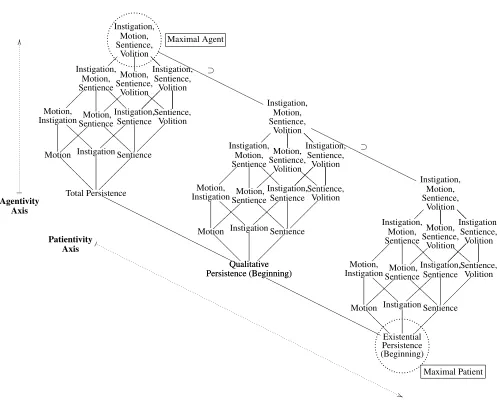
3.3.2 The Transitivity Region
the argument structures of transitive clauses in a unified manner is present in this framework as well.
The transitive situation minimally involves an agent committing an action and an object which undergoes the effects of that action. Arguments associated with the
two nodes ofExistential Persistence (End)andTotal Non-Persistenceviolate the
second condition, since any such argument would not exist at the beginning of the event as would be necessary to undergo the effects of the action. These two nodes are also structurally abnormal with respect to the lattice both in that they prevent the lattice from being completely symmetrical and in that they do not directly in-teract with the other features. Arguments associated with these two nodes also demonstrate peculiar behavior with respect to their interaction with definiteness, an issue which will be discussed in section 4.3.2. Those two nodes excluded, we are left with a symmetrical lattice, which encodes the typical transitive situation, which I will refer to as the transitivity region in what follows.
If one views vertical and horizontal axes alongside the lattice, as in figure 3.4, then the vertical axis encodes the degree of agentivity, while the horizontal en-codes the degree of affectedness in terms of change in persistence. The upper-left-hand corner contains all the positive entailments, and the lower-right-upper-left-hand corner is free from entailments, save initial existence. Thus, this framework encapsu-lates one of the primary generalizations of typological work on object structure: agents and patients of transitive clauses are in (direct) semantic opposition (Naess, 2004). Arguments located in between these two opposing poles are appropriately just those which possess a mixture of agentivity and patientivity properties, e.g., Experiencers, Benefactives, et al.
3.3.3 Lexical Classes
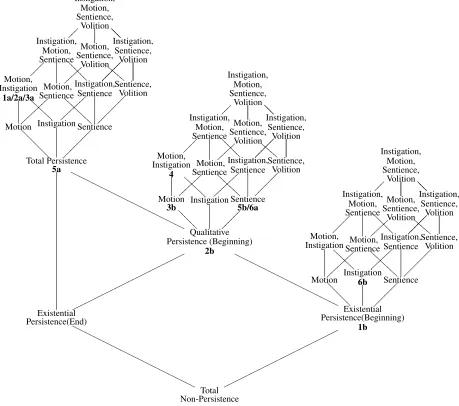
Before moving on to linking the agentivity lattice to case-marking, it is helpful to give a few examples of how different lexical classes, as delineated in (Levin, 1994), can be represented on the lattice, as in figure 3.5, in order to add some concrete examples to what may have been a too-abstract discussion so far.
1. “Change of State” : Break, Crack, Shatter. . .
2. “Contact/Effect” Hit, Cut, Crush, Smash. . .
3. “Change of Position”: Roll, Bounce, Move. . .
4. Directed Motion: Come, Go, Rise, Enter. . .
5. Stimulus-Subject Psych Verbs: Please, Amuse, Astonish, Bore. . .
Motion Motion, Instigation Total Persistence Instigation Motion, Sentience Instigation, Motion, Sentience Sentience Instigation, Sentience Motion, Sentience, Volition Instigation, Motion, Sentience, Volition Sentience, Volition Instigation, Sentience, Volition AAA AAAAA ? ? ? ? ? ? ? ? ? ? A A A A A A A ÄÄÄÄ ÄÄÄÄ ÄÄ ??? ??? Ä Ä Ä Ä Ä } } } } } } } } } } } } } } } } }}}} } C C C C C ? ? ? ? ? ? ÄÄÄ ÄÄÄÄ ÄÄ ÄÄÄÄ ÄÄ Ä Ä Ä Ä Ä Ä Ä Ä Motion Motion, Instigation Qualitative Persistence (Beginning) Instigation Motion, Sentience Instigation, Motion, Sentience Sentience Instigation, Sentience Motion, Sentience, Volition Instigation, Motion, Sentience, Volition Sentience, Volition Instigation, Sentience, Volition AAA AAAAA ? ? ? ? ? ? ? ? A A A A A A A ÄÄÄÄ ÄÄÄÄ ??? ??? Ä Ä Ä Ä Ä } } } } } } } } } } } } } } } } }}}} } C C C C C ? ? ??? ? ÄÄÄ ÄÄÄÄ ÄÄ ÄÄÄÄ ÄÄ Ä Ä Ä Ä Ä Ä Ä Ä Motion Motion, Instigation Existential Persistence (Beginning) Instigation Motion, Sentience Instigation, Motion, Sentience Sentience Instigation, Sentience Motion, Sentience, Volition Instigation, Motion, Sentience, Volition Sentience, Volition Instigation, Sentience, Volition AAA AAAAA ? ? ? ? ? ? ? A A A A A A A ÄÄÄÄ ÄÄÄ ??? ??? Ä Ä Ä Ä Ä } } } } } } } } } } } } } } } } }}}} } C C C C C ? ? ??? ? ÄÄÄ ÄÄÄÄ ÄÄ ÄÄÄÄ ÄÄ Ä Ä Ä Ä Ä Ä Ä Ä Qualitative Persistence (Beginning) ' ' ² Patientivity Axis O O _ Agentivity Axis OOOOOOOO OOOOOOOO OOOOOOOO OOOOOO OOOO OOOOOOOO OOOOOOOO
OOOOOO.......... .... ... ... .... ......... .... .. .. .. .. .. . . . . . . Maximal Patient . . . . . . .. .. .... ... ... .... ......... .... .. .. .. .. .. . . . . . . O O O O O O O O O O O O O O O O O O O O O O O
O Maximal Agent
[image:35.595.49.546.114.515.2]⊃ O O O O O O O O O O O O O O O O O O O O O O O O ⊃
Figure 3.4: Transitivity Region
Motion Motion, Instigation 1a/2a/3a Total Persistence 5a Instigation Motion, Sentience Instigation, Motion, Sentience Sentience Instigation, Sentience Motion, Sentience, Volition Instigation, Motion, Sentience, Volition Sentience, Volition Instigation, Sentience, Volition AAA AAAAA ? ? ? ? ? ? ? ? A A A A A A ÄÄÄÄ ÄÄÄÄ ??? ??? Ä Ä Ä Ä } } } } } } } } } } } } } } } } }}}} } C C C C C ? ? ??? ? ÄÄÄ ÄÄÄÄ ÄÄ ÄÄÄÄ ÄÄ Ä Ä Ä Ä Ä Ä Ä Ä Motion 3b Motion, Instigation 4 Qualitative Persistence (Beginning) 2b Instigation Motion, Sentience Instigation, Motion, Sentience Sentience 5b/6a Instigation, Sentience Motion, Sentience, Volition Instigation, Motion, Sentience, Volition Sentience, Volition Instigation, Sentience, Volition AAA AAAA ? ? ? ? ? ? A A A A A A ÄÄÄÄ ÄÄ ??? ??? Ä Ä Ä Ä } } } } } } } } } } } } } } } }}}} } C C C C C ? ? ??? ? ÄÄÄ ÄÄÄÄ ÄÄ ÄÄÄÄ ÄÄ Ä Ä Ä Ä Ä Ä Ä Motion Motion, Instigation Existential Persistence(Beginning) 1b Instigation 6b Motion, Sentience Instigation, Motion, Sentience Sentience Instigation, Sentience Motion, Sentience, Volition Instigation, Motion, Sentience, Volition Sentience, Volition Instigation, Sentience, Volition AAA AAAAA ? ? ? ? ? ? ? A A A A A A ÄÄÄÄ ÄÄÄ ??? ??? Ä Ä Ä Ä Ä } } } } } } } } } } } } } } }}}} } C C C C C ? ? ? ? ? ? ÄÄÄ ÄÄÄÄ ÄÄ ÄÄÄÄ ÄÄ Ä Ä Ä Ä Ä Ä Ä Ä Total Non-Persistence Existential Persistence(End) oooooo oooooo oooooo oooooo oo OOOOOOOO OOOOOOOO OOOOOOOO OO OOOOOOOO OOOOOOOO OOOOOOOO O O O O O O O O O O O O O O O O O O O O O O O O O O O O o o o o o o o o o o o o o o o o o o o o o o o o o o
Chapter 4
Typological Applications: Core
Case-Marking Systems
I now turn to detailing how the agentivity lattice can be used as a tool to account for case-marking. This chapter considers core case-marking systems, i.e., systems that mark subjects and objects. The research conducted on Thematic Roles has demon-strated that subject and object selection are largely determined by the thematic content associated with the arguments of a given predicate. Core case-marking systems are responsible for marking subjects and objects in a clause. Clearly then, there is a relation between the thematic content and the eventual marking patterns in case languages. Subjects (and objects) are associated with agentivity properties, and thus a case marking subjects (objects) will be associated with the same agen-tivity properties. In this way, a case can be represented as a region of the agenagen-tivity lattice.