The Good, the Bad, and the Difficult
Complexity in a Monotonicity-Grounded Natural Logic for
Reasoning with Generalized Quantifiers
MSc Thesis(Afstudeerscriptie) written by
Jonathan Frederik Sippel
(born June 12th, 1988 in Pfaffenhofen an der Ilm, Germany)
under the supervision ofDr Jakub Szymanik, and submitted to the Board of Examiners in partial fulfillment of the requirements for the degree of
MSc in Logic
at theUniversiteit van Amsterdam.
Date of the public defense: Members of the Thesis Committee:
August 29, 2017 Prof Dr Benedikt Löwe (Chair) Prof Dr Johan van Benthem Julian Schlöder
Abstract
Contents
1 Introduction 4
2 Of Logic and Reasoning 6
2.1 The Syllogistic Fragment . . . 8
2.2 Syllogistic Reasoning in Practice . . . 11
2.3 Formal Accounts of Syllogistic Reasoning . . . 13
2.3.1 Natural Logic . . . 13
2.3.2 Mental Models . . . 16
2.3.3 Probability Heuristics . . . 18
2.3.4 Evaluation . . . 20
2.4 Beyond Syllogisms: Iterating Quantifiers . . . 22
3 Natural Logic – A Logical Approach to Reasoning 24 3.1 Natural Logic – the Road so Far . . . 25
3.2 A Natural Logic Roadmap . . . 27
4 Generalized Quantifiers 28 4.1 Characterizing Quantifiers: Montonicity and Symmetry . . . 31
4.1.1 Monotonicity . . . 31
4.1.2 Symmetry and Conversion . . . 32
4.2 Some Remarks on Quantifier Interpretation . . . 33
4.2.1 Aristotelian Quantifiers . . . 33
4.2.2 The Curious Case ofMOST. . . 34
4.2.3 Cardinal Quantifiers . . . 35
4.3 Quantifier Iteration . . . 36
5 A Natural Logic for Reasoning with Generalized Quantifiers 38 5.1 Inference Rules . . . 38
5.1.1 Single Quantifiers . . . 38
5.1.2 Inference Rules for Iterated Quantifiers . . . 39
5.1.3 Beyond . . . 40
5.2 Complexity: a Weighted Number of Reasoning Steps . . . 42
5.2.1 Monotonicity I and II: Directionality and Harmony . . . 43
5.2.2 Monotonicity III: a Hierarchy of Informativeness . . . 44
5.2.3 Monotonicity IV: Negativity and the Monotonicity-Rollercoaster 45 5.2.4 Conversion and Pseudoconversion . . . 46
5.2.5 Existential Import . . . 46
5.3 The Difficulty of Reasoning with Single Quantifiers . . . 47
6 Natural Logic at Work 49
6.1 Complexity and Mean Success . . . 50
6.2 The Syllogistic Fragment . . . 51
6.3 The Quantifier Iteration Fragment . . . 52
7 Predictions 54 8 Interlude: Logic, Cognition, and Philosophy 55 9 Finale 58 Appendices 59 A Generalized Quantifier Theory 59 A.1 Definitions: of Models, Truth and Quantifiers . . . 59
A.2 Type <1>: Noun Phrases . . . 61
A.3 Type <1,1>: Determiners . . . 62
A.4 Monotonicity Revisited: Smoothness . . . 63
1
Introduction
Logic and psychology can look back on a shared history that is full of twists and turns, with the two moving back and forth on their commitment to one another. Recently, van Benthem (2008) noted that logic is undergoing a cognitive turn, where only little earlier others proclaimed the time of logic in psychology to be over (see e.g. Evans 2002 or Chater & Oaksford 1999). And some time before that, Frege argued for the independence of logic and psychology with so much eager and success that van Benthem speaks of ”Frege’s wall“ between the two fields. Logicians have since then however greatly extended the logical toolbox in some ways that can prove relevant for the investigation of a wide range of cognitive phenomena that we could describe as ”reasoning“. One of the corollaries of this extended toolbox is however that there is notonelogic for this kind of task, but a variety of them (see for example Stenning & van Lambalgen (2010) and Besold et al.(2017) on how reasoning under uncertainty can be approached using logic and logic programming). Thus, when talking about logic in cognitive science and psychology, we do not restrict ourselves to what is usually implied by the umbrella-term ”standard logic“ (embodying predicate logic and propositional calculus) but a variety of very different tools that may or may not account for a variety of very different phenomena. We will see later on that much of the criticism by Evans (2002) and Chater & Oaksford (1999) can be traced back to such an equalization of logic with ”standard logic“. The story of ”standard logic“ in psychology is indeed analogue to the story of the hammer that mistakes everything for a nail and further fully disregards the pluralistic view of logic (e.g. Stenning & van Lambalgen 2012).
That means that we cannot just go about and ”model reasoning with logic“ but have to handpick a specific phenomenon of reasoning and the appropriate tool. The phe-nomenon of reasoning that caught our eye is that of inferences on quantifier expressions in natural language, e.g.ALL,NO, andMOSTand their iterations, e.g. in ”MOSTpigeons
annoyedAT LEAST THREEtourists“.1 Due to the limited scope of our investigation, we will restrict our discussion to specific quantifier expressions in the English language – determiners. While some researchers have emphasized the universality of quantification in noun phrases across all languages (Barwise & Cooper 1981, 177), we will later see that some languages donotuse determiners for quantification. Quantifier expressions have been in logical spotlight since at least the advent of Aristotelian logic – with Aristotle being the (at least self-proclaimed) first logician and his syllogistic logic consequently the (at least self-proclaimed) first logic. There is thus much shared history to build upon. The appropriate logical hammer for this kind of reasoning, we think, isnatural logic.
Natural logic emphasizes the fact that some important and recurring expressions in natural language are not only carriers of information, containers in which we store this and that piece of information, but allow for reasoning. Natural logic tries to make
1To avoid misunderstandings, we will consistently write quantifier expressions in small caps, e.g.MOST
sense of such expressions by giving them a formal characterization emphasizing the properties that allow for the reasoning in question – this operationalizes a variety of log-ical constants with semantic properties mirroring such in natural language expressions, e.g. ”and“, ”or“, ”necessarily“, ”all“ etc. Reasoning and inferences that build on the semantics of these expressions are thus inferences that operate ”on the surface of natural language“ (van Benthem 2007). As it happens, quantifier expressions show semantic properties that allow for a rich variety of such inferences.
We will present a natural logic – an extension of the model proposed by Geurts (2003) – that captures the essential inferential properties of single and iterated quantifier expressions. At the semantic center of this logic is the notion of monotonicity: we can infer that ”MOST pigeons annoyed AT LEAST THREE humans“ from ”MOST pigeons annoyedAT LEAST THREEtourists“ because, from an anthropocentric viewpoint, we know that the set of all tourists is contained in the set of all humans. This example already highlights the direction in which we will expand Geurts’ logic – it contains two quantifier expressions and theseiterationsallow for monotonicity-based reasoning similar to syllogistic reasoning. We will introduce inference rules that account for this kind of reasoning as well. A natural logic defines some inferences asgoodand others implicitly asbad– but by adding a complexity measure to the inferences that are deemed good, we can also make statements about thedifficultyof a good sequence of reasoning steps. We will create such a measure that predicts the mean success rate of participants in adequate reasoning-experiments concerned with (iterated) generalized quantifiers. The entirety of inference rules and weight assignments will carry the name natural quantifier logic (NQL).
This endeavor builds on the intersection of logic, the psychology of reasoning and linguistics and operates under the assumption that it is possible to find a measure ofcomputational complexityof reasoning with quantifier expressions that aligns with the variation in itscognitive difficultyand correlates with mean success rates of human reasoners. Szymanik (2016) applies this idea to generalized quantifiers (where the complexity-measure is grounded in their representation as finite automata) but remains relatively silent on reasoning with them. The general approach of aligning complexity with difficulty is presented by Isaacet al. (2014). Due to the interdisciplinarity of the approach, there is no bottom-up way to build up a natural logic model of reasoning with (iterated) generalized quantifiers – we will take a rather circular approach and often introduce notions (e.g. that of monotonicity) by means of examples, before we can formally introduce them in a later chapter. We will thus circle back to the same ideas from different perspectives various times, hoping that they reciprocally clarify one another.
human performance and make predictions regarding their difficulty. In evaluating these theories against each other, we will find our reasons to go with the natural logic approach, which we will introduce in some detail in chapter 3. This is mostly a a matter ofrepresentation: as natural logic uses natural language representations, it is both flexible and expressive enough to be cognitively plausible.
Secondly, we will introduce generalized quantifiers in chapter 4. We will focus on their relationship to natural language and their semantic properties that allow for the formulation of inferences and extend the relevant semantic notions to iterated quantifiers where possible. We will however also see that the interpretation of quantifier expressions such asMOSTis not always clear – and that the inferential properties of generalized
quantifiers sometimes depend on their precise interpretation. We will thereby motivate a simplicity constraint stating that interpretation-dependent inferences should only be included if they proveuseful, and not just when they arepossible.
Thirdly, we will present NQL, a natural logic for reasoning with (iterated) generalized quantifiers, in chapter 5 that is an extension of the model in Geurts (2003). NQL will account for a larger variety of single quantifiers, more inferences based on semantic properties, inferences on the combined semantic properties of iterated quantifiers and more. We will motivate the inference rules and their weight-assignments with a large array of empirical evidence and semantic considerations whenever possible. We see our main contribution in this extension of Geurts’ model to a larger array of inferences, weight assignments that are better grounded in psychological research and thereby a complexity measure that better aligns with empirical data – we will see that the complexity measure of our logic will show a good correlation with mean success rates in experiments on syllogistic and related reasoning.
Finally, we will evaluate our logic in chapter 6 and see that it outperforms comparable models where comparison is possible and provides good predictions where not. We will further derive some testable predictions of our model in chapter 7, propose adequate experiments to test them and provide some philosophical context for our focus on the inferential properties of natural language expressions in chapter 8.
The natural logic approach brought forward here does not claim to give a full-fledged model of reasoning, we can rather state that a natural logic model for reasoning is almost necessarily incomplete, it presupposes a successful processing of interpretation and understanding (Braine 1978). It only claims that it is a very particular hammer that suits a very particular nail.
2
Of Logic and Reasoning
of a logic-based approach. After all, we owe the reader some motivation.
Critiques of investigations into deductive reasoning and the involvement of logic in these endeavors have often focused on the fact that ”this paradigm was developed in a context of logicist thinking that is now outmoded“ (Evans 2002, 978) and that logic can-not be the proper normative standard against which human reasoning is to be evaluated. This is a reaction to somewhat logicist statements that ”logical forms
...
are concerned with the ideal, with ’how we ought to think‘.“ (Henle 1962, 366), thereby proclaiming logic the science of thought (ibid.). This more recent skepticism against logic and the deduction paradigm mirrors a change of ideas on rationality and thinking which comes with an increased focus on pragmatic and other non-logical factors in reasoning, e.g. propositional content (though we will see later on that a logiccanaccount for pragmatic and other factors by assigning informative weights to inference rules). Throughout our work, we will focus on syllogistic and related modes of reasoning, i.e. a variety of reasoning forms closely related to what one could calleveryday deductionslike this one:
Some linguists are semanticists. All semanticists are philosophers. Some linguists are philosophers.
Deductive reasoning however goes far beyond that: adopting Evans’ (2002) termi-nology that later experiments by Wason and others (e.g. Wason 1983) introduced the modernparadigm, we might call syllogisms and their psychological investigation the classicalparadigm. Kicking off the modern paradigm, Wason introduced the selection task to investigate the logical capacities of participants (this variant here is taken from Stenning & van Lambalgen 2012). For the experiment, a reasoner is confronted with four cards:
A K 4 7
Reasoners are informed that they can only see one side (but not the other), and that each card has a number on one side and a letter on the other. Their task is to select the cards that one must turn to test the rule ”If there is a vowel on one side, then there is an even number on the other side“ without turning any unnecessary cards. If propositional logic is taken to be the adequate normative standard, only 5% of all participants manage to select the correct cards (Aand 7).
interpretations to the logical constants: implication in standard logic is material (i.e. p→
qis wrong if and only ifpand¬qare true), a standard that was unfortunately adopted by psychologists for their evaluation of how logical subjects reason in experimental setting. But the meaning of logical connectives is by no means fixed across all logics – a problem that refers to the correctinterpretationof reasoning tasks (Evans 2012, 990). In this vein, Stenning & van Lambalgen (2012) explicitly distinguished between reasoning toandfroman interpretation: a reasoner first needs an interpretation (what they call a logical parameter setting) before she can reason accordingly. The evaluation of Wason’s selection task in terms of standard logic thus means evaluating subjects according to a normative standard that they did not apply themselves and were not in any way aware of. For the remainder of this work, we will however, for the most time, disregard reasoningtoan interpretation and focus on reasoningfromit: we will assume that the interpretations of logical constants are fixed as we introduce them further below. That being said, we will shortly see a natural logic with a directional entailment relation (Braine 1978) accounting for the results of the selection task.
While we do not wish to spend too much time on the general adequacy of logical modeling paradigms, it is probably safe to say that much of the recent criticism that logic had to endorse can be traced back to an uncalled-for equalization of logic and predicate logic or propositional calculus (with the umbrella-termstandard logicusually being used). In Oxford & Chater’s work, for example, ”logic“ is clearly to be read as standard logic, in effect equating the both. They write, for example, ”...standard logic, which mental logic and mental models assume to be normative...“ (Oaksford & Chater 2001, 349).2 We will now look at the syllogistic fragment in some detail, compare theories that aim to explain experimental results and then go on to argue why logic is the right way to go here.
2.1 The Syllogistic Fragment
The analysis of syllogistic reasoning can look back upon a rich history – its logical investigation presumably started with Aristotle, while its psychological aspects came into focus some 100 years ago: Khemlani & Johnson-Laird (2012) note Störring (1908) as the first to investigate the psychology of deductive reasoning. Since then, the psychology of reasoning has seen a large variety of theories that aim to explain the why, the how, and the what of such inferential practices. We will take a moment to break this down here. According to a meta-study by Khemlani & Johnson-Laird (2012), there are three main kinds of theories regarding syllogistic reasoning: firstly, heuristic theories that emphasize principles that could underlyintuitive responses. Secondly, two kinds of theories that emphasizedeliberativereasoning – with methodological focus either on
2A logician can consequently respond to their favored example of logic being unable to account for
logical or set-theoretical notions. As a matter of further complication, these theories differ in what they callgoodandbadinferences.3
Syllogisms proof to be a good starting point for our endeavor, in fact, psychological studies that are concerned with human reasoning using quantification expressions are more often than not restricted to syllogistic reasoning. With the syllogistic fragment, we get a first study of quantification, a variety of inferential patterns and a large array of empirical data (assembled in a meta-study by Chater & Oaksford 1999, see table 1) that a model of syllogistic reasoning has to account for.
Syllogistic reasoning is deductive reasoning, and ”in daily life, individuals reason in a variety of contexts, and often so rapidly that they are unaware of having made an inference“ (Khemlani & Johnson-Laird 2012). Not all of this constitutes deductive reasoning and not all deductive reasoning is syllogistic reasoning – given, however, that humans are clearly able to perform deductive reasoning in everyday life (or at least while playing Sudoku or participating in a psychological experiment), this issue is worth investigating. Moreover, syllogistic reasoning has the advantage to be constituted of – formally – relatively simple reasoning patterns (some, however, prove to be – cognitively – quite difficult, as we will see) and empirical data of syllogistic reasoning can thus serve as a first benchmark for any formal theory of reasoning. By no means, however, is a theory of syllogistic reasoning to be confused with a theory of deductive reasoning and even less so with a theory of reasoning – as is exemplified by the selection task above.
Formally, syllogisms are inference schemes (inferences that hold for every proper as-signment of variables) using the quantifier expressionsEVERY,SOME,NO, andSOME...NOT.
For historical reasons, we adopt the shortcuts ”A“ forEVERY, ”I“ forSOME, ”E“ forNO
and ”O“ forSOME...NOT.4 They consist of three quantified sentences (two premises and one conclusion) and three variables (which we will call A, B, and C). All three variables occur in the premises, while the one variable that occurs in both, calledB, is not appearing in the conclusion. Aristotle noticed fourfigures, representing possible vari-able configurations in the premises. Figures do thus take different combinations of the variablesA,B, andCinto account, but not yet the different assignments of quantifiers, which is called a syllogismsmood.
Figures and Moods
For i ∈ {1, 2, 3}, let Qi be any of the Aristotelian quantifiers. The four figures, representing the possible variable configurations are
3Throughout this investigation into different paradigms of syllogistic reasoning, we will see a variety of
normative standards for reasoning, each of which makes sense in their own way. We will thus often not use the terminology ofvalidityto classify a favored class of inferences but simply usegood, which is less rich in implications and accounts for the relevance of non-logical theories.
4The symbols are derived from the first two vowels inaffirmativoandnego, which mean ”I affirm“ and ”I
Figure 1
Q1(B,C) Q2(A,B) Q3(A,C)
Figure 2
Q1(C,B) Q2(A,B) Q3(A,B)
Figure 3
Q1(B,C) Q2(B,A) Q3(A,C)
Figure 4
Q1(C,B) Q2(B,A) Q3(A,C)
Assigning Aristotelian quantifiers to theQigives the syllogism itsmood.
We will later see theories that use the concept of figures and moods to explain experi-mental results. Given that there are these 4 figures and 4 possible assignments for every Qi (thus 43moods), we end up with 4·43 =256 possible syllogisms, most of which are notgood inferences in any sense of the word. Lets look at a bad example to make the notation clear:
OA3E
SOME(B,NOTC) ALL(B,A)
NO(A,C)
Where 3 states the fact that the argument has figure 3, and O, A, and E state that the major premise is an O-proposition, the minor premise an A-proposition and the conclusion an E-proposition, respectively. Khemlani & Johnson-Laird (2012) however note, that there are 512 syllogisms, if one allows conclusions of the formQ3(C,A)(as it was done in scholastic logic). For the lack of a catchy name, we will henceforth call these 512 inferences the extended syllogistic fragment. Case in point is the Aristotelian syllogism AA4I, which is contrasted with the ”extended“ AA4A:
AA4I
ALL(C,B)
ALL(B,A)
SOME(A,C)
AA4A
ALL(C,B)
ALL(B,A)
ALL(C,A)
Note that the label alone does not tell us whether a conclusion is of the formQ3(C,A) orQ3(A,C). We will thus explicitly state if a label refers to a syllogism from the extended fragment. The Aristotelian AA4I with its restriction on the form of the conclusion is endorsed much less by participants in experimental settings than its extended counter-part AA4A – a fact that will later be mirrored in our natural logic, which even offers an explanatory account for such and similar inferential preferences.
mirrors its presence in natural language. Syllogisms are thus of a form close to natural language and are readily extended to reasoning with other generalized quantifiers such asMOST, which are not expressible in first-order logic (see for example Chater & Oaksford 1999). On the psychological side, syllogisms can be presented in experimental settings as for the subjects to either make or judge a conclusion of given premises – a relatively simple experiment. Regarding this psychological perspective, Khemlani & Johnson-Laird (2012) however note the important fact that
”the principal moral of these results is that individuals use a variety of strategies in reasoning...“ (Khemlani & Johnson-Laird 2012, 6)
This carries within an important corollary: if reasoners use a wide variety of strate-gies, the modeling of a single strategy cannot be sufficiently explanatory (for a more extensive study of different strategies in syllogistic reasoning, see for example Newstead 1989).
2.2 Syllogistic Reasoning in Practice
The results of Chater & Oaksford’s meta-study are presented in table 1. We will get a quick look at the multitude of explanatory accounts for their results before we zoom in on three theories that offer predictions regarding the cognitive difficulty of syllogisms. One explanatory account is to focus onfigural effects, i.e. that reasoners prefer certain conclusions in certain figures: subjects are biased towards A-C conclusions in figure 1, towards C-A conclusions in figure 2 and slightly biased towards A-C conclusions in figures 3 and 4, making conclusion against this bias difficult (Khemlani & Johnson-Laird 2012, 5). Note however that this presupposes the acceptance of A-C conclusions, which is contrary to the classical theory of syllogisms containing 256 syllogisms. The explanatory account of figural effect is thus only explanatory in the extended syllogistic fragment.
Atmospheretheory states that reasoners prefer to draw conclusions that fit the mood of the premisses and goes back to Sells (1936). More specifically, if one of the premises contains aNO, reasoners are biased towards aNO-conclusion as well and if one of the premises contains aSOME, reasoners are biased towards aSOME-conclusion. Otherwise, the bias is towards affirmative conclusions (Begg & Denny 1969). The takeaway is, that reasoners might take the quantifier expressions in the premises as hints towards which quantifier expression to use in the conclusion. Khemlani & Johnson-Laird (2012) note that most valid syllogisms indeed overlap with the atmosphere effect.Figural effectsand atmospherepropose heuristics stating that variable assignment (figure) and quantifier assignment (mood) of the premises indicate the correct solution. They do however lead to conclusions when the correct answer would be that nothing follows from the premises and do not allow for statements about the cognitive difficulty of different tasks.
Table 1: Percentage of times a syllogistic conclusion was endorsed as reported in Chater & Oaksford (1999). All numbers are rounded to the closest integer and valid conclusions are marked as gray. If two conclusions are marked as valid, the first one is valid only in predicate logic. AA1A for example is a valid syllogism in predicate logic, while AA1I is in Aristotelian logic (relying on existential import).
premises conclusion premises conclusion premises conclusion & figure A I E O & figure A I E O & figure A I E O
AA1 90 5 0 0 AO1 1 6 1 57 IO1 3 4 1 30
AA2 58 8 1 1 AO2 0 6 3 67 IO2 1 5 4 37
AA3 57 29 0 0 AO3 0 10 0 66 IO3 0 9 1 29
AA4 75 16 1 1 AO4 0 5 3 72 IO4 0 5 1 44
AI1 0 92 3 3 OA1 0 3 3 68 OI1 4 6 0 35
AI2 0 57 3 11 OA2 0 11 5 56 OI2 0 8 3 35
AI3 1 89 1 3 OA3 0 15 3 69 OI3 1 9 1 31
AI4 0 71 0 1 OA4 1 3 6 27 OI4 3 8 2 29
IA1 0 72 0 6 II1 0 41 3 4 EE1 0 1 34 1
IA2 13 49 3 12 II2 1 42 3 3 EE2 3 3 14 3
IA3 3 85 1 4 II3 0 24 3 1 EE3 0 0 18 3
IA4 0 91 1 1 II4 0 42 0 1 EE4 0 3 31 1
AE1 0 3 59 6 IE1 1 1 22 16 EO1 1 8 8 23
AE2 0 0 88 1 IE2 0 0 39 30 EO2 0 13 7 11
AE3 0 1 61 13 IE3 0 1 30 33 EO3 0 0 9 28
AE4 0 3 87 2 IE4 0 1 28 44 EO4 0 5 8 12
EA1 0 1 87 3 EI1 0 5 15 66 OE1 1 0 14 5
EA2 0 0 89 3 EI2 1 1 21 52 OE2 0 8 11 16
EA3 0 0 64 22 EI3 0 6 15 48 OE3 0 5 12 18
EA4 1 3 61 8 EI4 0 2 32 27 OE4 0 19 9 14
OO1 1 8 1 22
A = all E = no OO2 0 16 5 10
I = some O = some...not OO3 1 6 0 15
representation that allows for the making of inferences (e.g. Shin 1992). This yields a feasible method that is at the same time sufficiently flexible – Peirce’s diagrams for example can account for all of predicate calculus but, according to their creator, lose all psychological plausibility (Peirce 1958). Furthermore, number of researchers have considerednatural set theory, a hypothesis stating that humans have a natural way to deal with a plurality of objects (e.g. Seuren 2010). While this hypothesis has, to the best of our knowledge, not been tested yet, this could yield an alternative to create formal models of syllogistic reasoning focusing on sets.
Finally, we will ignore the complicating issue that there are large individual differ-ences in syllogistic reasoning: Khemlani & Johnson-Laird (2012) report that in experi-ments at a highly selective university, 55% of all inferences made were valid, whereas in experiments at a non-selective university, 37% of all inferences made were valid. Further, the proportion of valid inferences drawn per participant ranges from 85% to 15% validity. While these differences are important to keep in mind, we will henceforth work with the mean success rates reported in the meta-study by Chater & Oaksford (1999) as in table 1. Figural effects, atmosphere theory and Venn diagrams have in common that they suggest solutions to syllogisms but not their difficulty – we will now look at three paradigmatic theories that have something to say about that.
2.3 Formal Accounts of Syllogistic Reasoning
An immediate observation is, unsurprisingly, that somegoodinferences are easier than others. We will henceforth refer to this as thecognitive difficultyof an inference – the three formal accounts below differ from atmosphere, figural effects and Venn diagrams in the sense that they not only want to give the correct conclusion (or the one endorsed by most reasoners) but also a measure of complexity that aligns with the cognitive difficulty of inferences. The guiding principle is thus to develop a measure ofcomputational complexity that aligns with, or even predicts, thecognitive difficultyobserved in experiments. As a matter of further complication, all these theories yield different normative standards, i.e. labeling different syllogistic inferences asgood.
2.3.1 Natural Logic
Johnson-Laird 1997). We will thus focus on a later model brought forward by Geurts (2003), which we will also extend later on. We will however later revisit the distinction between natural deduction and natural logic and their common focus on the inferential properties of logical constants that correspond to natural language expressions. The general idea of focusing on monotonicity-properties of quantifiers as to create a natural logic for reasoning with them stems from van Benthem (1986, Chapter 7) and Sanchez Valencia (1991).
Exemplifying (natural) logic based approaches to syllogistic reasoning with the work of Geurts (2003) brings with it the benefit of already getting a first glimpse at what will be happening later. They present a natural logic that emphasizes the importance of monotonicity for comprehension of quantifiers and inferences involving quantification. Their logic pivots on semantical properties of quantifiers and aims to show that the study of formal semantics – here in the case of generalized quantifiers – provides insight for the psychology of deduction. Similar to natural deduction systems, inference rules lie at the heart of the natural logic approach, highlighting the close tie between inference and interpretation. Monotonicity will be defined formally below but we can already introduce the idea by means of examples here. Consider the sentences
(i) All flowers are vermilion. (ALL(A,B)) (ii) No flowers are red. (NO(A,C))
Sentence (i) entails ”All flowers are red“ (ALL(A,C)) while (ii) entails ”No flowers are
vermilion“ (NO(A,B)) because the set of all vermilion things is a subset of all red things (ALL(B,C)). More specifically, we have a variant of the syllogism AA1A:
AA1A
ALL(vermilion, red)
ALL(flowers, vermilion)
ALL(flowers, red)
We will usually say that the determiners ALL and NO put their second argument in
upward- and downward-entailing positions, respectively (are right-side upward mono-tone and right-side downward monomono-tone, respectively). We can already see how this allows for monotonicity-based inferences as the ones in (i) and (ii) above:
Mon↑
Q↑(A,B)
ALL(B,C)
Q↑(A,C)
Mon↓
Q↓(A,B)
ALL(C,B)
Q↓(A,C)
where Q ↓ (A,B) and Q ↑ (A,B) mean that the quantifiers put their second argu-ment in a downward and upward entailing position, respectively.5 Geurts’ logic is part of a tradition stating that syllogistic reasoning (and by extension reasoning with
5We wish to add that we use different names as well as different notation than Geurts (2003) – this is
generalized quantifiers) is essentially monotonicity-based reasoning. While these two inference rules do much of the work required in the syllogistic fragment, some other rules are necessary to account for all of it:
Conv Q(A,B)
Q(B,A) pConv
NO(A,B)
ALL(A,NOTB)
where Conv (symmetry) is only applicable ifQis eitherSOMEorNOand hinges on the
symmetry property that we will introduce formally later and pConv (pseudoconversion) only works withNO. These rules are already sufficient to prove all 15 syllogisms that are valid in predicate logic. Foreshadowing our later discussion on existential import, we need another rule to make all syllogisms that are valid in Aristotelian logic provable (Geurts 2003, 243):6
exImp ALL(A,B)
SOME(A,B)
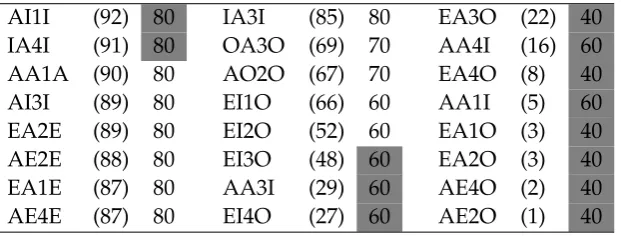
[image:16.595.145.456.487.605.2]As to fit the empirical data provided by Chater & Oaksford (1999), Geurts (2003) assign a costto each inference rule. A reasoner starts out with 100 points of which the costs of the inferences are subtracted: each use of either Mon↑or Mon↓costs 20 points, every use of pConv 10 points and every proof that contains an O-proposition (particular negative) costs an extra 10 points (thus implying that Conv and exImp are for free). Geurts’ model leads to the predictions in table 2.
Table 2: Comparison between the experimental data in Chater & Oaksford’s (1999) meta-study (in brackets) and Geurts’ model. Syllogisms are ordered in decreasing order of mean success. Predictions that are more than 10% apart from the actual performance are marked as gray.
AI1I (92) 80 IA3I (85) 80 EA3O (22) 40
IA4I (91) 80 OA3O (69) 70 AA4I (16) 60
AA1A (90) 80 AO2O (67) 70 EA4O (8) 40
AI3I (89) 80 EI1O (66) 60 AA1I (5) 60
EA2E (89) 80 EI2O (52) 60 EA1O (3) 40
AE2E (88) 80 EI3O (48) 60 EA2O (3) 40
EA1E (87) 80 AA3I (29) 60 AE4O (2) 40
AE4E (87) 80 EI4O (27) 60 AE2O (1) 40
Their model reaches a good fit with the syllogisms that constitutegoodsequences of inferences from an Aristotelian or predicate logic viewpoint: the model predicts much of the variance that occurs in mean success (r2= 0.87) and its predictions show strong
6This system allows a solution to more than just the syllogisms that are valid in Aristotelian or predicate
correlation with actual human performance (Pearson r=0.93).7 Zhaiet al.(2015) used the same logic but had the weights directly learned from the data – we do however think that the ratio of parameters to datapoints invites overfitting, eventually making the weights less informative. We wish to point out two weak spots of Geurts’ theory: the theory only applies to valid syllogisms, highlighting a lack of generality. Furthermore, the weights of the inference rules seem somewhat arbitrary. Both critiques were already pointed out by the authors themselves.
2.3.2 Mental Models
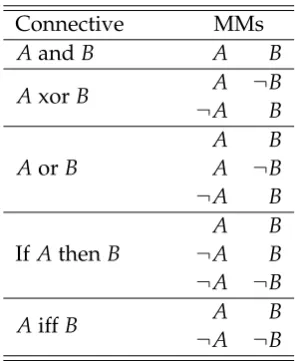
[image:17.595.223.371.372.553.2]Mental models theory has its foundation in the work of Laird (e.g. Johnson-Laird & Bara 1984, Johnson-Johnson-Laird 2010). Its assumption is that reasoners construct mental models which are consistent with the information they have received so far, where each mental model represents a possibility that is consistent with the present information state. So if AandB are two atomic propositions, the mental models for statements using operators from standard logic would be as in table 3.
Table 3: Fully explicit mental models representations for some logical connectives. ”A andB“ for example is represented by one model, others by two or three.
Connective MMs
AandB A B
AxorB A
¬A
¬B B
AorB
A A
¬A B
¬B B
IfAthenB
A
¬A
¬A B B
¬B
AiffB A
¬A B
¬B
We can already see that these connectives differ in how many mental models they require for their representation – which can be used to measure their difficulty (Johnson-Laird 2010, 3). As every model (one line) is a possibility, a conclusion is deemed necessary if it holds in all of the models. Ais thus a necessary conclusion from the premise ”Aand B“ but not from the premise ”AxorB“. Mental model theory assumes that reasoners represent sets by building mental models of their members, aim to maintain semantic information, are parsimonious and engage in a search for counterexamples against a
model (Khemlani & Jonson-Laird 2012, 19). A mental model of ”All semanticists are philosophers“ would thus look like the following:
semanticist philosopher semanticist philosopher semanticist philosopher philosopher philosopher ...
This highlights that the set of semanticists might not fully exhaust the set of philosophers. According to Johnson-Laird (2010, 2), this kind of representation isiconic, i.e. corresponds to what it represents as much as possible (this is opposed to asymbolicrepresentation, whose form has only conventional connections to its content). As is custom in mental model theory, we will take a step away from this iconic representation and adopt the convention that squared brackets around a letter mean a set is exhaustively represented by a symbol. More concrete, we will understand ”All semanticists are philosophers“ as
[semanticist] philosopher ...
instead of a representation akin to the one above, with
...
being an implicit model for all cases where the antecedent is wrong. Let us apply this to syllogisms (examples from Khemlani & Johnson-Laird 2012). On the left hand side, we see two syllogistic premises of the form AE4, on the right side its representation as a mental model.
All A are B. [A] [B] ¬C
No B are C. [A] [B] ¬C
[C] [C] ...
This conjoins mental models for both premises: all As areBs, as noted above, is repre-sented by
[A] B ...
whereas noBs areCs by
[B] ¬C [C] ...
areCs. Note that in syllogistic reasoning, only the relationship betweenAandCis of interest. Combined, this states that allAs are not-Cs , that there areCs and only things that are not-As can beCs, yielding the conclusion ”NoAareC“. We will now see a pair of premises (AI4) that requires two mental models:
All A are B. [A] B C [A] B
Some B are C. [A] B B C
C [A] B
... C
...
While the first model yields the conclusion ”Some Aare C“, the second model is a counterexample to this conclusion – the correct answer is thus that nothing follows from premises AI4: no statement about the relation between AandCis true in all models consistent with the premises. Mental model theory gives raise to a complexity measure, that is somewhat related to that of proof-length which will be introduced further below: the more models a syllogism takes, the more difficult it is.
This search for counterexamples – akin to falsificationism in philosophy of science – that the mental model theory imposes upon reasoners is however not supported by empirical evidence: reasoners do not try to engage in falsification but verification (Khemlani & Johnson-Laird 2012, 19). Furthermore, mental model theory suffers from a lack of flexibility – it is not clear how quantifiers beyond the syllogistic ones can be expressed in mental model theory (Chater & Oaksford 1999).
2.3.3 Probability Heuristics
Theories of reasoning that invoke logical tools and methodology have recently been under pressure from theories that try to give reasoning – even the presumably paradig-matic case of the usefulness of logic, deductive reasoning – a probabilistic foundation. The probability heuristic model has been proposed by Chater & Oaksford (1999) and Oaksford & Chater (2001). They state that human reasoning in experimental settings is usually evaluated against the wrong normative standards – the right normative standard being probability heuristics, not logic. Thus, if human performance is evaluated against the standard of logic, the results of reasoning experiments shed bad light on human capacities, as they tend to make logically bad inferences. If one would however evaluate human performance against probability heuristics, there would be another story to tell: then, humans would carry their everyday-reasoning heuristics into the experimental setting and reason according to them. The evaluation would then have to conclude, that humans manage to follow their normative standard, given by probability heuristics, even in an experimental setting (Oaksford & Chater 2001, 349).
• G1:choose the quantifier of the conclusion to be the same as the quantifier in the least informative premise (themin-premise) where informativeness is an (intuitive) ordering of the propositions involved in syllogistic reasoning (A>I>E>O) that we will come back to in chapter 5.
• G2:the next most preferred conclusion is the one that is probabilistically entailed by the one from G1 (themin-conclusion).
• G3:if just one of the possible conclusion subject noun phrases matches the subject noun phrase of just one premise, then the conclusion has that subject noun phrase.
• T1:be confident in the conclusion generated by G1-G3 in proportion to the infor-mativeness of the most informative premise (themax-premise).
• T2:avoid producing or acceptingSOME...NOTconclusions.
They furthermore introduce what they callprobabilistic semanticsfor quantifiers, thus defining quantifiers by means of conditional probabilities (Chater & Oaksford 1999, 200). So, for example,ALL(A,B)means that the conditional probability of B, given A, is 1, i.e. P(B|A) =1 andSOME(A,B)means thatP(B|A)>0 and that there are things that are bothAandB(existential import). While this approach makes it easy to extend their model beyond the syllogistic fragment, it is not clear how the probabilistic semantics of cardinal quantifiers or even iterated quantifiers can be given. Let us look at two examples of syllogistic reasoning using probability heuristics (taken from Chater & Oaksford 1999).
AI1I
ALL(Y,X) max-premise SOME(Z,Y) min-premise I-type conclusion by G1
SOME(Z,X) by G3
IE2E
SOME(X,Y) max-premise
NO(Z,Y) min-premise
O-type conclusion by G2
SOME(X,NOTZ) by G3 E-type conclusion by G1
NO(Z,X) by G3
Where the latter is valid in neither predicate logic nor Aristotelian logic. Oaksford and Chater give an interesting argument for favoring probabilistic over logical models that directly relates to our cause. They state that
”The most important feature of PHM [probability heuristic model] is that it can generalize to syllogisms containing quantifiers, such asMostandFew, that have no logical interpretation“ (Oaksford & Chater 2001, 354)
surface, we can rely on the expressiveness of natural language and interpretations of quantifiers that rely on quantification over sets, not only over individuals. Generality of the kind that is described by Oaksford and Chater is even a strength of the natural logic approach presented later.
A proper reason for the appreciation of the probability heuristic model might thus be to aim for a unifying theory of reasoning, i.e. the aim to formalize different cognitive capacities in one theory, e.g. probability theory. However, we wish to point out that probabilistic models, while sailing under the unifying flag ofprobabilistic modelingstill have large variation, like different logics. A proper comparison of the two approaches would thus mean to compare all probabilistic models with all logical models.
2.3.4 Evaluation
We can now compare the three main approaches introduced above – some results can be seen in table 4.8 No matter what preference one has, these results are at least a little bit funny: all three theories distinguish three identical categories of cognitive difficulty on this set of syllogisms (indicated by the additional horizontal lines in the table). If one was to choose their favorite theory of syllogisms, this choice can thus not be made on grounds of fit with empirical data and predictions. Note furthermore that all three theories, by making the same predictions, classify IE1O and EI1O as equally hard – while the mean of correct responses is 16% in the former and 66% in the latter. This calls for a more flexible complexity-measure that allows for differentiating between IE1O and EI1O in terms of cognitive difficulty.
All three theories have shown advantages and disadvantages. The reason to extend Geurts’ (2003) logic is twofold: firstly, it offers generality in the sense that it can account for a larger variety of natural language quantifier expressions (as it uses natural language representations, it inherits parts of the flexibility of natural language) and is thus easily extended to quantifiers such asMOSTwhile also carrying with it the normative aspect
that some quantifiers such asFEWdo not allow for many inferences because they have unfavorable monotonicity properties. This is contrasted by mental model theory’s inability to go beyond Aristotelian quantifiers and the fact that the PHM’s probabilistic semantics cannot account for cardinal quantifiers. Its generality continues in the sense that we can apply an extended version of Geurts’ logic to iterated quantifiers that we will introduce later on – it is hard to see how probability heuristics or mental models could operationalize iterated quantifiers while natural logic can rely on their linguistic treatment in generalized quantifier theory and monotonicity-entailments similar to the ones introduced above. We thus plan to go beyond the syllogistic fragment in ways that are supported by neither mental model theory or probability heuristics. Secondly, their
8A small disclaimer: some of the numbers reported in Oaksford & Chater (2001) differ from those in
Table 4: Comparison of mental model theory (MM), the probability heuristic model (PHM) and Geurts’ natural logic (NatLog) for some valid syllogisms. For mental model theory, we count the number of mental models involved in solving the syllogism, for PHM we state the heuristics involved (both taken from Oaksford & Chater 2001) and for NatLog the scores in Geurts’ system. The entries in the NatLog-column labeled with an asterisk were not provided by Geurts (2003) themselves and the one entry without a number is not a valid inference in Geurts’ system. The additional proofs in Geurts’ model are in appendix B.
Syllogism Theory Mean (%)
MM PHM NatLog
AA1A 1 G1 80 90
AI1I 1 G1 80 87
IA3I 1 G1 80 88
AI3I 1 G1 80 89
IA4I 1 G1 80 88
EA1E 1 G1 80 92
AE2E 1 G1 80 85
EA2E 1 G1 80 89
AE4E 1 G1 80 91
AO2O 2 G1+T1 70 67
OA2O 2 G1+T1 -∗ 56
AO3O 2 G1+T1 70∗ 66
OA3O 2 G1+T1 70 69
EI1O 3 G2+T2 60 66
IE1O 3 G2+T2 60∗ 16
EI2O 3 G2+T2 60 55
IE2O 3 G2+T2 60∗ 30
EI3O 3 G2+T2 60 48
IE3O 3 G2+T2 60∗ 33
EI4O 3 G2+T2 60 27
complexity measure proofs to be the most flexible – as the inference rules are weighted, derivations relying on different rules will yield a different measure of complexity. By this, we hope to obtain a better fit to the data and some testable predictions – a goal that we think both mental models and probability heuristics have too a static complexity measure for. Predictions of this kind are possible as weights assigned to inference rules areinformative, i.e. have a concrete interpretation.
2.4 Beyond Syllogisms: Iterating Quantifiers
Syllogisms is not all there is to reasoning. Somewhat surprisingly, not much empirical investigations have been done that extend the existing data on syllogistic reasoning in a direction that is of interest for one who studies the psychology of quantification. Geurts & van der Silk (2005) did an experiment on reasoning with iterated quantifiers investigating how their combined monotonicity properties interact with the cognitive difficulty of inferences. For lack of a better name, we will henceforth call the natural language fragment involved in their experiment on reasoning the quantifier iteration (QI) fragment. We have already seen examples of monotonicity-based inferences using single quantifiers – the inferential properties of iterated quantifiers will turn out to be quite similar. Consider the following inference:
Most pigeons annoyed more than three tourists. All tourists are human.
Most pigeons annoyed more than three humans.
Understanding a formulaφ(A,B)to mean that ”AannoyedB“, we can formalize this as
Q1Q2φ(A,B)
ALL(B,C)
Q1Q2φ(A,C)
where Q1 is MOSTand Q2 is MORE THAN THREE. This inference is a relatively easy one – the interaction of the two quantifiers involved is just of the right kind: bothMOST
andAT LEAST THREEare right-side upward monotone, and put the argumentBin an upward-entailing position.
involve upward entailment are easier than inferences that involve downward entail-ment, inferences that involve two quantifiers with the same (right-side) monotonicity properties are easier than those who do not and inferences that involve downward entailing cardinal quantification (e.g. usingAT MOST FIVE) involve more cognitive
[image:24.595.91.508.234.428.2]diffi-culty. Participants in their study had to determine whether reasoning patterns of the form
Table 5:Success rates in the QI-fragment, where the numbers in the %-row represent the percentage of successful assessments of an argument as valid or not. Mean response for inferences that conform to the given definition of validity are marked as gray.
QA QB Minor % QA QB Minor %
EVERY MORE THAN ALL(B,C) 91 MOST MORE THAN ALL(B,C) 91 ALL(C,B) 69 ALL(C,B) 67
FEWER THAN ALL(B,C) 71 FEWER THAN ALL(B,C) 62
ALL(C,B) 58 ALL(C,B) 60 AT LEAST MORE THAN ALL(B,C) 96 SOME MORE THAN ALL(B,C) 87 ALL(C,B) 69 ALL(C,B) 67
FEWER THAN ALL(B,C) 53 FEWER THAN ALL(B,C) 60
ALL(C,B) 51 ALL(C,B) 62 AT MOST MORE THAN ALL(B,C) 51 NO MORE THAN ALL(B,C) 69
ALL(C,B) 38 ALL(C,B) 53 FEWER THAN ALL(B,C) 36 FEWER THAN ALL(B,C) 73
ALL(C,B) 49 ALL(C,B) 64
QAA played against QBB. All B were C. / All C were B. QAA played against QBC.
were valid or not withQA ∈ {EVERY,MOST,AT LEAST,SOME,AT MOST,NO}andQB ∈
3
Natural Logic – A Logical Approach to Reasoning
We have seen in both datasets that some inferences prove to be easy, while others are hard an show success-rates below chance-level. Consequently, Braine (1990, 133) notes that, for many people, ”logical reasoning seems to present an odd and difficult, but erudite, mixture of the obvious and the counterintuitive“. We are convinced that much of this variation in cognitive difficulty can be explained by a semantic analysis of the expressions involved. The natural logic approach, in short, tries to present a logic whose inferential properties capture essential syntactic or semantic properties of the natural language fragment it aims to model. We will now talk about natural logic in general and then converge to a closer look at some natural logics. The first step in the direction of natural logic models is to look at natural deduction.
While natural deduction is related to other systems of deduction, e.g. Hilbert-Frege style proof systems, it does have a different emphasis: the goal is to create a system focusing oninferences, where said inferences are specified in a cognitively more plausible way or are at least not too cumbersome. The meaning of the logical constants in natural deduction (connectives and quantifiers) is defined by introduction and elimination rules – but still the same as in standard logic. These rules specify when and how one can make inferences that feature the operator in question as main operator in the conclusion (introduction rules) or the premises (elimination rules).
Conjunction-Introduction and -Elimination
Introduction and elimination rules state when one can draw an inference that introduces or eliminates a logical connective. See here introduction (I) and elimination (E) rules for conjunction:
(I) A1 A2
A1∧A2 (E)
A1∧A2 Ai
wherei∈ {1, 2}.
our natural logic approach: both highlight the semantic properties of logical constants that lead to inferences.
Gentzen’s theorem shows us how expressive his natural deduction system is – it clearly proves powerful (in fact equivalent to Hilber-Frege style proof systems), but still cognitively inadequate and limited in expressive power: most generalized quantifiers lie beyond its expressibility. Equally important is, however, that with language, we do not only have a means of saying something or expressing some information, but there are also forms of reasoning that operate directly on ”the surface of natural language“ (van Benthem 2007, 5). A natural logic is not only interested in inferences but in inferences that relate strongly to natural language. We thus have two distinct justifications for our pick of natural logic: other systems of inference are not expressive enough and we wish to have inferences operating on natural language representations (as we will see in more detail later,SOME(A,B)is just a much more plausible representation than
∃x(A(x)∧B(x))– Barwise and Cooper call this the ”norotious mismatch“ between the representational capacities of predicate calculus and natural language). Natural logic is thus not only about reasoning, but also about language and how the two interact: some parts of natural language allow for the extraction of formal properties that in turn allow for the modeling of reasoning.9
We will have a further discussion on natural logics and how to situate them in a cognitive modeling enterprise later on in chapter 8. For now, we will take a quick look at a variety of natural logic models to get a get a glimpse of what they might do.
3.1 Natural Logic – the Road so Far
Despite these introductory remarks, it is still not easy to pin down what natural logic actually is – a natural logic is a set of inference rules that act on the surface of natural language. But that does not come with any a priori constraints on how a natural logic should look like. We can however say that with each natural language, we get a variety of terms that allow for reasoning, e.g. expressions such as ”or“, ”and“, and ”necessarily“, but most importantly – in our case – quantifier expressions such as determiners. These natural language expressions allow their users to reason with them. We have already seen in the last chapter that such a set of inference rules for simple natural language reasoning can offer a simple, but informative model of reasoning that aligns reasonably well with human performance. This already outlined the path that we wish to travel but before we go further into this direction, we will have a quick stop and look at what is left and right of us. We will introduce various formal approaches to the capturing of inferential properties of natural language expressions and then decide why we can or
9There is no context-independent criterion whether more or less expressive power is better. The logic
cannot call them a natural logic.
Braine (1978) introduces a natural propositional logic that tries to capture the infer-ential properties of the natural language words that correspond to the connectives of propositional logic – the logic, for example, gives up on the truth-functionality of entail-ment: the conditional is understood asdirectional, meaning that, for example,p→qdoes not imply¬q→ ¬p. An ”if...then...“ statement thus only allows inferences from infor-mation aboutpto information aboutqbut not in the other direction. By defining logical connectives in a cognitively more plausible way, this logic can better account for human performance on reasoning tasks, e.g. Wason’s selection task that was introduced above. Braine’s work can quite easily be classified as a work of natural logic – it investigates natural language expressions (that correspond to the connectives of propositional logic) and their inferential properties in a way that fits human performance. The motivation for this can thus be said to becognitive, disregarding computational or even metalogical properties completely.
Endrullis & Moss (2015) discuss a proof system that is concerned with the inferential properties ofMOST(interpreted as ”strictly more than half“) – the fragment that their
logic models is given by sentences of the form ”AllXareY“, ”SomeXareY“, and ”Most XareY“. They proof that their system is sound and complete and provide a proof search algorithm, highlighting the low complexity of their logic. Their approach emphasizes the importance of the motivation that leads to the use of a natural logic: while ours is rather cognitive, they emphasize logical, algorithmic, and complexity results. This case proofs to be an interesting one as its classification as natural logic is not entirely clear – the proof system however operates on natural language sentences and tries to capture the inferential properties ofMOSTfrom a computational viewpoint but is trading these additional computational insights for a loss in cognitive plausibility. The proof system does for example not contain any manifestation of existential import – we will later argue against the cognitive plausibility of this. Nevertheless, this logic captures some inferential properties ofALL,SOMEandMOST.
Another approach toMOSTwas offered by Strößner (2017). She introduces a prob-abilistic entailment rule into a modal predicate logic that can be read as ”therefore, probably“. A statement of the kindMOST(A,B)then allows for a probabilistic inference
that an individual of kindAis also of kindB. This assigns probability not to the resulting proposition, but to the inference. With this new logical constant, given the statement ”most semanticists are linguists“, one can make the probabilistic inference that a given semanticist is ”therefore, probably“ a linguist. This logic specifies the inferential prop-erties of the determinerMOSTin a probabilistic way but gives up on natural language
Keenan (2003 and 2004) studies inferential properties of quantifiers that are related throughcomplementandpostcomplementrelations. In that vein, the quantifierNO STU
-DENTis the postcomplement ofEVERY STUDENTbecause we can infer ”every student passed“ from ”no student did not pass“ and vice versa. Keenan thus states that the semantic properties of quantifiers allow for inferences on their duals: if a quantifierQ1 can be characterized as the dual of another (e.g. Q1 = ¬(Q2¬)), this allows for some inferences between them. Highlighting the inferential relationships between quantifiers of all kind operating on natural language representations makes for a natural logic – Keenan however offers no additional insights, e.g. alignment with empirical data or testable predictions.
Finally, we wish to remark that the ”natural“ approach is expanding: Seuren (2010) offers an overview over natural set theory approaches that, similarly to Braine’s propo-sitional natural logic (above) tries to give a more plausible meaning to set-theoretical operations such as ”∪“ and ”∩“. We will however not further review this approach here and continue our way toward a bigger picture of natural logic. Furthermore, Bowmanet al. (2015) use neural networks to learn distributional semantics word representations and investigate whether they, by that, learn inferential relationships between words, e.g. that from something being a turtle follows that it is not a chair.
3.2 A Natural Logic Roadmap
We have seen different motivations for using natural logic models. Here we will try to carve out the main ones and then propose a natural logic methodology. As we have seen, one of the unifying characteristics of natural logic is that it operates on natural language – as a corollary of this, a natural logic model operates on representations that preserve the essential properties of natural language representations. With this comes great expressibility and thereby flexibility (as opposed to first order logic representations).
We have furthermore seen that natural logics vary in their motivations - while one can focus on cognitive plausibility – as Braine (1978) did –, one can also focus on metalogical properties or even automatic theorem provers – as Endrullis & Moss (2015) did. Accordingly, one might want to have one’s natural logic to be informed by the psychology of reasoning and then formulate appropriate reasoning rules. We will give a quick overview over the most important points. We can now formulate, in a concise way, which factors proof to be important for a natural logic.
Natural Logic Roadmap
1. identify suitable language fragment and core semantic or syntactic principles that inferences can be build on, e.g. monotonicity
2. formulate goal (cognitive, logical, exploratory)
4. if corresponding to goals: formulate complexity measure that captures the cognitive difficulty of inferences on the fragment
5. evaluate logic according to initial goals
Our logic is concerned with what is a good inference and how hard it is to get there – we will later talk about the philosophical implications of seeing the inferential characteristics of natural language expressions as their defining ones. We are convinced that natural logics should operate under a simplicity constraint: inferences should be added to a logic only if they are useful – one should aim for theminimal logicthat models the fragment in question.
4
Generalized Quantifiers
We will now shift our attention towards the other topic that dominates the title of this work: generalized quantifiers. These are known as such because, historically speaking, their formal, model-theoretic study was an extension of the study of the existential (∃) and universal (∀) quantifiers. The study of quantification is at the intersection of linguistics, logic, mathematics and psychology and is – from a ”natural“ viewpoint – especially interesting because, as Peters & Westerståhl (2006) note
”Quantifiers are one of very few expressive devices of language for which it is known how to break out of the circle of language and explain what a word means other than essentially in terms of other words’ meanings.“ (Peters & Westerståhl 2006, Preface)
This indicates that interpretation is unproblematic – we will however later see ex-amples that poof such an assumption to be too optimistic. But this and their relatively straight-forward model-theoretic semantics (together with further background in Ap-pendix A) makes them attractive for the formal study of natural language. We are however not mainly interested in their extensional but inferential properties, as those invite the use of natural logics.10
The introduction of modern studies of generalized quantifiers to linguistics is usually attributed to Barwise & Cooper (1981) and is mainly motivated by the inadequacy of first order logic to study aspects of natural language quantification – both existential and universal quantification are rather atypical from a natural language perspective. On
10Let us first fix a technicality: there is a large variety of quantifiers that are usually classified in types
<n1, ...,nk> withk∈N\0 andni∈N\0. We will however restrict ourselves to type <1,1> quantifiers and
top of that observation, there is the well known result that some quantifiers (e.g.MOST)
cannot be expressed in terms of first order logic at all (Barwise and Cooper 1981, 160).11 A syntactic discussion of binary quantifiers can start by clarifying the relationship between them and determiners in noun phrases (NP) in the English language. While the expressions mostly associated with generalized quantifiers are of the kindMOST,MORE THAN HALFandMANY, those are determiners, not quantifiers. It takes the combination of a determiner with a set expression to obtain a generalized quantifier (Barwise and Cooper 1981), reminiscent of the structure of noun phrases in the English language:
Quantifier
Determiner Set Expression
pigeons most
NP
Determiner Noun
pigeons most
MOST is thus not a quantifier but a determiner – MOST PIGEONS on the other hand is a quantifier. This analysis fits well into our natural logic perspective: if our formal treatment can mirror language, it is considerably more adequate than first order logic representations, which tend to be linguistically quite different from their natural lan-guage expressions (while still being logically equivalent, see examples below). Barwise and Cooper (1981, 164 ff.) call this ”the notorious mismatch between the syntax of noun phrases in a natural language like English and their usual representations in traditional predicate logic“, which they illustrate using the following example. Analyzing the following sentences that consist of a noun phrase followed by a verb phrase (left-hand side)
(i) Harry flies fly(h)
(ii) Some pigeon flies ∃x(pigeon(x)∧ f ly(x))
(iii) Every pigeon flies ∀x(pigoeon(x)→ f ly(x))
(iv) Most baby-pigeons fly (no FOL translation of this sentences)
one sees that the NPs here (Harry, some pigeon, every pigeon, most baby-pigeons) likely belong to the same syntactic category but translate to first order logic quite dif-ferently (right-hand side), introducing differences, where there are none in natural language. Thus, disregarding the syntactic similarities of these sentences in natural language, the first-order representation of (ii) and (iii) does not contain a representation of the NP (while (i) does) and (iv) is not even translatable to first order logic. Even
11On a sidenote, it is not only first order logic that showed difficulties with formalizingMOST. Similarly,
worse, (ii) can at best be translated as ”something is a pigeon and flies“, which might be logically equivalent, but proves linguistically different. First order logic’snotorious mismatchthus calls for a more adequate form of representation. As a corollary of these considerations, we can conclude that first order logic is insufficient for a study of infer-ences involving generalized quantifiers. This provides with the motivation to use the natural logic approach: natural language representations are both flexible and powerful enough to be cognitively plausible, whereas first order logic is not. Let us now look at the definitions of some quantifiers – how they fit into a model-theoretic setting is explained in Appendix A.
Some Generalized Quantifiers
IfQ(A,B)is a quantifier, we can usually define it by only referring to the two setsA andB. Here are some quantifiers that we will be using:
ALL(A,B)⇔ A⊆ B SOME(A,B)⇔ A∩B6=∅ NO(A,B)⇔ A∩B= ∅ NOT ALL(A,B)⇔ A−B6=∅
MOST(A,B)⇔ |A∩B|>|A−B|
FEWER THAN THREE(A,B)⇔ |A∩B|<3⇔ |A∩B| ≤2
MORE THAN TWO(A,B)⇔ |A∩B|>2⇔ |A∩B| ≥3
AT LEAST THREE(A,B)⇔ |A∩B|>2⇔ |A∩B| ≥3
AT MOST TWO(A,B)⇔ |A∩B|<3⇔ |A∩B| ≤2
TWO(A,B)⇔ |A∩B|=2
We will henceforth shorten the cardinal quantifiers as to not explicitly write any numbers, e.g. AT MOSTinstead of AT MOST THREE. Quickly extending our syntactic discussion above, we note that a multitude of grammatical structures allow for quan-tification: quantification expressions can themselves be NPs (”EVERYTHINGis going down“) or adverbs (for a detailed discussion of this, see Peters & Westerståhl 2006, 4 ff.). The syntactic forms of quantification furthermore vary from language to language. Peters & Westerståhl (2006, 11) for example note that the North American language of Strait Salish is knownnotto use determiners as to express quantification. This fact is of significance for the study of generalized quantifiers – we can however not account for it in this work. As the motivation for our work is a cognitive one, we rely on the availability of empirical data to evaluate our model. To the best of our knowledge, the only suitable data available is in English.
the scope of our investigation.
4.1 Characterizing Quantifiers: Montonicity and Symmetry
With our attention successfully restricted, we can now go on and take a closer look at the formal properties of the quantifier expressions that caught our interest. The formulation of a natural logic for reasoning with generalized quantifiers will hinge on the description of inferences through monotonicity- and symmetry-properties.
4.1.1 Monotonicity
Some quantifiers will be hard to characterize in terms of their monotonicity properties – and MOST will prove to be especially trying. Let us look at the definition and see what we can do with it (we will largely follow the presentation and notation of Peters & Westerståhl 2006).
Monotonicity
A functionFis called monotoneincreasingrelative to an ordering≤1of the arguments and an ordering≤2of the values iff
x ≤1 y⇒F(x)≤2 F(y)
In terms of generalized quantifiers, ”≤1“ is inclusion and ”≤2“ implication, thus stating thatQisleft-side monotone increasing(orleft-side upward monotone) iff
A⊆ A0 ⇒Q(A,B)→Q(A0,B)
andleft-side monotone decreasing(orleft-side downward monotone) iff
A0 ⊆ A⇒Q(A,B)→Q(A0,B)
Analogous,Qis calledright-side monotone increasing(orright-side upward monotone) iff
B⊆B0 ⇒Q(A,B)→Q(A,B0)
andright-side monotone decreasing(orright-side downward monotone) iff
B0 ⊆ B⇒Q(A,B)→Q(A,B0)
to this later and first look at some examples of monotonicity and inferences based on monotonicity.
Monotonicity Profiles
As a shorthand for the monotonicity properties of a quantifierQ, we will talk about itsmonotonicity profile. As an example, instead of stating that a quantifiers is left-side downward monotone and right-left-side upward monotone, we will say that its monotonicity profile is↓↑. To make the monotonicity profile of a quantifier explicit, we will often also write ↓ Q ↑. If a quantifier does not have any monotonicity properties on a side, we will write a dot instead. Examples are
↓ALL↑
↑SOME↑
↓NO↓
↑NOT ALL↓
·MOST↑
↓FEWER THAN THREE↓
↑MORE THAN TWO↑
↑AT LEAST THREE↑
↓AT MOST TWO↓
·TWO·
4.1.2 Symmetry and Conversion
Another property of generalized quantifiers that allows for inferences is symmetry. But while most quantifiers that we have seen so far has some kind of monotonicity properties that allow for inference, most quantifiers do not when it comes to symmetry. Let’s look at the definition.
Symmetry and Conversion
A type quantifierQis calledsymmetricif and only if, for allAandB,
Q(A,B)⇒Q(B,A)
the inference associated with this property is calledconversion.
The entailment does not need to be bidirectional and already has all generality. This will later allow for the definition of a powerful inference – that will however be restricted to smaller class of quantifiers. Some examples are:
(b) Some birds are pigeons.
(ii) (a) No pigeons are philosophers. (b) No philosophers are pigeons.
Whereas the following examples clearly show the limits of possible inferences on grounds of symmetry, as the pairs of sentences do not imply each other.
(i) (a) All pigeons are birds. (b) All birds are pigeons.
(ii) (a) Most pigeons are birds. (b) Most birds are pigeons.
And so on. The truth of the statements only depends on the intersection of two sets, thus allowing for an inference based on symmetry.
4.2 Some Remarks on Quantifier Interpretation
Model theorists often make the simplifying assumption that the meaning of basic expres-sions is fixed by context. We will, in principle, follow this lead here – Barwise & Cooper call this thefixed context assumption(Barwise & Cooper 1981, 163) – meaning that we take the interpretation of quantifier expressions to be clear. While this is a strong assumption for context-dependent determiners such asFEW, it is usually taken for granted for most determiners and we will do the same for those in the syllogistic- and the QI-fragments. We will however take a moment to justify their interpretations – especially that ofMOST– but notice that the precise interpretation of quantifier expressions is often not as relevant for natural logics as long as their inferential properties are preserved.
4.2.1 Aristotelian Quantifiers
Aristotle used the square of opposition to organize the syllogistic quantifiers and the relationships that hold between them (Westerståhl 1989, 582).
ALL NO
SOME SOME...NOT
contradictory contrary
subcontrary
subaltern