The Rules of Victorious Warriors
Logical and Game Theoretical aspects of Strategy Theory in ancient China draft
Peter van Emde Boas
ILLC, FNWI, University of Amsterdam[email protected]
Ghica van Emde Boas - Lubsen
Bronstee.com Software & Services, Heemstede[email protected]
Abstract
Victorious warriors win first and then go to war, while defeated warriors go to war first and then seek to win. This phrase, attributed to Sun Tzu in his book “The Art of War”, is a strong recommendation for generals to analyse a combat scenario before actually engaging in combat. This analysis can be understood to require some form of game analysis.
In this paper we will discuss whether it is appropriate to ascribe a game theoretical perspective to the ancient Chinese strategical thinkers. In addition we search for indications in ancient Chinese history and literature or tradition whether Chinese warriors actually used game analytic principles in their strategic considerations. We also indicate aspects of these stories which illustrate interesting connections to game theoretical concepts.
This paper is a stand alone version of a draft chapter in the forth-coming handbook of logical thought in China1.
1
Introduction
The purpose of this paper is to look into ancient Chinese works on strategy
and warfare, with a focus on Sun Tzu, “The Art of War”, from a rather
un-orthodox perspective. Authors studying these topics in general are students
in humanities (history, military science, philosophy, or linguistics).
The
1
background of the authors of this paper is quite different: mathematics,
computer science, and logic.
We aim to illustrate to what extent the strategic theoretical works of the
ancient Chinese, and the stories from (military) history and/or literature
contain elements which are interesting from the perspective of logic and/or
game theory.
The authors of this paper are not familiar with the Chinese language,
therefore we are forced to use translated volumes, which, even when they
agree on what the ancient authors want to convey, sometimes disagree on
the phrases used, and occasionally, also on the precise location where some
statements are to be found in the text. Help from our Chinese colleague,
Yanjing Wang, (see the acknowledgement at the end of this paper) is very
much appreciated.
1.1
Structure of this Paper
The first section presents a short inventory of the ancient Chinese strategy
studies which we have investigated. Chinese military studies did not end
after the third century AD, but since our prime interest is the ancient period
preceding 300 AD, we have not included various works dating from the Tang
Dynasty (618 - 907 AD) and later periods.
Next we present a concise description of Game Theory and why we
con-sider it relevant for the purpose of this paper.
Section 4 gives an in-depth description of the most relevant of the old
texts: Sun Tzu’s
The Art of War
. We emphasize the hidden logical structure
in this ancient text, using mind maps as an analysis tool.
In section 5 we look at a number of concrete stories from Chinese history
and literature, indicating how these stories illustrate the recommendations
of Sun Tzu being applied, and how information and other logical or game
theoretical features surface in these stories.
Section 6 presents a survey on related work we have found in the
liter-ature; this deals with papers by other authors discussing game theoretical
aspects of Sun Tzu and other stories from ancient Chinese military history.
Our conclusions are presented in section 7.
2
Strategy Theory in Ancient China
During the Sung dynasty Chinese scholars identified a corpus of seven
im-portant classic texts on strategy theory, all translated and discussed in [37].
These texts are:
1. T’ai Kung’s Six Secret Teachings (11 cent. BC), see also [43] 2. The Methods of the Ssu-ma (1000-700 BC)
3. Sun Tzu the Art of War (515-512 BC) 4. Wu-tzu (440-381 BC)
5. Wei Liao-tzu (350-240 BC)
6. Three Strategies of Huang Shih-kung (Han dynasty, around 0 AD)
7. Questions and Replies between T’ang T’ai-tsung and Li Wei Kung (Sung Dynasty, 1023-1063 AD)
Not included in this list of the seven classics are:
• Military sections of the Mozi (around 450 BC) [21] • Sun Bin, the Art of War (around 360 BC) [34]
The best known of these ancient writings is the Art of War from Sun Tzu [1, 11, 16, 17, 27, 30, 35, 42, 48, 49]. This work has been written during the late Spring and Autumn period in China (770 - 476 BC). He is frequently confused with the later military strategist Sun Bin [34] who lived during the earlier part of the Warring States period (476 - 221 BC); in fact only the excavation in 1972 of a Han dynasty tomb at Yinqueshan provided conclusive evidence that there had been two authors living some 160 years apart and two different texts, both entitledThe Art of War. The text of Sun Tzu originally was named “The Thirteen Chapters” and later “Sun Tzu’s The Art of War”.
Notwithstanding the fact that the oldest of these texts is attributed to a leg-endary author living 3100 years ago, the earliest written versions of the first four books date from the Warring States Period (476 – 221 BC), as is evident from the military equipment mentioned. The dates mentioned are approximate lifetimes of the legendary authors these works are being ascribed to. The chronological order in which the texts were written down consequently may be different from the order given above.
among contemporary scholars; see the introductory chapter in [37]. We have no interest in contributing to this discussion.
Instead it is important to indicate in which way the text by Sun Tzu is out-standing among these texts.
Sun Tzu and the other Authors
The T’ai Kung’s Six Secret Teachings text (1) is structured as a dialogue between the king (King Wu) and his military advisor (T’ai Kung): the king poses a question describing some concrete situation and the advisor answers with an expos´e how the king should solve this problem. Frequently the section is completed by an indication of approval from the king. The same pattern occurs in Wu-tzu (4) and in the T’ang T’ai-tsung (7), but also in the additional texts ascribed to Sun Tzu outside his famous thirteen chapters. In the other texts we primarily find the words of the advisor.The emphasis of the topics under discussion is also different between these authors.
T’ai Kung (1) starts out with sections on good governance in the first two sections before discussing more concrete military case studies in the remaining four chapters.
The methods of the Ssu-ma (2) describe war as a gentlemen’s game observing the warrior’s code rules like not attacking before your opponent has completed his formation.
Wu-tzu (4) focusses on training and taking good care of the soldiers and their equipment.
Noticeable in the Wei Liao-tzu (5) is the focus on punishments in order to discipline the army.
Huang Shih-kung (6) again focusses on good governance leading to the awe-someness required for leading the army to victory.
Finally the T’ang T’ai-tsung text (7) extensively discusses the ideas of the ear-lier authors and investigates whether famous ancient generals and kings followed these recommendations.
As we will explain in more details below the text of Sun Tzu stands out by be-ing structured in recurrbe-ing patterns, and by discussbe-ing the topics at a far more abstract level, using categorizations and rules. Relevant features include the semi-structured format of the text, and the focus on being prepared before engaging in warfare: the ideal warrior may win a war without serious fighting by being well prepared, and when he knows both his opponent and himself.
Sun Tzu’s text, though not involving either logic or game theory in a formal sense, exhibits features of a logical nature, and presents ideas and concepts which are, from contemporary perspective, related to game theory. These aspects are relevant since we want to investigate the logical aspects of the teachings of these ancient strategists.
There are authors (in fields quite different from history, linguistics or logic) who characterize Sun Tzu to be an early founder of game theory, as can be observed from the hits produced on Google by a query onSun Tzu and Game Theory. See for example [68, 69].
3
The Relevance of Game Theory
If game theory is defined as thetheory of agents in strategic interaction, then strat-egy studies about warfare are game theory studies. In this way, many other studies, including the works of Teucidides [44], Machiavelli [26], and von Clausewitz [10] can be considered to be game theory, including the work of Sun Tzu.
From a scientific perspective, this is a rather inconclusive statement, because game theory is usually understood in a more narrow sense: the Mathematical theory developed by von Neumann & Morgenstern [45], Nash [31], and others, primarily aimed at economical sciences. A standard text which doesn’t involve deep Mathe-matics is the textbook by Binmore [5].
Military applications of game theory are less frequent but seem to gain impor-tance. We will look at the ancient Chinese texts primarily from this perspective. However, as we shall see, standard Game Theory is frequently insufficient for a correct representation of the strategic situations at hand, and modern extensions to game theory should be taken into consideration as well.
3.1
Logic and Game Theory
To modern logicians the disciplines of logic and game theory are very much inter-twined. On one hand, logic is used to advance game theories and on the other hand, game theoretic principles are used as a tool-set in logic research. For more information on the long history logic and games have together see for exampleLogic and Games[20]. For a theoretical background of the connection between games and logic seeLogic in Games[3]2.
3.1.1
A very short Introduction to Game Theory
Game theory can be defined as a mathematical theory aimed at describing the behaviour of agents in strategic interaction. Some basic notions in Contemporary Game Theory are:
• Agents: Players • Actions: Moves
• Strategies: complete plans on how to move throughout the game • Outcomes: positions where the game ends
2
• Preferences and Utilities: express what players desire
The key idea is that players select actions according to some strategy which tells them which action they should perform given the state of the game. Starting from an initial situation, controlled by these actions, the game traverses a sequence of intermediate states, terminating in a final state called the outcome of the game. The preferences of the players indicate which outcomes are desired by the players. A standard way of expressing preferences is by associating with each outcome a numerical value called theutility; a higher utility value indicates that the outcome is preferred. It is generally assumed that players will aim for a more preferred outcome as far as it is in their power to do so: the players arerational.
More advanced notions in Game Theory include:
• Extensive games versus Strategic games: Extensive games traverse during play a sequence of states with in general only a single player having to move at this state. In a strategic game all players select a strategy which represents their action; the players all move simultaneously and the outcome state is reached in a single step.
• Probabilistic aspects: The result from an action (or a simultaneous set of actions) may be a stochastic event (E.G. when the action is throwing a dice or a coin flip). Alternatively the players may select their actions probabilis-tically from a given set of possible actions; this leads to the concept ofmixed strategies
• Incomplete information: Players may be uninformed about the precise state of the game; this lack of information can be created at the start of the game (think of shuffling a deck of cards) or be the result of actions by players which are invisible to their opponents.
• Solution concepts: methods to analyse a given game leading to some predic-tion on how the players will behave while playing the game. Some of the better known solution concepts are:
– Nash Equilibrium: a choice of strategies selected by the players with the property that no player can (unilaterally) obtain a better outcome by changing his strategy.
– Dominating strategies: a strategy is dominating another strategy if it yields a better outcome regardless the actions chosen by the other players.
3.1.2
Implicit Assumptions for Game Theory
In game theory it is customary to assume several characteristics for the game and the players:
• Common Knowledge of the Game and its rules: Agents know the structure of the game and they know which moves are possible in which states, both for themselves and for their opponents. They know that the opponents have the same knowledge, and that they know that we know it as well (in fact common knowledge entails an infinite collection of nested statements of the formI know that you know that I know that....).
• Common Knowledge of Preferences and Utilities: the players not only know their own preferences but also those of their opponents, and are aware of the fact that the opponents know their preferences as well (again up to arbitrary depth).
One can doubt whether these assumptions are reasonable, particularly in the context of warfare. Common knowledge of the game would require that all parties are fully informed about all aspects of the terrain and have full knowledge about the composition and strengths of the opposing army. Secret weapons would not be allowed. Common knowledge of the utilities would require that parties have complete information on the policies and internal affairs of the enemy. Under these assumptions spying would be futile.
Instead, it can be investigated whether the results of game theory can be pre-served while relaxing these unrealistic assumptions. One approach is to use those features in game theory which represent uncertainty to model the ignorance of the players. Incomplete information and probabilistic moves are the features involved. The problem is that one needs to know the ignorance of the players before one can model it in this manner.
3.1.3
Extended Game Theory
An alternative is to relax the assumptions in game theory themselves. L¨owe et. al. [25] show that game theoretical analysis is possible without assuming common knowledge of the utilities. Halpern and Rˆego [19] present a version of game theory where no common knowledge of the game structure is required. Another relevant approach is presented by Kaneko and Kline [23] who consider that a game is being learned while being played - an aspect certainly relevant for warfare.
Both Game Theory and Sun Tzu’s “Art of War” have received intense interest in business environments and many interpretations of Sun Tzu’s text are applied to business practices or modern warfare, sometimes giving his text almost mythical powers, see for example the websites: [51] and [53].
If we constrain ourselves to a definition of Game Theory stating analysis of strategies for dealing with competitive situations, then, as cynical as it may sound,
waris a game and Sun Tzu’s analysis of war strategy is game theory. It is therefore understandable that many business researchers did not bother too much about being able to find the right game theoretical background. How far we can get while using one of these more extended and liberal interpretations of Game Theory is a subject for future research.
3.2
Theory of Mind.
Theory of Mind is a concept originating from the field of Psychology, defined in Wikipedia as: Theory of Mind (often abbreviated as ToM) is the ability to attribute mental states — beliefs, intents, desires, pretending, knowledge, etc. — to oneself and others and to understand that others have beliefs, desires, and intentions that are different from one’s own.
In Game Theory, the use ofTheory of Mindis more focussed toward the concept of reasoning from the standpoint of another person: ”I think that you think that I think ...”.
A quote form an ancient Chinese legend makes the concept more clear and it proves that this type of reasoning was indeed used in ancient China:
One day, Zhuangzi and Huizi are strolling on Bridge Hao.
Zhuangzi: ”Look how happy the fish are just swimming around in the river.”
Huizi: ”How do you know they are happy? You are not a fish.”
Zhuangzi: ”And you are not me. How do you know I don’t know the fish are happy?”
Huizi: ”Of course I’m not you, and I don’t know what you think; but I do know that you’re not a fish, and so you couldn’t possibly know the fish are happy”.
This event is assumed to have happened during the Warring states period (403-211 AD), which means it is at least a century later than Sun Tzu who lived around 500 BC. This dating is relevant since, though Sun Tzu explicitly asks to reason about and prepare for your opponent, such an explicit reference to ToM reasoning can’t be found in his text.
willing to accept that the events described in this novel are (in part) historical, it suggests that theory of mind reasoning was used in the third century AD.
A possible explanation for the lack of explicit ToM reasoning in Sun Tzu can be found in considering that the use of ToM reasoning may occur at different levels.
Van Benthem [2] distinguishes three levels of theory of mind reasoning: 1. Using Theory of Mind: Most adult persons are capable of using ToM, but
often use it unconsciously.
2. Understanding Theory of Mind: At this level a person uses ToM consciously to determine his or her actions.
3. Reasoning about Theory of Mind: At this level it allows formulating a strat-egy in a game, and also to describe the nature of human empathy by philoso-phers or deficits in human behaviour by psychologists.
4
The Logical Thinking of Sun Tzu in “The Art
of War”
In this section we are looking more closely at Sun Tzu,“The Art of War”. As already remarked, Sun Tzu lived around 500 BC during the Chinese Warring States period. His very famous book is much more than a book about fighting in a war, it concerns itself primarily with winning without fighting and strategies for achieving that.
4.1
Translations of the Art of War into English
The history of the translations is interesting in itself, because most translators seem to be of the opinion that they improved significantly on what their predecessors did. The first known translation into English was done by Captain E.F. Caltrop in 1905, with improvements in 1908 [7]. Lionel Giles must be the second translator, motivated to do this translation because he thought that the translation by Caltrop was “excessively bad” [16]. Giles has abundant notes and explanations in his text. It would take about 50 years before another translation was made by Samuel B. Griffith and many would follow. Especially in business circles Sun Tzu became pop-ular, which resulted in books with frivolous titles such as: “Sun Tzu was a Sissy” [4], “Sun Tzu- The Art of War for Managers” [28], and “Sun Tzu for Women” [8].
Other translations were done by: Cleary (1988), Ames (1993), Sawyer (1994), Wu Rusong (1999), Minford (2002), Lin Wusun (2003), and Ziegler (2010).
The translations are substantially different and it is difficult to decide whether the exact concepts from the old text are used. Moreover, the source text is of course written in ancient Chinese, yielding additional problems, also for modern native Chinese scholars.
We use mainly the translation into English by Lionel Giles, one of the old-est translations, made in 1910. This text is available as part of the Gutenberg project [15] and is therefore freely available without copyright restrictions. Al-though there are later translations based on more modern research and on Chinese texts that were found during later excavations, notably in 1972, we think that the Giles translation is most suitable for our purpose: the translation is highly structured and because of its unrestricted availability we can transform the text to highlight this structure and the rules behind it. We consulted newer translations to check that understanding of the text is not completely dependent on the Giles translation.
Finding the right meaning and translate it the right way remains tricky, as is illustrated by three different translations of a sentence in chapter 4:
• From the Computer Game “Civilization IV”, Military Tradition splash screen:
Victorious warriors win first and then go to war, while defeated war-riors go to war first and then seek to win.
A winning army wins first and then seeks battle. A losing army first battles, and then seeks to win.
[image:11.612.160.450.199.297.2]See also figure 1, to view the original Chinese text. Note that the Chinese text actually starts withtherefore.
Figure 1: A winning army, excerpt of the translation by Andrew Zieger.
• From Lionel Giles, par. 15:
Thus it is that in war the victorious strategist only seeks battle after the victory has been won, whereas he who is destined to defeat first fights and afterwards looks for victory.
We can conclude from these examples that the word binghas been translated to single soldier, commander or the whole army. It can also mean weapons, or military. The use of the translation warrior in this context only appears in the Cleary edition [11] where it occurs in a commentary to the final sentence of chapter 1, ascribed to Zhang Yu, a commentator who lived during the Sung Dynasty (960-1279 AD). Therefore the quote in the Civilization IV game is actually a quote of an ancient commentator and not of Sun Tzu himself.
A comprehensive discussion of the diversity of the translations is given by Yang Ming [29].
4.2
The logical Structure of the thirteen Chapters of Sun
Tzu
In this section we present a very short summary of the content of Sun Tzu’s “Art of War”. The purpose of the summary is to highlight the logical structure of the book and to make it easier for non-Chinese readers (who may not have read a complete version of the (translated) original text) to understand what is presented in this section.
sequence is followed for describing the military theories, fromplanningto fighting
and all considerations to be taken into account.
Yang Ming [29] describes in her thesis, citing Li Ling, that ancient Chinese books were often divided in internal and external sections. The internal section is the most important part of a book. According to Li Ling, the first six chapters of
The Art of War constitute the internal section and describe the fundamental mili-tary theories. The other seven chapters contain the application of these theories. Similarly as for the content of each chapter, there is a great deal of discussion among translators what the exact wording of the chapter titles of “the Art of War” should be. We follow here the Giles translation.
4.2.1
The fundamental Part
In this part of the book, Sun Tzu explains military action at a strategical level. 1. Laying Plans
This chapter talks about the importance of making preparations, taking sev-eral factors into account, such as morale, circumstances and organization. He advises to assess which side has advantage in all of these factors. Sun Tzu states: Warfare is a way of deception, and subsequently he points out what can be done in various circumstances to deceive the opponent.
2. Waging War
This chapter is not about war itself, but about what is needed in preparation. Although there is an explicit list of how many chariots and troops are needed at the start of the chapter, it continues with a list of rules of when to attack and how. Emphasis is put on avoiding a long war, which according to Sun Tzu can never be beneficial. He stresses that material and food should be taken from the enemy, and not sent from home.
3. Attack by Stratagem
Stratagem means plan, deception, or ruse in the context of preparing for war. Therefore, again, this chapter is about planning. Indeed, in the Mair translation [27], the title for this chapter is “Planning for the Attack”, which has a less negative meaning than the word “stratagem”.
This chapter involves considerations that a peaceful solution is always supe-rior to war, that an enemy should only be attacked when it is certain that you will win, never attack walled cities, and disobey the ruler when you must.
III-1. the best thing of all is to take the enemy’s country whole and intact;
A famous quote of Sun Tzu can be found at the end of this chapter:
III-18. Hence the saying: If you know the enemy and know yourself, you need not fear the result of a hundred battles. If you know yourself but not the enemy, for every victory gained you will also suffer a defeat. If you know neither the enemy nor yourself, you will succumb in every battle.
4. Tactical Dispositions
We will look at this chapter in more detail later, when we use mind maps to analyse its text.
In the Mair translation [27], the title for this chapter is “Positioning”, which indicates more accurately what the content of this chapter is.
Sun Tzu explains in an abstract and poetic way what a great leader should do to maximize his chance for success in a war. The content can best be summarized with the following quote:
IV-17. In respect of military method, we have, firstly, Measurement; secondly, Estimation of quantity; thirdly, Calculation; fourthly, Bal-ancing of chances; fifthly, Victory.
IV-18.
Measurement owes its existence to Earth; Estimation of quantity to Measurement; Calculation to Estimation of quantity; Balancing of chances to Calculation; and Victory to Balancing of chances.
Notice how in paragraph 18 each next item in the military method refers back to the previous one.
Two other interesting quotes from this chapter are:
IV-2. To secure ourselves against defeat lies in our own hands, but the opportunity of defeating the enemy is provided by the enemy himself.
and:
IV-15. Thus it is that in war the victorious strategist only seeks battle after the victory has been won, whereas he who is destined to defeat first fights and afterwards looks for victory.
5. Energy
V-1. The control of a large force is the same principle as the con-trol of a few men: it is merely a question of dividing up their numbers.
V-10. In battle, there are not more than two methods of attack– the direct and the indirect; yet these two in combination give rise to an endless series of maneuvers.
6. Weak Points and Strong
In Mair’s translation [27], the title of this chapter isEmptiness and Solidity
and indeed this could be a literal translation, but as most of the chapter is about finding the weaknesses of the enemy and using ones own strengths, the title of the Giles translation seem more appropriate. An alternative translation (according to Yanjing Wang closer to the actual Chinese text) readsThe Fake and the Real.
A quote:
VI-2. Therefore the clever combatant imposes his will on the enemy, but does not allow the enemy’s will to be imposed on him.
A game theoretical important text fragment to consider is:
VI-28. Do not repeat the tactics which have gained you one victory, but let your methods be regulated by the infinite variety of circum-stances.
VI-29. Military tactics are like unto water; for water in its natural course runs away from high places and hastens downwards.
4.2.2
The Practical Part
In this part, Sun Tzu describes more of applied tactics, such as various types of terrain that can be encountered, marching, how to attack by fire, and the final chapter which discusses the use of spies.
7. Maneuvering
After having assembled the army, nothing is more difficult than maneuvering. Maneuvering means moving the army or parts of it and Sun Tzu explains what can happen if you move a too large part of the army, or move too fast, and what happens if the terrain is not taken into account.
8. Variation in Tactics
This chapter talks about army positions and what to do in various circum-stances. Sun Tzu states also that the commander has the highest authority on the battlefield and therefore:
Another illuminating quote from this chapter is:
VIII-11. The art of war teaches us to rely not on the likelihood of the enemy’s not coming, but on our own readiness to receive him; not on the chance of his not attacking, but rather on the fact that we have made our position unassailable.
9. The Army on the March
This is a long chapter dealing with warfare in different conditions, places, what can happen while marching, and rules for commanding. The first line effectively sums it up:
IX-1. Sun Tzu said: We come now to the question of encamping the army, and observing signs of the enemy.
10. Terrain
As the title suggests, this chapter handles terrain:
X-1. Sun Tzu said: We may distinguish six kinds of terrain, to wit: (1) Accessible ground; (2) entangling ground; (3) temporizing ground; (4) narrow passes; (5) precipitous heights; (6) positions at a great distance from the enemy.
The next chapter will again talk about different types of terrain, somewhat repetitious. However, in this chapter the description is more situational. The chapter ends with another famous quote:
X-31. Hence the saying: If you know the enemy and know yourself, your victory will not stand in doubt;
if you know Heaven and know Earth, you may make your victory complete.
11. The Nine Situations
This is the longest chapter in the book. It contains several miscellaneous subjects, starting with rules about how to fight in various types of terrain. The next subject is about how to care for and handle the soldiers and the army, followed again by a discussion about terrain.
12. The Attack by Fire
In this chapter Sun Tzu gives very specific advice how to attack with fire and he briefly also talks about water..
XII-1.There are five ways to attack by fire ...
XII-5.In attacking with fire, one should be prepared to meet five possible developments ...
13. The Use of Spies
This chapter presents some remarkable insight in the role of information and the way to obtain it. Sun Tzu describes five different types of spies whose roles vary between obtaining information from the enemy to planting false information with him.
XIII-5. Now this foreknowledge cannot be elicited from spirits; it cannot be obtained inductively from experience, nor by any deductive calculation.
XIII-6. Knowledge of the enemy’s dispositions can only be obtained from other men.
In a later section the use of spies and how this relates to use of information will be discussed.
4.3
Mind Maps
After looking at the content of the “Art of War”, we introduce the use of mind mapsto analyse and visualize the text and to expose the logic behind its meaning. Amind mapis a way to visualize information in an organizational and hierarchi-cal structure. Visual methods to help brainstorming, problem solving, structuring of a subject and so on is quite old, but made popular again be Tony Buzan [6] in the 1970-ies.
Since then a multitude of computer tools to create mind maps were developed, such asFreemind [50]. Freemind allows to import semi-structured text and that is what we did with the ”Art of War” in the Gutenberg edition of the translation by L. Giles.
4.3.1
Analyzing Text Using Mind Maps
A digital mind map is essentially text formatted in a tree structure. We tried to keep the formatting as simple as possible: although the tools allow pictures, colors, various shapes of nodes and more, we thought that this would not enhance the clarity of our analysis.
We did not add any text to the mind map, except for some categorizations, as explained below. Sometimes we removed text, when it seemed duplicate or not adding meaning after text restructuring.
The process of analyzing text using a mind map is roughly as follows:
• Import the original text, chapter by chapter, into a mindmap. We made a separate mind map for each chapter.
• The chapter title becomes the root node in the mindmap for that chapter. • Each paragraph becomes a sub-node.
– Guiding rules for finding sub-nodes are the occurrence of certain words such ashence ortherefore.
– The occurrence of enumerations help in finding structure in the text. • We made additional mind maps to show enumerated concepts, rules and
specific examples.
• To provide better traceability of the regrouping of text and in the additional mind maps, we left indications of where the original text can be found. The Roman numerals indicate the chapter, and the numbers are the paragraphs as shown in the Giles translation.
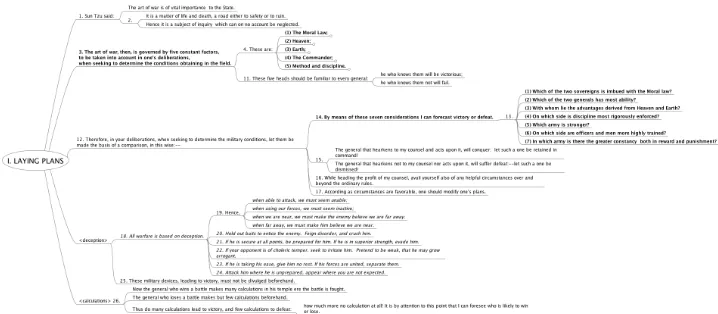
The resulting mind maps are too large to be published in this paper, we there-fore show an example of what a mind map looks like (do not expect it to be readable here), see figure 2.
We also show some partial maps with regroupings and several pieces of a mind map showing patterns that we found.
[image:17.612.125.484.413.570.2]As a final example, we look at a mind map rendered as text in a way that this becomes readable on paper. See for this our rendering of chapter 4 in section 4.3.4. We should stress here that our analysis is not finished, neither complete. It should be sufficient however, to prove that the Sun Tzu text contains a considerable amount of logical reasoning. The game theoretical aspects of “The Art of War” by Sun Tzu are discussed in later sections.
Figure 2: Mind map example showing chapter 1, Laying Plans
4.3.2
Categorizing Text
be able to categorize pieces of text, for example in the case that a definition or situation is described, such as this example in chapter 9 (The army on the march):
IX - 7. In crossing salt-marshes, your sole concern should be to get over them quickly, without any delay.
8. If forced to fight in a salt-marsh, you should have water and grass near you, and get your back to a clump of trees. So much for operations in salt-marches.
is mapped as in figure 3.
Figure 3: Chapter 9, Campaigning in salt-marshes
The figure shows that we added a label,<salt-marshes>, to the group of lines in paragraphs 7 and 8. We removed the text“So much for operations in salt-marches”. This text is useful in a narrative, but repetitive in a mind map.
[image:18.612.120.470.396.465.2]If we continue our analysis for chapter 9, with the text in paragraphs 1-10, then we get a mind map as in figure 4.
Figure 4: Chapter 9, Four rules for Campaigning
In figure 4, the lower nodes are collapsed, because we do not have space on the page show the complete text, but it makes clear that this text describes how to conduct warfare in four types of military terrain: mountain, river, salt-marshes
andflat country.
From the paragraph number you can see that the definition starting with
10. These are ...
As a side note: We found that this text is one of the rare places where Sun Tzu explicitly mentions someone else in his advice (the Yellow Emperor is the legendary first emperor of China believed to have lived around 3000 BC). Terrain warfare is also covered in other chapters and it could be illuminating to cross-reference the advice given here with what is advised elsewhere. A next iteration of going through the mind maps could make this clear.
4.3.3
Patterns
From reading the abstract of the content of ”The Art of War”, or from reading a narrative translation, it is not easy to get a grip on the logical rules and game the-oretical concepts that appear in the book. The mind maps helped us to find struc-ture and we noticed several patterns that we analysed further searching through the text, using the specific words Hence, Therefore and Thus. Furthermore, we systematically looked for enumerations that are frequently found in the text.
From this analysis several patters emerged, each will be described briefly here, with examples.
Rule
The occurrences of the words Hence, Therefore and Thus. Each of these words suggest that a rule could be found in the text.
A good example of a rule is in chapter 3, paragraph 8, shown here in figure 5.
Figure 5: III-8. It is a rule in war...
In the translation of L. Giles there are 65 occurrences of Hence, Therefore
andThus. This is an approximation for the number of rules present, because on one hand, not all rules contain those words and on the other hand, some sentences, specifically those withThus, cannot easily be interpreted as a rule. Interesting is that the words have an even spread over the chapters, each containing 5, 6 or 7 instances, except for chapters 8 and 9, which only contain 1 and 2 respectively. The specific data can be found in appendix C.
Enumerated Concepts
victory in chapter 3, the unlimited number of ways to combine the only two methods of attack, the nine varieties of ground, and so forth.
[image:20.612.196.411.195.369.2]We collected these enumerations in a mind map. Figure 6 shows the highest level of this mind map.
Figure 6: Overview Mind map of Enumerated Concepts
We cannot show an expanded view of all enumerated concepts in the mind map in figure 6, but an example is helpful how Sun Tzu uses these concepts. We show here an enumerated concept from chapter 1:
Right at the start of the book, there is a quite essential enumerated concept:
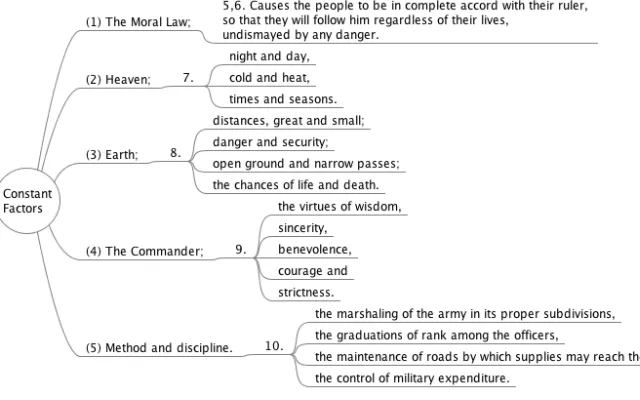
Sun Tzu says: I - 3. The art of war, then, is governed by five constant factors, to be taken into account in one’s deliberations, when seeking to determine the conditions obtaining in the field. These are: ...
See figure 7 for the mind map showing the five constant factors. Enumeration, Description, Rule
This is an extension of the enumeration concept, where the enumerations show a number of descriptions and then lead to a rule to follow.
We give a mind map example of this pattern from chapter 11, paragraph 1-14, see figure 8.
4.3.4
Reformatting Chapter 4, ”Tactical Dispositions”
Figure 7: Mind map showing Constant Factors of chapter 1
We show this text because, as explained earlier, it is awkward to show larger mind maps. This formatting of the text tries to give a feeling for the structure of the mind map and what the results are of analyzing this chapter using a mind map. The text is not altered, but we labelled groups of text. These labels are shown within the angle brackets<and>. By using nested lists, we added more structure. As a result, we see the following subjects: Good Fighter Qualities, Defensive and Offensive Tactics, Excellent Victory, Victorious Strategist, Military Method, and
Victorious Army.
The subjectMilitary Method, is an example of an enumerated concept, referring back to chapter 1. To us, it seems out of place here. We have shown this quote before in 4.
The last subject in this list, talking about a Victorious Army is in fact a metaphorical description of the chapter.
By highlighting the sentences starting withthusandhence we see that these groups: Good Fighter Qualities, Defensive and Offensive Tactics, Excellent Victory
andVictorious Strategist, have a reasoning with a conclusion. These are therefore instances of therulepattern.
We find famous sayings in paragraphs 4 and 15.
4.3.5
The Final Reformatted Text
Figure 8: XI - 1. Sun Tzu said: The art of War recognizes nine varieties of
ground.
• <Good Fighter Qualities>
1. The good fighters of old first put themselves beyond the possibility of defeat, and then waited for an opportunity of defeating the enemy.
2. – To secure ourselves against defeat lies in our own hands,
– but the opportunity of defeating the enemy is provided by the enemy himself.
3. Thus the good fighter is able to secure himself against defeat, but cannot make certain of defeating the enemy.
4. Hence the saying: One may know how to conquer without being able to do it.
• <Defensive and Offensive Tactics>
5. – Security against defeat implies defensive tactics;
– ability to defeat the enemy means taking the offensive.
6. – Standing on the defensive indicates insufficient strength;
– attacking, a superabundance of strength.
7. – The general who is skilled in defence hides in the most secret recesses of the earth;
– he who is skilled in attack flashes forth from the topmost heights of heaven.
7. Thus on the one hand we have ability to protect ourselves; on the other, a victory that is complete.
• <Excellent Victory>
9. Neither is it the acme of excellence if you fight and conquer and the whole Empire says, ”Well done!”
10. – To lift an autumn hair is no sign of great strength;
– to see the sun and moon is no sign of sharp sight;
– to hear the noise of thunder is no sign of a quick ear.
11. What the ancients called a clever fighter is one who not only wins, but excels in winning with ease.
12. Hence his victories bring him neither reputation for wisdom nor credit for courage.
• <Victorious Strategist>
13. He wins his battles by making no mistakes.
– Making no mistakes is what establishes the certainty of victory, for it means con-quering an enemy that is already defeated.
14. Hence the skillful fighter puts himself into a position which makes defeat impossible, and does not miss the moment for defeating the enemy.
15. Thus it is that in war the victorious strategist
– only seeks battle after the victory has been won,
– whereas he who is destined to defeat first fights and afterwards looks for victory.
16. The consummate leader cultivates the moral law, and strictly adheres to method and discipline;
– thus it is in his power to control success.
• <Military Method>
17. In respect of military method, we have,
firstly, Measurement; Measurement owes its existence to Earth;
secondly, Estimation of quantity; Estimation of quantity to Measurement;
thirdly, Calculation; Calculation to Estimation of quantity;
fourthly, Balancing of chances; Balancing of chances to Calculation;
fifthly, Victory. and Victory to Balancing of chances. • <Victorious Army>
19. A victorious army opposed to a routed one, is as a pound’s weight placed in the scale against a single grain.
20. The onrush of a conquering force is like the bursting of pent-up waters into a chasm a thousand fathoms deep.
The resulting text may be less literary interesting that the original, but when we compared our text with a summary of the same chapter 4 in Wikipedia, we were surprised to find that this summary missed some of the points that our structure uncovered as important.
We quote here the summary of the chapter 4 in Wikipedia [52]:
From our analysis there are two points in this chapter that are missing from this summary:
• First, the conclusion that a strategist although making no mistakes himself, cannot win because the enemy makes no mistakes either.
• Second, excellent victories are not rewarded because they seem too easy. There certainly is room for debate about the meaning of this chapter, that is made apparent through our mind mapping.
[image:24.612.127.484.268.474.2]To complete our picture, we show a cut-out of the mindmap that was the basis of the reformatted text of chapter 4, shown above. See figure 9.
Figure 9: Part of the Mind Map of Chapter 4 after text analysis.
4.4
Discussion of Analysing the Text of the ”Art of War”
In this part we tried to analyse ”the Art of War” using mind maps with the purpose of illustrating the logical structure of Sun Tzu’s book. In an ancient text that is not written explicitly as logic, this ”proof” can only be an approximation.
It is an outstanding problem whether a similar transformation is possible when starting from the original text in Ancient Chinese. Our colleague Yanjing Wang considers this feasible, but we evidently need a Chinese collaborator versatile in Ancient Chinese literature and History in order to perform this task.
5
Information, its use, and non-violent Action:
Examples from History and Literature
The ancient Chinese authors discuss information and its use at various places, providing a really modern insight in this matter. The very idea of warfare being based on deception requires to provide the enemy with false information and hiding the truth at the same time. A major difference with the concept of Theory-of-Mind reasoning which is also an essential ingredient of deception is that the Chinese authors are far more explicit when they discuss information and its use.
We indicate two specific fragments from the theoretical studies. Next we will consider a number of stories from history and literature which illustrate interesting game theoretical features.
5.1
T’ai Kung on Secret Letters
In section 25 of the third book (Dragon Secret Teaching) of the Six Secret Teachings (supposed to describe a dialogue which should have occurred more than 3000 years ago), we encounter an instance of the use of a cryptographic technique. The text also illustrates the question-reply-approval structure mentioned in section 1. Since, however, the first recorded written form of this text dates from the warring states era (after 476 BC), this yields no evidence that this form of cryptography actually has been used during the transition era between the Shang and the Chou dynasties, about 1500 years earlier. The same holds for the use of secret tallies as a type of code-book in section 24 of the same text.
Since it is a rather short section, I present the full text from the Sawyer trans-lation in [37]
King Wu asked the T’ai Kung: “The army has been led deep into the territory of the feudal lords and the commanding general wants to bring the troops together, implement inexhaustible changes, and plan for un-fathomable advantages. These matters are quite numerous; the simple tally is not adequate to clearly express them. As they are separated by some distance, verbal communications cannot get through. What should we do?”
The T’ai Kung said: ”Whenever you have secret affairs and major consid-erations, letters should be employed rather than tallies. The ruler sends a letter to the general; the general uses a letter to query the ruler.
The letters are composed in one unit, then divided. They are sent out in three parts, with only one person knowing the contents. ’Divided’ means it is separated into three parts. ’Sent out in three parts, with only one person knowing’ means that there are three messengers, each carrying one part; and when the three are compared together, only then one knows the contents.
of a Sage, they will not be able to recognize the contents”. “Excellent”, said KingWu.
Today we know that a two-part division of a message providing absolute secrecy can be implemented using the famous one-time pad scheme, where the public mes-sage is the exclusive-or sum of the plaintext mesmes-sage and a secret key mesmes-sage of the same lenght which has been transmitted by a safe channel previously (messages are assumed to be coded in binary).
Note that this is an instance of an early use of cryptographic techniques which is not mentioned in the historic survey part of the standard text on cryptography by Kahn [22].
5.2
Sun Tzu on Spies
The final chapter (chapter 13) of Sun Tzu’s The Art of War is dedicated to the use of spies. Given the huge expenses of maintaining an army during a campaign, Sun Tzu considers it immoral to abstain from gathering foreknowledge about the enemy for financial reasons:
2. Hostile armies may face each other for years, striving for the victory which is decided in a single day. This being so, to remain in ignorance of the enemy’s condition simply because one grudges the outlay of a hundred ounces of silver in honors and emoluments, is the height of inhumanity.
The only possible source for this knowledge is from other men:
5. Now this foreknowledge cannot be elicited from spirits; it cannot be obtained inductively from experience, nor by any deductive calculation. 6. Knowledge of the enemy’s dispositions can only be obtained from other men.
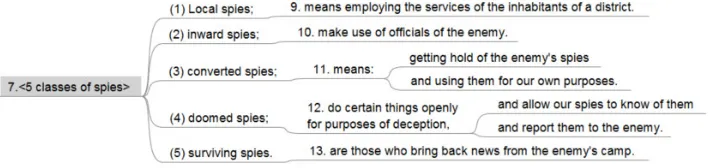
[image:26.612.128.482.514.598.2]Sun Tzu distinguishes five types of spies, as described in paragraph 7 in chapter 13, see figure 10.
Figure 10: 5 Classes of Spies, Sun Tzu, Chapter 13, The Use of Spies
For Clarity, we show below a formatted transcript from the mindmap quote in fig. 10:
• (1) Local Spies; Means employing the services of the inhabitants of a district. • (2) Inward Spies; Make use of officials of the enemy.
• (3) Converted Spies; Means: getting hold of the enemy’s spies and using them for our own purposes.
• (4) Doomed Spies; Do certain things openly for purposes of deception, and allow our spies to know of them and report them to the enemy.
• (5) Surviving Spies; Are those who bring back news from the enemy’s camp. The remainder of chapter 13 discusses how to treat and pamper spies, and how the different types of spies should interact, see figure 11.
Figure 11: Information and Spies, Sun Tzu, Chapter 13, The Use of Spies
Particularly the way information is described as a transportable item in the case of the doomed spy represents a remarkable modern perspective on the concept of information in the book of Sun Tzu.
5.3
Information and Spies in the Romance of the Three
Kingdoms
The Romance of the Three Kingdoms [18] is a historic novel describing events which occurred during a civil war in China at the end of the Han Dynasty during the years 168 – 280 AD. As a piece of literature it has had on Chinese culture an influence comparable to the works of Homerus for Greek and Western culture. Part of the events described in the book are historic; others are inventions produced during the more than ten centuries separating the real events and the first written version of the book.
A short synopsis which may be useful for understanding this section is given in Appendix A.1.
5.3.1
Jiang Gan steals a Letter
Cao Cao sends an old friend of Zhou Yu, Jiang Gan, as an envoy and spy to Zhou Yu in order to persuade Zhou Yu to surrender - Cao Cao controls at this time a stronger army.
Zhou Yu recognizes his old friend to be a spy, but hides this observation, treating Jiang Gan as a honoured guest instead. After a rich dinner party - no politics discussed - and ample amounts of wine, the two go together to sleep in the commanders tent.
During the night Jiang Gan discovers a letter written by two admirals of Cao Cao’s fleet announcing that they will deliver Cao Cao’s head to Zhou Yu. Jiang Gan steals this letter and hurries back to the other side of the river.
His mission to talk Zhou Yu into surrendering has failed but at least he has discovered a pending betrayal. Cao Cao doesn’t hesitate and has his two admirals beheaded; however, as soon as the heads are delivered he realises that he has been tricked by Zhou Yu.
We see here an instance of an enemy spy being used unwittingly as a doomed spy against his employer. As is the case with many of the more interesting stories in the Romance of the Three Kingdoms, this story is labelled to be fictitious. Therefore it does not present a proof that spies were actually used in this way.
5.3.2
The battle at Tong pass
The next story (claimed to be historic [66]) shows how even non-information may be abused in order to set up your enemies against each other. It occurs in chapter 59 of the Romance of the Three Kingdoms.
After his defeat at Red Cliffs (208 AD), the attempts of Cao Cao to extend the territory he controls to the south come to halt. A few years later he attempts to get the Northwest regions under his control (211 AD).
CAo Cao’s first opponent there is the local lord Han Sui, and his nephew Ma Chao who is commander of his army. Earlier Cao Cao has killed the father of Ma Chao and two of his brothers4
Initially Cao Cao had tried to convince Han Sui to surrender and to deliver Ma Chao to him, but Han Sui refused. Han Sui goes to war against Cao Cao, but at Tong Pass, after some initial victories by Ma Chao, the two armies get stuck in a stalemate. Winter is arriving and the two parties start negotiating a truce.
Seeing no way to defeat Ma Chao, Cao Cao designs a plot to create animosity between Ma Chao and Han Sui.
4This element of the story is not historical; according to the official records Cao Cao
During a negotiation in between battles, Cao Cao has a discussion with Han Sui; they discuss in public old events rather than the actual status. Ma Chao can hardly believe that no serious issues have been discussed.
Cao Cao then sends a letter to Han Sui filled with erasures. When asked for an explanation by Ma Chao, Han Sui can’t explain why Cao Cao has produced such a sloppy document which seems to have no content at all.
Cao Cao and Han Sui have another discussion at the battle field, where Cao Cao expresses thanks for the earlier words of Han Sui.
These developments make Ma Chao more and more suspicious, and Han Sui feels it. Subsequently Han Sui figures out that defecting to Cao Cao is after all the wisest policy at this stage. However Ma Chao learns about Han Sui’s intentions to defect to Cao Cao and to organize an murder attempt on Ma Chao.
Ma Chao attempts a pre-emptive strike on Han Sui, who is saved by Cao Cao, but Ma Chao escapes. So, having separated his enemies, Cao Cao becomes victorious at Tong Pass.
Ma Chao eventually will become one of the five tiger generals serving Liu Bei. The curious fact that the ruse is based on a public exchange simulating the exchange of information where there is in fact nothing to be exchanged, has been observed by Chinese commentators as well, as is illustrated in the notes section in [18].
5.3.3
The Ambush at Huarong
A most peculiar event in the Romance of the Three Kingdoms describes the ambush staged at Huarong on the army of Cao Cao during his retreat after the lost battle at Red Cliffs. The ambush is staged by commander Guan Yu (Lord Guan) who implements a strategic plan designed by Zhuge Liang (Kongming). This story is remarkable since it explicitly involves third-order Theory-of-Mind reasoning, and it references Sun Tzu’s teachings.
Cao Cao argues that his opponent Zhuge Liang, a well known and intelligent strategist, has lit fire in the mountains in order to lure him (Cao Cao) into the valley, where he will be ambushed. Strictly in accordance with the teachings of Sun Tzu: appear weak where you are strong and strong where you are weak. However, Cao Cao overlooks the fact that Zhuge Liang has predicted that he will argue in this way (also pointing out that the reasoning by Cao Cao is in accordance with the teachings of Sun Tzu).
The result is that Cao Cao takes the mountain road and subse-quently is ambushed by Guan Yu.
Cao Cao survives because Guan Yu has obligations towards him related to a previous encounter between him and Cao Cao.5
From a Game theoretical perspective the strategic situation is isomorphic to one of the simplest example games in Game Theory: Matching Pennies. Two players E andU both choose head or tails. E wins if the two choices are equal; otherwise U wins the game. If both players move simultaneously the game has no solution other than both players playing the mixed strategy of choosing by flipping a fair coin. In case the players move sequentially, it is evident that the second player wins because he can react on the move by his opponent.
By setting up a fire (having been instructed to do so by Zhuge Liang), Guan Yu actually grants the second move to Cao Cao, thus essentially giving away the game. However this analysis only works if we assume that the players are perfectly rational in a game theoretical sense. And in fact the players are not perfect; they are bounded reasoners.
The story evidently exhibits instances of Theory-of-Mind reasoning: Cao Cao, uses second order Theory-of-Mind reasoning (as he has done as well on several earlier occasions, for example when he indicates the precise locations for the earlier two ambushes), thus showing that his strategic reasoning goes beyond the basic rules of Sun Tzu. However, Zhuge Liang performs third order Theory-of-Mind reasoning, and thus outsmarts Cao Cao and wins the game. Also the references to the teachings of Sun Tzu are explicit. It is a historic fact that Cao Cao is the author of one of the most important commentaries on Sun Tzu.
The story also exhibits Zhuge Liang playing two strategic games at the same time: there is the short time game of damaging Cao Cao, and the long term game of strengthening the position of Liu Bei which requires Cao Cao to survive. Therefore his choice to have Guan Yu stage the third and final ambush is brilliant6.
5According to an ancient commentator this escape has also been foreseen by Zhuge
Liang; even though Guan Yu has promised his head in case he would let Cao Cao escape, Guan Yu observes his obligations to the warrior code. The overall strategic situation makes it advantageous to not eliminate Cao Cao completely, since Liu Bei at this stage would be no match against Sun Quan and his general Zhou Yu. Therefore the plan also works perfectly with respect to this higher order issue.
6
5.3.4
Zhuge Liang borrows Arrows from Cao Cao
The evenst at Huarong are not a first example of Zhuge Liang playing two strategic games at the same time. A previous example is the famous ruse where Zhuge Liang collects arrows from the enemy.
Before the battle at Red Cliffs (208 AD) Zhou Yu assigns to Zhuge Liang themission impossible task of procuring 100 000 arrows. Zhou Yu is almost certain that Zhuge Liang will fail this task, which will provide him with a sufficient excuse to get rid of this troublemaker. Surprisingly, Zhuge Liang doesn’t only accept the task, but promises also to complete it within three rather than ten days.
In order to fulfill the task Zhuge Liang assembles a small fleet of 20 ships, covered by straw and feigns an attack at Cao Cao on the opposite side of the river at dawn in the fog. Cao Cao’s troops are deceived and fire more than 150 000 arrows which are well preserved in the straw, and collected.
In this way Zhuge Liang both has saved his head against the evil plan of Zhou Yu, and also tricked Cao Cao.
The two stories about the ambush at Huarong and about producing the arrows are assumed to be fictitious. The battle at Red Cliffs and the defeat of Cao Cao are historic facts, but the events during his retreat are not. So the concepts mentioned in the story may have been conceived any time between the actual events in 208 AD and the recording of the Romance of the Three Kingdoms in the 14th century. This means that this story cannot be used as proof that theory-of-mind reasoning was consciously used during the warring state era or the Han Dynasty.
5.4
Diplomacy and covert Action
During the Warring States era, China was divided into seven major kingdoms. This means that whenever two kingdoms went to war, there were always several other kings available to form alliances. The actual course of history provides us with a chain of forged and broken alliances during this period, up to the time that China was unified whenQin had defeated the six other kingdoms in 221 BC.
One might expect therefore that building alliances and maintaining them would be an essential part of strategic theory. However, in Sun Tzu’s ”Art of War” the topic of building alliances is hardly mentioned.
We find the phrase alliance or related phrases only six times in the Giles trans-lation. One occurrence is metaphorical, whereas a second one repeats one of the others. This leaves four primary occurrences, all in chapter 11 (the nine situations).
12. On open ground, do not try to block the enemy’s way.
On the ground of intersecting highways, join hands with your allies. 52. We cannot enter into alliance with neighbouring princes until we are acquainted with their designs. We are not fit to lead an army on the march unless we are familiar with the face of the country — its mountains and forests, its pitfalls and precipices, its marshes and swamps. We shall be unable to turn natural advantages to account unless we make use of local guides.
54. When a warlike prince attacks a powerful state, his generalship shows itself in preventing the concentration of the enemy’s forces. He overawes his opponents, and their allies are prevented from joining against him. 55. Hence he does not strive to ally himself with all and sundry, nor does he foster the power of other states. He carries out his own secret designs, keeping his antagonists in awe. Thus he is able to capture their cities and overthrow their kingdoms.
For strategic recommendations on forming alliances and forms of non-violent subversive actions, we must look into the other six classics and other historical sources like the Records of the Grand Historian [41]. An excellent survey on this topic has been published by Sawyer [36]. This book illustrates the extent of spy-craft and diplomacy in Ancient China; the present paper is not the right place to investigate these issues more closely.
A direct and trivial form of subversive action is bribing the enemy, or its min-isters and generals. Recommendations to do so already can be found in the Six Secret strategies, section 15 om Civil offence [37]:
Fourth, assist him in his licentiousness and indulgence in music in order to dissipate his will. Make him generous gifts of pearls and jade, and ply him with beautiful women
5.4.1
The Missions of Zi Gong and Zhuge Liang
A famous story involving diplomacy is the story of the mission of Zi Gong (described in [47] as an illustration of the third strategy: Murder with a borrowed knife), on behalf of Confucius during the late Spring and Autumn period.7 The story involves five different states (emphasized below) and many agents.
The story of the Mission of Zi Gong
The home stateLuof Confucius is on the verge of being attacked by Qias part of a plan designed by Tian Chang, minister of Qi.
7
As an envoy of LuZi Gong first convinces Tian Chang that it would be advantageous for him personally not to attack the weak state Lu but to make war against the mighty stateWuinstead.
It is a win-win scenario: victory overLuis easy but when it is done, the other ministers will reap the benefits. If the war againstWu suc-ceeds Tian Chang’s star will rise and if he looses the state of Qi will be sufficiently weakened so that Tian Chang may usurp its power. Next he travels toWuand convinces king Fu Chai ofWuto attackQi thus providing Tian Chan with a good reason for his change of plans. However, Fu Chai fears that he may be attacked, while at war with Qi, by his neighbours in the stateYue. Therefore Zi Gong travels to Yueand convinces the king of Yue to ally withWu rather than to abuse this opportunity.
Returning toWuhe convinces Fu Chai to accept the support of Yue but not to allow the actual participation of the king of Yuehimself. As a final move Zi Gong travels to the neighboring state of Jin and informs its king about the impending war, and tells him to prepare his armies.
The result of these actions is thatWuattacks and conquersQi; next Fu Chai makes peace withQiandLuand overconfidently attacksJin where he is severely beaten by its well prepared army.
Luis saved.
From a game theoretical perspective the win-win scenario presented to Tian Chang by Zi Gong is most interesting. Furthermore this story exhibits the fairy-tale like pattern where the hero of the story, in order to complete some task, needs the assistance of someone else who assigns yet another task to the hero, a pattern which is repeated several times.
The Mission of Zhuge Liang to Sun Quan
Another famous instance of diplomacy is the legendary trip (described in the Romance of the three Kingdoms [18], ch. 43) of Zhuge Liang to Sun Quan, the king of Wu, in order to talk Sun Quan into an alliance with Liu Bei against Cao Cao.From the perspective of logic it is interesting that Zhuge Liang has to win this debating game in order to succeed in his mission.8
5.5
Sun Bin and the Horses of General Tian Ji
Sun Bin is the author of a second classic text entitledThe Art of War [34]. For a long period he has been identified with Sun Tzu, but an excavation in a Han tomb in 1972 has confirmed that there have been two different authors, believed to have lived 140 years apart.
The text of Sun Bin exhibits a substantial overlap with the teachings of Sun Tzu. He uses different formats: dialogues with the king and general Tian Ji al-ternate with thematic surveys and enumerations. A pattern in Sun Bin which is not explicitly visible in Sun Tzu is that he occasionally compares the importance of various recommendations, as illustrated by the quote from [34] below:
King Wei asked Sun Bin, “Many scholars of Qi have advised me to strenghten the army, but they don’t agree on how this can be done .... Some suggested that I practise a rule of benevolence ..., others recom-mended I distribute grain and provisions among the populace. Still others have suggested I let things run their course...”
To which Sun Bin replied, “None of these is the most crucial in strenght-ening the army.”
King Wei asked, “What then is the most crucial?”
Sun Bin answered, “Make the country prosperous.”When the king re-peated these words, Sun Bin continued,”...it was by making the country prosperous that both King Wei and King Xuan defeated the neighbouring states...”
Other than his text Sun Bin is renowned for two famous stratagems in Classic Chinese history.
StrategyBesiege Wei to Rescue Zhaois listed as the second in the collection of 36 strategies [46, 47]. It is named after a campaign Sun Bin lead on behalf of Qi.
The state of Wei is attacking the state of Zhao and the latter asks for help from the state of Qi.
General Tian Ji, advised by Sun Bin, leads the army of Qi to sup-port Zhao. Rather than supsup-porting the army of Zhao, Sun Bin allows the Wei general Pang Juan to invade Zhao, but launches himself a campaign against the capital of Wei.
When Pang Juan learns about this attack he is forced to withdraw in order to defend his capital, and Sun Bin sets up an ambush on the retreating army and defeats it.
8
Strategy 28 on the list of 36 strategies: Climb up the roof and remove the ladder
is illustrated in [46] by a stratagem attributed to Sun Bin as well.
Ten years after the rescue of Zhao, the history is repeated when Wei invades the state of Hann, and Qi comes to the rescue of Hann by invading Wei. Rather than setting up an ambush straight away on the retreating Wei army, Sun Bin exploits the arrogance of the Wei commander Pang Juan (the same general he has defeated ten years before).
Pang Juan believes that the Qi soldiers are cowards, and Sun Bin confirms him in this belief by diminishing the number of camp fires in the Qi camp every day, thus giving the impression that the soldiers are defecting and fleeing.
Pang Juan, believing that he is chasing an army retreating in panic, pursues his enemy in double speed, and is subsequently ambushed. Pang Juan is killed under a tree in which Sun Bin has carved a message statingPang Juan will die under this tree. Passing at night Pang Juan observes the tree and sees that there is something written on it; he asks for a torch to read it, but this light springs the ambush. Seeing that he is defeated Pang Juan commits suicide under the tree.
A relevant fact is that Pang Juan is the men who originally, while Sun Bin was serving as an adviser for Wei betrayed him and had him jailed under false accusations. Sun Bin escaped by feigning madness. He eventually arrived in Qi where his wits were recognized by general Tian Ji.
From our perspective it is interesting to note that this story involves a prediction which is made true by being announced.
5.5.1
Tian Ji and the Horse Race
The advice which Sun Bin provided to Tian Ji is unrelated to warfare. Tian Ji was involved with regular horse race matches against the king, and he was loosing substantial amounts of gold in the wagers involved in these races. The king simply had better horses. The horses were arranged in three groups: fast horses, ordinary horses and slow horses, and in each group the horses of the king were faster.
Sun Bin recommended to wager once again a substantial amount of gold, but then arrange the matches as follows: Tian Ji places his slow horse against the fast horse of the king, his fast horse against the ordinary one of the king, and his ordinary horse against the slow horse of the king. Thus he wins two out of the three bouts and therefore he wins the bet.
It is remarkable that the general was enabled to determine the pairing of the horses; one would expect that this would be the prerogative of the king, giving the king a guaranteed win.
Another more plausible scenario is that both Tian Ji and the king select an order independently. In this case there are six possible matchings, only one of which wil be winning for Tian Ji. This version of the game has been investigated by Leng and Parlar [24]. They show that under the standard interpretation of this game the solution of the game is that both Tian Ji and the King randomize amongst the six possible orderings. There are however alternative models of this game involving probabilistic outcomes of the races and more refined utilities where the game has more than a single equilibrium solution.
5.6
Conclusions about the use of information in these stories
This section contains a number of pieces of evidence on how the Chinese dealt with information and its use for strategic purposes in War and Diplomacy. Evidently our perspective is rather anachronistic, since we observe these ancient stories and texts from a contemporary perspective.
We have seen that the Chinese used a primitive type of code and of information hiding; this goes against the observation of Kahn [22] who claimed in his first edition that the Chinese didn’t need cryptographic tools since the degree of literacy in the ancient time and the complexity of the Chinese alphabet by itself sufficed for hiding information in practice9.
We have seen that Sun Tzu explicitly advocates the use of spies as a primary source for vital information which can’t be obtained from oracles or similar sources. His concept of the doomed spy as a tool for transporting false information to the enemy presents an unusual modern perspective on the concept of information.
The various stories from the three Kingdoms era and history illustrate how some of these events relate to games, be it that they also indicate the shortcomings of standard game theory for modeling the actual strategic set-up in War or Diplomacy. The clearest shortcomings is the non-validity of common knowledge assumptions, but also the lack of an operator combining games in such a way that a single action can be considered to be a move in two games at the same time.
The story of the ambush at Huarong suggests that at some point in the history the Chinese did understand the importance of depth in Theory-of-Mind reasoning. It should be noted, however, that - even when the story could be labelled to be historic - it is not the first recorded instance of third order theory-of-mind reasoning in a military context. Cline [12] mentions an attack on the Canaanite city Megiddo by the Egyptian Pharao Tuthmose III in 1479 BC. Tuthmose attacks by a narrow and dangerous mountain road, rather than taking the easier accesses by the val-ley. His argument was that the Canaanites would have left this mountain access
9
undefended, since they would never believe that their opponent would be so stupid to choose a road which anybody would recognize to be vulnerable for an ambush. See [12], page 29.
In the next section on previous work we will encounter yet another example of game models in the analysis of the Open City strategy by Cotton and Liu [13].