RESEARCH NOTE
Timed relay contact closure controlled
system for parallel second dimensions
in multi-dimensional liquid chromatography
William Craig Byrdwell
*Abstract
Objective: Short-chain triacylglycerols (TAGs) in lipid extracts of biological samples are not sufficiently resolved using conventional reversed-phase separation on two C18 columns in series, or using a two-dimensional chromato-graphic separation with a silver ion column as the second dimension (2D). An additional dimension of separation was
required.
Results: The hardware and software components to allow a second second-dimension (2D) separation and three
total separation dimensions were developed. Two contact closure (CC) activated 4-port, 2-position valves (4P2PVs) for ultra-high performance liquid chromatography (UHPLC) were joined together and used for one of two second dimen-sions in comprehensive two-dimensional liquid chromatography (2D-LC) coupled to four mass spectrometers simul-taneously in parallel in an LC1MS2 × (LC1MS1 + LC1MS1) = LC3MS4 configuration. A timed contact closure circuit (TCCC) controlled the two UHPLC valves, operated by repetitive CCs for the 4P2PVs. The TCCC-controlled 4P2PVs were used to direct a portion of the 1D eluent to one of the two 2D’s for separation by a quaternary UHPLC system that was
not allowed by the commercial 2D-LC system. The 1D separation was a non-aqueous reversed-phase HPLC
instru-ment used for separation of TAGs; the commercial 2D-LC 2D binary UHPLC was used for silver-ion chromatography of
unsaturated TAGs; and the CC-controlled second 2D was used for separation of short-chain (SC) saturated TAGs.
Keywords: 2D-LC–MS, APCI-MS, ESI-MS, APPI-MS, Contact closure
© The Author(s) 2019. This article is distributed under the terms of the Creative Commons Attribution 4.0 International License (http://creat iveco mmons .org/licen ses/by/4.0/), which permits unrestricted use, distribution, and reproduction in any medium, provided you give appropriate credit to the original author(s) and the source, provide a link to the Creative Commons license, and indicate if changes were made. The Creative Commons Public Domain Dedication waiver (http://creat iveco mmons .org/ publi cdoma in/zero/1.0/) applies to the data made available in this article, unless otherwise stated.
Introduction
Instruments for comprehensive two-dimensional liq-uid chromatography (2D-LC) are now routinely avail-able. Comprehensive 2D-LC produces a separation on a first-dimension (1D) column and all or a portion of the
effluent is directed to a second-dimension (2D) column,
with every peak in the 1D transferred to the 2D column,
in contrast to heart-cutting and other 2D-LC approaches. However, there are limitations inherent in commercially available 2D-LC instruments. For instance, the 2D-LC system was designed for the use of one 2D binary pump
ultra high performance liquid chromatography (UHPLC)
system coupled with the 1D quaternary pump HPLC (or
UHPLC) system. The system could not utilize newer qua-ternary UHPLC systems for the second dimension, since among other things, the software only allowed two sol-vent channels to be configured for the 2D in 2D-LC.
More separation options were needed than were com-mercially available because milk triacylglycerols (TAGs) are very complex and could not be adequately separated using 1D-LC, due to the presence of numerous isobaric isomers. Also, milk TAGs contain a large number of very short-chain fatty acids (SCFAs), down to C4, that were not retained well on the conventional C18 columns nor-mally used for TAG analysis. Furthermore, the SCFAs are saturated, so the TAGs that contained them were not separated using the silver-ion UHPLC used as the 2D to
separate unsaturated TAGs, especially those containing
trans double bonds [1, 2].
Open Access
*Correspondence: [email protected]
Page 2 of 6 Byrdwell BMC Res Notes (2019) 12:477
To overcome these limitations, we employed two con-tact closure (CC) controlled 4-port, 2-position valves (4P2PVs) that were joined together to emulate the eight-port switching valve on the commercial 2D-LC system. To automate the CCs, the 4P2PVs were connected to a timed contact closure circuit (TCCC) that provided consistent timed CCs to switch the 4P2PVs uniformly throughout the chromatographic separation. Control of the TCCC was incorporated into the wireless com-munication contact closure system (WCCCS) that we previously reported [3]. Using this prototype instru-ment configuration we were able to perform separations employing three LC systems and four mass spectrom-eters (LC3MS4), in which the 1D HPLC separation was
monitored using electrospray ionization mass spectrom-etry (ESI-MS) and atmospheric pressure chemical ioni-zation (APCI) MS in parallel (= LC1MS2), and two 2D
UHPLC separations were conducted simultaneously in parallel, with a binary UHPLC using a silver-ion column monitored using atmospheric pressure photoionization (APPI) MS (= LC1MS1) and a quaternary UHPLC using a C8 column monitored using ESI-MS (= LC1MS1). Thus, we report here the hardware and software compo-nents necessary to accomplish 2D-LC having two parallel second dimensions, with detection by four mass spec-trometers simultaneously in parallel, plus 7 other detec-tors, for LC1MS2 × (LC1MS1 + LC1MS1) = LC3MS4. This new experimental arrangement provides a new tool to allow us to conduct method development for complex lipid analysis.
Main Text
Materials and methods
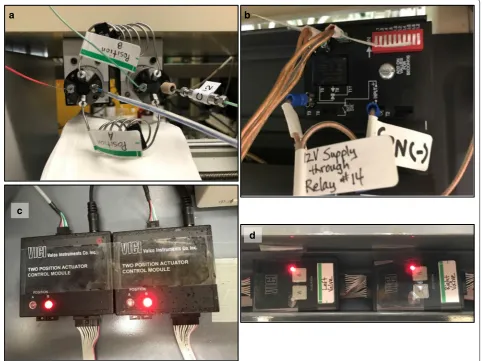
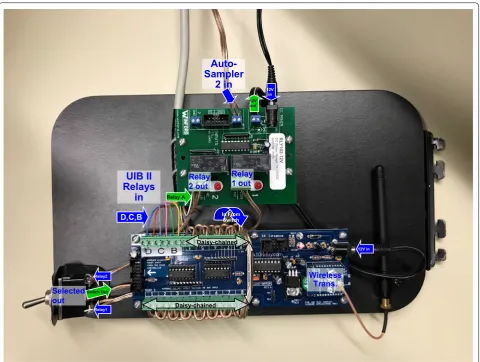
Two Cheminert nanovolume 4P2PVs with micro-electronic actuator (#C85U-6674EMT, Valco Instru-ments Co., Inc., Houston, TX, USA) rated to 20,000 psi (1379 bar) were joined together as shown in Fig. 1a. The microactuators for the two valves were both connected to a 12 V 10A 10-bit DIP-switch-controlled Infitech binary digital power timed delay relay (#BRKR1A411, Infitech, Inc., Syracuse, NY, USA) having a time delay range of 0.1 to 102.3 s as shown in Fig. 1b. The 12 V power required to initiate the on/off recycling of the TCCC was wired through relay #14 of the previously reported WCCCS receiver boards (Ref. 3 Figures 2B, 3). Both WCCCS sender boards were rewired to add indi-vidual controls of relays B, C, and D, as shown in Fig. 2. Relay A was already wired through the single switch on the sender board mounting units, to provide a timed relay as a longer start signal. Switch #14 on the switch distribution manifold made the voltage to the TCCC from the WCCCS switchable between Relay B from the Agilent 1200’s G1329A autosampler or from the Agilent
1290 Infinity Flex II’s Universal Interface Box II (UIB II), either of which was controlled by the relay control timetable in respective versions of OpenLab Chemsta-tion (OLCS) C.01.09 software running on both systems.
Repetitive CCs from the TCCC in Fig. 1b were con-nected to the microelectric actuator control modules (MACMs) shown in Fig. 1c. The CC connections to the two MACMs were joined together to ensure they acti-vated simultaneously, and connected to the horizontal and one vertical spade terminal on the TCCC, as shown as in Fig. 1b. Because both connections were connected to one of the two vertical terminals, the time set on the DIP switch was one-half of the valve cycle time. The maximum setting of the model of TCCC demonstrated here was 102.3 s, so the TCCC could be used for cycle times up to 204.6 s (3.41 min). 2D separations had run
times of 1.91 min (=114.6 s), so the DIP switch was set to 57.3 s, or binary 1000111101.
The same mass spectrometers and other detectors that were used for the previous reports on LC2MS4 were used for the 1D and 2D(1) [2, 4]. Detailed
descrip-tions of the instruments and parameters used for comprehensive 2D-LC with quadruple parallel MS (LC2MS4 = LC1MS2 × LC1MS2) were given previ-ously (see Supplemental Materials to Ref. 4). The Agi-lent Infinity Flex II quaternary UHPLC has been added since that report, and is used for the 2D(2) separation.
The exact same parameters that were used previously were used for the UV and fluorescence (FLD) detectors on the new UHPLC system [4]. The evaporative light scattering detector (ELSD) (G4261B, Agilent Tech-nologies, Santa Clara, CA, USA) was moved from the monitoring the 1D to monitoring the 2D(2). The
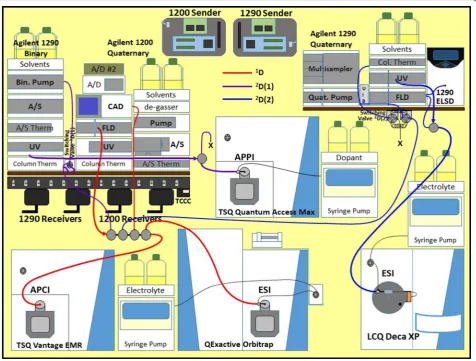
over-all arrangement of over-all liquid chromatographs, auxil-iary detectors, and mass spectrometers is depicted in Fig. 3. The arrangement of branches from the Valco tee flow splitting system previously used [4] was modi-fied slightly to provide flow to the 2D(2). A 75 μm i.d. × 2.5 m long piece of fused silica capillary (#160-2644-10, Agilent Technologies, Inc., Santa Clara, CA, USA) was connected to a Valco union via an adapting sleeve (#F-242X, IDEX Health and Science, LLC, Oak Har-bor, WA, USA), with a 0.10 mm i.d. x 10 cm piece of stainless steel tubing on the distal end to attach to the switching valve (seen at the far right in Fig. 1a). The capillary length produced a flow rate of 53.6 μL/min, so that the fill time of the alternating 100 mL sample loops was 1.86 min, with a total run time (= modula-tion time) of 1.91 min, to exactly match the commer-cial 2D-LC system. Another Valco tee splitter was added after the 2D(2) UV detector (Fig. 3), to split flow
Results and discussion
There were several limitations imposed by the OLCS software that had to be worked around to enable the
2D(2) separation that we desired. First, the 2D-LC
arrangement of instruments that was commercially available only allowed a binary UHPLC pump to act as the 2D separation. Therefore, the quaternary UHPLC
(LC#3) was controlled separately and attached to the 4P2PVs to allow the 2D(2) separation, while the
Agi-lent 1290 binary UHPLC (LC#2) was used for the
2D(1). Second, to accomplish the same type of shifted
gradient that was allowed on the commercial 2D-LC system, each individual sub-gradient had to be manu-ally programmed into the quaternary pump timetable. Unfortunately, the OLCS software has a limit of 100 time steps allowed in gradient timetables. Each sub-gradient was composed of five time points: (1) start
initial isocratic composition, (2) end of isocratic com-position and start of gradient, (3) end of gradient and start of hold composition, (4) end of hold composition and start of recycle gradient, and (5) end recycle to next isocratic composition and held until start of next sub-gradient. Therefore, the 100 allowed steps divided by 5 steps per sub-gradient permitted 20 sub-gradi-ents per UHPLC method. Each sub-gradient was set to 1.91 min to exactly match the shifted gradient times from the commercial 2D-LC binary UHPLC. This was not required, but allowed simplified data analysis using identical parameters to those used for the 2D(1) in the
LC x LC software (GC Image, Inc., Lincoln, NE, USA). Nevertheless, the OLCS software allowed only 20 sub-gradients that were each 1.91 min, for a total method time of 38.2 min. Therefore, two different methods with a
c
b
d
Fig. 1 Components of the timed contact closure circuit (TCCC) controlled dual switching valve system. a two four-port two-position high-pressure
valves joined by sample loops; b TCCC receives activating voltage from relay #14 in wireless communication contact closure system, with DIP switch
[image:3.595.58.541.90.451.2]Page 4 of 6 Byrdwell BMC Res Notes (2019) 12:477
≤ 100 steps each were required to cover the full time used for the 1D separation.
The previously reported [2, 4] first-dimension non-aqueous reversed-phase (NARP)-HPLC (LC#1) sepa-rations of TAGs were shortened to 76.4 min, to exactly match two 38.2 min 2D separation methods on the 2D(2)
UHPLC. The 54 min separation of fat-soluble vitamins (FSVs) was eliminated, since natural cow’s milk is not fortified and does not contain the early-eluting vita-min D that we have analyzed in other samples. To span the length of the 1D NARP-HPLC separation, two
dif-ferent methods were programmed into the quaternary UHPLC (LC#3) OLCS control software, and these were joined together into a “sequence”. The first method in the sequence used the injection parameter “manual
injection”, for which the start was triggered using Relay C of the Agilent 1200 HPLC (1D, LC#1) attached to
the WCCCS sender board #1 (wired identically to that shown in Fig. 2). The second method in the sequence used the injection parameter “no injection”, which started the second method immediately after the end of the first method. Relay A, attached to WCCCS sender board #1 (wired to the autosampler in LC#1 as shown in Fig. 1a in an earlier report [3] and identical to Fig. 2) started the other detectors and components for the 1D (LC#1)
and 2D(1) (LC#2), while relay A from LC#3 attached to
WCCCS sender board #2 started the detectors for the
2D(2). We chose to use a separate relay, Relay C, to start
the Agilent 1290 Infinity Flex II (LC#3) from the Agilent 1200 (LC#1) to allow more flexibility, e.g., to start the
12V in
12V out
Auto-Sampler
2 in
12V in
Relay 1 out Relay
2 out
Relay1 Relay2
Selected out Switch Out
Daisy-chained
Daisy-chained
Wireless Trans.
Relay A
UIB II Relays
in
D,C,B In From Switch
[image:4.595.59.540.86.448.2]2D(2) at a different time to analyze only a sub-section of
the 1D separation, if desired. Since this report describes
the hardware and software components necessary to automate the 2D(2) separation, full details of the
com-plete set of LC gradient parameters will be described in reports of the application of this new system. At the beginning of an experiment, the 2D(2) instrument
(LC#3) was started (“Run Sequence”) and all four mass
spectrometers were started (via various versions of Xcali-bur software), and all waited for the contact closure start signal from the 2D-LC Agilent 1200 autosampler (LC#1), via the WCCCS.
Using the reported combination of instruments, WCCCS (with sender boards, receivers, and switchable contact closure distribution manifold), TCCC, and CC-controlled ultra-high pressure valves, we were able to
Fig. 3 Arrangement of instruments, wireless communication contact closure system (WCCCS) (with sender boards, receivers, and switchable contact closure distribution manifold) and timed contact closure circuit (TCCC) for comprehensive two-dimensional liquid chromatography (2D-LC) with two parallel second-dimensions [2D(1) and 2D(2)], for LC1MS2 × (LC1MS1 + LC1MS1) = LC3MS4. The Agilent 1200 injected sample into the 1D
non-aqueous reversed-phase HPLC system with all flow directed through UV and fluorescence (FLD) non-destructive detectors, then to the splitter
composed of Valco tees and fused-silica capillaries to other detectors and switching valves (SVs). In addition to UV and FLD the 1D was monitored
by a corona charged aerosol detector (CAD) (collected by two A-to-D converters), a tandem sector quadrupole (TSQ) mass spectrometer operated in atmospheric pressure chemical ionization (APCI) mode, and a high-resolution accurate-mass QExactive orbitrap instrument in electrospray ionization (ESI) mass spectrometry (MS) mode with NH4OCOH electrolyte, for five detectors in the 1D. The SV(1) attached to the Agilent 1290 binary
UHPLC system loaded fractions onto a silver-ion column, followed by UV detection, then detection by atmospheric pressure photoionization (APPI)-MS on a TSQ instrument (with acetone dopant added via syringe pump). SV(1) was controlled by the Agilent OpenLab ChemStation (OLCS) 2D-LC software. SV(2) loaded sample onto the Agilent 1290 quaternary UHPLC system with C8 column, followed by detection by UV, then splitting to go through another FLD and to an evaporative light-scattering detector (ELSD) and the other branch going to an LCQ Deca XP ion trap mass
spectrometer in ESI-MS mode with NH4OCOH electrolyte. The 2D SV(2) was controlled by the TCCC via the WCCCS, with a manually programmed
[image:5.595.61.538.89.450.2]Page 6 of 6 Byrdwell BMC Res Notes (2019) 12:477
•fast, convenient online submission
•
thorough peer review by experienced researchers in your field
• rapid publication on acceptance
• support for research data, including large and complex data types
•
gold Open Access which fosters wider collaboration and increased citations maximum visibility for your research: over 100M website views per year
•
At BMC, research is always in progress.
Learn more biomedcentral.com/submissions
Ready to submit your research? Choose BMC and benefit from:
accomplish the first example of the hardware and soft-ware necessary for comprehensive 2D-LC with two paral-lel second-dimensions [2D(1) and 2D(2)], for LC1MS2 ×
(LC1MS1 + LC1MS1) = LC3MS4. This new configura-tion of instruments and CC control hardware and soft-ware allows new types of automated multi-dimensional liquid chromatography for greater separation of complex samples.
Limitations
This work requires a moderate level of mechanical apti-tude to accomplish construction of these components. This work requires the availability of three liquid chroma-tographs and four mass spectrometers.
Abbreviations
1D: first dimension; 2D: second dimension; 2D-LC: two-dimensional liquid
chromatography; 4P2PV(s): 4-port, 2-position valve(s); APCI-MS: atmospheric pressure chemical ionization mass spectrometry; APPI-MS: atmospheric pressure photoionization mass spectrometry; CC(s): contact closure(s); ELSD: evaporative light scattering detector; ESI-MS: electrospray ionization mass spectrometry; FLD: fluorescence detector; FSV(s): fat-soluble vitamin(s); HPLC: high performance liquid chromatography; MACM(s): microelectric actua-tor control module(s); NARP: non-aqueous reversed-phase; OLCS: OpenLab Chemstation; SCFA(s): short-chain fatty acid(s); TAG(s): triacylglycerol(s); TCCC : timed contact closure controlled circuit; UHPLC: ultra-high performance liquid chromatography; UIB: universal interface box; WCCCS: wireless communica-tion contact closure controlled system.
Acknowledgements
Mention or use of specific products or brands does not represent or imply endorsement by the USDA. The help of Mr. Pavel Jakubec in preparation of early experiments is gratefully acknowledged.
Authors’ contributions
This work was conceived of and carried out by the reporting author. The author read and approved the final manuscript.
Funding
This work was supported by internal funding from the USDA Agricultural Research Service. This research received no specific grant from any funding
agency in the public, commercial, or not-for-profit sectors. USDA internal funding provided support for the design of the study and collection, analysis, and interpretation of data and in writing the manuscript.
Availability of data and materials
Not applicable.
Ethics approval and consent to participate
Not applicable.
Consent for publication
Not applicable.
Competing interests
The author declares that there are no competing interests.
Received: 18 June 2019 Accepted: 20 July 2019
References
1. Byrdwell WC. Multiple parallel mass spectrometry for liquid chromatogra-phy. In: Holčapek M, Byrdwell WC, editors. Handbook of advanced chro-matography/mass spectrometry techniques, Chapter 10. Champaign: Elsevier/AOCS Press; 2017. p. 365–405.
2. Byrdwell WC. Blue jacaranda seed oil analysed using comprehensive two dimensional liquid chromatography with quadruple parallel mass spectrometry. Chromatogr Today. 2018;591:56–64.
3. Byrdwell WC. Construction of a wireless communication contact closure system for liquid chromatography with multiple parallel mass spectrom-eters and other detectors. J Lab Autom. 2014;19:461–7.
4. Byrdwell WC. Comprehensive dual liquid chromatography with quad-ruple mass spectrometry (LC1MS2 x LC1MS2 = LC2MS4) for analysis of Parinari Curatellifolia and other seed oil triacylglycerols. Anal Chem. 2017;89:10537–46.
Publisher’s Note