Laboratory evaluation of pavement performance using modified
asphalt mixture with a new composite reinforcing material
Zhen Fu
a,⇑, Wanqing Shen
a, Yue Huang
b, Guolin Hang
a, Xiaotong Li
aaSchool of Materials Science and Engineering, Chang’an University, Xi’an 710064, China
bSchool of the Built Environment, Liverpool John Moores University, Peter Jost Enterprise Centre, Byrom Street, L3 3AF Liverpool, United Kingdom
Received 19 September 2016; accepted 7 April 2017 Available online 18 April 2017
Abstract
As a new way of modifying asphalt or asphalt mixture, composite modification has obvious effects. In order to improve the perfor-mance of asphalt pavement in a simple, fast and efficient way, a new kind of composite reinforcing material (CRM) is used in this study. The Marshall Immersion test, the freeze–thaw splitting test and low-temperature bending test were conducted to evaluate the pavement performance of the asphalt mixture with different CRM contents. Test results show that the pavement performance of modified asphalt mixtures is better than unmodified asphalt mixture. When the CRM content increases, resistance to rutting at a high temperature increases significantly, low temperature cracking resistance and moisture damage resistance first rise and then fall. In consideration of other pavement performance, such as dynamic stability (DS), indirect tensile strength ratio (TSR) and maximum tensile strain, the sug-gested optimal CRM dosage is 5.9‰to 7.9‰.
Ó2017 Chinese Society of Pavement Engineering. Production and hosting by Elsevier B.V. This is an open access article under the CC BY-NC-ND license (http://creativecommons.org/licenses/by-nc-nd/4.0/).
Keywords: Highway engineering; Asphalt mixture; Composite reinforcing material; High temperature stability; Water stability; Low temperature cracking resistance
1. Introduction
The performance of asphalt pavements is strongly affected by the properties of asphalt mixture. With the growth of traffic, the harsh condition of high temperature and heavy axle load, there has been a higher requirement for asphalt concrete performance. In view of this situation, the modification technology to asphalt or asphalt mixture has been studied and improved. The most commonly used modification technology is to add various additives to asphalt or asphalt mixture. Single additive was used in the past but with varied improvement on pavement
perfor-mance. Composite modifiers, such as composite admix-tures with fiber and polymer, composite admixadmix-tures with natural asphalt and fiber, have attracted more attention. Since various components of composite modifiers are used each targeting the improvement of a certain performance, the overall road performance has been improved greatly. However, most of the studies so far focus on the single modification, and research on the composite reinforcement is still in its early stage despite of the increasing demand for its application to highway engineering.
2. Literature review of asphalt mixture additive
So far, the modification materials that are applied into asphalt and asphalt mixture are mainly of three kinds: high-molecular polymer, mineral filter and liquid modifier. Further, high-molecular polymer can be also divided into
http://dx.doi.org/10.1016/j.ijprt.2017.04.001
1996-6814/Ó2017 Chinese Society of Pavement Engineering. Production and hosting by Elsevier B.V.
This is an open access article under the CC BY-NC-ND license (http://creativecommons.org/licenses/by-nc-nd/4.0/).
⇑ Corresponding author.
E-mail address:[email protected](Z. Fu).
Peer review under responsibility of Chinese Society of Pavement Engineering.
www.elsevier.com/locate/IJPRT
ScienceDirect
thermoplastic elastomer (TPE), rubber and resin. Mineral filter includes diatomite, nano materials, carbon black, fibers, etc. Those materials have different modification effects on pavement performance when added into asphalt mixtures. Many scholars and experts at home and abroad have done extensive research on all kinds of materials. The authors talk about those additives including rubber powder [1,2], polyethylene (PE) [3–5], lignin fibers, basalt fiber [6,7] have a significantly improved effect on rutting resistance of asphalt mixture at high temperatures, but not very good in anti-fatigue performance or water stability or low-temperature cracking. There are also some mineral filters have a relatively good performance when used in asphalt mixtures, but the modification effect is limited, such as rock asphalt[8], basalt fiber[9], bio-char[10]. Although additives are various, no one is very good at improving the pavement performance including rutting-resistance, deformation-resistance, anti-fatigue performance, water stability, low-temperature cracking.
Since different modification materials primarily modify a certain performance, it is hard to satisfy every aspect of pavement performance. Thus, the combined use of multiple modification materials has attracted the attention of researchers [11]. Using both the tacky property of polypropylene (PP) fiber at a temperature around its melt-ing point and the high modulus of glass fiber is a possible way to modify asphalt concrete, such that the reinforced product got higher stability and lower flow[12]. Combining crumb rubber and Lignin fiber can improve the overall road performance of rubber asphalt mixture [13]. Double-adding technology (adding anti-rutting agent and lignin fiber simultaneously) is used in this paper to reduce rutting at high temperatures and cracking at low tempera-tures at the same time which can improve the pavement performance [11]. When diatomite and polyacrylate (PAE) are used together to modified asphalt mixture, the high temperature performance and the moisture damage resistance are enhanced simultaneously [14]. Research has showed that the addition of Nano-TiO2/SiO2 can boost
the asphalt rheological characteristics and improve the asphalt mixture’s rutting and fatigue resistance[15].
The modification effect of different additives on asphalt or asphalt mixtures is different. With the research of over years, it is found that lignin fibers added into asphalt mix-ture can absorb asphalt and make the asphalt film attached to aggregate thick, and make the connection between asphalt and aggregate more stable. Natural asphalt, of which production process is simple, is very compatible with petroleum asphalt, and is significant in improving the anti-rutting performance and water damage resistance, and as a modifier in road construction has a wide range of applica-tion advantages. Polymer modified material are various, such as natural rubber (NR), styrene butadiene rubber (SBR), styrene–butadienestyrene (SBS), polyethylene (PE), polyvinyl chloride (PVC), etc. Those materials widely used in modifying asphalt and asphalt mixture. The poly-mer, lignin fiber and natural asphalt have special features
in modifying asphalt mixture separately. However, making the three materials into a new composite material and eval-uating its effects on the performance of modified asphalt mixture is rarely studied. In this paper, the composite rein-forcing material (CRM) is made from polymers, lignin fibers and natural asphalt by a special process. A series of laboratory tests about this CRM asphalt mixture are conducted to illustrate the effect on, and characteristics of, the modified asphalt mixture. This paper provides mix design method, laboratory tests and discussion on results for its application in asphalt pavement.
3. Materials and experiments
3.1. Materials
3.1.1. Asphalt binders
The Shell heavy traffic road petroleum asphalt 70# was used in this study, meeting the requirements of Chinese JTG F40-2004 [16], its main characteristics for asphalt are shown inTable 1.
3.1.2. Aggregates
The fine aggregate and coarse aggregate used in this study are all limestone, and the properties of the aggregates are shown inTable 2(fine) andTable 3(coarse). The min-eral powder used in this study is also made from limestone, and its apparent relative density is 2.74, hydrophilic coeffi-cient is 0.60, the plasticity index is 2.3.
3.1.3. Composite reinforcing material (CRM)
and a combination of those modifications has a positive effect on the rutting resistance, moisture damage resistance and low temperature cracking resistance of asphalt mix-tures. The appearance and characteristics of this CRM are shown inFig. 1andTable 4. The CRM contains about 38% lignin fibers and 62% reinforced materials of polymers and natural asphalts. During the modification process, the CRM is added into hot aggregate before the spray of asphalt binder. The time of dry mixing is suggested to extend for 5 s to help CRM melting.
Because of the composition and morphology of the CRM, it is capable of modifying not only the asphalt bin-der but also aggregates in which CRM plays roles of wedg-ing, fillwedg-ing, wrapping and mesh constraint. So the overall strength of the mixture is improved, and the anti-rutting ability is enhanced. In addition, the CRM has the following advantages. (1) It can be used in a wide range of areas, especially where the material, equipment and construction technology is limited. It can improve the performance of asphalt pavement, for construction or maintenance of roads. (2) It can be used as a reinforcing material, partially or fully replacing the asphalt modifier. (3) Its application to asphalt production has no requirements for amendments of the existing production process and equipment.
3.2. Experimental plan
In order to reflect the modification effects on pavement performance of the CRM, a typical dense gradation (AC-13C) with a nominal aggregate size of 13.2 mm was selected, and the passing rate of key sieve of 2.36 mm is less than 40% by weight of all aggregates, as shown inTable 5. Firstly, in accordance with the Marshall mixture design method, a series of asphalt mixture with the CRM contents of 0%, 0.4%, 0.6%, 0.8% by weight of total mixture were prepared by dry process to determine the optimum asphalt
Table 1
Characteristics of asphalt binder.
Indicator Standard requirements Value
Penetration (25°C, 5 s, 100 g)/0.1 mm 60–80 71
Penetration index PI 1.0+1.0 0.87
Softening point (R&B)/°C 46 46.7
Ductility (15°C)/cm 100 116.3
Density (15°C)/g cm 3 – 0.98
Flash point/°C 260 274
Solubility/% 99.5 99.8
Wax content/% 2.2 1.8
Filmy heating operational test Mass loss/% ± 0.8 0.07
Residual Penetration ratio/% 61 69
[image:3.595.43.561.89.219.2]Ductility (15°C)/cm 15 >100
Table 2
Characteristics of fine aggregate.
Item Standard requirements Value
Apparent relative density/% 2.50 2.709
Sand equivalent/% 60 75
[image:3.595.44.293.260.309.2]Soundness (>0.3 mm)/% 12 15
Table 3
Characteristics of coarse aggregate.
Item Standard
requirements
Value
4.75– 9.5
9.5– 16
Crushed stone value/% 28 7.4 7.8
Los Angeles abrasion value/% 30 12.9 10.4
Apparent relative density/% 2.50 2.763 2.786
Water absorption/% 3 0.72 0.63
Soundness/% 12 8 8
Soft rock content/% 5 2 2
>9.5 mm needle and plate particle content/%
15 – 4.9
<9.5 mm needle and plate particle content/%
20 7.9 –
<0.075 mm grain content, water-washing/%
1 0.3 0.2
Fig. 1. Composite reinforcing material (CRM).
Table 4
Properties of composite reinforcing material.
Name Density (25°C)/g cm 3 Melting point/°C Grain size/mm
[image:3.595.42.293.350.515.2] [image:3.595.49.288.559.730.2]contents (OAC). As a result, the relation between the OAC and CRM contents is concluded. Secondly, the perfor-mance of modified asphalt mixture with different CRM content was evaluated to verify the effectiveness of this additive. Finally, the range of the optimum dosage of CRM was determined by analyzing test data.
3.3. Test methods
All tests carried out in this study are in accordance with the Chinese standard JTG E20-2011[17].
3.3.1. Marshall immersion test and freeze–thaw splitting test
The Marshall immersion test and freeze–thaw splitting test were conducted to evaluate the water stability of the mixture. The specimens in the Marshall immersion test were immersed in water bath at 60°C for 48 h. The speci-mens in freeze–thaw splitting test were subjected to contin-uous freezing at 18°C for 16 h, and thawing at 60°C for 24 h, after which the indirect tensile strength was obtained. The immersion residual Marshall stability (MS) and the freeze–thaw splitting strength ratio were calculated to eval-uate the water stability of the mixtures. The immersion residual Marshall stability (MS) was defined as the Mar-shall Stability ratio of wet and dry specimens. The freeze–thaw strength ratio was defined as the indirect ten-sile strength ratio (TSR) of freeze–thaw and dry specimens.
3.3.2. The wheel tracking test
The wheel tracking test was conducted at 60°C under dry conditions to get the dynamic stability (DS) and to evaluate the high-temperature rutting-resistance character-istics of the asphalt mixtures. The equipment used for wheel tracking test is automatic rut instrument HYCZ-5 made by Beijing aerospace aerospace measurement and control technology institute, which has automatic tempera-ture control system. The dimensions of the slab specimens were 300 mm300 mm50 mm. A solid-rubber wheel traveling at a speed of 42 cycles/min and at a pressure of 0.7 MPa is used to simulate the loading that vehicle driven on pavement layers.
3.3.3. Low-temperature bending test
The low-temperature bending test was to evaluate the tensile performance of asphalt mixtures at low tempera-tures. The experiment equipment is MTS810, mitutoyo ID-S112 LVDT sensors is set behind the middle of beam specimen. After beginning of experiment, concentrated load is put on the middle of team specimen until the beam specimen is destroyed. The system collects the data of dis-placement and load automatically, and the data can be drawn into X-Y recorder. The maximum loading and
middle displacement obtained at the point that the beam specimen is destroyed are the key to calculate flexural strength and maximum tensile strain. The test is conducted at 10 ± 0.5°C and at a load speed of 50 mm/min.
3.3.4. Oven aging test
The aging test was to simulate the aging effect caused by heat and oxidation in the construction process of mixing, transport, spreading and rolling of asphalt mixture. Oven aging test was also able to simulate the short-term and long-term aging of asphalt mixtures during the service life. Short-term aging was to put the asphalt mixtures prepared into oven at 135 ± 1°C for 4 h ± 5 min, the mixture was stirred with a shovel every hour. After the short-term aging, the asphalt mixture was further processed into spec-imens, which was then conditioned in a ventilated oven at 85 ± 3°C for 5 d, to simulate long-term aging during ser-vice life.
4. Results and discussions
4.1. Determination of OAC
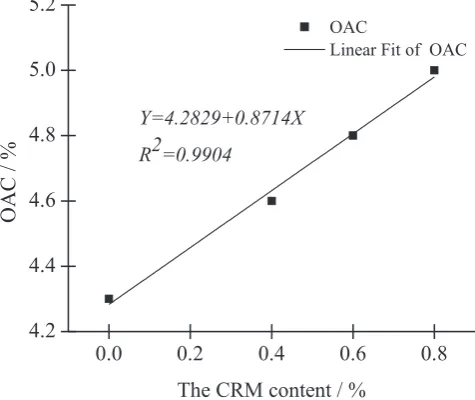
As the composition and morphology of the CRM may affect the OAC, many tests were carried out on the perfor-mance of the modified asphalt mixtures under different CRM contents to determine the OAC. The results are pre-sented in Fig. 2, which show that the OAC of mixtures increase linearly from 4.3% to 5.0% as the CRM content changed from 0 to 0.8%.
In order to verify the accuracy of above regression for-mula inFig. 2, a mixture of 0.5% CRM dosage was pre-pared and tested, and the result indicated that the OAC was 4.75% which is very close to the result obtained through equation:Y= 0.87140.5 + 4.2829 = 4.72. Thus it is affirmed that the regression formula above fits well with the correlation between OAC and the CRM content. Since the performance of different CRM dosage will be studied, the OAC with 1.2% CRM content needs to be determined. The result can be obtained from equation above, when X= 1.2, Y= 0.8714X+ 4.2829 = 0.8714 1.2 + 4.2829 = 5.3.
Fig. 2 shows that the OAC increases about 0.3–0.4% with every additional 0.4% CRM dosage. That is, When the CRM content increases 0.1% by weight of total mix-ture, the OAC will increase by 0.1% for ordinary asphalt mixture. It is necessary to explain that such conclusion can only be restricted to the mix used in the paper. It may not be applicable to other mix designs.
CRM contains lignin fiber, which is an inert organic fiber obtained from chemically treated wood, with stable chemical properties and high temperature resistance, and
Table 5
Gradation of AC-13C asphalt mixture.
Sieve size/mm 16 13.2 9.5 4.75 2.36 1.18 0.6 0.3 0.15 0.075
generally will not be corroded by acid solution. Fiber has a good absorption of asphalt due to its large specific surface. The more fiber in the mixture, the more asphalt will be absorbed, and the OAC will increase as a result. This con-firms the findings by Zhu[18]in previous studies.
4.2. Pavement performance
Laboratory tests were conducted to evaluate the pave-ment performance of modified asphalt mixtures with CRM contents of 0.4%, 0.8%, 1.2% and unmodified asphalt mixture.
4.2.1. Evaluation of high temperature stability
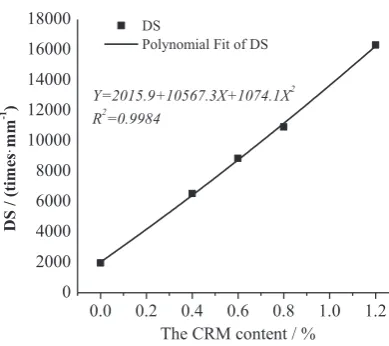
The composite reinforcing material (CRM) can effec-tively improve the high temperature stability of asphalt mixtures. The dynamic stability is improved with the increase of CRM, as shown inFig. 3.
It can be seen fromFig. 3that the dynamic stability of the mixture is 3 times as high as that of unmodified AC-13 when the mixture is added with 0.4% CRM. And it is 5.6 times and 8 times as high as unmodified AC-13 asphalt mixture when CRM increased to 0.8% and 1.2%, respec-tively. Test results show that the rutting resistance of asphalt mixture in high temperatures is improved signifi-cantly when adding an amount of CRM, which can be an effective measure to solve the rutting problem of asphalt pavement.
The reason that the CRM contributes greatly to high temperature stability is that asphalt mixture is produced at a temperature higher than the melting point of CRM (160–170°C as inTable 4), which turned the CRM into a viscous flow state during the process. When the CRM par-ticles deform and play a major role of binder and cohesion between aggregates, they strengthen the bonding between the binder and aggregates, and promote the overall ability of the mixture to withstand the load. In addition, there is
some natural asphalt present in the CRM. The amount of asphaltene in natural asphalt is much greater than that in base asphalt, the content of asphaltene in modified asphalt will thus increase, resulting in an increase of polar-ized substances in bitumen, which promoted the bond between molecules and enhanced the viscosity. Therefore, it is more difficult to break the bond between them unless the temperature is high enough. And the dynamic stability of asphalt mixture is an important indicator of its high temperature stability.
4.2.2. Evaluation of low temperature cracking resistance
The test results show that the ultimate flexural tensile strength and the maximum tensile strain of asphalt mixture are improved after adding composite reinforcing material, as shown inFig. 4.
When the CRM content is 0%, flexural tensile strength and maximum tensile strain of the asphalt mixture are 7.8 MPa and 2003le. When the CRM content increases, flexural tensile strength and maximum tensile strain increase at first and then decrease. When the content is 0.4%, the flexural tensile strength reaches the maximum value of 10.5 MPa, an increase by 34.6% compared with unmodified asphalt mixture. When the CRM content is 0.8%, the tensile strain reaches a maximum value of 2766le, i.e. 38.1% higher compared with that of unmodi-fied asphalt mixture. Although the improvement of low temperature performance is not particularly substantial, it is still able to produce a positive effect on the low temper-ature cracking resistance of mixture showing a good appli-cation prospect.
[image:5.595.49.287.72.272.2]Due to the ability of asphalt binder to withstand low temperature tensile stress, the contribution of asphalt bin-der to the cracking resistance of asphalt mixture is much higher than that of aggregates. The asphalt binder filled between aggregates will play a role of bonding when temperature drops, so that asphalt mixture doesn’t crack prematurely. However, when the temperature is lowered
Fig. 2. Relationship between OAC and CRM contents.
[image:5.595.323.544.81.254.2]to a certain extent, ordinary asphalt binder will not be able to withstand the excessive tensile stress and cracks will appear. The CRM used in this research is a new type of anti-rutting agent which is made from a mix of high poly-mer material, lignin fiber, natural asphalt and chemical agents. The polymer material for asphalt modification is able to increase its strength and toughness and meanwhile maintain its low temperature flexibility. The friction angle and cohesive force of asphalt binder can be improved by the incorporation of lignin fiber, which can also improve the shear strength of asphalt mixture and contribute to the low temperature performance of the mixture[19].
4.2.3. Evaluation of water stability
Water stability of asphalt mixture is mainly determined by the nature of mineral aggregate, the interaction between asphalt and mineral aggregate, the air void of asphalt mix-ture, and the thickness of asphalt film. Generally, water is easier to infiltrate aggregate surface than asphalt binder which then reduces the adhesion between asphalt and aggregates, and leads to moisture damage to the asphalt mixture [20]. So the presence of water is largely a threat to the asphalt mixture in road pavement.
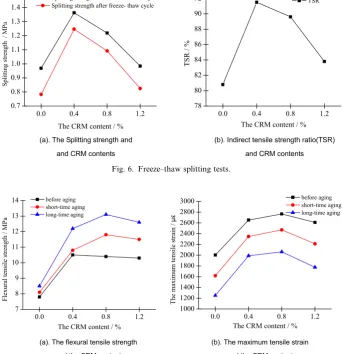
The relationship between immersion residual stability and freeze–thaw splitting strength with CRM contents is shown in Figs.5and6(a, b), respectively.
The immersion residual stability ratio of unmodified asphalt mixture is 88.2% and the indirect tensile strength ratio (TSR) is 80.8%. When adding 0.4% CRM modifier, the immersion residual stability ratio and the TSR increase to 93.9% and 91.5%, respectively. If the content of modifier continues to increase, the immersion residual stability ratio and the TSR start to decrease.
Figs.5(b) and6(b) show that the immersion residual sta-bility ratio is higher than the indirect tensile strength ratio (TSR) with the same content of modifier. The reason is that the specimens for Marshall Immersion test were compacted 75 times and porosity of the specimens has been reduced to
3–5%. It is difficult for water to enter the gap between aggregates and asphalt films, and thus water damage is less likely to occur. Porosity of the specimens for freeze–thaw split test is controlled at 7%, where the specimens were compacted 50 times closer to the actual compaction on site
[21]. CRM is a viscous fluid with good deformation ability at high temperatures. It is able to fill large pores, change their structure, and reduce the number of connected pores so effectively and prevent the migration of asphalt binder. The lignin fiber in CRM is porous, it has a strong tendency to adsorb asphalt, making the asphalt film on mineral aggregates thicker, and the amount of free asphalt is reduced as a result. This improves the adhesive force between asphalt and aggregates and enhances the water resistance of the asphalt mixture. In addition, the polymer materials in CRM can enhance the adhesion between bin-der and aggregates, and make it more resistant to water induced damage.
4.2.4. Evaluation of aging performance
The short-term aging (4 h) and the long-term aging (5 days) tests were carried out with 4 different CRM dosages of 0%, 0.4%, 0.8%, 1.2%. Then the water stability and low temperature cracking resistance were tested (high temperature stability is not appropriate because aging can produce beneficial effects on it). The change of the aging behavior of modified asphalt mixture was evaluated by flexural tensile strength, the maximum tensile strain and indirect tensile strength ratio (TSR). Test results are shown inFigs. 7 and 8.
On the one hand, the aging process makes aggregates absorb more asphalt; on the other hand, asphalt is subject to the effects of heat and oxygen[22]. Both effects increase the stiffness of asphalt, and weaken the low temperature ability (e.g. anti-cracking). With aging continuing, the flex-ural tensile strength increases, while the maximum tensile strain decreases, which is shown inFig. 7. The trabecular specimens in the low temperature bending test crack along the interface between aggregates. With the propagation of cracks, an extrusion and shear action to large particles appear, and eventually lead to the compression-shear dam-age. The stiffness of asphalt binder is increased after aging, so is the interface bond with mineral aggregate. The more the binder is aged, the greater the flexural tensile strength becomes. The asphalt binder becomes hard and brittle after aging, which is unable to resist large deformation in low temperatures. The more the binder is aged, the smaller the deformation when the mixture fails. The failure strain depends on the mid-span deflection when the trabecular specimens fail. The maximum tensile strain of the mixture after aging is inversely proportional to the degree of aging.
[image:6.595.39.278.66.258.2]Fig. 7 shows that although modified asphalt mixture can barely meet the technical requirements after short-term aging, and its performance fell sharply after long term aging, it is still better than the unmodified asphalt mixture. With regard to water stability of the aged asphalt mix-tures, when the CRM content increases from 0.4% to
0.8% and 1.2%, the TSR value of asphalt mixture is improved by 6%, 1.1% and 0.2%, respectively, compared with unmodified asphalt mixture after short term aging, and by 8.2%, 5.4% and 5.4% after long term aging, which is shown in Fig. 8. Thus, the incorporation of CRM can
effectively reduce the influence of aging effect on the water stability of asphalt mixture.
[image:7.595.132.469.73.219.2]For short-term and long-term aging situation, low tem-perature performance and moisture damage resistance of modified asphalt mixture are improved with the use of
[image:7.595.133.471.77.442.2]Fig. 5. Marshall immersion tests.
Fig. 6. Freeze–thaw splitting tests.
[image:7.595.131.474.273.628.2]CRM. The flexible tensile strength and maximum tensile strain see an optimal value at a CRM content of 0.8%, while the TSR value reaches highest with a CRM content of 0.4%. Therefore, CRM has a positive effect on the aging property of asphalt mixture.
4.3. Determination of the optimum dosage of composite reinforcing material
Five CRM contents with 0%, 0.4%, 0.6%, 0.8%, 1.2% was chosen to conduct tests of freeze–thawing split tests, high-temperature rutting tests, low-temperature bending tests. The indirect tensile strength ratio (TSR), maximum tensile strain and dynamic stability (DS) can be obtained. As the CRM content changes, indirect tensile strength ratio (TSR), dynamic stability (DS) and maximum tensile strain present a certain pattern of change, as shown in
Fig. 9.
An environment in which water and temperature has a detrimental effect on the asphalt mixture was simulated. In the Technical Specification for Construction of Highway Asphalt Pavements, the stipulation about TSR in the worst environment is at least 85%, while the Failure strain is at least 2800le in the relative worse environment. In paper, the author improves 5% on the basis of TSR stipulation and makes 90% as the threshold value. Failure strain of
2800leand TSR of90% are selected as technical stan-dards for low temperature stability and water stability.
Fig. 9(a) shows the change of low temperature stability against CRM content. When the CRM content increases, the maximum tensile strain of asphalt mixture increases firstly and then decreases. When adding 0.59–0.95% CRM, the tensile strain of the modified asphalt mixture can reach a value above 2800le.
Fig. 9(b) shows the change of water stability against CRM content, which shows a similar trend to Fig. 9(a).
[image:8.595.312.527.56.708.2]When adding 0.27–0.79% CRM, the indirect tensile strength ratio (TSR) of modified asphalt mixture can reach a value above 90%.
Fig. 8. Freeze–thaw splitting tests after aging.
[image:8.595.40.279.66.277.2] [image:8.595.312.538.76.252.2] [image:8.595.314.509.500.673.2]Fig. 9(c) shows the change of high-temperature stability against CRM content. It can be seen that the dynamic sta-bility (DS) presents a linear relationship with the increase of CRM.
Along with the increase of amount of Material CRM, the value of dynamic stability improves constantly, it has a positive effect on high-temperature rutting-resistance. This effect is not same to water stability and low-temperature performance. Author thinks that the cause may lie in: when the amount of CRM is over, the disper-sion effects of granular CRM in asphalt is not very homo-geneous, because the amount of asphalt is certain, the net structure formed by CRM dispersing in asphalt is not an ideal state to cover aggregate. This kind of heterogeneous state seriously affects the performance including water sta-bility and low-temperature cracking-resistance. That is a possible reason for deteriorated phenomenon when the amount of CRM is beyond the optimum dosage.
An important finding of this study is that the optimum content of modifier ranges from 0.59% to 0.79% consider-ing both the low temperature stability (Fig. 9(a)) and water stability (Fig. 9(b)). The dynamic stability increases in pro-portion to the CRM content within the investigated range, with a value from 8507 times mm 1to 10,748 times mm 1. Thus, when the content of CRM is between 0.59% and 0.79%, the road performance of asphalt mixtures is better in general. However, the choice of specific content should also consider the cost, environment and traffic requirement which may change the weighting of these technical criteria.
5. Conclusions
Through laboratory tests of asphalt mixtures modified by CRM, the pavement performance made using the CRM modified asphalt mixture is evaluated. Based on the results, the following conclusions can be drawn.
(1) The high temperature stability of asphalt mixtures modified by CRM is improved compared to unmod-ified asphalt mixture. The dynamic stability continues to rise with the increase of CRM, and the low temper-ature cracking resistance and moisture damage resis-tance increase at first with CRM and then decrease, but all higher than those of unmodified asphalt mix-tures. The optimal CRM dosage range of 5.9–7.9% in asphalt mixtures is determined using freeze–thaw splitting ratio and failure strain.
(2) The modified asphalt mixtures can still remain good water stability and low temperature cracking resis-tance compared to unmodified asphalt mixtures, after short-term aging. The performance deteriorates to some extent after long-term aging, but the overall performance is still significantly better than unmodi-fied asphalt mixtures. Therefore, CRM has a positive effect on improving the aging resistance of asphalt mixtures.
Acknowledgments
This research is supported by the funds of Natural Science Found Committee (NSFC) of China (No.51108038 and No. 51108039), and the Special Fund for Basic Scientific Research of Central Colleges, Chang’an University (310821152004), Shaanxi Science and Technol-ogy Research Development Project (No. 2013KJXX94 and No. 2013KW24).
The authors declare that there is no conflict of interest regarding the publication of this article.
References
[1] Nuha Salim Mashaan, Asim H. Ali, Suhana Koting, Dynamic properties and fatigue fife of stone mastic asphalt mixtures reinforced with waste tyre rubber, Adv. Mater. Sci. Eng. (2013), http://dxdoi. org/10.1155/2013/319259.
[2] Sungun Kim, Sung-Jin Lee, Yeo-Bin Yun, The use of CRM-modified asphalt mixtures in Korea: evaluation of high and ambient temperature performance, Constr. Build. Mater. 67(SI) (2014) 244– 248.
[3]Jeonga Kyu-Dong, Lee Soon-Jae, K.W. Kim, Laboratory evaluation of flexible pavement materials containing waste polyethylene (WPE) film, Constr. Build. Mater. 25 (4) (2011) 1890–1894.
[4]Moatasim Attaelmanan, Cheng-Pei Feng, Al-Hadidy Al, Laboratory evaluation of HMA with high density polyethylene as a modifier, Constr. Build. Mater. 25 (5) (2011) 2764–2770.
[5] Yuan-yuan Sui, Zhong-da Chen, Application and mechanism of a new type of polyethylene modifying additive in asphalt mixture, in: 7th International Conference on MEMS, NANO and Smart Systems, Kuala Lumpur, Malaysia, 2012.
[6]Qun-shan Ye, Hong-xin Guan, Properties of asphalt mixtures containing various fibers, J. Test. Eval. 40 (5) (2012) 708–714. [7]O.S. Abiola, W.K. Kupolati, E.R. Sadiku, Utilisation of natural fibre
as modifier in bituminous mixes: a review, Constr. Build. Mater. 54 (2014) 305–312.
[8]Zhao-feng Lu, Zhao-yi He, Min Qin, Pavement performance of asphalt mixture modified by rock asphalt, J. Central South Univ. (Science and Technology) 41 (6) (2010) 2407–2411.
[9]Fu Zhen, Huang Zhen, Ma Feng, Effect of basalt fiber on the road performance of agedasphalt mixture, Mater. Rev. 30 (1) (2016) 118– 122.
[10]Sheng Zhao, Bao-shan Huang, Xiang Shu, Laboratory investigation of biochar-modified asphalt mixture, Transp. Res. Rec. 2445 (2014) 56–63.
[11]Fu Zhen, Yanni Dang, Bo Guo, et al., Laboratory investigation on the properties of asphalt mixtures modified with double-adding admixtures and sensitivity analysis[J], J. Traffic Transp. Eng. (English Edition) 3 (5) (2016) 412–426.
[12]Sayyed Mahdi Abtahi, Saman Esfandiarpour, Mehmet Kunt, Hybrid reinforcement of asphalt-concrete mixtures using glass and polypropylene fibers, J. Eng. Fibers Fabr. 8 (2) (2013) 25–35.
[13]Hasi Tuya, The road performance of lignin and rubber powder composite modified asphalt mixture, Highway Eng. 39 (6) (2014) 170– 174 (in Chinese).
[14]Qiu-sheng Hu, Gang Zhou, Huo-ming Wang, et al., The water stability of PAE and diatomite composite modified asphalt mixture, J. China Foreign Highway 35 (4) (2015) 282–284 (in chinese). [15]G.H. Shafabakhsh, O. Jafari Ani, Experimental investigation of effect
[16] JTG F40–2004. Technical Specification for Construction of Highway Asphalt Pavements. People’s Republic of China Ministry of Transportation.
[17] JTG E20–2011. Standard Test Methods of Bitumen and Bituminous Mixtures for Highway Engineering. People’s Republic of China Ministry of Transportation.
[18] Zhao-hui Zhu, Study on the Road Performance of Asphalt Mixture with External Fiber, Master Dissertation, Chang’an University, Xi’An, Shaanxi, China, 2004 (in chinese).
[19]Xin-qiao Xia, Xiao-jun Fan, Study on fiber asphalt mixture shear strength, Highway Eng. 38 (2) (2013) 84–86.
[20] Dong-liang Xu, Study on Water Stability of High Performance Asphalt Mixture, Master Dissertation, Chongqing Jiaotong Univer-sity, Chongqing Municipality, China, 2008.
[21]Wen-you Chen, The comparison and election among several existing asphalt mixture water stability test method, Highway 58 (7) (2014) 335–338.