Commission of the European Communities
The Community's
research and development programme
on decommissioning of nuclear installations
Fourth annual progress report 1988
C 5 ¿igo¿
G
Commission of the European Communities
nuclear science
and technology
The Community's
research and development programme
on decommissioning of nuclear installations
Fourth annual progress report 1988
Ghe^*®*
0
ZW
Directorate-General
Science, Research and Development
1989
Í
f
Ai
ŢL
I
UR
?.
DiLÜotb.
Published by the
COMMISSION OF THE EUROPEAN COMMUNITIES Directorate-General
Telecommunications, Information Industries and Innovation L-2920 Luxembourg
LEGAL NOTICE
Neither the Commission of the European Communities nor any person acting on behalf of the Commission is responsible for the use which might be made of
the following information
Cataloguing data can be found at the end of this publication
FOREWORD
This is the fourth and last Annual Progress Report of the European Community's 1984-88 programme of research on the decommissioning of nuclear installations. It covers the year 1988 and follows the 1985, 1986 and 1987 Reports /1,2,3/.
The Council of the European Communities adopted the programme in January 1984 /4/, considering: "Certain parts of nuclear installations inevitably become radioactive, during operation; it is therefore essential to find effective solutions which are capable of ensuring the safety and protection of both mankind and the environment against the potential hazards involved in the decommissioning of these installations".
Also, the Council recognized that the 1979-83 programme of research on the decommissioning of nuclear power plants, of which the current pro-gramme is a follow-up, "has yielded positive results and opened up encouraging prospects". The main publications relating to the results of this first programme are listed in Annex I.
The 1984-88 programme has the following contents:
A. Research and development projects concerning the following subjects: Project N° 1: Long-term integrity of building and systems;
Project N° 2: Decontamination for decommissioning purposes; Project N° 3: Dismantling techniques;
Project N° 4: Treatment of specific waste materials: steel, concrete and graphite;
Project N° 5: Large containers for radioactive waste produced in the dismantling of nuclear installations;
Project N° 6: Estimation of the quantities of radioactive wastes arising from the decommissioning of nuclear installa-tions in the Community;
Project N° 7: Influence of installation design features on decommis-sioning.
B. Identification of guiding principles, namely:
- certain guiding principles in the design and operation of nuclear installations with a view to simplifying their subsequent decommis-sioning,
- guiding principles in the decommissioning of nuclear installations which could form the initial elements of a Community policy in this
field.
C. Testing of new techniques under real conditions, within the framework of large-scale decommissioning operations undertaken in Member States.
The research is carried out by public organisations and private firms in the Community under cost-sharing contracts with the Commission of the European Communities. The Commission budget planned for this five-year programme amounts to 12.1 million ECU. The main publications relating to the results of this programme are listed in Annex II.
The Commission is responsible for managing the programme and is assisted in this task by the Management and Coordination Advisory Commit-tee "Nuclear fission energy - Fuel cycle/processing and storage of waste" (see Annex III).
The present report describes the objectives, scope and work program-me of each research contract concluded, as well as the progress of work achieved and the results obtained in 1988.
For each contract, the Paragraph " C . Progress of Work and Obtained Results" has been prepared by the contractor, under the responsibility of the Project Leader. The Commission wishes to express its gratitude to all scientists of the contractors who have contributed to this report.
The Commission staff having edited the report are: E . Skupinski, R. Bisci and K. Pflugrad.
B. Huber
Head of the Programme
References
. / / l / "The Community's research and development programme on decommission-^ ing of nuclear installations. First annual progress report (year
1985)". EUR 10740, 1986.
/ 2 / "The Community's research and development programme on decommission-ing of nuclear installations. Second annual progress report (year 1986)". EUR 11112, 1987.
/ 3 / "The Community's research and development programme on decommission-ing of nuclear installations. Third annual progress report (year 1987)". EUR 11715, 1988.
CONTENTS
Page
1. PROJECT N° 1: LONG-TERM INTEGRITY OF BUILDINGS AND SYSTEMS -\
1.1. Deterioration assessment of nuclear power station buildings. 2 1.2. Long-term stability and leak-tightness of reactor
containments 6 1.3. Consequences of suppression of negative pressure in the
KW-Lingen containment -. 11
2. PROJECT N° 2: DECONTAMINATION FOR DECOMMISSIONING PURPOSES 17 2.1. Complete decontamination of a primary steam piping of the
Lingen BWR 18 2.2. Aggressive chemical decontamination tests on valves from the
Garigliano BWR 19' 2.3. Decontamination using chemical gels, electrolytical swab and
jet, abrasives 2 5 2.4. Development of an easy-to-process electrolyte for
decontami-nation by electropollshing 26 2.5. Optimisation of filtering systems for various concrete
decontamination techniques 2 7 2.6. Economic comparison of decontamination and direct melting
with a view to recycling of scrap 2 8 2.7. Remote electrochemical decontamination for hot cell
applications 2 9 2.8. Decontamination with pasty pickling agents forming a
strippable foil » 34 2.9. Rack-torch unit for remote decontamination of concrete 38
2.10. Feasibility of concrete decontamination using a
plasma-augmented burner 39 2.11. Closed electropollshing system for decontamination of
underwater surfaces 42 2.12. Development of vibratory decontamination with abrasives .... 4 8
3. PROJECT N° 3: DISMANTLING TECHNIQUES 53 3.1. Ventilation and filtration techniques for thermal cutting
operations 54 3.2. Prefiltering devices for gaseous effluents from dismantling
operations 60 3.3. Dross and ultrafine particulate formation in underwater
plasma-arc cutting 64 3.4. In-situ arc-saw cutting of heat exchanger tubes and of pipes
from the inside 71 3.5. Electrochemical technique for the segmenting of activated
steel components » 7 2 3.6. Explosive techniques for the dismantling of biological
shield structures 73 3.7. Explosive techniques for dismantling of activated concrete
structures 79 3.8. Prototype system for remote laser cutting of radioactive
structures 8 5 3.9. Investigations of applications of laser cutting in
decommissioning 88 3.10. Spreading and filtering of radioactive by-products of
under-water segmenting 94
-3.11. Development of a prototype system for remote underwater
plasma-arc cutting 100 3.12. Adaptation of a robot and tools for dismantling of a
gas-cooled reactor 104 3.13. Remote measuring and control systems for underwater cutting
of radioactive components 111 3.14. Removal of concrete layers from biological shields by
microwaves 116 3.15. Adaptation of an existing air-tight and modular workshop
for remote operation , 117
3.16. Adaptation of abrasive water jet to cutting of radioactive
steel and concrete 118 3.17. Development of abrasive water jet for submerged cutting of
steel 123 3.18. Analysis of results obtained with different cutting
techniques and associated filtration systems 129 3.19. Measurements of effluents from plasma arc and laser cutting. 133
4. PROJECT N° 4: TREATMENT OF SPECIFIC WASTE MATERIALS: STEEL,
CONCRETE AND GRAPHITE 137 4.1. Melting/refining of contaminated steel scrap from
decommissioning ► 138
4.2. Melting of radioactive metal scrap from nuclear
installations 141
4.3. Separation of stainless steel constituents using transport
in the vapour phase 143
4.4. Immobilisation of contamination of large waste units by
polymer coating 145
4.5. Treatment of active concrete dust by slurry setting method.. 148
4.6. Investigations into the melting of radioactive metal waste
in a controlled area 154
4.7. Behaviour of actinides and other radionuclides that are
difficult to measure, in melting of steel 155
4.8. Conditioning and disposal of radioactive graphite bricks
from reactor decommissioning 160
4.9. Separation of contaminated cementstone and
noncontaminated concrete aggregates 164
5. PROJECT N° 5: LARGE TRANSPORT CONTAINERS FOR RADIOACTIVE WASTE
PRODUCED IN THE DISMANTLING OF NUCLEAR INSTALLATIONS 169
5.1. Design and evaluation of large containers for reactor
decommissioning waste » 170
5.2. Large waste containers made of fibrereinforced cement 175
5.3. Large waste containers cast of lowlevel radioactive metal
scrap 179
6. PROJECT N° 6: ESTIMATION OF THE QUANTITIES CF RADIOACTIVE WASTE ARISING FROM THE DECOMMISSIONING OF NUCLEAR INSTALLATIONS IN THE
COMMUNITY 183
6.1. The assessment of lowlevel contamination from gammaemit
ting radionuclides 184
6.2. Development of methods to establish the curie content of
radioactive waste from decommissioning 185
6.3. Systems for contamination measurements on curved surfaces... 188
6.4. Optimisation of measurement techniques for very lowlevel
6.5. Monitoring gamma radioactivity over large land areas using
portable equipment 194 6.6. Radioactive wastes arising from the dismantling of a
commercial Fast Breeder Reactor 198 6.7. Methodology for assessing suitable systems for management
of reactor decommissioning wastes 203 6.8. Radiological evaluation of releasing very low-level
radioactive copper and aluminium 2 06
7. PROJECT N° 7: INFLUENCE OF NUCLEAR INSTALLATION DESIGN FEATURES ON
DECOMMISSIONING 209 7.1. Decontamination and remote dismantling tests in the ITREC
reprocessing pilot plant 210 7.2. Testing of cobalt-free valve seatings using a special test
loop 215 7.3. Pre-stressed concrete reactor vessel with built-in planes
of weakness • 220 7.4. In-situ sealing of concrete surface by organic impregnation
and polymerisation 226 7.5. Influence of design features on decommissioning of a large
Fast Breeder Reactor 234
8. SECTION C: TESTING OF NEW TECHNIQUES UNDER REAL CONDITIONS 241 8.1. Dismantling and decontamination of a feedwater preheater
tube bundle of Garigliano BWR 242 8.2. Conditioning, transport and dismantling of very large
plutonium glove-boxes 247 8.3. Large-scale application of segmenting and decontamination
techniques 248 8.4. Development of techniques to dispose of the Windscale AGR
heat exchangers 254 8.5. Pilot decommissioning of a mixed-oxide fuel fabrication
facility 253 8.6. Testing of new techniques in decommissioning of a fuel
(U, Th) fabrication plant 263 8.7. Decontamination and dismantling of the PIVER prototype
vitrification facility 2 66 8.8. Dismantling, partly in-situ, of a glove-box structure of a
mixed-oxide fuel plant 271 8.9. Melting of radioactive metal scrap from the KRB-A plant .... 2 77
8.10. Volume and plutonium inventories before and after
dismantl-ing of a mixed-oxide fuel plant 282 8.11. Decontamination, before dismantling, of the primary coolant
system of the RAPSODIE FBR 285 8.12. Automated measuring system for waste from dismantling of
the KKN plant, to be released 2 89
ANNEX I LIST OF PUBLICATIONS RELATING TO THE RESULTS OF THE 1979-83 PROGRAMME ON THE DECOMMISSIONING OF NUCLEAR POWER PLANTS ... 295
ANNEX II LIST OF PUBLICATIONS RELATING TO THE RESULTS OF THE 1984-88 PROGRAMME ON THE DECOMMISSIONING OF NUCLEAR INSTALLATIONS ..299
ANNEX III MEMBERS OF THE MANAGEMENT AND COORDINATION ADVISORY
COMMITTEE "NUCLEAR FISSION ENERGY - FUEL CYCLE/PROCESSING
AND STORAGE OF WASTE" 301
-1. PROJECT N°l:
LONG-TERM INTEGRITY OF BUILDINGS AND SYSTEMS
A. Objective
It has been proposed that the dismantling of nuclear installations be delayed for periods ranging from several decades to about a hundred years. Thereupon, the radioactivity having largely died away, dismantling would be easier and the radiation exposure of the dismantling personnel would be less. The objective-of this project is to determine the measures required for maintaining shut-down plants in a safe condition and to assess the radiological consequences and costs.
B. Research performed under the 1979-83 programme
The work performed under the previous programme relates mainly to the> following aspects:
- mode and pace of degradation of various materials as they exist in nuclear power plants;
- measures for maintaining plants in a safe condition and for keeping the necessary ancillary systems operable;
- monitoring and inspection procedures;
- radiological consequences and costs of maintaining the plants.
C. 1984-88 programme
The work performed under the first five-year programme should be comple-mented by further tests and the study of control methods relating to the
aging of relevant plant materials and by exploitation of additional experience with shut-down nuclear installations.
D. Programme implementation
Three research contracts relating to Project N°l were executed in 1988, of which two were completed.
-1.1. Deterioration Assessment of Nuclear Power Station Buildings
Contractor: Taylor Woodrow Construction Ltd, Southall, UK Contract N°: FI1D-0030
Working Period: April 1986 - December 1988 Project Leader: D.C. Pocock
A. Objectives and Scope
The objective of this research is to study the long-term performance of structures comprising nuclear power plants. The time period of interest for this study is 140 years (this figure is based on maximum periods of 40 years for operation and 100 years of storage). Particular attention will be given to those parts of the plant for which leak tightness and structural integrity are required, both during operation and for long periods after final shutdown.
This research will be executed in close co-operation with Zerna, Schnellenbach und Partner GmbH (see Par. 1.2.).
The specific aim of this research is to predict future deterioration of nuclear power station buildings, due to corrosion of reinforcement and prestressing steel. The state and rate of degradation of existing buildings will be assessed to provide qualitative data and to improve existing knowledge of the factors controlling the ageing process of nuclear plant buildings. P.elevant plant materials will be identified and proposals made for monitoring procedures, preventive measures and recommendations for future designs.
Buildings to be investigated will be typical of power stations of the United Kingdom. However, the results will be applicable also to plants sited in other European Community countries due to the nature of the specific problems posed. The survey of station buildings will be carried out on a range of nuclear power sites in the United Kingdom, selected to provide a range of exposure conditions, various degrees of deterioration and a range of concrete types. This survey will include the shut-down Gas-cooled Reactor stations of Chinon-Al and Marcoule-G2 in France.
B. Work Programme
B.1. Selection of sites and concrete types.
B.2. Literature survey including the assessment of the in-situ state of the concrete and steel and the determination of the causes for concrete deterioration and corrosion of steel.
B.3. In-situ testing of the materials, using non-destructive techniques, including the measurements of ultrasonic pulse velocity, rebar poten-tial, concrete resistivity, etc.
B.4. Laboratory tests on samples removed from safe areas (concrete strength, depth of carbonation, water permeability, oxygen diffusion, etc.).
B.5. Use of the test results, to develop a computer program predicting rate of deterioration, onset and rate of corrosion, extent of cracking and spalling, damages, service life of the structure, etc.
C. Progress of Work and Obtained Results Summary
Three suitable sites for survey work were agreed with the Central Electricity Generating Board (CEGB), namely Bradwell, Hinkley Point "A" and Wylfa Power Stations. The UK Atomic Energy Authority (UKAEA) site at Windscale was also made available. Preliminary surveys were conducted at each of the four sites, for planning and familiarisation purposes. These were followed by full surveys, including visual inspections, environmental monitoring, non-destructive testing and sample retrieval for subsequent laboratory analysis. The analysis of data and samples is substantially complete and information gathered is being used to predict the estimated timescales of reinforcement corrosion. Reporting is underway.
Progress and Results
1. Basis of Nuclear Site Selection (B.l.)
The research programme involves surveying existing nuclear power plants to provide quantitative data on the state and rate of degradation of buildings. Constraints within the programme dictated that it was not practicable to include all UK nuclear power stations. Therefore to meet the objectives of the programme, stations for survey work were selected to cover a range of geographical locations. To improve the calibration
process for the deterioration prediction package, reference was also made to previous work by the Central Electricity Generating Board under the CEC's phase 1 research programme on Decommissioning of Nuclear Power Plants (1).
2. Survey Planning (B.3., B.A., B.5.)
At stations available for the work, survey planning began with
preliminary visits for discussions with staff, selection of specific work locations and to facilitate preparation of survey specifications. Since Exposure and performance of the concrete were expected to differ
significantly in external and internal environments, areas of both externally and internally exposed concrete were selected.
3. Survey Activities (B.3., B.A., B.5.) Ä
Following preliminary visits, the main surveys were performed including the following four main categories of work.
a) visual inspection
b) environmental monitoring
c) non-destructive testing (N.D.T.) d) sampling
Specific survey activities were each closely related to either
environmental considerations, corrosion activation processes, or corrosion propagation processes.
4. Environment (B.3, B.4., B.5.)
Overall, the environmental considerations may be summarised as follows:
b) Internal environments are conducive to carbonation of the concrete, but corrosion of reinforcement is at present unlikely in general to proceed at significant rates, except when supported by regular localised wetting;
c) The potential exists for indoor concrete, carbonated during the station's operating life, to support increased corrosion rates later in the overall lifespan;
5. Literature Survey and Deterioration Prediction (B.2., B.6.)
In freshly placed concrete, reinforcement steel is protected by the high alkalinity of the surrounding cement paste, which causes the steel to be passivated. With time, however, the alkanity of the surrounding cement paste may be reduced by the neutralising effects of carbon dioxide
diffusion into the concrete from the atmosphere (carbonation).
Furthermore, the ingress of corrosive salts, primarily chlorides, can destroy passivation resulting in corrosion even under the highly alkaline environment of steel in concrete.
The rate of progression of the de-passivation front through the
reinforcement cover is slow. The time taken for the depth of penetration of chlorides or carbonation to become equal to the depth of cover to the reinforcement is known as the initiation time (TQ).
Once corrosion has been identified, the rate at which the corrosion progresses is determined by both the rate of the anodic and cathodic
reactions and the resistivity of concrete and the availability of moisture and oxygen. Assuming an adequate supply of oxygen and water, corrosion proceeds for a second period (Tţ) until the amount of corrosion products formed is sufficient to cause cracking and eventually spalling of the concrete.
The programme concentrates on the period leading to the initiation of corrosion, which is the key to the life prediction process. The two main mechanisms, mentioned above, by which corrosion is initiated are being pursued, with the aim of producing a more rigorous model for estimating the time to the onset of corrosion, based on the following factors:
rate of progress of the carbonation front
rate of chloride diffusion into the concrete and to reach a threshold level at the steel location
depths and variations in depth of concrete cover to the steel
6. Preliminary Conclusions (B.3., B.4.,B.5.)
From surveys undertaken and initial analysis work, the following preliminary results have emerged.
b) Chloride concentrations affecting reinforcement were generally low in internal concretes as expected. Some external concretes, however, contained appreciable
concentrations of chloride; this data will be used to predict the onset of chioride-induced corrosion.
c) Depths of carbonation were negligible in external concrete, but up to 50 mm in internal concrete, which was in excess of some reinforcement cover depth measured. This indicates that carbonation is likely to have penetrated to reinforcement in a percentage of the concrete and to have caused corrosion initiation. This extent of initiation is likely to increase considerably over the structures1 total lifespan as a result of continuing carbonation penetration.
d) The consequent rates of corrosion propagation are likely to be high in external concretes, based on damage observations and N.D.T. results so far. Internal concrete may support corrosion rates of long-term significance if moisture penetration into the indoor environment is permitted to increase, which could be expected to occur with progressive ageing of the various building components. This should be taken into account in ongoing maintenance and planning of decommissioning operations.
References
/l/ LEWIS, G.H., Degradation of Building Materials Over a Life-span of 30 - 100 years. CEC Report EUR 10020. 1986.
1.2. Long-term Stability and Leak Tightness of Reactor Containments
Contractor: Zerna, Schnellenbach und Partner GmbH, Bochum, Germany. Contract N°: FI1D-0031
Working Period: April 1986 - December 1988 Project Leader: R. Oberpichler
A. Objectives and Scope
The objective of this research is to study the long-term performance of structures comprising nuclear power plants. The time period of interest for this study is 140 years (this figure is based on maximum periods of 40 years for operation and 100 years of storage). Particular attention will be given to those parts of the plant for which leak tightness and structural integrity are required, both during operation and for long periods after final shutdown.
This research will be executed in close co-operation with Taylor Woodrow Construction Ltd (see Par. 1.1.).
The specific aim of this research is to investigate the behaviour of complex composite structures, taking as a basis the long-term behaviour of materials. The possible susceptibility to long-term damage will also be assessed, and the areas most prone to such damage will be identified. Further consideration will be given to the possible interaction between sealing steel components (steel containments, steel liners) and load bearing concrete structures.
This building survey will be carried out on structural elements of actual PWR stations (e.g. Emsland-Lingen) and BWR stations (e.g. Gundrem-mingen B and C). Consideration will be given to the validity of the inves-tigations for relevant structures of other commercial nuclear power plants in the European Community. This investigation will include the shut-down BWR station of Garigliano in Italy.
B. Work Programme
B.1. Investigation on reinforced concrete and prestressed concrete structures.
B.l.l. Selection of structural elements considered important with regard to the integrity of long-term containment.
B.1.2. Literature study on material behaviour covering long-term proper-ties.
B.1.3. Analysis of the long-term behaviour of the selected structural elements.
B.2. Investigation of steel containments
B.2.1. Selection of elements susceptible to damage, in particular plastic sealings with concrete and steel.
B.2.2. Assessment of damage (state of material, types of corrosion, forma-tion of condensed moisture, permeability of the concrete, etc.)
B.2.3. Optimisation of ultrasonic testing techniques (angular sound, weakening, creep wave, etc.) and application of the selected tech-niques to decommissioned Niederaichbach and Gundremmingen I nuclear power plants.
C. Progress of Work and Obtained Results Summary
During 1988 the work was continued concerning the following parts of the research programme:
- long-term performance of selected structural elements of the shut-down BWR station Garigliano in Italy (B.1.3. and B.2.),
- classification and assessment of damage caused by corrosion (B.2.2.), - long-term behaviour of plastic seals (B.2.1.),
- non-destructive tests (B.2.3.).
The first topic deals with the long-term behaviour of the main struc-tural elements of the shut-down BWR station Garigliano. The following three chapters deal with the steel containments and the steel liner. Con-cerning the corrosion mechanism literature studies were continued. The long-term behaviour of plastic seals was drawn up by a test programme. Ultrasonic tests were carried out in order to define decisive criteria for the detectability.
Progress and Results
1. Long-Term Performance of Selected Structural Elements of the Shut-Down BWR Station Garigliano in Italy (B.1.3. and B.2.)
The nuclear power plant Garigliano is a boiled water reactor-station, designed for the production of an electric power of 160 MWe. Figure 1 shows a section of the reactor building. The 2 m thick concrete foundation plate is supported by 750 concrete piles. The concrete calotte having a shape of a 1 m thick spherical shell section is lying on the foundation plate. The steel containment with an outer diameter of about 49 m and a thickness of 25.4 millimeters is embedded in this concrete calotte shell. The inner structures are very bulky concrete structures (e.g. the biologi-cal shield has a wall thickness of at least 1.85 m ) .
The requested long-term performance of the reactor building is main-ly dependent on two structural elements: the supporting structures, con-sisting of the concrete piles, foundation plate and calotte shell, which will be treated here, and the steel containment.
Presumed the used concrete meets according to DIN 1045 with the re-quirements of a B25 at least and the designed load considers not only dead load but also some extreme plant states, effecting the utilization factor being far below 1,0 during the past-operational state, it can be concluded - applying the formerly discussed general results -, that the bulky
-crete structures of the Garigliano power plant are not going to deterio-rate in consequence of normal environmental conditions within the regarded period of time. Nevertheless, it should be recommended to monitor the sup-porting structures periodically. After all it can be stated, that the con-crete structures are not the "weak point", as far as the long-term perfor-mance is concerned. More relevant for the life-time of the Garigliano NPP
is the leak-tightness of the steel containment. There are two critical areas which should be monitored carefully. Firstly, the transition area of the steel containment in the concrete calotte may lead to corrosion be-cause cracks in the grouting material cannot be excluded. Secondly, the penetrations of the containment are sensitive points with regard to cor-rosion, too. Monitoring and maintenance procedures should be taken into consideration.
2. Classification and Assessment of Damage Caused by Corrosion (B.2.2.) Corrosion protection of the containments of pressurized-water reac-tors (PWRs) and of the steel liners of boiling-water reacreac-tors (BWRs) is generally guaranteed by special measures such as protective paint coatings and seals. However, despite these measures, the occurrence of corrosion is to be expected in critical design areas, for example
- in the encased bottom portion of containments of pressurized-water reac-tors ,
- at platforms of adjoining areas and penetrations of pressurized-water reactors and
- at steel liners of boiling-water reactors.
The results obtained for the given boundary conditions indicate that the occurrence of uniform corrosion, shallow pit corrosion and pitting corrosion cannot be ruled out although shallow pit and pitting corrosion have not yet been observed in detected damage cases. For the materials and medium conditions used here, values of between 0.09 mm/a and 0.3 mm/a were found in literature for mass loss rates respectively erosion rates resulting from uniform corrosion.
cor-rosion velocity of uniform corcor-rosion.
Consequently, as determined within the scope of our investigations taking account of operating experience with older plants in particular, a long-term corrosion risk for the containments of PWR plants and steel liners of BWR plants can only be ruled out if design, operational, moni-toring and repair measures as well as drying measures are taken.
3. Long-Term Behaviour of Plastic Seals (B.2.1.)
During 1988, thermal aging tests were performed at different tempe-ratures (40, 60, 80 and 120 °C) on 200 prepared specimens of the silicon material RTV-1 manufactured by Wacker Chemie Burghausen (FRG) which was the subject of the examination. For this purpose, the silicon specimens were compressed by 25 % in special facilities. Then after each of the 9 different aging periods, 5 silicon specimens were removed from the hea-ting furnace and the compressive deformation set values were established.
Instead of continuing the tests for the planned aging period of 10000 hours they had to be terminated after 9000 hours because of schedule rea-sons .
After the thermal aging tests at the different aging temperatures other material tests such as Shore-A-Hardness measurement, density deter-mination and tensile tests were performed
The test results were presented in tables. The average values of the test results were shown graphically, evaluated using valid aging laws and, wherever possible, extrapolated to a long application period.
The results of the material tests were interpretated on the basis of additional literature studies and an attempt was made to evaluate the long-term suitability of the silicon material for use as sealing material in safety-related areas of nuclear power plant components.
4. Non-Destructive Tests (B.2.3.)
By means of calibration blocks with corroded surfaces it was veri-fied that with 45° angle beam search units and a test frequency of 2 MHz corrosion can be clearly detected within a distance of up to 150 mm from the upper edge of the encased bottom portion of the containment. Thereby, the decisive criterion for detectability is not the depth of the corrosion point but solely the type of pitting. The signal/noise ratio should amount to approximately 12 dB for detection of the indications.
49,00 m
[image:20.595.64.493.81.781.2]1 steel containment 2 biological shield 3 foundation plate 4 concrete piles
1.3. Consequences of Suppression of Negative Pressure in the KW-Lingen Containment
Contractor: Kernkraftwerk Lingen GmbH, Lingen, Germany Contract N°: FT1D-0032
Working Period: February 1987 - January 1989 Project Leader: W. Harbecke
A. Objectives and Scope
It is common practice to maintain a negative pressure in the contain-ment of shut-down nuclear reactors in order to avoid a transfer of the remaining radioactivity to the outside.
The objective of the present contract is to assess, from the stand-point of radiation protection of the environment, the acceptability of suppressing the provided ventilation and, consequently, the negative pressure in the containment of the shut-down Lingen Boiling Water Reactor Plant. The use of the ventilation system would then be limited to casual drying and air-conditioning purposes.
The work is aimed at demonstrating that safe enclosure without nega-tive containment pressure might be acceptable.
B. Work Programme
B.l. Inventory of the relevant plant characteristics and of the key issues to be considered.
B.2. Estimation of the activity release to be expected with shut-down ventilation system.
B.3. Design of an instrumentation system and a measurement programme for the control of the containment atmosphere.
B.4. Implementation of the measurement programme. B.5. Evaluation of the obtained results.
-C. Progress of Work and Obtained Results Summary
During this period, the measurement programme for the control of the containment atmosphere was pursued. Several data were collected.
Progress and Results
1. Implementation of the measurement programme (B.4.)
The calculated air exchange with the environment is shown in figure 1. The data are based on the measured distribution of wind velocity and the leakage-rate of the buildings as a function of pressure-difference (mea-surements carried out with and without negative pressure).
The activity releases are shown in figure 2. The calculations are done twice: with negative pressure inside the buildings (the average value, forced by an off-air rate of 600 m3/h was 10 pa) and without negative pressure. The aerosol activity inside the area of safe enclosure was measured. The total beta/gamma activity was found to be in the range of
1.5 to 2.6 Bq/m3 condensate. That means nearly 10 Bq/m3 of air according to a water content of 6 g/m3 of air.
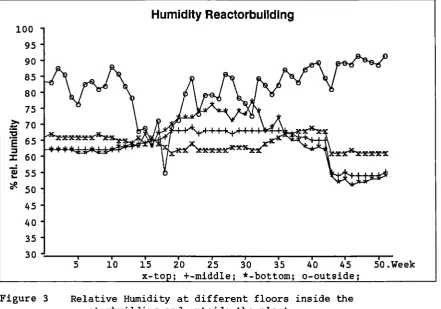
Figure 3 shows the relative humidity inside the reactor building at 3 different floors and the outside values. The figures are average values for one week.
The humidity inside the area of the safe enclosure is kept low by a drying system. The condensate is collected in tanks. The amount of collect-ed water is given in figure 4.
Figure 5 shows some typical temperatures inside and outside the plant. The figures are average values for one week.
2. Evaluation of the obtained results (B.5.)
Off - Air
10e66
4
.e c o 5L0e5 <
E 6
2-10e4 3 4 5 6 7 8 9 10 11
* - Leakage w i t h o u t n e g a t i v e P r e s s u r e
[image:23.595.76.520.71.382.2]12.Month
Figure 1 Air exchange with the environment with and without negative Pressure
Activity Releases
10e7'6' 4' 2 10e6'
6' 4' 2' 10e5' - 6'
§ A' 2 2'
S-0e4'
6' 4' 2' 10e3' 6' 4+1 2
10e2-l
I
il
ca
« ea
3 4 5 6 7 8 9 10 11 12.Month
* - Data w i t h o u t n e g a t i v e P r e s s u r e
F i g u r e 2 A c t i v i t y r e l e a s e s w i t h and w i t h o u t n e g a t i v e P r e s s u r e
Humidity Reactorbuilding
30 J — i —
[image:24.595.81.523.75.384.2]10 —r-15 20 25 30 35 40 45 50.Week — i — 25 30 i — i — 40 x-top; +-middle; »-bottom; o-outside;
Figure 3 Relative Humidity at different floors inside the reactorbuilding and outside the plant
25
20
Temperatures Reactorbuilding
10 15 20 25 30 35 40 45 50.Week
[image:24.595.78.521.76.733.2]x-top; +-middle; *-bottom; o-outside;
3 . 0 '
2 . 7
2 . 4
2 . 1
£
1.8i
co
CO
<
1.5'
1.2'
0 . 9
0 . 6
0 . 3
0 . 0
Collected Condensate
[image:25.595.75.522.68.361.2]io
11 12.MonthFigure 5 Condensate, monthly collected by the air-drying system
2. PROJECT N°2;
DECONTAMINATION FOR DECOMMISSIONING PURPOSES
A. Objective
The. objective of this project is to develop and assess techniques for decontaminating surfaces of components and structures of nuclear instal-lations that are past use. The main purpose of decontamination would be reduction of the occupational radiation exposure during dismantling of the contaminated item and/or reduction of the volume of radioactive waste.
B. Research performed under the 1979-83 programme
The following decontamination techniques have been developed and asses-sed:
- techniques based on the use of chemically aggressive decontaminants in liquid and gel-like form;
- electrochemical techniques;
- hydromechanical techniques (high-pressure water lance, erosion by cavitation);
- decontamination of concrete walls by flame spraying.
Other activities were:
- investigation of the characteristics and distribution of contamination in nuclear power plants that are past use;
economic assessment of decontamination for unrestricted release;
- collection of information on the particular decontamination problems posed by accidental contamination, as in the case of the TMI-2 nuclear power plant.
C. 1984-88 programme
Selected aggressive decontamination methods should be further developed with a view to their industrial application. Increased effort should be paid to the conditioning of spent decontaminants, where suitable techni-ques do not yet exist, and to the reduction of secondary waste arisings. Physical methods that limit the production of liquid effluents might be considered.
An important new topic of the second programme would be the decontamina-tion of hot cells and equipment contaminated with plutonium and other transuranics for purposes of the decommissioning of fuel-cycle installa-tions. The specific features of such installations (chemical nature of the liquids used during their operation, dimensions of the components, etc.) would be taken into account.
D. Programme implementation
Seven research contracts relating to Project N°2 were executed in 1988, of which six were completed.
-2.1. Complete Decontamination of a Primary Steam Piping of the Lingen BWR
Contractor: Kernkraftwerk Lingen GmbH, Lingen, Germany Contract N°: FI1D-0001
Working Period: January 1985 - March 1986 Project Leader: W. Ahlfänger
A. Objectives and Scope
A foregoing research contract (DE-B-004-D), aimed at the investigation of the composition of contamination layers and of the effectiveness of possible decontamination procedures of primary circuit steam lines, was concluded by following main results:
- the surface contamination is to an extent of 99% of oxide composition, the remainder is located at a penetration depth of up to 90 urn in the base material. For a successful decontamination, it is necessary to dissolve, besides the oxide layer deposited on the surface, also a small layer of the base material;
- the best way of decontamination (using solutions with less than 2% concentration) is to strip the deposited oxide layer by a LOMI reactive and a part of the base material by a mixture of hydrochloric and nitric acid.
These results have been obtained by laboratory-scale tests on repre-sentative samples.
The objective of this research contract is to demonstrate that the above decontamination procedure is also appropriate for a large-scale application to a steam line of the Lingen Nuclear Power Station.
B. Work Programme
B.l. Manufacturing of the decontamination rig comprising the sample steam pipe and all needed components for decontamination.
B.2. Preliminary laboratory decontamination tests of representative samples including determination of the composition and activity level of the contaminated layer.
B.3. Main test programme using the decontamination rig.
B.4. Assessment on optimal treatment of the generated radioactive secondary waste.
B.5. Evaluation of experimental results with respect to man-dose, quanti-ties of secondary waste and cost analyses, with extrapolation to a 1200 MWe BWR.
C. Progress of Work and Obtained Results
2.2. Aggressive Chemical Decontamination Tests on Valves from the Gari-gliano BWR
Contractor: Ente Nazionale per l'Energia Elettrica, Roma, Italy Contract N": FI1D-0002
Working Period: January 1985 - December 1988 Project Leader: F. Bregani
A. Objectives and Scope
The aggressive chemical decontamination methods, whose effectiveness has been proved both in many laboratory tests and in pre-industrial appli-cations, appear to need further investigations regarding both the deconta-mination of complex systems, such as valves, and spent decontaminant treatment in view of the limitation of the secondary wastes arisings.
The scope of the research is both to check the effectiveness of hard chemical decontamination on used components, such as small valves, and to search and develop a suitable and safe procedure to treat spent solutions, arising from aggressive chemical decontamination.
The advantages of this research are the possible demonstration of the decontamination effectiveness on complex components and the minimization of the total wastes produced.
This proposed research will be carried out in collaboration with CISE in the framework of a specific multi-annual agreement already in force. The experiments will be performed in DECO laboratory at Ispra, JRC.
Regarding the application of chitosan, specific agreements with the University of Ancona have already been undertaken.
Through a supplementary agreement concluded in 1987, the initial work programme is extended by items B.4. to B.6.
B. Work Programme
B.1. Aggressive chemical decontamination tests on valves (2-3 inches) of the primary cooling system of the Garigliano BWR in DECO loop.
B.2. Identification and qualification of a simple procedure to condition the spent decontaminant.
B.3. Neutralisation and flocculation tests in order to select and evaluate the best neutralising agent and specific chemical agents, such as chitosan, as supporter in flocculation.
B.4. Development of the decontamination process by using ultrasounds together with aggressive chemicals.
B.5. Decontamination tests with this method on contaminated samples of about 10 cm2 surface (stainless and carbon steel). If the results of the previous tests are satisfactory, the decontamination process will be applied to a little valve (1-2 inch).
B.6. Radiochemical measurements on selected samples before and after decontamination, in particular for the following elements: Fe-55, Ni-59 and Ni-63.
B.7. Cost evaluation of the process and assessment of the possibility of reprocessing and reutilizing of specific agents.
C. Progress of Work and Results Obtained Summary
After the literature review on the effect of ultrasonic waves on de-contamination and the first experiments, more than 100 lab tests in a beaker configuration were carried out in order to investigate and to opti-mize the decon process using ultrasounds in aggressive chemical baths. The effect of the different process parameters such as ultrasonic frequency and power, fluid viscosity and surface tension, pressure and temperature of the test solution, test duration, kind and concentration of chemicals and test materials was investigated on contaminated AISI 304 specimens from the Ga-rigliano BWR.
As a conclusion of the experimental activities two in-scale tests were carried out at Garigliano BWR Power Station, using a special US machine, on two contaminated 2" valves similar to the valves used in the aggressive chemical decon tests performed on the DECO loop in the first phase of the research.
Progress and Results 1. Introduction
The literature review showed that ultrasound is widely used in the nuclear industry as a decontamination technique, whilst it is never checked for decommissioning. It is generally used by immersing the piece to be decontaminated in water or water with detergents. No review has been per-formed on the simultaneous use of ultrasound in aggressive chemical solu-tions.
The process parameters that affect the scrubbing factor or the decon-tamination effectiveness were found. A general relationship can be written as:
AP (or DF) = AP (f, w, p, a , v , T, t, c)
where f is the ultrasound frequency, w the ultrasonic power, p the pressure of the fluid, a the surface tension of the fluid, v the fluid viscosity, T the process temperature, t the test duration and c the type and concen-tration of the chemicals.
Using ultrasound in a tank the pressure is atmospheric and it does not vary; moreover for aggressive chemical solutions at 3-1056 of concentration, the surface tension and the fluid viscosity were found not to vary greatly so the previous relationship becomes :
AP (or DF) = AP (f, w, T, t, c)
2. Laboratory testing (B.4, B.5)
In the first stage of the experimental activities, described in the last progress report, some laboratory tests were carried out with a fre-quency around 20 kHz on two typical HCl and HF/HN0 aggressive solutions, to evaluate test temperature and test duration.
For this reason it was decided to perform more laboratory experiments for a more precise investigation of test temperature and test duration, and to evaluate the effect of other parameters such as ultrasonic frequency, ultrasonic power, test materials, concentration of the solution and pres-ence of dissolved metals in the decontaminating solution. A list of the lab tests is presented in Tab. I.
The tests carried out on metallic specimens from the Garigliano BWR on the decon process with ultrasound in aggressive chemicals allow us to understand the effect of the different process parameters, although the definition of a mathematical relationship did not appear to be possible.
With reference to the formula mentioned above we can remark that:
- the pressure of the liquid, the surface tension of the fluid and the solution viscosity do not play any substantial role in decontamination; - when decontaminating materials with very adherent oxide layers the
fol-lowing test conditions have been found to be the best in terms of decon-tamination factors :
ultrasonic frequency, f ultrasonic power, w test temperature, T test duration, t test solution, c
22 kHz (see Fig. 1) > 25 W;
60°C (see Fig. 2) 30-60 min;
1% vol. HF/556 vol. HNO
V
- when decontaminating materials with not so adherent oxide layers, some of the test conditions mentioned above can be varied so as not to damage the base material; in particular the ultrasonic frequency can be raised to 40 kHz, the test temperature can be lowered to 40°C and the 4% vol. HCl solution can also be used as chemical;
- the chemical solution should be renewed when the concentration of dis-solved metals reaches to 5 g/1.
3. Decon tests on valves (B.5)
After the lab testing phase, the decon process was tested by in-scale experiments and carried out at Garigliano BWR Power Station in order to evaluate the real decontamination effectiveness. Two contaminated valves from the Garigliano BWR were used in particular.
The experiments were carried out at Garigliano BWR Power Station, in September 1988, using a special US machine, which was designed and acquired to test a similar decon process on pin tubes arising from a preheater
(CEC-ENEL Contract FI-1D-0023). The tested 2" valves were cut from a draining line of a SSG and they were contaminated similarly to the valves used in the decon tests on DECO loop without US.
They were tested in similar conditions (I phase: US in water; II phase: US in HF/HNO solution); in the second valve the packing was removed before the test (Tab. II).
The main comments which can be made on these experiments are the fol-lowing :
- the valves are not completely decontaminated; some radioactivity remains in particular zones of the valve such as crevices and areas not wetted by the solution;
-- the part that retains most of the radioactivity is definitely the obturator (plug) at the end of the stem, in fact the obturator is fixed to the stem by means of a weld leaving a deep crevice where the radio-activity tends to concentrate and to remain;
- in terms of total removed radioactivity the valve tested after the packing removal shows a better decontamination (97% of removed radioac-tivity as opposed to 95%) and the parts near the packing are better de-contaminated than in the valve tested with the packing installed;
- some external parts of the valves, the handwheel in particular, were slowly decontaminated during the tests. This was due to the diffusion of radioactivity in the process solution and to the redeposition which mainly affected the dirty surfaces.
Comparing these results with the results obtained in the decon tests on valves in the DECO loop, the following observations can be made:
- the profiles are similar, therefore the decontamination processes with in flow aggressive chemical (DECO loop) or with US appear to behave in a similar way;
- in terms of decon effectiveness, in the complex areas in particular, the action of the flow, in the tested valves, appears to be greater than the action of US. It should however be remembered that in the in-scale US testing much of the chemicals were exhausted by the external surface of the valve;
- looking at the US data in water it appears that the use of a US machine with a high power gives a better decontamination than the usual machine used to preclean the valves tested in the DECO loop.
4. Cost evaluation (B.7)
Table I Decontamination process with US in aggressive chemicals. Schematization summary of laboratory testing on AISI 304 contaminated specimens fro« the Garigliano BWR.
Lab. Test
series
Investigated parameters (*)
(and ranges)
Test material (**)
(and other constant
parameters)
Number of
tests
T, 2580°C t, up to 60 min
USf, static, 2122 and 40 kHz USp, 0142527 W/l
GP 4% HCl
or 1.5* HF/5* HNO
68
T, 2580°C t, up to 60 min
USf, static, 22 and 40 kHz USp, 02527 H/l
GS 4* HCl
or 1.5* HF/5* HNO
30
* vol. HF, up to 3 * vol. HNO , up to 10
3 . t, up to 60 m n
GP 60°C 40 kHz
20
dissolved metals, up to 10 g/1 USf, static and 40 kHz
USp, 027 H/l t, up to 60 «in
GP 60°C
1.5* HF + 5* HNO
10
(*) T » test temperature; t = test duration, USf ■ ultrasonic frequency; USp = ultrasonic power; (**) GP » 24" primary pipe; GS divider plate of SSG.
Table II Operating conditions in the inscale testing on US/aggressive chemical decon
process.
Test
First
Second (*)
Phase I II I II Step 1 2 3 1 2
Chemical solution
(* vol.)
Water
3 HF/5 HNO 3 3 HF/5 HNO
3 3 HF/5 HNO
3 Hater
3 HF/5 HNO 3 3 HF/5 HNO
3 Duration (■in) 30 30 30 30 30 30 30 Temperature Initial 60 60 40 40 60 40 40 (°c) Final 60 80 53 55 60 52 55
Position of the
valve in the tank
Handwheel Handwheel Handwheel Handwheel Handwhell Handwheel Handwheel top top top top top top bottom
(*) Valve disassembled, packing removed and reassembled.
DF
US+CH
DF CH
10
10
10
a GP Material ■ GS Material
1 I—I L.
20 40 USfrequency (kHz)
AP
US+CH
AP CH
1.5
1.0
0.5
\
O GP Material ■ GS Material
20 40 USfrequency (kHz)
Figure 1 Decontanination by ultrasound in aggressive chemical solution of Garigliano BWR
contaminated samples: effect of ultrasonic frequency in 1.5% HF + 5% HNO solution ((*) see Tab. I ) .
DF US+CH DF
CH
10
10
10
• After 10 min O After 30 min
i 20
— » —
40 60 80 Test temperature (°C)
Figure 2 Decontamination by ultrasound in aggressive chemical solution of Garigliano BWR
contaminated samples: ratio between decontamination factor with US and without US, versus test temperature on GP materials in the 1.5% HF + 5% HNO solution, at
2.3. Decontamination Using Chemical Gels, Electrolytical Swab and Jet, Abrasives
Contractor: Commissariat à l'Energie Atomique, CEN-Cadarache, France Contract N": FI1D-0003
Working Period: January 1985 - April 1988 Project Leader: G. Brunei
A. Objectives and Scope
As part of the dismantling of a nuclear installation, it is necessary to dispose of rapid and efficient decontamination procedures (high deconta-mination factor), which are simple to apply and lead to a low volume of wastes easy to treat.
The aim of this research is to study the following new decontamination techniques with a view to their application in the dismantling of nuclear installations :
- spraying of gels,
- electrolytical swab and jet, - abrasive water blasting.
These techniques are expected to usefully complement the established methods (immersion in chemical bath, electrolytical bath, high-pressure jet) developed in a previous study (Ref.: EUR 10043).
B. Work Programme
B.1. Optimisation of the decontamination processes, i.e. chemical gels, electrolytical swab and jet and abrasive water blasting, on non-radioactive samples of stainless steel, mild steel and aluminium. B.2. Application on contaminated samples from various types of plant
(gra-phite-gas reactor, PWR, LMFBR, fuel fabrication plant and reprocessing plant).
B.3. Implementation of these techniques with remote control and in the nuclear facilities before dismantling.
B.4. Assessment of quantity of secondary waste and its treatment.
B.5. Cost evaluation and assessment of radiological consequences of each process, including the treatment of secondary waste.
C. Progress of Work and Obtained Results
The work has been completed and the final report is now under publica-tion.
2.4. Development of an Easy-to-process Electrolyte for Decontamination by Electropollshlng
Contractor: Kraftanlagen Aktiengesellschaft, Heidelberg, Germany Contract N°: FI1D-0004
Working Period: November 1984 - December 1987 Project Leader: A. Steringer
A. Objectives and Scope
Electropolishing has become an approved and suitable decontamination process achieving high decontamination factors. However, the spent electro-lyte is hard to process and convert into a waste form suitable for dispo-sal. For example, in order to solidify phosphoric acid at a concentration above 60% in cement, it must be neutralised and heavily diluted. As a result, the waste volume for disposal is much higher than the initial electrolyte volume.
The aim and objective of this research is to find an easy-to-process electrolyte with high decontamination factors, suitable for disposal, which would give a much wider range of application to electropolishing as a
decontamination process. This means that it should be possible to condition the spent electrolyte in simple process steps, such as filtration, sedimen-tation and thermal decomposition, to produce a waste form that is easy to fix in cement.
The specified requirements with a view to easy processing of the electrolyte are fulfilled by a number of organic acids. In 1983, the contractor carried out various tests and experiments on organic acids. Whereas decontamination factors were satisfactory, unsatisfactory results were obtained for the electropolishing time, the service life and thermal
stability of the electrolyte, current density etc. These process parameters must be optimised. This work will be carried out in collaboration with
TEAM, Italy.
B. Work Programme
B.l. Literature survey for identification of the available information on already existing experience.
B.2. Selection of electrolytes other than phosphoric acid, promising easier conditioning and waste disposal.
B.3. Test series on contaminated and non-contaminated samples in order to optimise the electrolytes with regard to decontamination efficiency
(effect of chemical additives, of modifying process parameters,...). B.4. Optimisation of the process to minimise the final waste volume.
B.5. Development of procedures to extend the lifetime of electrolytes, in particular by continuous filtration.
B.6. Processing of selected electrolytes (sediment elimination, salt precipitation, solidification of sludges, volume reduction of the residual liquid, solidification of electrolyte residues).
B.7. Investigations about "on-the-job-safety": chemical aggressiveness, formation of toxic products, explosion hazards, etc.
C. Progress of Work and Obtained Results
2.5. Optimisatior of Filtering Systems for Various Concrete Decontamination Techniques
Contractor: Salzgitter AG, Salzgitter, Germany Contract N": FI1D-0005
Working Period: January 1985 - June 1987 Project Leader: W. Ebeling
A. Objectives and Scope
The effectiveness of mechanical and thermal methods for the deconta-mination of concrete surfaces has already been demonstrated. However, the
collection and conditioning of the important amount of generated dust, aerosols and toxic gases needs further development.
As concerns the filtration during thermal decontamination, multi-stage storing filters, as currently used in the nuclear industry, have shown' adequate efficiency, but their limited storage capacity precludes an economic operation. Concerning the effectiveness of filtration systems for mechanical decontamination, no extensive investigations have been
under-taken, so far.
The aim of this research programme is to investigate various filter systems, such as storing filters, regenerative mechanical filters, electro-static filters, concerning their separation efficiency, their storage capacity and service life, including an analysis of the amount and size distribution of dust available at each filtering stage. The experiments will use dust generated by the above decontamination methods on non-radio-active concrete samples.
Based on existing data on radioactive concrete surfaces, a theoretical assessment on possible radioactivity inventories in the investigated filter systems will be made, with a view to their optimization for real applica-tions.
B. Work Programme
B.l. Modification and adaptation of the existing test facility for air filtering systems.
B.2. Acquisition of components for testing and concrete samples. B.3. Selection and mounting of various air filter systems.
B.4. Implementation of various thermal and mechanical concrete decon-tamination procedures (flame spalling, grinding, chipping hammer, scarifier).
B.5. Measurement of airborn dust and aerosols by various methods.
B.6. Analysis of the measurement records and evaluation of the tested filters with respect to separation efficiency, retention capacity, radioactivity and costs.
C. Progress of Work and Obtained Results
The work has been completed, the final report is available as EUR report No. 11995.
2.6. Economic Comparison of Decontamination and Direct Melting with a View to Recycling Scrap
Contractor: Gesellschaft für Nuklear-Service mbH, Essen, Germany Contract N°: FI1D-0029
Working Period: January 1985 - June 1986 Project Leader: K. G. Janberg
A. Objectives and Scope
The decommissioning of nuclear facilities either requires the final disposal of large quantities of contaminated scrap metal or the deconta-mination to a degree which allows its further use in nuclear or other areas.
Decontamination technology is well developed and in most cases based on the application of highly corrosive agents or electrochemical processes. Recently, direct melting has been added to these procedures as it allows for the separation of Cs and Sr from the base material. However, the volatile contamination agents have to be retained by appropriate filter
systems.
The objective of this work is to carry out an economic study of decontamination, direct melting and super-compaction, with a view to recycling of scrap, in order to establish a state-of-the-art cost structure for the decommissioning of nuclear installations. This economic comparison is based on actual clean-up or decommissioning work executed by the con-tractor under industrial conditions.
This study takes into account the nuclear installations in Germany.
B. Work Programme B.l. Review studies
B.l.l. Inventory of contaminated metal scrap until 1994. B.l.2. Review of existing decontamination methods.
B.1.3. Review of licensing conditions for recycling of decontaminated metal scrap.
B.2. Assessment of the investment and running cost of the three following procedures:
- decontamination of scrap metal followed by melting and release, - direct melting of scrap metal, followed by release,
- super-compaction followed by disposal as radioactive waste.
C. Progress of Work and Obtained Results
2.7. Remote Electrochemical Decontamination for Hot Cell Applications
Contractor: United Kingdom Atomic Energy Authority, Harwell Laborato-ry, United Kingdom
Contract N°: FI1D-0033
Working Period: April 1986 - July 1989 Proiect Leader: A. D. Turner
A. Objectives and Scope
The primary aim of the programme is to develop and evaluate remote liquid-based decontamination systems for metal surfaces. The bulk of the waste volume should be reduced to a reuse or low-level waste disposal
category, while concentrating most of the activity in a small volume suitable for immobilisation. The goal of the development programme is to test these techniques in both alpha-active and alpha-beta-gamma hot cells in order to ascertain their usefulness as a component of an overall decom-missioning strategy. As a result of the radiological environment, particu-lar emphasis will be placed on remote operation in order to reduce occupa-tional radiation exposure.
Two types of techniques based on the electrochemical dissolution of thin surface layers of the substrate will be investigated: immersion of small items in tanks for electroetching, and in-situ electropolishing. In both cases, reagents will be chosen with their subsequent disposal in mind.
B. Work Programme
B.1. Investigation of immersion electroetching.
B.l.l. Optimisation tests on the synthetic and genuine waste samples. B.1.2. Design and construction of a full size unit with ancillary
elec-trolyte management system.
B.1.3. Testing of this unit inactively, and in hot cell facility. B.2. Investigation of in-situ electropolishing.
B.2.1. Optimisation tests on inactive, synthetic and genuine waste samples. B.2.2. Design and construction of an automatically controlled unit for use
with a remote handling system.
B.2.3. Testing of the unit inactively and in the high alpha-beta-gamma active handling facility.
C. Progress of Work and Obtained Results Summary
The procurement, fabrication and assembly of a 0.3 m^ immersion tank decontamination facility has been finished, and inactive commissioning is virtually complete. A dynamic reference electrode based on the evolution of oxygen from platinum under an intermittently applied constant current has been selected as the best system to optimize decontamination
effectiveness on the basis of the independence of its response to acid concentration, temperature and the presence of dissolved iron - as well as a negligible maintenance requirement. Zr together with a Pb(II) additive to the electrolyte has been identified as the optimum cathode system to minimize N0X to < 3 u£/C and completely suppress H2 from 1-5M HNO3
electrolyte. Active tests with this equipment will be carried out for the remainder of the contract.
Inactive trials on the mobile hot spot electropolishing
decontamination unit have concluded with the demonstration of a range of improvements identified previously. In particular, the use of only 6M acid has been shown to be satisfactory - even on 1 mm thick stainless steel. Silicone front face seals have been shown to be stable for prolonged periods in this medium. The system has also been modified for active use by providing an in-cell effluent tank. This will be demonstrated on active samples until the end of the programme. Robotic handling trials have also been carried out with a PUMA 560, using inductive proxistors to assist in head placement and a miniature multistage air ejector as a source of vacuum to retain the decontamination head in position and to suck out any residual electrolyte after the completion of treatment.
Progress and Results
1. Construction and commissioning of full size immersion electroetching unit (B.l. B.1.2, B.1.3)
The fabrication of the 0.3 mJ immersion electrolytic decontamination
tanks and ancillary equipment was completed and delivered to Harwell in June 1988. These units together with pumps, valves and sensors have now been assembled into an integrated plant and inactive commissioning is virtually complete. The unit comprises three main components:- the decontamination tank itself, an interim electrolyte storage tank and a mobile service trolley (Ref. / I / ) . The latter is operated from an inactive area and carries sealed stock acid tanks, the power supply and a
microprocessor controller. The latter provides a way of automating the system - permitting safe operation without the need for constant operator supervision.
As part of the decontamination system, a reference electrode is
required to optimize the effectiveness of the process through adjustment of the cell voltage. From a range of five potential systems identified
previously, a dynamic electrode based on the evolution of oxygen from platinum under a controlled pulsed current has been identified as the most suitable for active use. Not only is it completely maintenance free, but its response is essentially independent of acid concentration, temperature and the presence of dissolved iron.
Work on the selection of cathodes has now also been completed with the identification of zirconium plus a 3 mM Pb(II) additive as the optimum system for the suppression of N0X from a 5M nitric acid electrolyte
(< 3 u£/C). Hydrogen evolution was undetectable. The reason for the minimization of any off-gas is that 50% of the cathodic current yield results in the reduction of NO3- to NH4+. Performance of this
ventilation system has had to be incorporated into the decontamination tank, thus further simplifying its construction. Not only is the evolution of insoluble gases minimized, thus suppressing the formation of any active aerosols, but the production of toxic or flammable gases is also avoided.
Due to delays in the receipt of several items of equipment, this programme has now been extended until March 1989. Routine decontamination trials (B.1.3) will be carried out until this date.
2. Construction and inactive testing of a mobile electropolishing hot-spot decontamination unit- (B.2, B.2.2, B.2.3)
Further work on the prototype mobile hot-spot electropolishing decontamination unit has been undertaken in the light of inactive commissioning trials carried out previously (Ref. /I/). In order to
minimize the volume of secondary waste arising and to improve the stability of the elastomeric front face seals in the nitric acid electrolyte, the effect of further reductions in acid strength were investigated. As a result, stainless steel sheet of down to 1 mm thickness can be
satisfactorily electropolished in only 6M HNO3 (Figure 1). The chemical stability of a range of potential seal materials was subsequently
investigated by long term exposure in 6, 8 and 10M acid to identify the optimum system. For the continuation of prototype development, unloaded silicone tube filled with a soft silicone foam was confirmed as being the most suitable - both from the point of view of its chemical and radiation stability, but also the ease with which it could be fabricated into soft 0-ring seals. Viton and Nordel were identified as polymers more suited to injection-moulded fabrication on a commercial scale.
A range of modifications have been successfully made to the decontam-ination head (Ref. /2/) to make it sufficiently reliable for active trials. These included improving the means of front face seal retention, reducing feed pulsation arising from the use of a diaphragm pump and the evaluation of inductive proxistors in place of the simple mechanical switch as a surface placement sensor. In addition, the unit has been modified for hot-cell use by providing an in-hot-cell effluent tank and a miniature multistage air ejector and aerosol trap to suck out any residual electrolyte after decontamination. This will be used shortly to demonstrate the complete system on active waste samples for the remainder of the programme.
Robotic handling trials have also been carried out using a PUMA 560 in the Harwell Robotic Demonstration Facility (Figure 2). The decontamination head was successfully placed and sealed to both horizontal and vertical surface and water subsequently passed through the system to simulate the electrolyte. Inductive proxistors were satisfactorily demonstrated as a non-mechanical method of sensing when the head was in position on the surface to be treated. In addition, a miniature multistage air ejector proved effective as an alternative source of vacuum - both to retain the decontamination head in position, and also to suck out residual
electrolyte. Before the end of the programme, a PUMA 762 (10 Kg payload) robot will be used to demonstrate an electropolishing decontamiantion head with an integral activity monitor (G-M tube) and proximity detector for automated robotic placement.
References
HI TURNER, A.D., POTTINGER, J.S., LAIN, M.J. and JUNKISON, A.R.
"Development of remote electrochemical decontamination for hot-cell applications". Annual Progress Report 1987. AERE-G4532.
HI TURNER, A.D., JUNKISON, A.R., POTTINGER, J.S. and DAWSON, R.K. "Electrolytic treatment device". UK Patent GB 2203756A.
131 TURNER, A.D., JUNKISON, A.R. "Electrolytic treatment", GB 2205584A.