JHEP04(2016)182
Published for SISSA by SpringerReceived: September 30, 2015 Revised: April 6, 2016 Accepted: April 19, 2016 Published: April 29, 2016
Less-simplified models of dark matter for direct
detection and the LHC
Arghya Choudhury,a Kamila Kowalska,b Leszek Roszkowski,b,1 Enrico Maria Sessolob and Andrew J. Williamsb
aRegional Centre for Accelerator-based Particle Physics, Harish-Chandra Research Institute,
Allahabad — 211019, India
bNational Centre for Nuclear Research,
Ho˙za 69, 00-681 Warsaw, Poland
E-mail: [email protected],[email protected], [email protected],[email protected],
Abstract: We construct models of dark matter with suppressed spin-independent
scat-tering cross section utilizing the existing simplified model framework. Even simple com-binations of simplified models can exhibit interference effects that cause the tree level contribution to the scattering cross section to vanish, thus demonstrating that direct de-tection limits on simplified models are not robust when embedded in a more complicated and realistic framework. In general for fermionic WIMP masses &10 GeV direct detection limits on the spin-independent scattering cross section are much stronger than those coming from the LHC. However these model combinations, which we call less-simplified models, represent situations where LHC searches become more competitive than direct detection experiments even for moderate dark matter mass. We show that a complementary use of several searches at the LHC can strongly constrain the direct detection blind spots by set-ting limits on the coupling constants and mediators’ mass. We derive the strongest limits for combinations of vector + scalar, vector + “squark”, and “squark” + scalar mediator, and present the corresponding projections for the LHC 14 TeV for a number of searches: mono-jet, jets + missing energy, and searches for heavy vector resonances.
Keywords: Beyond Standard Model, Particle and resonance production, Hadron-Hadron
scattering (experiments), Exotics
ArXiv ePrint: 1509.05771
JHEP04(2016)182
Contents1 Introduction 1
2 The model blocks 2
2.1 Vector mediator 3
2.2 Scalar mediator/Higgs portal 4
2.3 Scalart-channel mediators 6
3 Methodology and analysis of the combined models 6
3.1 Model 1: combining Z0 and Higgs portal 7
3.2 Model 2: combining Higgs portal and squarks 13
3.3 Model 3: combining Z0 and squarks 16
4 Summary and conclusions 19
1 Introduction
In the past few years simplified model spectra (SMS) [1–5] have been used as a reasonable framework for the interpretation of the limits from mono-jet/mono-photon [6–11] searches on direct production of dark matter (DM) at the LHC. In SMS one generally parametrizes the cross section in terms of a few parameters, like the couplings of the DM with the visible sector, or the mass of the particles assumed to mediate the interaction between the DM and the partons in the nucleons, effectively obtaining a way to capture the physical properties of a vast class of weakly interacting massive particle (WIMP) scenarios without excessive proliferation in the number of free parameters.
Early LHC results presented by the experimental collaborations were often interpreted in the effective field theory (EFT) framework [12–20], which gives a good approximation as long as the interaction is mediated by particles with masses well above the collision energy. The EFT framework also has the advantage of providing bounds in terms of a common contact operator that can be used for comparison with the limits on the spin-independent DM-nucleon cross section,σSI
p , obtained in underground experiments like XENON100 [21] and LUX [22], or the spin-dependent cross section, σpSD, measured for example at PI-CASSO [23,24], COUPP [25] and, indirectly, IceCube [26,27] and ANTARES [28].
JHEP04(2016)182
on σSIp coming from reinterpretations of mono-jet searches are not competitive with thebounds from LUX or XENON100.
On the other hand, because of their reduced number of parameters, the most common SMS are not intrinsically equipped to capture some of the interesting phenomenology of more realistic theoretical DM models (for example those emerging in low scale supersymme-try (SUSY)). In models that involve a richer spectrum of particles, several effects can arise which are missed in the most simple SMS, like long decay chains, or the well known fact that interference between different diagrams, or cancellations in the couplings can give rise to “blind spots” for DD searches [49–55]. It is also known that with a larger number of parti-cles with differentiated properties one can make a more effective use of the complementarity of different experimental strategies, which can be employed in combination [41,56–58].
In this regard, then, it would perhaps be interesting to give a detailed look at the detection issues arising in cases when one moves just one step beyond the SMS approach, i.e., when one tries to build models that are halfway in between those SMS characterized by just one type of mediator and interaction mechanism, and a UV complete model. We take this approach in this paper, in which we combine existing SMS in pairs, with the goal to somewhat mimic the behavior of a developed UV theory without at the same time drastically increasing the number of parameters, or including the full spectrum of a specific model. We only consider SMS and parameter ranges for which the spin-independent scattering cross section is substantial, so that a comparison between the limits from DD and the LHC is always possible. The combinations involve three popular SMS characterized by vector mediators, scalar mediators, and colored scalar mediators, and we take the DM particle to be a Dirac fermion. The models given here represent only a few motivated examples of the many combinations that can be constructed. We dedicate special attention to the blind spots for DD, which stem from interference effects among different diagrams. We show that each of the emerging blind spots can be tested in Run 2 of the LHC, by different experimental strategies. Our study is thus complementary to previous studies in this direction [49–55], although, to the best of our knowledge, the combinations we consider here have not been analyzed before in this setting.
The paper is organized as follows. In section2 we review the three known SMS of DM that constitute the building blocks from which we construct new models for DM searches. In section 3we present the parameter space of these new models and confront them with the current bounds from searches for DM, which include underground detectors and DM searches at the LHC. We further identify the regions that give rise to suppressions in σpSI, and apply to the resulting blind spots existing bounds from the 8 TeV and 13 TeV LHC. We also calculate the corresponding projected reach of the 14 TeV run, showing that this can significantly probe these new regions of the parameter space. We finally present our summary and concluding remarks in section4.
2 The model blocks
char-JHEP04(2016)182
acteristics of more generic UV theories.Model 1. Combining vector and Higgs portal mediators;
Model 2. Combining Higgs portal and t-channel mediators charged under color;
Model 3. Combining vector andt-channel mediators charged under color.
In all three cases we take the DM particle to be a Dirac fermion singlet under the SM symmetries.
The combinations given above are built out of well known SMS, which we call the model blocks, whose characteristics we briefly recall in the next subsections. The model blocks should respect the gauge symmetries of the SM and not violate minimal flavor violation (MFV) [4, 59]. These requirements constrain the allowed forms of the models and their parameters, in contrast to the most general forms [2].
2.1 Vector mediator
The mediator considered is a leptophobicZ0. Dark matter SMS based on vector mediators of this kind where studied, e.g., in [35,36,40,43, 44, 47, 48, 60–65]. The Dirac fermion singlet DM particle,χ, is coupled to the new gauge boson,Z0. The new mediator is assumed to have negligible mixing with theZ boson of the SM, and to not couple to the SM leptons, so that one can easily evade the strong limits from di-lepton resonances at the LHC [66,67]. Note that this assumption will not affect the DD constraints and the results of the next sections will remain general. We also always assume that possible anomalies are canceled by new heavy states above mZ0, which do not contribute to phenomenology at the LHC.1
The interaction terms relative to DM detection at the LHC and in underground de-tectors are
L ⊃Zµ0χγ¯ µ(gχV −gχAγ5)χ+ X
i
Zµ0q¯iγµ(gqV −gAqγ5)qi, (2.1)
where the index iruns over the quarks and we have universal vector (axial-vector) quark couplingsgqV (gqA). The corresponding vector and axial-vector couplings to the DM are gχV
and gAχ, respectively.
In this paper we limit ourselves to the case where WIMPs are produced at the LHC through an on-shell mediator: 2mχ < mZ0. In this regime the production cross section
and mediator width are largely independent of the spin structure of the couplings [5], so that we can set either gVχ/q or gAχ/q to zero without loss in generality. We limit ourselves here to cases of vector boson exchange, which give contribution to the spin-independent WIMP-nucleon scattering cross section, σpSI.
We are thus left with 4 parameters for this simplified model,
mχ, mZ0, gχV, gVq , (2.2)
wheremχ is the WIMP mass andmZ0 theZ0 mediator mass. This number can be reduced
to 3 whengχV =gqV, since only the product of the two coupling constants matters forσSIp .
JHEP04(2016)182
2.2 Scalar mediator/Higgs portalThe second building block is a model such that the fermion DM singlet, χ, is coupled to a new singlet real scalar, s. This model has been analyzed, e.g., in [59,69,70], but scalar mediators have also been studied in, e.g., [45, 46, 71–74]. We note that there are many other variations with scalar mediators or extended Higgs sectors but this model allows us to keep the DM as a SM singlet and allows combinations with the other model blocks.
The terms in the Lagrangian relevant to DM searches are
L ⊃ −yχχχs¯ −µss|Φ|2−λss2|Φ|2, (2.3)
where yχ is the Yukawa coupling between the DM and the singlet, and µs is a mass term that induces mixing between s and the SM Higgs doublet, Φ, that gives rise to the Higgs boson after electroweak symmetry breaking. In eq. (2.3) we neglect eventual polynomial terms of the singlet only, which are not important for DM SMS (at least at the tree level), and which we assume are fixed by the UV completion. We assume that Φ develops the SM vacuum expectation value (vev), v: Φ→ 1/√2 (0, v+h)T, which can be determined in terms of the SM mass and quartic couplings.
Theµs andλsLagrangian terms produce an off-diagonal component in the (h, s) mass matrix. The mass matrix is diagonalized by a mixing matrix parametrized by a mixing angle θ,
hSM
H
!
= cosθ sinθ −sinθ cosθ
!
h
s
!
. (2.4)
In general we will identify the lightest scalar with the observed SM-like Higgs. Higgs physics measurement, electroweak (EW) precision tests, and vacuum stability then con-strain |sinθ|[75–78].
After diagonalization the relevant terms in the Lagrangian for DM phenomenology are
L ⊃ −yχ(hSMsinθ+Hcosθ) ¯χχ−
1 √
2(hSMcosθ−Hsinθ) X
f
yff f ,¯ (2.5)
whereyf are the SM Yukawa couplings andf,f¯SM fermions. This results in the presence of a heavy scalar mediator, H, as well as the SM Higgs, hSM, that couple the DM to the quarks. Note that the quarks couple to both mediators in proportion to their Yukawa couplings, as a result of the mixing, automatically in agreement with MFV. In the spirit of phenomenology one can trade the parametersλsand µs forθand the mass of the heavy scalar mH to produce a simplified model of DM. Note that we implicitly assume that the SM and singlet polynomial terms neglected in eq. (2.3) are such that the ratio of the Higgs vevs, tanβ ≡ v/vs, is much smaller than 1, so to be comfortably inside the bounds from perturbative unitarity [78].
The DM simplified model is finally described by 4 parameters,
JHEP04(2016)182
Figure 1. Contours of equal spin-independent scattering cross section,σSI
p , in pb in the (mH,yχ)
plane for the Higgs portal model. We setθ= 0.3 andmχ= 100 GeV. The solid red line represents
the current 90% C.L. upper bound from LUX [22]. The dashed red line gives the expected sensitivity of XENON-1T for 2017 or so [79], which we use as an example of the generic reach of tonne-scale detectors [80–82].
In the next section we will consider, for example, a case where the Higgs portal de-scribed here interferes with the model of section 2.1. However, we foreshadow this discus-sion by reminding the reader that there is also interference within the Higgs portal model itself, as recently pointed out in ref. [59]. Thus, the contributions to σSI
p intrinsic to this model are also going to be affected by interference effects.
We show this in figure 1, where we present contours ofσpSIin pb in the (mH,yχ) plane for a fixed θ = 0.32 and mχ = 100 GeV. The cross section depends on mχ through the reduced mass of the DM proton system and is thus mostly insensitive to changes in mχ when mχ mp. The current upper bound on σSIp from LUX [22] is shown as a solid red line. It is expected to be improved by future tonne-scale underground detectors [79–82], whose reach is shown here as a dashed red line.
In general the effective interaction between the quarks and the DM will grow with the mixing angle, the coupling strength yχ, and the mass of the heavy scalar, albeit very mildly whenmH mhSM. WhenmH ≈mhSM the contributions due tohSMandH cancel out and σSIp is suppressed. This creates a blind spot for DD, characterized by very little sensitivity for underground experiments.
2
In the analysis of section3 we will most often assumeθ = 0.2, which is allowed by the bounds from Higgs searches at the LHC in the rangemH>125 GeV [78], by perturbativity of the couplings, and one-loop
corrections to theW mass [78,83]. As pertains to figure 1, one should note thatθ= 0.3 is also excluded formH <125 GeV by searches at LEP and the LHC [78], and that the figure is here merely intended as
JHEP04(2016)182
2.3 Scalar t-channel mediatorsFor the third building block we consider colored scalar mediators coupling the DM directly to the quarks. Since these are exchanged in the t-channel for DM production at the LHC they are often calledt-channel mediators. This case has been analyzed, for example, in [37– 39, 41]. The new scalars must be charged under color and flavor, so that we can borrow the notation used to describe the squarks in the Minimal Supersymmetric Standard Model (MSSM), ˜q, even if our model is not necessarily SUSY based. We assume universality between the first and second generation for the masses of the “squarks”, as well as their couplings to the DM, as required by MFV. For simplicity, for the first two generations we further assume that all squark masses and couplings are universal, thus neglecting the differences between the left and right components, and up and down squark fields. The squarks of the third generation will instead be decoupled and assigned a large mass to avoid the complications associated with dedicated stop and sbottom searches. Besides, these will not contribute to DD observables.
The interaction terms then become,
L ⊃ X
i=1,2 gq˜
˜
u†i,RχP¯ Rui+ ˜u†i,LχP¯ Lui+ ˜d†i,RχP¯ Rdi+ ˜d†i,LχP¯ Ldi
+ h.c., (2.7)
where gq˜ is the coupling strength, ˜ui,L(R) are the left (right) up-type squarks of the ith
generation, ˜di,L(R) are the left (right) down-type squarks of the ith generation,ui (di) are the up (down) quarks of the ith generation and PR and PL are the right and left chiral projection operators, respectively. We assume that the stability of the DM is protected by a discrete symmetry similar to R-parity. We repeat that all squarks in eq. (2.7) have the same mass in our approximation.
This simplified model is described by 3 parameters,
{mχ, mq˜, gq˜}, (2.8)
where mq˜ is the universal squark mass and gq˜is the universal squark-DM coupling. Note
that in order to preserve the SM gauge symmetries the squarks will develop the same SM gauge interactions as the quarks as happens, e.g., in the MSSM. On the other hand, EW gauge and Higgs couplings will not play a role here. This is different from the MSSM, where gq˜ is fixed by neutralino mixing and gauge couplings, while in this scenario it is a
free parameter.
3 Methodology and analysis of the combined models
JHEP04(2016)182
the LHC 14 TeV for each model and compare them to the expected sensitivity of tonne-scaleunderground detectors.
Models 1, 2, and 3 are implemented in FeynRules [84], which is then used to generate CalcHEP [85] and Universal FeynRules Output (UFO) model files. The spin-independent cross section is calculated withmicrOMEGAs v.4.1.8[86]. For the mono-jet search we gener-ate events at the LHC withMadGraph5 aMC@NLO[87] andPYTHIA8[88] using MLM matching up to two jets. For models with squarks we produce bothχχ¯+jets,χq˜+jets associated pro-duction, and ˜qq˜∗+jets following the example of [41]. To derive exclusion bounds for the mono-jet and jets+MET searches we use CheckMATE [89–97] and two codes developed by some of us, which were previously used in refs. [98–100]. The LHC 14 TeV projections for the mono-jet and jets+MET searches are obtained by implementing the experimental cuts described in [101] and [102] in our own codes and CheckMATE. We do not consider other mono-X searches beyond the mono-jet to keep the number of searches considered to a minimum and since projections for 14 TeV are not currently available.
For the direct searches for Z0 we use MadGraph5 aMC@NLOto compare production cross section times branching ratio for Z0 → tt¯and Z0 → qq¯to the limits given in [103–105]. For the 14 TeV projections we use [106]. For the dijet search we use a combination of the 8 TeV data for mZ0 < 1.5 TeV and 13 TeV data for mZ0 & 1.5 TeV. In the case of the
13 TeV search the collaboration has recast the search explicitly in terms of the simplified model considered here, giving limits in terms ofgqV andmZ0. The collaborations have not
provided a projection for 300 fb−1 at 14 TeV in terms ofZ0 →qq¯, so that we use the di-top search throughout the paper for consistency. Finally, we calculate the partial width of the SM Higgs to DM particles, ΓhSM→χχ¯, with CalcHEP and compare to the limit from [107] following the method described in [57].
We do not apply to our models the bounds from the relic density of DM. In a sense, this is equivalent to considering the most general phenomenological case, neglecting all possible bias from the particular thermal history of the early Universe. The reader should bear in mind that from this point of view the models analyzed in this section are incom-plete. In order to satisfy the constraint from the relic density one must consider one or more of the following possibilities: large or non-perturbative couplings; additional parti-cles/interactions; or a non-standard thermal history.
3.1 Model 1: combining Z0 and Higgs portal
JHEP04(2016)182
As explained above, we consider only the vector couplings to the Z0. If we make theassumption that gVχ =gqV ≡gχ/qV we are left with 6 free parameters,
n
mχ, mZ0, mH, θ, yχ, gV χ/q
o
. (3.1)
We assume mixing as maximal as is allowed by the LHC constraints, perturbativity of the couplings, and EW precision observables: θ= 0.2 (see footnote 2). The cross section σpSI
depends mildly on the angle, via sin 2θ.
For a nuclear elementN, the differential WIMP-nucleus scattering cross section in the non-relativistic limit is given by [109]
dσχN
d|q|2 =
1
πv2 χ
[Zfp+ (A−Z)fn]2F2(Q), (3.2)
where|q|is the transferred momentum,Z is the atomic number,A the atomic weight,vχ is the average speed of the DM in the halo, and F(Q) is the Wood-Saxon function given in [109] as a function of Q=|q|2/2m
N.
The contributions to fp andfncome from the effective interactions of the WIMP with protons and neutrons, respectively, and they are approximately given in Model 1 by
fn≈fp ≈
yχsin 2θ 4m2h
SM
1−mh 2 SM
m2H
mp v X
q=u,d,s
fT q+ 2 9fT G
+ 3 2
gχVgVq m2Z0
, (3.3)
wheremp is the nucleon mass, and fT q and fT G are the hadronic matrix elements defined for example in [109]. We adopt in our study their default values embedded inmicrOMEGAs:
fT d= 0.0191, fT u= 0.0153,fT s = 0.0447, andfT G = 1−fT u−fT d−fT s. If yχ > 0 , mH mhSM, and g
V
χ =gqV, destructive interference between the terms in eq. (3.3) does not take place. In figure2(a) we show contours ofσSI
p in pb in the (yχ,gχ/qV ) plane in this case, for fixed values of the DM mass, mχ = 10 GeV, and of the mediators’ mass, mH = 600 GeV and mZ0 = 1000 GeV. The mediators’ mass has been chosen so to
be within the present limits from the LHC for reasonable choices of the couplings, not too far from their SM strengths, and also so that we are reasonably far away from interference effects between the light and heavy Higgs bosons.
As was the case in figure 1, the solid red line shows the 90% C.L. upper bound on σpSI
from LUX and the corresponding red dashed line the projected reach of XENON-1T. The upper bound from mono-jet searches at the LHC 8 TeV [9] is shown as a solid purple line, and the projected reach for mono-jet with 300 fb−1 at 14 TeV [101] is shown with a dashed purple line. The solid orange line shows the upper bound on heavy resonances from the invariant t¯tmass distribution after the LHC 8 TeV run [103] and the solid cyan line gives the equivalent limit in the ¯qq channel [104]. The projected reach for the ¯tt search at the LHC 14 TeV [106] with 300 fb−1does not improve on the 8 TeV bound formZ0 = 1000 GeV
JHEP04(2016)182
(a) (b)
[image:10.595.91.498.127.537.2](c) (d)
Figure 2. (a) Spin-independent scattering cross section in pb in the (yχ,gVχ/q) plane for a model
combining Z0 mediator and Higgs portal. We setmχ = 10 GeV, mZ0 = 1000 GeV, θ = 0.2 and mH = 600 GeV. The solid red line represents the current 90% C.L. upper bound from LUX and
the dashed red line is the projected limit for tonne-scale detectors in 2017 or so. Solid purple line is the 95% C.L. upper bound from the 8 TeV mono-jet search at ATLAS [9]. Dashed purple line is the projected limit from the mono-jet search at 14 TeV with 300 fb−1[101]. Solid orange line gives the upper limit from searches for heavy vector resonances in the di-top channel at 8 TeV [103], and the solid cyan line gives the equivalent limit in the ¯qqsearch [104]. Green solid line gives the upper limit from the invisible width of the Higgs boson in a CMS/ATLAS combined analysis [107]. (b) Same as (a) butmχ= 100 GeV. (c) Same as (a) but the sign ofyχ is negative. (d) Same as (c) but
JHEP04(2016)182
As is well known, the DD detection bound on gχ/qV from LUX is significantly moreconstraining then any of the collider limits, even for a relatively light DM mass. LUX loses sensitivity with respect to the collider bounds whenmχ.5 GeV. Formχ.62 GeV, the in-visible width of the Higgs boson analysis places an upper bound onyχthat is stronger than the projected reach of many tonne-scale detectors, as was also recently pointed out in [57]. When the WIMP mass becomes larger than 10 GeV the DD bounds become more severe, and they reach their maximal sensitivity when mχ≈50 GeV. We show the bounds formχ= 100 GeV in figure2(b). Note that the invisible width bound does not apply to this case, so that the strongest limits on both couplings here come from DD experiments. Also, the projected upper bound on yχ from mono-jet searches at the LHC 14 TeV is stronger when mχ.62 GeV, because theχχ¯ pair can be produced via an on-shell SM Higgs.
On the other hand, if yχ < 0 , or if it is positive but gχV = −gqV, the diagrams corre-sponding to the Z0 and Higgs portal interfere destructively and σSIp becomes suppressed, as can be inferred from eq. (3.3). Note, incidentally, that the cancellation can only hap-pen in the nonrelativistic limit. To see this one can consider the relativistic WIMP-quark scattering,q(p1)χ(p3)→q(p2)χ(p4), for which the squared amplitude reads:
|A|2 = 2sin 22θ y2
qy2χ(m2p+p1p2)(m2χ+p3p4)
[(p1−p2)2−m2hSM]2
+(g V
χgVq)2(16m2p−8p1p2)(16m2χ−8p3p4)
[(p1−p2)2−m2Z0]2
+√16 2
sin 2θ yqyχgχVgVqmpmχ(p1+p2)µ(p3+p4)µ
[(p1−p2)2−m2hSM][(p1−p2)2−m2Z0]
. (3.4)
Obviously, without a detailed knowledge of the incoming and outgoing 4-momenta, a can-cellation between the terms of eq. (3.4) cannot take place. Additionally, in eq. (3.3) there is also an effective term due to the coupling of the Higgs to the gluon field strength, which determines the position of the blind spot.
The effects of the cancellation are shown for mχ = 10 GeV in figure 2(c). The blind spot is in the plots a narrow diagonal region, over which the value ofσSIp visibly drops below the potential reach of tonne-scale detectors. The corresponding case for mχ = 100 GeV is shown in figure2(d).
From eq. (3.3) one can derive the condition for the blind spot:
yχ ≈ −
8.22×10⁷ GeV2
m2Z0
gV
χgVq
sin 2θ
1− m
2
hSM
m2
H
. (3.5)
Condition (3.5) shows that the contributions to the amplitude of the diagrams from theZ0
and Higgs portal are of comparable size for comparable coupling strengths ifmZ0 is at least
of the order of a TeV or larger. Here we neglect further loop corrections which may reintro-duce a suppressed coupling to the nucleus. When eq. (3.5) is satisfied the model is beyond the reach of DD searches in underground detectors but can be tested by collider means.
We therefore show in what follows how the interplay of mono-jet searches, searches for
JHEP04(2016)182
[image:12.595.90.504.97.304.2](a) (b)
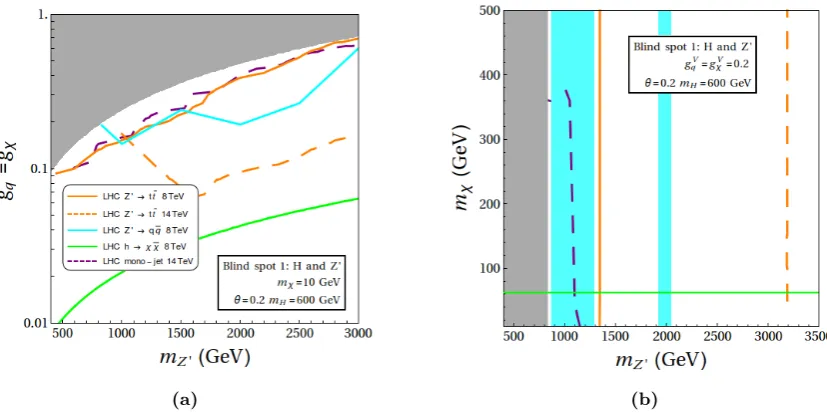
Figure 3. (a) Interplay of LHC constraints for the blind spot parametrized by eq. (3.5) in the (mZ0, gχ/qV ) plane. Heremχ = 10 GeV,mH = 600 GeV, andθ= 0.2. Solid orange line gives the 95% C.L.
upper bound from the ATLAS search for heavy resonances in the di-top channel at 8 TeV. The dashed orange line gives the corresponding reach of the LHC 14 TeV with 300 fb−1[106]. Solid cyan line gives a combination of the upper bounds on theZ0 invariant mass in ¯qqsearches at 8 TeV [104] and 13 TeV [105]. Green solid line gives the combined ATLAS/CMS upper bound from the invisible width of the Higgs. Dashed purple line gives the projected mono-jet reach at ATLAS with 14 TeV and 300 fb−1. (b) The bounds projected to the (mZ0,mχ) plane forgV
χ/q= 0.2 andmH= 600 GeV.
Corresponding bounds are now lower limits on the masses. The combination of 8 and 13 TeV data in ¯qq searches excludes the parameter space within cyan bars.
the bounds are shown in the (mZ0,gV
χ/q) plane, assuming eq. (3.5) holds. The DM mass is here fixed, mχ= 10 GeV, and we have set mH = 600 GeV. Note that the plots essentially do not change much for any mH &200 GeV.
The shaded region at the top of figure 3(a) is not allowed, as yχ becomes there non-perturbative, yχ > 4π. In both panels the color code is the same as in figure 2. Note that the strongest upper bound is currently given by the invisible width of the Higgs, but one must remember that the bound does not apply for mχ & 62 GeV. The limits from the mono-jet and direct Z0 resonance searches, on the other hand, barely change position over a large range of DM masses. The current ATLAS mono-jet bound is too weak and does not appear in figure3(a), in agreement with the results of figures 2(c) and2(d). The upper limit fromZ0→tt¯ is shown with a solid orange line and a combination of the upper bounds on the Z0 invariant mass in ¯qq searches at 8 TeV [104] and 13 TeV [105] is shown with a cyan solid line. Note that the 13 TeV data improved significantly on the 8 TeV data forZ0 masses above 1500 GeV.
We calculate that in Run 2 with 300 fb−1 the bounds from resonance searches will improve considerably for large masses, as shown by the orange dashed line. When mZ0 .
JHEP04(2016)182
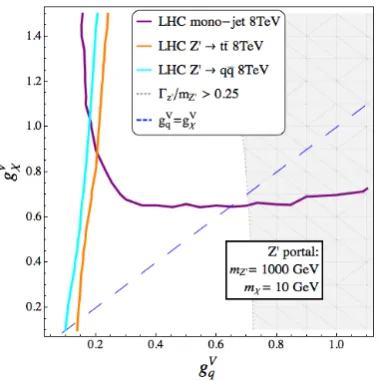
Figure 4. A comparison of the limits from mono-jet searches at the LHC and searches for Z0
in the di-top and di-jet invariant mass distributions in the (gVq , gχV) plane for mZ0 = 1000 GeV, mχ= 10 GeV.
project that there will be no improvement in the ¯tt resonance search, which explains why the orange dashed line does not appear in figure 2. Note that the 14 TeV mono-jet reach is comparable to the current di-top bound at 8 TeV and far below the 14 TeV projection making mono-jet searches less efficient than other strategies for testing this model.
The mono-jet bounds derived above feature just a mild dependence on the DM mass, since the probability for emission of a hard ISR jet is largely independent of it, as long as the mass is small compared to the cut on the transverse momentum of the leading jet. In figure 3(b) we show the parameter space that can by probed by mono-jet searches in the (mZ0, mχ) plane for gV
χ/q = 0.2. It can be seen that the mono-jet search is always weaker than the direct search for aZ0 in the di-top and di-jet channels. The 14 TeV mono-jet search loses all sensitivity once the DM mass becomes of the order of ∼ 350 GeV, as expected for the couplings and selection requirements considered here.
Finally, let us conclude this subsection with a few more comments. Given particular values for the Z0 mediator mass, the limits shown in the plots are derived under the assumption gχV =gqV. This choice implies that for most of the parameter space the di-top and di-jet searches for heavy resonances are more sensitive togVχ/qthan the mono-jet search
for DM. In figure 4 we show how the bounds depend on gVq and gχV separately, for values on the mediator and DM masses set atmZ0 = 1000 GeV,mχ= 10 GeV. The casegχV =gqV
corresponds to the dashed blue line. One can see that Z0 searches are more constraining than the mono-jet search for a wide choice of couplings, but the limits switch position when
gVχ & 3.5gqV due to the increased branching fraction Br(Z0 → χχ¯). Therefore, one must always keep in mind that even if the bounds presented here are valid over large regions of the parameter space, there remains a significant dependence on the underlying assumptions.
For gVχ 6= gqV the upper bounds in figure 2 will move in the (yχ, q
gV
JHEP04(2016)182
stronger, constraining smaller values of the product, and the monojet upper bounds willbecome weaker. For gVχ > gVq it will be the other way around. This can be understood from figure 4: if one takes gχV as large as possible, i.e. ∼ 1.4, then the upper bound on
gV
q derived from the monojet search is∼0.15, as the figure shows. One can then evaluate √
1.4·0.15 = 0.45 to get un upper bound on the product. This is essentially the strongest the monojet bound can get at the expense of the bounds from the di-jet distribution of the
Z0. The productqgV
q gVχ is the important quantity for the blind spot and direct detection.
3.2 Model 2: combining Higgs portal and squarks
This LSMS features some of the characteristics of SUSY models of DM. In particular the bounds can resemble those obtained in cases where the neutralino couples to the SM Higgs and additional heavy Higgs bosons; see, e.g., [54]. An obvious difference with the MSSM is that in the case presented here the DM is a Dirac fermion with free couplings, and the additional scalar is a SM singlet.
The low-energy Lagrangian of Model 2 is given by the sum of eq. (2.5) and eq. (2.7). There are 6 free parameters,
{mχ, mq˜, mH, θ, yχ, gq˜}. (3.6)
As before, we fixθ= 0.2 because of the mild dependence on sin 2θ. We start by fixing the masses of the mediators, mq˜= 1000 GeV and mH = 600 GeV. Recall that the latter choice implies that we do not investigate interference effects between the heavy and light Higgs bosons.
The effective amplitudes for DD in this case read
fn≈fp≈
yχsin 2θ 4m2
hSM
1− mh 2 SM m2 H mp v X
q=u,d,s
fT q+ 2 9fT G
+mp
mq
Ctree X
q=u,d,s
fT q+CboxfT G
gq2˜
m2 ˜ q−m2χ
, (3.7)
where we parametrize the numerical coefficients relative to the tree-level and box-diagram WIMP-quark-squark interactions in the proton with Ctree and Cbox, respectively. The nu-merical value of the sum in parenthesis in the second line of eq. (3.7) is 0.019. Note also that we use themicrOMEGAs default constituent valuemq= 0.05 GeV for the 3 lightest quarks. When yχ >0 cancellations in the amplitude for σpSI do not occur. We thus here limit ourselves to describing the case yχ<0, so that interference effects create a blind spot for DD searches. The condition for the blind spot is given by
yχ ≈ −
2.05×10⁷ GeV2
m2q˜−m2 χ
!
g2q˜
sin 2θ
1−m
2
hSM
m2
H
. (3.8)
JHEP04(2016)182
[image:15.595.90.507.100.305.2](a) (b)
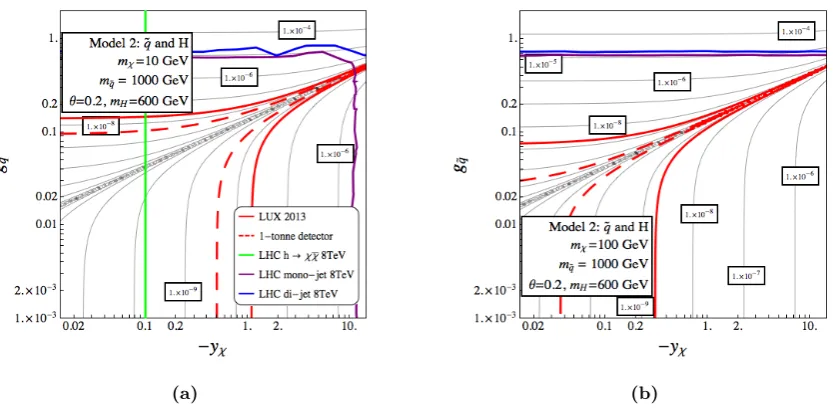
Figure 5. (a) Spin-independent scattering cross section in pb in the (yχ, gq˜) plane for a model combining squark-like mediators and Higgs portal. We setmχ = 10 GeV,mq˜= 1000 GeV,θ= 0.2, andmH = 600 GeV. The solid red line represents the current 90% C.L. upper bound from LUX and
the dashed red line is the projected limit for tonne-scale detectors in 2017 or so. Solid purple line is the 95% C.L. upper bound from the 8 TeV mono-jet search at ATLAS and solid blue line gives the 95% C.L. upper exclusion bound from direct squark searches with jets and missing energy [110]. Green solid line gives the upper limit from the invisible width of the Higgs boson from the combined CMS/ATLAS analysis. The full parameter space shown is within reach of 14 TeV jets+MET and mono-jet searches. (b) Same as (a) butmχ= 100 GeV.
the solid blue line shows the upper bound from the ATLAS 8 TeV squark search in jets + missing ET [110] (see also [111] for the CMS bound). As was the case for Model 1, the bound on|yχ|from the invisible width of the Higgs is stronger than the LUX bound from DD for this benchmark point.
In figure 5(b) we show the case with mχ = 100 GeV, for which the bound from the invisible width obviously does not apply. As was the case in figure2, the bound from mono-jet is less constraining for|yχ|in this case, as the SM Higgs is not produced on-shell. Thus, the parameter space that is not in reach of underground DD experiments remains essentially unconstrained, and this is in particular true for the blind spot, when mχ&62 GeV.
On the other hand, we stress that for the squark mass considered in figure 5, mq˜ =
1000 GeV, the 14 TeV jets+MET search with 300 fb−1at ATLAS [102], as well as the 14 TeV mono-jet search, are expected to exclude the full parameter space shown in the figures.
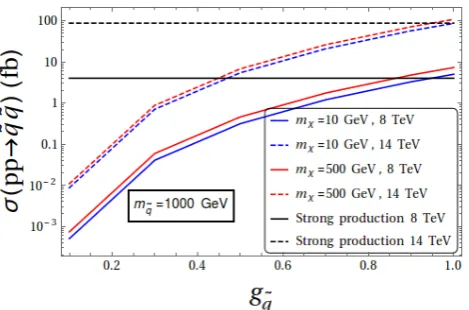
To show this in detail, we first present in figure 6plots of the squark production cross sections at the LHC as a function of the gq˜ coupling for mq˜ = 1000 TeV and different
choices of the WIMP mass. For mq˜ = 1000 TeV, the cross sections for strong [112] and t-channel DM exchange production of the squarks become of equal size when gq˜≈0.9, and
JHEP04(2016)182
Figure 6. Solid blue line shows the cross section for squark production through t-channel DM exchange at the LHC 8 TeV formq˜= 1000 TeV and a WIMP massmχ = 10 GeV, as a function of
thegq˜coupling. Solid red line shows the same production cross section whenmχ = 500 GeV. The
equivalent cross sections at the LHC 14 TeV are shown with dashed blue and red line, respectively. Solid black line shows the cross section for strong squark production at the LHC 8 TeV and the dashed black line the equivalent strong production cross section at the LHC 14 TeV [112].
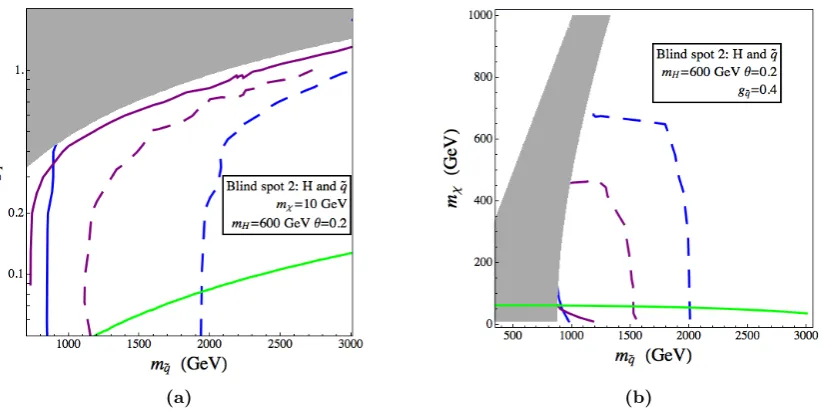
Then, in figure 7(a) we show the dependence of the bounds on the mediator and DM masses when eq. (3.8) holds. The first feature to note is that, as was the case in the previous model, the invisible branching fraction of the Higgs yields the greatest constraint when mχ < 62.5 GeV, with the exception of the region characterized by small gq˜ (how
small it should be to evade the bound depends on mq˜). It is also clear that at 8 TeV the
jets+MET and mono-jet searches dominate in different regions of the parameter space: when gq˜ is small direct production of the DM is negligible with respect to the strong
production of the squarks, whose cross section is shown as a black solid line in figure 6. As a consequence the jets+MET search has the greatest sensitivity and excludes a squark mass mq˜ . 900 GeV. As gq˜ increases direct WIMP production becomes more important
and the mono-jet bound overtakes the jets+MET bound for gq˜&0.3.
At 14 TeV the reach of the mono-jet and jets+MET searches both increase consider-ably. Taking the current projections of the backgrounds and cuts [101,102] at face value, it appears that the jets+MET search will play a more significant role in constraining the parameter space of Model 2 than the mono-jet search for Run 2.
In figure 7(b) we show the limits in the (mq˜, mχ) plane. Both the mono-jet and jets+MET limits show the well known characteristic shapes of squark searches; however, the region where the squark and WIMP masses are close to degenerate is not present here, as it corresponds to non-perturbative values of the couplingyχ. Thus, the limits on squark masses become more robust in the blind spot than in the individual SMS. Also visible is the apparent weakening of the limit on mχ from Br(hSM→χχ¯) as the squark mass increases,
JHEP04(2016)182
[image:17.595.93.505.98.305.2](a) (b)
Figure 7. (a) Interplay of LHC constraints for the blind spot parametrized by eq. (3.8) in the (mq˜,
gq˜) plane. Heremχ = 10 GeV, mH = 600 GeV, andθ= 0.2. Solid purple line gives the 95% C.L.
upper bound from mono-jet at ATLAS, and solid blue line the 95% C.L. upper bound from jets + missingET. The corresponding 14 TeV projections [101,102] with 300 fb−1 are given by a dashed
purple line and a dashed blue line, respectively. The green solid line gives the upper bound from the invisible width of the Higgs in a CMS/ATLAS combined analysis. (b) The bounds projected to the (mq˜,mχ) plane for gq˜= 0.4 andmH = 600 GeV. Corresponding bounds are now lower limits
on the masses.
3.3 Model 3: combining Z0 and squarks
In this subsection we consider an LSMS designed to mimic a UV completion characterized by an additional U(1)X symmetry that remains unbroken down to collider energies (see, e.g., [113]). One could imagine that U(1)X is spontaneously broken by the vev of a scalar field Ψ charged under U(1)X, giving rise to a lightZ0 boson which becomes part of the low-energy spectrum. The low-low-energy spectrum also contains scalar particles charged under SU(3) whose origin could be SUSY or something else. The details of the UV completion are not important for the phenomenology of the LSMS.
Constructing a gauge invariant combination of the two existing SMS requires some care since there is more than one way Model 3 could be constructed without breaking gauge invariance of the full Lagrangian. A first simple way is to imagine that the DM particle and the quarks have the same charges under U(1)X, and the scalar colored particles are instead U(1)X neutral. In this case the Lagrangian is a straight combination of eqs. (2.1) and (2.7), with a couplinggVχ/q≡gχV =gVq, and such that the extra scalars do not couple to theZ0. The resulting phenomenological model is described by 5 free parameters: mχ,m˜q,
mZ0, gV
JHEP04(2016)182
Another way of constructing a gauge invariant LSMS out of a combination of the SMSwith squarks and aZ0 is the following, which allows the squarks to have the same coupling to theZ0as the quarks, and could be seen as an approximation of a full UV theory involving an extended gauge symmetry and a supersymmetric sector. One needs two fermion SM singlet DM candidates, ξ and ζ, such that ξ is coupled to the Z0 like in eq. (2.1) and ζ is coupled to the squarks like in eq. (2.7). The symmetry is conserved if the fields are charged under U(1)X according to the following table,
Ψ ξ ζ qi q˜i,L/R
U(1)X charge +1 +1 0 +1 +1
(3.9)
where we have normalized all charges to 1 for simplicity, and we leave some freedom in choice of the coupling constants. As was the case before we assume that any anomalies are cancelled by additional states which do not effect the phenomenology described here. The low energy Lagrangian can contain the additional terms,
L ⊃y1Ψ ¯ξζ+
1
2mξξξ¯ + 1
2mζζζ¯ + h.c., (3.10)
where Ψ is the field that breaks U(1)X when it gets a vev Ψ →vΨ+ψ, withψa decoupled
physical scalar. After the symmetry is broken, ξ and ζ mix giving rise to two mass eigen-states: χ1 andχ2 which, if we assume mξ, mζ y1vΨ, are almost mass degenerate with a
massmχ=y1vΨ and maximal mixing.
Despite being apparently rather involved, the phenomenological LSMS is characterized by only 6 free parameters,
mχ, mq˜, mZ0, gχV, gVq, gq˜ . (3.11)
To reduce this number one can make the additional assumption gχV =±gVq ≡gχ/qV .
Destructive interference between different diagrams arises when gχV =−gqV, as
fn≈fp ≈ 3 2
gVχgqV m2
Z0
+mp
mq
Ctree X
q=u,d,s
fT q+CboxfT G
g2˜q
m2 ˜ q−m2χ
, (3.12)
see also eqs. (3.3) and (3.7). The condition for the blind spot is thus
|gq˜| ≈2 g V χ/q q m2 ˜ q−m2χ
mZ0 . (3.13)
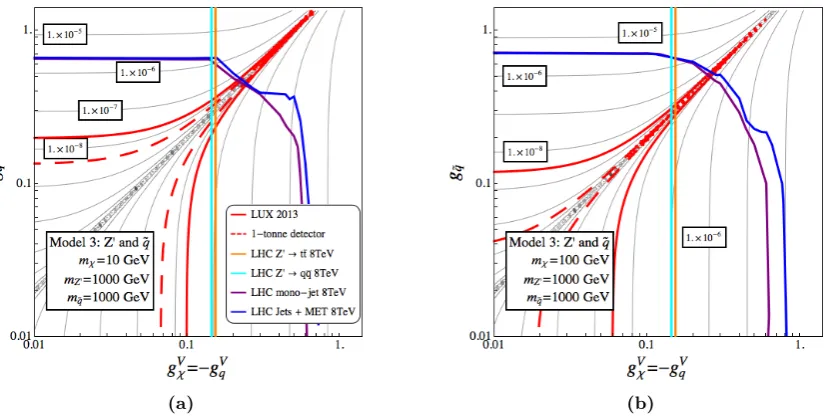
We plot in figure 8(a) contours of σpSI in pb in the (gχ/qV ,gq˜) plane for mχ = 10 GeV. The masses of the mediators are here set at mq˜ = 1000 GeV and mZ0 = 1000 GeV. The
color code is the same as in the previous figures. The case withmχ= 100 GeV is shown in figure 8(b). One can see again that the collider bounds barely move by changing the DM mass, but DD bounds reach their close-to-maximal strength when mχ= 100 GeV.
JHEP04(2016)182
[image:19.595.92.505.95.304.2](a) (b)
Figure 8. (a) Spin-independent scattering cross section in pb in the (gV
χ = −gqV, gq˜) plane for a combined Z0+ squark mediator simplified model. The masses are fixed at mχ = 10 GeV,
mZ0 = 1000 GeV, andmq˜= 1000 GeV. The solid red line shows the current upper limit from LUX
and the dashed red line the projected limit for tonne-scale underground detectors. Solid purple line is the upper limit from the 8 TeV mono-jet search at ATLAS and solid blue line is the upper limit from the 8 TeV jets+MET search at ATLAS. Solid orange line is the ATLAS limit onZ0 resonances from the invariantt¯tmass distribution at 8 TeV, while the solid cyan line gives the equivalent bound from the ¯qqdistribution. The full parameter space shown is within reach of 14 TeV jets+MET and mono-jet searches. (b) Same as (a) butmχ= 100 GeV.
projected reach with 300 fb−1for both searches covers the full parameter space, so that the limit does not appear in the figure.
The dependence of the collider bounds on the mediators’ mass when we confine our-selves to the blind spot for DD experiments (i.e. eq. (3.13) holds) is shown in figure 9. In figure 9(a) we show the interplay of the collider bounds on the (mZ0, mq˜) plane for gVχ/q = 0.1. The figure shows that a squark mass below∼900 GeV is excluded by the jets + missing energy ATLAS search, independently of the couplings, because squarks are pro-duced via strong interactions. On the other hand a Z0 mass below∼700 GeV is excluded by the di-top search for heavy resonance whengχ/qV = 0.1. The line moves to the right for larger couplings, as is shown in figure 9(b), where we present the case withgχ/qV = 0.4.
The reach of the mono-jet and jets+MET searches at the LHC 14 TeV, shown as a dashed purple and dashed blue line, respectively, are very sensitive to the size of gVχ/q. In general, our projections, based on [101, 102], show a significantly greater reach for the jets+MET search, which for gχ/qV = 0.4 can probe a squark mediator mass up to ∼2000 GeV.
JHEP04(2016)182
[image:20.595.90.507.96.304.2](a) (b)
Figure 9. (a) Interplay of LHC constraints for the blind spot parametrized by eq. (3.13) in the (mZ0,mq˜) plane. Heremχ = 10 GeV,gqV =−gVχ = 0.1. Solid purple line gives the 95% C.L. lower
bound from mono-jet at ATLAS, and solid blue line the 95% C.L. lower bound from jets + missing
ET. The corresponding 14 TeV projections with 300 fb−1 are given by a dashed purple line and a
dashed blue line, respectively. The solid orange line gives the current 95% C.L. lower bound on heavy resonances from the di-top distribution. The corresponding projected reach at LHC 14 TeV with 300 fb−1 is shown with a dashed orange line. The solid cyan line gives the bound on Z0 from the ¯qqinvariant mass distribution at the LHC 13 TeV, 4 fb−1. (b) Same as (a) butgV
q =−gVχ = 0.4.
4 Summary and conclusions
In this paper we have considered LSMS as simple extensions to dark matter simplified models, with the goal of mimicking some of the characteristics of more realistic models without introducing an excessively large number of parameters. Our starting assumption is that, to some extent, many of the features of complex models that cannot be explored in a single SMS framework, like interference of different diagrams that result in suppressions of the DM scattering cross section, or complementary use of different experimental strategies to explore a variegated parameter space from different angles, can instead be employed in LSMS built from simple combinations of existing SMS.
JHEP04(2016)182
and di-jet channels, invisible width of the SM Higgs boson, and searches for colored heavyparticles in jets with missing ET .
In particular, we dedicated special attention to the parameter space showing interfer-ence between different diagrams, which gives rise to blind spots for DD experiments. For these blind spots we have investigated to what extent interplay between collider limits on different particles and couplings can be used for a full exploration of the parameter space and we have additionally considered projections for the LHC 14 TeV run.
As is well known, in general for DM mass ranges such that mχ ≥10 GeV, the LUX upper bound onσSIp constrains the coupling constants of WIMP SMS by at least one order of magnitude more strongly than any of the LHC searches considered here. Even more strikingly, we find that the present bound from LUX also outperforms projected bounds for 300 fb−1 at the LHC 14 TeV in mono-jet searches and the projected reach of searches for heavy vector resonances in most cases.
A few exceptions to this rule can however be found. One is that in models with a Higgs portal, for mχ.1/2mhSM the coupling between the Higgs bosons and the WIMP are also strongly constrained by the invisible width of the SM Higgs boson, in agreement with what was observed in [57]. The other exception, which comprises the central part of this work, is that in regions of the parameter space whereσSIp is suppressed by interference effects a com-bination of LHC searches can effectively place strong limits, especially at the end of Run 2. In particular, we found that the following features apply to detections of a blind spot:
• The model involving a Z0 and Higgs portal (Model 1) is at present not constrained at all by mono-jet searches in the blind spot if gχV = gqV. Moreover, under this assumption, the projections for the LHC 14 TeV show that searches for heavy Z0
resonances will constitute the most effective strategy, among the ones considered here, to probe this part of the parameter space. Mono-jet searches, even with 300 fb−1 in the 14 TeV run, may be competitive with searches forZ0only for cases withgχV gqV . • In the two models (Models 2 and 3) involving squark-like mediators the bounds from mono-jet and jets+MET searches on the couplinggq˜are at present comparable.
However, according to the collaborations’ simulations [101, 102], the constraining power of jets+MET searches at the 14 TeV LHC for the blind spots significantly outperforms the expectations for mono-jet searches.
In general we find that the complementarity of different search strategies is crucial to obtaining the best constraints on DM at the LHC. Many motivated models are not necessarily constrained by direct detection experiments and thus demand careful attention at colliders. In this paper we have shown some first developments towards describing such scenarios in terms of a less-simplified model framework that can be investigated at the LHC.
Acknowledgments
JHEP04(2016)182
the BayesFITS Group at the National Centre for Nuclear Research for hospitality andsup-port in the early stages of this work. This work has been funded in part by the Welcome Programme of the Foundation for Polish Science. The work of A.C. is partially supported by funding available from the Department of Atomic Energy, Government of India, for the Re-gional Centre for Accelerator-based Particle Physics (RECAPP), Harish-Chandra Research Institute. K.K. is supported in part by the EU and MSHE Grant No. POIG.02.03.00-00-013/09. L.R. is also supported in part by a Lancaster-Manchester-Sheffield Consortium for Fundamental Physics under STFC grant ST/L000520/1. The use of the CIS computer cluster at the National Centre for Nuclear Research is gratefully acknowledged.
Open Access. This article is distributed under the terms of the Creative Commons Attribution License (CC-BY 4.0), which permits any use, distribution and reproduction in any medium, provided the original author(s) and source are credited.
References
[1] J. Goodman and W. Shepherd,LHC bounds on UV-complete models of dark matter, arXiv:1111.2359[INSPIRE].
[2] J. Abdallah et al.,Simplified models for dark matter and missing energy searches at the LHC,arXiv:1409.2893[INSPIRE].
[3] S.A. Malik et al.,Interplay and characterization of dark matter searches at colliders and in
direct detection experiments,Phys. Dark Univ.9-10(2015) 51[arXiv:1409.4075]
[INSPIRE].
[4] J. Abdallah et al.,Simplified models for dark matter searches at the LHC,Phys. Dark Univ. 9-10(2015) 8[arXiv:1506.03116] [INSPIRE].
[5] D. Abercrombie et al.,Dark matter benchmark models for early LHC Run-2 searches:
report of the ATLAS/CMS dark matter forum,arXiv:1507.00966[INSPIRE].
[6] ATLAScollaboration,Search for dark matter in events with a hadronically decaying W or
Z boson and missing transverse momentum in pp collisions at√s= 8TeV with the ATLAS
detector,Phys. Rev. Lett.112(2014) 041802[arXiv:1309.4017] [INSPIRE].
[7] ATLAScollaboration,Search for dark matter in events with a Z boson and missing
transverse momentum inppcollisions at √s= 8TeV with the ATLAS detector,Phys. Rev.
D 90(2014) 012004[arXiv:1404.0051] [INSPIRE].
[8] ATLAScollaboration,Search for new phenomena in events with a photon and missing
transverse momentum inppcollisions at √s= 8TeV with the ATLAS detector,Phys. Rev.
D 91(2015) 012008[arXiv:1411.1559] [INSPIRE].
[9] ATLAScollaboration,Search for new phenomena in final states with an energetic jet and
large missing transverse momentum inpp collisions at √s= 8TeV with the ATLAS
detector,Eur. Phys. J.C 75(2015) 299[arXiv:1502.01518] [INSPIRE].
[10] CMScollaboration, Search for dark matter, extra dimensions and unparticles in monojet
events in proton-proton collisions at √s= 8TeV,Eur. Phys. J.C 75(2015) 235
[arXiv:1408.3583] [INSPIRE].
[11] CMScollaboration, Search for new phenomena in monophoton final states in proton-proton
JHEP04(2016)182
[12] Q.-H. Cao, C.-R. Chen, C.S. Li and H. Zhang, Effective dark matter model: relic density,CDMS II, Fermi LAT and LHC,JHEP 08(2011) 018[arXiv:0912.4511] [INSPIRE].
[13] M. Beltr´an, D. Hooper, E.W. Kolb, Z.A.C. Krusberg and T.M.P. Tait,Maverick dark
matter at colliders,JHEP 09(2010) 037[arXiv:1002.4137] [INSPIRE].
[14] J. Goodman, M. Ibe, A. Rajaraman, W. Shepherd, T.M.P. Tait and H.-B. Yu,Constraints
on light Majorana dark matter from colliders,Phys. Lett. B 695(2011) 185
[arXiv:1005.1286] [INSPIRE].
[15] Y. Bai, P.J. Fox and R. Harnik, The Tevatron at the frontier of dark matter direct
detection,JHEP 12(2010) 048[arXiv:1005.3797] [INSPIRE].
[16] J. Goodman, M. Ibe, A. Rajaraman, W. Shepherd, T.M.P. Tait and H.-B. Yu,Gamma ray
line constraints on effective theories of dark matter,Nucl. Phys.B 844(2011) 55
[arXiv:1009.0008] [INSPIRE].
[17] A. Rajaraman, W. Shepherd, T.M.P. Tait and A.M. Wijangco, LHC bounds on interactions
of dark matter,Phys. Rev. D 84(2011) 095013[arXiv:1108.1196] [INSPIRE].
[18] P.J. Fox, R. Harnik, J. Kopp and Y. Tsai, Missing energy signatures of dark matter at the LHC,Phys. Rev. D 85(2012) 056011[arXiv:1109.4398] [INSPIRE].
[19] K. Cheung, P.-Y. Tseng, Y.-L.S. Tsai and T.-C. Yuan, Global constraints on effective dark
matter interactions: relic density, direct detection, indirect detection and collider,JCAP 05
(2012) 001[arXiv:1201.3402] [INSPIRE].
[20] S. Matsumoto, S. Mukhopadhyay and Y.-L.S. Tsai, Singlet Majorana fermion dark matter:
a comprehensive analysis in effective field theory, JHEP 10(2014) 155[arXiv:1407.1859]
[INSPIRE].
[21] XENON100collaboration, E. Aprile et al.,Dark matter results from 225 live days of
XENON100 data, Phys. Rev. Lett.109(2012) 181301[arXiv:1207.5988] [INSPIRE].
[22] LUXcollaboration, D.S. Akerib et al., First results from the LUX dark matter experiment
at the Sanford Underground Research Facility, Phys. Rev. Lett.112(2014) 091303
[arXiv:1310.8214] [INSPIRE].
[23] PICASSOcollaboration, M. Barnabe-Heider et al.,Improved spin dependent limits from
the PICASSO dark matter search experiment,Phys. Lett.B 624(2005) 186
[hep-ex/0502028] [INSPIRE].
[24] PICASSOcollaboration, S. Archambault et al.,Constraints on low-mass WIMP
interactions on19F from PICASSO,Phys. Lett.B 711(2012) 153[arXiv:1202.1240]
[INSPIRE].
[25] COUPPcollaboration, E. Behnke et al.,First dark matter search results from a 4kg CF3I
bubble chamber operated in a deep underground site,Phys. Rev.D 86(2012) 052001
[Erratum ibid. D 90(2014) 079902] [arXiv:1204.3094] [INSPIRE].
[26] IceCubecollaboration, R. Abbasi et al.,Multi-year search for dark matter annihilations in
the sun with the AMANDA-II and IceCube detectors,Phys. Rev. D 85(2012) 042002
[arXiv:1112.1840] [INSPIRE].
[27] IceCubecollaboration, M.G. Aartsen et al.,Search for dark matter annihilations in the
sun with the79-string IceCube detector,Phys. Rev. Lett.110(2013) 131302
JHEP04(2016)182
[28] ANTAREScollaboration, S. Adrian-Martinez et al.,First results on dark matterannihilation in the sun using the ANTARES neutrino telescope,JCAP 11 (2013) 032
[arXiv:1302.6516] [INSPIRE].
[29] P.J. Fox, R. Harnik, J. Kopp and Y. Tsai, LEP shines light on dark matter,Phys. Rev. D 84(2011) 014028[arXiv:1103.0240] [INSPIRE].
[30] I.M. Shoemaker and L. Vecchi, Unitarity and monojet bounds on models for DAMA,
CoGeNT and CRESST-II,Phys. Rev. D 86(2012) 015023[arXiv:1112.5457] [INSPIRE].
[31] G. Busoni, A. De Simone, E. Morgante and A. Riotto,On the validity of the effective field
theory for dark matter searches at the LHC,Phys. Lett.B 728(2014) 412
[arXiv:1307.2253] [INSPIRE].
[32] G. Busoni, A. De Simone, J. Gramling, E. Morgante and A. Riotto, On the validity of the effective field theory for dark matter searches at the LHC, part II: complete analysis for the
s-channel,JCAP 06(2014) 060[arXiv:1402.1275] [INSPIRE].
[33] G. Busoni, A. De Simone, T. Jacques, E. Morgante and A. Riotto, On the validity of the effective field theory for dark matter searches at the LHC part III: analysis for the
t-channel,JCAP 09(2014) 022[arXiv:1405.3101] [INSPIRE].
[34] D. Racco, A. Wulzer and F. Zwirner, Robust collider limits on heavy-mediator dark matter,
JHEP 05(2015) 009[arXiv:1502.04701] [INSPIRE].
[35] H. An, X. Ji and L.-T. Wang, Light dark matter and Z0 dark force at colliders,JHEP 07
(2012) 182[arXiv:1202.2894] [INSPIRE].
[36] M.T. Frandsen, F. Kahlhoefer, A. Preston, S. Sarkar and K. Schmidt-Hoberg, LHC and
Tevatron bounds on the dark matter direct detection cross-section for vector mediators,
JHEP 07(2012) 123[arXiv:1204.3839] [INSPIRE].
[37] H. An, L.-T. Wang and H. Zhang, Dark matter witht-channel mediator: a simple step
beyond contact interaction, Phys. Rev.D 89(2014) 115014 [arXiv:1308.0592] [INSPIRE].
[38] Y. Bai and J. Berger,Fermion portal dark matter,JHEP 11(2013) 171[arXiv:1308.0612] [INSPIRE].
[39] A. DiFranzo, K.I. Nagao, A. Rajaraman and T.M.P. Tait, Simplified models for dark matter
interacting with quarks,JHEP 11(2013) 014[Erratum ibid. 01(2014) 162]
[arXiv:1308.2679] [INSPIRE].
[40] A. Alves, S. Profumo and F.S. Queiroz, The darkZ0 portal: direct, indirect and collider
searches,JHEP 04(2014) 063[arXiv:1312.5281] [INSPIRE].
[41] M. Papucci, A. Vichi and K.M. Zurek, Monojet versus the rest of the world I: t-channel
models,JHEP 11(2014) 024[arXiv:1402.2285] [INSPIRE].
[42] M. Garny, A. Ibarra, S. Rydbeck and S. Vogl, Majorana dark matter with a coloured
mediator: collider vs direct and indirect searches,JHEP 06 (2014) 169[arXiv:1403.4634]
[INSPIRE].
[43] O. Buchmueller, M.J. Dolan, S.A. Malik and C. McCabe, Characterising dark matter
searches at colliders and direct detection experiments: vector mediators,JHEP 01(2015)
JHEP04(2016)182
[44] G. Busoni, A. De Simone, T. Jacques, E. Morgante and A. Riotto, Making the most of therelic density for dark matter searches at the LHC 14TeV run,JCAP 03(2015) 022
[arXiv:1410.7409] [INSPIRE].
[45] M.R. Buckley, D. Feld and D. Goncalves, Scalar simplified models for dark matter,Phys. Rev.D 91(2015) 015017 [arXiv:1410.6497] [INSPIRE].
[46] M. Garny, A. Ibarra and S. Vogl, Signatures of Majorana dark matter witht-channel
mediators,Int. J. Mod. Phys. D 24(2015) 1530019[arXiv:1503.01500] [INSPIRE].
[47] M. Chala, F. Kahlhoefer, M. McCullough, G. Nardini and K. Schmidt-Hoberg,Constraining
dark sectors with monojets and dijets,JHEP 07(2015) 089[arXiv:1503.05916] [INSPIRE].
[48] M. Duerr, P. Fileviez Perez and J. Smirnov,Simplified Dirac dark matter models and
gamma-ray lines,Phys. Rev. D 92(2015) 083521[arXiv:1506.05107] [INSPIRE].
[49] T. Cohen, J. Kearney, A. Pierce and D. Tucker-Smith, Singlet-doublet dark matter,Phys. Rev.D 85(2012) 075003 [arXiv:1109.2604] [INSPIRE].
[50] C. Cheung, L.J. Hall, D. Pinner and J.T. Ruderman,Prospects and blind spots for
neutralino dark matter,JHEP 05(2013) 100[arXiv:1211.4873] [INSPIRE].
[51] C. Cheung and D. Sanford, Simplified models of mixed dark matter,JCAP 02(2014) 011 [arXiv:1311.5896] [INSPIRE].
[52] R.J. Hill and M.P. Solon,WIMP-nucleon scattering with heavy WIMP effective theory,
Phys. Rev. Lett.112(2014) 211602 [arXiv:1309.4092] [INSPIRE].
[53] P. Huang and C.E.M. Wagner, Blind spots for neutralino dark matter in the MSSM with an
intermediatemA,Phys. Rev. D 90(2014) 015018[arXiv:1404.0392] [INSPIRE].
[54] A. Crivellin, M. Hoferichter, M. Procura and L.C. Tunstall,Light stops, blind spots and
isospin violation in the MSSM, JHEP 07 (2015) 129[arXiv:1503.03478] [INSPIRE].
[55] L. Calibbi, A. Mariotti and P. Tziveloglou,Singlet-doublet model: dark matter searches and
LHC constraints,JHEP 10(2015) 116[arXiv:1505.03867] [INSPIRE].
[56] A. Arbey, M. Battaglia and F. Mahmoudi, Combining monojet, supersymmetry and dark
matter searches,Phys. Rev. D 89(2014) 077701[arXiv:1311.7641] [INSPIRE].
[57] S. Baek, P. Ko and W.-I. Park,Invisible Higgs decay width vs. dark matter direct detection
cross section in Higgs portal dark matter models,Phys. Rev. D 90(2014) 055014
[arXiv:1405.3530] [INSPIRE].
[58] A. Arbey, M. Battaglia and F. Mahmoudi, Monojet searches for MSSM simplified models, arXiv:1506.02148[INSPIRE].
[59] S. Baek, P. Ko, M. Park, W.-I. Park and C. Yu, Beyond the dark matter effective field
theory and a simplified model approach at colliders,Phys. Lett.B 756(2016) 289
[arXiv:1506.06556] [INSPIRE].
[60] E. Dudas, Y. Mambrini, S. Pokorski and A. Romagnoni, (In)visible Z0 and dark matter,
JHEP 08(2009) 014[arXiv:0904.1745] [INSPIRE].
[61] H. Dreiner, D. Schmeier and J. Tattersall, Contact interactions probe effective dark matter
models at the LHC,Europhys. Lett.102(2013) 51001[arXiv:1303.3348] [INSPIRE].
[62] O. Buchmueller, M.J. Dolan and C. McCabe,Beyond effective field theory for dark matter
JHEP04(2016)182
[63] T. Jacques and K. Nordstr¨om, Mapping monojet constraints onto simplified dark mattermodels,JHEP 06(2015) 142[arXiv:1502.05721] [INSPIRE].
[64] M. Autran, K. Bauer, T. Lin and D. Whiteson, Searches for dark matter in events with a
resonance and missing transverse energy,Phys. Rev. D 92(2015) 035007
[arXiv:1504.01386] [INSPIRE].
[65] A. Alves and K. Sinha, Searches for dark matter at the LHC: a multivariate analysis in the
mono-Z channel,Phys. Rev. D 92(2015) 115013[arXiv:1507.08294] [INSPIRE].
[66] ATLAScollaboration,Search for high-mass dilepton resonances inpp collisions at
√
s= 8TeV with the ATLAS detector,Phys. Rev.D 90(2014) 052005 [arXiv:1405.4123]
[INSPIRE].
[67] CMScollaboration, Search for physics beyond the standard model in dilepton mass spectra
in proton-proton collisions at√s= 8TeV,JHEP 04(2015) 025[arXiv:1412.6302]
[INSPIRE].
[68] B.A. Dobrescu, Leptophobic boson signals with leptons, jets and missing energy, arXiv:1506.04435[INSPIRE].
[69] S. Baek, P. Ko and W.-I. Park,Search for the Higgs portal to a singlet fermionic dark
matter at the LHC,JHEP 02(2012) 047[arXiv:1112.1847] [INSPIRE].
[70] S. Baek, P. Ko, W.-I. Park and E. Senaha,Vacuum structure and stability of a singlet
fermion dark matter model with a singlet scalar messenger,JHEP 11(2012) 116
[arXiv:1209.4163] [INSPIRE].
[71] R.C. Cotta, A. Rajaraman, T.M.P. Tait and A.M. Wijangco,Particle physics implications
and constraints on dark matter interpretations of the CDMS signal,Phys. Rev.D 90(2014)
013020[arXiv:1305.6609] [INSPIRE].
[72] O. Fischer and J.J. van der Bij, The scalar singlet-triplet dark matter model,JCAP 01
(2014) 032[arXiv:1311.1077] [INSPIRE].
[73] A. Berlin, S. Gori, T. Lin and L.-T. Wang,Pseudoscalar portal dark matter,Phys. Rev. D 92(2015) 015005[arXiv:1502.06000] [INSPIRE].
[74] I. de Medeiros Varzielas, O. Fischer and V. Maurer, A4 symmetry at colliders and in the
universe,JHEP 08(2015) 080[arXiv:1504.03955] [INSPIRE].
[75] A. Farzinnia, H.-J. He and J. Ren, Natural electroweak symmetry breaking from scale
invariant Higgs mechanism,Phys. Lett.B 727(2013) 141[arXiv:1308.0295] [INSPIRE].
[76] G. B´elanger, B. Dumont, U. Ellwanger, J.F. Gunion and S. Kraml,Status of invisible Higgs
decays,Phys. Lett.B 723(2013) 340[arXiv:1302.5694] [INSPIRE].
[77] G.M. Pruna and T. Robens,Higgs singlet extension parameter space in the light of the LHC
discovery,Phys. Rev. D 88(2013) 115012[arXiv:1303.1150] [INSPIRE].
[78] T. Robens and T. Stefaniak,Status of the Higgs singlet extension of the standard model
after LHC run1,Eur. Phys. J.C 75(2015) 104[arXiv:1501.02234] [INSPIRE].
[79] XENON1Tcollaboration, E. Aprile,The XENON1T dark matter search experiment,
Springer Proc. Phys.148(2013) 93 [arXiv:1206.6288] [INSPIRE].
[80] D.C. Malling et al.,After LUX: the LZ program,arXiv:1110.0103[INSPIRE].
JHEP04(2016)182
[82] PandaXcollaboration, X. Cao et al.,PandaX: a liquid xenon dark matter experiment atCJPL,Sci. China Phys. Mech. Astron.57 (2014) 1476[arXiv:1405.2882] [INSPIRE].
[83] D. L´opez-Val and T. Robens, ∆r and the W-boson mass in the singlet extension of the
standard model,Phys. Rev. D 90(2014) 114018[arXiv:1406.1043] [INSPIRE].
[84] A. Alloul, N.D. Christensen, C. Degrande, C. Duhr and B. Fuks, FeynRules 2.0 — a
complete toolbox for tree-level phenomenology,Comput. Phys. Commun.185(2014) 2250
[arXiv:1310.1921] [INSPIRE].
[85] A. Belyaev, N.D. Christensen and A. Pukhov, CalcHEP 3.4 for collider physics within and
beyond the standard model,Comput. Phys. Commun.184(2013) 1729[arXiv:1207.6082]
[INSPIRE].
[86] G. B´elanger, F. Boudjema, A. Pukhov and A. Semenov,MicrOMEGAs3: a program for
calculating dark matter observables,Comput. Phys. Commun.185(2014) 960
[arXiv:1305.0237] [INSPIRE].
[87] J. Alwall et al.,The automated computation of tree-level and next-to-leading order
differential cross sections and their matching to parton shower simulations,JHEP 07
(2014) 079[arXiv:1405.0301] [INSPIRE].
[88] T. Sj¨ostrand, S. Mrenna and P.Z. Skands,A brief introduction to PYTHIA8.1,Comput. Phys. Commun.178(2008) 852[arXiv:0710.3820] [INSPIRE].
[89] M. Drees, H. Dreiner, D. Schmeier, J. Tattersall and J.S. Kim, CheckMATE: confronting
your favourite new physics model with LHC data,Comput. Phys. Commun.187(2014) 227
[arXiv:1312.2591] [INSPIRE].
[90] A. Barr, C. Lester and P. Stephens, mT2: the truth behind the glamour,J. Phys.G 29 (2003) 2343[hep-ph/0304226] [INSPIRE].
[91] H.-C. Cheng and Z. Han,Minimal kinematic constraints andmT2,JHEP 12(2008) 063 [arXiv:0810.5178] [INSPIRE].
[92] M. Cacciari and G.P. Salam, Dispelling theN3 myth for thek
tjet-finder,Phys. Lett.B
641(2006) 57[hep-ph/0512210] [INSPIRE].
[93] M. Cacciari, G.P. Salam and G. Soyez, The anti-kt jet clustering algorithm, JHEP 04
(2008) 063[arXiv:0802.1189] [INSPIRE].
[94] M. Cacciari, G.P. Salam and G. Soyez, FastJet user manual,Eur. Phys. J.C 72(2012) 1896[arXiv:1111.6097] [INSPIRE].
[95] DELPHES 3collaboration, J. de Favereau et al.,DELPHES3, a modular framework for
fast simulation of a generic collider experiment,JHEP 02(2014) 057[arXiv:1307.6346]
[INSPIRE].
[96] C.G. Lester and D.J. Summers,Measuring masses of semiinvisibly decaying particles pair
produced at hadron colliders,Phys. Lett.B 463(1999) 99[hep-ph/9906349] [INSPIRE].
[97] A.L. Read,Presentation of search results: the CLs technique,J. Phys. G 28(2002) 2693
[INSPIRE].
[98] K. Kowalska, L. Roszkowski, E.M. Sessolo and A.J. Williams, GUT-inspired SUSY and the
muong−2 anomaly: prospects for LHC 14TeV,JHEP 06(2015) 020[arXiv:1503.08219]
JHEP04(2016)182
[99] M. Chakraborti, U. Chattopadhyay, A. Choudhury, A. Datta and S. Poddar, Theelectroweak sector of the pMSSM in the light of LHC-8TeV and other data,JHEP 07
(2014) 019[arXiv:1404.4841] [INSPIRE].
[100] M. Chakraborti, U. Chattopadhyay, A. Choudhury, A. Datta and S. Poddar, Reduced LHC
constraints for higgsino-like heavier electroweakinos,JHEP 11 (2015) 050
[arXiv:1507.01395] [INSPIRE].
[101] ATLAScollaboration,Sensitivity to WIMP dark matter in the final states containing jets
and missing transverse momentum with the ATLAS detector at 14TeV LHC,
ATL-PHYS-PUB-2014-007, CERN, Geneva Switzerland (2014).
[102] ATLAScollaboration,Search for supersymmetry at the high luminosity LHC with the
ATLAS experiment,ATL-PHYS-PUB-2014-010, CERN, Geneva Switzerland (2014).
[103] ATLAScollaboration,A search for t¯t resonances using lepton-plus-jets events in
proton-proton collisions at√s= 8TeV with the ATLAS detector,JHEP 08(2015) 148
[arXiv:1505.07018] [INSPIRE].
[104] ATLAScollaboration,Search for new phenomena in the dijet mass distribution using pp
collision data at√s= 8TeV with the ATLAS detector,Phys. Rev.D 91(2015) 052007
[arXiv:1407.1376] [INSPIRE].
[105] ATLAScollaboration,Search for new phenomena in dijet mass and angular distributions
frompp collisions at√s= 13TeV with the ATLAS detector,Phys. Lett.B 754(2016) 302
[arXiv:1512.01530] [INSPIRE].
[106] ATLAScollaboration,Studies of sensitivity to new dilepton and ditop resonances with an
upgraded ATLAS detector at a high-luminosity LHC,ATL-PHYS-PUB-2013-003, CERN,
Geneva Switzerland (2013).
[107] ATLASandCMScollaborations,Measurements of the Higgs boson production and decay rates and constraints on its couplings from a combined ATLAS and CMS analysis of the
LHCpp collision data at√s= 7 and8TeV, ATLAS-CONF-2015-044, CERN, Geneva
Switzerland (2015).
[108] L. Basso, O. Fischer and J.J. van der Bij,NaturalZ0 model with an inverse seesaw
mechanism and leptonic dark matter,Phys. Rev. D 87(2013) 035015[arXiv:1207.3250]
[INSPIRE].
[109] G. Jungman, M. Kamionkowski and K. Griest,Supersymmetric dark matter,Phys. Rept. 267(1996) 195[hep-ph/9506380] [INSPIRE].
[110] ATLAScollaboration,Search for squarks and gluinos with the ATLAS detector in final
states with jets and missing transverse momentum using √s= 8TeV proton-proton
collision data,JHEP 09 (2014) 176[arXiv:1405.7875] [INSPIRE].
[111] CMScollaboration, Searches for supersymmetry using theMT2 variable in hadronic events
produced inppcollisions at 8TeV,JHEP 05(2015) 078[arXiv:1502.04358] [INSPIRE].
[112] LHC SUSY Cross Section Working Group webpage,
https://twiki.cern.ch/twiki/bin/view/LHCPhysics/SUSYCrossSections.
[113] P. Athanasopoulos, A.E. Faraggi and V.M. Mehta,Light Z0 in heterotic string standardlike