This is a repository copy of
AN ADAPTIVE LOCALIZATION SYSTEM USING PARTICLE
SWARM OPTIMIZATION IN A CIRCULAR DISTRIBUTION FORM
.
White Rose Research Online URL for this paper:
http://eprints.whiterose.ac.uk/118699/
Version: Published Version
Article:
Alhammadi, Abdulraqeb, Hashim, Fazirulhisyam, Fadlee, Mohd et al. (1 more author)
(2016) AN ADAPTIVE LOCALIZATION SYSTEM USING PARTICLE SWARM
OPTIMIZATION IN A CIRCULAR DISTRIBUTION FORM. JURNAL TEKNOLOGI. pp.
105-110.
[email protected]
https://eprints.whiterose.ac.uk/
Reuse
Items deposited in White Rose Research Online are protected by copyright, with all rights reserved unless
indicated otherwise. They may be downloaded and/or printed for private study, or other acts as permitted by
national copyright laws. The publisher or other rights holders may allow further reproduction and re-use of
the full text version. This is indicated by the licence information on the White Rose Research Online record
for the item.
Takedown
If you consider content in White Rose Research Online to be in breach of UK law, please notify us by
78: 9–3 (2016) 105–110| www.jurnalteknologi.utm.my | eISSN 2180–3722 |
Jurnal
Teknologi
Full Paper
AN ADAPTIVE LOCALIZATION SYSTEM USING
PARTICLE SWARM OPTIMIZATION IN A CIRCULAR
DISTRIBUTION FORM
Abdulraqeb Alhammadi
a, Fazirulhisyam Hashim
a*, Mohd Fadlee
a,
Tareq M. Shami
ba
Faculty of Engineering, University Putra Malaysia, 43300, Serdang,
Malaysia
b
Faculty of Engineering, Multimedia University, 36100, Cyberjaya,
Malaysia
Article history Received
1 February 2015
Received in revised form
24 March 2015
Accepted
1 August 2015
*Corresponding author
[email protected]
Abstract
Tracking the user location in indoor environment becomes substantial issue in recent research High accuracy and fast convergence are very important issues for a good localization system. One of the techniques that are used in localization systems is particle swarm optimization (PSO). This technique is a stochastic optimization based on the movement and velocity of particles. In this paper, we introduce an algorithm using PSO for indoor localization system. The proposed algorithm uses PSO to generate several particles that have circular distribution around one access point (AP). The PSO generates particles where the distance from each particle to the AP is the same distance from the AP to the target. The particle which achieves correct distances (distances from each AP to target) is selected as the target. Four PSO variants, namely standard PSO (SPSO), linearly decreasing inertia weight PSO (LDIW PSO), self-organizing hierarchical PSO with time acceleration coefficients (HPSO-TVAC), and constriction factor PSO (CFPSO) are used to find the minimum distance error. The simulation results show the proposed method using HPSO-TVAC variant achieves very low distance error of 0.19 meter.
Keywords: Indoor localization system, particle swarm optimization, Euclidean distance
© 2016 Penerbit UTM Press. All rights reserved
1.0 INTRODUCTION
Nowadays, navigation systems have been widely used in outdoor and indoor environments. There are many types of navigation systems such as marine navigation system, global position system (GPS), wireless sensor network and robotic mapping. These systems have been designed to estimate the target at particular places within network coverage. However, an indoor localization system that usually covers a small area compared to outdoor environment has a small location error. Recently, indoor localization systems have become recent interested research due to increase the tracking applications.
There are many techniques that are used for tracking the user such as radio frequency fingerprinting [1-2], angle of arrival (AOA) [3] and triangulation [4]. The typical localization system should have a good accuracy with less complexity. However,
the accuracy of the system depends on the type and size of the environments. Thus, indoor environment requires a good accuracy compare to outdoor environment. The indoor localization systems require different types of pre-knowledge information such as physical testbed, received signal strength (RSS) and orientation of the user. Moreover, fingerprinting technique considers the most accurate technique that has minor error distance compare to other techniques [5-6]. However, fingerprinting technique is suffering from high system complexity which consists of two operating phases (offline and online phase) [7]. Besides, it requires big size of radio map in order to obtain high location accuracy.
106 Abdulraqeb et al. / Jurnal Teknologi (Sciences & Engineering) 78: 9–3 (2016) 105–110
positions and velocity. It used to improve the accuracy of localization system. Recently, POS has considered by many research communities due to high convergence, more fixable and less complexity. The high accuracy obtains when the propagation condition line of sight (LOS) whereas non line of sight (NLOS) condition achieves low accuracy [9]. In indoor localization, the position of the particle represents the optimized position of the target, whereas the velocity represents the particle movement within a particular environment. In this paper, we propose a method to enhance the system accuracy by using PSO which generates a swarm of particles around each AP circularly.
This paper is organized as follows. Section 2 introduces the related work that has been done in the indoor tracking environment. Section 3 explains in details the methodology that has been proposed to minimize the distance error using PSO. Section 4 describes the simulation setup of the indoor environment. Section 5 shows the results obtained and compare the results for the four PSO variants. Lastly, section 6 summarizes this work.
2.0 RELATED WORK
The usage of PSO depends on the level of localization problem. Some of the researchers used a single object optimization model to solve simple problems of localization system. Random time variable PSO algorithm is an adaptive PSO proposed by [10], which called random time varying inertia weight and acceleration coefficients (PSO-RTVIWAC). This algorithm combined of two different algorithms which are: the random inertia weight (PSO-RANDIW) and time-varying acceleration coefficients (PSO-TVAC). It used to enhance the performance of the original PSO. However, this algorithm does not compatible for NLOS environments. In [11], the authors proposed a new distributed selection technique to minimize the number of selected nodes in wireless sensor network. These selected number of nodes considered the main part of the technique to establish the grid coordinate system. However, the localization accuracy depends on the grid nodes in the system. Unlike [12], a distributed and cooperative algorithm for multipath environments in wireless sensor network is proposed. This algorithm based on the multipath propagation that allows sensors to cooperatively self-localize with respect to a single anchor node in the whole network. The single anchor node is computed by using the range and direction of arrival measurements.
The authors in [13] proposed group discriminant (GD) algorithm to improve the accuracy of the location fingerprinting. GS depends on the AP selection approach which focusing on measuring the localization capabilities of each group of APs. The mean error obtained by GS is 3 meters for five APs. Unlike the traditional techniques that treat the APs based on their individual importance [14-15].
The working [16 -20] focus on multi-objective particle swarm optimization to solve the localization issues. The multi-objective particle swarm optimization improved the accuracy and convergence of the localization system. However, in [16] the system suffered from slow convergence and limitless size of the archive. Thus, the authors in [20] addressed these issues by considering the geometric topology constraint to increase the accuracy of localization system and using the global optimum solution in order to get better convergence. However, this method obtained an average localization error of 10 meters when many number of anchor points were used.
In this work, we apply the SPSO [8], LDIW-PSO [21], HPSO-TVAC [22], and CFPSO [23] in order to find the minimum distance error. In LDIW-PSO, the Inertia weight is decreasing during the searching process based on the following formula:
w t
w
maxw
min
T
t
w
minT
(1) wherew
max is 0 .9,w
min is 0.4, T is the maximum number of iterations, and t is the current iteration. HPSO-TVAC improved the performance of the SPSO by controlling the acceleration coefficientsc c
1,
2. Thevalues of
c
1 andc
2 are expressed as follows:
1 1f 1i 1i
t
c
c
c
c
T
(2)
2 2f 2i 2i
t
c
c
c
c
T
(3)where
c
1i is 2.5, c1 f is 0.5,c
2i is 0.5, andc2 f is 2.5. The velocity of the SPSO has been modified by Clerc and kenndey [23] resulting in a new PSO variant named constriction factor PSO. The velocity of the constriction factor PSO is written as follows:
1 1
2 2
1
id id idid
id d
v t
c r Pbest
t
x t
v t
c r Gbest t
x t
(4) where 2 2 2 4 k and c1 c2 , k(0,1]
3.0 METHODOLOGY
2
2
,
1,
,5
AP t AP t AP t m n
D
X x
Y y
Max d *
AP
(5)where (X ,Y ) and (x,y) Indicates the location of deployed access points and estimated target location respectively. Max d is the maximum value of measured distance error. represents the random number which is defined as a uniform distribution between .
The objective of this work to minimize the distance error using the following equation:
2 2
min( (
)
(
) )
error t e t e
d
x
x
y
y
(6) where xe and ye indicate estimated location of the target.The distance from the access point to the target can be measured using RSS. However, the position of the target cannot be determined since there are other coordinates that can produce the same distance. To overcome this problem we proposed a method that generates N particles in a circular distribution using PSO. The numbers of particles that are generated in the circle are abbreviated as NPC. It should be noted that each particle represents a position. Each of these particles is a potential to be the target (since all the generated particles have the same distance as the distance from the AP to the target). To confirm that our solution produces the exact location of the target, we test every generated particle in the circle by calculating the distance from each AP to that generated particle and confirming that the selected particle satisfies all distances (d1,d2,….d5) (It is
noteworthy that we choose the AP that achieves the highest RSS which has the minimum measurement distance error).
At the beginning of the process, we generate N
particles randomly in the area. In order to get the best particle that has the same distance as DAP,t . Then, in each iteration, PSO is used to find the particle which has the closest distance as DAP,t by using the following fitness function:
, ,
( )
min
(
Ap t Ap P)
f d
abs D
D
(7)Where DAP,p is the distance from the AP to the particle which is written as follows:
2 2
,
(
)
(
)
Ap p Ap p AP p
D
x
x
y
y
(8)The accuracy of the system depends on the optimization fitness function. In other word, the optimization fitness function is inversely proportional to the system accuracy.
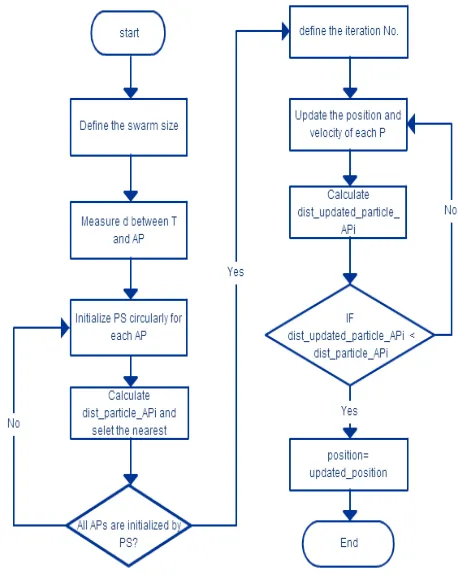
At the end of the PSO iterations, PSO records the best particle that has the same distance as DAP,t. This process is repeated K times where in each time a new particle (position) is generated around the circle. After that, we test each generated particle to confirm that it satisfies all other distances. Our methodology for the SPSO is explained in the following steps:
STEP 1: Define the swarm size N.
STEP 2: Locate the positions of APs randomly in the area
STEP 3: Measure the distances from each AP (d1,d2,…., dx) to the target using RSS.
STEP 4: Determine the AP that achieves the highest RSS (the minimum measurement distance error) and record its distance from target
STEP 5: For i=1:N.
STEP 6: Generate the positions of N particles and define them as X and set Pbest =X and V=0
STEP 7: For t=1:T.
STEP 8: Calculate the distance from AP (highest RSS) to the position of the particle (
x
i) using Equation 8.STEP 9: If
f x
( )
i <f Pbest
(
i)
then doPbestixi
End
STEP 10: Calculate the distance from AP (highest RSS) to the position of the particle using
Pbest
iSTEP 11: Record the gbest which is the best particle that achievesminabs D( Ap t, DAp P, )
STEP 12: Update the velocity of the particle using Equation 9.
STEP 13: Update the position of the particle using Equation 10.
STEP 14: Next T and i
STEP 15: Stop when all the N particles have been generated.
STEP 16: For each generated particle, find the particle that satisfies all the distances from the APs.
STEP 17: End for loop.
STEP 18: Return the position of this particle and calculate the distance error using Equation 6.
The flowchart of the proposed method that used to estimate the target location is shown in Figure 2. PSO uses position and velocity update equations which can be written as follows:
1 1
2 2
( )
(
( )
( ))
(
( )
( ))
id id id
id id id
v
w v
t
c r Pbest
t
x
t
c r gbest
t
x
t
(9)(
1)
( )
(
1)
id id id
108 Abdulraqeb et al. / Jurnal Teknologi (Sciences & Engineering) 78: 9–3 (2016) 105–110
where c1 and c2 indicates to the acceleration constants, w is the inertia weight, r1, r2, are uniformly distributed random numbers between 0 and 1.
4.0 SIMULATION SETUP
The testbed dimension of environment is 80mX50m with five APs are deployed. The coordinates of five APs that deployed in the environment are (10, 10), (70, 10), (10, 40), (70, 40) and (40, 25) as shown in Figure 1.
The particles were initialized for each AP with size of 100. The distance between particles and AP is calculated by Equation (11).
2 2
,
(
)
(
)
1, 2,...,100
AP p AP p AP p
D
X
x
Y
y
p
(11) [image:5.612.314.543.57.346.2]where xp and yp are the position of initialized particles at each AP.
Figure 1 Testbed with five deployed APs
[image:5.612.56.296.284.474.2]The number of particles that used in the simulation is 100 particles with maximum of 100 iterations for all four PSO variants as shown in Table 1.
Table 1 Specification of PSO parameters
Approach Parameter Setting
All Number of iterations 100
Runs 20
Swarm size 100
SPSO c c1, 2,w 2,2,0.9
LDIW-PSO c c1, 2,w 2,2,0.9-0.4
HPSO-TVAC c c1i,1f,c2i,c2f 2.5,0.5,0.5,2.5
[image:5.612.327.537.466.631.2]CFPSO c c1, 2,k 2.05,2.05,1
Figure 2 Flowchart of the proposed method
5.0 RESULTS AND DISCUSSION
The proposed method has been evaluated to investigate minimizing the distance error using four PSO variants that have been mentioned in section 3.
Figure 3 Cumulative distribution function of four PSO variants when NPC=30
[image:5.612.64.286.581.688.2]Figure 3 shows the comparison of PSO variants versus the distance error when NPC is 30. It can be observed that the SPSO achieved a maximum and minimum distance error of 14.59 meters and 0.30 meters, respectively. However, the maximum distance error of 14.59 is considered a high distance error that has a negative effect on the system accuracy. Likewise, LDIW-PSO achieved slight improvement compared to SPSO. Unlike CFPSO and HPSO-TVAC, the minimum and maximum of distance error is significantly improved by 82.14% compared to the previous two PSO variants. Besides, CFPSO outperformed HPSO-TVAC and minimized the maximum distance error by 45.26%.
Figure 4 Cumulative distribution function of four PSO variants when NPC=60
Figure 4, shows the distance errors for the four PSO variants when NPC is 60. It can be seen that SPSO improved its performance by reducing the minimum and maximum distance error by 23.33% and 51.61%, respectively. However, LDIW-PSO significantly improved with approximately 6 times better than SPSO. Finally, CFPSO and HPSO-TVAC achieved remarkable improvements which the maximum distance error closes to 1 meter. Therefore, the best PSO variants that have been tested to minimize the distance error are CFPSO and HPSO-TVAC.
Figure 5 Cumulative distribution function of four PSO variants when NPC=100
Figure 5 shows the comparison of PSO variants when NPC is 100. The SPSO obtained the optimum value of the maximum distance error (4.60 meters when NPC=100) compared to NPC=30 AND 60. However, LDIW-PSO does not positively affected by increasing the NPC from 60 to 100. The last two PSO variants (CFPSO and HPSO-TVAC) obtained the smallest distance error compared to the previous results. Specially, HPSO-TVAC considered the best variant that minimized the maximum distance error to 0.5 meter.
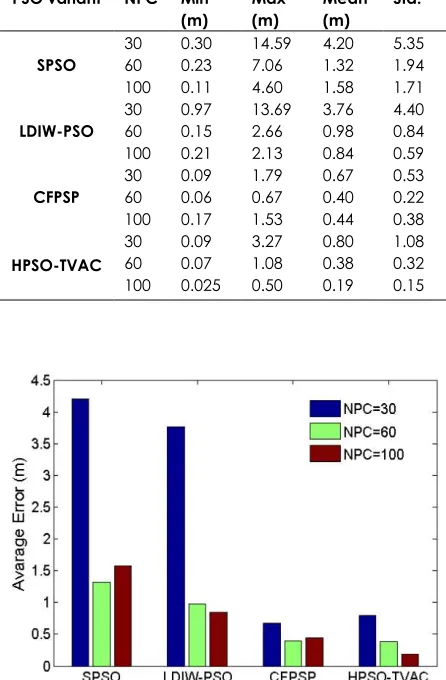
[image:6.612.58.282.145.375.2]Table 2 The distance error of the four PSO variants when NPC=30, 60 and 100
Figure 6 Average error of the four PSO variants for NPS=30, 60 and 100
The localization accuracy depends on the PSO variants as well as NPC. Figure 6 and Table 2 shows the HPSO-TVAC achieved the best average accuracy of 0.19 meter while the SPSO achieved the poor average accuracy of 1.58 meter when NPC is 100. To conclude, When NPC increases the minimum distance error decreases. HPSO-TVAC achieved the best results in terms of accuracy as well stability when NPC is 100 followed by CFPSO, LDIW-PSO, and SPSO. The most stable PSO variant is HPSO-TVAC since it has a very low standard deviation.
PSO variant NPC Min (m)
Max (m)
Mean (m)
Std.
SPSO
30 0.30 14.59 4.20 5.35 60 0.23 7.06 1.32 1.94 100 0.11 4.60 1.58 1.71
LDIW-PSO
30 0.97 13.69 3.76 4.40 60 0.15 2.66 0.98 0.84 100 0.21 2.13 0.84 0.59
CFPSP
30 0.09 1.79 0.67 0.53 60 0.06 0.67 0.40 0.22 100 0.17 1.53 0.44 0.38
HPSO-TVAC
[image:6.612.333.563.206.367.2] [image:6.612.336.559.214.554.2] [image:6.612.62.271.554.718.2]110 Abdulraqeb et al. / Jurnal Teknologi (Sciences & Engineering) 78: 9–3 (2016) 105–110
6.0 CONCLUSION
Localization systems are still a considerable issue in wireless communication, especially in indoor environments. PSO is a well-known optimization algorithm that is used for obtaining good results. In this paper, we proposed a method that uses PSO to improve the system accuracy in the indoor environments. The idea of our proposed method is to generate N particles in a circular distribution where the particle distances are the same distance from the AP to the target. Then, we test each particle if it satisfies the other distances (distances from each AP to the target) and not only the distance from the selected AP to the target. We select the particle which satisfies all distances as the target. The proposed method has been evaluated in simulation with the deployment of five APs in a dimension area of 80
x
50 m2. Four PSOvariants, namely, SPSO, LDIW-PSO, CFPSO and HPSO-TVAC are used to observe their effect on minimizing the distance error. Based on the obtained results, HPSO-TVAC is the best PSO variant that minimizes the distance error with average distance error of 0.19 meters when NPC is 100. Other PSO variants can be used to further minimize the distance error since it is not optimal yet.
References
[1] Al-Ahmadi, A. S. M., Omer, A. I. A. and Kamarudin, M. R., and Rahman, T. A. 2010. Multi-floor Indoor Positioning System Using Bayesian Graphical Models. Progress In
Electromagnetics Research B. 25(2010): 241-259.
[2] Alhammadi, A., Alias, M. Y., Tan, S. W. and Sapumohotti, C. 2013. Enhanced Indoor Localization System for Multi-Floor Environment using Clustering Techniques. 1st International Conference of Recent Trends in Information and Communication Technologies, Malaysia, 12-15 September 204. 37-47.
[3] Li. M, Kwok. S. H and Gordon, H. 2010. Accurate Angle-of-Arrival Measurement Using Particle Swarm Optimization.
Wireless Sensor Network. 2(5): 358-364.
[4] Rady, S., Wagner,A. and Badreddin, E. 2010. Hierarchical Localization Using Entropy-Based Feature Map And Triangulation Techniques. 2010 IEEE International Conference on Systems Man and Cybernetics (SMC). 10-13
October 2010. 519-525.
[5] Ding, G., Zhang, J., Zhang, L. and Tan, Z., 2013. Overview Of Received Signal Strength Based Fingerprinting Localization In Indoor Wireless LAN Environments. 2013 IEEE 5th
International Symposium on Microwave, Antenna,
Propagation and EMC Technologies for Wireless
Communications (MAPE). 29 October 2013. 160-164.
[6] Alhammadi, A., Fazirulhiysam, M. Fadlee and S. Alraih. 2016. Effects of Different Types Of RSS Data On The System Accuracy Of Indoor Localization System. 2016 IEEE Region
10 Symposium (TENSYMP). 9-11 May 2016. 311-314.
[7] Machaj, J. and Brida, P. 2012. Optimization Of Rank Based Fingerprinting Localization Algorithm. International
Conference on Indoor Positioning and Indoor Navigation
(IPIN). 13-15 November 2012. 1-7.
[8] Kennedy, J. and Eberhart, R. 1995. Particle Swarm Optimization. Proc. IEEE International Conference on Neural
Networks. 27 Nov.-1 Dec. 1995. 1942-1948.
[9] Yan, W. and Nan, H. 2014. A Novel Particle Swarm Optimization Based Non-line of Sight Mobile Node Localization Algorithm. Journal of Computational
Information Systems. 8759-87661.
[10] Zhu, H. Ngah, S., Xu Y., Tanabe, Y. and Baba, T. 2008. A Random Time-varying Particle Swarm Optimization for Local Positioning Systems. International Journal of Computer
Science and Network Security. 8)6(: 49-60.
[11] Tsai, P., Lin, Chun., Chen C., and Wang J. 2013. A Scalable Localization Scheme using Particle Swarm Approach for Sensor Networks. 7th International Conference on Sensor
Technologies and Applications, 25 -31 August 2013. 21-26.
[12] Leng, M., Tay, W. P., Quek, T. Q. S. 2012. Cooperative And Distributed Localization For Wireless Sensor Networks In Multipath Environments. IEEE International Conference on Acoustics, Speech and Signal Processing (ICASSP). 25-30
March 2012. 3125-3128.
[13] Lin, T. N., Fang, S. H., Tseng, W. H., Lee, C. W. and Hsieh, J. W. 2014. A Group-Discrimination-Based Access Point Selection for WLAN Fingerprinting Localization. IEEE Transactions on
Vehicular Technology. 63(8): 3967- 3976.
[14] Chen, Y., Yang, Q., Yin J., and Chai X., 2006. Power-Efficient Access-Point Selection For Indoor Location Estimation. IEEE
Transactions on Knowledge Data Engingeering. 18(7):
877-888.
[15] Kushki, A., Plataniotis, K. N., and Venetsanopoulos, A. N., 2007. Kernelbased Positioning In Wireless Local Area Networks. IEEE Transactions Mobile Computing. 6(6): 689-705.
[16] Vecchio, M., López-Valcarce, R. and Marcelloni, F. 2012. A Two-Objective Evolutionary Approach Based On Topological Constraints For Node Localization In Wireless Sensor Networks. Applied Soft Computing Journal. 12(7): 1891-1901.
[17] Shokrian, M. and High, K. A. 2014. Application Of A Multi Objective Multi-Leader Particle Swarm Optimization Algorithm On NLP And MINLP Problems. Computers and
Chemical Engineering. 60(2014): 57-75.
[18] Zhang, E., Wu, Y., and Chen, Q. 2014. A Practical Approach For Solving Multi-Objective Reliability Redundancy Allocation Problems Using Extended Bare-Bones Particle Swarm Optimization. Journal of Reliability Engineering and
System Safety. 127(2014): 65-76.
[19] Duan, C., Wang, X., Shu, S., Jing, C., and Chang, H. 2014. Thermodynamic Design Of Stirling Engine Using Multi-Objective Particle Swarm Optimization Algorithm. Energy
Conversion and Management. 84(204): 88-96.
[20] Sun, Z., Tao, L., Wang, X., and Zhou, Z. 2014. Localization Algorithm in Wireless Sensor Networks Based on Multiobjective Particle Swarm Optimization. International
Journal of Distributed Sensor Networks. 11(8): 1-9.
[21] Yuhui, S. and Eberhart, R. C. 1999. Empirical Study Of Particle Swarm Optimization. Proceedings of the 1999 Congress on
Evolutionary Computation. 6-9 July 1999. 1950.
[22] Ratnaweera, A., Halgamuge, S., and Watson, H. C. 2004. Self-organizing Hierarchical Particle Swarm Optimizer With Time-Varying Acceleration Coefficients. IEEE Transactions on
Evolutionary Computation. 8(3): 240-255.
[23] Clerc, M. and Kennedy, J. 2002. The Particle Swarm - Explosion, Stability, And Convergence In A Multidimensional Complex Space. IEEE Transactions on Evolutionary