EU R, ft
:S*1
* * * *
* * * * *
Commission of the European Communities
Evaluation of the R & D programme
in the field of Non-Nuclear Energy
(1985-1988)
Commission of the European Communities
Evaluation of the R&D programme
in the field of Non-Nuclear Energy
(1985-1988)
(Volume 1)
Authors: Sir H. BONDI (Chairman)
F. AMMAN
A. JAU MOTTE
Ch. MARNET
J.J. PALOMARES
R.J. UFFEN
P. WALDTEUFEL
Published by the
COMMISSION OF THE EUROPEAN COMMUNITIES Directorate-General
Telecommunications, Information Industries and Innovation Bâtiment Jean Monnet
LUXEMBOURG
LEGAL NOTICE
Neither the Commission of the European Communities nor any person acting on behalf of the Commission is responsible for the use which might
be made of the following information
ISBN 92-825-9022-4 (Volume 2) ISBN 92-825-9023-2 (Volumes 1+2)
Cataloguing data can be found at the end of this publication
Luxembourg : Office for Official Publications of the European Communities, 1988 ISBN 92-825-9021-6 Catalogue number: CD-NA-11834-EN-C
TABLE OF CONTENTS
Introduction
Summary
General recornmendations for the Community Programme in the field of Nan-nuclear Energy
v.
ix.
xviii.
1. Solar Energy
2. Energy from biomass
3. Wind Energy
4. Geothermal Energy
5. Energy Conservation
6. utilization of Solid Fuels
7. Production and utilization of New Energy Vectors
19.
27.
41.
51.
63.
69.
8. Energy Systems Analysis and modelling
73.
9. Optimization of the production and utilization
of Hydrocarbons
79.
Introduction to Annex A Annex A
89. 91.
Introduction to Annex B Annex B
I N T R O D U C T I O N
This report is an evaluation of the Community Programme in the field of Non-Nuclear Energy (1985-88).
We were appointed as an independent panel by the Commission and carried out our task between autumn 1987 and summer 1988. We come from several scientific and professional fields, and this has permitted us to take a very broad view of the evaluation. We found useful to ask the Commission to retain a group of consultants to analyse some general characteristics of the programme in more detail. A summary of their findings is at Annex B.
We based our evaluation on several sources of information, notably : - interviews with programme managers, with staff from several units in
the Commission, with contractors, with potential users in Member States, and with the Management and Coordination Advisory Committee
(CGC) delegates,
- questionnaires sent by post to all contractors,
- documents and literature on the programme and on the energy field.
We are grateful to all those who kindly provided us with information and views.
Following the terms of reference provided by the Commission, our evaluation covers the scientific and technical achievements of the programme as well as its dynamics, its potential impact, its management and its international environment.
A. Development of Renewable Sources of Energy : 1. Solar Energy
2. Energy from Biomass 3. Wind Energy
4. Geothermal Energy B. Rational Use of Energy :
1. Energy Conservation
2. utilization of Solid Fuels
3. Production and utilization of New Energy Vectors 4. Optimization of hydrocarbon production and use 5. Energy Systems Analysis and Modelling.
Hie main objectives of the programme were to develop advanced energy technologies to :
- increase the range of energy sources
- increase the ef f iency of energy use and production - reduce long-term dependence on imported fuel
- counter environmental pollution
- enhance the capability and competitivity of European industry in energy related areas.
Panel Membership
Sir Hermann BONDI (UK) (Chairman) Master, Churchill College
Cambridge
Prof. Fernando AMMAN (I)
Institute of Energy Economics (IEFE) University Bocconi
Milano
Prof. André JAUMOTTE (B) Ecole polytechnique
Université Libre de Bruxelles Brussels
Dr Chrysanth MÄRNET (D) Stadtwerke Düsseldorf A G Düsseldorf
Mr Juan José PALOMARES (E)
Oficina de coordinación, de Investigación y Desarrollo Electrotécnico
Madrid
Prof. Robert J. UFFEN (CAN) Department of Geological Science lhe Queen's University
Kingston-Ontario
Dr Philippe WALDTEUFEL (F)
Ministère de la Recherche et de la Technologie Paris
The group of consultants consisted of : Centre de Sociologie de l'Innovation
(Prof. Callón, Dr Laredo et Mr Mauguin) F-Paris
GMV Conseil
(Mr Crance et Mr Paulat) F-Vaucresson
Université de Namur
(Mr Vinck et Melle Warrant) B-Namur
Centre d'Economie des Ressources Naturelles (Prof. Giraud)
EVALUATION OF THE R&D PROGRAMME IN THE FIELD OF
NON-NUCLEAR ENERGY (1985-1988)
1 - SUMMARY
1.1. First, we are very pleased that the Community has an Energy R & D programme. The lowering of the oil price has in no way diminished the crucial dependence of Europe and its prosperity on imported energy, and the effort to diminish this and to minimize the buffetting of the economy of Europe by external events rightly involves an appreciable R & D programme. Moreover, we feel the objectives of DG XII's energy R & D programme should (and, it seems, are) somewhat wider, relating to other objectives of the EC. Industrial competitiveness in hardware relating to energy production, conversion and use seems to be an obvious consequence of the stated aims, for one could hardly feel successful in ciiminishing Europe's external energy dependence if this were replaced by dependence on an externally produced item. Once our industry is competitive in energy items in the internal market, it will plainly strive to be so externally.
and axe greatly reassured by the work of our consultants whose wide and skilled probing we found most helpful. Our work related to DG XII's NNE programme but clearly there are connections with' DG XVII's work on demonstration projects across an ill defined boundary.
1.2. Vfe are very favourably impressed by the technical quality of all the projects we have seen. In every case the targets set have been of value and of attainable nature, the teams have been competent and well coordinated, enthusiastic and capable. Naturally there have
been minor variations in this quality t but this is only to be
expected.
Biis uniform high quality is a tribute to project selection and management. Excellent as its output is, we feel it necessary to point out that this process of project selection takes a very great effort on the part of very many people and causes some of the delay. However, we are aware of the essential need in a Community not only to choose well, but to be seen to choose carefully and well. Though the balance is fine, we do not suggest that the method of choice should be abbreviated.
We firmly believe that the effectiveness of Commission programmes is compromised by these delays. Recognizing the need to ensure that money is spent properly, we yet feel that the Community would get better value for money if the delays to finalization of contracts and to payments been received were reduced by simplifying administrative procedures or, if this were truly proved to be impossible, by hiring staff adequate in quantity and quality to go speedily through essential procedures.
This administrative complexity seems to us to be unnecessarily great. We fully agree with the following paragraph from our consultants' report : "While such a process is adequate for a procurement policy, where the buyer wants to be sure to get the exact product or service he pays for, it does not warrant R&D support : in that case, the EC no longer buys a good, but helps financially other parties to increase their research effort either by themselves or preferentially with others. The only effective contractual requirement should then be that the contractor does actually spend the contractual amount of money
(including both his share and EC support) on the agreed theme; legal procedures, accordingly, should bear on monitoring conditions rather than on obligation of results." The management of this complexity is
furthermore made particularly difficult by the three separate DG's involved having different and unlinked computer systems.
1.4. We have been very favourably impressed by the way the Commission has, with relatively modest amounts of money, managed to bring together a variety of industrial firms, university teams and staff from institutes to cooperate well and successfully. Sadly, European companies do not often cooperate of their own volition in R&D which fact much diminishes their competitive standing vis-à-vis U.S.A. and Japanese firms, as does the frequently less close connection with universities than is common in U.S.A. Indeed, we are pleasantly surprised by the success of DG XII staff in setting up such "clubs" of firms and university departments and ensuring their effectiveness. Where this has been achieved, we feel that the question whether it was appropriate for the subject to be pursued as a Community task is easily answered with a firm and clear "yes". There is less enthusiasm on our part for the (fortunately less common) case where the contract is with a single small group of researchers all in the same firm or university department. There will be cases where such a project is necessary within a wider
Community project, but such work needs special justification, and coordination and dissemination must be assured. Educationally indeed DG XII has been most successful within the programme to lead people to think together and work together, but we regard it as essential to drive home the principles of such an attitude consistently and forcefully. Regrettably, there are still people about who believe they are "communautaire" if they have, wholly on their own, devised a project in every detail, and then invite others to join in carrying it out. We believe DG XII in this programme is very successful in establishing proper cooperative attitudes, but we hope that many contractors are right in being confident that these habits of cross border cooperation between different companies will, in the majority of cases, long survive the ending of Community support and rnanagement. The prognosis is good in cases where EC enforced cooperation has been lengthy.
In line with Community policy in the area of DG XII's responsibilities almost all the work done is at the precompetitive
stage. However, frem a European point of view it is most desirable that cooperation between firms begun in this manner is continued, so that a transnational effort in Europe, involving the resources of several firms jointly, is in competition with the American and Japanese giants. We are not clear what mechanism exists to stimulate, where necessary continuation of such cooperation begun in the precompetitive phase through into the commercial work though we are encouraged by this happening spontaneously in a few programmes
(like amorphous silicon solar cells and perhaps combustion).
1.5. We were much impressed not just by the quality of the work being done on energy modelling and systems analysis, but by its central position in the whole programme. It ensures contacts and meetings with people engaged in its different components, and so is a major element in its cohesion. We are convinced that it must be a continuing effort for it will always be needed to evaluate the changing scene, and infer consequences for the rest of the programme, in addition to ensuring its cohesion.
1.6. The aims of the different sub-programmes seem to us well chosen and appropriate. We do not feel in many cases immediate progress to démonstration projects or to commercialization is to be expected, for many of the sub-programmes aim, rightly, to put Europe in a position where it can react speedily and effectively to* an increase in price or a decrease in availability of imported fuel. The advance to commercialization is not to be expected unless and until such a contingency occurs.
The aim of improving the competitive position of European industry is readily served by sub-programmes on the rational use of energy, though again not much of the necessary investment will occur until energy becomes again more expensive.
know-how, technical R & D cannot necessarily ensure success. Indeed we are a little disturbed by our being unable to identify a proper apparatus for such industrial strategic decision taking. We are not arguing that in, say the nass production of solar cells, Europe is no longer in a position to catch up with Japan, but we do not know where such a proposition would be discussed and decided. Europe's resources of skilled people are large, but finite, and we cannot
expect to become a world leader in everything. Ihe risk of
squandering resources in hopeless areas is real, and these questions need study.
1.7. Again there are areas where good work is being done under the programme, but where it is obvious that this is only a modest part of the global effort e.g. in the utilization of heavy oils, or in enhanced oil recovery. We want to praise, not criticize, the work being done, but we do not find much evidence of its output being used to trade information with others, such as oil companies. Through trading of this sort, the likelihood of a commercially useful result emerging could be markedly improved. Undoubtedly that is a complex situation with an industry not used to public funding but with small oil companies anxious to utilize basic research done under Community sponsorship as they do so little themselves.
Accordingly we wish to command the steps taken in order to insure that the whole European research Community, including large oil companies, participate in the next phase.
Solid fuels present a particular set of programmes. The first task must be to make the burning of European coal, lignite and peat environmentally acceptable in an economical way. We discuss later in detail our attitude to the different ongoing programmes. Next, one must be clear that increasing the acceptability of imported coal considerably diversifies Europe's external dependence. The energetic marketing of coal to areas not used to it implies R & D in new techniques (water-coal mixtures). Concerning the pollution issue,
there obviously is an important natter of norms and standards that are based on measurements if one wishes to have them respected. It might be useful to make sure that the matter of research aimed at measuring devices and procedures does not lie somewhere in the vacuum between the energy programme and the environment programme. Certainly this is a field for European cooperation.
1.8. While we are much impressed by the technical quality and by the management of the work under the programme, we feel that the time is approaching where the outlook should be widened, in two very different directions.
First the excellent engineering and science that is being carried out is beginning to need support from behavioural sciences and from economics. In many of the sub-programmes their future utility would be much enhanced by having experts from these fields integrated into the project team and also involved in EC management groups, utilization is not just dependent on hardware skills, and a widening of the effort from engineering to include the social sciences would in many cases now be advantageous. This would be particular valuable in areas where decisions are taken by many people (efficiency of energy use). Experience shows that barriers exist inhibiting favorable decision taking when this is not centralized, as it is, on the supply fields. Therefore the inhibitions to the use of small generating equipment and particularly on energy saving measures are not purely technological and must be addressed
otherwise.
for many of the projects. The developing countries seriously industrializing are virtually bound greatly to increase their coal consumption. The export of hardvrare or know-how (perhaps through aid programmes) could be of great help to European industry, to the country concerned through enabling it to burn coal more efficiently and with less environmental damage, and, by avoiding worse effects on the global atmosphere, help us all to live more agreeably. Indeed in many ways projects being carried out under this programme are valuable not just for Western Europe, and we see little evidence of the relevance of this being considered. Nor do we feel that enough thought is being given to the energy and environmental policies of our close neighbours in Eastern Europe. They will be important for us, and though this will not necessarily affect R & D projects we would feel happier if we could feel sure this matter had been considered.
Again, while we enjoyed the technical quality of all the work we saw, we wonder whether there is enough long range research in the programme. For example,we see it is as part of DG XII's job to bring radically new innovative technologies to sectors of the energy field modernizing themselves in a less revolutionary way. Such work will not inevitably yield usable results, but without.it the programme will have less benefit. Knowledge gained by public funding must become generally available though sometimes persuasion and effort is required to achieve this. While we appreciate that significant efforts are being devoted to the dissemination of the valuable results obtained through conferences, publications etc, we feel that in some cases energetic marketing to the Community's industry and users is required.
1.9. In a forward looking organization the R & D component is of central importance. All other sectors should come to it with their future needs and problems, and should in turn receive from D6 XII suggestions of technological projects of interest and importance to them.
Unhappily, vie found a number of the other Directorate-Generals too thinly staffed to be able to concentrate on the future, with urgent present needs taking all their available effort. We find this worrying, and would hope the Commission can gradually remedy this. The more all parts of the organization think about the future, the more will DG XII be able to assume the central role that should belong to it; and the more DG XII can equip itself to deal with behavioural and economic questions as well as with engineering ones,the more it will be able to help all the others to face the future. To be more specific, it seems to us unusual that such a large undertaking as the Commission's Aid Programme does not carry with it (at say 1% or 2%) an R & D component whose natural home would be DG XII. With the pressing worries about the energy household of the developing world (and its environmental effects) some of this should be in the non-nuclear energy R & D programme.
The Commission has already a considerable and well-established success in the Common European Driving Cycles for motor cars. Other such efforts at commonality of measurement (and regulation) in energy may well require an R & D effort.
1.10.To sum up :
2. GENERAL RBCOEMENDATIONS FOR THE COMMUNITTY PROGRMME IN THE FIELD CF NCN-NüCLEñR ENERGY.
2.1. In trying to assign overall priorities to the different portions of the EC's programme, we are keenly aware that it forms only a few percent of the total funded in Europe from public funds in the area of non-nuclear energy. It is therefore clear to us that we must look for those areas where Community funded research can make a special contribution. The main, but not the only criterion here is whether the project in question can benefit from being transnational, whether Europe can, in the field in question, do better by bringing
together industries, universities and other public institutions in different countries under EC management. Naturally DG XII work is best placed at the precompetitive phase.Particular attention must be paid to the smooth transition of projects from DG XII to DG XVII's demonstration portfolio. Our suggestions for the future must be guided by the experience of the past, and by the consideration that the task of a research programme is the acquisition of knowledge. This acknowledge may suggest the ending of a programme, or its continuation, or its transfer to the larger arena of publicly funded demonstration projects or to purely industrial funding.
2.2. We feel that the objectives of DG XII's NNE programme - should and indeed do include not only the lessening of Europe's energy dependence on the rest of the world, but also the improvement of competitive capability of Europe's industry, both by the encouragement of transnational cooperation and by strengthening industry-university links.
We judge that DG XII has achieved much in these aspects, with modest financial means, and this encourages us strongly to recommend a continuation of the NNE programme. Vfe would hope however that it can be made even more effective by making it easier for new entrants to join the very well functioning transnational "clubs" and by reducing the disincentive to doing so by the heavy administration and the long delays before formal approval and before payments.
2.3. Vis are quite clear that systems analysis and modelling is most useful and helpful in the programme/ and must be continued. It has the potential to increase the cohesion of the programme and this should be exploited. Ttie current funding is barely sufficient for this activity with its present remit; if, as we propose, its remit is widened, somewhat larger funding will be required. We would like to suggest that in other areas of Commission work, such system analysis could also be employed to advantage.
2.4. In renewable energies we are particularly impressed by the programmes on geothermal and on solar energy (as regards the later, particularly the work on amorphous silicon). In both these programmes we are not only impressed by the progress made, not only impressed by the prospects,but we also very much like the transnational nature of the efforts, and the way the best people in Europe are brought together irrespective of location. Accordingly we recommend that the funding for these should be fully maintained and, if possible, increased.
Useful and transnational work is going on in wind energy. It has two main thrusts :
a) the provision of a source of energy for island and isolated communities where energy now is unduly expensive;
b) a contribution to the general production of electricity for the grid.
We would strongly support (a) (but solar energy also needs to be considered here), but hope that work in this field can soon be transferred to the demonstration stage. On (b) we feel it important for the new programme to be directed to establish economic viability in likely future circumstances, especially since big wind machines have at present a much higher cost per Kw than small ones.
NNE finances should be reduced but that DG VI and DG VIII should be involved in setting objectives and ensuring that enough money is available for this programme.
2.5. Energy conservation seems to us to be a most important area. More rational use of energy would not only reduce Europe's energy hunger, but would reduce the environmental burden and other undesirable side effects. Yet progress here is only very partially dependent on technical advances and those that are needed are generally not over expensive. Good examples are absorption heat pumps, the combustion project and fuel cells. On the other hand, economic, social and behavioural factors are decisive in this field (one need only consider the behaviour of drivers, or the reluctance of company boards to sanction energy saving measures ) .We recommend therefore continuation of the programme at a reasonable level of funding, but feel that to ensure its effectiveness energetic studies of the relevant economic, social and behavioural sciences must be included.
2.6. We welcome the work being done on fossil fuels, and are conscious that R & D in such mature areas cannot be cheap. Both for oil and gas, there is a vast area for research well ahead of industrial development. We gladly support transnational projects in this domain, which gather European competencies, while not duplicating the necessary research effort by large oil companies. Similarly the environmentally and socially acceptable utilization of Europe's resources of solid fuels seems to us to be a priority item, and we similarly give our strong support to transnational programmes in these fields in which the social and environmental factors are fully considered. The aim should be, on one hand, to improve the penetration of European coal into Community markets not used to them, and secondly to diversify Europe's sources of energy imports.
2.7. Given our strong support for so much of the programme, we are dis-turbed by the substantial cut proposed and trust that consideration of our report will strengthen its claims on the promised revision.
1. SOLAR ENERGY
1.1 INTRODUCTION
It is well known that quantitatively speaking, solar energy is the most important source of energy on earth, even though it is widely dispersed and therefore difficult to use in applications apart from the "natural" ones such as photosynthesis, etc., as it requires elements to concentrate and convert such energy.
From the point of view of collection/usage, this source of energy can be classified into three different groups with, in turn, different technologies for collection and use :
a) Passive solar energy
b) Thermal solar energy - Low temperature - Medium temperature - High temperature
c) Photovoltaic solar energy
The activities of the DG XII in this field date back to the work carried out by the JRC in the early seventies which resulted in the first Solar Energy Programme (1975-1979, 18,7
1.2. OBJECTIVES
Table 1 shows the evolution of the objectives of the various sub-programmes throughout the three R & D sub-programmes already carried out.
The following aspects should be mentioned as significant :
- A certain continuity exists between the three programmes, progressing from basic research in the first programme to more experimental research in the third.
- As a result of this, at the beginning of the third programme, those lines of investigation, where a possible technico-economic viability is not clear, such as the high temperature (Eurelios Tower) and the Photochemical, or where the research is considered concluded as in the case of low temperature solar energy, were abandoned.
In the Photovoltaic area, efforts are concentrated on investigating ways of reducing cost so as to become competitive, and the development of concrete applications commences by means of pilot plants. A new research path is opened in the passive use of solar energy.
- At all times the energy goal has had a greater weight than others such as economic, social or environmental objectives.
Three generic fields of action are established : A) Solar Energy Applications in Buildings.
A.l. Passive solar system development (PASSYS).
Development of design tools and simulation models for passive solar heating system and development of test procedures for passive solar components.
A.2. Passive solar topics research (PASTOR).
Heat transfer and air movement, thermal comfort, auxiliary heating and controls, daylighting, planning and urban design.
B) Photovoltaic Power Generation.
B.l. Amorphous silicon solar cells (AMOR).
The programme was focused on new or improved preparation techniques with emphasis on efficiency, stability and low-cost potential.
B.2. Thin-film solar cells from alternative materials (ALTERNA).
Development of thin-film solar cells using alternative materials in case these turn out to be economically superior to amorphous silicon, at least for some applications.
C) Solar Radiation Data.
1.3. OCMPOSïTïGN OF THE PROGRAME
Table 2 shows the cxxtposition of the programme once the research proposals presented have been examined and approved.
The following should be mentioned as the most significant generic aspects of the programme :
- The projects approved and put into action cover the fields of action foreseen in the programme, some being amplified, as in the case of the passive solar programme in which, with very good judgment, two activities have been added, directed to the dissemination of the results obtained.
In the same way the widening of the field of action in Photovoltaic energy to include the development of pilot plants for concrete applications, compensating, to a certain extent, the high level of basic research in this programme, should be considered as opportune.
- A very positive aspect is the high level of participation of the various countries in each of the lines of action undertaken.
In nearly all cases, except in the subprogramme of pilot installations, it consists of a unique project with multinational participation with all the benefits deriving from this type of action such as the exchange of knowledge between countries, the homogeneity of work methods, avoidance of duplications of research, etc.
1.4. ANALYSIS CF THE DIFFERENT SUBPRDGKAMMES (*)
a) Passive Solar (Energy)
The subprogramme is composed of three projects (PASSYS, PASTOR and SQLINFO) shared by nearly all the Member States of the E.C. The general aspects of the said projects, such as objectives, number of contracts, etc. are shown as previously stated in table 2.
With these three projects it can be said that the different aspects to take into consideration for the good use of solar energy through passive systems are well covered, as they cover aspects from the design and validation of computer programmes which permit the evaluation of the economic viability of a passive system, up to the analysis of different systems including the monitoring of 60 installations gathering data such as construction details, architectural ideas and even the level of satisfaction among users.
One aspect to be taken into account in this type of project is the dissemination of results, as on this depends, to a large extent, the possible viability or not of the economic and research efforts carried out.
To cover this aspect the SQLINFO and AFOHSQL projects have been put into action in the way that, through them the results of other projects have been made known to collectivities such as architects, engineers, builders, planners, etc.
In the particular case of architects, some 3.500 professionals have been identified to whom, periodically, information on results achieved is circulated.
Thus, in general terms, it can be said that the passive solar programme has been well designed and is being carried out in an
adequate way, with excellent «»rdination and a satisfactory level of circulation of the results.
Nevertheless, attention should be drawn to a crucial aspectfor achieving the objectives. It would be ideal that with the information obtained, a set of regulations is drawn up at a community level for standards of construction, from the energy point of view, which could range from energy recommended guidelines to obligatory regulations in which case, without any doubt, the passive solar energy contribution would be
significant.
b) Solar Radiation Data.
d i s programme is a continuation of the activity in this field, started in the first programme, in which projects started in previous programmes are completed, as is the case of the European solar radiation map to which the study of different European microclimates has been added.
Ät the same time the activities started in the 2nd programme on themes relative to the obtention of solar radiation data via satellite, are being concluded.
It is obvious that in order to make the most of any energy resource, especially in the case of solar energy, the knowledge of the existing resources is basic, thus the work undertaken to date must be useful, especially in respect to the analysis of economic viability of a chosen system of exploitation or in the selection of the site for its installation.
Nevertheless, the level of information currently available is more than sufficient to be able to tackle aspects such as those mentioned previously. Thus it does not seem advisable to
coordination and honogenization, instead of being included in a Community R & D programme.
An important aspect to take into account, with respect to making the most of the effort involved, is the publication of the results, as in some way it should be ensured that these results reach those institutions which could potentially make use of them. Perhaps one way would be to request from the different national participants to take on the responsibility for disseminating the results throughout their own countries.
c) Photovoltaic.
As mentioned previously, economically, the photovoltaic programme represents the biggest effort in the solar energy programme. This subprogramme has been structured around three actions :
Amorphous silicon.
The project is aimed at developing a European option in the development of amorphous silicon cells compared to the alternatives of USA and Japan. The project is built around two companies, one French and the other German, which assume the role of industrializing and
commercializing the product without, of course, moving away from the research aspects and a large number of research centres, in many cases in the universities, where partial aspects of the problem are analyzed.
Ten Member States from the Community participate in the project, which consists of 23 contracts from as many institutions.
take charge of completing the innovation process with this product.
d i s could be a highly enlightening example of a very useful way of establishing actions within a programme such as non nuclear energy. That is to say, to create groupings of companies (in this case two), in which research centres join a concrete project, headed by one or various companies. In case of success, these very companies would go into production thus completing the innovation process. One aspect to take into account in projects such as the present, is to try to ensure the continuity of the action once the contract with DG XII has expired, perhaps by tying it to other community, national or multinational programmes, such as Eureka.
Thin-film solar cells from alternative materials (AUTH7NA). This action is aimed at developing technologies of thin film solar cells using alternative materials to silicon. The operation has been subdivided into four subprogrammes in accordance with the different alternative materials to be studied. The programme is formed by 23 contracts with as many research centres integrated by the type of material to study/ the coordination work being done by DG XII programme Manager, in each subprogramme of the different participating contractors.
The programme has a very marked basic research component and can only be evaluated from the point of view of acquired scientific knowledge, as economically or industrially all depends on the potential use of the results by some company. Apart from what has been said of the scientific knowledge acquired, a clear result must be the identification of multidisciplinary transnational groups with high scientific qualifications, to tackle investigations linked to concrete innovations with
expectations of economic viability«
Photovoltaic pilot programme.
Despite the fact that in the first objectives of the third NNE programme the project in the field of development of pilot installations for the use of photovoltaic energy was not included, in our opinion this concept has rightly been included by the management of the programme,which in someway begins to compensate the existing imbalance between basic and experimental research within the photovoltaic programme.
This project composes 13 contracts carried out mainly by companies which have as a final objective the development of some equipment or system which covers some existing applications.
Although, as it has been said previously, the concept is well introduced, perhaps the topics of the different projects are not so consonant as they are completely independent projects, analysing, in many cases, partial aspects of a more generic problem.
In this sense it would have been more useful to identify concrete applications for the use of photovoltaic energy, such as rural electrification, water pumping, photovoltaic systems combined with other types of energy, etc. and to have tackled the problem as a whole, seeking the most viable technico-economic solution involving in each project various institutions such as in the previous programmes.
1.5. EVALUATION CF THE PROGRAMME.
a) Scientific and Technical Achievements.
The scientific and technical knowledge achieved in the current programme could be classified as direct and indirect. In the first group this knowledge is quite different according to the subprogramme; thus in solar application in buildings two main blocks exist, one in which potent computer tools have been developed and tested, which permit, through simulations, the measurement of the energy contribution of solar origin in a building using passive concepts and systems, as well as the economic repercussions of these and therefore their economic viability. The other big block concentrates on the monitoring of a determined number of installations and collecting and publishing the results.
In the photovoltaic programme, a great step forward has been made in the amorphous silicon technology, creating the basis for the possible development of a European industry to exploit this technology.
On the other hand, in the laboratory the possibilities have been studied of new technologies for the production of thin film cells with materials alternative to silicon and very definitely directed to the production of cells at low cost. On the side of indirect results, basically, two aspects should be mentioned : in the first place the contribution of programmes such as the present in which is not just a collection of national ones, this is being creation of a truly European technology, achieved through the participation in the same programme of research teams from different countries, and secondly, and as a direct consequence of the first, the interchange of knowledge between these research teams avoiding, with this, the duplication of research.
On the negative side it must be pointed out that since the
beginning, the programme has had purely a general energy objective and therefore that research whose energy viability was not clear has been terminated, although it may be useful for some highly specialised purposes, for example, high temperature solar energy and photochemical energy.
It would be interesting to develop applications normally of high technology, different from those of electric generation, in which the characteristics of solar energy are an important differential in relation to the other energies. For example, in the case of thermal solar energy, the possibility of having a thermal source with a temperature higher than 1000° C, with no contamination should be used for different applications than electric generation; for example, development of new alloies, high power lasers, thermal shields, etc. However, the potential users of such applications should first demonstrate their interest and need through active financial participation before such a programme is undertaken.
In the same way, in the photovoltaic area it would be interesting to identify those applications in which the generation costs with photovoltaic systems were more in line with the conventional ones, and develop the system in a global sense, not only certain subsystems. Most of the applications for the supply of electricity to isolated installations, either domestic (isolated communities), industrial (agricultural installations, water pumping, etc.) could be in this situation.
b) Practical and Commercial Relevance.
technologies, etc. With respect to the first, it is practically impossible to quantify the energy contribution due to several factors :
On the one side, at the moment, there are no sufficiently developed statistical methods which would permit the measurement of the contribution of renewable energies in general.
On the other, the penetration level of the renewable energies is wholly conditioned by the current price of conventional energy sources, as well as by the political decisions taken in the different Member States. Ifcwever, we could talk of a significant contribution to the Community consumption in the year 2000 with active and passive thermal solar energy. This contribution is based fundamentally on low temperature solar energy (hot water supply) and passive solar energy.
The development, or rather the contribution of passive solar energy, is heavily conditioned by the establishment, by the Member States, of specific regulations for the use of concepts and systems in the construction of new buildings.
In relation to the subsidiary aspects the amorphous silicon subprogramme is a good example as, if it bears fruit and develops an industry capable of competing with US and Japanese industries, it will have access to a potential market in the E.C. in a short space of time of some 40 Mw peak which, at a current cost of 8 Ecu/W peak, means a potential market of 320 MEcu. On the other hand it means the creation of an industry in the field of semiconductors with its benefits of creation of
jobs, interchange of technology, etc.
Another aspect to consider in the photovoltaic programme is the important role which it can play in improving the infrastructure and conditions of life in the less favoured regions, with favourable effects on the depopulation of these
regions and on the conservation of the environment.
c) Effectiveness of Management and Use of Resources.
The following targets in the general management of the
programme can be mentioned :
- Definition and preparation of the programme. - Request for research proposals.
- Evaluation and selection of proposals.
- Control and follow up of the different subprogrammes. - Evaluation of the subprogramme.
In general terms it can be said that the existing process as well as its management is highly satisfactory. However, some aspects which could bring about general improvement in such process are detailed below.
When designing a new programme, starting from the generic idea that an R & D programme Luce the present, one should try to coordinate, bond, contrast, etc. the different existing national programmes in the Member States : It would be interesting to know the objectives of these programmes from the protagonists; for example, through meetings of the people responsible for the different programmes with the management of the DG XII.
1.6. CONCLUSIONS AND RECOMMENDATIONS.
a) Objectives and Bange of the Programme.
In general terms it can be said that the objectives foreseen in the programme have been covered in a satisfactory way having been, in some cases, rightly amplified, as in the case of the SQLINPO and ARCHISQL actions, without which the results of the subprogramme of passive energy would have had limited circulation. In the same way, the project of pilot plants in the photovoltaic subprogramme is well thought out but it is necessary to promote new projects, more adequate for the development of this line of action. With the projects undertaken in the third NNE programme and in the preceding programmes it can be said from the technology point of view that the situation is the following :
The passive use of solar energy has been sufficiently studied, having developed information tools which permit the evaluation of the viability of a determined component of installation. Thus, at the moment, the work to develop is more in the area of the demonstration projects rather than research, and as a consequence looking at the new
programme. The aim of a new programme should be
acquisition of knowledge so that the penetration of this energy saving technology could become widespread whether through regulation action or otherwise. Only a programme with such an aim would be worthwhile.
The same can be said of the "Solar radiation data" programme in which, at the moment the level of knowledge of energy sources of solar origin is very superior to the level of use which is made of the same, thus there is no sense in continuing this activity.
Imaginative proposals for rising the spectral composition of sunlight should be supported provided interested users can be identified.
In photovoltaic, the subprogramme of amorphous silicon can be considered an important success and should be continued giving opportunities to interested firms not yet involved. The way in which this project has been developed should serve as a guide to implement other actions directed to developing complete systems which satisfy a real need, such as those existing in the supply of energy isolated communities. Ihis also has relevance to the Community aid programme.
At the same time, the development of mixed systems, photovoltaic and another type of energy, either conventional or renewable, can contribute to find solutions for this type of Communities, as do some other renewable sources of energy.
b) Management.
On the whole, as already mentioned, the procedure used is correct and it is only necessary to point out the following :
Establish better contact among those responsible for the DG XII and those responsible for the different national or sectorial programmes.
2. ENERGY FROM BIOMASS. 2.1. NaTuRE oF THE PROGRMME
Olie programme (20 million Ecu for the period 1985-88 - split among 123 projects) covers the following divisions :
I. (4.8 million Ecu) Biomass production and improvement of Productivity
II. (1.0 million Ecu) Harvesting, Transport, Storage, Drying. III. - IV. - V. (10.3 million Ecu).
III : Biogas (small budget)
IV : Ethanol fuels and basic studies in Biological Conversion. V : Ethanol. Pilot plants.
VI. (3.5 million Ecu) Thermal Biomass Conversion
VII. (0.4 million Ecu) Photochemical and Photobiological Processing for producing energy-rich compounds (concerted action on photobiology, photochemistry and photoelertrochemistry)
The programme can roughly be divided into :
a) Biomass production, harvesting and collection; b) Biomass conversion.
2.2. ANAL2SIS OF THE DIFFERENT SÜB-PROGRMMES.
I. Firmam* Production and Improvement of Productivity.
Among the plants which have been shown to be most interesting are Jerusalem artichokes and Sweet sorghum.
Experimental plantings have been nade in West Germany, Italy and Spain (sowing 100 hectares).
Production seems to be approximately 70-100 tonnes per hectare fresh material) with a content of :
- sugar : 8 - 1 0 tonnes per hectare - lignocellulose : 20 - 30 tonnes per hectare
One would need to achieve a productivity of 15 tonnes per hectare of sugar.
It would seem useful to increase the culture trials in the Community to be able to extract from them average production values which are statistically valid. On such bases, a
strategy for the future could be prepared.
H . lÉirvesting
Hiere exists good machinery for the large trees, but there is not good machinery for small trees and difficult terrain. Research and development directed to machinery would be interesting in cooperation with other programmes (agriculture, forestry, etc...) in order to obtain the necessary critical financial weight.
Transport
The programme includes one small concerted action for the
pneumatic transport of cut biomass (over a distance of 1 km. as a trial).
Storage and Drying
Based essentially on past programmes. Only the warehousing and drying of sweet sorghum has received particular attention.
H I . Ringas
This is an activity which has been almost abandoned as the biogas digesters are at the stage of being industrialized and cxxnmercialized. Some small activity has been retained, directed towards advanced digesters.
IV. Ethanol Fuels and Basic Studies in Biological Conversion.
The withdrawal caused by lead free petrol has not been ignored. Ethanol fermentation has been replaced by a special effort directed towards the development of several pilot plants. Bioethanol can be obtained from various plants (straw, wood, sugar beet, Jerusalem artichokes, sweet sorghum, etc...) either through acid hydrolysis or through enzymatic hydrolysis. Enzymatic hydrolysis will not be profitable for many years. Effort has been concentrated on acid hydrolysis with the objectives of :
reducing the price and reaching that of synthesised ethanol;
extending the treatment to new basic materials, such as Jerusalem artichokes and sweet sorghum.
With sweet sorghum a production of 9 tonnes of bioethanol per hectare has been achieved. It should be noted that the market
for bioethanol will remain modest for at least a decade.
VI. Thermal hi crass conversion.
In contrast, there is a new interest in pyrolysis because : the investment is lower than for gasification;
the installations are more compact; the operating costs are lower.
Significant results have been obtained with a limited budget. A pilot plant with a fluidised bed (using 1 tonne per hour of material) has been operated. d i s uses all types of agricultural waste (including the bagasse of sweet sorghum) and forestry waste.More than 150 modifications have been made to the installation in order to create- a standard module for pyrolysis.
As a follow-up to this programme, and in co-operation with other departments, three major projects have been started in Southern Italy, Galicia and Greece. Two further projects are to be added in Catelonia and in Sarre.
This has, therefore, resulted in an agro-energy scheme, whose objectives are as follows :
a) to direct agriculture towards sweet sorghum, which appears particularly interesting, both for Northern and Southern Europe. It would be appropriate to conduct research into the varieties of sweet sorghum which maximalise production per hectare. Currently this production is around 70-100 tonnes per hectare.
b) to extract the sweet juice under pressure. The problem of stabilising this juice has not been fully mastered.
c) to use the bagasse of sweet sorghum, half as product paper pulp of good quality and half as a combustible liquid through a pyrolitic process which has been developed. This combustible - similar to bunker C oil - is usable in thermal installations, particularly in power stations.
The balance sheet of value achieved is approximately as follows:
Sugar : 10 t/ha x 110 Ecu/t = 1,100 Ecu/ha Wood pulp : 10 t/ha x 25 Ecu/t = 250 Ecu/ha Pyrolitic fuel : 10 t/ha x 73 Ecu/t = 730 Ecu/ha
2,080 Ecu/ha
Approximately : 2,000 Ecu/ha. = = = = = The liquid fuel (oil and slurry) obtained by pyrolysis can be
immediately utilised in existing steam boilers. It presents the following main characteristics :
Oil : lower calorific value 6,100 kcal.kg specific gravity 1.2 t/m3 viscosity (50°C) 600-900 cp S content 0.01 % ash 2 %
Slurry : lower calorific value 4,500 kcal/kg S content 0.01 %
viscosity (50°C) 600 cp
There are, therefore, two possibilities of using a plant like sweet sorghum, which appears to be the most favorable amongst the short rotation bushes, either for the production of bioethanol or for the production of sugar, paper pulp or liquid fuel. This second route is extremely interesting whilst waiting for the development of the market for ethanol. The programme relating to pyrolysis should be pursued in cooperation with the countries most advanced in this field, mainly Canada.
V U . Photochemical and Ehotobiological Processes
2 . 3 . EFFECTIVENESS OF MANAGEMENT AND COORDINATION.
The production and utilization of bicmass requires cooperation, or at least coordination, between completely different scientific and technical disciplines : forestry, agriculture, harvesting machinery, transportation, biology, chemical and power engineering, economy, etc.
The use of biomass is heavily dependent on fuel prices, which have varied considerably during the period of the programme (1985-1988). For these reasons, the managerial task of such a programme is particularly difficult. In my opinion, it has been accomplished successfully. The results obtained are important for the Directorate-General VIII (Development) which could make use of the experience and test plans realised to solve specific problems in the developing countries.
2.4. EVALUATIO N
The quality of the research has been excellent. The participants have been well qualified and have carried out their projects with due regard to E.C. objectives.
The programme has created links between the teams, especially the university teams, which would not have existed without it, particularly the smaller and more isolated teams.
2 . 5 . RECOMMENDATION
The policy of "freezing" land, which is in the process of being decided (covering 5 million hectares) will pose problems of using the land "freed" and of the future of the agricultural population. The utilization of "frozen" land for energy purposes is an interesting possibility. It is, therefore, important to assess the routes which are economically the most profitable.
The extent of market penetration will depend largely on the future supply price of biomass and the cost of conversion technologies. There is a need for further development to reduce costs and for developing integrated biomass utilization, lhe main objective of a future programme is the development of techniques for the production, conversion and use of fuels from biomass. The primary relevance of this programme is for agriculture policy. DG VT should therefore be involved in the setting of objectives and in making resources available.
The programme will be directed to : Production of bianass
research into short rotation forestry and alternative crops like sweet sorghum under various pedoclimatic conditions using a common methodology. The emphasis will be on problems of quality, standards and production costs.
Harvesting, etc.
development of harvesting machinery with emphasis on the suitability of machinery.
Biological conversion
R & D on acid and enzymatic hydrolysis of lignocellulose; basic research en photocatalysis and photochemical liquid cells for the production of fuels.
Thermal conversion
pyrolysis processes at intermediate temperature, in cooperation with other countries, particularly Canada.
It is important to have in the programme integrated schemes, i.e. pilot projects incorporating production, harvesting, conversion and marketing as an integrated whole, for short rotation forestry and
3. WD« ENERGY
3.1. INTRODUCTION
Among the renewable energies, wind energy is the one which is closest to its viability threshold.
In the last ten years two events, which are worthy of mention, have occurred :
On the one hand, in California, through tax benefits for the generation of renewable energies, wind energy is competitive with conventional energy, producing a spectacular increase in the installed power which is currently over 1.400 Mw.
In the Ccnnunity, the existence of such a market produces an important growth in the number of manufacturers and the types of machines. It must be born in mind that a great part of the installed power in California has been supplied from Europe.
On the other hand an important aspect to note is the ability of this type of energy to be able to compete successfully in price with conventional supplies in the supply of electricity to marginal markets, not-connected to the general grid, such as small insular
systems with high electricity generation costs at the moment.
3.2. OBJECTIVES
Thus the following projects were set up :
Assessment of the technical and economic potential of wind energy in the European Community.
Preparation of a Wind Atlas for the European Community.
Study of R & D related problems interconnecting aerogenerators to the grid.
Collection of data from the operation of existing aerogenerators.
Instrumentation for monitoring of aerogenerators.
In the third NNE programmethe research funds available for this energy were increased considerably, with a budget of 18 MEcu, and with the following goal :
The general objective is the improvement of the technical characteristics of wind conversion systems, and the decrease of their cost. The subprogramme should also help to extend the considerable know-how which has recently emerged in Europe on small and medium size machines to sizes up to the megawatt range.
To achieve this objective, two lines of action were established :
Wind energy technology R & D (WINNER)
The purpose is to address generic R & D problems associated with wind energy conversion. Topics include aerodynamics, mechanics and electric conversion.
Development of wind machines in the 1 Mw class (WEGA).
Design and construction of innovative wind energy conversion system in the 1 Mw class.
3 . 3 . STRUCTURE CF THE FROGRMME
Table 1 shows the composition of the programme once the research proposals had been studied and approved.
The following aspects should be noted :
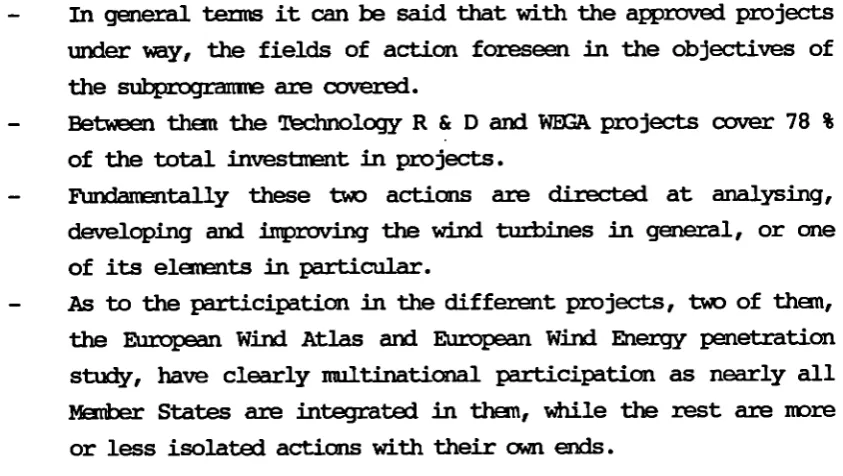
In general terms it can be said that with the approved projects under way, the fields of action foreseen in the objectives of the subprogramme are covered.
Between them the Technology R & D and WEGA. projects cover 78 % of the total investment in projects.
Fundamentally these two actions are directed at analysing, developing and improving the wind turbines in general, or one of its elements in particular.
As to the participation in the different projects, two of them, the European Wind Atlas and European Wind Energy penetration study, have clearly multinational participation as nearly all Matter States are integrated in them, while the rest are more or less isolated actions with their own ends.
3.4. ANALYSIS GF TBE VARIOUS ÏKDJBCTS (*) a) European Wind Atlas.
This project started in 1981 as a collaboration between 9 countries, increasing to 11 in 1986 and had as a goal the elaboration of the European wind atlas.
As with any sort of energy, basic for its possible commercial exploitation is the knowledge of resources available. In this sense this project should, and in fact already is, contributing to the development of wind energy in the European Community. Another important aspect to note is the relatively low cost of
the project showing an efficiency in the means at its disposition in relation to others in other types of energy.
(b) European Wind Energy Penetration Study.
The intention is to provide the different Member States with a tool which - in the absence of national data - makes it possible for them to evaluate the extent to which wind power can technically and economically be fitted into the national power production systems, in order to :
Serve as background information in the energy political deliberation of the Community and the national governments.
Serve as background information for utilities.
Serve as guidance for wind turbine manufacturers' market analyses.
The guidelines consist of :
Recxxtmendations for technical and economic evaluations which form a background for harmonization of the studies in the different countries.
Demonstration of the possibility to obtain the necessary wind turbine data and wind data where these are not available.
Ten companies participate in the project, one for each country, the latter being in charge of analysing the penetration of wind energy in the same one. The project can be very interesting as the level of penetration of wind energy in the Community will be a direct funtion of the level of penetration of such energy in each of the electric companies.
c) Kind Rubine Experiment Project (in preparation)
The purpose of the Experimental Project is to operate 4-5 medium size wind turbines under various topographical and climatic conditions within the EC. The turbines shall supply information on production, operation and maintenance under these conditions. The operators (owners) of the turbines shall be the utilities, distribution companies or the like. The actual project covers the preparation phase of the Experimental Project. The preparation has concentrated on Specifications for Wind Turbines, Invitation to tender, Turbine Bid Evaluation and Technical Information for Proposers.
This action, as planned, can only supply limited information on the behaviour of a certain machine in several places, and it is not possible to integrate the results of the different installations due to the disparity of the conditions of the experiments, imposed by the very definition of the project. In any case, in principle it does not seem that the results obtained in an experiment such as this could be of any relevant use.
d) Operational Data Collection and Studies (Data Base)
The European wind turbine data base Eurowin gives a survey of current European wind technology and wind turbine sites.
EURCWIN contains :
manufacturer data with addresses, technical details, prices, etc.
operator data such as local data, monthly data, tariffs, current costs, etc.
Analysis data like average capacity factors, cumulative energy production, installed rated power, average operational time, etc.
failure analysis data such as component failures encountered, causes and effects of the failures.
The result of this project will allow inquiries and comparison of wind turbine data and their sites according to various criteria.
A project luce the present can serve to establish the current state as far as service and results of the existing machines within the Community, permitting the identification of areas not investigated, as well as serving to help those producers interested in generating wind energy as far as the supply of existing systems is concerned.
In any case the most important problem is, as in any data base, the necessary update which will represent certain cost.
e) Technology R & D
This project, second in importance as far as assigned budget, covers a whole series of technology aspects linked to the design of wind turbines.
The project is structured around the following themes : Aerodynamics of horizontal axis wind turbines.
It consists of 3 projects whose aim is :
To provide a coherent set of measured aerodynamic data accounting for axial and nanaxial flow, free stream turbulence and stall in high winds on three similar HÄWT rotors with diameters 3m, 17m and 26m. These measurements are designed to quantify the relative importance of three-dimensional, unsteady and scale effects.
Total budget : 871.000 Ecu.
Wake effects.
8 projects, carried out by as many institutes, analyse the effect of the wake of a wind turbine on the rest of the turbines in configuration, in wind parks.
Gust measurements and modelling.
Formed of 4 projects and aimed at designing and validating a model which permits the measurement of the effects of turbulence on the dynamic response of the wind turbine structures.
Total budget : 581.000 Ecu.
Material testing.
This is formed of 3 coordinated projects and its aim is the analysis of the critical structures from the point of view of fatigue in the wind
generators.-Total budget : 632.000 Ecu.
Design criteria for wind turbines.
Composed of 4 projects to analyse different basic criteria of the design of wind turbines in order to achieve maximum service.
Total budget : 838.000 Ecu.
Other actions.
This action consists of 10 projects, normally independent of each other, in which a specified component of the wind turbine is studied or developed.
Total budget : 1.206.000 Ecu.
As significant aspects, the following should be noted :
In all the projects there is a coordination between the different research teams involved to interchange experiences and ensure the uniformity of unite criteria. This perhaps could be the most clear result of a project like the present one : the interrelation between research teams from different countries.
Most of the projects are more or less theoretical studies
and, although the scientific and technical qualifications of the research teams is high, and therefore from a scientific point of view the results are valuable, from the practical point of view, it is not clear what use will be made of the results. Probably a large part of the knowledge obtained will not transcend the academic area.
It would be helpful if a company were linked to each of the projects to assume the evaluation of the developments carried out from an economic point of view.
f) Development of Mf-Size Turbine (WEGA).
This is the most important project from the point of view of the investment made and is aimed at the development, construction and experimentation of three different wind turbines in the Mw range. An electricity company from the country where the machine is to be installed, participates in the project, and assumes the task of operating and maintaining the machine.
Without any doubt, from the point of view of electricity generation, for the production of wind energy connected to the grid, the companies tend to go for the size of machines of maximum power compatible with a good possibility of
installation, operation and maintenance.
In this sense the objective is well chosen and the results will be useful in a medium-long term period. From an economic point of view, the costs per Kw of this sort of machine are well above those of the medium power machines (more than double), even though it is true that, with new developments and economies of scale when producing in series, it is hoped to reduce the costs drastically.
3.5. EVALUATION OF THE PROGRAMME.
a) Scientific and Technical Achievements.
Seen as a whole, the programme is clearly designed and implemented from the point of view of the supply of wind systems.
That is to say a whole series of projects have been structured where the different existing problems in wind generation are
analysed, taking the wind turbine as the.central component. Thus : __
A data base is developed and implemented in which the different types of existing wind generators are stored, their characteristics, functioning, etc.
At a theorical-practical level all the most important aspects linked to the design of the wind turbines have been analysed, such as :
- Gust measurements and modelling - Wake effects
- Material testing - Aerodynamics - Design criteria
Lastly, three wind generators in the Mw range are designed built and operated.
In a word, the project consists of offering a reliable system which can penetrate the market of electricity generation without having yet achieved costs, competitive with those of conventional energies.
Another way of approaching the objective of incorporating wind energy in the energy balance, and from our point of view the most efficient, would be from the side of the demand, that is : Carry out a segmentation of the market by type of application.
Thus, in a first approximation, four segments could be defined, each clearly differentiated.
1st segment : Very low power.
Basically directed at small agricultural applications, mainly water pumping, already operating, with adequate machines and with their own channels of industrialization and commercialization. In principle, no action is necessary on the part of the Community institutions.
2nd segment : Systems in isolated areas.
The possibility of covering small rural communities, without electricity, or insular systems as well as industrial installations of an agricultural or livestock type. In this case, it is necessary to develop solutions, not only the air turbine, which range from a system for an isolated house not needing a continuous supply, to the supply of a larger community, with a level of quality of service similar to the electric grid, using mixed equipment or storage systems.
3rd segment : Special appi i rati ens.
Certain applications exist, such as desalination, which can function in a discontinuous way : when there is enough wind the plant functions and when there is not, it stops. In some way the wind energy is stored in the form of potable water.
4th segment : Connection to the general network.
The generic application is studied in the programme, with the fundamental problem of having to compete with cheaper systems, already installed in the companies. The criteria