Version: Published Version
Conference or Workshop Item:
Deterding, Christoph Sebastian orcid.org/0000-0003-0033-2104 (2016) Toward Economic
Platform Studies. In: 12th Annual Game Research Lab Spring Seminar “Money and
Games”, 18-19 Apr 2016, University of Tampere.
[email protected] https://eprints.whiterose.ac.uk/
Reuse
["licenses_typename_other" not defined]
Takedown
If you consider content in White Rose Research Online to be in breach of UK law, please notify us by
Toward Economic Platform Studies
Sebastian Deterding
Version 1.0, April 1, 2016
INTRODUCTION
Whenever scholars engage with a form of cultural expression, they face the choice how much to engage in an immanent analysis of the “work in and by itself”, as in tradi-tional hermeneutics or the close reading popularized by New Criticism (Wellek, 1978); and how much to contextualize the form as the “cultural effect” of some other context, as practiced in e.g. Cultural Studies (Turner, 2003) or New Historicism (Veeser, 1989).
This paper invites game researchers to focus and expand such contextualizing analy-ses of games to economics. Economic aspects have long been part and parcel of cul-tural studies frameworks like Hall’s (1997) circuit of culture, and a sizeable body of game studies work has explored the economic conditions of contemporary video games (e.g. Dyer-Witheford & de Peuter, 2009, Marchand & Hennig-Thurau, 2013). In contrast to these often complex and holistic analyses, this paper invites a particular focused and systematic research program analogous to technological platform stud-ies. Part of the “material turn” (Apperley & Jayemane, 2012) of game studies, platform studies provide a classic contextualizing “investigation of underlying computing sys-tems and how they enable, constrain, shape, and support the creative work that is done on them.” (Montfort & Bogost, 2009, vii). Yet as Montfort and Bogost readily admit, platforms don’t materialize out of thin air; they are “situated in culture, soci-ety, economy, and history.” (ibid., 147).
In response, this paper suggests a program of economic platform studies that asks how particular economic conditions enable, constrain, shape and support particular aesthetic forms of games. Again, such a program is not without precedent. In film studies, Bord-well, Staiger and Thompson (1985) authored a now-classic analysis of how the mode of production and aesthetic style of “The Classical Hollywood Cinema” interrelate – a work that inspired media production studies (Caldwell, 2008; Mayer, Banks & Cald-well, 2009), which are slowly finding their equivalent in game research (Whitson, 2012; O’Donnell, 2014).
To illustrate the idea, scope, and value of a future economic platform studies, the pa-per will first assemble existing research into a series of vignettes showing the kind of research questions and insights an economic platform studies might pursue. Ab-stracting from this material, the paper will outline a conceptual model in contrasting
comparison with Bogost and Montfort (2009) on the one hand and Bordwell, Staiger, and Thompson (1985) on the other. In so doing, it will review constructs in economics and game studies to theorize economic conditions and aesthetic forms. Finally, it will sketch methodological approaches for tracing their linkages, and outline the intellec-tual and societal impact to be expected from an economic platform studies.
VIGNETTESOFECONOMICPLATFORMSTUDIES
Free-to-Play is the Latest Rage
“‘Do you believe social games are evil?’ ‘Yes, absolutely. There’s no other word for it except evil.’” (Blow in Caldwell, 2011) These choice words by game designer Jonathan Blow echo a sentiment commonly heard among ‘traditional’ AAA and independent game designers during the first boom of social games in the late 2000s. The reason for their moral indignation: social games like FarmVille allegedly turn “art into a business intent only on making as much money as possible” (cited in Johnson, 2010, n.p.; cf. Whitson & Dormann, 2011; Whitson, 2012; Ahla et al., 2014). As phrases like “the gami-fication of clicking” (Jacobs, 2012) or “dark patterns” (Zagal, Björk & Lewis, 2013) re-veal, this moral affront has been shared by several game scholars as well.
More pragmatically, in the late 2000s, social games popularized online startup prac-tices like metrics-driven design and viral marketing together with a free-to-play or freemium revenue model, where games can be played without cost, but players gener-ate revenue through micro-payments for virtual goods like in-game currency speed-ing up gameplay, or through viewspeed-ing ads or sendspeed-ing invites or requests to online con-tacts, thus driving player acquisition and retention (Tim, 2014, 145–153; Nieborg, 2015). The combination of continually updatable games-as-a-service, rich data analyt-ics, and the freemium business model meant that game designers were enabled and indeed mandated to make design decisions directly informed by their economic con-sequences for the game company. In industry publications and conferences like GDC or CasualConnect, social game designers openly discussed design strategies and me-chanics to maximize player acquisition, retention, and monetization, such as hyper-accessible content digestible for the largest possible audience, “dark patterns” like “play by appointment” forcing players to access the game at certain times or lose in-game resources (Zagal, Björk & Lewis, 2013), or “in-game design as marketing” such as intentionally inconveniencing players with sub-optimal interfaces they can buy out of (Hamari & Lehndovirta, 2010).
were seen to be “evil” because they put economic concerns above player enjoyment: “we’re [in the AAA industry] still as much about creating great experiences first and foremost, and the money is a happy second. With Farmville and such, the premise is to make a lot of money, and that is the drive that informs every single decision.” (quoted in Johnson, 2010, n.p.).
The heated, value-laden vocabulary of these reactions tell us that members of the game industry share strong moral norms about what impact of economics on the aes-thetic form of games is “normal” and “appropriate”: Just like real-money trading and microtransactions troubled players’ unspoken norms that gameplay ought to be un-tarnished by economic factors outside its “magic circle” (Lin & Sun, 2011), so AAA game developers in 2010 seemed to feel that game design ought to occur in its own magic circle kept at a distance from economic concerns. In their moral immune reac-tion, they show little reflexive awareness of how their own creative work is shaped by economies. Before we turn to these, it is worth drawing some general observations from free-to-play games for the project of economic platform studies:
• A particular revenue generation mode (freemium), linked with particular modes of production and distribution (games-as-a-service, online viral marketing) can direct-ly enable and drive particular game design practices (metrics-driven design) and patterns within individual games.
• At a given time and place, particular modes of game production and distribution, together with particular degrees of (open vs. covert) economic concerns affecting game design are socially normalized among producers and users. Deviation from these unspoken norms causes trouble. This indicates that as so often, ‘hot’ moments of social change provide valuable data by foregrounding such otherwise implicit norms, and it opens the question how the normalisation vs. change of economic ‘platforms’ interrelates with the normalisation vs. change of game producer and au-dience practices and conventions.
AAA is Risky Business: The Blockbuster Form
once upfront. In contrast, the aesthetic possibility space within which AAA games can be designed is itself very much beholden to their economics. By far the most common aesthetic critique of AAA games is their creative stagnation in a series of se-quel after sese-quel within a small range of genres, differentiated by technical and au-diovisual prowess (White, 2009). As Nieborg (2012) demonstrates in his detailed analy-sis of the commodity form of AAA games, this aesthetic stagnation is due to the par-ticular modes of financing and exchange, and market structure of AAA games.
First, the market concentration around consoles, and the concentration of consoles on two platforms (Sony PlayStation, Microsoft Xbox) means that platform owners can exert strong homogenizing pressure on publishers and studios to (a) comply with technical requirements and (b) invest significant portions of resource to utilize and showcase the technical capacities of each new console generation.
Second, as digital entertainment goods, AAA games show strong economies of scale and high risk – it is uncertain whether an entertainment good, once finished, will be liked by audiences. This is matched by an uncertain expected utility on the consumer side (Andersson & Andersson, 2006, 103-109): No matter whether purchased as a pack-aged box or downloaded online, AAA games are typically purchased all at once before the consumer has a chance to assess the entertainment value of the game.
This combination of high economies of scale and high risk drives market concentra-tion and risk mitigaconcentra-tion strategies that directly result in the “stagnant” aesthetics of AAA games: Just as in Hollywood studios, game studios and publishers pool invest-ment in few blockbuster productions to increase the odds of a game becoming a hit by force of capital-intensive “production values”. Significant capital flows into market-ing those blockbuster games to reach economies of scale, mitigate negative word of mouth or reviews, and generate positive reviews that consumers have to rely on to assess the game’s entertainment value. As a result, those few blockbuster titles be-come ever-more capital-intensive and thus, risky – a self-reinforcing spiral that leads to the current “über-Triple-A” (Nieborg, 2012, 215). The aesthetic risk mitigation re-sponses are
• formatting: licensed (Harry Potter) or self-developed (Gears of War) IP is extended in sequels, as this IP has established fan bases and/or proven to sell in its prior instan-tiation (ibid.)
• cataloguing: publishers develop new IP only within “proven” genres which they haven’t covered with a game series in their own portfolio (ibid.).
titles are increasingly enriched with freemium micro-payment and real-money trad-ing options (Prax, 2013) to extract further revenue from an ever-smaller portfolio of titles. Hence, AAA titles are increasingly perceived to break the same implicit enjoy-ment-over-profit norm that AAA developers themselves accused social games to vio-late, with expectable moral outcry: “DLC is inherently evil” (Mannion, 2014). Again, several general lessons can be drawn from this small vignette:
• Modes of financing, production, and distribution can not just directly affect design choices for an individual game, but indirectly determine the possibility space of what games are made, and what kinds and degrees of aesthetic innovation/diversity versus continuity/homogeneity are pursued.
• Comparative analyses of financing, production, and distribution (AAA games ver-sus social games) can foreground taken-for-granted but in fact contingent econom-ic conditions of possibility (one-time up-front payment enables a ‘mageconom-ic circle’ shielding in-game activity from economic concerns).
Pay-per-Play: Pinball and the Coin-Op Arcade
Indeed, a look into the early history of video gaming quickly reveals that the separa-tion of game design and gameplay from direct economic concerns is a recent phe-nomenon. In coin-operated arcade machines, gameplay is directly affected by the money the player has available. In turn, the mode of exchange of coin-op arcade ma-chines again very directly drove particular aesthetic forms: arcade game mama-chines were designed and placed to audio-visually attract passing potential players. The games were highly accessible and required minimum initial learning to maximise conversion of passer-bys into paying customers. Games were also designed to have high replay value, short rounds, and a rapidly rising difficulty curve to minimize ef-fective play time per inserted coin all the while maximizing player interest in contin-ued play (DeLeon, 2012; Kocurek, 2012). In fact, due to the particular revenue split be-tween arcade manufacturers and operators, even the invisible technical parts of game arcades were designed for revenue maximization: namely to minimize outage times and enable local operators without special technical knowledge to repair them if needed (Kocurek, 2014).
subscription-based games (to generate more play time/revenue for capital invested) are anathema for a coin-op model.
Finally, coin-op arcade games and their pinball predecessors provide a ready illustra-tion how political economy conditions game aesthetics: Caught in several moral pan-ics surrounding the corrupting effects of gambling, both pinball machines and arcade games at various points became subject to legal prohibition and responded to this by design changes that set them more clearly apart from for-money gambling: be it that they exchanged monetary rewards for endogenous rewards (high scores, playtime) be it that they foregrounded skill over chance in their design (Huhtamo, 2005). Oddly enough, we are currently finding the same moral, legal, and design battles and strate-gies play out by gambling companies trying to reach new consumers through skill-based gambling, and real-money fantasy sports betting (Kestenbaum, 2015; Rott, 2015). To generalize:
• Networks of interlinked aesthetic forms and economic platforms propagate through history. The emergence of particular aesthetic innovations at particular points in time can be enabled by a change in economic conditions.
• Aesthetic forms are affected not just by direct economic modes of financing, pro-duction, and distribution, but also by broader political economies.
The Eternal Return of the Indie
– it is. The rise of the indie game ecosystem merely means that individuals can and more and more individuals do engage in the high-risk gamble of achieving a breakout hit, or the somewhat lower-risk gamble of building social, cultural, and intellectual capital they then might be able to exchange for financial capital in art and education markets, i.e. stipends, subsidies, grants, residencies, and teaching positions. Indeed, the indie ecosystem has become so hypertrophic that several pundits warn of an im-pending “Indiepocalypse” or the contraction into few economically viable “Triple-I” studios (Jaffit, 2015).
With minor differences, this development of independent games follows in the foot-steps of the rises and falls of independent or art cinema in the 1970s and then digital independent cinema in the 2000s. Again, the aesthetic style of independent movies – signalling authenticity, favouring authorial expression over mass-market appeal – was wrapped up in and enabled by a particular independent mode of production (Bor-dwell, 1979) and the rise of “art cinema as institution” (Neale, 1981). New (analog then, digital now) technologies massively reduced the cost of production; arthouse cine-mas, festivals, publications provided an appreciation community, distribution chan-nels and consumer bases; particularly in Europe, government subsidies supplied al-ternative funding sources; and the rise of film studies and film schools legitimized and cultivated the appreciation of film as an aesthetic form, as well as producing graduates willing to make the precarious gamble of independent film-making (see Andrews, 2010; Tzioumakis, 2006 for more recent and detailed analyses). Today, digi-tal independent movies face the same issues of precarious labor, market oversatura-tion, and “grow or die” pressures leading to insitutionalization and concentration of studios and intermediaries as independent games (Schamus, 2008; Wyatt, 2008; Barnes, 2014). Generalizing once more, we can see:
• Modes of game financing, production, and distribution can form a systemic whole of institutions with particular aesthetic forms, audiences, and modes of consump-tion.
• Games are produced for and distributed on multiple markets with their own differ-ing logics affectdiffer-ing their aesthetic form, not just consumer retail.
• Different media show parallel economic processes, suggesting the value of cross-media comparative work.
THEORIZINGECONOMICPLATFORMS
that we have to draw up a “nomological network” of constructs and their relations that entertains a reliable, robust relation with observable phenomena through opera-tionalization (Crohnbach & Meehl, 1955; Bacharach, 1989).
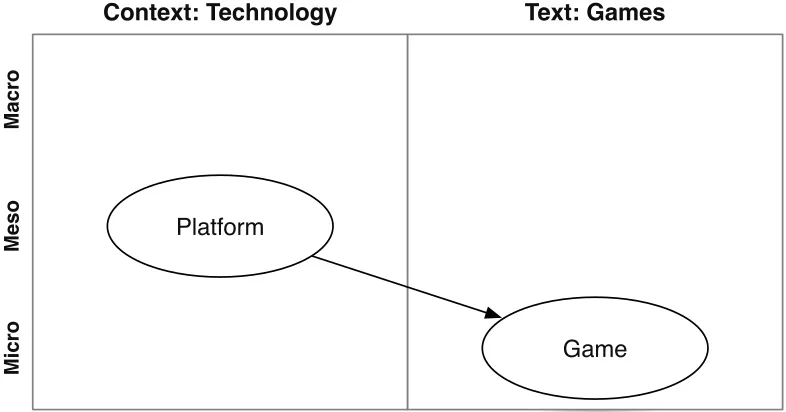
[image:9.595.92.487.104.309.2]To illustrate, let’s return to the beginning. Economic platform studies, we noted, is a contextualizing analysis of cultural artefacts (fig. 1). The two closest analogues to its program we identified were (technical) platform studies (Montfort & Bogost, 2009) and (film) production studies, particularly the study of the linkage between mode of production and film style in Classical Hollywood Cinema (Bordwell, Staiger & Thomp-son, 1985). If we abstract platform studies into a basic conceptual diagram, it looks somewhat like the following (fig. 2).
Figure 1. The basic theoretical model of contextualism.
Text: Games Context: Technology
Platform
Game
Mi
c
ro
Me
s
o
Ma
c
ro
Context
Text
[image:9.595.94.487.526.732.2]It claims that platforms as technical context construct located on a level of granularity “somewhere in the middle” between low-level reception/operation, interface, code etc. and high-level “culture and context” afford and constrain the design of individual games as text construct (Montfort & Bogost, 2009, 145-150) – acknowledging that plat-forms themselves are historical shaped by other contexts.
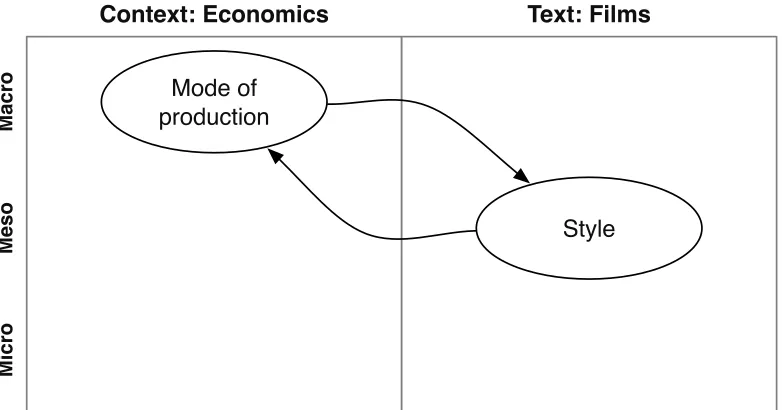
Classical Hollywood Cinema makes an analogous but still interestingly different theo-retical claim. (fig. 3). First, it identifies “modes of production” as a quite messy, high-level socio-cultural context construct:
“A mode of film practice is ... most simply, a context. ... the Hollywood mode of film practice consti-tutes an integral system, including persons and grous but also rules, films, machinery, documents, institutions, work processes, and theoretical concepts. ... a characteristic ensemble of economic aims, a specific division of labor, and particular ways of conceiving and executing the work of filmmaking.” (Bordwell, Staiger & Thompson, 1985, xvi-xvii)
Similarly, while instantiations of this mode and its effects can be observed in individ-ual films and their production, Bordwell, Staiger and Thompson aim for a more gen-eral and abstract construct of aesthetic form, namely a style shared by multiple films, which they define as “a set of norms” (ibid., 4): “Those norms constitute a determinate set of assumptions about how a movie should behave, about what stories it properly tells and how it should tell them, about the range and function of film technique, and about activities of the spectator.” (ibid., xvii) Classic Hollywood Cinema like platform studies acknowledges that modes and styles form and change over time affected by yet other contexts. But notably, it doesn’t assume a unidirectional context-text rela-tion: “The relations between film style and mode of production are, we argue, recipro-cal and mutually influencing.” (ibid., xvii)
Text: Films Context: Economics
Mode of production
Style
Mi
c
r
o
Me
s
o
Ma
c
r
[image:10.595.97.488.113.318.2]o
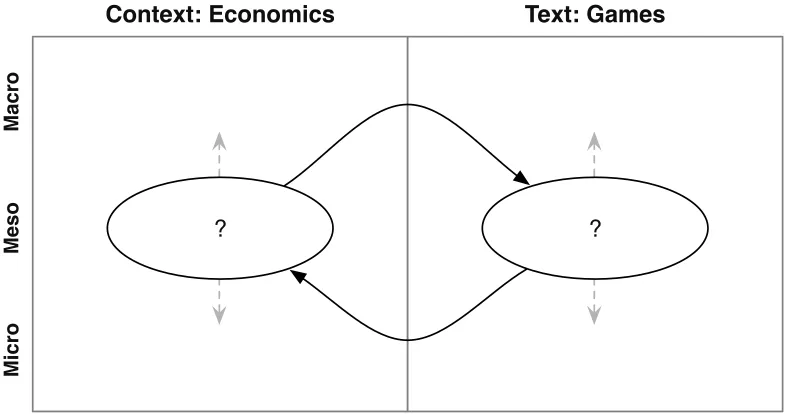
The theoretical possibility space and question opened between these exemplars thus becomes: What relations between what constructs of economic conditions and aes-thetic forms should it model and study (fig. 4)? Previous work has suggested a large variety of constructs. On the economic side, scholars commonly distinguish produc-tion, distribuproduc-tion, consumption, and sometimes, financing as broad aspects or domains. More concretely applied to video and computer games, we find:
• An originally Marxist concept, commodity form describes the particular way in which a particular object with a particular use and exchange value is produced and exchanged within a given society (Nieborg, 2012). Thus, Nieborg (ibid.) speaks of AAA games as “unfinished commodities” and free-to-play games as “connected commodities” (Nieborg, 2015).
• Mode of production, another Marxist concept, captures the specific combination of productive forces (like human labor, machines) and social and technical relations of production (like property and power relations) characteristic for a given kind of so-ciety. Postigo (2003) used it to describe the unwaged labor of modders.
• Business models broadly describe the interrelated aspects or “rationale of how an or-ganization creates, delivers, and captures value” (Osterwalder & Pigneur, 2010). As such, they entail several subcomponents such as delivery channels, customer seg-ments, of revenue streams/models (ibid.). Prax (2013) analysed real-money auction houses in Diablo 3 as a component business model. Goumagias and colleagues (2014) recently empirically classified video game business models, and revenue generation or monetization models have been used repeatedly to capture the particularities of e.g. free-to-play vs. COTS games and their economic logics.
Text: Games Context: Economics
Mi
c
r
o
Me
s
o
Ma
c
r
o
[image:11.595.94.490.113.320.2]? ?
• Value chain analogously describes the linked activities of a business to deliver value to customers, broadly divisible into design, production, marketing, delivery, and support. Tomaselli and colleagues (2008) have applied this concept to video game consoles and console games.
• When Juul (2015) speaks of AAA games or independent games as a “system”, he un-wittingly evokes the concept of business ecosystems as “extended system of mutually supportive organizations; communities of customers, suppliers, lead producers, and other stakeholders, financing, trade associations, standard bodies, labor unions, governmental and quasigovernmental institutions, and other interested parties” (Moore cited in Peltoniemi & Vuori, 2004, 272).
On the side of aesthetic forms, established constructs include:
• Game design patterns, defined as “commonly reoccurring parts of the design of a game that concern gameplay” (Björk & Holopainen, 2005, 425).
• Game mechanics: social game design literature frequently discusses the linkage be-tween particular game mechanics and revenue models (e.g., Fields, 2014), though rarely using common game studies understandings of game mechanics as “methods invoked by agents for interacting with the game world” (Sicart, 2008) – their notion is closer to game design patterns.
• Game genres, which can be defined as “the codified usage of particular mechanics and game design patterns to express a range of intended play-experiences” (Arse-nault, 2009, 171).
• Visual style, as a term Juul (2014) borrows from Bordwell but never defines.
• Again, commodity form (Nieborg 2012, 2015) as an economic-aesthetic hybrid.
being more ecologically valid, albeit they can be analytically decomposed into sub-components such as revenue models.
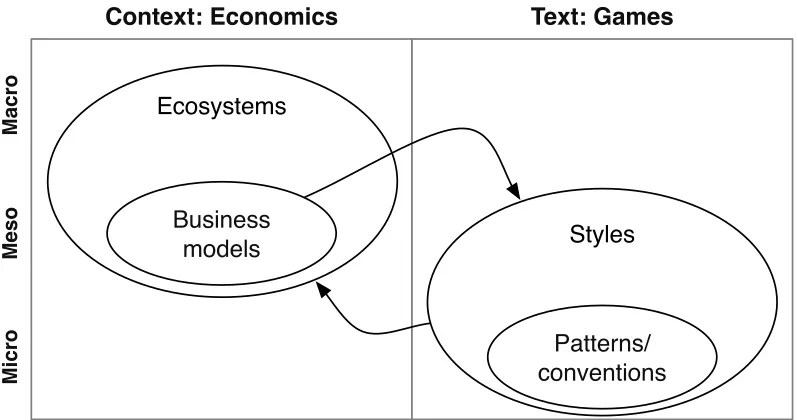
On the design side, researchers have identified particular micro-formations like de-sign patterns characteristic for particular game business models (Zagal, Björk & Lewis, 2013). Then again, such patterns likewise only become functional within the larger systemic whole of a game (Björk & Holopainen, 2005). In addition, across our vignettes, patterns were typically found as functionally interlinked clusters of multi-ple patterns that together serve aesthetic or economic functions: simple controls plus short rounds plus steep difficulty curve plus high replay value equal high coin income. Finally, many of the aesthetic regularities identified in the vignettes do not fit the game design pattern definition of “commonly reoccurring parts of the design of a game that concern gameplay”: production values, sequeling, cataloguing, intentional deviation from established mainstream convention, emulated low-tech visuals, ar-cades placed and designed to draw in passer-bys, etc. This suggests that styles, broadly understood with Bordwell, Staiger and Thompson (1985) as functional systems of mul-tiple aesthetic conventions or norms, might be the most ecologically valid and con-ceptually appropriate construct for capturing aesthetic forms affected by economics, though again, these can be described as made of identifiable subcomponents which include game design patterns and other, non-gameplay related aesthetic conventions.
Restated in a first, tentative, and initial focus, economic platform studies asks how par-ticular business models, embedded in parpar-ticular ecosystems, reciprocally enable, constrain, and shape particular game styles and their component design patterns and conventions.
Text: Games
Context: Economics
Mi
c
r
o
Me
s
o
Ma
c
r
o
Patterns/
conventions
Ecosystems
Business
[image:13.595.89.488.480.690.2]models
Styles
That being said, on closer analysis, any of these constructs will reveal complicated multi-causal networks themselves – just think of the positive feedback loops between investment volume, risk, and risk mitigation strategies in the AAA business model.
DOINGECONOMICPLATFORMSTUDIES
With this first theoretical framework at hand: What is the appropriate method for economic platform studies? There seems to be no principled reason to exclude any method or approach – nomothetic or ideographic purpose, close reading of one text or distant reading of many, qualitative or quantitative analysis. The aggregate nature of our target constructs – business models and styles, not Blizzard and World of Warcraft – suggests that ideographic readings alone won’t suffice; but that doesn’t mean tht case studies can’t make significant contributions. Neither Classical Hollywood Cinema nor Racing the Beam make any strong methodological claims; they are media histories by virtue of their authors’ training and predilections more than anything else. Our vignettes highlighted two general points: First, there is great value in comparison – across times, places, contexts, cases, media (see Klimek & Müller, 2015, for a general discussion), as it allows to foreground otherwise taken-for-granted phenomena. Bor-dwell, Staiger and Thompson (2010) acknowledge in hindsight that the lack of com-parison weakens the argument of Classical Hollywood Cinema; the main reason they did not engage in it was practical. A second point is the value of studying historically “hot” moments of conflict, change, and emergence, where social actors very literally (and with lots of material and document traces) work and talk through how things can fit together or not (Latour, 2005).
does a “business model” touch the “design” of a game, and what is that made of? Apart from taxonomising business models, ecosystems here and styles and patterns there, one of the main tasks of economic platform studies will be to trace in this em-pirical and theoretical detail that and how the two come to influence each other.
THEVALUEOFECONOMICPLATFORMSTUDIES
There is no theoretical end to the number of potential contexts in which to situate games: So why economic platform studies? A first obvious answer is that economics are an important part of (or lens on) the totality of culture. Contextualizing games economically thus simply adds to the totality of our understanding of games as com-plex cultural artefacts, and of the conditions of creative expression writ large. Second, it serves as a critical corrective to other contextualising and immanent readings: what is currently interpreted as malign intent or false consciousness may simply be eco-nomic necessity.
But there are also important pragmatic reasons: if we as a society wish certain forms of cultural expression in games to occur, we would be well-advised to study what makes them economically viable, sustainable, and likely. Despite good evidence for their effectiveness, serious games for instance are still failing to establish themselves in e.g. education or health care. If we trust senior observers (Sawyer, 2014), the reasons are economic not designerly: regulatory capture of markets by incumbents; a busi-ness-to-business environment the gaming industry is not used to operate in; and the lack of a surrounding business ecosystem. Similarly, while independent games are widely lauded as pushing and enriching games as an aesthetic form, they are also eco-nomically fragile and precarious. Economic platform studies can supply validated best practice business models and design patterns for game companies as well as rec-ommendations to policy-makers how to nurture and regulate business ecosystems to best support desired kinds of games.
CONCLUSIONS
To study such phenomena systematically is to engage in what we here termed econom-ic platform studies. Both economic conditions and aesthetic forms tend to appear in functional, systemic wholes or clusters that span production, distribution, consump-tion and financing on the economic side and extend beyond game mechanics and pat-terns on the design side, which suggests theorizing them in more complex constructs: business ecosystems, business models, sytles, conventions. Studying them and their linkage neither presumes nor excludes any particular method. But one of the first tasks of a future economic platform studies will be to trace in micro-empirical detail how “economics” and “game design” are constituted and affect each other.
REFERENCES
Alha, K., Koskinen, E., Paavilainen, J., & Hamari, J. (2014). Free-to-Play Games: Profes-sionals’ Perspectives. In Proceedings of Nordic Digra 2014.
Andersson, Å. E., & Andersson, D. E. (2006). The Economics of Experiences, the Arts and Entertainment. Cheltenham, Northampton: Edward Elgar.
Ang, I. (1996). Living Room Wars: Rethinking media audiences for a postmodern world. Lon-don: Routledge.
Apperley, T. H., & Jayemane, D. (2012). Game Studies’ Material Turn. Westminster Pa-pers, 9(1), 4–25.
Andrews, D. (2010). Art Cinema as Institution, Redux: Art Houses, Film Festivals, and Film Studies. Scope, 18, 1–21.
Arsenault, D. (2009). Video Game Genre, Evolution and Innovation. Eludamos. Journal for Computer Game Culture, 3(2), 149–176. Retrieved from http://www.eludamos.org/ index.php/eludamos/article/viewArticle/65/125
Bacharach, S. B. (1989). Organizational Theories: Some Criteria for Evaluation. The Academy of Management Review, 14(4), 496–515.
Barnes, B. (2014). America’s next Wal-Mart: The indie film industry. Salon.com, Feb-ruary 22, 2014. http://www.salon.com/2014/02/22/americas_next_wal_-mart_the_indie_film_industry/
Björk, S., & Holopainen, J.. (2005). Games and Design Patterns. In K. Salen & E. Zim-merman (Eds.), The Game Design Reader: A Rules of Play Anthology (pp. 410–427). Cambridge, London: MIT Press.
Bordwell, D. (1979). The Art Cinema as a Mode of Film Practice. Film Criticism, IV(1), 56–64.
Bordwell, D., Staiger, J., & Thompson, K. (1985). The Classical Hollywood Cinema: Film Style and Mode of Production to 1960. New York: Columbia University Press.
Bordwell, D., Staiger, J., & Thompson, K. (2010). The Classical Hollywood Cinema Twen-ty-Five Years Along. Retrieved from http://www.davidbordwell.net/essays/classi-cal.php
www.pcgamer.com/jonathan-blow-interview-social-game-designers-goal-is-to-degrade-the-players-quality-of-life/
Caldwell, J.T. (2008). Production Culture: Industrial Reflexivity and Critical Practice in Film and Television. Durham, London: Duke University Press.
Cronbach, L. J., & Meehl, P. E. (1955). Construct Validity in Psychological Tests. Psycho-logical Bulletin, 52(4), 281–302.
DeLeon, C. L. (2012). Arcade-Style Game Design: Postwar Pinball and the Golden Age of Coin-Op Videogames. Unpublished Master’s Thesis, Georgia Institute of Technology. Deterding, S. (2015). The Ambiguity of Games: Histories, and Discourses of a Gameful
World. In S. P. Walz & S. Deterding (Eds.), The Gameful World: Approaches, Issues, Applications (pp. 23–64). Cambridge, MA, London: MIT Press.
Dyer-Witheford, N., & de Peuter, G. (2009). Games of Empire: Global Capitalism and Video Games. Minneapolis, London: University of Minnesota Press.
Fields, T. (2014). Mobile & Social Game Design: Monetization Methods and Mechanics (2nd ed.). Boca Raton, FL: CRC Press.
Goumagias, N., Cabras, I., Fernandes, K. J., Li, F., Nucciareli, A., Cowling, P., … Ku-denko, D. (2014). A phylogenetic classification of the video-game industry’s busi-ness model ecosystem. In L. M. Camarinha-Matos & H. Afsarmanesh (Eds.), Col-laborative Systems for Smart Networked Environments (pp. 285–294). Berlin, Heidel-berg: Springer.
Hall, S. (1997). Introduction. In: Hall, S. (ed.): Representation: Cultural representations and signifying practices (pp. 1-12). Milton Keynes, London: Open University Press/ Sage.
Hamari, J., & Lehdonvirta, V. (2010). Game design as marketing: How game mechanics create demand for virtual goods. Journal of Business Science and Applied Management, 5(1). Retrieved from http://www.business-and-management.org/paper.php?id=48 Huhtamo, E. (2005). Slots of fun, slots of trouble: An archaeology of arcade gaming. In
J. H. Goldstein & J. Raessens (Eds.), Handbook of computer game studies (pp. 3–22). Cambridge, MA: MIT Press. doi:10.7238/a.v0i7.761
Jaffit, M. (2015). Indiepocalypse, or the birth of Triple-I? Medium, August 31, 2015.
https://medium.com/@morganjaffit/indipocalypse-or-the-birth-of-triple-i-eba64292cd7a#.wen1fzen7
Johnson, S. (2010). “Fear and Loathing in FarmVille.” Designer Notes: Soren Johnson’s Game Design Journal, March 19, 2010. Retrieved from http://www.designer-notes.-com/?p=195.
Juul, J. (2014). High-tech Low-tech Authenticity: The Creation of Independent Style at the Independent Games Festival. Proceedings of the 9th International Conference on the Foundations of Digital Games. Retrieved from http://www.jesperjuul.net/text/in-dependentstyle/
Kestenbaum, D. (2015). Casinos Offer New Ways To Win With Games Based On Skill. NPR.org, July 20, 2015. http://www.npr.org/2015/07/20/424728989/casinos-offer-new-ways-to-win-with-games-based-on-skill
Klimek, S., & Müller, R. (2015). Vergleich als Methode? Zur Empirisierung eines philologischen Verfahrens im Zeitalter der Digital Humanities. Journal of Literary Theory, 9(1), 53–78.
Kocurek, C. A. (2012). Coin-Drop Capitalism: Economic Lessons from the Video Game Arcade. In M. J. P. Wolf (Ed.), Before the Crash: Early Video Game History (pp. 189– 209). Detroit: Wayne State University Press.
Kocurek, C. A. (2014). Rendering Novelty Mundane: Technical Manuals in the Golden Age of Coin-Op Computer Games. In J. DeWinter & R. M. Moeller (Eds.), Computer Games and Technical Communication: Critical Methods & Applications at the Intersec-tion (pp. 55–68). Surrey: Ashgate.
Latour, B. (2005). Reassembling the Social: An Introduction to Actor-Network-Theory. Ox-ford: Oxford University Press.
Lin, H. & Sun, C.-T. (2011). Cash Trade in Free-to-Play Online Games. Games and Cul-ture, 6(3), 270–287. doi:10.1177/1555412010364981
Liu, A. (1989). The Power of Formalism: The New Historicism. ELH, 56(4), 721–771. Mannion, G. (2014). GTA 5 proves why DLC is inherently evil. Lazygamer.net, February
25, 2014. http://www.lazygamer.net/gaming-news/playstation/ps3/gt-5-proves-why-dlc-is-inherently-evil/
Marchand, A., & Hennig-Thurau, T. (2013). Value creation in the video game industry: Industry economics, consumer benefits, and research opportunities. Journal of Interactive Marketing, 27(3), 141–157. doi:10.1016/j.intmar.2013.05.001
Mayer, V., Banks, M.J. & Caldwell, J.T. (eds.) (2009). Production Studies: Cultural Studies of Media Industries. London: Routledge.
Montfort, N., & Bogost, I. (2009). Racing the beam: the Atari Video computer system. Plat-form studies. Cambridge, MA: MIT Press. doi:10.1162/leon.2010.43.2.188
Neale, S. (1981). Art Cinema As Institution. Screen, 22(1), 11–39.
Neyland, D. (2008). Organizational Ethnography. Los Angeles, London, New Delhi, Sin-gapore: Sage.
Nieborg, D. B. (2011). Triple-A: The Political Economy of the Blockbuster Video Game. Un-published doctoral dissertation, Universiteit van Amsterdam.
Nieborg, D. B. (2015). Crushing Candy: The Free-to-Play Game in Its Connective Com-modity Form. Social Media + Society, 1(2), 1–12. doi:10.1177/2056305115621932
Postigo, H. (2003). From Pong to Planet Quake: Post-Industrial Transitions from Leisure to Work. Information, Communication & Society, 6(4), 593–607.
Rose, M. (2013). Chasing the Whale: Examining the ethics of free-to-play games. Gama-sutra. Retrieved from http://www.gamasutra.com/view/feature/195806/chas-ing_the_whale_examining_the_.php?print=1
Rott, N. (2015). Skill Or Chance? Question Looms Over Fantasy Sports Industry. NPR.org, November 25, 2015. http://www.npr.org/2015/11/25/457279313/skill-or-chance-question-looms-over-fantasy-sports-industry
O’Donnell, C. (2014). Getting Played: Gamification, Bullshit, and the Rise of Algorith-mic Surveillance. Surveillance & Society, 12(3), 349–359.
O’Donnell, C. (2014). Developer’s dilemma: The secret world of videogame creators. Cam-bridge, MA: MIT Press.
Osterwalder, A., & Pigneur, Y. (2010). Business Model Generation.
Peltoniemi, M., & Vuori, E. (2004). Business ecosystem as the new approach to com-plex adaptive business environments. In Proceedings of eBusiness Research Forum (pp. 267–281).
Sawyer, B. (2014). Games for Health. In MIT Media Lab Talks. Cambridge, MA: MIT. Retrieved from
https://www.media.mit.edu/video/view/wellbeing-2014-11-05
Schamus, James. (2008). To the rear of the back end: the economics of independent cinema. In St. Neale & M. Smith (Eds.), Contemporary Hollywood Cinema (pp. 91-105). Routledge: New York.
Tomaselli, F. C., Di Serio, L. C., & de Oliveira, L. H. (2008). Value Chain Management and Competitive Strategy in the Home Video Game Industry. In POMS 19th Annual Conference (pp. 1–42). La Jolla, CA.
Turner, G. (2003). British Cultural Studies: An Introduction (3rd ed.). London, New York: Routledge.
Tzioumakis, Y. (2006). American independent cinema: an inroduction. Edinburgh: Edin-burgh University Press Ltd. doi:10.3366/edinEdin-burgh/9780748618668.001.0001 Veeser, H. A. (Ed.). (1989). The New Historicism. London: Routledge.
Wellek, R. (1978). The New Criticism: pro and contra. Critical Inquiry, 4(4), 611–624. doi: 10.1086/447958
White, M. M. (2009). The Senescence of Creativity: How Market Forces are Killing Digital Games. Loading..., 3(4).
Whitson, J. R. (2012). Game Design by Numbers: Instrumental Play and the Quantitative Shift in the Digital Game Industry. Unpublished doctoral dissertation, Carleton Uni-versity.
Whitson, J. R., & Dormann, C. (2011). Social gaming for change: Facebook unleashed. First Monday, 16(10). Retrieved from http://firstmonday.org/ojs/index.php/fm/arti-cle/view/3578/305