RIT Scholar Works
Theses
Thesis/Dissertation Collections
5-10-2002
Teacher perceptions of the New York State regents
requirements: A Pilot study
Jennifer Lerner
Follow this and additional works at:
http://scholarworks.rit.edu/theses
This Thesis is brought to you for free and open access by the Thesis/Dissertation Collections at RIT Scholar Works. It has been accepted for inclusion
in Theses by an authorized administrator of RIT Scholar Works. For more information, please contact
Recommended Citation
Running head: TEACHER PERCEPTIONS OF THE NEW YORK STATE
Teacher Perceptions of the New York State Regents Requirements: A Pilot Study
Graduate Thesis
Submitted to the Faculty
Of the School Psychology Program
College of Liberal Arts
ROCHESTER INSTITUTE OF TECHNOLOGY
By
Jennifer E. Lerner
In Partial Ful:fillment of the Requirements
for the Degree of Master of Science and
Advanced Graduate Certificate
Rochester, New York
May 10,2002
Approved:
_
(conunittee chair)
(conunittee member)
Dean:
-School Psychology Program
Permission to Reproduce Thesis
PERMISSION
GRANTED
Title of thesis
~~h~~~-S~- r~~ ~~
LfO tfA<
.S"rlt-r~!U4fd()
I~
=
~fii:
;
-r
.s
rcJlQ7'
I
J€NI\J~ L~..vc..
heieby-
grant p-ermission
to the
Wallace Memoilfai[ibrary of the Rochester Institute of Technology to reproduce my
thesis in whole or in part. Any reproduction will not be for commercial use or profit.
Date:
S
~,16
Z
Signature of Author:
PERMISSION FROM AUTHOR REQUIRED
T;~~~es~., ~W':==.:$!');$,.r~
I
prefer to be contacted
each time a
request for reproduction is made. I can be reached at the following address:
PHONE:
_
Date:
_
Signature of Author:
_
---
,
PERMISSION
DENIED
TITLE OF THESIS
_
I
hereby
deny
permission to theWallace
Memorial Library of the Rochester Institute of Technology to reproduce my
thesis in whole or in part.
Abstract
This
pilotstudy
investigated
teachers' perceptions ofthe
effects ofthe
New York State
Regents
requirementsonteachers
andstudents.An
eight questionLikert
scalesurvey
wasadministered
to
onehundred high
schoolteachers
in
an upstateNew York
urban schooldistrict.
Survey
questions coveredthe
impact
ofthe
new standards onteacher
autonomy,
in
additionto
student and
teacher
anxiety level. Teachers
were asked aboutthe
fairness
ofthe exams, the
amountof
time
spentteaching
to exams,
andhow
they
perceivedthe
exams asimpacting
schooldrop-out
rate.Results
indicated
that teachers
believed
that the
new requirementshad
a negativeimpact
ontheir
teaching
style and autonomy.Teachers
also reportedthat
they
did
notthink
that
Teacher
Perceptions
oftheNew York
State
Regents
Requirements
A
high
schooldiploma
certifiesthat
a studenthas
accomplishedan acceptablelevel
oflearning.
A
test
is
oneofthe
many
tools
usedto
measure a student'smastery
of material.To
be
valida
test
mustbe
anaccurate measureof a student'smastery
of relevantknowledge (American
Educational
Research
Association,
1998). Some
ofthemostimportant
assumptions abouttests
used
for
certificationdecisions
arethat
they tap
the
knowledge
they
aredesigned
to measure, that
the
minimumpassing
scoreis
a goodindicator
ofmastery
ornon-mastery,
andthat the test
scores are reliable.
The
currenttrend
in
testing
has
movedaway from
minimumcompetency
tests
towards tests that
measurehigher level
skills(American Federation
ofTeachers,
1997). These
tests
areknown
as"high
stakes"because
they
likely
willhave
affects on graduation rates.Educators
areconcernedbecause
currentpsychometricstandardsrecommendthat
adecision
that
will
substantially impact
atest
taker
should notbe based solely
onthe
results of onetest
score.It
is widely
acknowledgedthat
other relevantinformation
aboutthe
student shouldbe
taken
into
account
(American Educational Research Association
as citedin Heubert &
Hasuer,
1999).
Research
done
onhigh
stakestesting
indicated
that
preparing
studentsfor
these tests
oftenresulted
in "drill
andpractice"
teaching
methodsthat
did
not encouragehigher levels
ofthinking
(O'Day
&
Smith,
1993). As
testing
stakes areincreased districts
may
take
on a single-mindeddedication
to
increasing
test
scores.The New York State Regents
examinationsare achievementtests that
wererevisedin
2000
to
measurethe
New York State
Learning
Standards. In
orderto
graduatefrom
high
schoolin
New York
State,
students must achieve minimumpassing
scoresonEnglish, Mathematics,
Science,
andSocial Studies Regents
exams.The
exams weredesigned
sothat
passing
scoreswere
designed
to
measurethe
quality
ofinstruction
aswell asto
measure whatlearning
took
place
in
the
classroom.Students
take the
Regents
examinations aftercompleting
courseworkin
the
subjectarea ofthe test
(New York
State
Education
Department,
2000).
Currently,
studentswho
do
nottake the
Regent's
Exam
can receive aLocal
Diploma;
however,
this
optionwillbe
phasedout
by
2004
and allstudents,
exceptthose
withseveredisabilities,
will graduate withaRegents diploma.
For
aRegents
diploma,
a score of65
or above on each examis
required.Students
withdisabilities
will continueto
have
the
option oftaking
the
Regents
Competency
tests,
if
they
fail
the
Regents
Examination,
in
orderto
receive alocal diploma. The Regents
Competency
tests
are achievementtests that
measurebasic proficiency
and areless rigorous
than
the
Regents
examinations(The New York State Education
Department,
2001).
The
fairness
ofthe
newstandardshas been
hotly
debated. Critics
ofthe
Regents
requirements question whether
the tests
willultimately
penalize students withlearning
disabilities,
students oflow
socio-economicstatus,
students with atypicallearning
styles,
andstudents who attended alternative schools.
Proponents
oftheRegents
requirementsbelieve
that
the
new standards will ensurethat
all students will meet setlearning
standards.This study
examined
the
Regents
requirements,
the
argumentsfor
and againstthe
newstandards,
andteacher
perceptions ofthe
new requirements.Diploma Requirements for A Regents High School Diploma
Students
who entered grade ninein
or after1985 but before
the
2001-2002
school yearmust earn at
least
eighteenand onehalf
credits orthe
equivalentin
orderto
receive aRegents
orlocal diploma. Credit
mustinclude: four
units ofEnglish,
four
units of socialstudies, two
unitsofmath,
two
units ofscience,
one unit of art ormusic,
and ahalf
unitin health
education(The New
Students
entering
ninthgradein
the
2001-2002
school year or after must earn atleast
twenty-two
units ofcreditto
earn aRegents
diploma. Students
must completefour
creditsin
English;
four
creditsin
socialstudies; three
creditsin
science(with
atleast
one coursein
alife
science andonecourse
in
aphysicalscience); three
creditsin
math(with
eachlevel
at a moreadvanced
level
than
gradeeight);
one creditin
art, music,
dance,
ortheatre;
onehalf
credit ofhealth
education,
andtwo
creditsin
physical education(The New York State Education
Department,
2000,
section100.5).
In
orderto
demonstrate
attainment ofNew York State
learning
standards,
students mustpass
the
New York State Regents Examinations. Students
who entered ninth gradebefore 1996
could
demonstrate
that
they
metthe
standardsby
passing
eitherthe
Regents Comprehensive
Examination
in English
orby
passing
the
Regents
Competency
tests
in
Reading
andin Writing.
For
students who entered ninth grade after1996
but before September
2000,
passing
the
Regents
Comprehensive Examination
meetsthe
requirements ofNYS standards.The
minimalpassing
score on
the
Regents
examis
a65. For
alocal diploma
the
minimumpassing
scoreis
a scorebetween 55
and64
asdetermined
by
the
individual
school.Students
who entered ninth gradein
September
2000
or after can meetState
requirementsby
passing
the
Regents
examination withascore of
65
orhigher.
Students
withdisabilities
whofail
the
Regents Comprehensive
Examination
andwho started ninth gradebetween September 1996
andSeptember 2002
canmeet requirements
for
alocal diploma
by
passing
the
Regents
Competency
Test in
Reading
andthe
Regents
Competency
Test in
Writing
ortheir
equivalent(The New York State
Education
Department,
2001,
section100.5).
Students
who enteredninthgradebefore
orin
the
2000-2001
school yearmay
earnalocal diploma.
To
earn alocal diploma
studentsmust:(1)
completeasequenceofthree
creditunitsin
math, science,
alanguage
otherthan
English,
a careerandtechnical
educationsubject,
five
credit unitsin
eitherEnglish
orsocial
studies,
and an art or music subjector,
(2)
completea sequence ofthree
unitsof creditin
each oftwo
careerandtechnical
education
subjects,
orin
each oftwo
languages
apartfrom
English,
orin
eachoftwo
of
the
following
subjects:math, science,
alanguage
otherthan
English,
art ormusic,
career and
technical
subjectsor,
(3)
complete a sequence offive
units ofcreditin
math, science,
alanguage
otherthan
English,
art ormusic,
as well as a career andtechnical
education subject(The New
York State Education
Department,
2000,
section100.5).
(4)
the
sequenceofthree to
five
creditsin
alanguage
otherthan
English
must consistofcourses
in
onelanguage
(i.e.,
not onecoursein
Spanish,
onein
French,
and onein
Italian). The
sequence of creditsthat the
student chooses mustinclude
the
eighteenand one
half
credits requiredby
New York State.
(5)
students who areattempting
to
earn alocal diploma
shall also pass a career andtechnical
proficiency
exam(when available) if
they
arefollowing
a careerandtechnical
education sequence(The
New York State Education
Department, 2000,
section
100.5).
Local Certificates
Currently,
a student with adisability
may
earnalocal
certificateif
that
studentmeetsthe
the
certificateis
awarded.
Before
this
canhappen,
the
schooldistrict
musthave
written policiesin
placeto
ensurethat
studentswithdisabilities have
adequate opportunitiesto
earnahigh
schooldiploma.
The
student must alsohave
attendedschoolfor
atleast
thirteen years,
whichdoes
notinclude
kindergarten,
orhave
received anequivalenteducationfor
an equal period oftime.
When
a student receivesa
local
certificateit
shouldbe
accompaniedby
a written statementfrom
the
school
district
assuring
that the
student willbe
eligibleto
attendthe
district
in
whichthe
studentlives
untilhe
or shehas
receivedtheir
high
schooldiploma,
oralternately,
untilthe
end ofthe
schoolyear
in
whichthe
studentturns
twenty-one,
whichever comesfirst. Due
to the
changesin
graduation requirements
local
certificates will notbe
awarded on or afterFebruary
1,
2005 (The
New York State Education
Department,
2000,
section100.6).
High School
Individualized
Education Program Diplomas
Presently,
the
Board
ofEducation may
issue
anIndividualized Education Program
(IEP)
Diploma
to
a student with adisability.
As
withalocal
certificatethe
school musthave
writtenpolicies
that
ensure adequateopportunity for
students withdisabilities
to
earn ahigh
schooldiploma (The New York State Education
Department, 2000,
section100.9). The Board
ofEducation may
award anIEP
diploma
to
a student withdisabilities
atthe
end ofthe
yearthat the
student will
turn
twenty-one
or whenit
has been
establishedthat the
studenthas
metthe
goalsand
learning
standardsspecifiedin
the
student'sIEP. The IEP
diploma
appearsidentical
to the
school
district's
regularRegents diploma
exceptthat there
willbe
a notationthat the
diploma has
been
awarded onthe
basis
ofthe
students'
IEP
program(The New York State
Education
Department,
2000,
section100.9).
In
orderto
guaranteethat
students with severedisabilities
areaccountedfor in
the
statewide assessment
procedure,
IDEA
requiredthat
statesdevelop
alternativeassessmentsfor
studentswho could not complete
the
regularassessments,
even withaccommodations.These
alternative
assessmentsweredesigned
to
measure skillmastery
relatedto the
New York State
learning
standards(Office
ofVocational
andEducational
Services
for
Individuals
withDisabilities,
1998).
The
goalis
to
measure objectives relatedto
real worldskillsthat
help
withplanning
for long-term
adult outcomes.The New York
State
Alternative Assessment
is
similarto the
regularstatetests
in
that
it
measuresstudentachievement
in
state pre-selectedlearning
areas.Alternative
assessments weredesigned
because
the
requirementsofthe
other statetests
werenotbasic
enoughfor
studentswith severe
disabilities
(Office
ofVocational
andEducational
Services
for
Individuals
withDisabilities,
1998). Alternative
assessmentsdo
measurethe
student'sprogresstowards
generaleducationgoals.
The Committee
onSpecial Education
(CSE)
determines
whether a student with a severedisability
willtake
partin
the
alternative orthe
regular assessments.Only
students with severedisabilities
are eligiblefor
this type
of assessment.The CSE along
withthe
student's parents orguardians make
this
determination
on anindividual
basis.
The
student'sIEP
mustdocument
whether
he
or she willbe participating in
regular or alternative assessments and whataccommodations
for
testing
willbe
needed(Office
ofVocational
andEducational
Services for
Individuals
withDisabilities,
1998). The CSE
must considerthe
student'shistory,
whichshouldinclude
an evaluation of adaptivebehavior
aswell as an evaluation ofthe
student's academicThe CSE
must ensurethat
decisions
about which assessmentsthe
students willtake
arenot
based
uponthe
category
ofthe
disability,
language
differences,
cultural or environmentaldifferences,
orexcessive absences.Assessment
measures must meetthe
requirements of section200.4
(b) (6)
ofthe
Commissioner's
regulationsas wellassection300.532
ofthe
code offederal
regulations
(Office
ofVocational
andEducational
Services
for
Individuals
withDisabilities,
1998).
Students
whoparticipatein
alternative assessmentsmustdemonstrate
aseverecognitivedisability
as well asseveredeficits
in
language,
communicationand adaptivebehavior. These
students mustalso require a specialized education program and educational support such as
assistive
technology,
behavioral
interventions,
health
services or personal care(Office
ofVocational
andEducational Services for Individuals
withDisabilities,
1998). Students
areevaluated
using
multipletechniques
including
direct
observation,
writtenproducts,
or audio orvideotape
that
shows a studentmeeting
alearning
standard.The
student workis
scored with arubric
system,
similarto the
regularstate assessments.(Office
ofVocational
andEducational
Services for Individuals
withDisabilities,
1998).
Students
withseveredisabilities
areincluded in
the
system ofaccountability
because
educators, parents,
and administrators wantto
ensurethat
students with severedisabilities
aregaining
the
skillsneededto
adaptto
the
adult world.In
addition, the
Individuals
withDisabilities
Act
of1997/IDEA)
requires students withdisabilities
to
be included
in
stateanddistrict
wideassessments
(Office
ofVocational
andEducational
Services for
Individuals
withDisabilities,
1998).
The
Board
ofRegents determined
that there
was a needto
extend a"safety
net"
for
studentswith
disabilities.
The safety
netrefersto
prolonging
the
amount oftimelocal diplomas
will
be
availableto
students withdisabilities.
This
meansthat
students withdisabilities
are stillable
to
get alocal diploma if
they
cannotmeetthe
Regents
requirements.Originally,
the
Board
of
Regents
determined
that
the
safety
netshouldcover students withdisabilities
who enteredninth grade
between
September 1996
andSeptember 2000. In
February
2001,
the
Board
ofRegents
extendedthe
safety
netfor
students withdisabilities
to
include
students who enterthe
ninth grade
between
the
yearsof2001-2004. In
doing
this,
the
Board
ofRegents has decided
that
studentswith
disabilities
who enterthe
ninth gradebetween September 1996
andSeptember
2004
willbe
requiredto take
both Regents
courses andthe
examinations(The New York State
Education
Department,
2001).
If,
however,
they
do
not passthe
Regents
examination,
studentswith
disabilities
willbe
ableto
meetthe
requirementsfor
alocal
diploma
by
passing
the
Regents
Competency
Tests
orthe
equivalent.Students
mustfirst
attemptandfail
the
Regents
examto
be
allowed use of
the
safety
net.This
recommendation also extendedthe
availability
oflocal
diplomas for
students withdisabilities. It
is hoped
that the
extension ofthe
safety
net willaccomplish
the
following:
1
.Provide
moretime
for
academicintervention
services sothat
students willbe better
ableto
meetthe
goals ofthenewlearning
standards,
2.
Give
educatorsmoretime to train
in
modificationandadaptationto their
curriculumin
order
to
better
assiststudentsin meeting
the
learning
standards,
4.
Ensure
that
studentswithdisabilities
aregetting
equalaccessto the
coursecontentthey
need
to
getahigh
schooldiploma
(New York State Education
Department, 2001,
policy
01-06).
Alternative Schools
andRegents
Exams
Richard
Mills,
New York's Education
Commissioner,
ruled onApril
25th,
2001
that
alternative schools couldnot use alternative assessments such as
projects,
oralpresentations,
orexperiments
in
place ofthe
stateRegents
exams.He
indicated
that
he believed
that the
schoolsfailed
to
provethat their
alternative methodsconsistently
measured studentprogresstoward
New
York State
Learning
Standards
(Holloway,
2001). The ruling
was a major setbackto
agroup
of37
smallalternativeschools,
mostin New York
City
(Holloway,
2001). It
is believed
that this
decision
willlikely
force
the
schoolsto
changetheir
unconventional curriculums sothat their
studentscanpass
the
statewideexamsin
five
subjects.The
alternativeschoolsindicated
that
their
curriculumis
what makesthem
alternative.It
wasinteresting
to
notethat
onelocal
alternative school
in
upstateNew York
that
usesits
own curriculumhas
reported morethan
80%
of
its
graduates go onto
college.In
addition,
it
maintained one ofits
District's
highest
attendancerates,
lowest
suspension rates and one ofthe
District's
highest
SAT
averages(Rochester
City
School
District,
2002).
Alternative
schools often use portfolio review andteacher
evaluationto
decide
whetheror notastudent
is
making
progress.They
may
usedifferent
teaching
stylesanddo
notfollow
traditional
teaching
methods.They
generally
follow
learner-centered
philosophies anddo
notrely
on standardizedtesting
to
evaluatetheir
students.Some
parents,
teachers,
andadministrators
involved
in
these
alternative schoolsbelieve
that this
changewillhurt
their
schools(Holloway,
teaching
towards
atest.
State
officials,
however,
indicated
that
if
the
alternativeschools'
programs are
solid, the
studentsshouldbe
ableto
passthe
Regents
exams withoutchanging
the
curriculum
(Rosenberg,
2001).
Critics
ofMills
reportedthat
he
wasignoring
the
fact
that
all studentsdo
notlearn
the
same way.
They
arguedthat
many
ofthe
studentsin
these
alternative schools are students whoalready
had
difficulties
in
the traditional
school setting.Approximately
37 New York State
alternative public schools applied
for
a variancefrom
the commissioner,
which wouldhave
exempted
them
from
the
Regents
examinations.This
wasdenied
in
April,
2001
(Holloway,
2001). Each
ofthe
schools used someform
of performance-basedassessment, to
determine
whether a student
is
ready
for
graduation.Cumulative
documentation is
also assembled overtime,
to
demonstrate
how
the
studentis
performing.In
addition,
all students are offered multiplemethods
through
whichto
demonstrate
their
learning. The
schoolslost
the
ability
to
assesstheir
students
in
these
alternative ways as ofSeptember 2001.
Arguments For
andAgainst
the
Regents
Testing
Requirements
Gardner
(2001)
pointed outthat
whilethere
shouldbe accountability in
schoolswemay
be
pushing
in
the
direction
ofinsisting
that
allstudentsmustlearn in
the
same way.He
questioned
how
andby
whomdecisions
were made.He
questioned whetherthese tests
measuredlearning
conceptsandhigher level
thinking
orfact
memorization.Gardner
indicated
that
he
believed
these types
ofhigh
stakestests
hurt
studentswho weren'tparticularly
good atmemorizationand
damaged
teachers
who preferred notto
follow
someone else'scurriculum.Across
communitiessubstantial variationin
educationalachievementhas been found
between
studentsfrom
different
socio-economicbackgrounds.
Maynard
&
Kelsey (1996)
the
drop
out ratein
urbanareasoftenexceededfifty
percent.Also,
reading
proficiency
scoresin
disadvantaged
communities are onaverageten
percentless
than those
in
more advantaged urbancommunities
(National Center
for
Educational
Statistics,
1993).
Maynard &
Kelsey (1996)
reported
that
in
the
educationalprocess,
family
had
the
strongestinfluence
ona child'sbehavior
and outcome.
The
family
socioeconomicstatus, the
number ofchildren withinthe
family,
the
time that the
parents spent withtheir children,
andhealth
and nutritional practices were allfactors
that
affected school achievement.In
addition,
parents conveyedto
their
childrentheir
feelings
about schoolby
their
involvement
with school activities andby
the
messagesthey
sentabout
how
highly
they
valued education.Another
componentto
a child's outcome wasthe
community
that
they
live in. (Maynard &
Kelsey,
1996).
Schools
alsoinfluenced
a child's successin
the
future.
The
factors
that
influenced
achild's success were class
size,
teacher
quality,
and peergroup
characteristics(Odden &
Kim,1992). Ogbu
(1987)
pointed outthat
culturaldifferences
andthe
perception of pooreconomic prospects
may have
accountedfor
some ofthe
performancedifferences
between
minority
groups and white youth.U.S.
schools areserving larger
numbers of poor children.Between 1980
and1990
the
percentage ofpublic school childrenfrom
low-income families
increased
by
forty
percent(Kantor &
Brenzel,
1992). Over
the
pasttwenty
yearsthere
has been
an
increased
concentrationofminority
and poor childrenin center-city
schools.In
comparisonto
suburban schools
these
schoolshad
ahigher
rate of schoolviolence,
less
resourcesperchild,
higher
rates ofdiagnosed
learning
disabilities
and overalllower
studentoutcomes.Poverty
outside of central cities
has
been
falling
whilein
citiesit has been
rising.There
was aneara
result,
almost onehalf
ofinner
city
schoolshad
amajority
oftheir
studentsfrom
low-income
families
(Kantor &
Brenzel,
1992).
Dropout Rates
Reardon
(1996)
found
that the
schoolsthat
were mostlikely
to
have
high
stakestesting
policieswere schools
that
had
high
concentrations of studentsfrom low
socioeconomicbackgrounds.
He
reportedthat the
poverty
ofthe
schools andthe communities,
andtheir
associated
lack
of resourceslinked high
stakestesting
to
ahigher
drop
out rate.Kreitzer
et. al(1989)
comparedthe ten
states withthe
highest dropout
ratesto the ten
states withthe
lowest
dropout
rates.They
found
that
nine out often statesthat
had
the
highest dropout
rates usedhigh
stakes
tests
for
graduation whilethe
states withthe
lowest dropout
ratesdid
not usehigh
stakesgraduation
testing.
Kreitzer
alsopointed outthat
high
stakes graduationtests
may potentially
push at-risk students out
the
door. Cawthorne
(1990)
interviewed
studentsin
two
Boston
schools.Results
indicated
that
many
ofthe
students whofailed
the
newly
implemented
graduationtests
were
minority
orbilingual
students whodid
nottest
wellor readEnglish
too
slowly
to
finish
the
test.
Many
ofthese
students were students whohad
receivedgood gradesin
school.Some
groups ofstudents,
such aslow
SES,
African-American, Hispanic,
andEnglish
language
learners had been found
to
be
morelikely
to
attend schoolsin
whichhigh
stakestest
were given
(Reardon,
1996).
These
same children also werefound
morelikely
to
attend schoolswhere
they
were notreceiving high
quality
curriculum andinstruction.
Therefore,
it
shouldnotcomeas a surprise
that
low SES
andminority
studentsfailed high
stakesgraduationtests
athigher
ratesthan
high SES
and white students(Natriello &
Pallas,
1999).
Whether
or nothigh
stakestesting
has improved inadequacies in
curriculumhas
notbeen
a
young
person'sfuture. It has been
suggestedthat
graduationfrom high
school should notbe
based
ontest
scores alone.Other
alternatives,
such ascompensatory
models andthe
useofdifferentiated diplomas
(which
is
being
phased outin
NYS)
have
been
suggested.Placing
high-stakes
test
based
accountability
onstudents'
poses additional
legal
problems.Educators
mustdemonstrate
that the tests
usedto
makedecisions
do
notdiscriminate
againstany group
ofstudentsand
do
notdeny
any
studentdue
process.States
mustdemonstrate
notonly
that
studentshave
received adequate notice ofthe
requirementsbut
alsothat
they
have
been
taught
whatthe
test
is
measuring
(Taylor,
2001). The National Research Council
(1999)
recommendedthat
high
stakes
decisions
should notbe based
on atest
scorealone,
but
madein
conjunction withotherrelevant
information
such asteacher
recommendationand grades.One
ofthe
major purposes ofaccountability is
to
encourage schoolsto
focus
their
effortson
improving
student performance.However,
in
the past,
raising
test
requirementshas
notalways
had
the
desired
effect.Some
schoolshave focused
their
instruction
onthe
format
andgeneral content of
the test
instead
of onthe
skills and conceptsthey
weredesigned
to
measure.Other
schoolshave
resortedto
unethicalandillegal
practices,
including
cheating
(Pipho,
2000).
An important factor in accountability
is
ateacher's
ownjudgement
abouthis
orher ability
to
affect
the
learning
of students.In
schools with weakinternal
accountability, the
expectationfor
student
learning
is
oftenlow because
teachers
believed
that the
issues
the
studentsbring
to
school,
ratherthan
their
ownefforts,
have
the
greatest amount of control over studentlearning
(Elmore
&
Rothman,
1999).
Jones,
Jones
&
Hardin
(1999)
found
that
80 %
ofteachers
indicated
that
they
spent morethan
20%
percent oftheir
instructional
times
focusing
onpracticing
for
the
endofthe
yeartests.
practicing
for
endofthe
yeartests.
Jones,
Jones
andHardin
(1999)
reportedthat the time
taken
away
from
regularinstruction for
practicing
the tests
as wellastaking
the
tests
themselves
narrowed
the
focus
ofthe
curriculumto
only
conceptsbeing
tested
by
the
state.Twenty
four
percentofteachers
believed
that their
studentswereless
confident.In
addition,
48.5
%
ofteachers
indicated
that the
accountability
programhad
a negativeimpact
ontheir
students'love
of
learning.
More
than
77%
percent ofteachers
reportedthat
morale waslower among
them,
76%
respondedthat the
program would notimprove
the
quality
ofeducation and morethan
76
%
of
responding
teachers
felt
that their
jobs
were more stressfulthan
before
the
accountability
program was
implemented.
More
than
half
ofteachers
whorespondedindicated
that
they
would considerchanging
schoolsif
their
school wasdesignated
as poor performing.Eighty-nine
percentof
teachers
surveyedindicated
that
they
felt labeled
asthe
result oftheir
students' achievement onthe tests
Local Opinions
onHigh Stakes
Testing
On
May
3, 2001,
Dr. Richard
Ryan,
William
Cala,
Susan
Gray,
andDan
Drmacich
presented
their
opinions abouthigh
stakestesting
at aforum
organizedby
the
Rochester
Coalition
for
Common Sense in Education. The
following
are excerptsfrom
their
presentations.Dr.
Richard
Ryan,
a professor ofpsychology
atthe
University
ofRochester,
obtaineddata from
the
NY State Education Department regarding
the
validity
ofthe
Regents
examinations
currently
being
administered acrossthe
statein
gradesfour
andeight,
aswell asin
the
high
schools.Dr. Ryan indicated
that the
statehas
notpresentedhim
withany
evidencethat
these tests
have any
predictive validity.He
opposedthe
procedurethat the
stateusedto
determine passing
andfailing
scores onthe
newtests
afterthey
have been
administeredto
he indicated
that the
state shouldbe
ableto
determine benchmarks before
the
testing
takes
place.Dr.
Ryan
further indicated
that the tests
arenotreally
aligned withthe
state educationalstandards.
He
pointed outthat
skills suchaspublicspeaking
andcreativity
couldn'tpossibly
be
measured
by
apen and penciltest.
He
postulatedthat
many
students arebeing
denied
a rich andvaried curriculum
because
ofthe
limited
visionofthe tests.
Dr. Ryan
reportedthat
school reformsthat
assist studentsin
becoming
more motivatedare
those that
actively
engagedstudents,
increased interest
in
learning,
andaddedto the
senseofbelonging.
He
indicated
that
childrendid
better academically
whenthey
felt
a sense of choiceand autonomy.
Dr. Ryan
specifiedthat test reform,
like
that
currently going
onin New York
State,
limited
ateacher's
ability
to
caterlessons
to
studentinterest
andto
effectively
pacelessons.
He
further
pointed outthat
test-focused
teaching
leads
to
adecrease in
teacher
enthusiasm
for
teaching.
He
notedthat
teaching
to the test
underminedthe
validity
ofthe tests
themselves.
Additionally,
he
postulatedthat
it had
a negative effect on student motivation as wellas student performance.
Both Dr. Ryan
andMr.
Drmacich,
Principal
ofSchool Without Walls
in
the
Rochester
City
School
District,
pointed outthat
studentshad
adiversity
oflearning
styles aswell as
different
rates oflearning,
asindicated in
developmental
as well as educational research.They
arguedthat
using
onetest
as a measurementdenied
the
diversity
of children.They
reportedit
further
forced
usinto
a"one
sizefits
allmentality"
which
did
notfollow developmental
oreducational research.
Mr.
Cala,
Superintendent
ofFairport Public
Schools,
believed
that
trying
to
force
allchildren
to
"walkthe
same walk and reachthe
same gate atthe
same time"is
unconscionable.He indicated
that
childrenarelosing
large
amountsofimportant instruction
time
in his district.
as spend
time
practicing
the tests
withstudents.He
estimatedthat
studentsin his
district
arelosing
aroundtwenty
instruction days
ayear.He
statedthat
we aremoving from
multipleintelligence
to
minimalintelligence.
Mr.
Cala
pointed outthat the two
major manufacturers ofthese tests
indicated
that
they
shouldnotbe
used ashigh
stakestests
orasdiagnostic
measures.He
also pointed outthat
majortest
manufacturerslike
Houghton
Mifflin
reportedthat
no singletest
shouldbe
usedto
assess a child's abilities or skill attainment.Mr.
Cala
notedthat
standardizedtest
scoresarehighly
correlatedto
the
income
andeducationof
the
student's parents.He
believed
that the
main purpose ofthese
standardizedtests
is
to
sortlarge
numbers of students asquickly
andefficiently
as possible.He further indicated
that these tests
lead
to
depression,
anxiety, withdrawal,
and stress as well asto
anincrease in
special education.
Ms.
Gray,
Superintendent
ofPenfield
Schools,
statedthat there
needto
be
more optionsfor
students.She
is
an advocate ofthe
theory
of multipleintelligence.
She
statedthat
if
verbal-linguistic
intelligence
is
not one ofthe
student'shigh
ability
intelligences,
it
couldcausedifficulty
onthe
Regents
examinationbecause
so much ofit is based
on verbal-linguisticabilities.
She
asked,
"If
we canteach
to the
ability
and style strengths ofchildren,
why
can'tthey
demonstrate
some oftheir
learning
through their
individual
strengths?"She
arguedthat
otherabilities of students
besides
verbal-linguistic should counttowards
orin
place ofsomeofthe
New York State
tests
for
graduation.She
reportedthat
bodily kinesthetic,
spatial-visual,
interpersonal,
intra-personal
as wellas naturalisticintelligence
canbe
asimportant
ormoreimportant
skillsin
adultlife.
Proponents
ofthe tests
believed
that the
Regents
exams willhelp
ensurethat
allhigh
suggested
that the
Regents
tests
in
fourth
andeighth grade assistedin
identifying
where studentsand school
districts
arehaving
trouble
(Kohlstrand,
2001).
Supporters indicated
that
if
ateacher
is
truly teaching
to the
standardsthen the
students should nothave
any
difficulty
withthe
tests.
They
arguedthat the tests
will ensurethat
allstudentsin
New York
receive an educationthat
willenable
them to
read and write at setstandards;
no matter what school a student attendsin
New
York he/she
will allhave
achieved certaincompetencies.Advocates
believed
that the
Regents
examinationswill enable students
to
gethelp
whenthey
arefalling
short oflearning
standards,
something
they
may
nothave
received withoutthe
Regents
examinationto
identify
them.
They
reported
that
studentsshould notbe graduating from high
school withoutthe
necessary
skillsto
be
successfulin life.
Assemblyman Joseph Morelle (personal
correspondence,
May
6,
2001)
indicated
that
it
will
be
difficult
to
satisfy
everyone with regardsto the
Regents
requirements.He
postulatedthat
no matter what
type
of measureis developed
there
would alwaysbe
some students who weredisadvantaged
by
the tests.
He
agreedthat
suburban childrenin
wealthierdistricts do have
anadvantage over children
from
poorerdistricts
that
do
nothave
the
same resources.He
agreedthat
the
problemsin
the
urbandistricts
would notbe
solvedby
giving
tests
andmaking
graduationrequirementsmore restrictive.
Purpose
& Rationale
It
wasthe
hypothesis
ofthis
authorthat the
newRegents
requirementswouldbe
perceived as
having
a negative effect onboth
teachers
andstudents,
particularly
those
working
in
urban
districts. It
wasimportant
to
exploreteacher
perceptionsofthe
requirementsbecause
teachers
areultimately
responsiblefor
preparing
studentsfor
the
exams.Equally
important
is
hypothesis
that the
newrequirementswillnegatively
affectboth
teachers
and studentsaLikert
scale
survey
wasdeveloped
andadministeredto teachers
in
an urbandistrict
ofUpstate New
York.
Method
Participants
One
hundred city
schooldistrict teachers,
males andfemales,
completed an eight-question survey.All
participantsworkedfor Rochester
City
School District
in
one ofthree
urbanhigh
schools aseither regular education or special education
teachers.
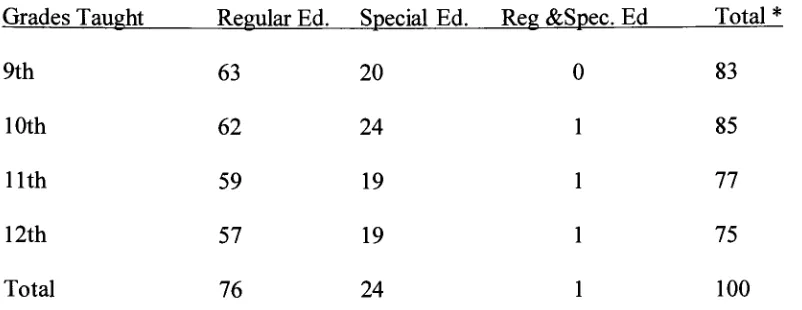
Seventy-six
regular education andtwenty-four
special educationteachers
participated.Respondents
averaged14.59
years(SD=10.19)
teaching
experience.Table 1
presentsthe
survey
participantsby
gradelevel
and classroomtype.
Rochester
City
schooldistrict is
alarge
urbanschooldistrict in
upstateNew York
that
had 37,159
students
in kindergarten
through twelfth
grade as ofJuly
2000. The
ethnicbreakdown
ofthedistricts
students was65% African
American,
17%
Hispanic,
16%
Caucasian,
and2%
Asian,
Pacific
Islander,
Native American
orEast Indian
(RCSD,
2000). Of
the
students withinthis
district,
67.5
percent were eligiblefor
afree
lunch in
the
97-98
school year.The
percentages ofstudents who received a
free lunch
in
the three
schoolsthat
participatedin
this
study
were similarand ranged
from 30.9
to
45.0
for
the
1996-97
school year(RCSD,
2002). Since
percentageofstudents who receive a
free
lunch
is
a goodindicator
oftheoverallmake-up
ofthe school,
data
from
the
entire sample was pooled.Materials
andProcedures
Three hundred
teachers
in
three
inner
city
high
schools received asurvey
with a coverletter
encouraging
involvement
in
the
study in
their
mailboxes.Approximately
two
weekslater,
Through
these two canvassings,
100
surveys(33
percent responserate)
were receivedfrom
regularandspecial education
teachers.
Materials
consistedof aneight-questionXikert-scale,
paperandpencil survey.Questions
were
based
onteacher
concerns voiced at ahigh
stakestesting
forum
sponsoredby
the
Rochester
Coalition for
Common Sense in
Education,
as well asfrom
teacher
concerns notedin
previousstudy
by
Jones,
Jones
& Hardin (1999). The
questionsfocused
onteacher's
perceptions ofthe
NYS Regents
requirements.Respondents
ratedthe
affectthey
believed
the
newRegents
requirementswould
have
onthe
drop
out rate andhow
wellthese tests
assessed studentknowledge.
Respondents
alsoindicated how
these
required assessmentsimpacted
their
ownteaching
style,
anxiety
level,
autonomy,
and use ofteaching
time.
Space
was providedfor
additional comments.
Respondents
wereprovided with envelopesto
return surveysto
adrop
box
provided
in
the
main office of each school.A copy
ofthe
survey
appearsin Appendix A.
Results
The
results ofthis
study indicated
that teachers
have strong
opinions aboutthe
New York State
Regents
requirements.Table 2
presents adetailed
breakdown
ofthe percentages, means,
andstandard
deviation
of respondentsto
all eight questions.When
respondents were asked whetherthe
newRegents
examinationsfairly
assessedtheir
studentsknowledge,
53%
eitherstrongly
orsomewhat
disagreed
withthis
statement.It
is
notablethat
only 3%
ofteachers
strongly
agreedthat the
new requirementsfairly
assessedknowledge.
In
responseto the statement,
"The
newRegents
requirements willlead
to
anincrease in
the
drop-out
rate withinRochester
City
School
District",
65%
ofteachers
indicated
that
they
either somewhat orstrongly
agreed withthis
statement.
Notably,
only 11%
ofteachers
strongly
disagreed
with statement.Fifty
three
percentaffected
their
autonomy
asteachers;
whileonly 7%
ofteachers
indicated
that
it
had
no affect onthem.
Fifty-three
percent of respondentsindicated
that the
Regents
requirementsinitiated
achange
in
their
teaching
style.Notably,
only 27%
ofteachers
reportedthat
they
had become
more anxious about
their
jobs
sincethe
graduation requirementschanged,
while35%
ofteachers
either somewhat or
strongly
disagreed
withthis
statement.Fifty-seven
percent ofteachers
reported
that their
stresslevel
had increased
sincethe
implementation
ofthe
new graduationrequirements,
whileonly 7 %
of respondentsstrongly disagreed
withthis.
It
is
important
to
observe
that
53%
ofteachers
reportedthat
they
believed
their
students were more anxious aboutpassing
the
Regents
examinations sincethe
requirements changed.Only
9%
ofteachers
strongly
disagreed
withthis.
Only
21%
of respondentsindicated
that
they
spend notime
teaching
to the
Regents
examinations,
while44%
ofteachers
admittedthat
they
spendbetween 50
to
100 %
oftheir time
teaching
to the
Regents
examinations.Table 3
presents responsesto this
questionby
category.
No
significantdifferences
to
survey
questions werefound
between
the
responses ofteachers
with more orless
than
fifteen
years experience.Table 4
presentsthis
information
for
each question.
The
responses of regular education versus special educationteachers
were alsocompared and one significant
difference
(p=.018)
wasfound.
Table 5
presentsthis
information
for
each question.Results indicated
that
special educationteachers
were morelikely
to
believe
that
they
had
to
changetheir
teaching
stylein
responseto
changesin
Regents
Examination
requirements
than
regular educationteachers.
Discussion
Overall,
resultsindicate
that teachers
believe
that the
newRegents
requirements
teachers
onthe
surveysamplify
these
findings.
Past
research(Kreitzer, 1989; Reardon, 1996)
aswellas
the teacher
perceptions reportedin
the
currentstudy
supportthe
idea
that
more childrenfail
to
completehigh
schoolbecause
they
are unableto
passthe
Regents
examinations.In
the
present
study,
65%
ofteachers
indicate
that
they
believe
the
drop
out rate willincrease. This
result must
be
considered carefully.One
respondentin
the
currentstudy
wrotein,
"Higher
standards equal a
higher
drop
out rate and ahigher
level
of student frustration" and addedthat
real vocational alternatives are needed
for
students.Another
educatorstated,
"The
requirementsare one of
the
mostignorant
decisions I've
seen sinceI
startedteaching".
A
third reported,
"Placing
Regents
standards on all studentsis
unfair andillogical".
Past
researchindicates
(Natriello &
Pallas, 1998; Cawthorne,
1990)
that these tests
arenot
fair
to
all students acrossrace, gender,
and socio-economic status andfor
students withdisabilities.
Natriello & Pallas
(1998)
found
that
childrenin large
urbandistricts
are mostpenalized
by
high
stakestesting.
Teacher
writein
commentsfrom
the
currentstudy
also reflectconcerns
that
the
Regents
examinationsunfairly
disadvantage
ESL
and special educationstudents.
One
teacher commented,
"Many
more special education students willdrop
out or get anI.E.P. diploma". An ESL
teacher
noted,
"The
standards andtests
are unfairto
ESL
studentswhoare required
to take
the
state exams andhave
to
pass with a65%
orbetter,
especially if
they
have
been in
the
country
for less
than two
years."A
special educationteacher wrote,
"The
standardsdo
notsufficiently
include
special educationstudents,
it's
eitherRegents
or anIEP
diploma,"and"Where does
that
leave my
students whenthe
local diploma
andthe
safety
net aretaken
away"?A high
school educatorwrote,
"I
am worried about students who enterNYS
in
their
junior
ortheir
senior year whothen
must passthe
examinations.In
responseto the
Regents,
test
standardswrote,
"The
examsdo
not measureany
"standards",
standardsin
themselves
arebeneficial
to
students while
high
stakestests
are not".Results from
the
currentstudy
replicateJones,
Jones
andHardin's
(1999)
findings
that
vast amounts of
time
arebeing
spentpreparing
studentsfor
these
exams.That study found
that
28%
ofstudents spent morethan
60%
ofinstructional
time
practicing for
tests.
In
the
currentstudy,
42%
ofteachers
reportspending between 51-100%
oftheir time
teaching
to
the
Regents
examination.
One
teacher
wrotein,
"Although my
students areonly
requiredto
take
onetest
this
year,
whenthis
year'sfreshman
class entersthey
willbe
subjectedto
passing
five
examsbefore
they
can graduate.I'll
needto
startteaching
to the tests
much morein
the
future,
which,
in
turn,
willmake
my
currentprojectdriven
class, test-driven".
Not only
do
teachers
reportthat
they
arespending large
amounts oftime
preparing
their
students
for
these examinations,
but
they
also reportthat
they
do
notbelieve
these
exams aregood
indicators
of studentknowledge. It is astonishing
that
53%
ofrespondents surveyeddid
notbelieve
that
the
Regents
examinationsfairly
assessedwhattheir
studentsknew,
whileonly 3%
ofrespondents reported
that
they
agreedthat the
Regents
examinationsfairly
assessed studentknowledge.
In
addition,
someteachers
statedthat the
changein
requirements moved educationaway from exploring
material and conceptsto
basic fact
memorization.They
reportedthat
learning
seemedless
significantfor
students.One
teacher
wrote,
"The
requirementsforce
teachers
to teach to the
test,
whichfocuses
onlower level
ratherthan
complexthinking
skills.When in
history
have
all studentsbeen
expectedto
perform atthe
same level?"An
English
teacher
wrote,
"This
examdoes
notimitate
realwriting,
writersdo
not write underthese
More
than
half
of current respondentsbelieve
they
must changetheir
teaching
styleto
accommodate
Regents
examinations,
while45% believe
that their
autonomy
has
been limited.
These
changed attitudesmay impact
the
way
teachers
relateto their
students.Special
educationteachers
were morelikely
than
regular educatorsto
indicate
that
they
had
to
changetheir
teaching
style sincethe
implementation
ofthe
new requirements.This
is
probably because
beginning
in
2005,
special education students will nolonger be
ableto
receive alocal diploma. A
high
schoolteacher noted,
"Teachers have
become
moreinterested in
covering
the
curriculumrather
than
going in-depth for
richunderstanding
of materialandmeeting
studentinterests
due
to
the
new standards".Another
wrote,
"Social
studieshas
been
reducedto
meaninglesstrivia".
A
third
respondentwrote,
"The Regents
exams are not aligned withthe
state standards or withcommon sense.
They
arearbitrary, political,
and a professional affrontto
any
goodteacher.
The
exams are requirements
that
stiflecreativity
andthe
joy
oflearning,
both
of which shouldbe
ourgoals as educators".
Finally,
ahigh
schoolteacher stated,
"Students
are notbeing
taught to think
but
ratherto
regurgitateinformation
only".Jones,
Jones,
andHardin
(1999)
indicated
that
61%
ofteachers
surveyedbelieved
that
their
students were more anxious after ahigh
stakestesting
program wasimplemented
in
their
district.
Similarly,
in
the
currentstudy
57%
ofteachers
reportedthat
the
newRegents
requirements
increased
their
stresslevel
whileonly
16%
ofteachers
disagreed
withthis
statement.
Increased
teacher
anxiety may
impact
the
ability
to
relateto
andteach
students.Teachers
in
the
currentstudy
also reportedthat
54%
oftheir
students were more anxious sincethe
graduationrequirementshad
changed.A
mathteacher commented,
"Many
students cometo
me well
behind in
ninthgrade andmay
nothave
passedmathfor many
years.It
is
quite atask to
already
been
changesin
my
class.If I
do
not putup
a question onthe
board
for my
studentsto
respond
to,
the
students areunableto think
withoutrelating
the
questionto
whatthey've
learned
for
the
Regents
exam.Students
aremoving away
from
learning
andthinking
for
the
simplevaluesand
joys
oflearning
andflunking
andequateknowledge
withformulaic
writing".Some
educators surveyedbelieve
that the
new standards couldbe
beneficial.
One
respondent
indicated,
"The
standardsmay
force
teachers
to teach
atthe
appropriatehigh
schoollevel.
Currently,
many
of our school'shonor
roll students goto
college and musttake
remedialcourses.
This
indicates
that
educators are notdoing
their
job".
Another
educatorwrote,
"The
Regents
examsin Science
keep
meto
a particular goal.Requiring
topics/units
forces
ateacher
to
make sure
the
appropriatetopics
aretaught".
Another
teacher
stated,
"It
is
basically
a newtest,
no
more,
noless.
The only
negativeis
that
it limits
creativity,
whichis
the trade
offfor
setting
arninimum standard".
Considered
with abundant previous research onhigh
stakestesting
andminority
students,
the
results ofthis
study
suggestthat teachers
and studentsin
urbandistricts
may
be
adversely
affected
by
the
revisedNew York State Regents
standards.Most
respondentsbelieve
that
high
stakes
testing
may
notbe
the
best way
to
assess all students.Clearly
some meansto
measurestudent achievement
is necessary
to
guaranteethat
students who graduatehave
the
knowledge
to
be
successfuland productive adults.Most
respondentsto this
study
think that the
currentRegents
examinations
detract from
learning
and aredetrimental
to
teaching
because
they
focus
onfact
memorization and
increase
anxiety.The
solutionsto this
dilemma
are not clear.Educators
mustconsider
the
impact
that the
newRegents
requirements willhave
on students andteachers,
andLimitations
andFurther Directions
Limitations
ofthis
preliminary study
arethe
small sample size(7V=100)
andthe
homogeneous
make-up
ofthe
respondents.All
respondents camefrom
one urban schooldistrict,
wherestudents
historically
performpoorly
on standardizedtests.
Future
research might compareteacher
perceptions ofthe
Regents
requirementsin
urbandistricts
versus suburbandistricts
using
larger
sample sizes and more representative samples.In
addition,
future
research should explorethe types
of assessmentsteachers
believe
would mostfairly
andadequately
measure studentReferences
American
Educational Research Association
(1985). Standards for
Educational
andPsychological Testing.
Washington,
DC: American Psychological Association.
American Federation
ofTeachers
(1997) Making
Standards Matter 1997:
An
Annual
Fifty-
State
Report
onEfforts
to
Raise Academic Standards.
Washington,
DC: American
Federation
ofTeachers.
Cawthorne,
J. E.
(1990)
Tough
graduation standards and goodkids.
Boston,
MA: Center
for
Study
ofTesting,
Evaluation
andEducational Policy.
Elmore,
R.F. &
Rothman,
R.
(Eds.)
1999.
Testing,
teaching,
andlearning:
a guidefor
statesand school
districts.
Washington,
DC: National
Academy
Press.
Gardner,
H.
(2001,
April 17). Stick
to
testing
the
basics. The New York Times.
Retrieved
onApril
25, 2001,
from
http://www.nytimes.com
Heubert,
J.P. &
Hauser,
R.M. (1999). High
stakes:testing
for tracking,
promotion, andgraduation.
Washington.
DC: National
Academy
Press.
Holloway,
L.
(2001,
April
26). Commissioner
tells
schoolsto
usetests,
not portfolios.The New
York Times.
Retrieved
onMayl, 2001,
from
http://www.nytimes.com
Jones,
G.M., Jones, B.D.,
&
Hardin,
B. (1999). The
impact
ofhigh
stakestesting
onteachers
and studentsin North Carolina. Phi Delta
Kappan.
81(3),
199-203.
Kantor,
H. &
Brenzel,
B. (1992). Urban
education andthe
"truly
disadvantaged":
the
historical
roots ofthe
contemporary
crisis,
1945-1990.
Teachers College Record.
94(2),
278-31
1.
Kohlstrand,
J.
(2001,
May
2).
States
academictesting
spurs protest.Democrat
andKreitzer, A.E., Madaus,
F.
&
Haney,
W. (1989).
Competency
testing
anddropouts.
In L.
Weis &
H.G.
Petrie
(Eds.),
Dropouts
from
schooklssues,dilemmas
andsolutions.Albany,
NY:
New
York Press.
Maynard,
R.
&
Kelsey,
M. (1996). Economics
of school reformfor
at-risk students.In
E.A. Hanushek
& D.W. Jorgenson
(Eds.),
Improving
America's
schools:the
role ofincentives
(pp.
147-168). Washington.