Rochester Institute of Technology
RIT Scholar Works
Theses
Thesis/Dissertation Collections
9-26-2005
Journal writing within deaf education
Clare Cassidy
Follow this and additional works at:
http://scholarworks.rit.edu/theses
This Master's Project is brought to you for free and open access by the Thesis/Dissertation Collections at RIT Scholar Works. It has been accepted for inclusion in Theses by an authorized administrator of RIT Scholar Works. For more information, please [email protected].
Recommended Citation
Journal Writing
Journal Writing Within Deaf Education
MSSE Master's Project
Submitted to the Faculty
Of the Master of Science Program in Secondary Education Of Students who are Deaf or Hard of Hearing
National Technical Institute for the Deaf ROCHESTER INSTITUTE OF TECHNOLOGY
By
Clare Therese Cassidy
Student Signature
In Partial Fulfillment of the Requirements For the Degree of Master of Science
Rochester, New York
Db
.
I 5 . 0 5
(date)Approved:
I
---Journal Writing
Special Thanks to:
My Parents
Susan Fischer
Jason Kulchinsky
Tammy Murphy
and
~:
Introduction ... 1
ProblemsWithinDeaf Learners 1
What is Journal Writing? ... ... ... ... ... ... ... ... ... ... ... ... ... ... ... ... ... ... ... ... ... ... ... 3
Benefits of JournalWriting 4
Possible Shortcomings of Journal Writing ... ... ... ... ... ... ... ... ... ... ... ... ... ... ... 8
Reasons for creating this curriculum ... ... ... ... ... ... ... ... ... ... ... ... ... ... ... ... ... 9
Overview of Journal Writing Curriculum... ... ... ... ... ... ... ... ... ... ... ... ... ... ... ... ... 10
Rules of JournalWriting .14
Definitions/Descriptionsof JournalWriting... '" ... ... ... ... ... ... ... ... ... ... 15
Ideal Class Schedules ... . . . .. . .. . . ... . . ... .. . . .. ... ... . . . .. . .. . . ... ... . .. ... . . ... 17
Assessment ... ... .. . ... ... .. . ... .., ... ... ... .. . ... ... ... ... ... ... ... ... ... .. . ... ... ... .. . ... 20
Summary ..21
Lesson Plan Section 23
Assessment Tool Section... ... ... ... ... ... ... ... ... ... ... ... ... ... ... ... ... ... ... ... ... ... ... . 38
References 45
Appendices Section... ... ... ... ... ... ... ... ... ... ... ... ... ... ... ... ... ... ... ... ... ... ... ... ... . 49
Daily Sparks Section... ... ... ... ... ... ... ... ... ... ... ... ... ... ... ... ... ... ... ... ... ... ... ... ... 53
Journal Writing
Journal Writing
Writing has generally always been a source of resentment. aversion and unhappiness for deaf
people. It shouldn't be. When one mentions an English writing course. one would involuntarily
envision a long class of boring lectures on parts of speech. sentence structures and know their written
paper will return all bloody from those red markers. This has to change~the unconscious fear of English
within Deaf people affects their academic. personal and social growth.
The change can happen by the classical conditioning of making writing and English a fun and
pleasant learning experience. One remedy to such adversity is journal writing. When growing up. I
remember my pleasant experiences were when my teachers or friends wrote to me through journaling
and it was nothing like writing those papers required for school. I loved every minute of it.
I decided to try journaling with my students for both student teaching experiences and have come
to the conclusion that journal writing is effective in creating a pleasant experience for writing~however.
it can be more successful if we blend the academic requirements with journal writing with structured
guidance.
Although I used journal writing with my students. I realized that I did not have a structured
system for journal writing to have it effectively blend with their academic skills. This led me to the
current project. where I aspire to create a curriculum based solely on journal writing that will at the
same time meet the academic standards while creating a positive and enjoyable learning experience for
everyone involved.
I am about doing this project because not only will I provide information on deaf readers'
problematic factors that can be remedied by journal writing~I will also share ideas of topics. objectives.
samples of journaling questions. and activities to effectively make journal writing an academically
fulfilling experience.
.
The education of the Deaf. thus far. has been considered a failure. Over the years through reports
and research. the deaf population's average reading level has been shown to fall at the level of 3rdto 4th
grade. The fact of the failure was officially recognized by the 1965 Babbidge report (Babbidge. 1965)
and further verified as a continuing failure by the Commission on Education of the Deaf in 1988 (Bowe.
1988). There are countless research studies that state the problematic average of deaf individuals being
education is in general agreement that. as a group. deaf children have difficulty attaining literacy in
English beyond the fourth grade level.
There are several explanations as to why this has been the case for more than a century.
Referring to this commonly known problem. Golladay (1977) said that the average is low due to the
disadvantage of individuals with prelingual hearing loss. He said that development of vocabulary.
idiomatic and grammatical English and sophisticated sentence patterns. and the understanding of
abstract concepts are "severely retarded" thus. affecting
their reading (Golladay. 1977). In addition. the
struggles may be based on several factors. namely deaf
students' weakness in metacognition skill as discussed
Deaf children in reading:
·
Lack confidence·
Has poor metacognition skills·
Have low knowledge of vocabulary·
Sees English as a foregin language by Albertini (1990) and Strassman (1997). lack ofconfidence when it comes to writing (Vanett & Jurich
1990a).low knowledge of vocabulary (Mayer & Mosko. 1998) and more than necessary discomfort
when it comes to the subject of English.
Finally. some have argued that the system of educating the deaf lacks proper educational
methods (Walworth. 1990); one study emphasized that the problem originated from language barriers
(Golladay. 1977). Most of those researchers hold late language development (missing the critical
period of language development) accountable for this problem. Inevitably. it would be common sense
to assume that writing is one of the domains that is a constant battle for deaf learners. Given all those
language related factors. it would not be surprising to see deaf children developing an aversion towards
writing. reading and English in general.
There are many educational methods in Deaf education attempting to remedy this dilemma.
For this project. my belief in journal writing as a "remedial" educational strategy is sincere. Journal
writing alone address satisfy most of those issues brought up by research in regard to Deaf education.
Journal writing. according to Albertini (1990) taps into several areas: for instance building independent
strategies (metacognition). increasing confidence. coherence. improved expressive skills. and even
grammar skills. Also. Hall (1997) described journal writing as a magical way of encouraging children to
be interested in writing.
This leads me the beleif that journal writing will ease the anxiety of deaf learners and their
may be able and willing to increase their exposure to it.
Journal Writing
.
.
.
?Written communication between teachers and students is called journal writing; it is also known
as dialogue writing. Journal writing, according to Montgomery (2001), consists of several writing
methods between the teacher and the students. Montgomery's focus in using journal writing was for
mainstreamed students who had learning disabilities or were English Language Learners. She saw it as
an effective tool to appropriately evaluate everyone's skills, regardless of diversity, because she was able
to assess each student individually.
When it comes to journal writing, the role of the teacher is to ask questions, throw in topics and
encourage thought provoking writing (Albertini, 1990; Vanett & Jurich, 1990a, 1990b, Montgomery,
2001; Hall, 2002). Then in turn, the students will freely write their responses and thoughts, ask
questions (inference), and relate their answers through personal anecdotes, to experiences or already
familiar knowledge (Muller, 1992; Meath-Lang, 1990; Vanett & Jurich 1990a; Albertini, 1990;
Montgomery, 200 1). Journal writing between teachers and students is a
Journal writing
II turn-taking process where the content of the journal continues to grow asis magical.
-Hall,
-211
bonding and communication develops.It is an important to stress that all those previous researchers on
journal writing have emphasized that grammar was not to be a major concern and correcting grammar
within journal writing was ill-advised. However, Peyton (1990) and Reid (1997) said that in journal
writing the teacher does not evaluate what is written, "but models correct language and provides a
nonthreathening opportunity for ELL students to communicate in writing with someone proficient in
English, and to receive some feedback." Also, Reid's literature review and her action research project
show dialogue journaling with a teacher as beneficial in improving spelling and fluency. Within my
project, grammar skills are fostered through mini-lessons (usually 15 minutes) per class on specific
grammar exercises to ensure that grammar skills are also being taught.
As stated in the introduction about problematic factors for deaf learners, journal writing seems
to cover all the bases and do even more. In almost all studies on the effect of journal writing on deaf
individuals, there was mutual agreement that journal writing has positive effects in several domains.
meaningful teachings and metacognition skills (Albertini, 1990~Vanett & Jurich, 1990a, 1990b~Peyton,
1990~Montgomery, 200 1~and Hall, 2002). The backbone of their argument as to why journal writing
was effective for deaf learners was the win-win situation this genre has for both teachers and students in
Deaf education.
...
Relationships between the teacher and the students
All
across the articles and studies, authors have repeated over and over that journal writingpromotes relationships between teachers and students, and also among the students themselves.
Through those relationships, they develop the concept of interactive communication between students
and teachers.
Meath-Lang (1990) elobrated on the topic of journal writing~she wrote, "teacher and
student, in journal writing, journey together;' while Vanett & Jurich (l990a) explained that while the
traditional relationship between teacher and student is often seen as
"assignment giver and the assignment completer, or evaluator and
the grade seeker;' journal writing between teachers and students
Teacher and student,
in journal writing,
journey together.
-Meath-LaDR.199O
forces everyone out of that "role" as students came to recognize
their teachers not only as the assigner, and the one who reads, but also as a writer. According to a study
in a similar vein, Vanett & Jurich, (l990b) state that teacher-writers affect all of the relationships in
the classroom~the result is a classroom that is not only more open and "nonthreathening, but also more
democratic. "
Students responded to Vanett & Jurich's journal writing class by claiming that their confidence
and motivation increased throughout journal writing (Vanett & Jurich, 1990b). Finally, the students and
teachers wrote with "rear purpose and meaning, wishing to share their personal experiences with each
other, and more of an opportunity for communication" (Vanett & Jurich, 1990b).
The development of relationships has an obvious positive impact and is a good way to break
the aversion to English for deaf learners. Thus far, we have seen that journal writing builds confidence
(Meath-Lang, 1990), encourages motivation (Albertini, 1990), and puts deaf writers at ease when
writing (Vanett & Jurich, 19908, 1990b). With the ease and comfort in relationships built from journal
Journal Writing
Quality of content and writing skills
The genre of journal writing is not limited only to the benefits of relationships; it also has an
impact on the quality of content and writing skills in deaf learners. According to several studies, journal
writing, with confidence in stride, fosters grammatical skills, coherence and well-structured contents
(Vanett & Jurich. 1990a, 1990b; Peyton, 1990; Kluwin & Kelly, 1991; Albertini, 1990). Specifically,
Kluwin and Kelly (1991) conducted an extensive study focusing on 153 deaf students; during the
study, the researchers looked for changes in content and syntactic complexity through the use of journal
writing. They found an improvement in the quality of writing of the deaf students and a change in
the nature of the content of their entries. Peyton (1990) drew similar conclusions. Peyton's study
was based on 6 hearing English Language Learners who experienced journal writing for 10 months;
results showed that even with the variety of students, journal writing did reflect "changes in students'
language proficiency over time, even at the earliest stage of second language acquisition" (1990). Aside
from language proficiency, their forms and structures of written English continued to develop as well.
Bridges' findings (1997) also supported Peyton's study; she found that when using journal writing,
teachers understand each of their student's individual "weaknesses" in grammar better. Through journal
writing, according to her, "we're in a more effective position to help them;
Modeling is an
effective tool in
teaching grammar
and writin2.
to respond in ways that might make a difference for them both personally
and academically" (Bridges, 1997). She used the term "academically" to
mean fluency in grammar, spelling and expressive skills.
The development of quality in content and writing skills is due to several contributing factors.
One is the exposure to modeling of well-written sentences from the teacher or from classmates.
Modeling, to the researchers, means instances where the "accurate" or "appropriate" word order,
structure and grammatical rules are displayed for others to see and "copy" (Meath-Lang, 1990; Kluwin
& Kelly, 1991; Peyton, 1990; and Vanett & Jurich, 1990a). During the process of journal writing,
teachers ask for "publication" where the students share their written materials with the class (Vanett &
Jurich, 1990a). When sharing, students discuss the work that is displayed and offer feedback and ideas;
revisions can be made if needed. Students are thus empowered with opportunities to independently
improve their written materials (Vanett & Jurich, 1990a). Vanett & Jurich (l990a) also explained that
other students benefited from noticing that those well-developed sentences or writings looked better;
Journal Writing Peyton (1990) stresses that when teachers read students' journal entries, teachers are to refrain
from trying to correct the grammar errors because that would ruin the "flexibility" of journal writing.
Again, in my proposed curriculum, lessons will be conducted during class time and in those
mini-lessons, students will be taught about grammar and sometimes their common "errors" will be addressed
through those when needed. It is important to note that these mini-lessons will be separated from the
journal writing activity.
Overall, the improvement of quality of content and writing skills has been shown in most
research. This is accomplished through the freedom of writing, publication, group discussion, sentence
expansion exercises, mini-lessons and modeling. Finally, Vanett and Jurich (l990b) argue that when
writing, students intrapersonally challenge themselves to explore their potential as writers~and when
those students are in the process of writing, they strengthen their independent skills by being "authorities
on their content." Vanett and Jurich also hope that their students will aspire to be writers someday.
Meaningfulleaming
experience
Meaningful learning experience is the area where teachers and students engage in meaningful
lessons such as, talking or writing about their personal experiences or relating lessons to current
knowledge. This type of domain may seem insignificant, yet it has a large role within the education
of the deaf. It is widely known that deaf people lack access to ongoing events, where they miss out
an overwhelming amount of information, also described as, "fund of information" (pollard, 2004).
According to Pollard, many people learn new things such as current events, vocabulary or ideas through
overhearing side conversations, engaging in a friendly chat while waiting at the food store cashier's lane
and listening to the radio. The majority of information would be conveyed through the auditory channel,
something that the deaf individuals obviously lack (Pollard, 2004).
Research studies have repeatedly shown that in teaching deaf learners, it is crucial to ensure that
the lessons are meaningful. Journal writing excels in this aspect, in that, it provides a non-restrictive
learning experience that taps into the familiarity zone through using one's own personal experiences.
Reinforcing this point, Meath-Lang states that journal writing is a "powerful bridge" between life
experience and the classroom because "it creates written documentation of both life-school and
teacher-student relationships" (Meath-Lang, 1990). She also emphasizes that the use of journal writing looks for
Journal Writing
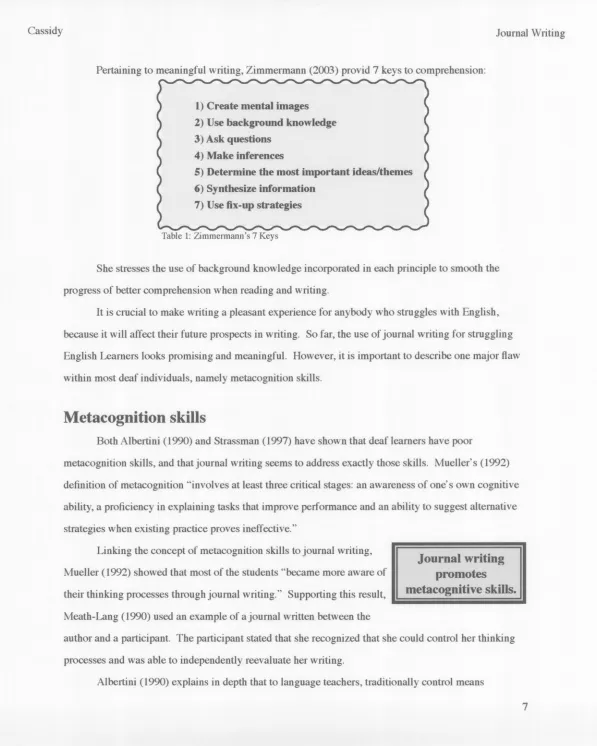
Pertaining to meaningful writing, Zimmermann (2003) provid 7 keys to comprehension:
1) Create mental images
2) Use background knowledge 3) Ask questions
4) Make inferences
S) Determine the most important ideas/themes
6) Synthesize information
[image:11.618.11.608.15.761.2]7) Use fix-up strategies
Table 1: Zimmennann's 7 Keys
She stresses the use of background knowledge incorporated in each principle to smooth the
progress of better comprehension when reading and writing.
It is crucial to make writing a pleasant experience for anybody who struggles with English,
because it will affect their future prospects in writing. So far, the use of journal writing for struggling
English Learners looks promising and meaningful. However, it is important to describe one major flaw
within most deaf individuals, namely metacognition skills.
Metacognition
skills
Both Albertini (1990) and Strassman (1997) have shown that deaf learners have poor
metacognition skills, and that journal writing seems to address exactly those skills. Mueller's (1992)
definition of metacognition "involves at least three critical stages: an awareness of one's own cognitive
ability, a proficiency in explaining tasks that improve performance and an ability to suggest alternative
strategies when existing practice proves ineffective."
Linking the concept of metacognition skills to journal writing,
Mueller (1992) showed that most of the students "became more aware of
their thinking processes through journal writing." Supporting this result,
Meath-Lang (1990) used an example of a journal written between the
author and a participant. The participant stated that she recognized that she could control her thinking
Journal
writing
promotes
metacognitive
skills.
processes and was able to independently reevaluate her writing.
"knowledge and correct use of grammar and vocabulary of that language." Instead of language teachers
branding the concept of "control" in traditional ways, Albertini suggests that educators of the deaf
encourage metacognition control skills through the process of journal writing, where by the students
would naturally develop those skills. Meath-Lang (1990) also emphasizes that through journal writing,
"greater control, complex structuring, and real fluency emerge, all characteristics that some people
assume deaf people and nonnative speakers cannot achieve."
The bottom line of the studies relating to metacognition skills is they all strongly suggest that
journal writing promotes the skill of metacognition because through writing, students will analyze their
work, choose which entries to share, expand and correct their sentences, and successfully bridge their
"raw" entries to formal academic tasks. Doing those activities requires the students to naturally use their
metacognitive skills.
...
So far, the concept of journal writing seems to have no drawbacks. It is not always the case.
Some research has presented several possible problems as well as some solutions for each issue. Three
problematic issues are: sensitivity towards the writer, lack of adequacy in inadequacy of academic skills,
and promotion of egocentricity in the writer.
The issue of teachers' sensitivity towards students is emphasized by Meath-Lang (1990). She
says that teachers must be "ever-ethical and sensitive to the fears evoked in the assignment of personal
writing." She also adds that if the teacher give neutral responses or directly challenges the writer or
even ignores the topic brought up by the student, it could lead to limited topics and restricted writing.
Vanett and Jurich (l990a) bring up some concerns that journal writing does not meet the needs of
the students pertaining to other academic skills. Examples include going to college, performing certain
job responsibilities, and other type of real life situations. Focusing on linking journal writing skills to
academic skills, they offered the point that when journal writing, students develop more confidence and
expertise in other domains that can bridge them to successfully transfer their skills to the academic skills
that scaffold independence skills in the future (Vanett & Jurich, 1990b).
Finally, journal writing has more of a personal aspect~it may make students less aware of
the audience and, therefore, "more egocentric writers" (Vanett & Jurich, 1990a). Vanett & Jurich
For instance, by sharing their work, also known as publication, with other students, students "gain an
understanding of who their audience is and what content is appropriate to share" (Vanett & Jurich,
1990a)
Despite those issues, there seem to be beneficial ways to make journal writing a positive learning
environment for deaf students (and according to Peyton (1990), also for hearing students with English as
a second language).
...
Strassman (1997) and Albertini (1990) explained the lack of metacognition skills within
deaf learners as a source of struggle in English and education in general. Strassman (1997) also
states that the education of the deaf does not emphasize metacognition skills enough. According to
Strassman (1997), Schirmer (2001) expressed her concern that despite the obvious results of improved
metacognition skills through journal writing within deaf education, effective educational methods are
not being put to use. Therefore, the goal of my project is to develop a curriculum focused on journal
writing within deaf education and to have it implemented in schools nationwide that work with deaf
learners. Not only should teachers or professionals be aware of this successful teaching tool, but parents
of deaf children should know about it too. This will be made possible through concise and
parent-friendly articles published through newsletters for members of the deaf community and/or people in the
field of deaf education.
The target population for the development of this curriculum is middle school students who
range from performing at grade level to below grade level in reading and writing. The reason for
choosing this specific level is the problem brought up by Gaustad (2002), who indicated that even with
language growth when it comes to using American Sign Language (ASL) as a first language (Ll) source
to learn English, second language (L2) learning ability seems to plateau at the middle school level. The
length of time for the proposed curriculum is approximately 10 weeks, depending on the type of students
in each class and their levels. Finally, the development of my journal writing curriculum is intended
for deaf learners who are struggling in English~however, it can also apply to hearing English Language
Learners.
The concept of journal writing has been used before, but what is new about the curriculum I
important not to correct the grammar but to use the grammatical errors from journal writing as a raw
material for the development of grammar exercises.
...
Topics and skills facilitated by specific topics
Journal writing can be about anything, but requires guidance; the purpose of journal writing
becomes meaningful, academically and personally, as well as facilitating improvements in writing skills
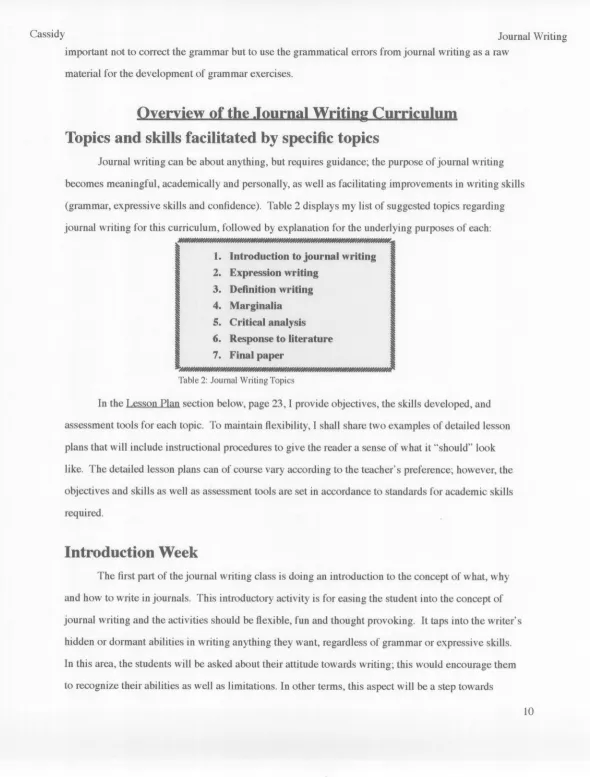
(grammar, expressive skills and confidence). Table 2 displays my list of suggested topics regarding
journal writing for this curriculum, followed by explanation for the underlying purposes of each: ~
1. Introduction to journal writing
2. Expression writing
[image:14.612.10.600.9.786.2]3. Definitionwriting
4. Marginalia
5. Critical analysis
6. Responseto literature
7. Final paper
Table 2: Journal Writing Topics
In the Lesson Plan section below, page 23, I provide objectives, the skills developed, and
assessment tools for each topic. To maintain flexibility, I shall share two examples of detailed lesson
plans that will include instructional procedures to give the reader a sense of what it "should" look
like. The detailed lesson plans can of course vary according to the teacher's preference; however, the
objectives and skills as well as assessment tools are set in accordance to standards for academic skills
required.
Introduction
Week
The first part of the journal writing class is doing an introduction to the concept of what, why
and how to write in journals. This introductory activity is for easing the student into the concept of
journal writing and the activities should be flexible, fun and thought provoking. It taps into the writer's
hidden or dormant abilities in writing anything they want, regardless of grammar or expressive skills.
In this area, the students will be asked about their attitude towards writing; this would encourage them
recognizing their strategies (metacognition skills) when it comes to writing.
Also,this is a warm-up
weekfor the studentsand the teacherto developand establishrapport
Journal Writing
and expectations from each other on communication.
Expression
Writing
Expression writing is a writing activity that varies in many areas. The purpose of including
this skill is for student writers to be aware of the specific audience they are writing to. For this specific
journal writing curriculum, the students have an activity such as creating a letter to a historical figure.
Students are given an opportunity to write from their personal experience and develop the skill of
writing to a specific audience.
Students will be asked to explain their reasons for choosing that particular historical person
and to explain the difference between writing a letter to that specific person and writing to the teacher
Students will also identify their writing tone, style and choice of words when comparing the differences.
This will help the students see that writing skills include conscious knowledge of whom and what they
write for.
Definition Writing
The ability to write expression pieces comfortably scaffolds the students' confidence to the next
level of writing skills, namely and namely definition writing. Definition writing is the skill of defining
a vocabulary word or an idiom/slang. In this project, students will choose a phrase from Shakespeare
to describe in their journal writings. They will be required to provide at least two different explanations
for their chosen phrase. This type of writing fosters the skill of analyzing new phrases using the
students' previous knowledge and linking it to new knowledge. Within this activity, students will learn
the strategy of using previous knowledge to understand challenging phrases and/or vocabulary words,
especially in English, with ease.
Thus far in the curriculum, the students have been learning how to write from their personal
knowledge, learned how to write to specific audiences and given justification for their chosen written
materials. By now, the students have developed a sense of their writing styles and confidence, and
are able to take the bold step into more academically demanding skills. To build a bridge between
analyze. critically think. and respond. The deaf learners. to repeat have weak metacognition skills~
practicing different strategies before actually doing the academically challenging tasks would be
beneficial.
Marginalia
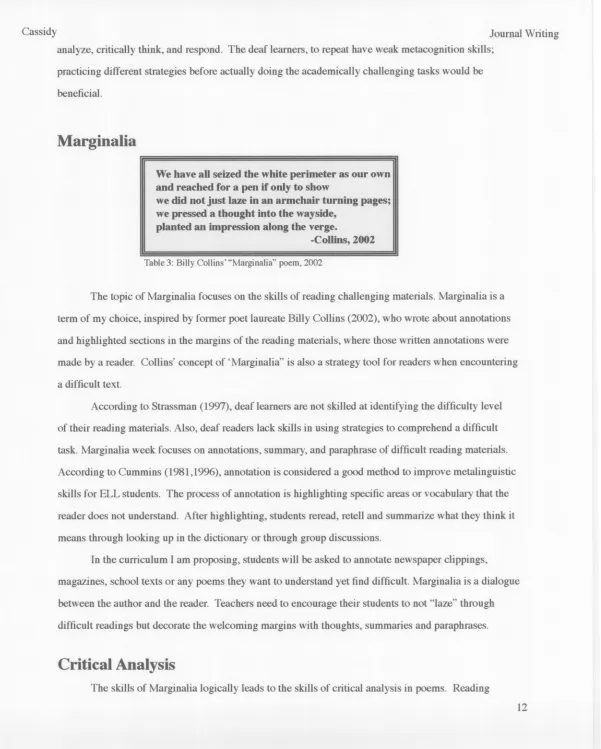
We have aU seized the white perimeter as our own and reached for a pen if only to show
we did not just laze in an armchair turning pages; we pressed a thought into the wayside,
planted an impression along the verge.
[image:16.619.18.620.14.763.2]-Collins, 2002
Table 3: Billy Collins' "Marginalia" poem. 2002
The topic of Marginalia focuses on the skills of reading challenging materials. Marginalia is a
term of my choice. inspired by former poet laureate Billy Collins (2002). who wrote about annotations
and highlighted sections in the margins of the reading materials. where those written annotations were
made by a reader. Collins' concept of 'Marginalia" is also a strategy tool for readers when encountering
a difficult text.
According to Strassman (1997). deaf learners are not skilled at identifying the difficulty level
of their reading materials. Also. deaf readers lack skills in using strategies to comprehend a difficult
task. Marginalia week focuses on annotations. summary. and paraphrase of difficult reading materials.
According to Cummins (1981.1996). annotation is considered a good method to improve metalinguistic
skills for ELL students. The process of annotation is highlighting specific areas or vocabulary that the
reader does not understand. After highlighting. students reread. retell and summarize what they think it
means through looking up in the dictionary or through group discussions.
In the curriculum I am proposing. students will be asked to annotate newspaper clippings.
magazines. school texts or any poems they want to understand yet find difficult. Marginalia is a dialogue
between the author and the reader. Teachers need to encourage their students to not "laze" through
difficult readings but decorate the welcoming margins with thoughts. summaries and paraphrases.
Critical Analysis
poetry requires many skills such as imagery. theme analysis. tone analysis. symbolism. vocabulary. and
connecting one's personal reflection to the poetry. Zimmermann's (2003) 7 principles as shown on page
7 is a good application to this area of focus. The students will not be limited only to the analysis of
printed poetry; they also will analyze a piece of artwork as well as watch a short ASL story. The ASL
aspect of this topic is a good cultural link to their deafness. and the realization that ASL also requires
critical analysis; it also gives the students a sense of pride in their language. According to Herrell (2000).
it is important to have cultural lessons incorporated when acquiring skills of a second language. It
makes it a more meaningful and effective learning experience.
Response to Literature
Students have gone through different lessons. topics and written materials up and are now able
to develop an academic piece that requires less of a journal writing style namely. a response to literature.
In that lesson. students develop an organized essay responding to a reading with specific expectations
such as comparing and contrasting or writing a personal response to the literature. They've already
learned about critical analysis. are aware of their strategy skills when it comes to reading. comprehention
and writing. Using those acquired skills. students will develop their own responses with supporting
explanations.
This area requires students to think not only about what the literature is about but what the
author's purpose is; students must also reflect on their feelings or thoughts when reading that specific
literature.
Final Paper
Throughout the lessons in journal writing. mini-lessons and publication. and other type of
activities. students have probably developed a strong sense of confidence in their tone and writing styles.
In this area of focus. they are to choose a writing skill and develop an essay with one of the topics they
felt most comfortable with. Students will be required to write an essay using the skills of Expression.
Definition. Critical Analysis or Response to Literature and the choice of the skill is up to them. They
will independently pick a topic for their essay either from their already written entries or. even better.
challenging themselves to pick a brand new topic. For more details. read Final Paper in Lesson Plan
Journal Writing
e.e
So far we have discussed the topics and are aware of the magical powers of journal writing; it is
important not to overlook the gnidelines required for this genre. To maintain structure. it is important to
establish certain rules for both teachers and students. Here is what my rules would look like based on
my past experience and my review of the literature.
-ournal Writinr
.
personal experiences t if they write alarmingmu!ht notify somebody
-It unfamiliar vocabulary phrases
.
Igquestions of each otherThe most important rule I would emphasize is to avoid making personal comments to each other.
For instance. teachers shouldn't detail information about their private lives such as domestic issues
or family problems. Teachers can "connect" by saying. "I had a friend like that." and doing so, the
teacher's role remains a "teacher" not as a "best friend." On the other hand. teachers can share personal
anecdotes that would be relevant to the written entries such as funny memories, embarrassing (discreet!)
memories or precious moments.
Secondly, I would emphasize to the students that they can write about their personal experiences;
however, if they write about something that the teacher might find alarming. slhe may have to report
it. Examples include suicide notes or family abuse or sexual comment. This is based on my personal
experience: I had a student who wrote a poem about slashing her wrists, and I felt that I had to notify
the counselors. Luckily for me. I had already informed the students that I would report anything I found
alarming. The student continued writing with me and I challenged her to write positive poems about
nature. This type of skill requires practice and if a teacher wishes to know more about red flags. I would
recommend that they talk with the school counselor.
know. I explain to the students that they can look up words in the dictionary themselves, but they still
have to highlight it because I would be more than happy to explain some more about the words they
had difficulty with. I do this because the idea of stopping to look up a few words can become too time
consuming and disruptive of the reading process; therefore, students would prefer to skip the word
and keep reading. Highlighting without having to look in the dictionary will help students recognize
in the end how many words they did not understand; it would also help the teacher to recognize their
vocabulary difficulties; students can also use this kind of opportunity to learn to find word meaning
from context..
Finally, the rule of thumb for my journal writing is: ask questions. The teacher must ask thought
provoking questions to ensure liveliness in students' learning and thinking processes. Teachers also
should require students to ask questions as well. At first the students may ask trivial and easy questions,
but as the journal writing process proceeds, their level of questioning becomes more profound.
My experience has shown that, at first, journal writing will seem like it isn't getting anywhere
and some of the students probably would do a cheap job at the beginning. As time passes, with
patience, students and teachers will find the whole thing enriching, pleasant, and a very meaningful and
educatonal experience.
...
.
Reading Materials
Week by week, reading materials vary due to specific topics. Sometimes they consist of poetry,
sometimes clippings of newspapers or sections from a magazine and sometimes a short story. One week
will include a visual storytelling activity through watching a video by Sam Supulla, For a decent living
(1994, Dawn Sign Press), for critical analysis. The choice of reading materials is flexible as long as
materials are appropriate for the topics to facilitate specific writing/reading skills.
Writing Workshop
This is where the students are given an opportunity to independently write answers to
questions, to brainstorm as a group, and to evaluate each other's chosen pieces through use of rubrics
and checklists. Also, this is an opportunity for the classroom to become student-centered with some
Journal Writing
Mini-lessons on Grammar and/or Writing Techniques
Throughout the week, mini-lessons will be incorporated on specific grammar exercises through
using worksheets and sometimes, examples provided by the teacher. Teacher may use examples from
students from previous years, concealing their identity, to model revision and allow students to correct
their own errors. The mini-lesson grammar skill of the week will be included in Friday's vocabulary
qUizzes.
NB: grammar is usually an area of discomfort or aversion for deaf students. To encourage ease
when teaching grammar avoid correcting grammar in student's journal entries, it is important to allow
the students to volunteer their written sections to share with the class for grammar revision without the
teacher's requ iring that they do so..
According to Bridges (1997):
Mini-lessons should be what they sound like, short lessons. Whenever
possible and appropriate, I try to demonstrate an instructional point using
student writing or my own. Having students conduct the lesson, showing
some skill they've mastered or some ideas they've discovered can be
particularly effective.
Bridges also emphasizes that she would use student writing only for positive reasons and never
to show mistakes, in order to encourage confidence.
Publication
Students will present a chosen piece they have worked on through peer and self-evaluation
to share with the class. Students are encouraged to present their pieces through a variety of creative
methods such as poster-presentation, film presentation, photography, artwork or American Sign
Language (ASL). Guidelines and rubrics for assessment are shown in the Assessment Tool Section.
Word Wall (Vocabulary skills)
The Word Wall consists of vocabulary words chosen by the students and sometimes the teacher,
and put up on the wall. The words could come from students' journal writing entries or reading
materials that they have highlighted. The words of the week (preferably around 10 words per week)
will be defined through variety of worksheets (see Ap.pendice...Section, Appendices B and C) and then
quizzed on Fridays, alongside with the grammar skill of the week.
Journal Writing
Free Journal Writing Prompts
Free Journal Writing prompts: students are to choose a prompt once a week. There will be three
categories: easy. moderate and challenging. Students choose one of the questions for the week and
answer it any time during the week. Samples of journal writing prompts can be seen in Daily Sparks:
Journal Writinr section. Those Daily Sparks are taken from the Daily Sparks: Journal Writing (Spark
Notes. 2004).
Day 1:
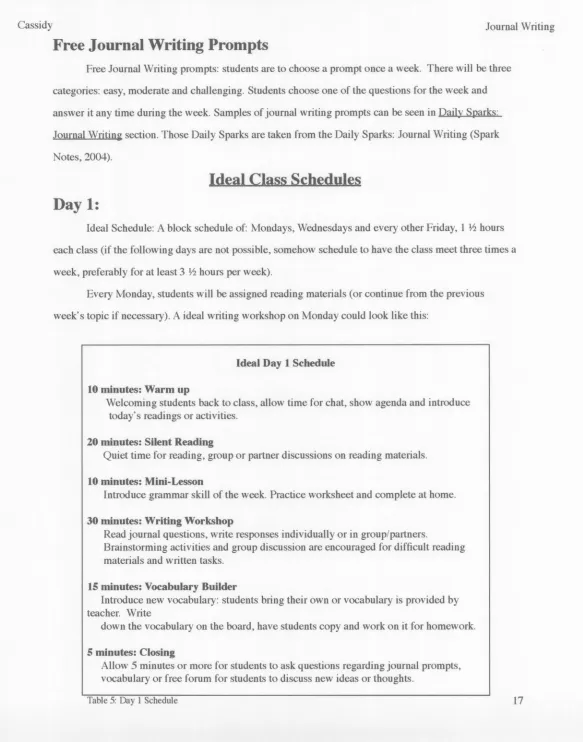
Ideal Schedule: A block schedule of: Mondays. Wednesdays and every other Friday, 1 ~ hours
each class (if the following days are not possible, somehow schedule to have the class meet three times a
week, preferably for at least 3 ~ hours per week).
Every Monday, students will be assigned reading materials (or continue from the previous
week's topic if necessary). A ideal writing workshop on Monday could look like this:
Ideal Day 1 Schedule
10 minutes: Warm up
Welcoming students back to class, allow time for chat, show agenda and introduce today's readings or activities.
20 minutes: Silent Reading
Quiet time for reading, group or partner discussions on reading materials.
10 minutes: Mini-Lesson
Introduce grammar skill of the week. Practice worksheet and complete at home.
30 minutes: Writing Workshop
Read journal questions, write responses individually or in group/partners.
Brainstorming activities and group discussion are encouraged for difficult reading materials and written tasks.
IS minutes: Vocabulary Builder
Introduce new vocabulary: students bring their own or vocabulary is provided by teacher. Write
down the vocabulary on the board, have students copy and work on it for homework.
S minutes: Closing
[image:21.621.24.607.21.763.2]Allow 5 minutes or more for students to ask questions regarding journal prompts, vocabulary or free forum for students to discuss new ideas or thoughts.
Journal Writing
NB: Teacher is to observe, participate and make sure students understand the journal
questions.
The point of Day 1 is to introduce new reading materials and grammar skills to the students.
Also. day 1 is used to allow students to have time to write responses to the journal questions. It is
necessary to give importance to writing not only for homework but also in the classroom. The stress on
writing in the classroom rather than stressing lectures on grammar skills encourages the writer to value
writing.
Day 2:
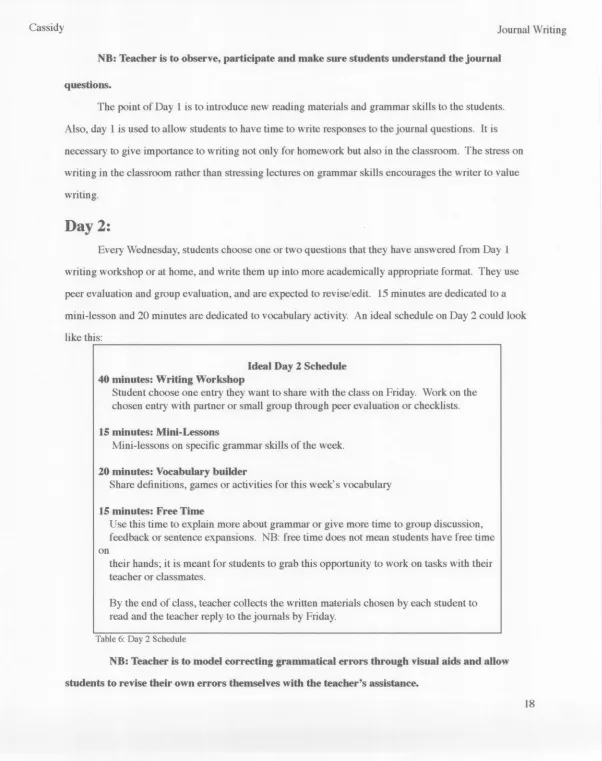
Every Wednesday. students choose one or two questions that they have answered from Day 1
writing workshop or at home. and write them up into more academically appropriate format. They use
peer evaluation and group evaluation. and are expected to revise/edit. 15 minutes are dedicated to a
mini-lesson and 20 minutes are dedicated to vocabulary activity. An ideal schedule on Day 2 could look
like this:
Ideal Day 2 Schedule 40 minutes: Writing Workshop
Student choose one entry they want to share with the class on Friday. Work on the chosen entry with partner or small group through peer evaluation or checklists.
15 minutes: Mini-Lessons
Mini-lessons on specific grammar skills of the week.
20 minutes: Vocabulary builder
Share definitions. games or activities for this week's vocabulary
15 minutes: Free Time
Use this time to explain more about grammar or give more time to group discussion. feedback or sentence expansions. NB: free time does not mean students have free time on
their hands~it is meant for students to grab this opportunity to work on tasks with their teacher or classmates.
[image:22.621.13.615.20.781.2]By the end of class. teacher collects the written materials chosen by each student to read and the teacher reply to the journals by Friday.
Table 6: Day 2 Schedule
NB: Teacher is to model correcting grammatical errors through visual aids and allow
Journal Writing
The point of this day is for students to work on their own entries, to expand and improve their
papers from being too "personal" into more academically acceptable. After choosing and working on
the materials, they will hand their entire journal plus the revised chosen entry to their teacher. The
teacher writes responses to all, and specifically the chosen entry, for the student to read and then publish
it on Friday or Day 3.
Day 3:
Every Friday, students (and teacher) take turns presenting their chosen written piece through ASL
and allow an open forum. An open forum is a time for free questions and/or discussions among students
and teachers regarding the recent publication of a student. Time per student should be limited: if there
are more than 6 students in the classroom (allow appropriately 8 minutes for each if 6 or fewer students).
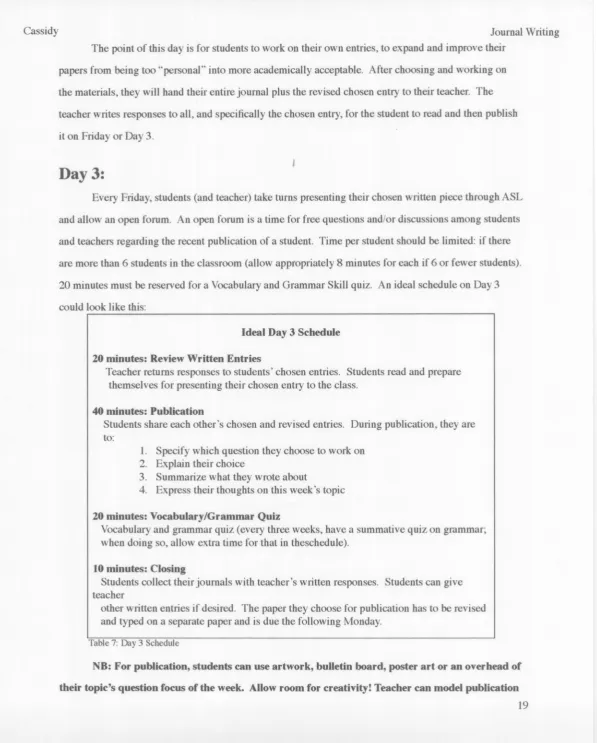
20 minutes must be reserved for a Vocabulary and Grammar Skill quiz. An ideal schedule on Day 3
could look like this:
Ideal Day 3 Schedule
20 minutes: Review Written Entries
Teacher returns responses to students' chosen entries. Students read and prepare themselves for presenting their chosen entry to the class.
40 minutes: Publication
Students share each other's chosen and revised entries. During publication, they are to:
1. Specify which question they choose to work on 2. Explain their choice
3. Summarize what they wrote about
4. Express their thoughts on this week's topic
20 minutes: Vocabulary/Grammar Quiz
Vocabulary and grammar quiz (every three weeks, have a summative quiz on grammar; when doing so, allow extra time for that in theschedule).
10 minutes: Closing
Students collect their journals with teacher's written responses. Students can give teacher
[image:23.619.17.615.14.758.2]other written entries if desired. The paper they choose for publication has to be revised and typed on a separate paper and is due the following Monday.
Table7: Day3 Schedule
NB: For publication, students can use artwork, bulletin board, poster art or an overhead of
their topic's question focus of the week. Allow room for creativity! Teacher can model publication
their topic's question focus of the week. Allow room for creativity! Teacher can model publication
a few times for inspiration.
The point of Day 3 is for the students to transfer their skills of writing into presenting (in ASL).
In doing so, they enrich their written materials from print to discourse, giving them more depth, meaning
and understanding. The point of the students taking home their chosen entries with the teacher's
comments is to expand the entries from personal written pieces into an academically skilled essay
format. They will develop their written paper due to using the "raw" data they invented right from the
start. This skill will foster the students to bravely write essays with confidence and a positive outlook.
Assessment
Assessing students' work accurately requires specific criteria in replying and grading. It is
crucial that the assessment tools match the objectives~that way, one can make sure that the students are
making measurable progress.
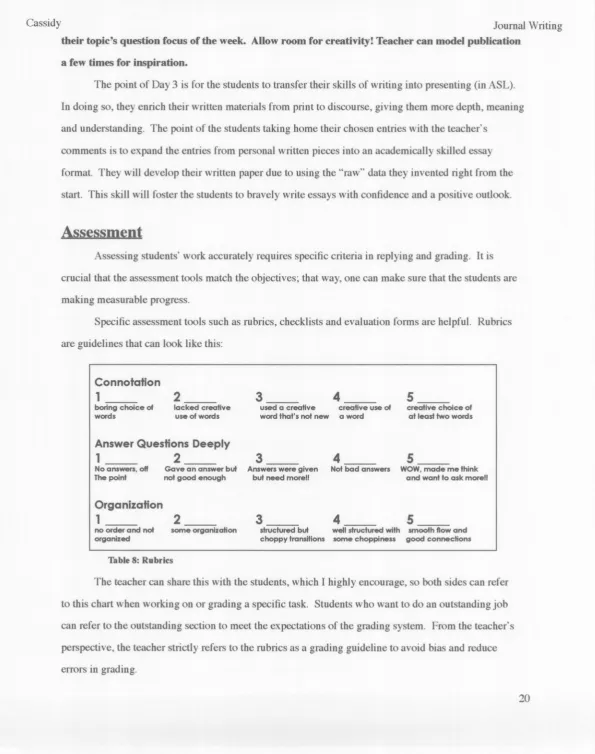
Specific assessment tools such as rubrics, checklists and evaluation forms are helpful. Rubrics
are guidelines that can look like this:
Connotation
1
boring choice of words
2
lacked creative use of words
3
4
used a creative crealive use of word that's not new a word
5
creative choice of at least Iwo words
Answer Questions Deeply
1
2
No a~. off Gave an answer but The point not good enough
3
Answers were given but need morel!
4_
Nof bad answers
5
wow. made me think and want to ask morel!
Organization
1
no order and nof organized
2
some organization
3
4
5
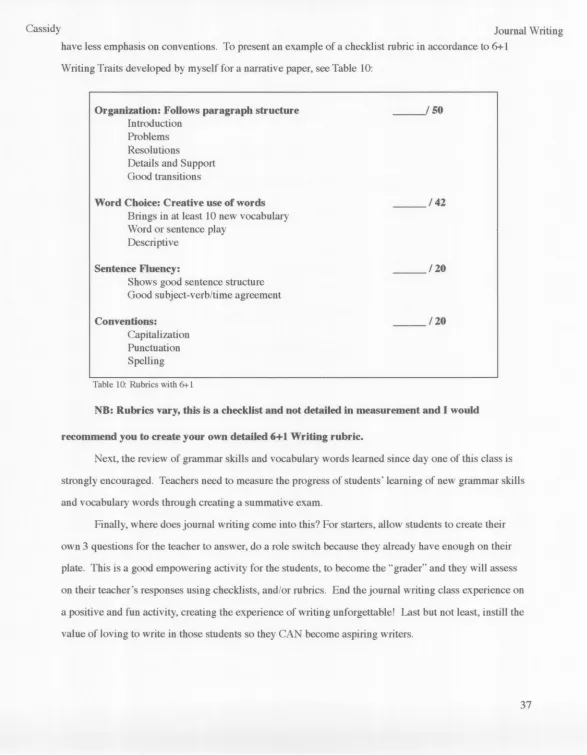
[image:24.619.14.610.22.777.2]structured but well structured with smooth flow and choppy transitions some choppiness good connections
Table 8: Rubrics
The teacher can share this with the students, which I highly encourage, so both sides can refer
to this chart when working on or grading a specific task. Students who want to do an outstanding job
can refer to the outstanding section to meet the expectations of the grading system. From the teacher's
perspective, the teacher strictly refers to the rubrics as a grading guideline to avoid bias and reduce
Journal Writing The checklist is also another guideline for both teachers and students to refer to and is much
easier for students to use in identifying their progress on meeting the requirements or goals. Evaluation
forms are similar in this aspect; however. the evaluation form gives more flexibility for students and
teachers to make comments or feedback. The purpose of the evaluation forms is for the student to
improve their written materials from the comments/feedback. The evaluation form can be filled out by
the teacher or by peers; which I believe the latter option is more meaningful and effective. The use of
peer evaluation also requires practice and guidance.
Based on my personal experience. students initially took the peer evaluation lightly. thinking it
wasn't important. I changed that attitude by announcing that their evaluation of other classmates would
be graded. I emphasized that they had to make comments in the evaluation form and provide examples
to support their comments. This dramatically improved their incentive in giving peer evaluation and
resulted into better-written materials based on each other's opinions!
Finally, it is important to ensure that students make neutral and positive comments and refrain
from making derogatory. insulting. or highly critical comments.
SummaQ:
The curriculum developed in this project's jorunal writing topics as previously addressed not
only improves skills but also interlinks with metacognition skills and writing with ease; it also provides
and a meaningful learning experience for Deaf students. It is fun for students and teachers, as well
as promoting meaningful communicative relationships among students and teachers. Not only is the
relationship between students and students glorified in journal writing, but skills of grammar, coherence
and confidence are also nurtured and fostered in this genre. Finally. journal writing instills skills for deaf
learners to improve their independent reading and writing abilities. helping to give the lie to Strassman's
(1997) study claiming deaf individuals having weak metacognition skills.
Journal writing needn't be limited to Deaf learners. but also, according to Montgomery (200 1). it
can be used for mainstreamed students; according to Peyton (1990). journal writing is an effective tool
for teaching hearing ELL students. Journal writing also should be used for normal students who have
no problem with learning English because it is fun. beneficial and from my perspective. real hands on
writing experience.
It is imperative to be aware that journal writing can become too free without academic skills.
of journal writing such as making it too personal touchy-feely can be avoided by guidance, structured
planning when teaching journal writing, and incorporating grammar mini-lessons when teaching. Also,
journal-writing can be time consuming~therefore, it would be good if journal writing classes were
limited to small numbers: my voice of experience says it will be worth it!
Again, Schirmer (2002) expressed her concern that despite the obvious results of improved
metacognition skills through journal writing within Deaf
education, effective educational methods are not being put
to use. This needs to change~we need to implement the
effective use of journal writing within Deaf education, giving
each deaf individual a chance to become an aspiring writer. This is what I hope for, for my project to
Journal writing in deaf
education is not getting
the attention it deserves.
extend nationwide, creating a national awareness for all writing for English teachers. When it becomes
nationally known, more ideas and more structure guidance could come out of the process. I hope for
this project to be a head start for effective teaching methods combining both writing and reading.
Journal writing doesn't have to be restricted to a classroom~it can be used for mathematics
writing such as problem solving skills, science lab reports, and even physical education where students
reflect on which physical activities they enjoyed and why. Or even better, students could talk about
self-image and progress towards accepting themselves regardless of their appearance. I could continue to
wax eloquent about the many uses of journal writing, but I will leave that to the reader's imagination.
Finally, I return to my main motivation for diving into this project: my personal experience. I
have taught using journal writing methods, but my journal writing teachign experience was unstructured
and I had little guidance. I thought journal writing deserved more than that, hence the development
of this project! I truly believe that with structured guidance for journal writing within classrooms, the
education of the deaf learners, who already are frightened of anything pertaining to English, will soar off
Journal Writing
Lesson Plan
Section
23
--Topic by --Topic lesson plans with objectives, skills and assessment
The topics as previously introduced in this project will each have stated objectives, skills that
are developed, and assessment tools. The lesson plans, including the instructional procedure, vary for
each teacher~therefore, in this project, there will be two samples, and the topics that I have chosen for
detailed lesson plans are: Introduction week and Marginalia. Specific rubrics and/or assessment tools
will be provided for those two samples~however, they can be used as a general idea for other topics. The
remaining topics' instructional procedure is open to the teacher's skilled imagination and preferences.
So now, we begin and dive into the great world of journal writing, enjoy yourselves!
Introduction Week
The goal of this week is for students to warm up to the idea of writing and seeing the difference
between academically appropriate writing materials to journal writing entries. The rules and ideals will
be introduced.
Objectives:
1. Analyze the reader's level of ease in writing and reading
2. Compare and contrast the difference between writing a paper and journal writing
3. Write 150 words essay about personal feelings toward writing through journal writing
4. Do publication of chosen revised entry
Skills:
Grammar: Parts of Speech, Use of nouns
Wrltiag: Reflection, Critical thinking, Free writing, Revision Voeabulary: Adjectives
Publication: Sharing aloud from chosen revised entry
r
---
--
-,Assessment:
Informal
1. Group discussion, participation, partner/peer evaluation forms 2. Highlighted vocabulary words unknown to them
Em:mal
1. Responses to 3 questions that include supportive explanation for their answers; rubrics will be used as an assessment tool (see "Peer Checklist! Evaluation" in Assessment Tool Section, page 39)
2. Publication of chosen entry. 6 minutes long and used visual aids; Student and teacher evaluation forms will be used as grading tool
3. Completed worksheets
4. 150 words essay about personal feelings on journal writing; rubrics will be used as an assessment tool (see "Personal Reflection Rubrics" in
Assessment Tool Section, page 42)
---Journal Writing
Suggestive mini-lessons topics: 1) Identifying parts of speech 2) Use of nouns
Sample of Instructional Procedure from Day 1 to Day 3: Day 1:
30 minutes: Warm up
1. Welcome students to class~introduce the rules and expectations of journal writing. Introduce the Word Wall (which is blank at the moment), explain about mini-lessons and schedules, and pass out blank journals.
2. Show poem by Saul Williams through visual aids: "even my pen man ship
throws thoughts overboard into a black ink sea
and how many thoughts perish before they reach the page?"
3. Ask students to take turns in describing or explaining what the poem means. Encourage them to independently find the author's purpose and theme of that poem. Be sure to ask
dents about words they are unfamiliar w assistance: teacher should be last resort
4. During group discussion, teacher observes and guides students through the poem analysis; have students see that sometimes good thoughts are lost and it is good to write them before they are forgotten.
20 minutes: Writing Workshop
1. Have everyone open their blank journals and explain that they will take part in a "free writing" activity. Rules for free writing are:
1. Write 5 minutes non-stop
2. Do not go back to erase or scribble over errors~leave them alone 3. Say anything that comes to mind after reading the question asked by the
teacher
a. If student doesn't know what to say, write "I don't know what to say" until you do
4. If someone stops writing, a penalty of 30 seconds will increase (which means,
they
have5 minutesto writenon-stopand if someonestops,the time increases
thus, 5 minutes plus 30 more seconds) 5. Have fun!
2. Show the question: "I like/don't like Saul's poem because Allow students to read the question and the time for questions of clarifications do not count for the 5 minutes of writing time.
3. When time is up, have everyone gather together in a circle and ask students to share their written entries. Open forum: group discusses their thoughts and feelings about the free writing activity, about how they think they did on their writing and what they think about journal writing in general.
4. Explain that now is the time for them to start writing in their own journals, answering 3 questions as a weekly basis and that this week will focus mainly on introduction.
30 minutes: Journal Writing
1. Present the journal questions of the week, signed in ASL for clarification if needed. Possible journal questions of the week (choose 3):
1) How do I feel about writing? 2) Do I like writing? Why or why not? 3) How often do I write? Why do I write? 4) What "journal writing" means to me.
5) What am I most curious about (what would I like to learn about)?
2. Students can work independently or in small groups. Allow them to discuss the first few minutes but then encourage them to focus independently when answering questions.
10 minutes: Wrap up
1. Explain that they can finish the questions at home also emphasize that students will choose one of the three questions to work on in Day 2 class activity. The piece they choose to work on will be used for publication on Day 3.
2. Allow some time for students to ask questions for clarification regarding rules, procedures, questions and so forth.
Day 2:
40 minutes: Writing Workshop
1. Students choose one entry they want to share with (or present to) the class on Day 3.
2. Students partner up with classmates or split into smaller group (those who choose question # 2 group together while those who choose # 1 get together).
3. Have students discuss together about their chosen entry, including why they picked that specific entry and what they liked about it. Also have them discuss what they didn't like about the other questions.
4. Within that group discussion, swap papers and allow students read each other's papers. Evaluate papers through peer evaluation form with guidance of teacher explaining how to use it through the whiteboard and/or visual aids.
15 minutes: Mini-Lessons
1. Offer a written entry on the board, have students identify parts of speech~underline the verbs, circle the nouns, double underline the adjectives.
2. Show students a paragraph of any selected text. Have them identify nouns by circling them. Show students a chart on specific nouns: show them the first few answers from the "Nouns: General, Specific, and More Specific" worksheet. Model thinking process on the first and second part of the chart. Discuss with students about how it is/isn't specific. 3. List the nouns and ask students to reocgnize if the nouns were specific (described clearly)
or if it was general. Students take turn in identifying as a group.
4. Hand out developed worksheet relating to this mini-lesson subject and allow free time for students to work on worksheets independently or in small groups. If incomplete by 15 minutes, do for homework.
20 minutes: Vocabulary Builder
1. Since this is the first week, teacher will give 15 new words (preferably adjectives) and students can choose their favorite ten. Have them copy the words into their journal.
2. Pass out graphic organizers, ask student to pick a word from the list they want to focus on, it will be shared on Day 3.
Journal Writing ASL if needed, but encourage them to try themselves first.
4. Explain that usually this activity happens on Day 1 but since this is introduction week, they will not have any quiz on Day 3~however, the words will be on the final exam.
15 minutes: Free time
1. Use this time to explain more about grammar or give more time to group discussion, feedback or sentence expansion. NB: free time does not mean students have free time on their hands~it is meant for students to grab this opportunity to work on tasks with their teacher or classmates.
2. By the end of class, teacher collects the written materials chosen by the students, as well as the journals~read and reply by Day 3.
D~y 3:
15 minutes: Review Written Entries
1. Teacher return a responses to students' chosen entry. 2. Students read and prepare for publication.
40 minutes: Publication
1. Students share each other's chosen and revised entries through visual aids, presentation in ASL. During publication, they are to:
1. Name which question they chose to work on 2. Explain their choice
3. Summarize what they wrote about
4. Express their thoughts on this week's topic
2. After each publication, allow an open forum where students comment, share feedback, make suggestions and discuss any leading questions if any.
10 minutes: Vocabulary Builder
1. Have a short vocabulary activity called, "Beach Fun!" Which consists of a real beach ball on each color of which is a specific request. For example, the white part asks for the definition, the red part asks for a sentence with the definition, the green part asks for a synonym, and the blue part would ask for an antonym. Students take turns tossing the ball to each other and when their hand lands on a specific color, teacher shows them the word and they have to answer in accordance to the specific color. If a student makes a mistake, they have to toss the ball to another student volunteering (hopefully).
2. This game may need practice, the teacher mustn't despair if students don't do well or get a little bit out of control. If they go out of control, resort to the boring part where things points at student to define or elaborate the chosen words. This takes practice!
15 minutes: Mini-lesson review
1. Introduce the concept of Abstract Nouns using any developed worksheet regarding this topic. 2.. Allow students to volunteer in finding answers, discussion and leave the remaining 5 minutes
for students to work independently. Complete worksheet at home if needed.
10 minutes: Closing
1. Students collect their journals with teacher's written response. Students can give teacher other written entries if desired.
2. The paper the students choose for publication, which already has teacher's comments
Journal Writing
Expression
Writing
The goal of expression writing is for students to recognize and choose a specific audience when
writing. This is a skill that requires students to identify specific tone and style when writing for a
specific audience.
Objectives Students wUlbe able to:
1. Write for a specific audience with appropriate tone and style 2. Explain their choice of famous person to write to
3. Add or remove characteristics of the famous person for specific reasons 4. Identify the use of pronouns
5. Recognize forms of adjectives and adverbs 6. Do publication of chosen revised entry
SkiDs:
Grammar: Pronouns, Adjectives, Adverbs
WrltiDg: Specific tone and style to specific audience Vocabulary: Using context clues
Publication: Sharing aloud from chosen entry
I Assessment: Informal
I. Group discussion, participation, partner/peer evaluation forms 2. Highlighted vocabulary words unknown to them
fm:InID.
I. Responses to 3 questions that include supportive explanation for their answers
2. Written letter to specific famous person in accordance to checklist (see "Specific Audience Checklist" in Assessment Tool Section. page 43. 3. Completed worksheets
4. Publication of chosen entry, 6 minutes long and used visual aids; Student and teacher evaluation forms will be used as grading tool
5. Vocabulary and Grammar quiz
Suggestive miDI-lessons: 1) Use of Pronouns
2) Identifying Adjectives and uses it 3) Recognizes adverbs
.Journal Ouestions:
1) Why did you choose that person? How did you know about the person you choose?
2) How well do you know about that person? Did you feel like you needed to explore more about that person before writing a letter?
3) If you could be that person in the future, what characteristics would you add or remove to be a better person than the one you wrote to. Why'!
Sample Journal Writing Instruction/Questions of the week:
"Dear famous person..."
Definition Writing
JournalWriting
The goal of this topic is for the student to choose and define a phrase. Not only the definition is
required. but students also are to make personal connection between the definition and themselves.
Objectives (or tasks for students):
1. Definea phrasefrom Shakespeareinto theirown words
2. Compose 150 word essay on personal experience relating to phrase 3. Identify simple predicate and linking verbs
4. Publication of chosen revised entry
Skills:
Reading: Comprehension, Inference, Evaluation Grammar: Simple Predicate, Linking verbs WritfDg: Definition of phrase, Explanation of choice Vocabulary: Using context clues
PabUcatlon: Sharing aloud from chosen entry, discussion
Assessment:
-Informal1. Group discussion, participation, partner/peer evaluation forms 2. Highlighted vocabulary words unknown to them
Emma!
1. Responses to 3 questions that include supportive explanation for their answers
2. 150 words essay on personal experience relating to chosen phrase in accordance to a developed rubric
3. Publication of chosen entry, 6 minutes long and used visual aids; Student and teacher evaluation forms will be used as grading tool
4. Completed worksheets 5. Vocabulary and Grammar quiz
Suggestive miDI-lessons: 1) Simple Predicate 2) Linking verbs
Journal Ouestions:
1) Why did you pick that phrase? Was it easy or hard to describe?
2) Did you use that phrase before'! Or is it the first time you've seen it?
3) How did the phrase you choose relates to your life experience'!
Sample Journal Writing Instruction! Questions of the week:
The Common Shakespeare
Shakespeare had an enormous working vocabulary~he used about 29.000 different words in his plays and poems. (Most people today have working vocabularies of only around 9.000 words!) Many people think of Shakespeare's language as difficult to understand. but he invented many words and phrases that we use nearly everyday.
Below are some common phrases from Shakespearean plays. Choose one phrase and explain what you think it means.
Apple of her eye All the world's a stage To thine own self be true
Good riddance Green-eyed monster Tower of strength
Marginalia
The goal of this area is for the students to develop studying strategies, inference and paraphrasing
skills when reading difficult texts. This area also strongly promotes the skill of metacognition, where
students practice studying skills or strategies when it comes to reading difficult texts.
Objectives: 1. 2. 3. 4.
Paraphrase, retell and/or summarize difficult texts through annotation Identify reading strategy approaches when encountering difficult texts Do sentence expansion from their own written materials
Do publication of chosen revised entry
Skills developed:
Reading: Comprehension, Inferring, Making critical judgments, Drawing conclusions, Highlighting key points, Evaluating
Grammar: Revision, Rewrite, Sentence Expansion Writiag: Paraphrasing, Retelling, Summary
Vocabulary: Using context clues, Synonym, Antonym PubDcadou: Sharing aloud from chosen entry, discussion
I
:Assessment: Informal
1. Group discussion, participation, partner/peer evaluation forms 2. Highlighted vocabulary words unknown to them
3. Margins filled with key words, summarization, paraphrases BmnaI.
1. Responses to 3 questions that include supportive explanation for their answers
2. Written summary of chosen reading materials, written into their own words; accurately summarizes it; see rubric "Marginalia Rubrics" in Assessment Tool Section. page 44.
3. Publication of chosen entry, 6 minutes long and used visual aids; Student and teacher evaluation forms will be used as grading tool
4. Vocabulary and Grammar quiz
--~uggesdve mini-lessons:
I) Choose the Synonym and the Antonym for several vocabularies to improve connotation 3) Revision, Rewrite, Sentence Expansion
Sample of Instructional Procedure from Day 1 to Day 3:
D~y 1:
10 minutes: Warm up
1. Welcome students to class~show them reading materials spread out on desk: newspaper clippings, science textbooks, history textbooks, et cetera.
2. Point out that they do not need to understand the selected texts right away but that it will be this week's goal to do so. Have them choose two different type of reading materials.
15 minutes: Silent Reading
1. Students read the selected pages/newspaper clippings and summarize what they read.
20 minutes: Writing Workshop
1. Teacher sh