See discussions, stats, and author profiles for this publication at: https://www.researchgate.net/publication/304010645
Building Professional Learning Identities:
Beginning Teachers’ Perceptions of Causality
for Professional Highs and...
Chapter · January 2016
DOI: 10.1007/978-981-10-0785-9_14
CITATIONS
0
READS
59
2 authors:
Some of the authors of this publication are also working on these related projects:
Continuum of Educational Support for High Schools (Year 7-10) - ACT DirectorateView project
Working in partnership to provide evidence of impact in teacher educationView project Ellen Larsen
Griffith University
3PUBLICATIONS 1CITATION
SEE PROFILE
Jeanne Allen
Griffith University
33PUBLICATIONS 188CITATIONS
SEE PROFILE
All content following this page was uploaded by Jeanne Allen on 23 June 2016.
1
Beginning teacher perceptions of causality for their professional
highs and lows during their first year of teaching
Ellen Larsen and Jeanne M. Allen
Abstract The transition from pre-service to beginning teaching has been well documented
as complex and challenging, with novice teachers shown to experience a number of professional highs and lows as they progress through their first year of teaching. As they reflect on their early experiences, beginning teachers establish perceptions of causality that influence their sense of professional agency, self-efficacy and motivation. This type of attributional thinking can have a strong impact on their ongoing development as teachers. In this chapter, which reports on the first phase of a larger mixed methods study, we discuss the influence of attributional thinking on the development of beginning teachers’ professional learning identities. The use of an online survey, which drew from a sample of 57 beginning teachers working in independent schools across Queensland, sought to identify the ways in which participants attributed causality (that is, why things happened the way they did) for their professional highs and lows during their first year of teaching. The study found that, when attributing causality for success, participants were most likely to identify their own practice as an enduring cause for this and similar future successes. They were also likely to attribute the cause of events perceived as unsuccessful to their own practice. Notably, this study found that beginning teachers apportioned high shared levels of control of causes for both successful and unsuccessful events with others in their working contexts, such as their colleagues and mentors. This study raises significant questions as to how attributional thinking, engaged during reflective practice, impacts the development of the professional learning identities of beginning teachers.
1.
Background Context
It has been well documented that beginning teachers can experience “reality shock” upon entering the teaching profession (Keogh, Garvis, Pendergast, & Diamond, 2012). According to Devos, Dupriez and Paquay (2012, p. 206), “beginning teachers enter a new world,
2
demonstrate a commitment to structured support for beginning teachers in their transition to full professional performance and, in doing so, build and sustain a culture of professional responsibility” (2014, p. 38).
The provision of support in this context requires an understanding of both the
professional learning needs of the beginning teacher (Lovett & Cameron, 2011), and also of the ways in which the beginning teacher develops an identity with a propensity to engage as a professional learner (Walkington, 2005). Self-efficacy (Devos et al., 2012), motivation, resilience (Doney, 2013) and a positive attribution style (Fineburg, 2010) have all been linked to beginning teachers’ ability to cope with the early challenges of teaching. A study of
novice coaches by Larsen and Allen (2014) also found that those coaches who displayed evidence of a strong professional learning identity were able to remain positive in the face of significant challenges. Little is known, however, about what motivates beginning teachers to prioritise professional learning in the development of their teacher identities.
In response to research acknowledging that professional learning is key to teacher retention and success, the “teacher as professional learner” has emerged as significant in educational policy (Australian Institute of Teaching and School Leadership (AITSL), 2011, 2012). The implementation of The Australian Professional Standards for Teachers (AITSL, 2011) has established professional learning as an expectation for all teachers through, for example, structured induction programs. According to Phillips (2008), effective engagement in professional learning also requires a sense of responsibility for that learning. There is a need, therefore, for us to understand how teachers entering the profession develop positive professional learning identities. The work reported on in this chapter goes some way to addressing this need.
2.
Research Aim
The aim of the research reported on below is to develop an understanding of the ways in which beginning teachers interact within their working contexts to develop their identity as professional learners during their first year of professional practice. For the purposes of this chapter, data analysis and interpretation from the first phase of the study, conducted through an online survey in 2015, will be presented and discussed. In doing so, we respond the following research question:
How do beginning teachers attribute causality for the successful and unsuccessful1 events that they experience in their first year of teaching?
The findings from this study raise important considerations in relation to how such
attributions impact the development of beginning teachers’ beliefs, values and identities as professional learners. This chapter will acknowledge these considerations as study findings are discussed.
1
We are not suggesting a polarity between “successful” and “unsuccessful” here. Rather, participants reported a range of experiences across this spectrum. The terms “successful” and “unsuccessful” were used by
3
3.
Literature
We begin this review by discussing current national and international literature about the development of teacher identity, which provides an overarching conceptual framework to this research. We then provide a brief overview of how the literature portrays the professional identity development of the beginning teacher, and the ways in which teacher identity has been shown to be impacted by professional learning. The final part of the review focuses on the process of reflection on and for action—and its relevance to professional learning identity development.
Teacher identity has been an area of increasing focus for some time (Beauchamp & Thomas, 2011; Day, Kington, Stobart, & Sammons, 2006; Gee, 1999). It stems from an individual’s sense of personal identity, which has been described as the set of beliefs and values that one holds about oneself that exist behind one’s “situated identities” (Bullough, 2005) that are specific to the particular roles or contexts in which an individual participates. Referred to as both teacher identity (Flores & Day, 2006) and professional identity (Cohen, 2010), both terminologies refer to the teacher’s understanding of what an effective teacher is, and their own beliefs and values about the teacher they want to become (Thomas &
Beauchamp, 2007).
Identity research has demonstrated that teachers not only perform a functional role, but also develop an identity reflecting their understandings and inclinations as a teacher practitioner (Beauchamp & Thomas, 2011; Beijaard, Meijer, & Verloop, 2004; Flores & Day, 2006). The seminal work of Lortie (1975) demonstrated that beginning teachers come to teaching with a set of values and beliefs that impact the ways in which they understand their multiple professional responsibilities informed by their experiences as school students, through a process of anticipatory socialisation. This process of occupational socialisation is then further influenced during pre-service professional experience activities (see, e.g., Allen, 2006), and, as the pre-service teacher transitions to practising teacher, through immersion in the institutional environment (Allen, 2006) and through interaction with colleagues (Cook, 2009). Beginning teachers modify their early understandings and beliefs about teaching as they experience the realities and demands of their new role. According to Day et al. (2006), this is an intense time of identity work when new teachers often question current beliefs and values, and reshape their identities as they reflect on the highs and lows of their experiences in the workplace.
According to Hammerness et al. (2005, p. 383), “developing a professional identity is an important part of securing teachers’ commitment to their work and adherence to values and norms of practice.” The impact of beginning teachers aligning their practice and beliefs to “adjust to the requirements of the conditions of the workplace” (Hargreaves, 1995, p. 80) has been debated within the research. However, teachers are expected as a norm of practice, in Australia and elsewhere, to engage in ongoing professional learning (AITSL, 2011; United Kingdom Department of Education, 2011). It is therefore essential that beginning teachers value and prioritise professional learning as a responsibility of their work.
Researchers agree that such professional learning comprises of more than
4
the formation and mediation of teacher professional identity.” This view represents a shift in attention away from teacher behaviour and towards teacher thinking and reflection (Zuljan, Zuljan, & Pavlin, 2011). From this perspective, engagement in professional learning “promotes the teacher as a flexible, lifelong learner, able to participate in ongoing change” (Walkington, 2005, p. 54). The emphasis is on both the development of knowledge for improved practice, as well as the growth of a professional learning mindset.
Key to the development of such a mindset is a focus on reflective practice Teachers who engage reflectively can develop the capacity to identify areas for improved practice (Liu & Zhang, 2014). Researchers agree that reflective practice has transformative potential through the “thoughtful, systematic, critical exploration of the complexity of one’s own learning and teaching practice (Samaras & Freese, 2006). Therefore, within the context of this study, reflection can be seen as thinking about, and moving forward from, the highs and lows of teaching.
However, while reflective practice has been clearly identified as a critical factor in teacher professional learning, it continues to be represented in myriad ways (Liu & Zhang, 2014; Toom, Husu, & Patrikainen, 2015). Seminal works by Dewey (1933) and Schön (1983) occupy a prominent position in the literature on reflective practice, albeit from different theoretical perspectives. While Dewey (1933) supports a retrospective approach to reflection through a sequenced and logical practice known as reflection on action, Schön (1983) is critical of such a technicist approach, and places value on the tacit and experiential knowledge of the teacher to respond flexibly and spontaneously to experiences as they happen through reflection in action.
Reflection on action provides the beginning teacher with the opportunity to make sense of their professional experiences that can be “complex, unpredictable and often
challenging” (Jones & Jones, 2013, p. 74). For the beginning teacher, tacit understandings of teaching (Herbert, 2015) and past teaching experiences, upon which to draw while reflecting in action, are obviously more limited (McIntyre, 1993). Reflection on action provides a retrospective opportunity for beginning teachers to make meaning about “themselves as persons and as teachers, events they encounter and the contexts in which their experiences occur” (Toom et al., 2015, p. 322).
While reflective practice of the type proposed by Dewey (1933) is important to understanding past events, Eruat (1995) argues the need for a model of reflection for action that requires beginning teachers to consider future actions and development (Urzua &
5
4. Theoretical Framework
Our adoption of Weiner’s theory of attribution (Weiner, 1972, 1985, 1986) provides an effective frame within which to examine the thinking that facilitates professional learning. Attribution theory explains the process and consequences of seeking a determination of causality following a particular event perceived by an individual as having either a successful or unsuccessful outcome. According to Weiner (1985, 1986), individuals have an innate tendency to seek causality to explain the causes for events that occur in their lives,
particularly when such events are novel, unexpected or negative (Perry, Daniels, & Haynes, 2008). The attribution process is therefore highly pertinent to the beginning teacher
undergoing a significant transition into an unfamiliar context (Boyer, 2006). Furthermore, attributional processing subsequently influences the behaviour of the individual within that social context (Weiner, 1995).
4.1 Dimensions of causality
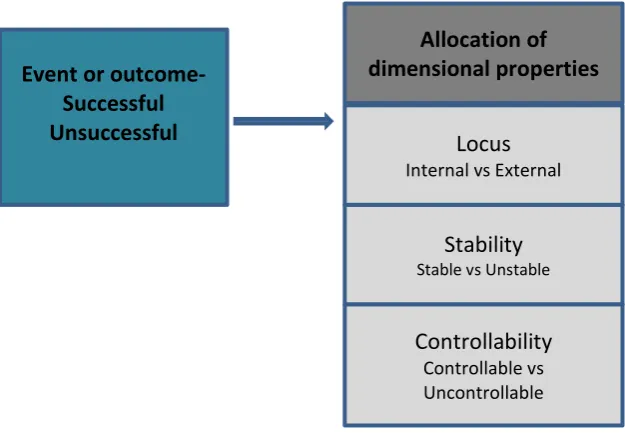
[image:6.595.72.385.384.604.2]Weiner (1972, 1985, 1986) proposes that individuals allocate causality across three dimensions of locus, stability and controllability. The properties for each dimension (see Figure 1) are considered as individuals reflect, and determine causality.
Figure 1 Dimensions of causality
Locus of causality: In allocating the locus of causality, an individual seeks to ascertain the
source of responsibility for an event outcome as either internal or external to their own self. A locus of causality that is internal includes personal ability and effort. External loci of causality include (a) the abilities or decisions of others, and (b) the context in which the event took place.
Stability: Stability refers to the individual’s perception of the changeability of the attributed cause in the future. On one hand, a highly stable cause would be deemed to be fixed, and
Event or outcome- Successful Unsuccessful
Allocation of dimensional properties
Locus Internal vs External
Stability
Stable vs Unstable
6
unlikely to change in the future. On the other hand, an unstable cause would indicate a possibility for change across time.
Controllability: Weiner (2010) defines controllability as the perception of influence over the cause of an event. High controllability refers to a high degree of perceived influence over either an internal or external cause. McAuley, Duncan and Russell (1992) found that greater reliability of attributional measurement occurs when both personal and external perceptions of control are included.
4.2 Attributional Responses
Significantly, dimensional attributions for the cause of an event outcome impact an
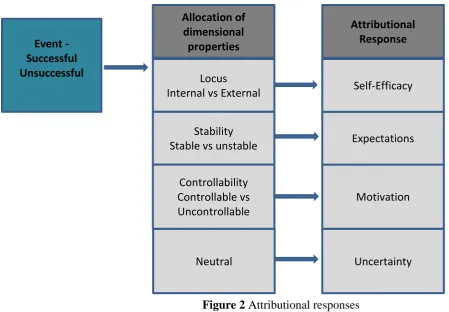
individual’s subsequent actions, motivations, and emotional responses (Weiner, 1986), as we explain below. These actions and responses have been linked by Weiner to self-efficacy, expectations for the future and the motivation of the attributing individual (see Figure 2).
Attributions for locus of causality have been closely linked to self-efficacy (Weiner, 2010). When attributing a successful outcome internally, the individual is likely to
experience a sense of pride and self-efficacy. Conversely, external attributions for successful outcomes may lower the individual’s sense of self-efficacy due to feelings of failure
(Bandura, 1989). Where causality for an unsuccessful outcome is determined to be external, self-efficacy can be preserved (Coleman, 2013). In contrast, self-attribution for an
unsuccessful outcome can lead to feelings of guilt and lowered self-efficacy.
Stability gives rise to expectancy shifts for future achievements and is a powerful determinant of perceived hope for success, while controllability creates a perception of influence over the cause. There is a strong link between controllability and Bandura’s (1989, 2001, 2006) work on human agency. A high sense of agency leads the individual to perceive that they have the ability to influence factors impacting their success. In contrast, a low sense of agency elicits the perception that circumstances are controlled by others, which can impact negatively on the motivation to act.
Martinez, Martinko and Ferris (2012, p. 17) introduced the concept of “fuzzy attribution style.” Whereas the attributions above indicate a “crisp set” of attributional decisions by the individual, a fuzzy attribution results from an uncertainty, or an
7
Figure 2 Attributional responses
As alluded to above, this chapter focuses on the attributions of causality across these dimensions, reported by a sample of beginning teachers in response to their perceived successful and unsuccessful experiences during their first year of teaching.
5. Methodology
This is the first phase of a larger sequential mixed methods study (Creswell & Clark, 2011), involving the online collection of survey data in 2015 following ethical clearance from the University’s Human Research Ethics Committee. Fifty-seven first-year teachers working in independent schools in Queensland completed the online survey consisting of an adaptation of the Causal Dimension Scale II (CDSII) (McAuley, Duncan, & Russell, 1992), designed to measure participants’ attributions of causality for events in which they were involved in their first year of teaching. With a return rate of 30.6 percent from a possible sample of 186 beginning teachers, demographic data indicated that there was representation of independent school contexts across geographic location, school size and year level (Prep to Year 12).
6. Data Analysis
To remain within the scope of this chapter, two of the four sections of the survey data have been selected for presentation here. These include open responses providing participants’ reported experiences and associated perceptions of causality, and quantitative data from a bi-polar scale providing detailed attributions across the dimensions pertaining to each cause. Analysis firstly involved the coding of attributed causes for the event outcomes. Each cause was coded using key words, and iterative coding led to the development of categories (Miles,
Event - Successful Unsuccessful
Allocation of dimensional properties
Locus
Internal vs External
Stability Stable vs unstable
Controllability Controllable vs Uncontrollable
Attributional Response
Motivation Expectations
Self-Efficacy
8
Huberman, & Saldana, 2014). Frequency counts and percentages were calculated for each category to ascertain the prevalence of causes identified by this first-year teacher sample.
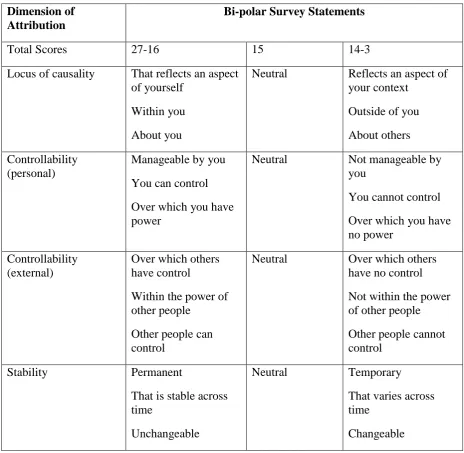
Total scores were then calculated for each causal dimension (locus, controllability and stability) attributed to each cause (see Table 1). The higher the total score, the higher the personal responsibility (internal), perception of both personal and external control, and perceived stability of the cause; the lower the score, the lower the sense of personal
responsibility (external), personal and external control and stability of the cause. A score of 15 was considered neutral.
Dimension of Attribution
Bi-polar Survey Statements
Total Scores 27-16 15 14-3
Locus of causality That reflects an aspect of yourself
Within you
About you
Neutral Reflects an aspect of your context
Outside of you
About others
Controllability (personal)
Manageable by you
You can control
Over which you have power
Neutral Not manageable by
you
You cannot control
Over which you have no power
Controllability (external)
Over which others have control
Within the power of other people
Other people can control
Neutral Over which others
have no control
Not within the power of other people
Other people cannot control
Stability Permanent
That is stable across time
Unchangeable
Neutral Temporary
That varies across time
[image:9.595.65.530.220.673.2]Changeable
Table 1 Total scores for the Causal Dimension Scale II (adapted from McAuley, Duncan, &
9
7. Findings
We present our findings in four parts: (1) Causes2 of successful outcomes; (2) Causes of unsuccessful outcomes; (3) Dimensional attributions for successful causes; and (4) Dimensional attributions for unsuccessful causes.
7.1 Causes of Successful Outcomes
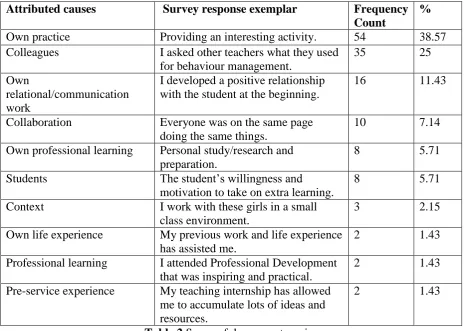
Ten cause categories for success were established. Of these categories, participants were most likely to attribute success internally to their own practice. In total, participants attributed causality internally in 57.14 percent of survey responses. While there was a propensity for these beginning teachers to attribute internally, external causes were also represented, with support from colleagues accounting for the majority of external attributions. Table 2 includes the attributed causes, an exemplar survey response and the frequency count. Other external causes were also acknowledged, such as collaboration, students, contextual conditions, professional learning and pre-service experiences to lesser extents (see Figure 3).
Attributed causes Survey response exemplar Frequency
Count
%
Own practice Providing an interesting activity. 54 38.57
Colleagues I asked other teachers what they used
for behaviour management.
35 25
Own
relational/communication work
I developed a positive relationship with the student at the beginning.
16 11.43
Collaboration Everyone was on the same page
doing the same things.
10 7.14
Own professional learning Personal study/research and preparation.
8 5.71
Students The student’s willingness and
motivation to take on extra learning.
8 5.71
Context I work with these girls in a small
class environment.
3 2.15
Own life experience My previous work and life experience has assisted me.
2 1.43
Professional learning I attended Professional Development that was inspiring and practical.
2 1.43
Pre-service experience My teaching internship has allowed me to accumulate lots of ideas and resources.
[image:10.595.66.534.337.668.2]2 1.43
Table 2 Successful cause categories
2 As previously noted, this is a perceptual study and, therefore, these are participants’ reported perceptions of
10
Figure 3 Successful cause distributions
7.2 Causes of Unsuccessful Outcomes
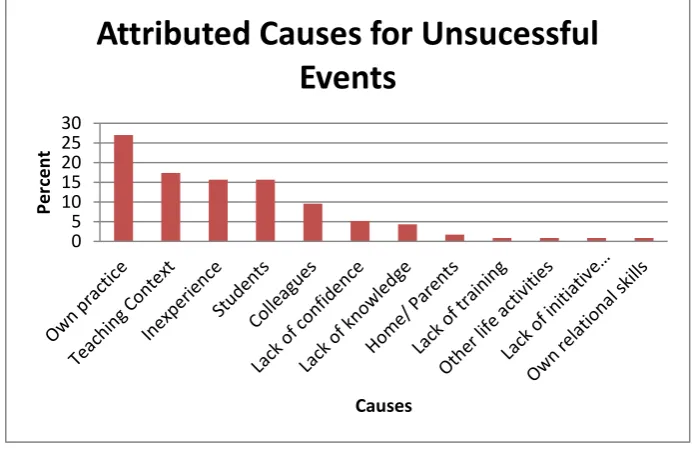
Similarly, participants were most likely to attribute causality for unsuccessful outcomes to their own practice (see Figure 4).
Figure 4 Unsuccessful cause distributions
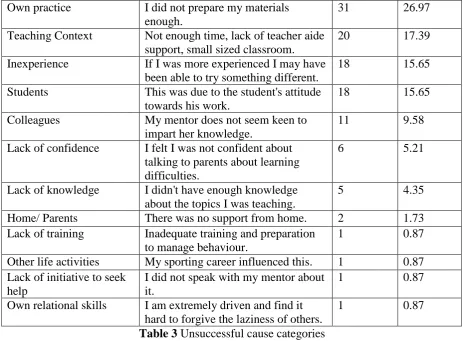
Internal categories, which included inexperience, a lack of confidence and knowledge, lack of professional learning initiative and relational skills, totalled 53.92 percent of
responses (see Table 3). Notably, causes pertaining to external causes such as teaching context, students, colleagues, parents and the home, lack of training and other life activities combined to yield 46.09 percent of responses.
Attributed causes Survey response exemplar Frequency
Count
%
0 10 20 30 40 50
Pe
rc
e
t
Causes
Attributed Causes for Sucessful
Events
0 5 10 15 20 25 30
Per
ce
n
t
Causes
[image:11.595.123.473.388.615.2]11
Own practice I did not prepare my materials enough.
31 26.97
Teaching Context Not enough time, lack of teacher aide support, small sized classroom.
20 17.39
Inexperience If I was more experienced I may have been able to try something different.
18 15.65
Students This was due to the student's attitude towards his work.
18 15.65
Colleagues My mentor does not seem keen to
impart her knowledge.
11 9.58
Lack of confidence I felt I was not confident about talking to parents about learning difficulties.
6 5.21
Lack of knowledge I didn't have enough knowledge about the topics I was teaching.
5 4.35
Home/ Parents There was no support from home. 2 1.73
Lack of training Inadequate training and preparation to manage behaviour.
1 0.87
Other life activities My sporting career influenced this. 1 0.87 Lack of initiative to seek
help
I did not speak with my mentor about it.
1 0.87
Own relational skills I am extremely driven and find it hard to forgive the laziness of others.
[image:12.595.65.529.72.413.2]1 0.87
Table 3 Unsuccessful cause categories
7.3 Dimensional Attributions for Successful Causes
Attribution sets for each cause were developed combining dimensions of locus of causality and stability. Our data analysis generated five types of personal and external attributions for successful experiences (see Table 4). Two types of personal or internal attributions featured, with the first illustrating a perception of high stability and the second attributing low stability. These two attribution types were categorised as “Personal 1” and “Personal 2” consecutively. Similarly, two external attribution types were developed with the first featuring attributions of high stability, and the second, low stability. We labelled these types “External 1” and “External 2.” The last attribution type included attribution sets where locus of causality was perceived as neutral, and was thus categorised as “Neutral.”
Attribution Set (L Locus, S Stability)
Attribution Type and Description
Frequency Count Percent
L internal S high
Personal 1
I can always achieve success
46 44.66
L Internal S low
Personal 2 This success was mine, but may not continue
22 21.34
12
S high They can always
achieve success L 13 external
S 9 low
External 2
This success was not mine and may not continue
10 9.71
L Neutral S Neutral
Neutral
I am not sure who is responsible for this success
[image:13.595.68.531.72.213.2]15 14.56
Table 4 Attribution sets (locus of causality and stability) for successful events
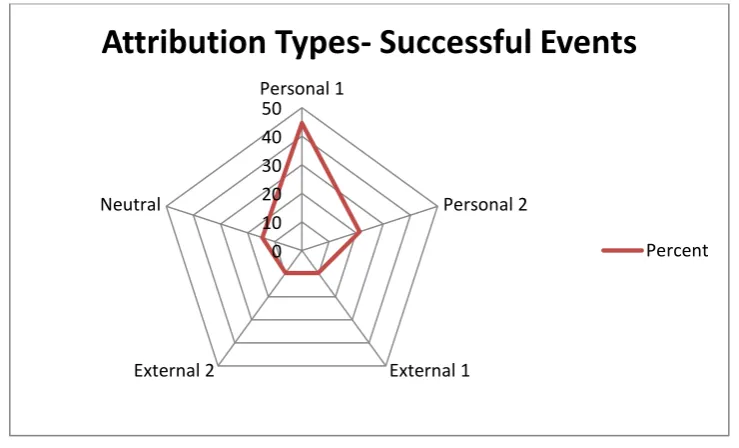
These findings indicate that the majority of participants attributed success to internal causes that they perceived as constant (see Figure 5). The second most common attribution type demonstrated a propensity to attribute internally, but to perceive the cause for success as unstable. A total of 19.42 response sets attributed causality externally, with 50 percent of these perceiving this cause to be stable into the future. Significantly, 14.56 percent of responses were recorded as neutral, which suggests that, for a portion of these beginning teachers, decision making with regard to locus, stability and/or controllability remained undetermined.
Figure 5 Attribution type distributions for successful events
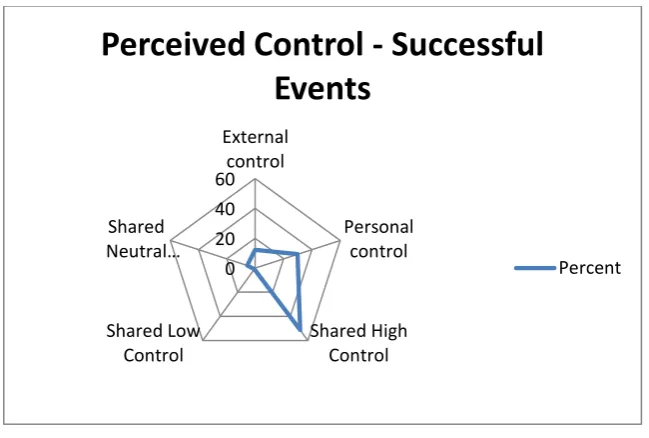
Through the analysis of personal and external control data, we found that participants reported a significant level of shared high control for successful experiences (see Figure 6). This was particularly significant where the locus of causality was perceived to be internal, calculated at 40 percent of responses (see Figure 6), compared to shared high control for externally attributed successes at 8.57 percent. Aside from shared control, participants were also more likely to express higher levels of personal control for successful causes than
external control. It is noteworthy that there were also a number of participants who perceived success to be the responsibility of, and within the control of, others in their context.
0 10 20 30 40 50 Personal 1
Personal 2
External 1 External 2
Neutral
Attribution Types- Successful Events
[image:13.595.112.482.373.597.2]13
Figure 6 Control distributions for successful events
7.4 Dimensional Attributions for Unsuccessful Causes
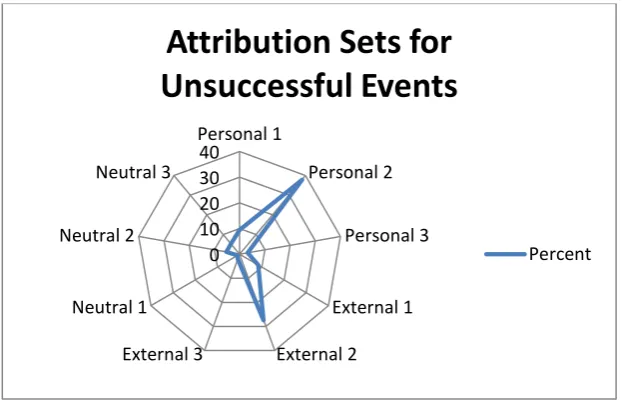
Analysis of attributional sets combining locus and stability dimensions for unsuccessful causes generated two dominant types. Significantly, participants were most likely to perceive high levels of personal responsibility for unsuccessful events, but to also see these causes as unstable (see Table 6). External causes, although less significantly represented, were also perceived to be likely to alter across time see (Figure 7). Attribution sets consisting of neutral attributions accounted for 16.84 percent of responses. Additionally, a total of 17.89 percent of responses indicated a perception that causes would be unlikely to change across time.
0 20 40 60
External control
Personal control
Shared High Control Shared Low
Control Shared Neutral…
Perceived Control - Successful
Events
14
Attribution Set
(LC Locus, S Stability)
Attribution Type and Description Frequency Count
Percent
LC Internal S High
Personal 1
I am responsible and it probably will not change
9 9.47
LC Internal S Low
Personal 2
I am responsible but the cause may change
36 37.9
LC Internal S Neutral
Personal 3
I am responsible but the cause may or may not change
3 3.16
LC External S High
External 1
Others are responsible and it probably won’t change
8 8.42
LC External S Low
External 2
Others are responsible but it could change
26 27.37
LC External S Neutral
External 3
Others are responsible and it may or may not change
2 2.11
LC Neutral S High
Neutral 1
It is nobody’s responsibility in particular and it probably won’t change 1 1.05 LC Neutral S Low Neutral 2
It is nobody’s responsibility in particular but it could change
5 5.26
LC External S Neutral
Neutral 3
It is nobody’s responsibility in particular and it may or may not change
[image:15.595.142.455.563.763.2]5 5.26
Table 5 Attribution sets (locus of causality and stability) for unsuccessful events
0 10 20 30 40 Personal 1 Personal 2 Personal 3 External 1 External 2 External 3 Neutral 1 Neutral 2 Neutral 3
Attribution Sets for
Unsuccessful Events
15
Figure 7 Attribution set distributions for unsuccessful events
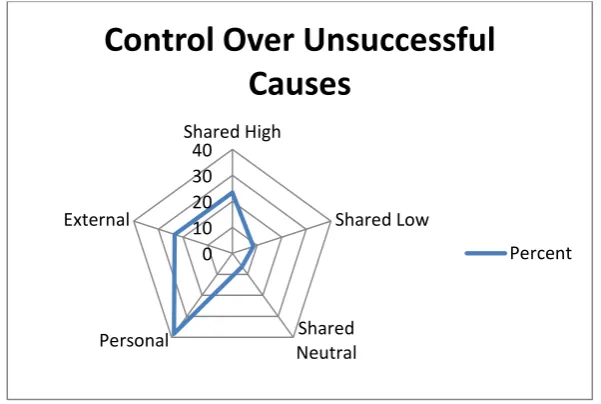
Analysis revealed that control over causes for unsuccessful experiences was mostly perceived as personal (see Figure 8), with highest perceptions of personal control where participants also held themselves to be responsible for the cause. Similarly, external causes were linked to external control. However, in 17.02 percent of the responses, despite an attribution of internal responsibility, participants also reported perceiving that others shared high levels of control with them over this cause (see Figure 8). For some participants, a neutral attribution of responsibility for unsuccessful experiences was compounded by a lack of definitive attribution for who had any control over the cause.
[image:16.595.147.448.260.462.2]
Figure 8 Control distributions for unsuccessful causes
8. Discussion
We now turn to a discussion of the findings and, in doing so, respond to the research question underpinning this study: How do beginning teachers attribute causality for the successful and unsuccessful events that they experience in their first year of teaching?
8.1 Successful Causes
The findings indicate that, when reflecting on a particular successful experience, these beginning teachers are likely to attribute responsibility for that success to their own practice. These findings could be indicative of self-serving bias, described by Harvey, Martinko and Gardner (2006) as the tendency for individuals to attribute success internally, and to attribute failure to external causes. Research has shown that such attributions assist individuals to maintain self-efficacy. In a study of attribution styles and teacher burnout, Fineburg (2010) found teachers perceiving an internal locus of causality for successes avoided burnout and loss of efficacy in the profession. We can thus deem such attributions to be positive in the lives of teachers as they face ongoing challenges.
0 10 20 30 40
Shared High
Shared Low
Shared Neutral Personal
External
Control Over Unsuccessful
Causes
16
Participants also display a tendency to associate internally attributed causes with high stability, or persistence, of the successful cause into the future. According to Fineburg (2010), such attributions also fall into a positive attribution style whereby there is an
optimistic expectation for the future. While facilitating a positive outlook for future practice, this tendency raises the question as to how such a reflection on action would lead to reflection for action. Where professional improvement is not deemed necessary, a view of continuous professional learning may be compromised.
Furthermore, participants’ reported perceptions of dual high control over causes for success presents as an interesting trend. Controllability creates for the individual a perception of influence over the cause. For these first-year teachers, shared high control indicates a perceived duality of power. An attribution of shared control could, according to Turner and Stets (2006), be a consequence of the individuals’ acknowledgement of power, or fair treatment, by others in the context. Where a less powerful individual feels that they have been treated fairly by a more powerful other, that individual may choose to attribute success to a disposition of their own, but also acknowledge the disposition of another (Turner & Stets, 2006). The question then arises over the impact of shared controllability on proactive reflection and planning for action by the first-year teacher.
8.2 Unsuccessful Causes
Participants also made internal attributions to both their own practice and inexperience in response to unsuccessful events. These are important findings in light of the fact that internal attributions for failure are categorised as negative, with a tendency to lower self-efficacy (Weiner, 1985). According to Schlenker, Weigold and Hallam (1990), concern over criticism may activate a more cautious approach when attributing responsibility for unsuccessful outcomes. This may indicate that first-year teachers are less comfortable attributing
responsibility to others in their context for unsuccessful outcomes, such as colleagues, leaders or mentors. The influence of power and positioning on the reflections of first-year teachers may in turn influence their attributions, despite the negative impact that this thinking may have on perceptions of self-efficacy.
It is important to note that this sample of first-year teachers, regardless of attributions of responsibility, perceived the cause for their unsuccessful experiences to be temporary and changeable. It could thus be reasonably anticipated that such an attribution style would facilitate these teachers’ positive reflection for action. However, such action planning for transformation (Toom et al., 2015) requires a perception of controllability. While the majority of participants reported a perception of high personal control, there was also a significant group that considered causes to be controlled either in part, or completely, by others in the context. Given that controllability influences agency to make change, it would be reasonable to expect that some first-year teachers may anticipate dependency upon others, either completely or in part, to action change.
8.3 Neutrality
17
individuals would avoid making decisions as to appropriate action. Across all attributions, participants demonstrated a tendency to include in part, or completely, neutral attributions for successful and, even more commonly, unsuccessful causes. In light of these concerns, these first-year teachers may be at risk of focusing solely on reflection on action, without “looking forward” (Toom et al., 2015) to engage in refection for action. Limited experience
(McIntyre, 1993) and concerns over the response of colleagues to attributions made by the beginning teachers (Schlenker et al., 1990; Turner & Stets, 2006) could play an influential role in attributional neutrality.
9. Limitations
We acknowledge several limitations pertaining to our presentation and discussion of this research study. First, for the purposes of this chapter, we report only on the first phase of our larger mixed methods study; a more comprehensive report, drawing from the full study, is forthcoming. Second, there are a number of areas that we point to in this chapter that require further exploration. These areas, which include neutral responses and the role of power and authority on attributional styles, will be further explored in Phase Two of the study, as well as in ensuing research projects. Third, given the space limitations of this chapter, we were unable to engage with additional literature, such as that of Daniels (2011), that could potentially add to and enrich our attributional framework. Again, this will be incorporated into our future work.
10. Conclusion
The findings from this study provide important insights into the ways in which first-year teachers reflect on their practice and make meaning from the experiences they encounter during their work. In this chapter, we reported on the first phase of a larger research study aiming to develop an understanding of the ways in which beginning teachers interact within their working contexts to develop their identity as professional learners during their first year of professional practice. The findings from an online survey used to elicit responses from a sample of first-year teachers working in independent school contexts across Queensland shed light on the ways in which participants reflected upon particular experiences and attributed causality for the associated outcomes.
In sum, this study found that the sample of first-year teachers displayed common patterns of attribution in response to perceived successful and unsuccessful events. Particular patterns representative of positive attribution styles included self-attribution for success and a perception of the instability of causes for unsuccessful experiences. The propensity for first-year teachers to self-attribute causality for unsuccessful events, and the neutrality of some attributional thinking, was evident within our findings. Notably, the extent to which causes for successful outcomes were perceived as constant and the perception of shared control over causes of both successful and unsuccessful events has raised questions as to the influence of such attributional thinking on the development of dispositions valuing ongoing professional growth and learning.
18
beginning teachers attribute causality for the highs and lows experienced during their first year of teaching could provide an important key to supporting beginning teachers’
19
References
Allen, J. (2006). Beginning teacher socialization in the workplace: some perspectives from the literature. In B. Walker-Gibbs & B. A. Knight (Eds.), Re-visioning research and
knowledge for the 21st century (pp. 101-115). Teneriffe, Qld: Post Pressed.
Australian Institute of Teaching and School Leadership (AITSL). (2011). Australian
Professional Standards for Teachers. Melbourne: Australian Institute for Teaching and School Leadership.
Australian Institute of Teaching and School Leadership (AITSL). (2012). Australian Charter
for the professionl Learning of Teachers and School Leaders. Melbourne: AITSL.
Bandura, A. (1989). Human agency in social cognitive theory. American Psychologist, 44(9), 1175-1184.
Bandura, A. (2001). Social cognitive theory: an agentic perspective. Annual Review of
Psychology, 52, 1-26.
Bandura, A. (2006). Toward a psychology of human agency. Perspectives on Psycholological
Science, 1(2), 164-180.
Beauchamp, C., & Thomas, L. (2011). New teachers' identity shifts at the boundary of
teacher education and initial practice. International Journal Of Educational Research, 50, 6-13.
Beijaard, D., Meijer, P., & Verloop, N. (2004). Reconsidering research on teachers' professional identity. Teaching and Teacher Education, 20, 107-128.
Boyer, W. (2006). Accentuate the positive: the relationship between positive explanatory style and academic achievemnet of prospective elementary teachers. Journal of
Research in Childhood Education, 21, 53-63.
Buchanan, J., Prescott, A., Schuck, S., Aubusson, P., Burke, P., & Louviere, J. (2013). Teacher retention and attrition: views of early career teachers. Australian Journal of
Teacher Education, 38(3), 112-129.
Bullough, R. J. (2005). The quest for identity in teaching and teacher education. In G. Hoban (Ed.), The Missing Links in Teacher Education Design (pp. 237-258). Dordrecht: Springer.
Cohen, J. (2010). Getting recognised: teachers negotiating professional identities as learners through talk. Teaching and Teacher Education, 26, 473-481.
Coleman, M. (2013). Emotion and the ultimate attribution error. Current Psychology, 32, 71-81.
Creswell, J. W., & Clark, V. (2011). Designing and Conducting Mixed Methods Research (2nd ed.). California: SAGE Publications.
Daniels, H. (2011). Analysing trajectories of professional learning in changing workplaces.
Culture Psychology, 17(3), 359-377.
Darling-Hammond, L., Wei, R., Andree, A., Richardson, N., & Orphanos, S. (2009). Professional Learning in the Learning Profession: A Status Report on Teacher
Development in the United States and Abroad. Stanford: National Staff Development Council.
Day, C., Kington, A., Stobart, G., & Sammons, P. (2006). The personal and professional selves of teachers: stable and unstable identities. British Educational Research
Journal, 32(4), 601- 616.
Devos, C., Dupriez, V., & Paquay, L. (2012). Does the social working environment predict beginning teachers' self-efficacy and feelings of depression? Teaching and Teacher
Education, 28, 206-217.
Dewey, J. (1933). How We Think: A Restatement of the Relation of Reflective Thinking to the
20
Doney, P. (2013). Fostering resilience: a necessary skill for teacher retention. Journal of
Science Teacher Education, 24, 645-664.
Eruat, M. (1995). Schon shock: a case for reframing reflection-in-action. Teachers and
Teaching: Theory and Practice, 1(1), 9-22.
Fineburg, A. (2010). Examining explanatory style's relationships to efficacy and burnout in
teachers. (Doctor of Philosophy Dissertation), The University of Alabama, Alabama.
Flores, M. A., & Day, C. (2006). Contexts which shape and reshape new teachers' identities: a multi-perspective study. Teaching and Teacher Education, 22(2), 219-232.
Gee, J. P. (1999). Identity as an Analytic Lens for Research in Education. Review of Research
in Education, 25 99-125.
Hammerness, K., Darling-Hammond, L., & Bransford, J. (2005). How teachers learn and develop. In L. Darling-Hammond & J. Bransford (Eds.), Preparing Teachers for a
Changing World: What Teachers Should Learn and be Able to Do (pp. 358 - 389).
San Francisco, CA: Wiley & Sons.
Hargreaves, A. (1995). Realities of Teaching. In L. W. Anderson (Ed.), Internationl
Encyclopedia of Teaching and Teacher Education (2nd ed., pp. 80-87). Oxford:
Elsevier Science Ltd.
Harvey, P., Martinko, M., & Gardner, W. (2006). Promoting authentic behaviour in
organisations: an attributional perspective. Journal of Leadership and Organisational
Studies, 12(3), 3-11.
Herbert, C. (2015). Knowing and/or experiencing: a critical examination of the reflective models of John Dewey and Donald Schon. reflective Practice, 16(3), 361-371. Huisman, S., Singer, N., & Catapano, S. (2010). Resiliency to success: supporting novice
urban teachers. Teacher Development, 14(4), 483-499.
Ingersoll, R. M. (2001). Teacher turnover and shortages: an organisational analysis. American
Educational Research Journal, 38(3), 499-534.
Jones, J. L., & Jones, K. A. (2013). Teaching reflective practice: implementation in the teacher education setting. The Teacher Educator, 48, 73-85.
Keogh, J., Garvis, S., Pendergast, D., & Diamond, P. (2012). Self-determination: using agency, efficacy and resilience (AER) to counter novice teachers' experiences of intensification. Australian Journal of Teacher Education, 37(8), 46-65.
Larsen, E., & Allen, J. M. (2014). The novice literacy coach: Exploring motivation and
persistence in the face of challenge. Paper presented at the AARE, Brisbane.
Liu, L., & Zhang, Y. (2014). Enhancing teachers' professional development through reflective teaching. Theory and Practice in Language Studies, 4(11), 2396-2401. Lovett, S., & Cameron, M. (2011). Schools as professional learning communities for early
career teachers: how do early career teachers rate them? Teacher Development, 15(1), 87-104.
Martinez, A., Martinko, M., & Ferris, G. R. (2012). Fuzzy attribution styles. Journal of
Leadership and Organisational Studies, 19(1), 17-24.
McAuley, E., Duncan, T., & Russell, D. (1992). Measuring causal attributions: the revised Causal Dimension Scale (CDSII). Personality and Social Psychology Bulletin, 18, 566-573.
McIntyre, D. (1993). Conceptualising Reflection in Teacher Development. In J. Calderhead & P. Gates (Eds.), Theory, Theorising and Reflection in Initial Teacher Education (pp. 39-52). London: Falmer Press.
Miles, M. B., Huberman, A. M., & Saldana, J. (2014). Qualitative Data Analysis: A Methods
Sourcebook (3rd ed.). California: SAGE Publications.
21
Perry, R., Daniels, L., & Haynes, T. (2008). Attributional (explanatory) thinking about failure in new achievement settings. European Journal of Pscychology of Education, 23(4), 459-475.
Phillips, P. (2008). Professional development as a critical component of continuing teacher quality. Australian Journal of Teacher Education, 33(1), 1-9.
Samaras, A. P., & Freese, A. R. (2006). Self-study of Teaching Practices Primer. New York: Peter Lang Publishing.
Schlenker, B. R., Weigold, M. F., & Hallam, J. R. (1990). Self-serving attributions in social context: effects of self-esteem and social pressure. Journal of Personality and Social
Psychology, 58(855-863).
Schon, D. (1983). The Reflective Practitioner. New York: Basic Books.
Teacher Education Ministerial Advisory Group (TEMAG). (2014). Action Now: Classroom Ready Teachers. Canberra: Department of Education.
Thomas, L., & Beauchamp, C. (2007). Learning to live well as teachers in a changing world: insights into the devlopment of a professional identity in teacher education. The
Journal of Educational Thought, 41(3), 229-243.
Toom, A., Husu, J., & Patrikainen, S. (2015). Student teachers' patterns of reflection in the context of teaching practice. European Journal of Teacher Education, 38(3), 320-340. Turner, J. H., & Stets, J. E. (2006). Sociological theories of human emotions. Annual Review
of Sociology, 32, 25-52.
United Kingdom Department of Education. (2011). Teachers' Standards: Guidance for
school leaders, school staff and governing bodies. London: Author.
Urzua, A., & Vasquez, C. (2008). Reflection and professional identity in teachers' future-oriented discourse. Teaching and Teacher Education, 24, 1935-1946.
Walkington, J. (2005). Becoming a teacher: Encouraging development of teacher identity through reflective practice. Asia-Pacific Journal of Teacher Education, 33(1), 53-64. Weiner, B. (1972). Theories of Motivation: From Mechanism to Cognition. Chicago: Rand
McNally.
Weiner, B. (1985). An attributional theory of achievement motivation and emotion.
Psychological Review, 92, 548-573.
Weiner, B. (1986). An Attributional Theory of Motivation and Emotion. New York: Springer-Verlag.
Weiner, B. (1995). Judgments of Responsibility: A Foundation for a Theory of Social
Conduct. New York: Guilford.
Weiner, B. (2010). The development of an attribution based theory of motivation: a history of ideas. Educational Psychologist, 45(1), 28-36.
Zuljan, V., Zuljan, D., & Pavlin, S. (2011). Towards mprovements in teachers' professional development through the reflective learning paradigm. H.U Journal of Education, 41, 485-497.